
In Scotland, landowners aren’t required to maintain a right of way, but they must not obstruct it and have a duty of care to people on their land. The “right to responsible access” means people aren’t necessarily restricted to paths and can walk across uncropped fields where no path exists.
Farmer’s Weekly
It is something of a rush in the morning to get the blog all finished, breakfast eaten and stretching done before leaving at 8:15 to catch the bus back north again. My truly lovely Airbnb host June, however, was just back from walking Peggy as I was getting ready to leave, and she gave me a lift out to the bus stop on her way to work. As the bus carried me north, with half an eye on the view, I proofread yesterday’s blog which I had put up in such a hurry this morning.
The bus driver let me off at Scoughall Farm, marked by a gigantic, hard-to-miss sign created out of an old rusty anchor.

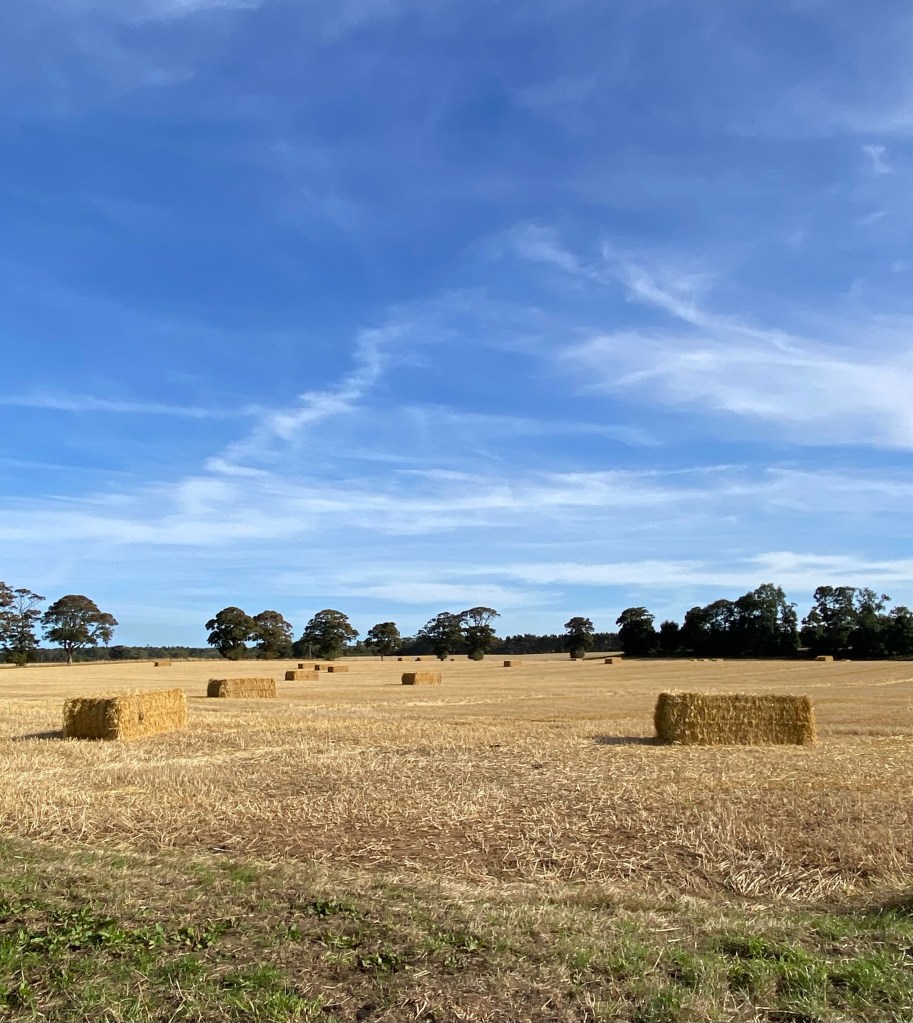
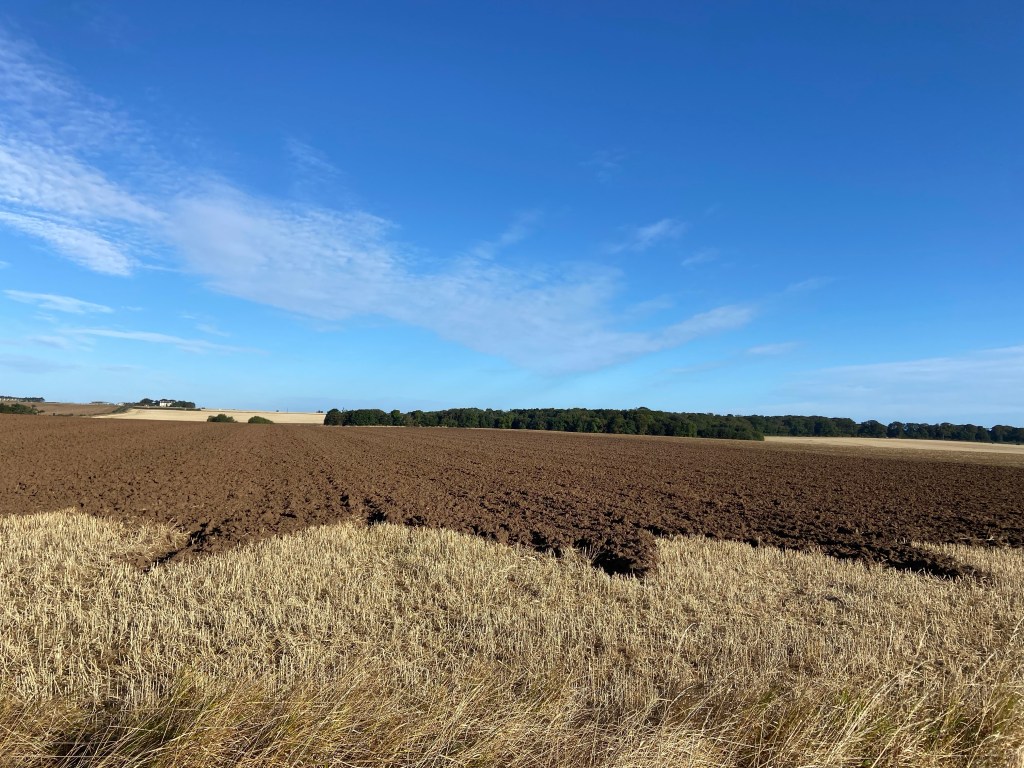
I walked from the roadhead down towards the sea, easing my feet into their boots and stretching out the muscles that I had not had time to warm up this morning. Rookie error — I hoped I was not going to pull something. I did not make the error however of not enjoying the stripes made by fields, and sea, and sky, and the patterns made by freshly-turned sandy arable soil and the golden corn stalks left behind as the tractor turned, leaving a headland at the field edge.
Two sizable flocks of tiny birds blew past me along the sparse hawthorn hedge and into the cornfield, too fast for me to catch them with the binoculars, but Merlin told me that they were linnets and meadow pipits. A flock of linnets! What a way to be greeted in the morning! I watched half a flock of greylag geese take off, honking, from where they had been gleaning in the gathered cornfields and kept my eye out for deer; I had caught sight of some from the bus, but there weren’t any more that I could see.
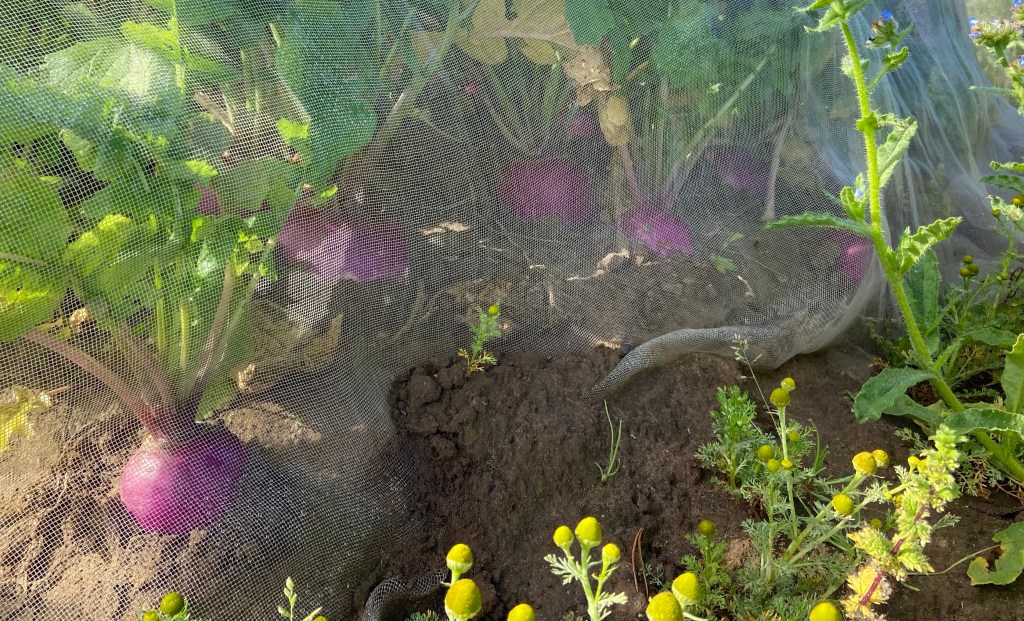
I had been heading towards the sea, but now the farm track turned right parallel to it, and either side were long rows of netted crops. Underneath it were beautiful purple turnips, unblemished, perhaps being protected from cabbage white butterflies, or perhaps from the mad flocks of noisy geese that were currently rioting on the other side of the stand of Scots pines. It sounded as though there were hundreds of them. I think I would rather have perfect organic turnips grown under (hopefully reusable) plastic mesh, than open-air perfect cabbages sprayed with chemicals so that they are untouched by butterflies and pigeons. That having been said, I would rather not eat a turnip at all.
The next field had been sown with thousands of leeks — we have about 18 planted at home, the first of which should be ready to harvest soon. Ours are Musselburgh! A local variety which we have been planting for years, and I had never thought about the place they came from. Such are the absorbing thoughts of a solo walker.
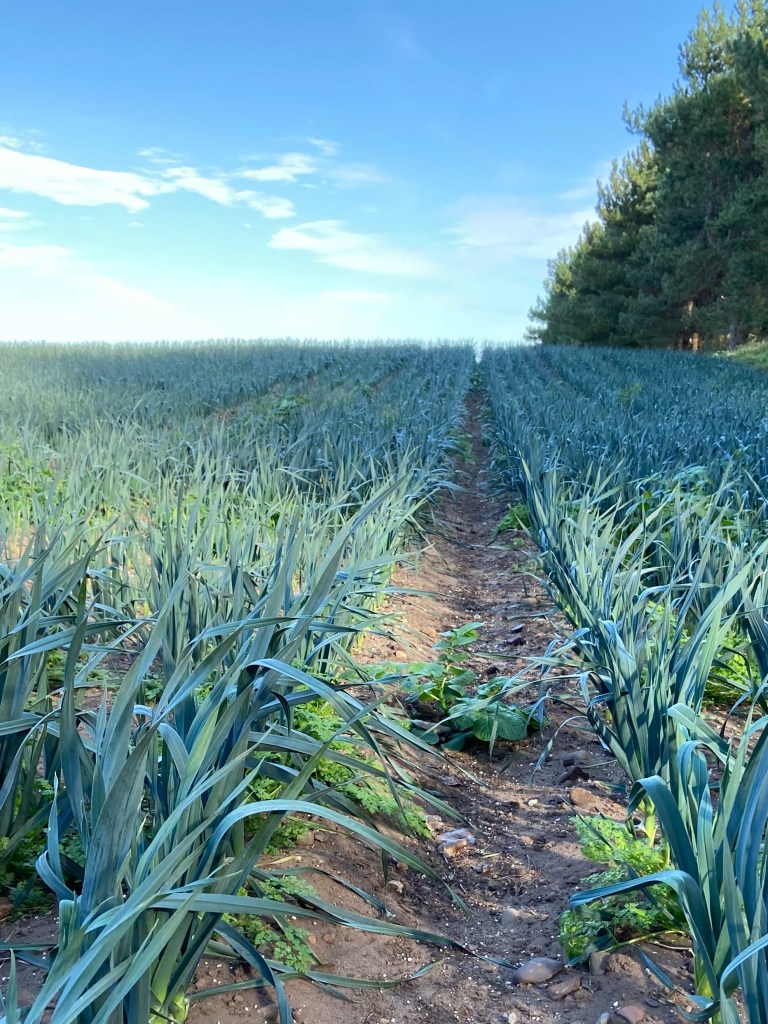
The nearest way down to Peffer Sands seemed to pass through a small and very discreet holiday village of beach cabins, but signs very clearly stated that there was no beach access apart from for guests, so I continued down the farm track, past a series of huge chicken sheds: a flock with an altogether different life experience to the free-flying, plundering geese.
More unfriendly signs warned that cars parked here may be damaged if towed and again forbade access to the beach. Being a good girl, I dutifully trudged on along what now was signed to be a public path (access to which there was none except through private land — I am very hazy about Scottish access laws), until I judged I was far enough away from Harvest Moon Holidays to pose no danger to the privacy of their guests. I climbed up and over the dunes, and, after an hour’s walk, was at last in sight of the sea.
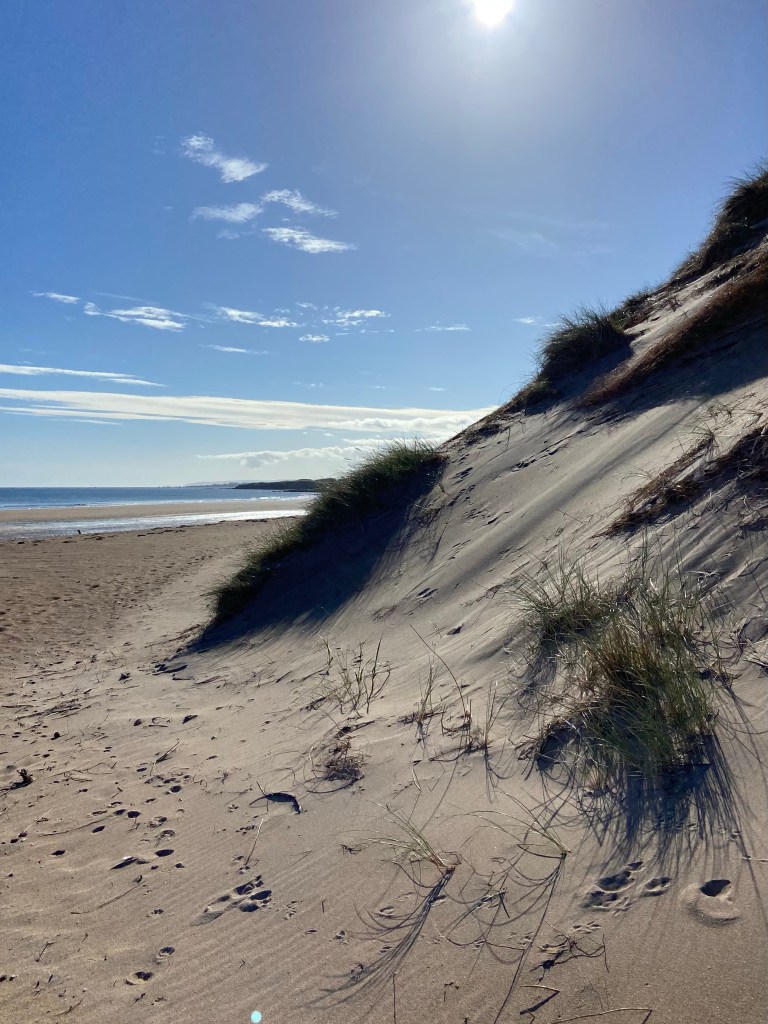
Determined to make up for yesterday’s routemarch past all the beaches, I sat down on a driftwood log which seemed had been put here for that purpose by the sea.

The sun was glorious and I decided to get my legs out. As I was opening my rucksack to retrieve my shorts, Eleanor came over the same dune path with her seven-year-old rescue labrador, Bane.

This was the first day she had felt well enough to come out after returning from what should have been an exciting Alaskan cruise on which both she and her husband had caught Covid, and felt rotten with it. I hope the sea completes your recovery, Eleanor! She told me that although she wasn’t aware the beach was private around the Harvest Moon cabins, apparently there are patches of quicksand in which a friend of hers on a horse had got into some difficulty a while back. This is not a hazard I had ever considered before!
Further along, I met Gillian, another local blessed with an exceptional beach right on her doorstep. She said she would love to get out to do a long walk on her own but didn’t have the confidence. It’s not a scary as you think, Gillian! The only danger I have encountered is cows (although who knows, I could always get swallowed up by Eleanor’s quicksand). Gillian was of the opinion that golfers might provide more of a problem round here.
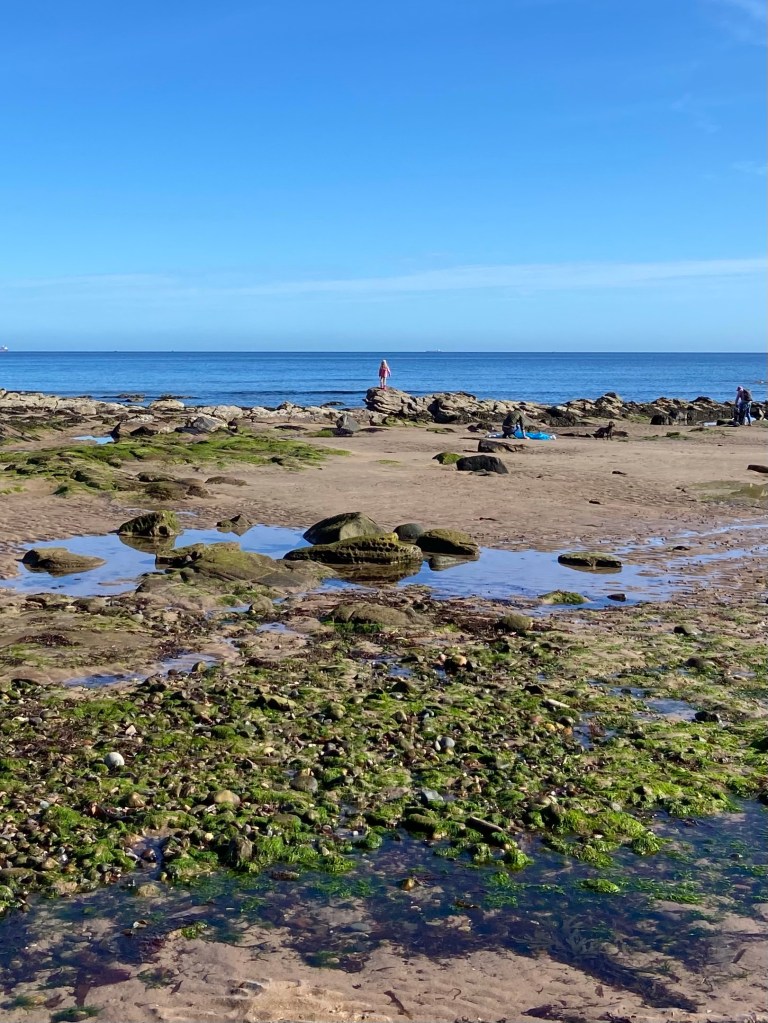
At the end of the beach I had to faff around a little locating the path up to the cliff top rather than the path to the car park. The beach here was a jumble of smooth rocks and warm, shallow pools, kelp deposited at the high tideline, and green sea lettuce still damp over all the rocks around the tide pools. For the first time I could smell that scent of childhood beach holidays, rockpooling for hours on the seashore.
I turned inland now into Links Wood (yet another golf course!) immediately, the character of the birdsong changed, the oystercatchers and gulls being replaced by a chorus of robins, chaffinches and chiffchaff, with a song thrush out-singing all. This part of the wood was a single-species plantation of sycamores, and, looking up, I saw the phenomenon of crown shyness, a ‘patchwork of green islands separated by rivers of empty space’. It is believed that each tree maintains its separate space to protect itself from pests, diseases and storms; ‘from below, this sometimes creates a beguiling, seemingly backlit geometric pattern against the sky’.

The sycamore soon gave away to a pine plantation, its undergrowth home to a pair of deer moving swiftly and silently into the rhododendrons as I rounded a turn in the path. Above me, the canopy was an aural mass of goldcrest, each tree the closely-guarded territory of a single bird loudly advertising the fact. It was an avian version of Harvest Moon Holidays.

I couldn’t see any through my binoculars, but did watch a tree creeper working. Its plumage was spotted like a roe deer, the tail unexpectedly long, and a close-up photograph (of which my camera is not capable) would reveal the extraordinarily long claws which enable it to scuttle so effortlessly up and down the branches.
The next creature I encountered in the Wood was a simply enormous, mediaeval beast. Naemie and Darrell explained that Archie was a deerhound, slimmer than an Irish wolfhound, a breed that had died out when wolves disappeared from Ireland, and was reconstructed in Victorian times by crossing deerhounds with mastiffs.
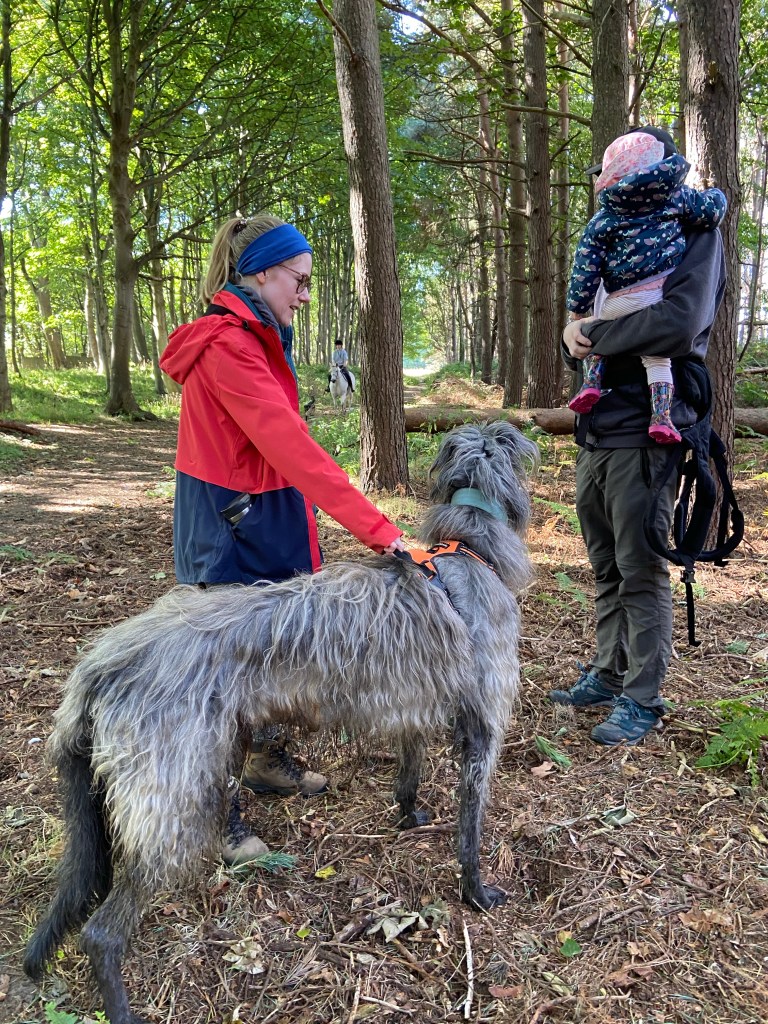
Bréagha (meaning ‘fair’) chipped in to the discussion. She had a particularly jaunty hat on, and was very fair, as well as very chatty.
I was skirting the estuary of one of the rivers Tyne now (a mini version of the great river that this coastal walk will hopefully be extended to end at, some time in the future) following the path as it snaked its way around the inlets and loops of the river, around the edge of reed beds and saltmarsh.
A fleeting view suddenly opened up as I briefly popped out of Links Wood and into Fir Links Wood, a beech plantation followed by more Scots pines. The light is so different amongst beaches — golden yellow,
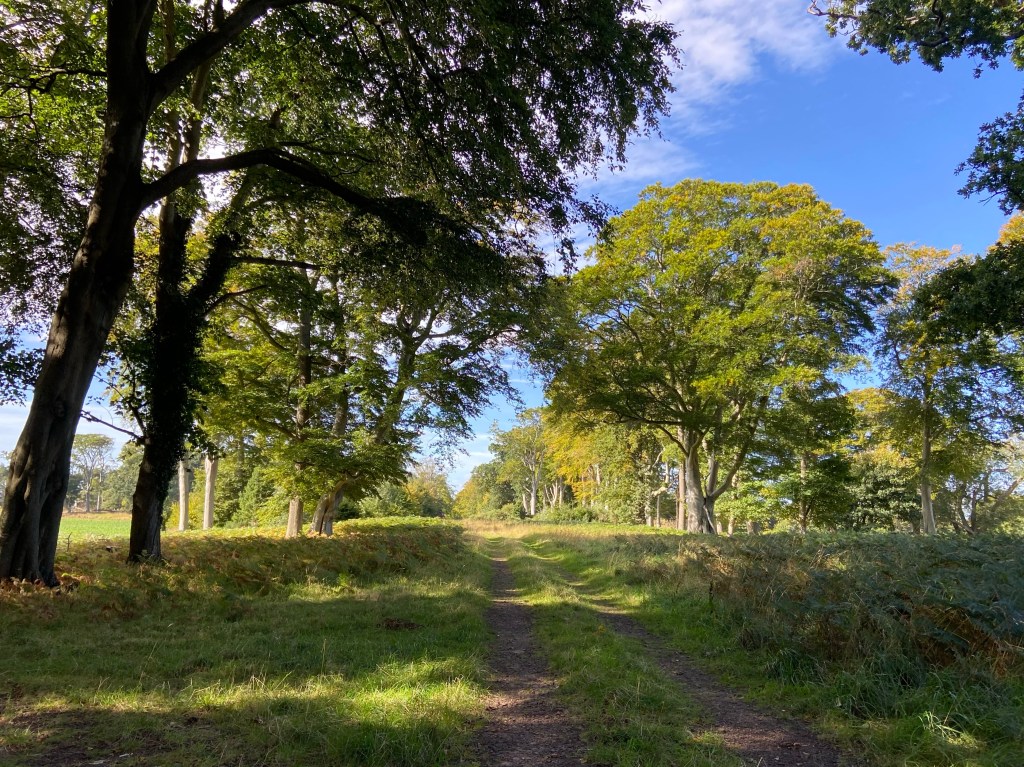
instead of glowing red. It makes so much sense for squirrels to be red here (rather than grey — although greys were all I saw today). Here I was luckier with the binoculars, watching a tiny goldcrest hanging seemingly precariously from the flimsy needles at the tip of a pine twig.

Further on, out in a more open parkland, ancient beach trees rose gracefully up out of the bracken. The hollow trunks of stricken giants provided nutrients for the next generation, growing inside them, protected from winds as they recycle the nutrients from the slowly rotting wood.

It was a world away from the coast, but I would join it again soon enough.
Famous last thoughts. I reached the point where the wood met a tight loop of the river, and it was not at all clear how the path on the map would work. It seemed to involve hacking through farmland — firstly a field of heavy cows and then over a footbridge that I could see in the distance. Through my binoculars, I could see a variety of farm gates, but they didn’t look the kind I was supposed to be going through — heavily padlocked, so to be climbed over rather than opened. So near, and yet so far.
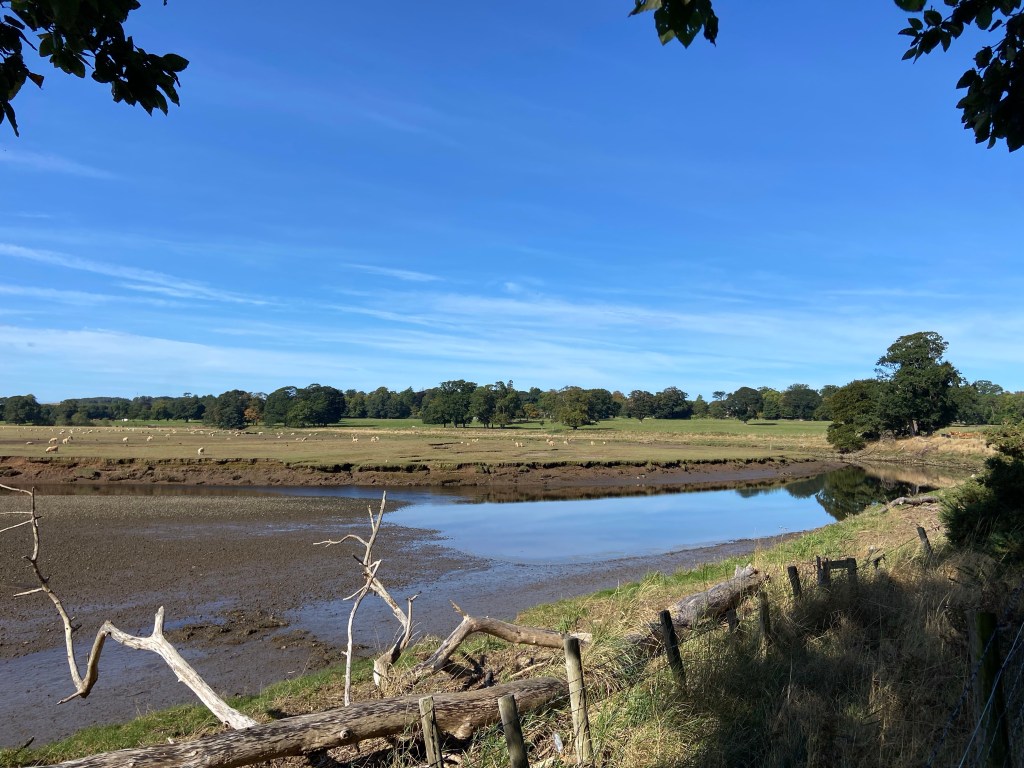
I took a moment to have a look at the map. It was clear I was going to have to retrace my steps, and there were various tracks that cut across the parkland that clearly belong to the enormous Tyninghame House. I realised I don’t know very much about Scotland access rights, apart from the fact that they exist. But to what extent? I didn’t think that right to roam extends to wandering about across Lairds’ country house estates. I have been so used to following signposts for public rights of way in England, it didn’t occur to me that I was going to have to negotiate a different system here. Totally my fault for having come off the John Muir Way.
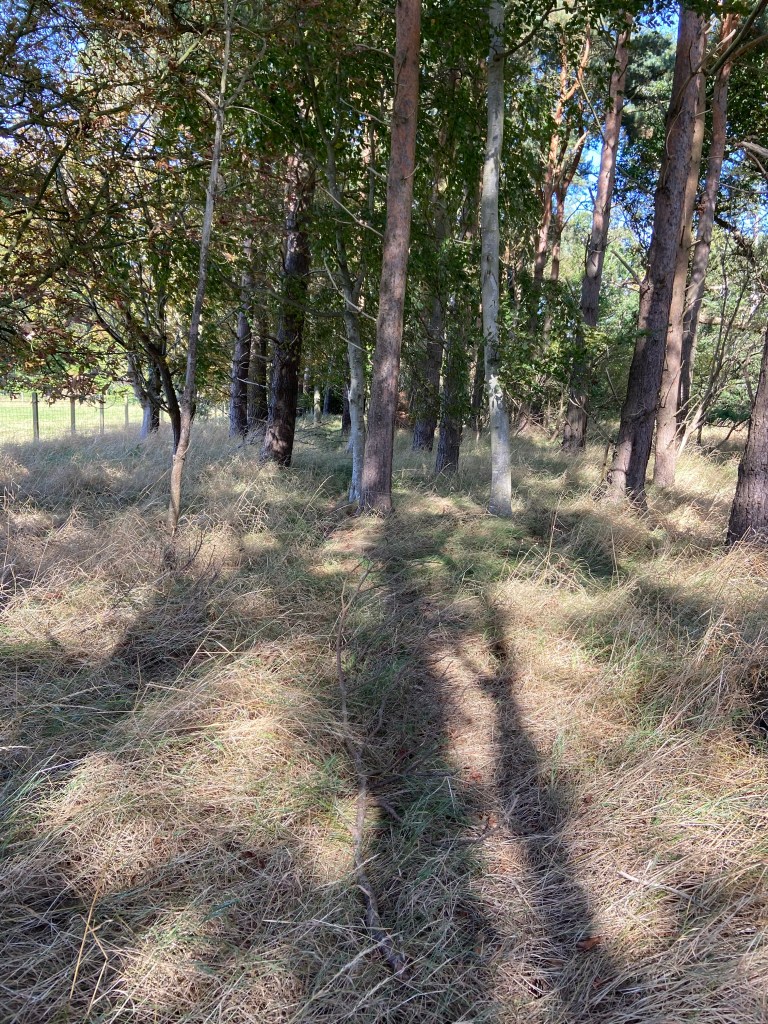
Nothing for it but to retrace my steps through the woods, but this time in a less than positive frame of mind, this time thinking about deer ticks and angry landholders with guns. I thrashed about a bit off the main tracks, on paths which existed on the map but not really on the ground, especially on something called “the Avenue” on the map, which was nothing of the sort.
Eventually I reached the car park that I had been so close to an hour before. To rejoin the John Muir Way (why oh why don’t I do what my friend Jane does in her solo walks, and follow a named Path?) I simply had to walk down Limetree Walk, then turn left, and walk down the A-road.
Limetree Walk (Limetree Slog, more like) was a dead straight road more than 2 km long, and the A-road at its far end was a dead straight road more than 3 km long. I was so grateful that the laird had seen been careful to mow the grass at the side of the road so I didn’t have to pound the tarmac with feet that still haven’t got used to these long days walking.
I passed a long low stone farm building and wondered why it was derelict. It would make the most glorious home.

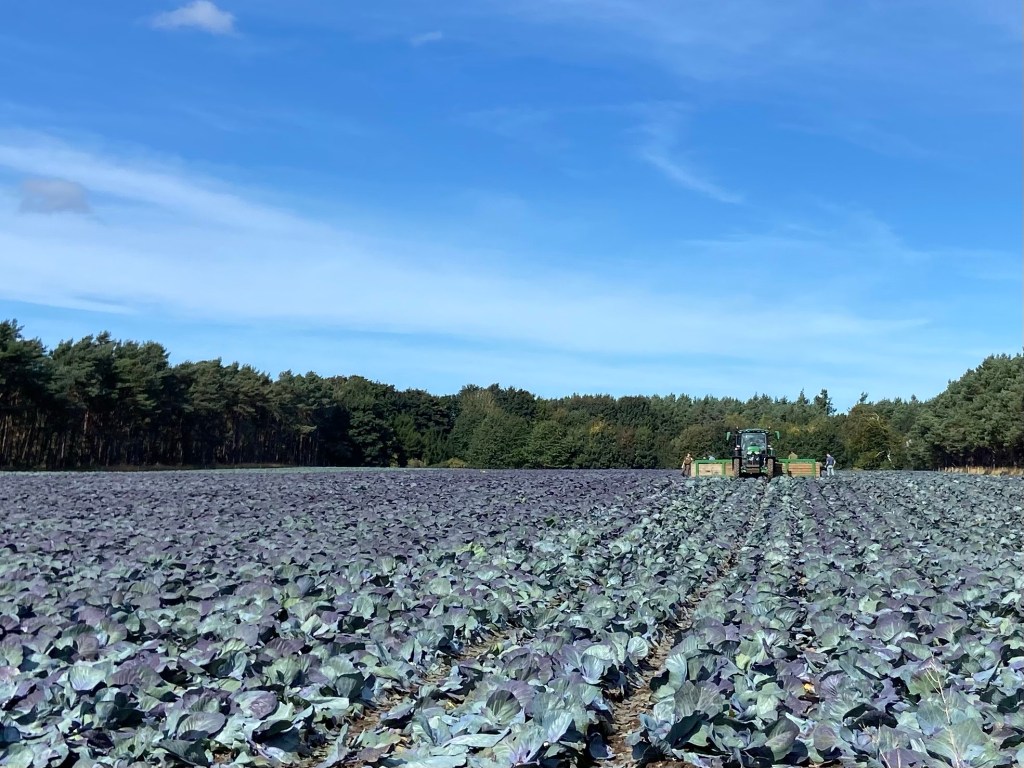
Further along a crew of farmworkers were engaged in the thankless task of picking cabbages by hand. The field was vast, with was a portaloo in the corner of the field for the benefit of the workers who are in the field for days on end. Despite not enjoying this long hard slog, I would rather do this than spend all day bending down, picking a cabbage, straightening up, and tossing it into a hopper. I once spent a summer picking strawberries, and another picking sweetcorn. I don’t think my spine could cope with it so easily now.
I was very circumspect walking along the road. Although you could see a long way down, there were several blind summits, and not much of a verge to hop onto when cars raced past.

Google Maps told me that in Tyninghame there was a café, and I fully intended to find a table, take my boots off, and sit for a long time eating something nice. The Country Café fit the bill perfectly.
They were very shortstaffed there, poor things, and were having something of an epic day themselves. In their confusion they brought a small cheese muffin and five glasses of water to my table (?). They had run out of the sausage roll platter I ordered, and then brought me a red pepper quiche instead of the salmon I had asked for. It didn’t matter: it was delicious, and the chance to sit quietly in the corner was appreciated even more.

I sat there and rested for about an hour and was pathetically grateful to take my boots off, gather my thoughts together and mentally prepare for the 11 km I still had left to do.
A kilometre or so down the road I joined the John Muir Way again. It felt like meeting an old friend. Almost immediately it improved in quality underfoot, firstly a quiet country backroad with lovely soft moss and weeds running down the middle, and then a sandy path when we finally got back to the estuary. I stood at the place I should have reached from the other side of the estuary: 2 km of path taking about 23 minutes to walk. I calculated that my detour had been over 8 km in total, which had distinctly lengthened the day.

It was what it was. It was high tide now, and the salt marsh had completely filled up. The water was an incredible striking blue in the afternoon sun, and the saltmarsh vegetation was a contrasting mixture of golden and red.
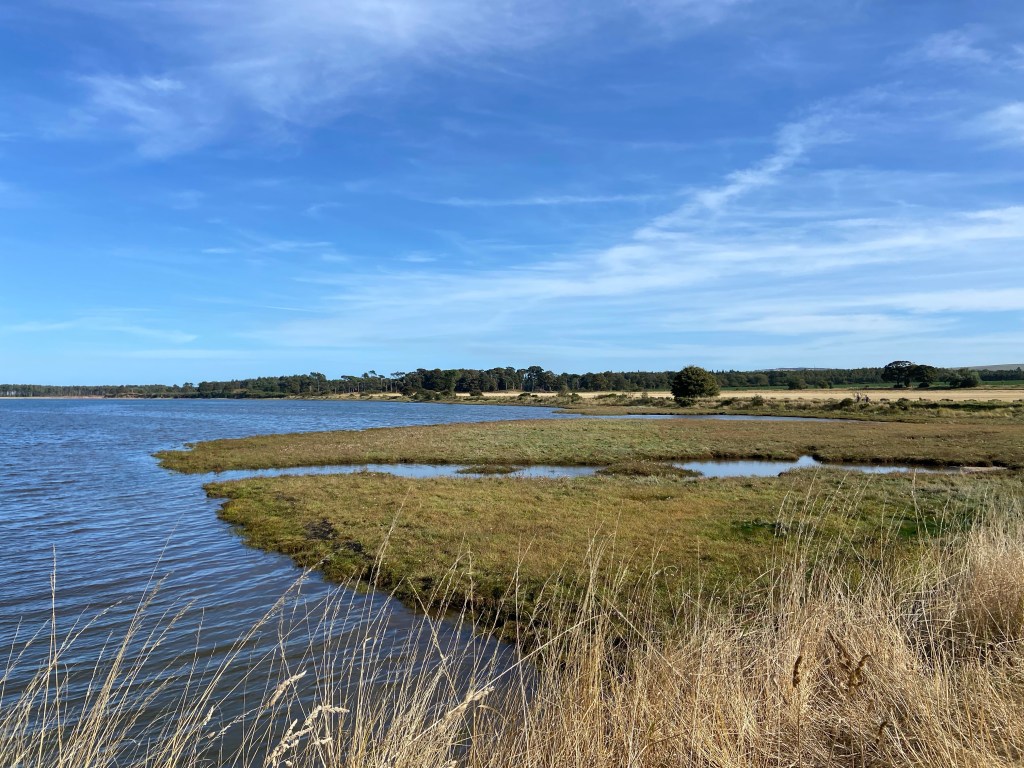
The water lapped gently a few feet away. Despite my tiredness and footsoreness, it was deeply peaceful, and deeply restorative.
Eventually, the long path down the estuary ended, or rather, joined the maze of footpaths through a country park. Families were playing in the water,
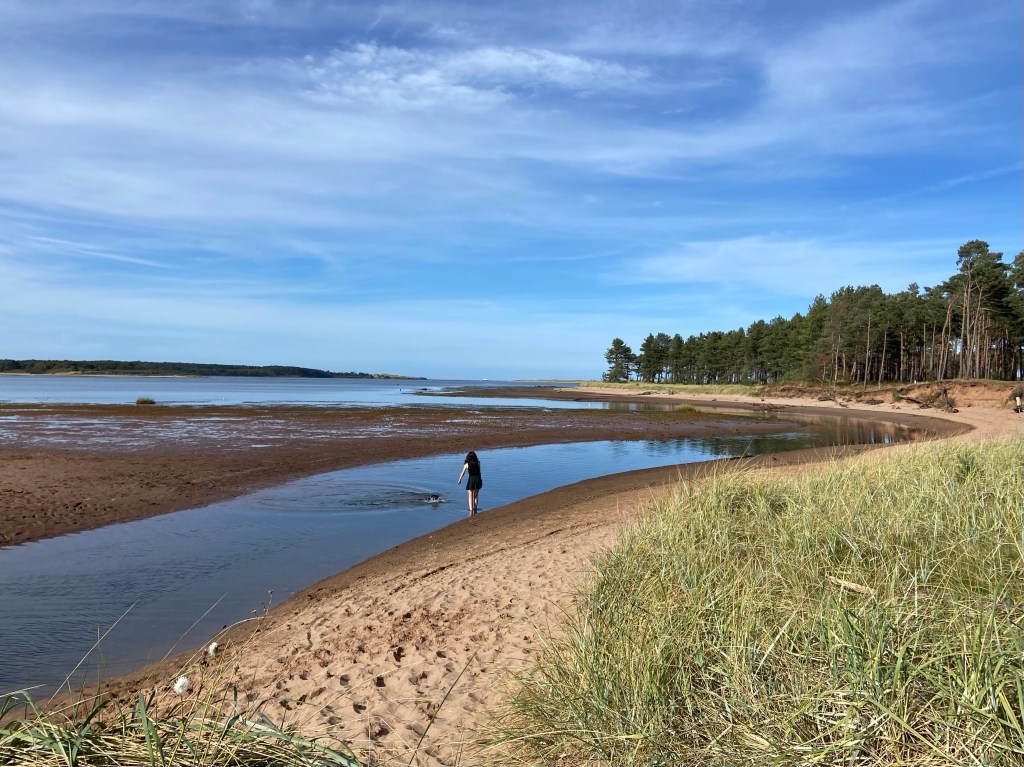
and the path passed the ostrich and alpaca enclosure at a small wildlife park. It all felt very incongruous.
I was stopping fairly frequently now to rest my feet, knowing that the end was achievable and not, thankfully, having any pressure of time. Two swans had raised their family of cygnets almost to adulthood and they were all foraging independently in the weed at the bottom of one of the little streams feeding the estuary under the footbridge taking me over it and into town.

The edge of Dunbar is made up of the obligatory golf course, around which the coastal path wound narrowly. For a while now I had been listening to my audiobook and it was a powerful help in taking my mind off the physical. I stopped wherever possible to sit on a bench, take in the view and take the weight off my feet.

Bass Rock seemed incredibly close. Was it really a whole day’s walk away? It didn’t look any way near it.

The sea had that lovely evening calmness where the wind dies down and everything bathes in the golden light for as long as it lasts. The rock on which Dunbar is built is a striking brick red, and the cliffs and the mesa-like formations deserved to be admired.

Today had one final surprise for me. A knot of people had gathered at the top of one of the cliffs with binoculars and cameras, all looking intently at a thorn bush quite close to the path on the cliff edge.
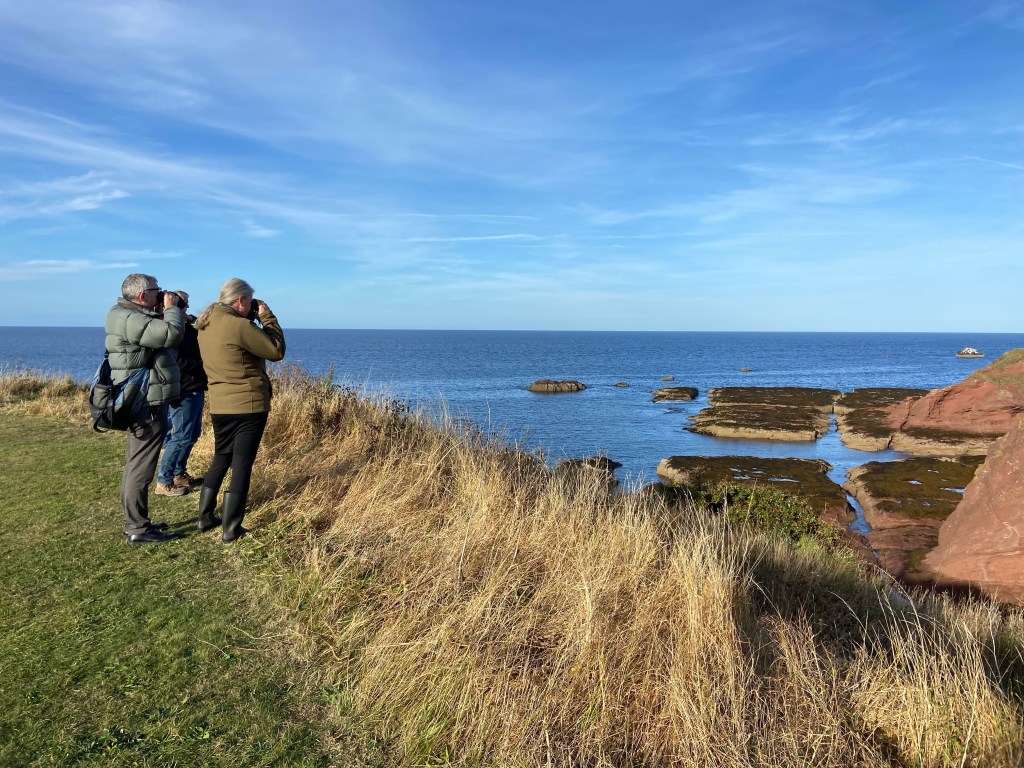
I asked what it was. A couple told me that it was a Steppe Grey Shrike, a native of Afghanistan, Kazakhstan, and China, an incredibly rare visitor to the British Isles. I stood with them training my binoculars onto the bush, but I couldn’t see it, although the man next door to me was recording its call on his Merlin app. Proof positive it was in there! I went round to the other side of the cliff, however, and could clearly see the bird with my binoculars, although too far away to take a photograph. If I hadn’t been so tired, I would definitely have stayed longer.
The final flourish of the John Muir Way route is designed to be the ruined castle on the southern tip of the cliffs, the ancient ‘dyn barr’, or ‘fort of the point’ first defended by the Brythonic Votadini tribe even before the Berenician kings held it in the 7th century.

Then the path turned into the town itself, and in a few short minutes I was standing in front of the John Muir museum, closed of course this late in the day, but a moving experience none of the less, to stand in front of his birthplace.
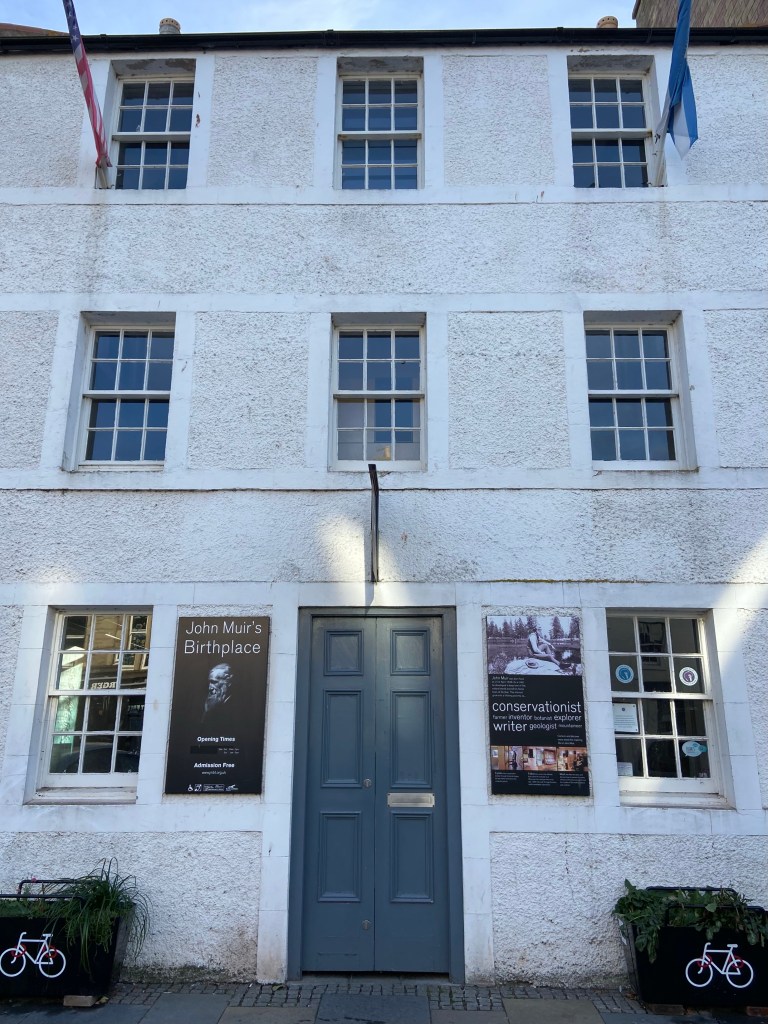
I felt a stream of memories connecting the walk of the last few days to the section of the path near the Falkirk Wheel and the canals that I had travelled with Stephen, and a profound sense of respect for the man who inspired the conservation movement in America and in Britain.

There were still a couple of kilometres to go to stock up on food and then walk back to my AirBnB. The audiobook got me through it, and my tally at the end was a grand total of 26.45km — 16.4 miles. My feet felt every inch of them!
But it’s always worth it. Muir was a passionate advocate of the power of spending time out in the natural world, in a kind of birthright to roam.
Walk away quietly in any direction and taste the freedom of the mountaineer. Camp out among the grasses and gentians of glacial meadows, in craggy garden nooks full of nature’s darlings. Climb the mountains and get their good tidings, Nature’s peace will flow into you as sunshine flows into trees. The winds will blow their own freshness into you and the storms their energy, while cares will drop off like autumn leaves. As age comes on, one source of enjoyment after another is closed, but nature’s sources never fail.
John Muir, Our National Parks
🏴
 Walking The Landscape
Sophie, I felt your foot pain through reading this. I would also rather not have turnips but leeks…… that’s a different matter!
LikeLiked by 1 person
😆
LikeLike
Very excited for the shout out, less excited about all the retrudging. The worst type. But excellent shrikes and excellent, if wrong quiche. Hope you are able to replenish and rest up.
LikeLiked by 1 person
♥️
LikeLike
Thank you, as always, for the inspiration, Sophie. I love the Muir quote and your beautiful bird musings.
LikeLiked by 1 person
Awwww
LikeLike