Switzerland is a country […] where many things end
F Scott Fitzgerald
I prioritised sleep last night, writing most of yesterday‘s blog this morning, and consequently I made a very late start. I came down to the sight of perhaps the most sumptuous breakfast of the journey so far, not one but two tables spread with a luxurious assortment of delicacies, from which it was hard to choose.
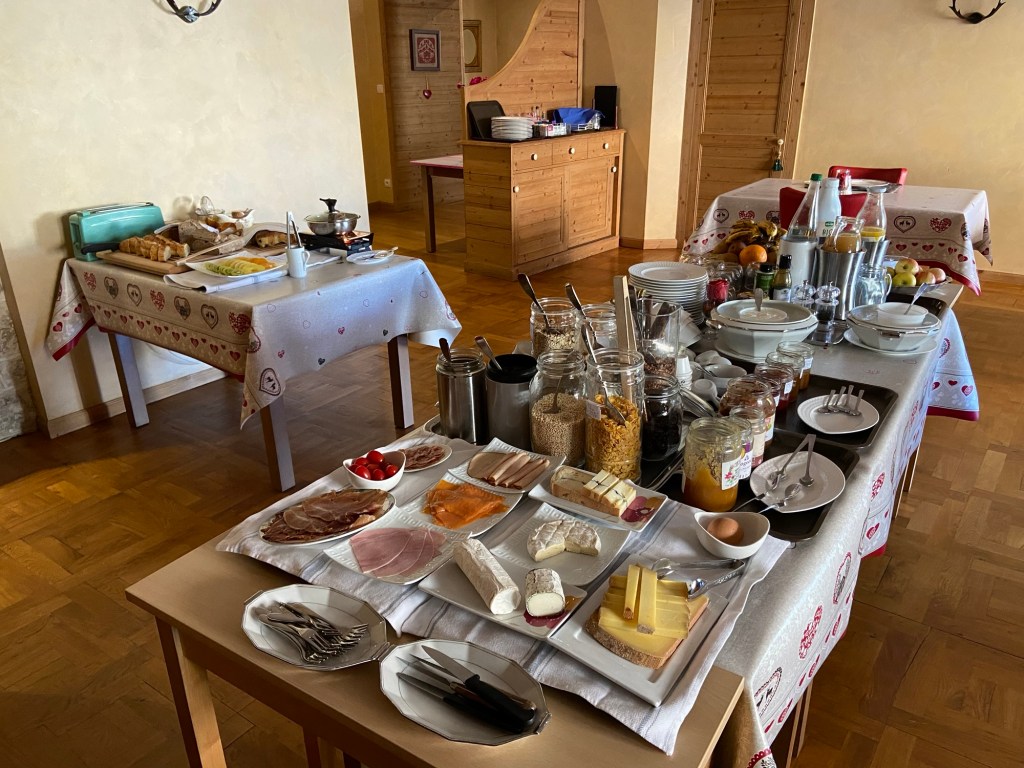
Eventually, I selected some dropscones which I ate with crème fraîche, prunes and confiture de marrons, followed by a grand café and a huge puffy croissant, light as a feather. After that I had no room to make any inroads into the breads, cereals, meats, cheeses or smoked salmon, but I did make up a sandwich for later.
As I was putting on my shoes to check out, Margarida took me to the back garden. ‘You must see the view before you leave,’ she insisted. And it would have been a terrible thing to have missed it. She swept her arm out into the view. ‘Switzerland!’ she announced. And we waved at the family on the terrace below, stopping to take their breakfast after a much earlier start than me.

I just couldn’t wait any longer to get amongst it. I gave Margarida the last of very many hugs, and I set off.

Despite the view, it was eyes down for the serious descent to the road below.
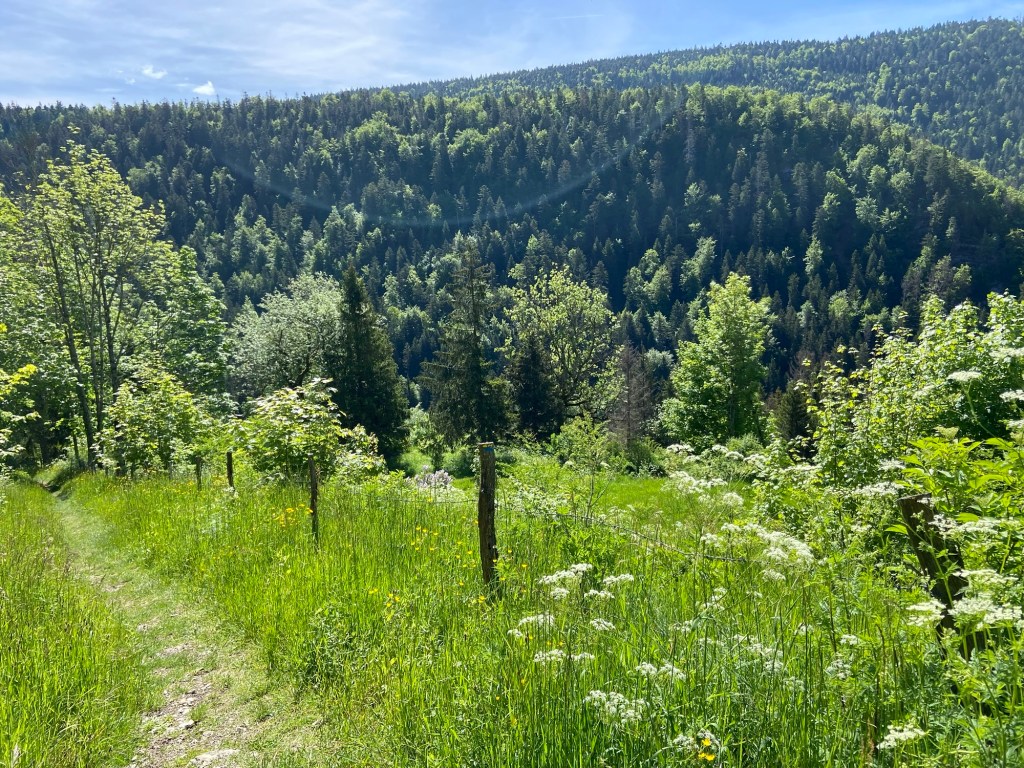
The grass was full of chirping crickets, and after the days of rain and showers, the butterflies were out once more. I made sure not to slip on the thyme-covered gravel, as it would have been a case of so near and yet so far were I to lose my footing now.

The path reached the road by the oldest building in the Haut Doubs, the Romanesque chapel of the early Christian Saint Maurice. Its squat exterior bulk was built in the 12th century over a 9th-century Carolingian crypt that still exists under the choir;

— I saw a trap door in the floor by the altar, but didn’t investigate. The interior space was cool and plain,
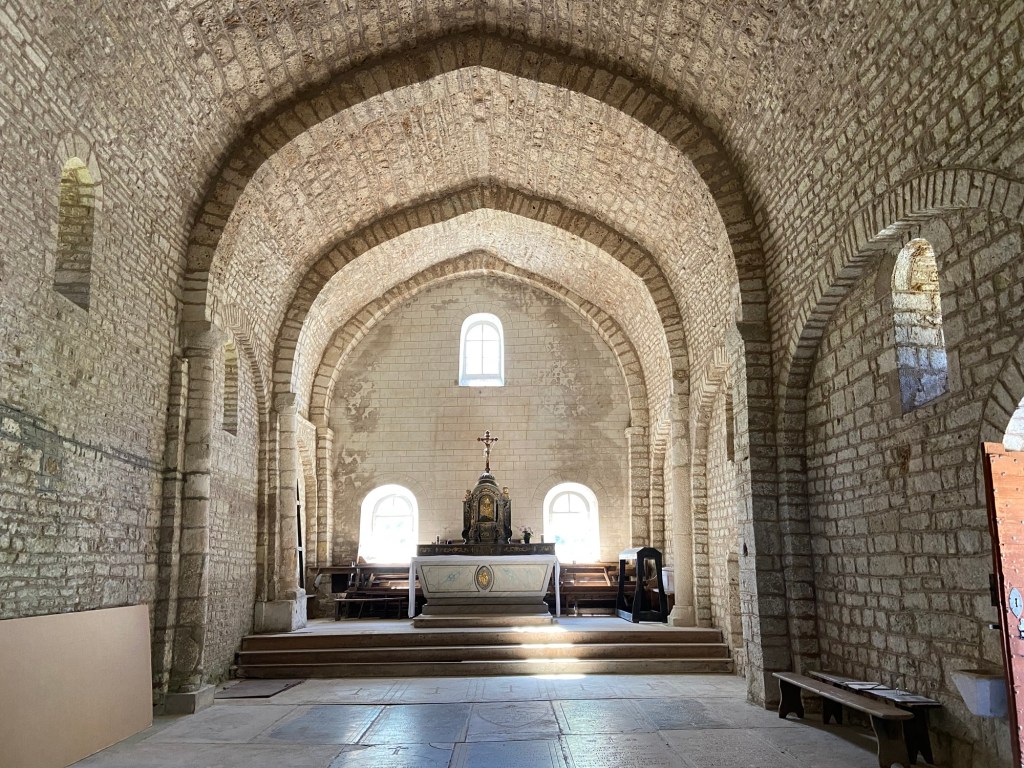
the only details the carved slabs in the doorway,

and the carved corbel on the column of one of the nave’s four bays.

Having paid my respects to the ancient building, I took the road contouring around the valley, now able to give my full attention to the views of Le Mont d’Or at 1463 metres, whose massive east-facing cliffs were striped with the characteristic yellow/beige Jura limestone layers formed of the fossils of tiny marine creatures, glowing golden in the midmorning sun. I thought of the cheese which is flavoured by being wrapped in spruce bark and named in honour of this peak in the region in which it is made.
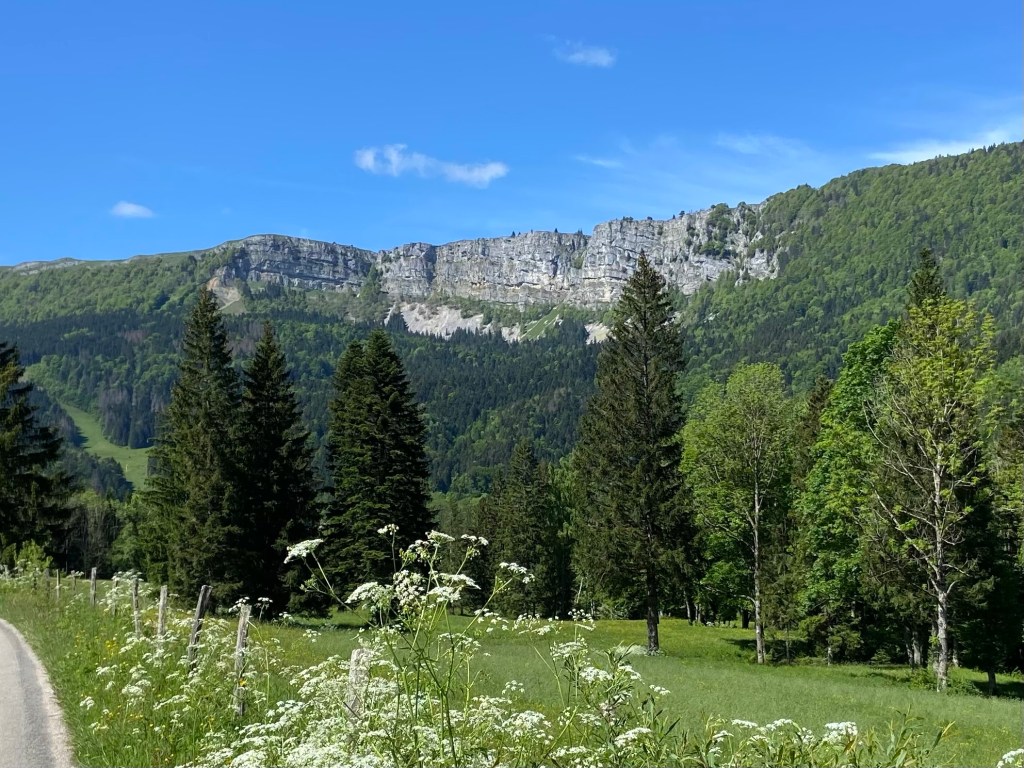
I followed the Rue Jules César through the very last of the French villages, thinking how apt the name was and attempting to give my marching cadence suitably processional gravitas, to give a sense of purposeful aplomb to the moment.
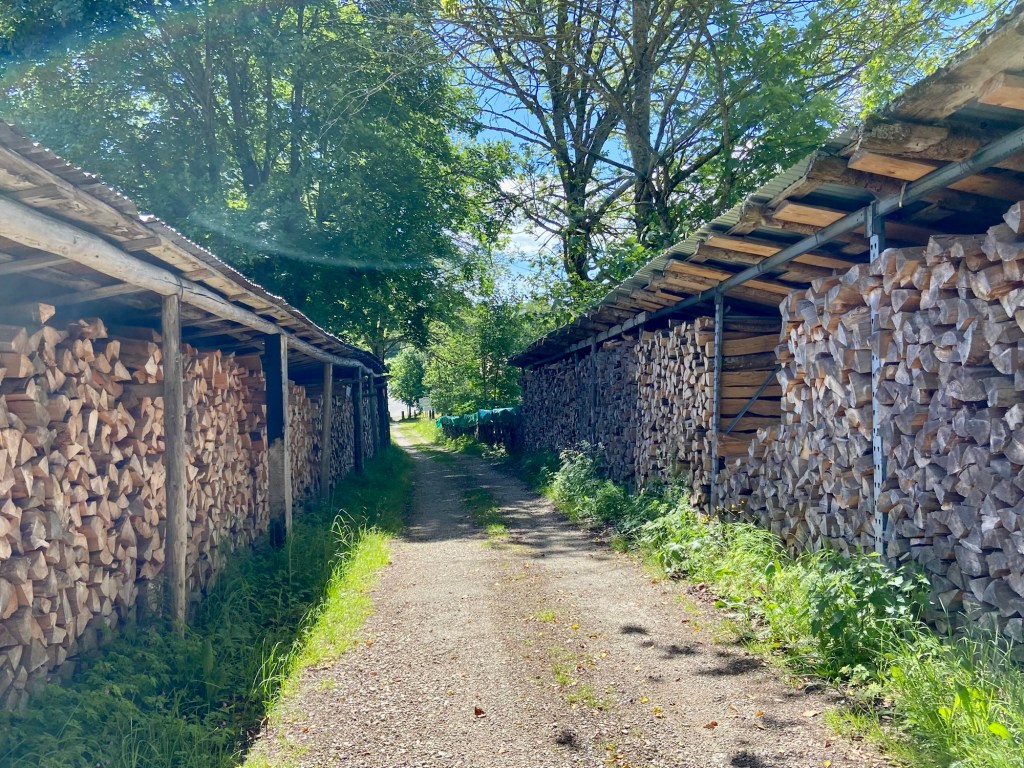
The road curved around the shoulder of the mountains to my left, and I passed between a corridor of sawn logs creating a ceremonial approach to the border.
Waiting to cheer me through were four gents walking the Francigena in chunks: Graham from New Zealand, Martin from Australia (who lives in Thailand) Pierre from Switzerland (walking home) and Riepko from the Netherlands, who had all met decades ago working for Nestlé. They didn’t have a lot of good things to say about the Nestlé factory in Pontarlier (which is where Nesquik is made, apparently), so I said that we would share my celebratory Toblerone instead, as there were exactly 5 chunks left.
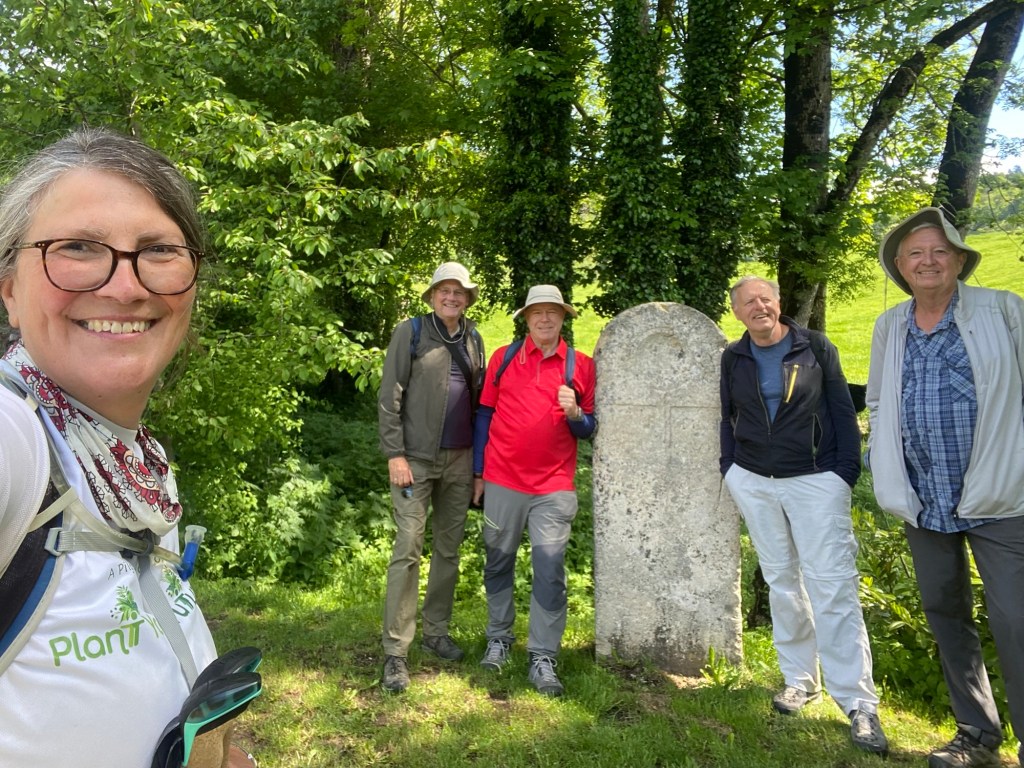
We took a number of cheerful commemorative photos by the border stone, and then they cheered me through. Thanks, Annual Amblers: it was a pleasure and an honour to meet you, especially at such an auspicious location! I look forward to reading up on your adventures on Facebook.

The four musketeers graciously allowed me to walk on alone as they said I was walking faster than them, but I unexpectedly felt something of Frodo’s cinematic doubt about which way to go to Mordor, because now I needed to get used to following the green markings of the ‘Sentier de La Jougnena’ — the Swiss name for the Via Francigena. As I was to discover, signposts are few and far between.

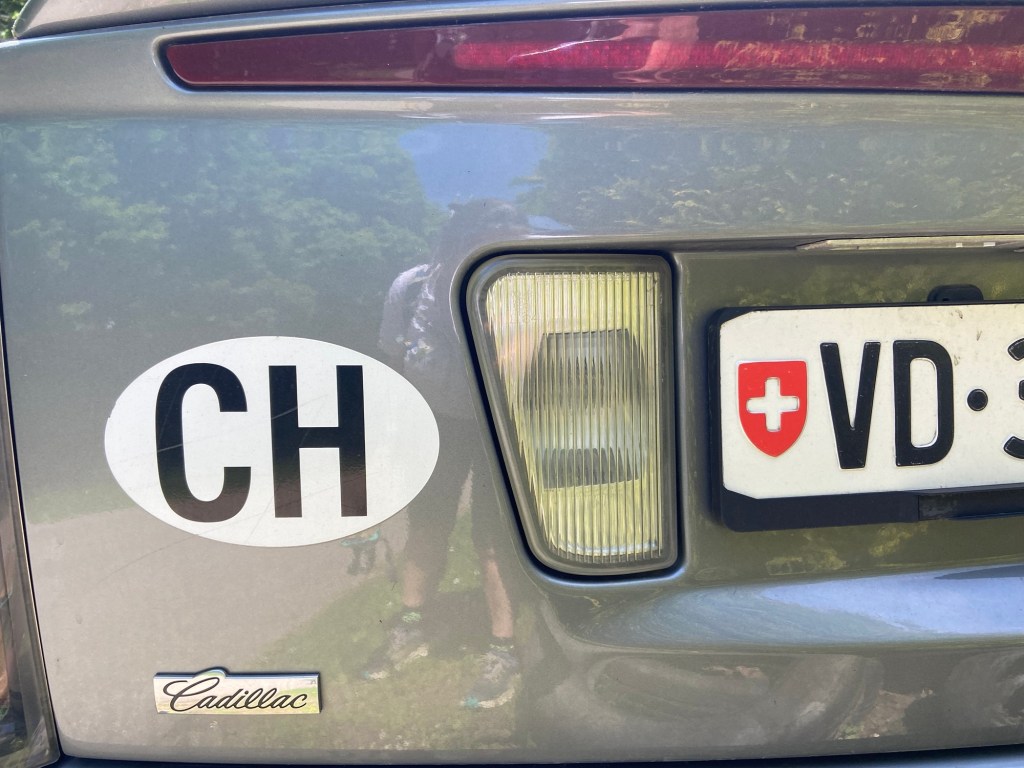
Initially the road took me all the way to the first Swiss village, Ballaigues, and to confirm my arrival in the country there was a tiny flag on the numberplate of the first parked car I saw.
I was surprised by how unsure I felt about the route. There were some tricky turns to navigate, and I missed the little reassuring white and red GR145 flashes on trees. My wonderful French IGNRando app had of course now ceased to provide detail in Switzerland, and thank heavens I had thought, months ago, to download the Swisstopo app which now at least gave me topographical detail, if not the Via Francigena GPX track, which I would need to figure out how to download tonight. So I was pretty reliant on the text descriptions of the route from the guidebook.
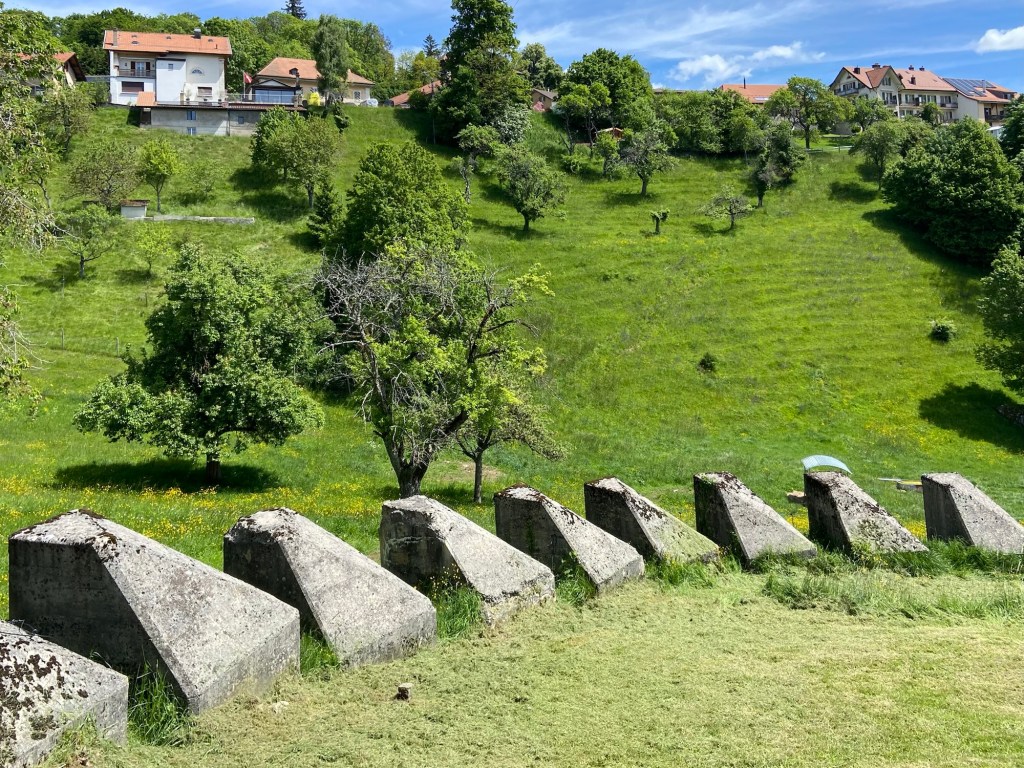
I followed a signed post which definitely pointed me in the right direction, passed a series of the tank barriers known as Toblerones and which Margarida had said were the inspiration for the shape of the chocolate. I have heard two other stories, however: the shape is commonly said to recall the shape of the Matterhorn (per the modern Toblerone logo), although the sons of Mr Tobler claim he was actually inspired by the pyramid shape created by dancers at the Follies Bergères in a show he saw. Pick which origin story you prefer.
This road twisted and turned and lost a lot of height. I was not at all sure I was on the right track because I was looking for a grassy path according to the guide book. I asked a sweaty chap strimming the verges of the field, but he shook his head and said he had no idea about the tourist paths. On I went, very underconfident, reading and rereading the text description of the route and trying to make it fit the path underfoot. I triangulated with both the IGNRando map, which at least had the red route thread on it with my blue location dot, even if the background was blank, and the SwissTopo map, which had all the detail and my location marker, but no Francigena route highlighted.
I thrashed around hesitantly at a junction with a concrete road, trying to decide whether to go right or left, then scrutinised really carefully first a pile of brash and then a yellow diamond painted on a tree behind it. There was a very narrow path in the long grass hidden behind the pile, and it roughly corresponded to the direction arrow on the blank IGNRando map. This was ridiculous.

But I soon confirmed that I was right by shuddering down the path and watching that my blue dot was still on the red line on the blank IGNRando map. There was a generally unnerving lack of any signage though, and I realised that my final three days’ walking was going to be very different to the French Francigena. After almost two months in France I felt as though I was in a foreign country.
The absurdly steep and narrow path twisted and zigzagged down through woodland where eventually I would meet the river Orbe at the bottom of this gorge. There was a breather from the intense concentration as I crossed a transverse path and then down the dizzying slopes I went again, now with limestone cliffs on my right and left.
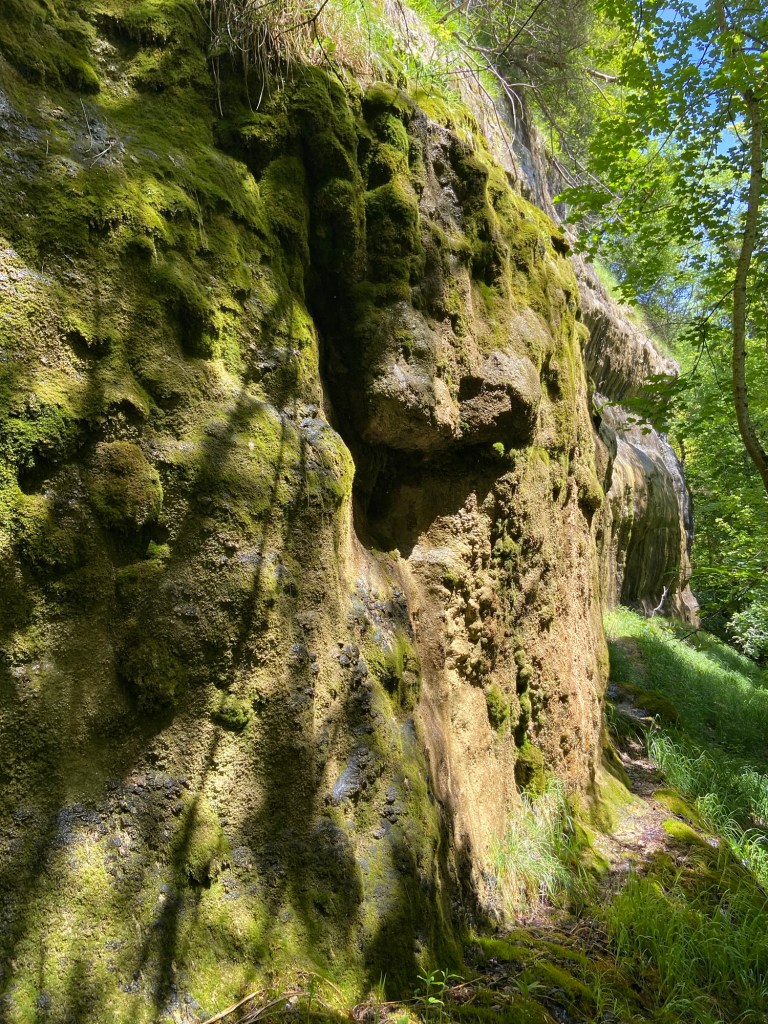
I picked my way over sections where water from the rain or from springs was oozing its way downhill down my path (of least resistance), creating slippery mud from the leaf litter and earth. I descended extra carefully, using the handrail where necessary, and feeling fervently grateful to Judith Holroyd for my walking poles. They were a lifesaver here, because sometimes the handrails were collapsing into the gorge.

Finally, I reached the bottom, crossing the Orbe by a bridge with signs that warned not to go into it because the water levels were liable to change very suddenly without warning when hydroelectric dams spilled their contents to generate power. Today everything looked innocently — and invitingly — safe, as obviously thought the families picnicking with their children on the banks.
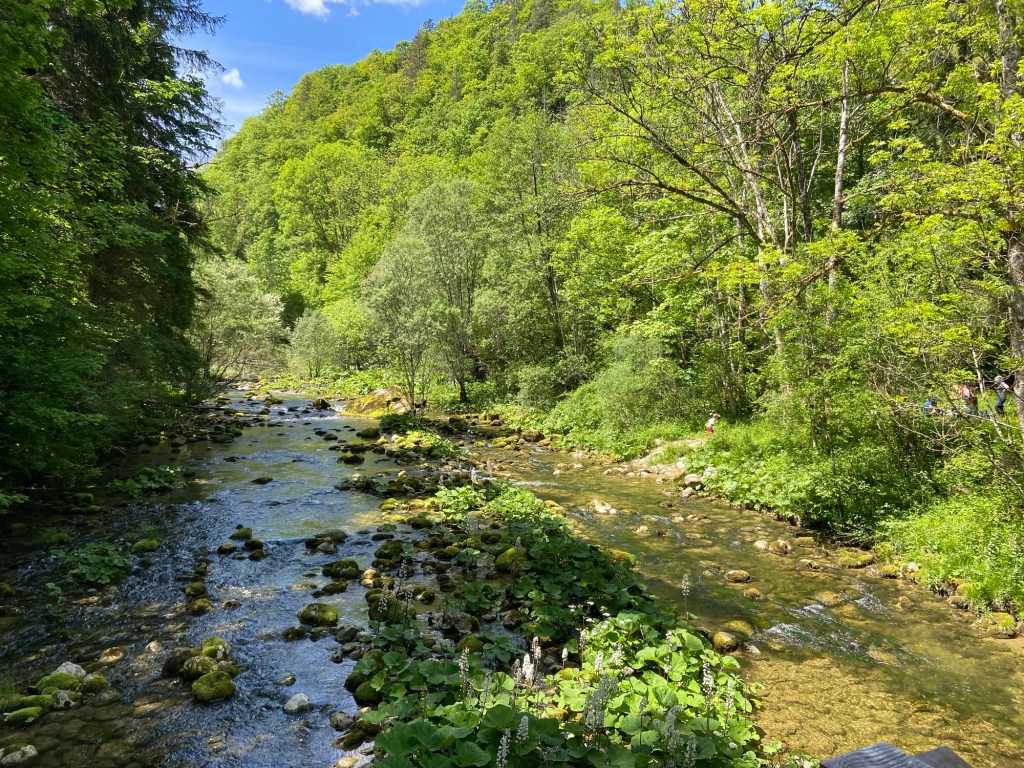
Now I could commence the gorge walk proper, along a contouring path between the steep-sided chasms carved out by the river.
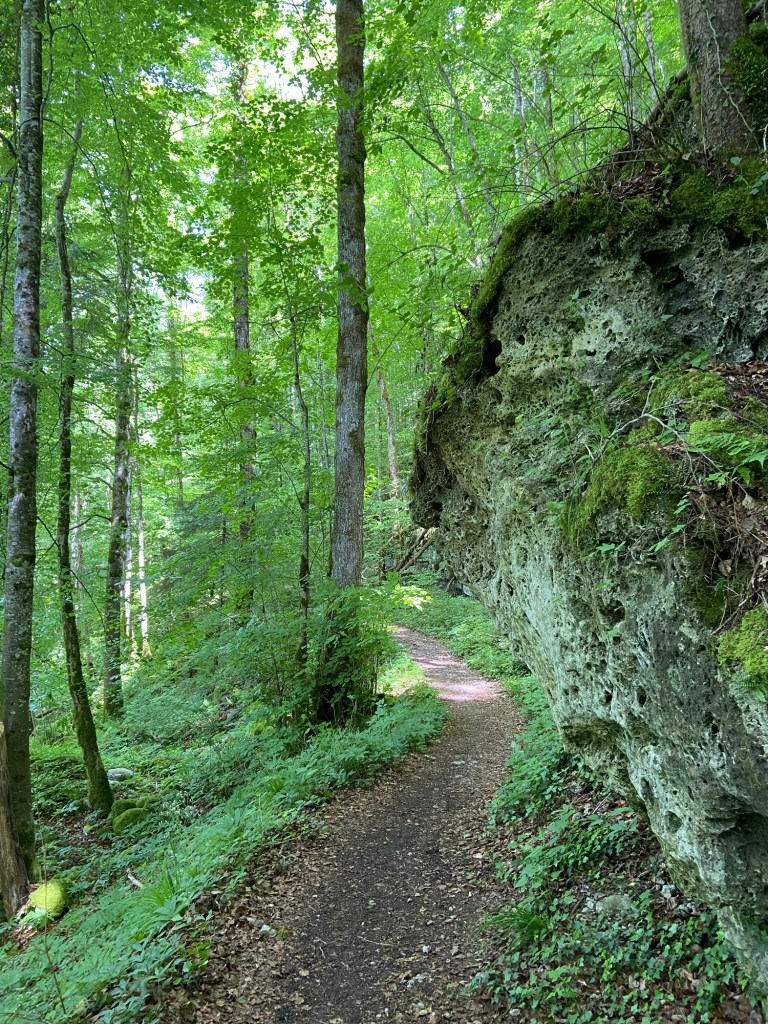
In this moist and shady environment of the rive droite entire trees were coated with moss, and species such as broadleaved helleborine (flower buds as yet firmly closed), harts tongue fern

and mossy sandwort thrived.

Here limestone cliffs towered overhead, with trees growing atop them, dizzyingly far above.

Tall pines reached up to the top of the cliffs, and terraces of moss and fern striped the cliff faces in places. In other places trunks of ivy had clawed their way right to the top and had begun to spread out laterally to cover the limestone face.
At times the path neared the river, and at times climbed above it, but always the sound of the water accompanied me.

Sometimes there were handrails to hold,
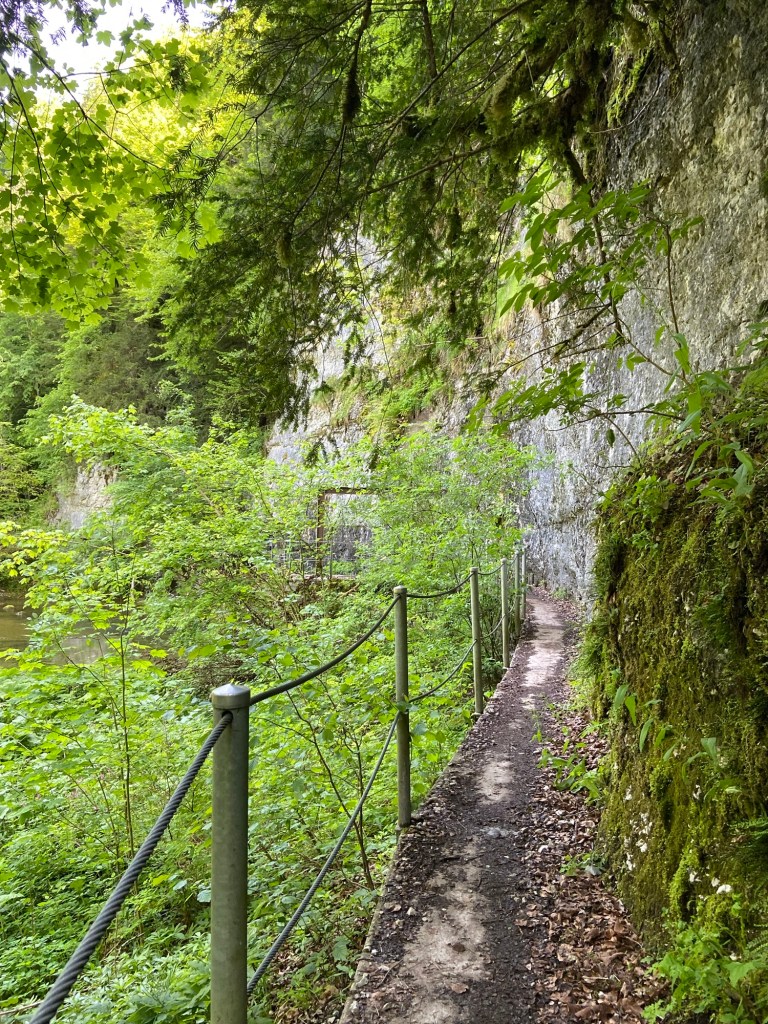
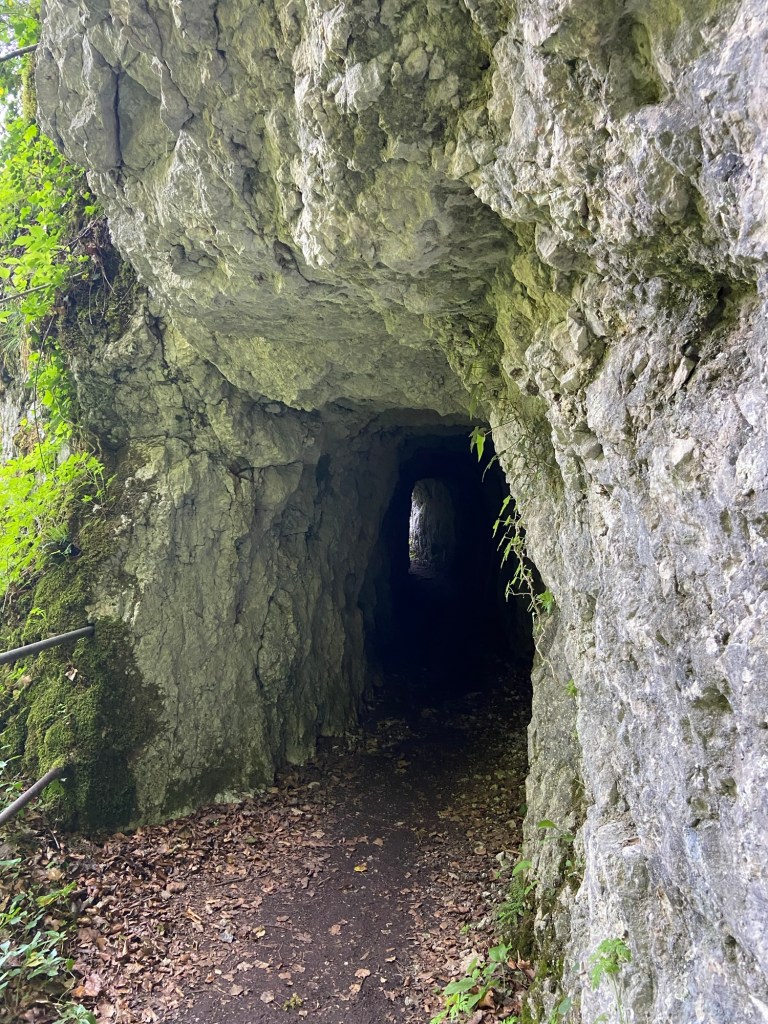
and there were a number of hand-carved tunnels to pass through, where the air was immediately cooler and the contrast with the warmth when I exited was lovely.
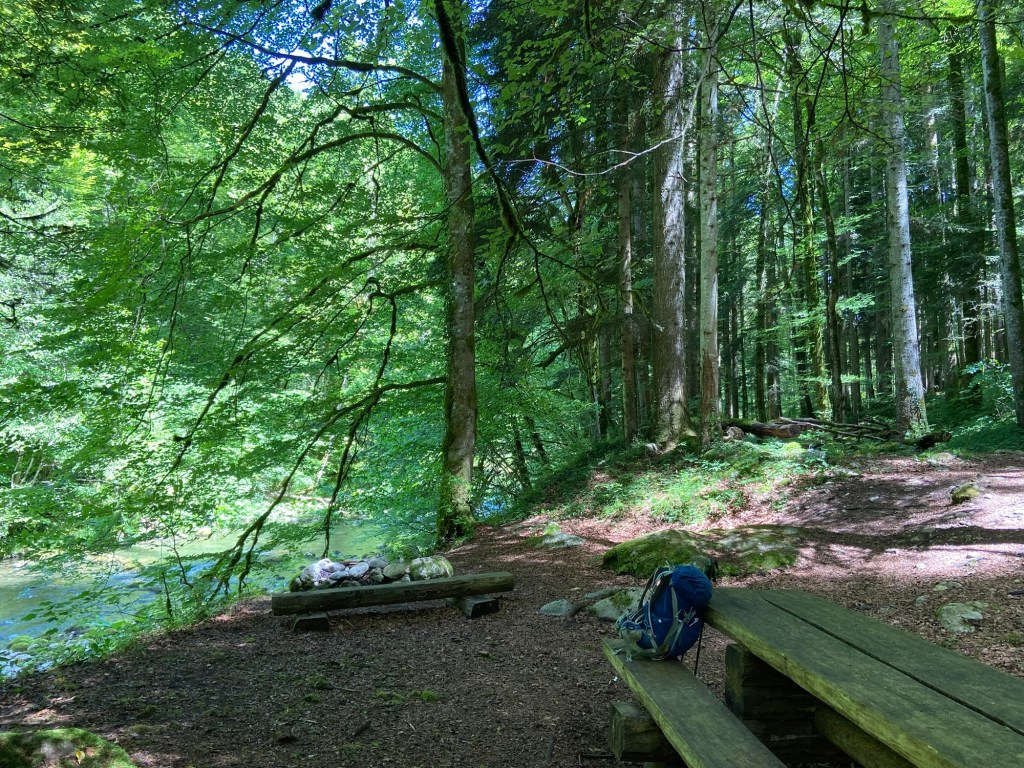
A picnic bench had been provided at a fold in the river, and I made use of it to sit down and enjoy my small sandwich from this morning. The bread was soft and chewy and the local cheeses and meats absolutely delicious. It was one o’clock, and I didn’t seem to have come very far at all today, what with route-reading problems and the very slow and careful descent.
But I cared not a wit. This walking was fabulous. The air even in the shade of the gorge was warm, and I felt perfectly comfortable in my shorts and (after days and days on the road) absolutely filthy T-shirt. Where the path clung to limestone cliffs it reminded me more than anything of some of the trails we hiked in New Zealand in 2017,

a sense of burgeoning life totally enveloping one, being surrounded by plants making the most of every available niche, filling up every space with their abundance.
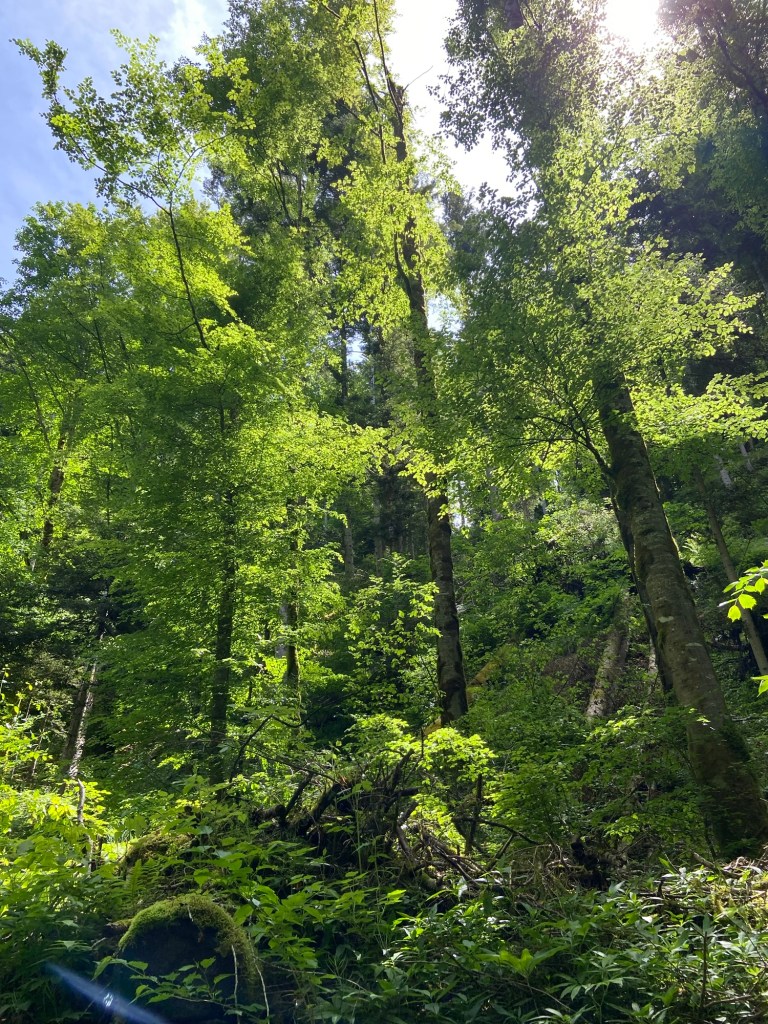
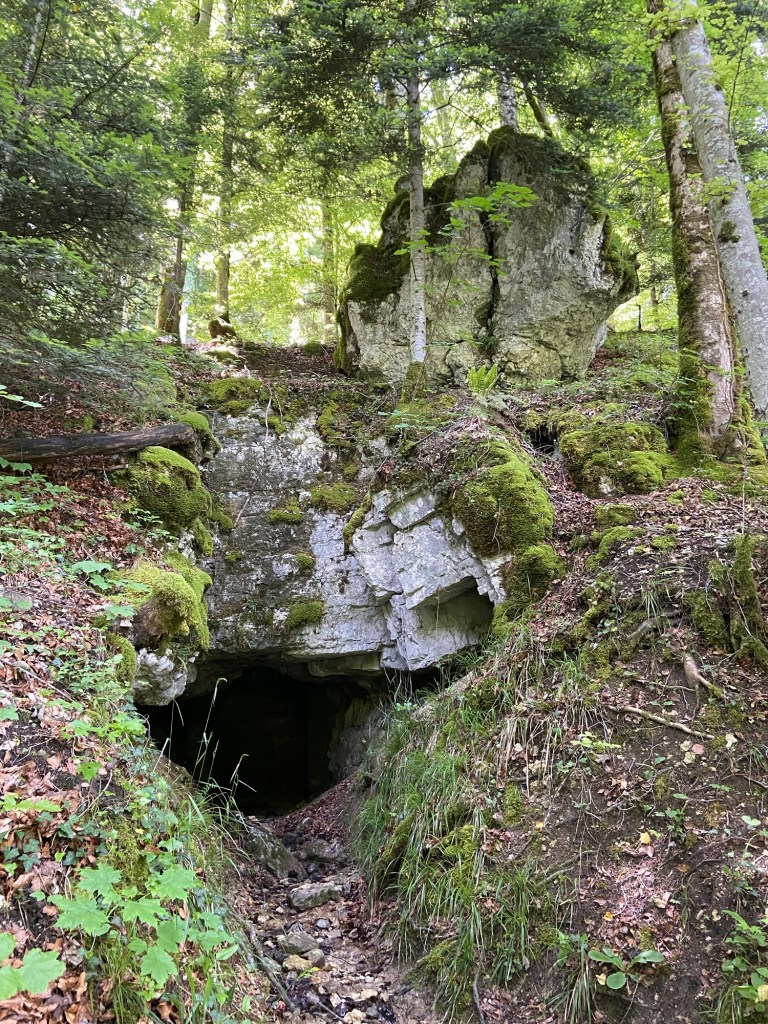
Around every corner was something new to see — a natural caves with a great rock perched above it, ready to fall and block its entrance,
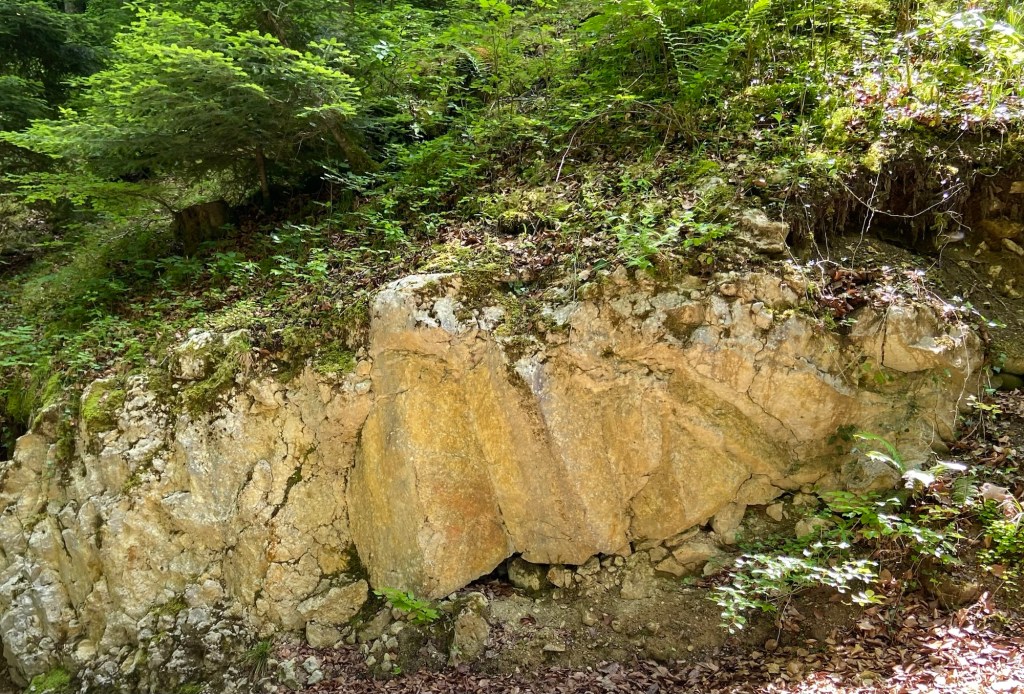
Or slabs of the yellow-tinged limestone, up close here so I could examine it, rather than in the striations of inaccessible peaks like Le Mont d’Or.
I doubt I will ever now walk to the source of the river Loue, but I cannot imagine the gorge is any lovelier than this.

Where shafts of light struck down to illuminate rocks or tree stumps covered in Hylocomium splendens (also known as glittering woodmoss or splendid feather moss),
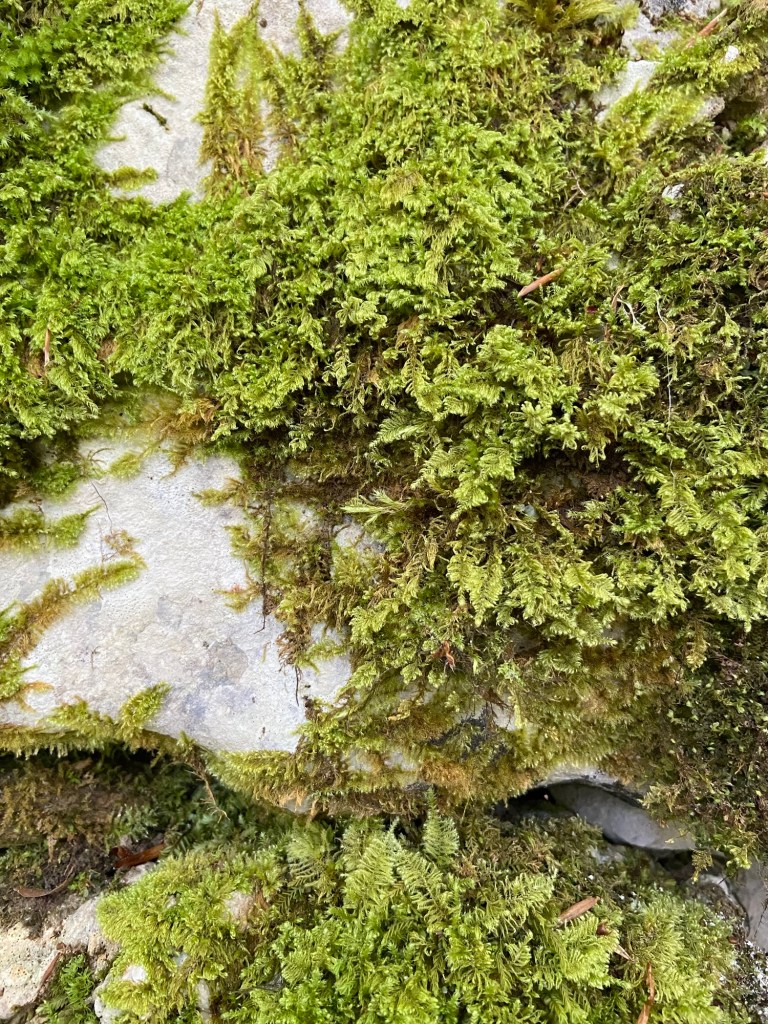
my heart filled in the way that at first I thought indescribable, but then I recalled the Japanese word Shinrin-yoku meaning ‘forest bathing’. That described exactly what I was experiencing in this old-growth, almost completely natural environment.
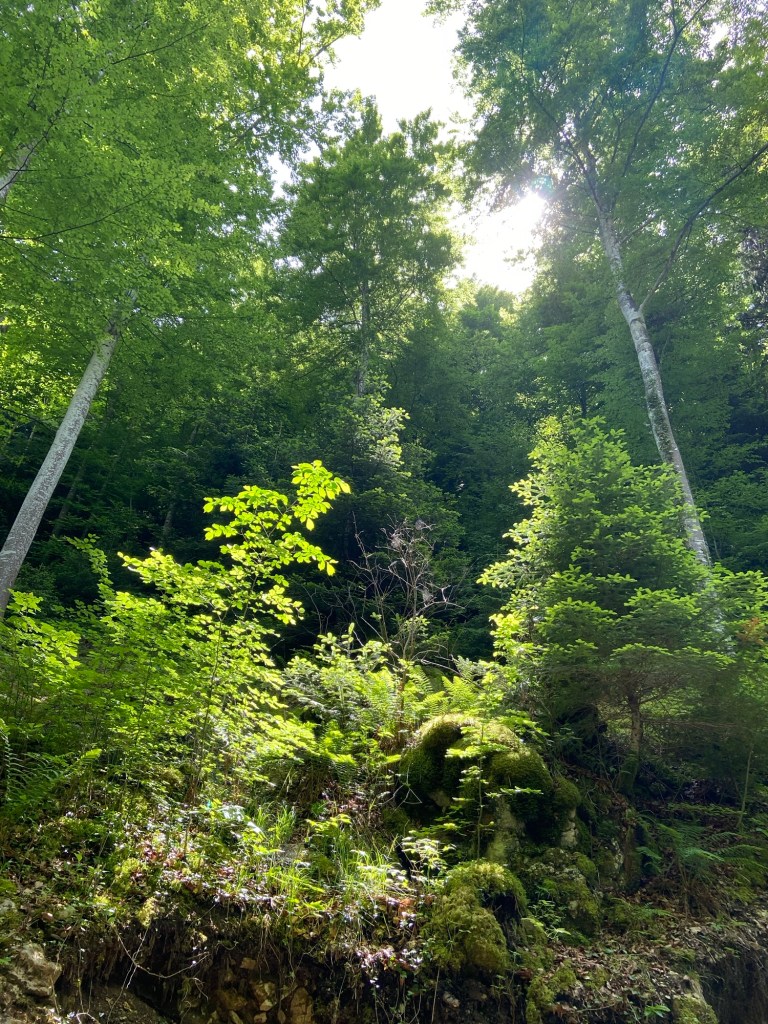
Eventually, the gorge ended, the path drawing gently down to the Orbe,
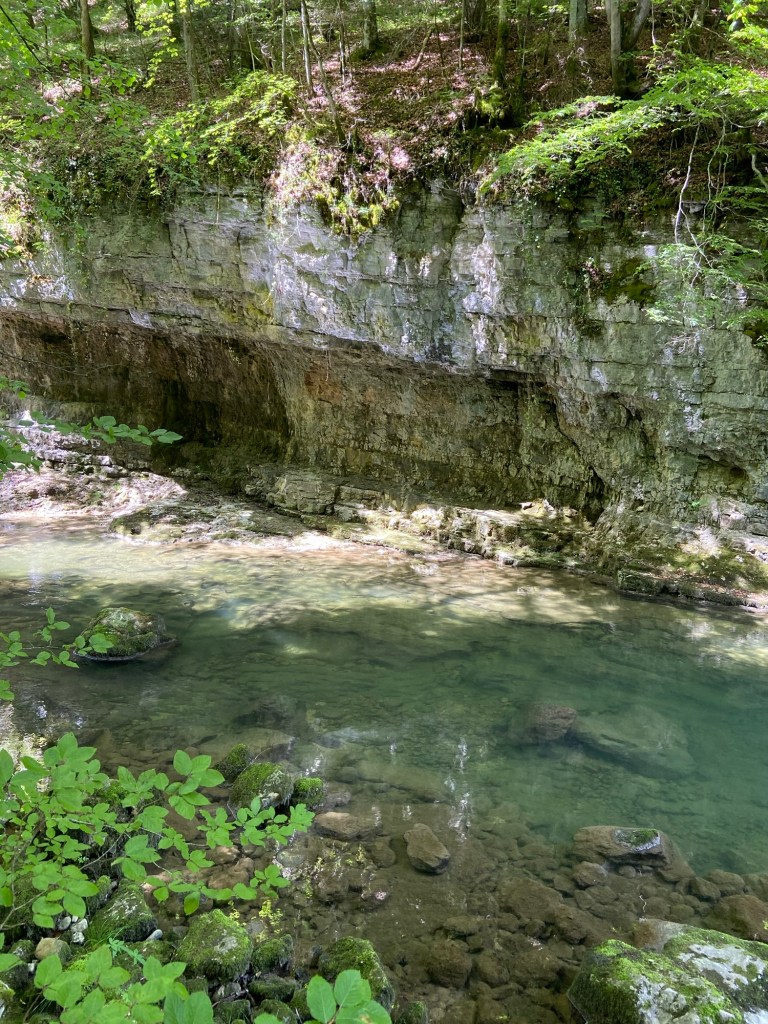
one last time.

I was spat out once more onto a roadway, feeling rather disoriented by the contrast. So I ignored the invitation for an optional break in the ancient village of Les Clées, and stuck to the onwards path.

It took me into a second phase of the gorge, shallower and broader, where the views of the river were more expansive.

I eventually caught up with Linda and Joel, a joyously international family with ties to Scotland and America, but brought up in Paris and now living here in Switzerland with their two young teenage children. Midwife Linda is recovering from a skiing accident, and had a most impressive brace like an exoskeleton on her right leg.
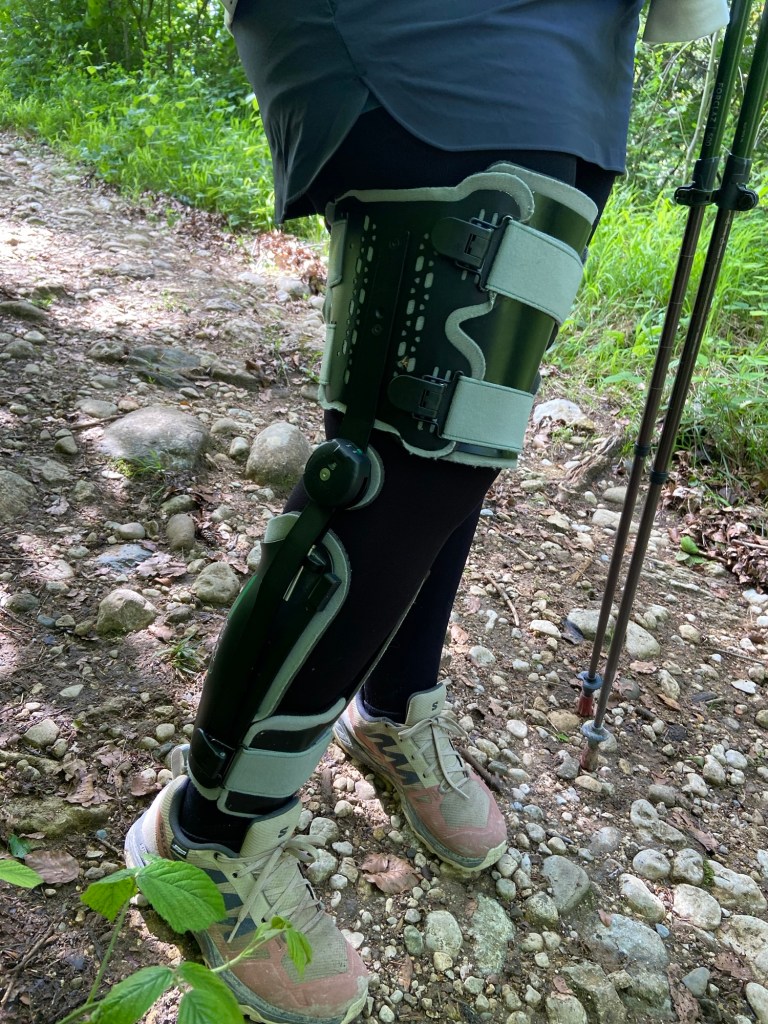
I walked with them while she heroically completed her longest walk since breaking it, gazing down at the Orbe from the middle of a high-up bridge,

and negotiating root-covered paths underneath rocky overhangs.
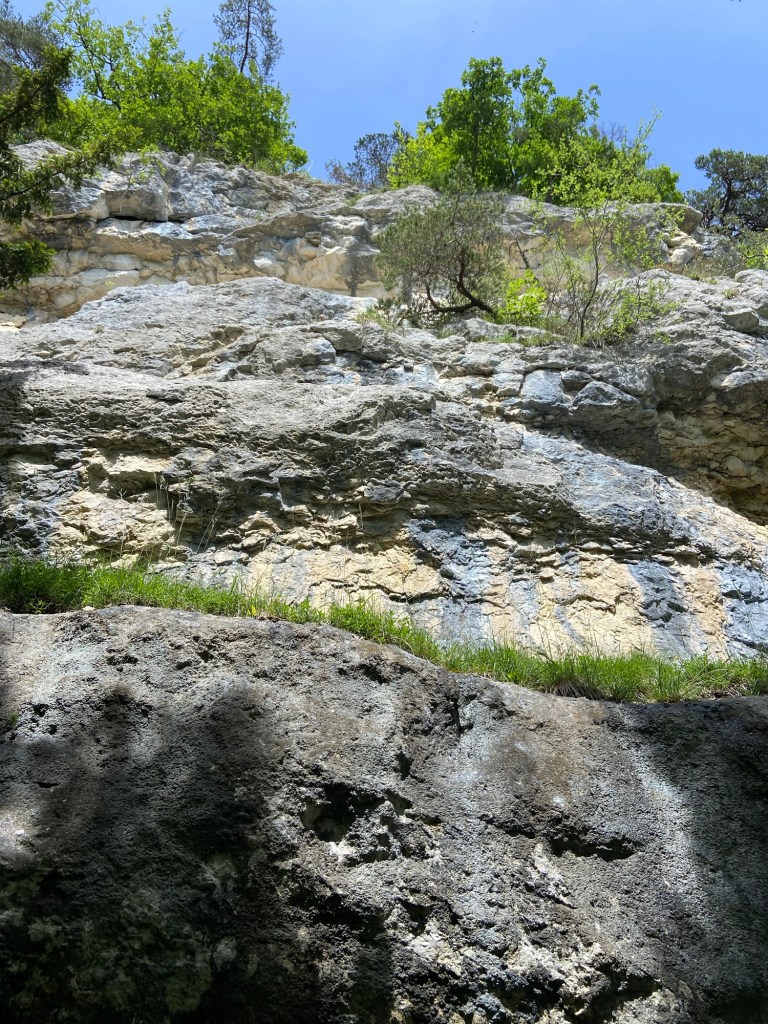
They were such a lovely couple! It was wonderful speaking English to locals, and hearing about their take on Swiss schooling in comparison to the French system, and the French private school system in comparison to the English one. I 100% wish I could’ve spent more time chatting to them. Joel very kindly offered me a lift into Orbe, but you know, I have to do it all on my own two feet!
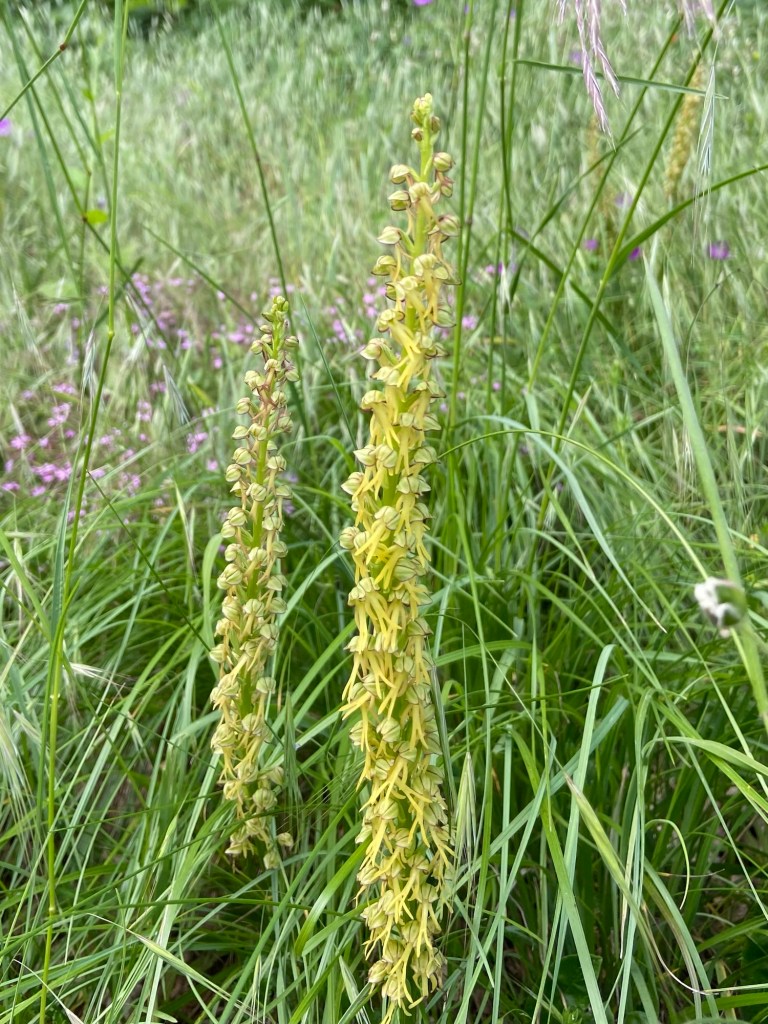
The end of the river walk came at last, but not before Joel and I had identified a violet bird’s-nest orchid, Limodorum abortivum, in bud. The reason we hadn’t immediately spotted it was an orchid was that its leaves are reduced to scales. This means it can’t produce enough energy from photosynthesis, and instead parasitises particular species of fungi, seedlings remaining below ground for 8-10 years before flower spikes form. If I had had a car I would definitely have made trips back to see it on a daily basis until the flower buds opened.

I said goodbye to Linda and Joel at the car park. It was SO nice to meet you both — well done on your walk, Linda, and I hope the leg strengthens and heals really quickly.
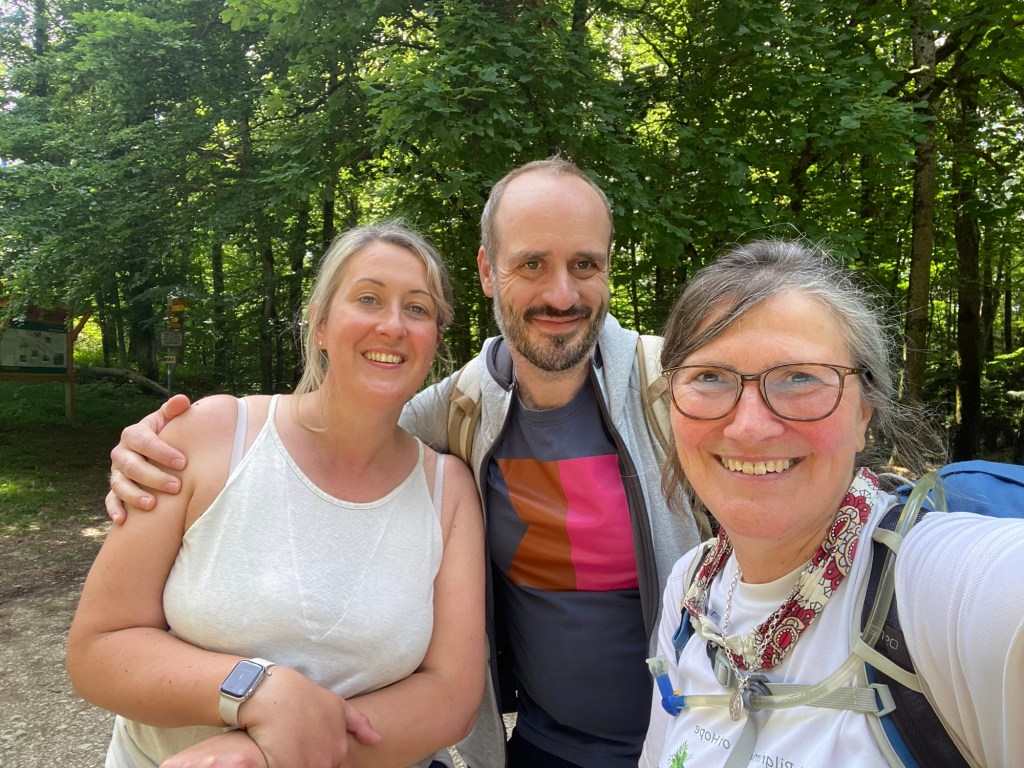
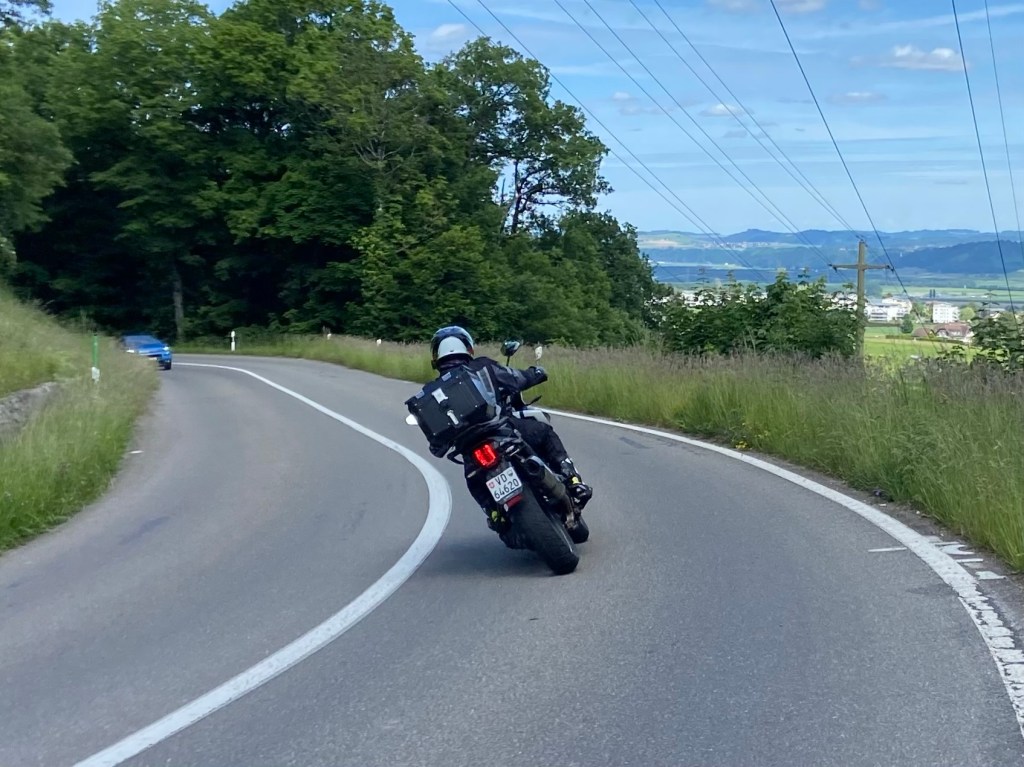
I now had to walk on the pavementless 132 road as it curves dramatically off the Jura foothills. It was glad there was a wide verge to hop into,
not least because here were mats of pink mossy soapwort, and another new orchid, the man orchid, Orchis anthropophora.
At the turn of the road down into Orbe, the town I am staying in tonight, the guidebook had told me I would get my first view of the town. I think it was a perhaps a deliberate decision not to reveal the other thing that I would see from the same spot, because when it came, it was such an overwhelming surprise that it made me gasp. On the horizon very clear and tremendously powerful, were the snow-capped Alps.
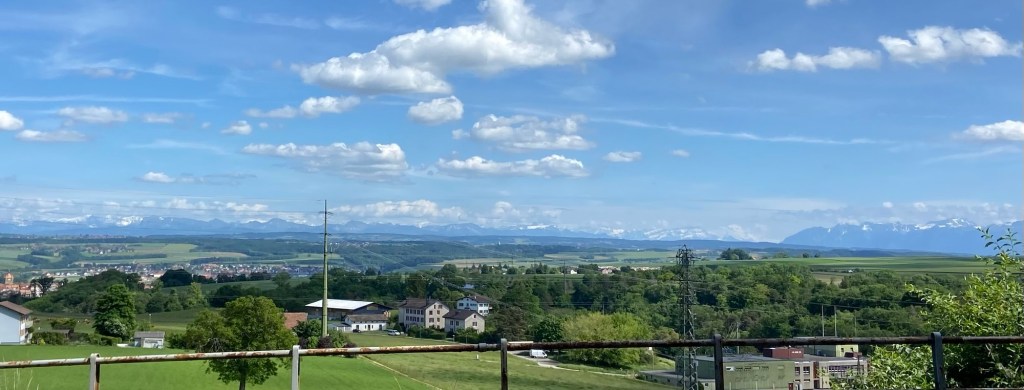
I sat for a long time on a low wall, gazingmy fill of the Alps. Seemingly lower than the others but certainly recognisable was Mont Blanc, all blanc where the others were only snowcapped at their very tops. I felt very emotional. More than anything, I felt grateful at the sight. Grateful to be here. Grateful to be alive.
And now I walked towards this great view. This great wall between me and Italy that Stephen and I will tackle next year. Turning round I saw the Jura, another wall, of forested limestone, an obstacle overcome and the geological finale of this walk.
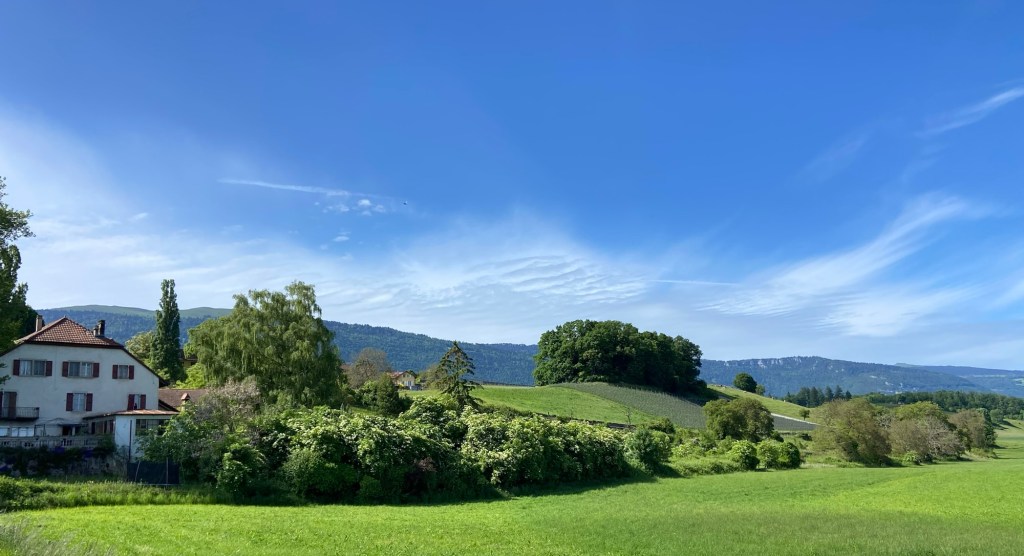
As I neared it, the view into Orbe got better and better, and I could see it was constructed defensively on a limestone promontory, and it was the bell tower I was making for, for not only was the Airbnb underneath the campanile, ‘Campanile’ was also surname of the Airbnb hosts.

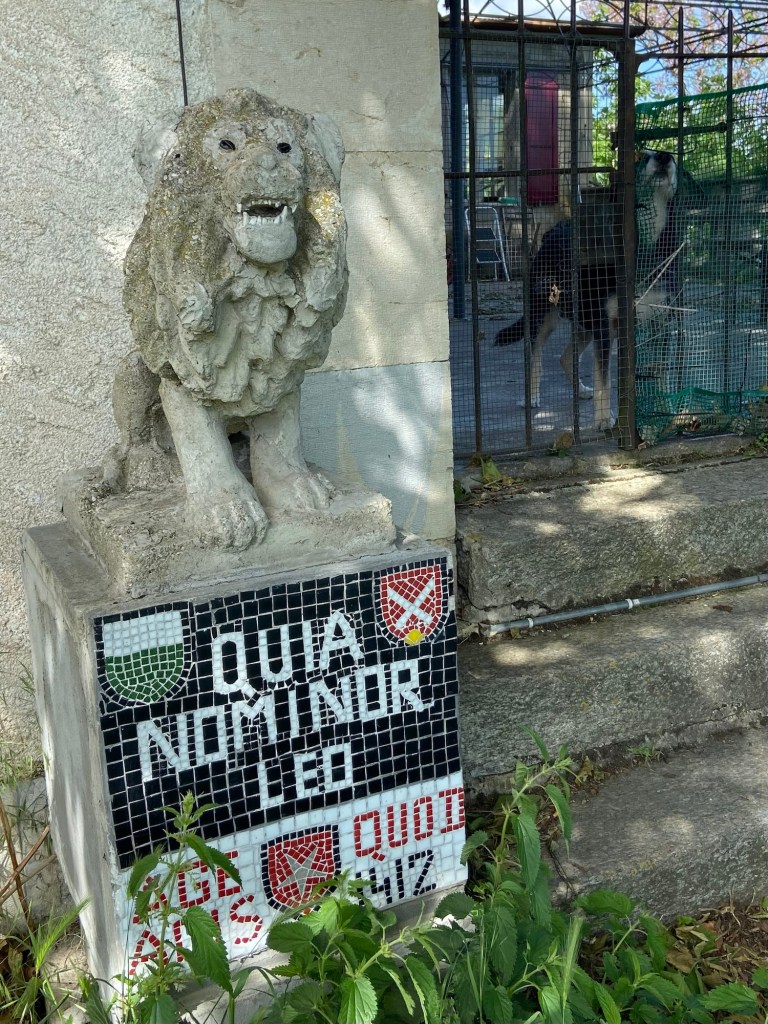
Also defensive (agressively so) was the first inhabitant of the town that I encountered, trying to live up to the Latin motto perhaps, which is the defence of all tyrannical despots: ‘I take the lion’s share because I am named lion’.
Some of the town’s architecture was extraordinary — Orbe gothic, perhaps?

The town’s main square was more typical, filled with cafés and banners of both Switzerland and the commune.

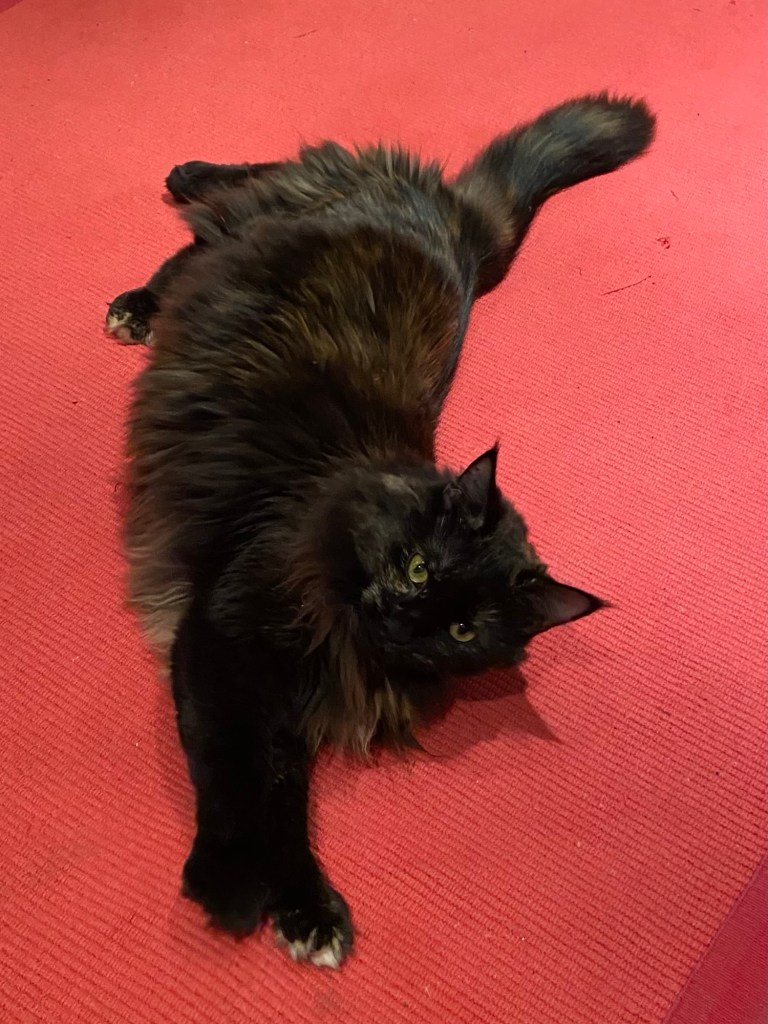
My Airbnb was right on the corner. Pascale and Antonio had rolled out the red carpet — but Pixel got there first!
Stats for the Day
Distance: 20.42km
Pace: 4.5km/h — and I really thought I had dawdled in the gorge
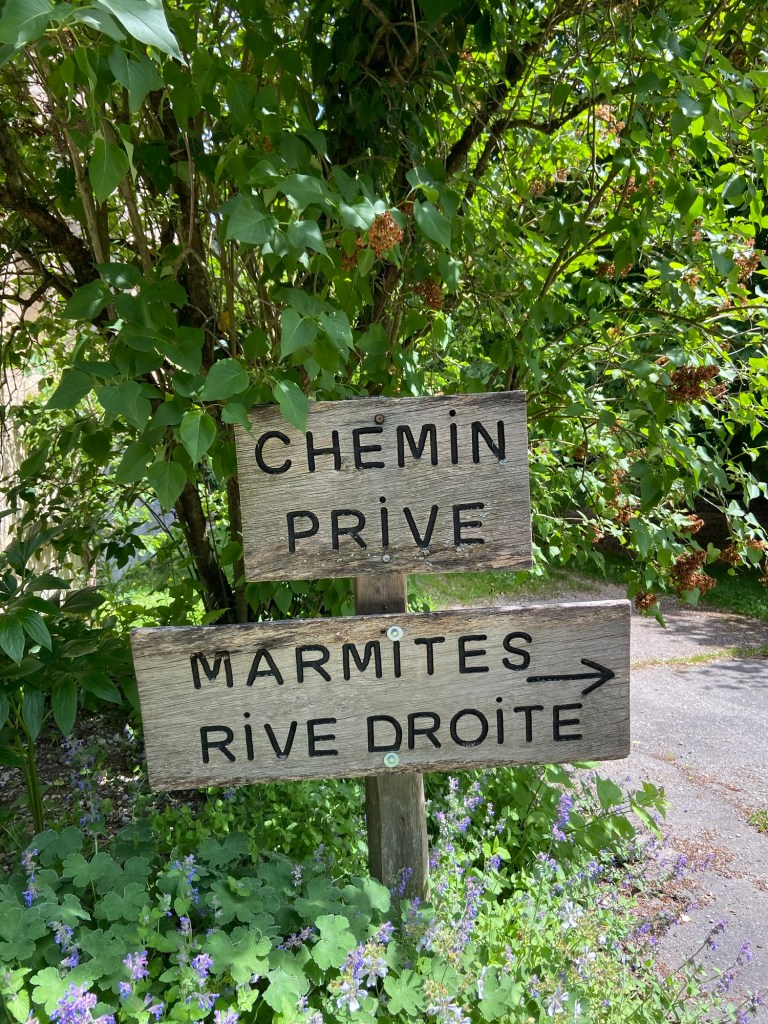
Amusing Sign of the Day
 Walking The Landscape
What a day! I was so anxious about that footpath, but the gorge!! You have done so amazingly well, and look at what you have ahead of you next year. Wonderful.
LikeLiked by 1 person
♥️ all is possible
LikeLike