
Or rather dost thou tread
Thomas Hood
Those cloudy summits thence to gaze
below, like the wild chamois
Today was to be the last day of serious climb, in which the Francigena crosses the highest point of its Jura route at 1200m, and after four hours sleep in two chunks (this is getting ridiculous!) I wasn’t really feeling up for it! But today I had a companion to help me make light of the tiredness: Aphra and I were doing pretty much the same stage today, although she was going to stop at the village before Jougne where I was headed. We hoovered up the youth hostel’s excellent breakfast, shouldered our packs, and set out into the showery day.
We crossed the Doubs again, a young river here, which we had last encountered in its more mighty form at Besançon. From here on the bridge the waters which flowed under our feet will do a gigantic 400 km loop to the north and west, eventually joining forces with the Saône.

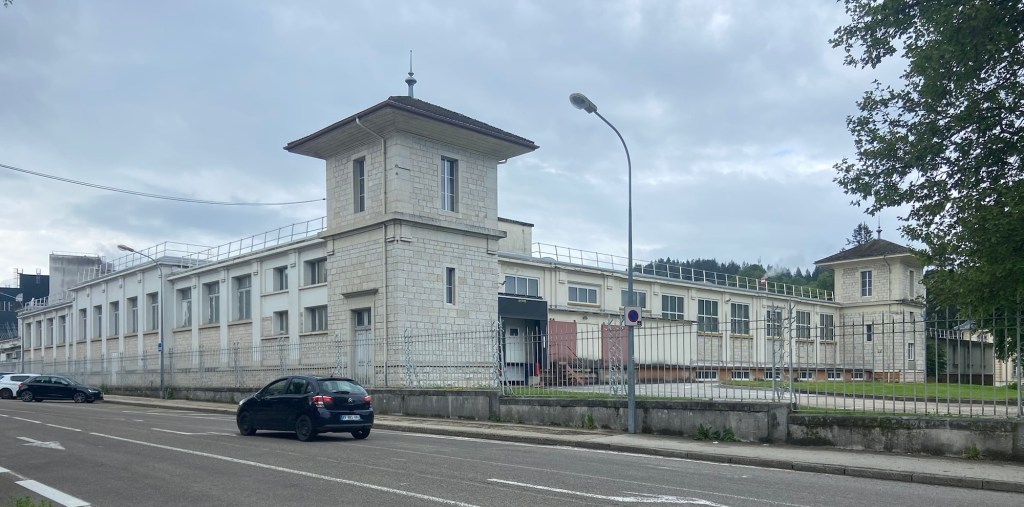
On the outskirts of town (and I could smell it in the air) was a Nestlé factory, looking more like a high security prison than a chocolate factory. But I suppose Willy Wonka’s factory was also designed forbiddingly to keep out unwanted visitors, as well as waft delicious scents through the air out over the town.
We discussed the fact that we are excitingly near Switzerland, where our chocolate of choice would not be anything made by Nestlé, but Toblerone, and we decided that we must buy some to celebrate tomorrow’s border crossing.
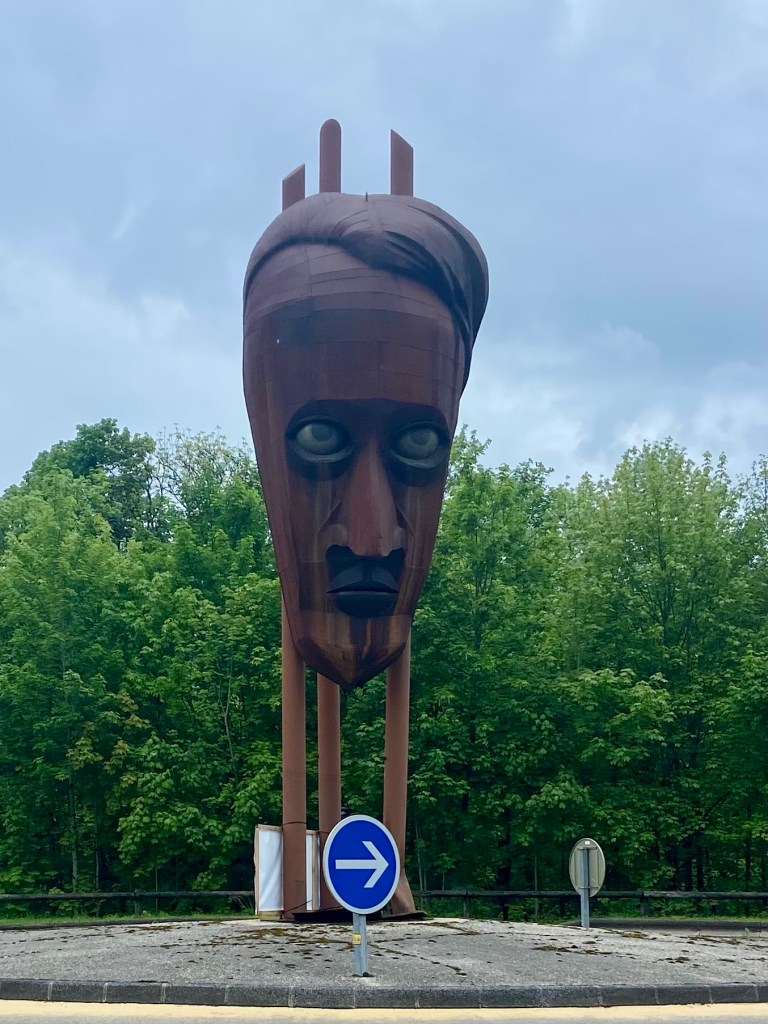
The mask of novelist and former minister under General de Gaulle André Malraux glares balefully out from the roundabout at the southern end of Pontarlier. According to a satirical article I found on the internet the giant mask’s bulging eyes cause the local children under 10 years of age so much traumatic stress that the mayor has recently issued an edict forbidding parents to drive their children around the roundabout, necessitating a detour of some 5 km. Aphra and I certainly found the mask disquieting, so we scurried past and headed for the hills.
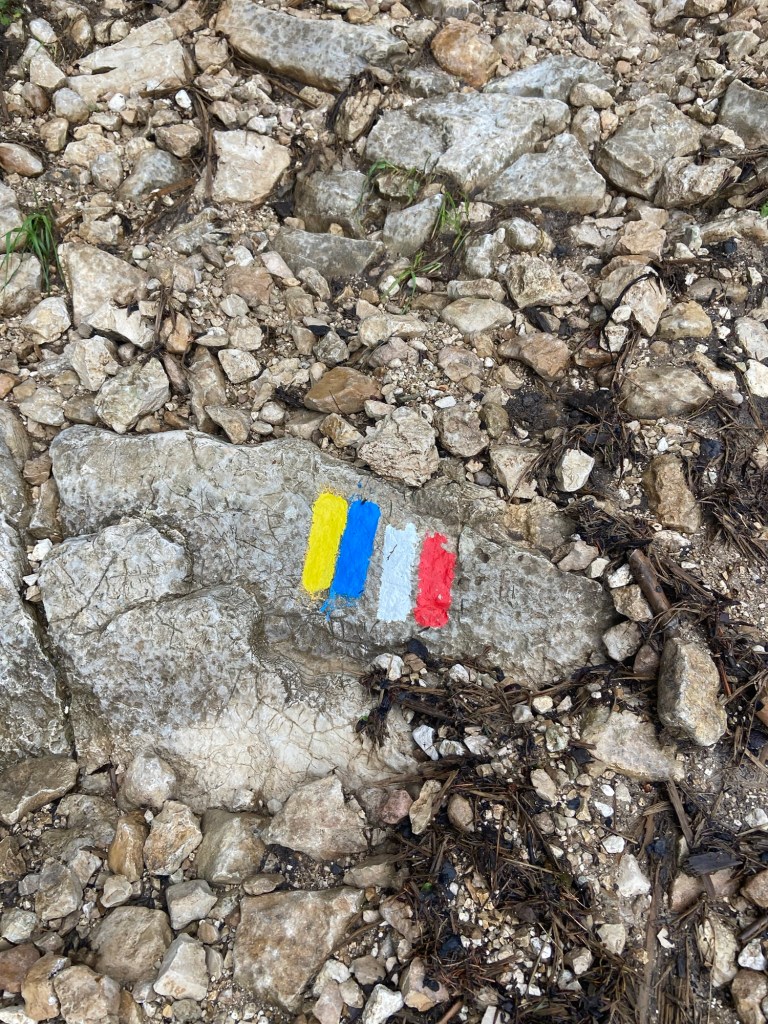
The day started as ever with a sharp climb, from 829m to 1054 metres over two kilometres,. We were swallowed up by pine forests, where fresh paint had been applied festively to rocks and trees to aid pilgrims in finding their way.

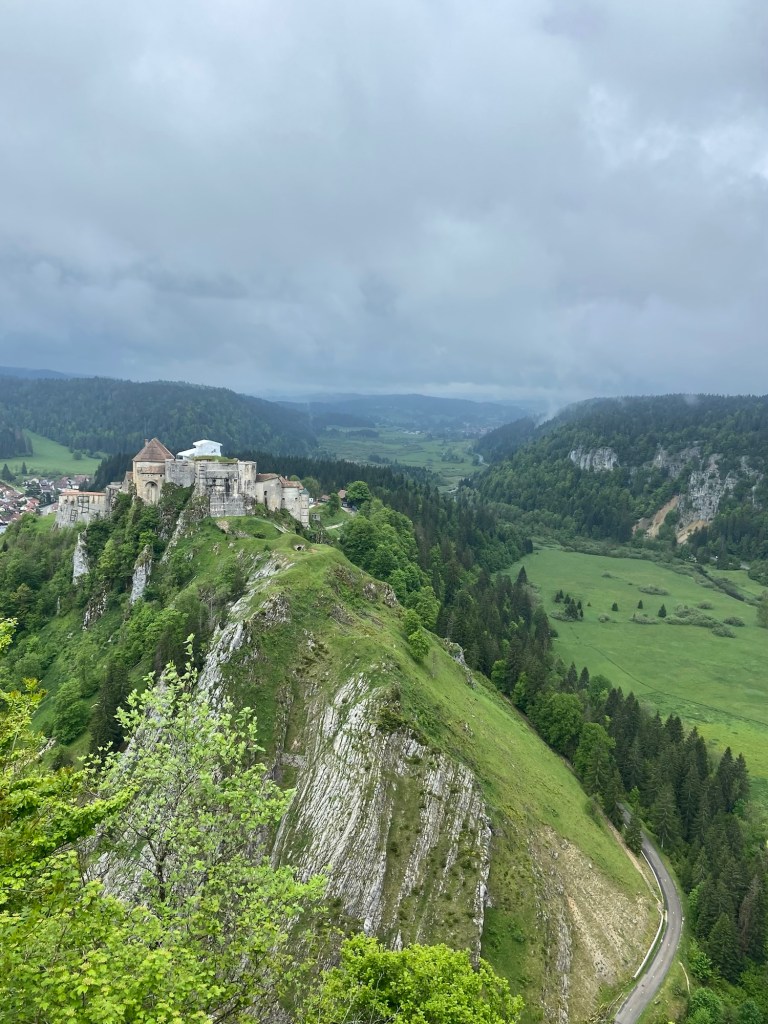
The first feature of note today was a spectacular view of the Fort de Joux, built in the eleventh century to be an enduring stone structure to replace a pre-existing wooden fortress. It went back and forth between France and Austria for centuries, before finally settling in French hands in the late 19th century. As a modernised bastion it was an element in the Maginot line to prevent German advance in the Second World War. Aphra and I adjudged that it would be phenomenally difficult to attack from below; it looked almost impregnable. We also thought that it would respond well to a siege too, being supplied by a hand-dug well 147 m deep (I later found out that the fort had been besieged by the Wehrmacht in June 1940, although I couldn’t discover any more about the outcome).

The tone of the forest walking today was almost immediately established, with some stiff climbs through trees on decent logging tracks,
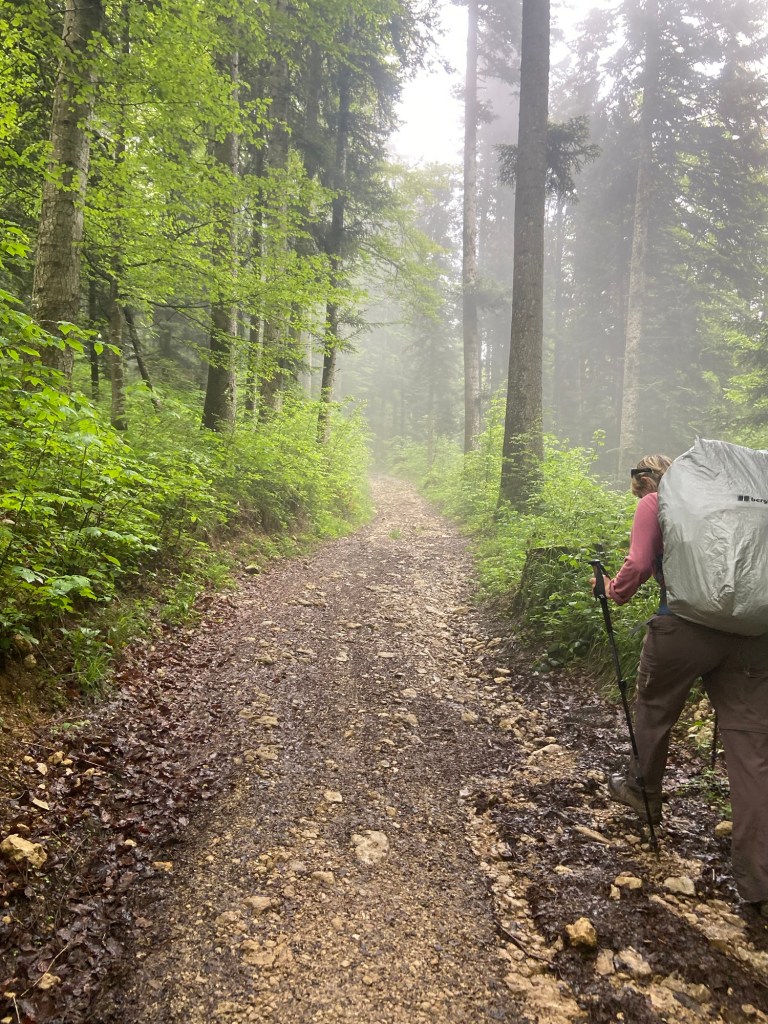
giving way to high, enclosed meadows.

This forest experience was quite different to yesterday, not least because it was dry. But also because we were so focused on each other’s company, and scaling the altitude lines on the map happened almost unnoticed as we got to know each other. Aphra studied Archaeology and Anthropology at university and I was fascinated by her take on a variety of cultural issues we discussed during the day. I really hope Aphra returns to making podcasts with anthropological slants after she has finished her epic walk.
We also discovered a shared interest in the natural world and I enjoyed seeing today’s landscape changes reflected through another’s eyes. We were higher up here, and the terrain was noticeably craggier. The flora had to interact with this change in different ways.
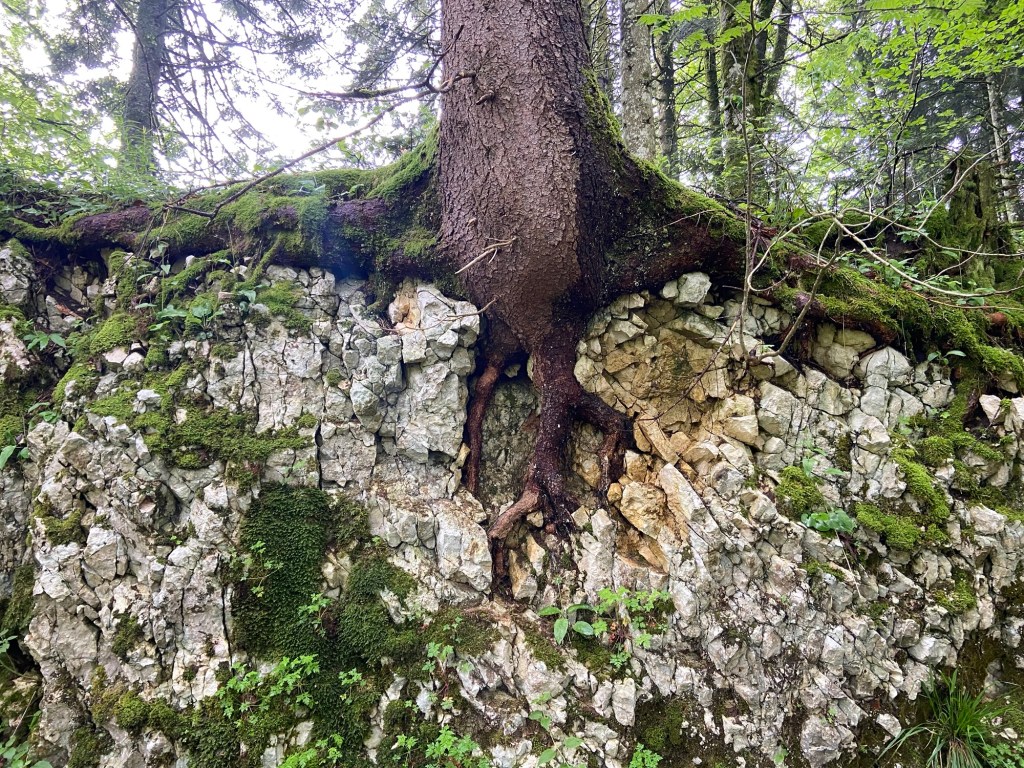
and so did the people: unfortunately the 19th century constructors of Fort Malher lacked the resourcefulness of the pine tree and the technical knowledge of the Lords of Joux, and their ability to the dovetail their building stone to the rocky slabs
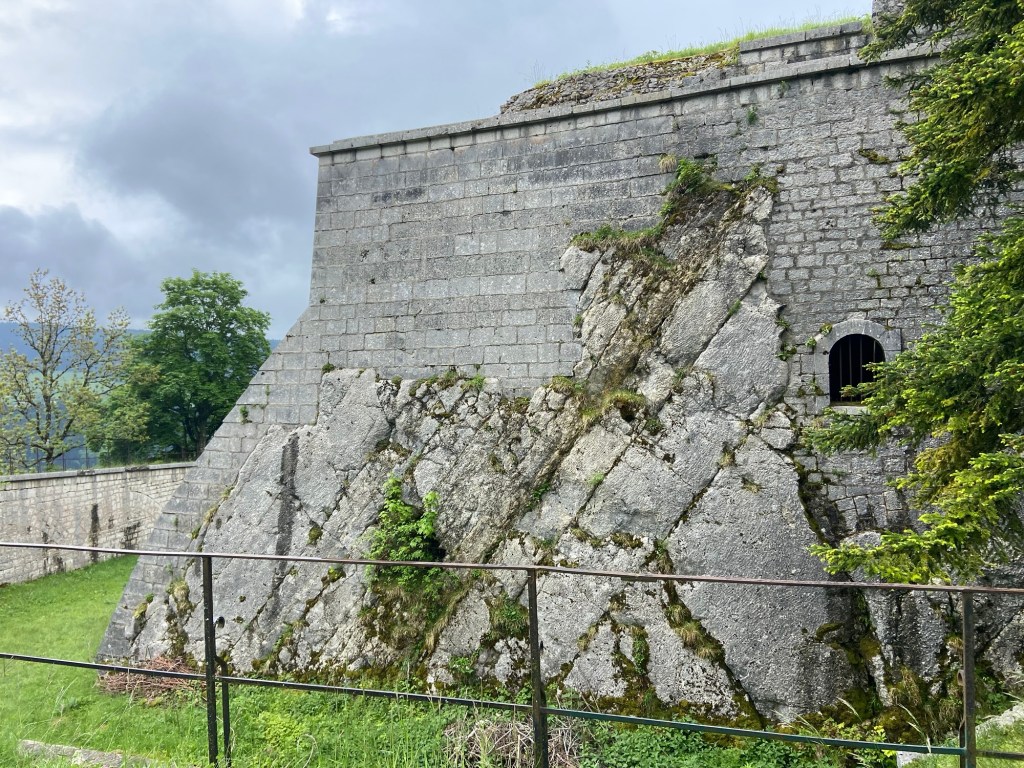
was only partially successful.
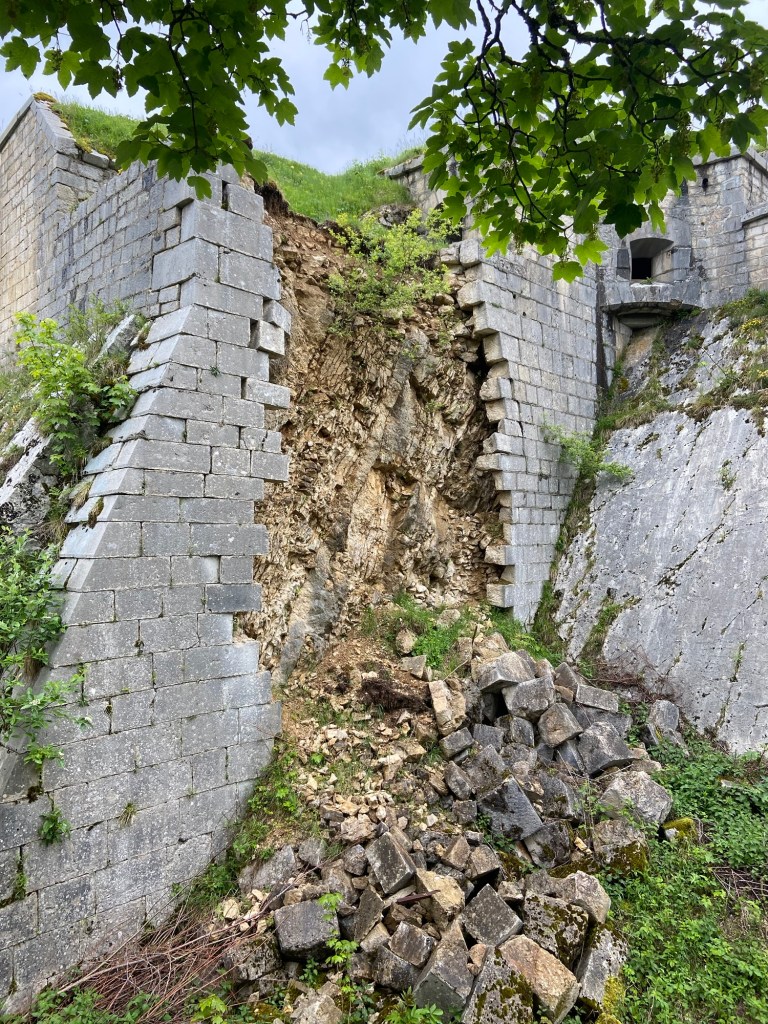
Unless we were standing at a belvedere where a view opened up over the flat plain, it was quite hard to conceptualise that we had been walking along the edge of the main trunk of a multi-branched gorge created by the Doubs, upstream of Pontarlier. The Fort of Malher sat atop one of the viewpoints the valley, and it provided even more spectacular views over its older neighbour, the Joux fort.
Up on the rock with us was a group of three retirees, like us popping on and off waterproofs as the showers came and went. A chaotic and happy group of tiny schoolchildren were being shepherded down the path. Their teachers were calling instructions to them which the children were utterly failing to hear as they ricocheted off each other.
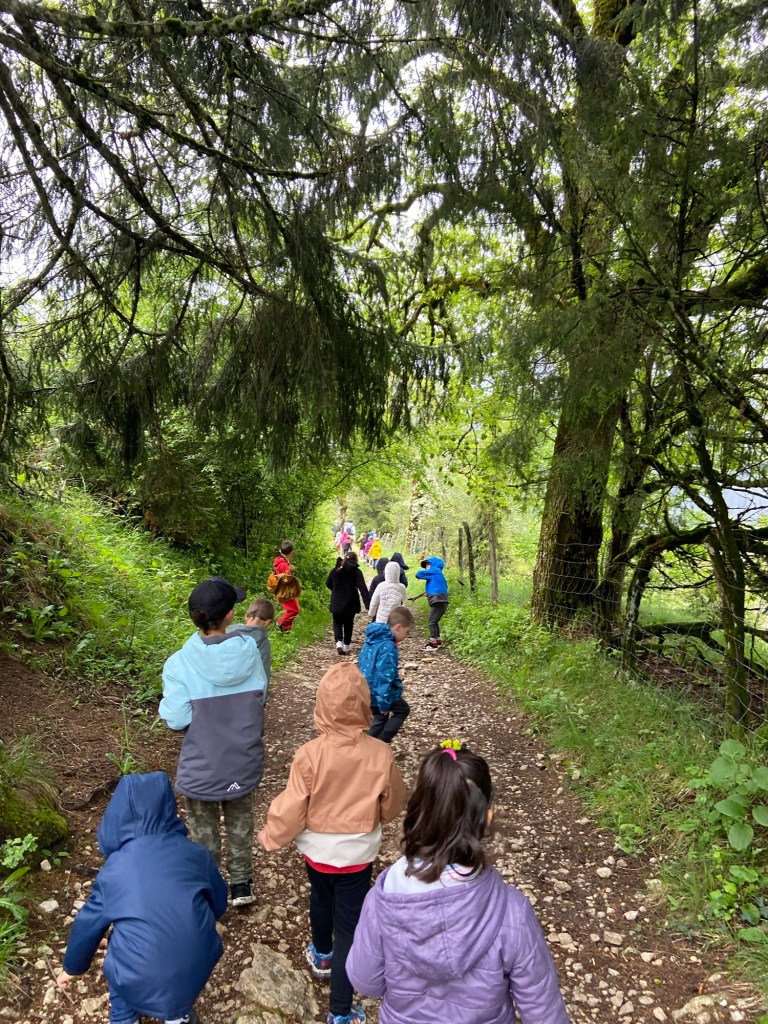
Once over the rocky lump we dropped down into another branch of the gorge, higher than before; in the last three days we have gone up in steps, gaining height each time until the Francigena will eventually cross its Jura crest later today.
The gorge valley was now given over to peaceful meadows and thickets of willows growing on the banks of the river (which rejoices in the inauspicious name La Morte), where marsh warblers called back and forth to each other. In former days the tightening of the gorge here between the two high-up forts guarding it had proved useful for collecting tolls and taxes, with duties applied variously on salt, iron, spices, rice and silk.
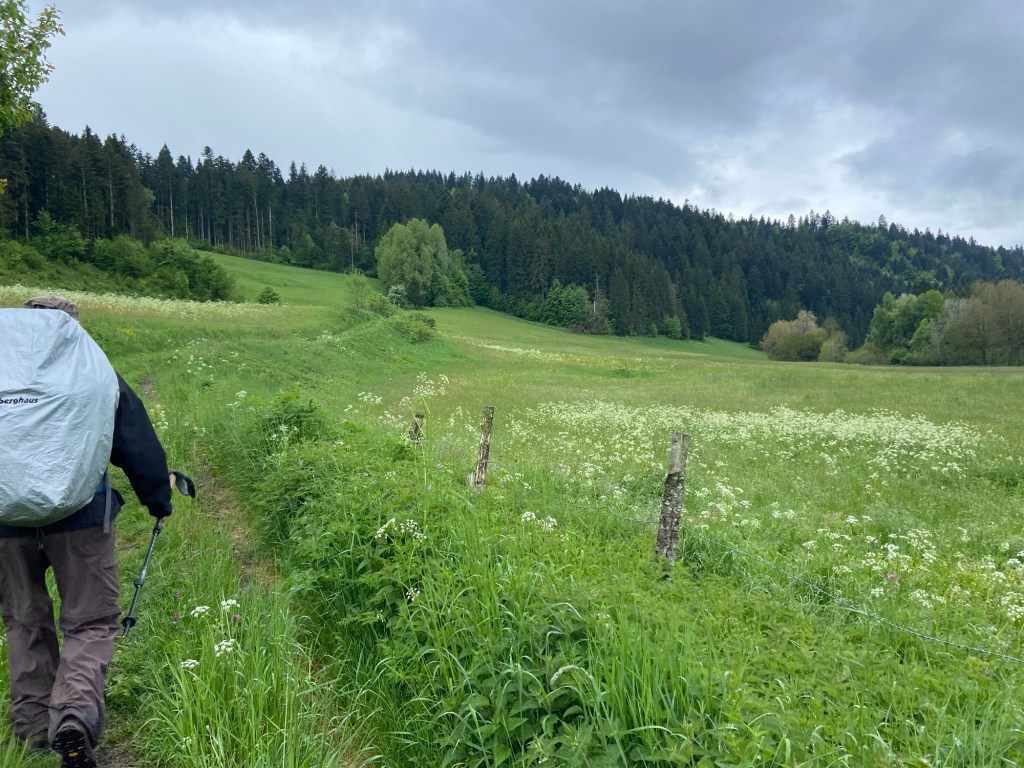
The valley was so bucolic as to offer a grassy path through which we waded, thoroughly soaking our footwear and in Aphra‘s case, her trouser bottoms. Having crossed it, we climbed again through the next section of forest, an obstacle course this time.

The deciduous slopes above us and ahead were cut through by narrow paths deep with mud. Climbing poles were an essential piece of kit today, to stabilise us and to act as a kind of a pole vault to get us over the muddy sections.

I graded the paths Steep
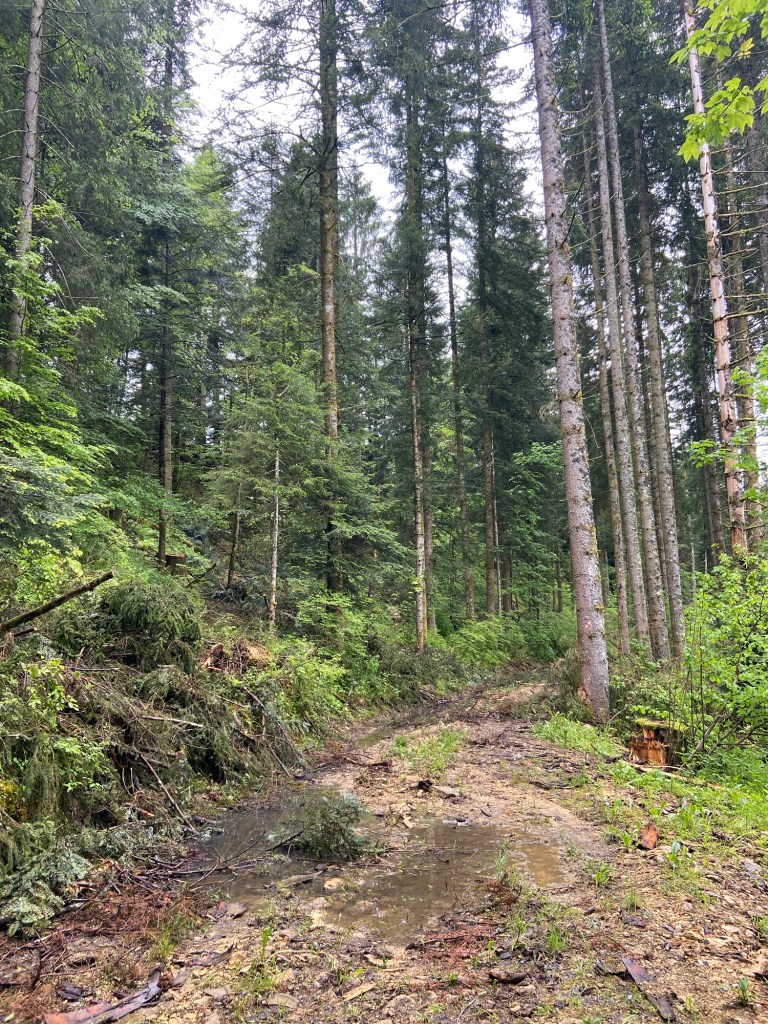
and Really Steep, although Aphra’s company made traversing them all light work.

Cow bells from unseen pastures contributed a counterpoint to the soundtrack of birdsong. We debated whether the cows themselves would mind having bells round their necks, and Aphra was of the opinion that they probably did. We exited the trees into one pasture as a farmer with his dog was in the adjacent field checking his herd, and as he crossed back into ours to return to his farm, his dog swung behind us, to herd us all together.

The farm formed the centre of the hamlet of Montpetot, six houses and a striking chapel with a commanding view,

over pastures grazed by the distinctive local Montbéliardes.
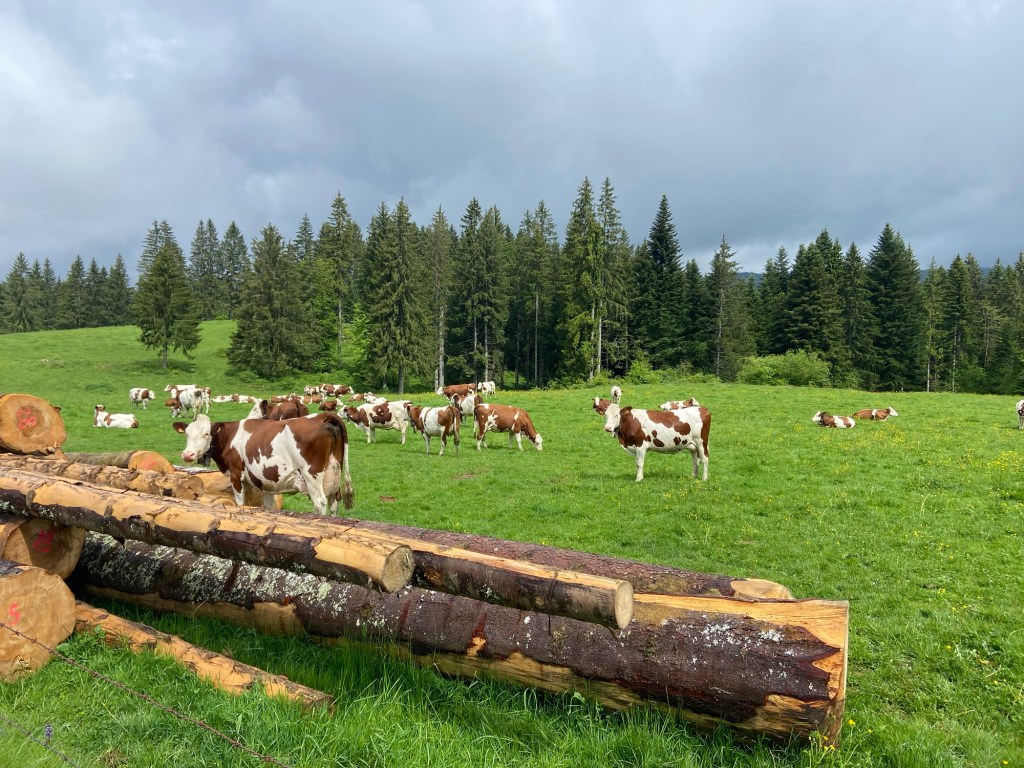
We stopped to admire the bells round the necks of the cows, wondering whether the date 1997 was the year the bell was cast.

There was something quintessentially Alpine about the houses now. They all had the steeply-pitched roofs with wide eaves and timber cladding, and stood amongst huge sloping pastures with pine forest edges.

A feature of today’s walk was an ingenious way to cross a fence line, a combination of a stile and a cattle grid, shaped like a little bowed bridge with posts on either side to haul oneself up by.
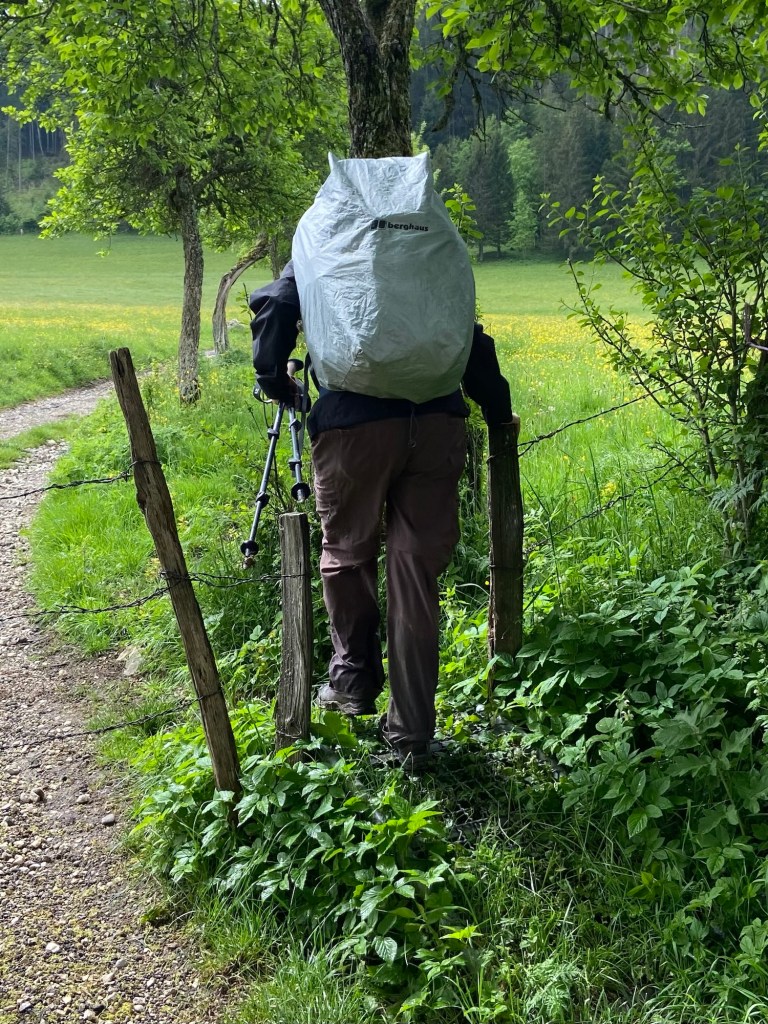
With our packs on, we were grateful not to have to climb stiles.
After the hamlet came the very last of today’s steep forest paths, but this high up it drained well and wound through forestry up to join an asphalt road at last.
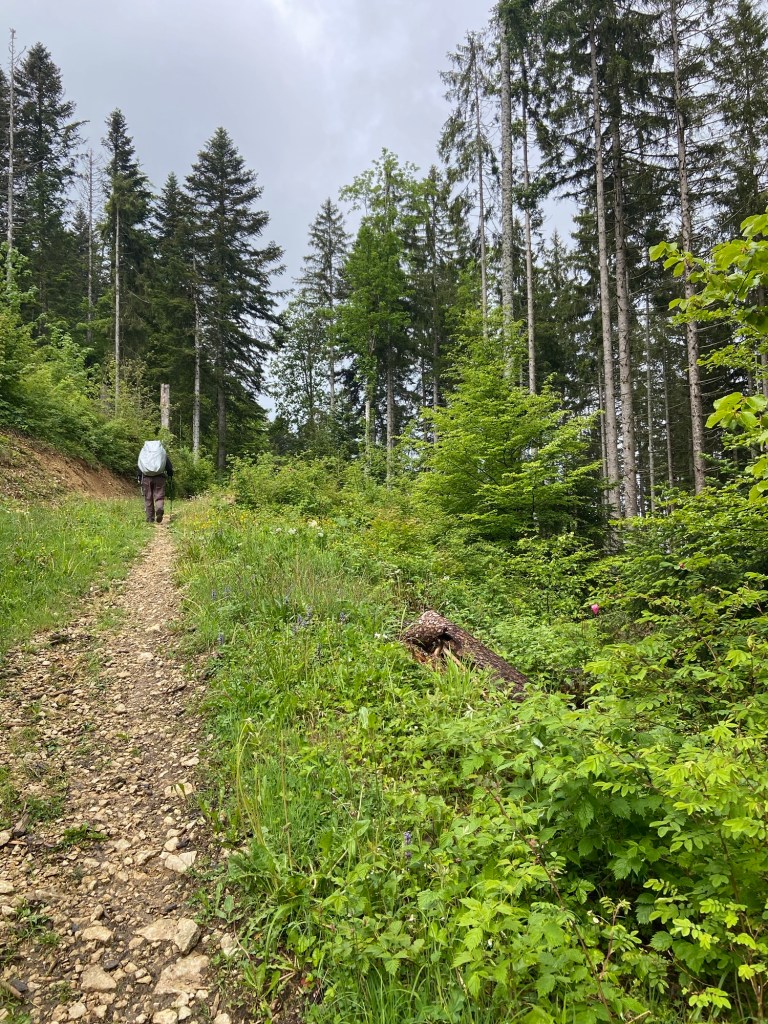
We were still climbing, but now through flower meadows sloping gently down to the first houses in the long roadside community of Petit-Fourgs and Fourgs, not in fact indicating the presence of a historical forge but rather from the low Latin word meaning ‘fork’. I don’t know why, since there was but one long road, the start of which was marked by a well-tended wayside shrine.

Fourg itself was something of a centre up here in the remote hills. The weather was by turns sunny and overcast, but we coincided with the village’s communal vegetable garden and picnic table during a sunny spell, so we sat on the slightly damp benches and ate the cheese and ham rolls we had made up from the youth hostel’s generous breakfast buffet.

The burghers of Fourgs seemed to cultivate a whimsical bent as well as vegetables; after hours of pine forests and meadows it was odd to see a train carriage marooned on the outskirts of the village, and who knew Valkyries travelled by caravan?
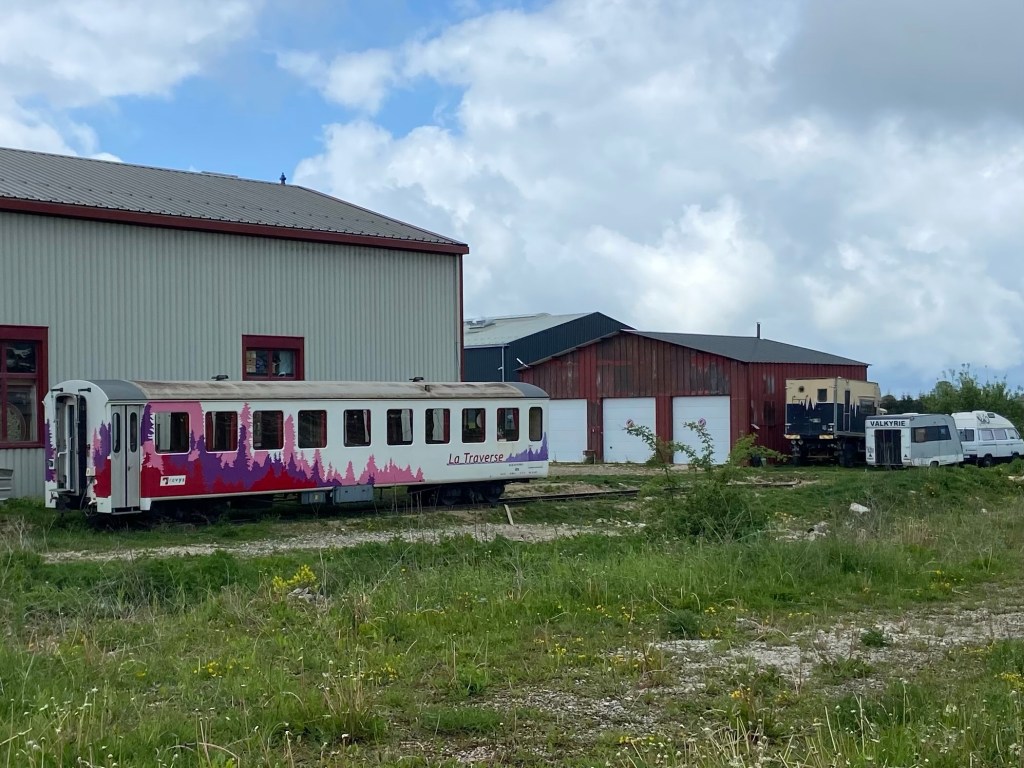
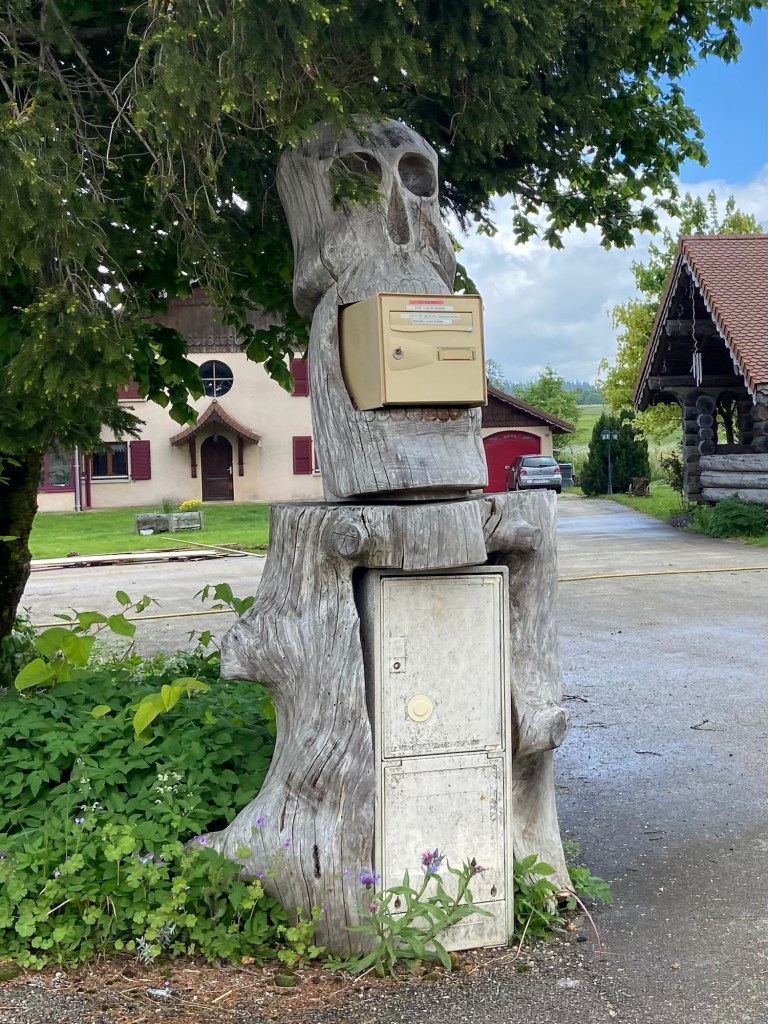
Down in the village proper the creative Fourgs whimsy was expressed in the form of a mad sculptural surround for a letterbox,
and a pictorial address for a cowbyre in the centre of Main Street. It looked like the inhabitants had been kicking the door to open it.

We were reminded of the lateness of the spring here, up so high, and grateful for the wide overhangs on the pitched roofs of one chalet-style house, when it unexpectedly started to hail and we briefly sought shelter for Aphra to cover her rucksack again. But it was very brief, and the ski lifts on the edge of the settlement were buried in spring grass and not the deep snow which would transform the character of the village later in the year.

We turned away from our last views of the village and set our faces towards the final climb upwards to the summit of this whole first half of the Road to Rome, as we now climbed to the highest point of the Francigena in France, past wet roadside timber piles steaming in the afternoon sun after the last of the day’s rain.

It was an easy road giving us time to gaze around us and appreciate the richness and variety of the wildflowers, a profusion of blooms we supposed would eventually be turned into hay. After the focused ascent on the forest paths it was good to be able to breathe deeply and fill our lungs with the clear air.
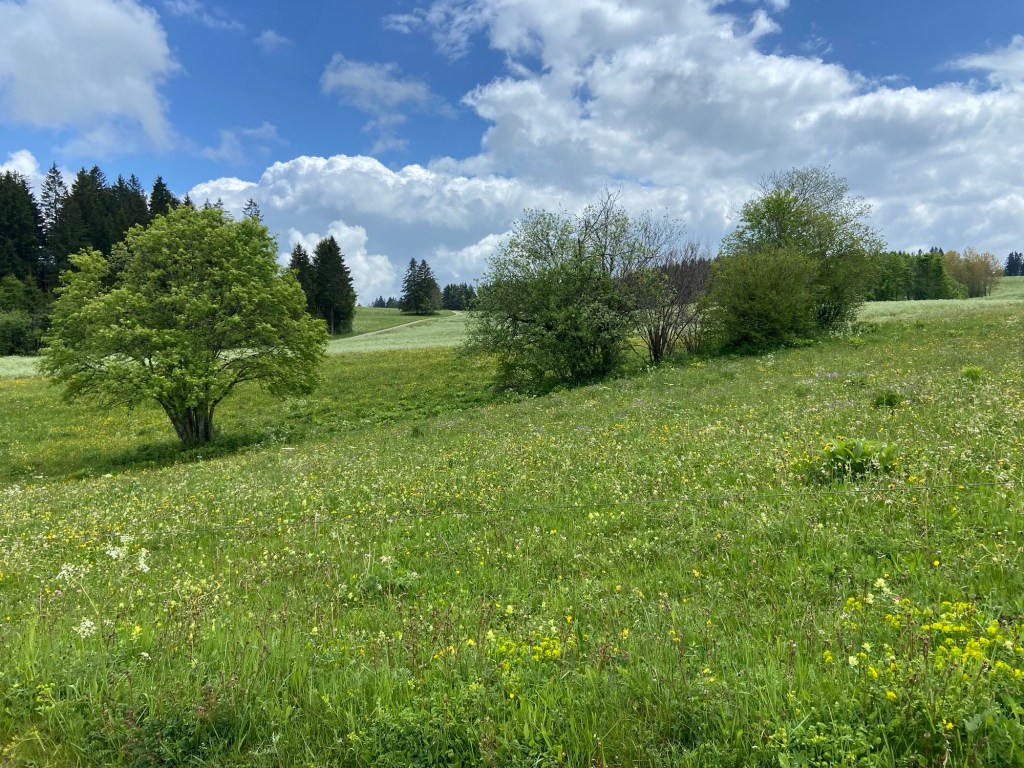
Spring was noticeably later; there were still cowslips and wood anemones in the forest verges and spotted orchids still firmly in bud. Although I had walked through spring turning into summer in the lowland fields and woods of France as April moved through May, high up here in the Jura it was still early spring, and we were surrounded by acres of the freshest, greenest leaves as we summited the French Francigena.
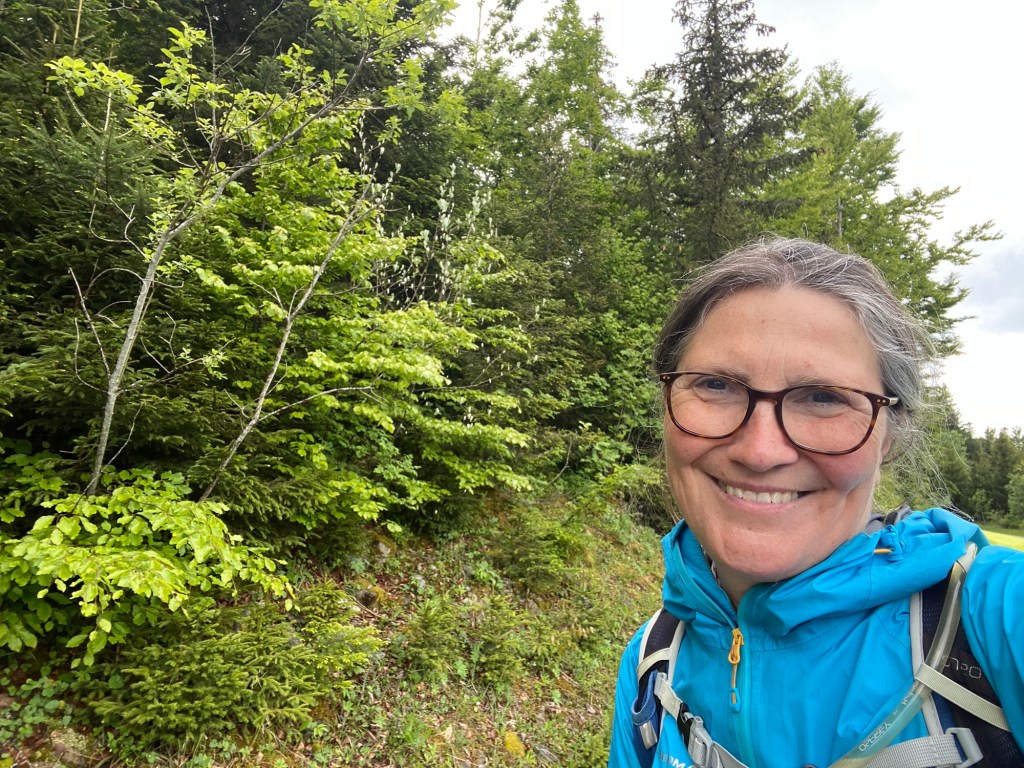
There now began the very nicest part of the day’s walk, a gentle descent through golden meadows over which swallows and martins skimmed.

This seemed a truly Alpine world — although ‘truly’ it was not; that awaits the second part of this great journey, next year. But the fields of flowers, the warm surrounding pine forests, the distant views of even higher hills with ski runs cutting through the trees… all seemed to breathe an Alpine air.
We walked down through a complex of immaculate farm buildings, utterly different from the ancient heavy limestone granges of the lowlands.

Here all was triangular in form: roofs extending almost to the ground, and timbered gable ends, a barn with a drawbridge-like ramp to access the upper floor.

Triangles continued to control the lines of the composition as we came downhill from the high meadows into the more populated valley,

where some houses were ultra modern takes on the traditional chalets,

and others emphasised the agricultural history of the area, with traditional wooden and leather clogs, a recently-used scythe and a wild goat skull arranged around the letterbox on one side of a doorway from 1870.

La Seigne was a centre for Nordic skiing. A farmhouse-style skiing centre had an intriguing shingled shed with curved walls; we theorised that it was a sauna but we had no way of knowing without breaking in.
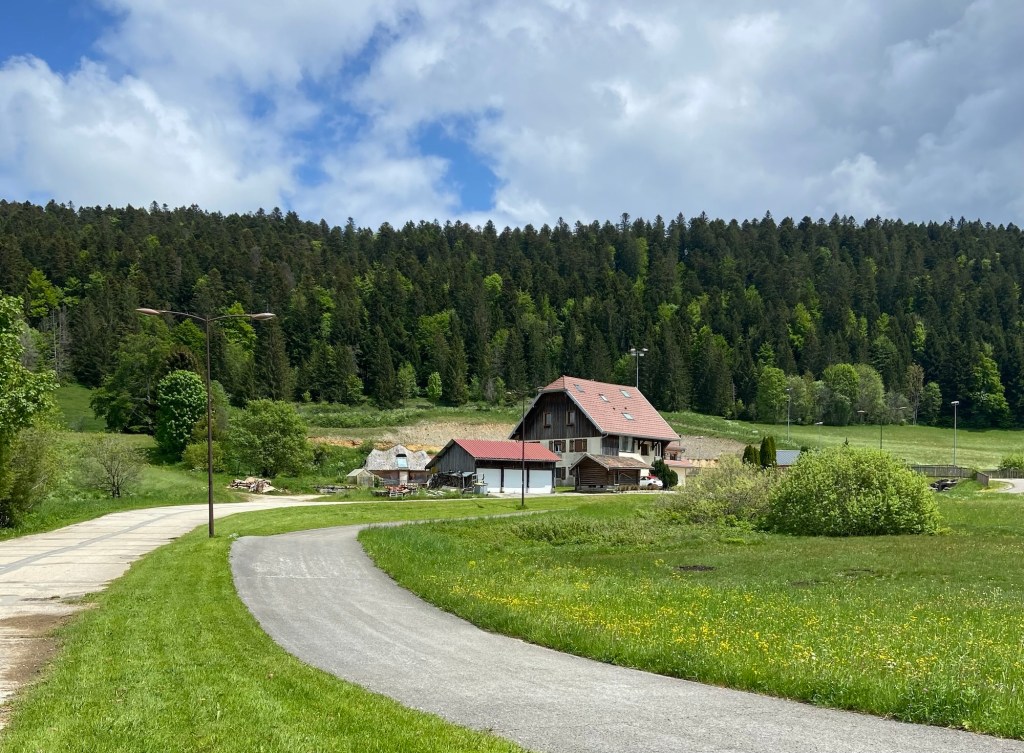
The main building to hire cross-country skiing equipment and begin one’s day out on the many tracks had a green roof, long racks for boots and an impressive start/finish archway.
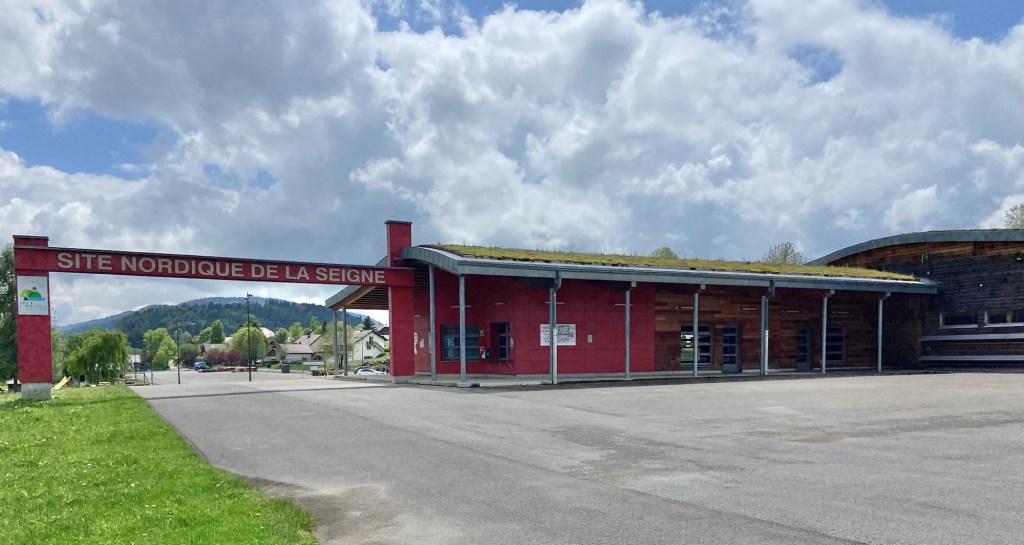
It functioned as the gateway to the town: the Francigena descended on one of the cross country skiing routes,

down past houses capable of being battened down for the winter at a moment’s notice,

contemporary angled roofs in modern outskirts giving way to older farm buildings with limestone block walls, perhaps dating from the time when the village had housed a leper hospital.

In the middle of the more recent settlement of Les Hôpitaux Neufs was a market hall-type building structurally reminiscent of centuries-old meeting spaces at the centre of many ancient towns.

It was filled with dozens of hanging baskets in plastic bags for easy watering, all ready for hanging around the village to usher in the early summer when it comes, as I thought, but Aphra found out later from her slightly tipsy landlady that there had been a village party, and all the mothers had been given one.

Aphra had an hour and a half to wait before she could get into her accommodation, so we went down to the bottom of the village to stock up from the supermarket to provision ourselves against an otherwise expensive three days in Switzerland.
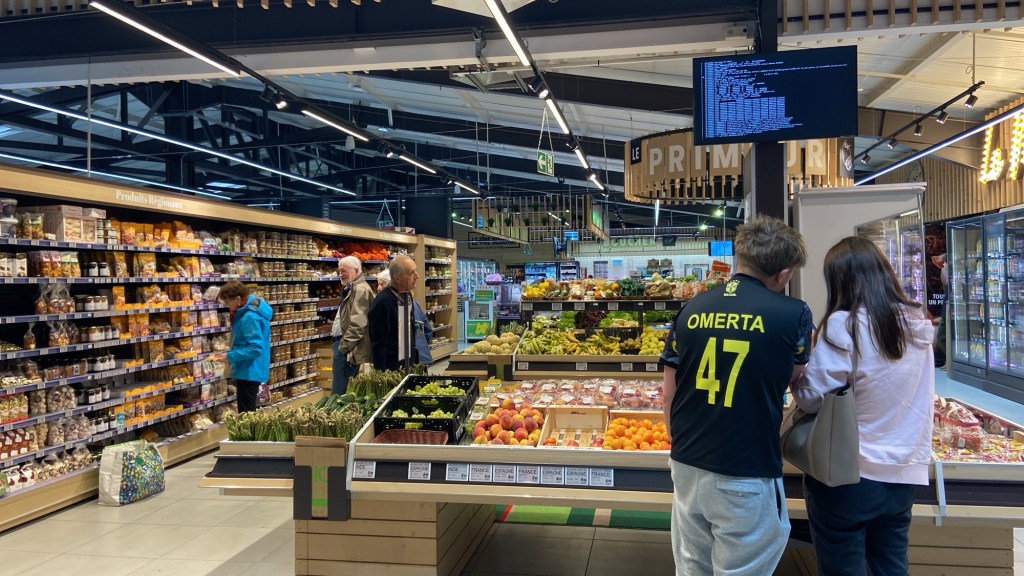
With the frequent triangular reminders during the day, I had not forgotten our prismatic confectionary aspirations, and furnished myself with a Toblerone that I broke into half to share with Aphra. We would not be walking together tomorrow as I still had to continue down the valley to Jougne this afternoon, but perhaps our paths would cross again, before or even in Lausanne.

I carried on down to Jougne, down the steep main valley highway. It wasn’t far — indeed the villages are pretty much joined, although Jougne seems the older.
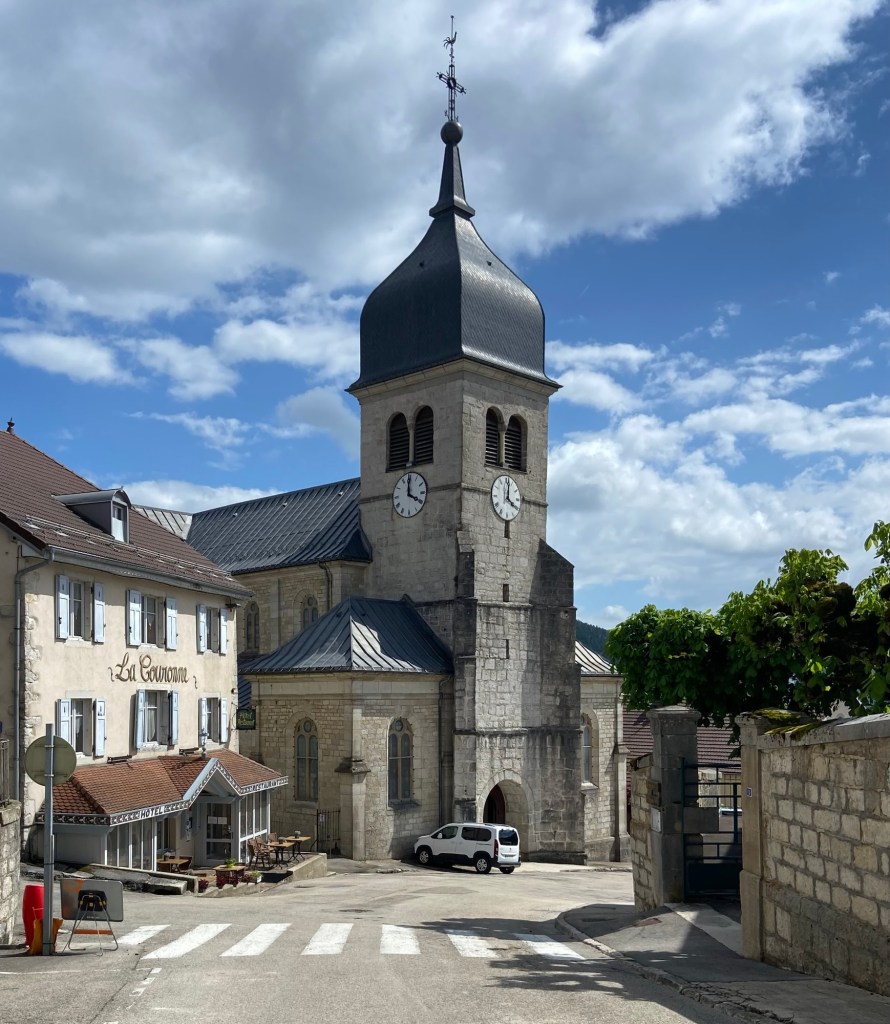
My day ended by going under the gate framing a view of the church and the steep valleys beyond, with my hotel, the Couronne, right next door.

I had a the warmest of welcomes from Margarida, who showed me to a huge room with the most luxurious of facilities: a bath to soak my aching muscles.
Stats for the Day:
Distance: 25.79km
Elevation gain: 694m
Pace: a sedate 4.5km/h
French Kilometres remaining: only 4.1 !!!
 Walking The Landscape
How lovely to clock up your last French kms in such great company!
LikeLiked by 1 person
Yes! It felt like a real joint endeavour. I hope Aphra had such a great day as I did today as well ☺️
LikeLike
Sedate??! A real treat to have such good company, especially for the moist, steep ascent. Hope the bath aided sleep.
LikeLike