Nothing is so insufferable to man as to be completely at rest […] without diversion
Blaise Pascal
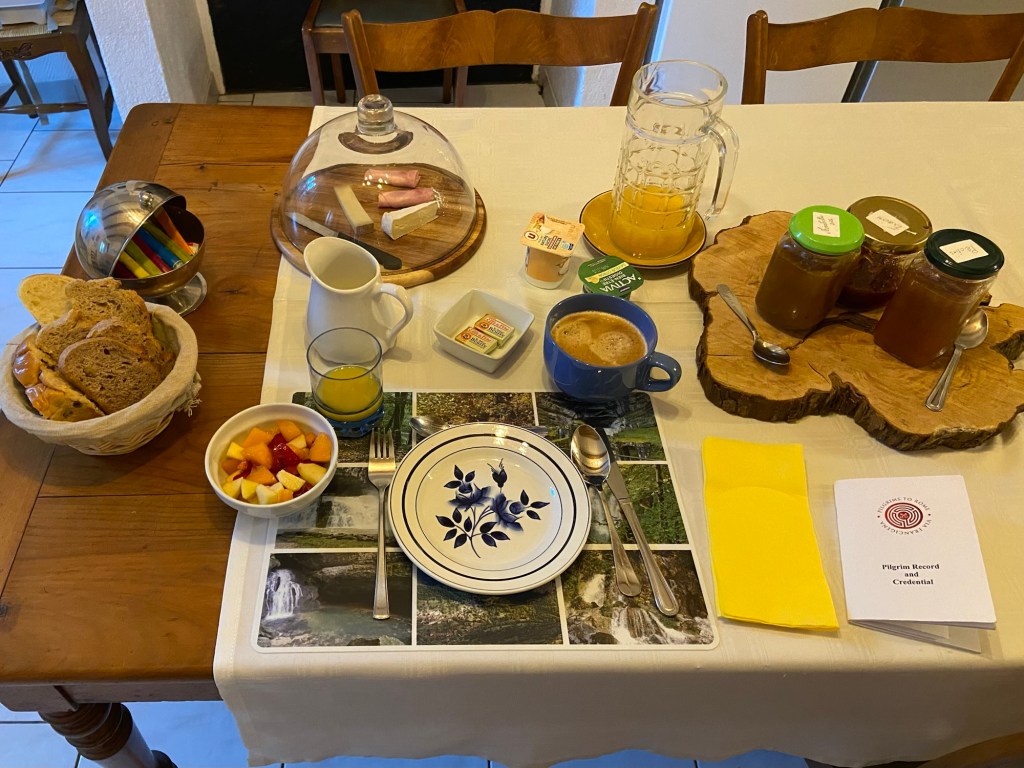
Nadine at the Maison de Léonie had laid out a stupendous breakfast for me this morning. I fell upon the fruit like as to a scurvy knave, slurped up an excellent bowl of coffee, and used the cheese and ham to make a small sandwich out of the walnut bread for later.
It was already raining so I tried to pack as effectively as possible, making the bulk as small as I could so the rain cover would fit on optimally,e taking as much out of the wide pockets and lid as I could and putting everything in plastic bags if I couldn’t. At last I was ready to leave — wishing I had seen more yesterday of this tiny village than just an interesting roof which reminded me of the miraculously twisting corrugated iron one that we used to have in our town back home,

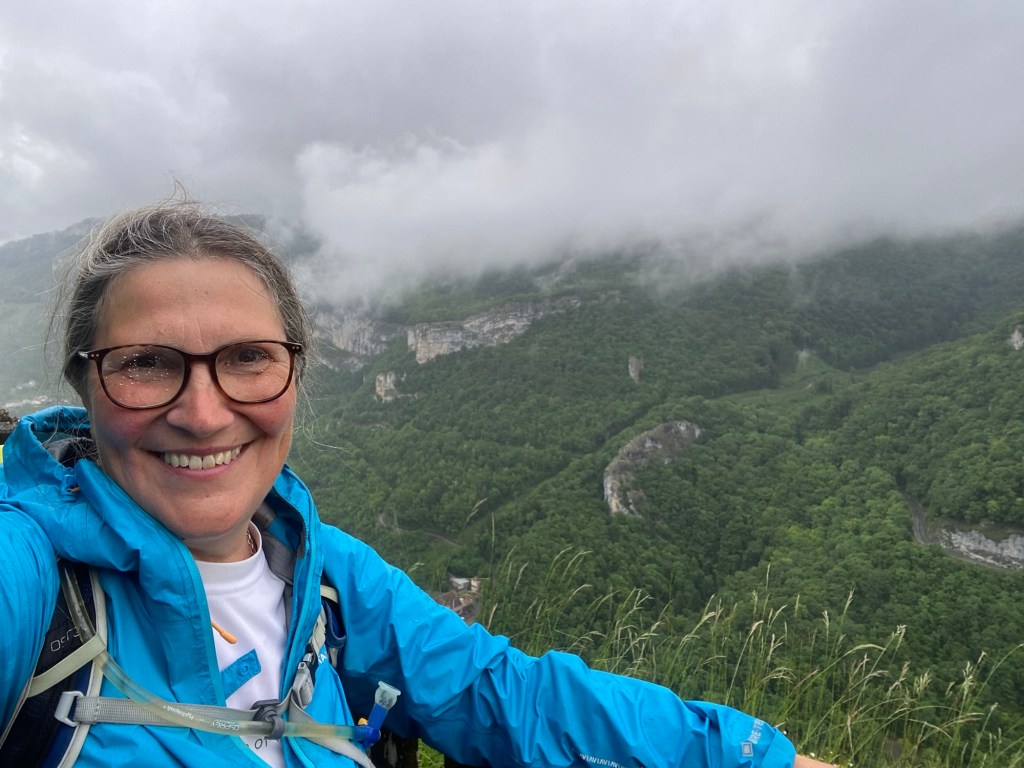
and an inspiring view in more senses than one.

The official Francigena path took me down near to the river where an army lorry was unloading. Perhaps my friends from the bridge from yesterday, still on exercise on the river Loue, here to patch up the broken bits of trail?

Sadly it wasn’t the same group. So I turned to the matter of the trail, which was clearly closed but with a sign directing me to jump off a parapet, and tried to make sense of the complicated arrows on the post which seemed to be spinning me round in all directions.
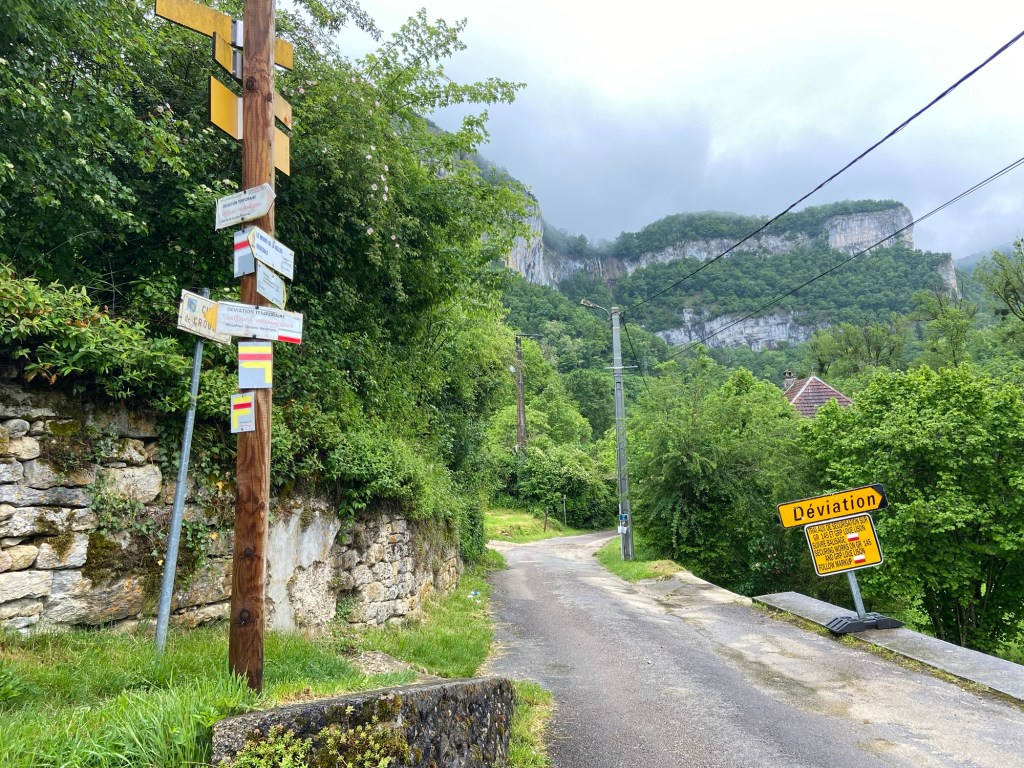
I finally figured out that the diversion was going to take me over to the opposite bank, and my heart heaved a small sigh when I realised that, of all the possible diversion paths, it was going to take the one which made a wide loop away from the gorge path and instead of a smooth, gentle sinuous rise with the river, was going to take me up the precipitous cliffs I’d seen last evening and had imagined myself admiring from the comfort of my garden sauna.
It had been a dream as fanciful as the one painted on a wooden panel outside one of the houses in the village above.

The first climb of the day — or should I say the initial section of what turned out to be a steady 5km of climb — was a long poured concrete road in which diverse dogs and a man wearing work boots had left their prints, as had an unwary mountain hare.

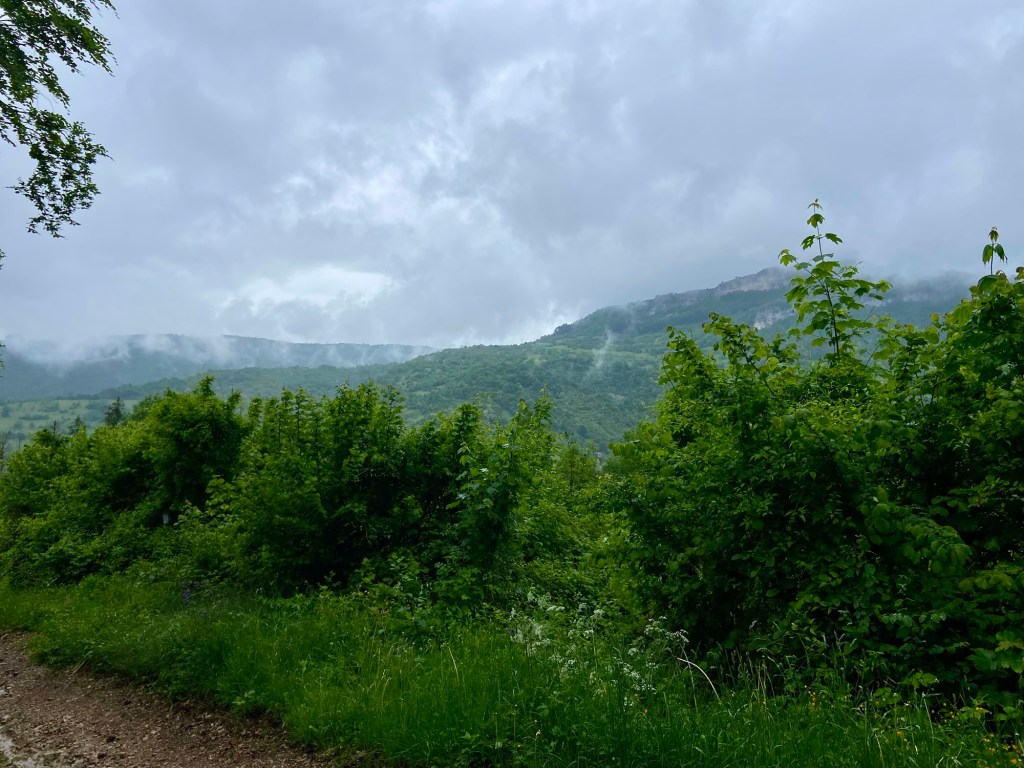
This eventually gave way to a very decent gravel road which although steep warmed me up nicely, and steamed up my glasses so that I might as well not have brought them). Dramatic views opened up over to the opposite valley from where I’d come.
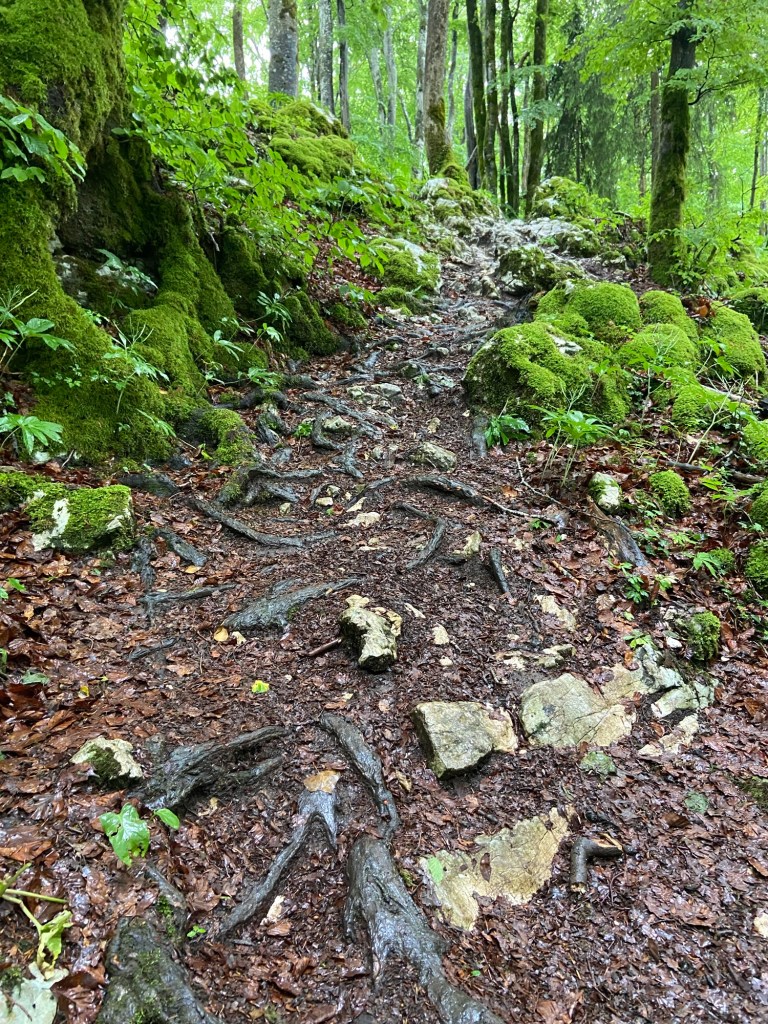
Steep paths of earth then followed, washed away to reveal the rocks and stones beneath despite heavy metal guttering laid down in an effort to carry the water off the path down steep gullies, and leaf litter sodden by the rain.

Already there were fallen trees to negotiate,

which made me feel intrepid and galvanised, if not a little sweaty. The much-vaunted wicking properties of high-tech waterproof fabrics were nowhere in evidence. I was soaked to the skin and thought I’d never get dry.
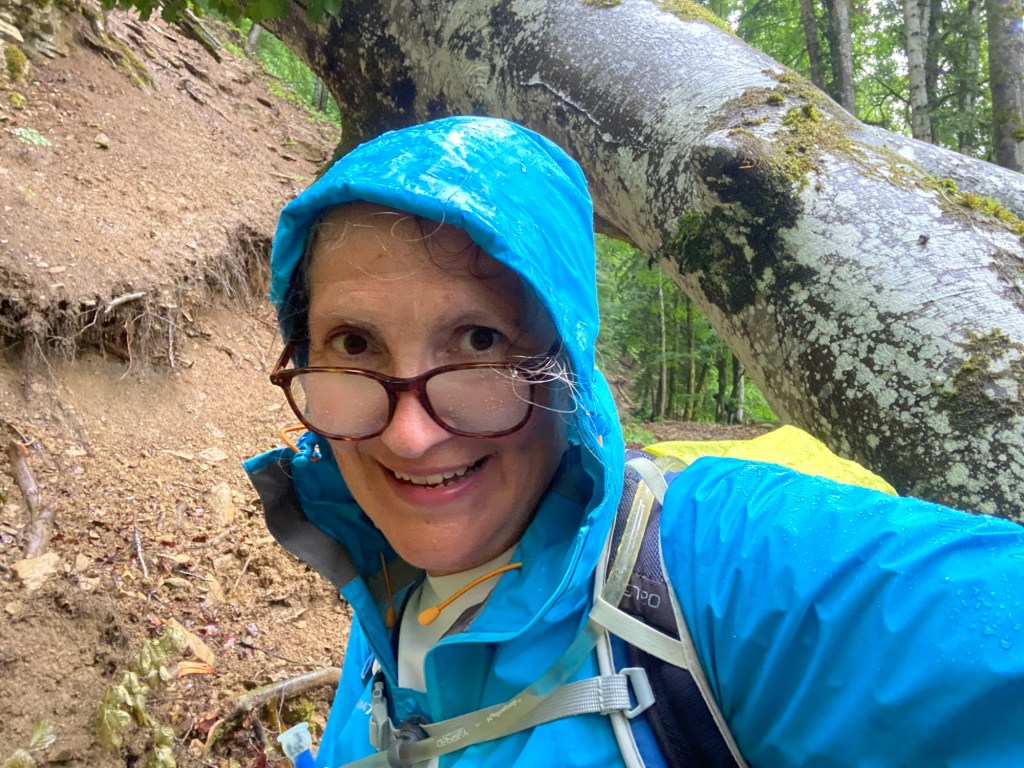
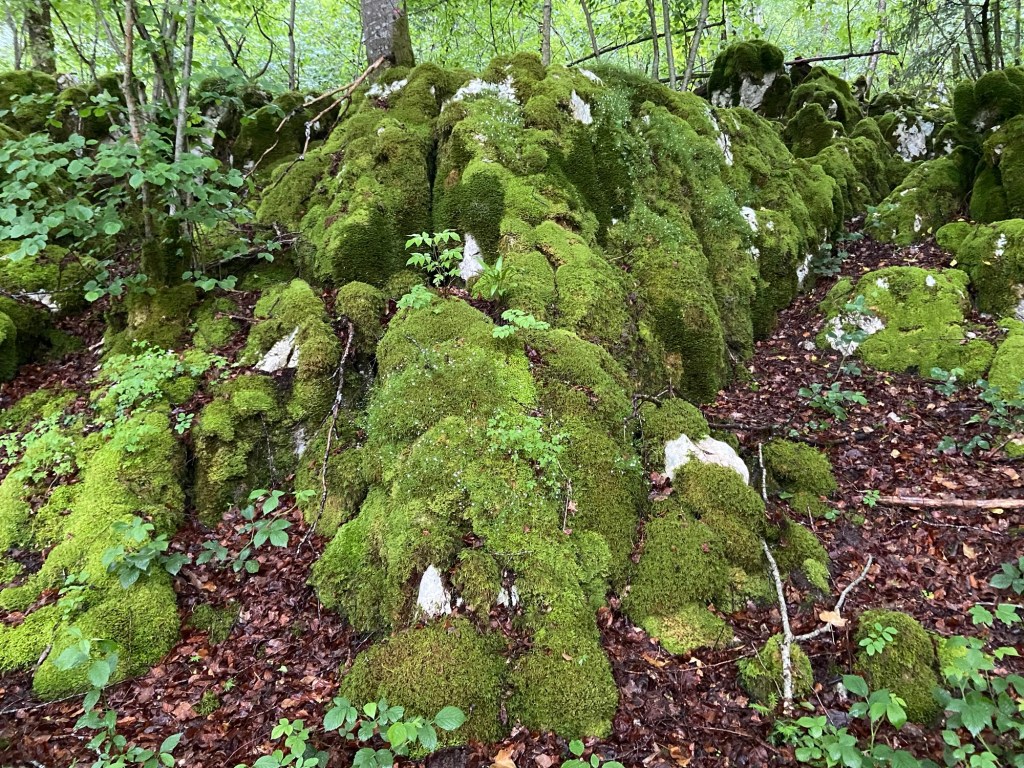
The uphill slopes were sometimes covered in limestone boulders under thick mats of moss,
and to the left were gullies so steep that I was walking exhilaratingly at the height of really quite tall trees.
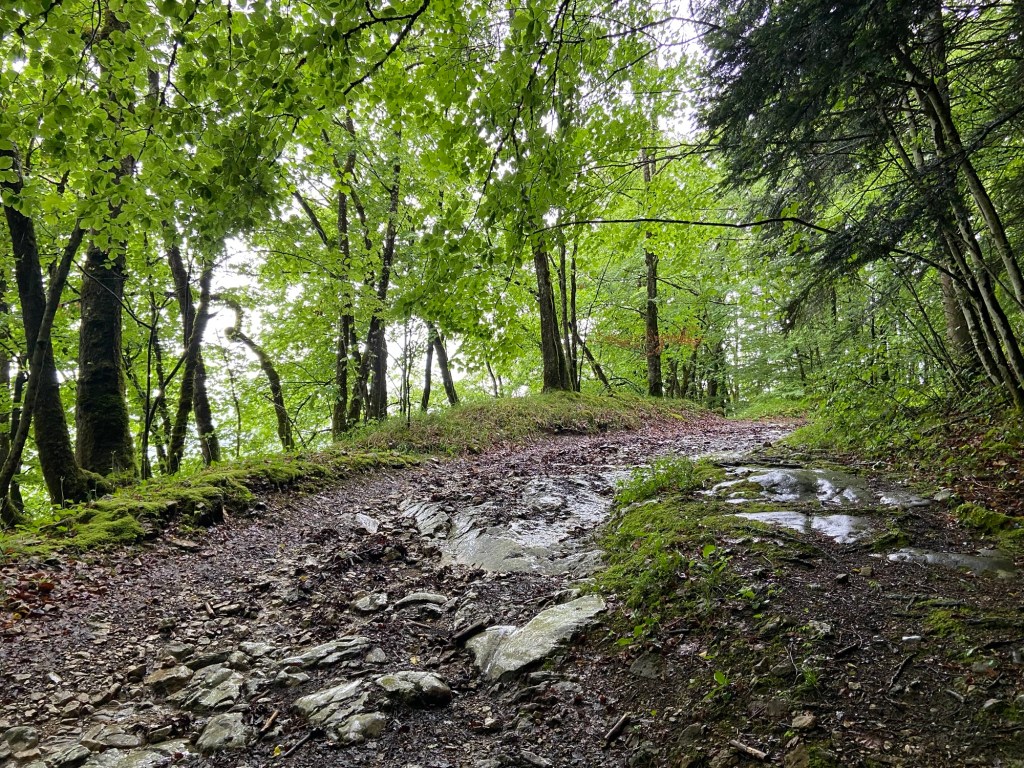
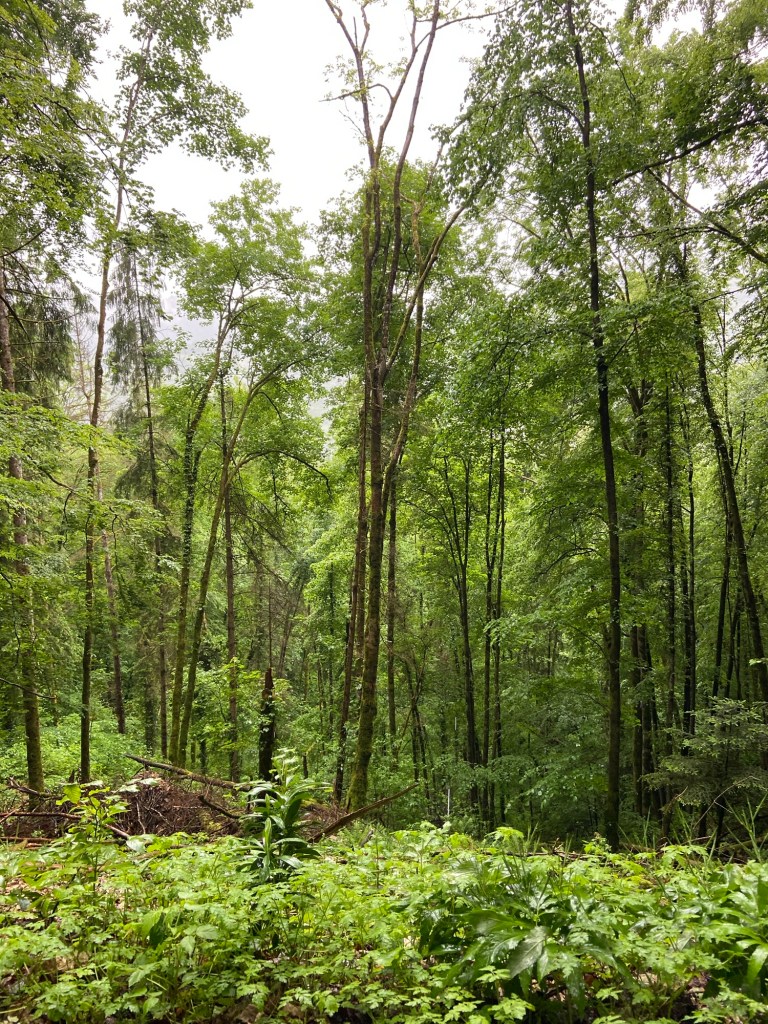
Underfoot was rough but not slippery at all for all that, at times with chunks of bedrock exposed. I was glad I was going slowly and steadily up and not descending, which I find much less secure and harder on the knees.
There were plenty of opportunities to catch my breath and peer through the thickly wooded slopes to try and make out a view — but it was all so misty that there was pretty much nothing to see.


Sometimes the cloud stole eerily through the tree trunks,
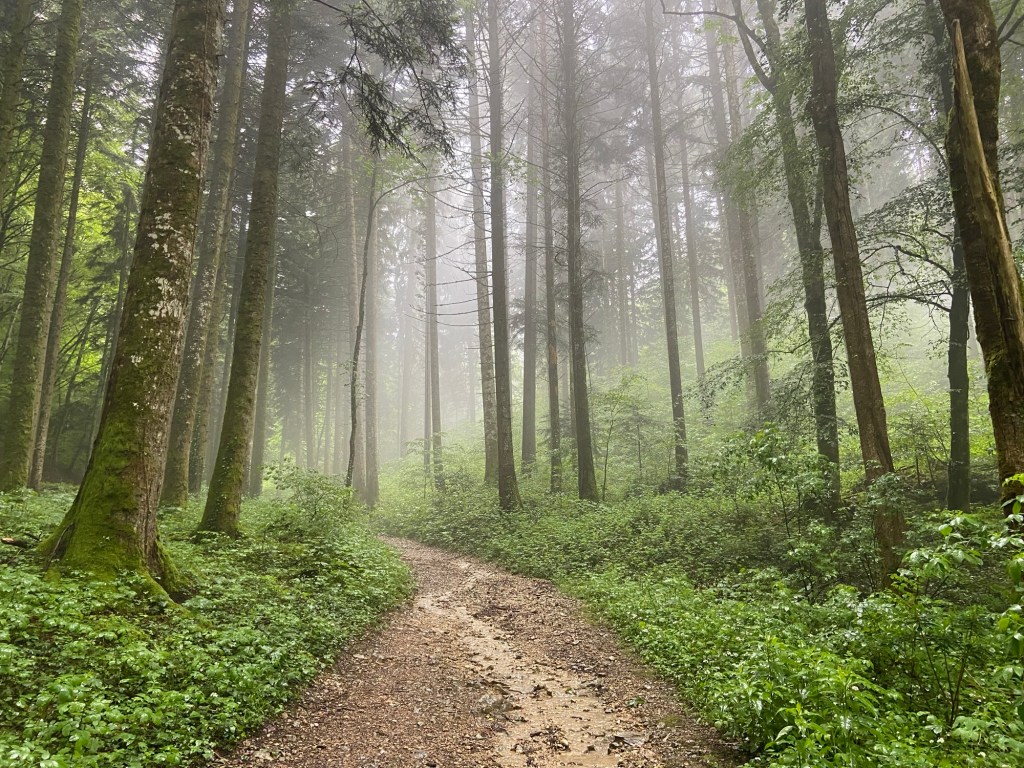
but the path was always completely obvious and always perfectly signed. Which was a relief since I was completely reliant on the signage today.

The gorge path must be frequently closed: internet searches last night for a map of the diversion to try and gauge distance and height to help me plan the day had yielded nothing except many references to closures in 2022 and 2023. I realised that they must keep the diversion path properly signposted as an alternative route to the Source of the river Loue, and simply put out a few extra large signs down by the river in Mouthier Haute-Pierre to funnel walkers onto it.
I could only imagine the damage there must be with fallen trees and rocks in the gorge when I came across another tree fallen over my path. This one was a little trickier to ease myself and my backpack underneath; it looked recent but not so recent that chainsaws had not been out and I wondered why they hadn’t just cleared the whole damn thing.

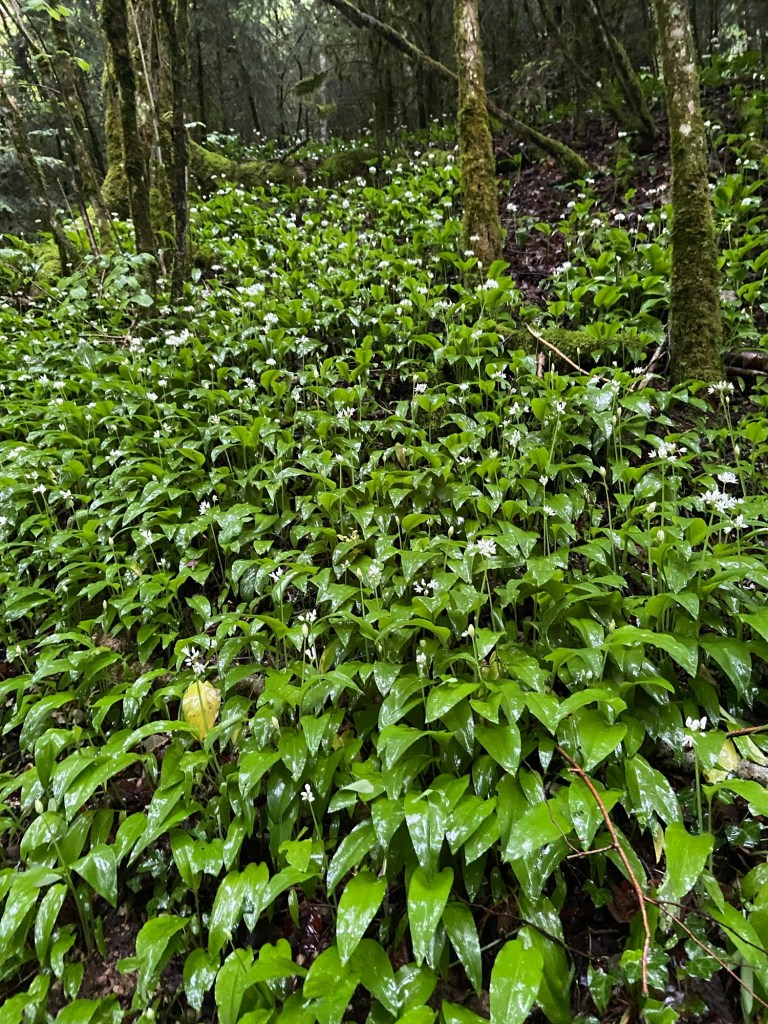
Rain fell constantly. I wasn’t particularly sheltered here, and neither was the starry wild garlic, leaves slick and shining with water, struck every so often with fat drops from the trees above so that leaves flicked in a random pattern of mesmerising movement.
I reached a junction of many forest paths and saw to my amusement that I had effectively done a great chunk of the Moine de la Vallée route that Alphonse had been researching yesterday in the bank. I’d said to him that I hadn’t got time for tourist diversions, I recalled, diverted.
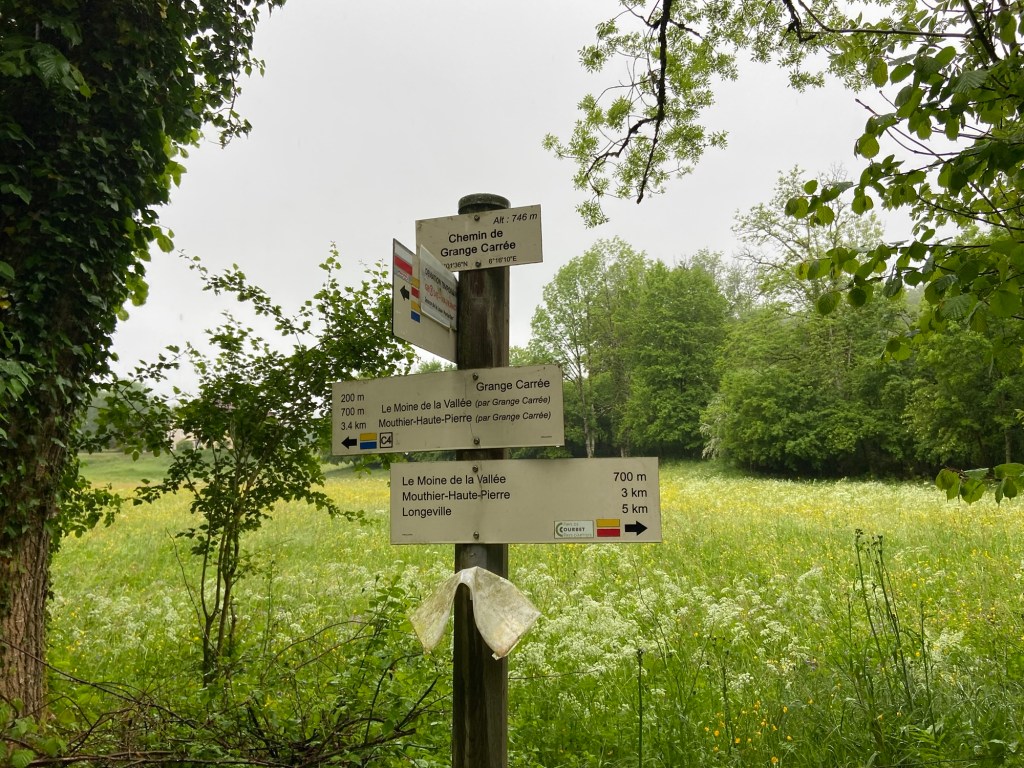
At this junction the Francigena took a much smaller, woodland path that wound now rootily up and down gentler beechwood slopes.
I could now see from my geolocated position on my map the likely path I would take. I was going to follow the curve all the way round the very top of the limestone cliffs, and on past the Source to then descend a zigzag path connecting to a road. Which would then lead back to the Loue. Hmm.

This was a lovely path. Beechwoods are surpassingly beautiful even in the wet, and these ones were dotted about with pink orchids and a narrow-leaved, mat-forming plant with the tiniest of white flowers.

I was eager for views to open up so I could see how high I was, and they occasionally did, though never with a clear view down the plunging slopes. I had a great thrill when I disturbed a chamois on the edge of a chasm — it flashed away down the rocks, unerringly surefooted.
I was getting to well-trodden paths now, as evidenced by a children’s camp shelter, its form echoing that of the ribcage of a great Jurassic beast abandoned in this Jurassic limestone landscape.

Suddenly a great vista opened up at a proper Belvedere. I was right up at the top of the cliffs towering over the gorge now and the view was clear: stunning, exhilarating, extraordinary.
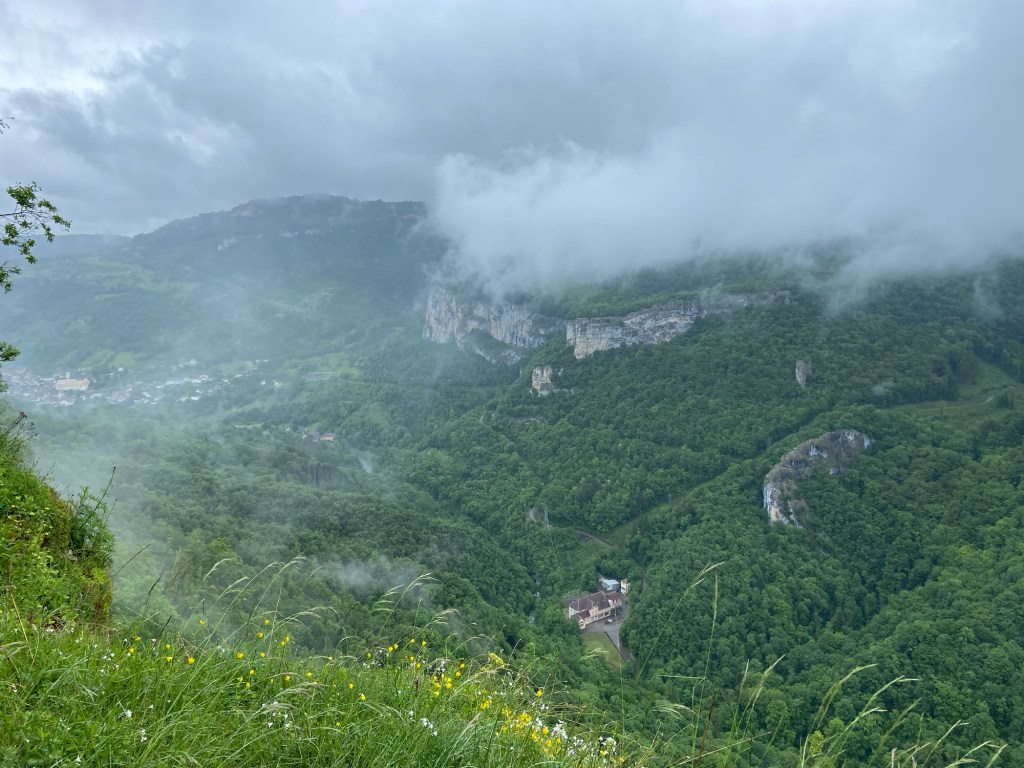
I was uplifted, emotionally as well as literally by the clouds welling up from the depths of the chasms, ever-changing, ever-renewing, like a tropical cloud forest.
The source of the Loue could not be more spectacular than this.
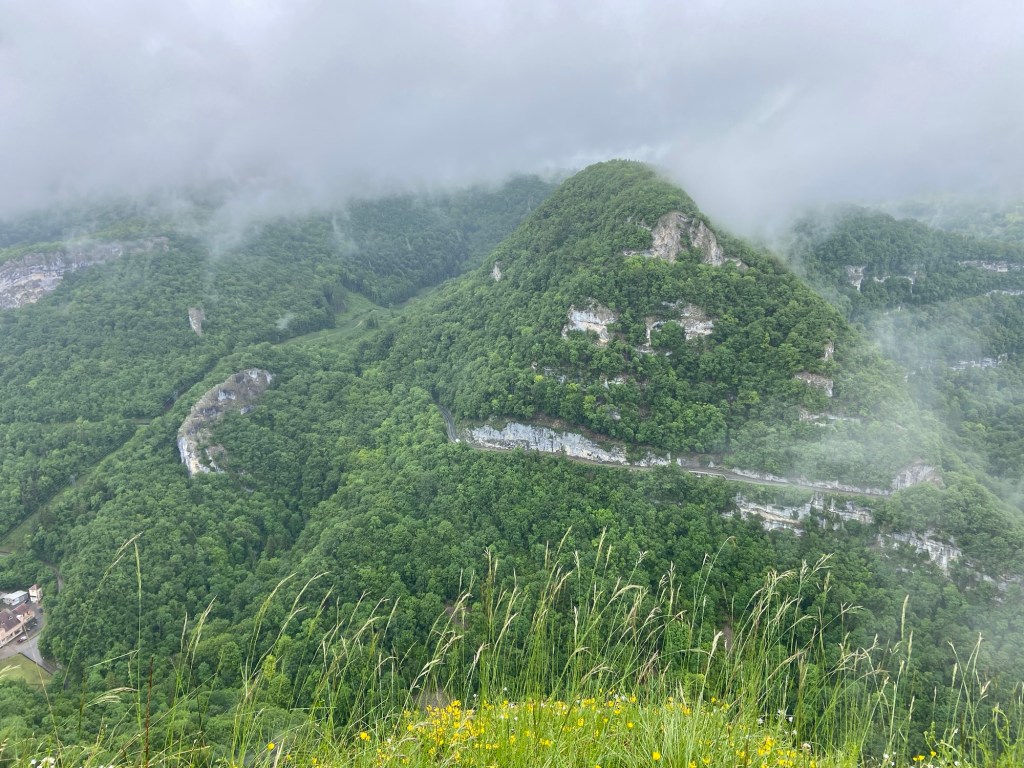
I was totally satisfied by this diversion and every moment of the highly enjoyable climb had been amply repaid.
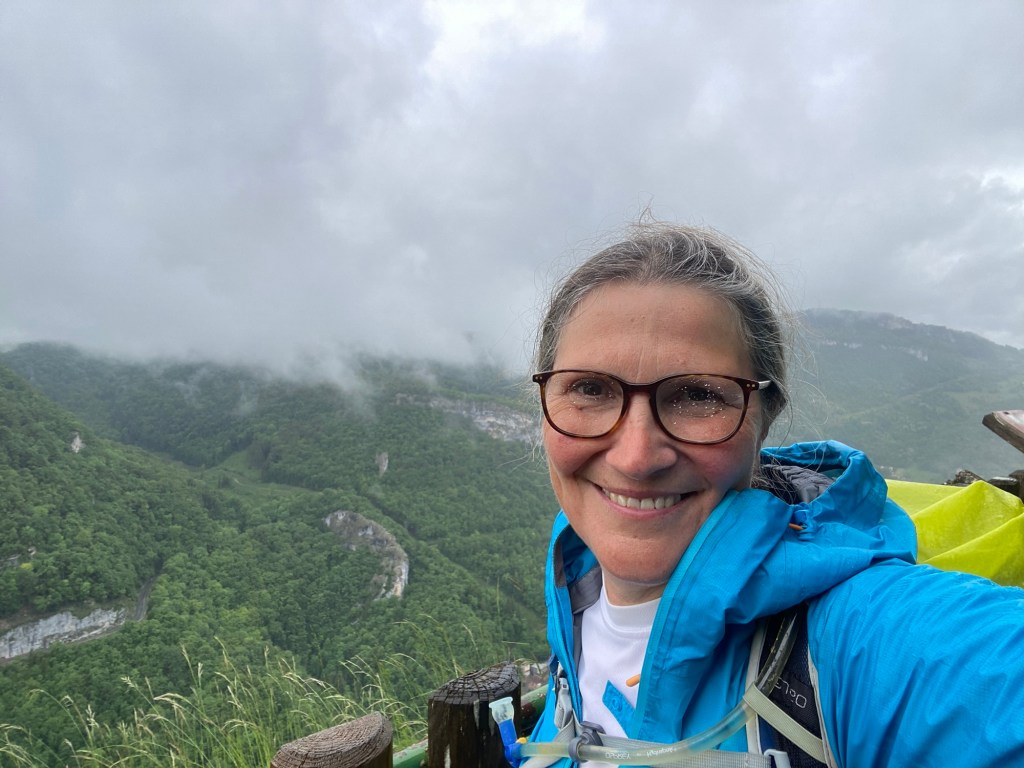
There was now a decision to make, and it was an easy one. To my left the path continued to the Source, with a potentially slippery loss in height of hundreds of meters, only to have to climb out of the gorge again to gain the village of Ouhans. To my right was the hamlet of Renédale (I could not think how the is came to be named — was it really an English toponym, tacked onto the end of a proper noun?), and an all-but-flat not to mention shorter road walk down to Ouhans. It was a no-brainier.
I ignored the multicoloured crosses telling me that none of the trails went this way; I remade them in my mind as festive bunting, welcoming me onwards.

The hamlet was unremarkable except for one house that seemed to foreshadow Switzerland, barely a day and a half’s walk away now,
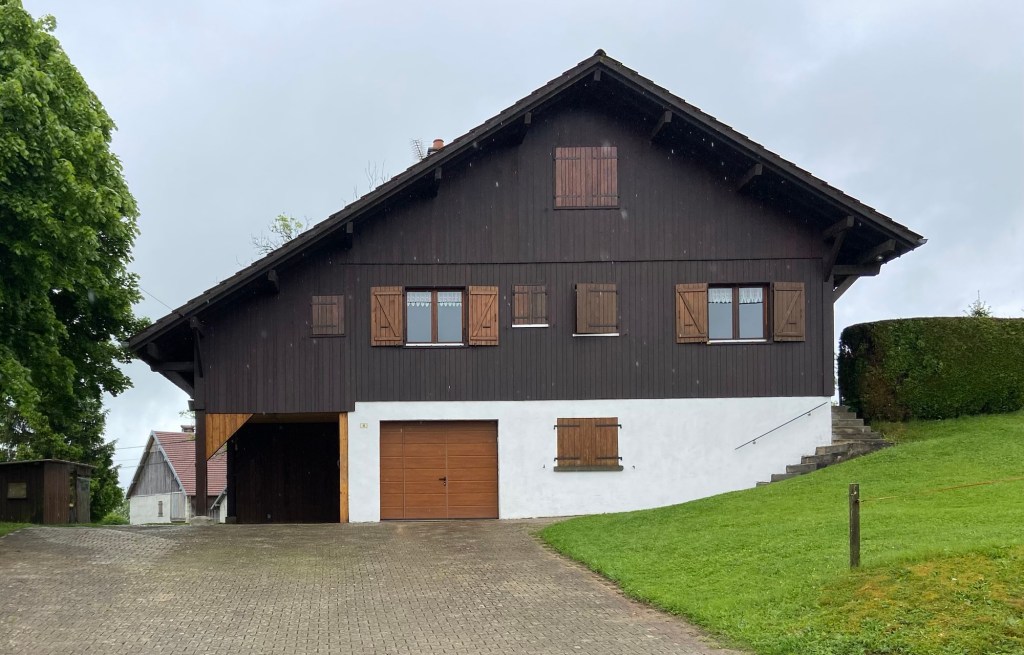
and then it was out into the rolling countryside on a pleasingly winding road. I ate my walnut bread cheese and ham sandwich.
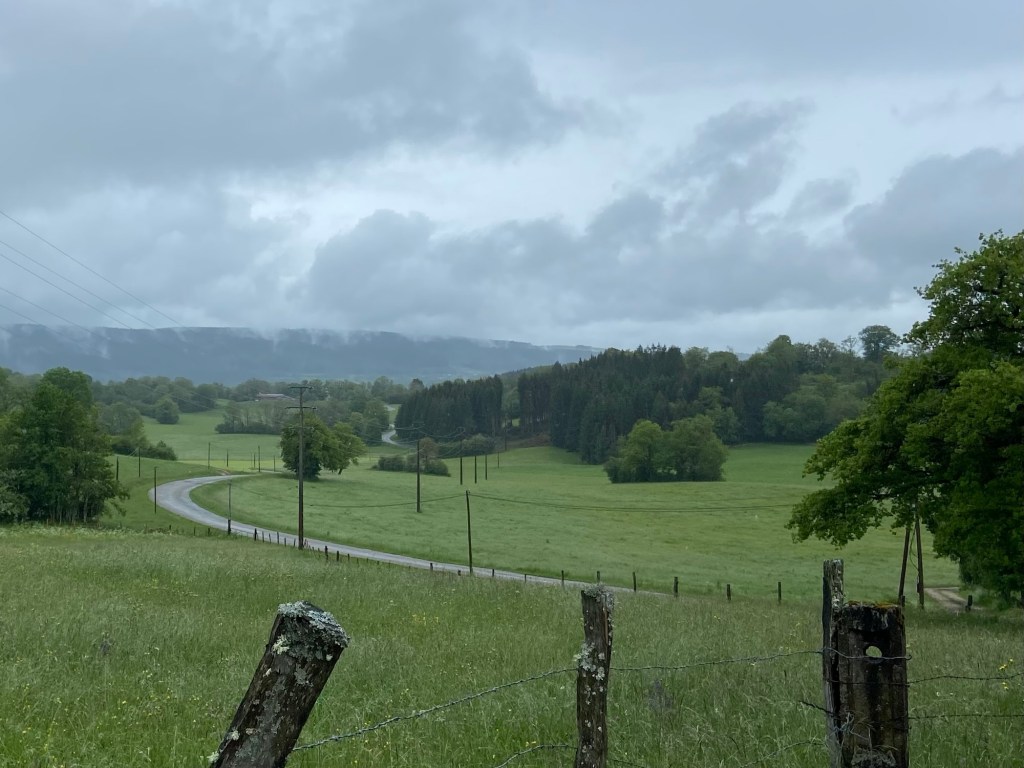
Ouhans was almost as unremarkable as Renédale, slightly off the Via Francigena proper and spreading out in the high plateau valley beneath yet another limestone ridge that I now must climb.
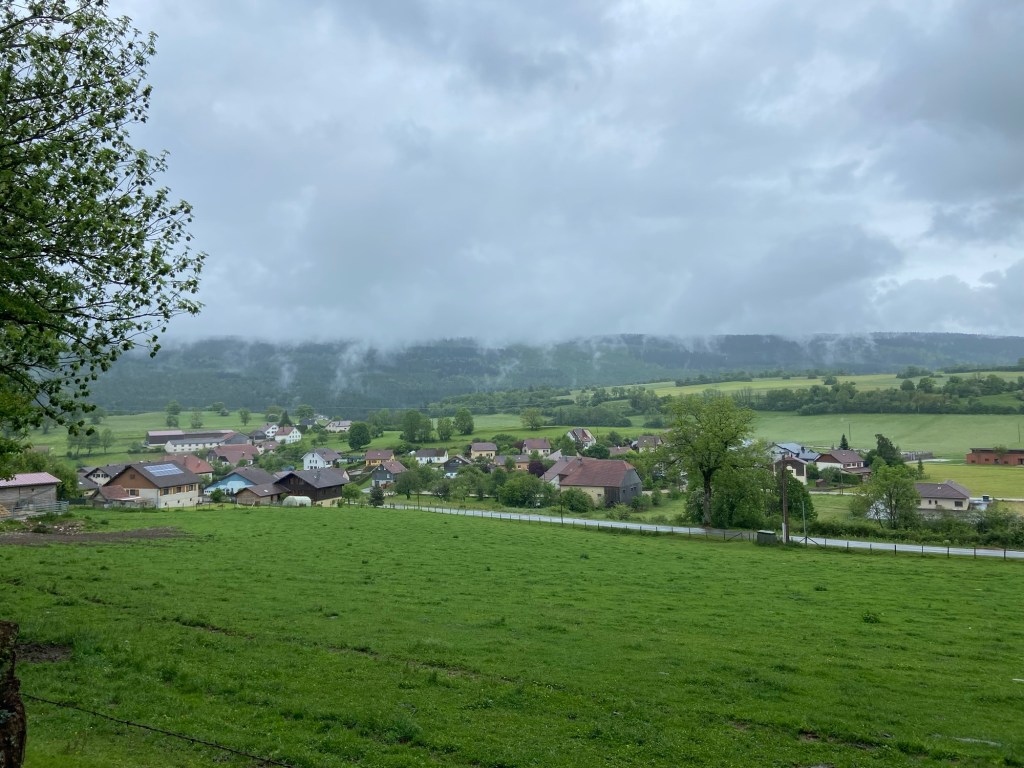
I had rejoined the Francigena on the far side of the village, beginning the second ascent at a sign saying there was to be no way out. But I rather hoped there would be.
The amount of cow muck on the track suggested there were some free-ranging cattle around and sure enough there they were, bells round their necks, browsing on trees. They lumbered round to look at me but I studiously didn’t look at them, figuring out I would hear their bells if they made a move.

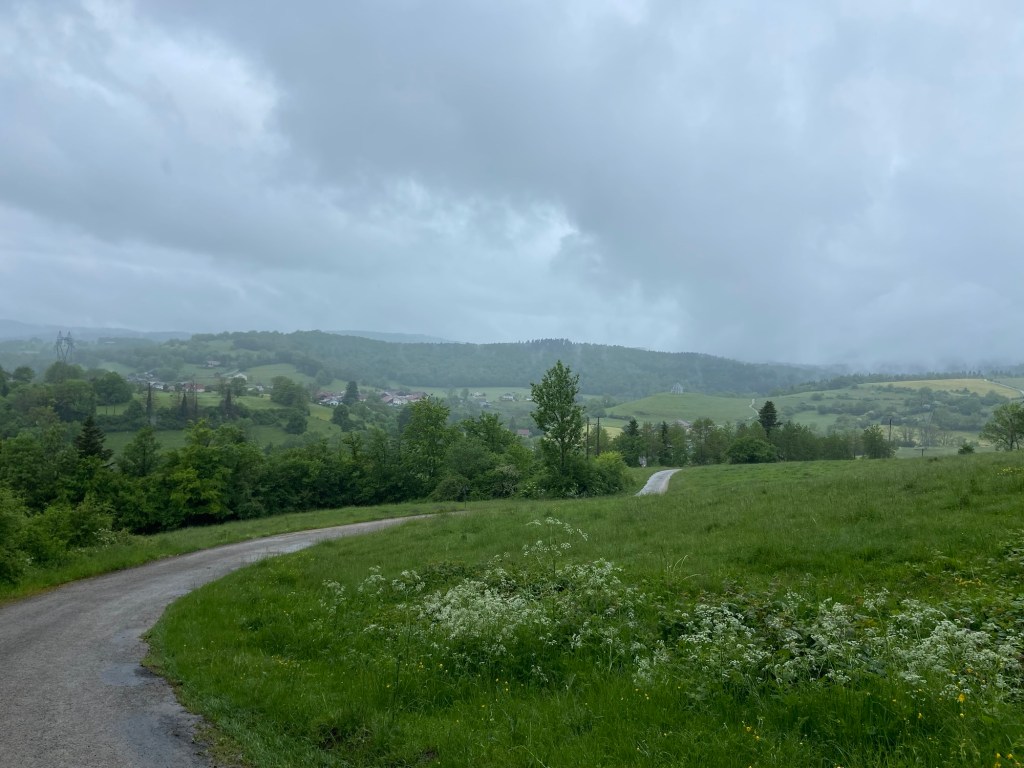
The views back as the track climbed were terrific; would have been more so on a clear day but were nonetheless lovely in the wet air.
At the bottom of the hill my hands had got really quite chilly, wet from the rain and lacking the faster-pumped blood from the exertion of a climb, so much so that I was having difficulty getting my phone in and out of my pocket to take photos of monkey orchids,
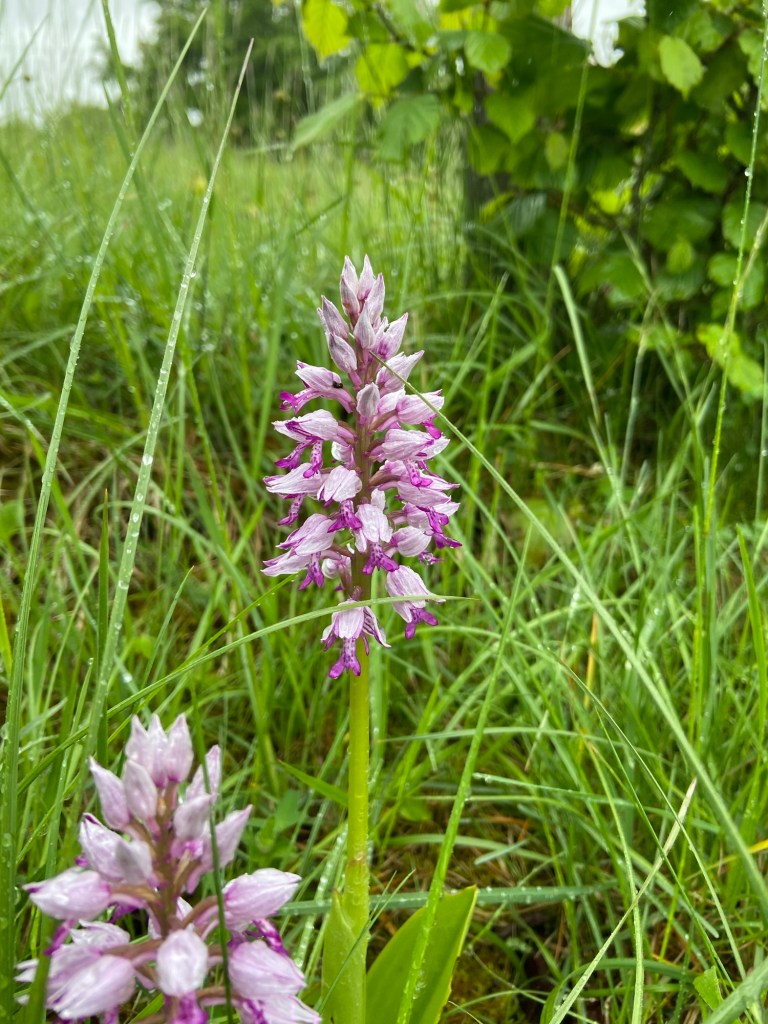
But I persisted because they were lovely and I simply couldn’t help myself.
I was climbing amongst wet meadows now, which yesterday must have been waving in the hot sun and light breeze (how glad I was that I wasn’t tackling the ascents in the heat!) and which today were bowed down with the weight of water droplets. I wondered how much extra weight I was carrying in the water that was soaking me. My hands were now quite pink and warm with the exertion.

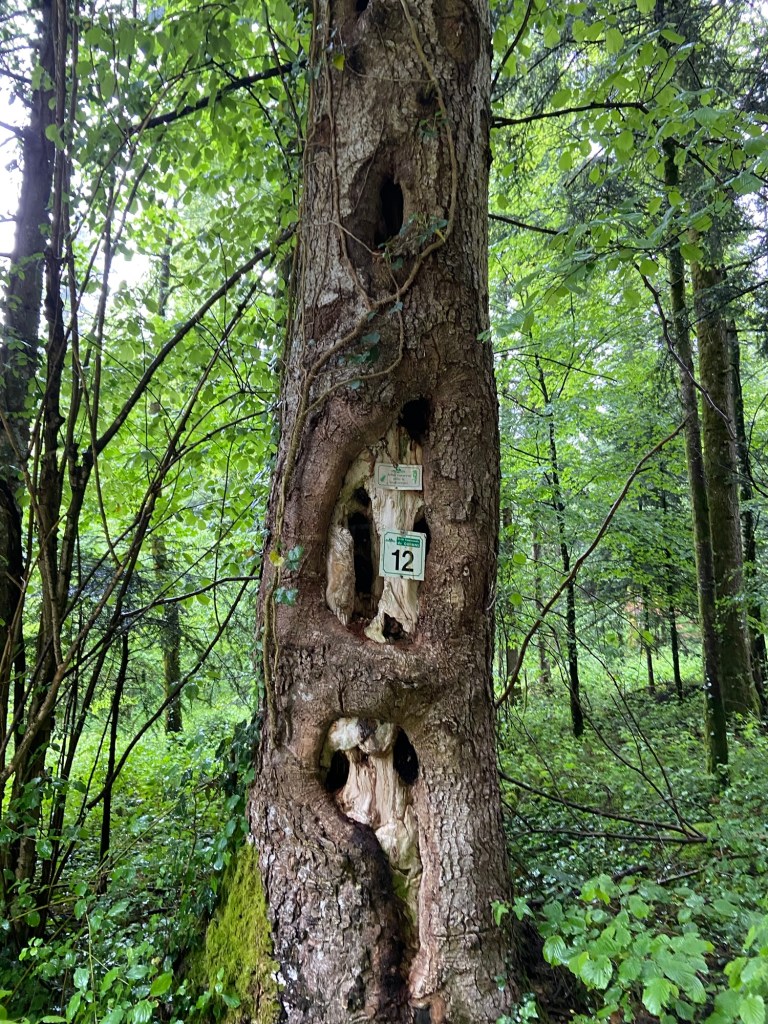
And then I left the meadows behind, climbing up into a plantation woodland, not boring at all, for the interesting trees that kept cropping up,
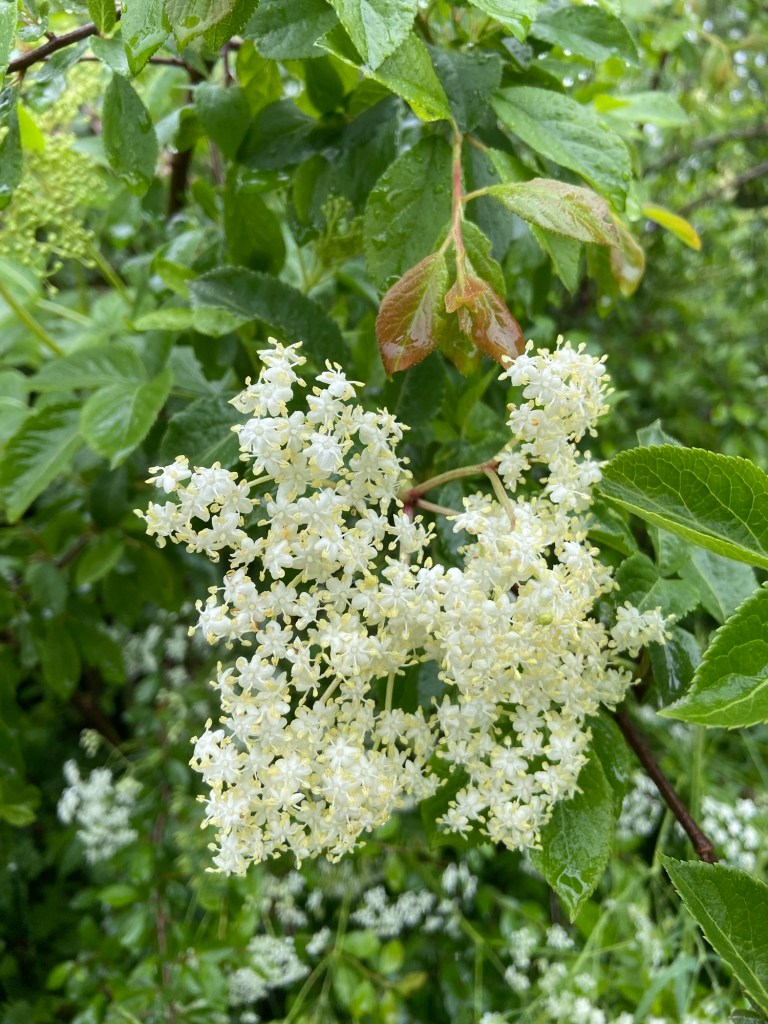
and the first elderflowers of the season — which made me think unfailingly of Stephen and Kitty, who have been going out together ever since she was tiny to forage for creamy heads of elderflowers from which to make cordial.
I was just thinking that I wasn’t likely to get a stop of any kind today, when there appeared a roof ahead of me which turned out to belong to a kind of wooden hut perhaps for celebrating hunting (witnessed by the sanglier art and long table inside), or perhaps even a seasonal pilgrim pit stop (suggested by the stacked chairs outside and makeshift tables on a sort of veranda).

It was locked of course, but that didn’t matter as there was a handsome porch at the side of the hut which could keep a pilgrim under really dry cover. I took my sopping coat off and hung it on the hooks by the door (disturbingly, these were upside-down chamois hoofs, but there was nothing I could do about that). Phoebus, the god of the sun, was today an ironic reference.

But I didn’t care. It was just so lovely to stop. I switched on data and answered some texts, sent some others, and ate some more of the food I had set aside for lunch, in this case a crunchie bar.
I also investigated the rucksack cover: clearly, from the way it was sticking to the lid of my pack, not working. I left well alone and kept my fingers crossed for Monica’s bin bag.
After the pit stop the path continued to climb to the highest point of today’s walk, an 879m summit which passed almost unnoticed as I was focused on the spooky clouds which filled the pine wood, turning the air as milky as the limestone did the Loue river,
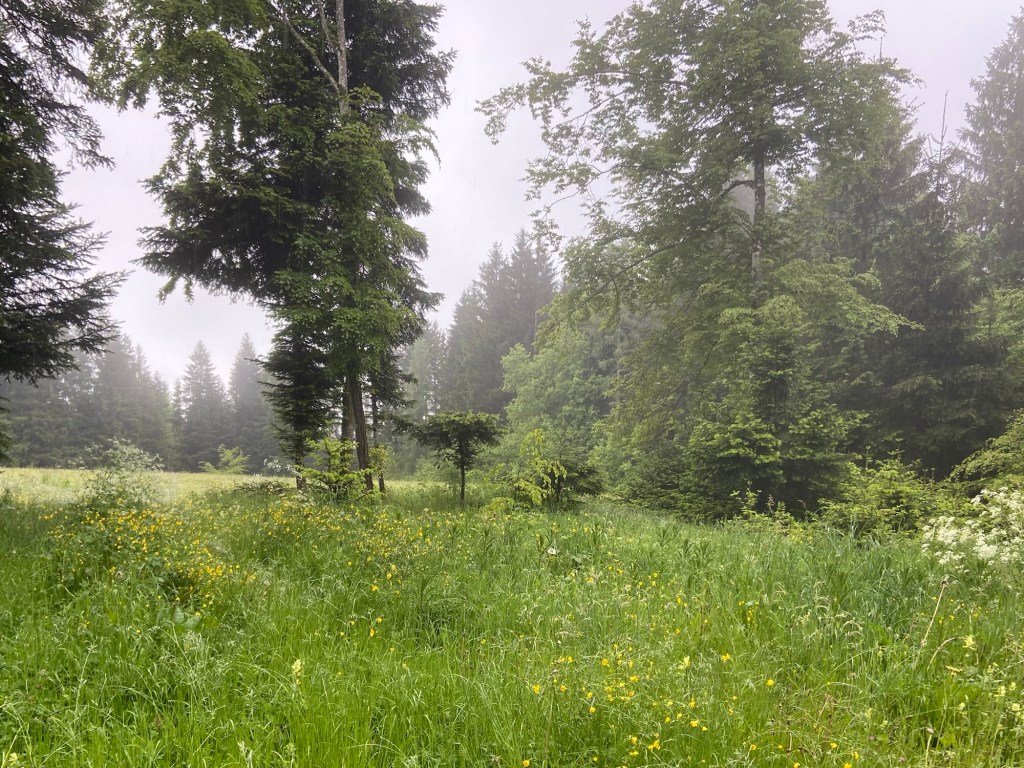
and identifying the different species which had colonised the areas that had been clear felled.

There was a moment of confusion at a forest junction where the two decent tracks both had no entry crosses signed by them (no way out!), until I noticed the Francigena sign pointing to an almost invisible thread of a path leading between the conifers. I dutifully took it, but it was one long trial of slippery mud which took all my concentration to navigate. Occasionally there were signs that others had passed this way: a footprint, for example (‘hello, pilgrim’) and someone had filled a mud hole with sticks and logs (which I made use of, to honour their effort).

Sometimes the thick bed of needles was brightened by the startling green of new growth at the tips of the nascent branches of seedlings, but mostly it was dark and gloomy and very, very wet.

I was really grateful to exit the fir wood — it was the only bit of genuinely difficult and annoying path I encountered all day. The sense of space and expansion after being closed in by the trees was wonderful, and although there were no views to speak of, there was a strikingly austere kind of spareness to the landscape,
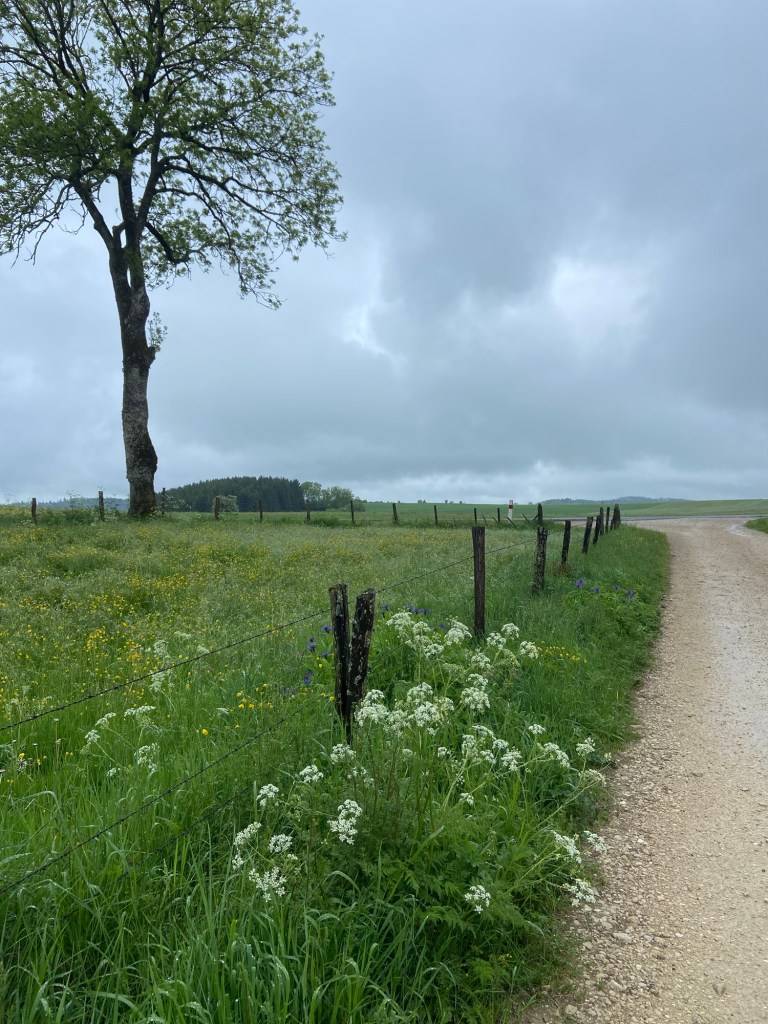
and touches of surprising beauty in the verges, even today.
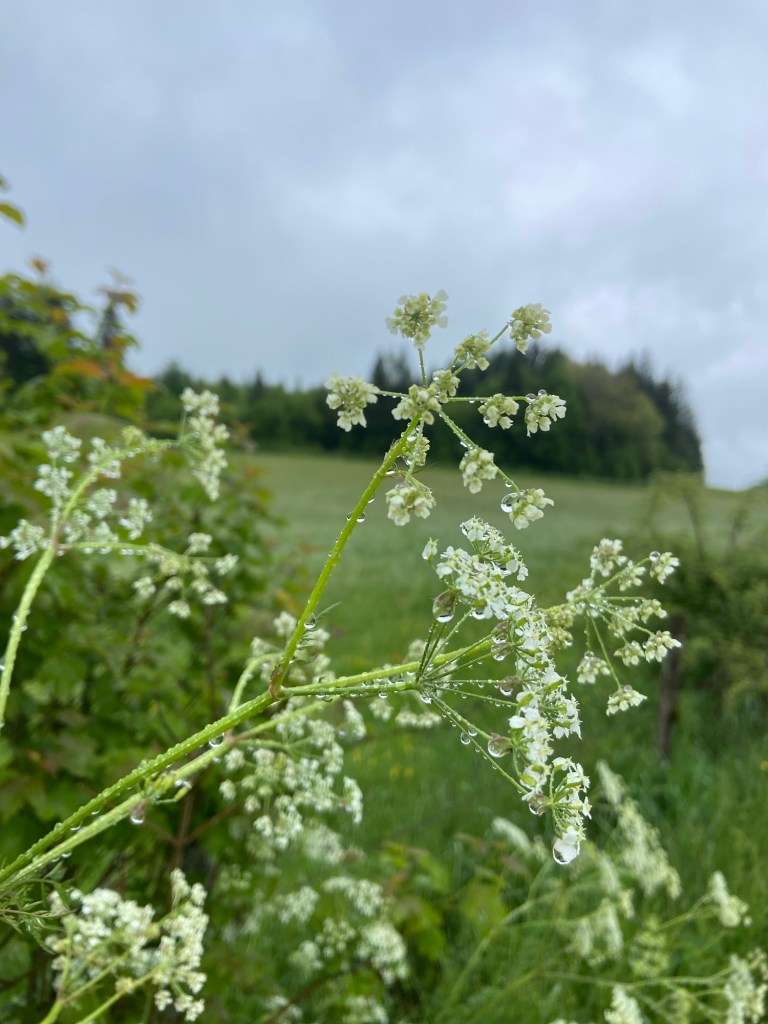
After easing off a bit, the rain now came down again in earnest. Out here in the high valley there was no shelter at alldtf, and I just put down my head and marched.

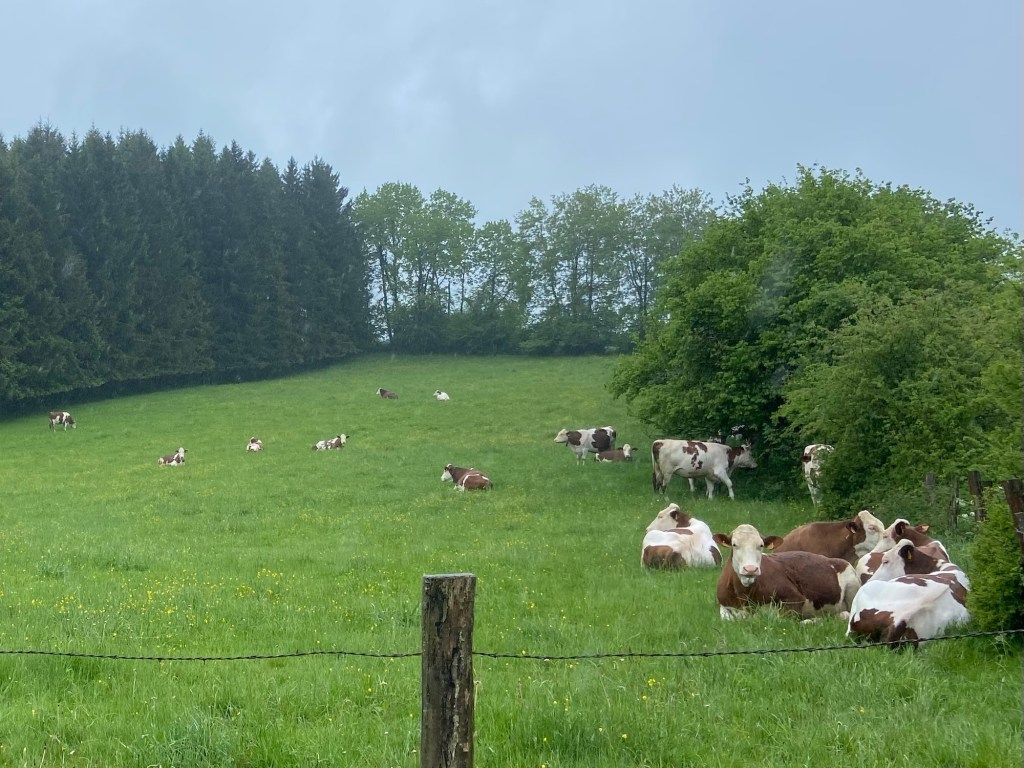
The funny thing was how cheerful I felt throughout it all — had been all day, in fact — to the extent that I caught myself many times with a grin on my face. I was even singing to the cows. They looked a little surprised.
Almost out of the woods which took me down the last section into the valley on the other side of which lay Doubs and Pontarlier, out of the corner of my eye, I saw what looked like some kind of viewpoint to my left, and I tramped across the sodden ground to an interpretation board and a rotting railing looking out over the grey Lac du Moray and pretty little else — the cloud was right down and not even the neo-Gothic church tower in Doubs was visible.
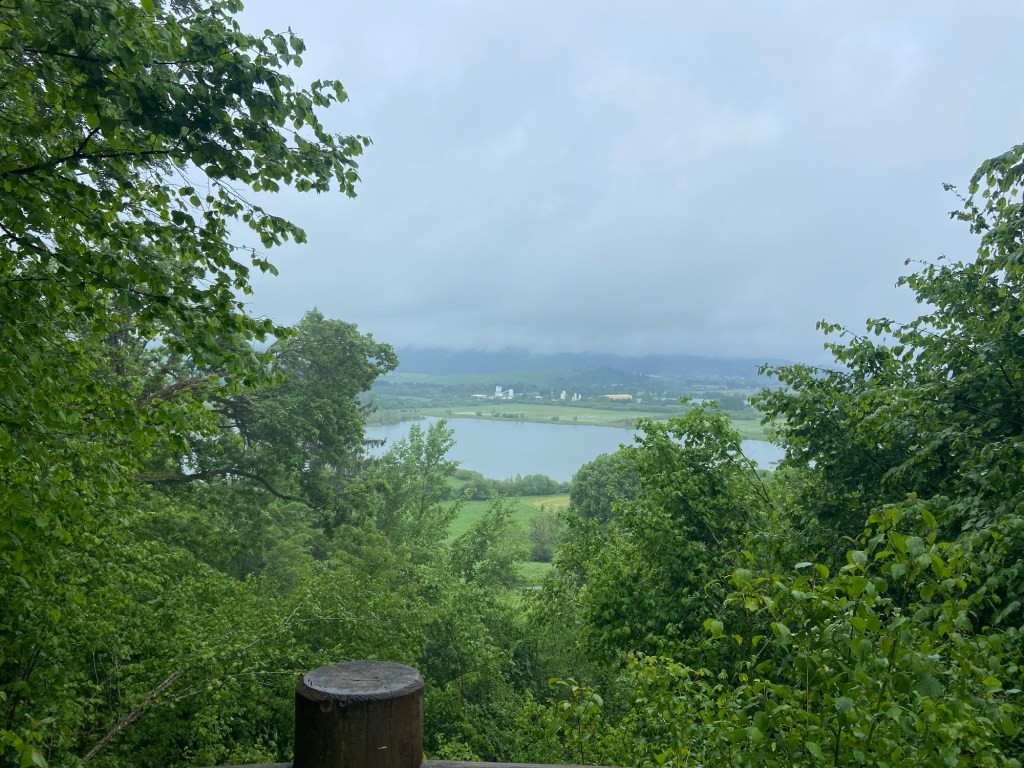
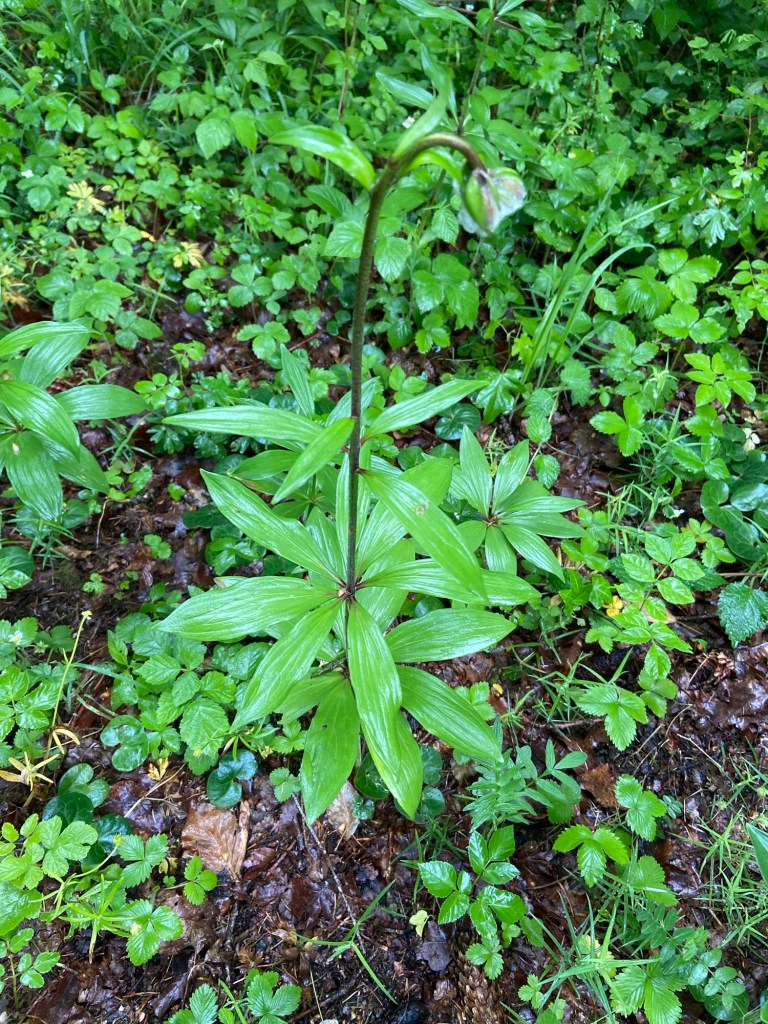
The view was hardly worth it, but still, there was a plant I didn’t recognise, with striking leaves and a developing seed pod at the top; today’s mystery plant #3
As I came down the hill into Vuillecin at the 20km mark Danielle was collecting her bin from the street. I must have looked very bedraggled because when I said (quite cheerfully) that I had just walked 20km she asked me whether I would like to come in for a coffee! I could not have been more grateful.
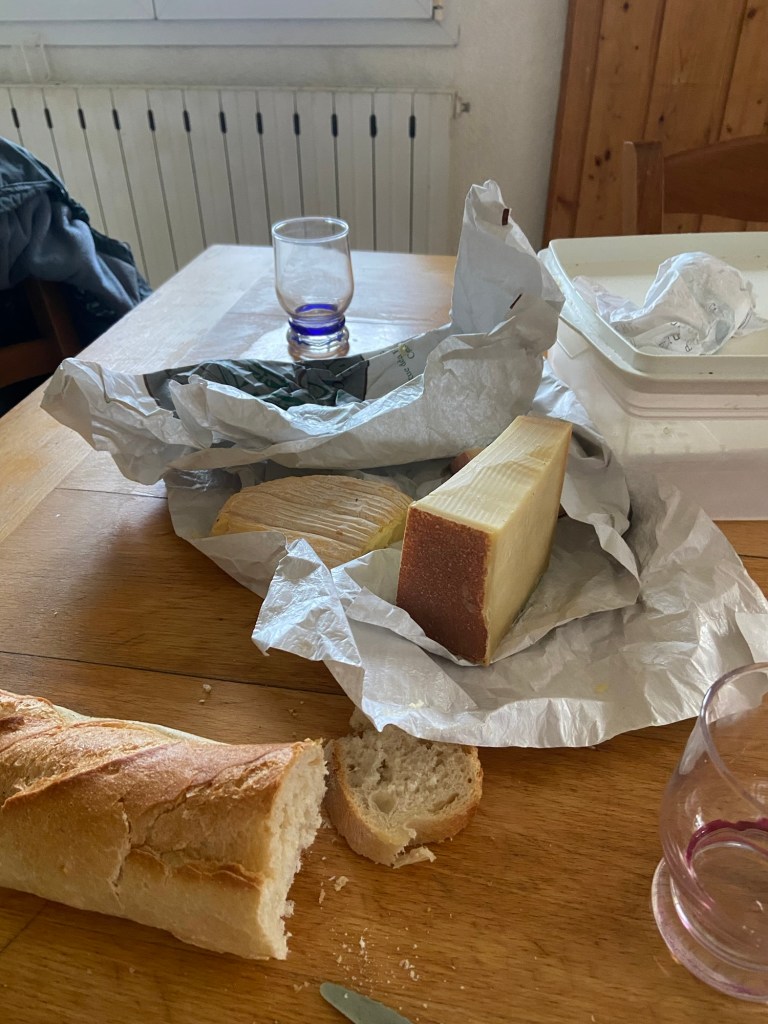
Danielle was one of those remarkable people who is just brimming with good humour and generosity. Her ready laughter seemed to banish the wet and the cold in an instant. And walking through the door into a warm house felt just blissful. We sat at the kitchen table and she offered me water and lemonade and as much bread and cheese as I could eat: three wonderful varieties, Comte and Morbier, both local to the Doubs region, and Délice de Bourgogne, a fabulously creamy cheese which I think was my favourite. I asked about the brown and white cows that I have been seeing over the past few days, and Danielle said they were called Montbéliardes — their milk is exclusively used for the Comte and Morbier cheeses (Simmental milk may be used as well). For the Comte cheese there can be no more than 1.3 cows per hectare of pasture and they must not be fed silage (in fact, sometimes the cows are fed on 100% fresh hay). Morbier is traditionally made from two kinds of curds, leftover evening curds, not enough to make a whole cheese, were traditionally spread into a mould and covered with a thin layer of ash to preserve them until the next day when curds from the morning milking were added to fill the mould and complete the cheese with its signature layer of ash running through it.
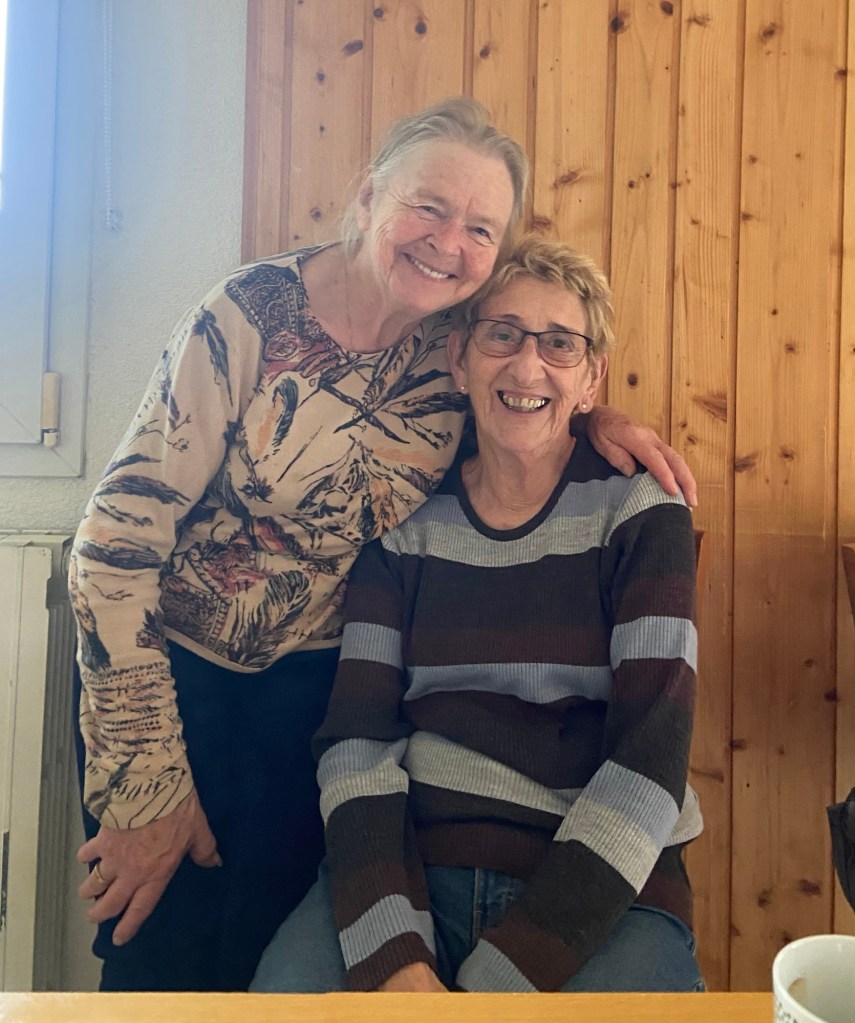
Just as Danielle was about to put on the promised coffee, her neighbour Claudine arrived and let herself in. With Claudine there was double the hilarity — they were obviously the best of best friends. Danielle brought Claudine up to speed with my enterprise.

There was much hugging and kissing on both cheeks over my thanks and goodbyes. I felt I had been, to use Ged McFaul’s phrase in her account of her Francigena journey, ‘kindnapped’.
It was heaving with rain when I left Danielle’s house, physically dry and warm and full of the emotional warmth that comes from being on the receiving end of unexpected kindness and generosity. This heat somewhere in the metaphysical region of my heart lasted me all the way down the vile pavement-free D130E, down which lorries thundered, throwing up gigantic amounts of spray from the wet road. I don’t think it made much difference: the rain was coming down so hard that my dry clothes and more importantly rucksack cover were sodden in seconds.

Danielle and Claudine had been very insistent that I did not take the extension into Doubs but just go straight across the mega-roundabout and into town. I followed their local advice and was very glad to see that there was an underpass so I did not have to risk life and limb crossing I don’t know how many carriageways.
I was watching the kilometre counter very carefully, and at 25K I celebrated the completion of my one thousandth kilometre.
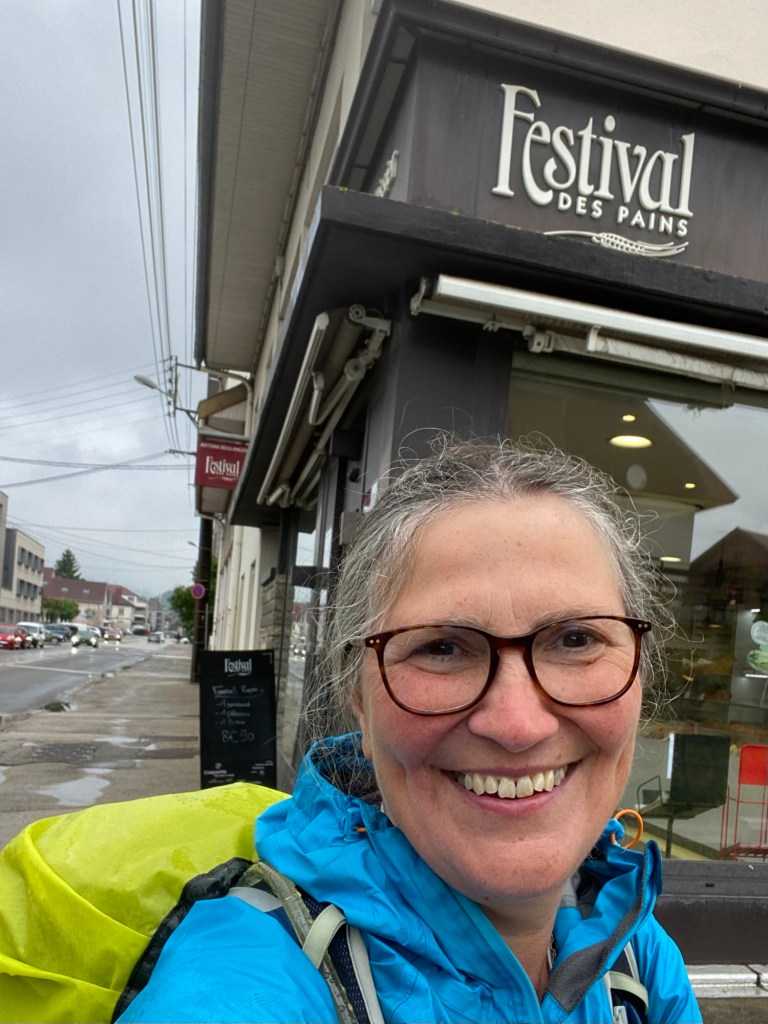
I happened to be just outside the Festival des Pains bakery, so went inside to create my own festival and celebrate with an éclair. Natalie had just one left — vanilla, my favourite — and when she heard about the milestone, she gifted it to me! It was lovely having somebody to celebrate with.

To add the cherry on the cake, when I came out, it had finally stopped raining. I decided to take off the rain cover, and discovered that despite the fact that Danielle and I had mopped up the water collected in the bottom of it, already after just two kilometres there was another pool of water in which the base of the rucksack was sitting. I dreaded to think what the state of the interior would be. Would Monica’s bin-bag have done the trick?
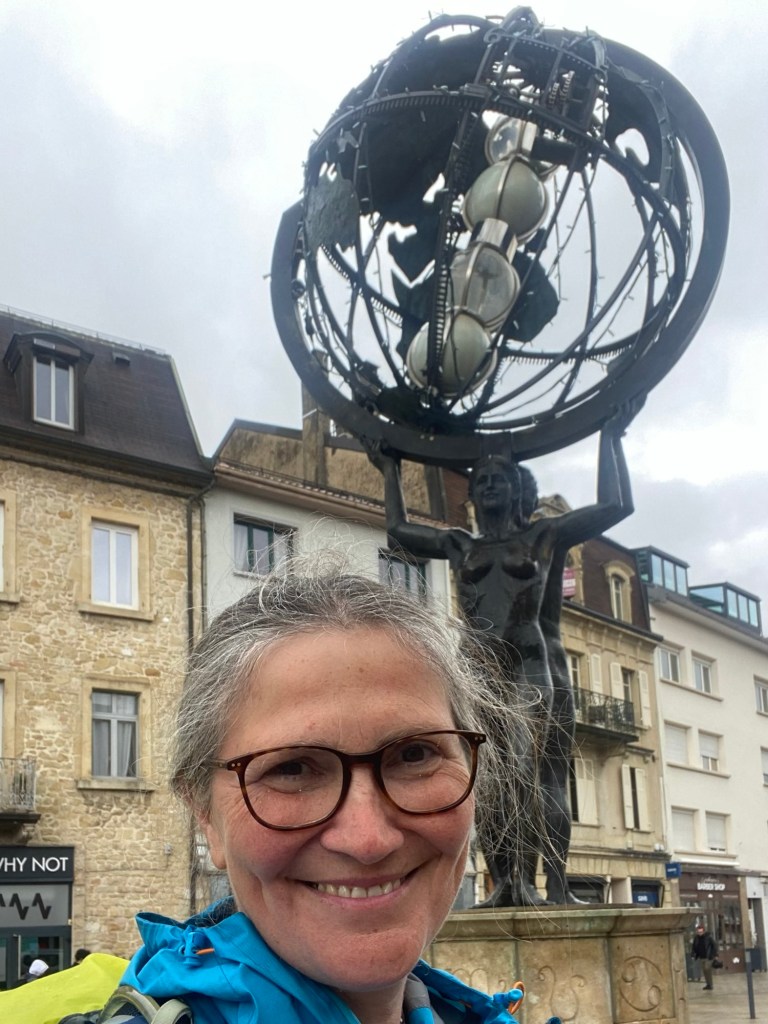
From the bakery it was less than a kilometre to the Port Saint-Pierre, via a statue of a woman holding up a globe which this afternoon seemed to match my positive, celebratory mood perfectly.
Room 17 in Pontarlier youth hostel was a four person dorm, already occupied by Aphra, a Via Francigena pilgrim from Newcastle. She had arrived yesterday and had been on a rest today, so she had not finished her day similarly sodden. I set about the business of hanging everything up to dry in creative ways to make the best use of the single but very effective radiator. My shoes dried out remarkably quickly: by the time I was thinking about supper at 7:30, socks and shoes were both dry as toast and as warm.
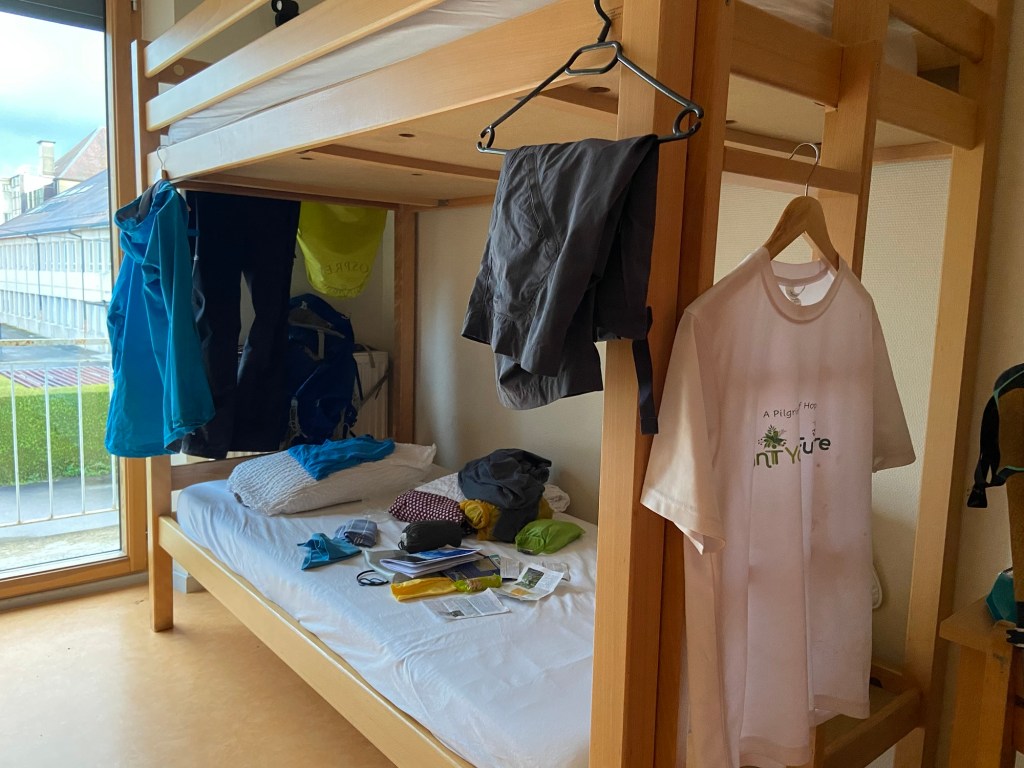
I warned Aphra about my alleged snoring, and she very cheerfully said that she had signed up for dorm accommodation, so that came with the territory as far as she was concerned.
Stats for the Day
Distance: 26.34 km
Climb: 833 (more than advertised! Bit would have been over 1000 if I had gone down to the Source)
Pace: a quite remarkable 4.4kmh
Hours of rain: 7 hrs 40 mins out of a possible 7 hrs 51 mins
Things for which I was grateful today
A really sustaining breakfast and a cheese and ham roll for lunch
My inability to throw away plastic bags — I had plenty to pack everything away in
Monica’s binbag. Without it everything would have been soaked
My general fitness and superglutes, which combined to allow me genuinely to enjoy a day full of really steep climbs
All the beauty, all day, of the forests
Claire the osteopath who sorted out my knee so effectively the week I had left, full of trepidation for the way my knee might or might not perform, way back in March
Hokas — I never thought I would say this, but they were super comfortable all day. The conditions under foot were really tough and they didn’t let me down once. They were also pretty waterproof, and dried incredibly quickly
Hot water for a brilliant shower
An excellent radiator which dried out even the evil rucksack cover
Aphra’s cheerfulness and warm welcome when I arrived
And last but by no means least, Danielle — Danielle — Danielle. A miraculous human being.
 Walking The Landscape
Huge congrats, and even more so walking in that rain through the mud 👏
please can you remind me, what maps and apps are you using and i read you turned data “on” so you’ve downloaded the maps?
and what sim card do you have? I’m using Lebara while here in Malvern but I’m a bit worried about using it in remote places
LikeLike
IGNRando app with the GPX file downloaded from the cicerone guide. I have data off but it can still geolocate me
I map each day on Strava. I need data on for the Geo location to find me, but once it’s done that I can switch it off.
That’s it. I’m afraid I can’t tell you whether Lebara has roaming because I’ve never heard of it. You will have to ask your service provider. However, you can get an eSIM if your phone will work with one: the woman I am walking with at the moment got to France and realised she didn’t have roaming on her Phone and so she bought an ALOSIM, with 20GB for €25/30. I do not have an eSIM so can’t tell you anything more about how that works I’m afraid.
LikeLiked by 1 person
thank you so much for this info. I will sit down and look into this today
LikeLike
Also download SwissTopo and put the GPX track on that. I haven’t investigated Italian apps yet
LikeLiked by 1 person
The Woman Balancing the World is the perfect symbol to represent your 1000km milestone. Your relentless positivity and capacity for observation and reflection despite quagmires and downpours is wondrous. I hope you slept well.
LikeLiked by 1 person
1000!!!! 👏👏👏 Well done!!!!
mystery plant 1 ….annual pearlwort?
2 …. Pinnate coralroot?
3 …. Martagon lily?
All according to my plant identifier app.
LikeLiked by 1 person
I must get one. But on the other hand, I do very much like asking you!
LikeLike
…and I am happy that you do!!! X
LikeLiked by 1 person
Xxx
LikeLike