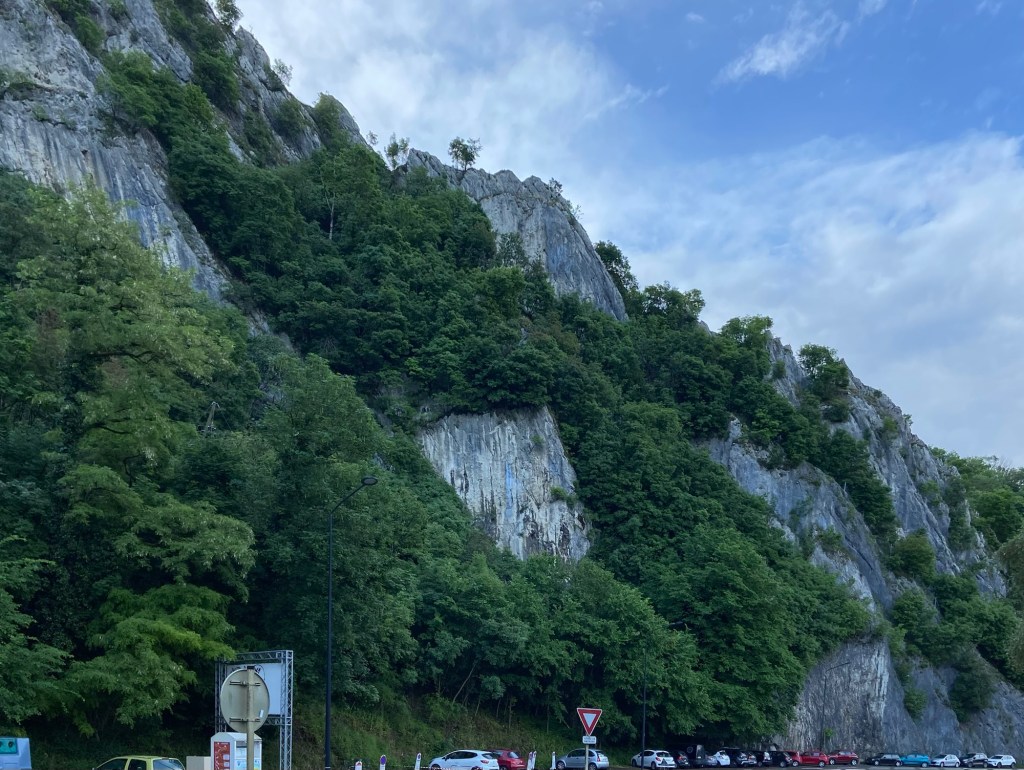
The rolling farmlands of France are behind, to be replaced by the ridges and valleys of the Jura mountains, gateway to Switzerland
Sandy Brown, the Cicerone Guide to the Via Francigena
I had breakfast as early as possible this morning, which meant 6:30, so I could be away an hour later to begin the first of the mountain stages of the Jura (‘as in Jurassic’), the finale of this first part of the walk. It had rained very heavily overnight and was forecast to get up to about 20° which I thought sounded as though it would be pretty steamy. I wanted to get the first climb out of the way in the coolest part of the day — the advertised 700m of ascent was going to begin straight out of the box.
The €2 pilgrim breakfast in the diocesan centre where I was staying consisted of a very respectable basket of fresh bread, butter, and various jams, which I supplemented (feeling highly French) with a bowl of coffee, and my first sit down with a newspaper since the start of my walk. The front page news was the very dry spring and the risk it would bring of water shortages. I read the full page spread, pleased I could understand all the meaning, even if not translate all the words exactly.

Before picking up the official Francigena route I wanted to see the oldest monument in the city, the 176 AD Porte Noir, a Roman triumphal arch once blackened by fire and restored in 2007 to the tune of 1.2 million euros.
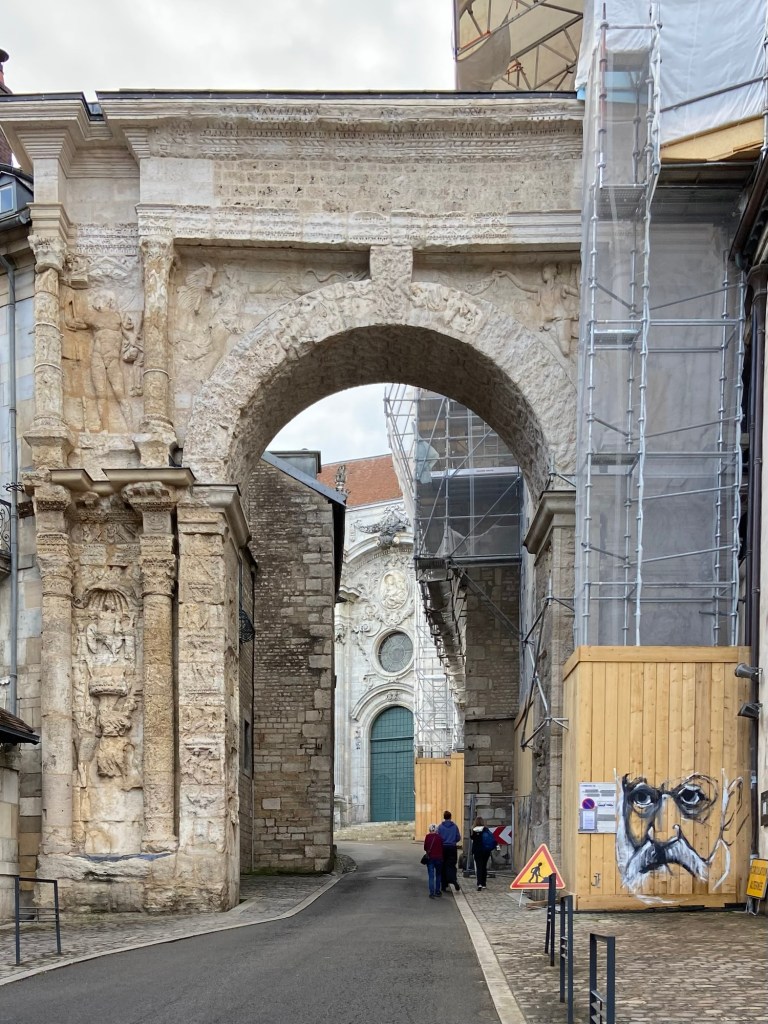
The gate actually stands 11m tall, but the bottom meter lies beneath the modern road, here swathed in scaffolding and imaginatively graffitied wooden boards. The Roman carvings are in impressive conditions considering their age — I liked the fragmented bodies which hinted at their original glory.

The city was just waking up. The roads were almost empty and I had them almost to myself; I didn’t have a lot of time to explore this morning, but I did really enjoy the coming across the sculpture of ‘The Source’ by Jens Boettcher in an 18th century monumental niche. It made a welcome change from the very many Virgin Maries that line the Via Francigena.

I had climbed quite high up the back of the city now, but I needed to check the map to see that I could access the route from here. Students were on their way to the school and I stopped one to ask whether I could get through the Citadel to the mountain past beyond, but he said that the citadel was now a zoo, and opened his Google app to determine that it didn’t open until 10 o’clock. After climbing up I therefore now needed to descend back down again to the river.
I’m so glad I did, because although the Citadel was now discouragingly far above my head, along with the wooded slopes I would need to climb through to reach the summit of the ridge, the Doubs river and the lock system on its canal were stunning in the early morning light.
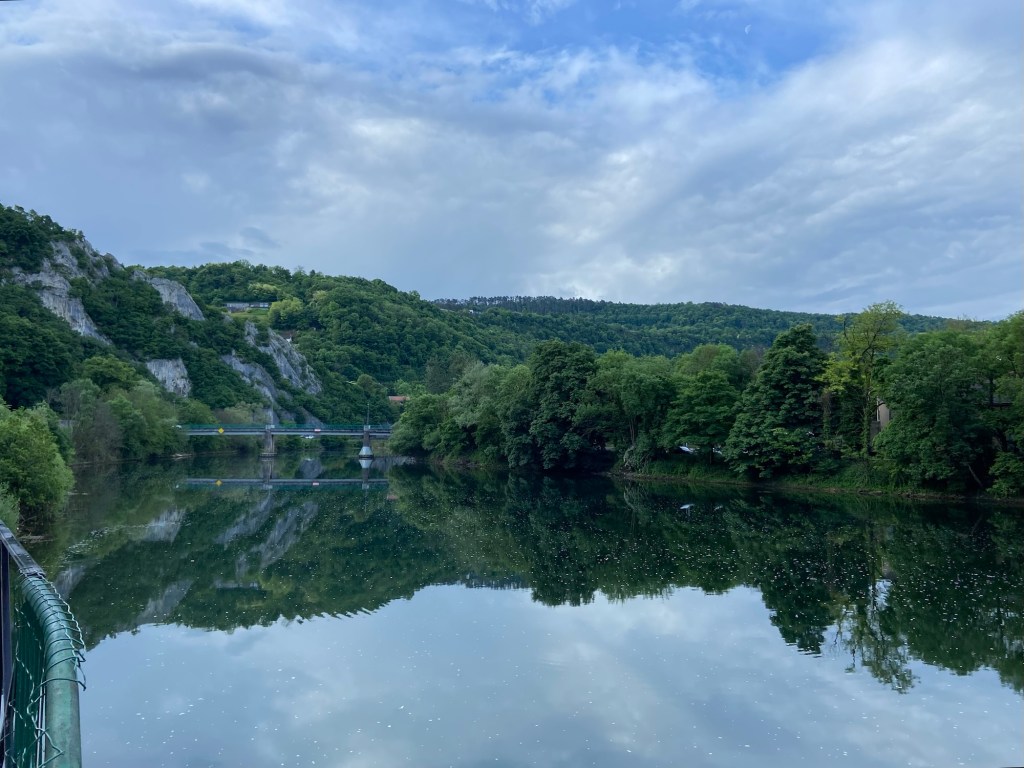
Its meandering form through the towering limestone cliffs helps to shape the character of Besançon, and I wasn’t quite ready to leave it — and scale them — yet.

But eventually climb I must. The road option snakes upwards in a series of switchbacks but there are pedestrian stairways and paths which are steep but cut down distance. They take you a much more direct route up to the top of the limestone ridge in whose shadow Besançon lies. I was most grateful that I was ascending in now at 8.15, and not in the sauna-like heat of a late sunny morning.

Whilst I sweat up to the top in my own personal sauna, Reader, I will draw a veil over the red face and steamed up glasses. You might like to know what I have been up to over the past four days.
I got a train last Thursday out to one of the little villages just on the French side of the border and very close to Lake Geneva, where Hester and her husband Angus live. They made me so welcome for four days during which I slept right through, napped during the day, and when I wasn’t napping, I was reading in their garden. I got through two books and a good way through a third. Angus was starring as Henry Higgins in the local theatre company’s production of Pygmalion (we went on Saturday — actual culture! — and it was a fantastic evening) and Hester, a garden designer, was giving garden tours around a local château, when she was not meeting with her own clients.
I had a pair of my Altra Timps on order, and I had a notification that they arrived in the local UPS warehouse late on Thursday. But there they then languished for three days. Would they arrive in time for me to collect them before I left? The blisters on my poor feet had four marvellous days to heal completely; it would be a shame to take them back too the state they were in before. In a pinch (not, I hoped, literally) would the Hoka shoes which had given me so much trouble be ok with the thinner socks I had bought Besançon? I did a decent trial walk with Angus on Sunday to test them out.
The first half of the walk was round the shores of Lake Geneva. It was difficult to comprehend how utterly gorgeous it was.
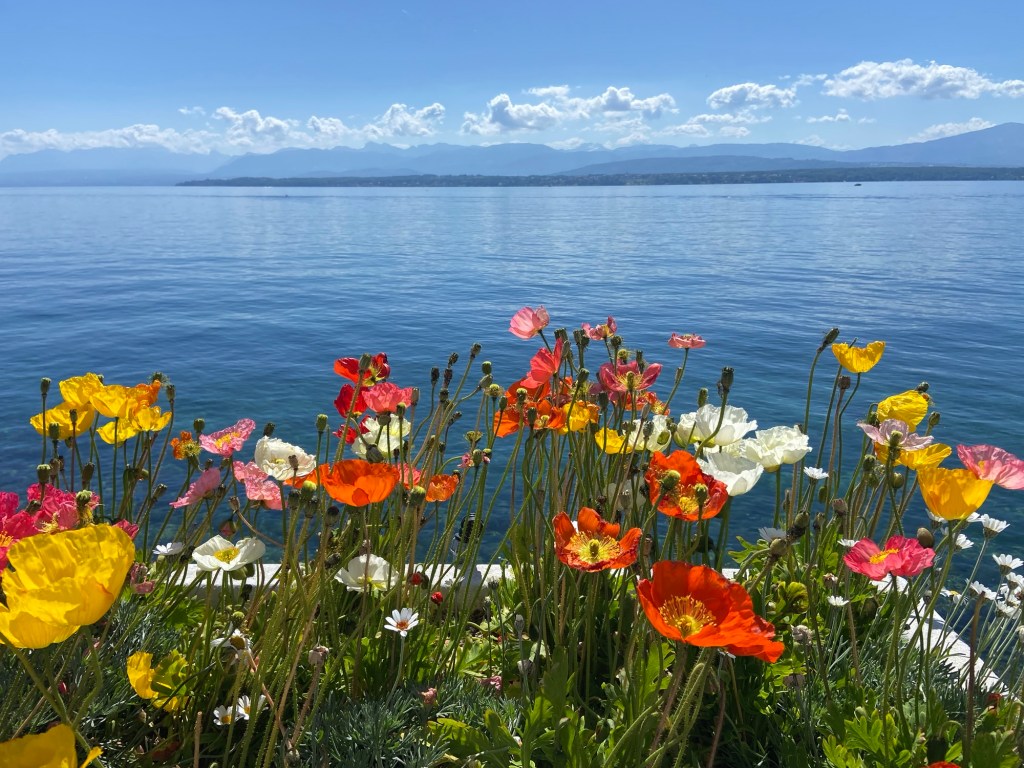
We walked through the flea markets, but my eyes were only for the water, and the Alps rising beyond. What a landscape.
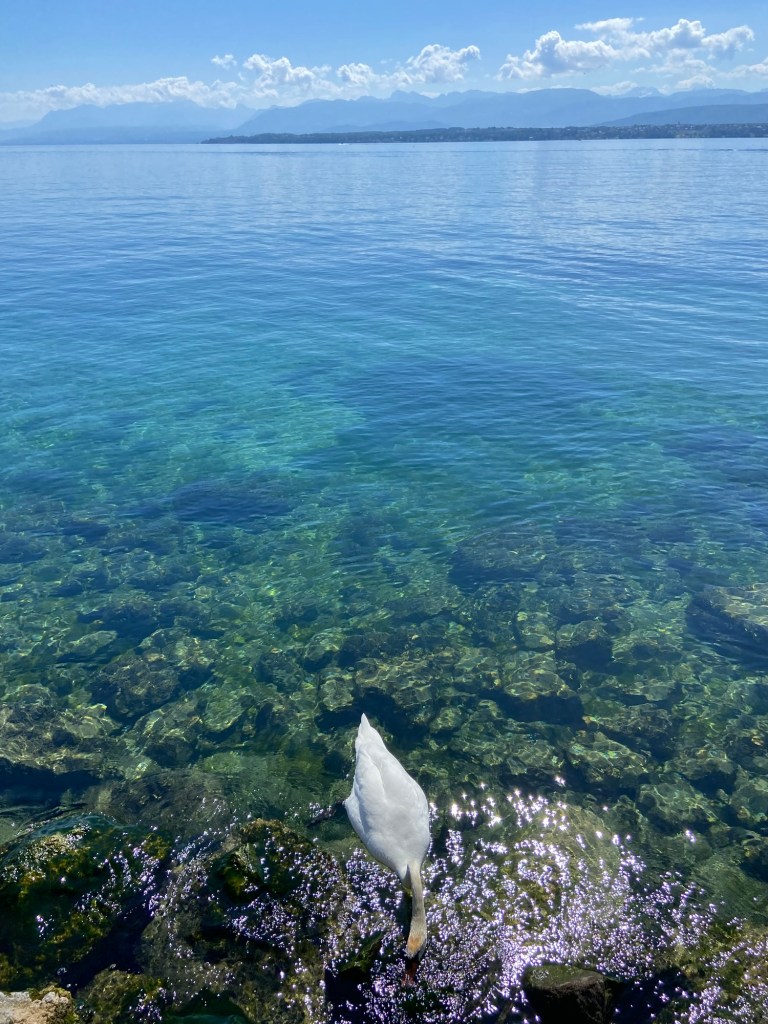
I left as long as I could on Monday before leaving since I could see that the shoes were out for delivery by UPS, but of course they were delivered an hour and a half after I had left to catch the bus to Geneva station. Hokas it was, then. They had been fine on the walk yesterday, so I was feeling reasonably confident. Hester had invited me back to stay on Monday night before I fly back home, so I can pick the Timps up then!
The train journey through the Jura to the other side and back again was inspirational. I had been somewhat nervous about the next seven days’ walking, but the train went through some of the same valleys as my route, and it just made me want to get out there even more. So different to the farmlands I had been walking through for the past forty days!

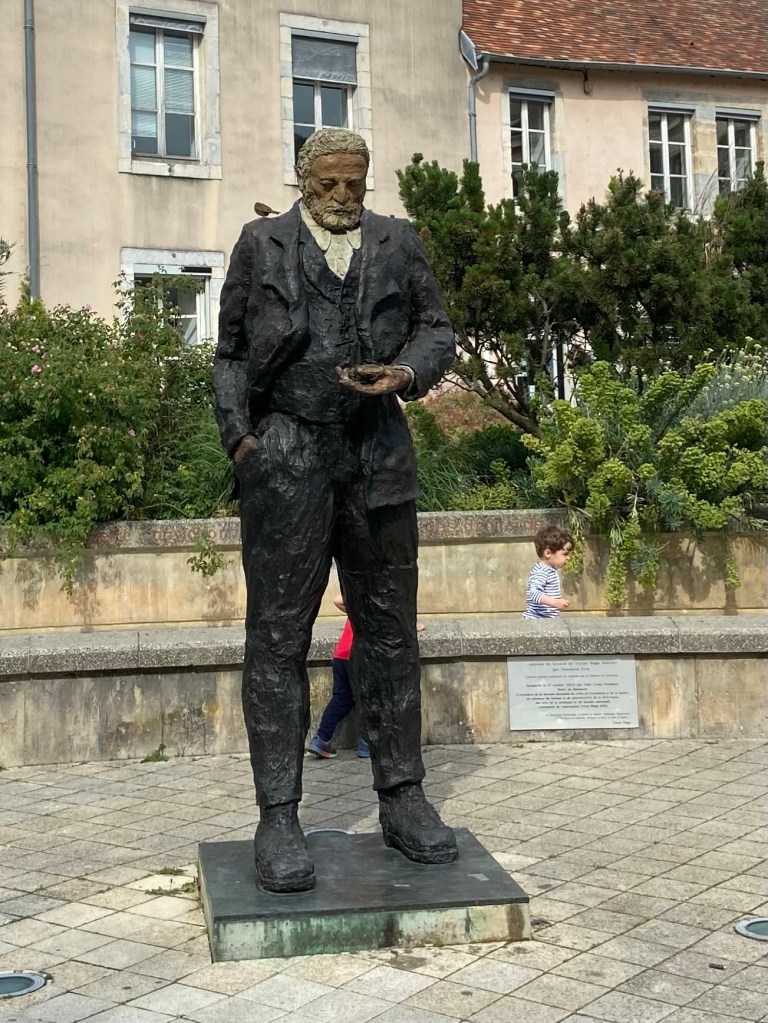
I arrived fairly early back in the city, enough time for me to do a little bit more sightseeing. The city’s sparrow population was using the statue of Victor Hugo, famous son of the city, as a perch.
But that was yesterday. In the here and now I was climbing steadily up the steep path to the top of the cliffs, to the village of Chapelle des Buis (buis meaning box tree, which cover the slopes of the hills). I met two groups of people: the first was a disgustingly healthy and energetic posse of pretty buff runners coming back down the hill heading for the city (‘What energy!’ I called out. ‘You’ve just got to do it!’ they called back as they powered on towards their showers and breakfast). Then I met Evelyn and Nicole, out for a constitutional. They could not believe how far I was going: their jaws literally dropped open. I appreciated the opportunity just to stop for a bit to chat to them and catch my breath.

The road climbed up past a sequence of white metal panels rather like the stations of the cross, only recounting the story of Mary,
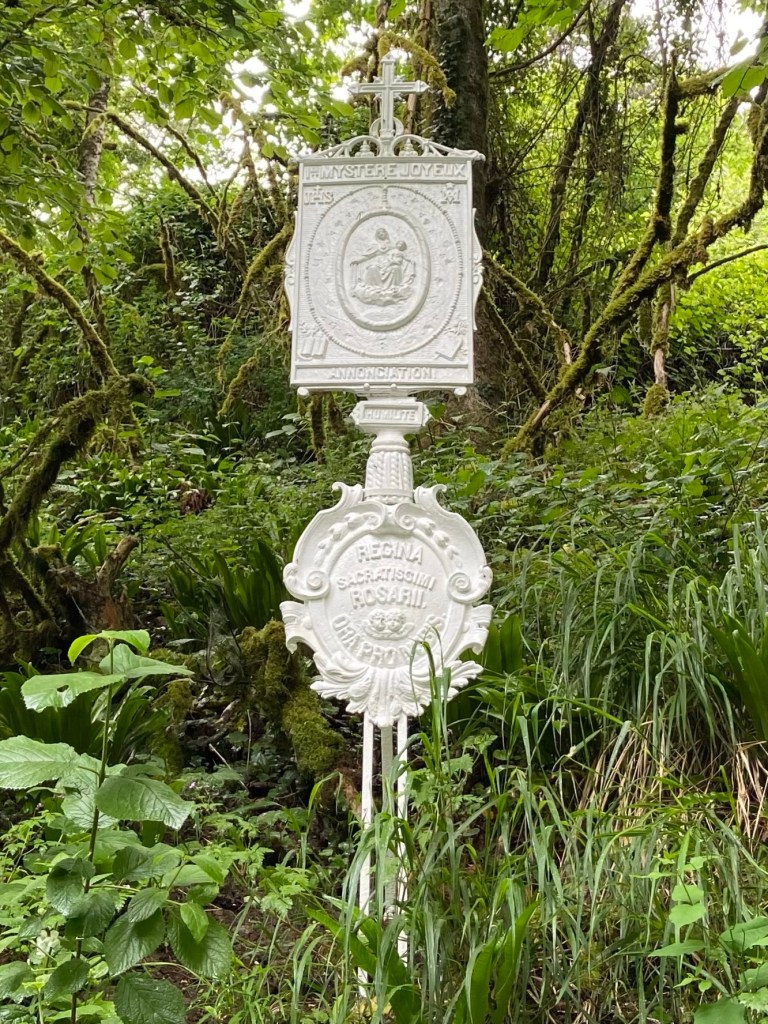
and in other places, the steep edges of the road offered enough space between the rocks for someone to create patches of garden, one complete with a whimsical version of Pride Rock, complete with the figure of a tiny lion inside.

Evelyn and Nicole looked around the exterior of the 17th century Chapelle du Buis with me, and they pointed out the bees that were living on the outside wall at the feet of the virgin. ‘They’re always there,’ they said.

Our paths parted ways here, but they recommended that I visited the monument to the Liberation, a little way further up the hill, and told me to make sure to check out the crypt there too. I followed their advice (although the monument was in fact on the route) and indeed it was a beautiful thing: a tall pensive statue of the Madonna and child looking down over the city.

The monumental statue and the crypt below it were built by the order of the archbishop of the city after the Second World War, to give thanks that the city was spared from bombing. The crypt Chapel was open, and the sense of peace and meditation beneath its vaults was palpable.
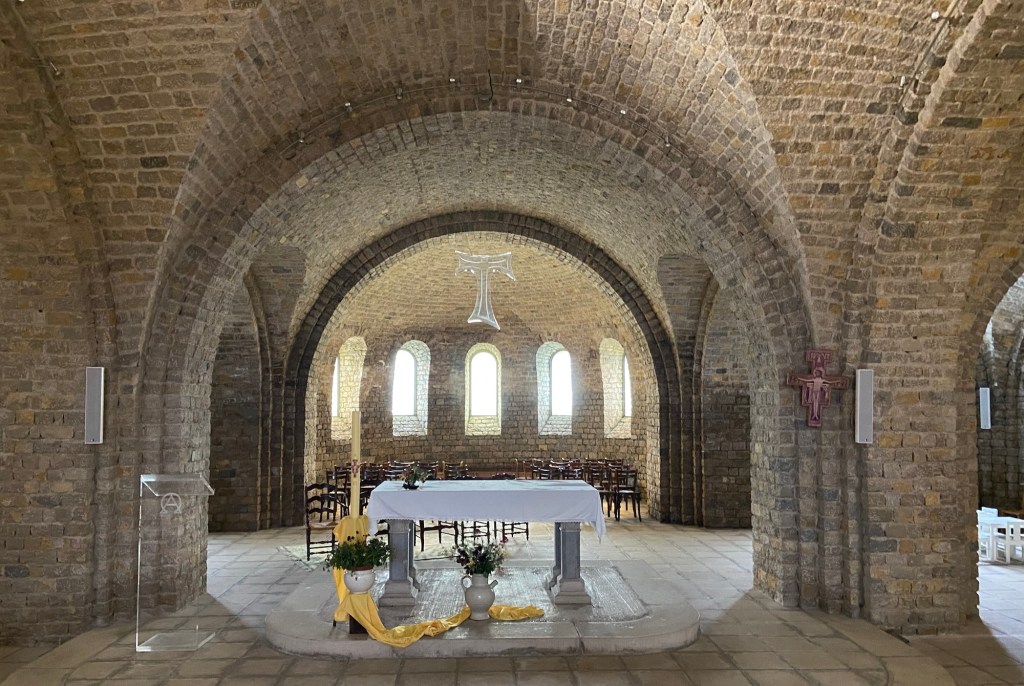
Around the walls were ranged the names of the dead from the city and the surrounding villages. Panels of name after name of young men who lost their lives. I could only get a fraction into the camera frame.

So it was in a contemplative mood that I came out into the daylight from the crypt chapel, and looked down over the city with the Madonna, also giving thanks that that lovely place had been spared.
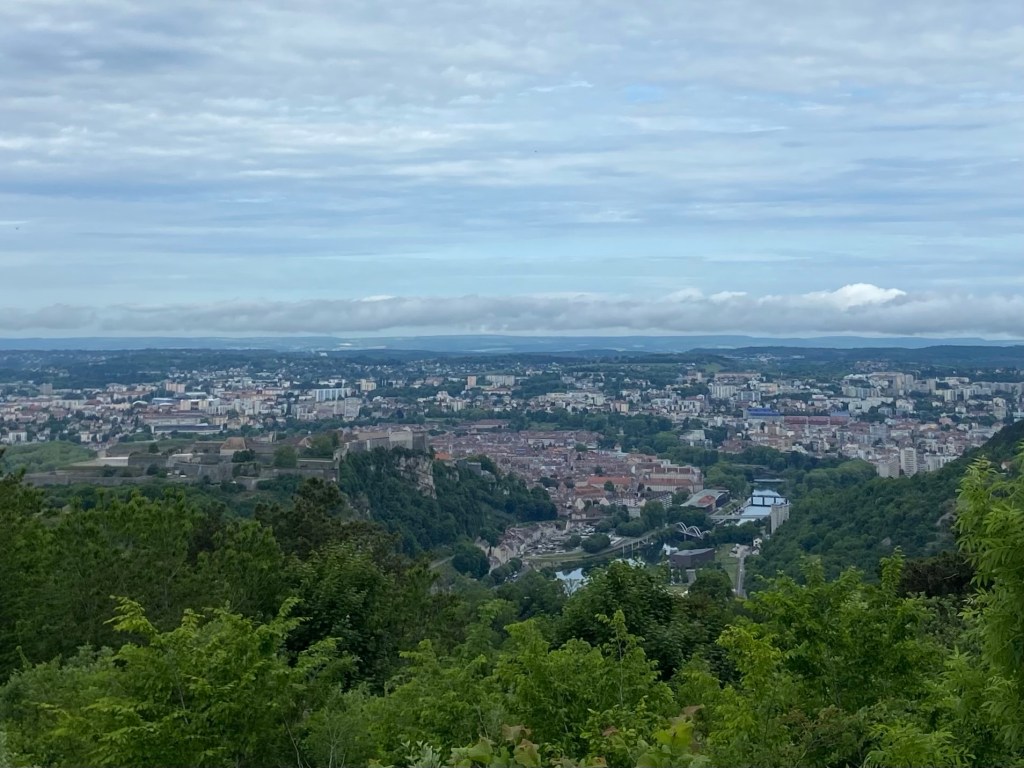
There was a fiddly, rocky path off the hill and when I reached the road at the bottom, I had a decision to make. In order to cross the arterial roads running along the valley, the route takes what feels like a 6km detour, first a long way east along a wooded ridge, then dropping down to turn back on itself to track the road 2km back on itself in the opposite direction. Or, I could finagle a shortcut and head straight along roads to the village of Saône. I wasn’t really feeling the need for any shortcuts yet: I was feeling positive about today’s walk, and full of energy. So I took the official Francigena route, and met Evelyn and Nicole one final time coming towards me, having turned around to head for home. They looked askance at my decision to go into a wood ‘on my own’ when I told them where my path went. They preferred road walking. It’s so surprising to me how many people ask me whether I feel safe or not, walking on my own.
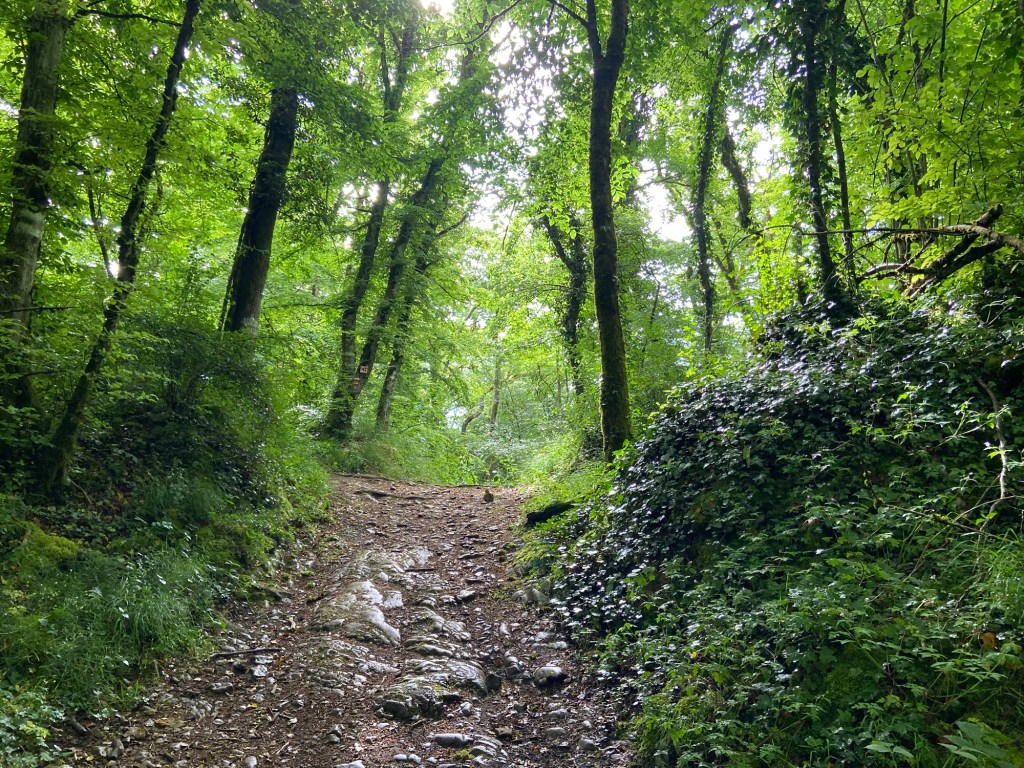
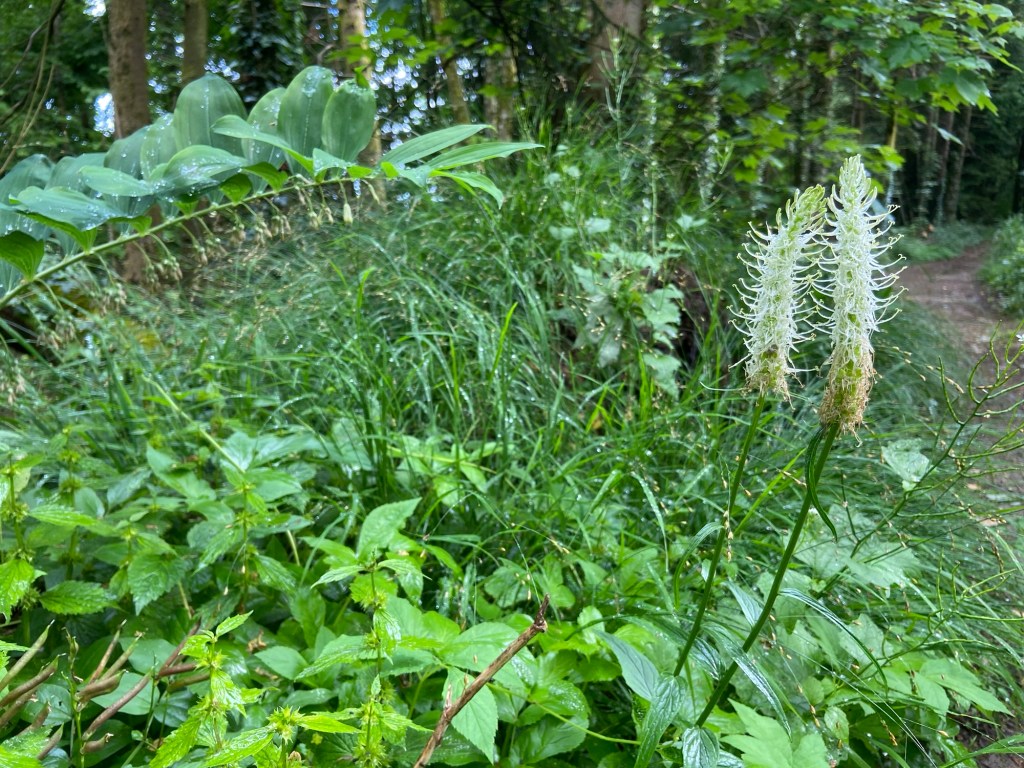
The wood along the ridge was peaceful but I had to concentrate on the surface underfoot. A tiny wren hopped off a disintegrating log to tchick angrily at me from inside a bush while I admired a white version of the betony-leaved rampion that had come into flower over the last week.
When the wood ended there was a longish urban extension out to the only place where one might reasonably cross the busy roads. Someone had whimsically brought the countryside into the town with some imaginative decoration of an otherwise ugly utility shed.

I started the long path back the way I had come only on the other side of the road. I was immediately back amongst wonderful wildflower meadows, this time offering me the first of the campanula,

and a huge patch of parasitic yellow rattle.
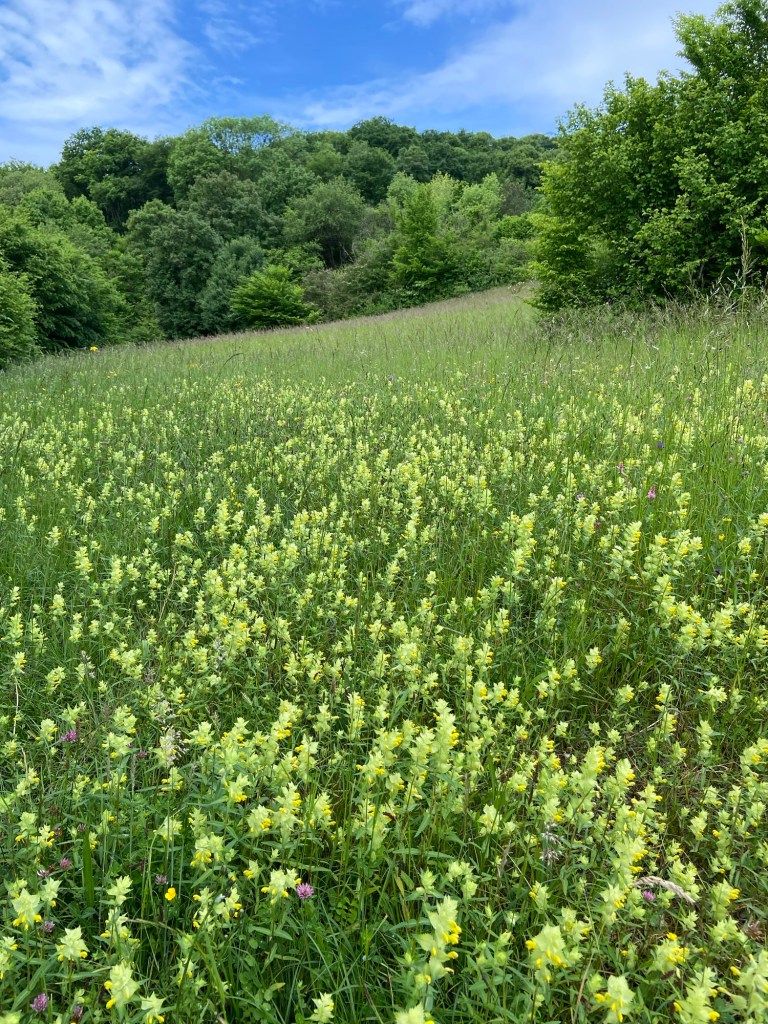
I was just thinking it extraordinary that there were no livestock in this succession of meadows, when I came across a small herd of horned cows lying in buttercups snuggled up to the fence. It felt quite muggy; I don’t know whether they can feel more rain coming.
I didn’t mind being taken along this path at all, and it seemed very soon that I passed a little farm with impeccably weedless vegetable beds. Four men were working on mending a tractor and when one of them left the job and came up towards the barns through which I was walking, I realised the farm might have been a kind of sheltered community for people with learning difficulties. A lovely site for it, looking down south west over the meadows, to the marshes.
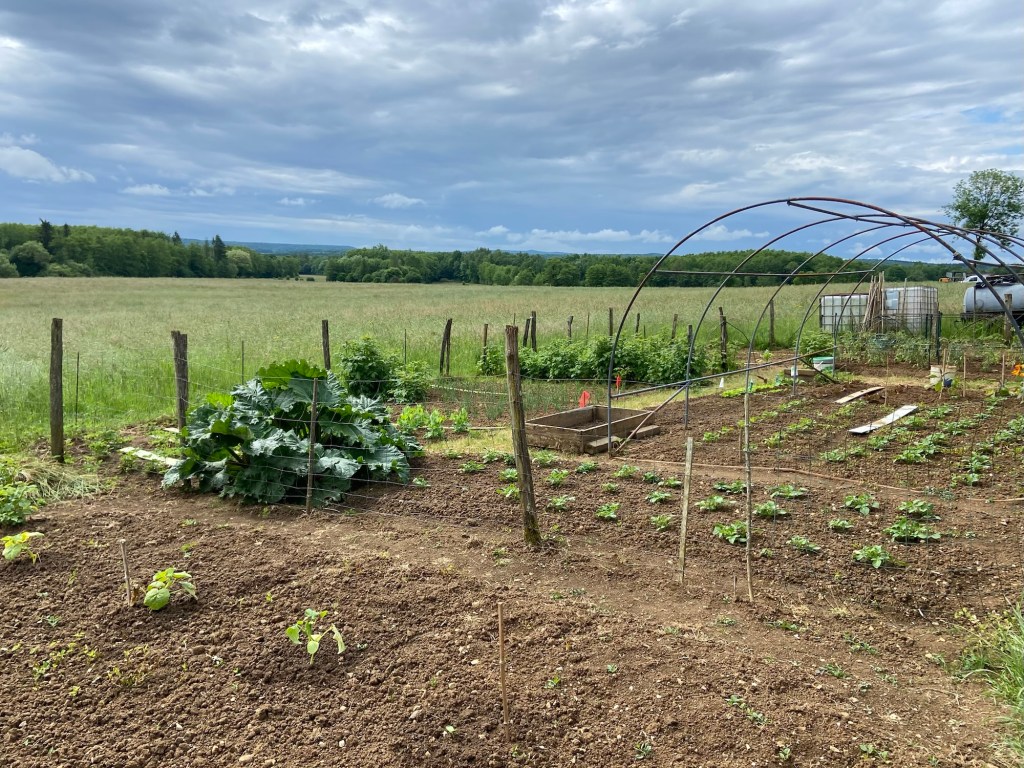
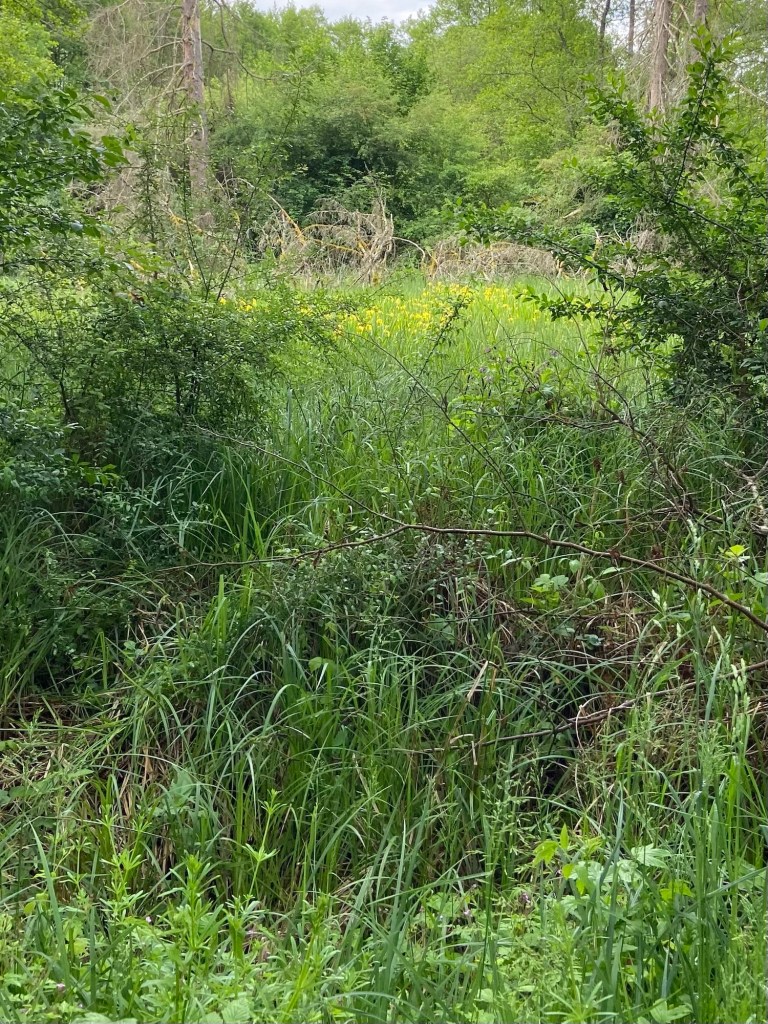
I had been looking forward to the interesting marshland habitat. As the guidebook said, ‘in season, the local wildlife don camouflage gear with orange vests and lineup in shelters along this road to be warily observed by the marsh’s avian residents’. I was expecting bird hides looking out over open water, but the path led straight through marshes almost entirely colonised by low-growing willows (not a single nightingale calling now), screened by thick vegetation, with only the most fleeting of disappointing views of pools full of yellow flag iris.
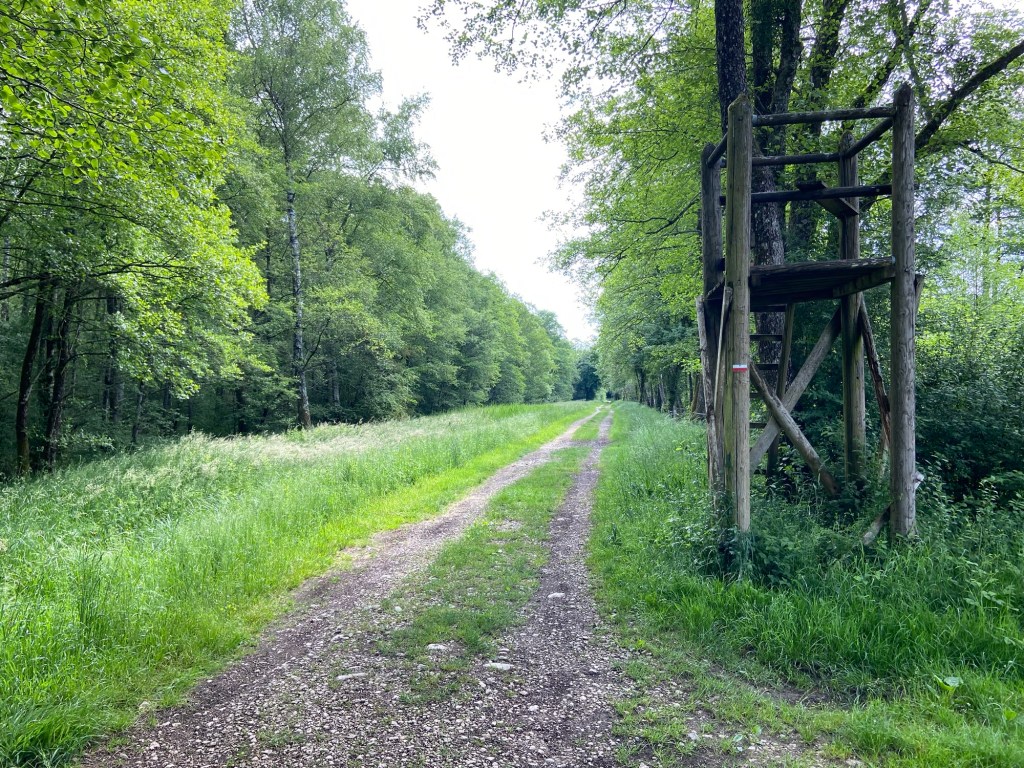
Instead of the hides I had been anticipating there were structures like hunting platforms where one might ascend to watch birds or any other wildlife, but mostly they seemed to be positioned next to impenetrable scrub with limited visibility.
There might have been a faraway herd of enormous grey horses, but I was too distant to make them out properly.

I had been going for four hours by now, and had come only 14 km, what with the long climb up and over and then down the ridge behind Besançon. I stopped for half an hour at a deadwood standing tree around which a bench had been constructed, to charge my phone a little. Everything was so dry — the ditches by the side of the post were mostly desiccated.

From there, it was a very short walk into the village of Saône, where I briefly considered a detour of a couple of kilometres to visit the supermarket where I might get some ham or cheese to supplement my boxed lunch of the unadorned lentils and cherry tomatoes which were left over from supper last night, along with a hunk of bread. Micheline’s box is still going strong!
A man approached me and asked whether I need help finding a route. He wanted to speak English, and wanted to be helpful, but he couldn’t make sense of the maps on either my or his phone, and the alternative supermarkets he suggested were even further off route than the one I was looking at. He gave me some rough timings and distances, and we realised that I would get to the next village in the middle of its supermarket’s lunchtime closing. This was okay by me since I can’t get into my accommodation tonight until five, and I had left so impressively early that without some decent stops I was going to have a very long wait at the other end.
Eventually, I decided that a good place to stop would be the next village rather than this one, so I thanked him very much for his not-very-;helpful help, and made my getaway.

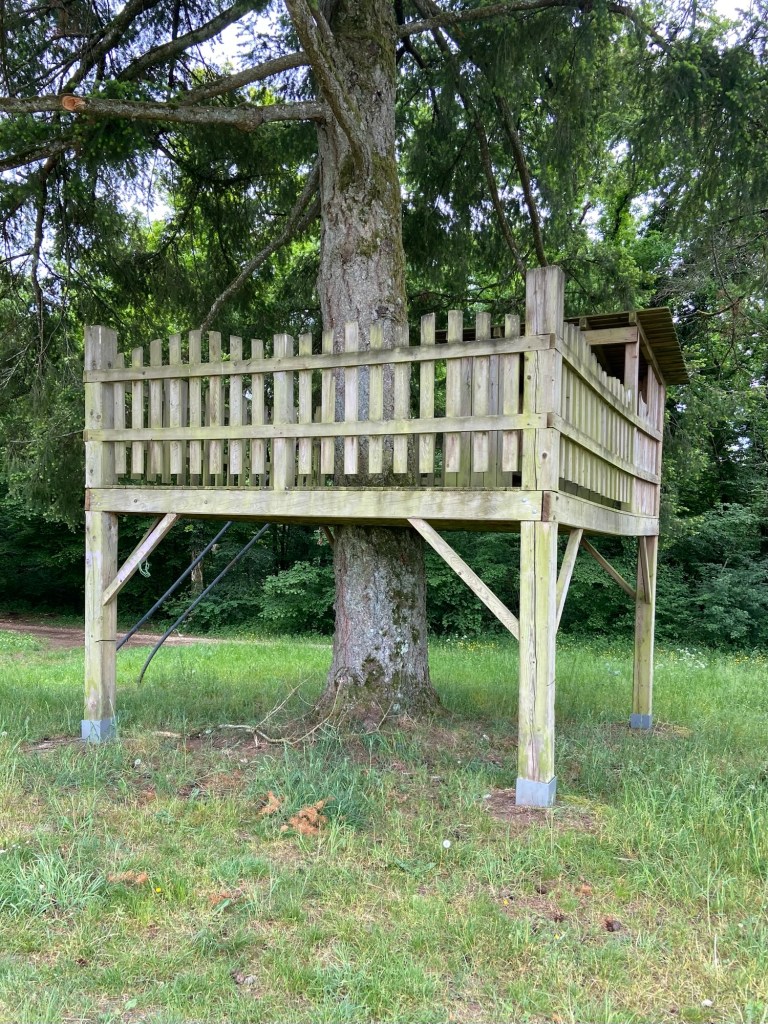
The quiet back road curved round through cornfields to join the main road, and chiefly offered interest in a well-constructed treehouse, the ropes of which ladder had been removed or had rotted away so it was now inaccessible,
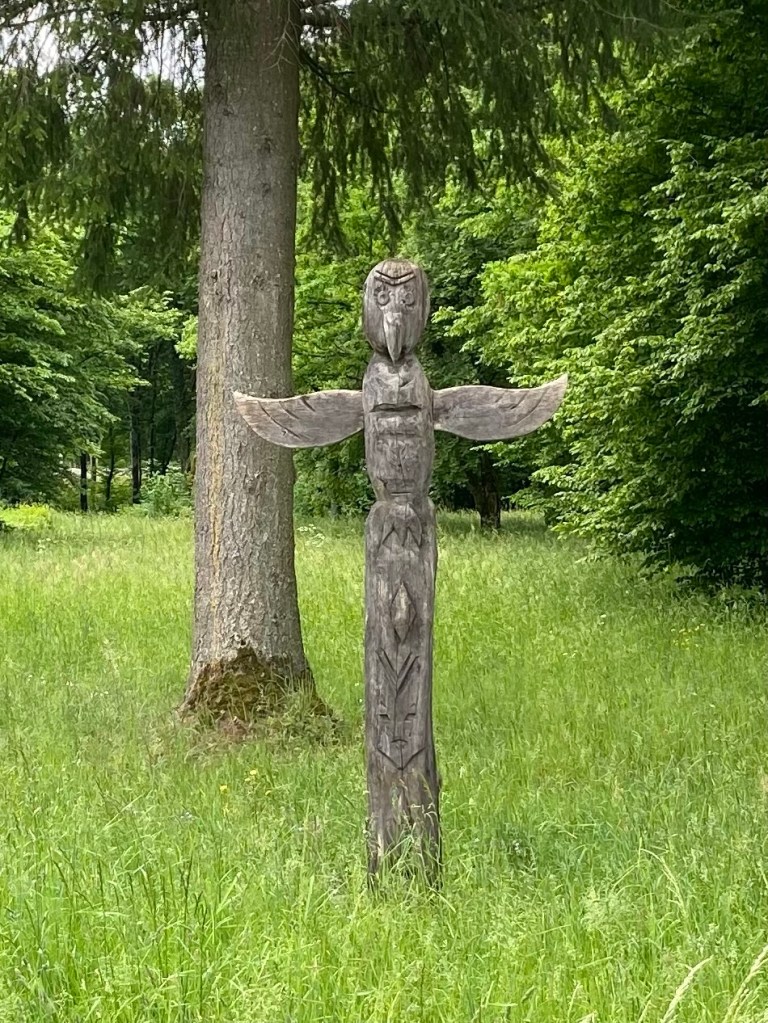
a striking owl totem pole in the middle of nowhere, warning off intruders,
and an intriguingly rude sign pointing off the path. I was itching to go and see who these disgusting people were who were meeting up, but decided it was wiser to give it a miss.

At the end of the path where it joined the main road was an enormous industrial chipping machine in action. It had almost filled up a gigantic semitrailer with wood chips fired out of a cannon-like appendage. A dent seemed not to have even been made in the colossal pile of scrappy pinewood and brash towering next to the vehicles that was being fed into the chipper’s maw.

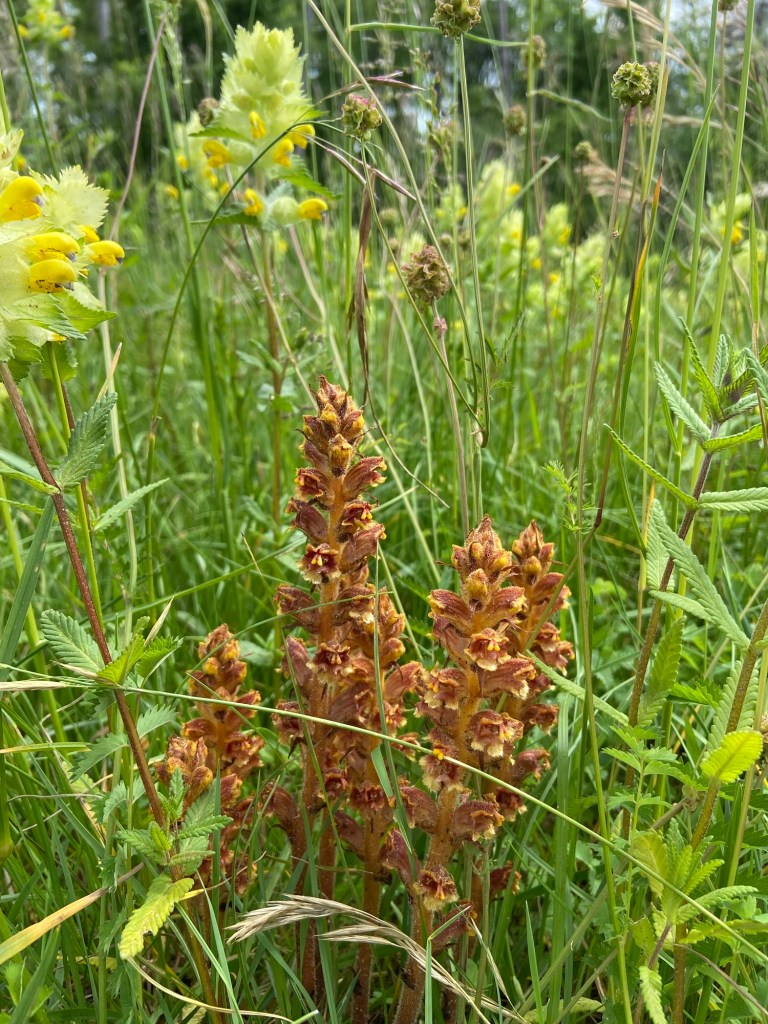
The pine trees had all been cleared from the edge of the wood, leaving behind a verge full of light with umber-coloured broomrape, more yellow rattle, wild mignonette and three different kinds of orchids.

From there it was a long straight walk uphill into the village of Mamirolles past a cornfield where the ears of corn were now fully formed and dotted around with fragile scarlet corn poppies.

I parked myself on a bench by empty pétanque terriers and a play park, and whiled away the hour until the supermarket opened, having a proper rest, accompanied by another owl, this one much friendlier.

The supermarket turned out to be just that: super. It was full of imaginative local produce, a well-stocked deli, and lots and lots of Easter chocolate and Christmas biscuits. Almosty favourite item was a great big fluffy hoodie with the unpromising name of ‘Sweat’, with ‘teleworking mode activated’.

I had a sudden hankering for FRUIT, so I bought a nectarine, a small bag of cherries and some clementines, and sat on a bench outside to gobble the lot. But, seeing some heavy grey clouds building up, I checked the weather app and saw that the showers that had been forecast were now imminent.
The easiest route would be just to follow the bike route, the flat but twisting back road which would take me the remaining 6km to Foucherons, but I doubted it would offer as much cover as the woodland path. This would involve a steep climb, but ultimately took a straighter path to the village. I decided that the uphill path was not only the shortest, the most sheltered, but also the nicest (‘a serene and beautiful path’, according to the guidebook).
Dark clouds were gathering and swirling up from behind the ridge as I climbed it, over the plain I had just crossed and away over to the northwestern ridge above Besançon that I had come over this morning. But as yet I was still in full, hot afternoon sun. I tried to climb first the hill road and then the logging road into the wood as fast as I could, to get under cover. The clouds seemed to be massing mostly behind me, and there was a breeze blowing in my face, so I reasoned that the clouds would be forming behind me rather than ahead. Things were looking hopeful, and I kept my fingers crossed.
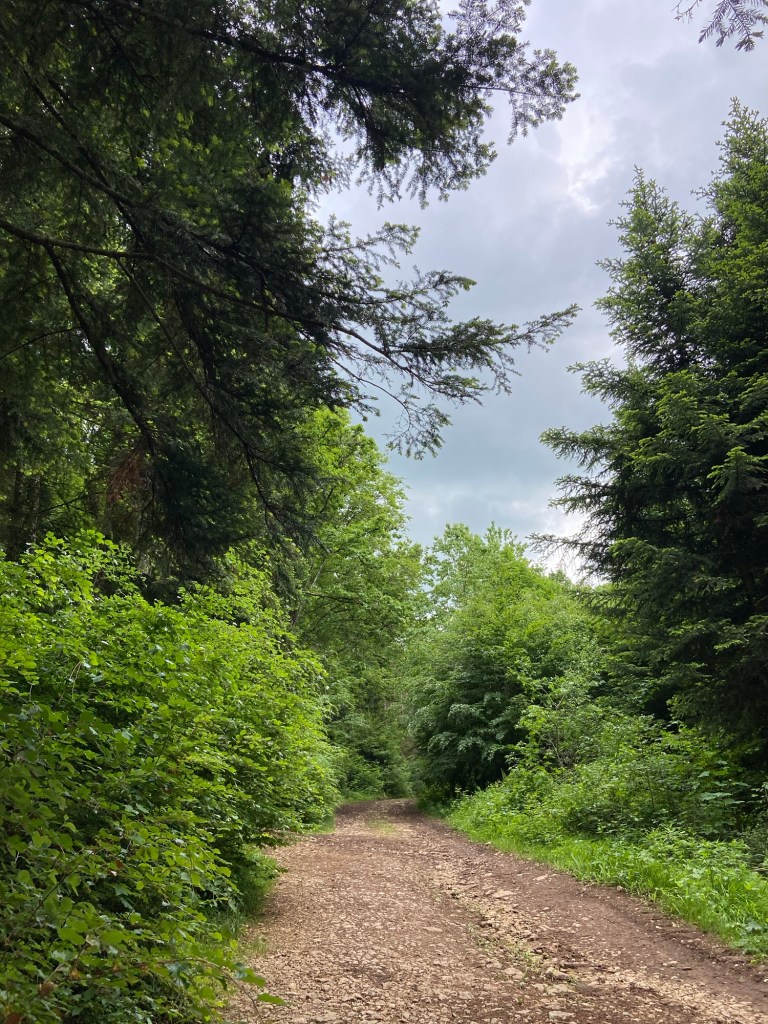
I was also encouraged that birds were singing, as if they weren’t anticipating rain. The clouds were getting darker and darker and I powered along as fast as I could on the muddy, rocky surface, which quickly turned from limestone to reddish sandstone as the path crossed under powerlines and started to descend. Down through the cutting cleared for the pylons I could see that on the plain I had just left it was already raining.
I crossed the D-road and as I was climbing up the other side to gain the height I had lost, peels of thunder rolled round the sky behind me. I held onto the songs of the tree creepers and chaffinches, and the little handkerchief of blue sky ahead that Dutchman Ian would take as a sign of hopeful weather.
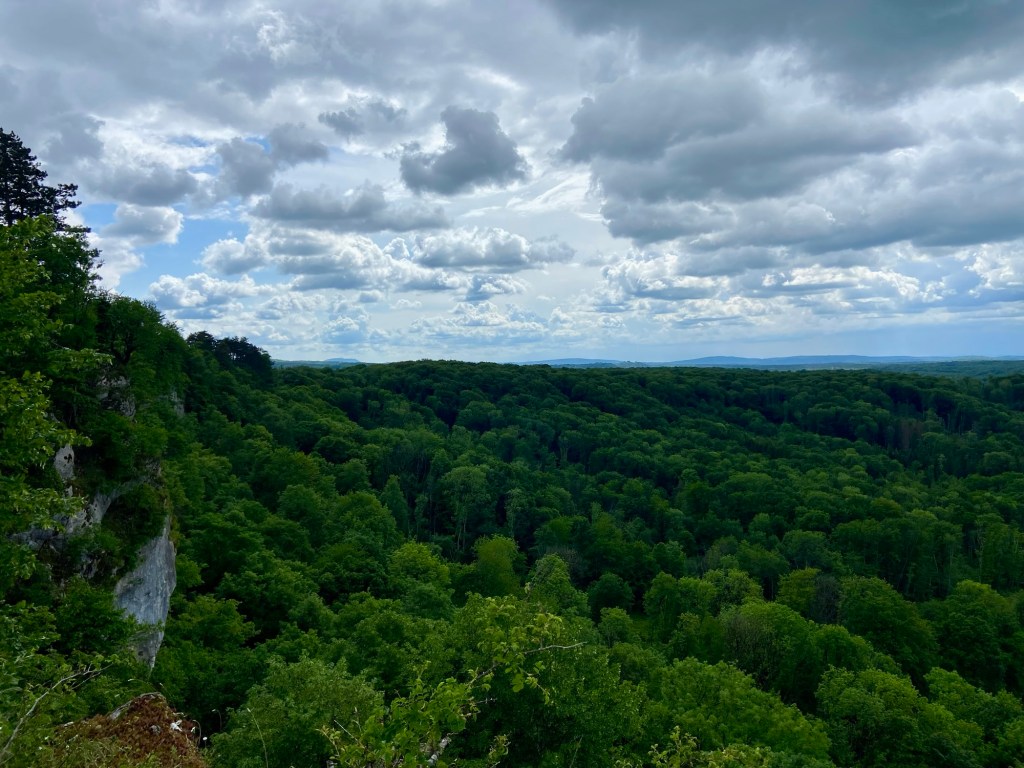
One of the other attractions of the forest path along the ridge was a viewpoint marked on the map: a handrail on top of a craggy rock jutting out of the trees and looking out over the whole valley I had come,

with menacing clouds behind me and overhead,
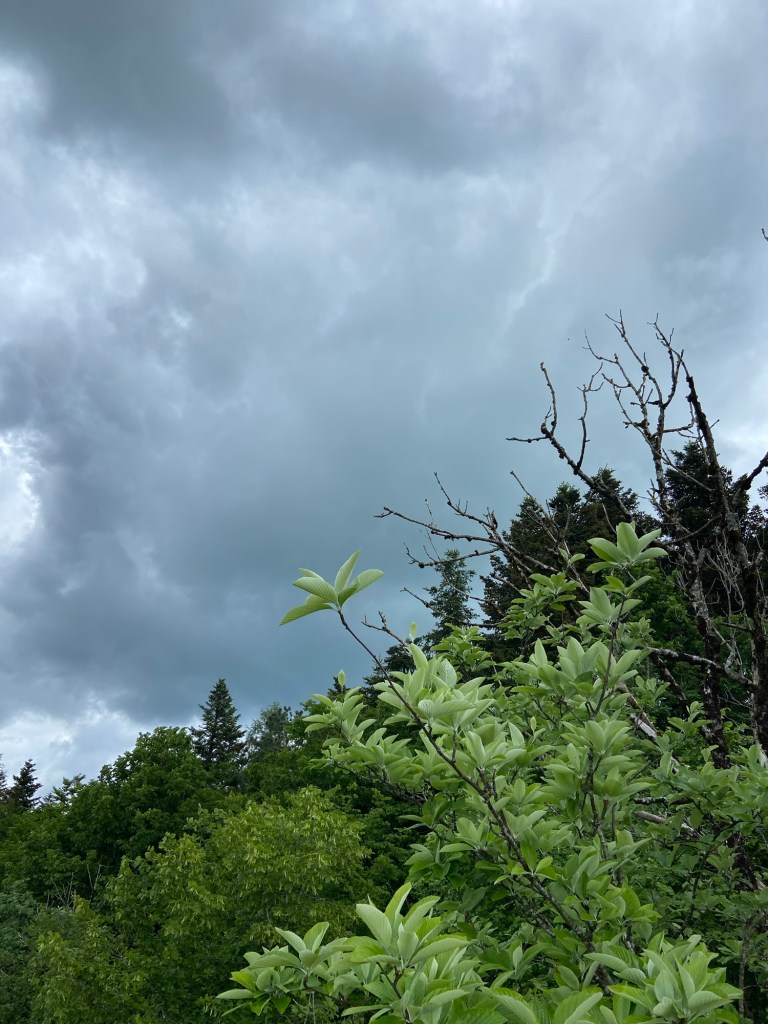
but away in the direction I was heading, the clouds were higher in the brighter sky.
A cuckoo beckoned me on through the wood, now darker when the trees closed in, now lighter in patches of hazel. Last night’s rain had softened the ground so that it was a gentler surface to walk on at the back end of this long day, although quite chewed up in places by logging operations.
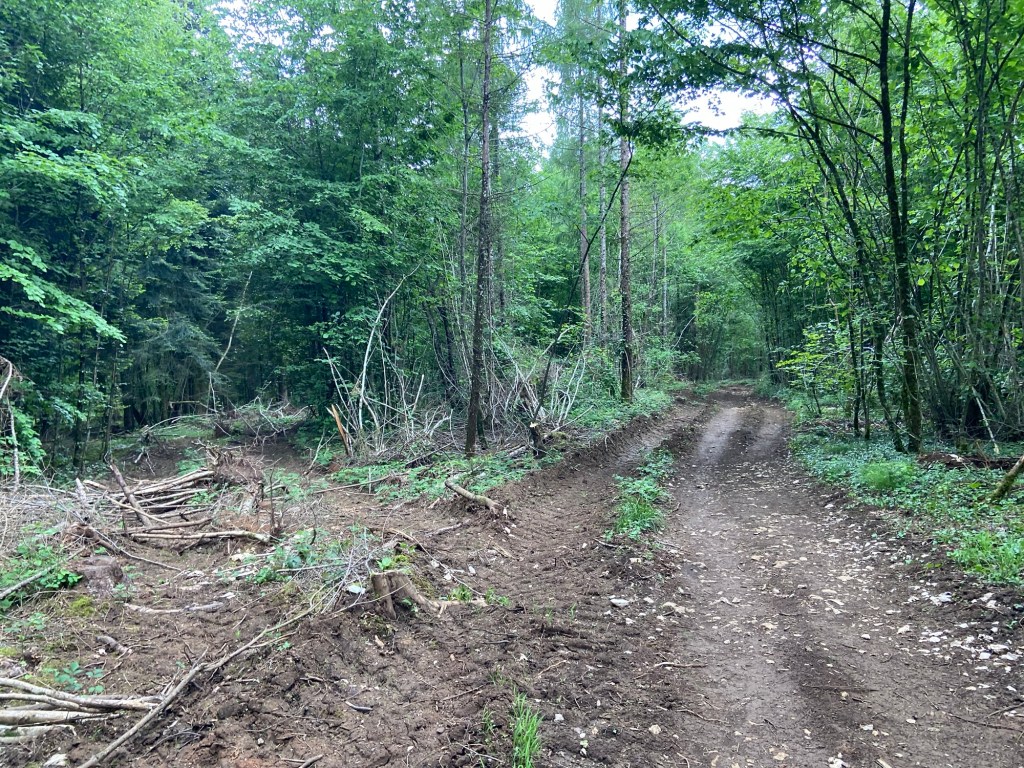
Suddenly my feet went out from underneath me and I found myself on the ground in mud, with my hip and arm in a puddle.
I stayed there for a few moments trying to figure out whether anything hurt. It totally didn’t — and I hauled myself to my feet, coated liberally with wet mud. Agh! I had been so close to the road!

I could spend no time dealing with the mess because clouds were now forming overhead and in front of me. The Dutchman’s handkerchief had been swallowed up and rain was now inevitable. I tried to make more haste with more speed, although I did find a thick handful of dry hay on the road to wipe off the worst of the mud. I was chivvied along by a very insistent guard dog who barked at me when he wasn’t scrapping with his brother on their side of the fence.
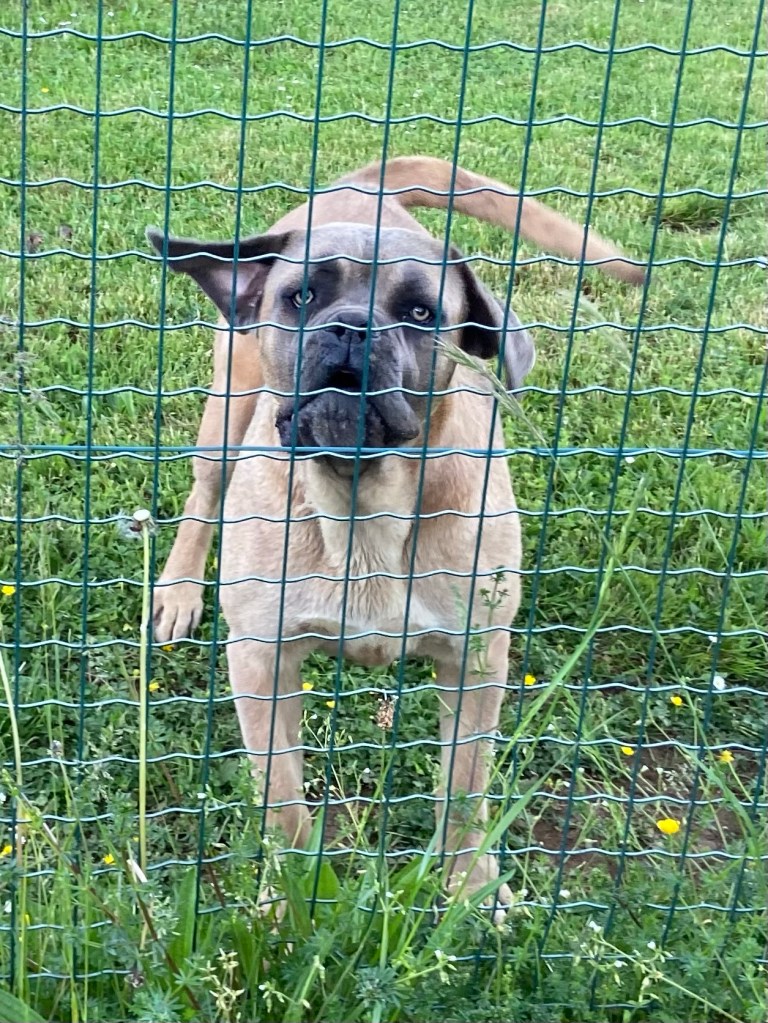
Perhaps energised by my pace a herd of bullocks with rings in their noses rushed to the edge of their field and crowded as close to me as they could get as if to tell me to hurry.
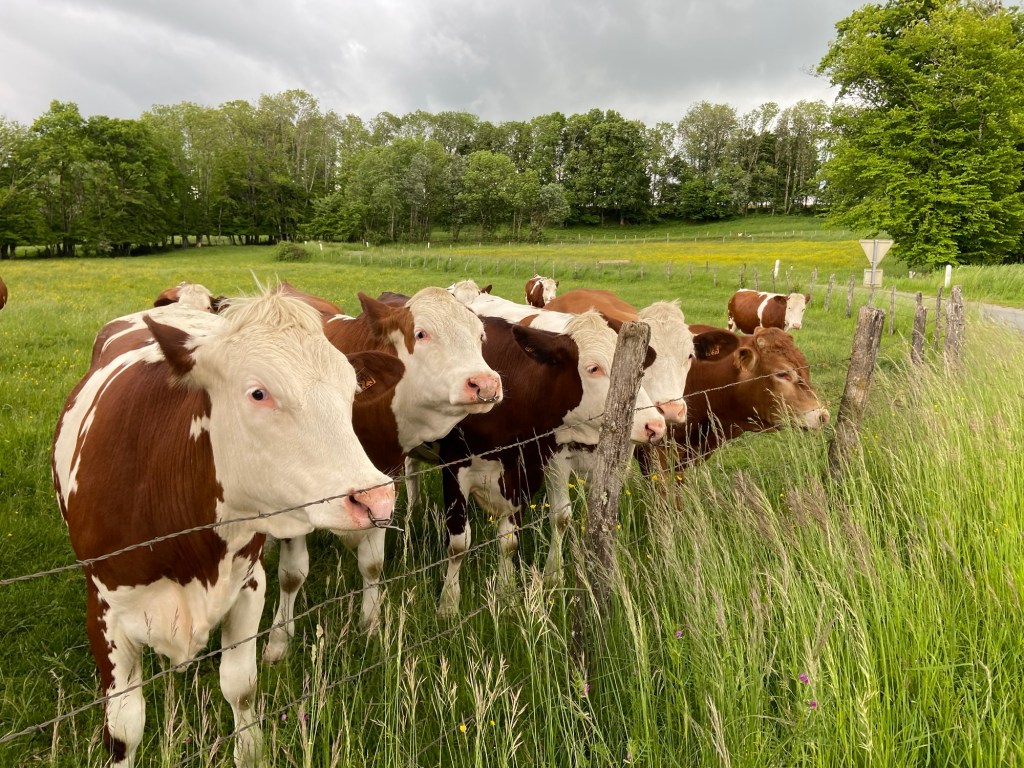
I absolutely did. And I made it to the gîte in the village of Foucherons just in time — I felt the very first light drops of rain on my arm as I arrived at the door, and the heavens opened the moment I shut it behind me, and it began to pour.

Stats for the Day
Distance: 26.82 km
Climb: 721 m
Pace: 4.5 average — not bad with all the climb!
 Walking The Landscape
So good to have you back walking! My heart was in my mouth when you fell, hope that all is well today. 76.82km???? That is very good going…🤣 xx
LikeLiked by 1 person
BIG FAT TYPO!!! 😂
LikeLike
Yes, so good to have you back and be able to accompany you albeit a day behind. I missed your daily blog, but was so pleased that you had such a lovely few days of rest. I hope those thinner socks have worked miracles. X
LikeLiked by 1 person
SO FAR SO GOOD…..! Xxxx
LikeLike
Glad you are back on your journey with a spring in your step. Im hoping someone builds you a triumphal arch or two to welcome you to Rome.
LikeLiked by 1 person
Thank you! It’s just a shame that I have to do it in two separate journeys… although I am pretty ready to be going back home now. Not to stop walking but just that it’s a long, long time to be away. Project Rome in 2026!
LikeLike
What an epic day!!! Glad the socks seem to be making the shoes work. It is such a delight to read and view your observations. I can well imagine that home will be very welcome.
LikeLiked by 1 person