
Jorges Louis Borges
The tall unknowable city takes over the countryside. […]
They speak of homeland.
My homeland is […]
the willow grove’s visible prayer as evening falls.
Time is living me.
More silent than my shadow, I pass through the loftily covetous multitude.
They are indispensable, singular, worthy of tomorrow.
My name is someone and anyone.
I walk slowly, like one who comes from so far away
he doesn’t expect to arrive.
I made an extremely slow start this morning, in the mistaken belief that today’s walk would only be 14 km. In fact it’s almost 18, to which I had to add an extra 2.7 because my accommodation last night was a little bit off the route and a little bit before the stage’s official end.
However, I didn’t regret that because the Suite du Garagiste was a really lovely place to stay. Fanny and Bruno live above the shop as it were, although in this case next to it, in the unit where Bruno has his car workshop. When you imagine a car workshop, you think dirt and grime, but this is a workshop for his hobby cars: two immaculate rally cars and the most wonderful 2CV in powder blue. Not a speck of dirt in sight. He’s also restored a scooter, a project with his son (‘ to get him off his phone’).

Fanny had invited me over for coffee this morning, and we spent a happy hour and a half (well I spent a happy hour and a half, I hope I didn’t outstay my welcome) just chatting about everything under the sun. The coffee was delicious, and there were biscuits to go with it, and a German Spitz puppy called Vicci, a tiny heart-melting bundle of white fluff.

So in the end, I didn’t get away until 10.30, and it wasn’t a nice surprise to find that it was going to be another 20 km day. Within about 20 yards I realised that I was going to have to stop and put on some more Compeed. I sat on the side of the curb on the industrial estate and covered up three more blisters on the bottoms of my toes. That makes a total of eight blister plasters (!) And after that I could walk on.
Fanny had said that one of her guests had observed that all the villages around here have a lavoir — and it was true. I hadn’t noticed before, but it has been a phenomenon that seems peculiar to the Haute-Saône. The 19th century washhouse in Etuz is constructed in the style of a superb double Romano-Grecian temple, with the limestone stream flowing through it into a series of basins. It seems ludicrously, and admirably over-designed for a small village of 700 (which I think would have been smaller still back in the day). Much grander than the simple by contrast Greek cross in Bucy. And imagine taking your smalls to a temple to wash in public.
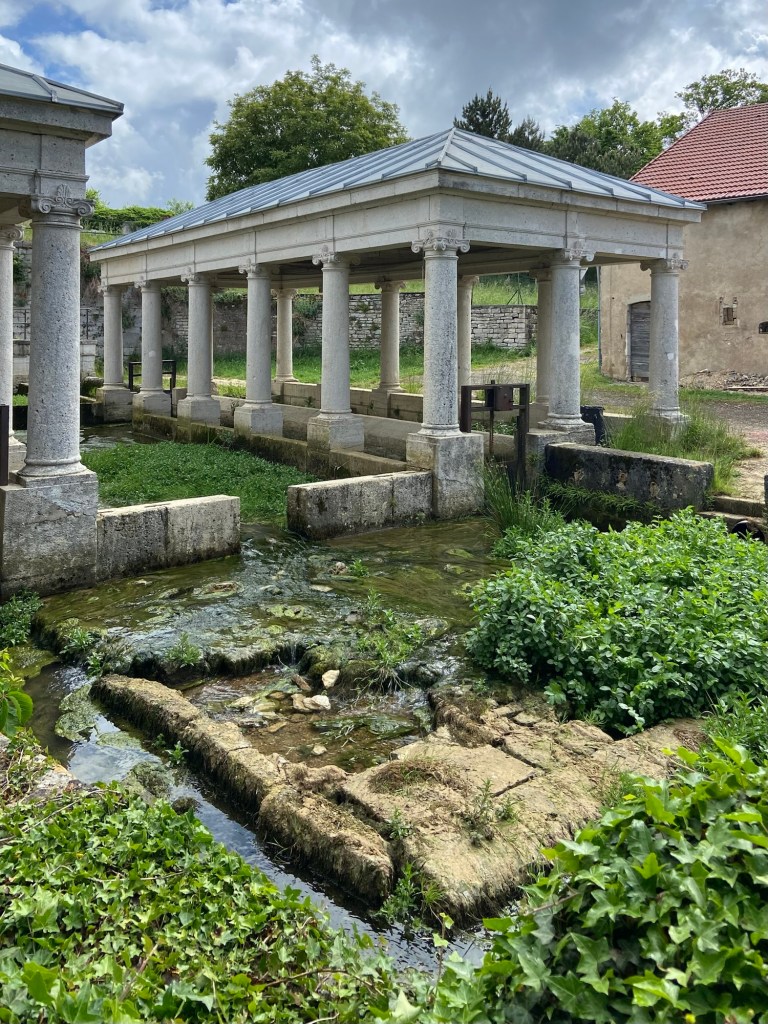
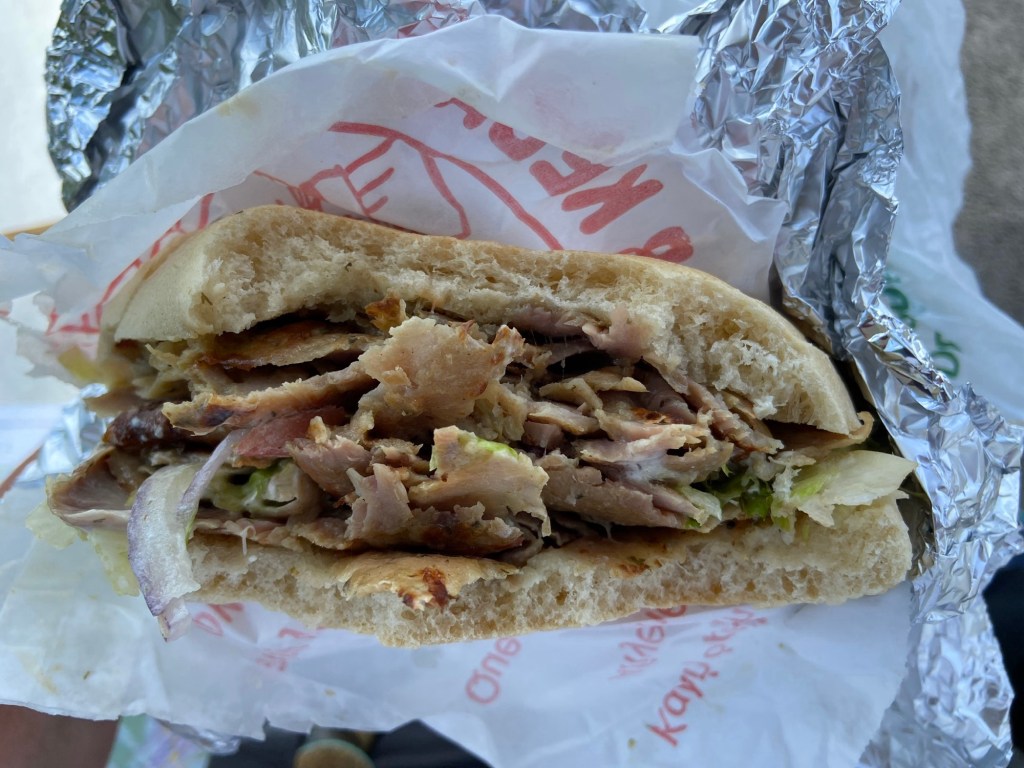
The lavoir reminded me very much of the temple ruins at Patara in Turkey, and it was appropriate therefore that the pizza joint next door was actually a kebab house run by a Turkish chef who packed me up a stonking chicken kebab to take with me for lunch later.
I retraced my steps of last night into Cussy, noticing that the first of the yellow waterlily buds was showing on the pond adjacent to the river,
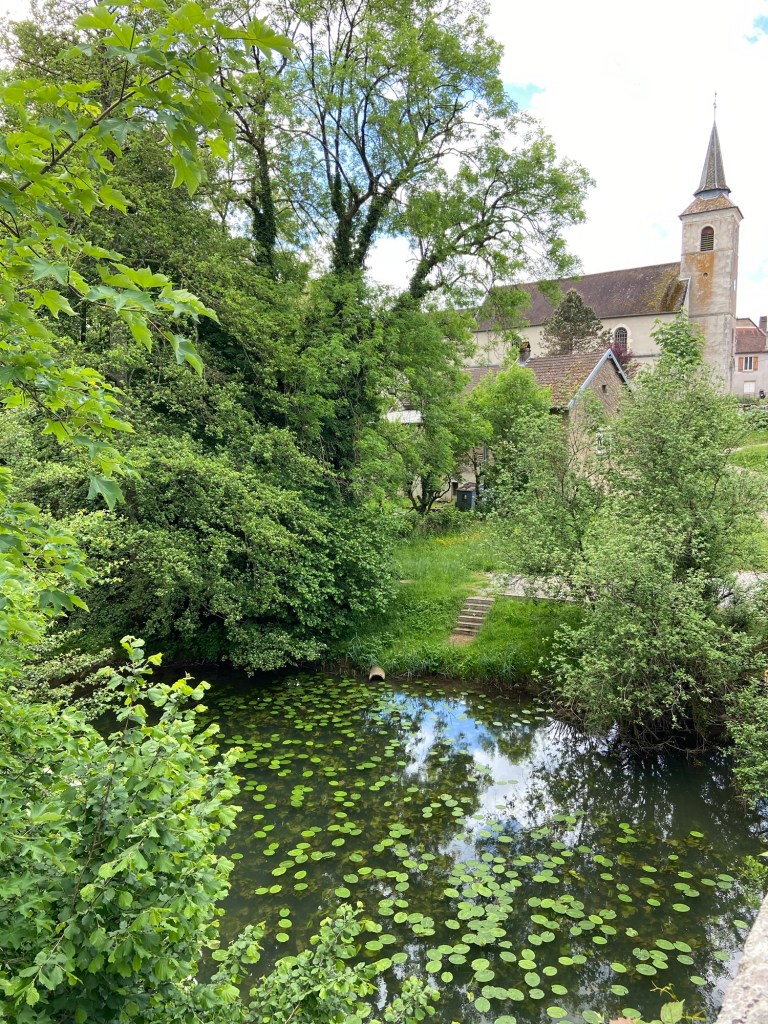
over which a heron flew and landed to perch on the dead branches of a robinia.

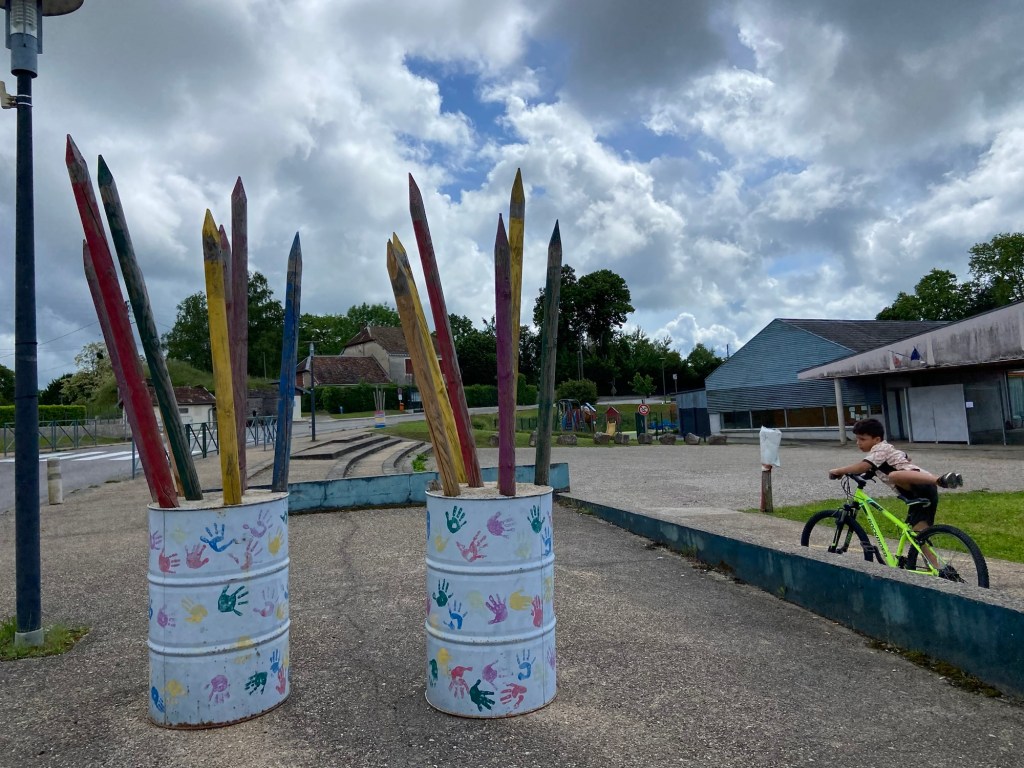
I visited the pharmacy and restocked with Compeed. My glasses steamed up as soon as I got inside — it had been cloudy this morning, but now it was shaping up to be an incredibly humid day. Next to the pharmacy was a small play area, marked by some menacing-looking oil drums filled with oversized wooden ‘pencils’, which were effectively stakes, looking like a weapons cache. No wonder the solitary boy on his bike was looking anxious to get as far away as possible.
The Francigena traces a twisty path along gravel agricultural tracks to get from Cussy to the next town, Les Auxons, and I’m sure it would’ve been very pleasant, but the dead straight D1 road was going to get me there quicker and was going to be much better for my feet. As I said over text to my walking friend Jane, who kindly asked for a report on my toe woe, I am micromanaging the walking at the moment and that means choosing as flat a surface as possible for literally each step, so that even small turns of the ankle don’t put pressure on my toes. It is extremely aggravating, but it is what it is. If I manage the walking in this way, I can do it. That is all I’m going to say about my feet for the rest of the day.
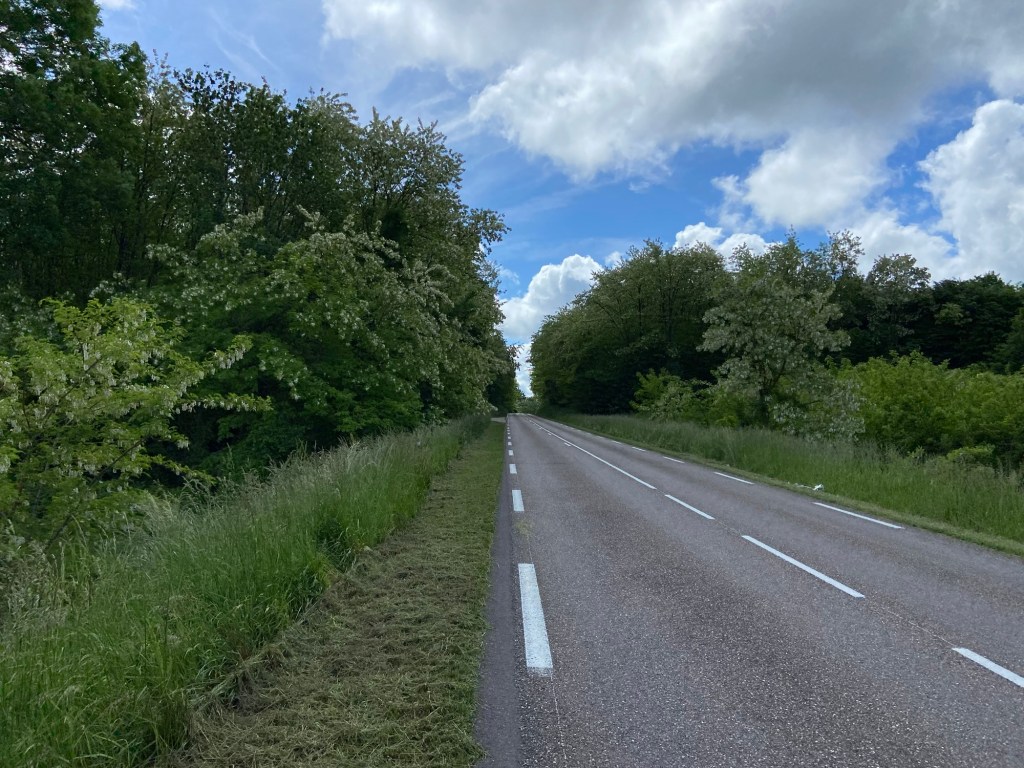
There was a fantastic verge closely mown all the way along the road so that I could march along the tarmac and hop off every time a car came towards me. Even as I walked towards the urban sprawl of the commuter villages around Besançon, I could appreciate the last of the countryside, the fields of cows, the verges with poppies and wild cranesbill, the views over the meadows.
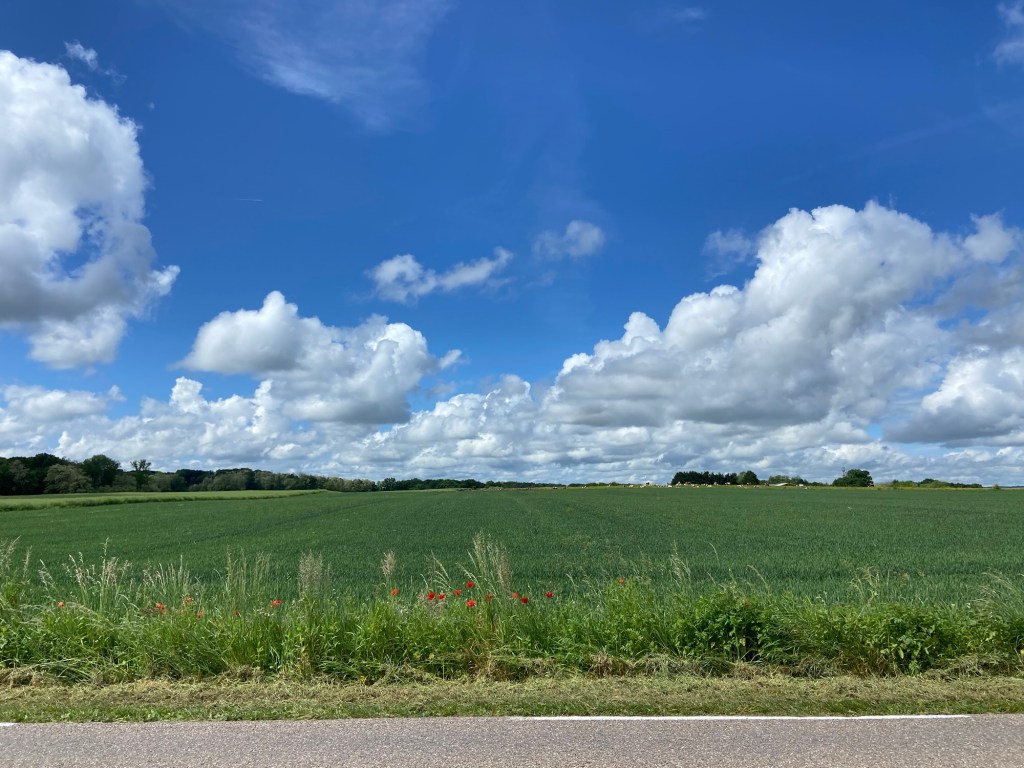
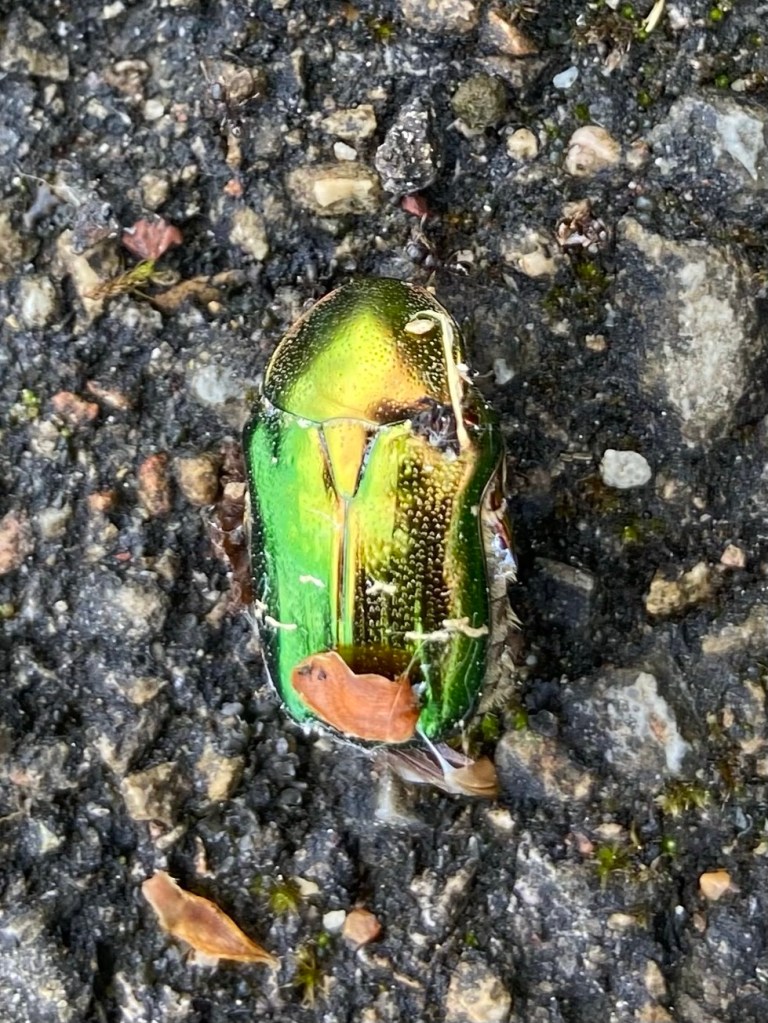
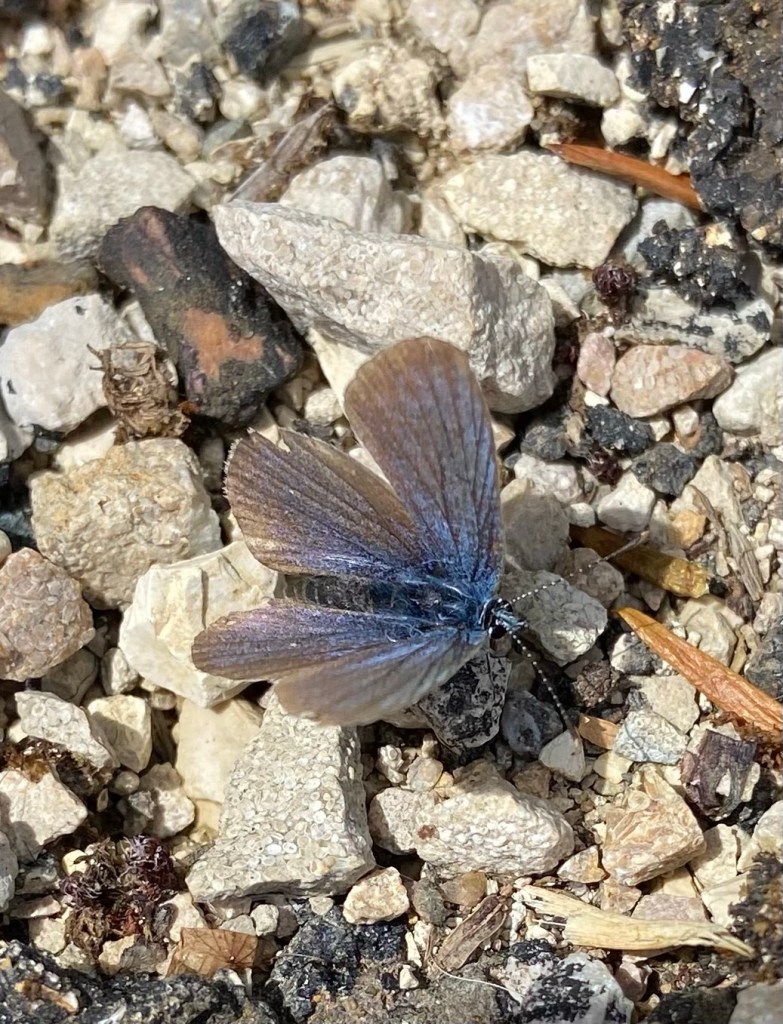
But urbanisation is inimicable to wildlife, and apart from birds (herons flying to and from the Ognon river, a buzzard sticking close to the nest), the only creatures I saw were dead on the road: two blue butterflies, a common blue and a chalk hill blue, an iridescent rose chafer beetle, and the skin of a snake or a slow-worm.
Les Auxons was a pleasant upmarket dormitory town made up of mostly new houses with lots of green space around them, and a very urban feel in contrast to the rural villages of the last weeks.

I had come about a third of the way so I sat in the shade in a bus stop, put on some sunscreen, dried my thinner bamboo socks on the tarmac, and tucked into the vast and satisfyingly overstuffed kebab. It was far too much for one sitting — I would positively be forced to stop later on for round two.
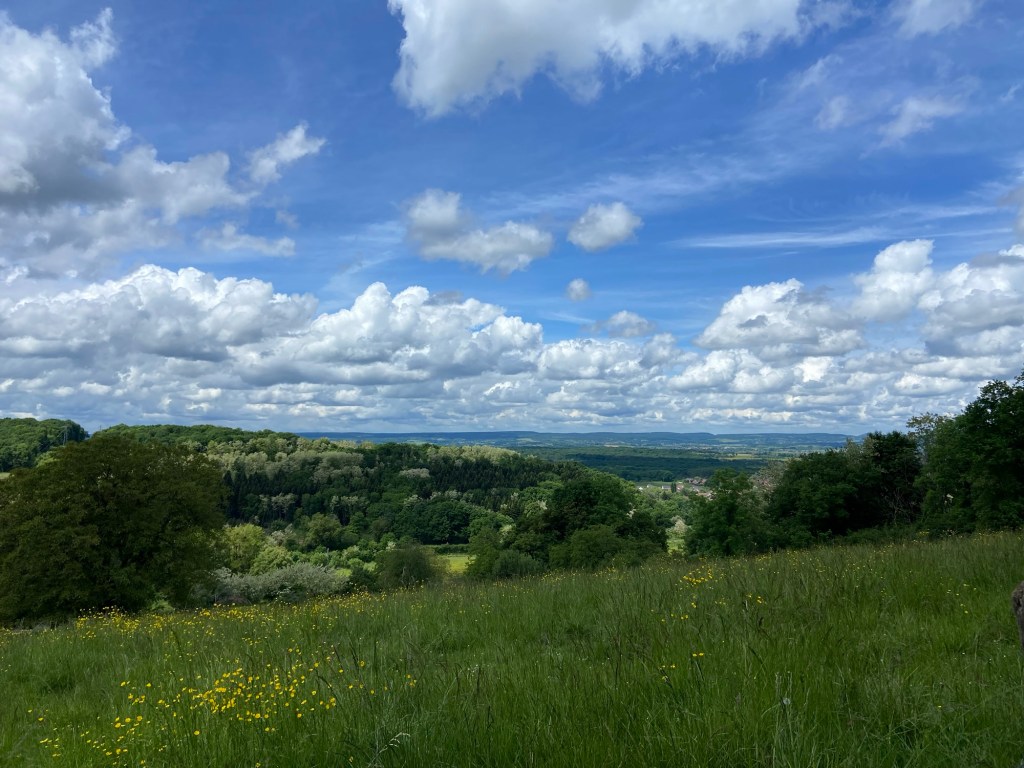
The afternoon stage started with a steep climb, but not as steep as it might have been had I not been road walking. The countryside was holding its own here up over the limestone ridge between Auxons and Miserey Salines, giving jaw dropping views back over the landscape I had walked yesterday, spread out beneath clouds as fluffy as Vicci. I could see all the way back to the Grands Bois de Montboillon I’d come down from on the skyline, to the villages of the Ognon valley. It was absolutely inspirational.
Even here, there were signs of the crossing of the threshold between country and city. Behind me as I photographed the landscape was a 30 km/hr urban speed limit and a warning that I was now on CCTV.

Nearer at hand as I climbed was the valley through which the Francigena rose to meet me, an idyll of woods and pasture and sunlight,

although I was glad I hadn’t come that way when I saw that I would’ve had to have walked through a very unidyllic cloud of dust created by a workman noisily digging up the road.

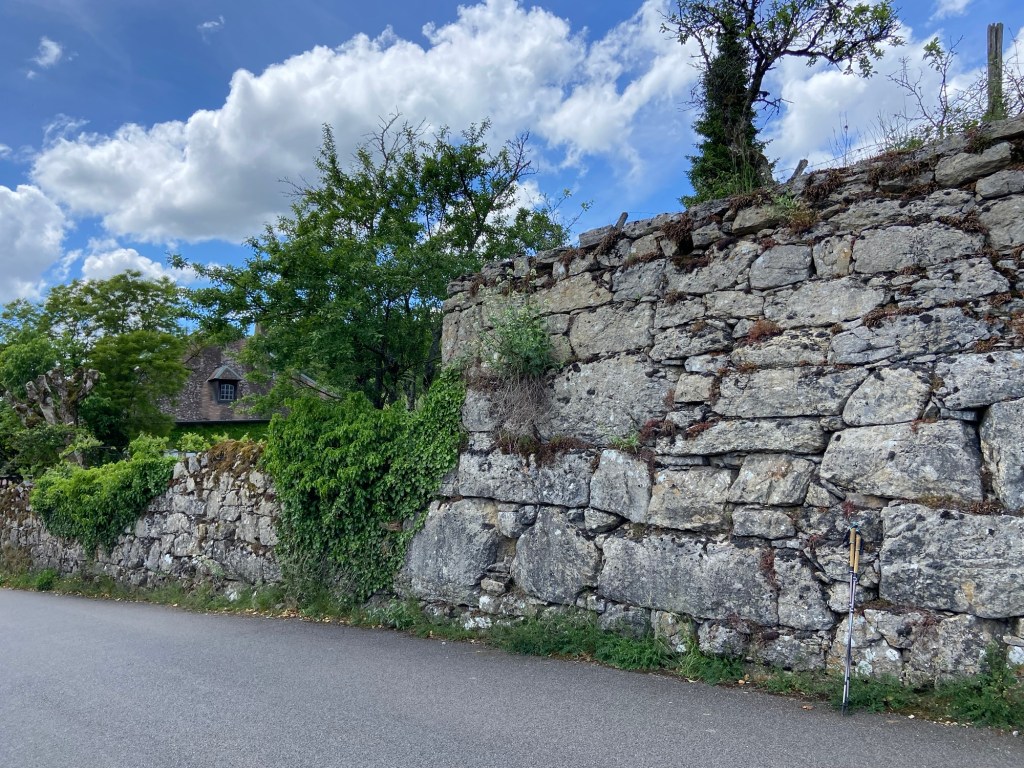
Miserey Salines spilled down a steep hill on the other side of the ridge, and the road was skirted by an impressive wall holding up someone’s garden, made of boulders so enormous that I put my poles in the photograph for scale.
On the other side of the valley there was a corresponding hill to climb, but at the bottom, before negotiating the roads and roundabouts to go under the motorway and up the hill, my eye was caught by a group of locals playing simultaneous games of pétanque on four municipal terrains.
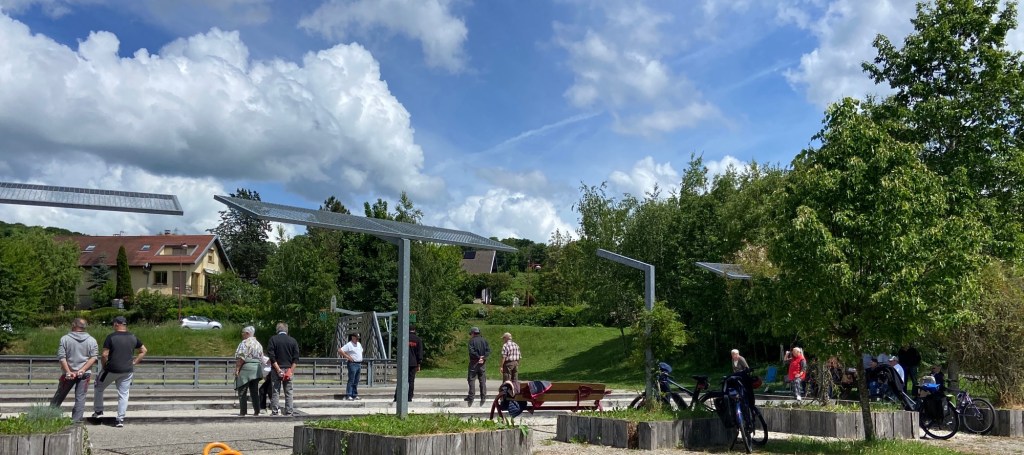
Pétanque has always seemed to me a quintessentially French pastime, and although I have walked past plenty of the sandy, stony pitches, I have never seen a game played. So I walked over to watch and try and make sense of it. The players were mostly retired people (and one younger man in tracksuit trousers covered in white paint) who had brought food spread out on a picnic table in the shade at one end, and lots of bicycles propped up against planters with trees and rose bushes.
I was particularly fascinated by the cup-shaped magnets on the ends of long tapes which they used to pick up the boules without having to bend down.

I got chatting to one of the players who, when she heard I was English and had never played before, invited me to join in the next game. I was lent a pair of boules with a little hatched pattern on so I could recognise them from the others, and the teams were chosen. This happened with everyone standing very close and looking down at the boules and at their feet. The first mystery.
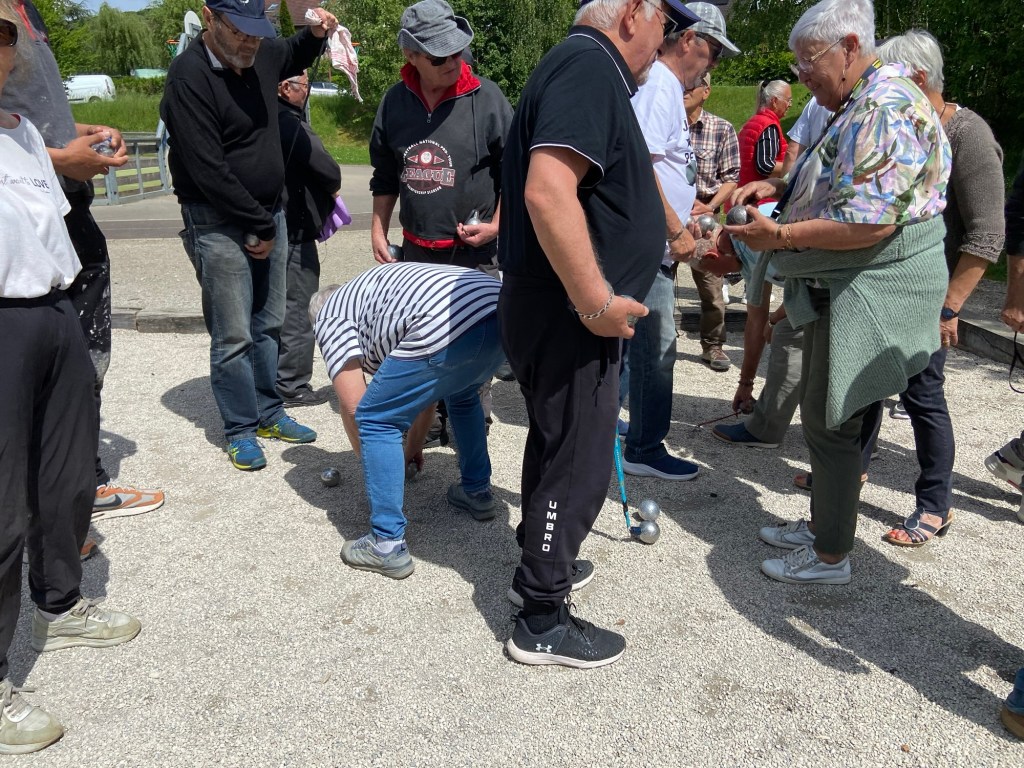
The second mystery was who was on my team — I was assigned to one particular chap and I thought we were playing as a couple, but when scores were announced (the game was over when one team got to 13 points) there were only two numbers given, and there were at least six people playing. Or was it more? Was it two teams of four? Then there seemed to be no set order of play — I just threw one of my boules when people told me to. I didn’t even know what anyone’s name was, apart from Françoise who had lent me the boules — and that was only because I overheard somebody addressing her.

The boules are thrown from inside a little flat ring on the ground at one end of the pitch. The first person throws a little target ball, which must land at least 6 meters from the ring. Then everybody throws, trying to get their big, heavy boules closest to the tiny target.
I was a little bit worried about being absolutely dreadful, and besmirching the family honour, but I had some beginner’s luck and drew some appreciative comments.

The best player was the chap in the paint-splattered trousers whose signature move was to throw the boules high in the air and land them on top of the boules closest to the little green target ball, knocking them spectacularly out of the way.

At some points a tape measure was brought out to check which boule was closest.
It was huge fun. We played a whole game and although my team lost, from the little I’d understood it wasn’t necessarily my fault. But it didn’t matter anyway. It was just the most convivial of games, even if everyone knew my name and I didn’t know anybody else’s. Everybody bid me a very jolly goodbye and I showed my pack again and set off on the last 8 km into the city.

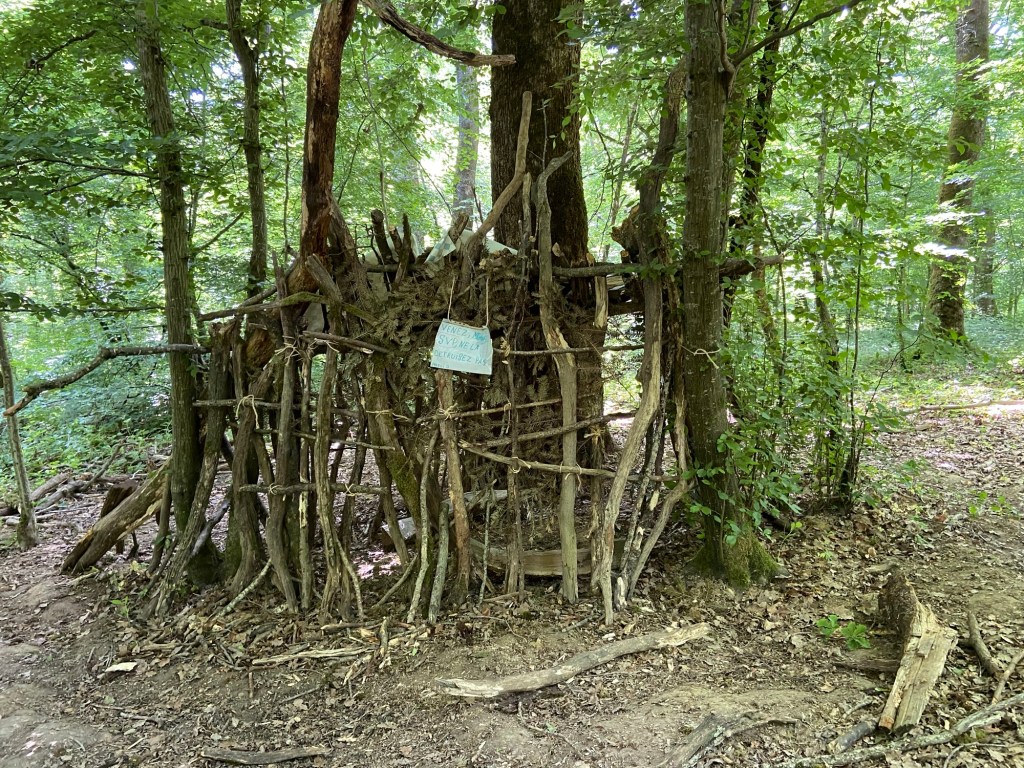
Unfortunately, I ran out of water almost immediately. I imagined that because I was going into increasingly built-up area it would be easy to find some, but the route took me over a hill first through a shady woodland in which children had been building camps (leaving a sign that welcomed other children to use their camp but with a plea not to destroy it),
and then through some parkland, and then a residential estate and it was all lovely, but dry as dust!
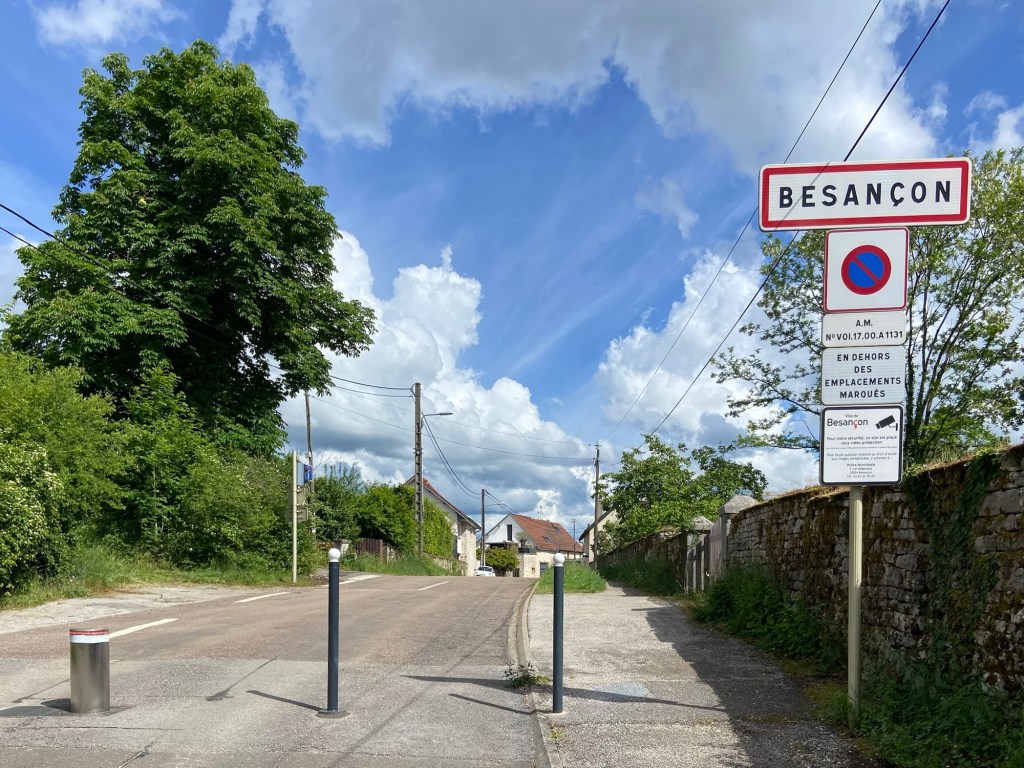
But at least I had now arrived IN BESANÇON.
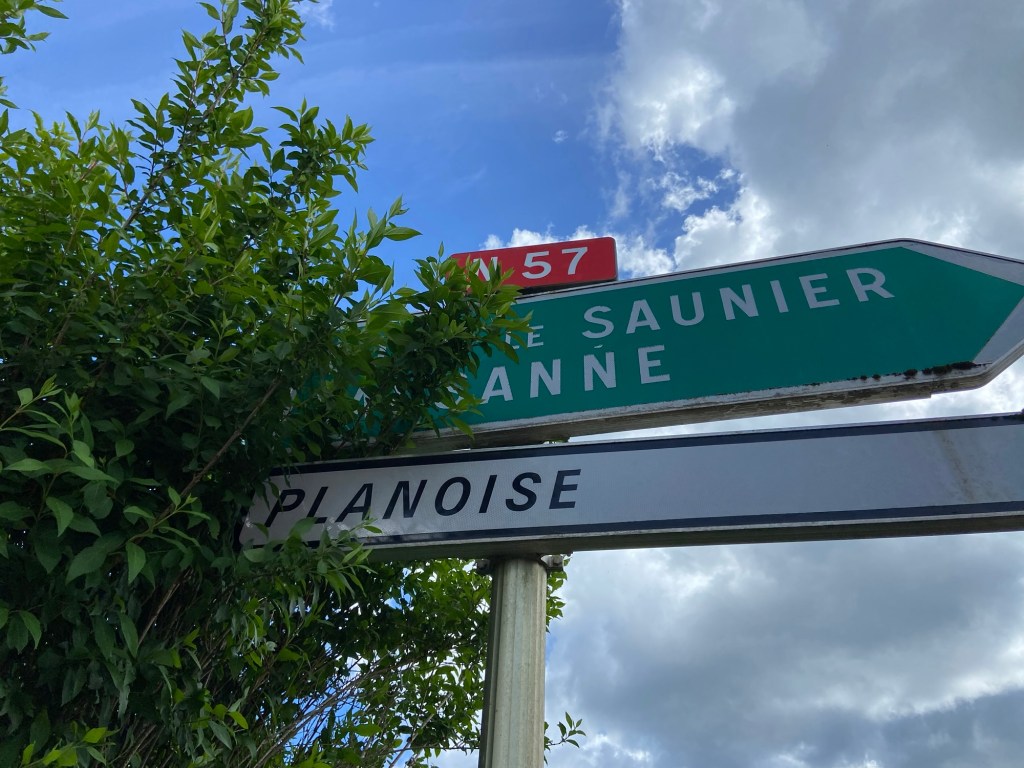
And further on, excitingly and half hidden in a bush, the first signpost to Lausanne, pointing to an entry ramp into the motorway.
The city centre was ahead of me and all I had to do was walk down the long hill, which morphed into boulevards on the other side of the motorway, with research institutes and offices of international accountants, and everywhere wide borders filled with grasses and wildflowers, including even a pyramid orchid (the photo of which turned out to be blurred when I checked it later).
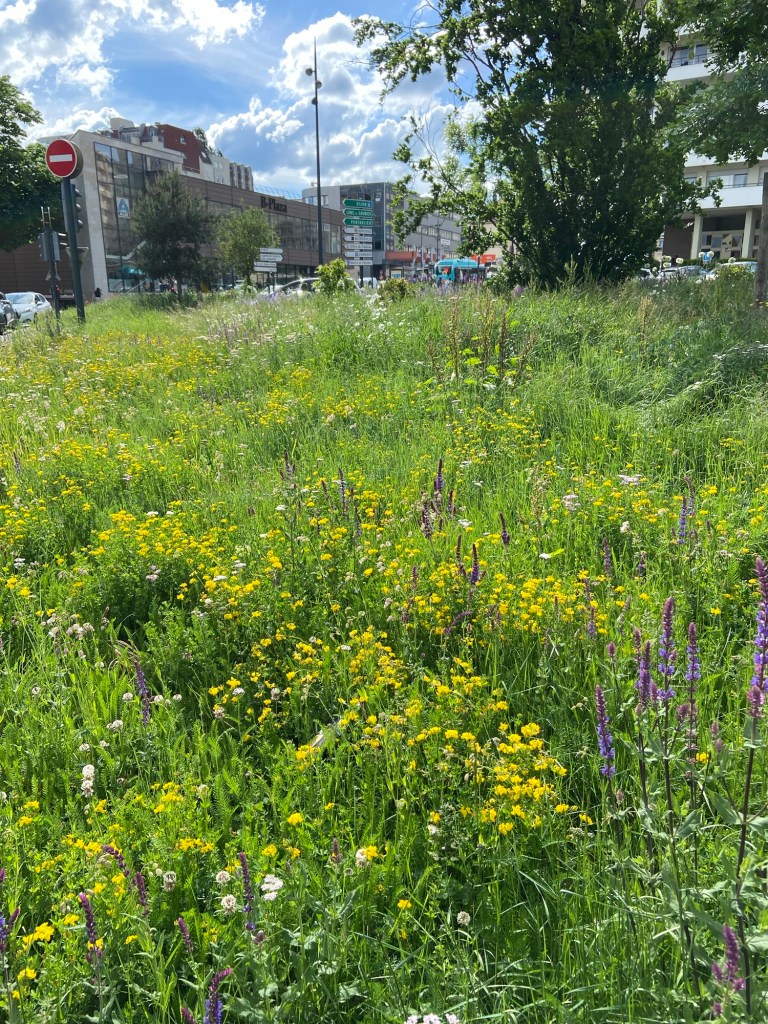
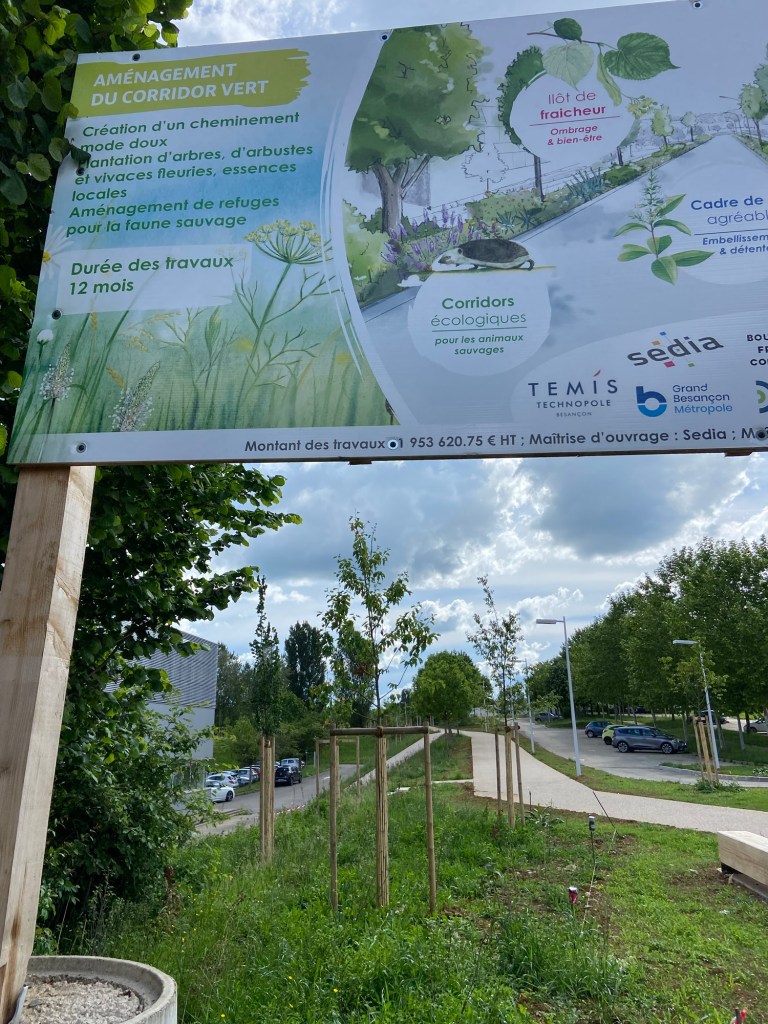
There were works underway to create a green corridor here, incorporating trees, shrubs, flowering perennials and local species, building in wildlife refuges and plants best supporting pollinators. Ribbons of countryside were being extended into the heart of the city.
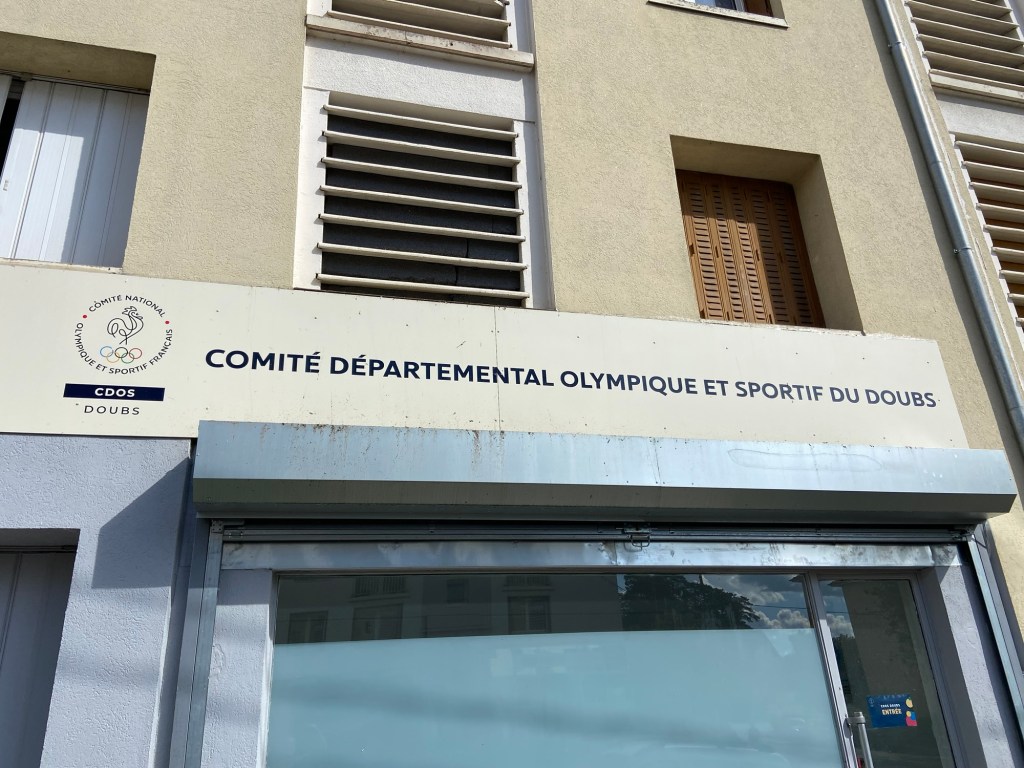
Following my pétanque success I was pleased to walk past the regional Olympic committee. If the office hadn’t been closed I would have gone in to offer my services. But I had an appointment with a bottle of water in an épicerie, the first water source I had seen in 6km.
The water galvanised me for the final approach into the city — and it was good to quicken my pace because I was fearing water of a different and negative kind. The pétanque players had mentioned ‘orages’ in the afternoon… thunderstorms.

But the rain held off as I crossed the bridge over the Doubs river, the third of the major tributaries of the Rhône in almost as many days, impressed by the sheer scale of it all.
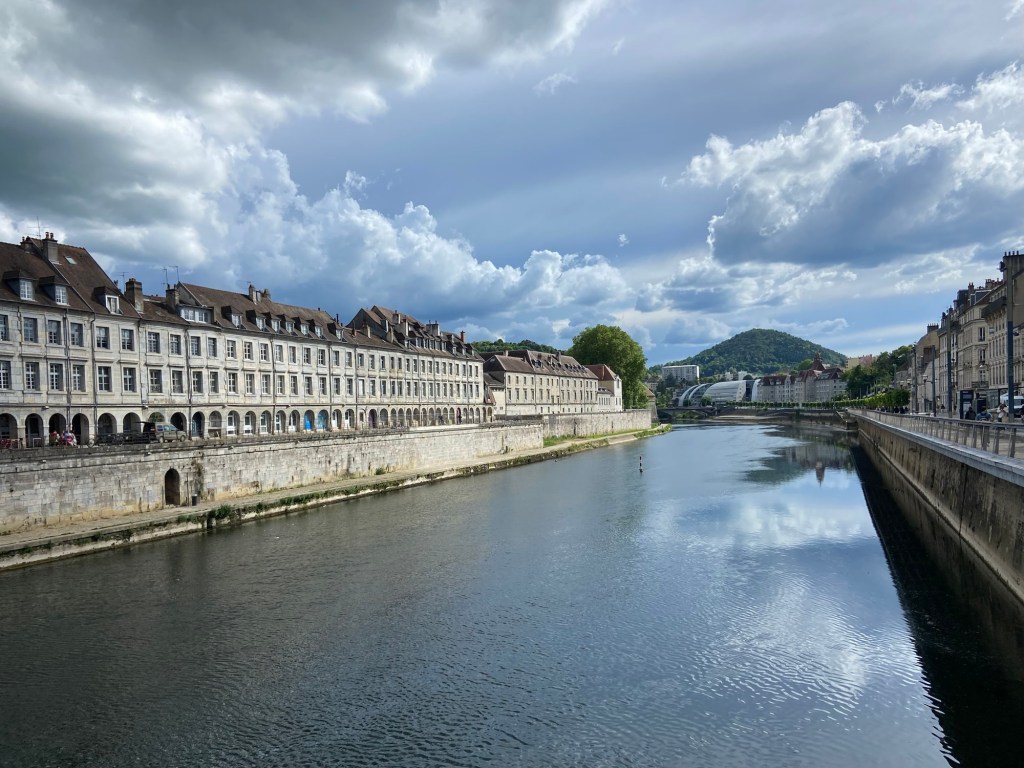
And the numbers of people. And bicycles. And cafes. And shops. And…
It was just overwhelming — but in a good way. It was a far cry from the meadows and the woods and the water lilies, but not a difference that made me feel unhappy; rather it was galvanising.
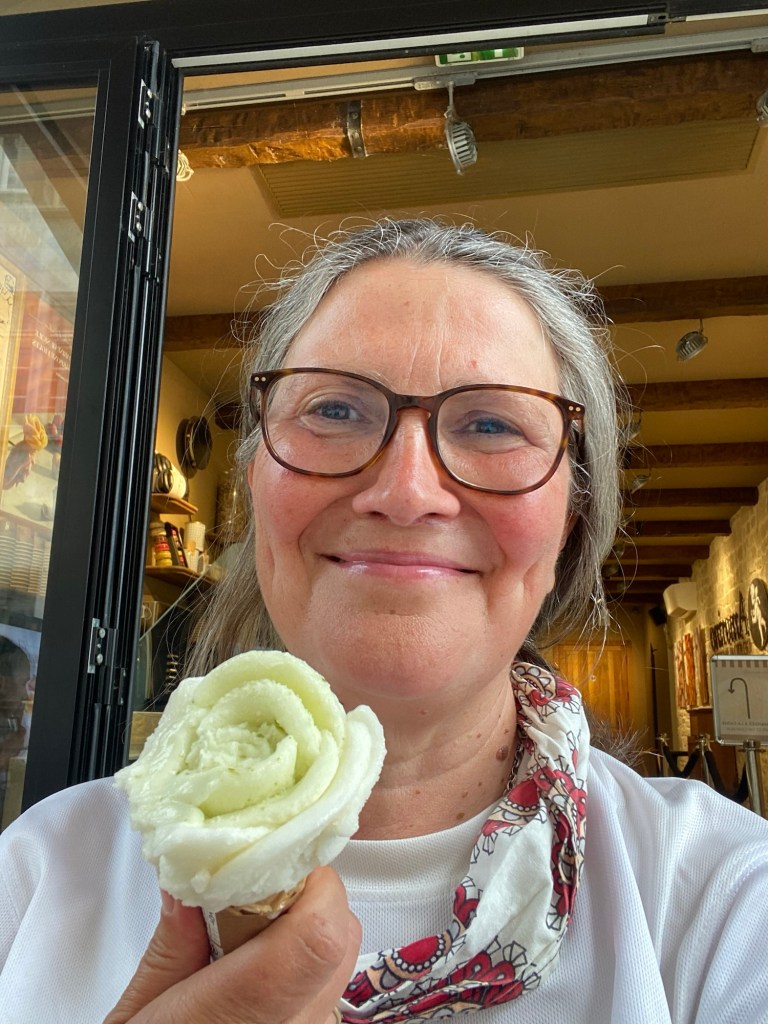
I thought I deserved a thorough treat to celebrate the achievement of getting here to this point: 920kms on foot, 40 days of walking. What would my walking friend Jane do? She would make for an icecream parlour. So I did — and I’ve never had an icecream like it. A work of art!
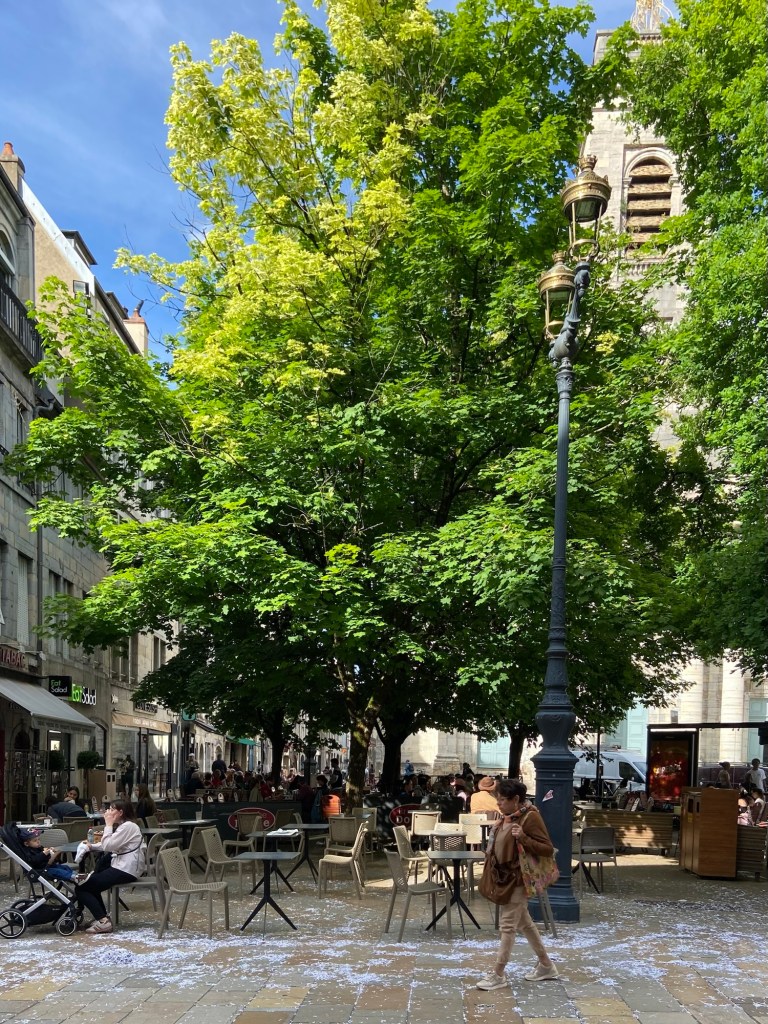
Next I went to the tourist information at the Hotel de Ville, which presented itself in a sea of paper confetti from a wedding which spread from the steps to the café under the trees in the square in front of it.
I felt slightly tearful as I explained how far I’d come, I think more from relief at the fact my feet had held out than anything. I would need to rethink the next few days, in that regard.
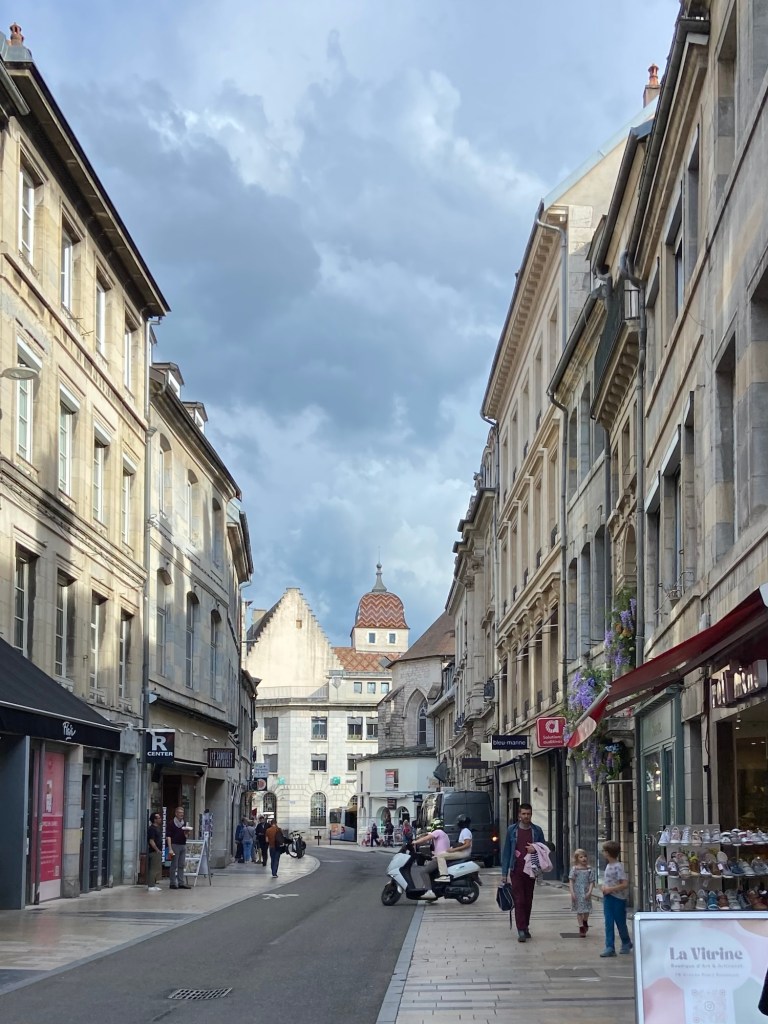
From there it was a walk through the shopping streets,
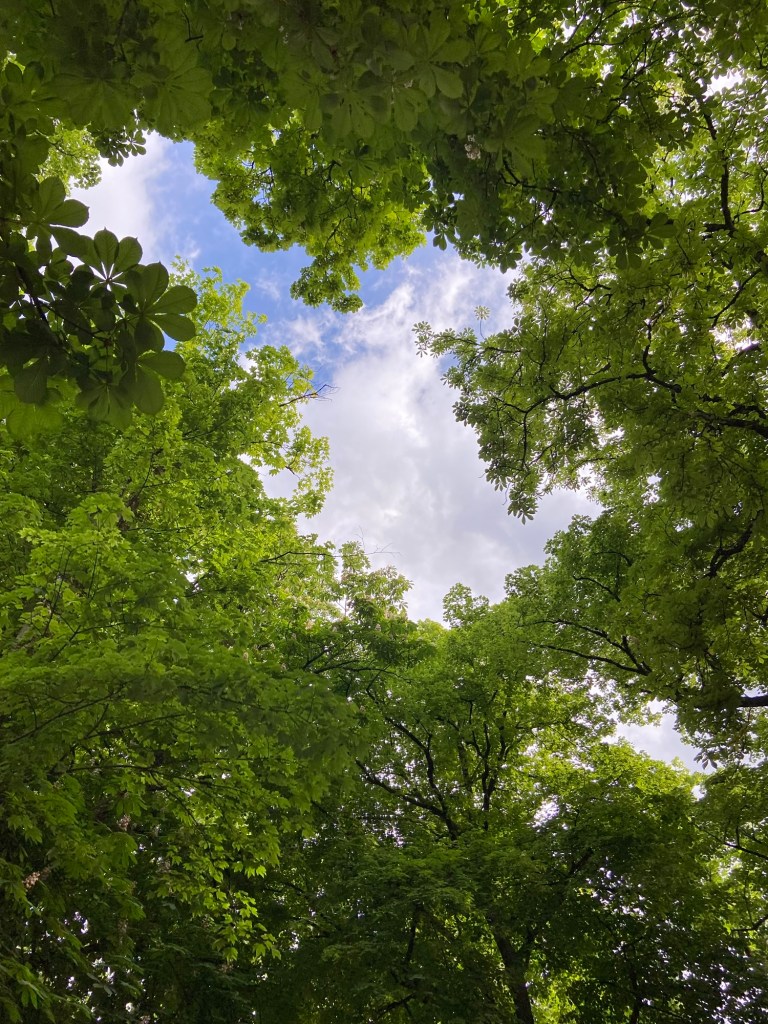
and a park where I looked up into the plane trees and I might have been back in the forests again
until I made it successfully to the apartment. I unloaded everything and just lay there on the bed, absolutely exhausted. It seemed much more than seven days since I’d left Langres, and although it was ‘only’ 156km it felt somehow much much longer.
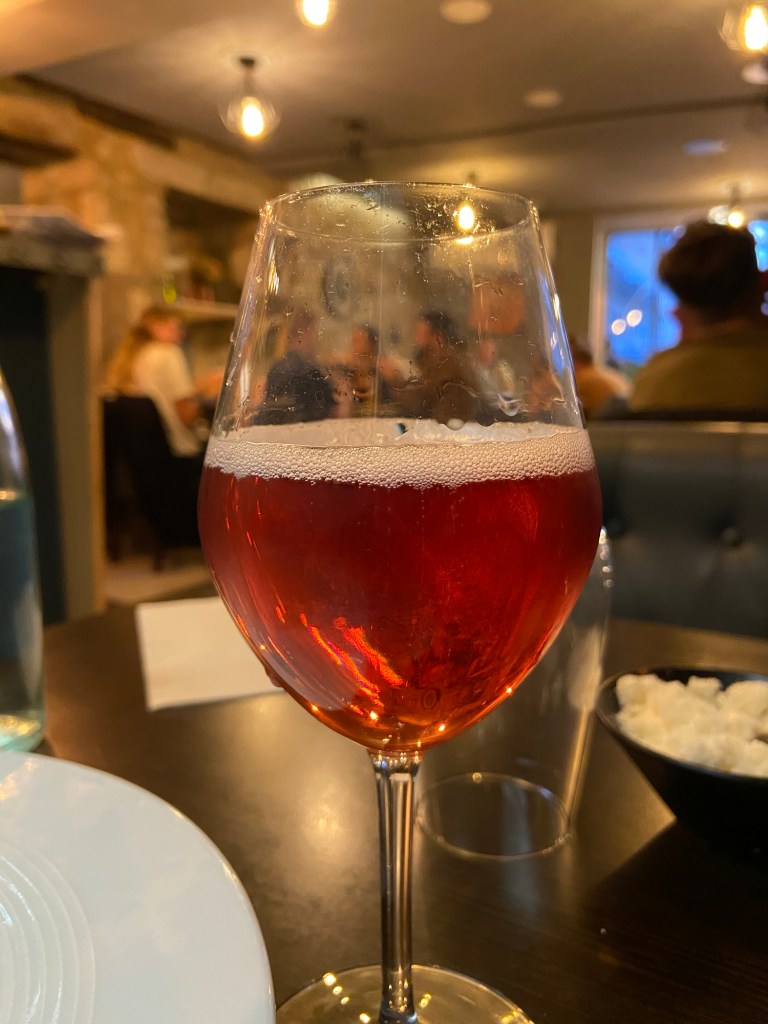
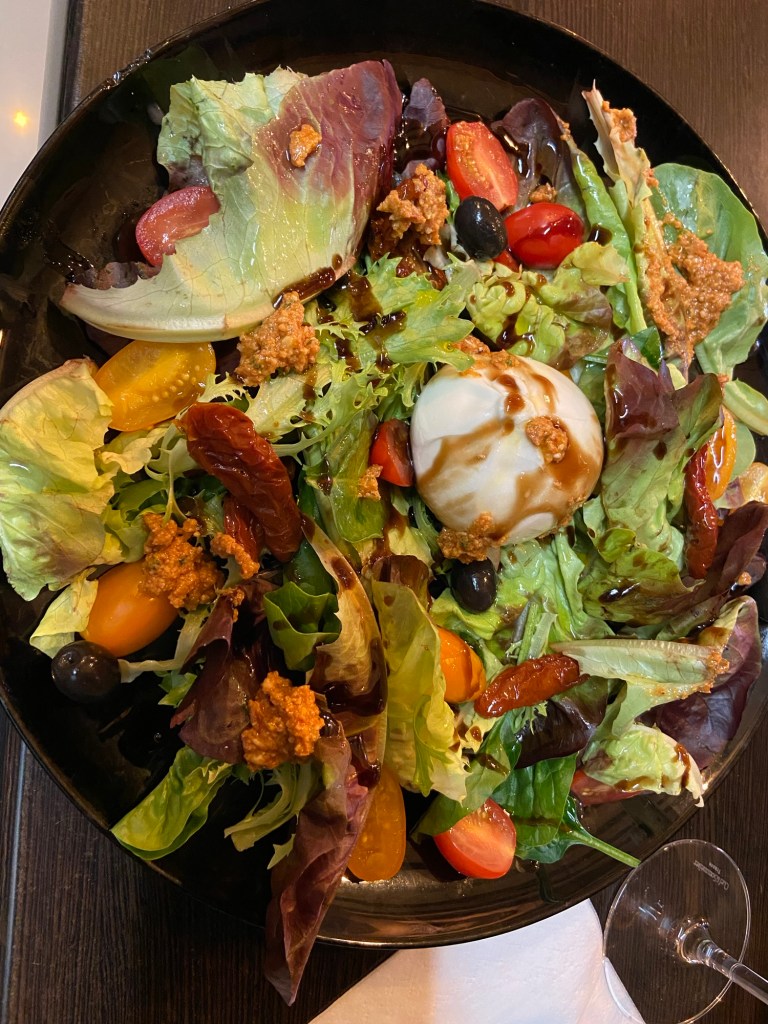
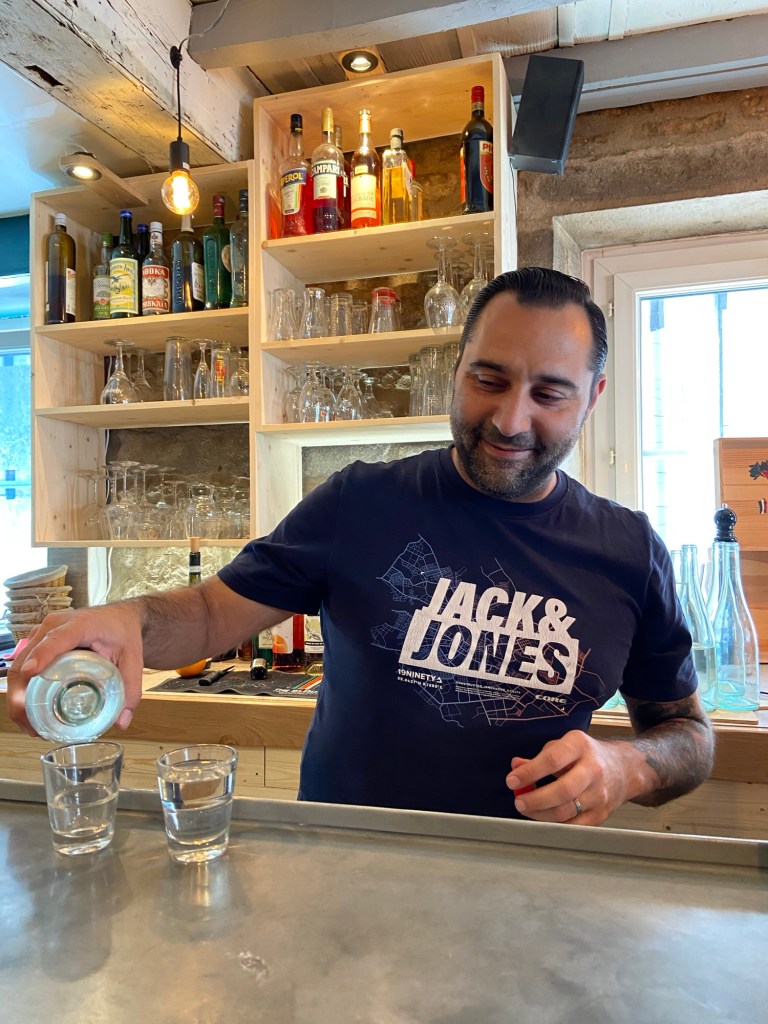
I treated myself to a slap-up meal at Le St Nicola’s. The Italo-French patron and the waitress Lisa worked with real joy and synergy; an unusually fantastic partnership. The food was wonderful and I toasted my walk thus far with Proseccasis. The perfect place for a celebration.

Stats for the Day
Distance: 20.38 (by dint of taking the Roman road)
Pace: a stupid 4.6kmh
Time: 4 hrs 23 moving time over 7 hrs 28
Temperature: 🔥
UPDATE
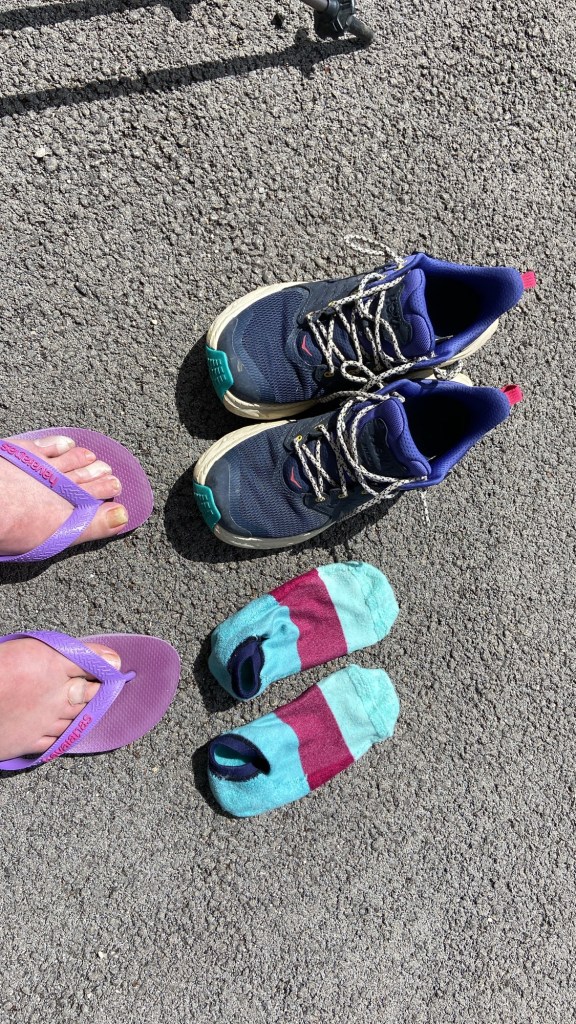
My feet were a mess when I got in. I was very relieved that they had made it, but these new shoes are not working out. My feet had very many blisters and are swelling in the heat.
I had another very bad night with just four hours of sleep and woke up on my rest day exhausted and very worried about my ability to carry on.
As I saw it, I had two options, to carry on or to go home, and I couldn’t bear the thought of putting my shoes on again tomorrow. I phoned Stephen to discuss, and he said that there was a third option: to just take a few days, let my feet recover, and then see how I was. I chewed the plan over further with my walking friend Jane, and talking through it really helped. I had an immensely generous offer of some rest days near Geneva, and so that is what I am going to do. I have ordered some replacement Altra Timp shoes identical to the ones I walked the first nearly 800km in, and hopefully they will be delivered to this friend’s house by Monday!
I spent the afternoon reorganising my forward accommodation from next Tuesday onwards, and all the places I had booked and/or paid for kindly agreed to change the dates.
SO. I’m going to take a few days’ break now and will start walking again from back here in Besançon next Tuesday — there will be a Rest Day Photo Essay tomorrow morning, and then I’ll see you on the other side, raring to go and scale some mountains, if you’re up for it!
 Walking The Landscape
Sophie – so pleased you’ve come up with a plan. Take your rest days and enjoy them. I hope you come back refreshed and ready. xxxx
LikeLiked by 1 person
Yes, because otherwise Mrs. Maskell will have nothing to project on the board! I should’ve made more chemical mileage from the limestone
LikeLike
Going to have to plan my own Form time activities for a few days!!
LikeLiked by 1 person
Eek!
LikeLike
Have a well deserved rest Sophie. Gina x
LikeLiked by 1 person
Xxxxxx Thank you!
LikeLike
Sorry to hear of your foot woes. I am a podiatrist and am happy to hear that you’re going back to your Altras – they are a great foot shaped shoe and I think they will be much better. I hope you have allowed a little extra space for swelling in the heat! Compeed is fantastic too. Socks – I love Falke socks – they are also foot shaped and have thin layers built in. Expensive – but worth it.
Have you tried rubbing surgical spirit on your feet? It’s supposed to toughen them up.. And of course rest is the best! Enjoy your rest days.
LikeLiked by 1 person
Emily! This is amazing all round. Thank you so much for the advice … it makes me feel much more confident about my choice. I will look into the socks! ♥️
LikeLiked by 1 person
Thanks again for your lovely comment. I picked up the Altras on my way back after I’d finished, but luckily my feet were fine once the blisters had healed and I had thinner socks. I trialled the new Altras today on a short walk near home and they were glorious! So much more comfortable in every way. I’m glad you approve of Compeed. I’m always amazed when people say negative things about them. I think it’s because people try to take them OFF and when you do that you risk tearing the skin — but that’s not what it says to do. You’re supposed to leave them on. ¯\_(ツ)_/¯ I have always found them to be a lifesaver.
LikeLiked by 1 person
Such a sensible plan! Have a wonderful and very well-earned rest time with your friends. You are remarkable!
LikeLiked by 1 person
♥️
LikeLike
So glad that you have a plan, and a chance to heal. And also so glad for all the shoutouts today, I felt I was with you! Wishing you speedy shoe arrival and blister hardening, enjoy your break. Xx
LikeLiked by 1 person
Thank you! I found a great sports shop this morning and bought 2 new pairs of thinner socks. A revelation!
Xxxxxxx
LikeLike
What an incredible achievement so far and I’m so glad you have a plan that takes care of you and your feet! Switzerland can wait (even if they don’t approve of lateness!).
LikeLiked by 1 person
Hahahahahhaha!!!!!!!!!
LikeLiked by 1 person