
It isn’t just a village. The houses aren’t just places to live. Everything belongs to everybody. Everyone belongs to everyone else.
Joanne Harris, ‘Blackberry Wine’
I didn’t actually remember any of my dreams this morning, but I was awakened several times in the night by the dog barking frantically.
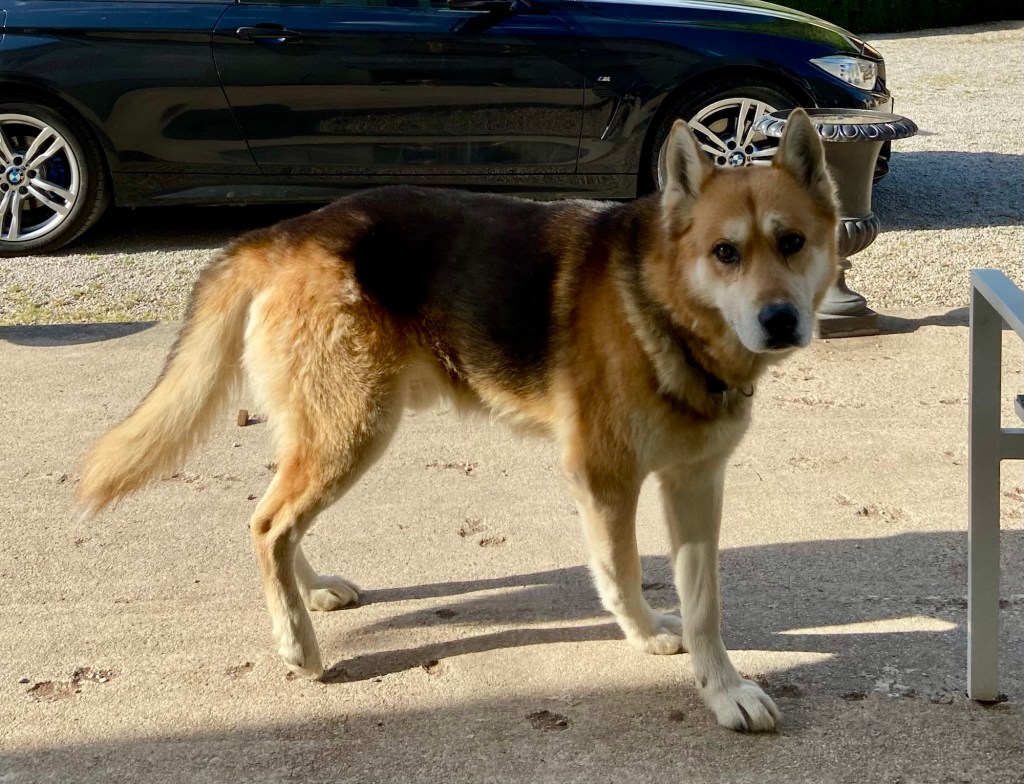
Étienne told me over breakfast that some young kids were having a party down by the river and the dog felt he needed to protect the estate. Étienne is only 20, and his sister (who I thought was his fiancée, but no!) is 25. I was horrified to learn that their very ill father (to whom I had spoken two weeks ago) had died the week before, and the young people are carrying on the entirety of the business themselves. It is a huge burden to carry on such young shoulders, and they are doing a magnificent job so far. I wish them from my heart all the very best of luck.
The first order of the day was to phone Stephen, as I had been asleep by the time he got home from school at 9:30 last night. We chatted as I marched along the road towards the day’s end at Chez les DomDoms at Bucy-les-Gy; a most pleasant way to let 3.5km pass, almost unnoticed.

I did retain enough awareness of my surroundings, however, to say hello to two cyclists who passed me (with yesterday’s quotation in mind, about to see a lot less along their route than me) and notice the unusual bi-colour pink flowers on the pea crop.

On the edge of Vellexon I met Claude (trimming the hedge) and Florian (stacking wood). I asked about the timber: was it really all for heating houses? ‘Yes,’ said Claude, looking with a judicious eye at the pile. ‘That’ll last about four months. That will be pretty much all that is needed for a year, given that so much of the time it is too hot to need any heating.’ He plucked at his overalls and said he was shirtless for most of the summer. ‘I hope not working with power tools,’ I observed, looking at his hedge trimmer, ‘Although always with a chic hat on?’ ‘Oh yes,’ he said. ‘I am always chic. I’m not English after all.’

He asked how I’d found the French, and I said that everybody I met had been incredibly kind and welcoming. Even the cars that pass me on the roads invariably give me a smile and a wave. They were both pleased to hear it, although they did say that things were changing a good deal now. Their experience has been that people are becoming more closed, more insular. ‘Perhaps in the cities and big towns?’ I suggested. Certainly that, they replied, but also, sadly in the villages.
I asked whether it was going to rain today; an all-important question for me. ‘All of the Internet sites I have consulted said no, but what do you think?’ They gave their well-practiced Gallic shrugs. ‘Maybe a little thunderstorm.’ I didn’t want a thunderstorm of whatsoever kind. I’d packed all of my wet weather gear in the bottom of the rucksack on the forecast’s assurance that it was going to be dry, and wet weather would necessitate a complete emptying out and repacking by the side of the road. ‘Think of me when it rains,’ I said.
Claude took me to see his garden, with fig trees, raspberries, and a vegetable patch planted up with potatoes and shallots and a bit of salad. ‘I’m really happy here,’ he said. ‘This is where I’m happy.’
I walked on, on the paths that made me happy. And I also looked ahead to the horizon where it definitely was raining already. Perhaps the cloud would lose all its burden before I caught up with it (or it with me). The clouds above my head seemed high enough, and there was little wind which meant that the rain was mainly falling on some other plain and might not move terribly fast in my direction. We would see.
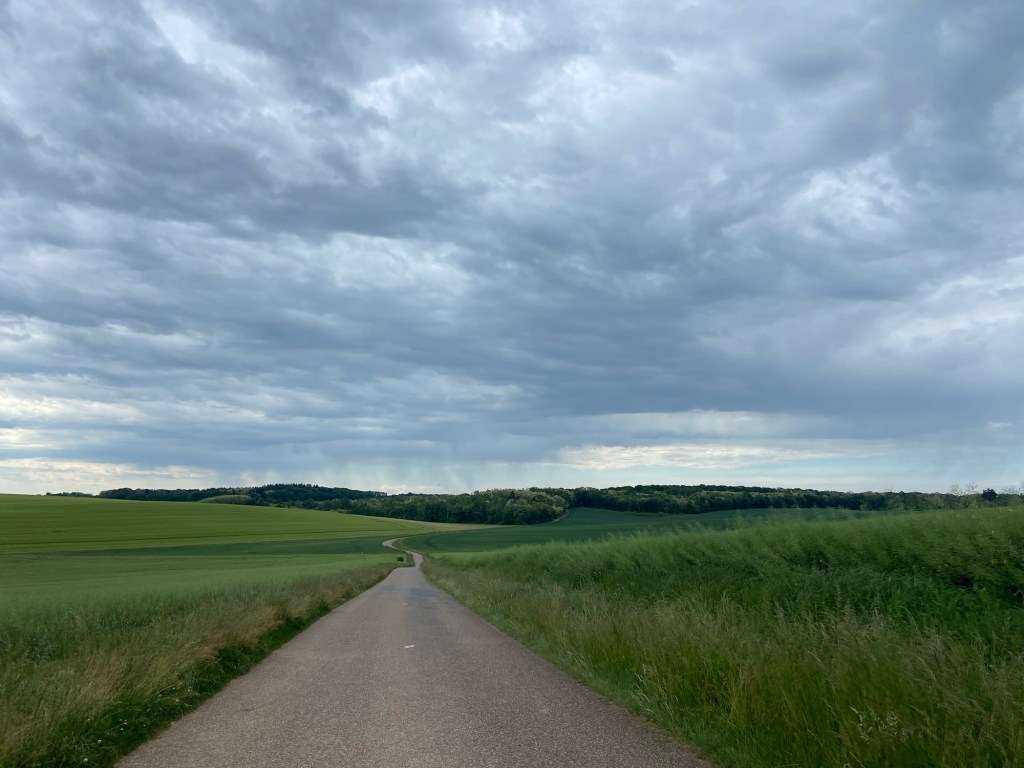
The rain held off until the next village, Vaudey, remarkable only for someone’s outdoor plunge pool, which must constitute a public spectacle in the season, with no hedges or privacy to speak of, and just a wire fence to separate them from the road.

There was an old mill decorated with genii loci, a hedging of the bets, with a demon face over the door to the cellars, and an assemblage of dwarves dotted about the garden like gnomes.

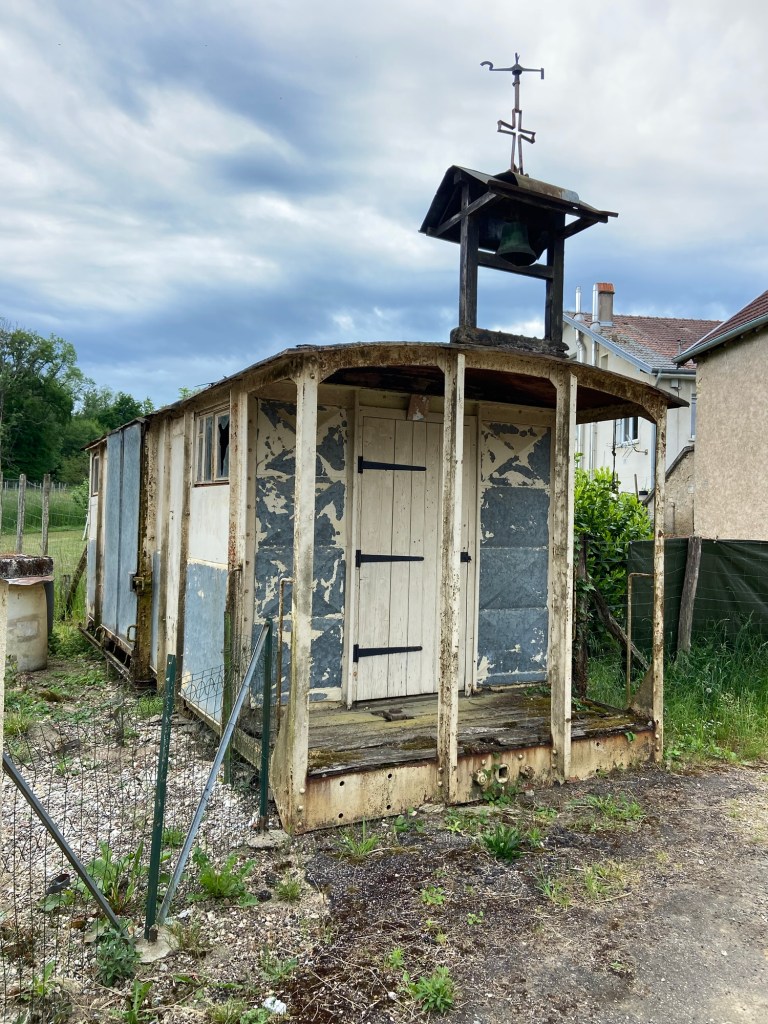
The village was too small to have a church, but there was a little chapel in the garden of someone’s house, made out of an old railway cattle truck complete with a little chapel bell.
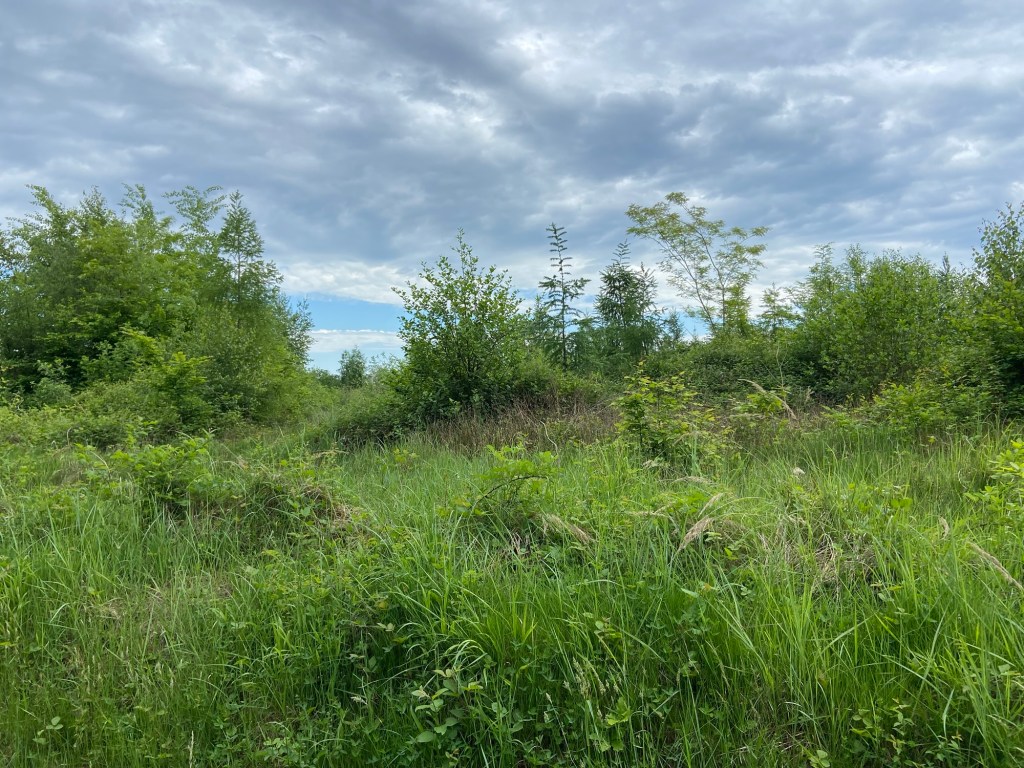
Out of the village, it began to spit with rain. The map had shown this as a road section taking me through some woods, and it did not seem yet as though rain would begin earnest. I had hoped to have some protection from the trees, if I needed to repack my rucksack, although this wood turned out to have been cleared some time ago. Now it provided shelter for turtle doves.
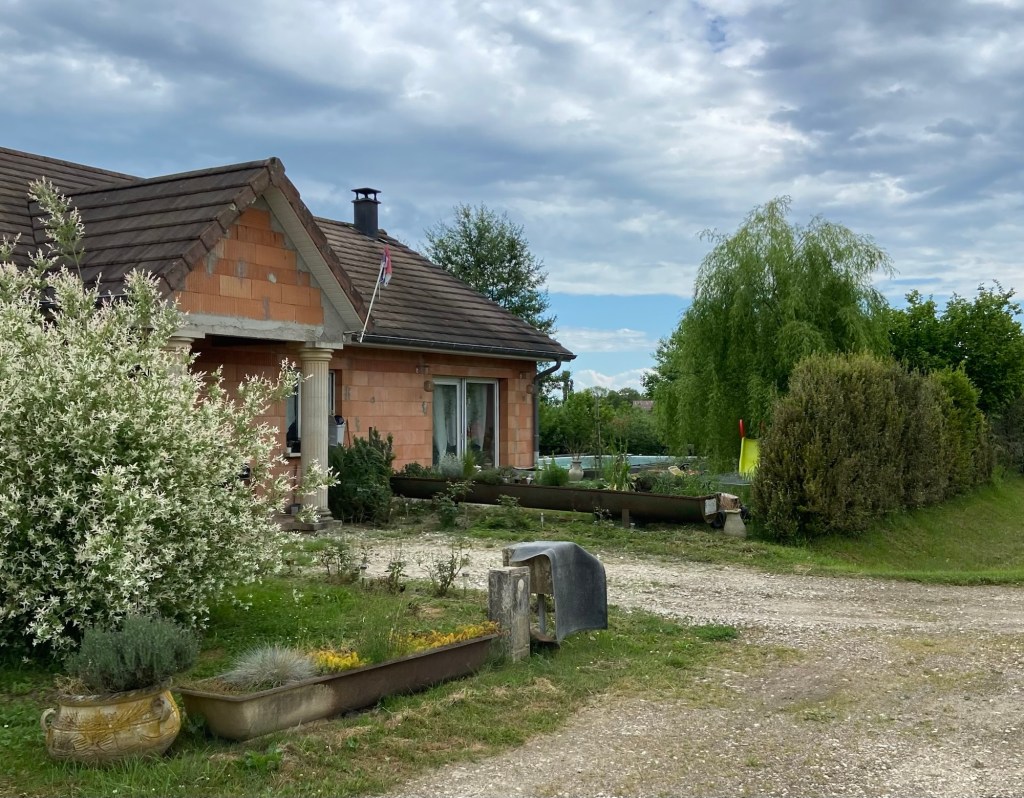
I had been listening to my audiobook as I came into Saint Gand. In the novel two characters were beating a carpet, from which enormous clouds of dust billowed. From the first house on the left in the village a mat flew through the air and landed with a great phwapping noise on a flower planter, and billowing clouds of dust were thrown up into the air. It was a case of life imitating art far more than art imitated life, to paraphrase Oscar Wilde.
Three children were standing in the doorway of the house, where somebody had begun to build a porch with enormous Grecian columns, being swept by the older of the boys, who had tossed the mat out onto the driveway.
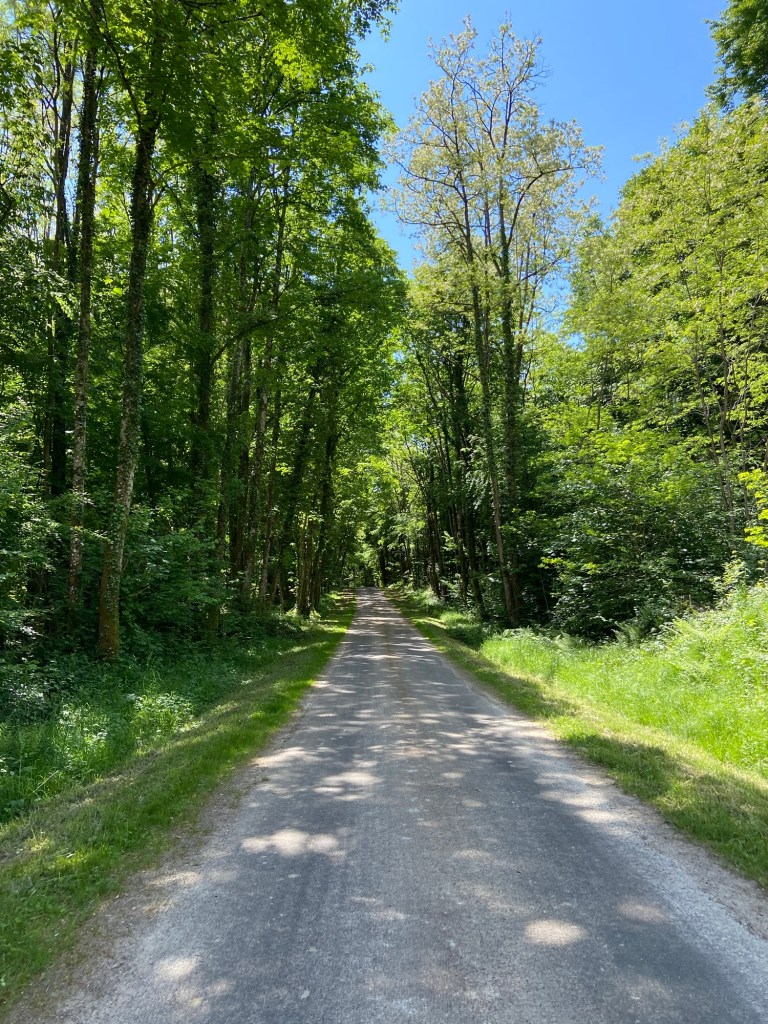
It began to heat up. An idyllic lane led into the woods,
where I spent the first hour of the afternoon. There was cool green shade for much of the time, and I found a place to sit down (briefly), and try to pad out my sorrowing left foot a little bit with Ian‘s lambs wool. It is uncomfortable, but it certainly isn’t agony. And really there is nothing I can do about it.
The forest was peaceful and lovely, and I was sorry when it came to an end,
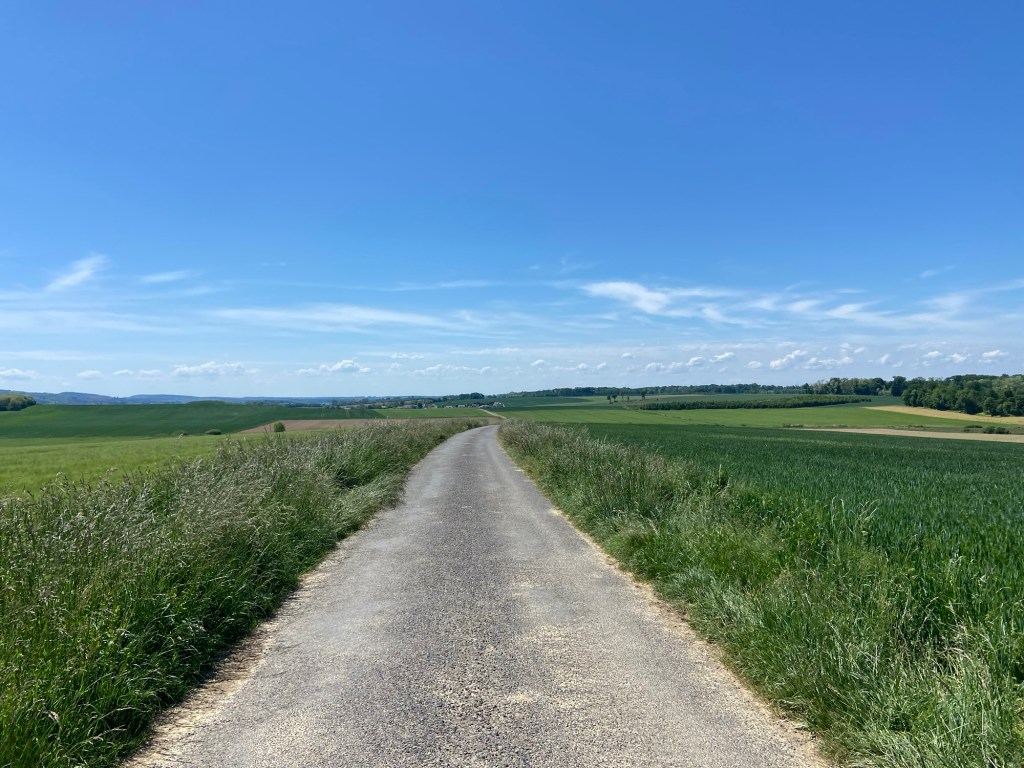
because in the heat of the afternoon there came a long exposed stretch of road with no shade, along which I toiled under the sun — although it must be said that it was infinitely preferable to the rain which I had feared earlier on.
In contrast to some of the friendly-seeming villages that I walked through today, the village of Montbleuse was the least sympathetic. There were signs up everywhere saying ‘No to wind turbines! Protect the environment and heritage!’ and the irony was every single one of these modern houses had done everything they could to make their own little environment as sterile as possible, whether that was with non-flowering bushes, closely mown lawn, and pots of begonias,

or by blocking up the eaves of their houses — this on a house which had mounted a metal freeze of swifts on its external wall. One house protesting the wind farms had no garden of whatsoever kind and three cars parked on its concrete, another had five vehicles in its drive. In this sun-baked valley, none of the houses had solar panels.

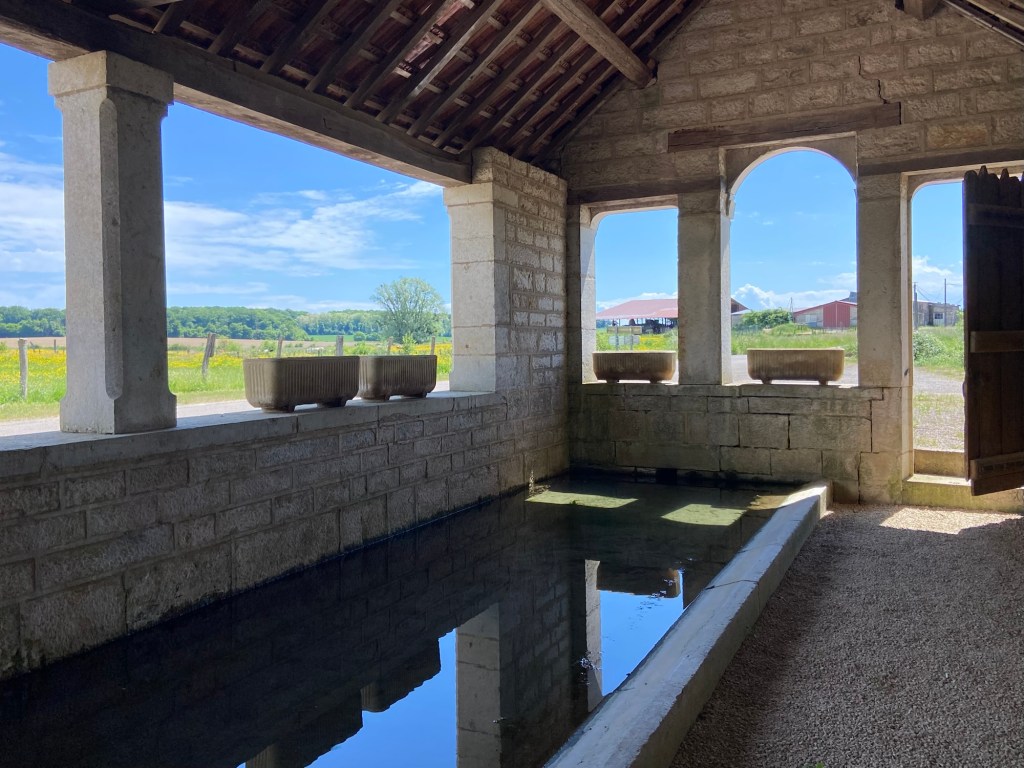
The only thing I liked about that village was the old wash-house. A parade of frogs plopped into the water from the edge of the low trough outside as I passed, and inside it was cool. Unfortunately, there was nowhere to sit down, otherwise I would’ve done (and maybe cooled my feet in the water).
In many ways it was easier to walk than sit down because it was so hot, and because every time I stopped, even for a little while, my feet got more uncomfortable and it took me a while to ease them into getting going again. I just wanted to get the day over with. I stopped to compose myself at the bottom of the final hill, the highest of the day, before climbing to the village near the top, listening to a wryneck in a tree. Wry feet, more like, I thought, wryly.
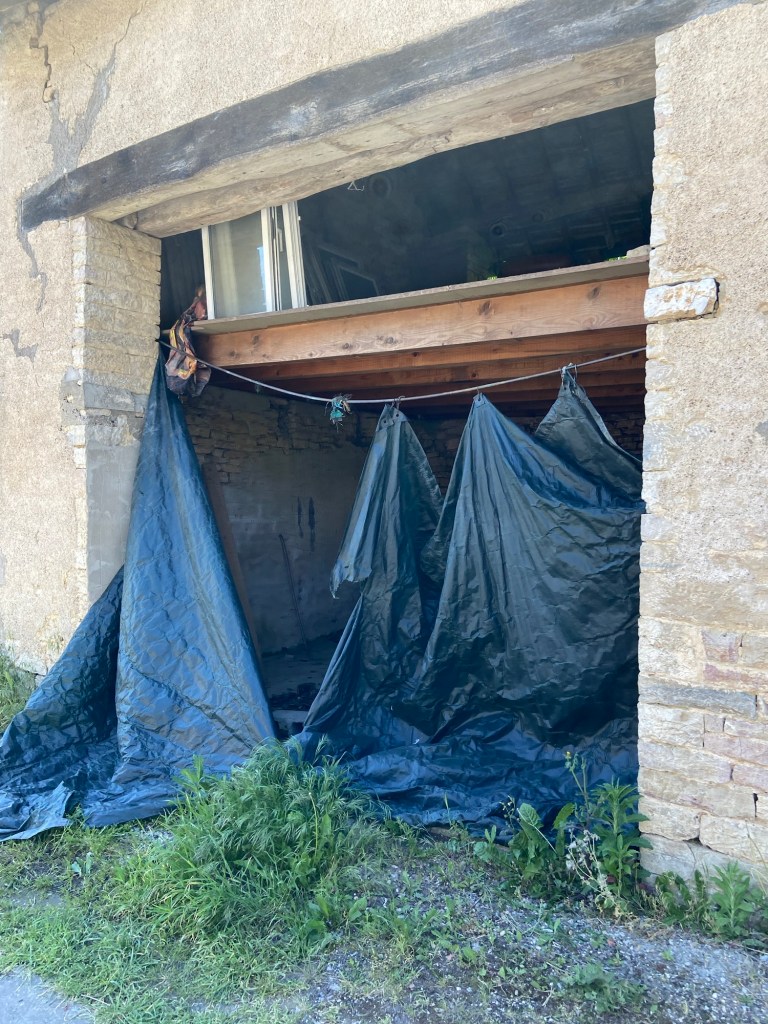
The village was flapping with tarpaulins over shed doors and roofs.
There was one short section on a grassy path which led up through a shady twitten and then past a small vineyard behind the church. The ground was uneven and this was the slowest section of the day’s walk.

I made sure I had put fresh sunscreen on my nose, cheeks and forehead, and marched on, trying to think about how I might create a little bit more space in my left shoe. A thinner sock might be worth trying.
I pondered this while passing a village where the road swerved just before it entered it, so I never found out anything more about the enchanting pictorial signpost advertising honey, Christmas trees and chicks. It had previously advertised goats and pigeons as well, but these had been erased with yellow stickers.

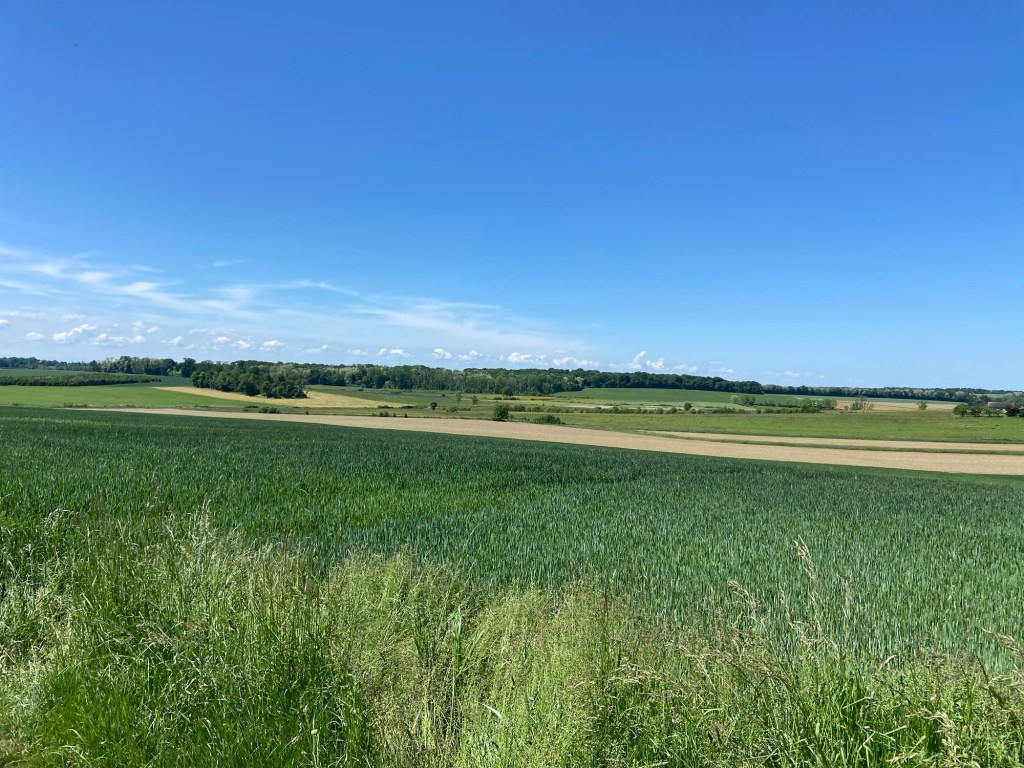
At the top of the hot hill I had consulted Google Maps and saw there was only 4.5 km to go; the map gave the time of an hour and a quarter to get there. Whilst I didn’t want to look at my watch too much, since a watched pot never boils, it was also true that I was already boiling, so it was good to check in every now and then just to see how much time had passed and how long I would have to endure.
The last hour went by in a flash. And the last village was the nicest. It had a public water feature made from a lumpy, bumpy, moss-covered upside-down tree trunk.

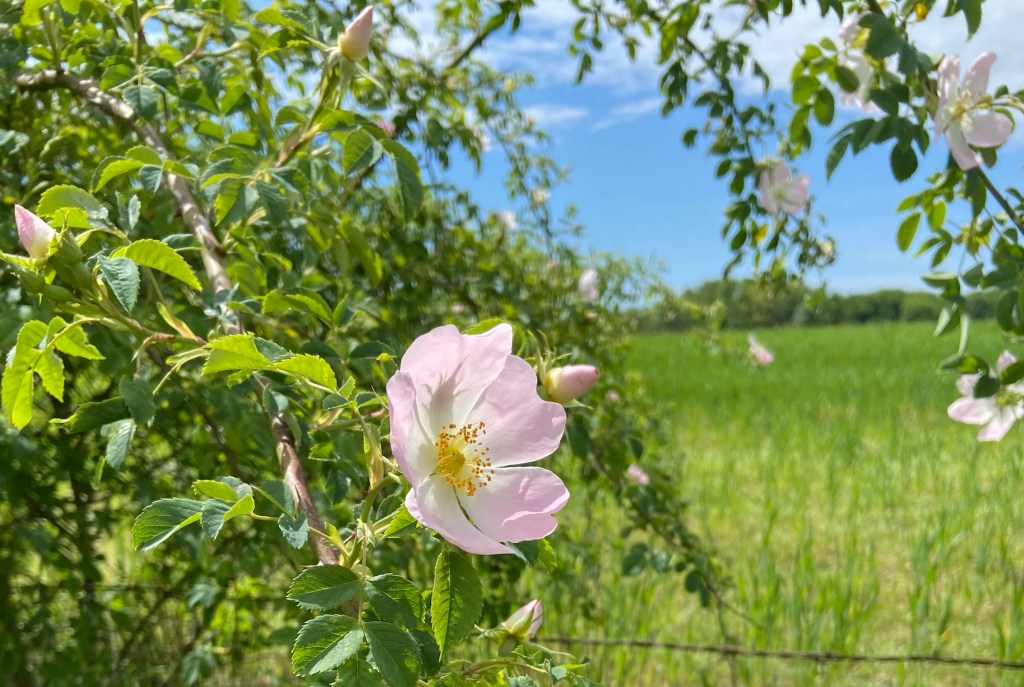
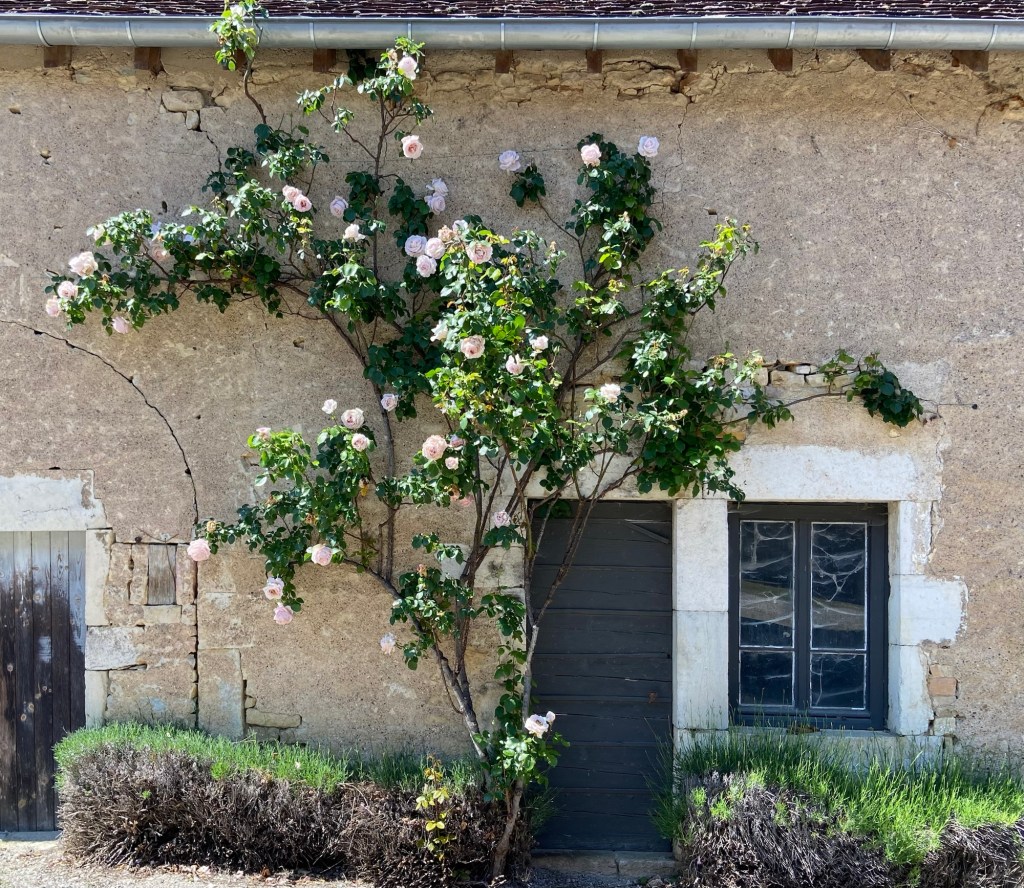
Up the very, very last of the many little hills of today was a stone bench in the shade, opposite a house covered in roses in bloom. It made me feel refreshed just looking at it.
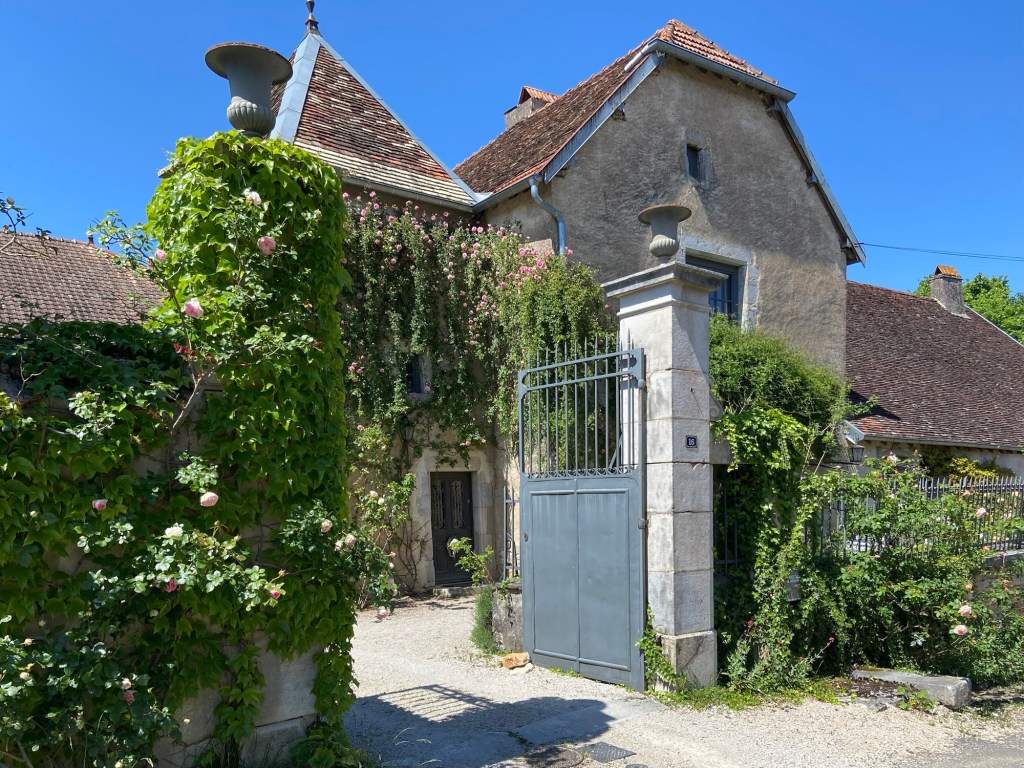
From there it was only thirteen minutes to Bucy-les-Gy and the house of Mr Dominique Loriot, whose name means Oriole. His wife opened the door and introduced herself to me — she was also Dominique. ‘It’s a name that goes for men as well as women,’ she said. ‘And is that why you call your accommodation ‘Chez les DomDoms?’ I asked.
It was!
Stats for the Day
Distance: 24.45km. Just what Étienne had said it would be.
Time: 5 hrs walking, with 50 mins of breaks for one reason or other
Pace 4.9km/h. Some determination
 Walking The Landscape
Wishing you sweet, cool breezes and happier feet!
LikeLiked by 1 person
Thank you! I think the feet need a rest day for sure. It’s annoying because they were FINE until the new shoes. But— c’est la vie!
LikeLike
DomDom is a very cute name given the owners names (and makes one think also of domesticity – clearly a good attribute in accommodation). But I wonder, would you have married Stephen if your name was Stephanie?
Sorry the new shoes are causing issues. Sending healing thoughts for fewer blisters and less blistering heat!
LikeLiked by 1 person
Chez les StephStephs
LikeLike