There’s a certain amount of freedom involved in cycling: you’re self-propelled and decide exactly where to go. If you see something that catches your eye to the left, you can veer off there, which isn’t so easy in a car, and you can’t cover as much ground walking.
David Byrne (who has never walked from Canterbury to Rome)
It had been interesting to listen to the four-way French conversation last night, as this was the first time I had listened to French being spoken naturally. The detail went completely over my head, but I did understand the gist. At first they discussed the grape varieties in minute detail, but then I gathered they had moved the conversation on to discuss wind farms and nuclear power and the cost of energy. I contributed that electricity was very expensive in England. The conversation turned to timber and the chap from Paris said that in the south of France, the Spanish were marauding over the border to steal French wood. I murmured something about fish. Then the conversation turned to the management of the national forests and the presence of the wolves which so far had not attacked any people, but were beginning to cause problems for livestock farmers. I wish I had understood the minutiae of this discussion because I think Pascal had very strong opinions about it. His accent was very thick, however, and I found him very hard to follow.
After a night of not very good sleep, I made my way to the boulangerie for breakfast at 6:30, where last night’s carbohydrate- and fat-heavy supper was followed by a carbohydrate-and sugar-heavy breakfast. The coffee machine had m run out of milk, and when I asked for some in my coffee she added hot water. ‘Café-au-eau’, texted my brother.

Out of Champlitte (late, owing to having to finish writing), I crossed the Salon, by a rickety wooden bridge so that I could photograph the grander stone one. The crowfoot have reached the peak of their loveliness, and swallows appreciated the insects, although I didn’t see any dragonflies or damselflies.

As I sweated up the climb to the village of Champlitte-le-Ville I heard another hoopoe up ahead behind the farm, which provided me with the impetus to keep up the pace in the hope of seeing one. Not only was there a hoopoe ahead but a nightingale and some turtledoves on my right in the bushes. I managed to get a recording of it to send to my brother who yesterday had had a great spot of his own: a spoonbill on the Dulas estuary on Anglesey.
The church in the village had pretty little yellow tiles arranged in a sort of flower pattern on its belltower, although when I got round the back, I saw that they’d only been put on three sides. It was hard to photograph against the sun, and from the side the church was hidden by a large and elaborate farmhouse
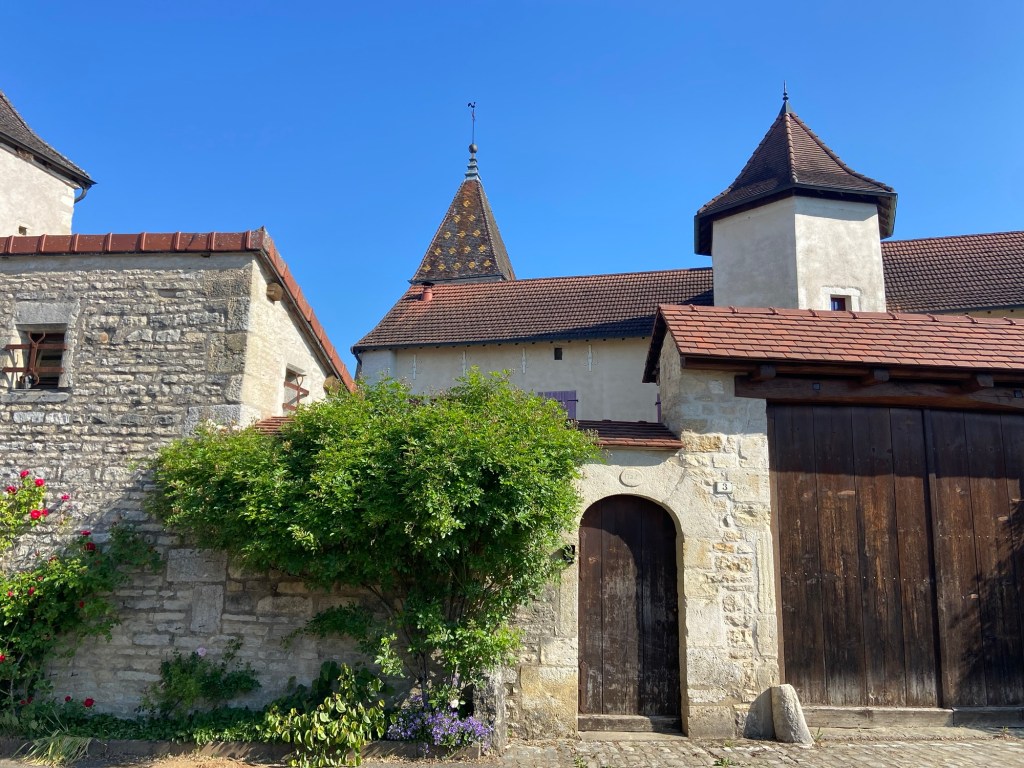
This was the prettiest of French hill villages, with the kind of gardens British folk dream about for continental holidays

In most of the gardens there was a tumbling mix of roses and fruit trees, with tiny peaches and his already starting to fatten up for a harvest later in the year.
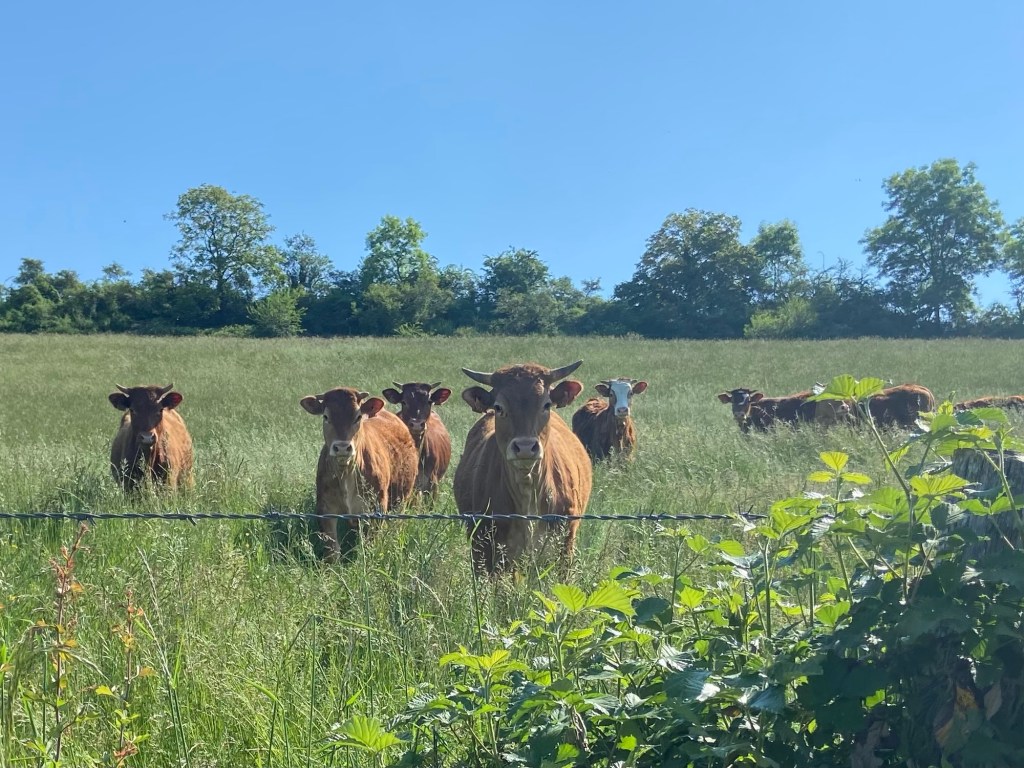
As I turned away from photographing some cows which I had disturbed mid bite, something pinged in the back of my hip. I could feel it with every step. I didn’t some stretches to try and loosen it. My shoes were already not quite so comfortable as I’d taken out the gel pads this morning, and I could feel the blisters on both my heels today. I was generally a bit annoyed about all of this because today was going to be so long, but after a while it all seemed to loosen up and I forgot about the aches and pains.
I did however decide that I would keep on the valley road past Neuvelle-lès-Champlitte (which seemed pretty old to me; like in the Malverns they seem to have run out of the local place names). I just wanted to get some kilometres under my belt with a smooth surface under foot and a regular rhythm. So I crossed the Salon again and stayed low.

Up a little side road off my main road just outside the village was a walled cemetery, like a village of the dead. Champlitte-les-Morts. Having said I had wanted to get on, I saw that rising above the cemetery walls was an absolutely fascinating-looking monument. I channelled my walking friend Jane who absolutely would not have passed up the chance to see something unusual in the interests of cutting kilometrage. So I turned off and headed for the graveyard.
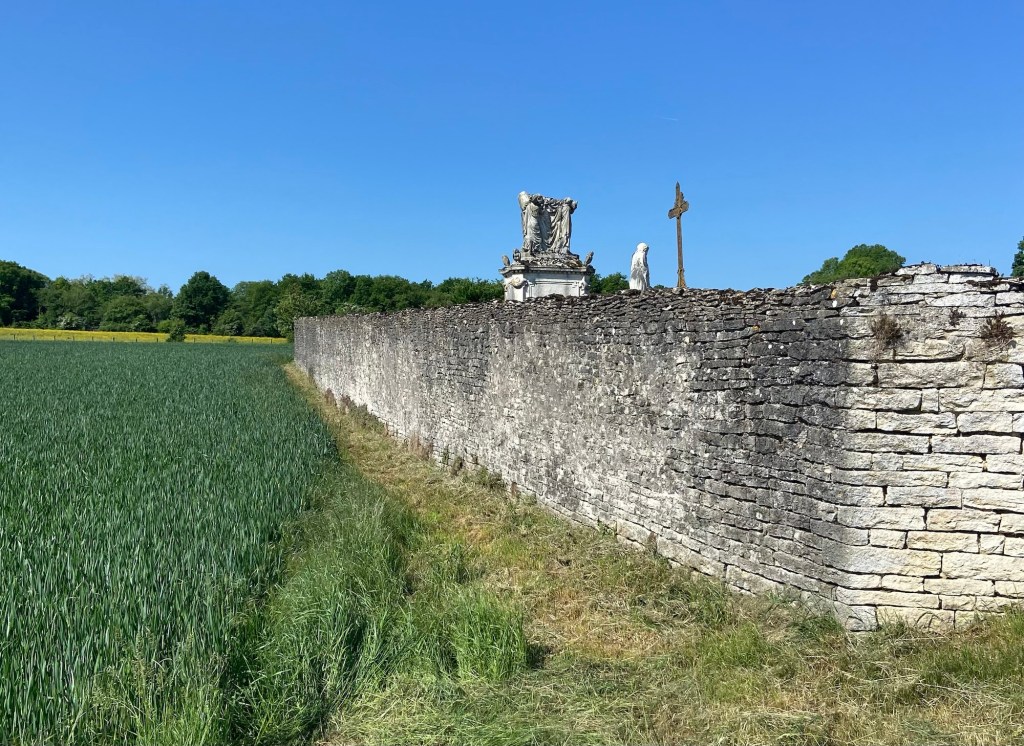
I let myself into the cemetery. The tomb was the family sepulchre of the Petitjeans, and like the character of the physically enormous Little John in Robin Hood, the Petitjean tomb was by some way the biggest of them all.

It had been designed by two Parisian architects for Alexandre Petitjan, a banker originally from the village who had made his fortune in Paris and had died in 1872 at the age of 34. The sculpted group on the tomb featured his swathed figure being carried on the shoulders of four maidens with classically draped costumes and 18th century hairstyles. Four exceptionally sad owls stood at the corners of the monument, and there were disconsolate cherubs, a bas-relief portrait of the deceased, and memento mori details such as hourglasses.

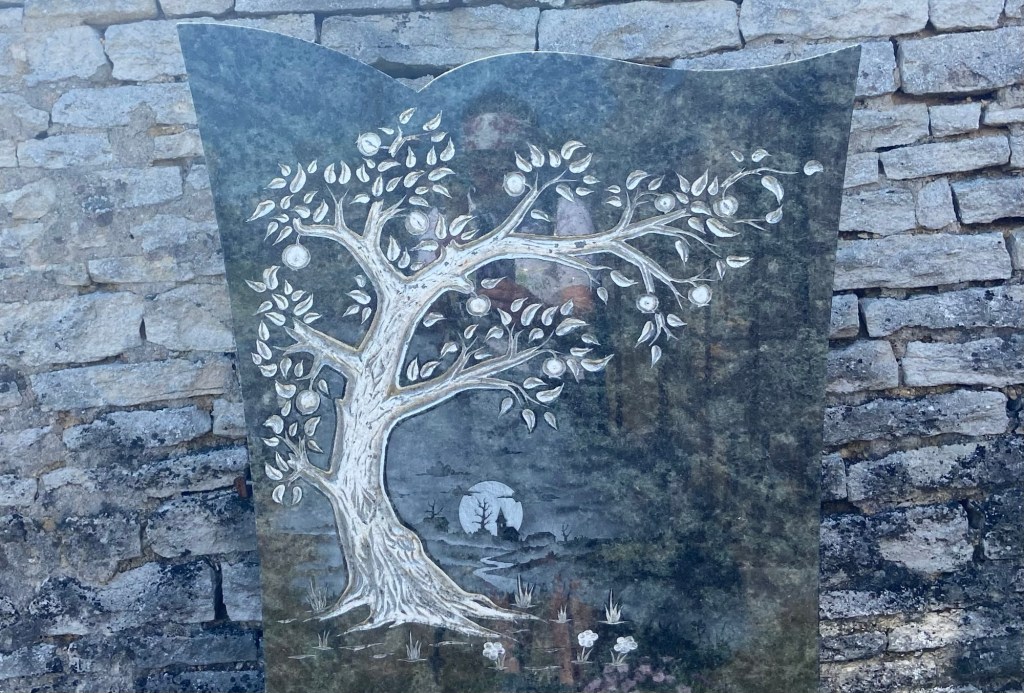
I was so glad not to have missed out on seeing this spectacular tomb. And it seemed that creativity had not died out in the village either, if this rather creepy gravestone is any indication, with a weeping pomegranate tree picked out in white drawing the eye towards a Halloween scene of a full moon with a silhouetted church and some dead trees in the background.
I stayed on the official bike route into Framont, crossing the river again and climbing the hill. Fremont was a village of competing visions of belltowers.


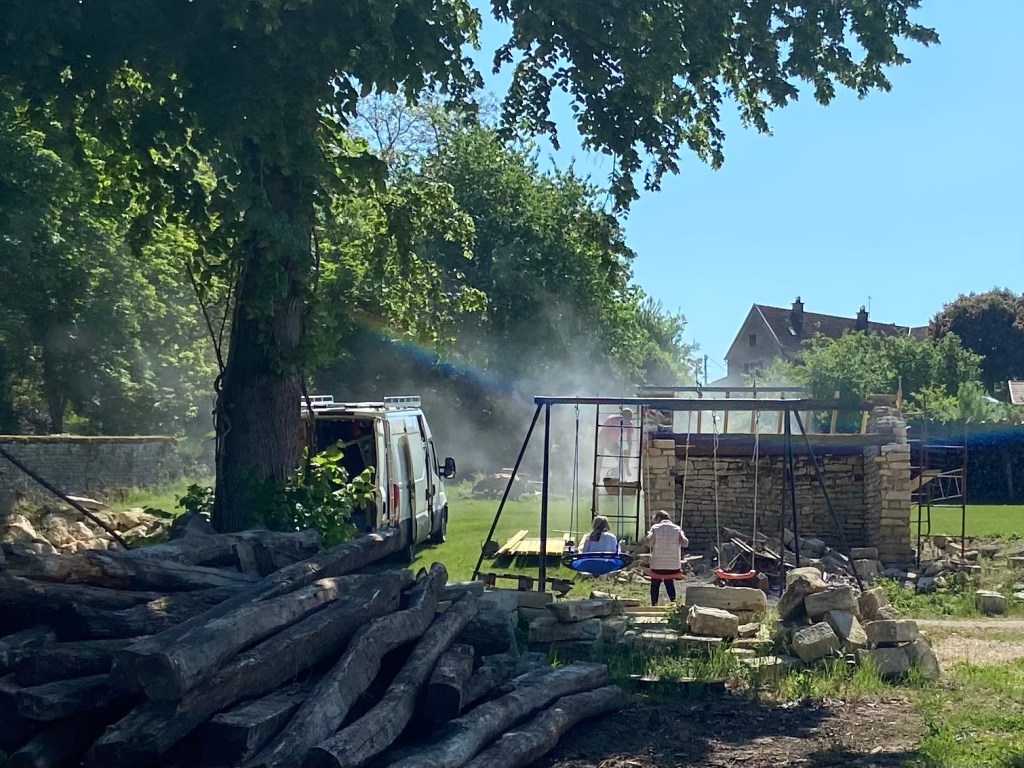
On this hot Saturday, a man was cutting stone to repair a field shelter on his land, while his daughters looked on from the swings. There were huge piles of enormous timbers. He clearly has plans. Was he wearing a mask against the stone dust? He was not.
I had planned to wait until Dampierre 19 km in to have my lunch, but by 10 km it was 12 o’clock and having had breakfast at 6:30 am, I was really hungry. I had come to one of the roadside Madonnas, this one sheltered in a shady bower of lime trees.

On the steps had been placed little votive offerings, a silver metal cross, two strings of beads that looks like friendship bracelets, and a rosary — now trampled into the ground.
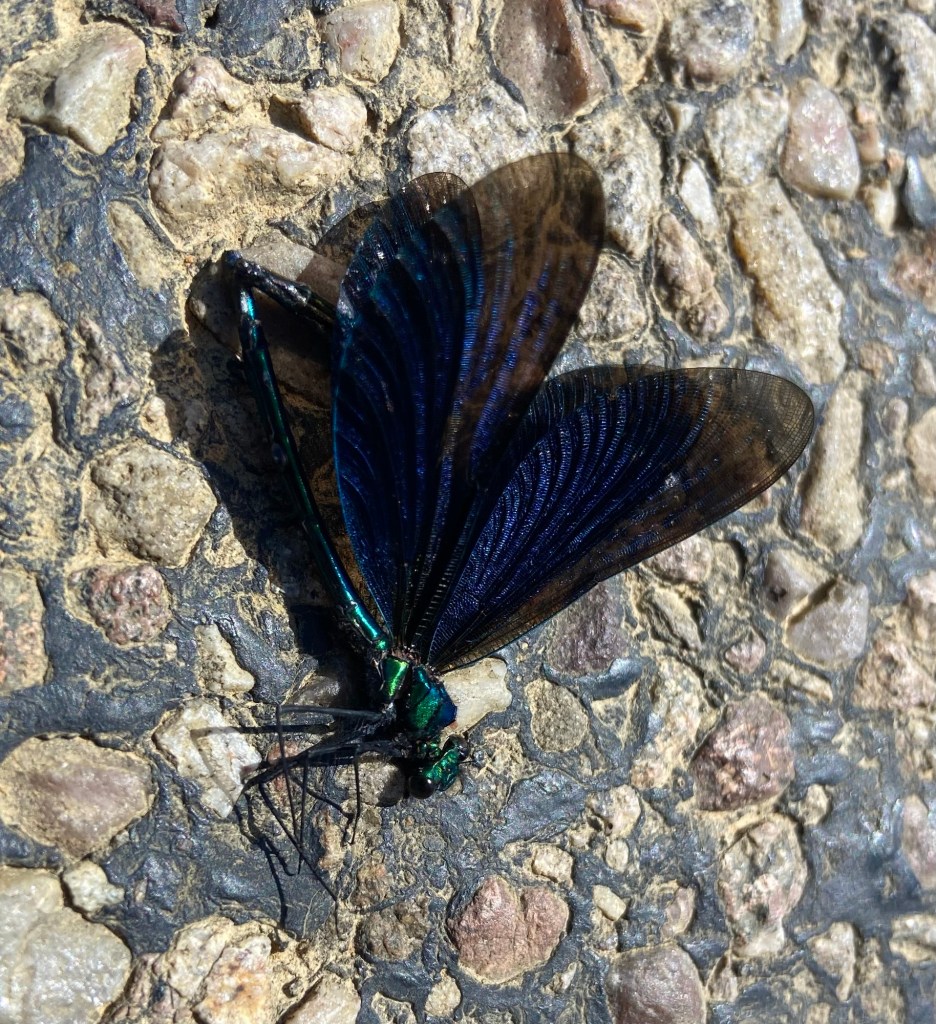
Also trampled was an exquisite Beautiful Demoiselle, and this I thought sadly was probably the best chance I would get to photograph this lovely creature (the roads today, although I found them mostly quiet, were pretty deadly: I also encountered a dead cat and a fox)
Here by the Madonna was also an actual bench (complete with lizard orchids), but I didn’t see that until afterwards, so I sat on the steps up to the statue, and ate half of the baguette I had bought this morning. I dried my socks in the sun and watched little ants dragging off fallen pieces of ham.
The statue was on the outskirts of the village of Achey. My feet weren’t particularly, by that point, having dried my socks out and applied some (more!) Compeed. It’s useful stuff.
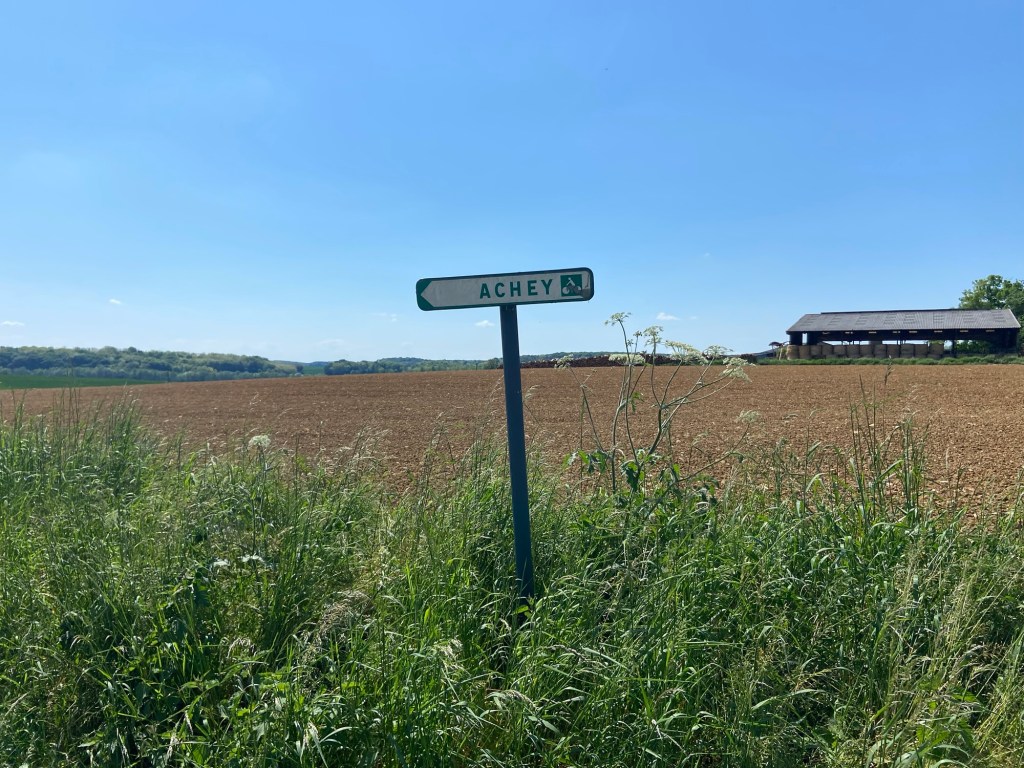
The village itself was quiet and unremarkable, although its cows were quite feisty and once again I was glad that they were all safely behind a fence, along the line of which they kept pace with me. And this time I don’t think it was for treats.

The penultimate village before the final approach to Dampierre was Delain. The Salon made a loop through it so I crossed again wondering how many times this was going to happen today (the answer: 5)
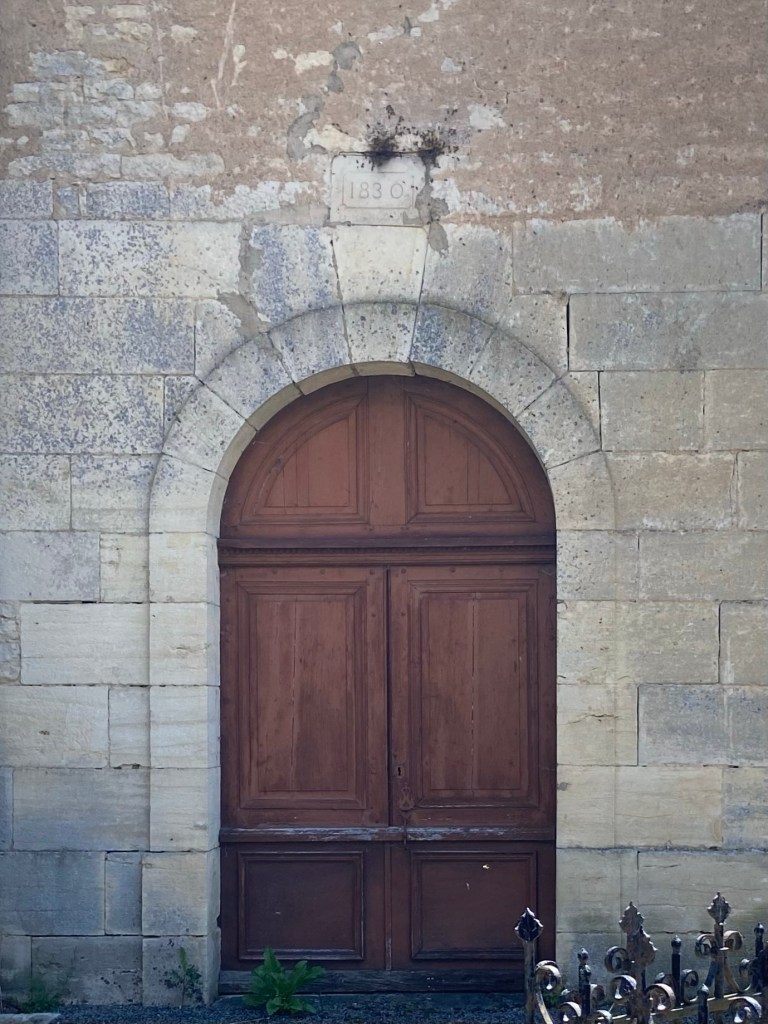
On the outer walls of the church, it looked as though another swarm was forming, although perhaps it had already swarmed inside two large cracks in the wall, and was properly installed. In the church itself, I could hear buzzing everywhere but couldn’t see where the creatures were, except for a pile of dead ones in one corner.
The stained glass was designed with Victorian sentimentality, but I did like the leggings, hunting horn, crossbow and spaniel of this hunter, whose upper half had sadly been smashed sometime in the past.

On the way out I admired the holy water stoop With a frugivore serpent, and a card on the top from St Anselm’s parish Tooting Bec. I wondered whether it had been left by another pilgrim?

It might’ve been something about walking through a river valley, but I saw quite a few birds of prey today. It started with a kestrel, and then a huge kite, lazily riding the thermals, and as I came into Denève, two buzzards lumbered off the ground and flew away to land in trees on the edge of the wood. Nearer at hand, a heron was perched on the edge of the reed-filled settling tanks of the village sewage works. There must’ve been frogs in the water.
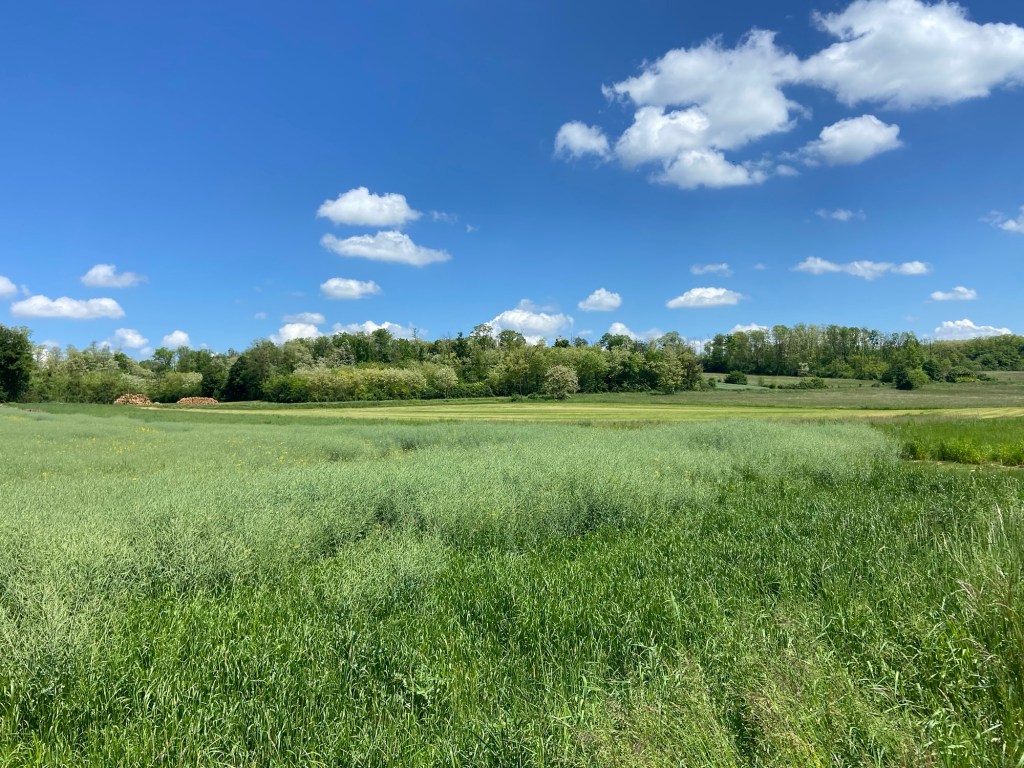
And here in this wide valley I had my final crossing of the Salon.

Dampierre turned out a bit of a damp squib. I was looking for a place to sit down and have my second lunch, and saw a likely-looking bar with some tables outside. I could almost taste the cold beer. But as I neared it, a waft of cheap fried food and unwashed counters assailed me, so I walked on by. The nicest thing about most of the town was the advertisement for a (much-needed) local beekeeper right at the town boundary.

Then there were a number of benches, but none of them seem to have a particularly nice view. There was an enormous metal and blue glass skyscraper with the word Restaurant over the top, some ghastly breach of planning regulations, now standing empty. On the way out of town — having barely seen it and not made it down to the river — there was a much more interesting architectural sight: perhaps the supplier of all those coloured tiles for the church belltowers I had seen over the course of the morning had seen fit to decorate his own manor.

Just on from there was another bench. It was on the main road, but it was in front of some flowerbeds and I took my shoes off spread my socks out on the asphalt (having lost all sense of propriety by now) and settled down to charge my phone, text my friend Jenni, and eat my second lunch.
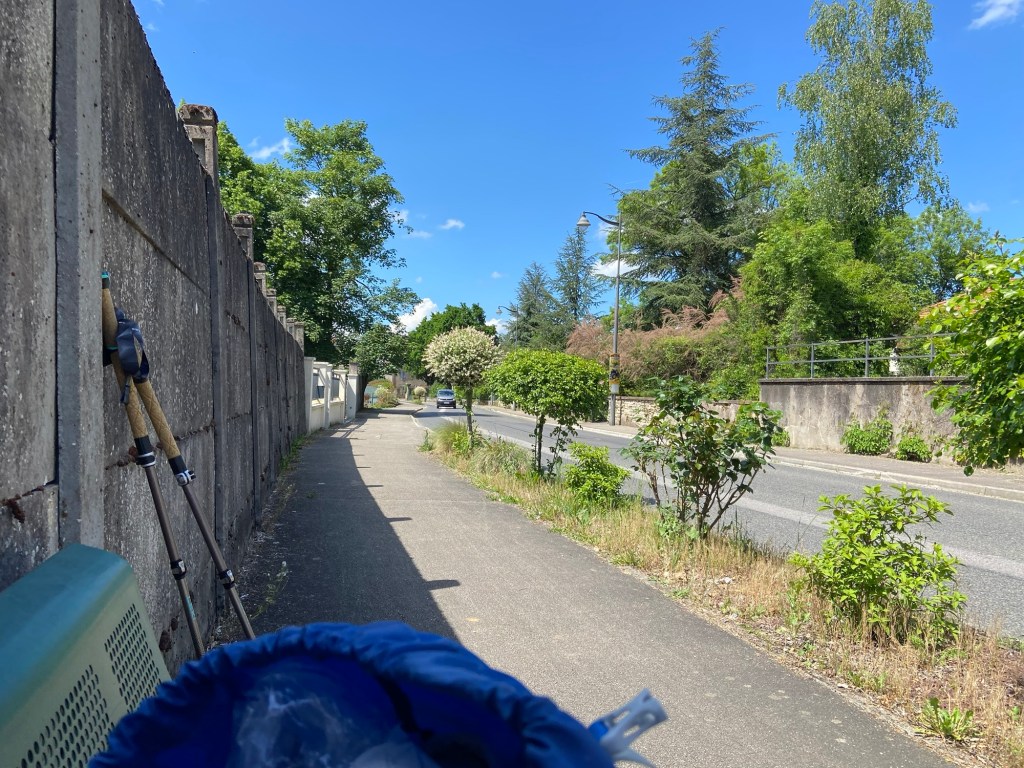
Observe my foresight in purchasing not only a pan aux abricots for this morning‘s breakfast, but also an almond viennoise for lunch as well. I kept a little bit back for a time in the afternoon when I might be feeling desperate and in need of some sugar to get me through.
It was only 6 km by road to Seveux, but a few hundred metres on the traffic-heavy tarmac served to satisfy me that this was not a sensible route, so I detoured the kilometre into Autet, a little village on a bend in the Saône, to join the Francigena route for piétons rather than vélos. Once again the route tantalisingly didn’t take me down to the river. Instead, it took me puffing up a hill, although some trompe l’œil artwork made the effort worthwhile.

Once out to the village and across some fields the path ducked into a deep dark wood that I think must have originally been the site of a railway line.
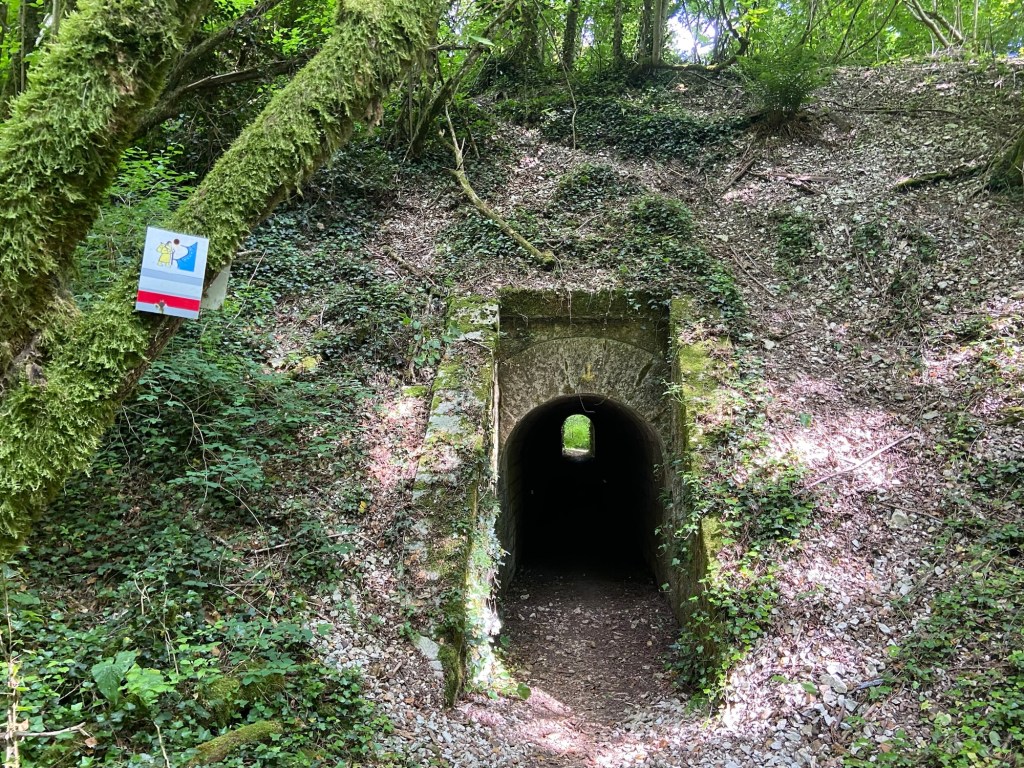
I shuddered down a slope before I had to duck to pass through a really long cobblestoned tunnel.
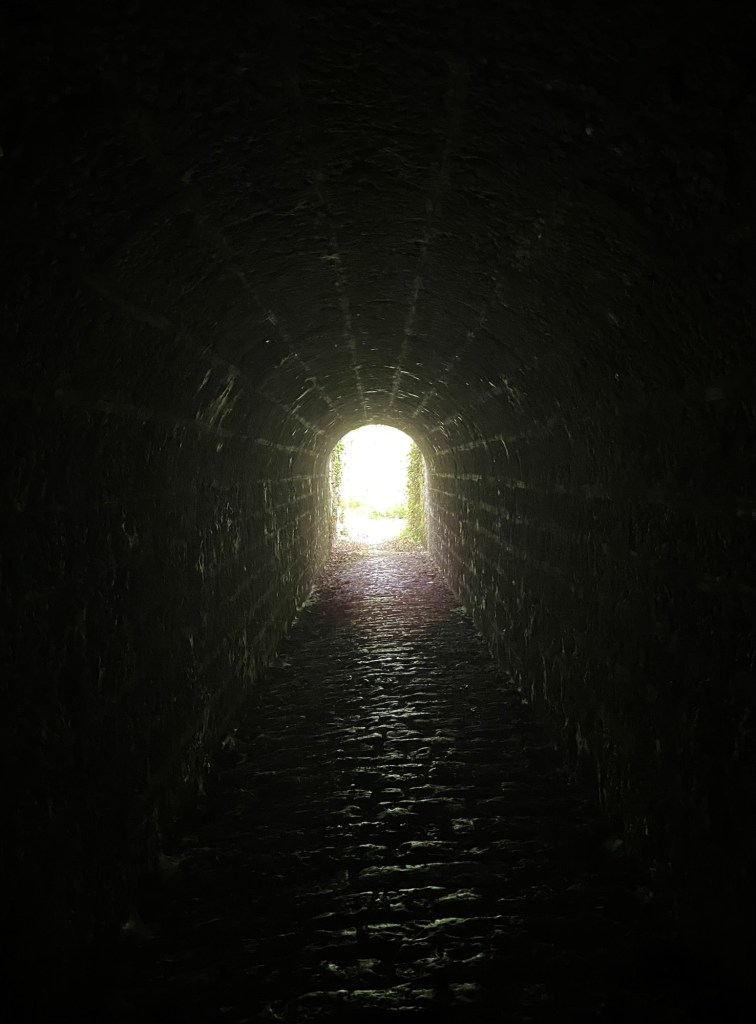
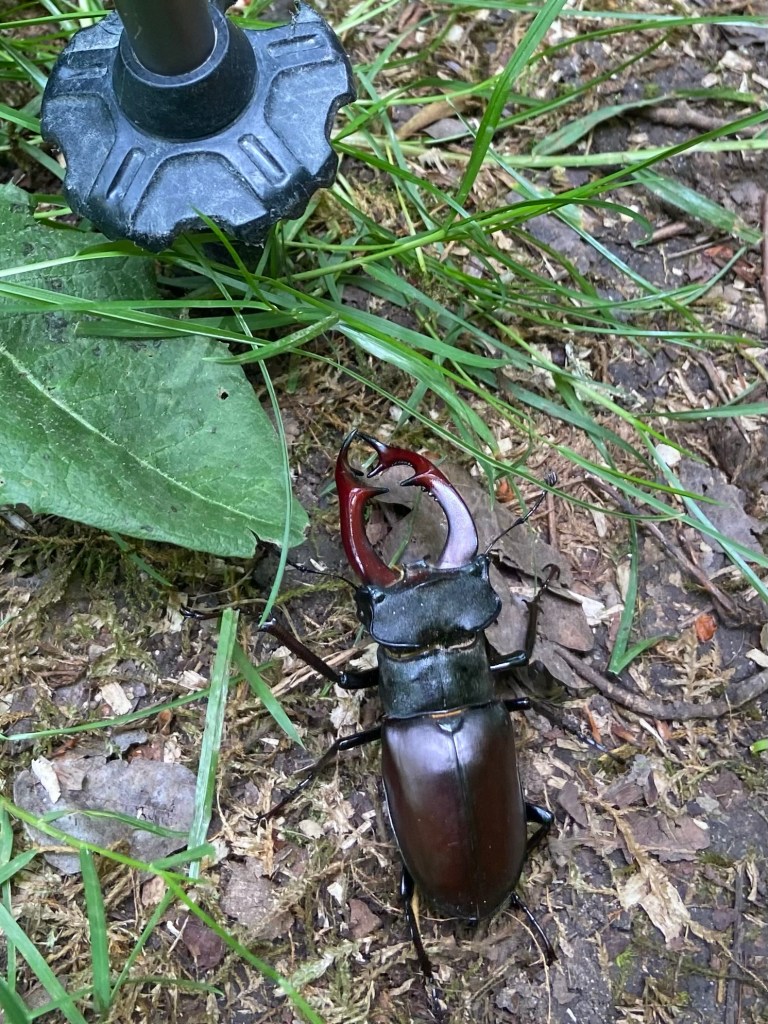
This wasn’t the quality of path I had come to expect from the Francigena! Once through that, I was out into much lighter woodland, although the path was still unusually overgrown. Although apparently cheerful, this wood was home to some quite fabulously well-armed creatures.
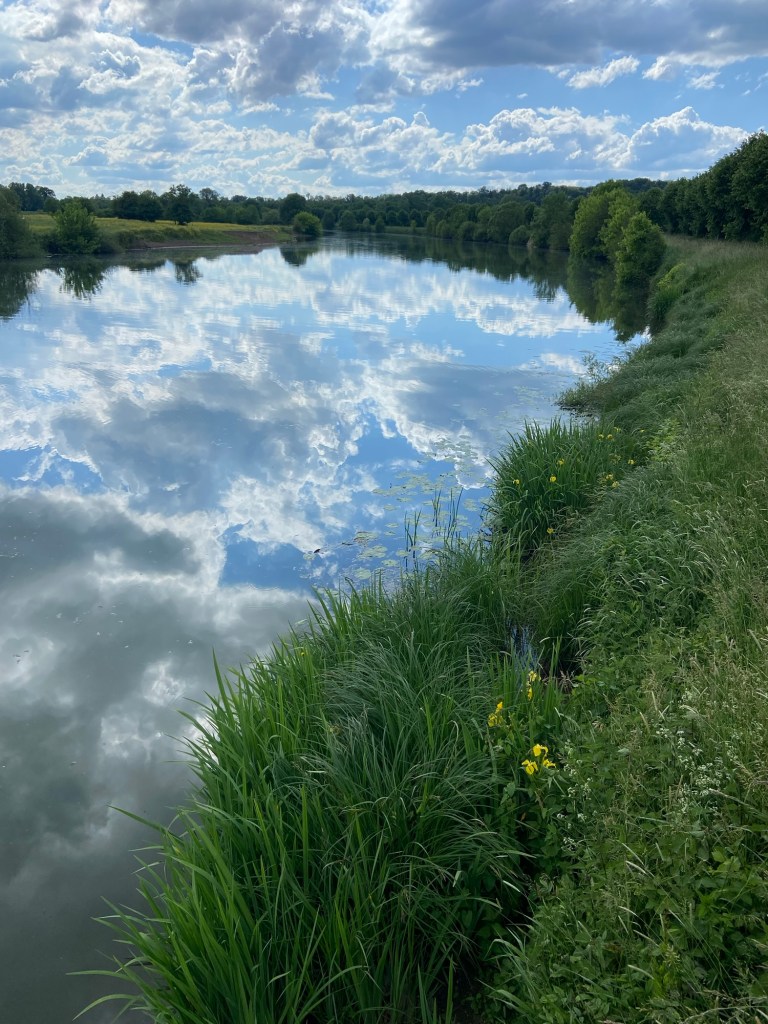
And here it was, finally: the Saône. Wide and deep, and so slow flowing it barely seemed to move. It looked more like a lake than a river.

Annoyingly, the riverpath was set up for cycles so it wasn’t particularly nice underfoot, but it did mean that I sped along until I got to the really beautiful stretches, where sandmartins were flying in and out of rows and rows of nestholes excavated into the opposite bank.
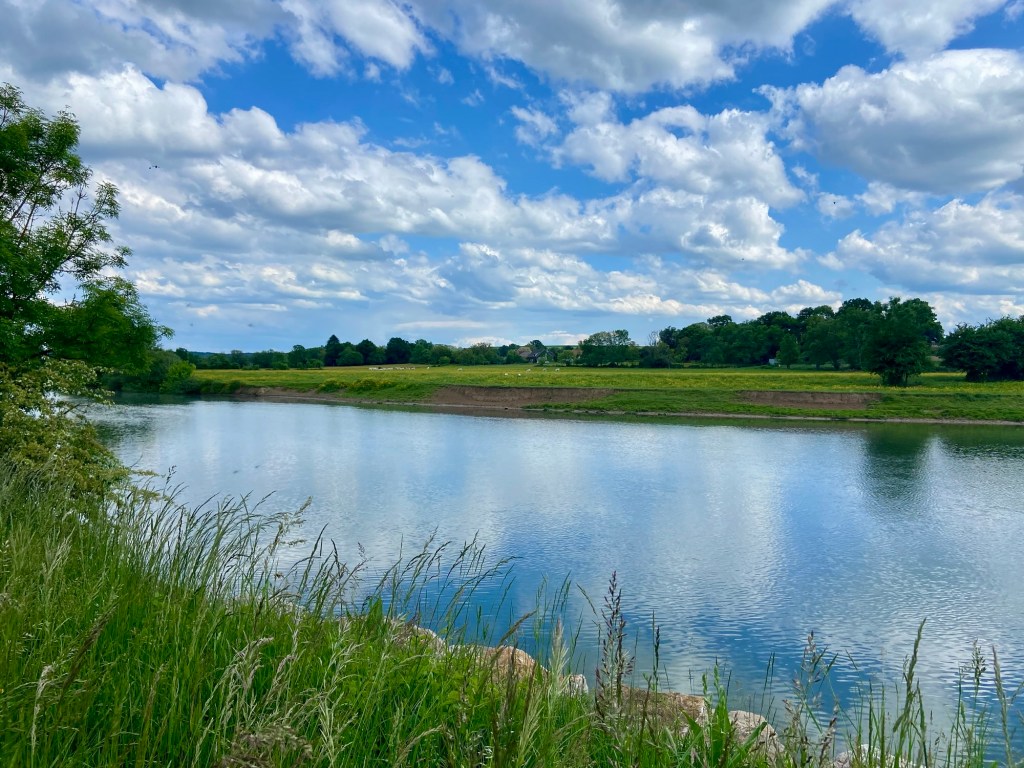
The reflections all along the river were extraordinary.

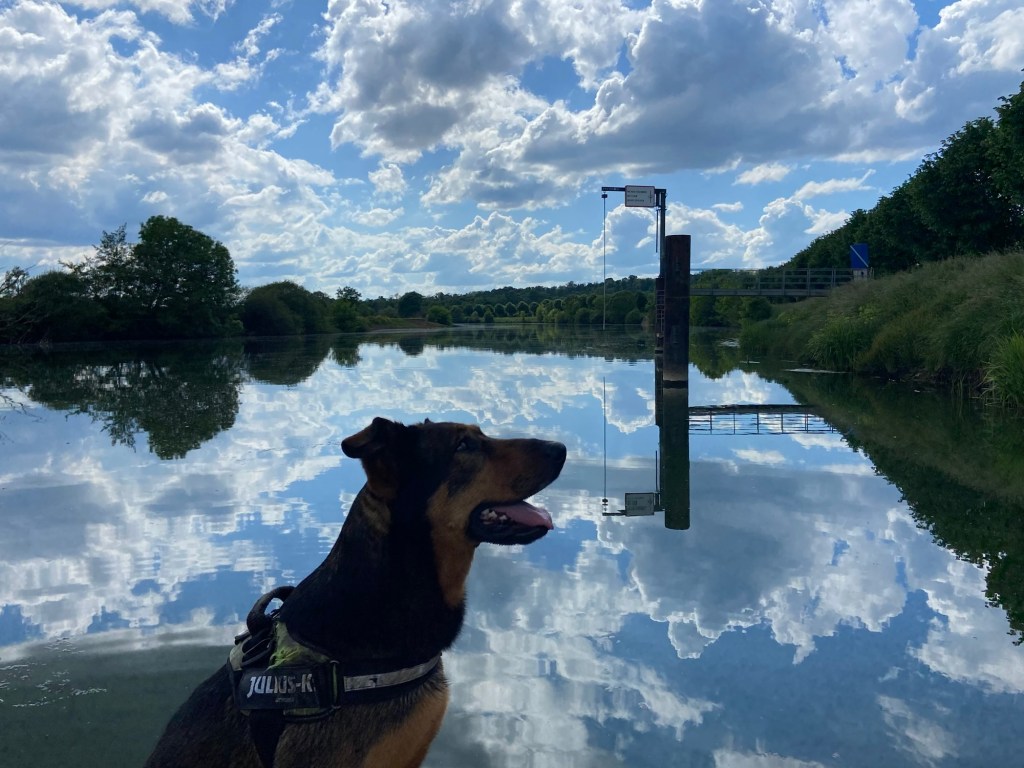
Thomas and Haku the dog were out fishing in the sky. The iPhone took such beautiful photographs of them that I went down onto the pontoon and showed them to Thomas, asking him whether he’d like me to email them to him. After having a little sniff at me, Hoka was absolutely fixed on the weight dangling from Thomas’s fishing rod. ‘He loves fishing,’ he said. ‘Loves swimming.’
On the path was a poster advertising a free local orientation game for children to download on their phones.
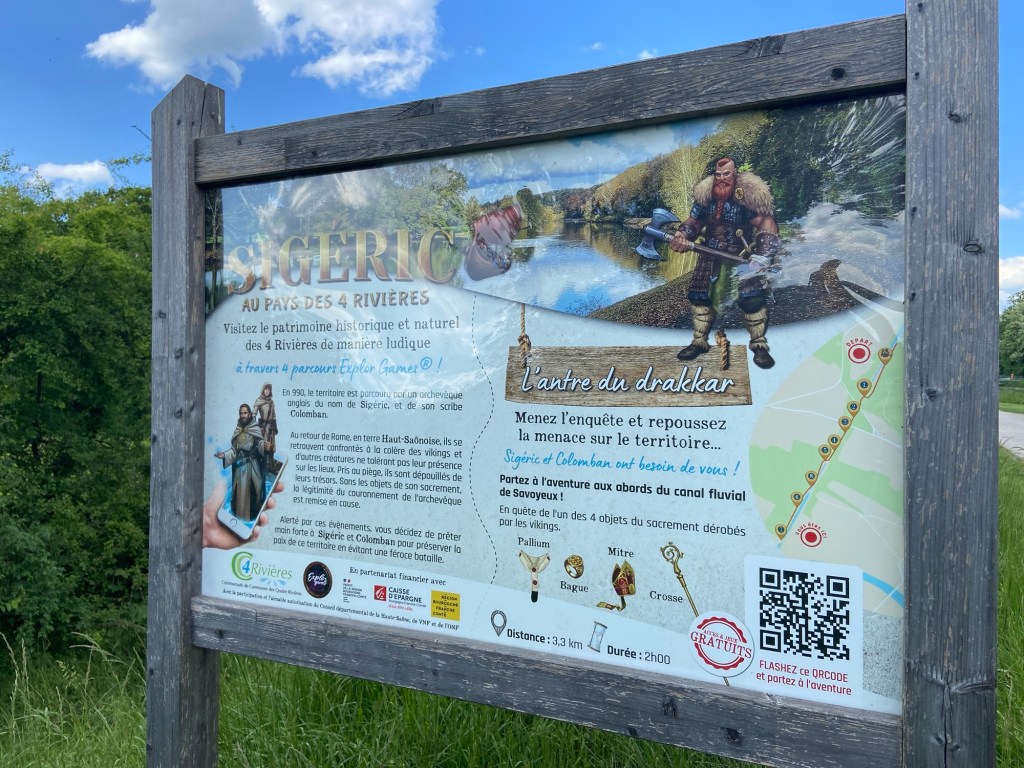
Here is the translation that (ironically enough) Google translate came up with, on my phone:
SIGÉRIC IN THE LAND OF THE 4 RIVERS
Visit the historical and natural heritage of the 4 Rivers in a fun way through 4 Explor Games® trails!
In 990, the territory was explored by an English archbishop named Sigéric and his scribe Columbanus.
On their return from Rome, in the Haut-Saône region they found themselves confronted by the wrath of the Vikings and other creatures who did not tolerate their presence there. Trapped, they were stripped of their treasures. Without the objects of his sacrament, the legitimacy of the archbishop’s coronation was called into question.
Alerted by these events, you decided to lend a hand to Sigéric and Columbanus to preserve peace in this territory by avoiding a fierce battle.
The Lair of the Longship
Lead the investigation and repel the threat to the territory…
Sigeric and Colombanus need you!
Embark on an adventure along the Savoyeux river canal in search of one of the four sacramental objects stolen by the Vikings:
Pallium, Mitre, Ring, Crozier
I suppose it is meant to be educational, a way for children to ‘interact’ with the human and natural history of the area, but my first thought is that I would have thought a better way to interact with the flora and fauna and general environment is to look at it (Your Honour, the Prosecution submits Exhibit A, the European Stag Beetle), and my second is that (without downloading the game to check), they have got their history muddled.
The account of Sigeric’s journey is a two-paragraph list, first of the churches he visited while in Rome (of interest to ecclesiastical historians of the 10th century), then of his overnight stops on the return journey north, from Rome to the Channel port on the French side which at the time was not Calais but ‘Sumeran’, modern-day Wissant. (This is why the first day in France of the Via Francigena goes counterintuitively West from the coast, from the ferry terminal at Calais to Wissant and only there turns inland to head in the broadly south-east direction to Rome). I am writing this from Seveux, Sigeric’s ‘Sefui’, his 61st overnight stop on his journey north (and my 37th south).
That is as far as I am aware the extent of our historical knowledge of Sigeric’s journey. How to explain the presence on the poster of the fearsome red-bearded Viking with the severe razor fade, supposedly a hazard encountered by Sigeric in the Haute-Saône on his journey?
Sigeric was Archbishop of Canterbury during the reign of Æthelred the Unready, during which time England was subjected to attacks by the Danes, in particular the Danish king Sweyn Forkbeard, in 991 (the year after Sigeric returned from Rome and took office). Sigeric counselled Æthelred to pay protection money to the Dane (which he did to the tune of 10,000 lb of silver) — and we all know how that ended. Sigeric himself paid the Danish three years later to stop Canterbury Cathedral from being burned down. I can only surmise that this is the historical basis for the fast-and-loose alternative facts that the game seems to be promoting.
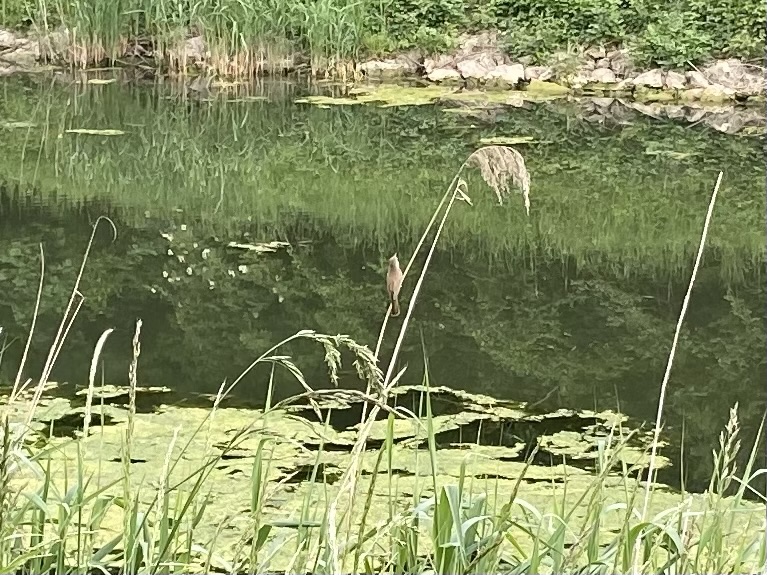
I came off the river by a canal, unexpected since I hadn’t spotted it on the map. I was soaking up the stillness and quiet of the waterside setting until an incredible racket on the nearside bank attracted not only my attention but that of other passers-by. It was a Great Reed Warbler — the largest of the warblers (and not a resident bird in Britain), clinging to a single exposed reed and utterly unbothered by our presence, and singing his little heart out to defend his territory or attract a mate.
The canal narrowed and then disappeared into a tunnel, whilst my path climbed up the steep hill, so I ate the last of my almond pastry in my hour of need. At the top the path just went straight on, a blessedly shady route which would take me in a dead straight line to Seveux.
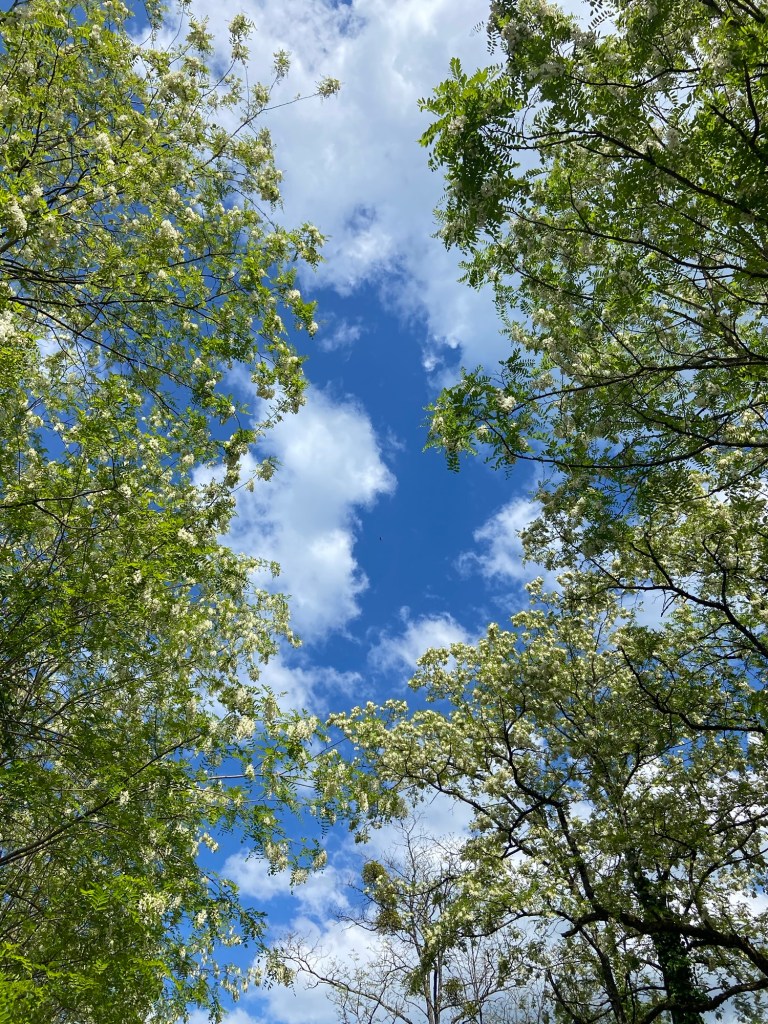
Above my head the canopy of oaks was mixed with strange trees with bark, leaves and flowers like a white wisteria, scented, amongst which tens or hundreds of thousands of bees buzzed in a steady hum which accompanied me the whole way.
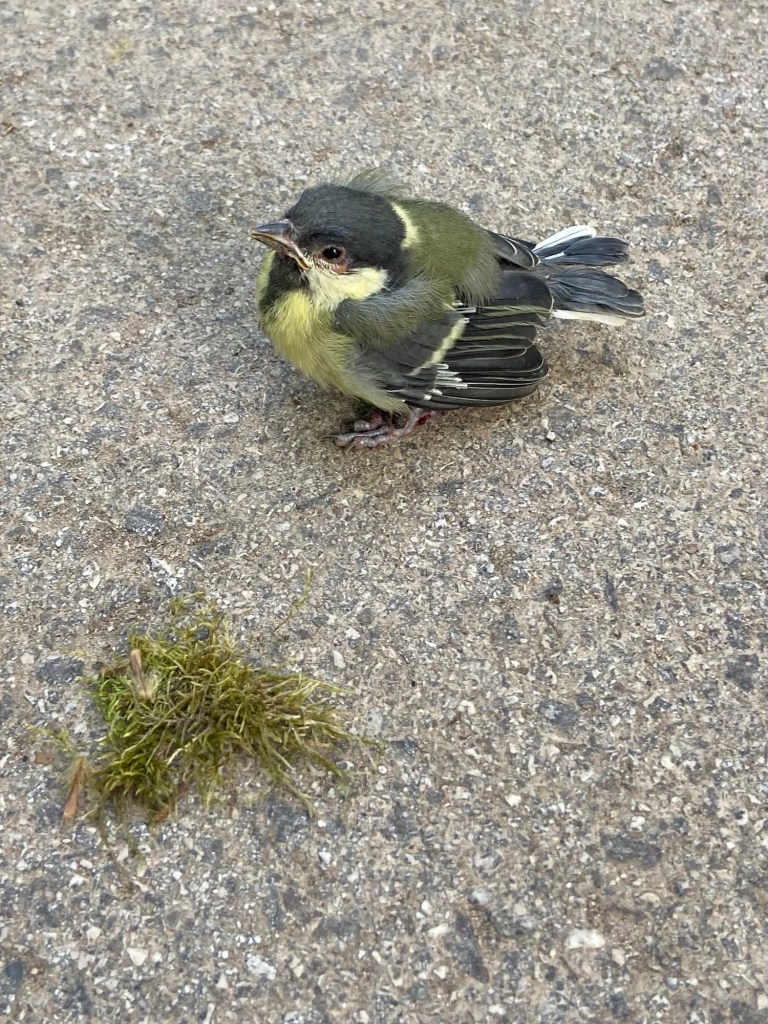
I came across a baby great tit not yet fledged (although not far off) sitting in the middle of the path. The presence of a piece of moss nearby suggested to me that he had fallen out of his nest. I didn’t pick him up and move him to the side of the path since all I have heard about baby birds out of their nest suggest that you should leave well alone, but if he doesn’t find his way to the side of the path and if his parents don’t find their way to him and carry on feeding him, I don’t much fancy his chances.
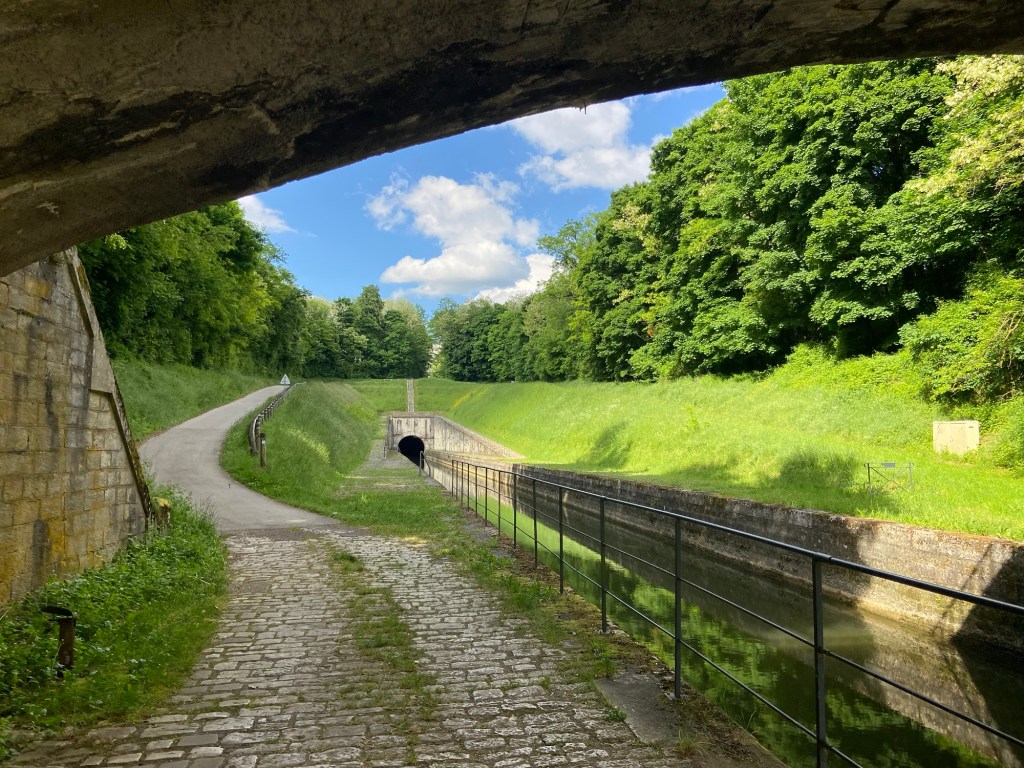
Right at the top of the hill was a terrific view of the canal emerging from its tunnel with the road turnoff visible nor far ahead.
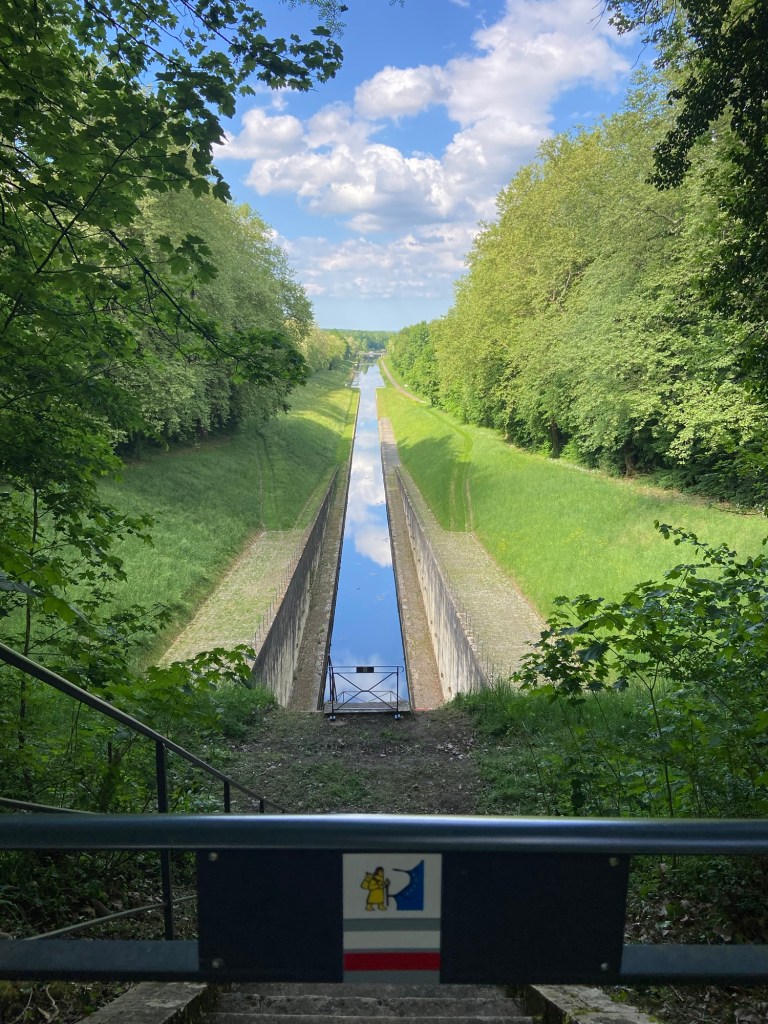
This stretch looked unnavigable, although a red stoplight at the mouth of the tunnel suggested that a narrow boat might pass through the tunnel back the way I had come, and make its way down the canal the other side through the locks and into the river. This section of the canal had pleasurecraft on it, but they were beyond the bridge I came off at.

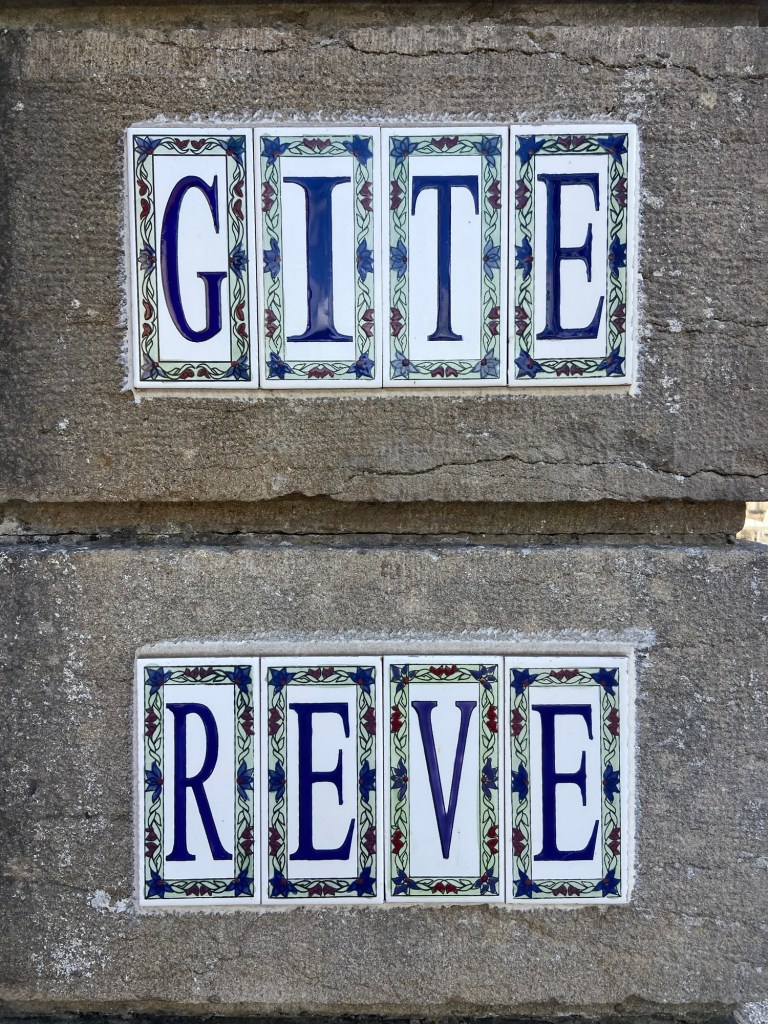
I had run out of water when I had joined the river about an hour and a half ago, but it wasn’t now far to go to Gîte Rêve. I discovered in my pocket the tiny mini biscuit that had been given to me with my morning coffee in the boulangerie, so I ate that too.
It’s a good thing I was looking down at the path because I almost stepped on one last extraordinary creature: a striped hawk moth (also not resident in Britain), its salmon-pink underwing just visible.
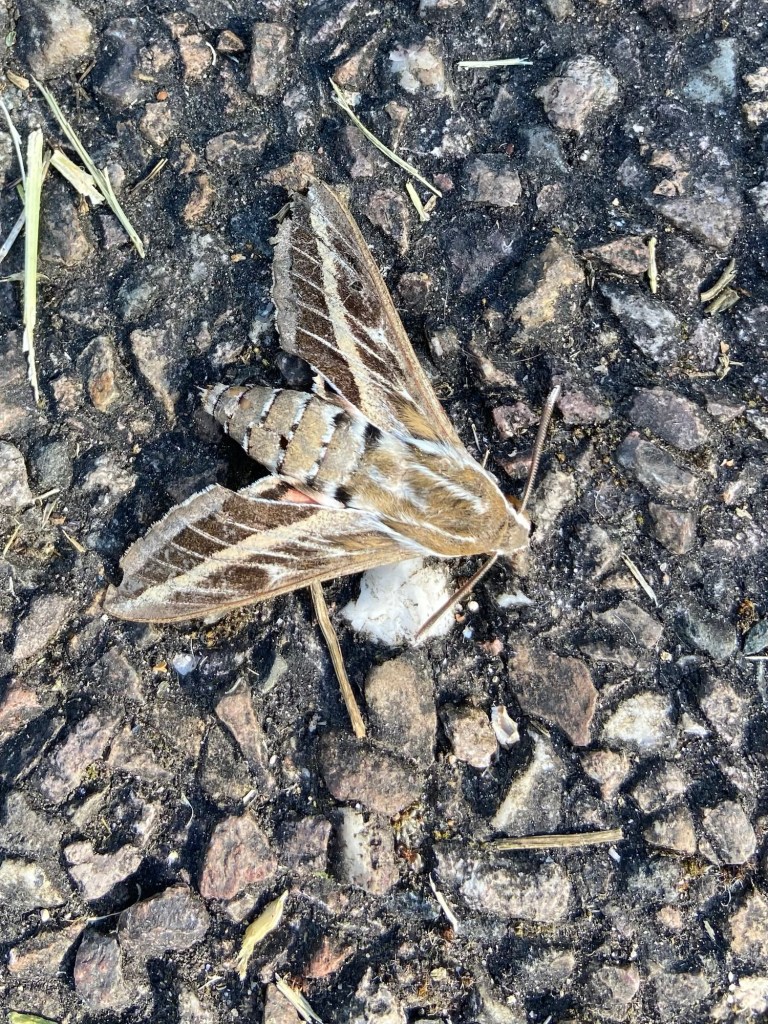
I’m afraid I forgot all about the moth later when the path crossed over the huge river Saône, an even vaster expanse here than before. This is the last I will see of it as it flows south; it will join with the Ognon which I will cross the day after tomorrow, and then the Doubs, which I will meet the day after that, for my final rest day at Besançon, thence to flow through Lyon and points south, eventually to join the Rhône and then out into the Mediterranean in the Camargue beyond Arles.
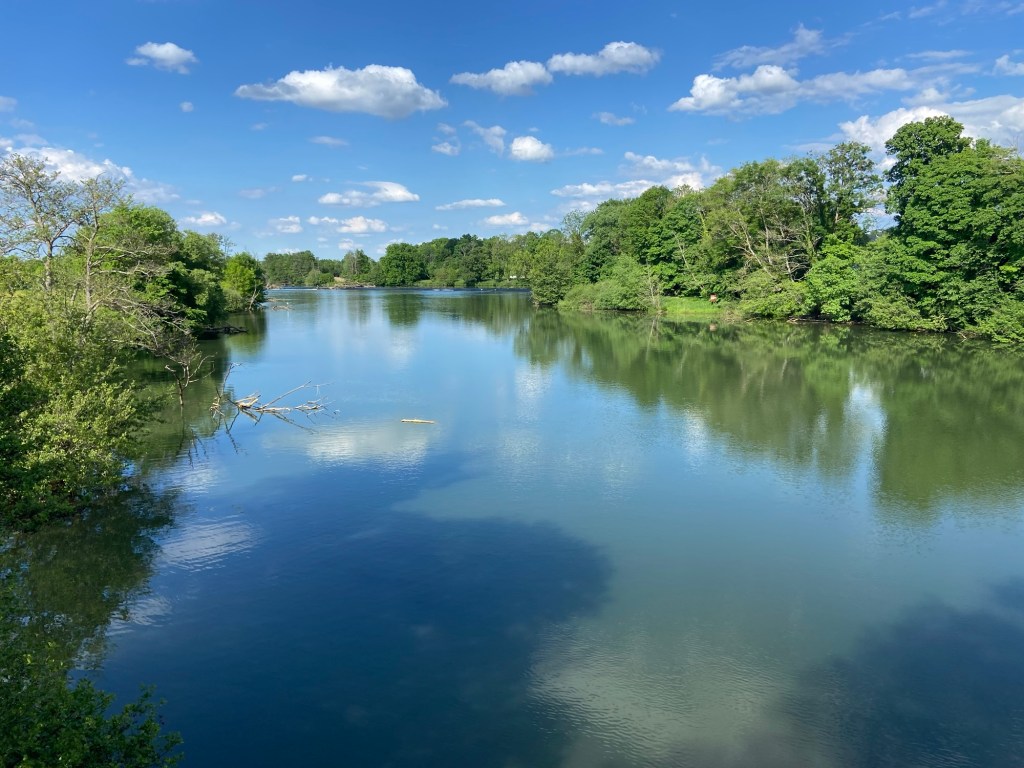
My day ended here at the little Gîte Rêve, where Etienne and his fiancée, and their two dogs welcomed me for what I hoped would be a night of good dreams.
Stats for the Day
Distance: 27.25 km —- shorter than it would have been had I not mostly taken the bike route option
Time: 5 hrs 46 mins over almost 8 hours
Pace: getting quicker in these new shoes, 4.7 km/h
 Walking The Landscape
I love the LittleJohns bigging themselves up for eternity! What a fabulous monument.
LikeLiked by 1 person
Me too!! And from the other side of the wall you couldn’t see any of the other graves or the bottom of the tomb, just these four stone maidens carrying the dramatically shrouded figure
LikeLike
…and the cherubs are so utterly devastated – perhaps at his untimely death.
Hope you sleep well after another lovely watery walk.
LikeLiked by 1 person
Thank you.
LikeLike