Look at their shoes!
Charles Beaumont, ‘A Spy Alone’
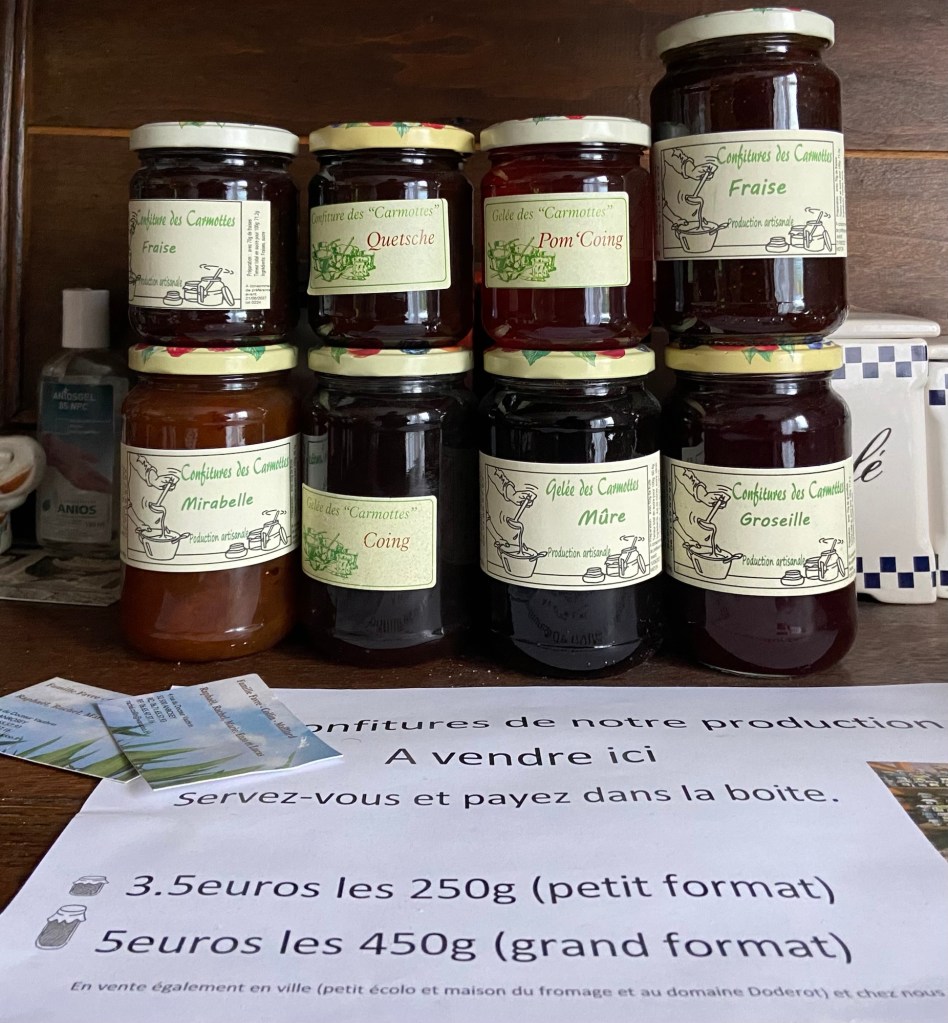
Two rest days! It felt like total luxury. It was very strange walking about the city unencumbered by a rucksack and walking poles — I kept thinking I had left something behind. On the first day I pretty much did nothing except switch B&Bs, arriving at Rachel’s relaxed house and meeting two of her lovely children. It was such a nice change being in a family home with the daily routine of packing up for school, children getting back at the end of the day, sitting at the kitchen table and doing homework. I clean forgot to take any photos of Rachel, but here is a picture of her delicious jams instead — she sent me off with a tiny jar of confiture for the road. Thank you Rachel, for a great pit stop.
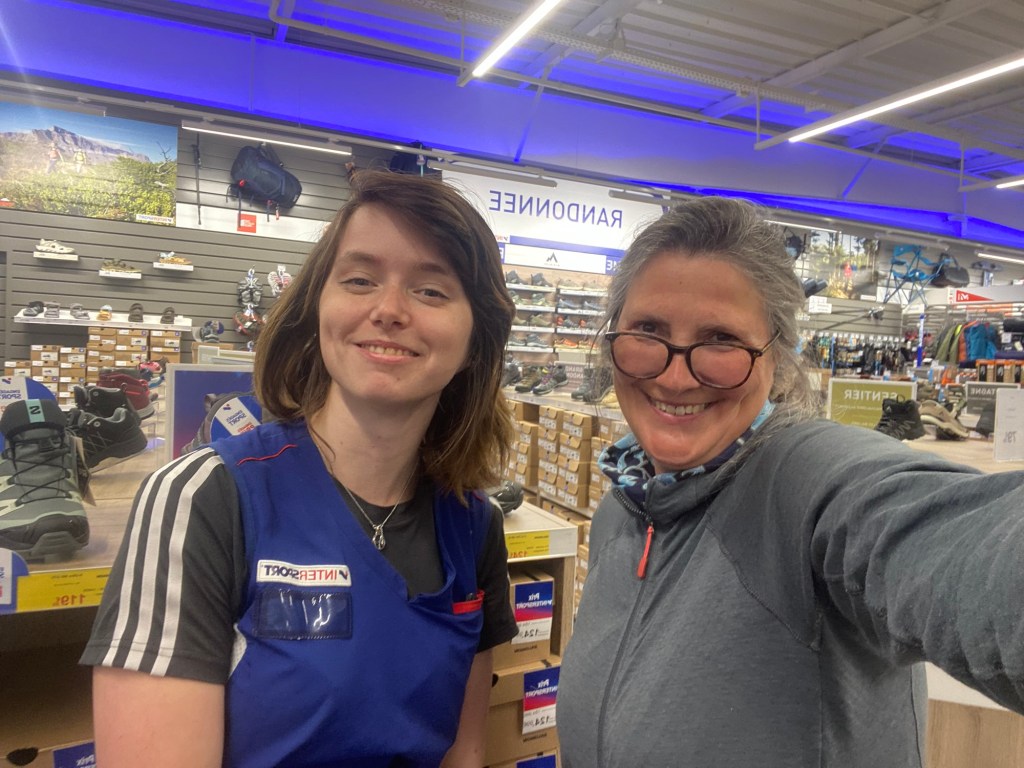
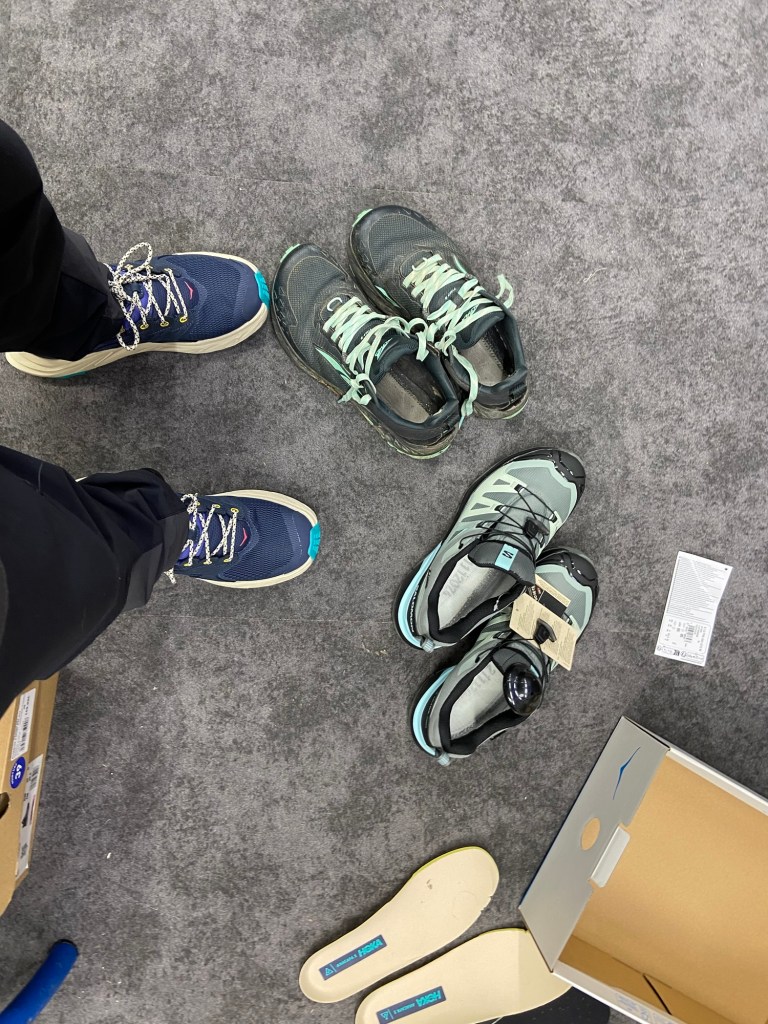
On the second rest today, my main job was to replace my shoes. I had thought that I was going to have to get a train into a big city like Dijon, but Rachel told me there was a large sports shop on the retail park in the nearby dormitory town of Saints Geosmes (pronounced ‘Gee-ome’). I fell right on my feet here, as it were, as they had not only a great selection of shoes, but also a great advisor in the person of Pauline who was exceptionally patient, extremely knowledgeable, and also spoke pretty good English, so that the technical business of describing the kind of shoe I wanted on my part, and going through the various options on hers was a lot less difficult than it might have been.
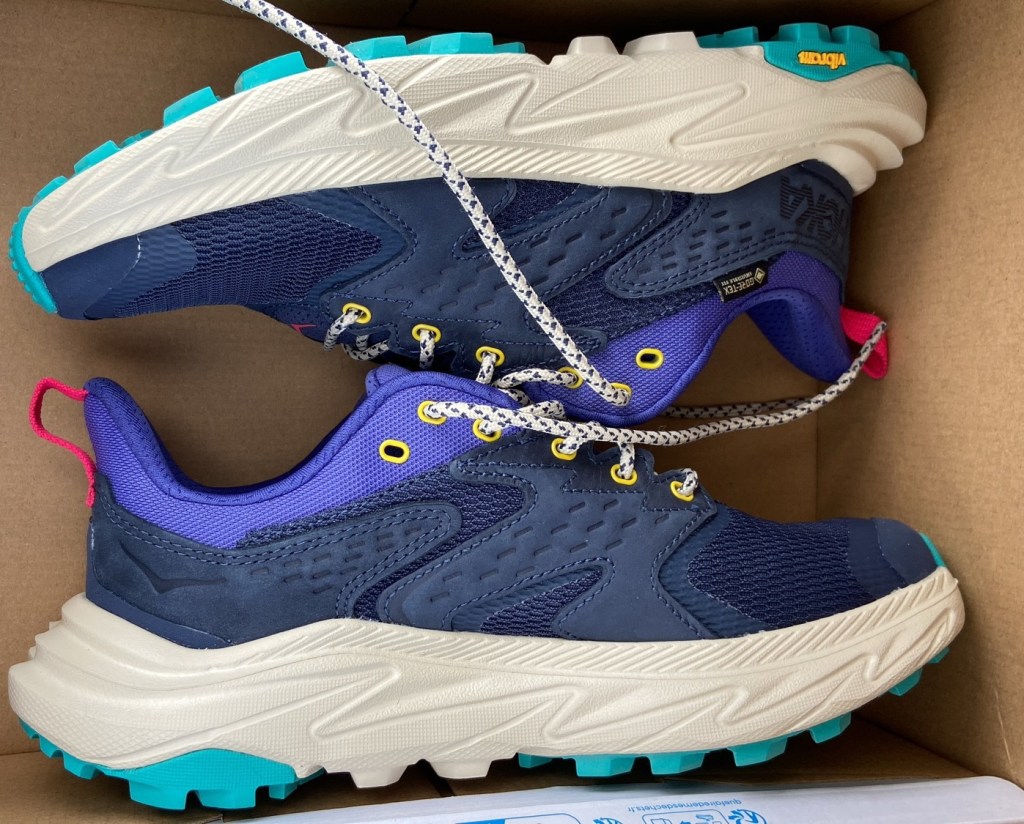
I couldn’t replace my shoes exactly, so I had to get my head around that. When I stopped comparing the two shoes I was considering with my existing shoes, and started comparing between them instead it was an easier choice, and I eventually walked out of the shop with a pair of Hokas — although not the model I would have chosen, which they didn’t have in. I have no idea whether I have made the right choice, but it’s the one I’ve made, and after all they only have to get me to Lausanne, which by now is less than two weeks’ walking away.
Back in the town I met up with Ian, who had just arrived for his rest day tomorrow. We coincided for a lovely lunch and catch up, and then quite a chilly walk around the top of the fortified ramparts (more photographs in yesterday’s rest day selection), learning such interesting facts as that the town is twinned with Beaconsfield in the UK, and that one of its old 16th century towers had at some point been converted to a military pigeon loft.
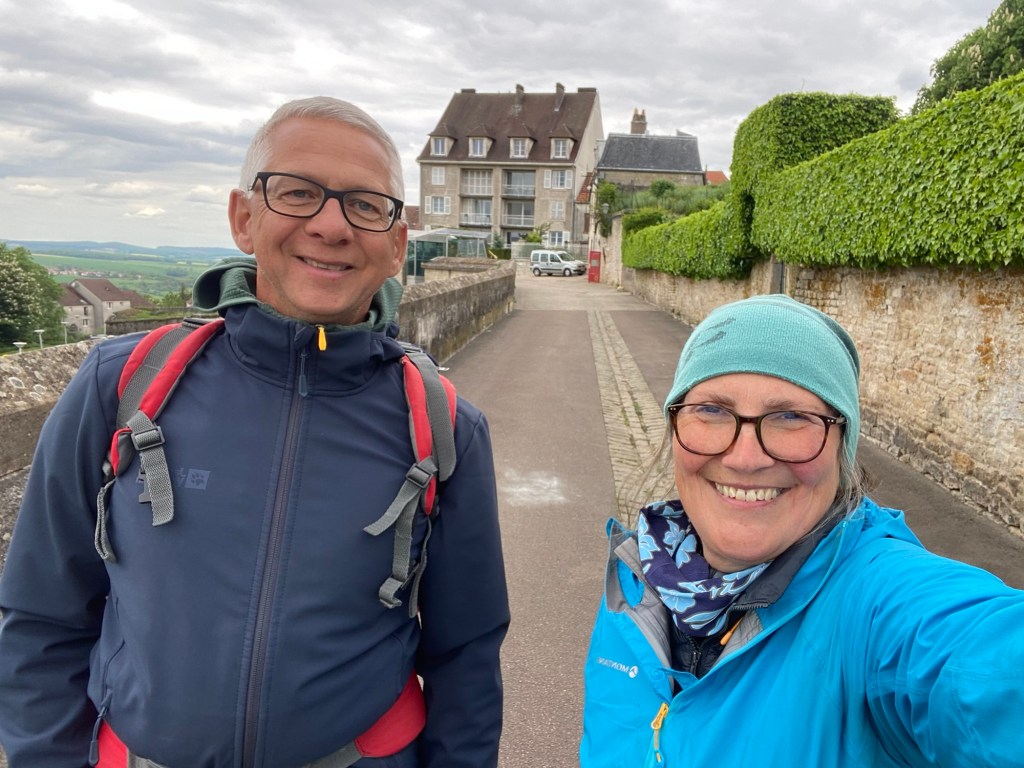
After a rather frugal supper and a good night’s sleep, I woke to a dawn which made me want to get back amongst it.
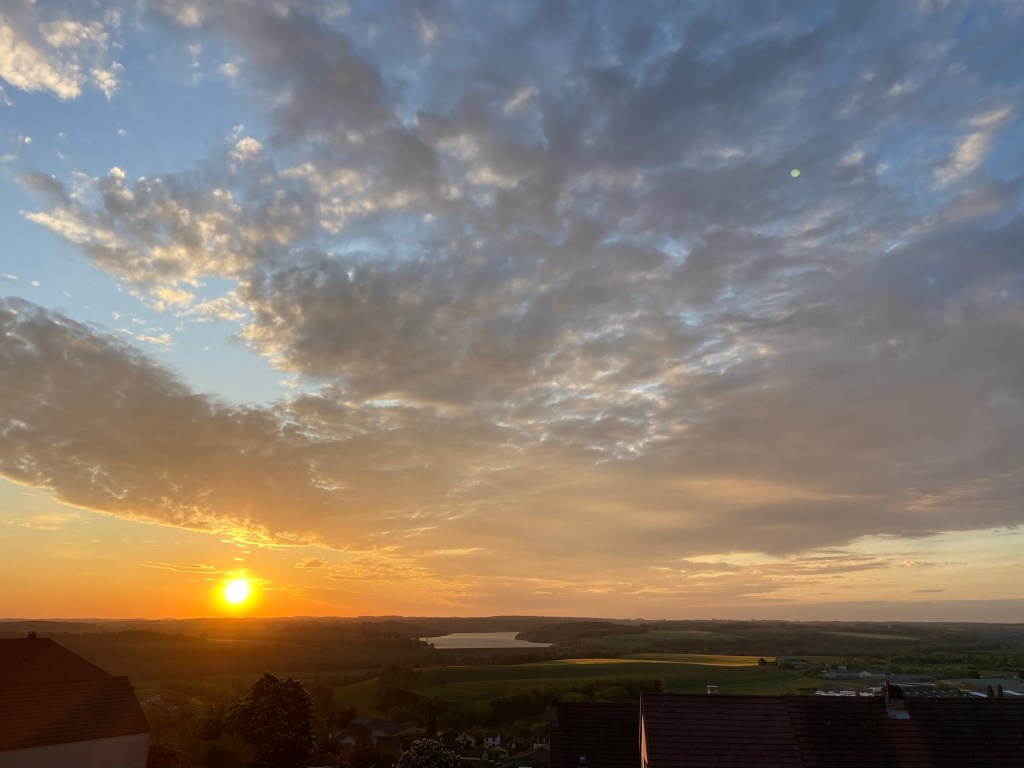
My bag was very heavy today, as I didn’t feel I should bin my Altras in case the Hokas don’t work out, so they were packed in the top of the rucksack.
Rachel lives right on the Francigena, so I was able to walk straight out of the door and onto the path, down to the Porte de Sous-Murs, a fortified entrance designed to be protected by arquebusiers and cannon and intended for the collection of taxes on goods entering the town.
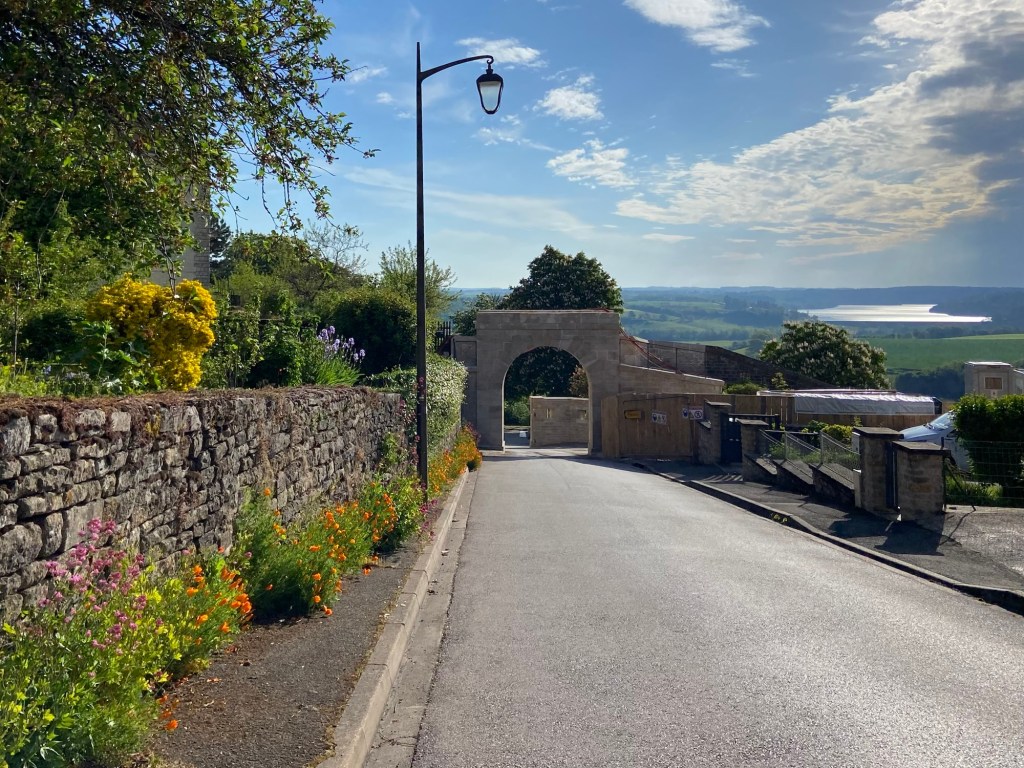
I passed straight through — the gateway to the next section of the route, which will take me to the start of the Jura mountains at Besançon in a week’s time.
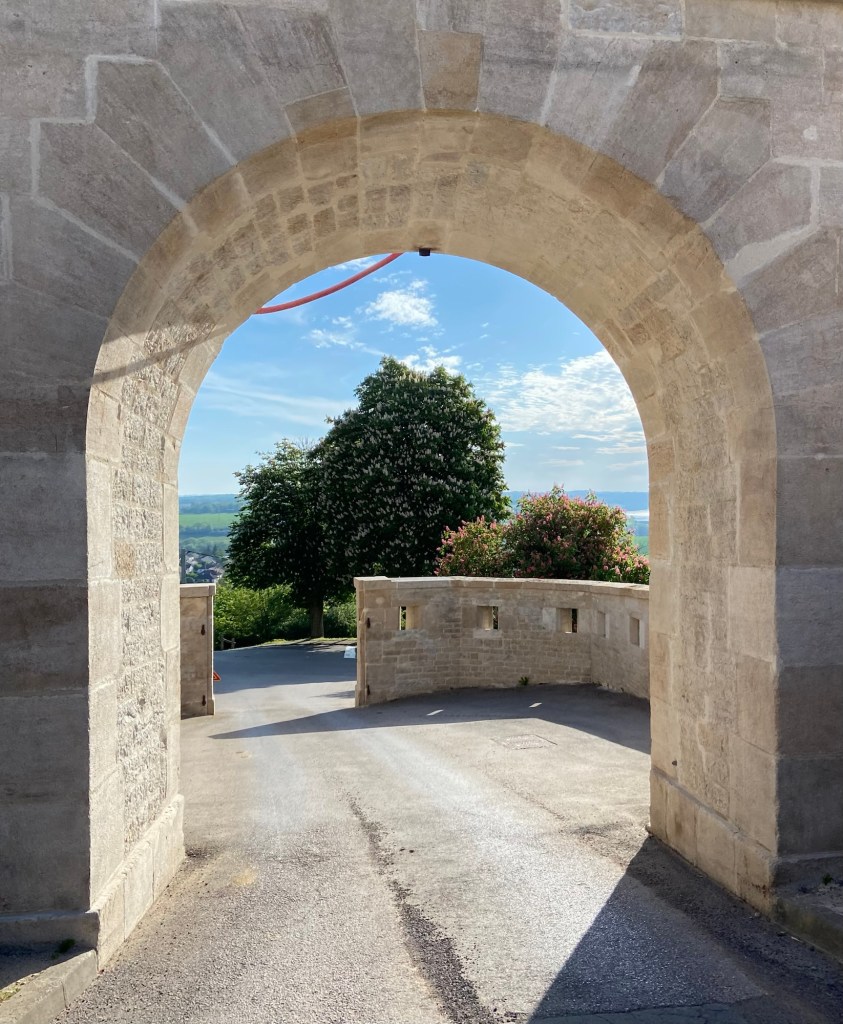
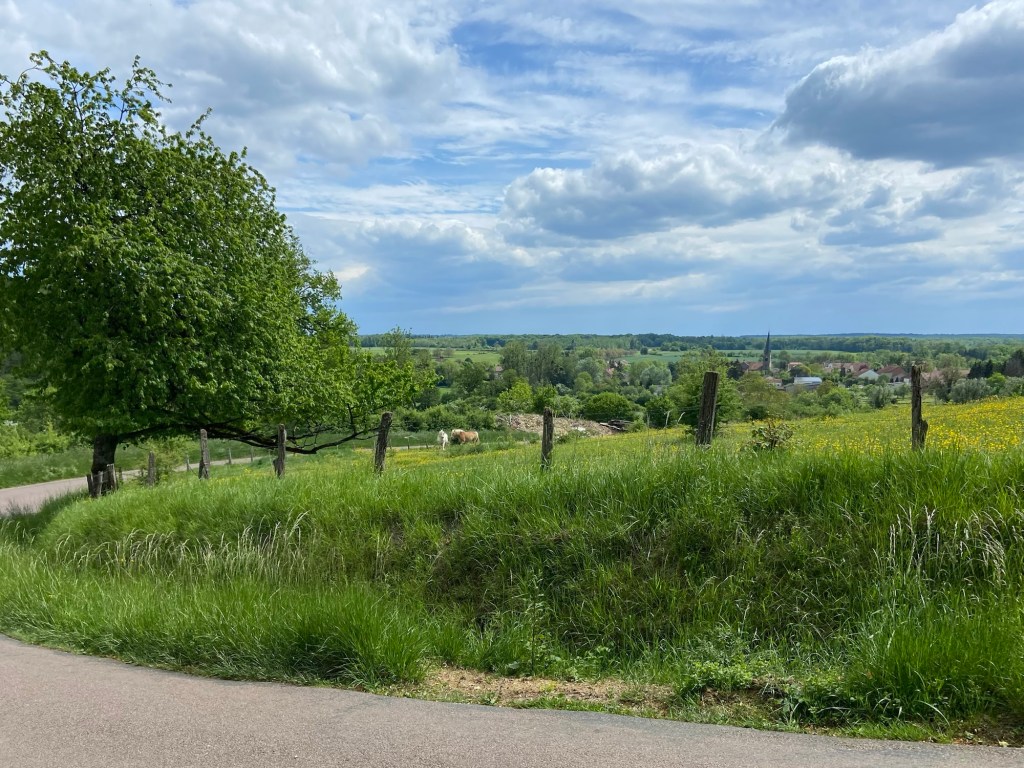
The view was tremendous — the whole of today’s route extending out onto the plain beneath the plateau, out over the Lac de la Liez and beyond to ridges which looked flat from here.
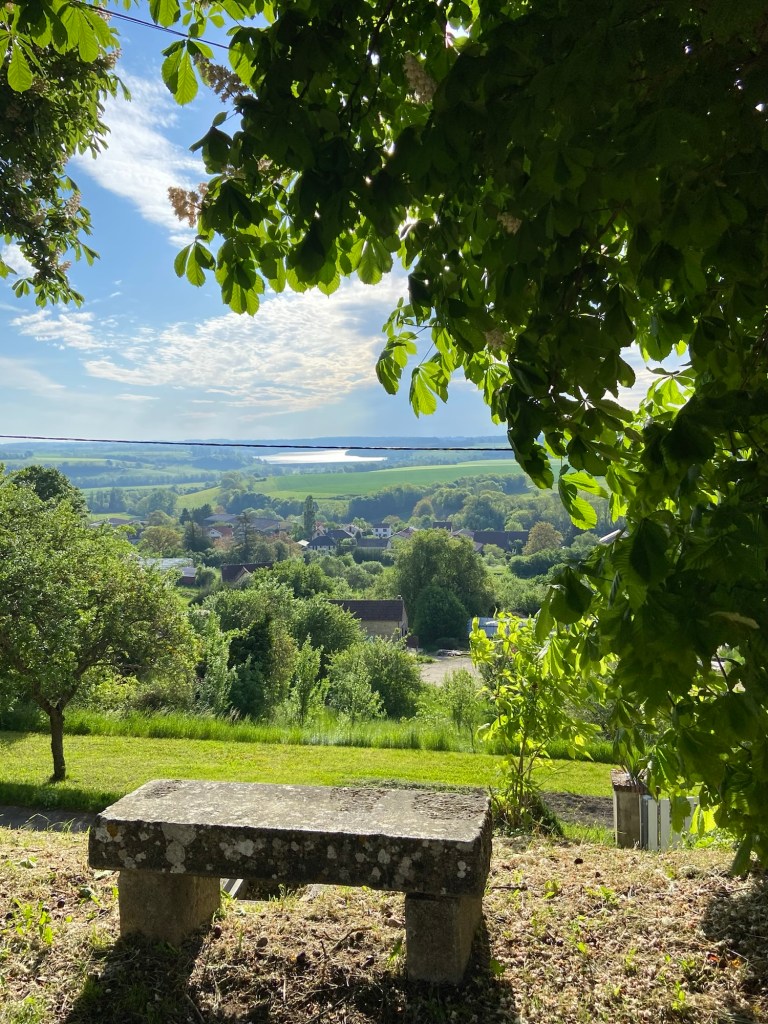
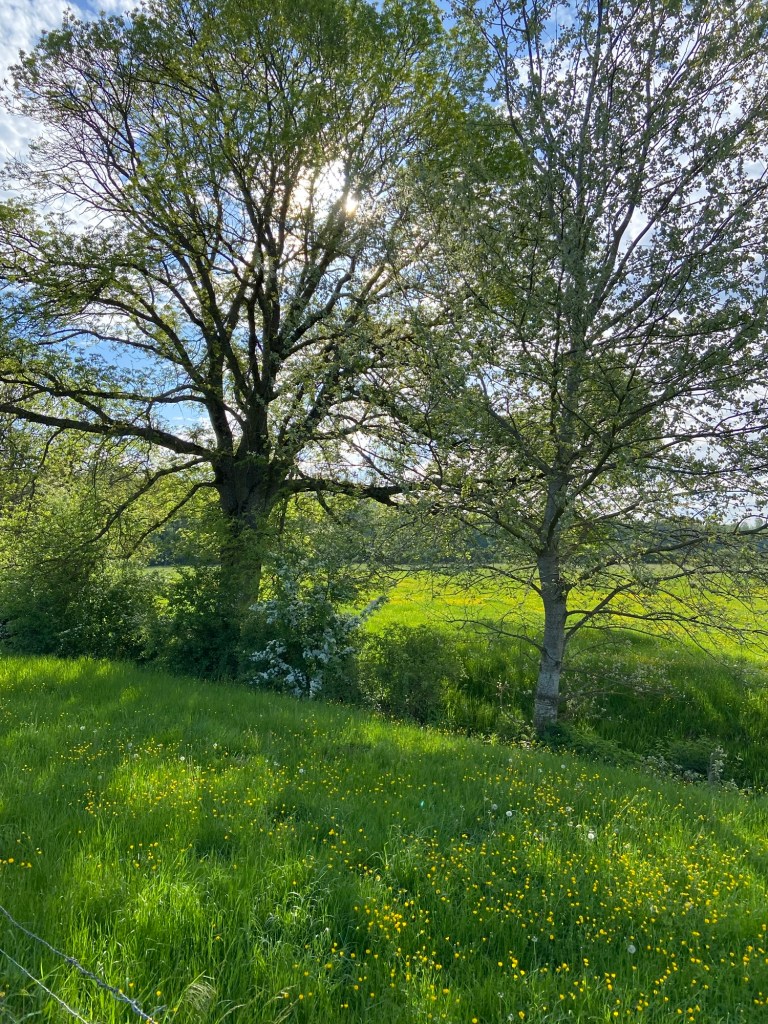
So I got going, firstly making a deep plunge down onto the plain, into the greens of the countryside which the recent rain had only served to freshen and enhance.
I crossed the Marne once more (a thread of itself now, so close to its headwaters), and out briefly to join the canal connecting the Marne and Saône rivers which I’d last picked up with Ian way back on April 25th as we’d walked into Vitry le François. The canal and I had taken different twisting paths to get here, the river and the canal staying north and heading east-west, then dropping down south to meet me here.
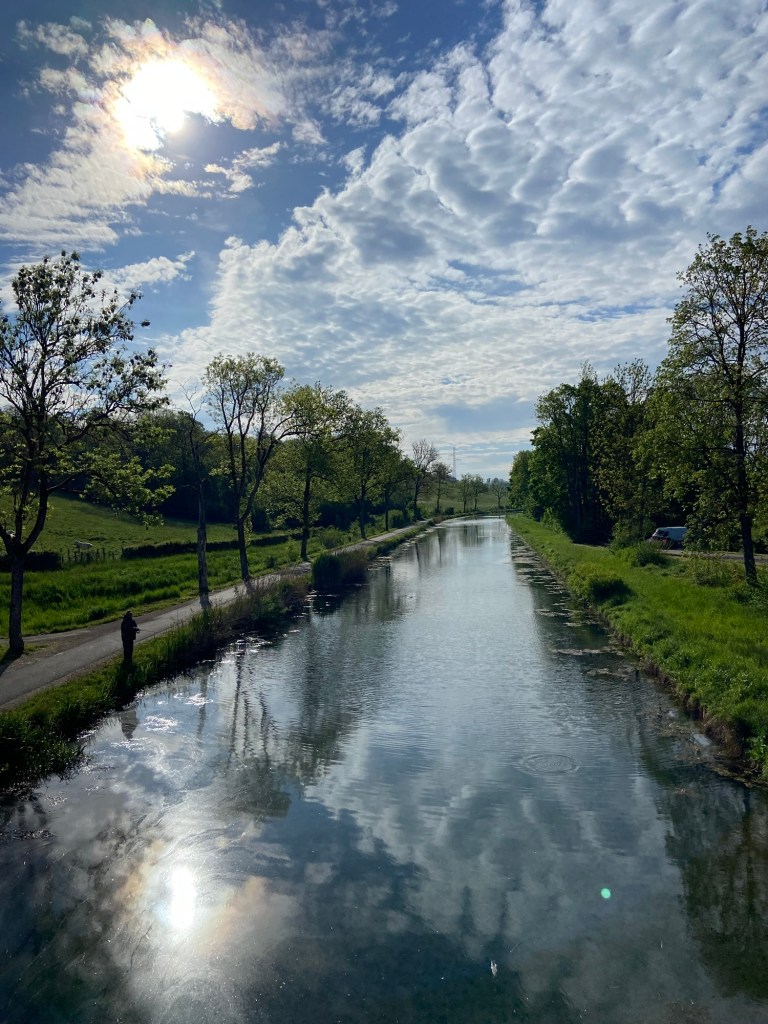
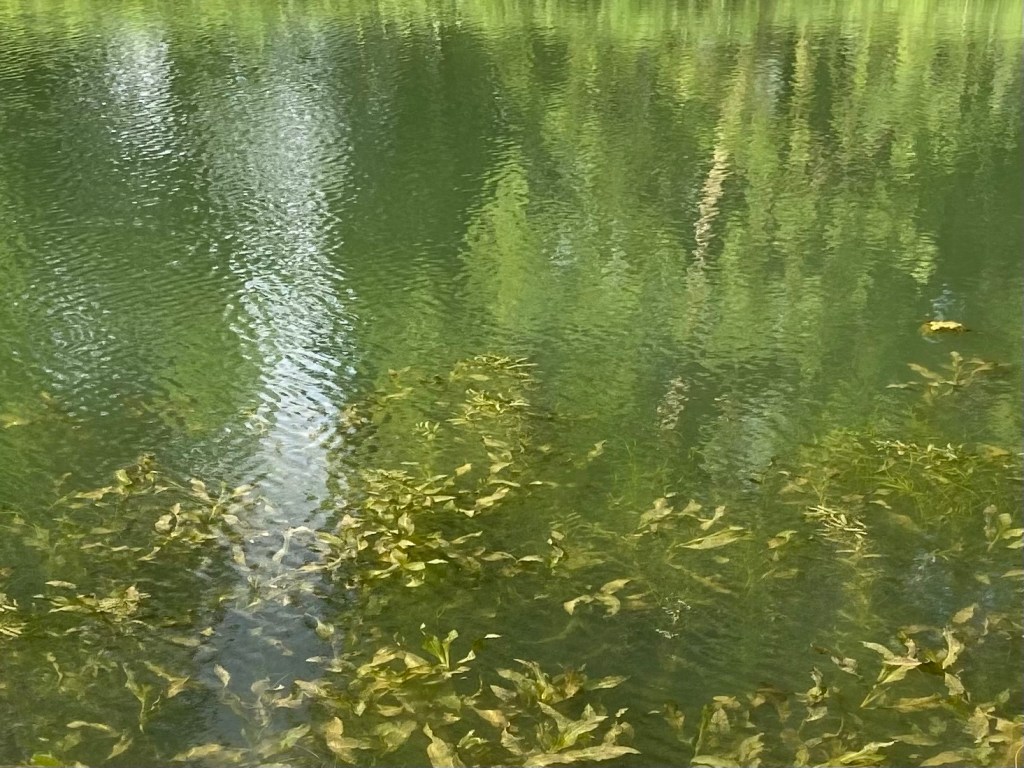
After a couple of cold and sometimes rainy days, it was lovely to get back down by the water, sparkling, blue and green by turns, its surface sometimes showing the sky back to itself, sometimes ruffled by the wind, fragmenting the reflection.
I was hearing more nightingales, but also orioles singing from different sides of the canal. Finally I saw a pair of them, chasing each other around the canopy of an ash tree, furious streaks of black and gold, flashing through the branches and then away.
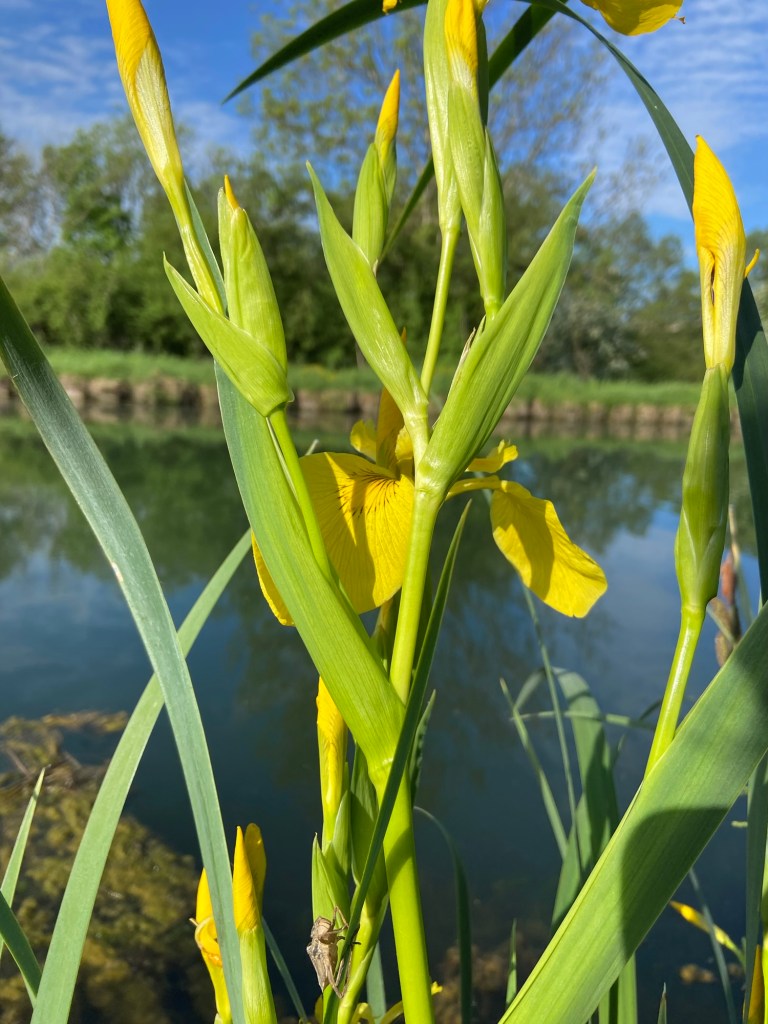
It was a trio of gold: first the orioles, then yellow flag iris (with an exuvia husk left behind after a damselfly larva had used the stem to climb up out of the water for the final moult into its winged form),
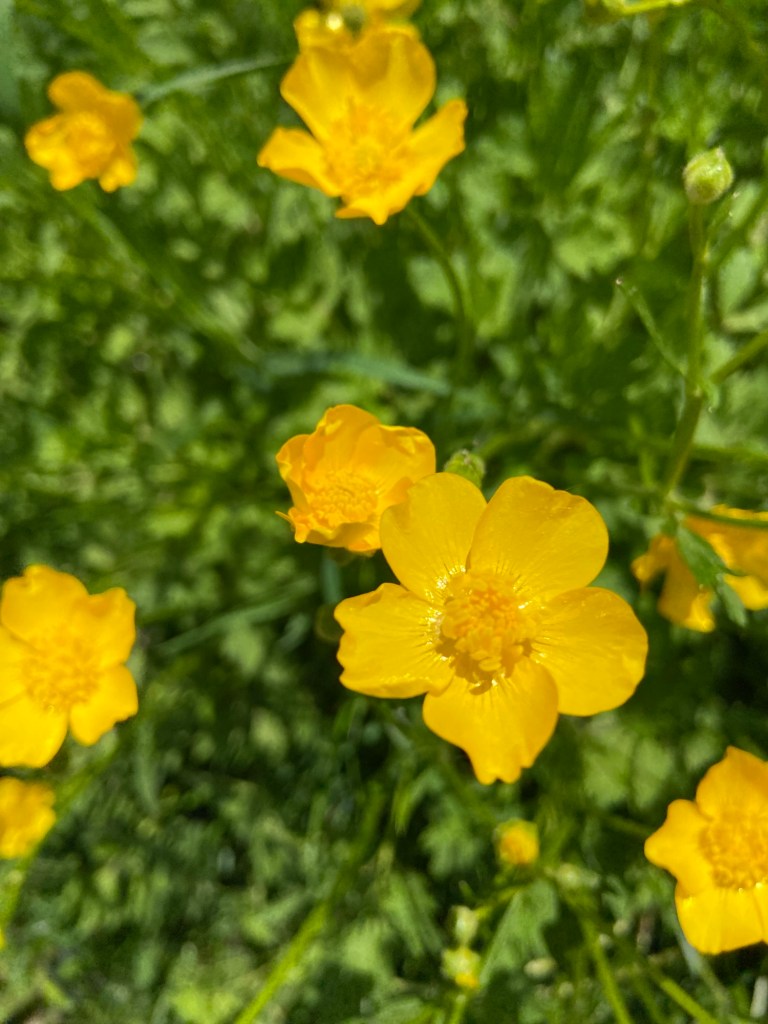
and a meadowful of buttercups with shiny petals reflecting back the light of the sun.
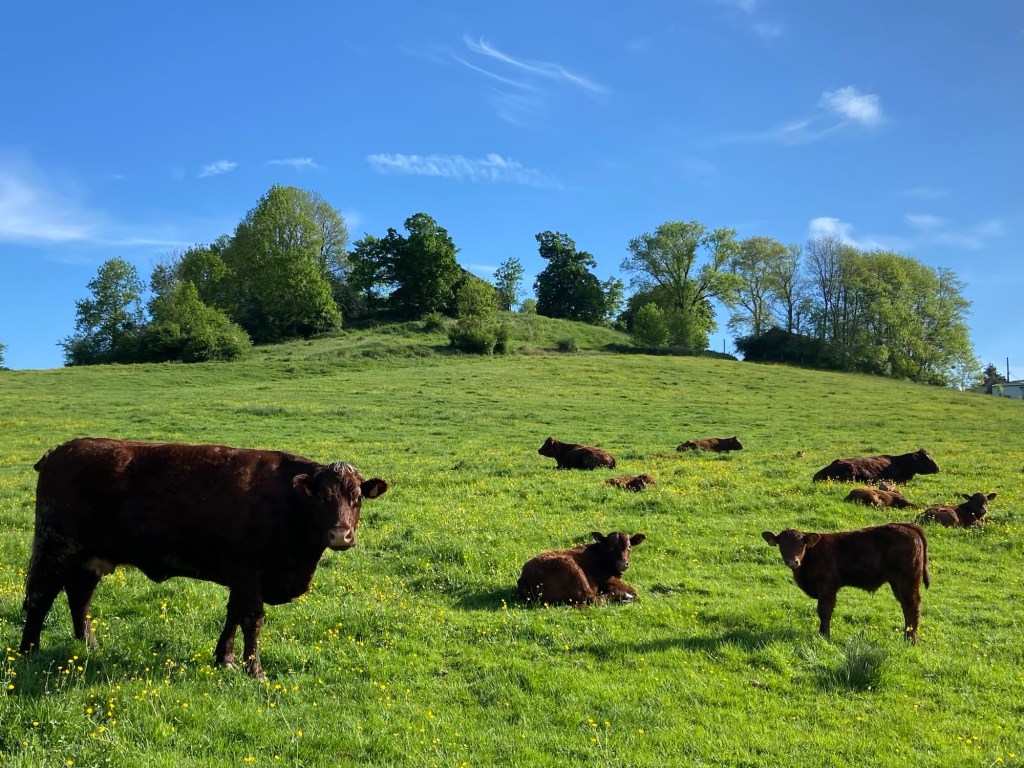
I came off the canal to walk by a pasture where cows were lazily chewing the cud and most were paying me almost no attention,
finally to reach the shores of the Lac de la Liez, today’s main geological feature.
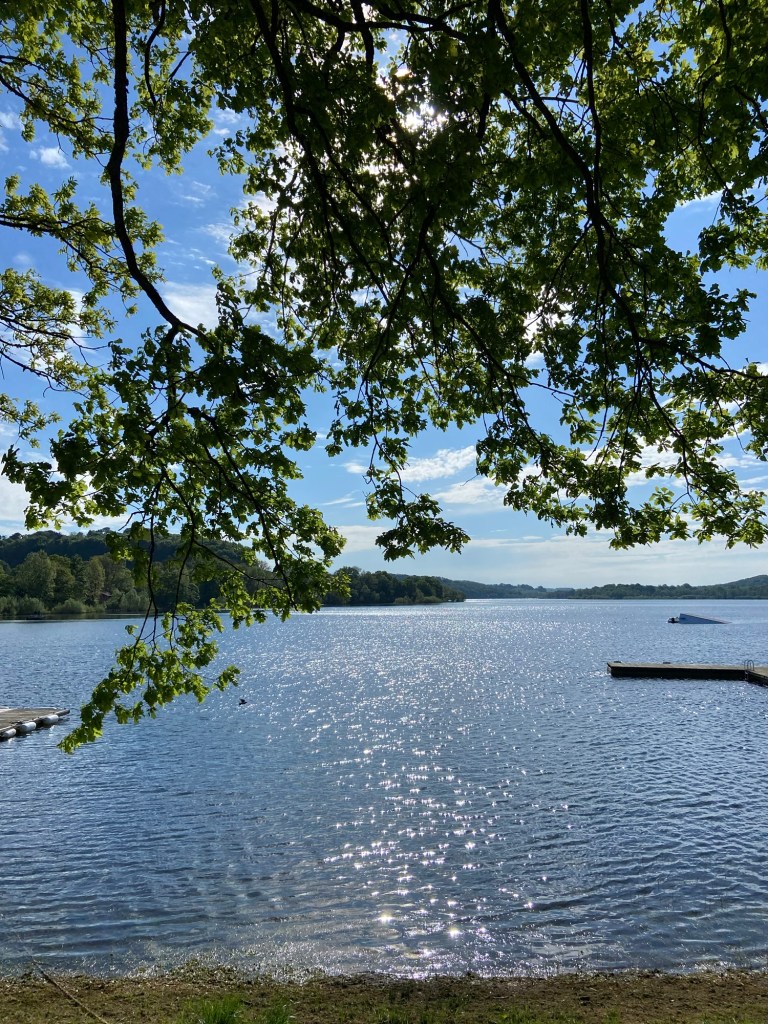
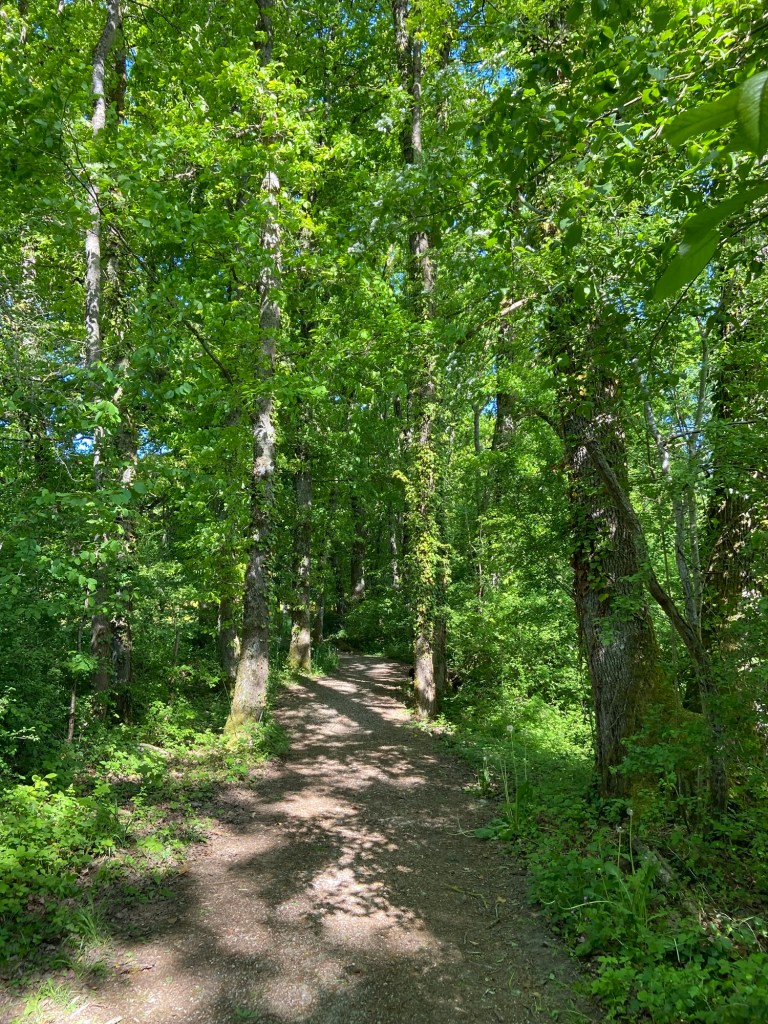
The Francigena curls around half the lake’s 14-km shoreline, which on its western end was built up with homes, a tiny swimming beach, restaurants and bars (all closed) and development in the form of a building site with a couple of huge cranes towering over the path. But I took the forest path, where an aural corridor of nightingales singing from the willows was punctuated occasionally by fisherman.
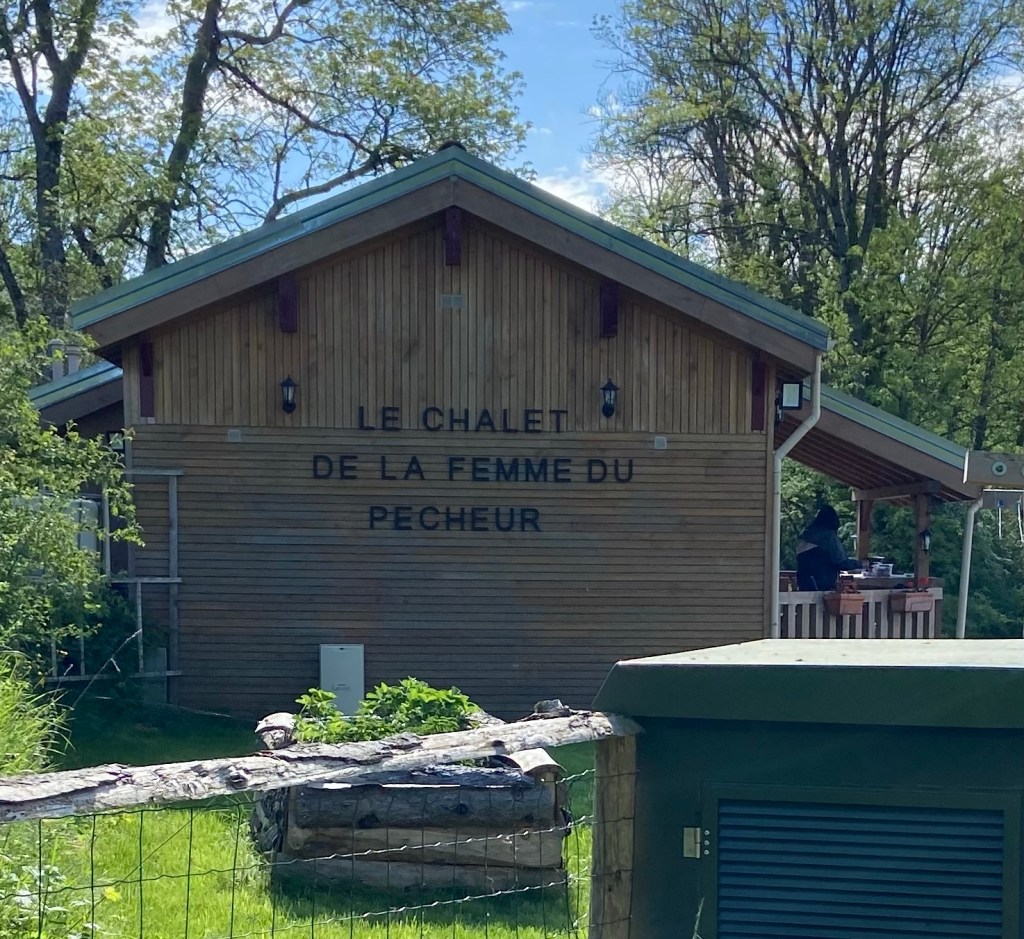
My suspicion that the pastime is one of the last domains of chauvinism seemed to be confirmed by a little chalet I came across,
and some fairly misanthropic fishermen and their suspicious dogs dotted along the route.
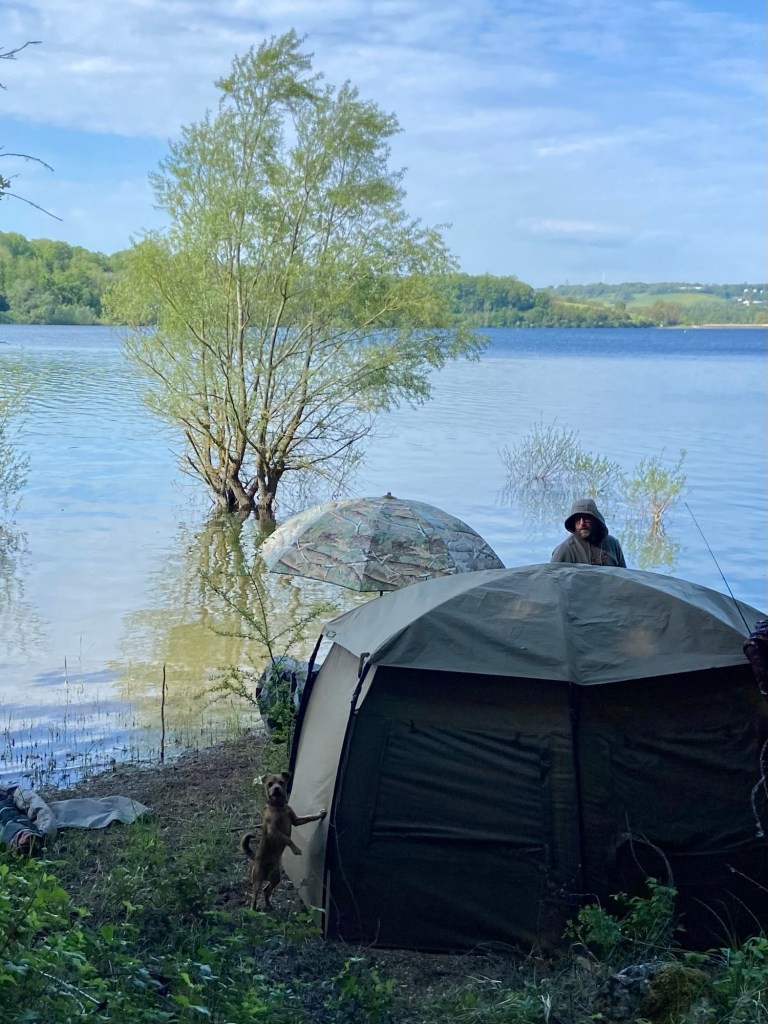
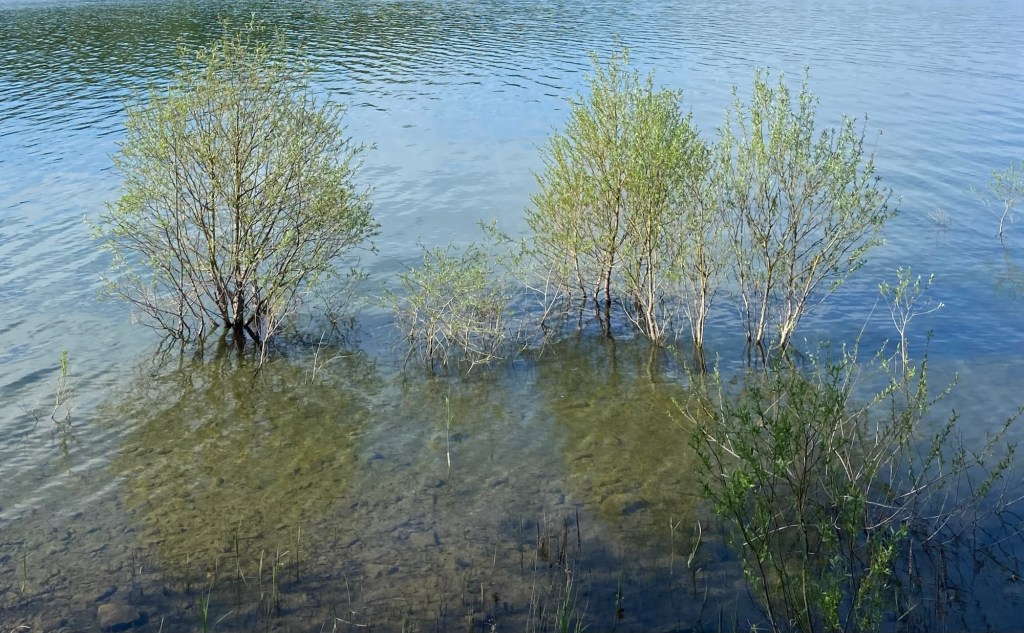
But for the most part it was peaceful and lovely, and I was just enjoying mostly forgetting about my feet and being back in a t-shirt, being delighted by marvellous glimpses of the blue, blue lake as the kilometres along its shore fell under my feet. Crystal-clear water lapped at the shoreline and drowned thickets of willow.
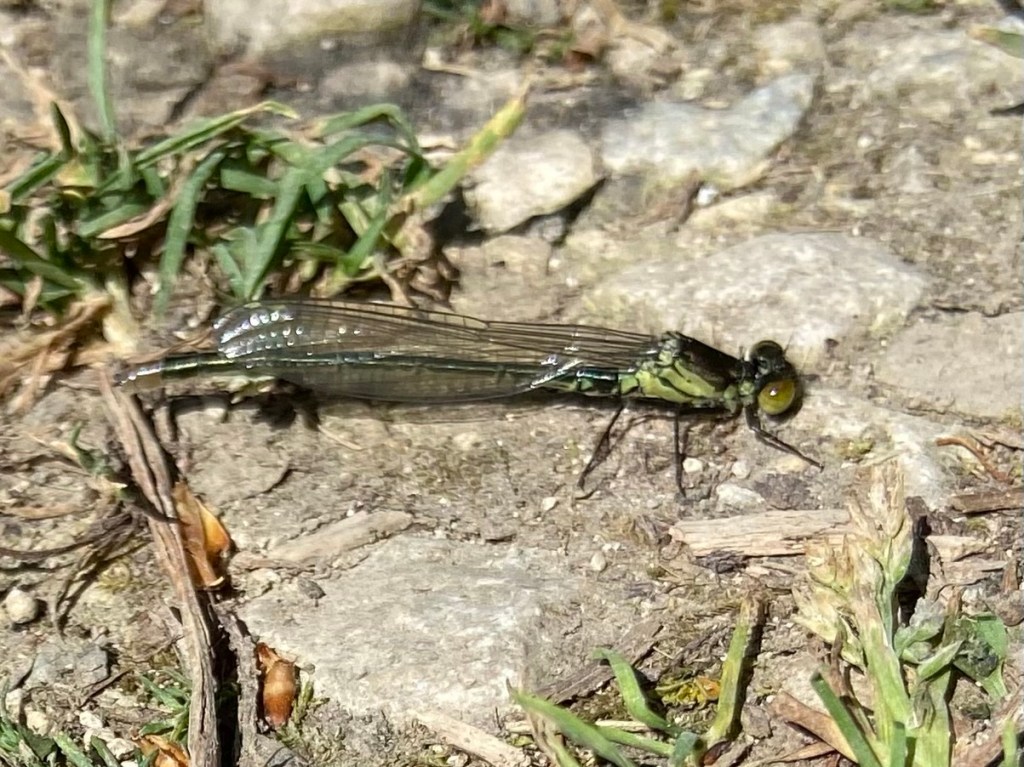
The plant growth at the sides of the path was invariably enlivened by Wall butterflies, and the tiniest of damselflies, so diaphanous as to be almost transparent.
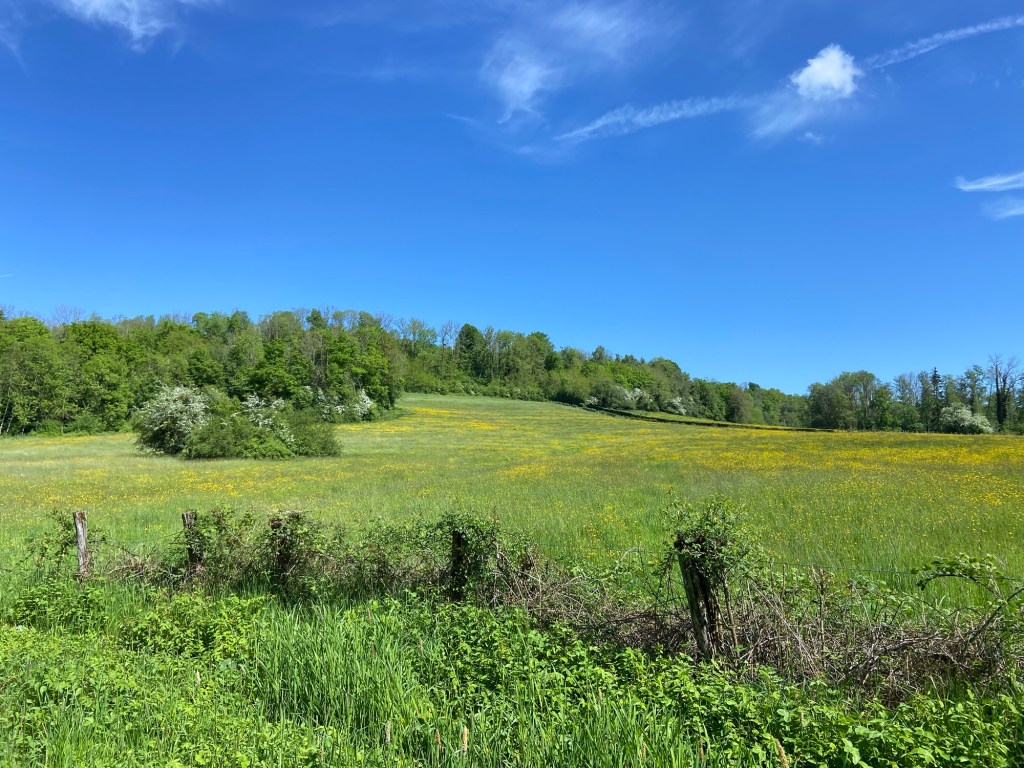
The south east end of the lake was a long reach terminating in reed beds and wetlands around which the path wound. I briefly exited the woodland path into huge meadows in which faraway herds of cows stood up to their bellies in deep grass, backed by wooded ridges where more oriole sang.
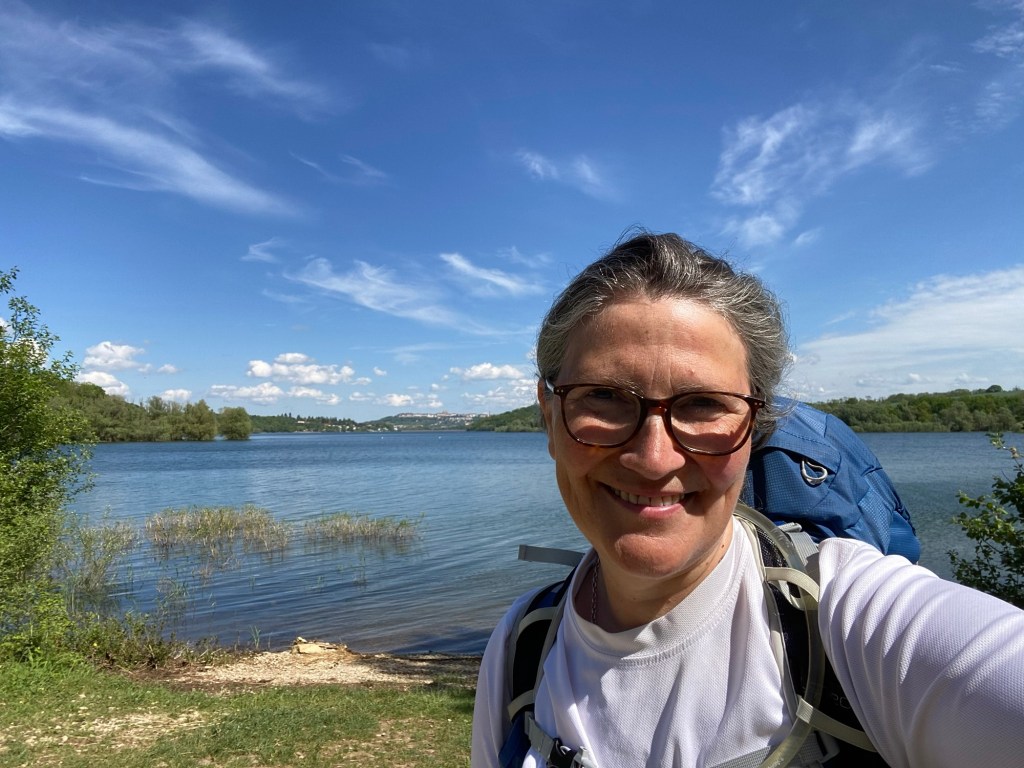
The last section of the lake path offered the most spectacular final views backwards to the town on its hilltop, and I thought of the views I had had out over the lake from Rachel’s house. Now I was there, on its far side.
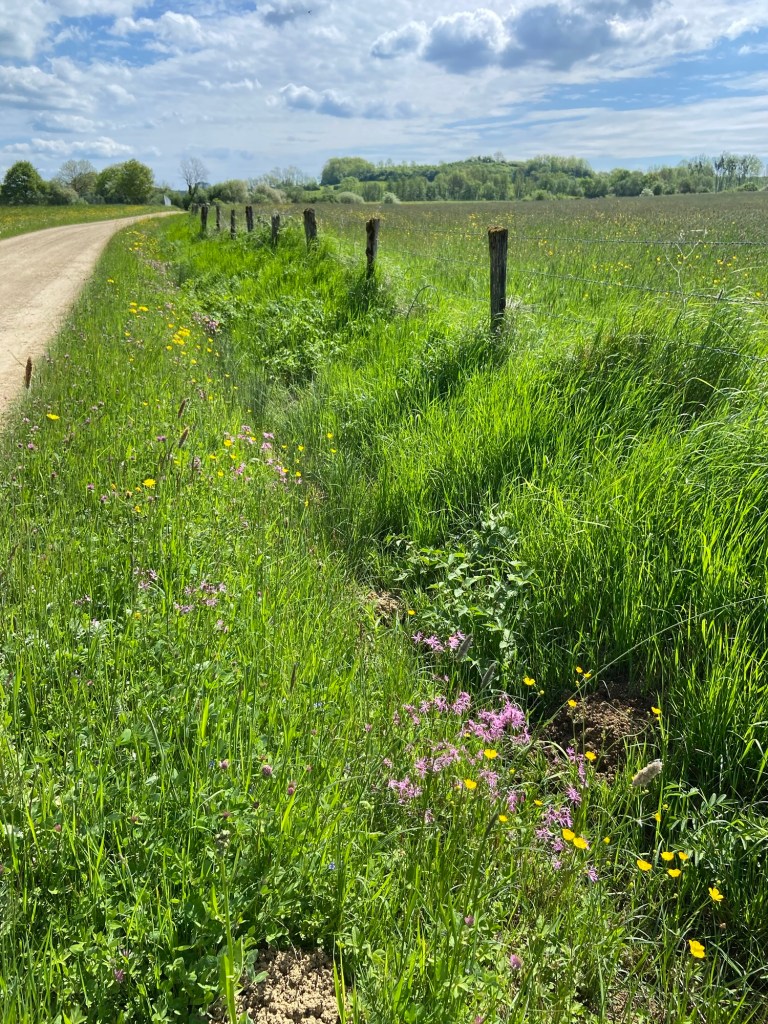
After the lake all seemed changed, as though spring had come on another couple of weeks whilst I was walking around it. There were marsh marigolds amongst the reeds, and flushes by the side of the road were scattered with clumps of ragged robin in bloom.
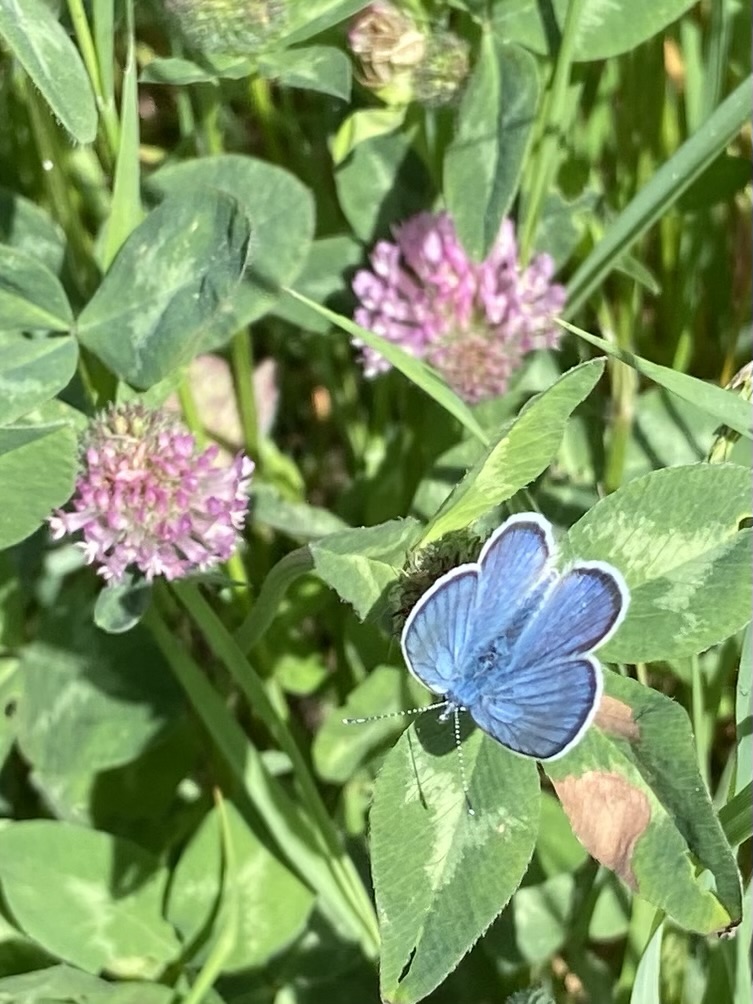
A small blue butterfly fluttered amongst red clover.
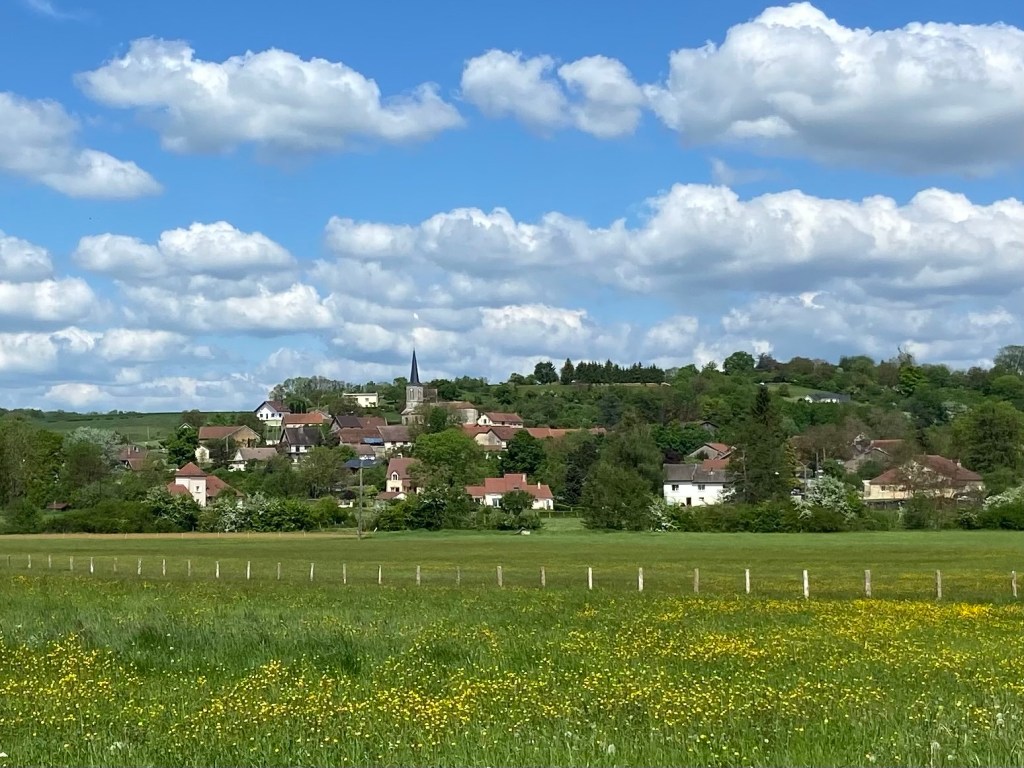
Now the path turned away from the lake and for a while walked up the river Liez with the little farming village of Lecey on the other side.
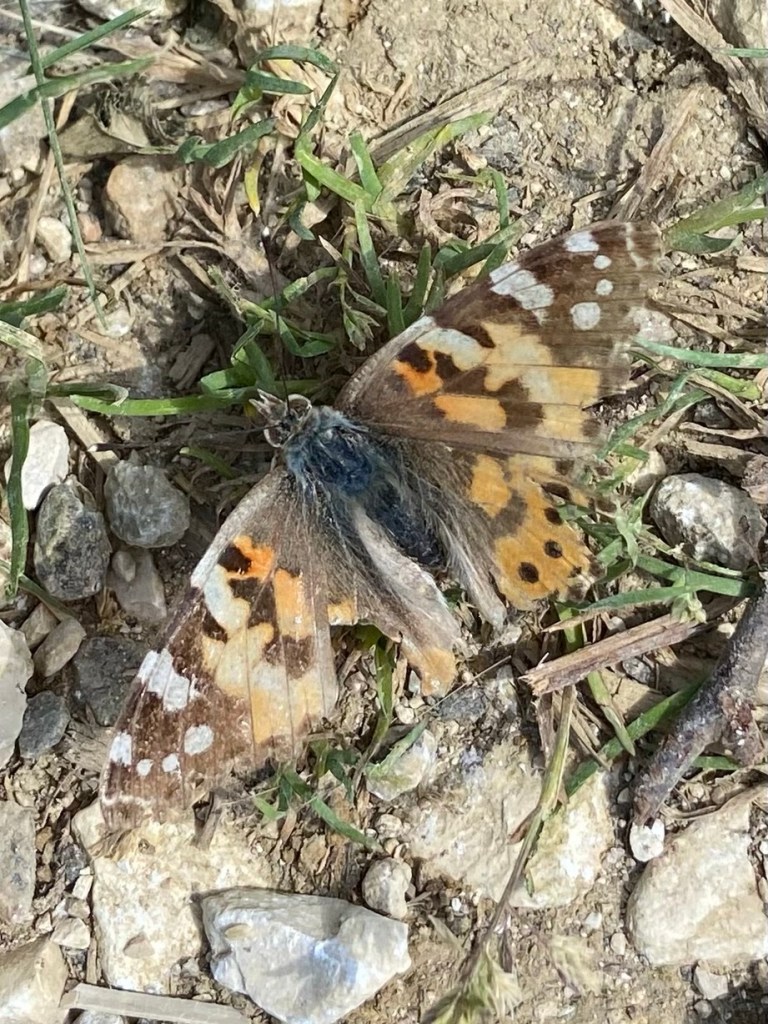
Unbelievably, nightingales and orioles were still my constant companions in the thickets and the trees, and this rather battered painted lady butterfly, exhausted and ragged from his part in the 10-generation butterfly migration from equatorial Africa to Northern Europe, sat still long enough for me to photograph him.
Next to the route in 2022, the village of Lecey had planted a heritage orchard of apples, pears, cherries and plums using varieties of fruit trees grafted from the village gardens, hedges and wild spaces. Each has an interpretation plaque to give more information about the variety and its history.
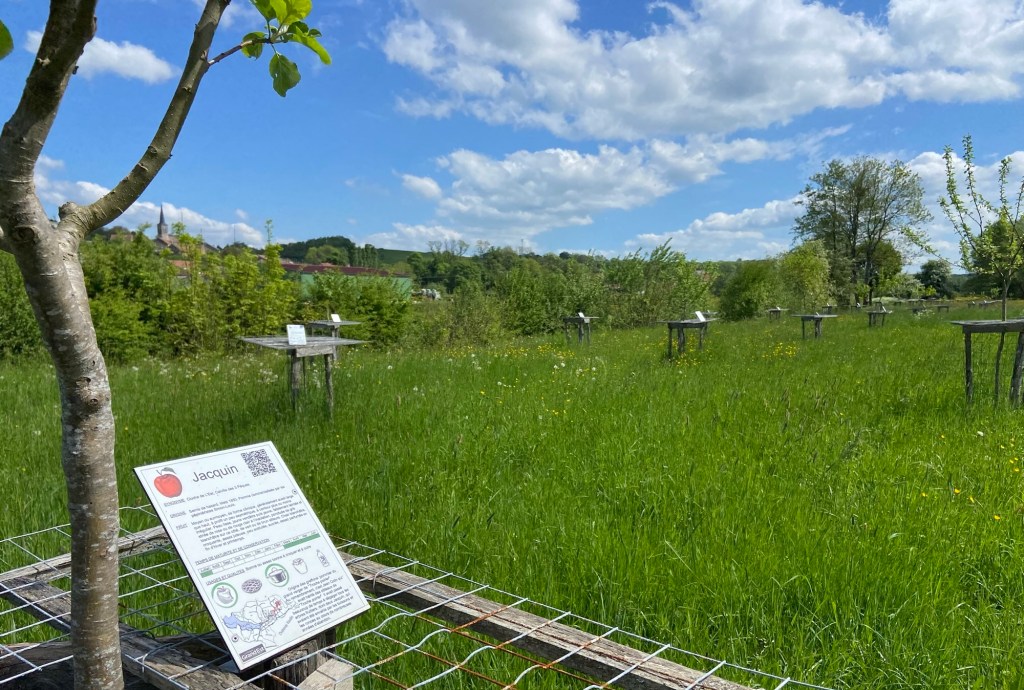
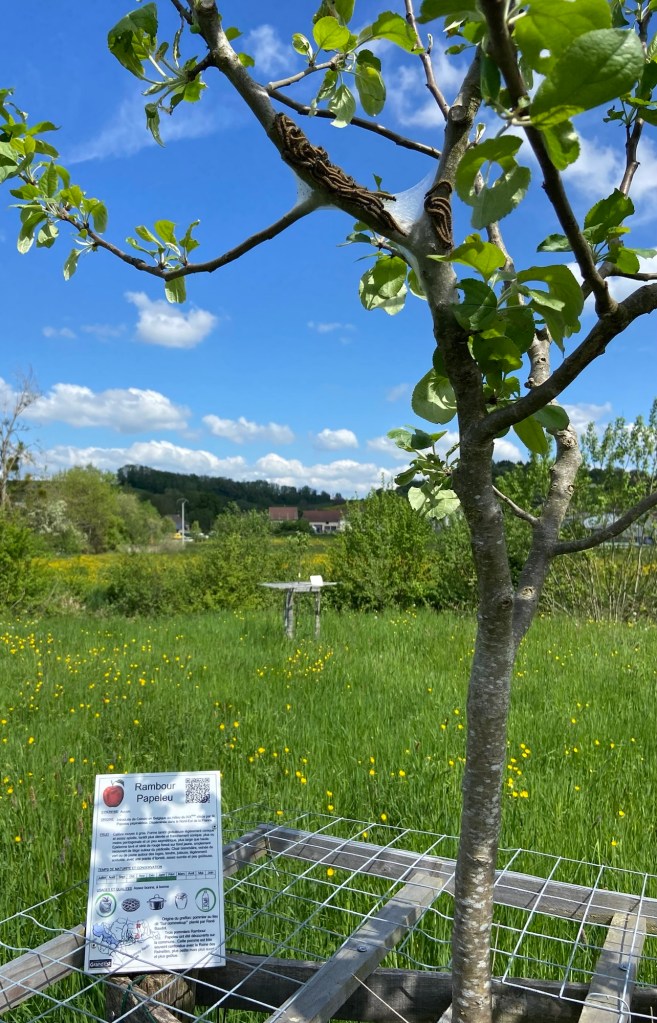
Caterpillars seemed to like the Rambour Papelou, named after the nurseryman who introduced the variety into Belgium from Crimea in the mid-19th century, from where it spread into north-east France.
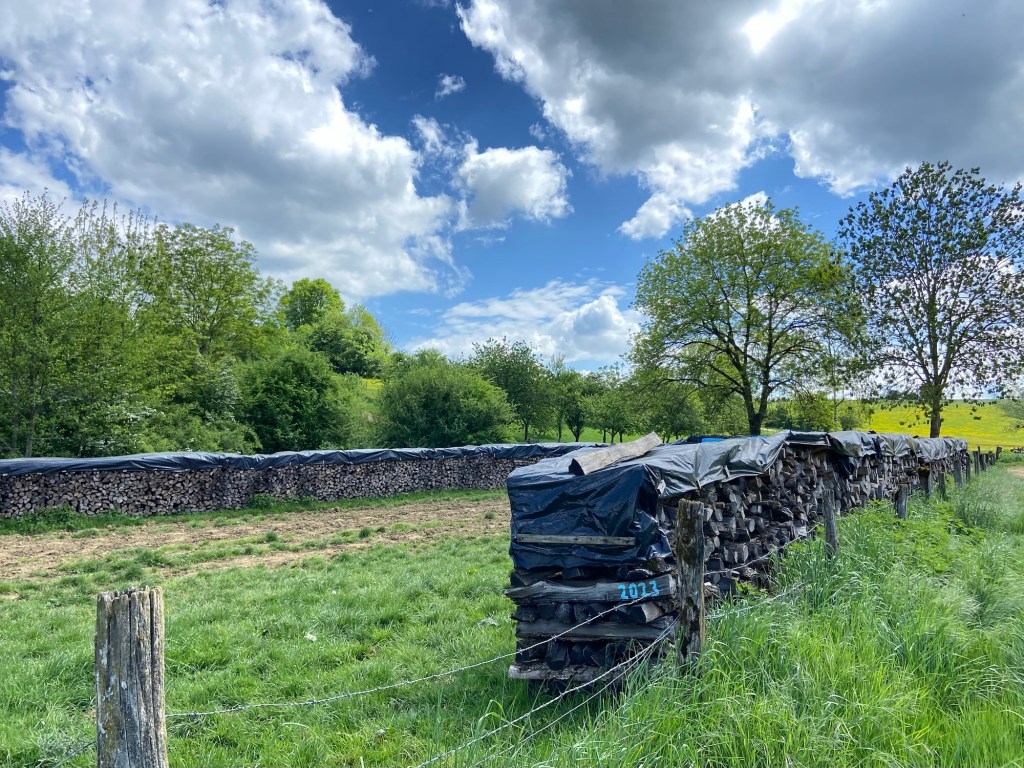
The road now climbed up through the even more agricultural village of Chatenay-Vaudin, where I made the mistake of not sitting down in the bus stop for a rest, which might have otherwise prevented me from continuing on the road for a little while up a hill, instead of turning off on the farm track that led past more of the immaculate stacks of firewood, which have been an omnipresent feature of France in gardens anywhere whether there is a wood or copse near. This stack, constructed meticulously around the perimeter of a paddock, had been labelled with the date the trees had been cut.
If the burghers of Lecey prized their heritage pommes, the Chatenay locals preferred their pommes de terre: an enormous pile was sitting in front of a silage clamp,
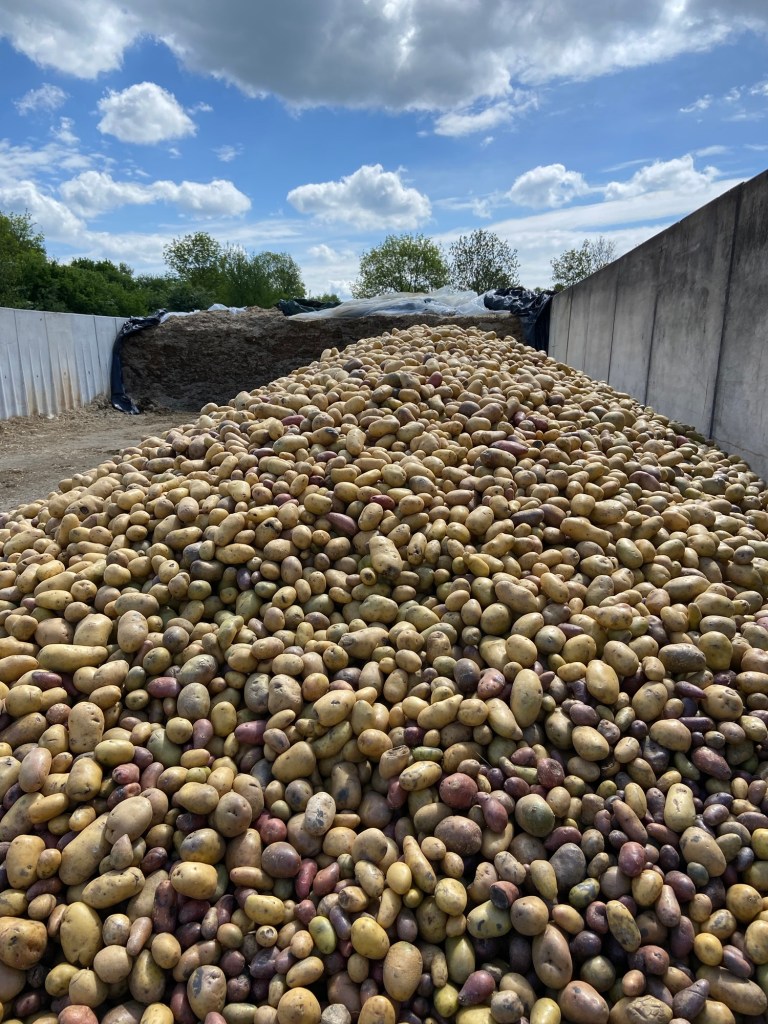
and closer inspection revealed it to be many different varieties, all mixed and jumbled up. I wondered what it was for; seed potatoes, or feed?
The track joined a road which took me up through impossibly green pastures inhabited by herds of cows. The business of tearing off grass with their teeth set up a fantastic jangling music from the slightly differently sized cowbells around their necks.
Up here the rape fields were almost through their flowering period. I remembered the bright yellow of the fields in full bloom against the hard blue sky of the Somme. Here the seed had set, and the pale green pods with a few scattered late-blooming flowers stood against the pale blue of today’s sky to completely different effect.
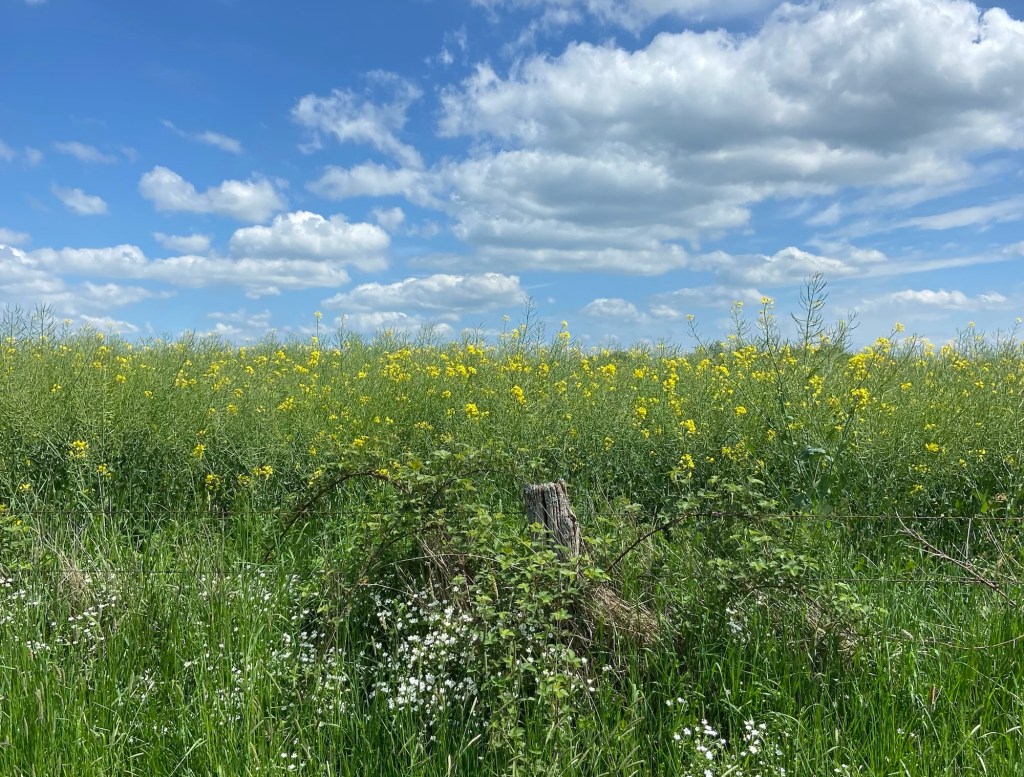
On the other side of the track, if I looked very carefully on the horizon to the right, I could still just make out the cathedral towers of Langres and the bell tower of St Martin’s church.
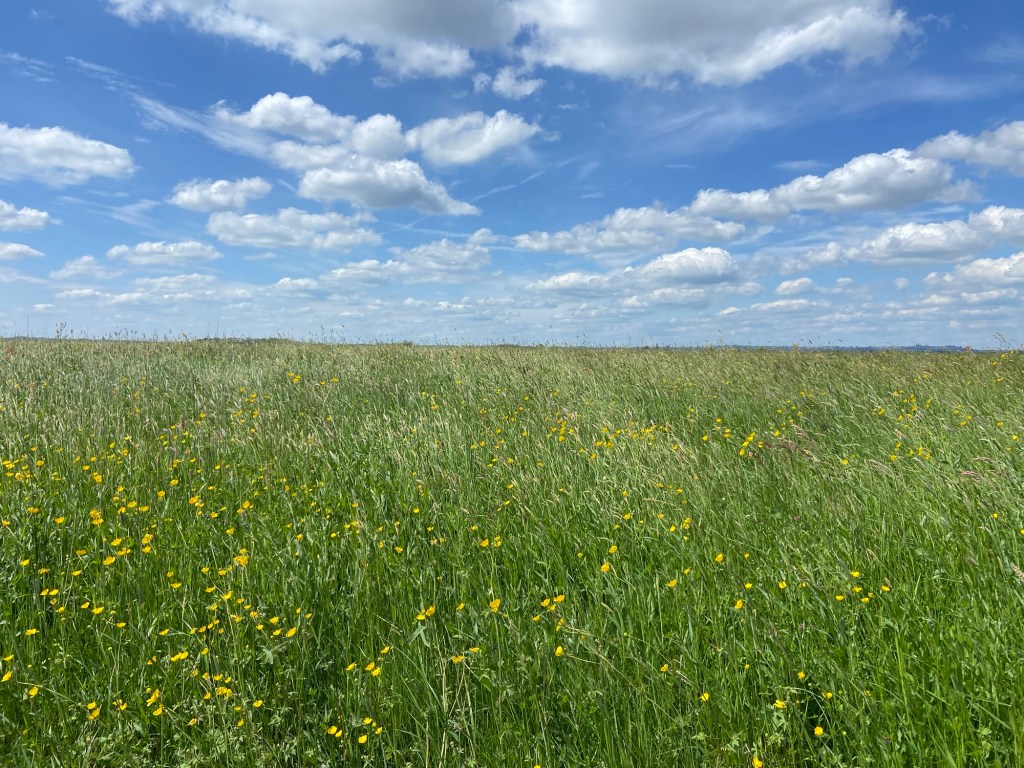
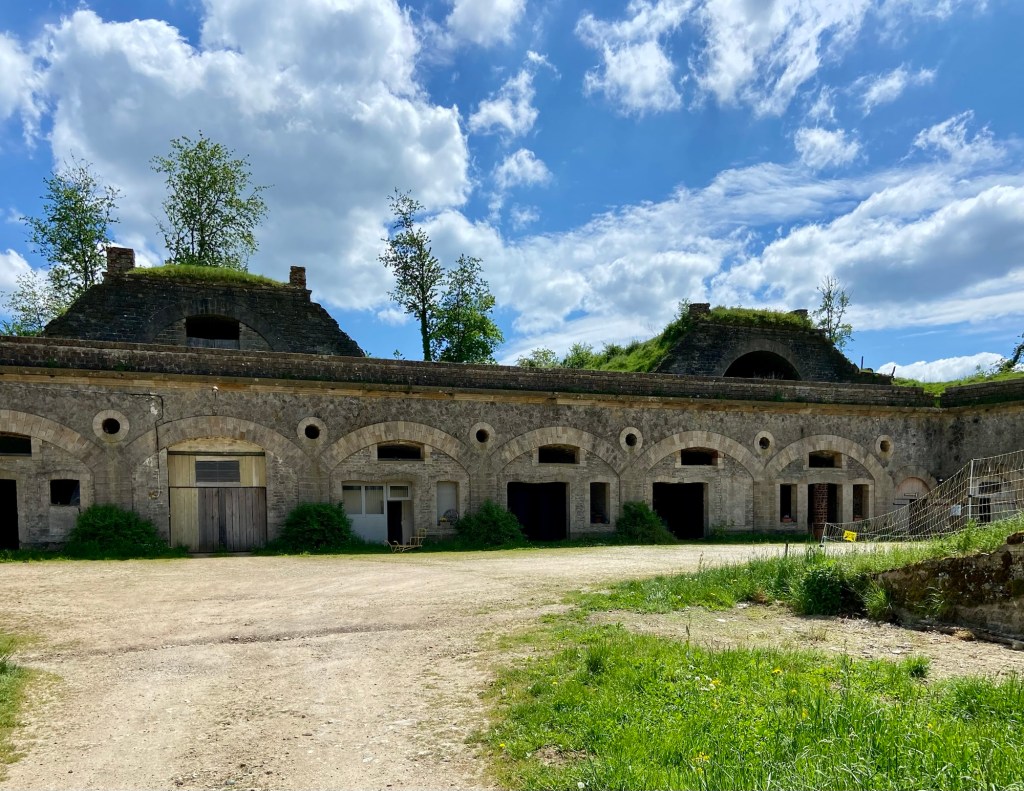
The Francigena here traced a huge V shape, dipping down to a dangerous road that would have provided a handy shortcut but which the guide book warn us against, not least because the right-hand stroke of the V took the traveller past the late 19th century Fort Mortier at Montlandon, built into the rock on a ridge so that from the outside the face presents as hobbit holes.
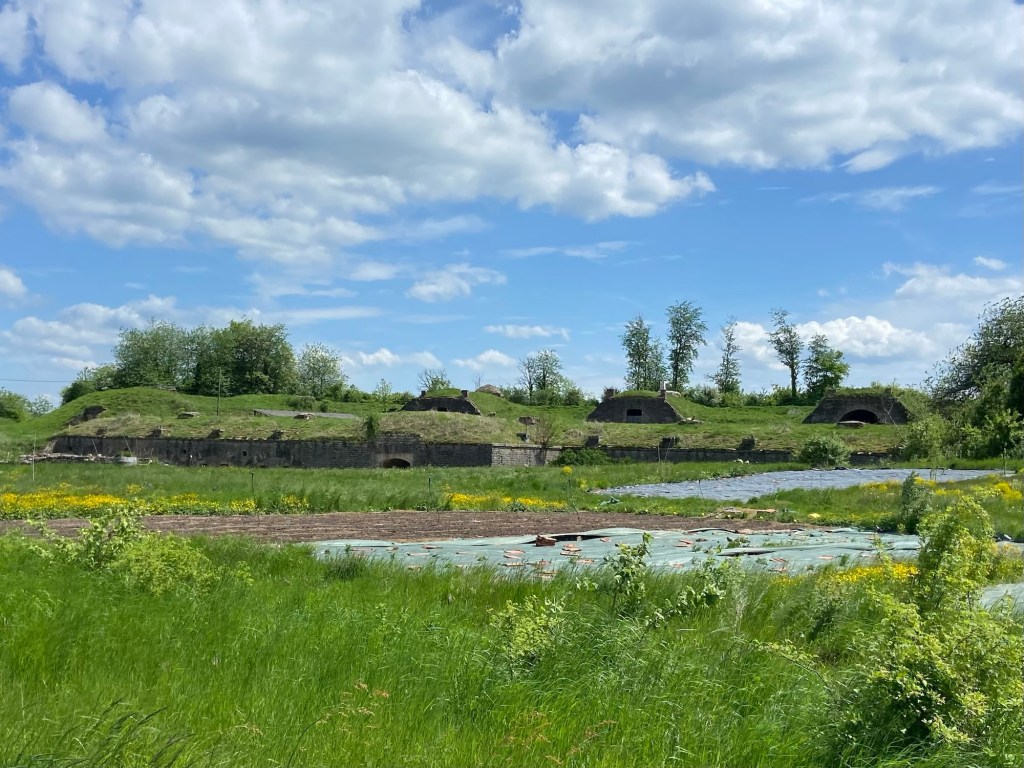
The fort is now a farm of sorts, and as I walked through the tunnel entrance
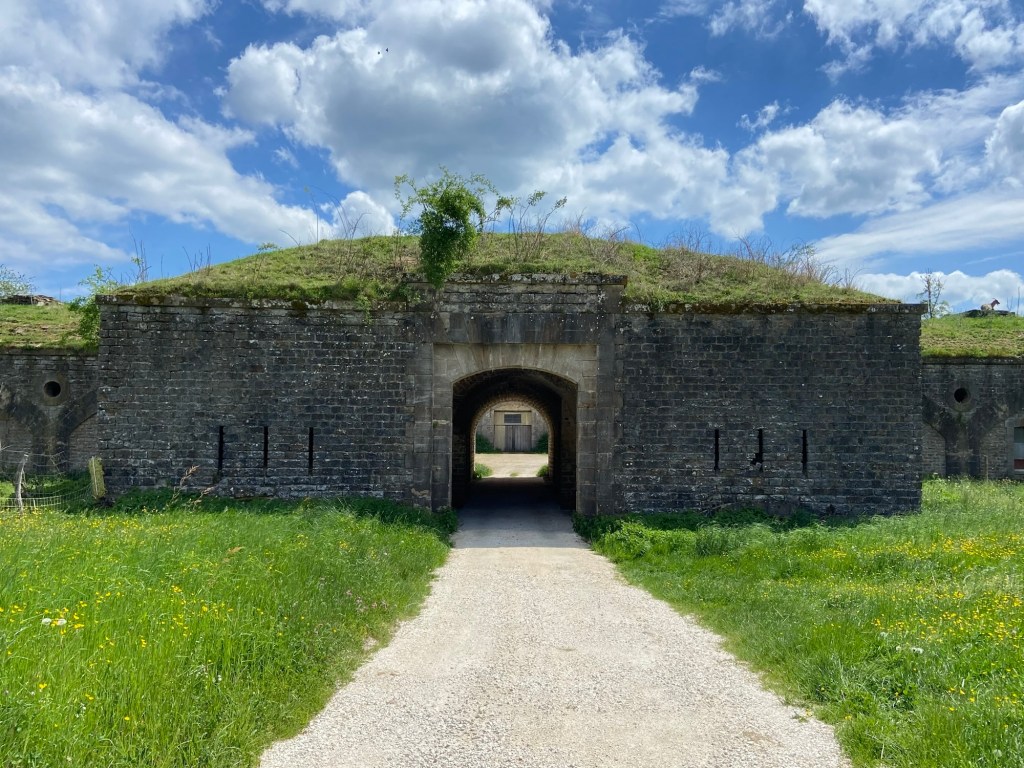
I could hear chickens clucking away down the dimly-lit corridors where once 350 soldiers had lived and worked.
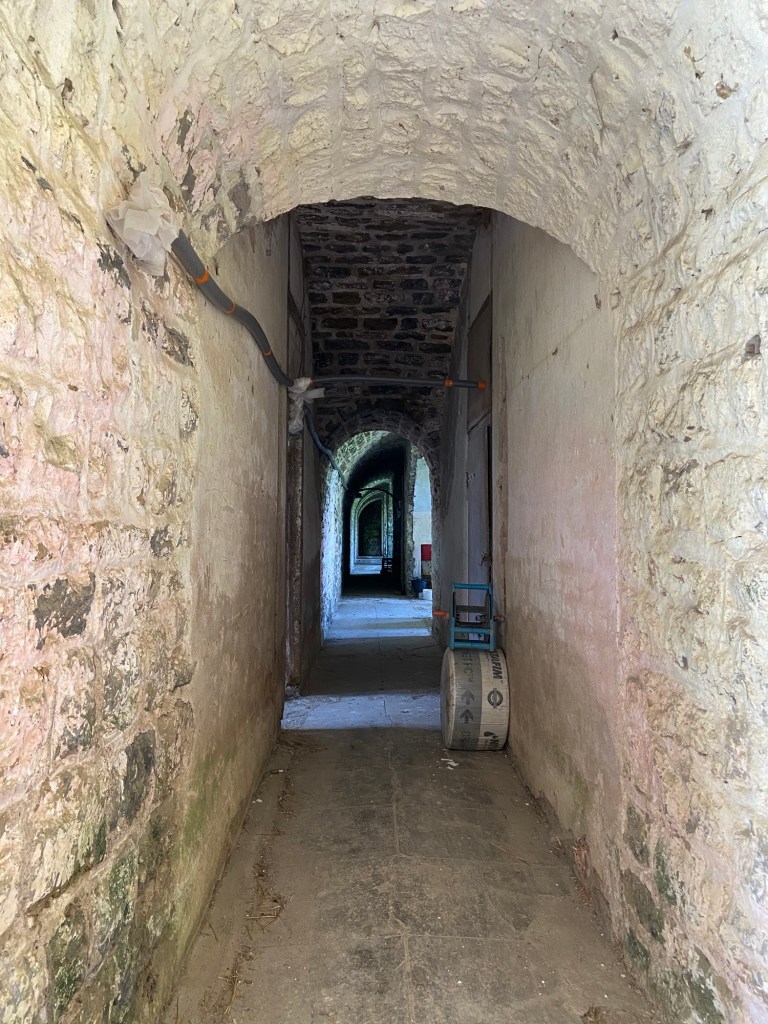
The trapezoidal courtyard provided plenty of storage space under its archways to act as farm sheds. It was a shame they only do tours on a weekend — it was fascinating.
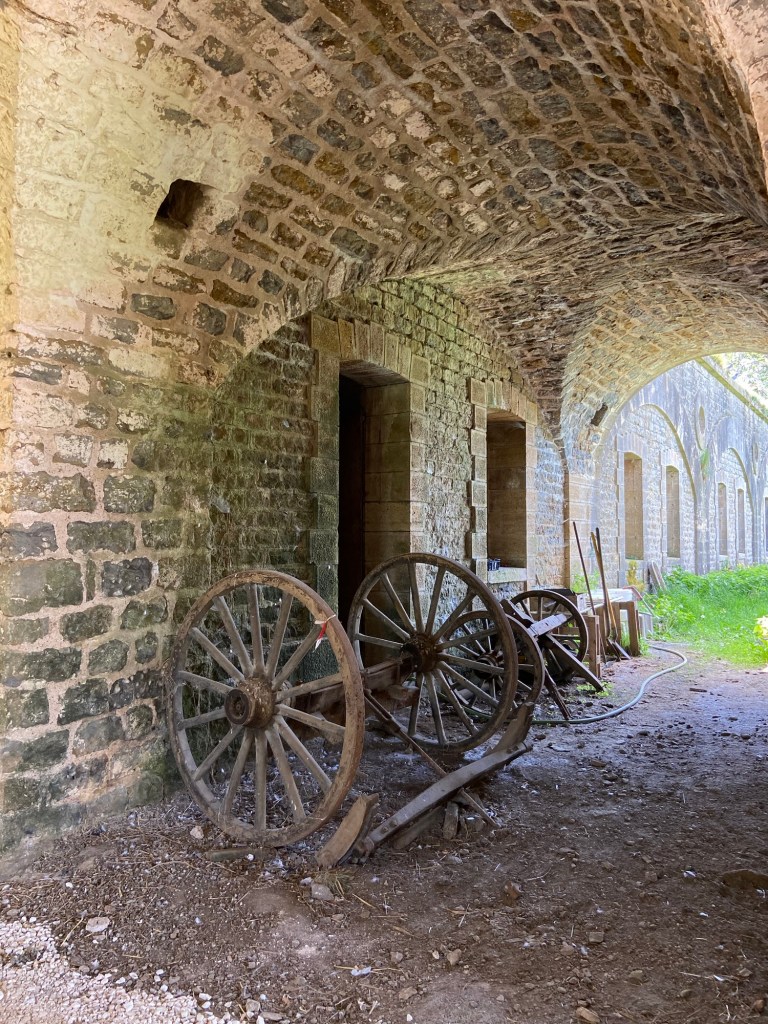
I could have found out whether these were gun carriages or farming implements.
Back out in the air I gratefully stopped for a proper break, sitting down after 20km on blocks of stone marking the entrance to a rough driveway. I recharged my phone and took off my shoes — the new shoes did seem to be performing ok, although not as effortlessly comfortable as the old ones with not nearly as much cushioning (a fact I was really noticing on a long day of asphalt), and with the left shoe a little tight. Perhaps thinner socks (of which I have none) would help. But there was no blistering, so I was still cautiously optimistic.
I ate what I had for lunch, some mini salami and a fruit and nut mix, then set off again. According to the guidebook the walk was 24 km, but it was clear from the map that it was going to be the thick end of 28, even with a proposed shortcut to avoid logging activity in a long wood.
Above my head a huge red kite examined the long piles of meadow grass cut for hay or silage in the hope of spotting a meal. A heron flapped away from the margins of a pool in which the flowers of pond water crowfoot scattered the surface with bright starry flowers. Away in the distance I could still see Langres from the top of this ridge —and this really was my very last view of the town, of all the ‘last views’ I thought I had had during the day.
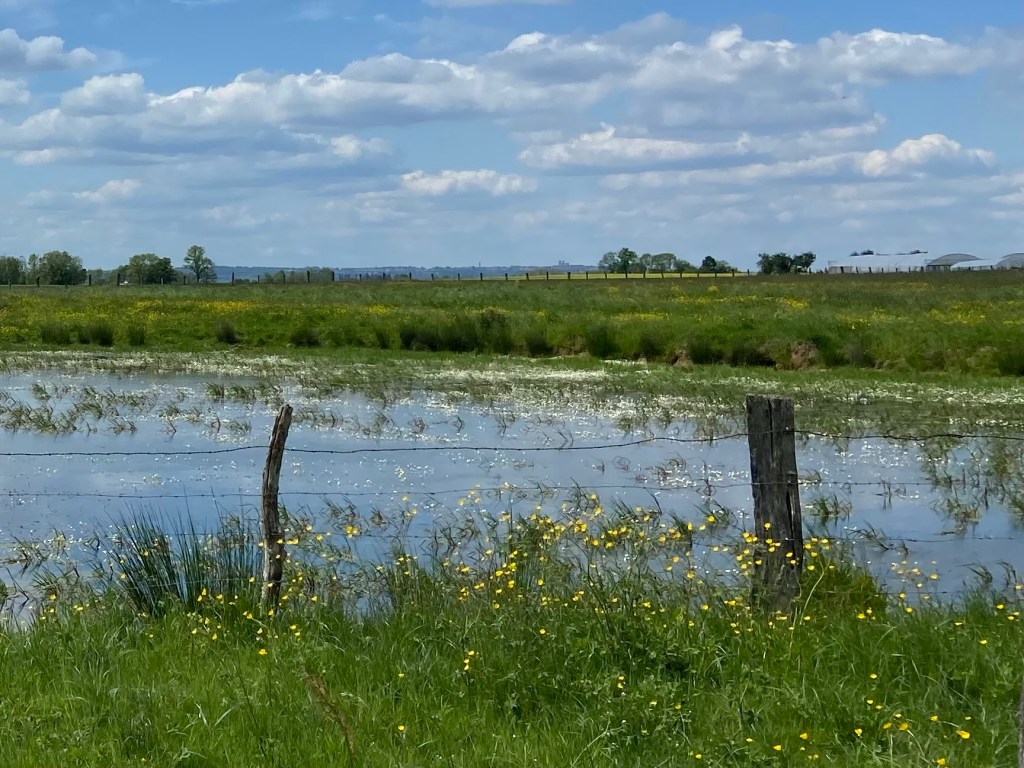
At long last the road curved down off the ridge to Torcenay, and I realised that my accommodation was really quite far off the route: a good 4 km, an extra hour’s walking at this stage of the day.
I was going to have to walk into Chalindray anyway, to visit the supermarket and stock up for a couple of day’s lunches because tomorrow, Thursday, is the VE Day national holiday and shops will be shut, and I won’t be passing anywhere to buy food on Friday until the day’s end at Champlitte.
I bought a good amount of lunch food, potato galettes, ham, some cherry tomatoes and a nice bag of interesting and fairly robust-looking salad which I thought would last in my pack. I also fancied the look of a large vol-au-vent stuffed with chicken and mushroom which I thought I could have as a snack before the supper provided by the gîte, and stocked up on the mini salamis and fruit and nut. I felt I was carrying food that was far too heavy, and if I kept carrying my old shoes for another cautious day, I wasn’t sure I would have enough room in my pack either.
I was too tired to think about it, though. There was still half an hour to go until I reached the gîte, and I trudged along the road carrying a bag full of shopping and wondering how I was going to get it all in the rucksack tomorrow.
The question was partially answered when I arrived and realised that I was not going to be given an evening meal — I had made a mistake. What luck I had bought so much food.
Stats for the Day:
Distance: a tiring 27.68km
Time: 6hrs 5mins
Elevation
Pace: an enervated 4.5kmh
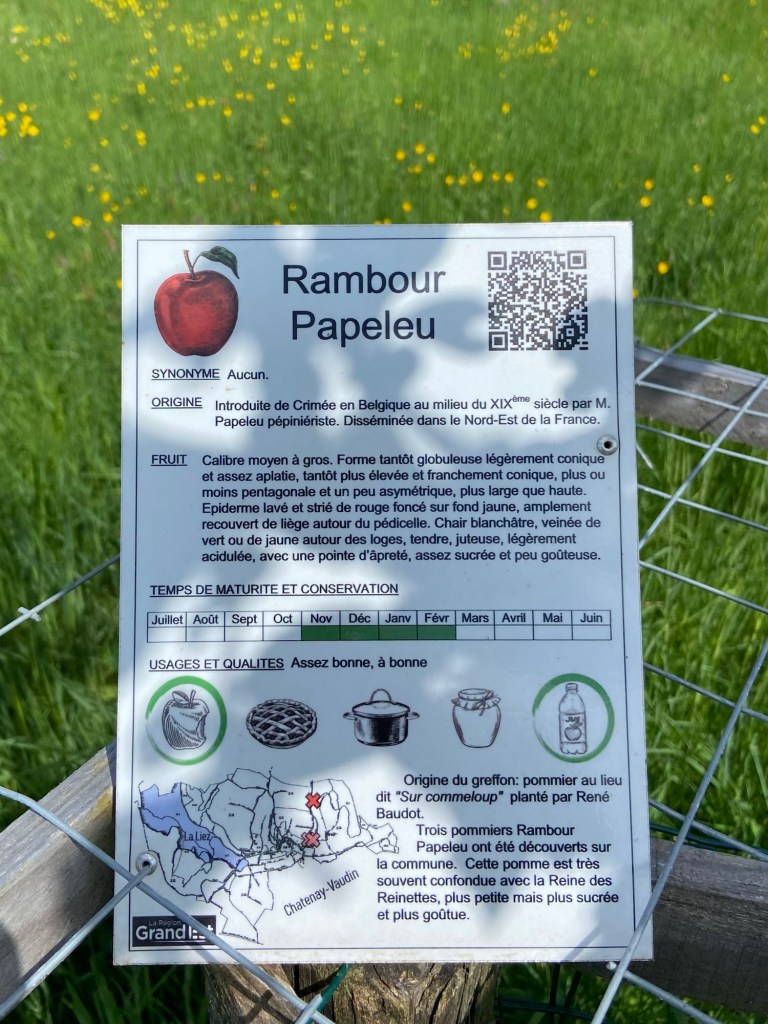
More about the Rambour Papelou apple
‘Medium to large size. Shape sometimes globular, slightly conical and quite flattened, sometimes taller and more clearly conical, more or less pentagonal and slightly asymmetrical, wider than tall.
Skin washed and streaked with dark red on a yellow background, amply covered with cork around the pedicel. Flesh whitish, veined with green or yellow around the locules, tender, juicy, slightly acidic, with a hint of bitterness, quite sweet and not very flavorful.
Origin of the graft: Apple tree planted by René Baudot at the place called “Sur commeloup“.
Three Rambour Papeleu apple trees have been discovered in the commune. This apple is often confused with the Reine des Reinettes, which is smaller but sweeter and more flavorful.’
 Walking The Landscape
Another interesting read! I love the apple tree idea. It would be worthwhile repeating over here. Really hope the shoes settle well and support your feet for the next couple of weeks. X
LikeLiked by 1 person
Twinned with Beaconsfield! That’s where I remember the name from. So glad to catch up with this, and that the shoes are ok, if not perfect. And phew about dinner, imagine…..😱😱😱
LikeLiked by 1 person
I know!!! I thought of you and guffawed internally
LikeLike
I’ve finally caught you up! I had considered gobbling up your delicious prose having begun the journey very late in the day, but each exquisite observation and reflection required time to savour and digest. What a gift you have given us!
Hoping your shoes become completely comfy and support your next weeks’ walking.
I love the way you inhabit each moment. An inspiration.
LikeLiked by 1 person
Gosh! THANK YOU!
LikeLike
I love that you were taken to quote “look at their shoes”. I’ve been roaming around Rome for the last few days and have spent a lot of time looking at other people’s shoes. Im amazed by the terrifyingly unsuitable footwear some choose, but also by the amount of couples who wear matching his and her shoes. Hope your shoes bring you the joy of comfy feet
LikeLiked by 1 person
Matching shoes??? 😱
LikeLike
Yesterday the shoes were not at all comfortable. Better today… It’s a lot cooler.
LikeLike