
Vegetius, De Re Militari
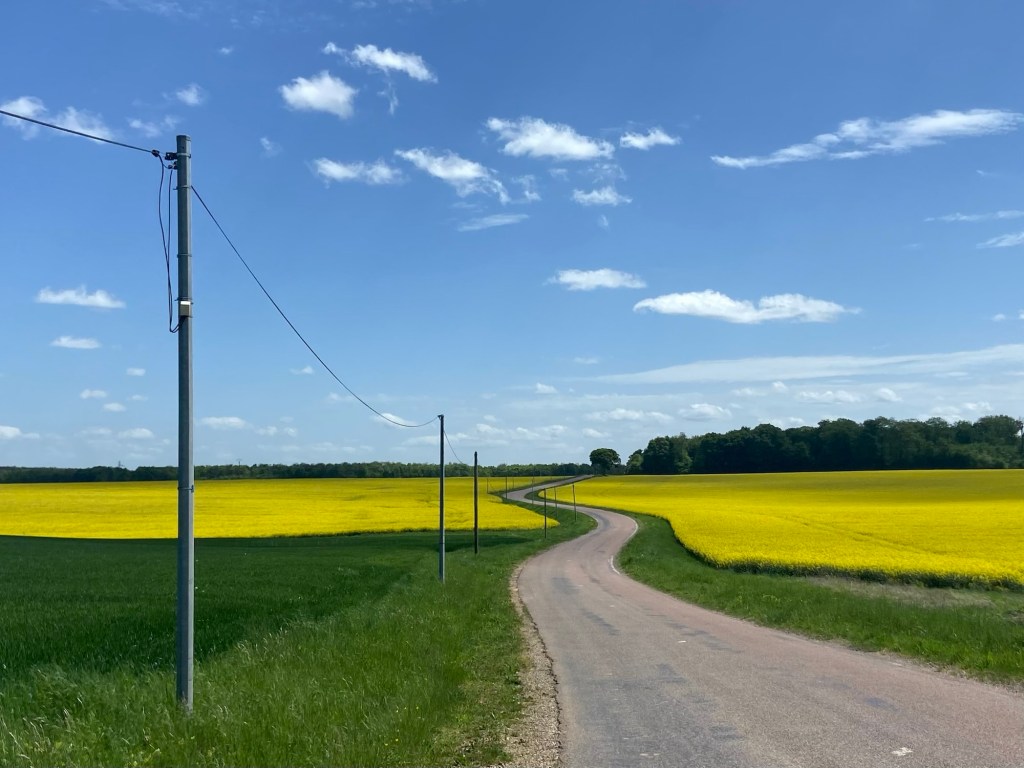
Troops who march in an irregular and disorderly manner are always in great danger of being defeated. They should march with the common military step twenty miles in five summer-hours’
Where to start with the Moulin de la Fleuristerie? Annette is originally from Sweden and met her husband when they were both working as product managers for Bosch. An opportunity came up to buy the old mill where her French husband had grown up, they took the leap and had a complete change of life.
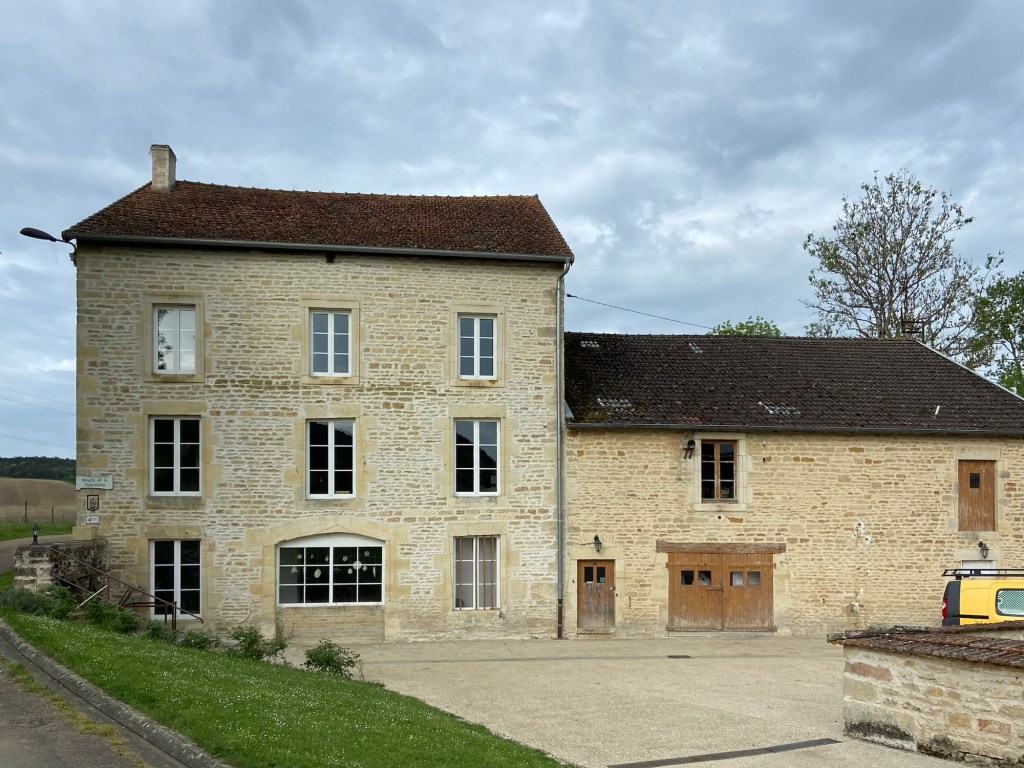
After I had had my reviving beer and shower and changed my clothes, Annette took me round the 12th century mill at the source of the Dhuy river.

It originally ground flour for the monks at Clairvaux, and had many incarnations over the years including as an iron smelting works. In 1902 it was converted to produce electricity from the water wheel via an astonishing set of cogs and gears and fly wheels connected together with ancient leather straps.
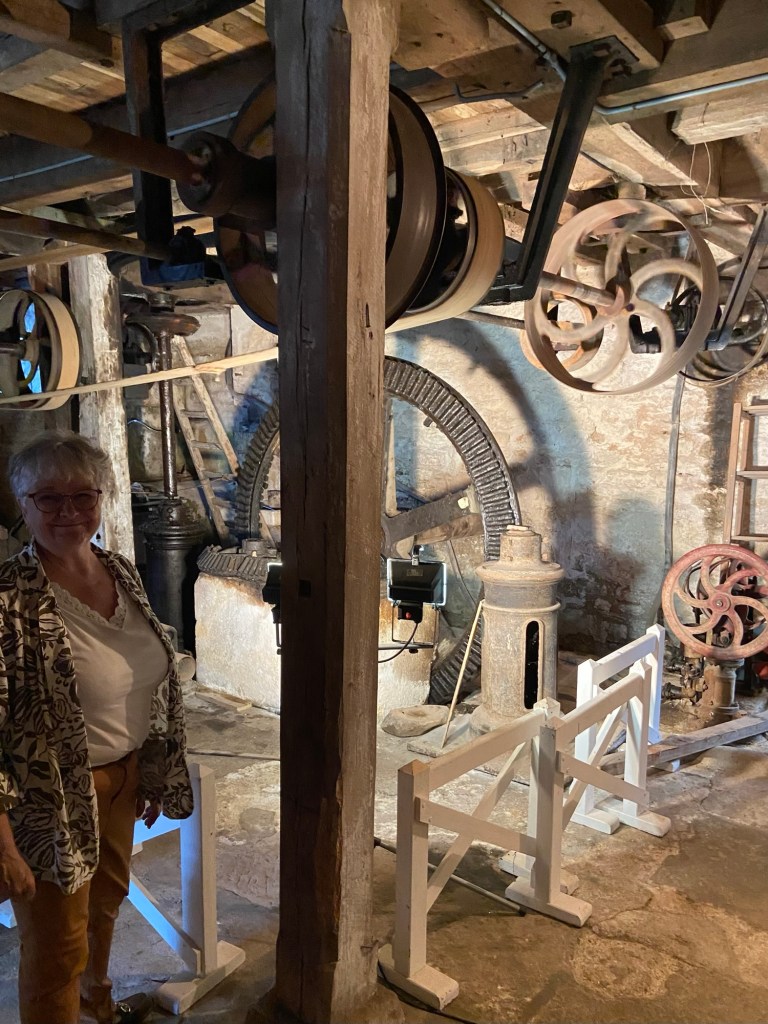
Annette still works by the water-generated electric lights, using the original and extraordinarily inventive machines powered by the water wheel which straighten thin wire and wrap it in cotton thread.
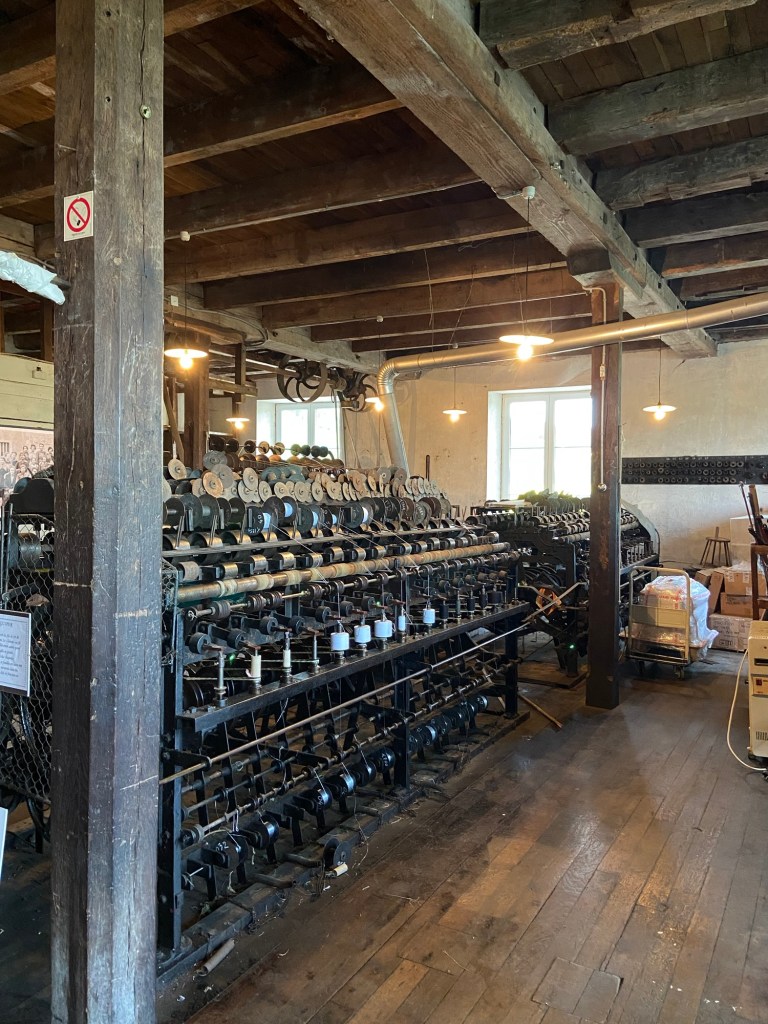
The wire is then stretched out kilometre by kilometre on traditional frames, then to be trapped between differently spaced battens and precisely cut into lengths, twelve dozen at a time.
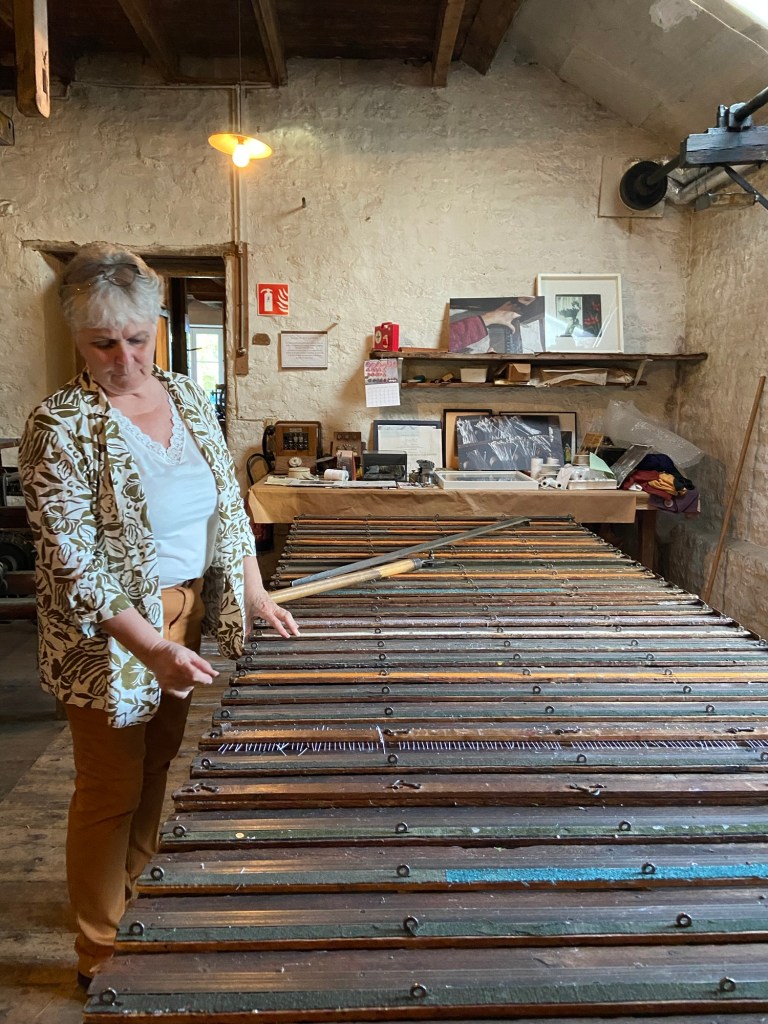
The ends of the wrapped wires are dipped into liquids and powders made with secret recipes,
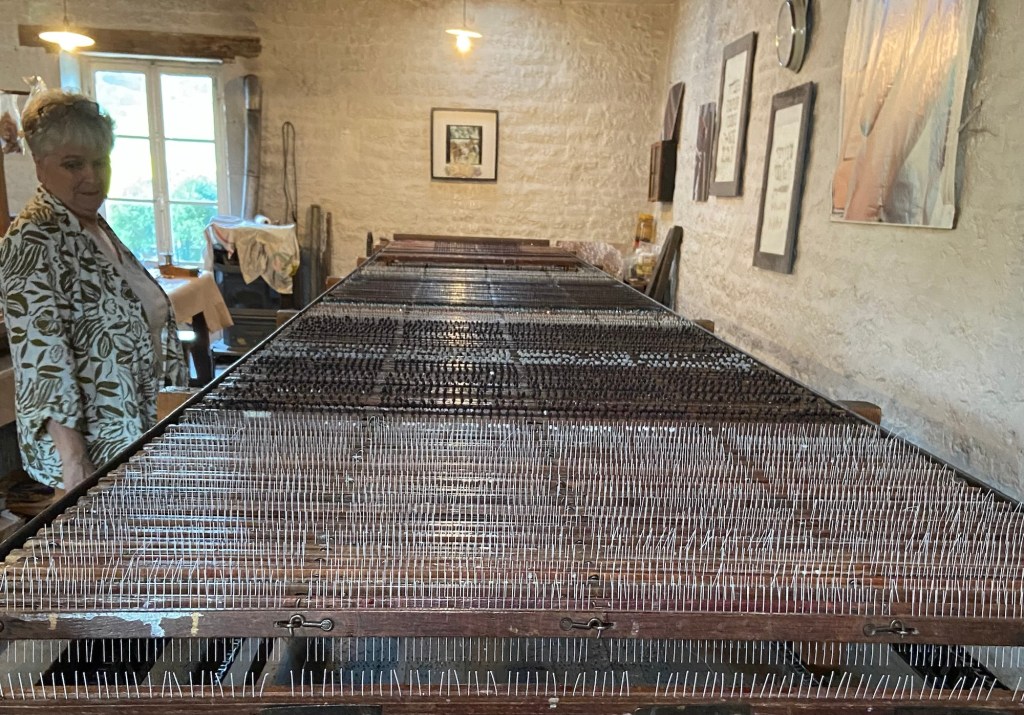
to create the finished product: stamens to place in the centre of silk flowers.
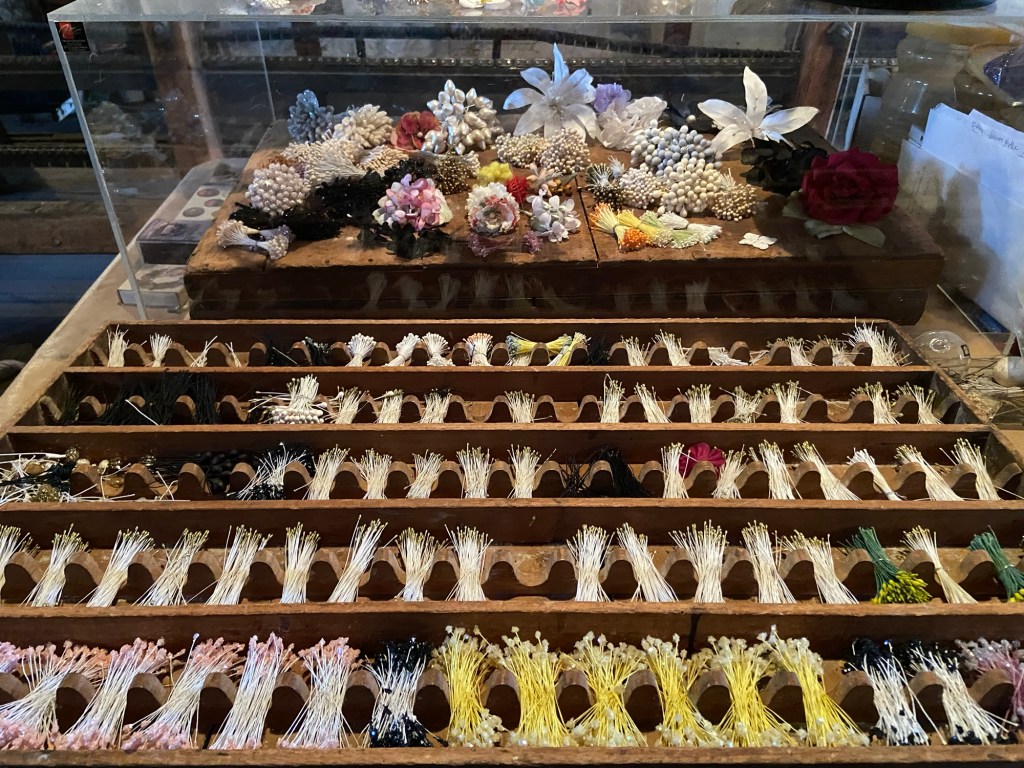
In the Belle Epoque such flowers were much in demand to trim hats, whereas now the product is rather more recherché, although since the Moulin is the only place in France that makes these stamens and can use them in finished silk floral designs, they are often contracted by the couture fashion houses to supply the delicate decorations and trimmings.
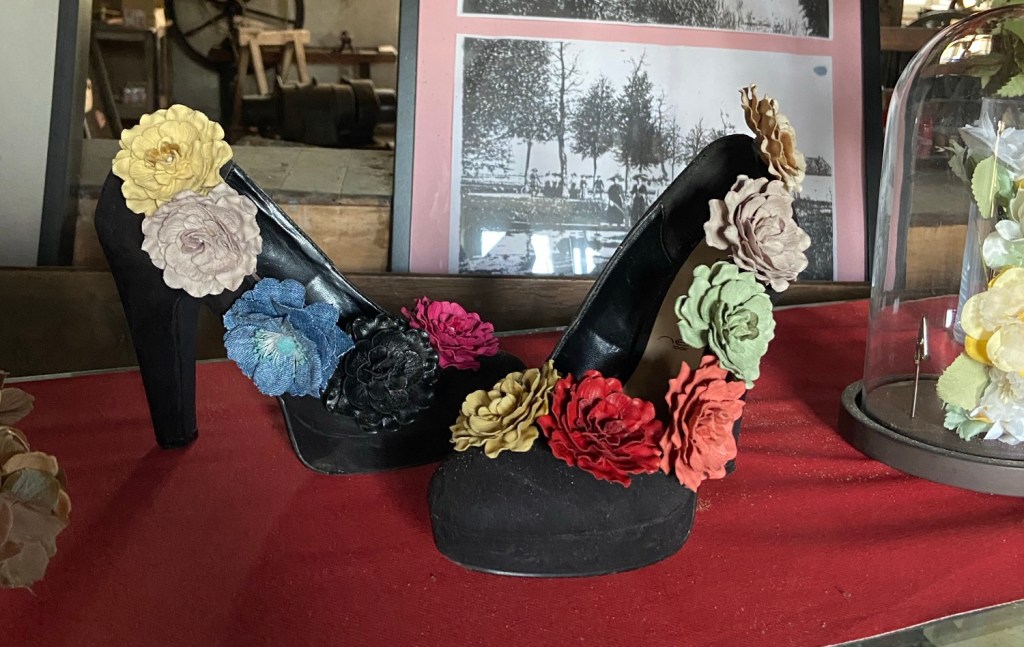
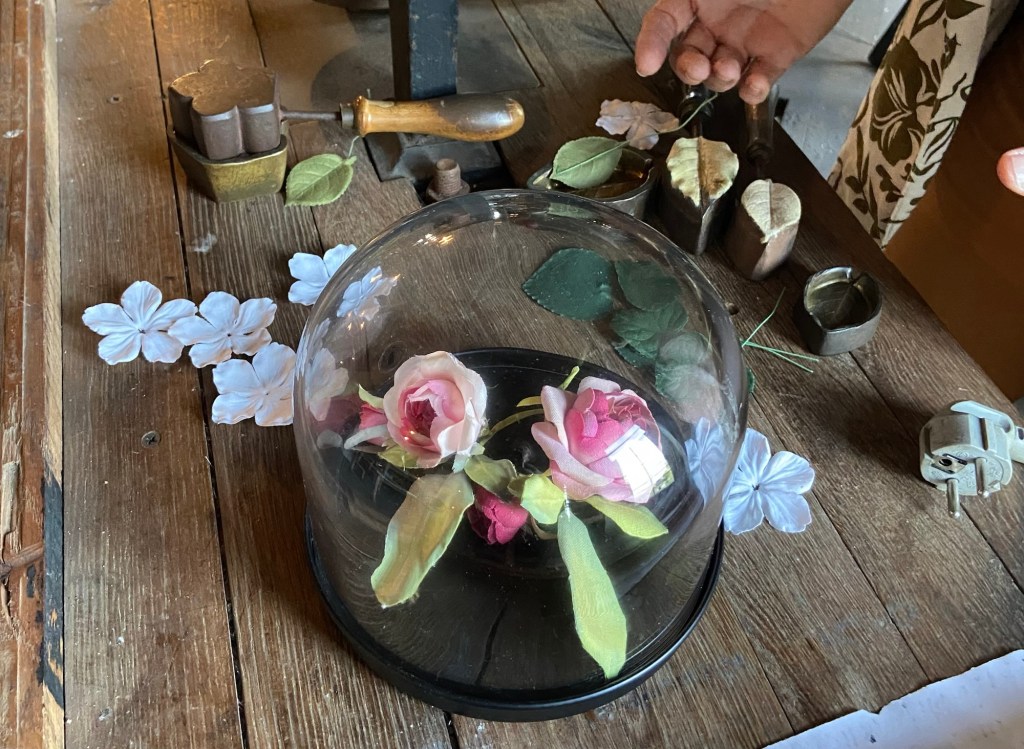
Annette showed me the die cutting punches she uses to cut out petals by hand, and how using the same patterns and colours she can create two completely different floral results using stiffened cotton (another secret recipe) or silk.
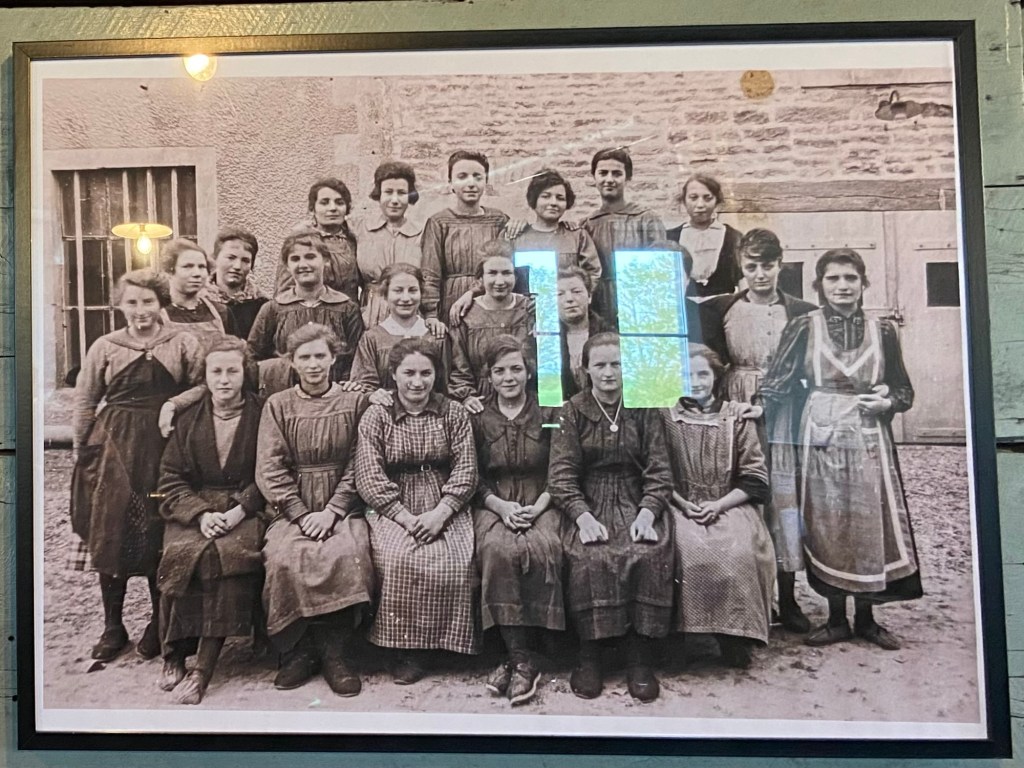
In Annette‘s workshop next to the machines with the bobbins for wrapping cotton thread there is a black-and-white photograph of the women who used to work here in the early post of the 20th century. A 92-year-old local woman who worked in the Fleuristerie for years remembers meeting some of them. I was struck by the direct gazes and smiles that seemed to speak to the characters of these women. In the winter Annette said it is about 8° in her workshop, so she fires up the old woodburning stove that must have warmed these women too.
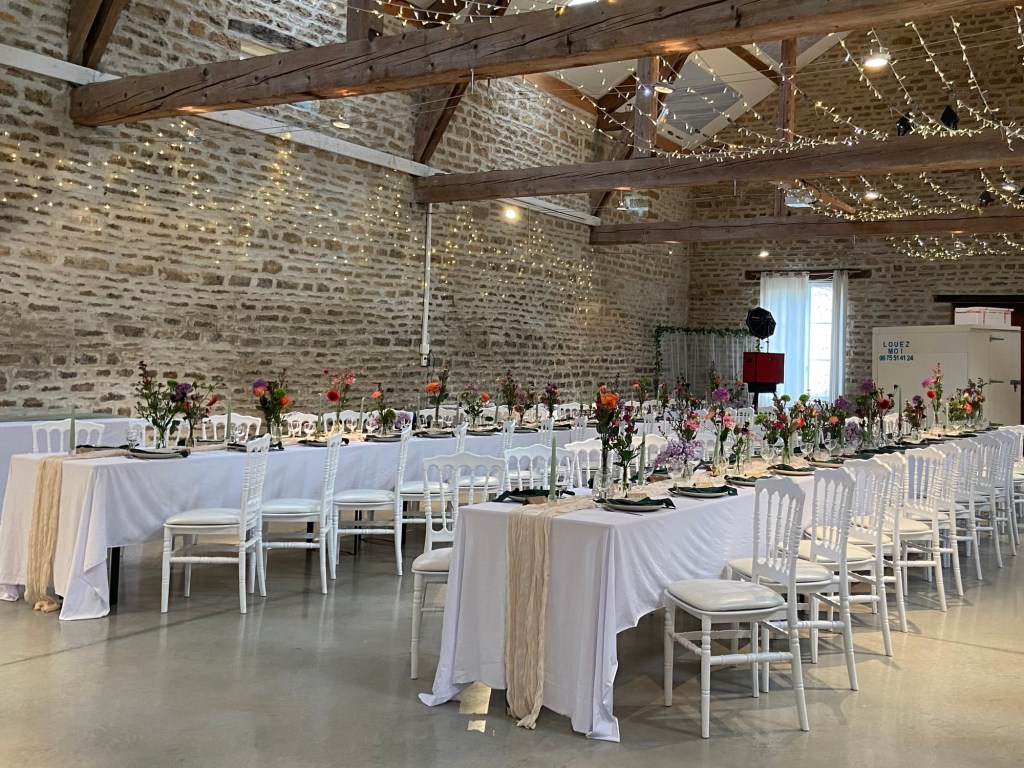
Annette also toured me round the wedding venue. This one had been set up for the surprise party to celebrate a 40th wedding anniversary.
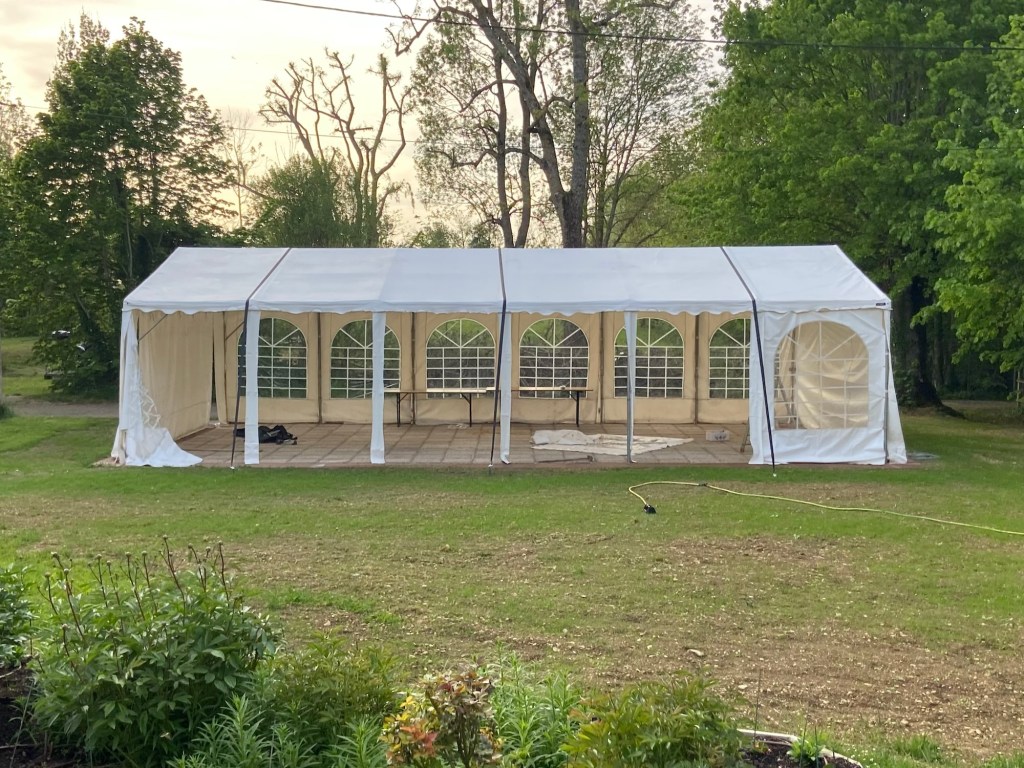
Her husband had single-handedly put up the marquee for the season: sadly not with the aid of magic like the Weasley family.
Her husband was still outside until very late, fitting a plumbing system in one of the gîte and cutting the grass on a ride-on mower. So Annette and I sat down for a long chat over supper together, discussing our lives, our careers and life choices, and culture and politics. I was so grateful that Annette spoke such impeccable English that I could have a night off from the improving but nonetheless fatiguing French.
For the second time on this journey, I slept with the windows open in the hope of hearing nightingales singing in the darkness. This time, I was lucky. I woke several times in the night to hear the song billowing out through the darkness as I drifted in and out of sleep. A remarkable experience.
In the night I had a dream, presumably provoked by my fears in the forest yesterday, in which I threw in the towel and asked Stephen to come and pick me up. In the dream I felt a total failure, and really disappointed with myself. It was such a relief on waking to realise that it hadn’t happened, and that I would once again be walking on.
The sky today was completely clouded over, and Annette said if I could get to the day’s end before 4 o’clock then I might avoid the rain. However, it was already slightly spitting as I said goodbye to her, with the firm intention of passing by this way again.

Annette and I had discussed the forest path. She has seen wild pigs with their young in today’s section of the Châteauvillain et d’Arc Forest before, and said there were also oak processional moths to watch out for. If I didn’t need to visit the supermarket in Châteauvillain, she said, she would suggest I followed the historic route which is now the official VF cycling option. It takes a straighter and more more rapid 19km to Mormant Leffonds.
It sounded eminently sensible to me, so I heeded the guidebook’s warning and Annette’s advice, and set off along the road looking out for the little path that would take me up the abandoned railway track and into the first little village of Bricon.
In the verges flax from the fields had seeded itself. The guidebook had a picture of flax fields for this area, although I couldn’t re-create it because there were none this year. I picked one long stalk to bash to see whether I could get the fibres to separate. I wouldn’t mind gathering an armful to try and make paper from, if only they would fit into my pack.

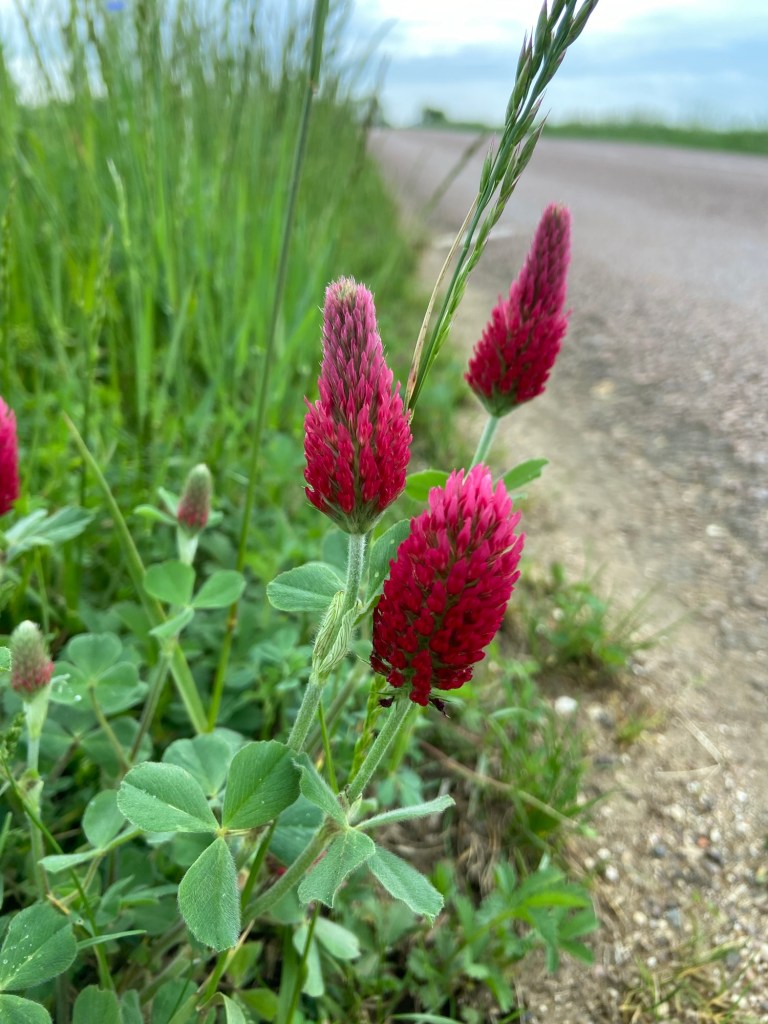
Also in the verge was the dark red clover I had seen in the fields yesterday growing as a cover crop or as a nitrogen fixer. Its fat flower spikes were an intense shade of puce — no wonder the field had been so striking.
Young cows had been released for the first time into a field bordering the road, and they were clearly unsure of my nature and my intentions. They got into formation and kept a close eye on me until I was well past their field.
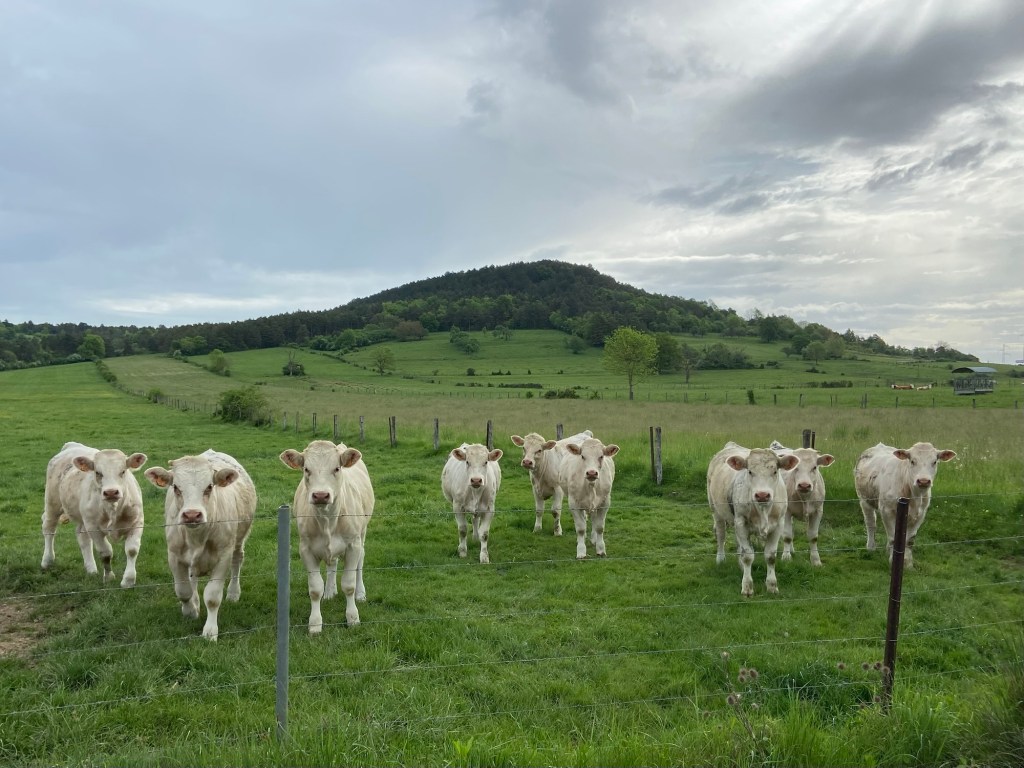
What an enlightened country this is, that none of their footpaths go through fields of cattle.
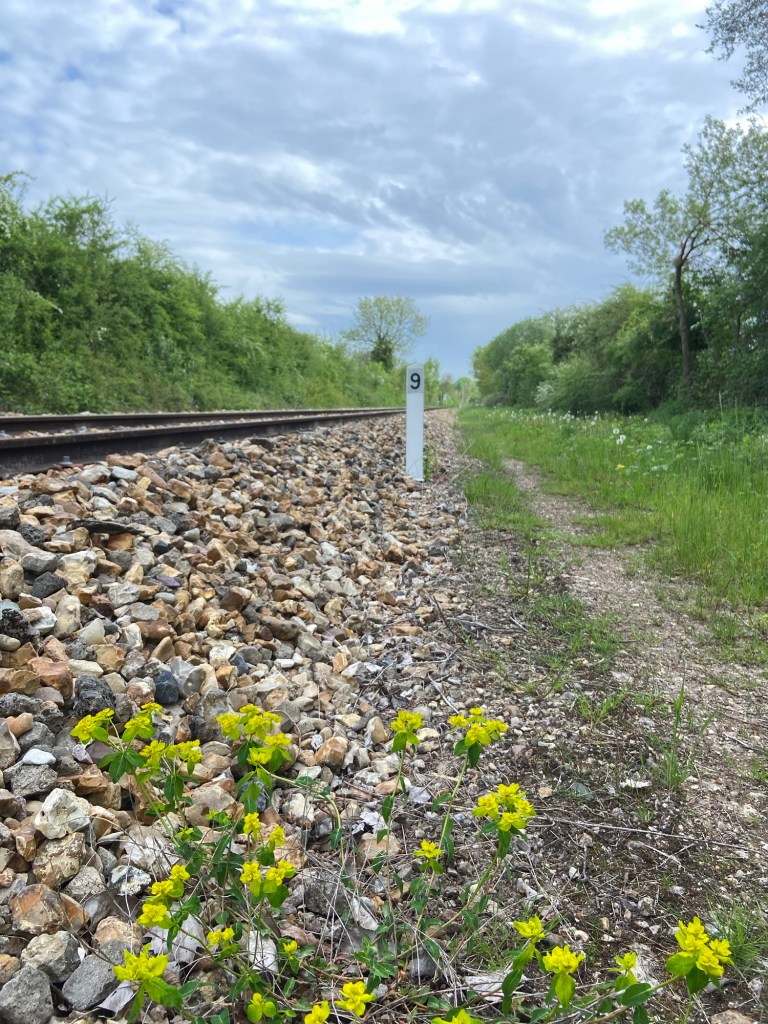
I picked up the old railway line and for a while hopped from sleeper to sleeper.

It wasn’t very comfortable though, so I jumped off the track and just walked alongside it, as many others seem to have done. Perhaps with euphorbia seeds in the treads of their shoes.
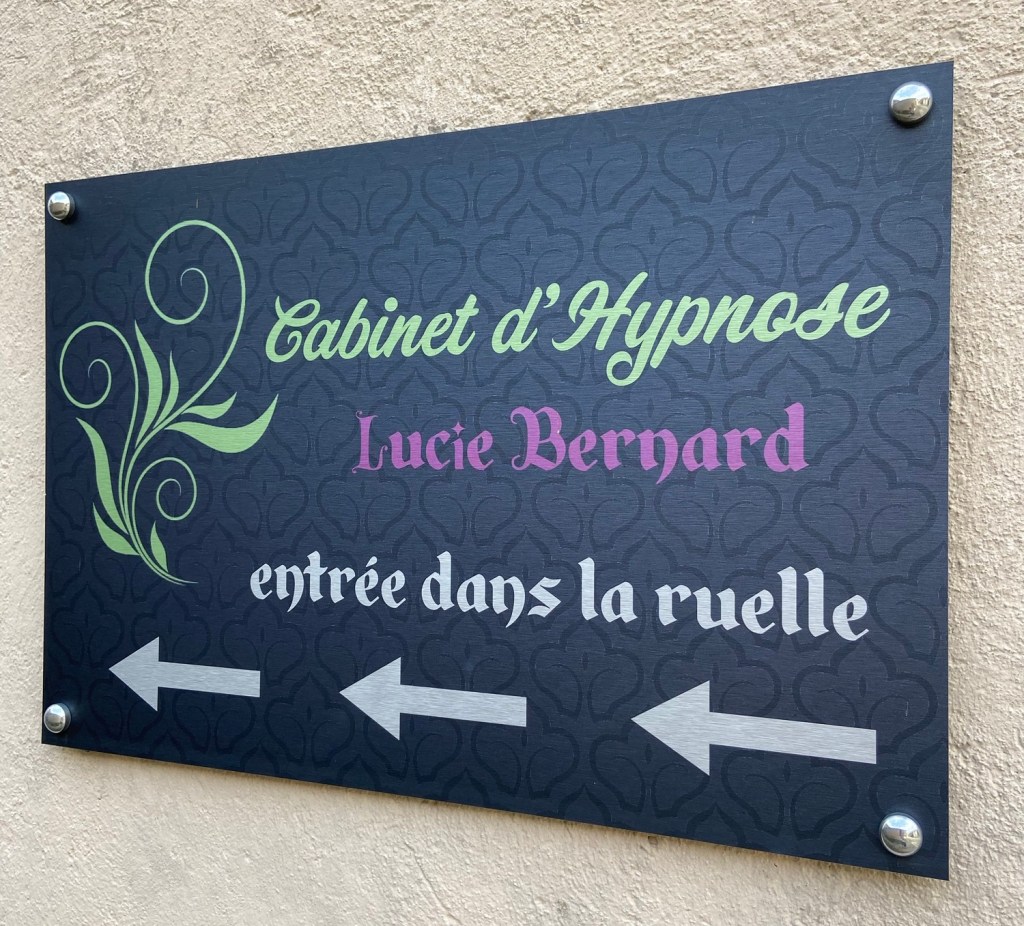
Bricon was a mad place, with a high density of unexpected things for such a small place — like many of these communities, halfway between a hamlet and a village. For example, it had its own hypnotist, whom you could find in a cabinet down an alley,
and there was a fantastic collection of fancy fowl: peacocks both blue and white, golden pheasants and absurd silkie chickens.
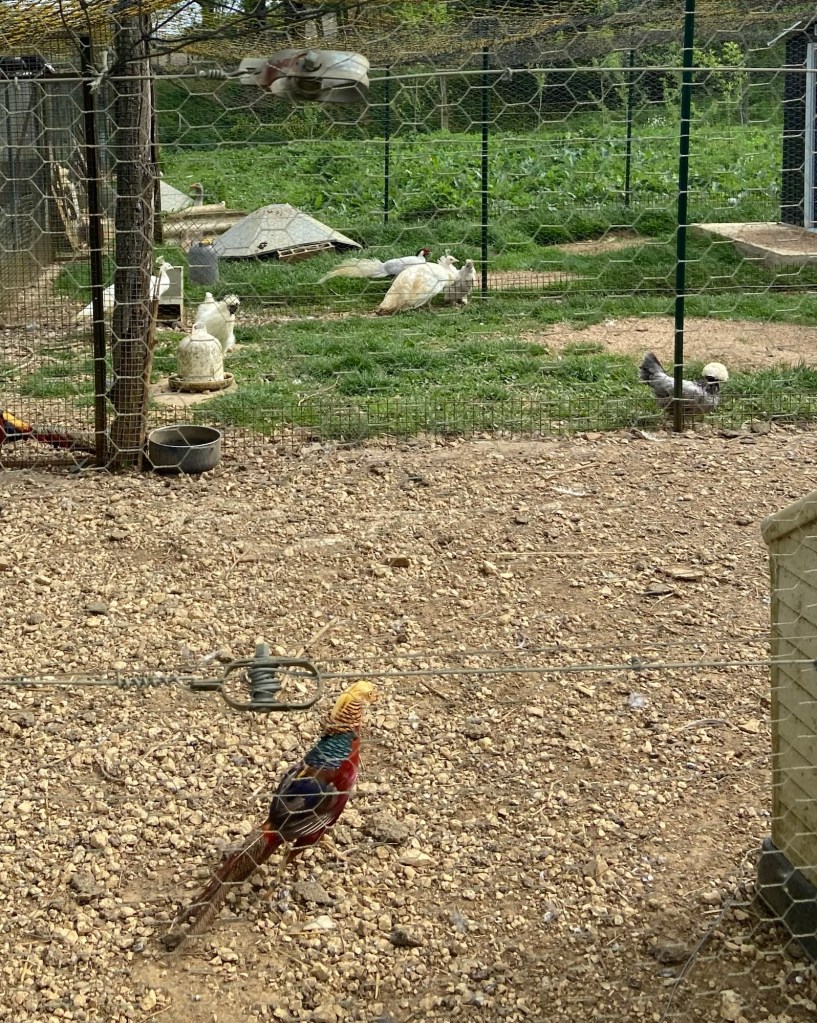
A man pulled over in his car and slipped out of it to cross the road to talk to me, leaving the engine running. His wife was in the car waving madly. ‘Are you walking the Francigena?’ he asked. ‘I am!’ I said. ‘We walked to Rome seven years ago,’ he said fervently. He had a cadaverous face with long thinning hair and the air of a visionary or an evangelist. It had clearly been a profound, life-changing experience for them both.
The next village on my long straight Roman road was Blessonville. It was full of absolutely masses of baitballs of tiny flies, almost too small to see, and over the fields of lentils and wheat swallows were sweeping up and down, a couple of feet above the plants, presumably with their beaks open, hoovering up.
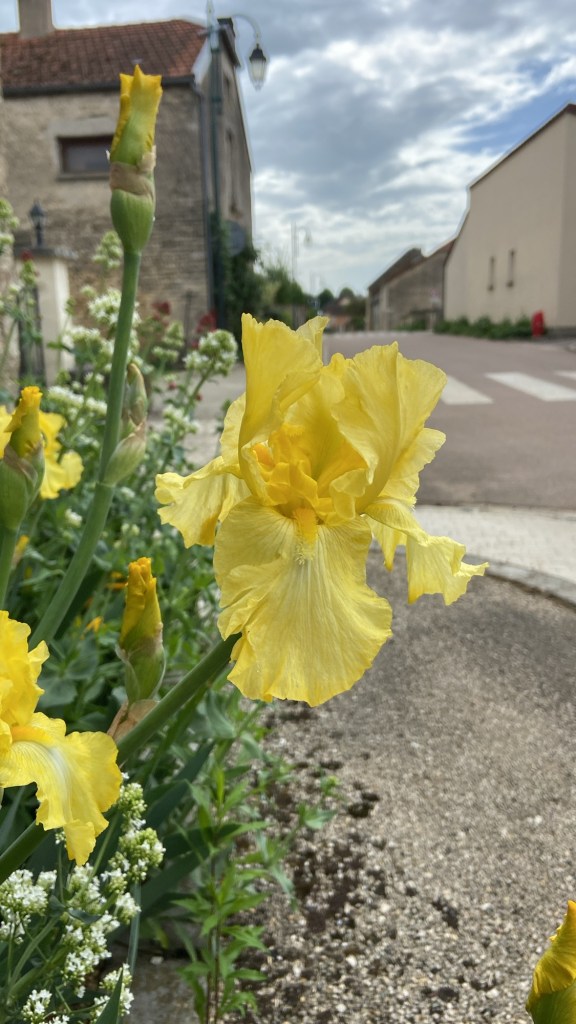
This was a slightly bigger village, many houses with their own wells in their front yards. One house was bucking the trend of a month of purple irises with blowsy yellow ones.
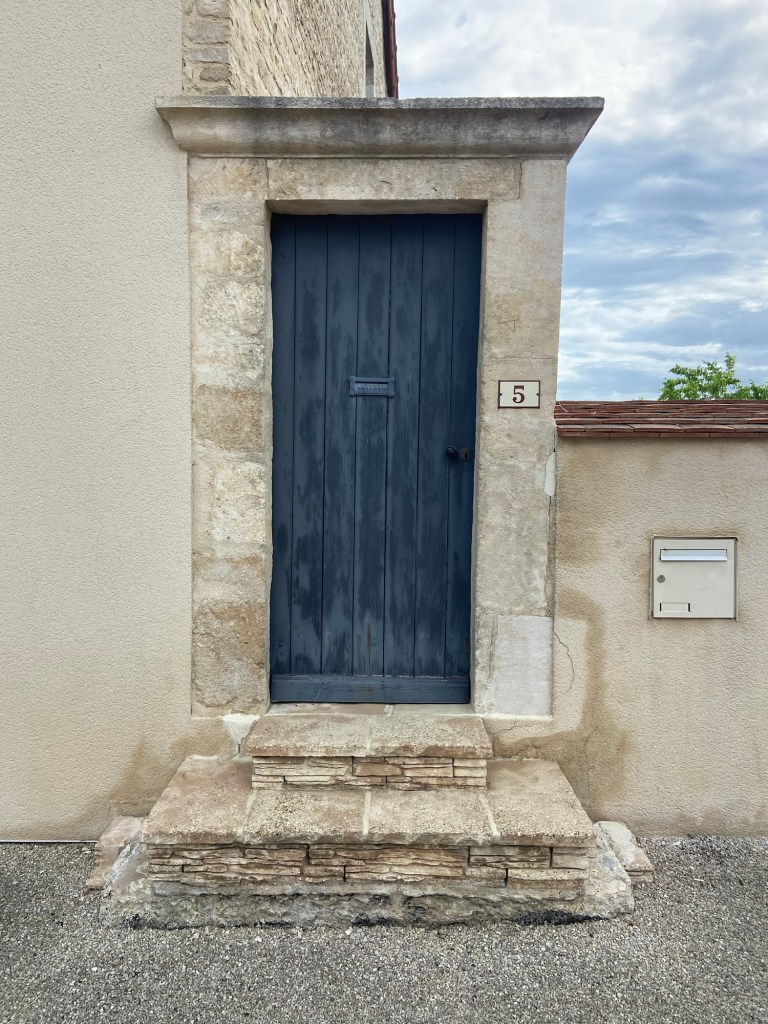
It was a village of angular thresholds,
and loose-limbed, fluid, dancing dogs.

The threatened rain of this morning had not amounted to anything and a brief check of the weather app confirmed that the increasingly blue skies were going to remain clear all afternoon. I was starting to appreciate the shade, and wishing that I had encountered this municipal concrete picnic table and benches just beyond the village border in a couple of hours’ time.
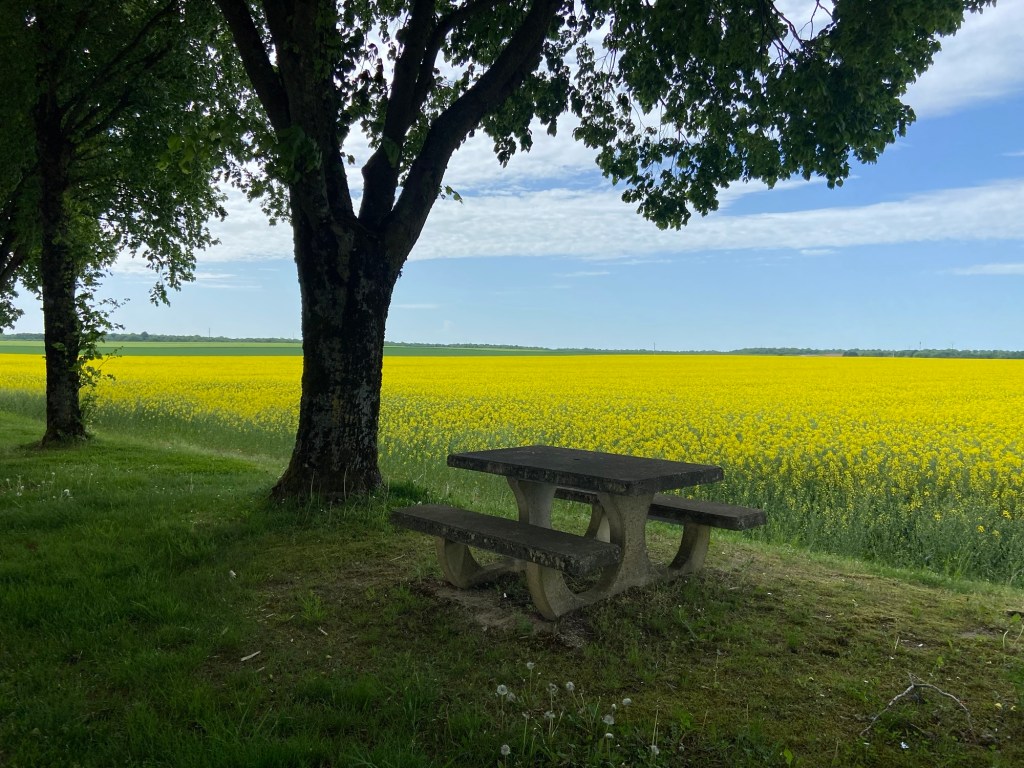
In between the villages the fields were now huge flat tracts of land. I was steadily climbing all day, but imperceptibly, and the vast national forest of Arc-en-Barrois lay to the south. The northern edge of the forest was a constant presence to my right and I was glad that I wasn’t in it. With a historical hunting tradition of find hundred years, it’s still principally maintained at a national level for hunting of deer and wild boar, with some limited feeding operations inside the woods to try to limit the incursion onto arable crops of the game. This explained the scattered maize I had seen on the muddy section of forest trail yesterday.
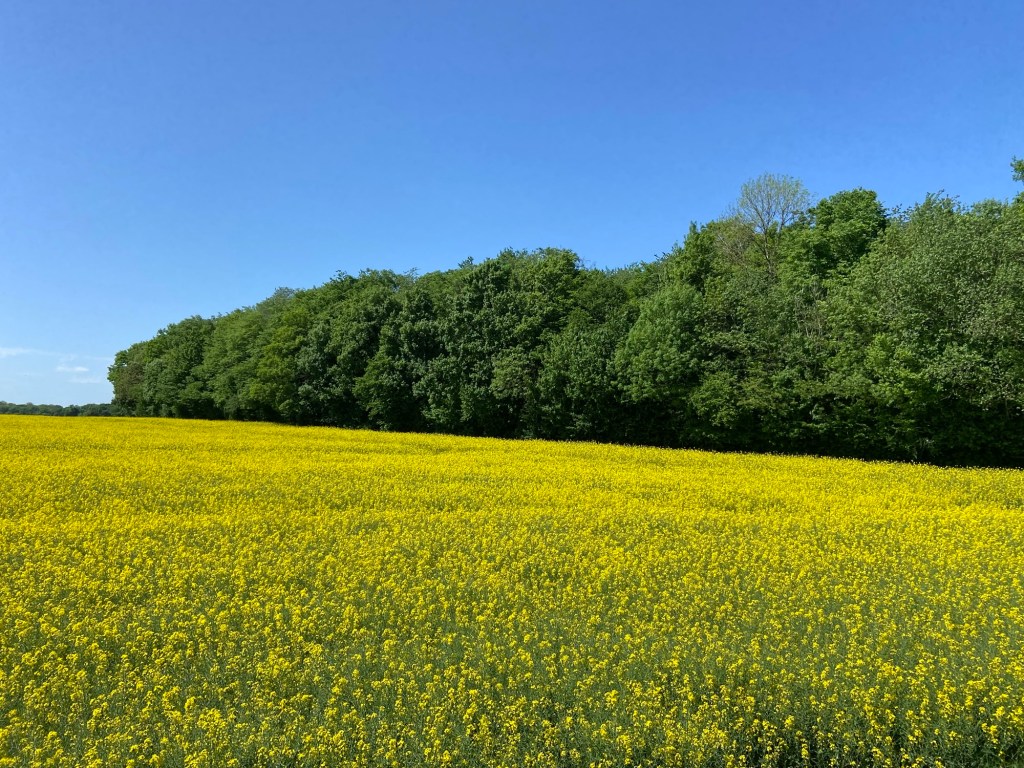
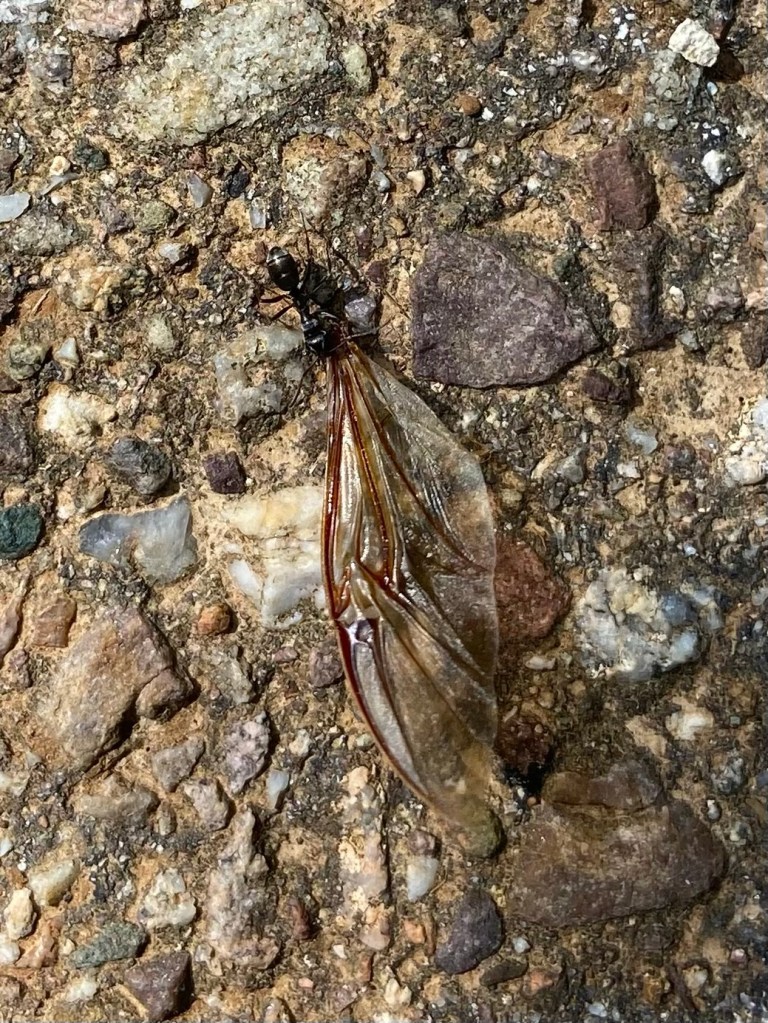
The sun was strong enough just before midday that I thought I ought to stop and put on some sunscreen. This morning when I had packed all the wet weather gear at the top of the pack I had briefly considered putting the bottle at the bottom and was now extremely glad that I had just stuck it in the side pocket as usual. While I rested a little a black ant near my feet on the asphalt was toiling away to bring the entire wing of a large winged insect (a hornet?) back to its nest. As well as being relatively heavy it must have been an unwieldy burden.
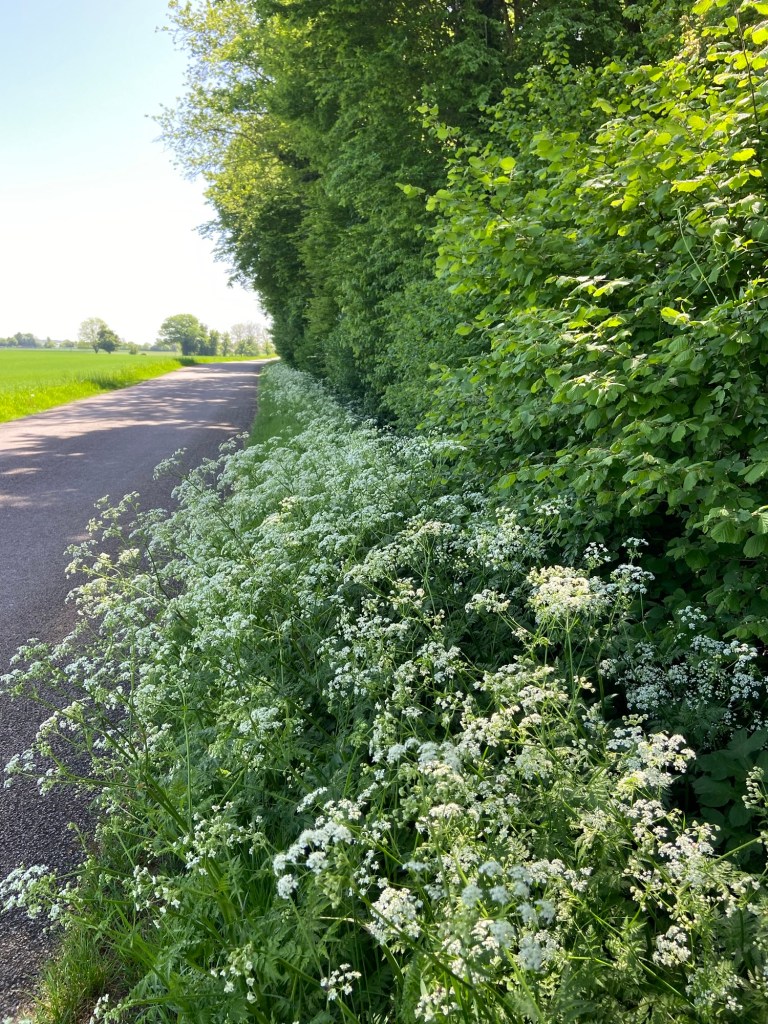
Every so often the road came closer to the tree line and when it did I enjoyed the break from the relative monotony, and the opportunity to walk briefly in some shade.
I passed through the larger village of Richebourg and took a proper break here, with only 6 more km to go. The central village square offered a children’s play park and benches in full sun next to the shady trees, but there was a covered space with a blackboard, a table tennis table, a book-swap scene and a public loo which also had a bench to sit on. I didn’t take my shoes off as my heels seemed to be coping reasonably well with the regular pace and asphalt surface that kept them stable but I’m going to have to try some more wool padding perhaps tomorrow — I think after a month my socks have thinned at the heels and aren’t providing enough cushioning any more.
From Richebourg onwards the road skirted the wood more or less precisely, sometimes just dipping into the trees. Here the first painted lady butterflies fluttered from mauve vetch to mauve vetch, and between the low spires of blue bugle. Orange tip were still flying too, more numerous here on the forest edge than hitherto, in the agricultural fields.
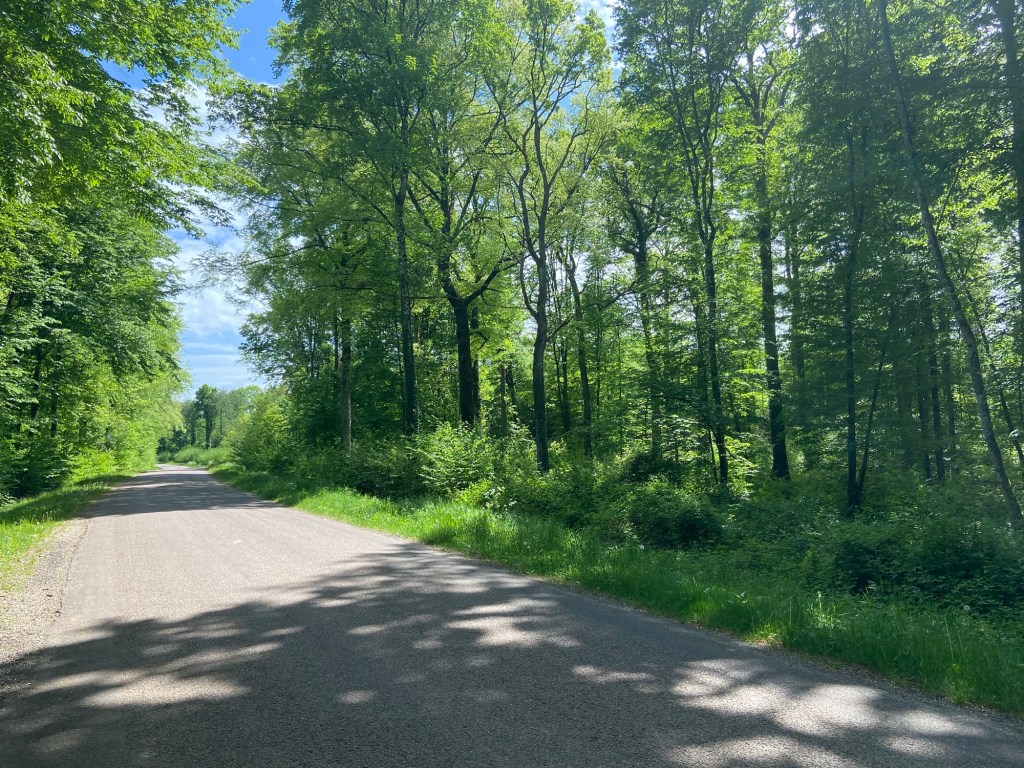
One last long open section of road twisted before me,
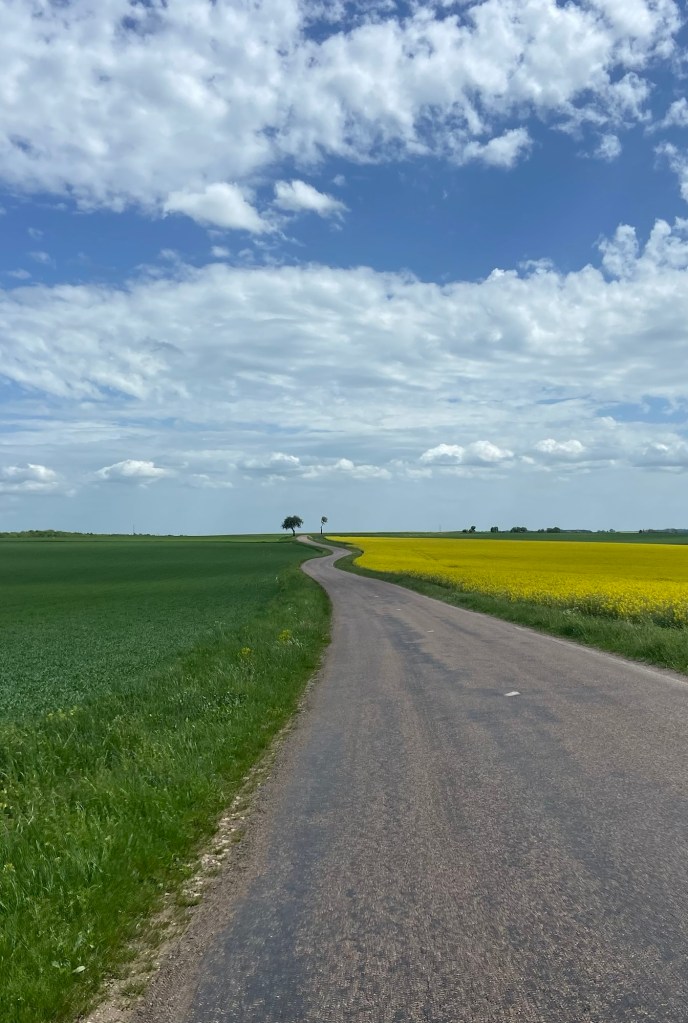
until finally the hamlet of Mormant came into view.
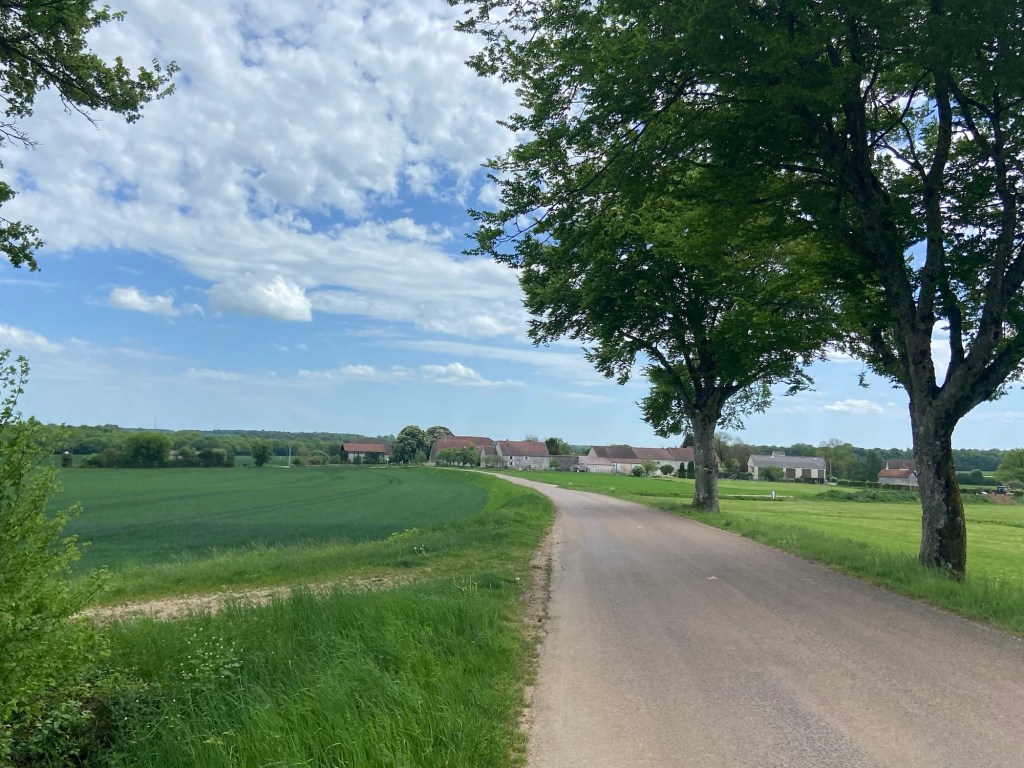
The straight road I had walked today and which I would be walking too tomorrow is the ancient Roman Via Agrippa which ran north from what is now modern-day Milan through Lyon to Boulogne-sur-Mer. The Abbey provided wayside and hospital accommodation in the Maisondieu, the best preserved of the Abbey structures and now inhabited not by the Augustinian monks who built it in the early 12th century nor the Templars who took over from them, nor the soldier monks of the Hospitallers of Saint John of Jerusalem who followed, nor yet the Knights of Malta who were the last to run the abbey lands, now for agricultural purposes, before the Revolution finally dissolved the religious complex. Now only the swallows dip in and out of the archways, flying from their nests to the telegraph wires.
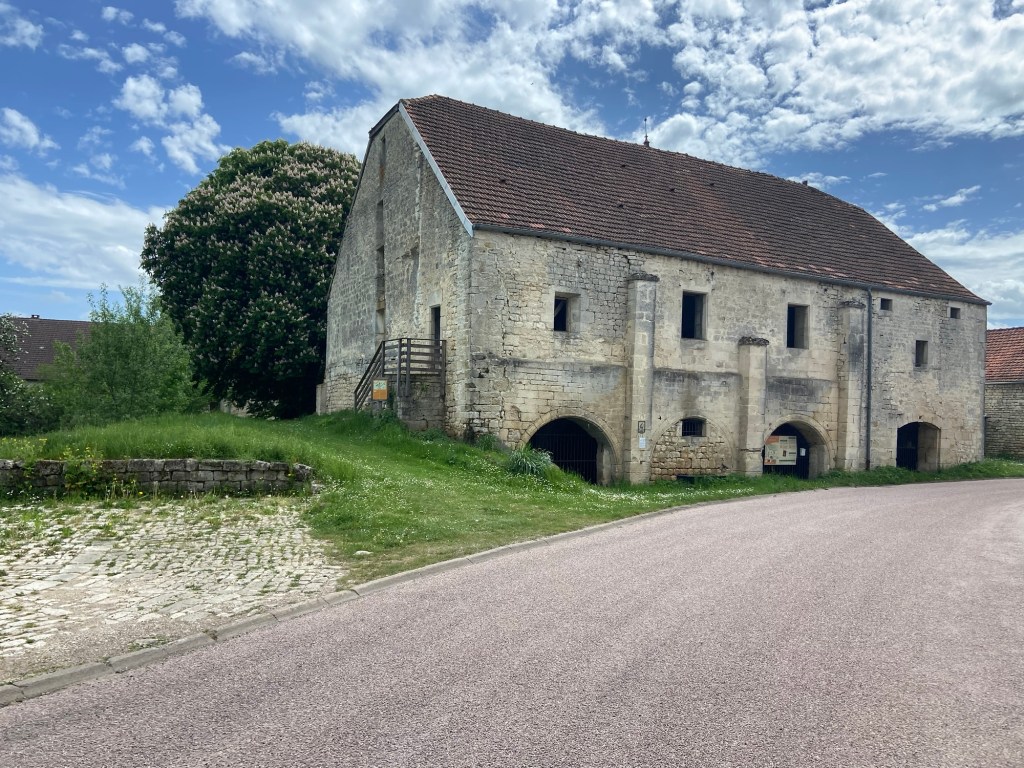
Other sections of the Abbey remain, such as partial walls of the ramparts on one side of the 70s bungalow which provides pilgrim accommodation in the Hospitaller tradition,
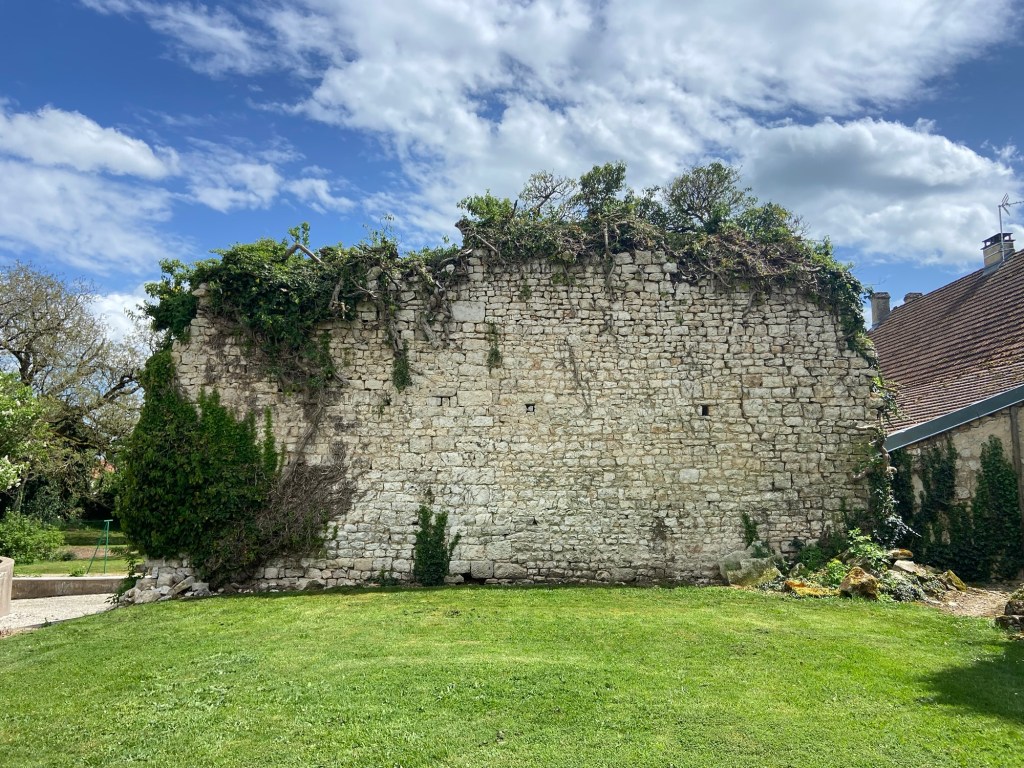
and on the other an archway in the great stone wall leads into the vegetable garden.
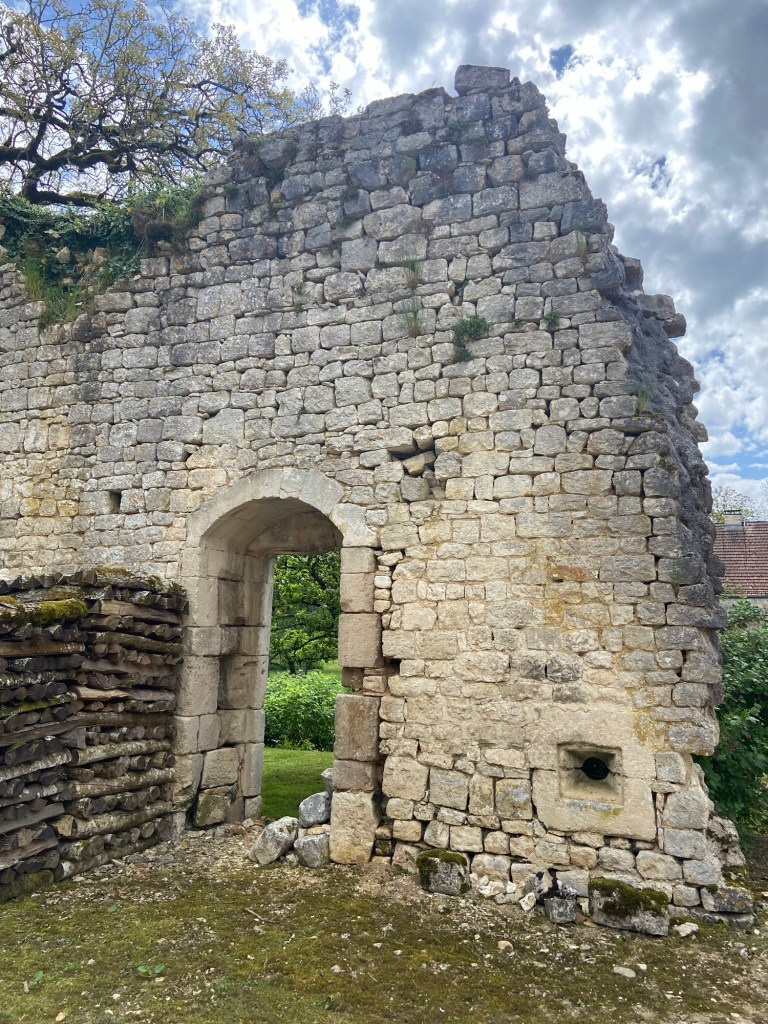
A tree is splitting apart in the space wheee the refectory once stood, and its two trunks are gained together to prevent it falling ans further damaging the sections of wall that are still standing.
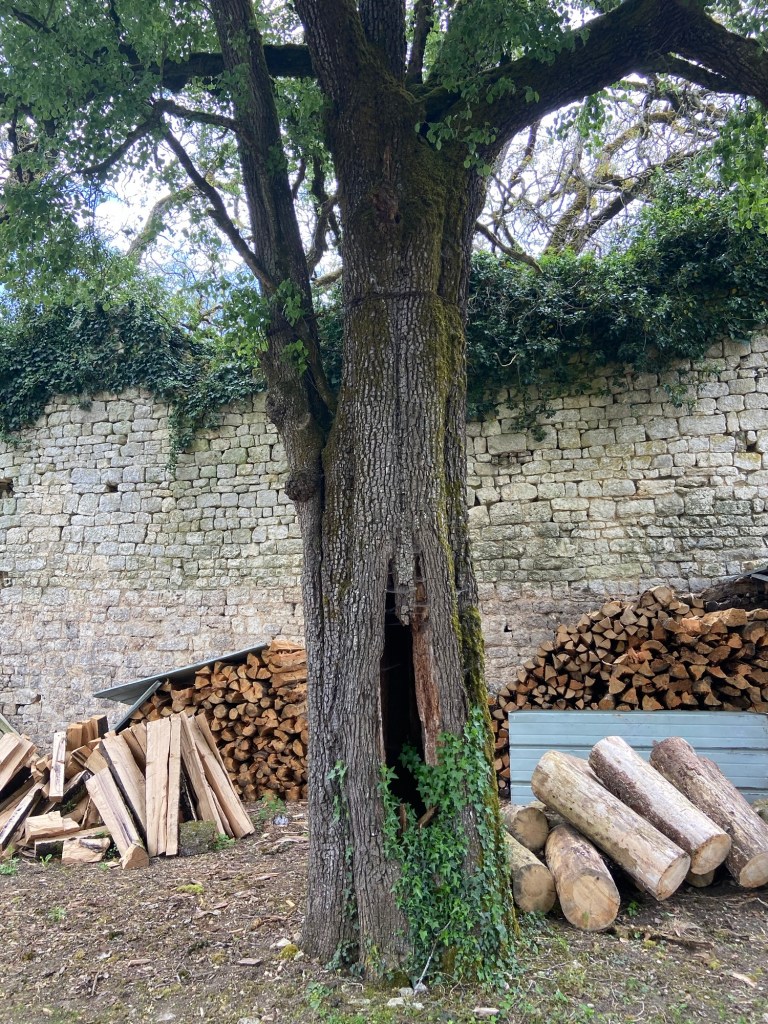
The rest is the rubble of time.

Stats for the Day
Distance: 20.9km
Time: 4hrs 23 mins over 5hrs 43 mins
Pace: take a wild guess
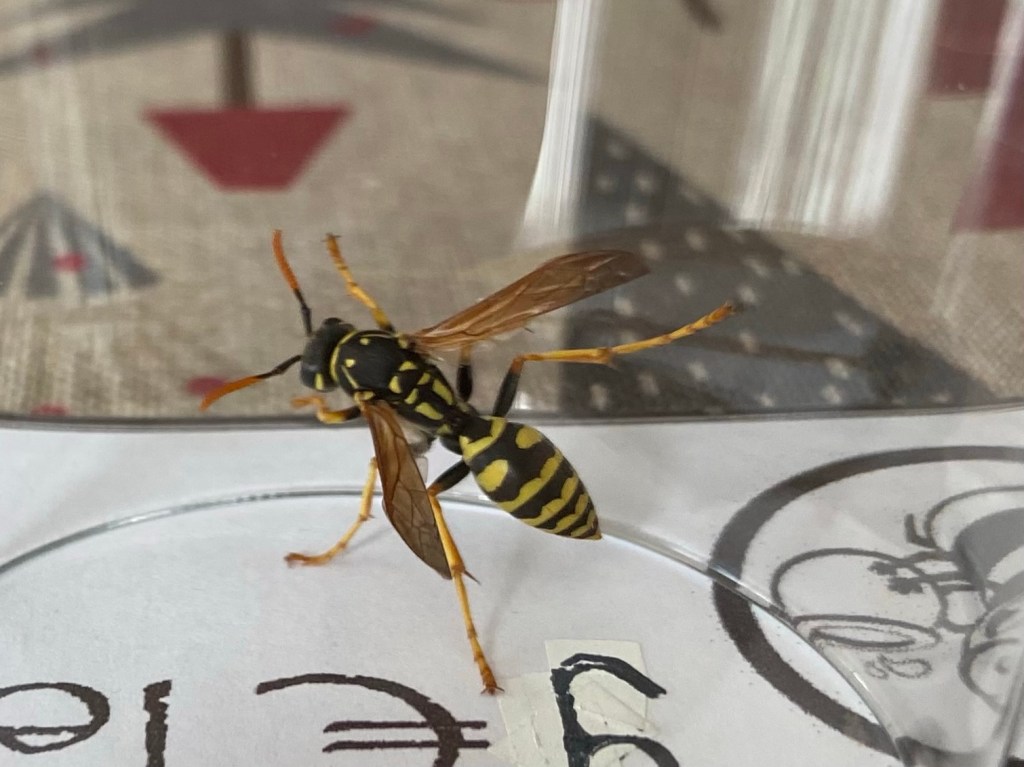
Strange wasps rescued from my bedhead and relocated outside by means of a wineglass: 1
 Walking The Landscape
I’ve enjoyed catching up on your week of walking. Edward is always terrified we will meet wild boar in the Forest of Dean so he feels your anxiety on that front. Im struck by what wonderful people and places you’ve met and seen. I loved the silk flower mill. Hope your heels hold up- sheep’s wool seems an ingenious solution.
LikeLiked by 1 person
AND WOLVES! My landlady for today says there are also lynx but I would like to meet a lynx. I wouldn’t begrudge getting eaten by a lynx.
LikeLike