Cogsworth, Disney’s Beauty and the Beast
If it’s not Baroque, don’t fix it.
Isabelle and Pierre run an idyllic gîte that can accommodate 15 people in various rooms, including beautifully-presented family rooms. They converted their 19th century home when the last of their children moved out, and anyone staying in this ‘Parenthesis in Champagne’ is phenomenally fortunate.
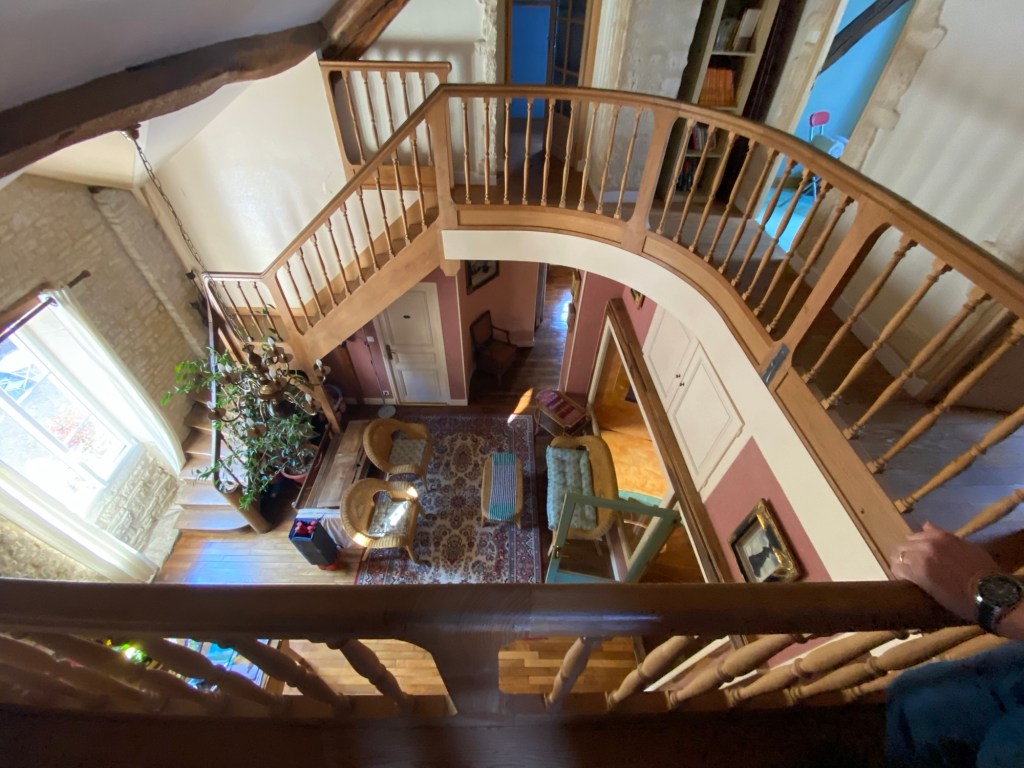
Isabelle‘s warmth and generosity were so welcome after a hot day, and during the course of the evening she and I discussed our families and our life stories as she made fresh brioche buns covered in sugar crystals for this morning’s breakfast, and roasted a chicken for our supper around the family table (not to mention the raspberry clafoutis that was already in the fridge). Her youngest son Clement, a trainee nurse, was visiting, and he turned out to be very useful when Isabelle’s washing machine broke down and he was able to mend it somehow with a screwdriver and a lot of patience.
I slept incredibly well in this haven of peace and tranquility, and this morning‘s breakfast totally set me up for the day: home-made yoghurt, the home-made brioche from last night, and a fried egg, perfectly cooked with crispy edges and a little bit of salt and a runny yolk. I said a very fond farewell to them this morning, and do hope that they come and visit the next time they drive up to England to visit their daughter and her family in Bath.
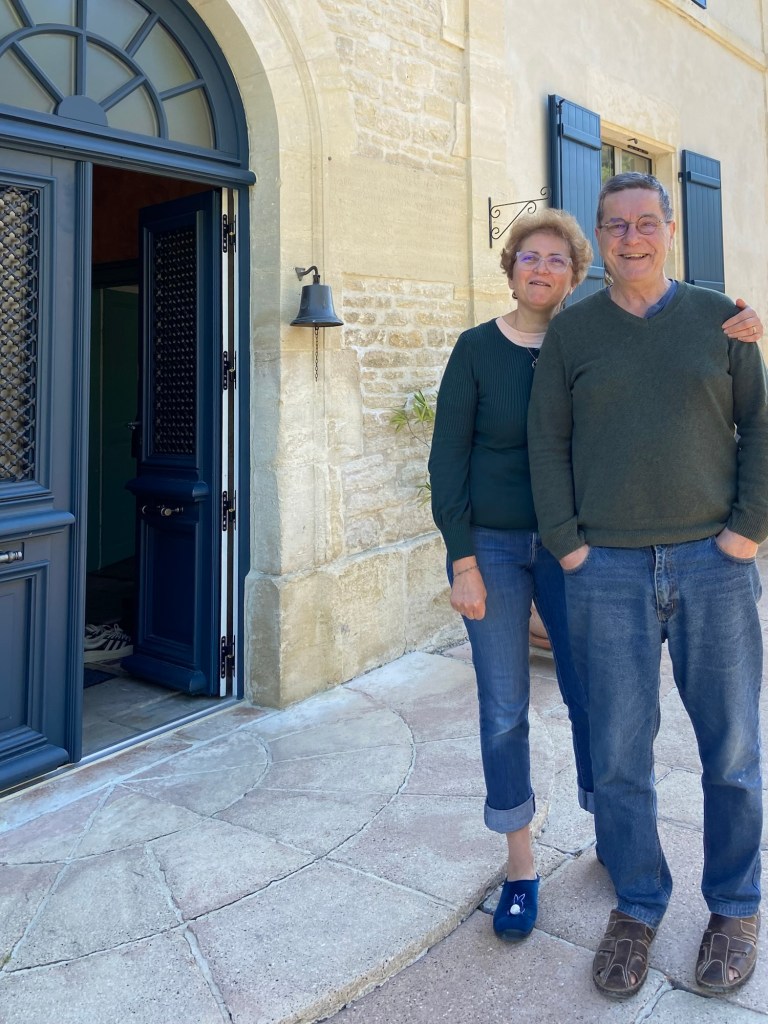
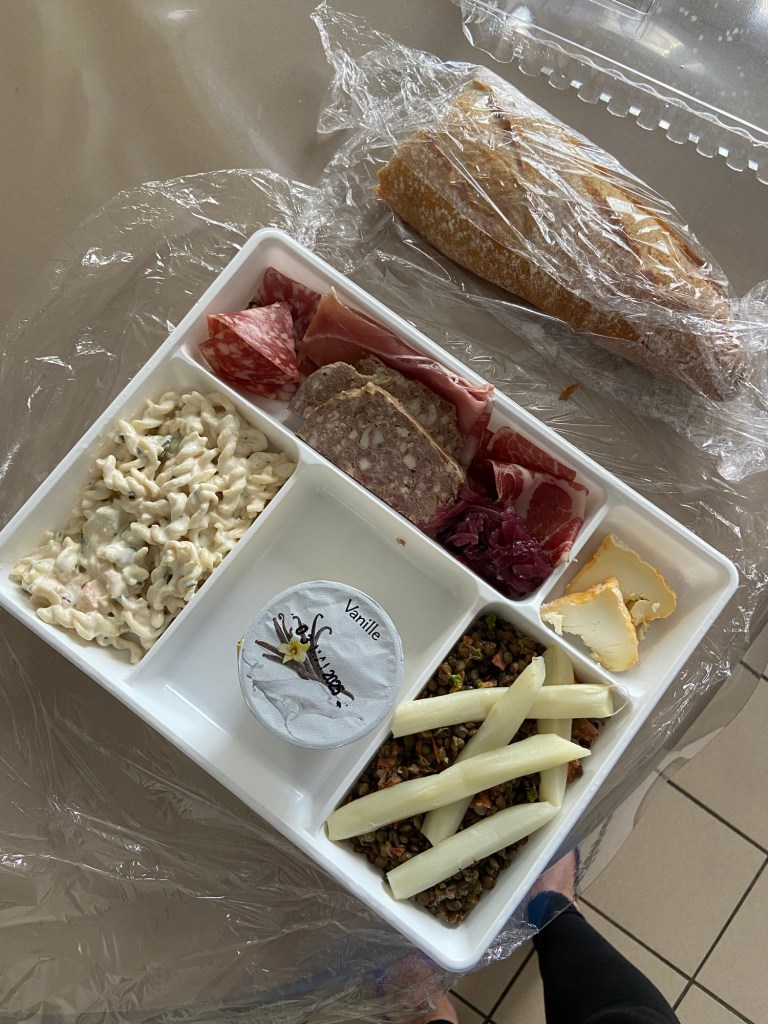
Isabelle had pointed out that it was May Day and a public holiday. Everything in the town of Bar-sur-Aube where I had been really looking forward to spending some time was going to be closed. In view of this, she sent me off with a packed lunch, which, added to the extra water I was carrying, made my pack a little bit heavier than usual. As I set out along the road, past a small orchard and the kitchen garden at the peak of spring greenness,
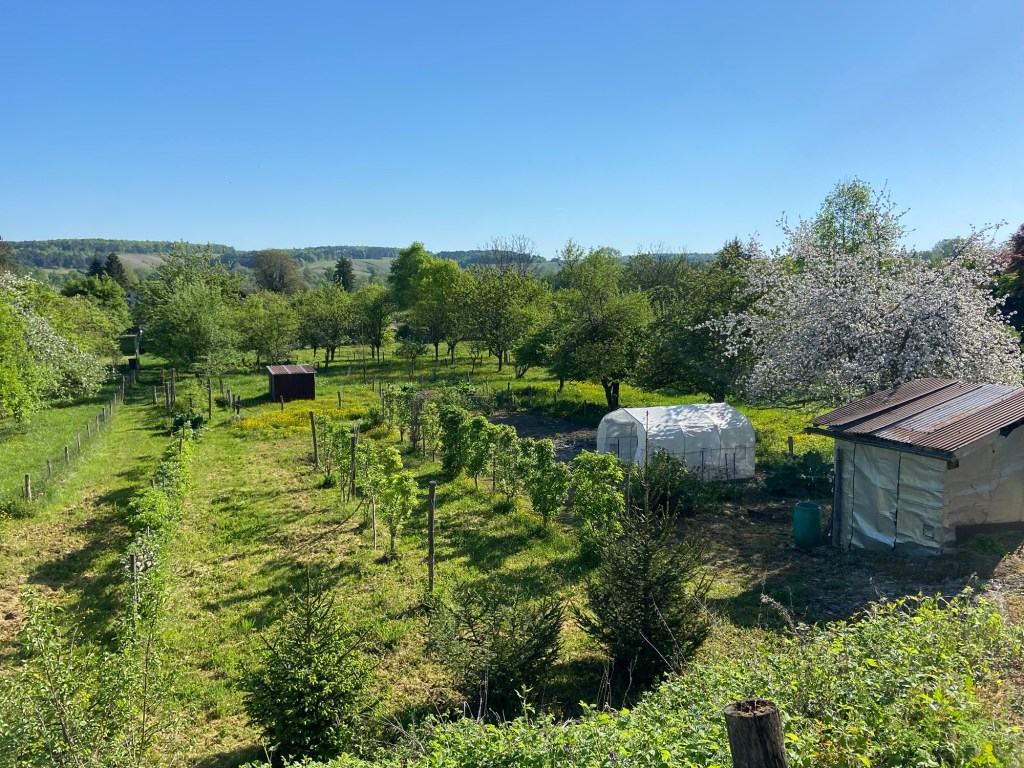
a young woman on her morning run shouted a warning as she passed that the road ahead was brutally hot with a pitiless sun (I paraphrase). For a walker rather than a runner, in a morning breeze which was still stirring the branches of the wooded hill to my right, it didn’t feel too bad.
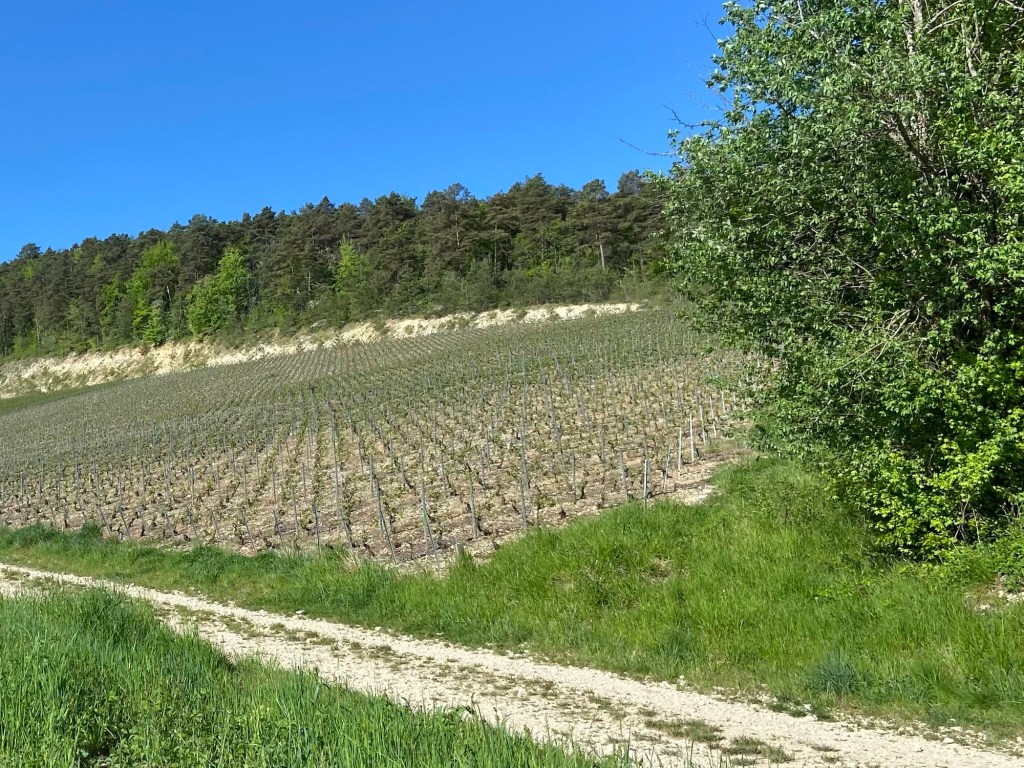
It was a really pleasant walk into the little champagne village of Proverville — a much more down-to-earth place then the other champagne villages in towns, with very small growers,
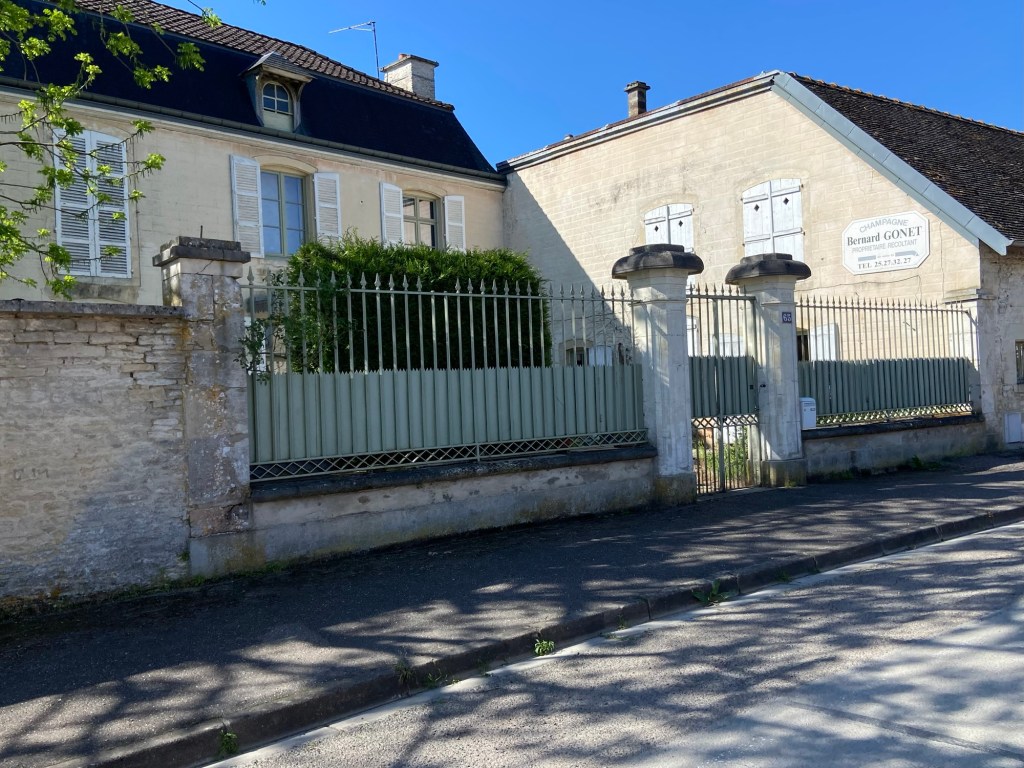
some creative accommodation options of which pilgrims might avail themselves,

and a proper vehicle with bona fide champagne/vineyard mud.

Just down the road and round the corner was Bar-sur-Aube. The Francigena path doesn’t go through the town, but grazes the edge of it at Proverville and then turns away. Even though I really wanted to get to the end of the day before the mercury hit 28° at 3 o’clock, I didn’t think I could walk past without seeing what by all accounts was a beautiful place. Kate and Bryce had highly recommended it.
So I turned left towards the river instead of right uphill, and was pretty much stopped in my tracks by the view from the bridge.

This river! Each time I cross it, it seems ever lovelier. I think houses with their feet in the water are some of the most charming.
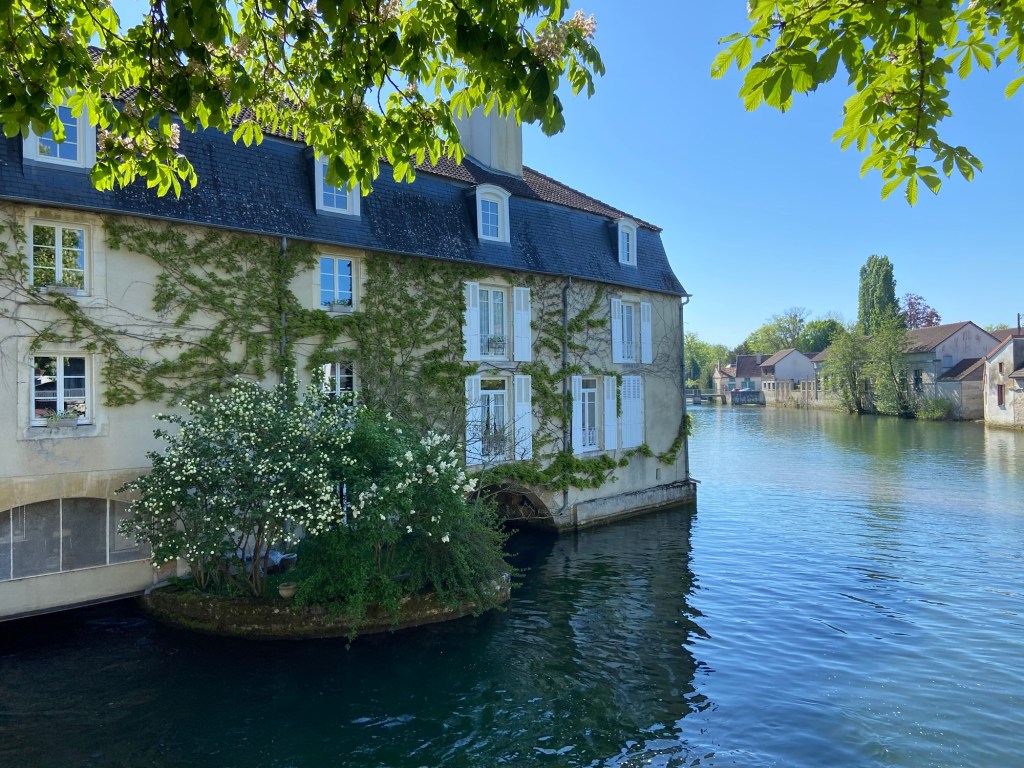
The water around this one was so clear that you could see right down to the bottom through the water lilies and water weed.

I didn’t get very far into the town, but enough to see that there were some pretty likely-looking fixer-uppers,
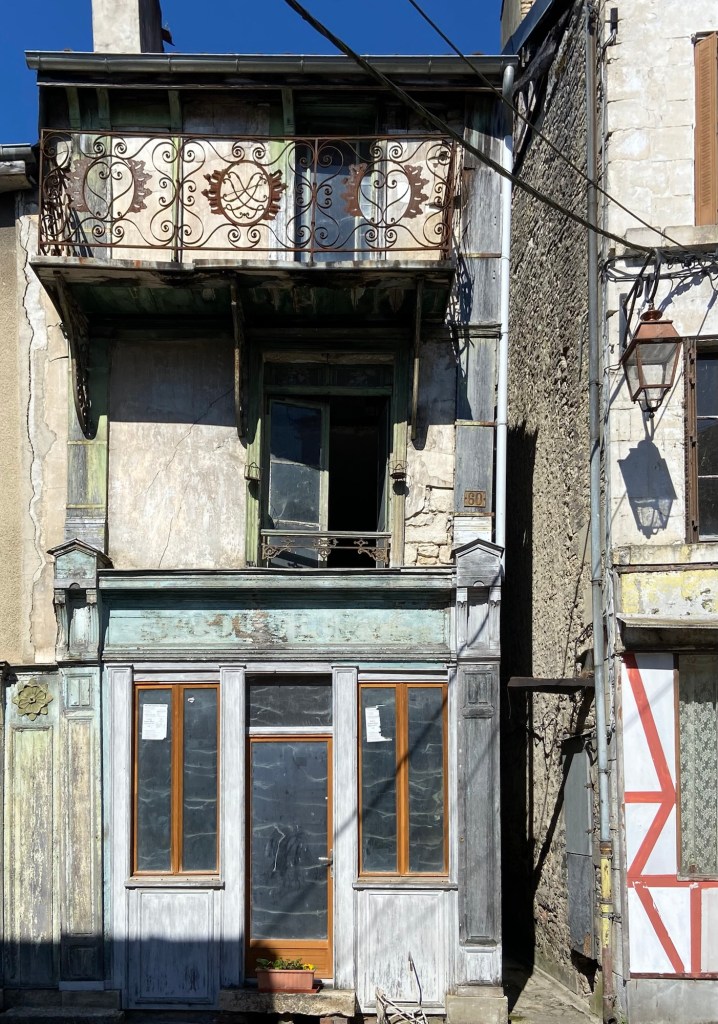
and plenty of 18th-century faded grandeur.
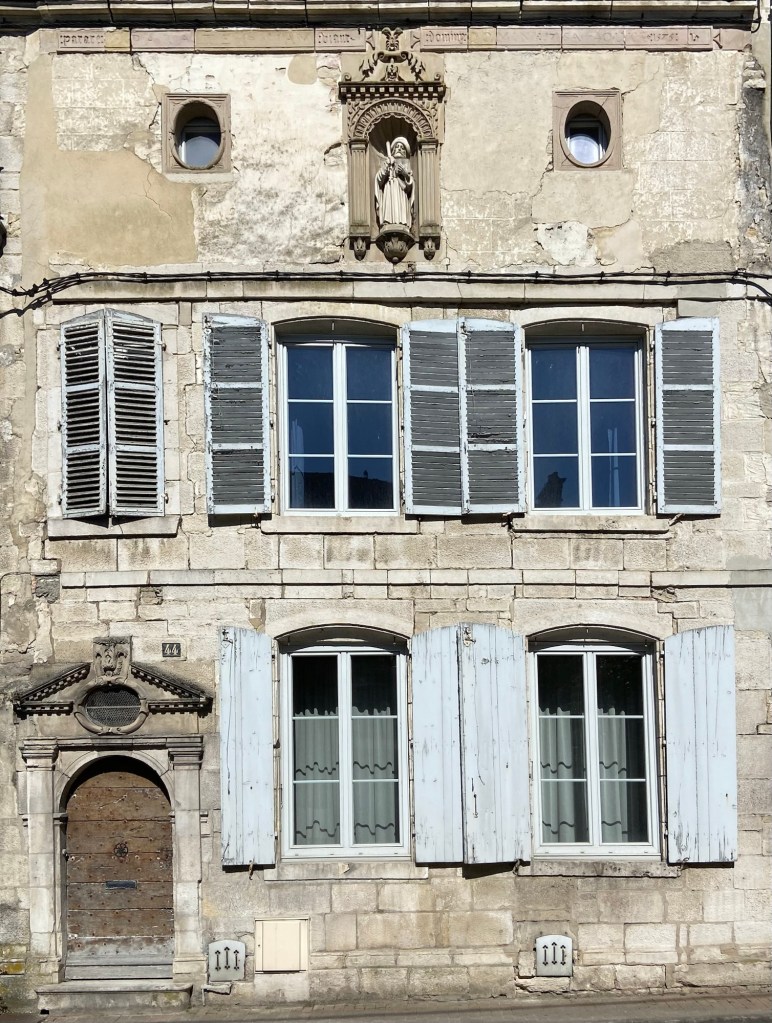
Some of the townhouses even had the air of being tranquil retreats deep in the country.

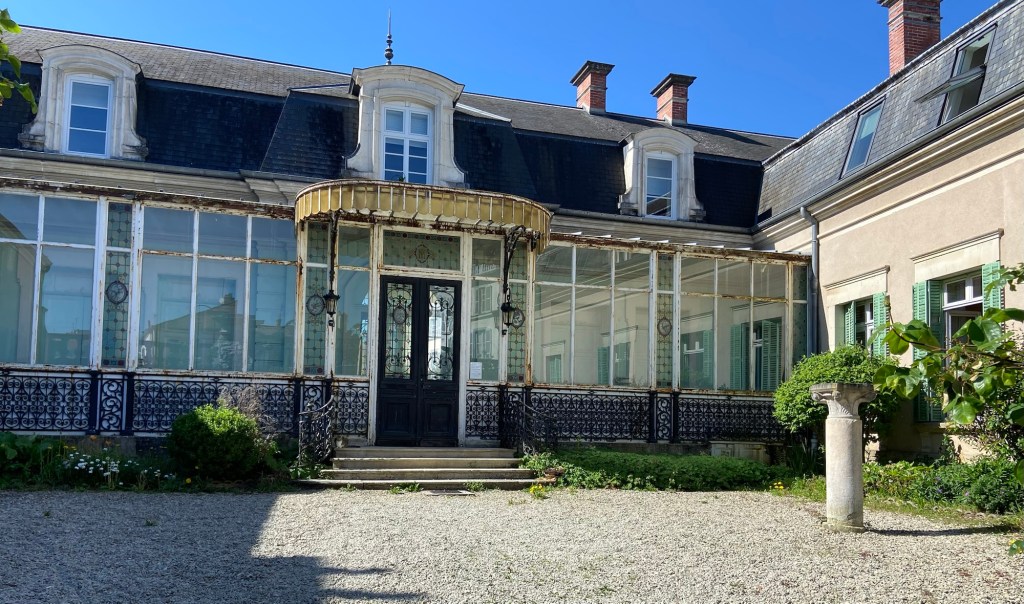
Others were little Victorian gems locked away behind grand gates.
I was made two tempting offers during my brief time in the town. This was the first:
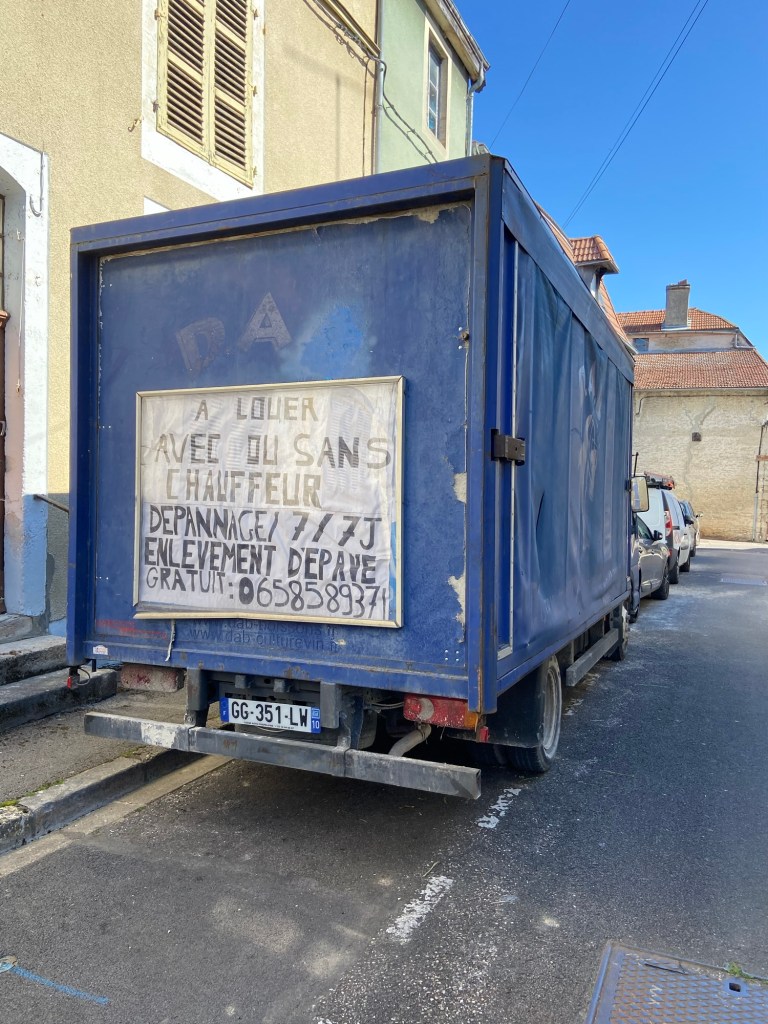
and the second came from one of the workers striding along bearing a red flag all heading towards the main square for their Labour Day festivities.
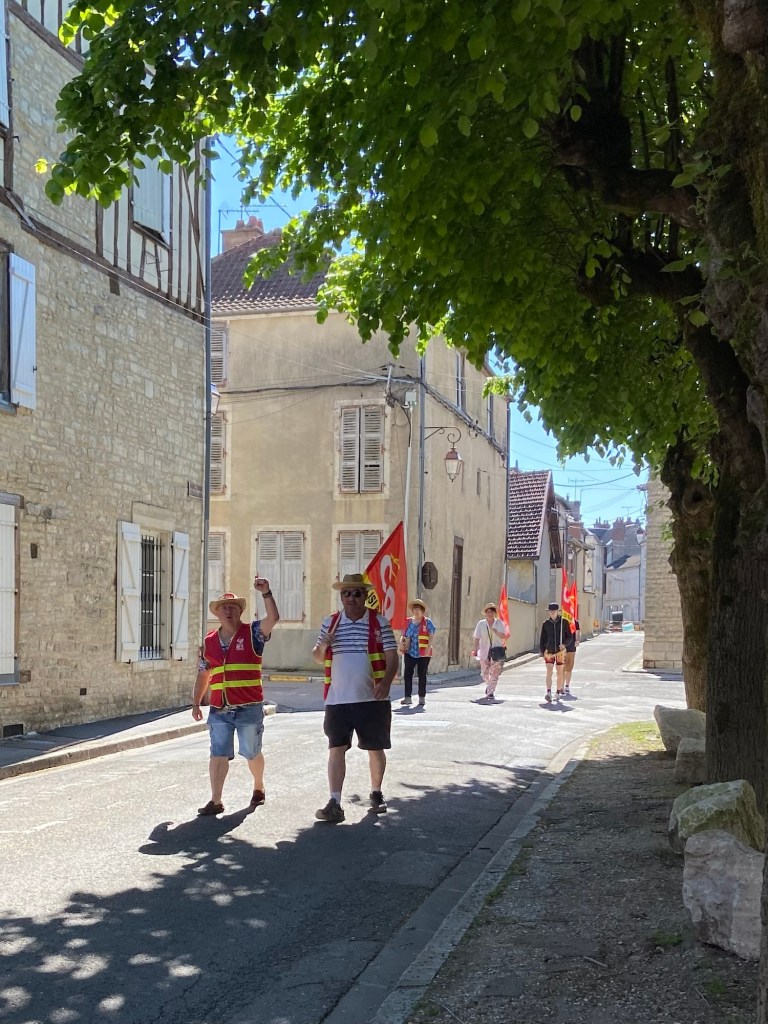
The man with the triumphally-raised fist stopped to talk to me, and when he heard what I was doing he grasped my hands between his and urged me to come into the square to hear the speeches at 11 o’clock, and stay for something to drink and eat at 12.
Ordinarily, I would’ve let myself be persuaded, and certainly would have been if it wasn’t going to be so hot this afternoon. However, I really had to get going.
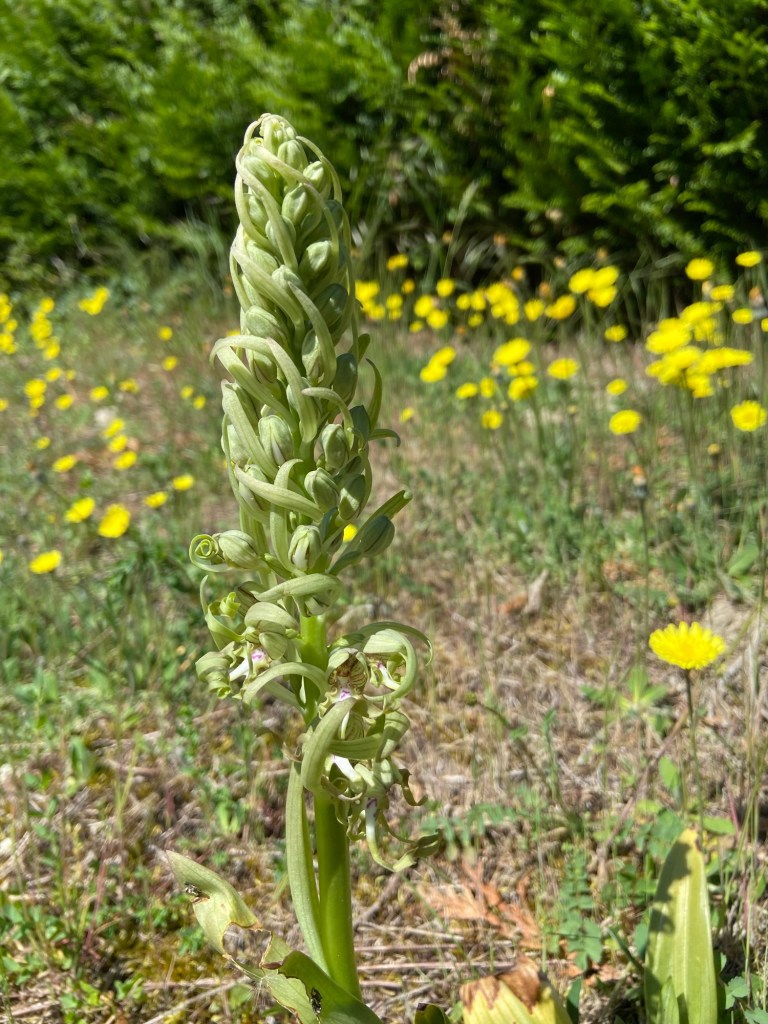
The guidebook describes the 300-foot climb up from the river to the top of the Sainte-Germaine hill as a ‘tricky and vertical forest path’, but before tackling it, I was distracted by what I think is a lizard orchid, the first I’ve ever seen. The labellum was extraordinary: twisted and ridiculously elongated, with fluted dorsal lobes like a sea cucumber. Hyperbolic geometry.

And then it was up the steep path through the woods, glad I was going up rather than down. It was only 11.30, but I was perspiring freely despite the shade, and mopping my brow with the breakfast serviette that I had absentmindedly pocketed this morning. At some points the path plunged only to climb again.
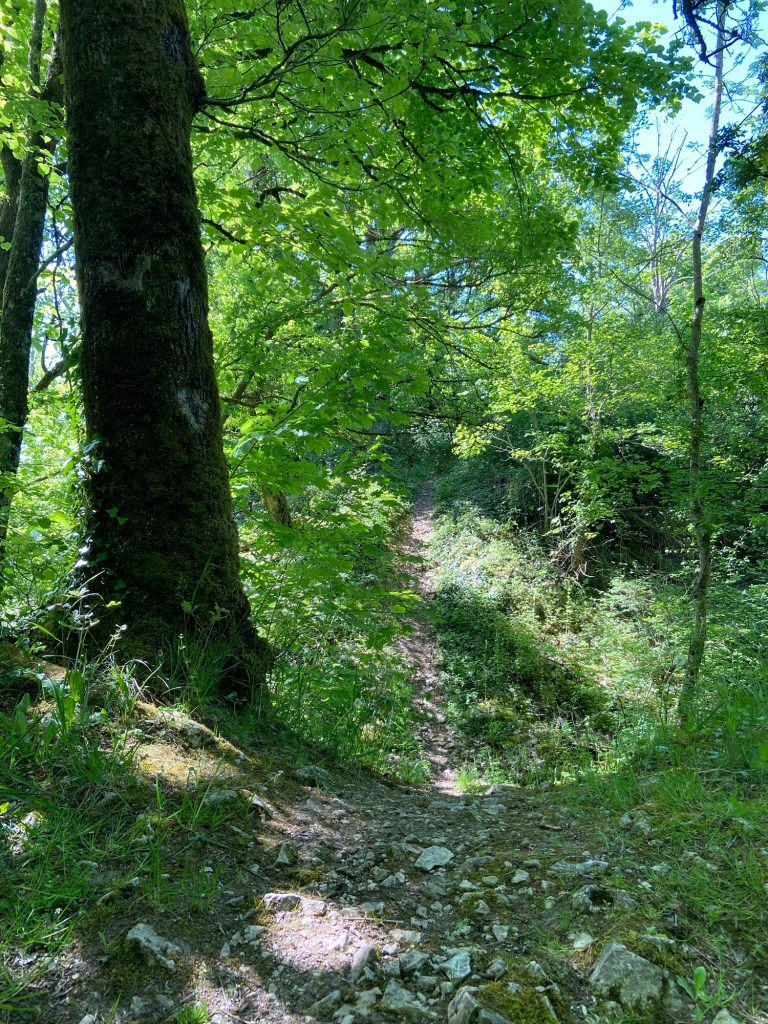
At the top one is rewarded with a beautiful meadow and a stupendous view out over the whole of the Aube valley, across its acres of vineyards to wooded hills beyond.

There was supposed to be a little chapel up here where the eponymous virgin Germaine was martyred, having spurned Attila the Hun in 451AD. I cast around and eventually found it hidden behind the extensive farm buildings.
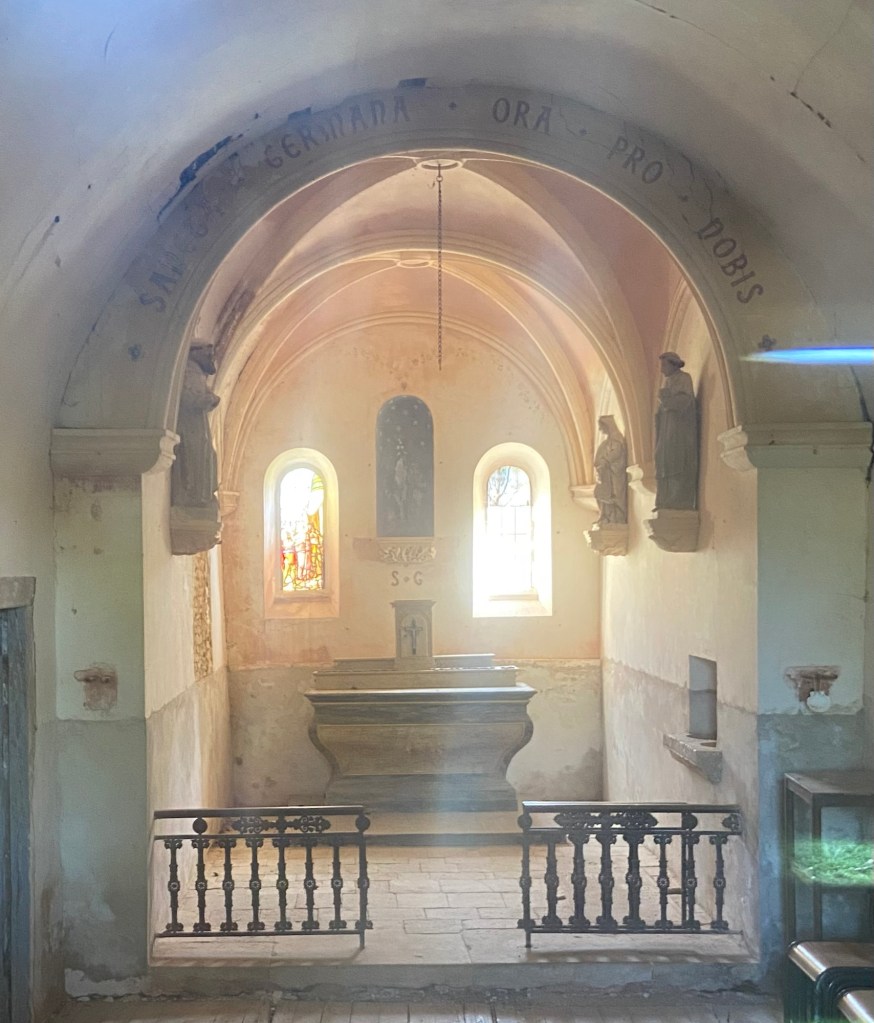
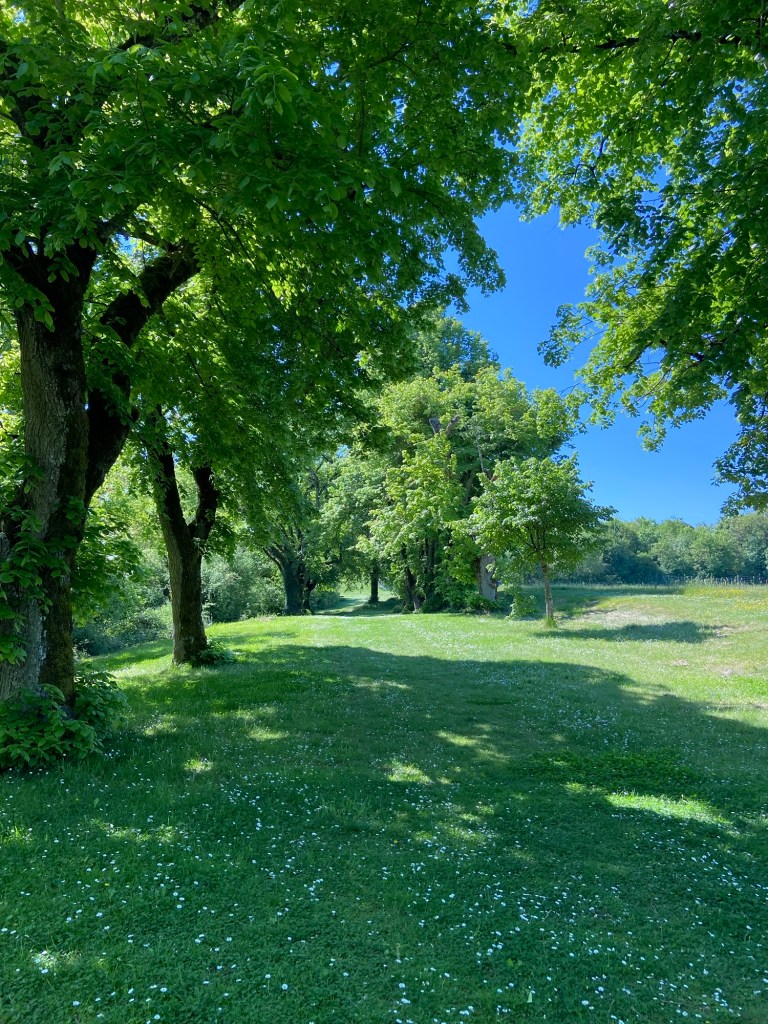
It was very dull. More lovely were the trees up here,
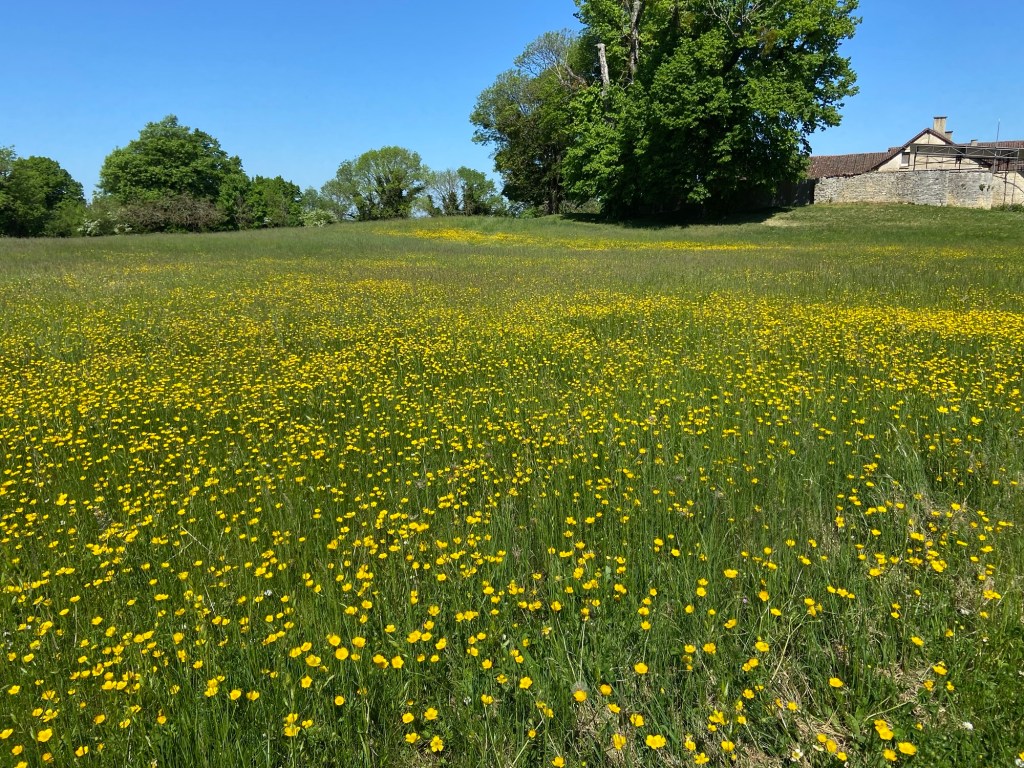
and the buttercup meadow.
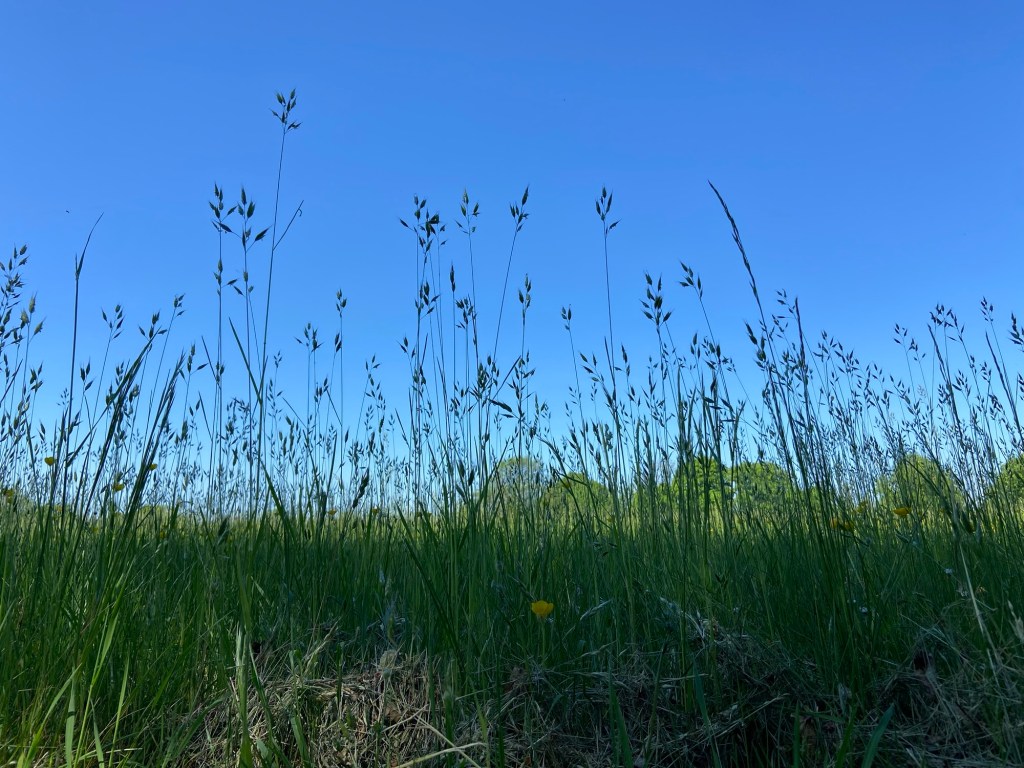
The path went slightly below it, so the grasses were silhouetted against the sky.
Here up on top of the ridge, despite the sun, a cooling breeze was blowing and I found I could cross the open fields without feeling as though my brain was going to boil, until finally the path plunged from merciless sun into cool forestry,
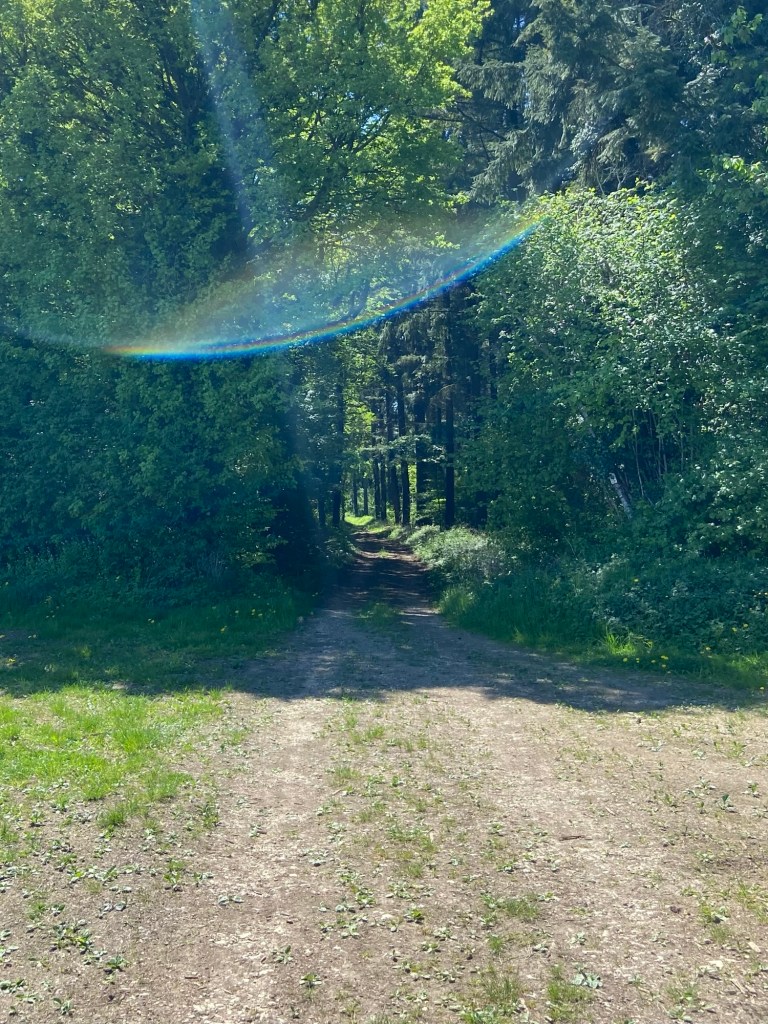
providing blessed shade for walkers,
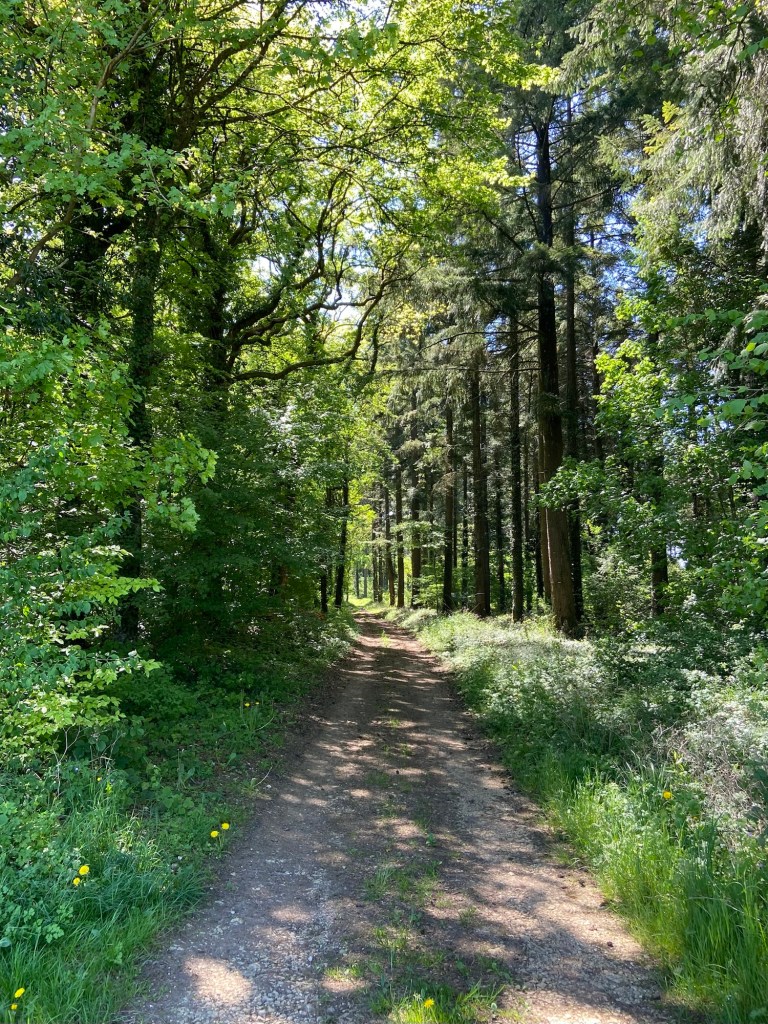
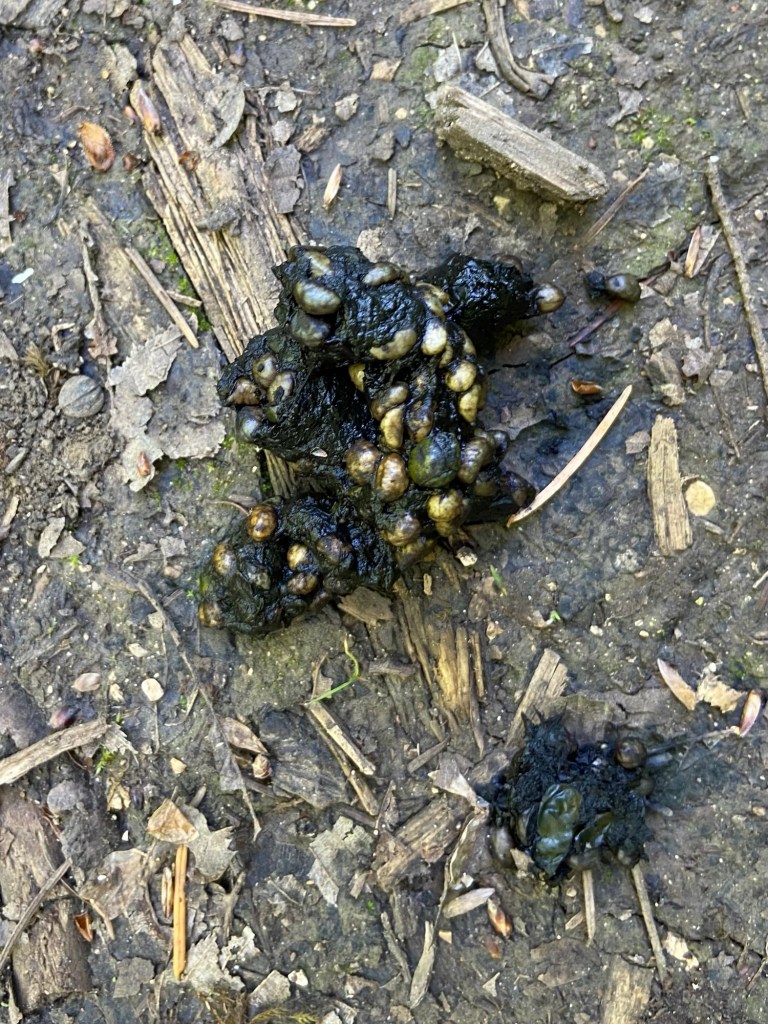
badgers,
and a variety of shade-loving plants including Solomon’s seal,
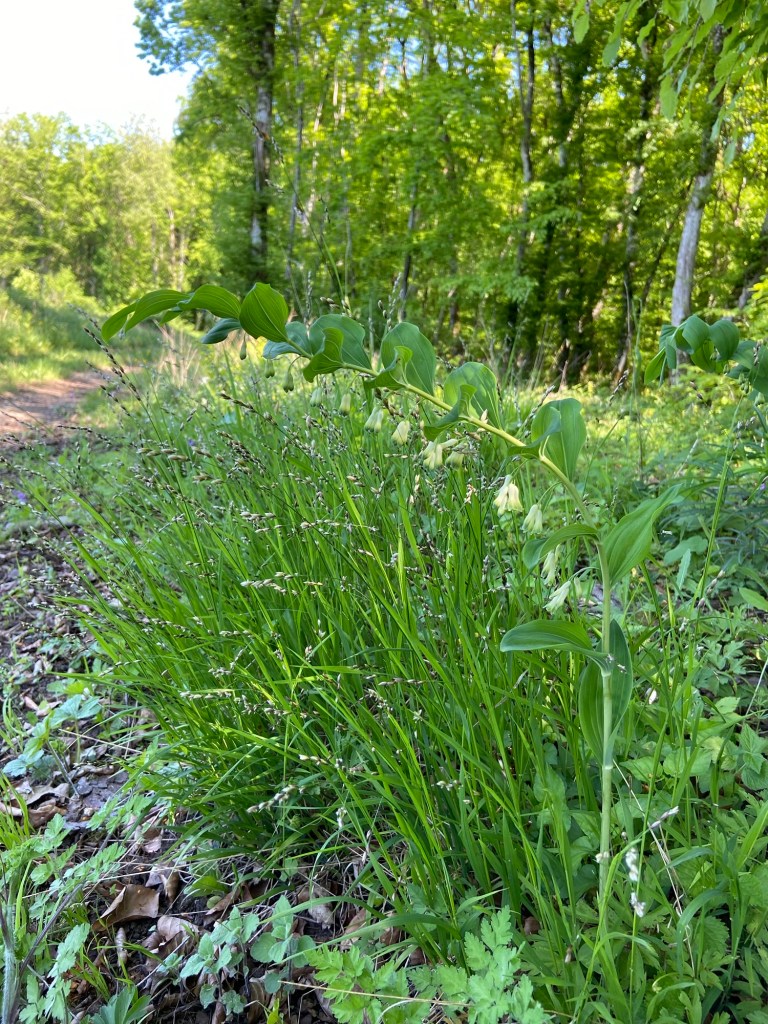
green hellebores, and and lily of the valley.

The forestry gave way to deciduous woodland divided into hunting posts. Mostly the path just chugged along with deep ruts on either side, occasionally filled with water over which thick swarms of flies buzzed,
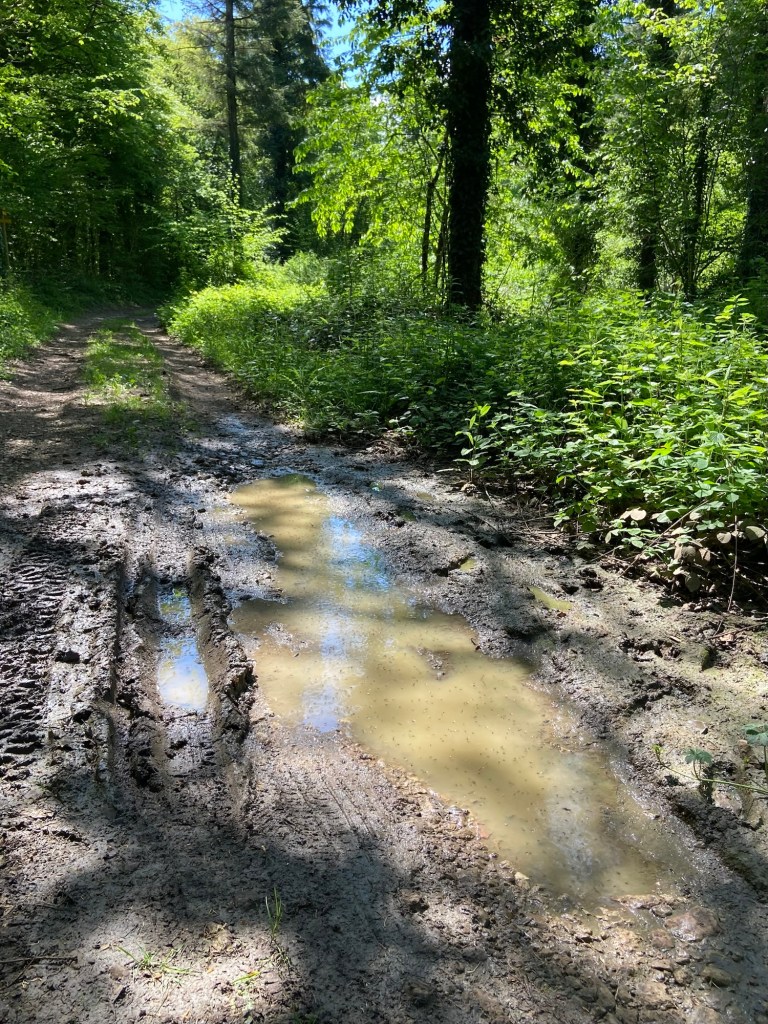
occasionally showing its chalky underbelly.
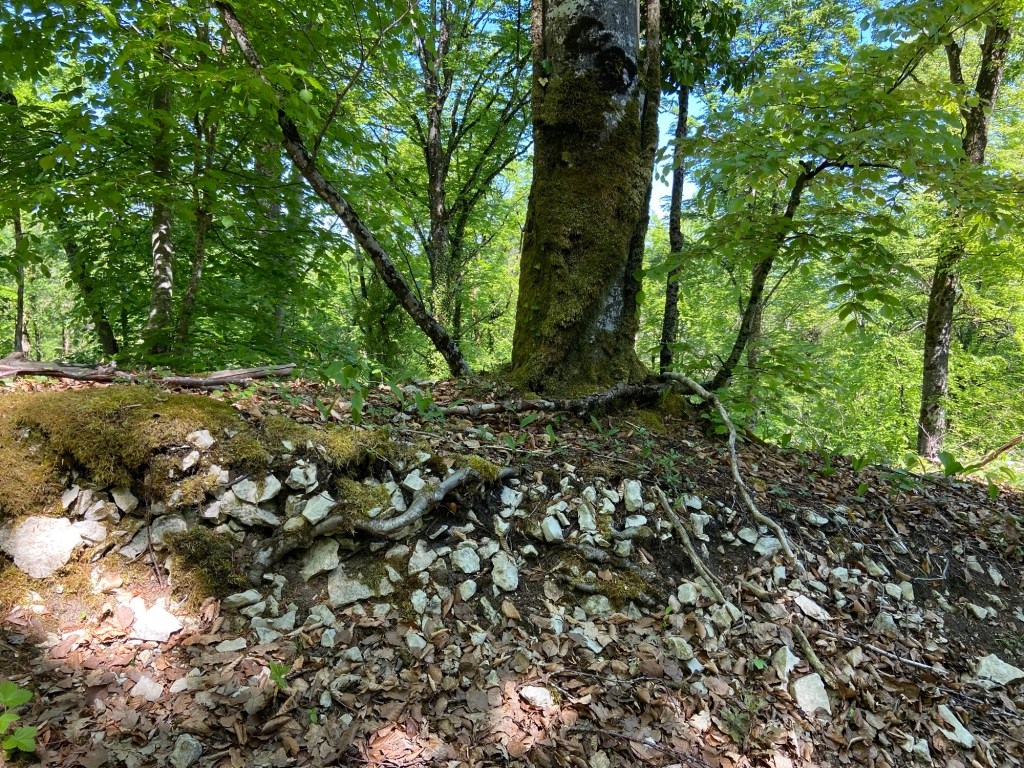
And that was the hint that I was coming to the end of the long kilometres of woods and their lovely shade, and out into wine country again.
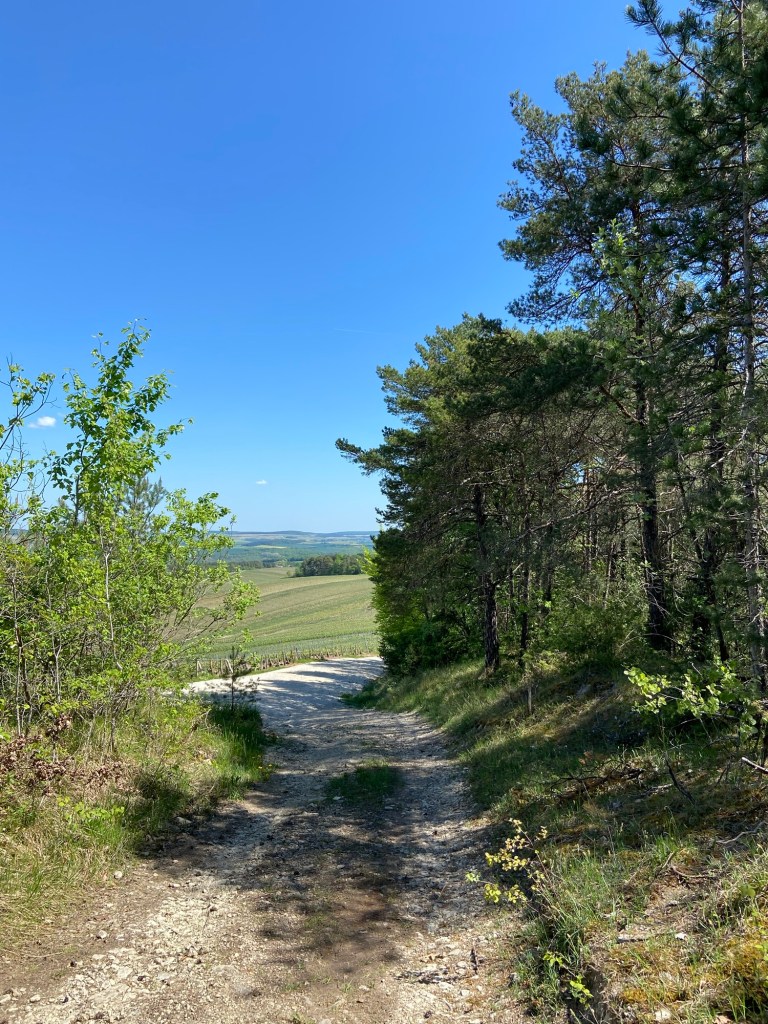
There was the smell of hot pine trees with pine needles underfoot, and dry white soils. With the heat rolling up the vineyard tracks it felt entirely like the south of France rather than the Nord Est region.

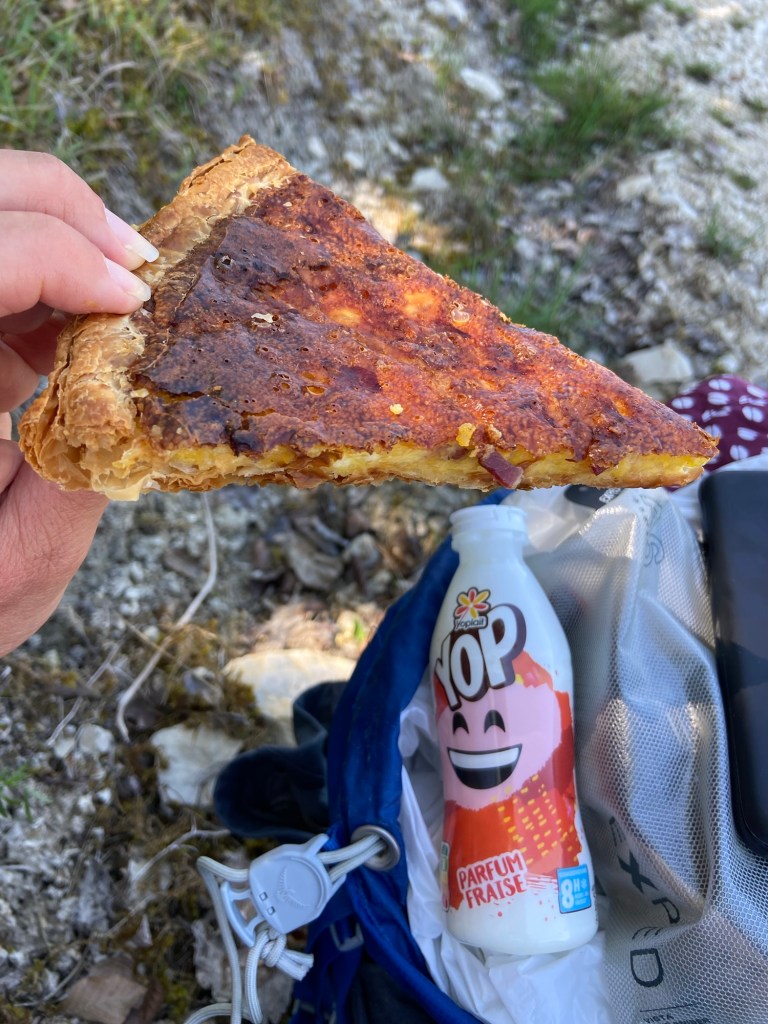
I started off down the blindingly white chalky path, but in 50 feet or so I thought better of it and decided I needed to return to the shade and apply more sunscreen. GOOD GIRL. It was nearly 1 o’clock, and a good time for lunch as well, with a view of the vineyards and the little town away to my right. I blessed Isabelle for her delicious quiche lorraine, the three juicy tomatoes and the perfectly boiled egg. What a great walking lunch. I chugged the yoghurt drink as well: more useful liquid on board.
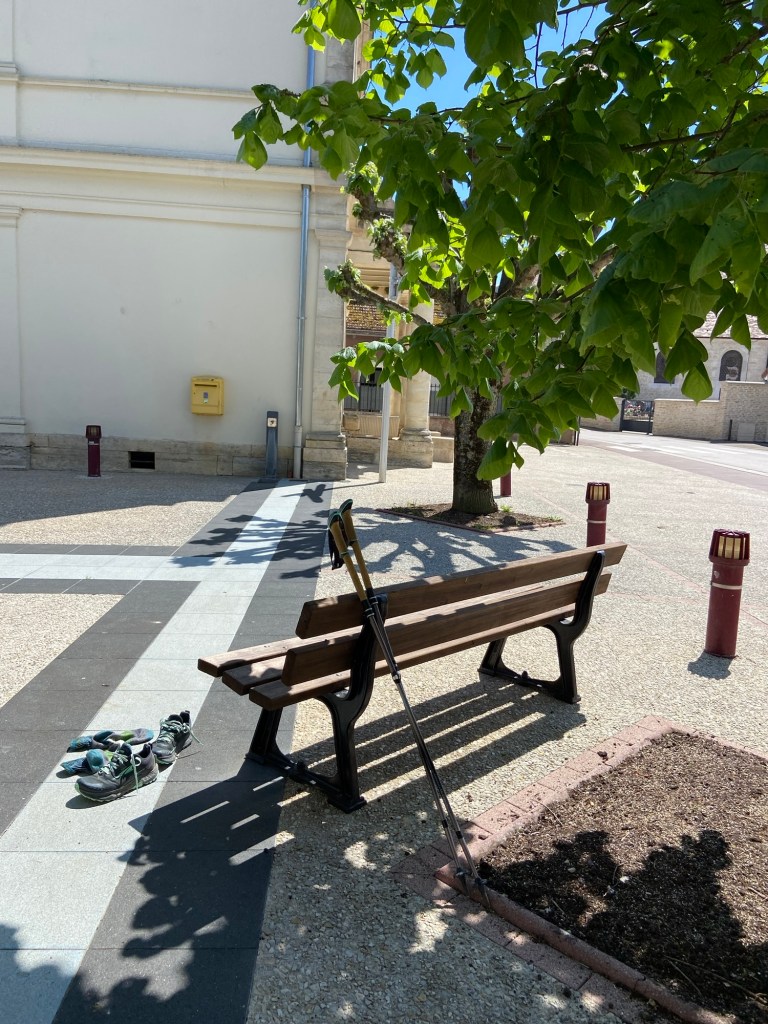
It took about five minutes to get down into town of Baroville. The guidebook had advertised benches and water next to the Mairie, so I made straight for there. There was a tiny amount of shade on one of the benches to sit in, so I plumped myself on that, took my shoes off and put my flip-flops on. I drank the rest of the water that was in my bladder, and so I’d had a litre and a half this morning, plus coffee and juice at breakfast.
There was no water in the little public fountain here in the square, and when I tried the water tap, a few drops came out and then it ran dry. I asked a passing boy of about ten who was waiting for a friend to finish lunch and come out to play, and he suggested a little doubtfully that perhaps I could buy some water on the road. Apart from the fact that I wasn’t taking the road this afternoon, it was May Day I explained, and everything was closed.
However, the church of Saint Stephen was just across the road and I remembered what Micheline had told me: you can always fill up with water in cemeteries. I prowled around the church until I found the water tap, and filled the bladder so full that there was no way I could get it properly back inside the special pocket in my rucksack. It didn’t matter: I was afloat for the afternoon.
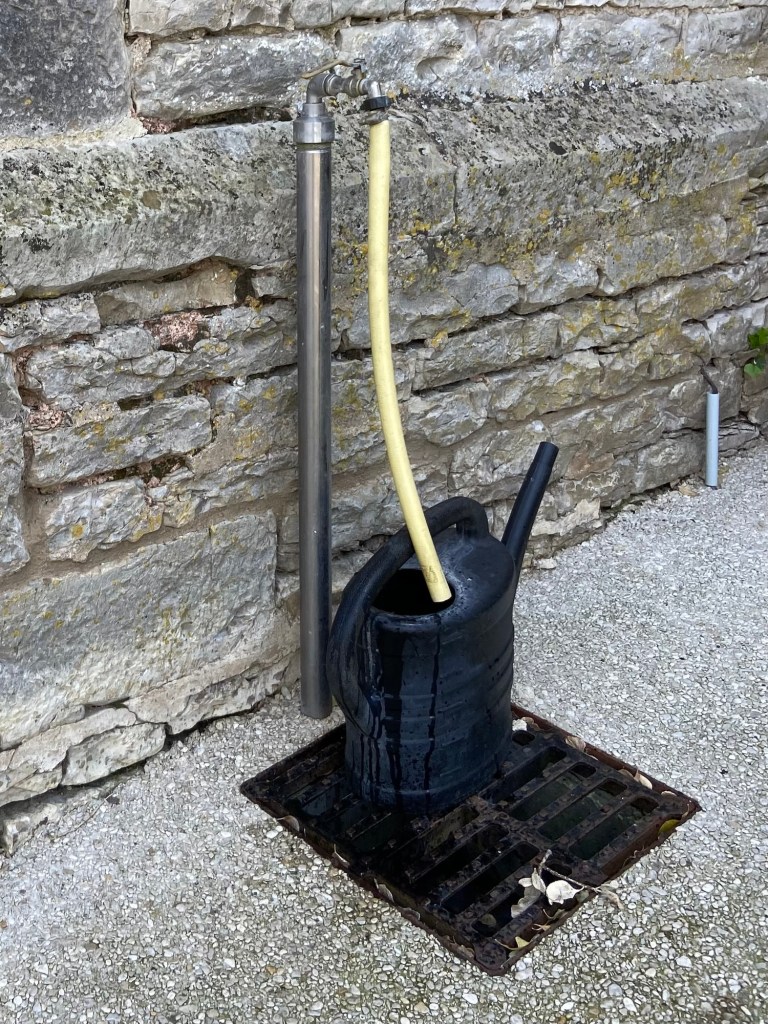
On the way out of town, I stopped in at the old town washhouse with water circulating in a pump system. It seems there was water everywhere in this town, except for in the municipal water tap!

Ahead of me there was a daunting, blindingly white hill which led up over the slopes of the vineyards.

I had just started hauling myself up it, turning back to look down on the town and catch my breath, when the sun miraculously went in. I squinted up and there above my head was a large dark cloud.
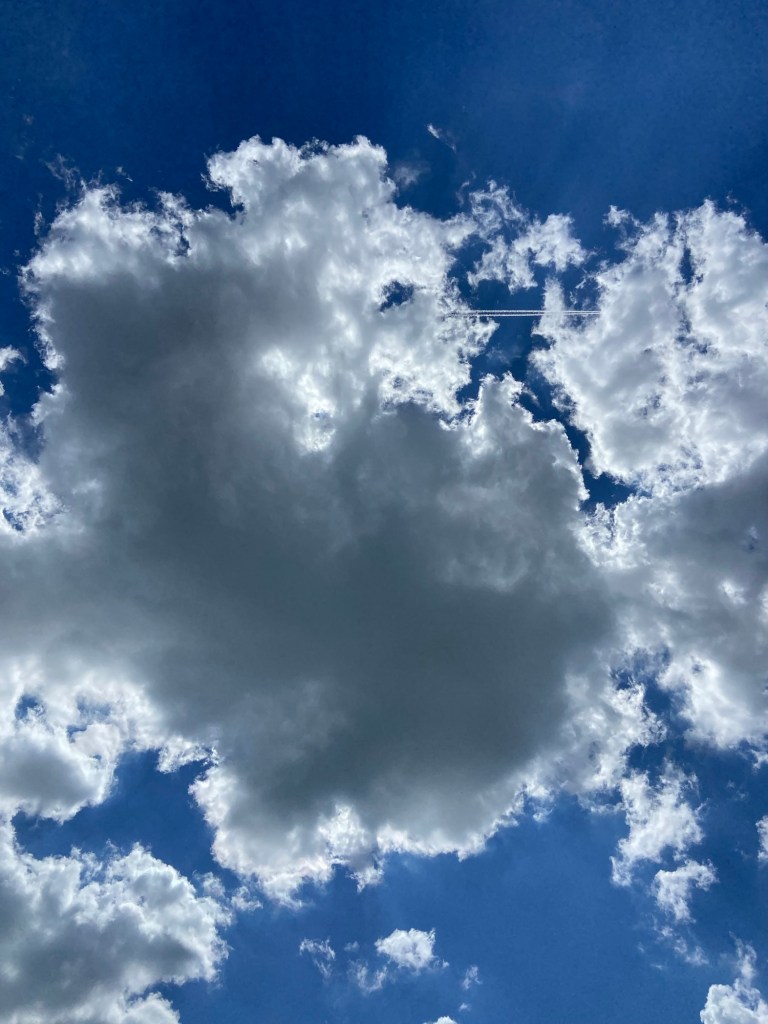
Slow moving in the hot, still air, it covered the sun for the exact amount of time it took me to get up to the top of the hill. I found myself whispering a little prayer to my St Christopher medallion, to thank him for this relief.
On this hilly land the slopes were once again covered in vineyards, as they had been when I walked through champagne country. On that day it had been cool and rainy, but today it was baking hot with a metallic sky, and the wooded hilltops, essential for the growing of champagne, were now in their full, richly green leaf.
The miraculous cloud moved slowly as I did and continued to provide me with shade as I crossed the fields and climbed up into the thick woodland.
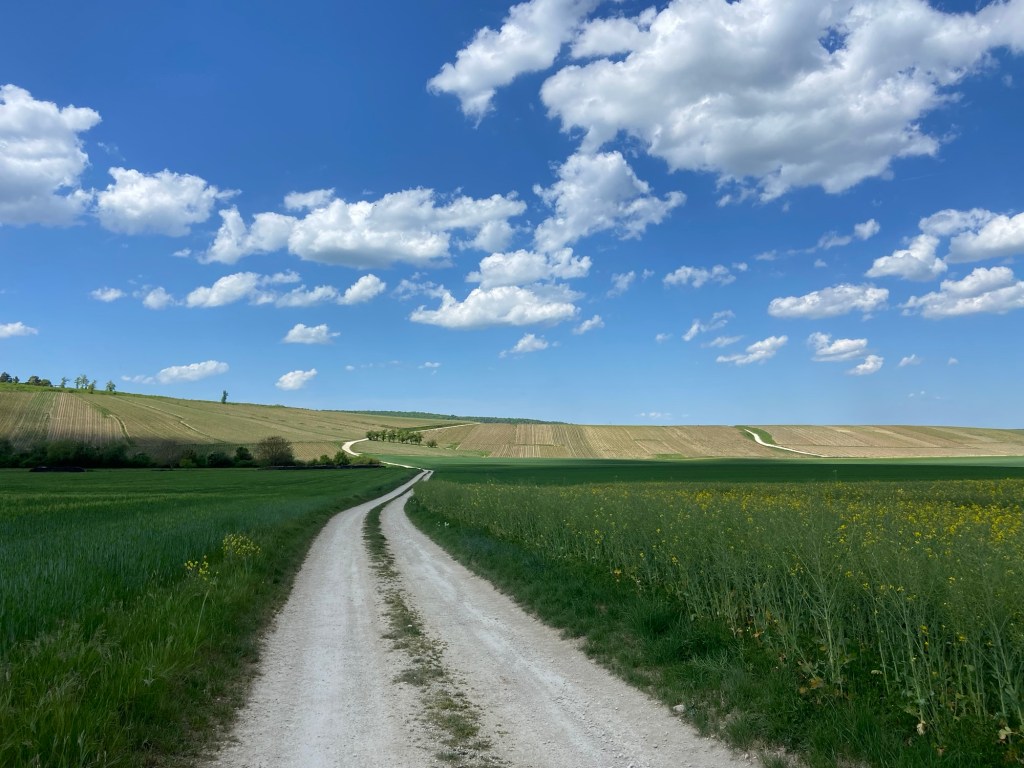
Once it moved off for good, I had the protection of some shade on this long, long straight road which would carry me straight to Clairvaux. From the top of the hill I could see the cutting of the logging road undulating straight ahead, first downhill and then up and over the horizon.

There was a measure of shade pretty much all the way, with the occasional enormous felled tree trunk to sit on and rest,
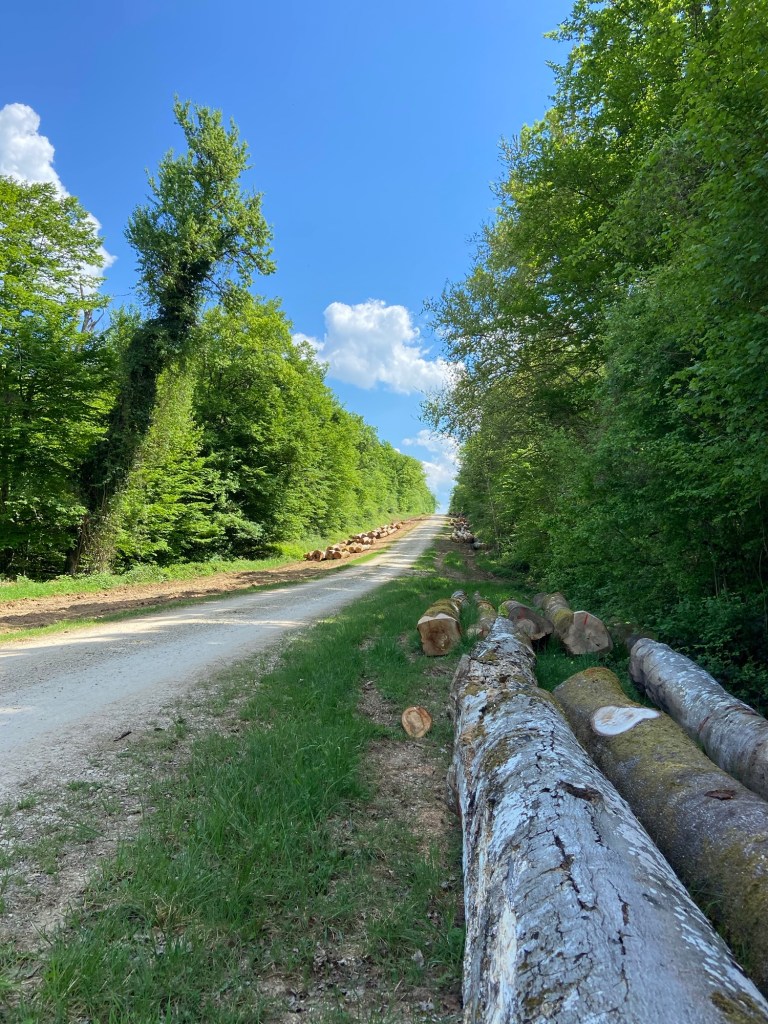
and thus I moved through the hottest afternoon of this week — and of the walk so far. All of Europe was baking, and London recorded its hottest May Day on record.
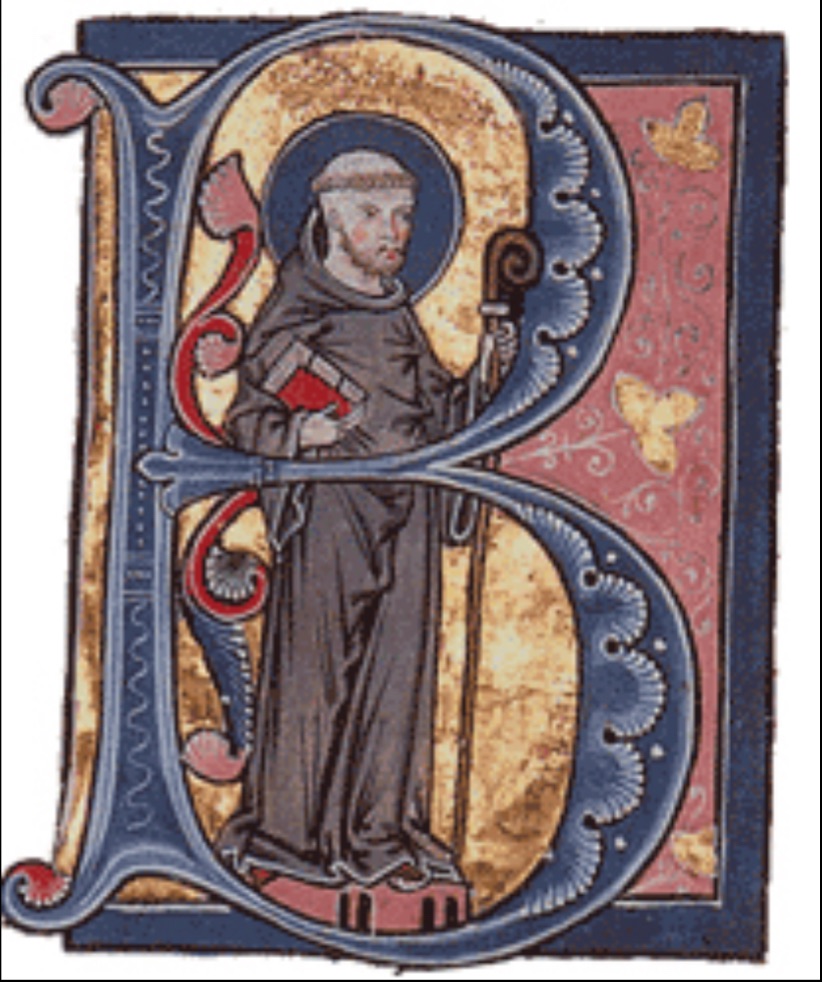
From the top of the final hill the road pretty swiftly dropped me down into the Val d’Absinthe where the Aube flowed southwards. Here in the Val d’Absinthe it was, that a twenty-five year old monk from a family of lesser nobility from Fontaine-lès-Dijon settled in 1115, bringing twelve other monks with him and founding an Abbey that he would name Clairvaux.
Clairvaux became the largest and most important abbey in France, at one time numbering 700 monks. More than sixty monasteries were established from Scandinavia down to the Mediterranean in Bernard’s lifetime. His Rule for Cistercian monastic life lasted nine hundred years — I thought of the nuns living in their closed order at Wisques, and those sisters living under their Benedictine rule of silence at St Thierry, both of which communities had received me according to the ancient practice of pilgrim hospitality.
But I would not have wanted to be hosted in contemporary Clairvaux. In Revolutionary times the abbey was dissolved, the remaining religious community of 26 expelled, and the buildings seized by the Republic according to the decree of 2 November 1789. Under Napoleon’s penal reforms (when the galleys began to be considered an unacceptably cruel method of punishing criminals), it became a prison. By 1819 Clairvaux housed some 1500 inmates.
In the first years of the Second World War, Clairvaux housed Communists, then Resistance fighters, and finally, as political fortunes changed, ministers of the Vichy Government. The prison, in its fantastic 18th century accommodation, continued to house prisoners as a high-security correctional facility.
The guidebook said it could not be visited, and that for security reasons no photographs could be taken. This made me deeply sad, because when I had chosen Clairvaux for this day’s end I had imagined a medieval site like Fountains Abbey in Yorkshire, and had planned to wander around the ancient ruins, appreciating the coolness provided by their stone construction.
So instead I walked down the road beside the abbey walls, and pressed the bell for my accommodation.
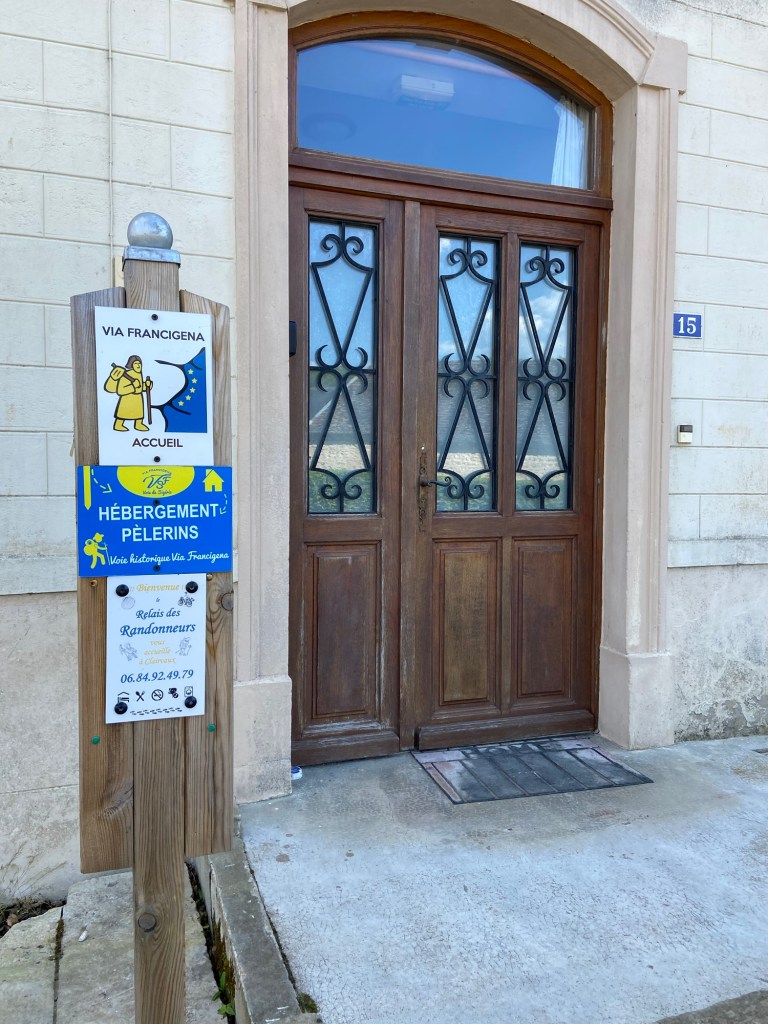
There was no answer.
I sat on the low wall of the entrance ramp and texted the host. When I had sufficiently recovered from the walk over the hills from Baroville, I decided that I would go and explore the entrance to the Abbey, where the guidebook said there was a shop and small visitor Centre.
As it turned out, the prison had closed in 2023 , pretty much just as my edition of the guidebook came out. And it was possible to visit! The last visit of the day had just left, but it would be possible for me to join. The man at the cash tills took my rucksack and stored it in the office and, gratefully unencumbered, I crossed the outer courtyard to join the tour, through a door with a warning that if I communicated with or gave anything to the inmates I would be subject to prosecution.
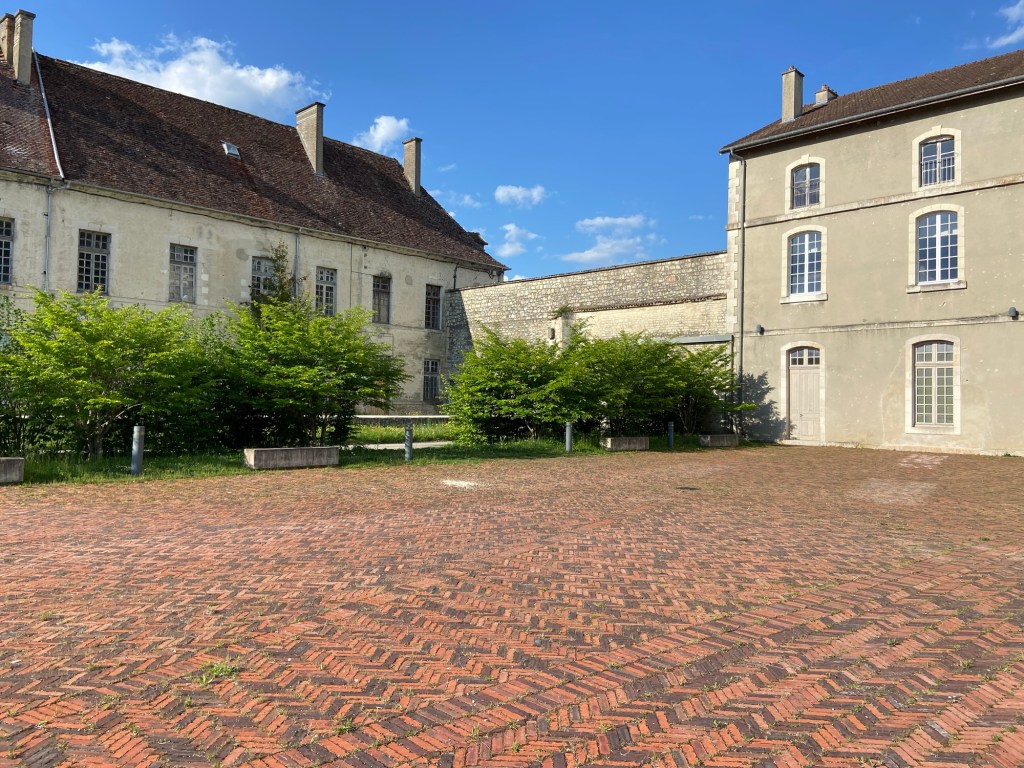
The tour was conducted by young man who as it turned out had absolutely comprehensive knowledge of the site and its history down the ages. It was all in French, and started with a long orientation lecture, but I let what I could understand of the facts and information filter into my brain while I sat and appreciated the coolness, and wondered why the bulldog on a lead held by the woman sitting next to me was wearing a nappy. Her four children asked some intelligent questions, initially focused on the lives of the 550 children who were at one time incarcerated in here. The children’s exercise yard had been the brick-tiled courtyard we crossed to begin our tour.
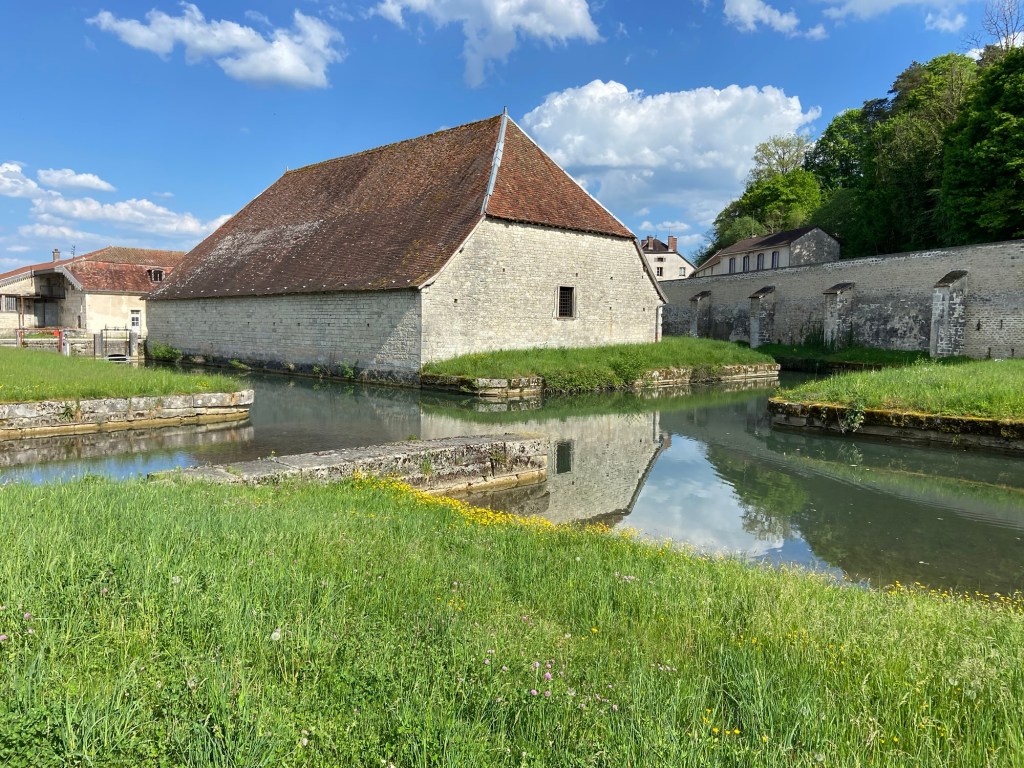
The tour then went out into the first courtyard, where the only remaining building from medieval times, the original lay brothers’ accommodation (later converted into a storage barn for the large quantities of grain and other food stuffs produced by the Abbey lands, necessary to feed the community), basked in the sun beside the shallow fishponds (still occupied!) which contained water diverted via a small canal from the Aube.
The rest of the medieval buildings were seemingly gone. The chapel had been sold to a quarry manager and dismantled for its stone. There remained the vast 18th century structures and courtyards from the last incarnation of the religious community — bewilderingly grand to someone who had been expecting simple monastic buildings. There had been stabling here for more than a hundred horses.
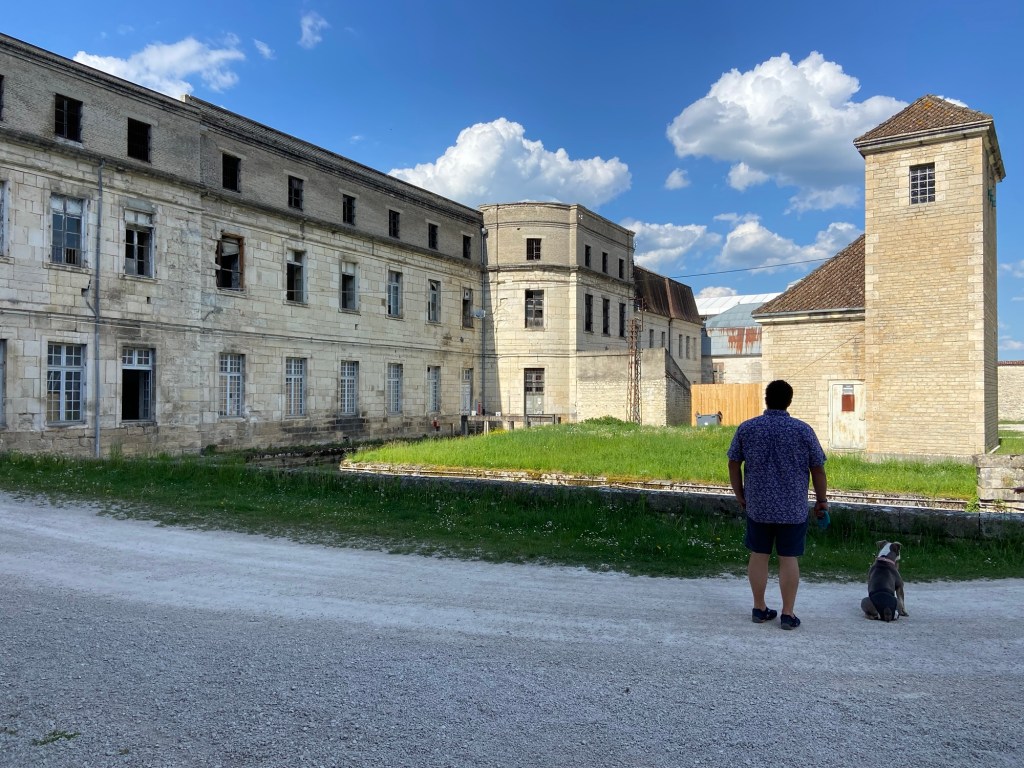
The place was disturbing, eerie. Entire wings of the vast buildings were under restoration wrapping. The guard towers seemed to observe us as we looked around at the dilapidation and ruin. A lone security guard prowled around, keeping an eye on us.

Since the restoration of Notre Dame in Paris following the disastrous fire, the Clairvaux project is the largest in France, with a budget from the state coffers equivalent to almost £11 million. We were taken into the buildings that had already been restored: the 18th century kitchens from the third historical phase of monastic construction, and the refectory. The buildings were modelled on medieval monastic originals. They had been over-restored in my view, and seemed like modern reconstructions akin to a theatre set.
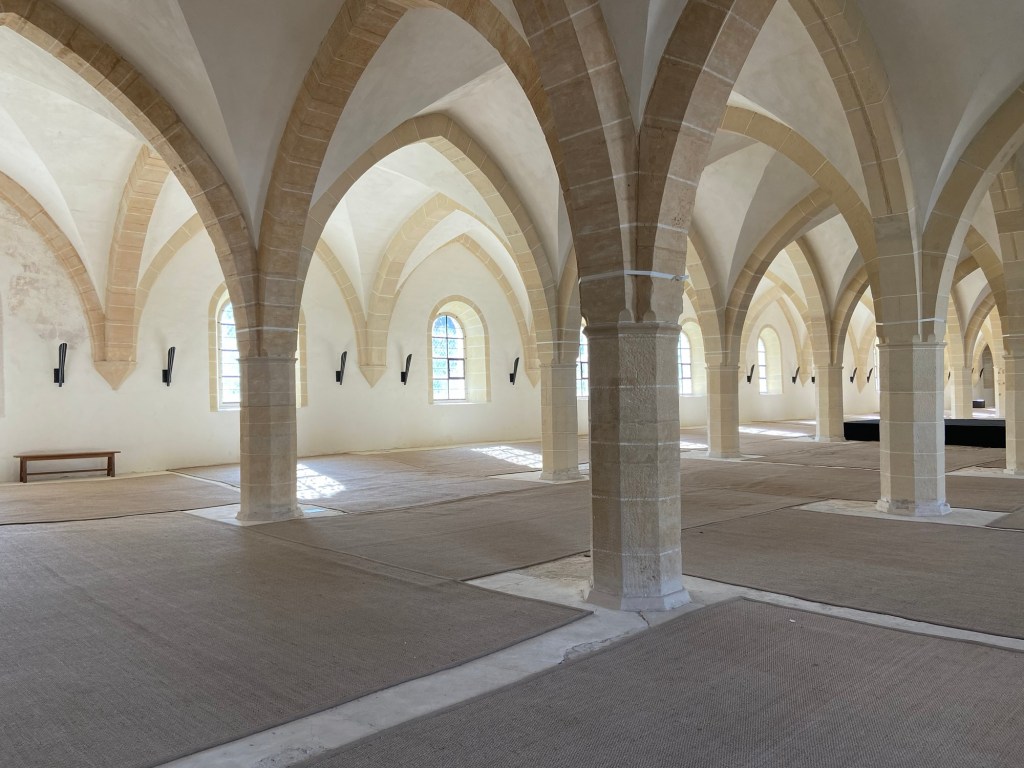
From the dortoir windows we could see the gigantic chantier, swathed in protective covering.
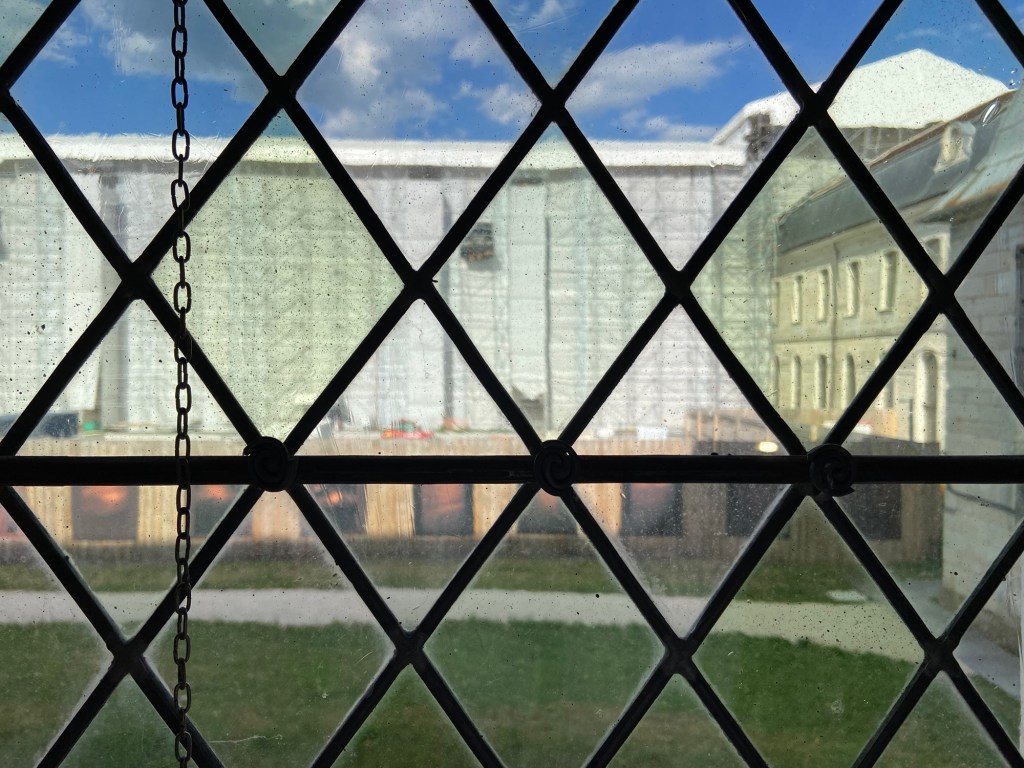
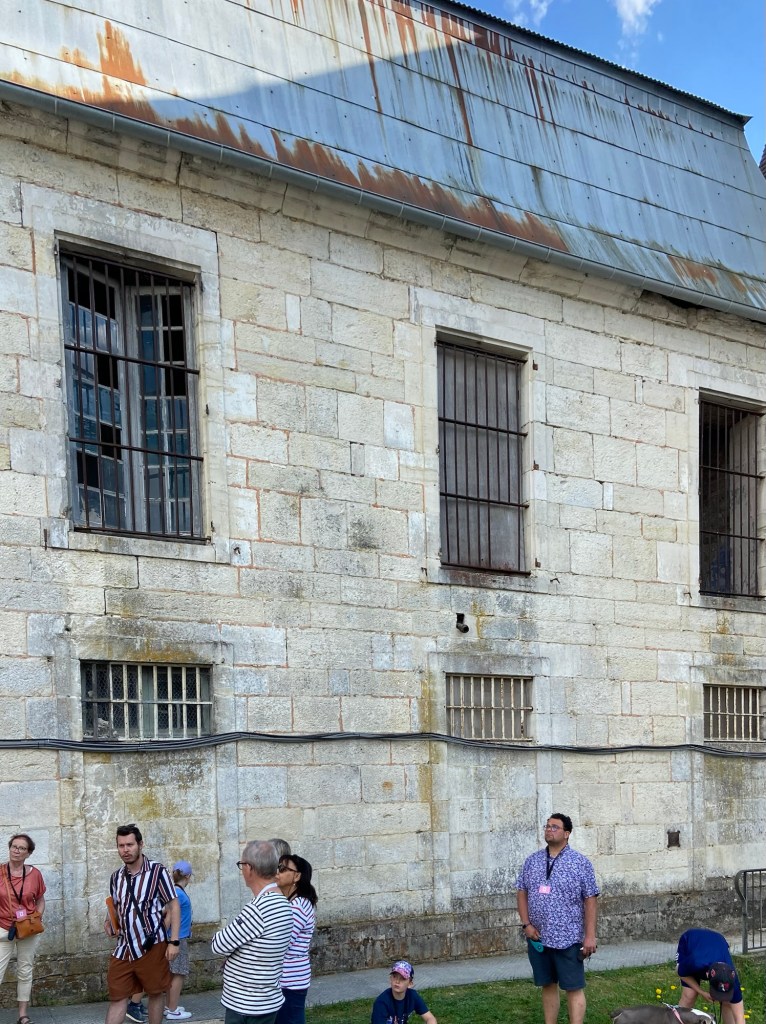
Out in the air again we did a mental about-face, going from contemplating monastic space to staring instead at the barred windows and rusting metal roofing of the prison.
We were taken to a final 18th century building, originally a large chapel which became subsequently used as the prison dining hall.
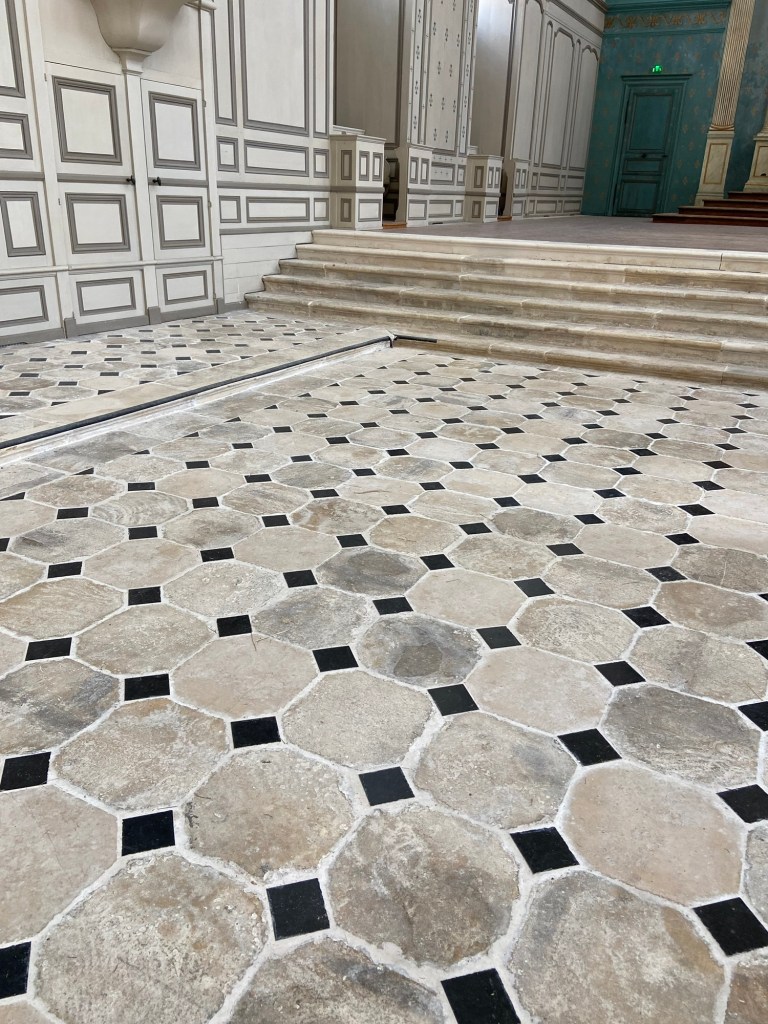
The back wall had been left to show the four tiers of the 1875 construction of ‘chicken coops’ — individual cells measuring 5 x 6.5 feet which remained in use for almost 100 years, until 1971. Before this reform industrialists had been allowed to rent entire jails and ‘employ’ inmates in return for promising to provide for their basic needs. However in 1847 it was made known that 700 prisoners had died through ill treatment, and from then on the prison became the responsibility of the Ministry of Justice.
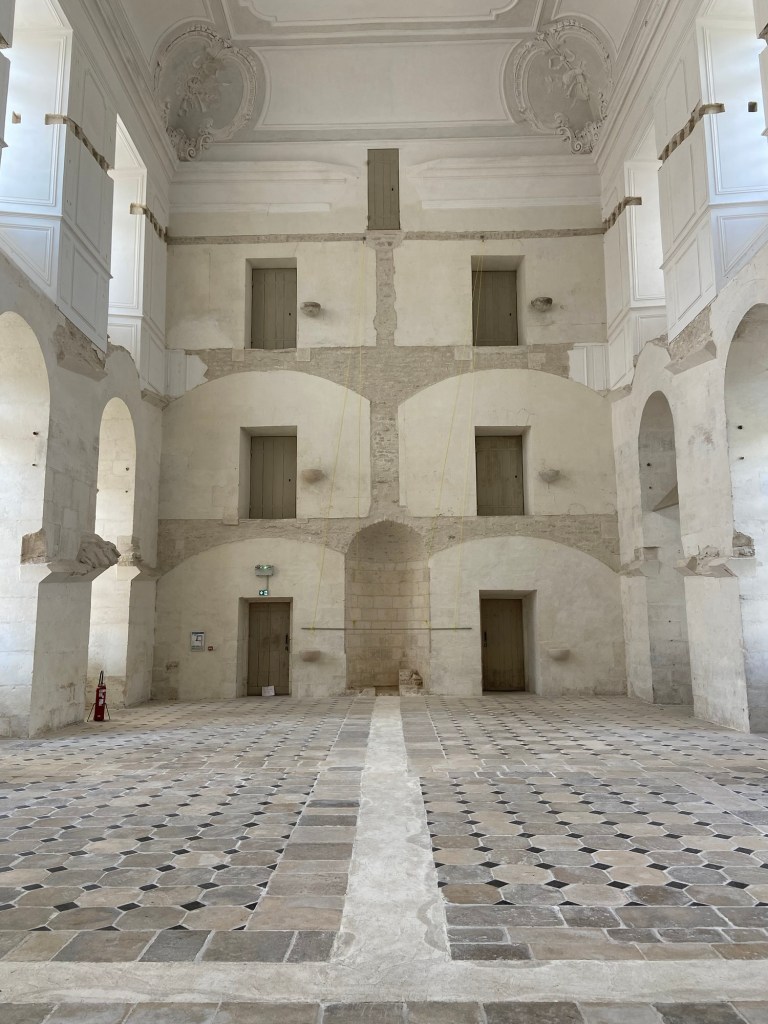
Photographs from the last century showed the cells before their dismantling.
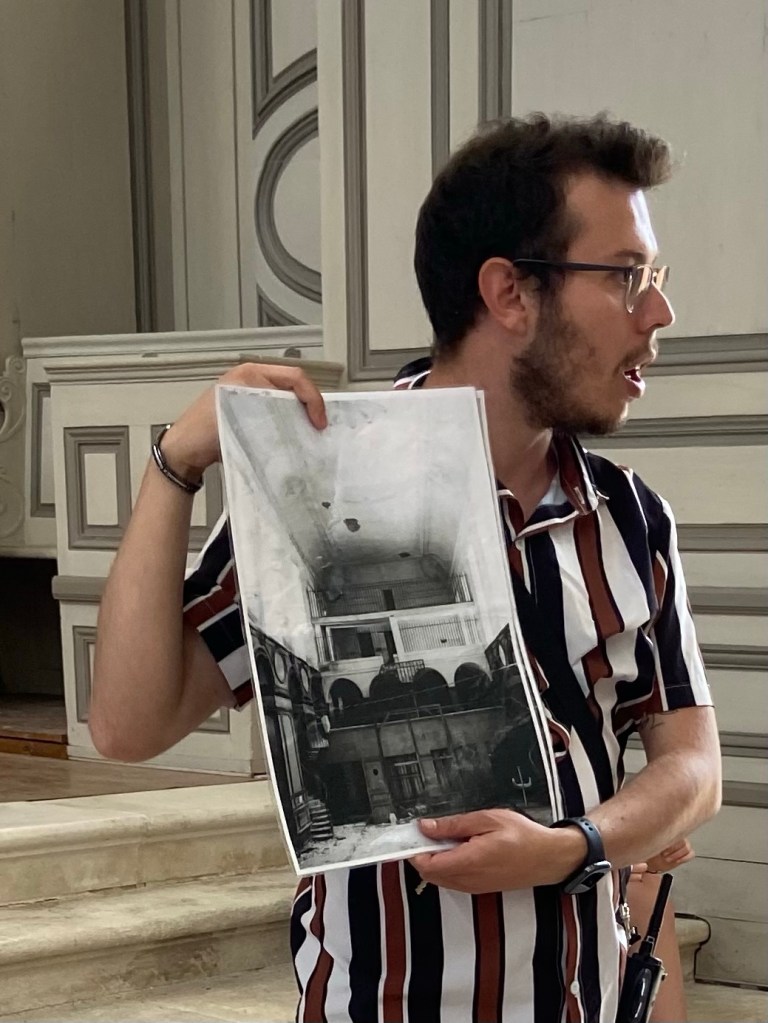
The final stage of the tour took us through yet-to-be restored spaces, with blistered paint peeling from damp plaster, ancient pipes and cabling hanging off walls, everything thick with cobwebs. The unrestored, abandoned character of the place took me in my imagination straight back to 1831, when Claude Gueux, a prisoner jailed for a trivial misdemeanour committed in the context of a life of constant misery, was beheaded for killing a warden who had separated him from a cellmate. When the tragedy became public, it inspired Victor Hugo to write his 1834 short story ‘Claude Gueux’, which in turn became the background material for his later novel Les Misérables, and Gueux became Jean Valjean.
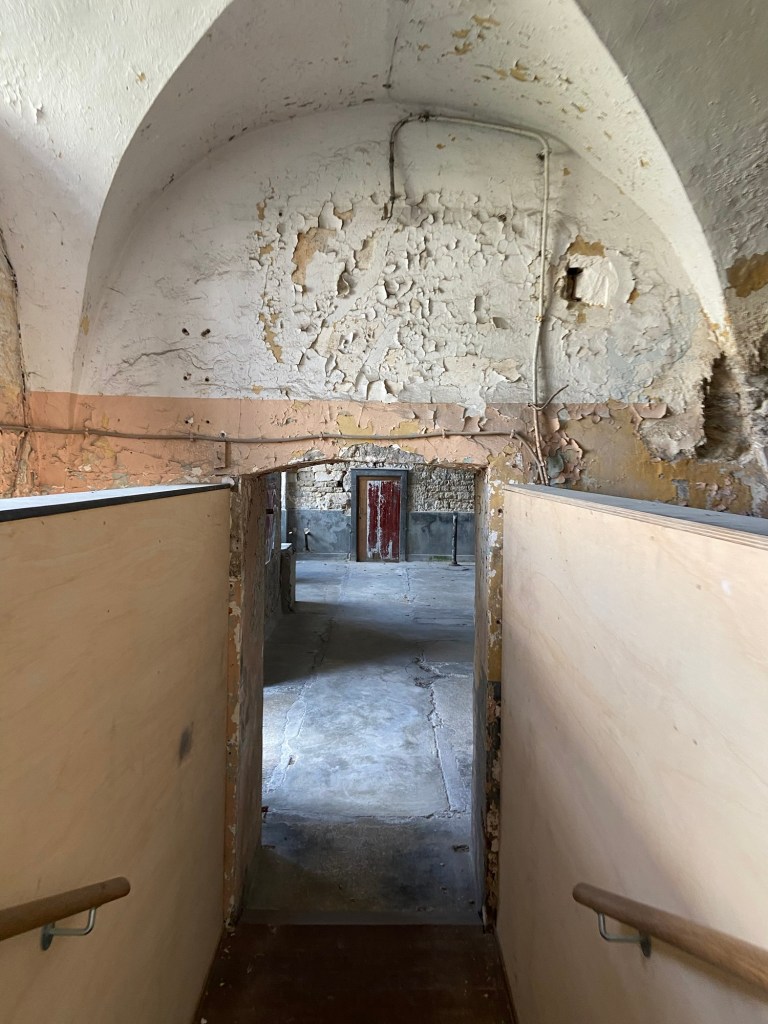
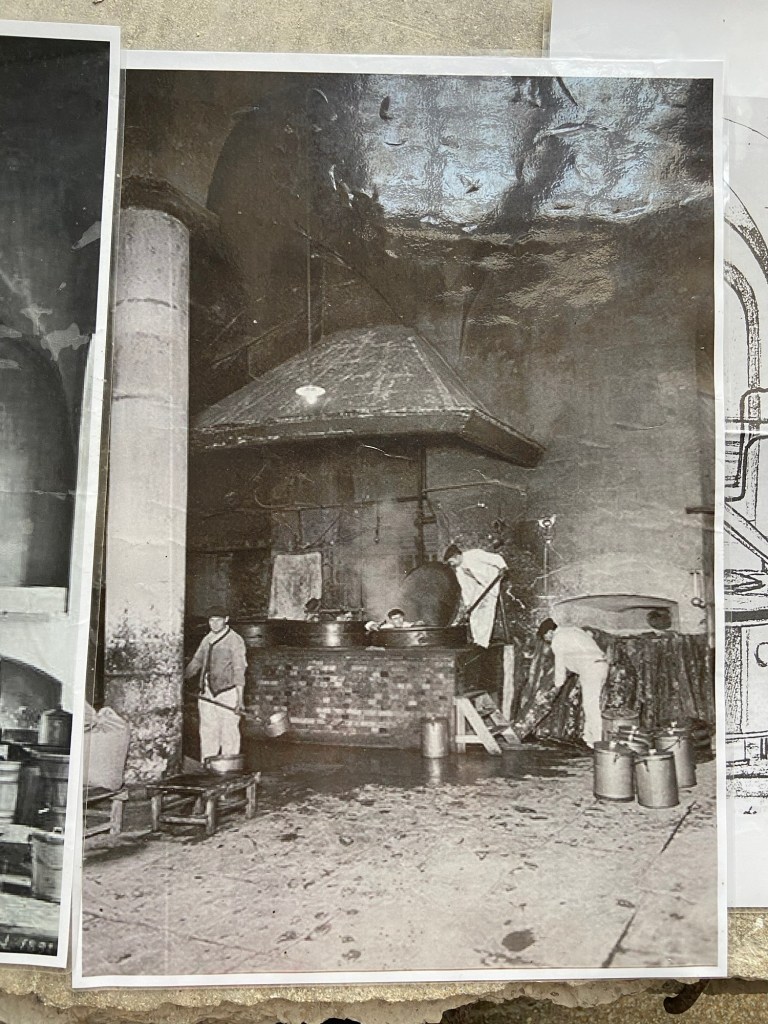
Here was the prison kitchen, a cavernous, pillared space with a vast, blackened open oven chimney.

Another photograph, taken in 1931, showed inmates toiling away here over huge vats of the thin vegetable gruel which was the daily fare. Occasionally, we were told, there was a little bread.
We all walked thoughtfully out of the gates, the other visitors to their cars and me to my hostel. The two incarnations of this place had been fascinating, and totally unexpected. Enclosed communities, and Orders of very different kinds. Asceticism, and privation. I had anticipated mediaeval beauty (and had had my fill today of beauty in Bar-sur-Aube), but encountered something much more beastly in the chilling fortunes of the great former Abbey of Clairvaux.
Stats for the Day
Distance: 22.47km
Time 4 hrs 53 mins over 7 hours
Pace: a slower 4.6 km/hr average! I put it down to the heat and the hills.
Elevation gain: just shy of 400m
Delicious meals left in the fridge for me in the pilgrim hostel by Aude the good fairy: 1, but effectively 2, since there was so much I packed up half for tomorrow’s lunch.

 Walking The Landscape
This was a wonderful blog to read and full of information on all levels. I don’t know how you do it. Thank you Sophie for the array of photos all of which have their own story to tell. Thank you again! X
PS I’ve never seen a lizard orchid and on googling find them amazing! Lucky you.
LikeLike
I’m in Malvern Hills. It was so hot here yesterday too. Slightly cooler today with a nice breeze. Just love your descriptive writing thank you. 1 month today and I will start
LikeLiked by 1 person
You’ll have an amazing time! Happy packing and dreaming
LikeLiked by 1 person