There must be a union between the spirit in wood and the spirit in man … gradually the form evolves, much as nature produces the tree in the first place.
George Nakashima
I woke up this morning feeling incredibly stiff all over, in particular in the muscles of my upper back which are supposed expand when I breathe deeply. It felt like they were going to go into spasm. This thought was particularly alarming, since today’s walk was to be 29 km, created by putting together two stages. I stretched carefully for a long time, shunning Stephen‘s very sensible suggestion of another hot shower, because I rather pathetically didn’t want to get my towel soaking wet, and by the time I left the hostel everything had loosened up somewhat.
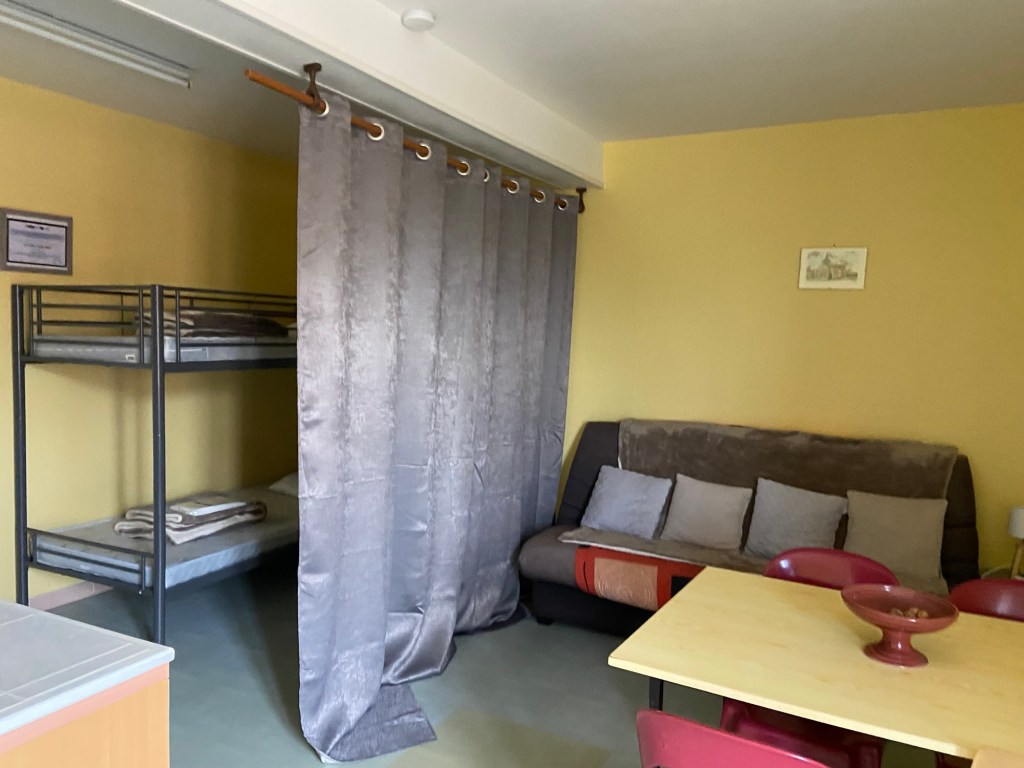
I was immensely cheered that after my perfectly serviceable hostel accommodation last night, I was heading to a place about which the guidebook noted ‘spa available’. After a month on the road, I feel pretty much ready for one of those!
Perhaps a visual metaphor for how my body felt was to be found in this carcass of a half timbered building,
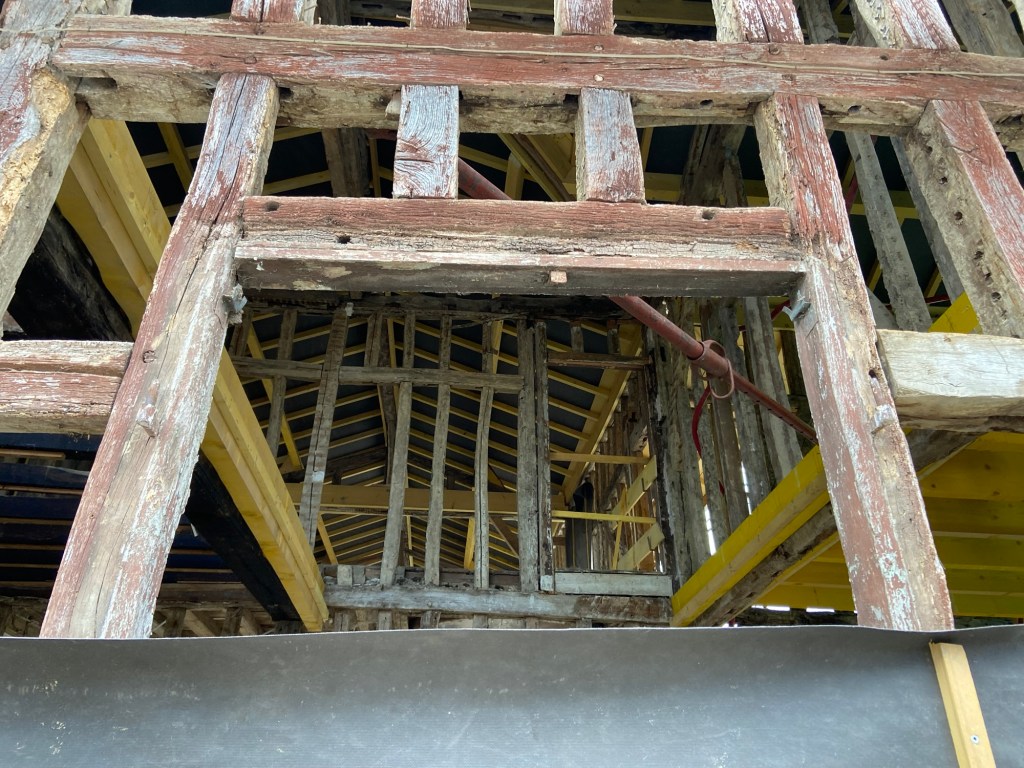
being prepared for a renovation with tile infill and a new oak sole plate.
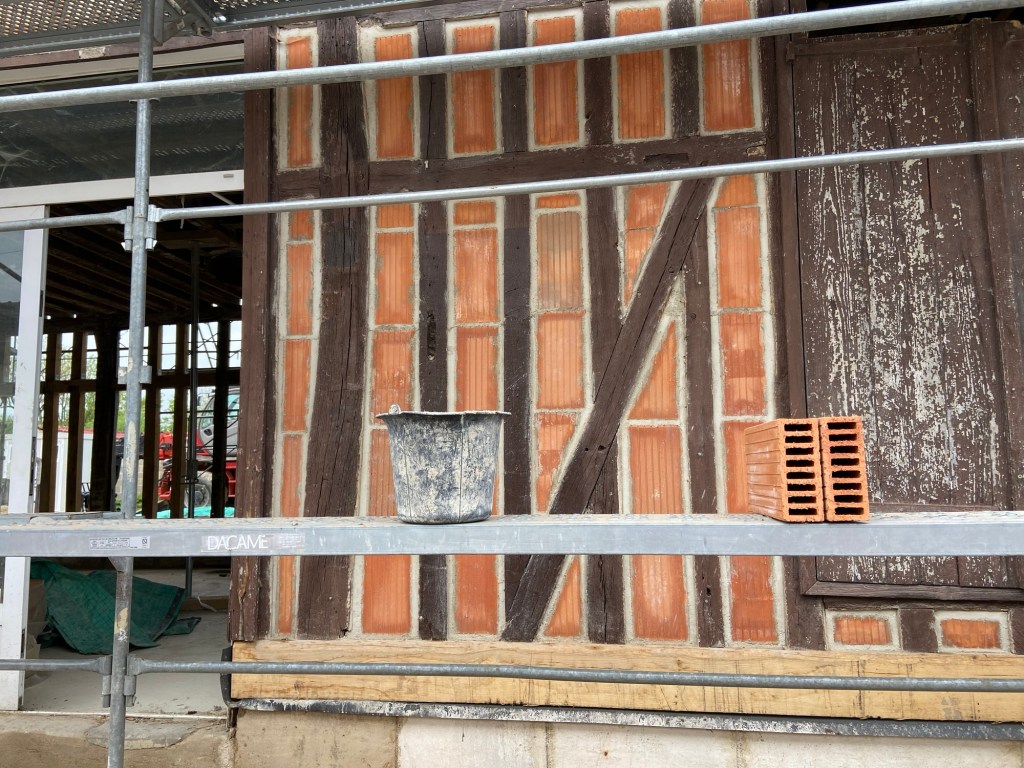
It also presaged the main feature of the day: half-timbered houses and churches in villages amongst woodland nature reserves punctuated by the ponds which characterise this ‘wet Champagne’ region where the ground is too damp for viticulture and where stone for construction is lacking.
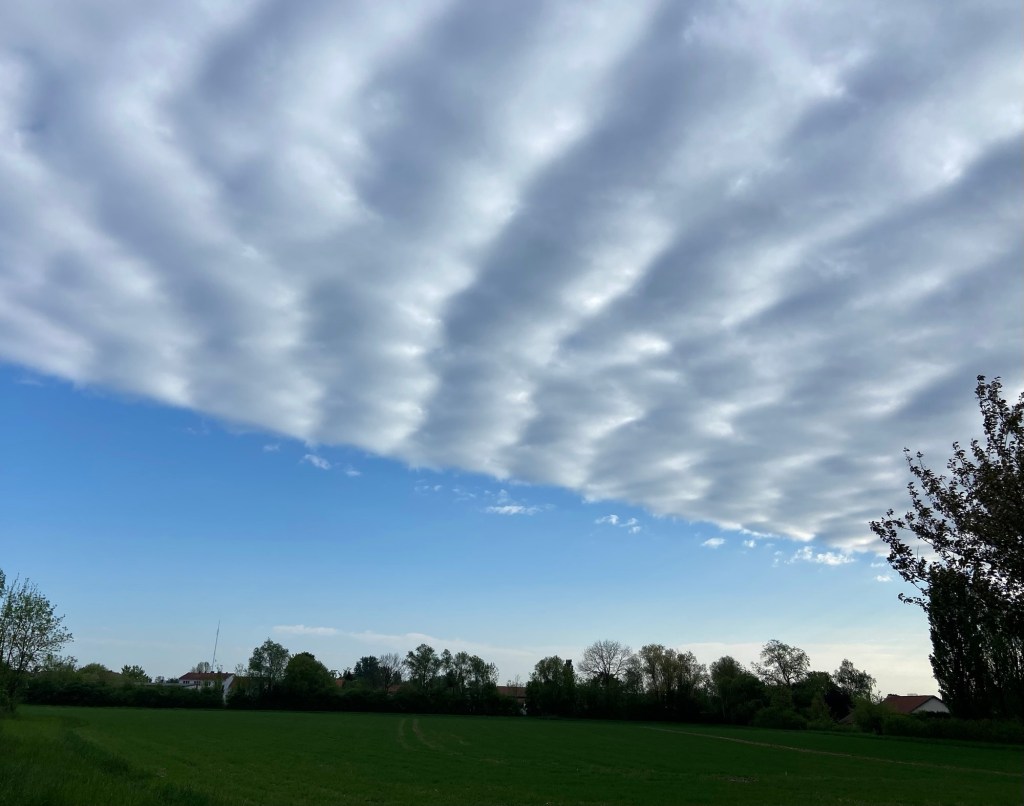
First though for me, it was out into the fields again under a terrific sky.
In the fields of either side of the road a range of scarecrows had been set up, ghostly figures and more of those huge bird-of-prey kites, tied to long poles and swooping and dipping in the breeze. Who knows whether any of them actually work? Crows are pretty smart creatures.

The entry into the woodland section was promising,
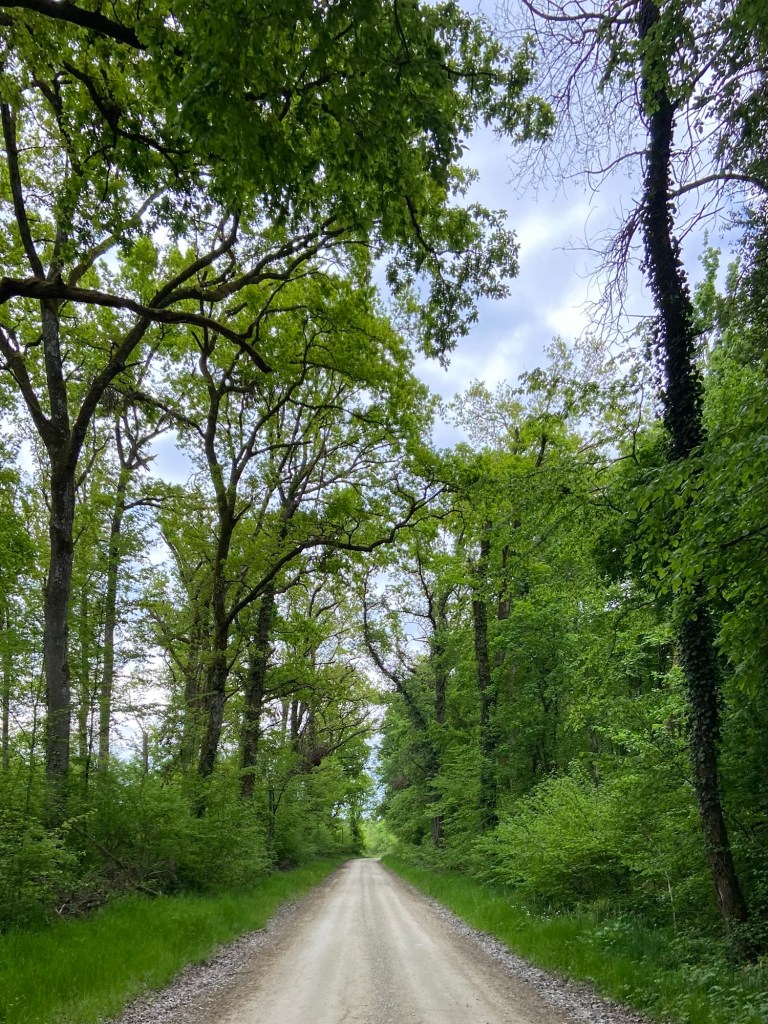
but it was long, and at times felt lonely. The path now crept around the edge of trees, now through dark stands of thickly-growing natural woodland. It was all a little bit creepy. There was a single farmhouse, in a state of advanced dilapidation,

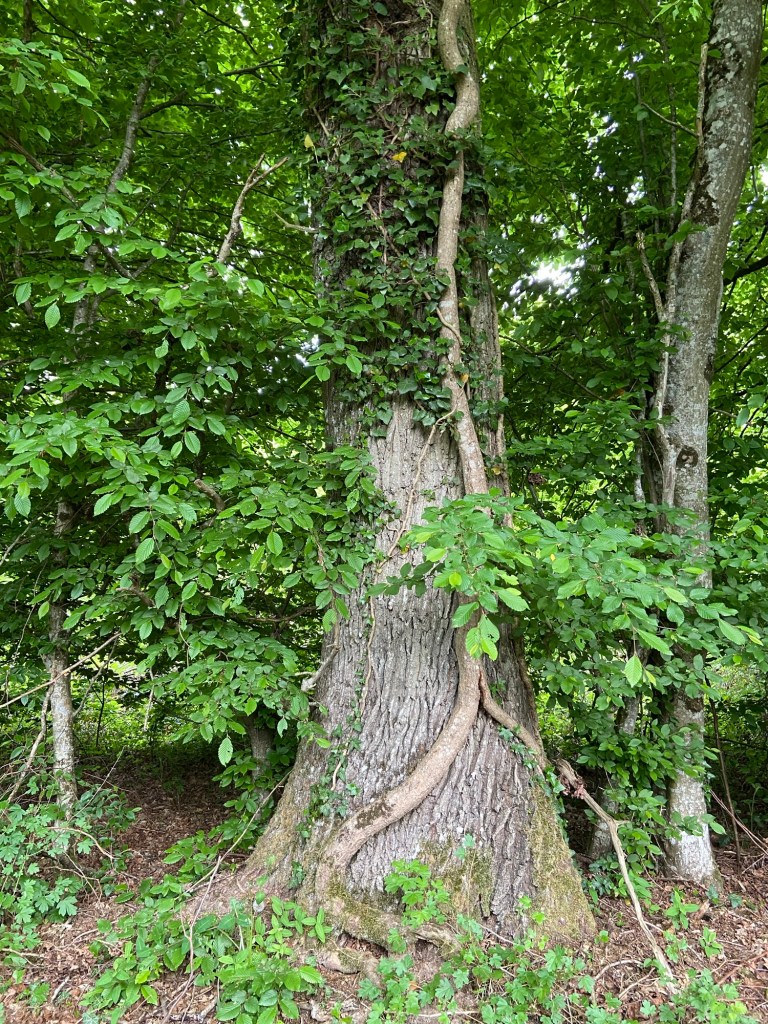
and handsome oaks were being parasitised in triple-slow forest time by vigorous ropes of ivy.
On the map there were plenty of lakes and ponds, part of a managed system for holding water in the landscape and protecting Paris from flooding. The road passed by one or two, but most were hidden away in woods, or too far away to appreciate.
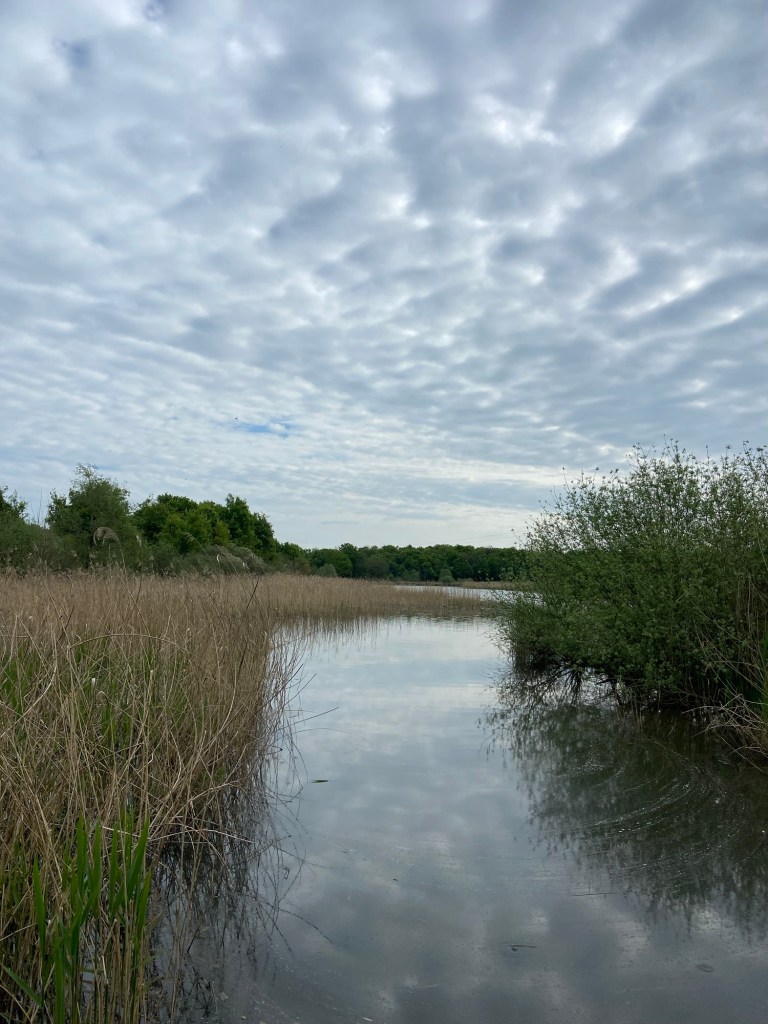
I met no one, but out in the fields there were semi-human forms: more disquieting scarecrows. Bird-scarer cannons went off at random moments, making not only me jump, but also a little deer browsing on the path ahead. With the dry ground, there would be no chance of her leaving tracks as she leaped the fence and bounced away into the meadow ahead, although in the damper ground in the wood I had seen some deer hoof prints. I made a mental note to check for ticks later.
I mostly listened to my audiobook for company, and was glad that the word ‘swampy’ in the guidebook had prompted me to put on some insect repellent. Insects of the mosquito kind were a constant presence all around me in the warm, dim woodland, but seemed to be effectively fended off by the cloud of discouraging chemicals.
The swampy ground did support lots of wild comfrey, though, in colours ranging through white to pink to purple, and I saw the first ragged robin,

and, at last, wild garlic in flower. It’s taken a month walking through land too naturally dry to support it to find any.

Finally, this section of the route came to an end at a little gîte hidden away in a woodland where both nightingale and churring turtle doves were calling. The gîte was called ‘In the Middle of Nowhere’, and it was well named.
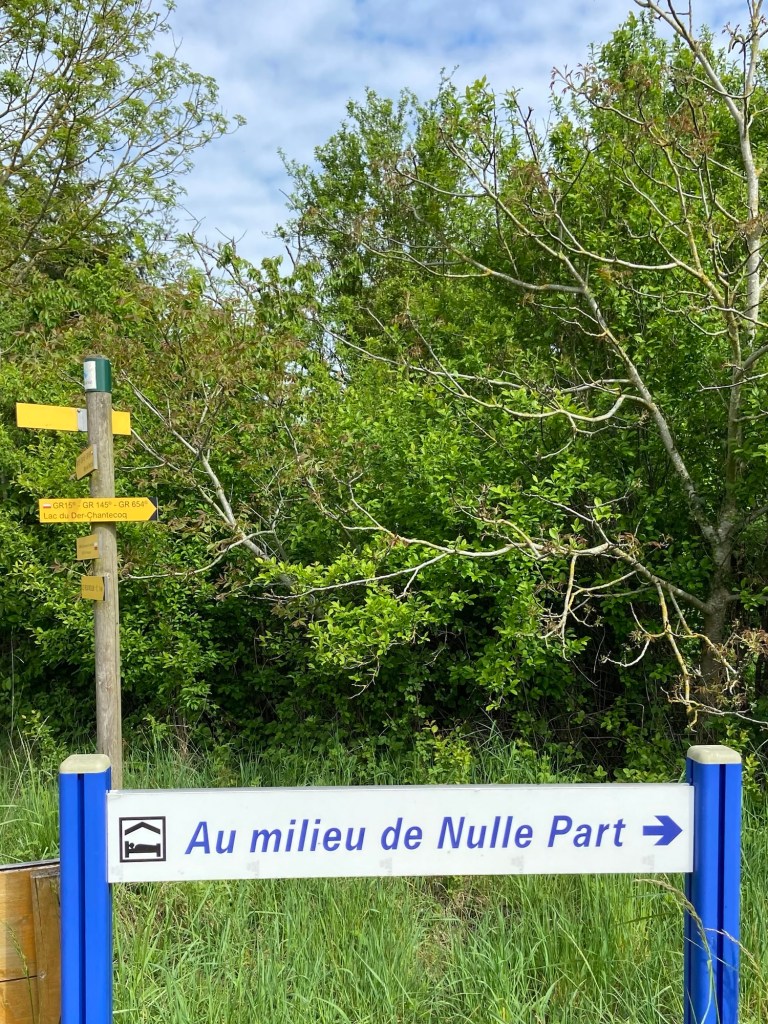
The asphalt road into the tiny village of Outines was much easier walking, and provided an honour guard of western yellow wagtail (to add to the grey and pied wagtails I have so far seen). Their yellow breasts and bellies seemed to draw colour from the fields of oil-seed rape beneath them as they called from the telegraph poles above, then flew off, yellow flashes against the blue sky.
But apart from them, it was a lonely road.

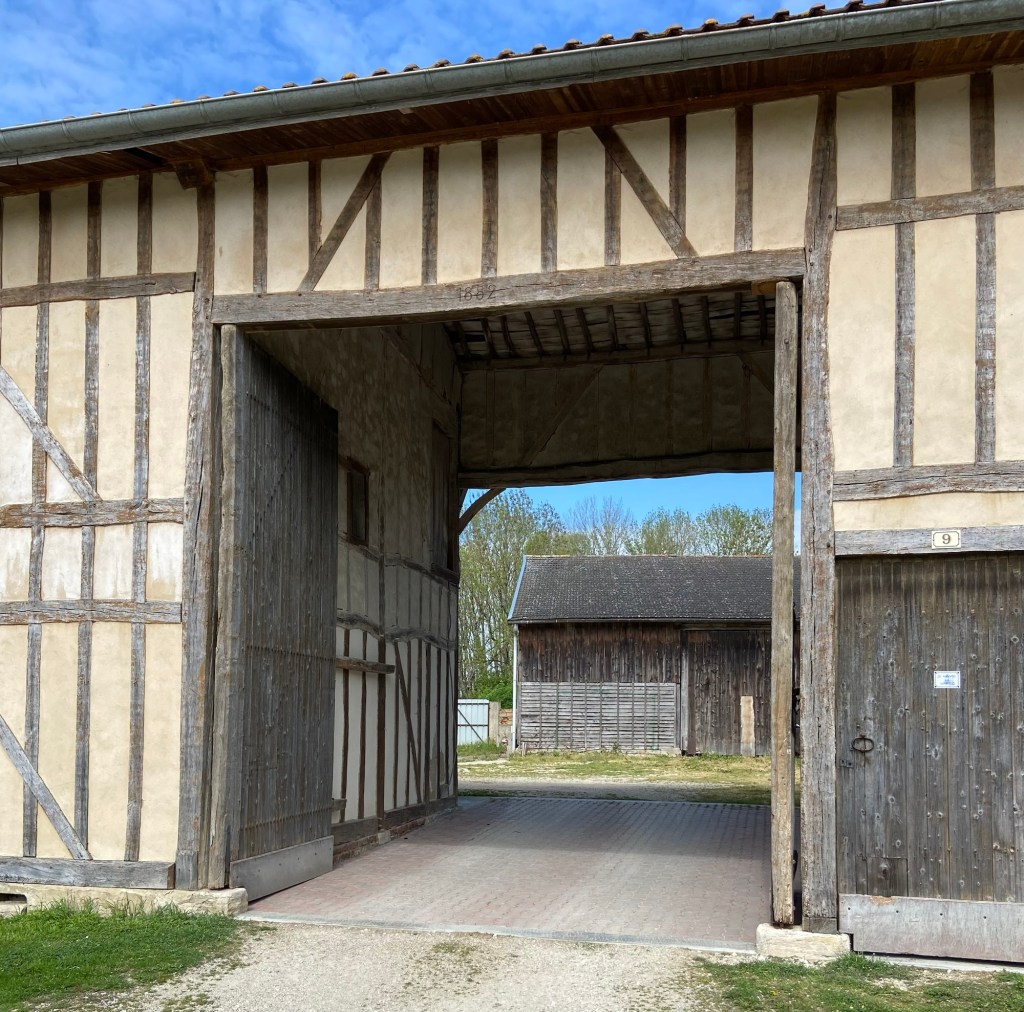
Outines, when it came, was a little gem. A village of half timbered houses, architectural protections are now in place to conserve the character of the village. The long, wide central street looks today almost as it did in the 19th century,

albeit with the addition of many cars.

Here again farms make up the bulk of the town buildings, half-timbered courtyards visible through the enormous porches.
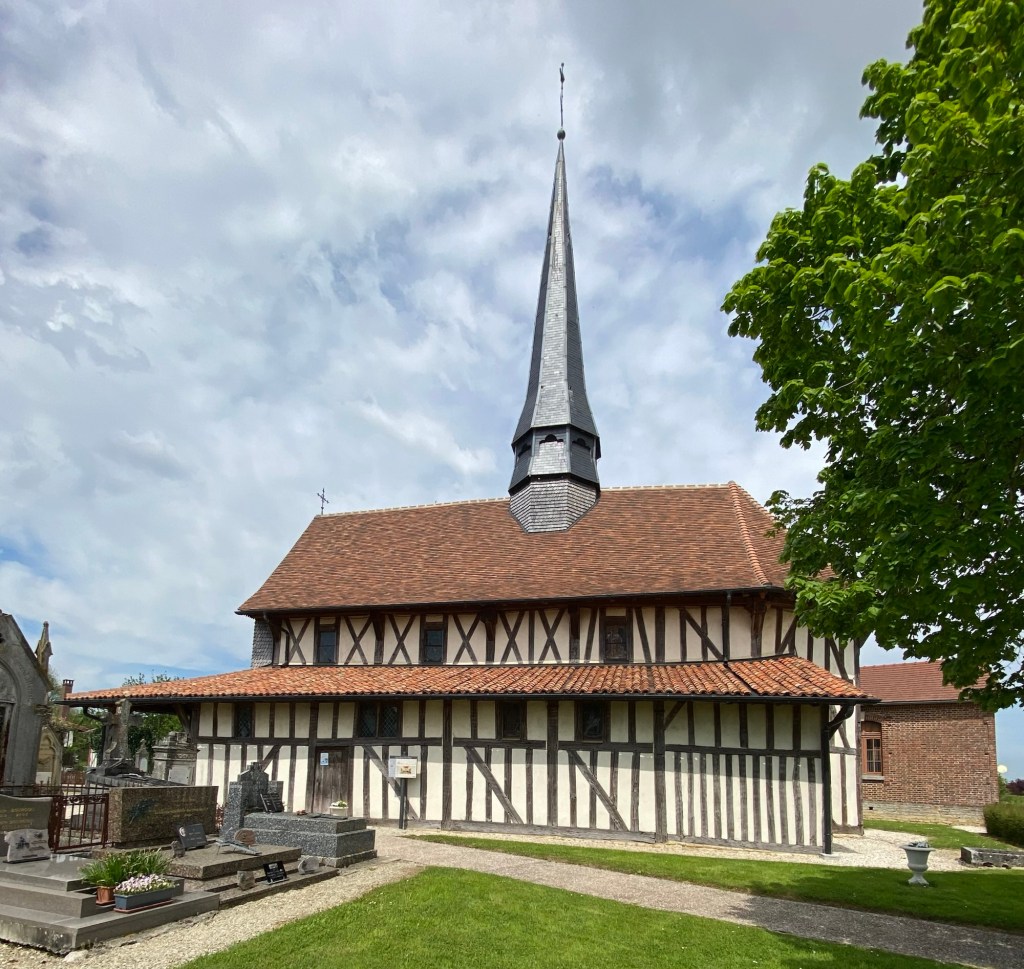
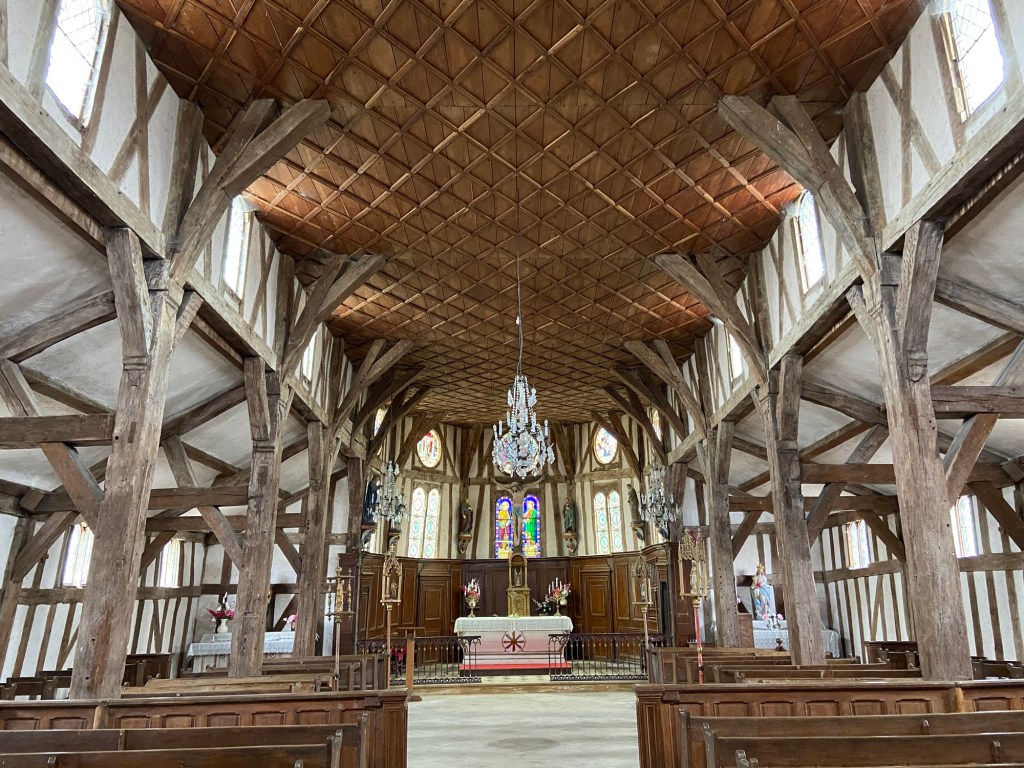
But the centrepiece is the extraordinary half-timbered Church of St Nicholas in the centre, dating from the middle of the 16th century.
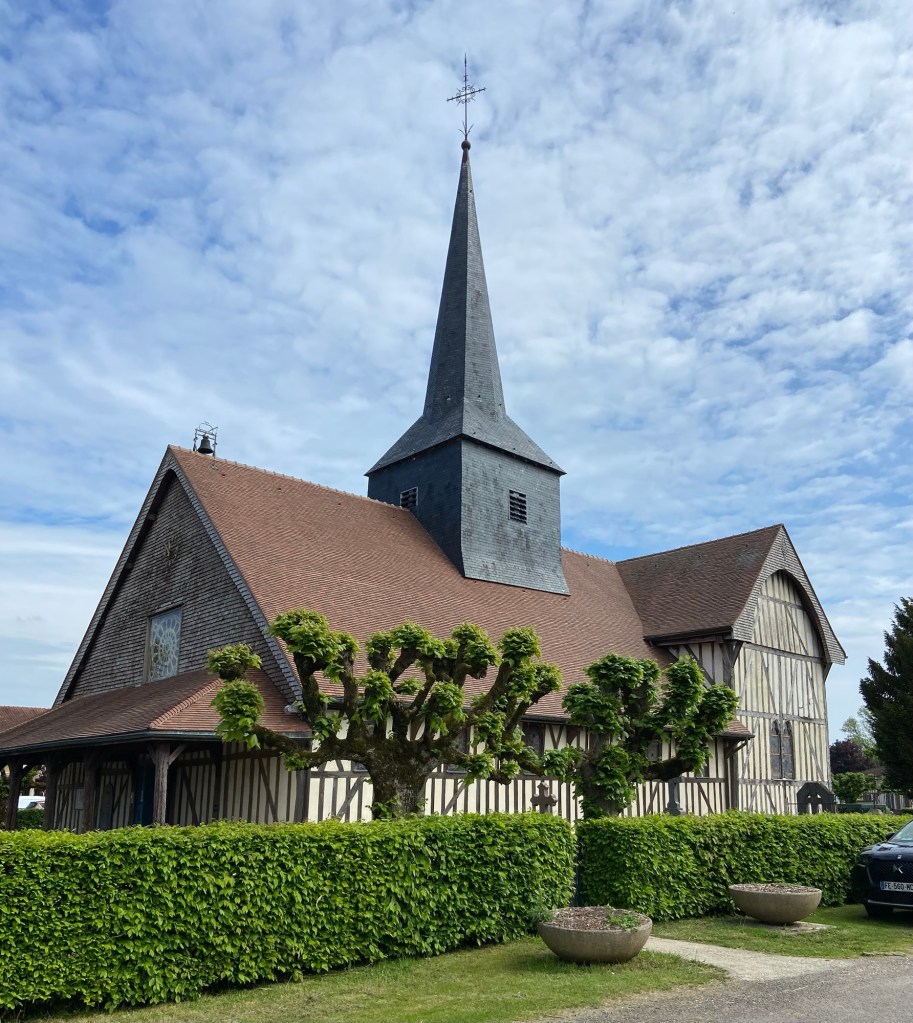
At first I thought I had unintentionally timed my visit to coincide with the ending of mass, but there was a baptism about to begin as most of the parishioners were leaving.

I was able just to have brief glimpses of the interior, including a wooden model of its construction, showing the complex pattern of pillars, side aisles and spire interior,

before I had to leave when the service began.
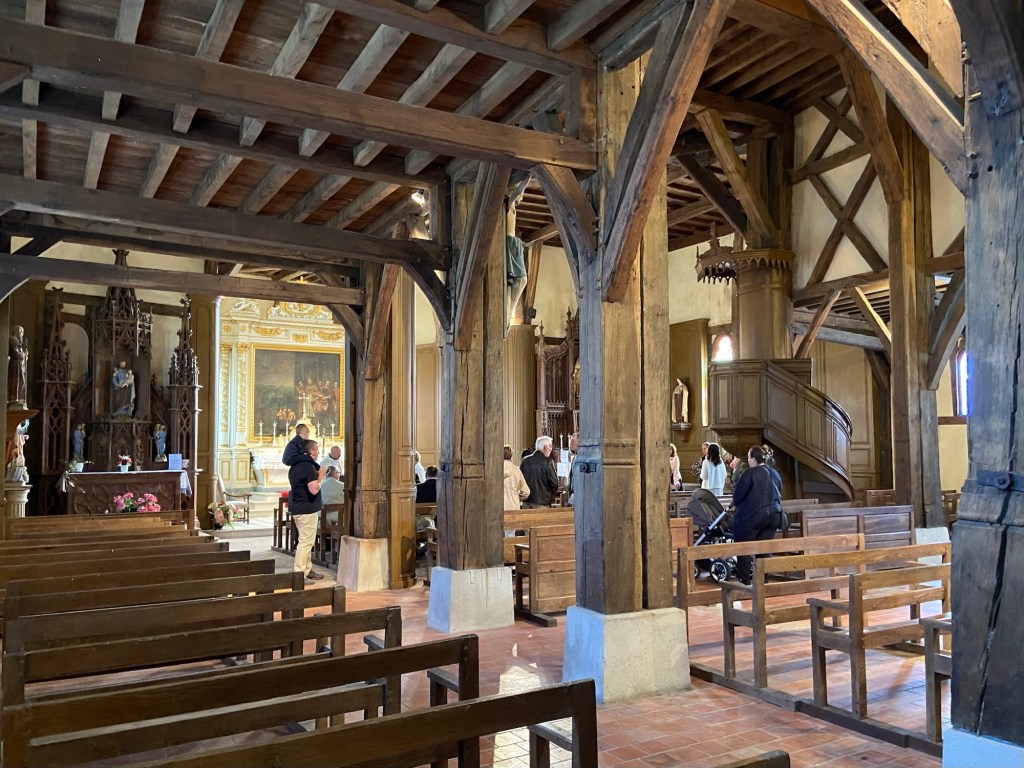
So I sat on a boulder on one of the wide swathes of grass outside, listening to the singing from inside the church, as its people welcomed another soul into their small family.
Outines was the end of the day’s official stage, but I was combining two, to end up at a village some 16 km away. The skies were clearing and the sun coming out, so I put on some sunscreen and covered my head, put my shoes back on and set off, taking a road route to save myself what I hoped would be a kilometre also.
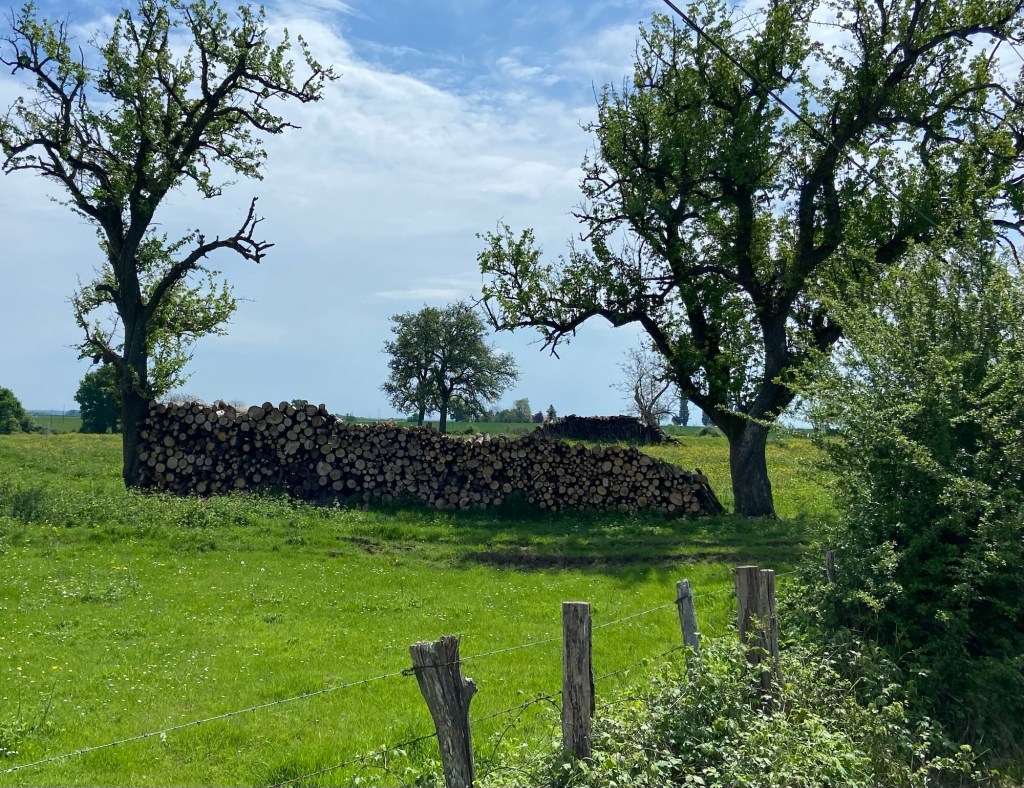
It was a pretty country road. Cows were sheltering from the sun under the trees, and I wished I could too.
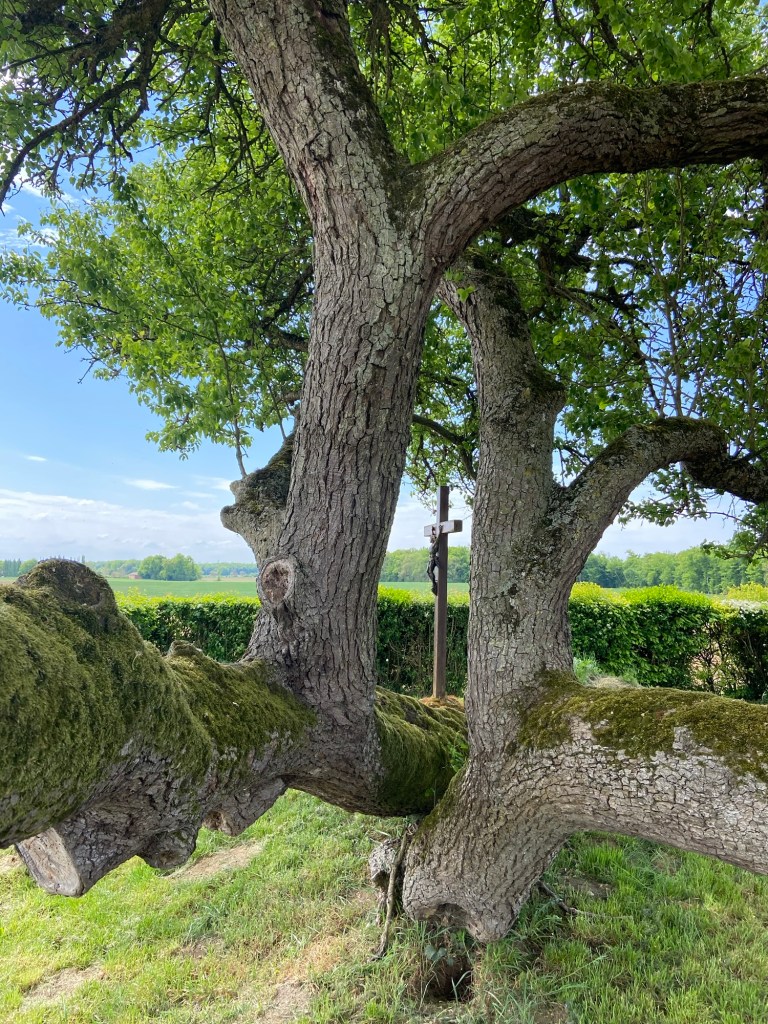
I did so at the first opportunity, where one of the roadside crucifixes, a Calvaire, had been raised under a shady tree. A check with the Merlin app confirmed that the large grey bird of prey I had seen quartering the cornfield on the lookout for small mammals or perhaps something larger, like a rabbit, had been a western marsh harrier. But it also threw up a surprise: somewhere, a little owl was also making its presence known. I checked carefully in the tree but couldn’t see one roosting.
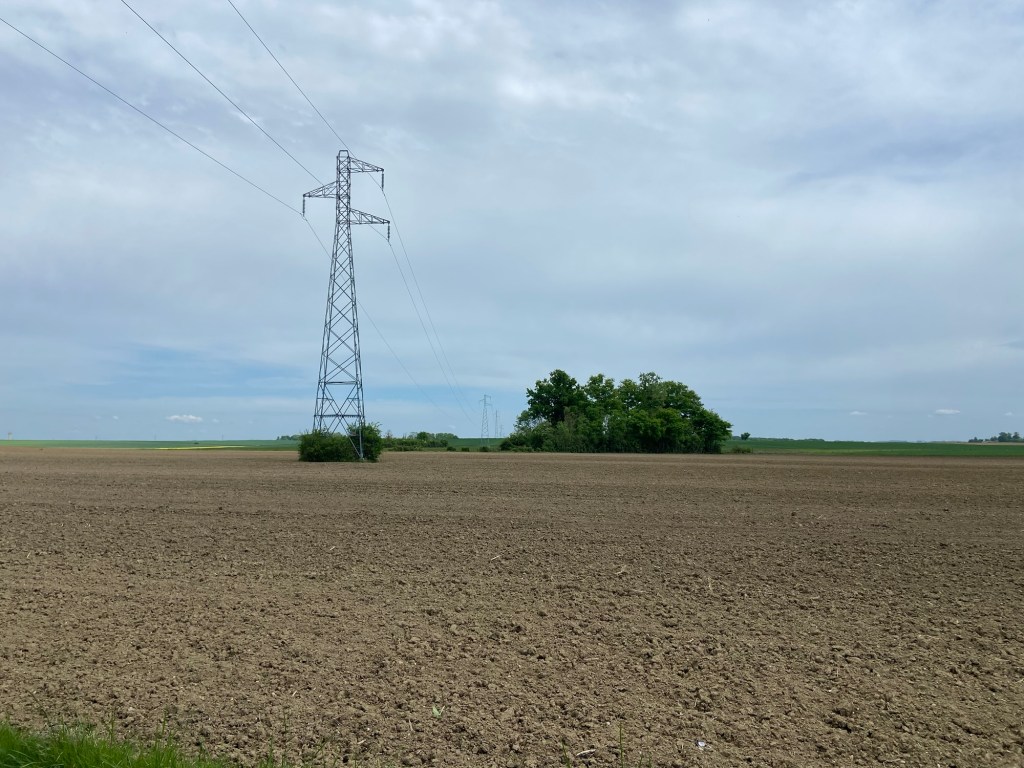
For the rest of the walk to the next village, I was serenaded by nightingales, their voices thrown across the fields from the little copses in which they were nesting. There are just so many of them! But I’m not feeling blasé… they still feel very special, and literally stop me in my tracks. They’ve been one of the most memorable aspects of this walk.
The day’s second wooden church was in Bailly-le-Franc. The 1510 Church of the Exultation of the Holy Cross was also open (miracle!) and by the time I got there, I was so hot and sticky that the interior coolth (as mum would say) felt blissful.
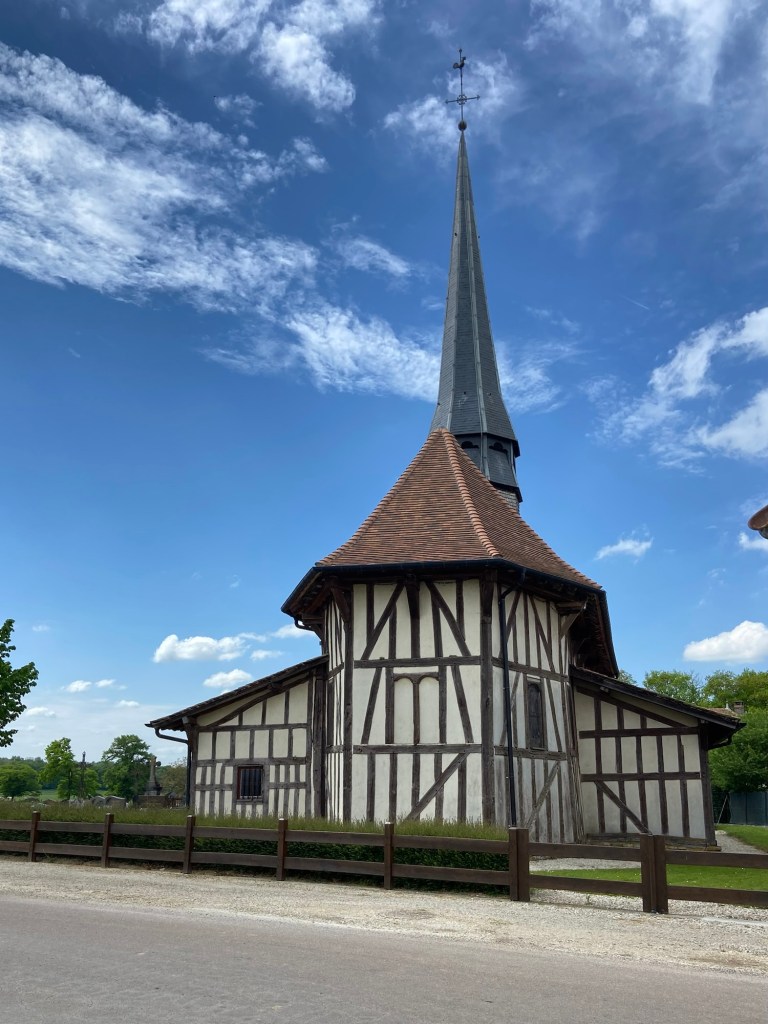
The church is constructed with the same side aisles as in Outines, but here with roofs of different levels, topped by a soaring slate-covered spire.
Inside, the nave is apparently ‘lit by a row of narrow bays surrounded by Saint Andrew’s crosses created by the way the wood is assembled’, but I couldn’t work that out, myself.
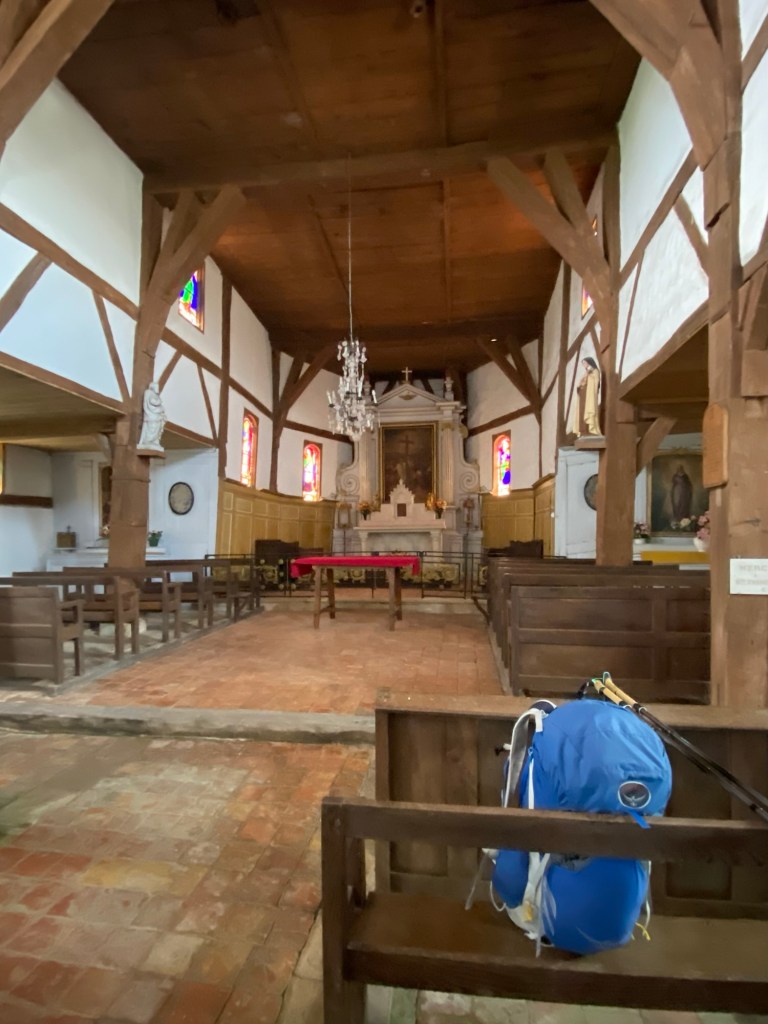
The inside definitely felt as though it could do with an awful amount of (expensive) care and attention — so much so that I wondered whether the church was actually in use. The pews seemed dusty, and underneath be section the beautiful red pantiles were green with damp. The ceiling looked intact, so I presumed it was coming up from below.

I signed the visitors book, adding my name to the hundreds of pilgrims who have passed this way. The pages felt damp too. In contrast to Outines, where there is a thriving community, this village was almost vanishingly small, with empty homes or houses for sale. Too few, it seems, to form an effective parish to care for its patrimony.

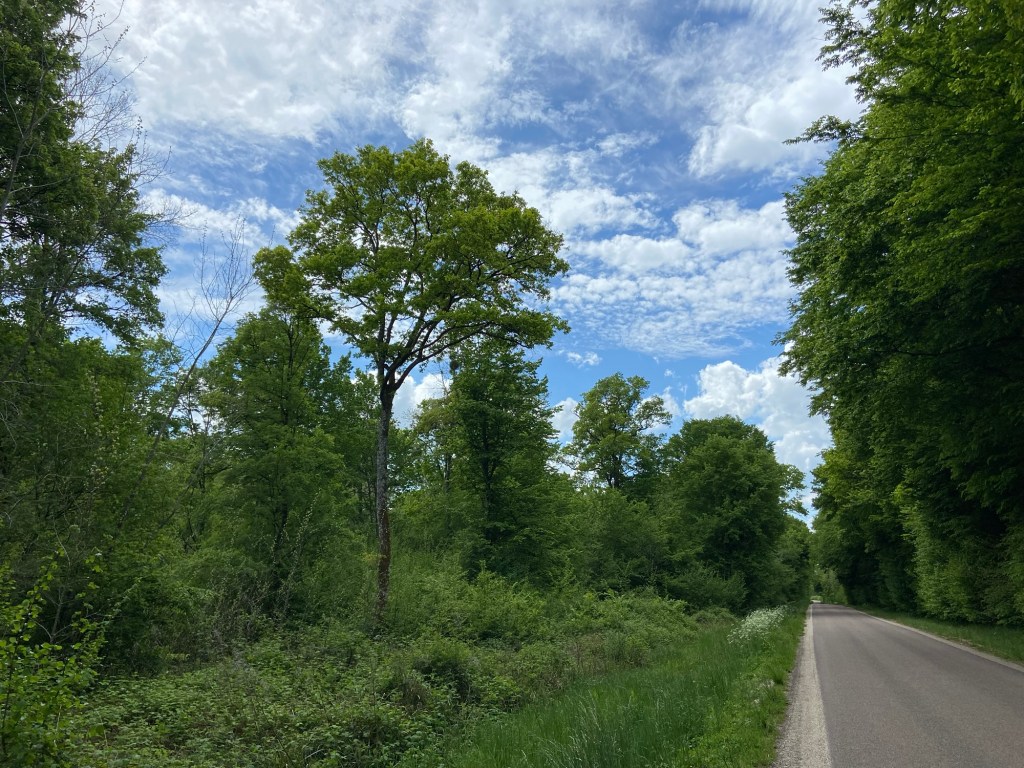
Now it was onto the third village, through another patch of woodland, still all on the road.
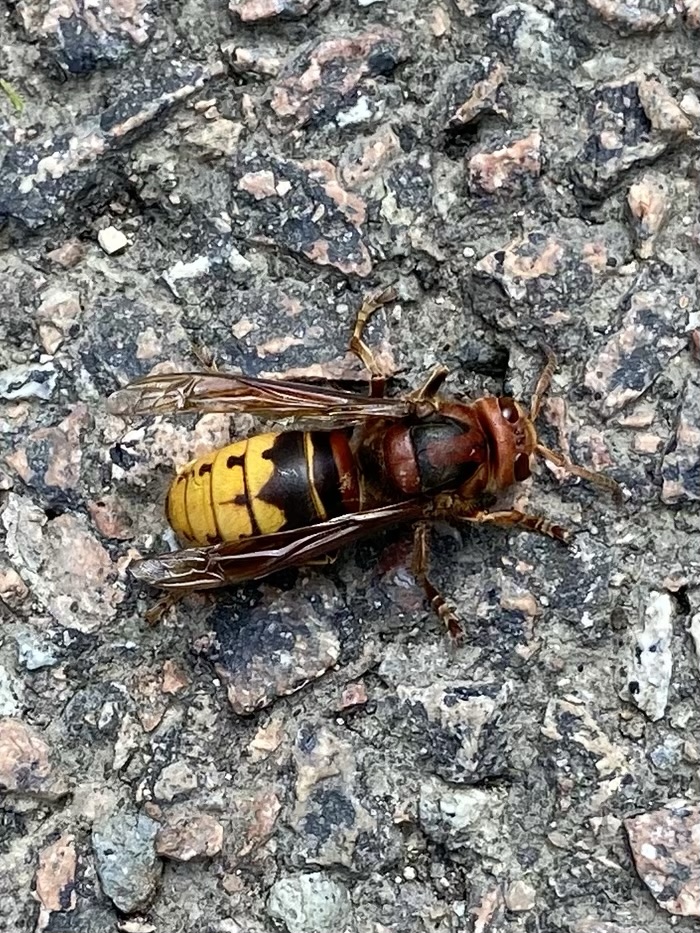
and giving a very wide berth to a 3.5cm European Hornet, Vespa crabro. I find them absolutely terrifying: I wouldn’t have lasted long in the Carboniferous when the dragonflies had 75cm wingspans. Speaking of dragonflies, I had seen my first yesterday, but had forgot to mention it. I saw none today, despite so many pools and lakes.
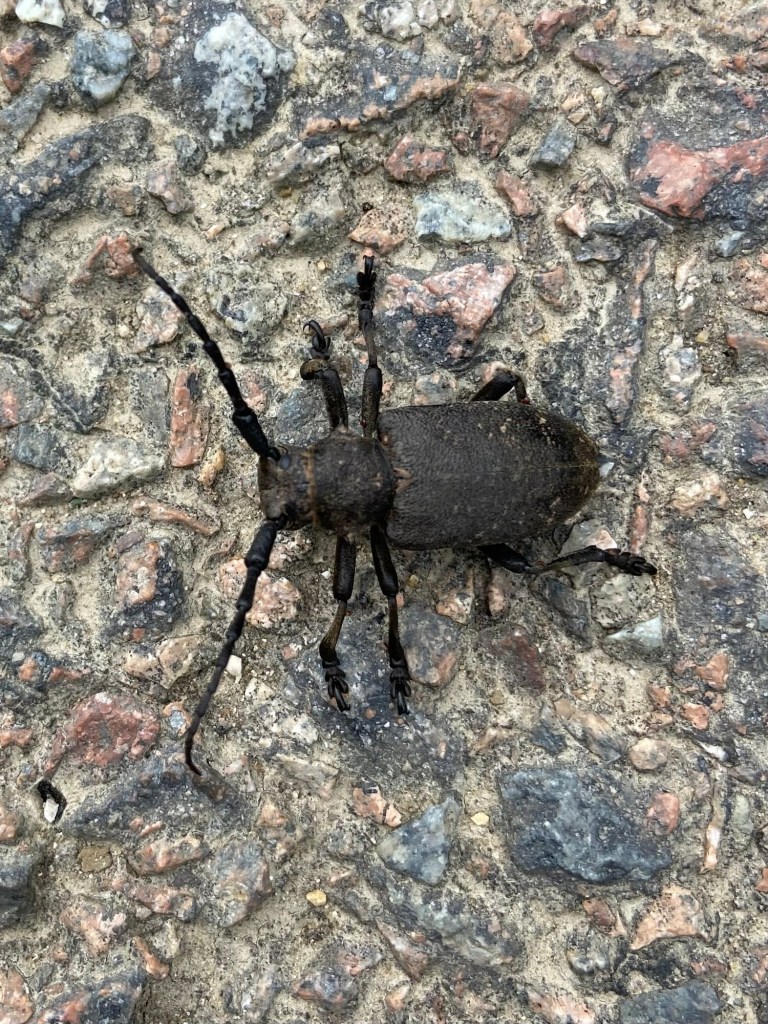
Also on the tarmac was a longhorn weaver beetle, Lamia textor. I’m not sure why it and the hornet were on the ground and so obligingly easy to photograph. But I was glad to see some of the otherwise invisible inhabitants of the woods.
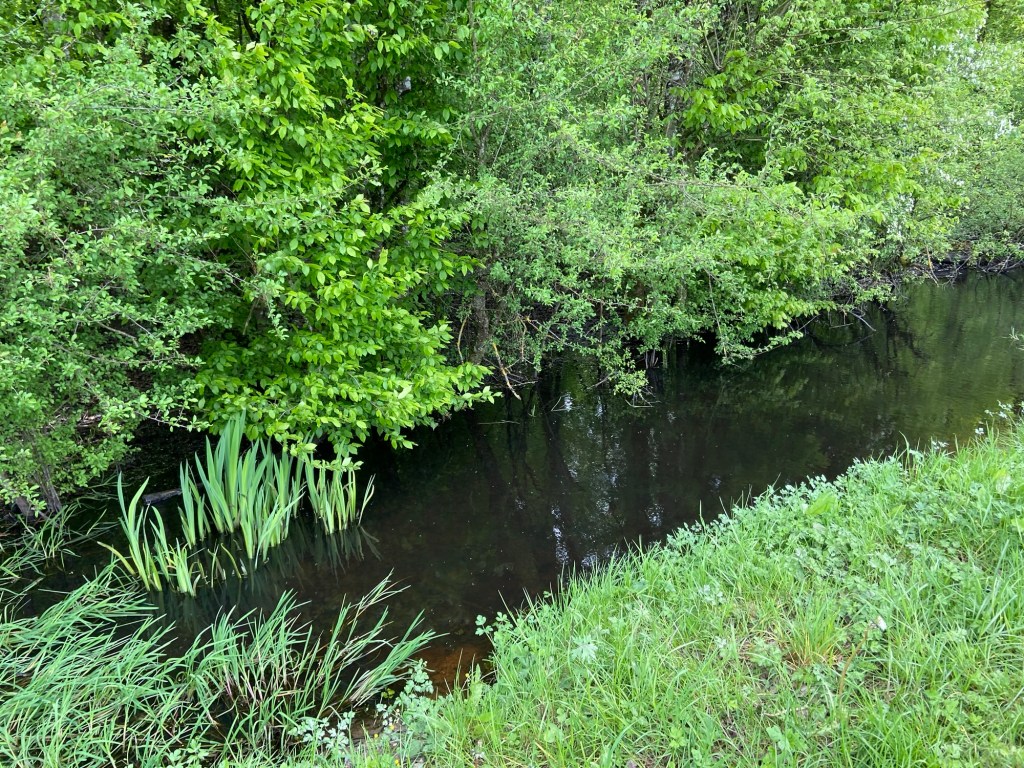
I met nobody today to have a conversation with in the whole eight hours I was out. So it was nice to walk by the drainage ditches filled with water, and hear the plopping of frogs jumping off the side and into the water as I passed. They felt like a bit of company.
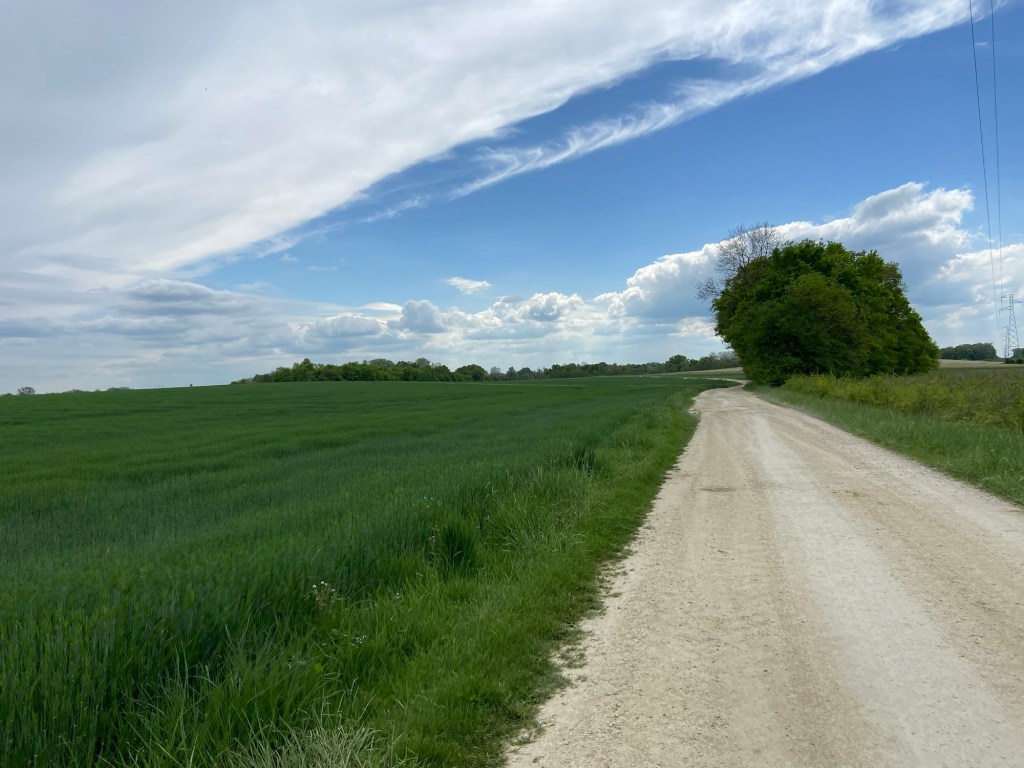
The village with the hilarious name of Lentilles was the final one today of the three with a half-timbered church. The Francigena took a sort of a shortcut down a field road, and from the end it didn’t look as though the village houses were very far. However, it was one of those roads which is in fact made of elastic, which together with the number of meanders made it take absolutely ages — almost an hour — to get there.
The church was worth it, though.

The layered and faceted gable end had a covering of chestnut shingles and battens, locally known as tavillon,
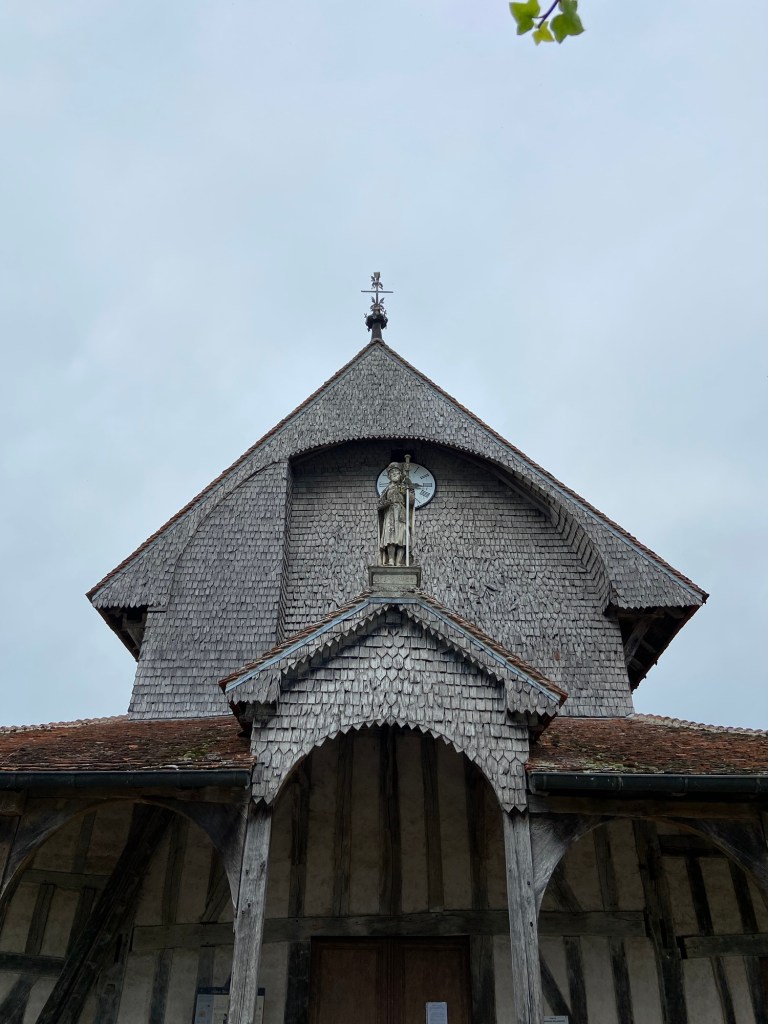
and it was the first church I have seen with a hayloft ladder stretching up under the porch.

The interior was light and lovely, the numbered pews well taken care of, and the timber framing intricate and solid. I just wished so much that Stephen could have been there, since he is my oak framing expert.
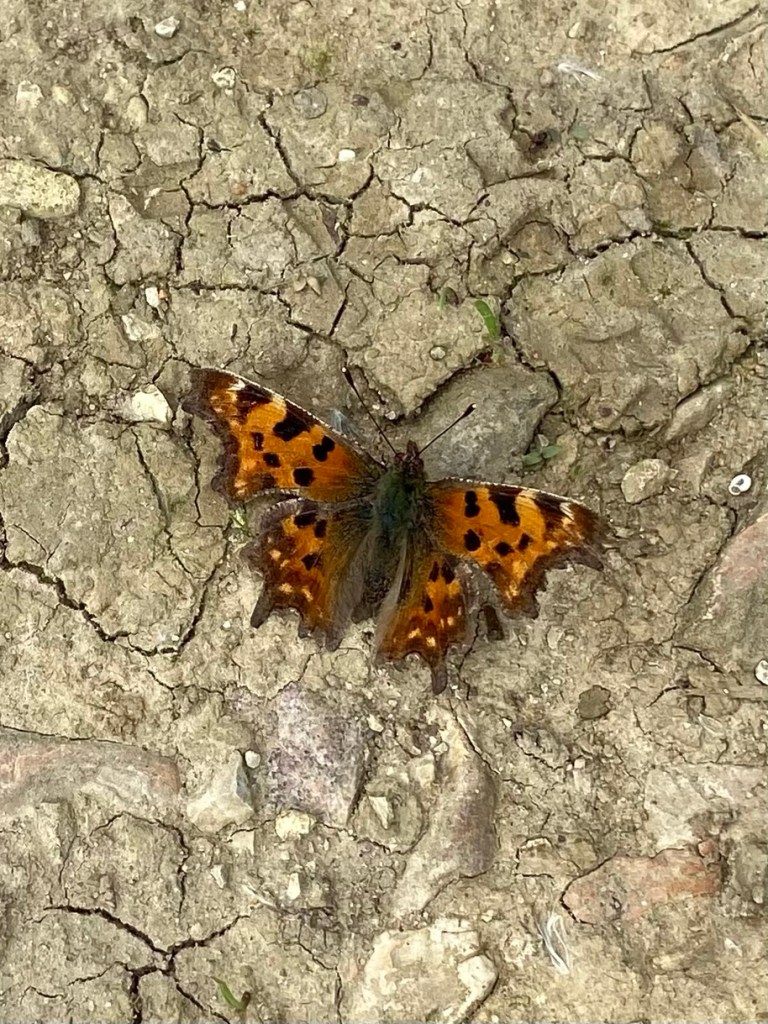
It was about another 4 km to my lodging at the end of the day, and most of it was a grassy path over farmland. Butterflies had begun flying again after their cold wet downtime days, and commas had now started to appear, their frilly edges standing out against the baked earth.
Montmorency-Beaufort was visible in the distance, and I made myself cover the last kilometre with the same pace I have been working at, even though my feet — well everything, actually — was really tired. I had felt generally underpowered today, and I think it was because I didn’t have a very good meal yesterday. It’s much harder on days when I have to carry my own food to make sure that I get proper walking nutrition.

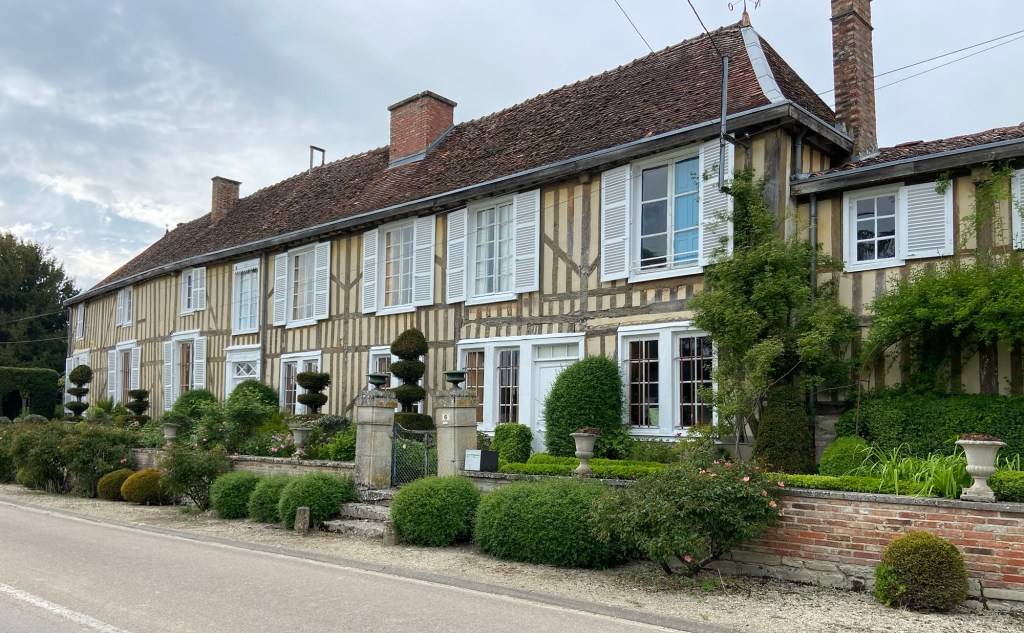
However, tonight I was being fed. And Montmorency looked promisingly well-tended and gleaming.
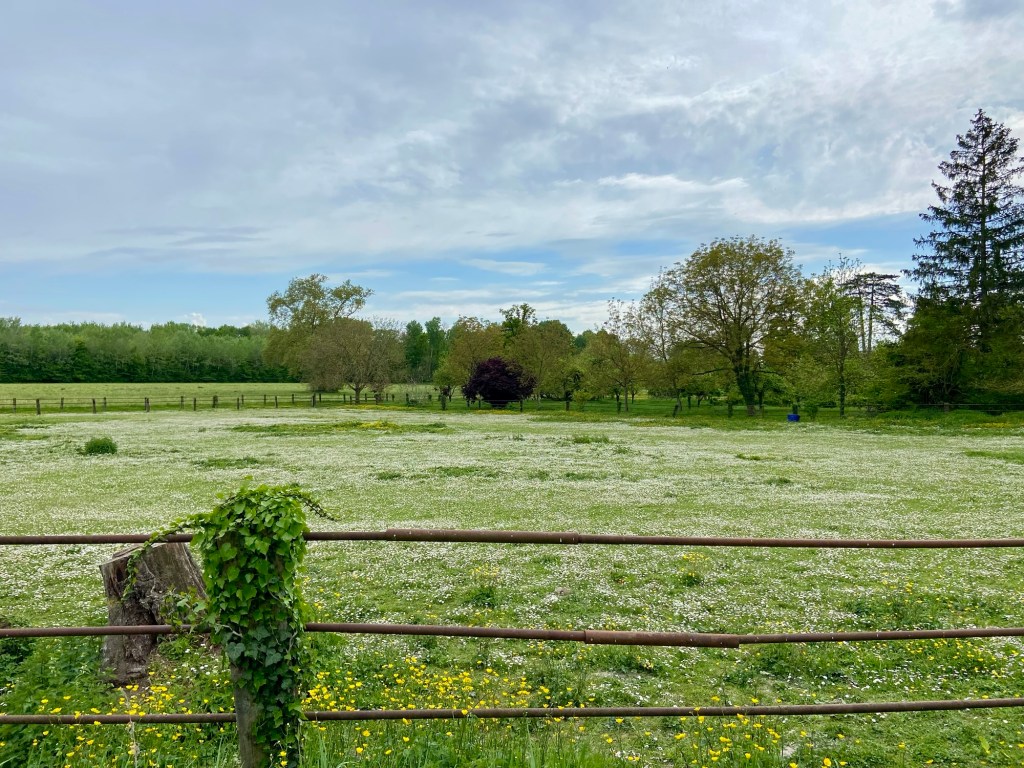
Meadows for horses were overflowing with daisies,
and people were out titivating their gardens. It felt like Peak Spring.
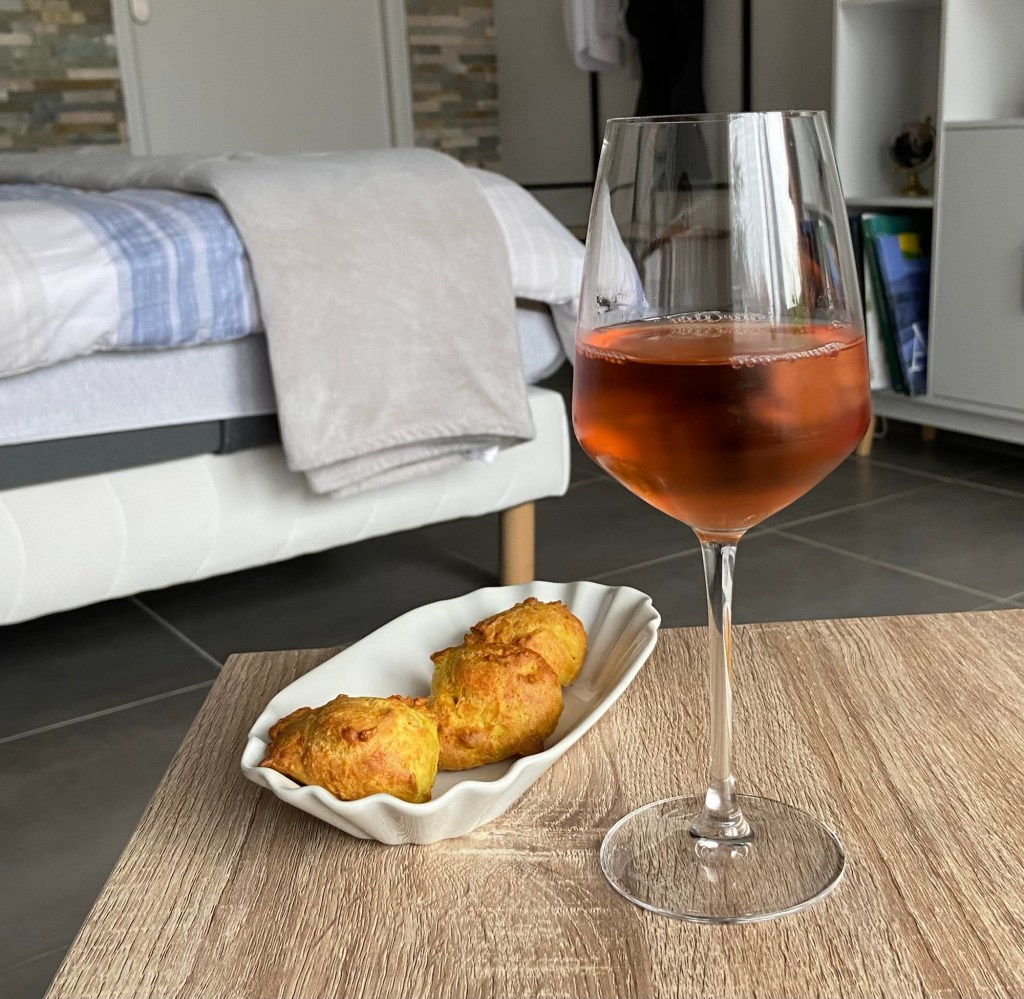
It was a huge relief to reach La Lavandière. The gîte has a separate little self-contained studio and this is where I was for the night. Unfortunately after a day speaking to no one, and as tired as I was, the French didn’t really come readily, but that didn’t much matter. Davide was the host and the chef, and brought each course of my supper to the studio, starting with a well-earned and inexpressibly welcome aperitif.
Stats for the Day
Distance: a long and humid 29.4 km
Time: 6 hrs 13 mins walking over just under eight hours.
 Walking The Landscape
Gosh that sounded a hard slog for you! So many lovely traditional buildings; is there a desire to stick with what’s always been there, or a lack of interest, or money, to build anything different do you think? Can’t think I’ve ever heard a turtle dove or a nightingale. How fortunate you are!
LikeLiked by 1 person
I am. And I heard a FANTASTIC bird today. There are lots of different buildings around — is just that Outines is a conservation area like we have at home. And the wooden churches are in one particular area and were the local style at one time. Didn’t see any today! There weren’t the stone quarries around to make buildings out of, and there was an awful lot of forest to provide the timber. I think in the 16th-17th centuries construction was pretty much with local materials. There is a tourist route around all the wooden churches in the area, a bit like Herefordshire’s black-and-white villages trail
LikeLike