When you take a flower in your hand, it’s your world for the moment
Georgia O’Keeffe
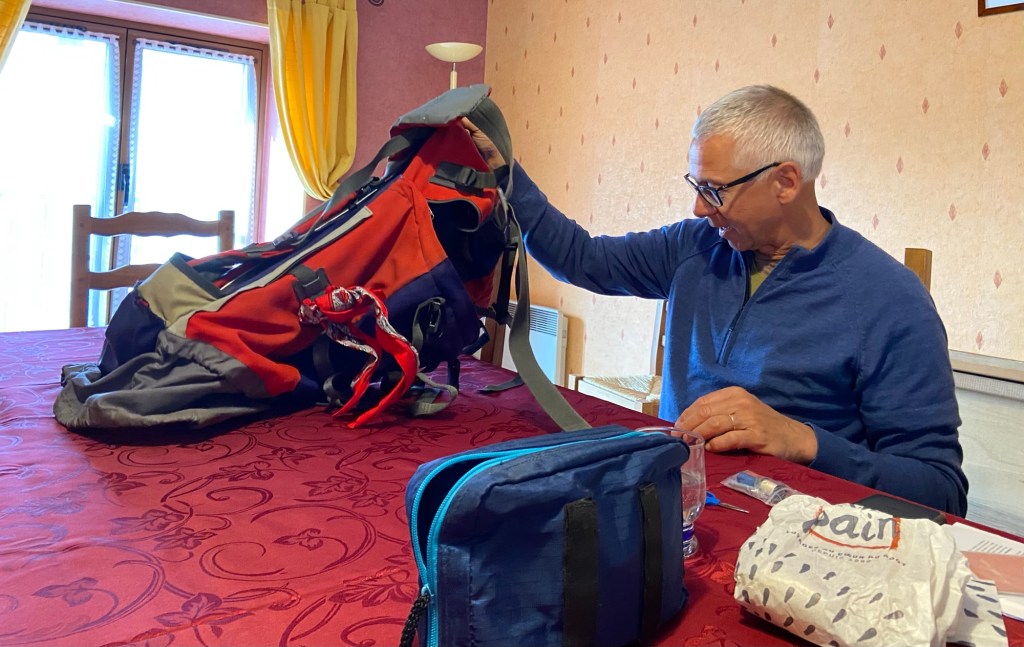
By the time Ian and I emerged from our respective cavernous gîte bedrooms with their many beds (four in mine, two singles and a double), breakfast had already been set out: fresh baguette, butter and, a croissant each and lovely coffee and hot chocolate. Once caffeinated and chocolated, we set about the business of the day, locking down a few nights’ accommodation and effecting running repairs to Ian’s rucksack.
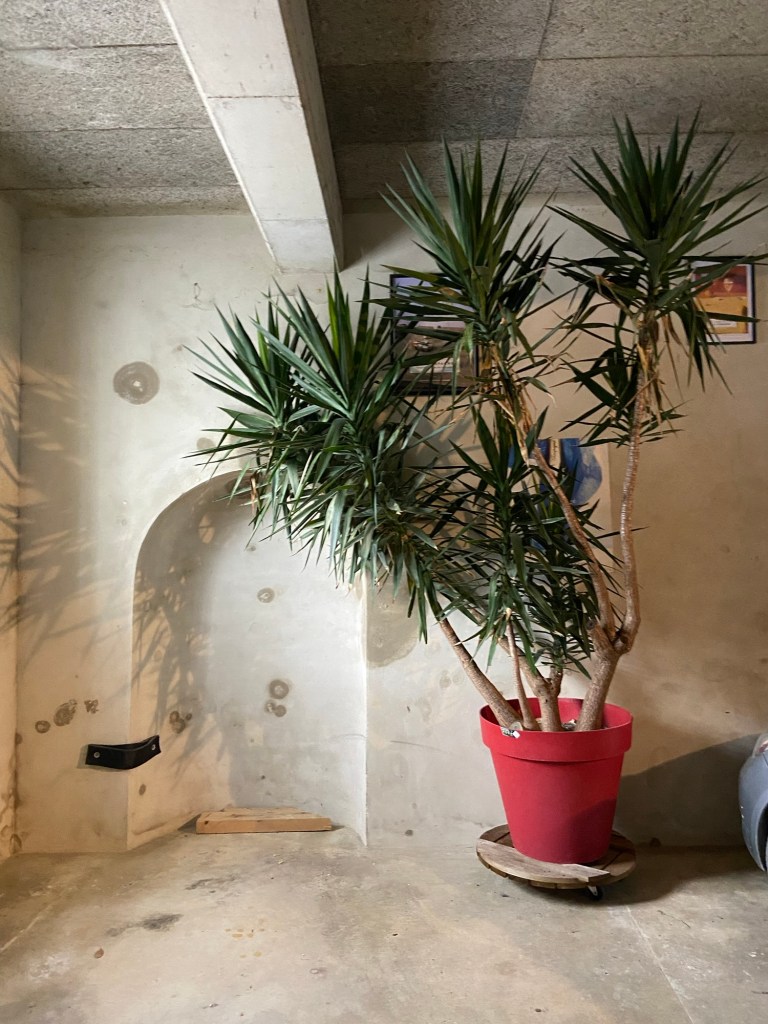
The next business was to check out of the gîte, and get our credentials signed. Ian took photos of our host and I took photographs of the colossal Yukka that Odile’s husband Alain had been give mn by his mother for a long-ago birthday. It was a magnificent specimen.
We didn’t have far to go today — barely 20km which is beginning to feel like a short day — so we were practically pottering about, looking round all the shops for things to take with us to make supper in the evening when we got to Condé. We bought a tin of lentils and one of haricots verts and some lardons, and lettuce and tomatoes. Splitting it between two didn’t cost very much, and carrying it between two was even less of a hassle.
Every second door here seemed to belong to a small-scale champagne producer. High-clearance tractors were parked outside houses like family cars,
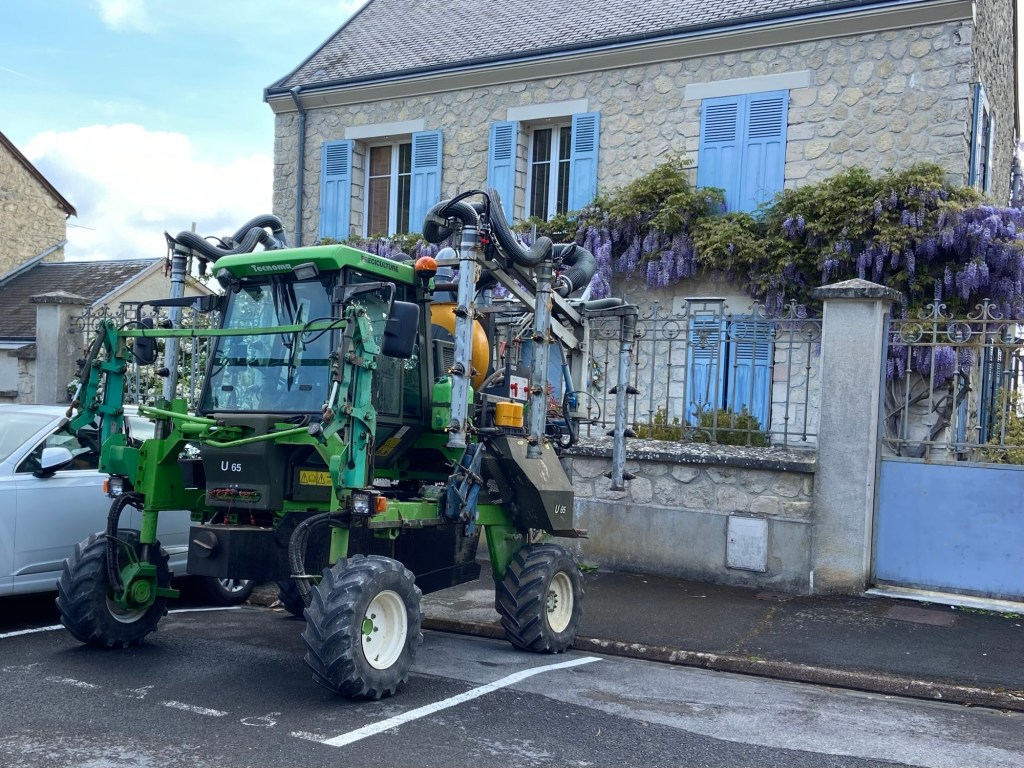
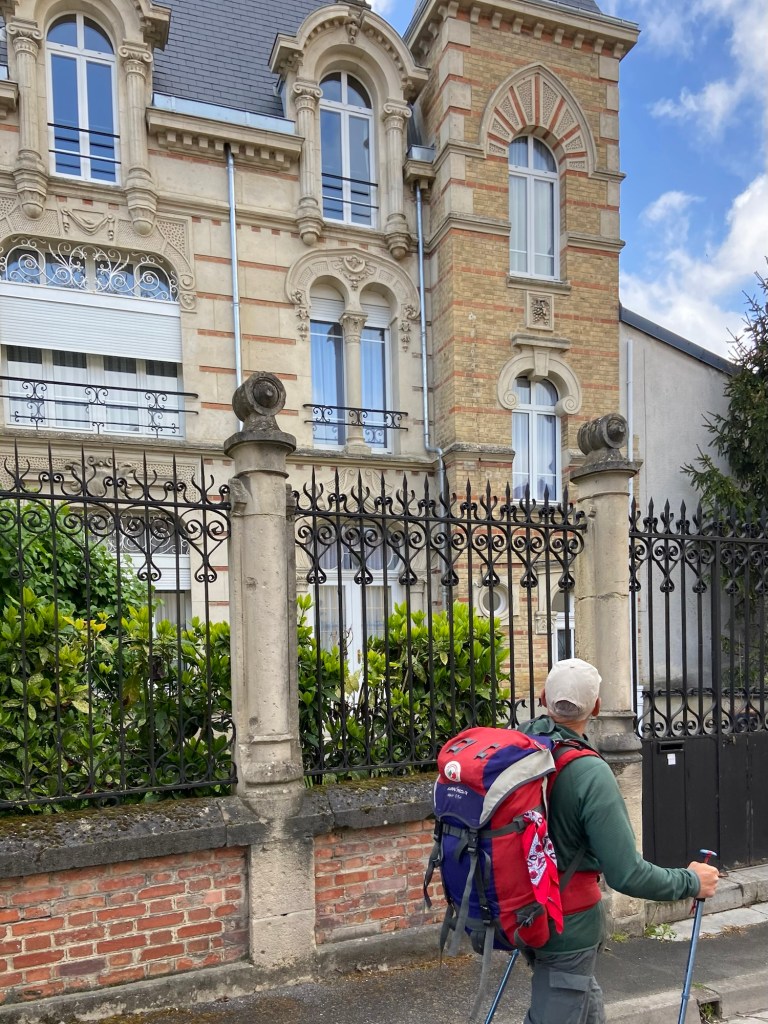
and the smartest houses had stucco details with bunches of grapes. It was like being back in Liques with turkeys everywhere only here it was champagne.
Up through the vineyards we climbed,
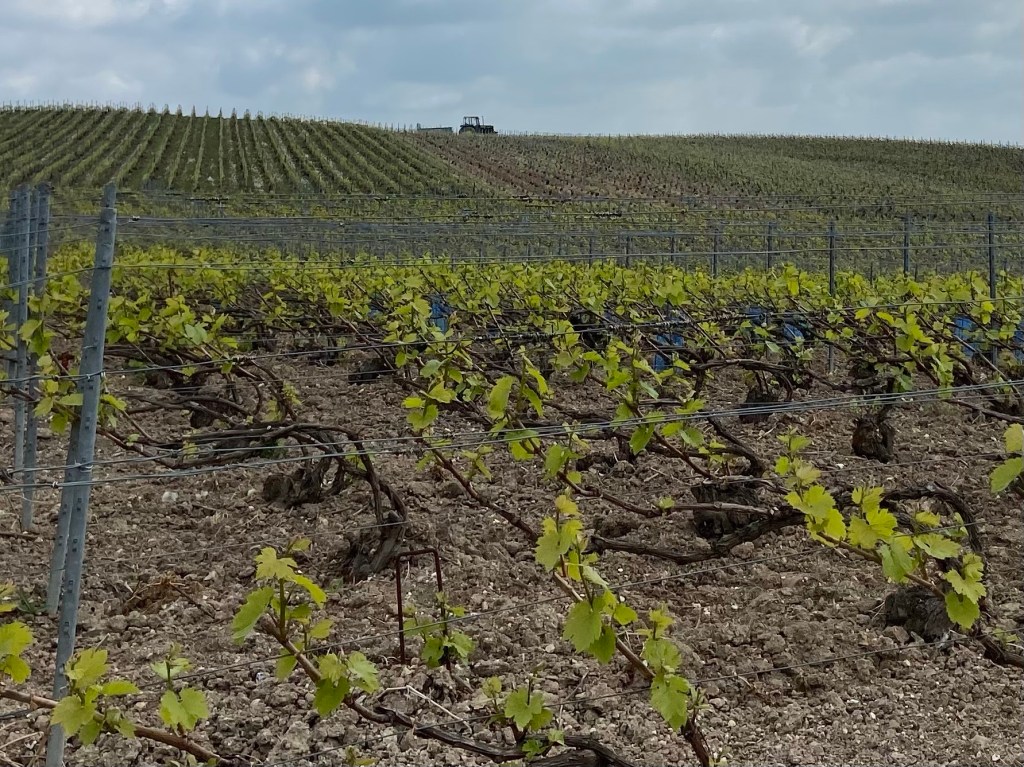
our eyes newly opened after our museum visit to the mechanics of vine training with little twists of rafia-covered wire.
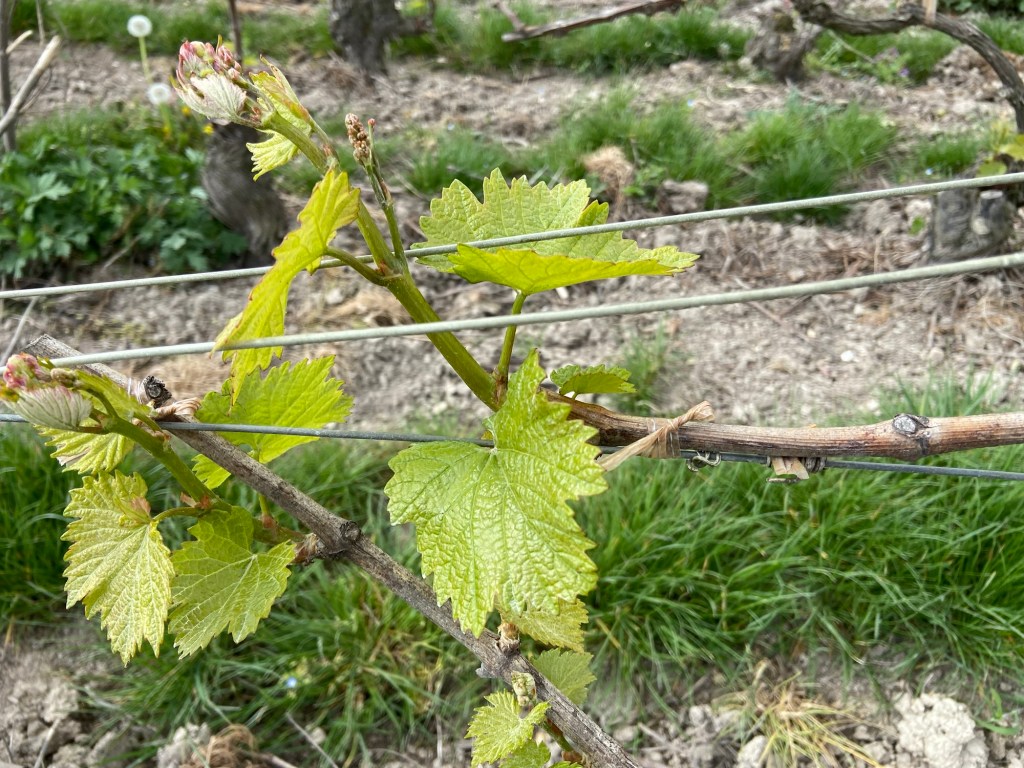
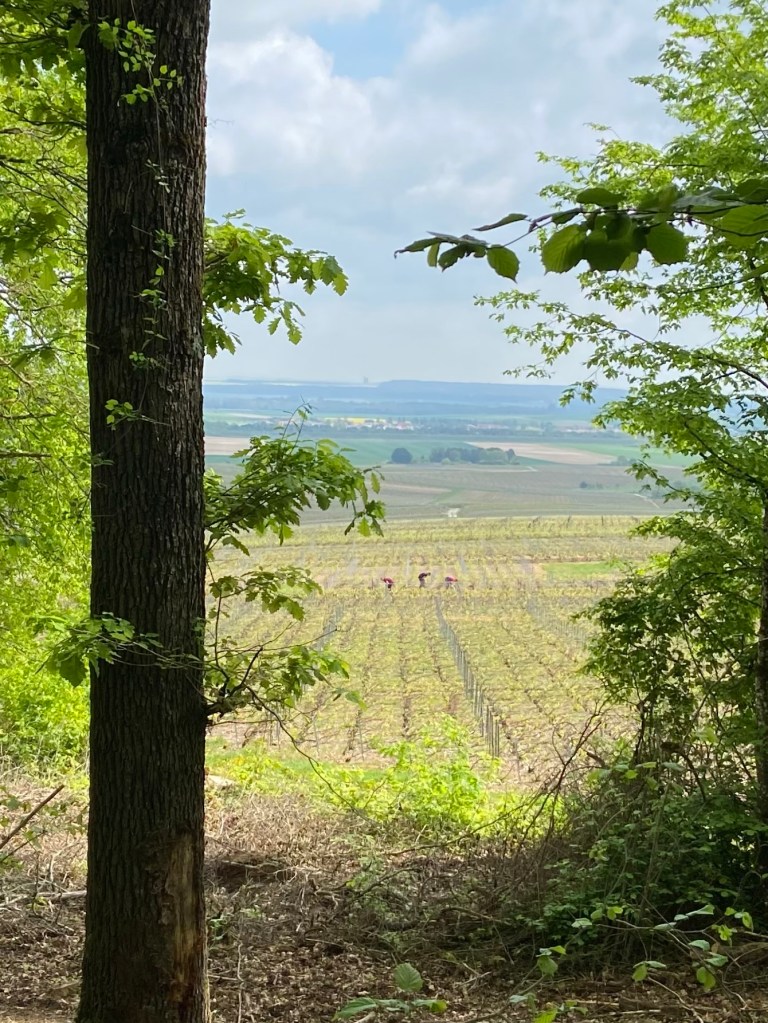
Some of the vineyards had people working in them, bent double to secure the vines to the wire supports; it seemed as though a whole army working flat out around the block couldn’t ever get through that job. The individuals were just dotted around amongst the vast expanse of the slopes. The museum stay had made clear that all the tying and winter pruning had to be done by hand.
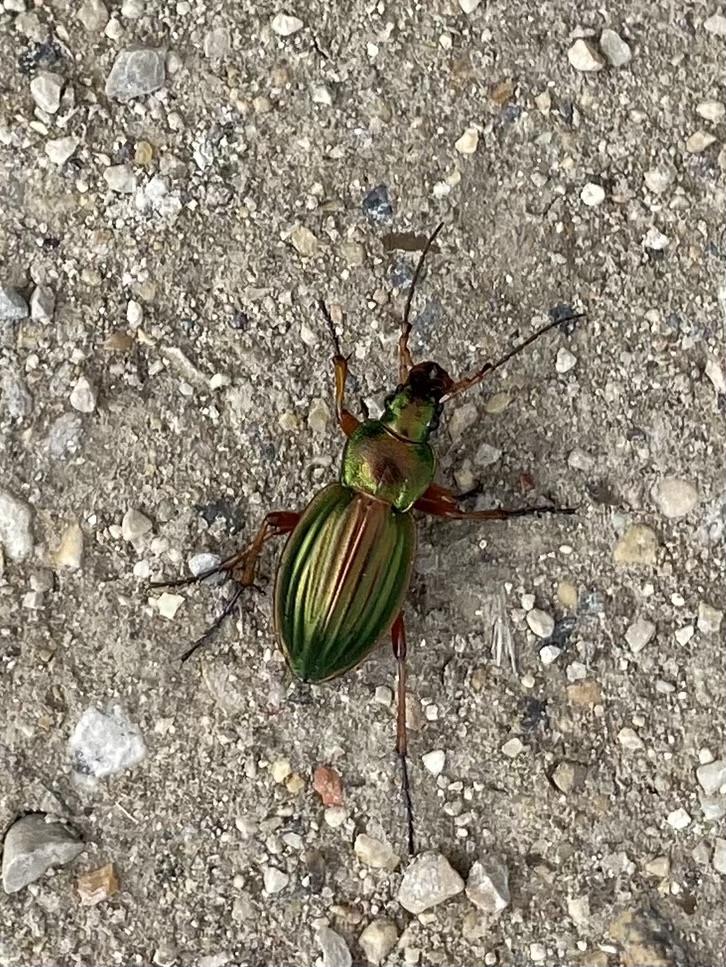
On the chalky path I spotted the first of many invertebrates that characterised the day. I think they are all finally hatching out now it’s late April. This was a golden ground beetle, Carabus auratus, a quite voracious hunter that preys on snails, worms and slugs, seizing them with its mandibles and spraying its prey with a secretion that starts digesting it before the creature is actually consumed.
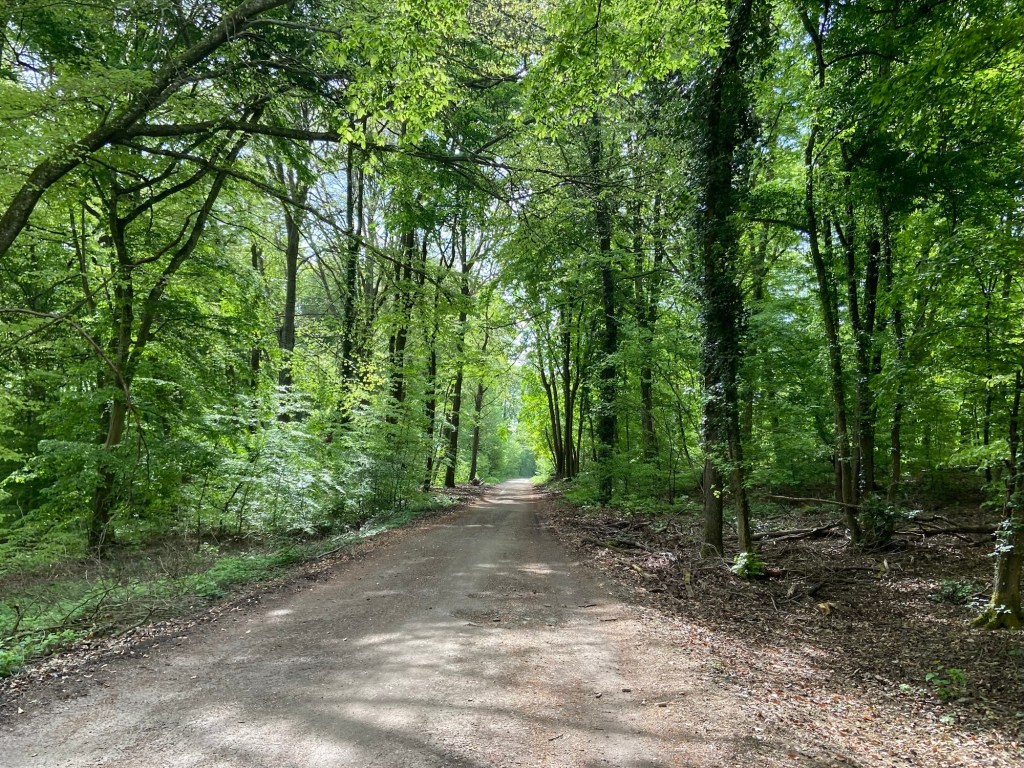
The woods when we reached them were lovely as ever, here a mixed woodland with a preponderance of beeches.
Tiny beech seedlings with their strange seed leaves were growing in the grass margins of the path, and also in the grass margin was a deer, straight ahead of us, that stood stock still upon seeing us, then bounded away amongst the trees.
Every now and then the path came out of the trees to skirt along the edge of a vineyard. It was very bucolic.

Chatting, we took a wrong turn, which had the effect of presenting a shortcut to the little town of Billy-le-Grand. Billy the Big? A ridiculous name! We stopped for some water and something to eat, using a broken pallet as a makeshift bench,
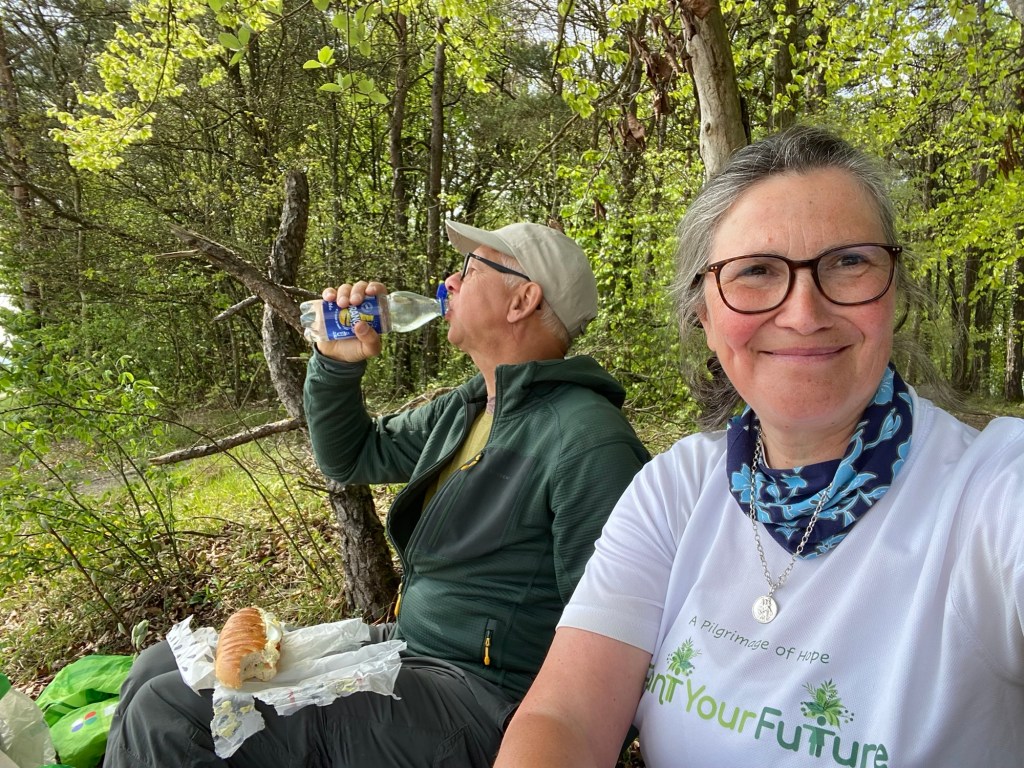
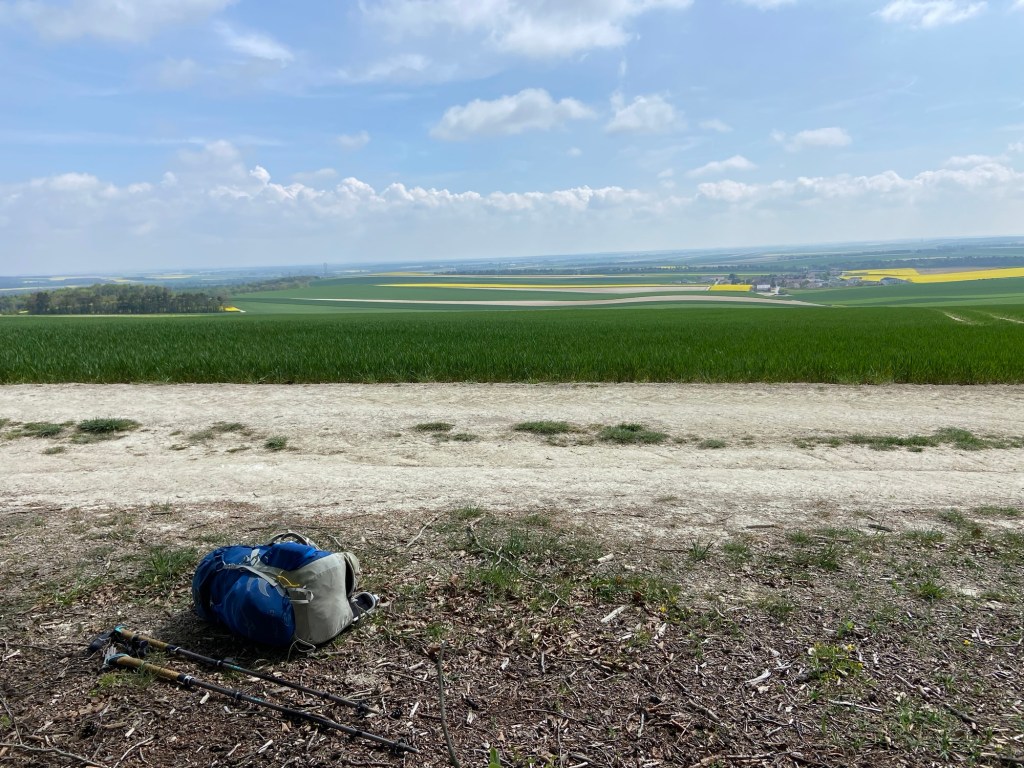
and enjoying the stupendous view out over the plain, the corn buntings fizzing in their nests, and the larks over all.
My second beetle presented himself on the chalk path down to the village. I thought at first he was just covered with chalk dust, in manner of Harry the Spotted Dog, but when I looked at my photograph close-up, I could see that he sported a handsome mottled and dotted pattern. I’ve tried to identify him without success.

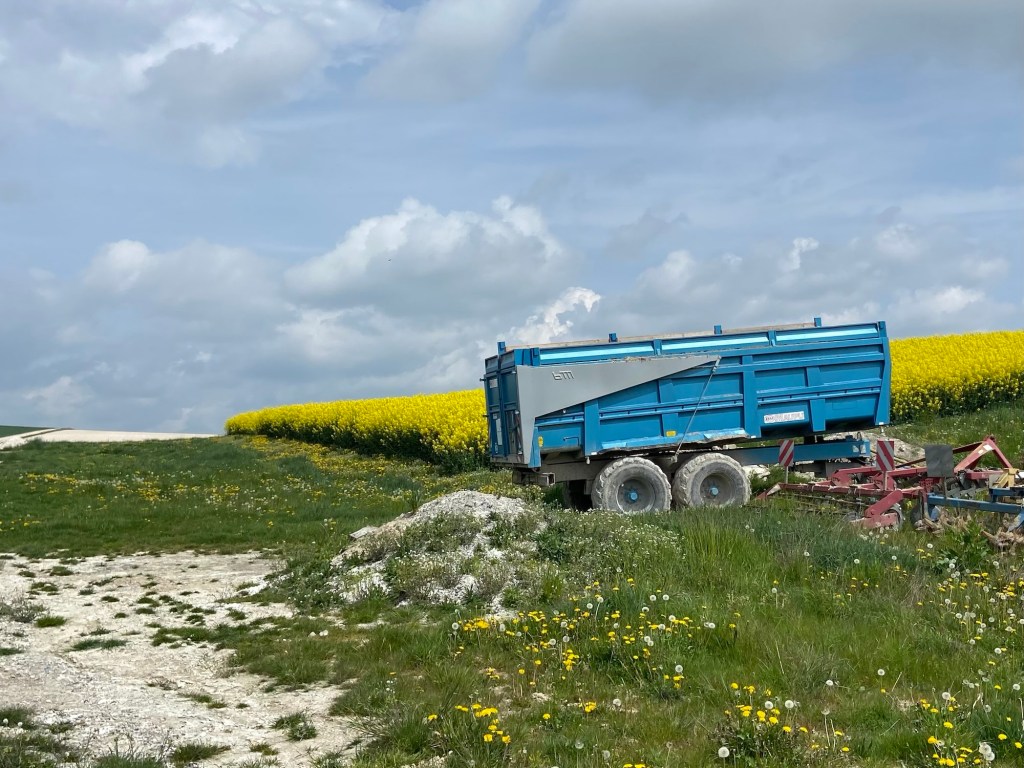
Billy-le-Grand was in fact a small place, although full of colour in its brightly coloured trailers and other farm machinery,
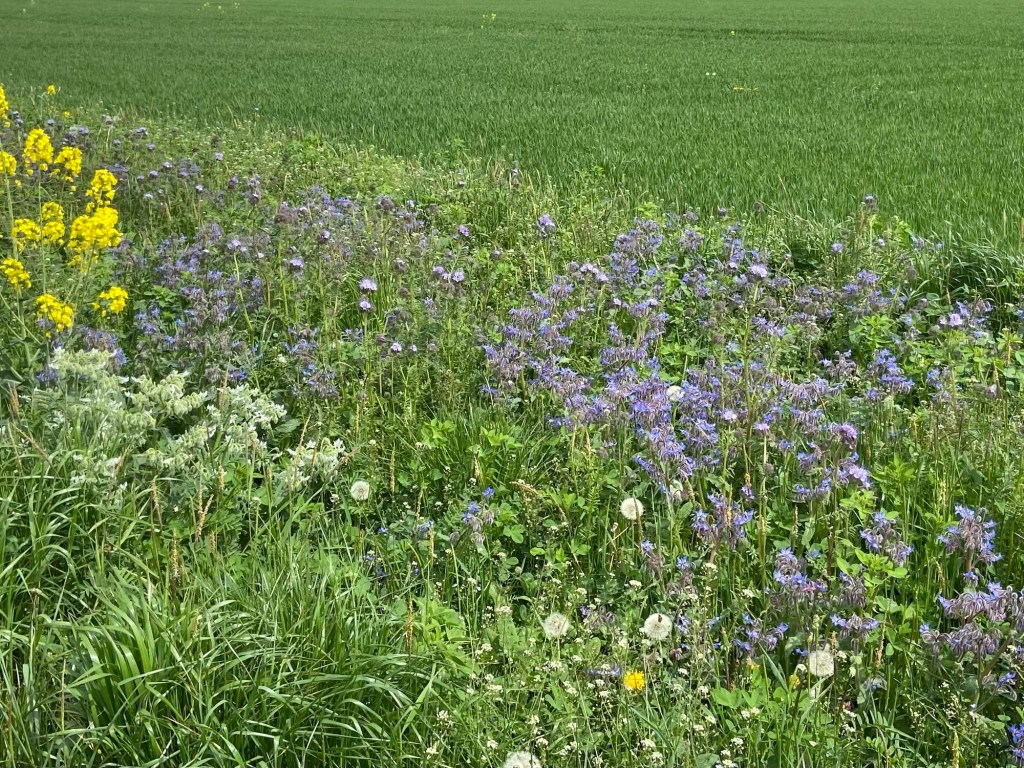
and in the patches of wildflowers sown on the edges of fields. I rather liked the white borage here. I would have taken some seeds for my friend Jane’s garden in which she has planted so many white flowers, but a) there weren’t any seeds; and b) in my garden some blue flowers come up white where there is a lot of formic acid in the soil, but their seeds flower blue, true to type.
The town was also strikingly full of texture and pattern,

and often both.

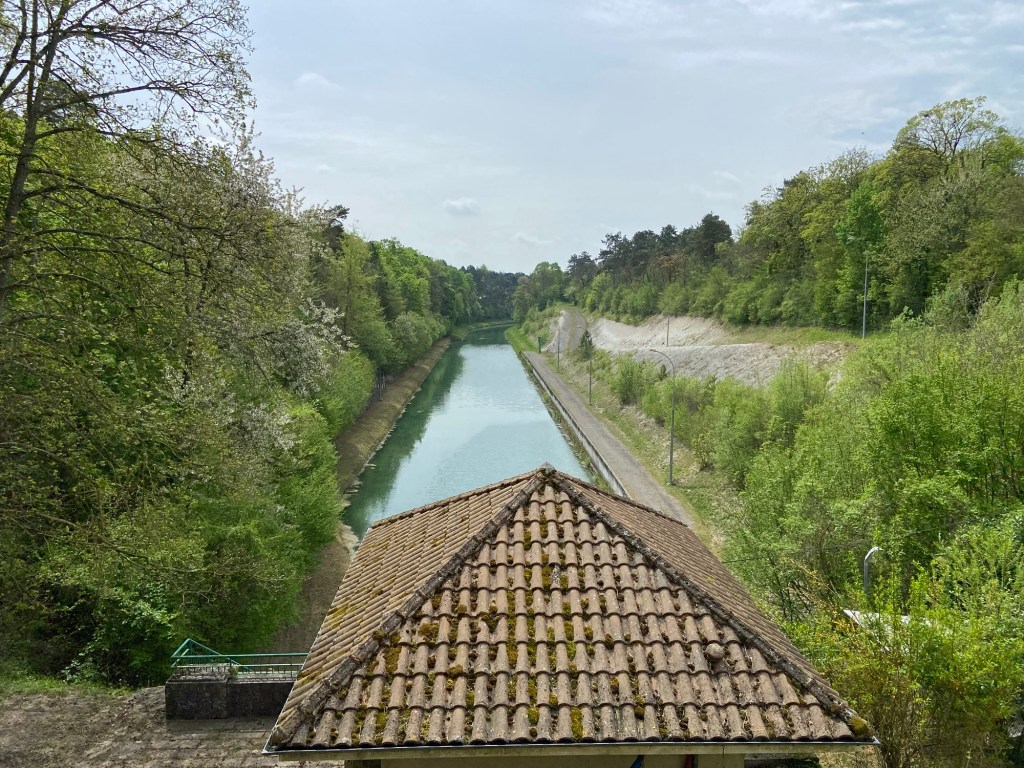
A wide avenue lined with chestnut trees in full leaf led us down to the Marne and Aisne canal path again
where for the first section we walked along a cowslip ride, dotted with thousands of the little yellow flower spikes.

The canal had undergone one enormous change in the couple of days since Reims: the mayflies were synchronising their emergence, hatching in their thousands. Next to the canal the last moult of the nymph occurs as they crawl out of the water, and a flying subimago or ‘dun’ emerges.
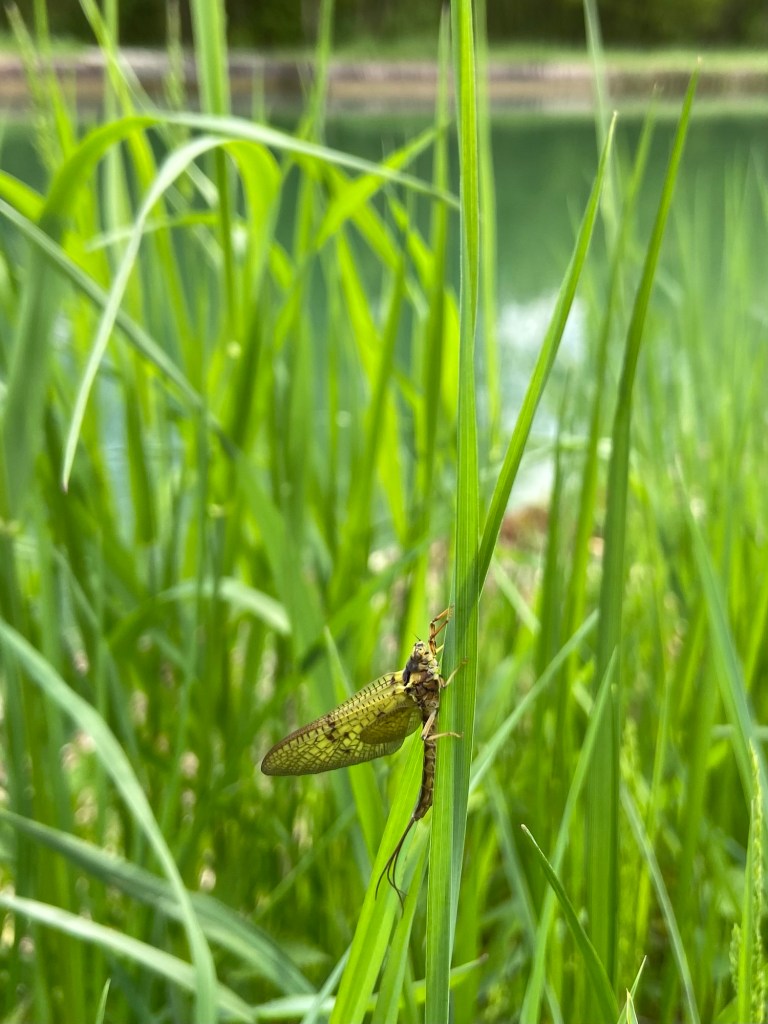
This gives the creature the possibility of getting away from the water to make its final moult,
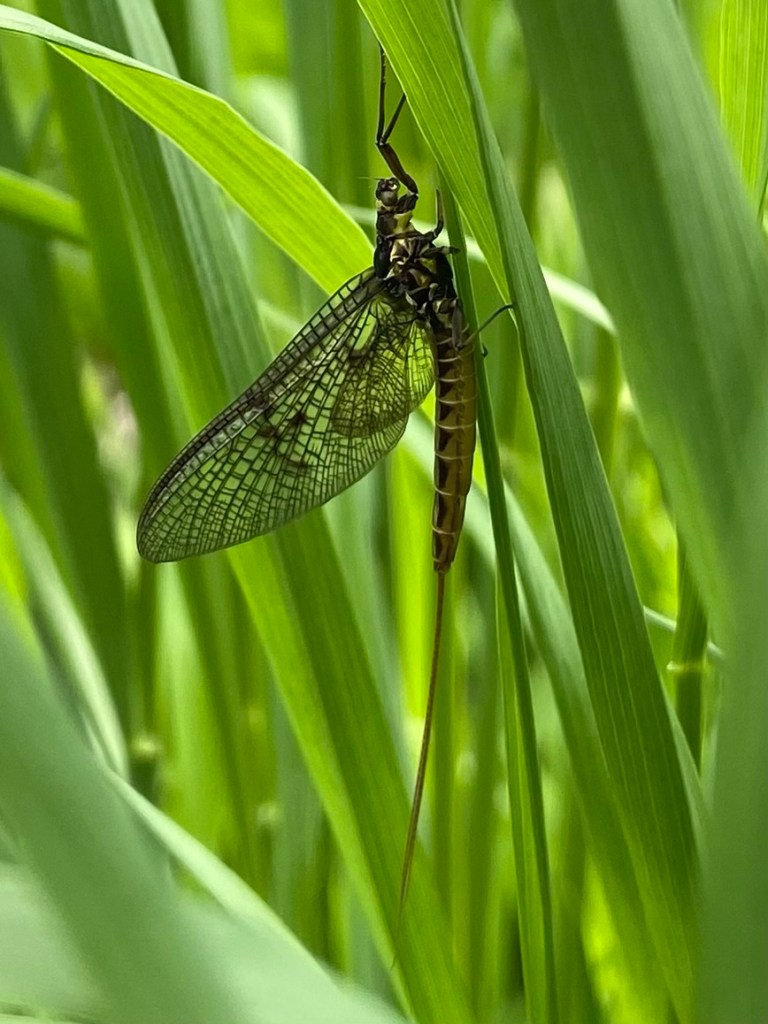
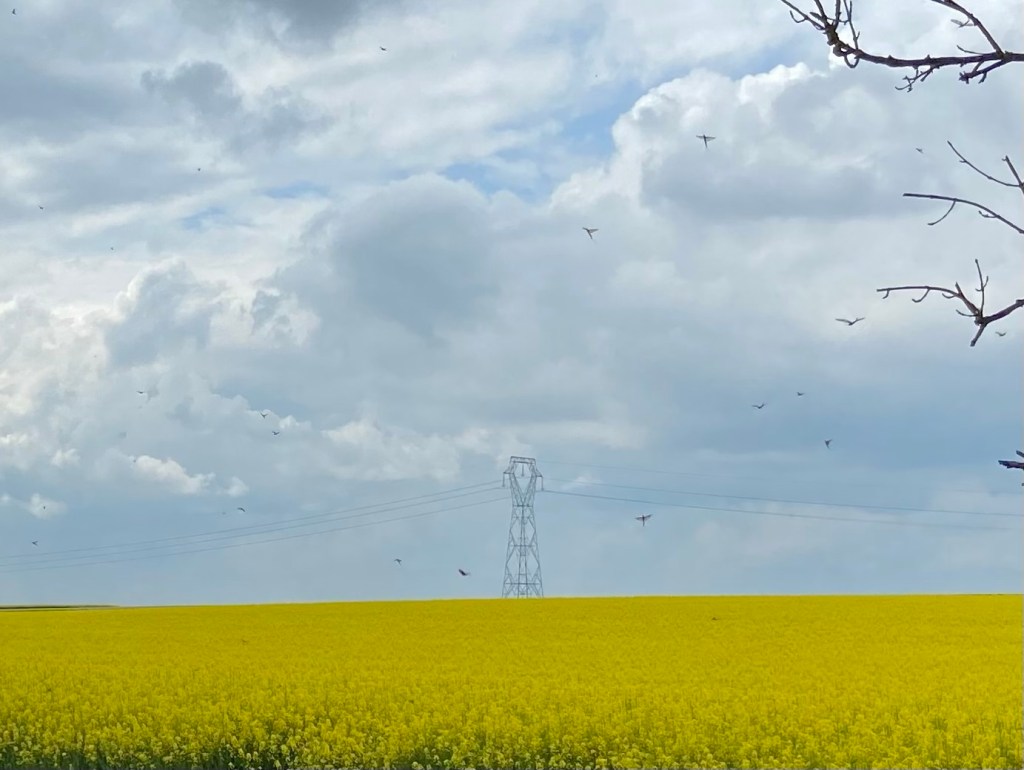
and indeed, the air on the field side of the path was thick with mayflies rising from their final hatching,
and many of the ephemeral flies had ended up dying on the canal’s placid surface, exhausted from their one, brief and glorious mating flight.
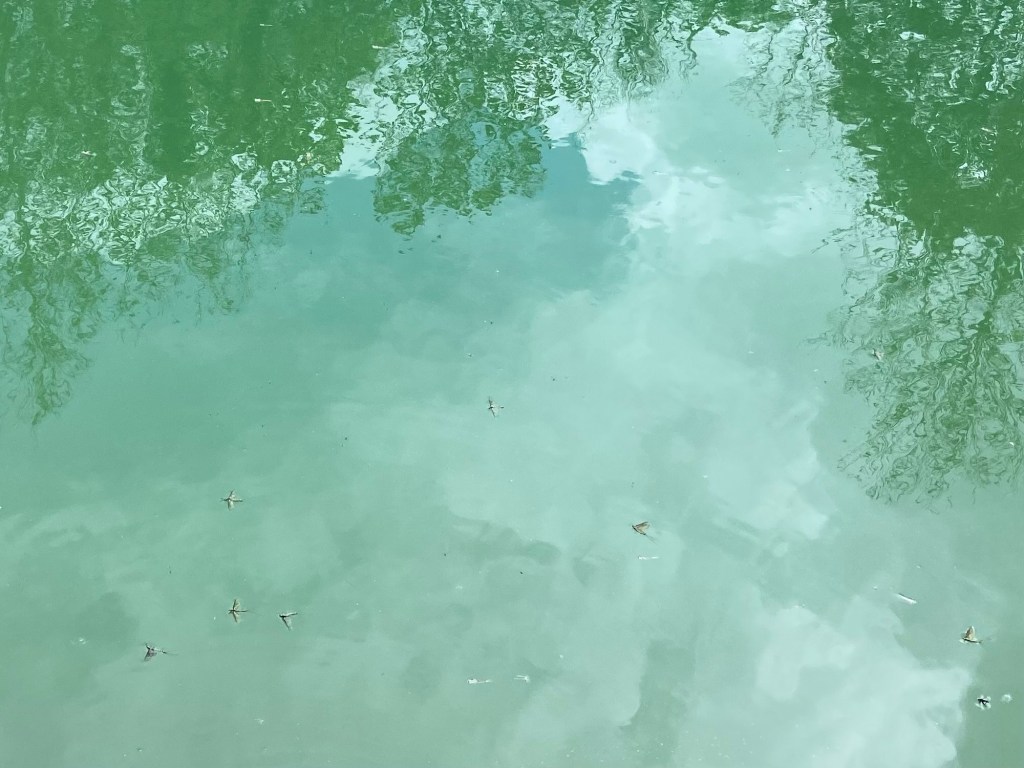
Every so often on the river, a fish would leap out to grab a mayfly flying above the water’s surface, but these incidents were almost impossible to photograph.
The bird life on the canal was as diverse as I have come to expect, with more nightingales, which Ian now heard for the first time, and linnets, melodious warblers and serins. We watched a pair of large brown raptors with a distinct dark stripe to the edge of the fanned-out tail fly from tree to tree ahead of us. I have looked and looked at pictures to try and identify it, but I haven’t been successful.
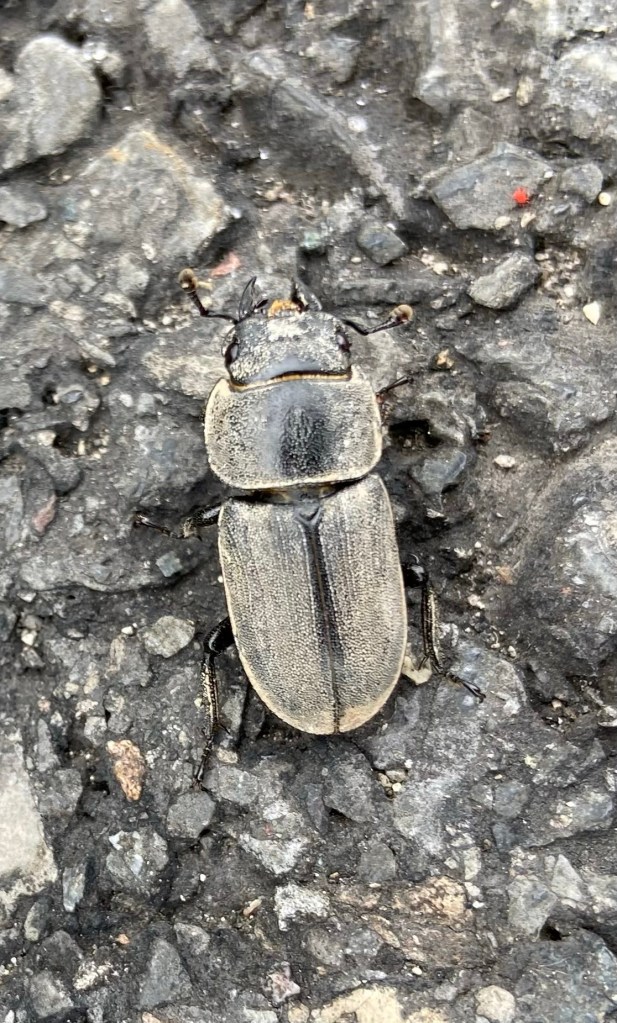
Also unidentified was this next beetle, on the towpath,
and I don’t know why this dragonfly exuvia was so white — it seems pretty early for them to be appearing and I haven’t seen any yet, but it conversely seems rather unlikely that this one would have been left over from last year, since they are very fragile.

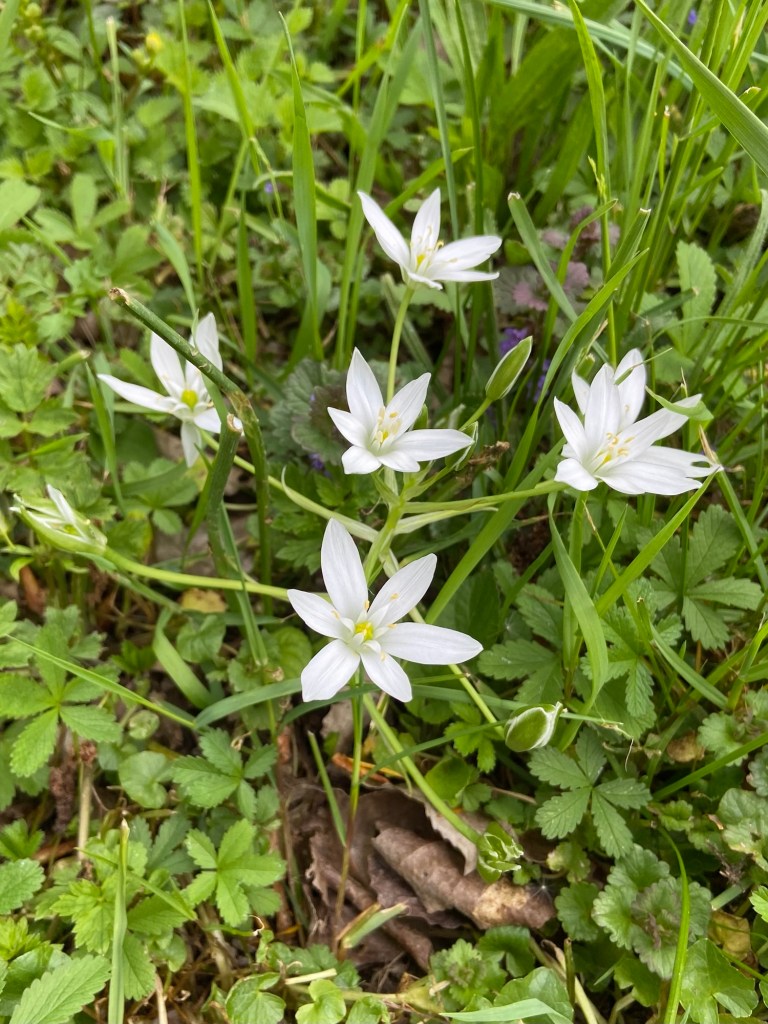
I was more successful at identifying this as Star-of-Bethlehem, a native to Europe which I don’t think I have seen before. Pretty as it is, the bulbs and flowers are poisonous, containing cardiac glycosides (like foxglove) which can induce nausea, salivation, vomiting, diarrhea, and shortness of breath. However because of their name they have been associated with pilgrims, so nice to have spotted them.
One amazing sight, running parallel to the canal, was a gin-clear chalk stream rising from one of the chalk aquifers.
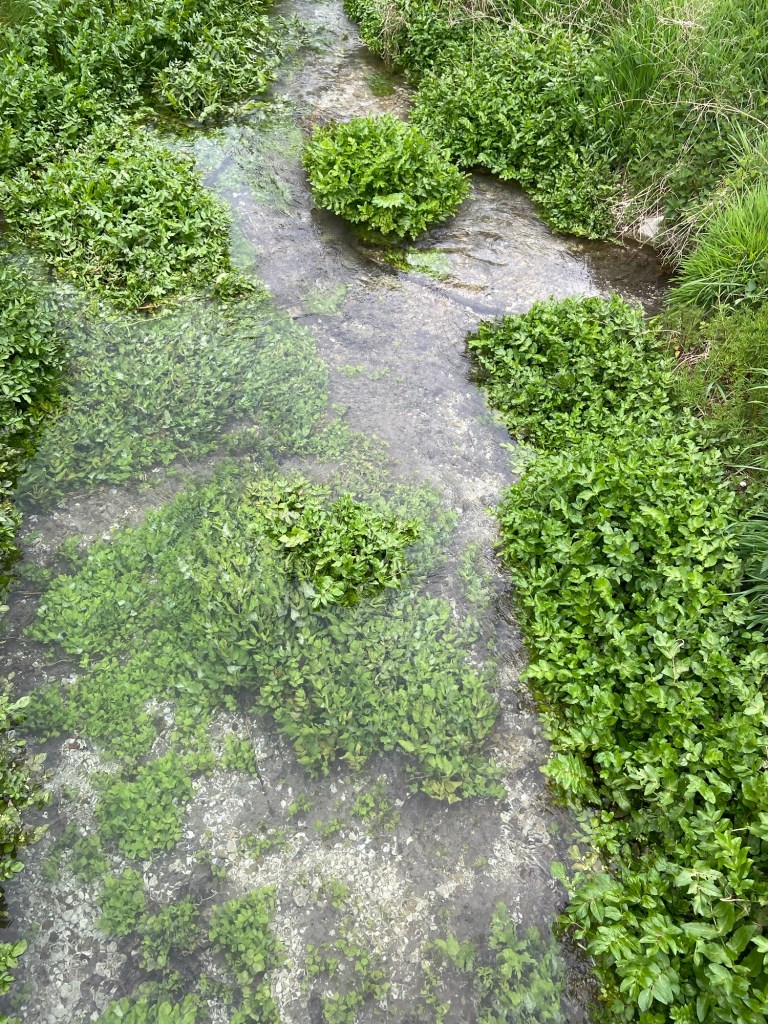
It had the typical chalky gravels and mats of watercress. There are 210 of these streams in the world, 160 of them in England, so it’s always a privilege to see one. If I were to see one anywhere her in France, it would likely be in the Champagne region.
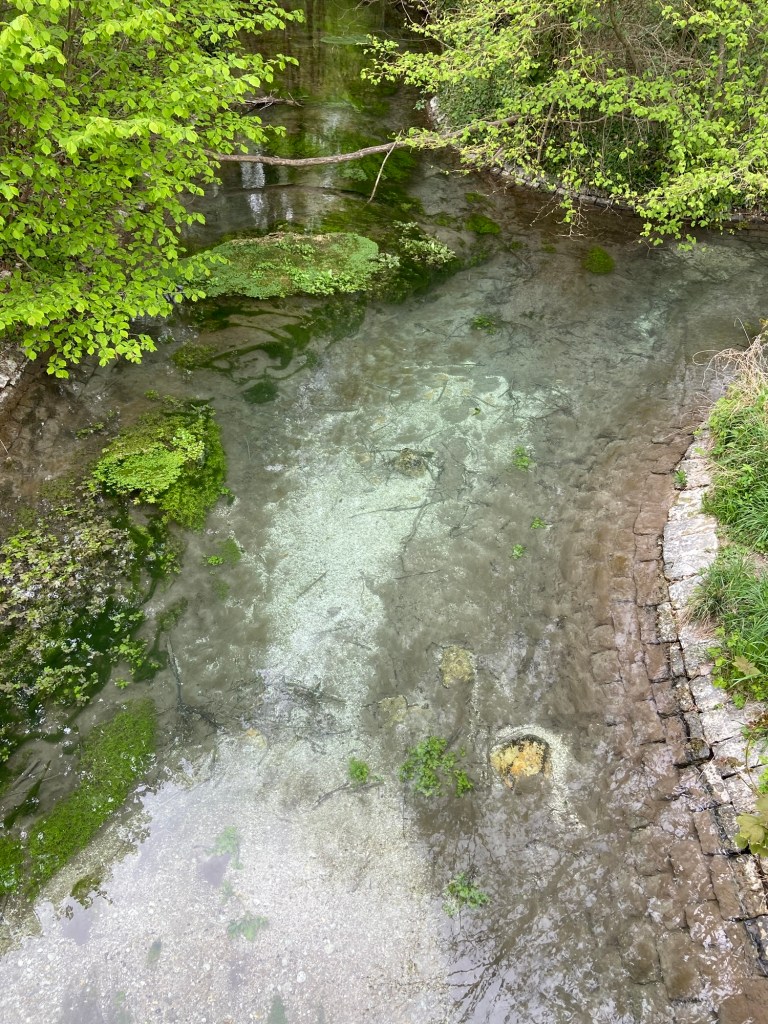
It felt as though, despite the 10 km along the river which one might have thought would be monotonous, there had been been plenty to see.
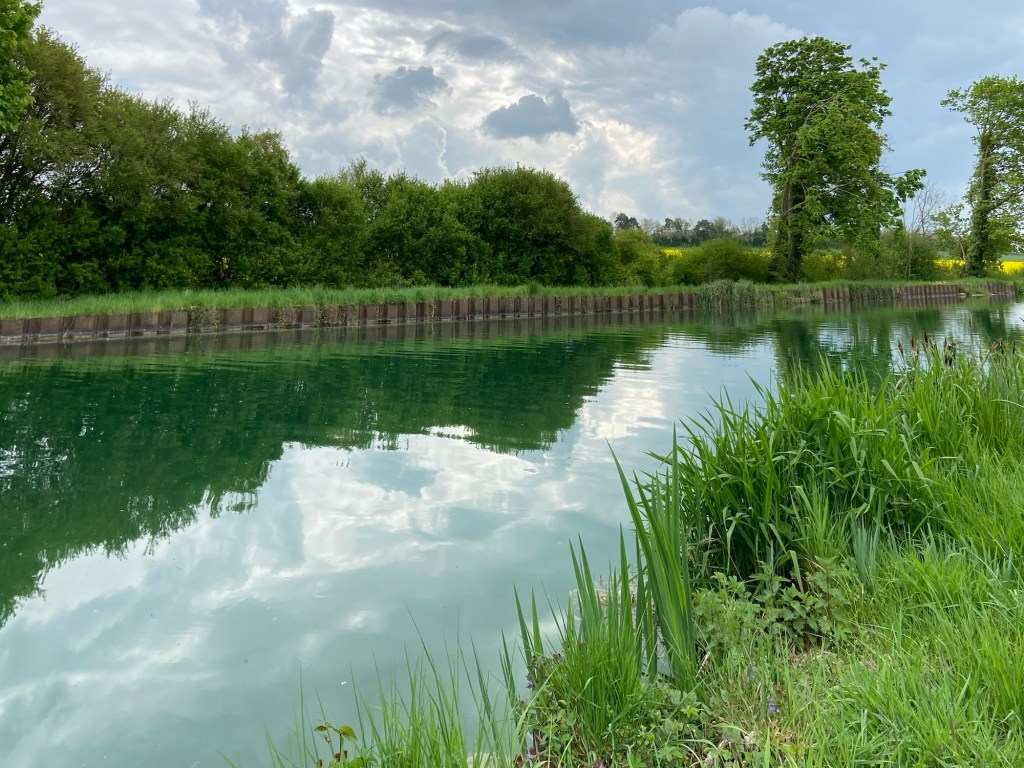
We came off the canal at Condé-sur-Marne at the lock, and our gîte, the Clef des Champs, was not far. The town seemed at first new but gradually it became apparent that these were older houses that had sustained a lot of damage in the Second World War (indeed three quarters of the houses were destroyed or damaged, including the church which had only just been resorted after the bomb IV of the First world war. Its tower was decapitated, killing a German who had taken up a machine gun position there). It felt as though the town had suffered an earthquake from which it was only just recovering: cracks in external stone walls to houses or layers of plaster missing, houses only now gradually being restored to sandstone-yellow-painted smartness.
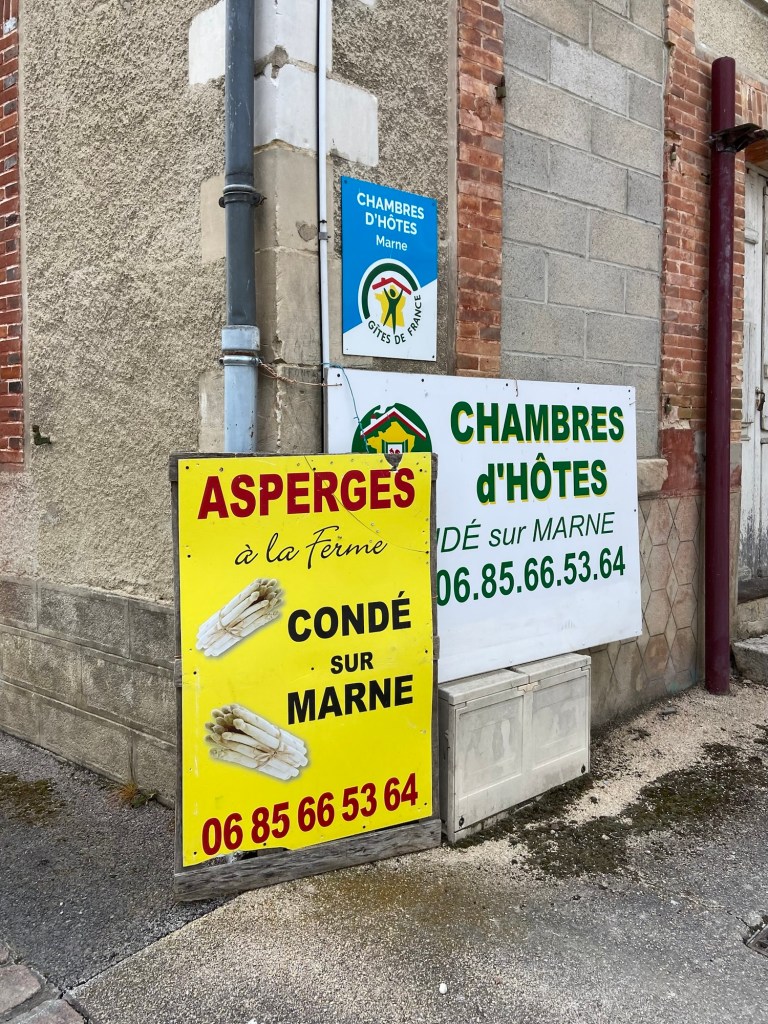
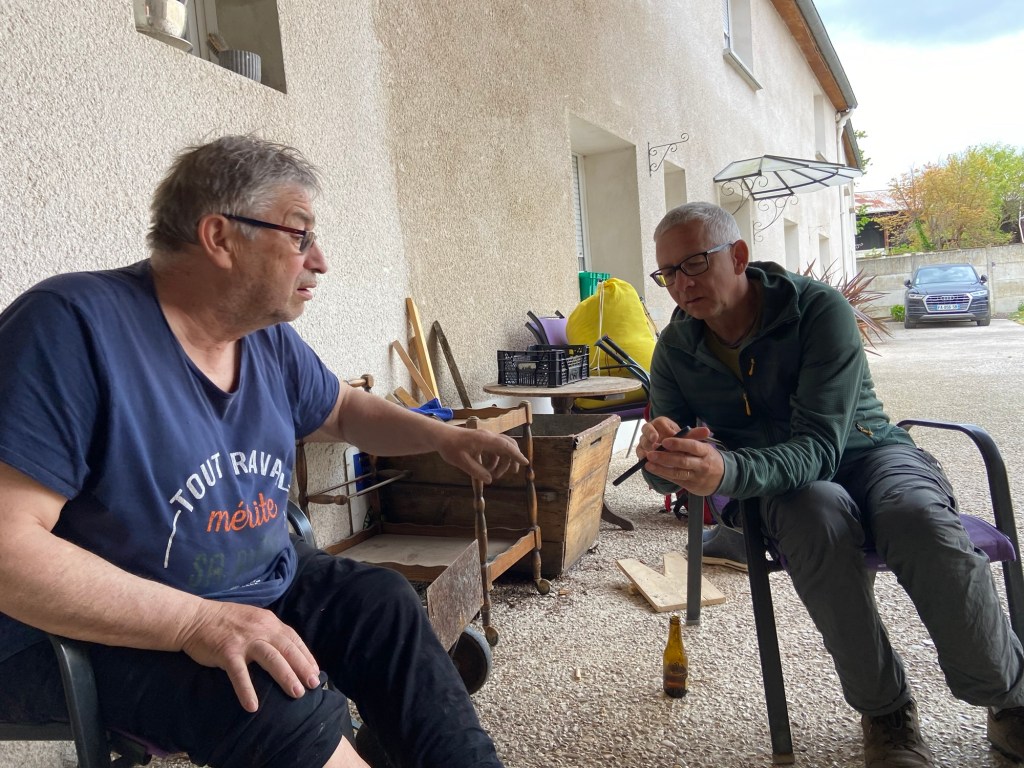
Our gîte had a bright yellow board outside saying ‘FARM ASPARAGUS’ and all through the early afternoon customers came to buy kilos of the white spears from the farm shop in a room off the covered portal inside the huge wooden gates to the yard. Denis welcomed us with a beer, so we pulled out another two chairs in the yard to sit and drink it with him.
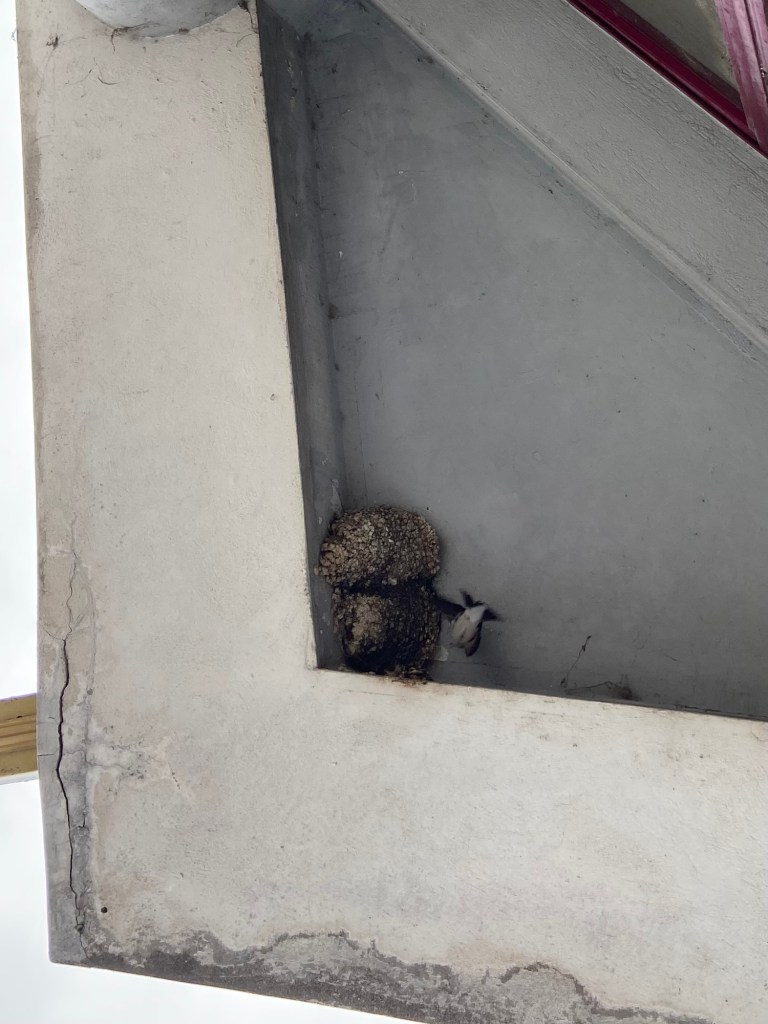
There were dozens of house martins (here, ‘window swallows’, hirondelle de fenêtre) chittering about above us. They are nest-building now, rows of them in the eaves to the houses and farm buildings throughout the town. Denis thought they were a pest, dirtying everything with their droppings.
Denis cuts his asparagus every other day for the six-week season.
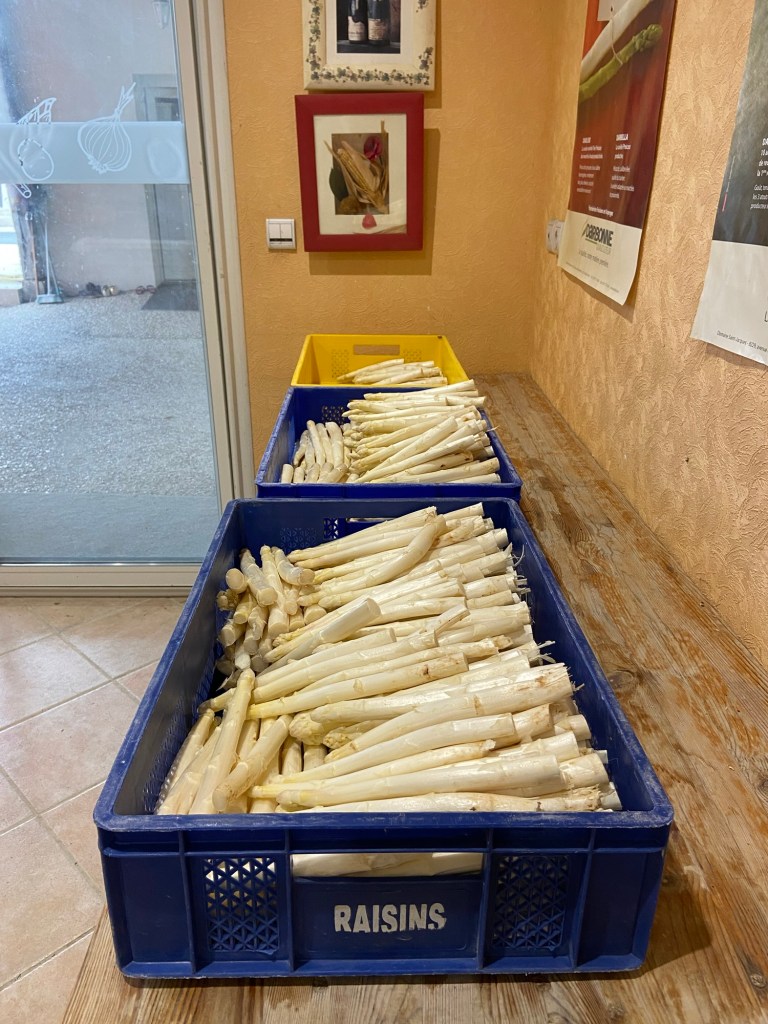
I went out later to see whether the farm produce vending machine at the top of town had any sausages. They didn’t, but a kind woman discussed what else I might put with the tin of lentils and haricots verts. Boudin no, she said. It wouldn’t really go. We agreed on a separate dish of pâté en croute, and she helped me with the touchscreen for selecting it. It’s an amazing system, with refrigerated products behind doors as well as dry goods. There were bigger doors containing the ingredients for a whole meal and I was really sad Stephen wasn’t here, firstly to buy kilos of white asparagus and dress it with the béarnaise sauce that three separate people told me how to make (as if I travelled with eggs and olive oil in my rucksack), and to understand what was in the large jars and tins of confit and stews and ratatouille-like vegetable preparations.
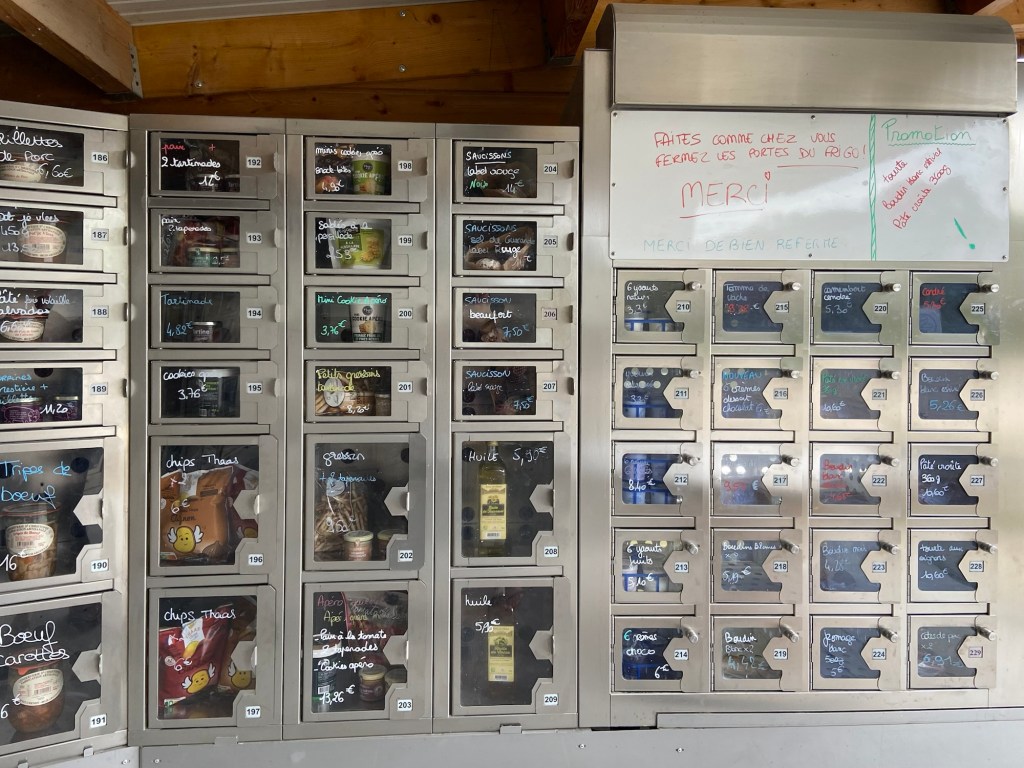
If only we had known that there was such a comprehensively effective shop in town, we might not have carried our own food, but as it was we had to buy everything we needed in the morning, because we can’t set out for a day’s walk having read in the guidebook that there were no services in the town except a pizza vending machine, and expect to magically find excellent food somehow at the end of it.
I took back the huge sausage roll (for that was what the pâté-en-croute turned out to be), and back at the ranch Denis was doing a roaring trade in asparagus, having to refill his stocks from his van. He said he’d give us some, but it slipped his mind.

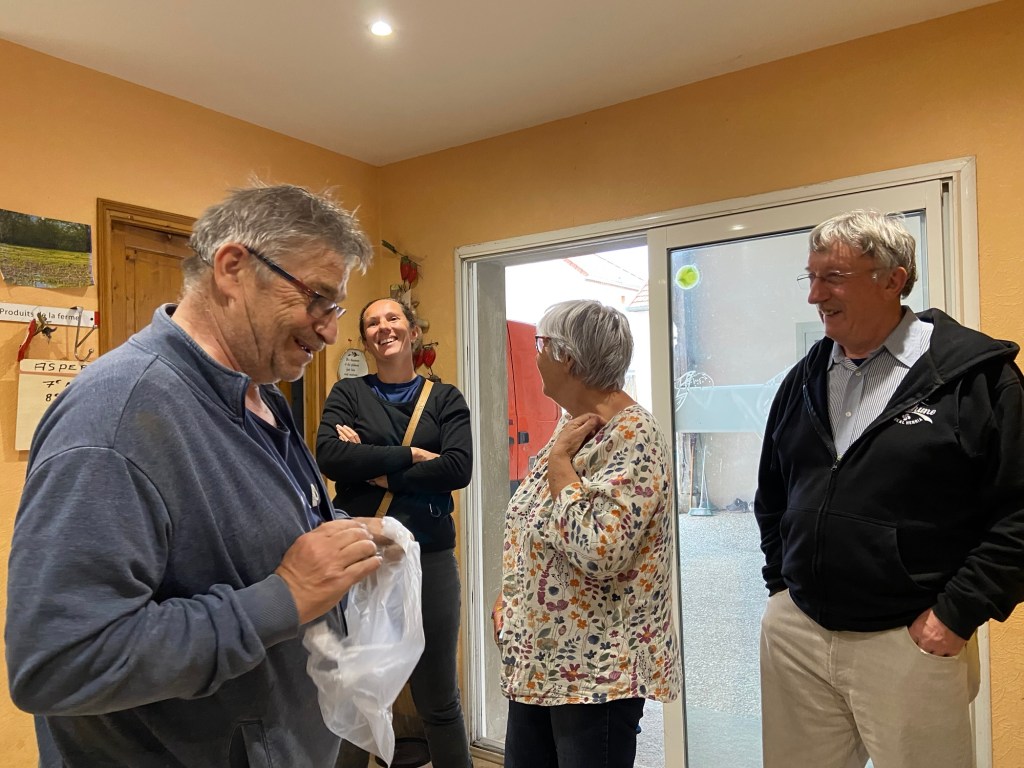
The shop was full of gales of laughter I almost managed to sell some asparagus myself to one of Denis’ friends, who called him ‘Chef’. Patricia chatted to me for ages in immaculate English. She imparted recipe suggestions for making asparagus quiche, and her husband, holding kilos of the white spears in plastic bags, eventually dragged her away by her ear. The woman from the vending machine turned up, and it was like meeting an old friend.
Finally we got the keys to the church from Denis. It was just up the road.
A woman was weeding the gravel path outside the church amongst a quite extensive and beautifully maintained garden inside the iron gates, including an immaculately trained grapevine. I wondered whether the church tower was the beheaded version, or whether it had been subsequently rebuilt after its decapitation during the last war.
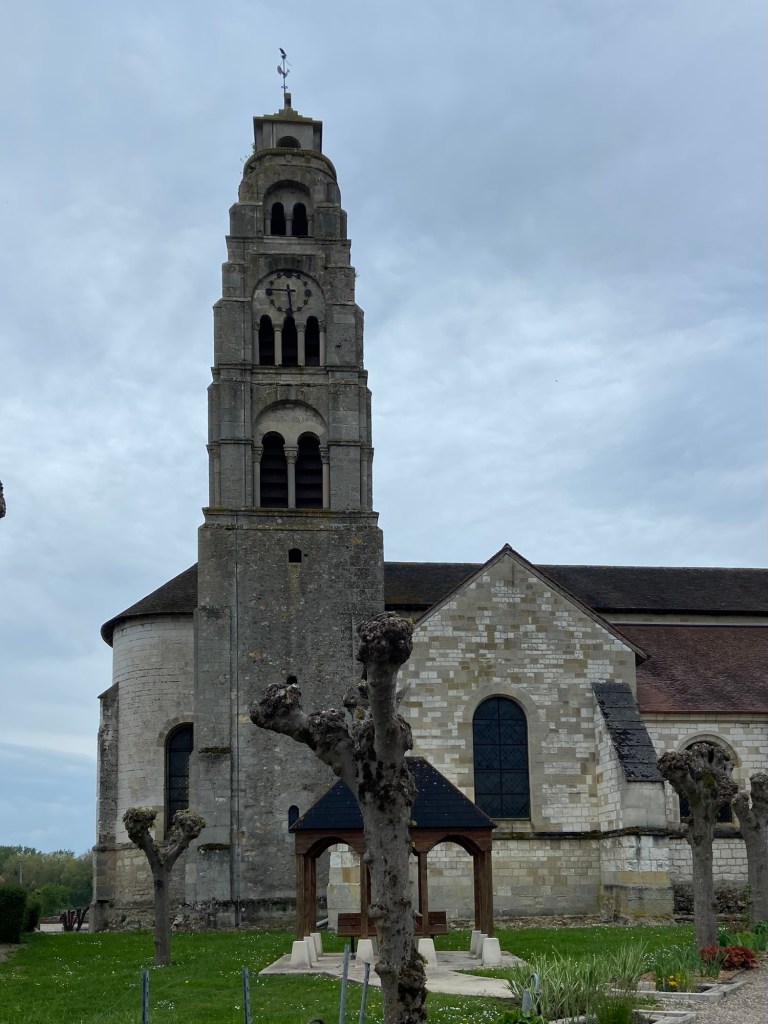
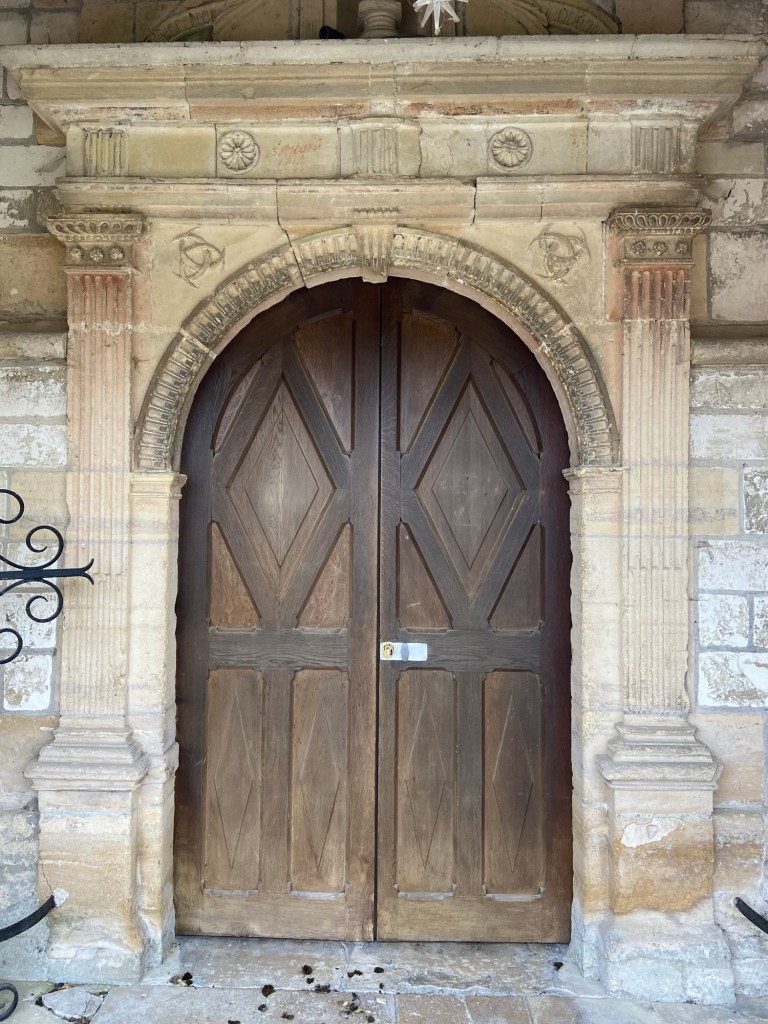
The church was an extraordinary building, with the accretions of the years visible in a renaissance doorway decorated with the triple crescent moon symbol of Diane de Poitiers. How this had escaped the severe civil refashionings of the Revolution I don’t know — the town itself briefly changed names from Condé to Montage-sur-Marne, according to a local history site, giving the dates à la Revolutionary calendar: on the 28th Nivôse of Year II (January 7, 1794) … to resume its original name on the 1st Brumaire of the Year IV (October 23, 1795).
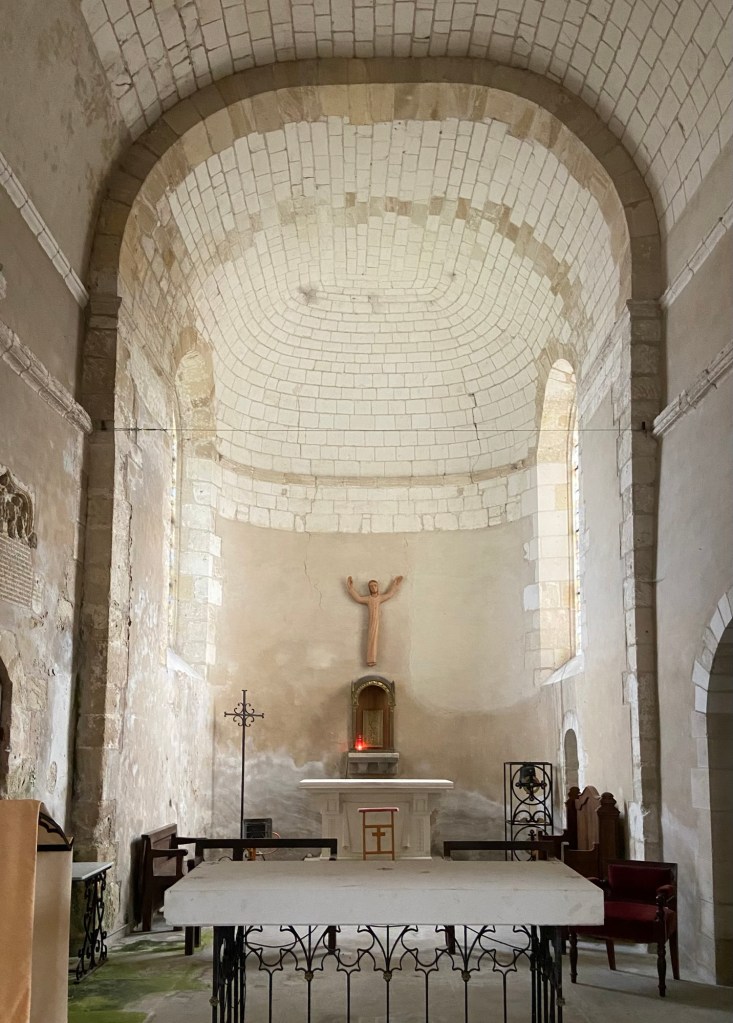
The interior felt cool and ancient, with beautifully-proportioned pillars and arches supporting a tiled vault.

The apsidal end was a scoop shape, the usual curves flatted in two dimensions, unexpected and oddly attractive.
There was plenty to look at but we were getting hungry. We came home via a black and white cat whose favourite spot was atop the courtyard wall above the front door to Denis’ over-the-road neighbour’s house.

He was chittering back to the martins still wheeling in the sky, but also rubbing his cheeks and chin against the tiles and plaster. He was the first friendly cat I have seen in more than three weeks of walking through towns and villages.

Stats for the Day
Distance: 20.51 km
Time: 4 hrs 16 mins although we were out for longer.
Pace: 4.8 again … it felt as though we were dawdling, but in fact we weren’t. The walk was incredibly flat today: a mere 118 m of climb.
 Walking The Landscape
Looks as if you’re fair galloping along the kms now! I love the flora and fauna you’re sharing. The biggish beetle with spots/striations looked a bit lesser stag beetley to me so I googled French lesser stag beetles and a site popped up, with a pic like your chap! I’ve put the link on our Suma WhatsApp group. The refrigerated food pods look amazing!
LikeLike
The flattish looking one looks much like the vine weevils we have in the uk.. possibly Otiorhynchus sulcataus?
LikeLiked by 1 person
The grey patterned one? It was bigger than that. I think Niknak is closer with some kind of stag beetle. It had the pincers at the front and that aggressive stag stance.
LikeLike