Her neck being opposed to the Sun wil diuersify into a thousand coulours, more various then the Iris it-self, or that Bird of luno in al her pride; as scarlet, cerulean, flame-coulour, and yealding a flash, like the Carbuncle, with vermilion, ash-coulour, and manie others besides, which haue no name, but as you borrow them from other things.
Henry Hawkins, Partheneia Sacra
There was another pilgrim (or should I say, walker) in the hotel last night: Martin, a retired ergonometrician and enthusiastic local footpaths officer. I shot off my chair with enthusiasm at this last fact, and he barked with laughter, and said I was the first person he’d ever met who had had that reaction. So I showed him some of the non-existent footpaths along the river Avon that I had tried and sometimes failed to battle my way through on my walk to Cambridge a couple of years ago — a towering wall of brambles, for example, and dilapidated stiles and bridges. We had a convivial supper, with some strong Belgian beer.
I slept well last night although when the alarm went off, I could really have done with a couple more hours of sleep. Reims and a Sunday lie-in awaits! In the breakfast room I saw a cabinet I had not noticed last night, absolutely full of the most amazing local finds.
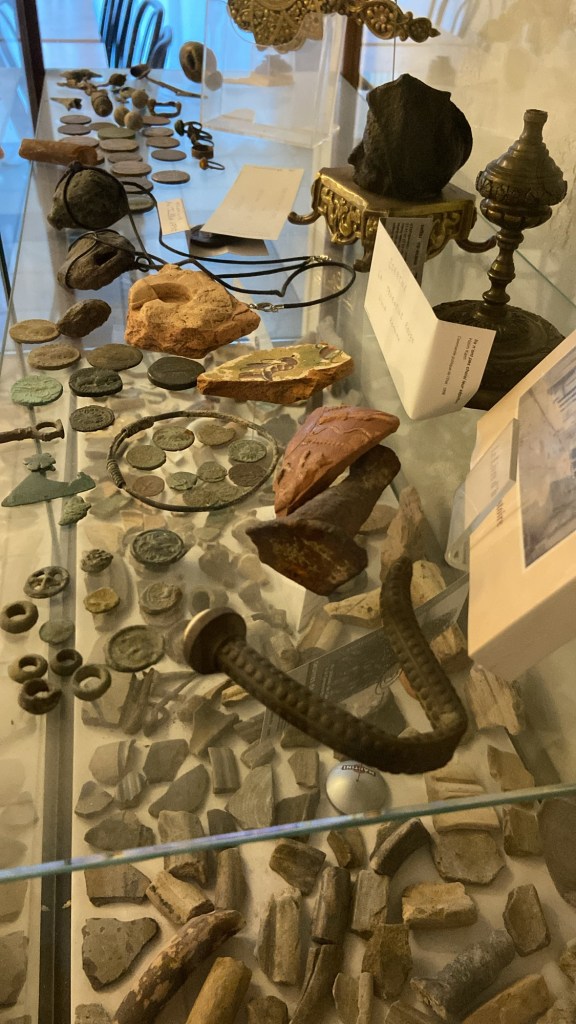
Isabelle the waitress said that her father-in-law had a good eye and just finds these things in the fields. There were Roman coins, balls of WW1 shrapnel, neolithic stone hand tools, and many pieces of tile.

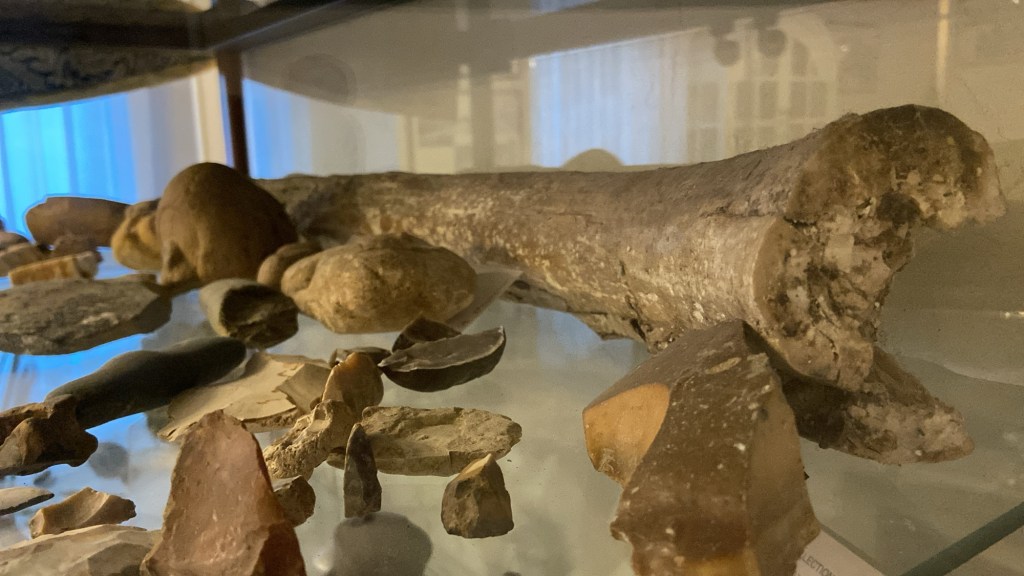
My favourite item was a piece of mammoth tusk about a foot and a half long. Never had breakfast with a mammoth before! And the coffee was really excellent.
Martin asked whether I minded if he walked alone today, and the answer was no, really. It is so nice to talk, but one really needs ones own rhythm, and a good deal of attention on the route. We did end up leapfrogging each other several times, and walking together a little as well.
Almost the first thing I saw on leaving the hotel was an asparagus bed in somebody’s vegetable patch which I texted Stephen about. ‘You have a knife!’ he said. ‘Pick some!’ Reader, I did not.
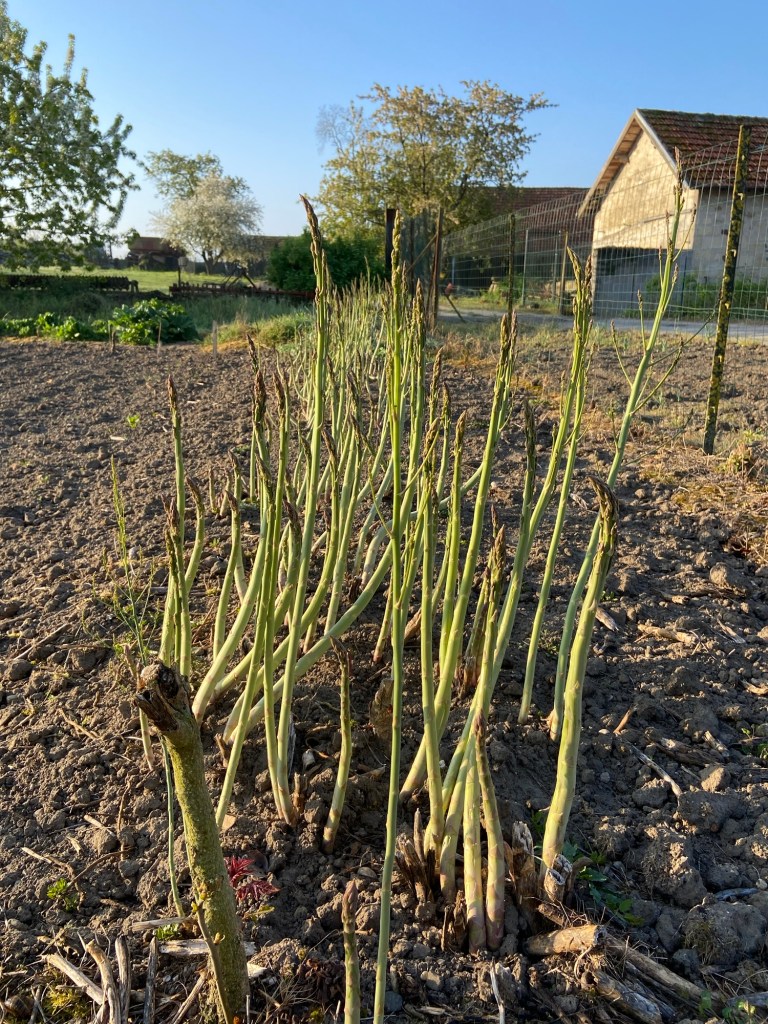
So I set off asparagusless into the bracing cold morning which at 4° had left a heavy dew on the grass and swathes of mist in the air.

It was energisingly atmospheric.
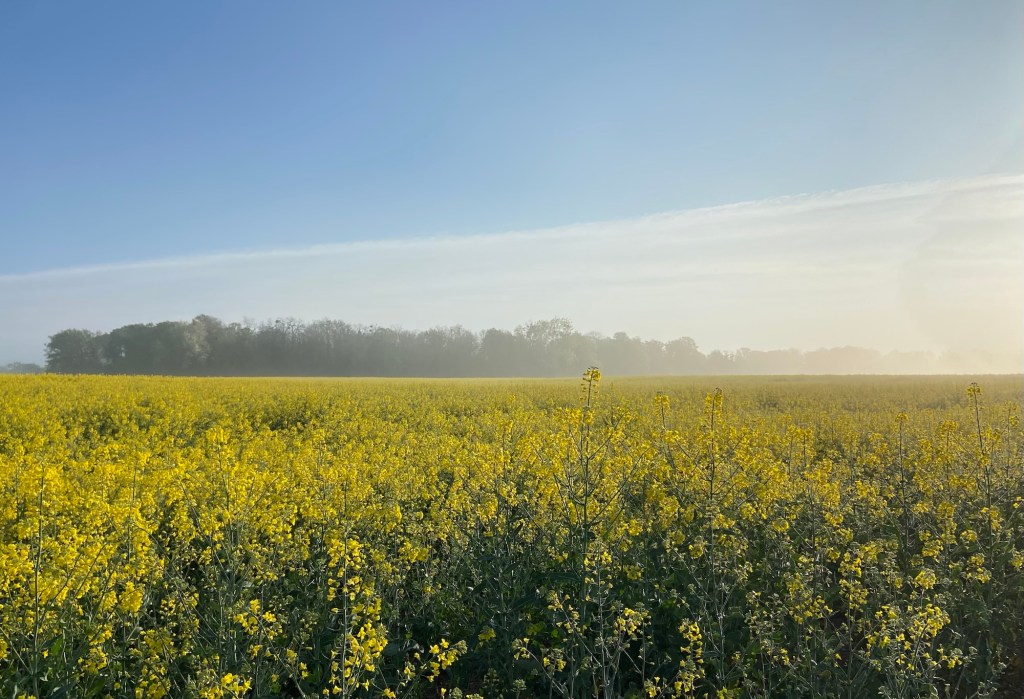
There was almost 6 km of road walking to start the day down a quiet very flat road through open fields of rape and corn. There were aircraft sheds in the middle of a field, and a windsock, flaccid in the still morning air.
The moisture in the air took away any views there might have been, but the land is so flat here there were almost no objects between me and the flat horizon.
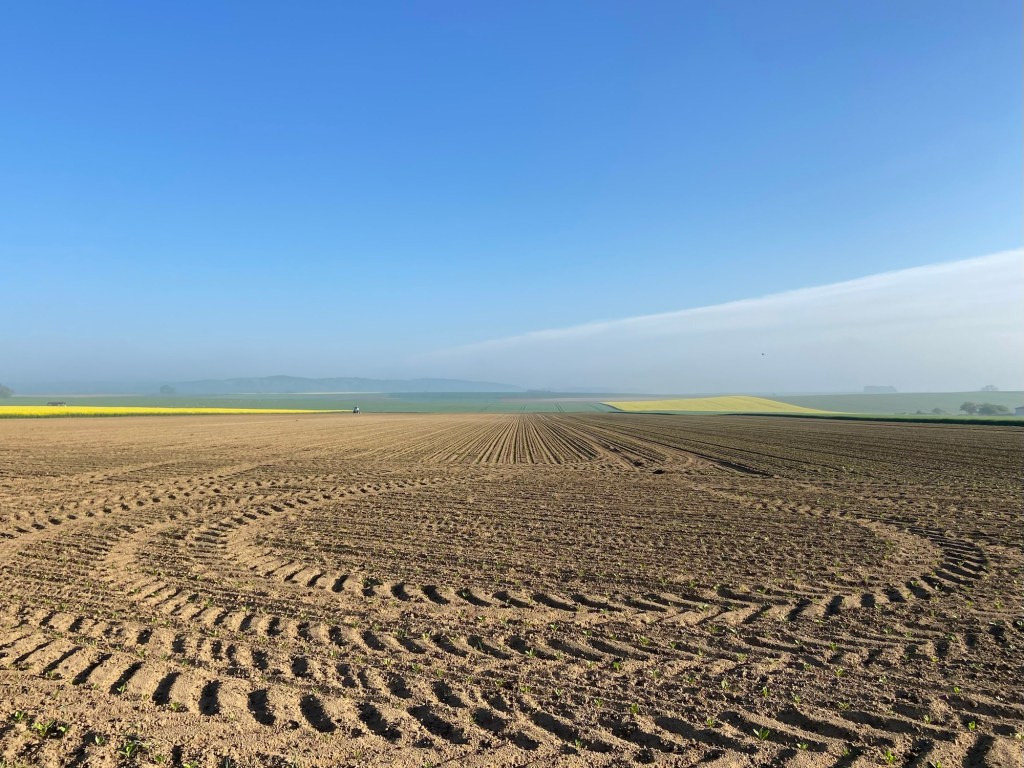
The cornfields were bristling with corn buntings, a UK red list species, calling to each other from nests only a few metres apart. A tractor passed me on the road, turned off and began spraying one of the fields with a wide boom sprayer. I pitied the larks and the buntings. Although, with so many in every field, somehow they must be surviving the pesticide onslaught, both in terms of themselves and the insects they feed on.
Juvincourt-et-Damary was another small village where people were getting on with business: chicken farming, and arable work. Having stopped to smell a huge rosemary bush in glorious flower in front of someone’s garden, I heard a cooing sound coming from the bushes to my right. I have never heard that particular cooing before, but I was convinced that this quiet soft sound was a turtle dove. I opened the Merlin app and watched as the AI program identified the bird. Streptopelia turtur. I was absolutely enchanted.
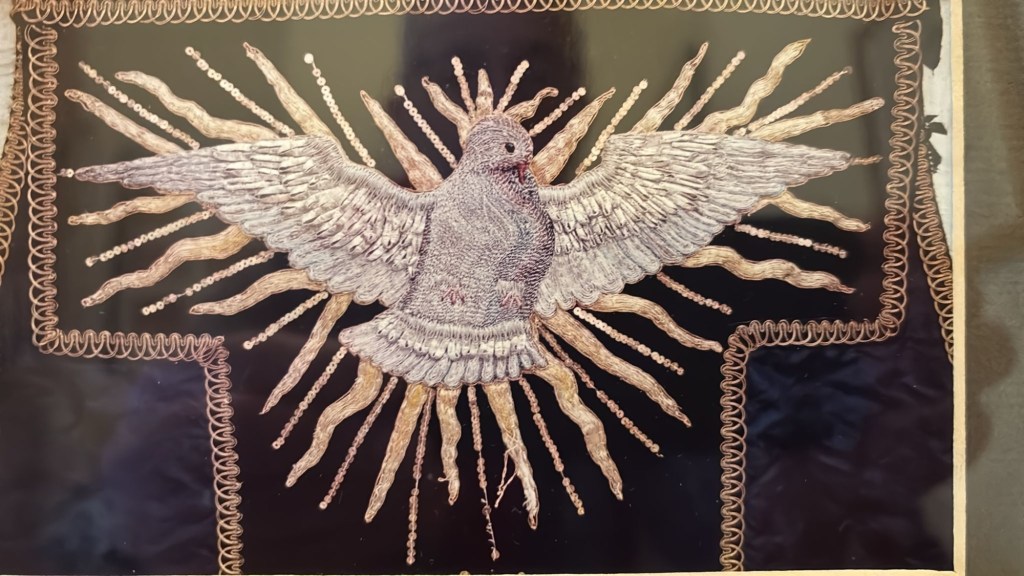
I thought of Helena Winter, the daughter of one of the Gunpowder Plotters who stayed in the UK all her life until she died in 1670, instead of moving to a convent on the continent, like the other women from the Pllotters’ families did. She supported and hid Jesuit priests on her farms in Warwickshire, and embroidered an extraordinary number of vestments for the various offices of the Catholic Church, many of which have survived. One of these, a dalmatic for use on Good Friday is a black satin tunic with a wide band of silk running down the front and back, with another band running horizontally to create the shape of a cross. Where the arms of the cross meet she has placed an embroidered dove, a tour de force design accomplishment, lines of light coming from its rainbow breast. This is the image which Hawkins describes in his discussion of the ‘turtle’, in his emblem book Partheneia Sacra, which forms the headline quotation above.
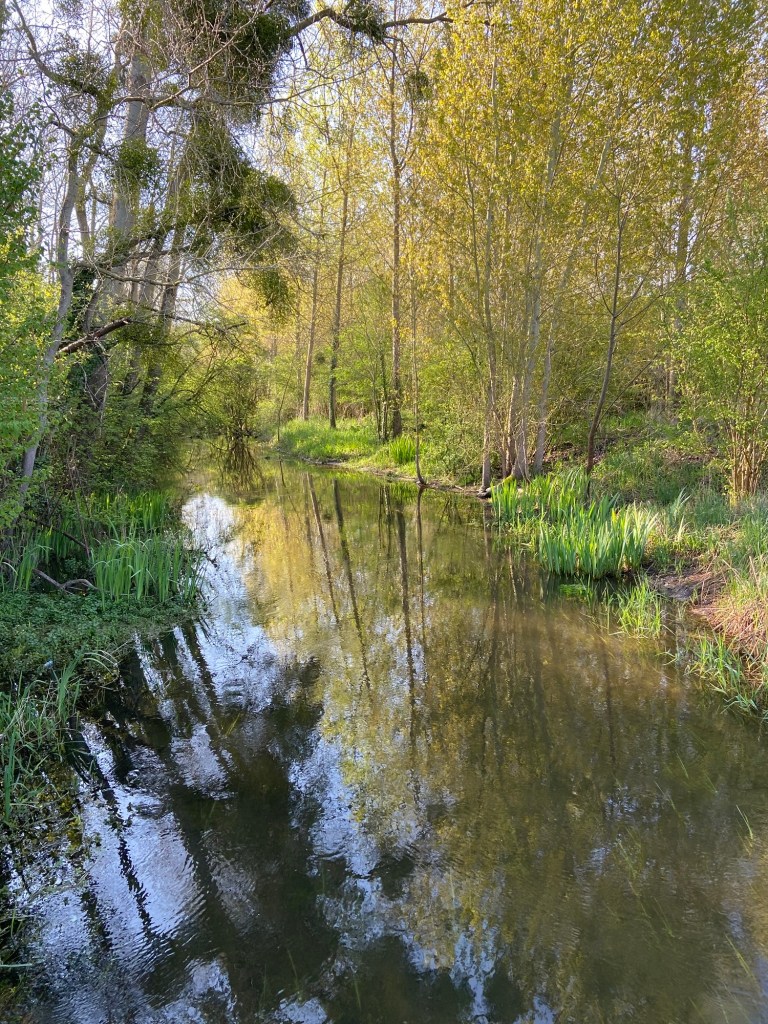
I walked on in haze of happiness at having finally encountered a turtledove, which only increased when I came to a quiet river, strap-like weeds waving in the current. Overhead firecrests were calling in the tops of the trees.
The path curved round a long, long wood in which forestry operations had created clearings with scrub growing up, creating the perfect conditions for nightingales. Sure enough they were calling to each other, as well as the unmistakeable bread-and-no-cheese sound of yellowhammers. Now yellowhammers are by no means little brown jobs, and I felt sure that if one was on the wing, I would see it, despite not having binoculars. Sure enough as I kept my eyes on where the sound was vaguely coming from it flew out of its perch in the trees, a startlingly yellow head on a tiny, missile-shaped body.
Bery-au-Bac is the end of a stage in the guidebook, but tomorrow’s stage from here to Reims is 39 km, so most people continue on. I was booked in to stay at the Benedictine convent in St Thierry, from where there are only 12 km to go tomorrow to get to the city.
Bery was, as far as I could see, a town of cats. In the third house I came to there was seven of them, very wary, sitting on the pavements and windowsills.
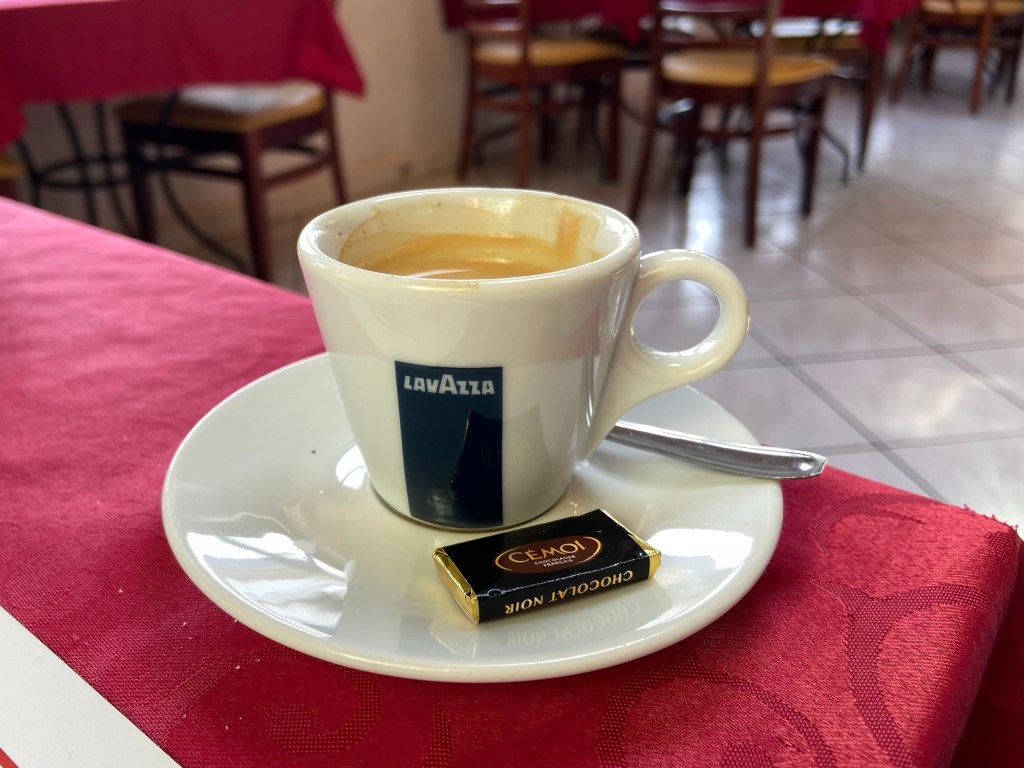
I asked a lad sent to put recycling out in the bins whether there was a café in town and he pointed me to the restaurant down at the bottom of the road. Although it wasn’t yet open, it being 10.45, they cheerfully said they would make me a coffee, and a perfect coffee it was too.
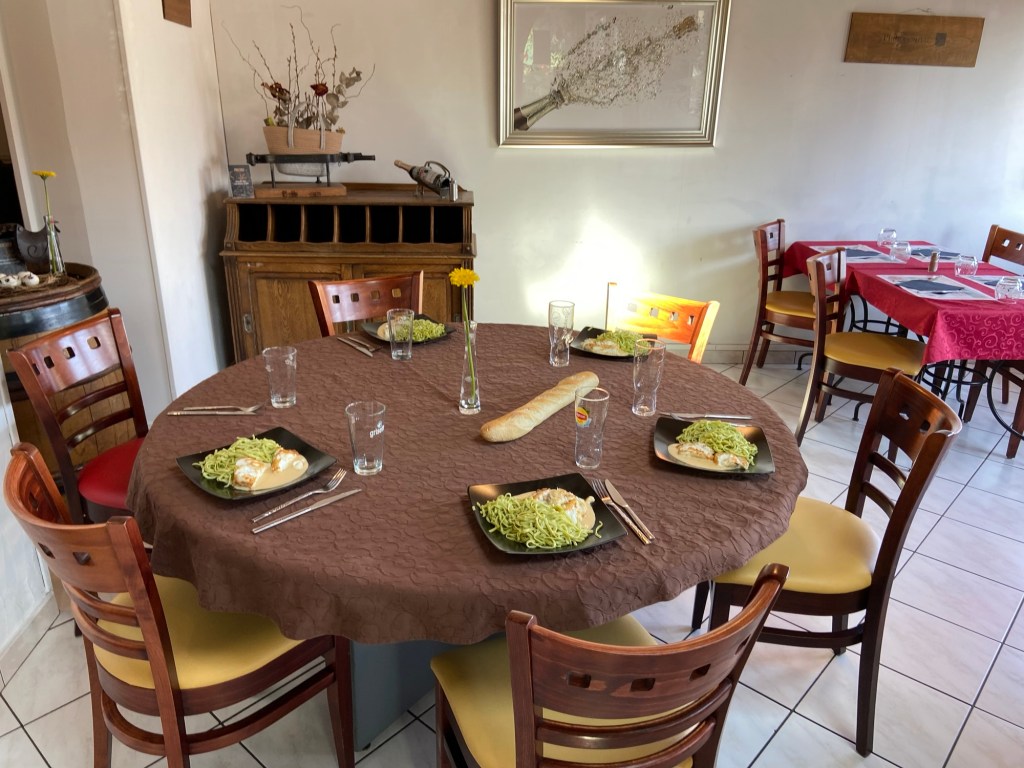
By the time I left, they were bringing out the bread and the plates of salad and sauced chicken for the family lunch before service.
Further on down the road a boulangerie supplied me with a baguette with tuna mayonnaise and salad. Although I had vowed to eat the (heavy!) food I am carrying rather than buy more, which would usually mean a lunch of sliced salami and an oat bar, I didn’t know what kind of food the sisters of the convent would share with us tonight, so I thought it might be as well to get something else on board.
Bery was a neat, small town on the river Aisne where it splits into two channels, creating an island in the middle, so I got to cross it twice. Both times I tried to see whether I could hear a Kingfisher, but the trees were full of blue tits. Not the blue bird I was looking for.
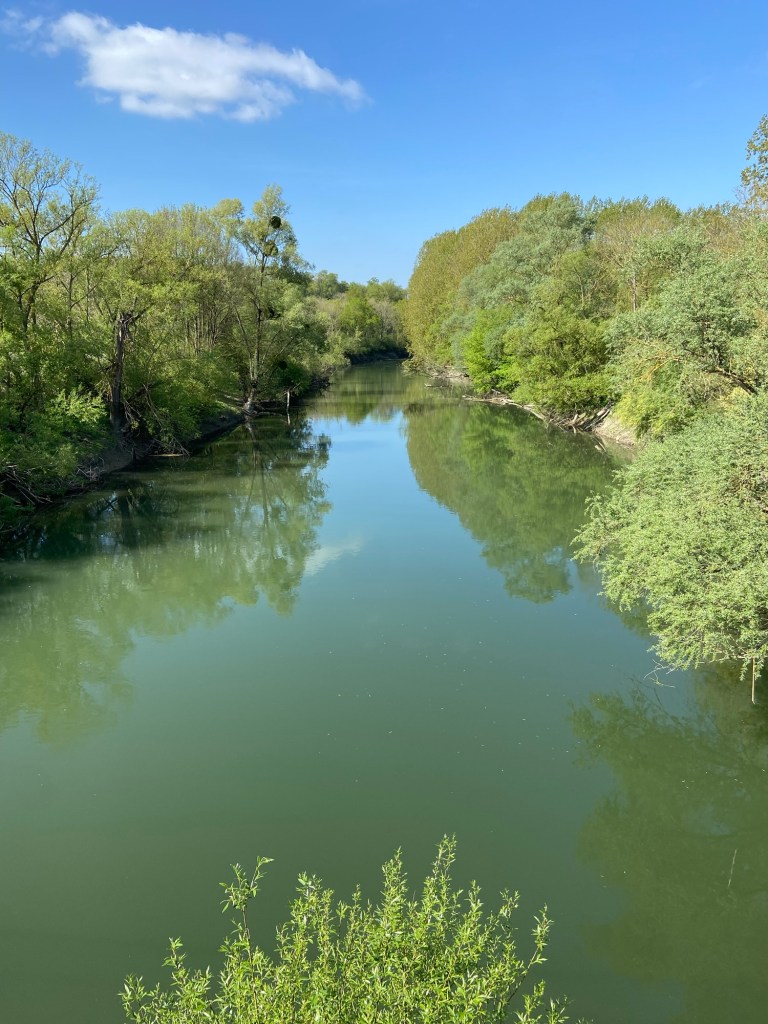
Then there was a canal, to which the waters of the river had been diverted, here a wide stretch of water on the banks of which fisherman were sitting in the sun. And for the first time there were canal boats. I crossed over the road to see the lock and get a better look at the boats, and if I hadn’t done so, I wouldn’t have met Peter.

Peter was sitting enjoying his lunch on the canal side, having parked his extraordinary bike with its giant solar panels on the path behind him. He is cycling to Morocco on a solar powered electric bike. That is way cooler, not to mention more inventive, than walking to Rome. Unsurprisingly it turns out that Peter is an engineer, and he created the bike himself (‘it’s just screwing all the pieces together,’ he said, modestly). Being Belgian, he spoke impeccable English, and it was another canal-side encounter that lifted the heart still further on what was turning out to be a really Good Friday.
I sat on the bank beside him and he offered to share his lunch with me (so generous!) But I had the tuna baguette, so I got that out of my pack and we sat very companionably watching the swallows conduct an aerial display above us, and there were even Arctic terns swooping over the water.
We swapped contact details, and I shouldered my pack and set off, leaving Peter to enjoy his canalside dreams of a job in which he can engineer electric air compressors and still find three months of the year to get out on the road.
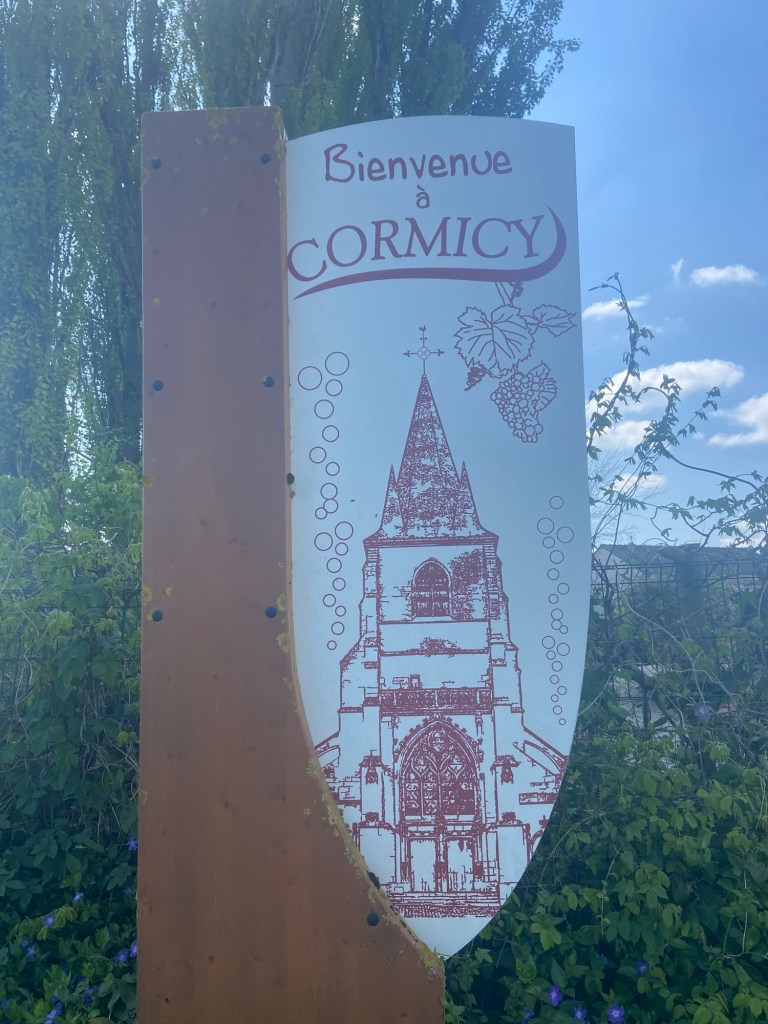
The little village of Cormicy heralded its character with a welcome sign showing a church with champagne bubbles rising on either side. This was promising!
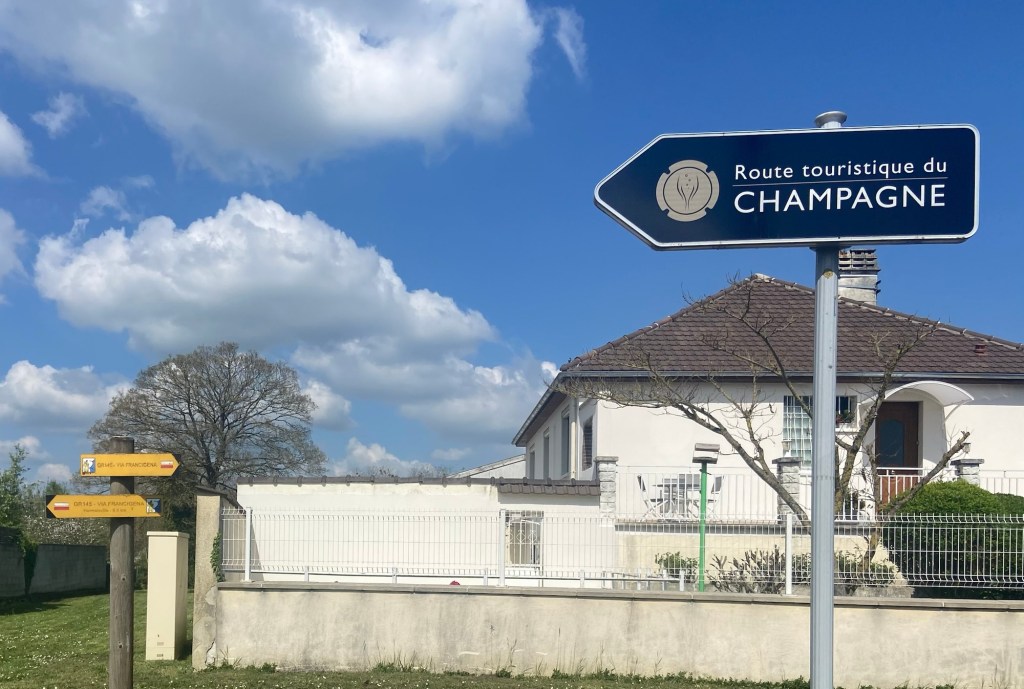
Further on there was a sign for the champagne tourist route, right next to a Via Francigena sign. More promising yet!
I walked into town with a big smile on my face, half because I was thinking of champagne, and half because I was thinking of Peter cycling southwards along sunny roads to the Mediterranean coast with the big solar panels open on the front and back of his bike.
Cormincy had some lovely buildings. The Mairie had no flags flying outside it, either because it had closed down and administrative responsibility had been switched to another town, or because it was Good Friday. But the square outside it was pleasant enough, with benches under lime trees,
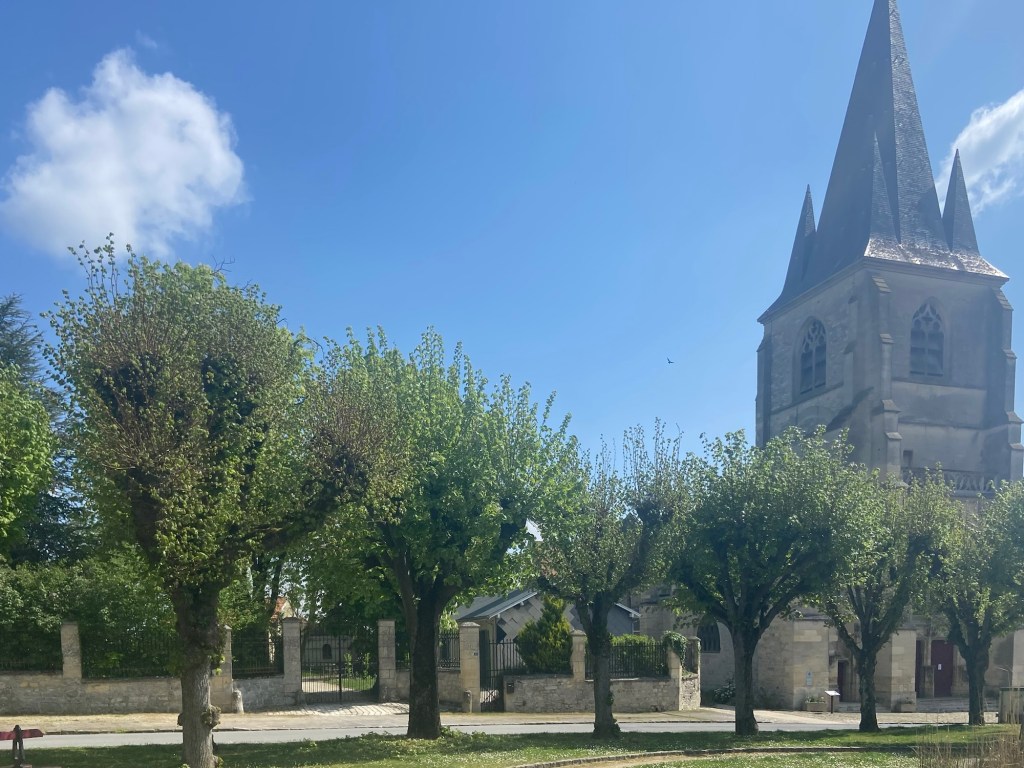
and an Italian restaurant called Il Postino in the old Postes Télégraphe.

At the end of town, the path climbed uphill through Champagne vineyards. They were impeccably tended. Each one of the thousands and thousands of vines was a meter long, tied meticulously by hand to the lowest of two or three horizontal wires.
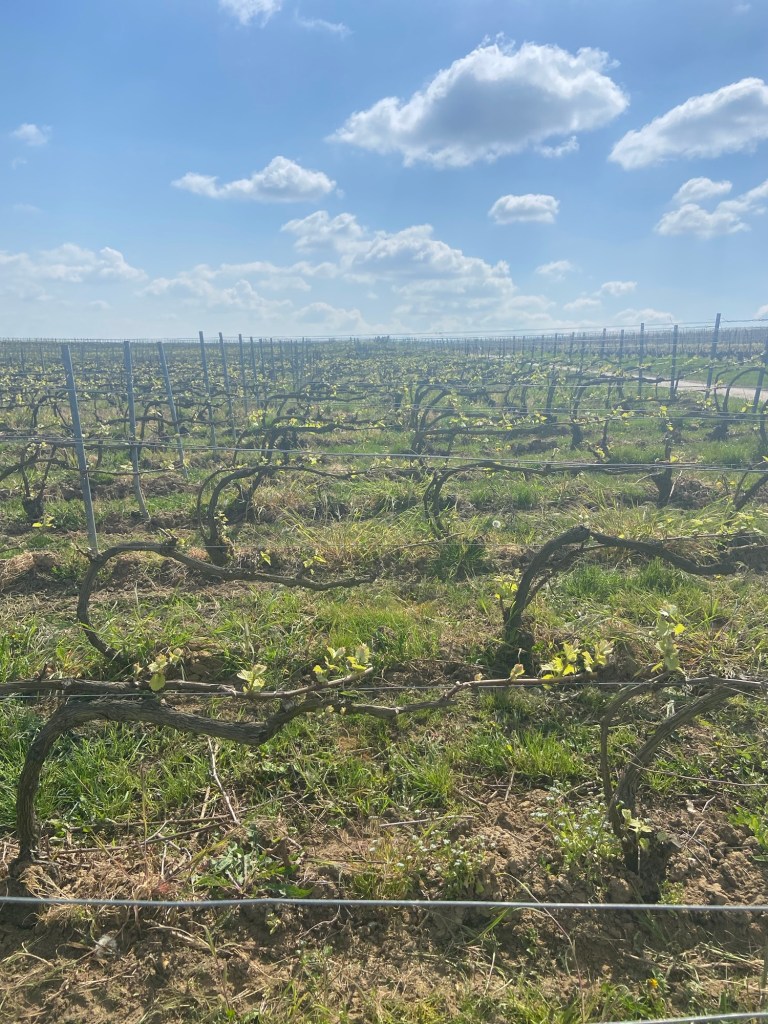
There were vines stretching as far as the eye could see. At the end of some of the rows were little rose bushes, or irises already flowering.
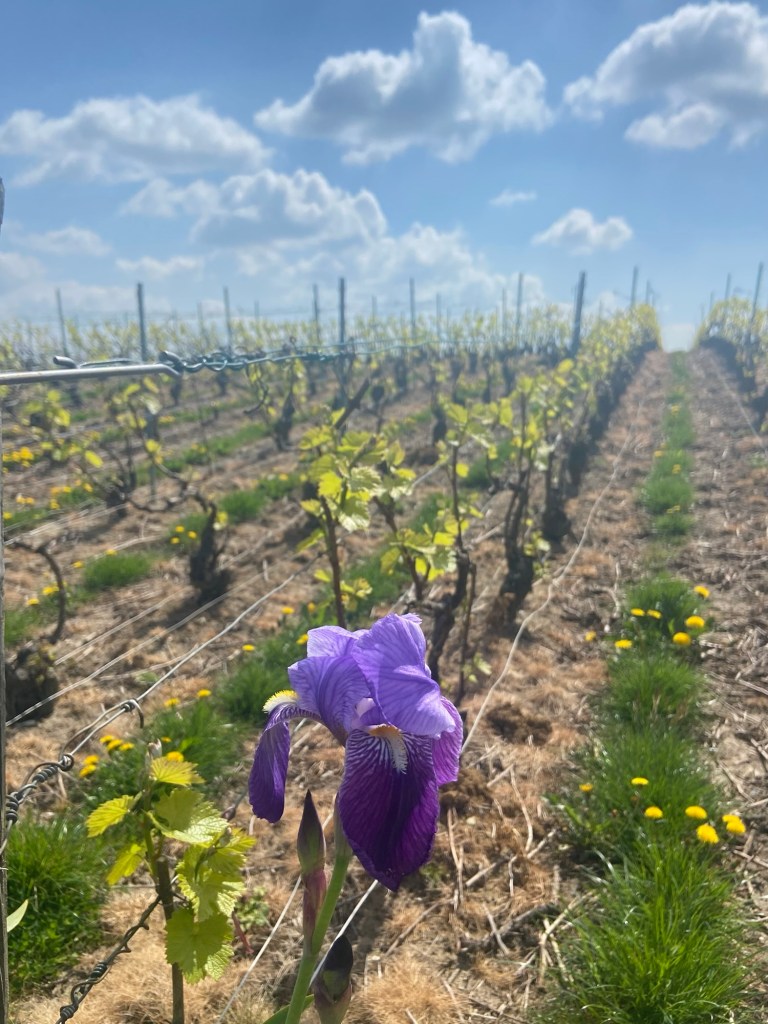
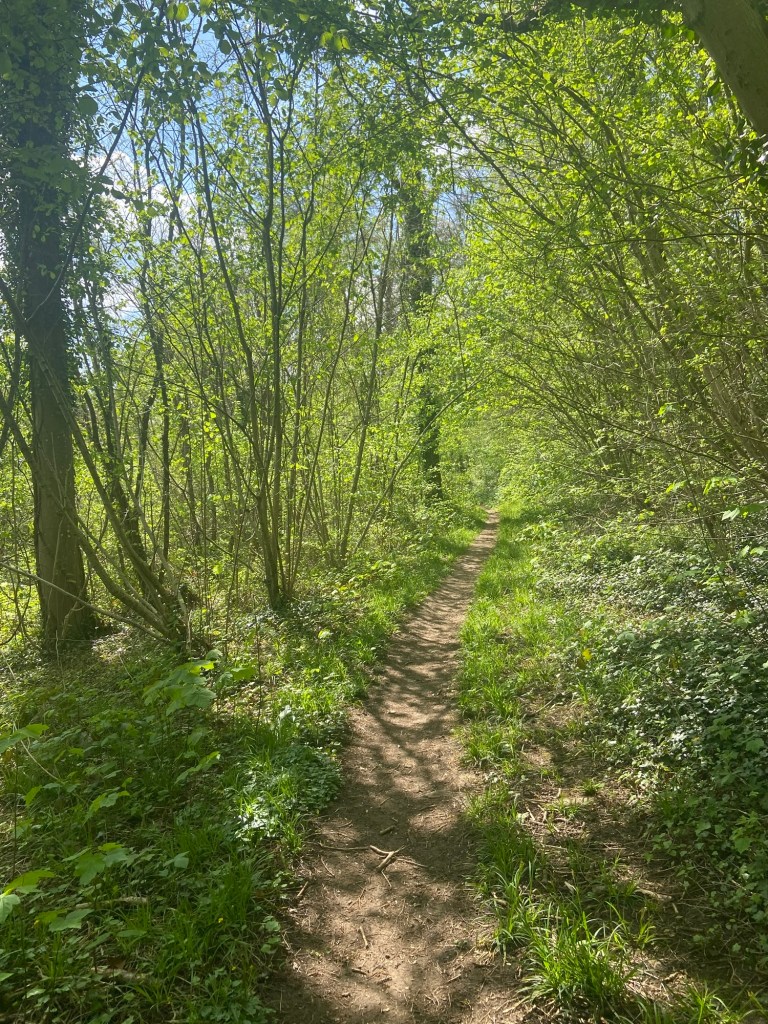
It was quite a pull-up to the top of the vineyard where it met a wood, and when I reached it, there was Martin sitting on a log munching away at his baguette lunch. I left him there and went on. After the stiff climb, the leafy path through coppiced hazel was delightful.
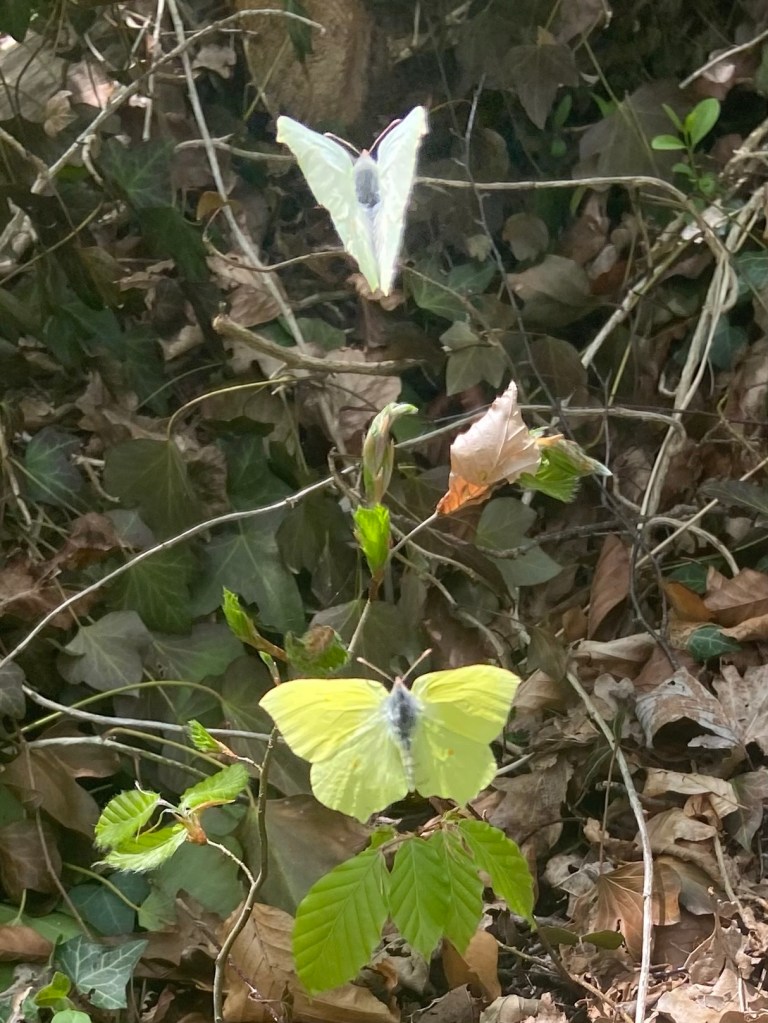
There was even a pair of brimstone butterflies fluttering around each other, but unlike the aggressive-seeming peacocks’ spiral battles, this was languid and seemed to me clearly a mating flight.
Not far from the edge of the wood, Martin caught up with me, and we walked on a little way, his long legs creating a pace that pushed me to the edge of what I felt comfortable with, even though I think he slowed down a little!
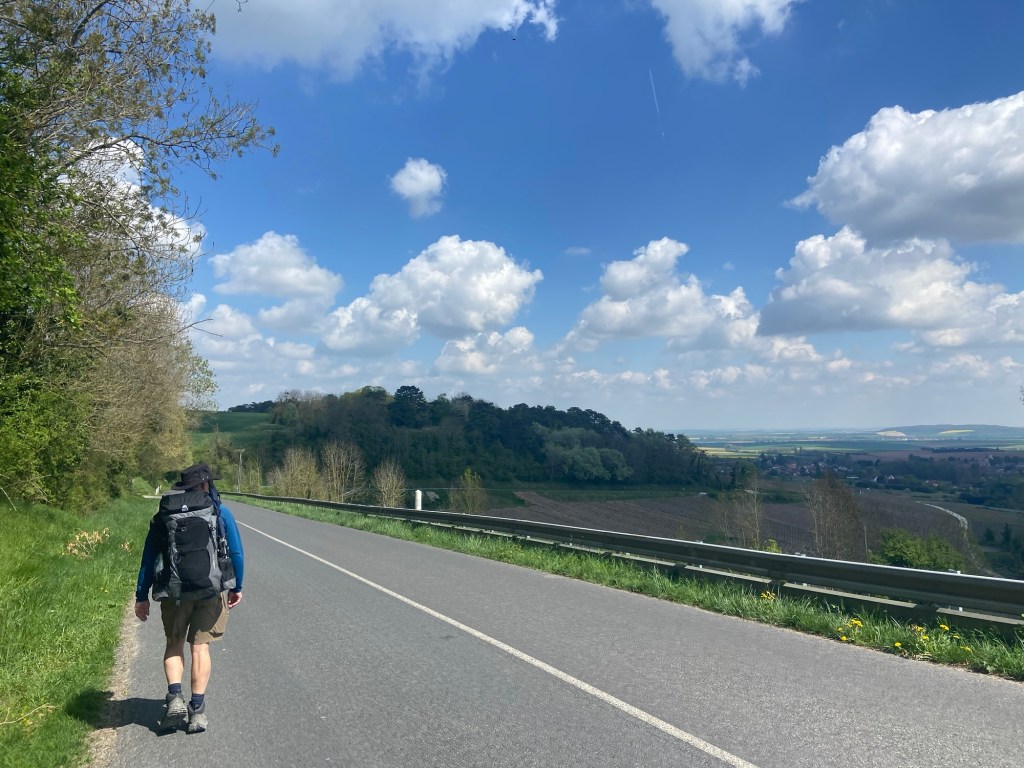
On the way we met some young men out paraponting. The wind wasn’t on their side and they said that it kept dragging the parapont further to the south of them they would’ve liked. While we were talking, one arrived with the huge packed wing on his back, through the vines from where he had landed, and another took off from the edge of the wood above us.
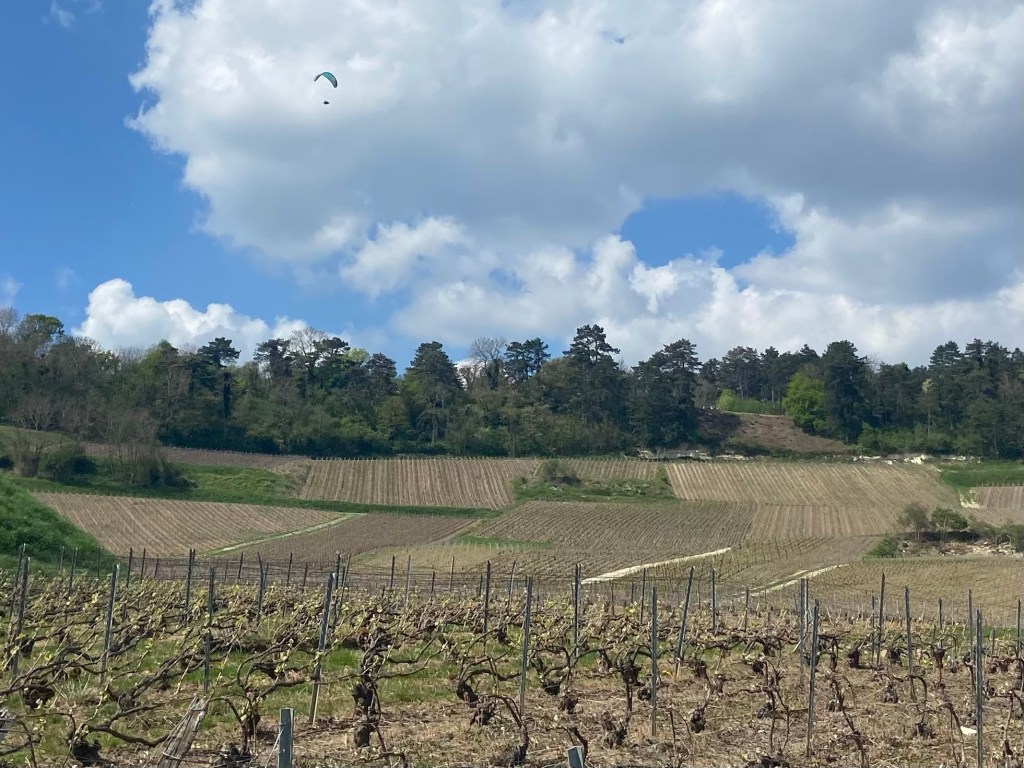
In the main square of champagne town Hermanville Martin was waiting for me on a bench, and we confirmed our understanding of where the Abbey was before he set off. I took my shoes off, put my phone on to charge, and rested a bit in the shade. I had another 6 km or so to go.
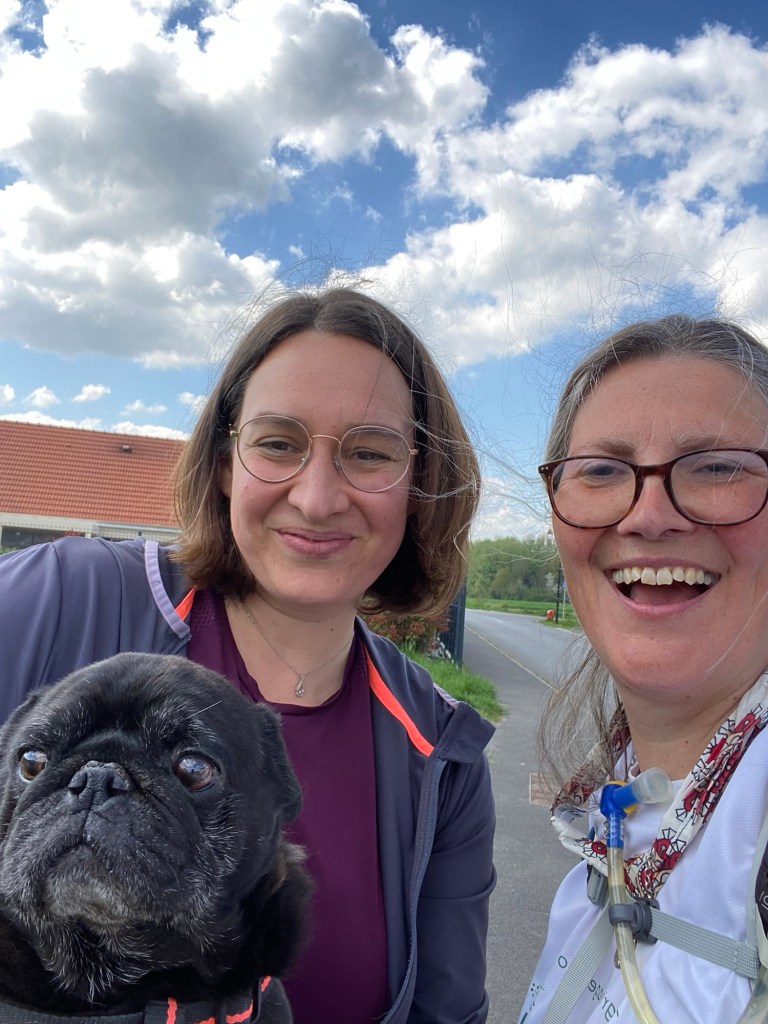
Coming back into town as I was in the way out was Chloe, a local mental health nurse, and her pug, Nestor, whose snuffling had drawn my attention from the other side of the road. We stopped to chat about the effect that the pandemic had had on the mental health of young people, and both agreed there was great need for support. It is somehow reassuring to know that it is not just in England that the young are struggling, it isn’t something that we are doing ‘wrong’, but perhaps an inevitable loss of the resilience that one develops through constant social interactions. We conducted the conversation in a mix of English and French, and I think that was why the conversation was effective! I learnt a new phrase though when I said it was a pleasure to have met Chloe, and she said. Plaisir partager. The pleasure is shared. Yes, that’s it. Pleasure is shared.
The route, for no reason that I could see, did two sides of a triangle up and down a wooded hill. I decided that I would walk the hypotenuse, and in doing so, I passed a set of lonely gates at the end of what was once a carriage drive up to the grand Château of Toussicourt.
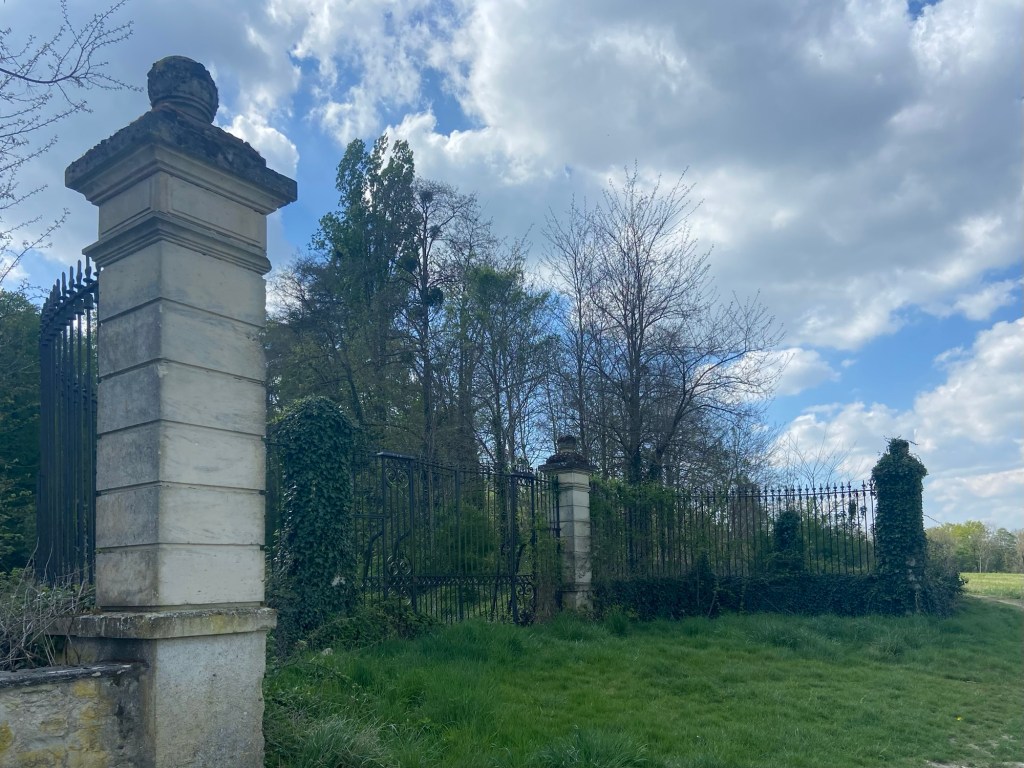
Built in the 18th century for the Cliquot family, the Château was occupied by troops in the Great War and sustained enormous damage — eventually it was razed when it became too dangerous for the children who came to play there.
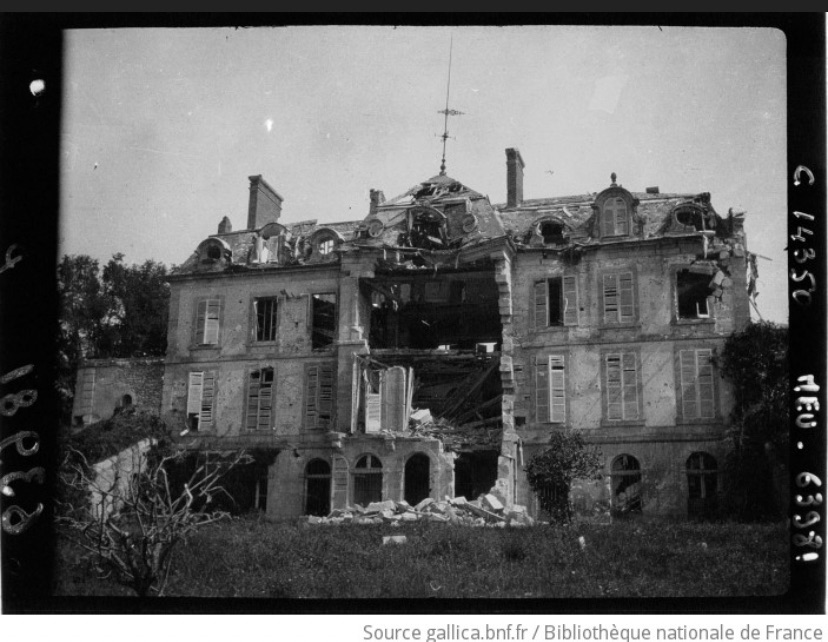
Nothing now remains except for the perimeter wall which looked like the real-life location for Sleeping Beauty.

I climbed up into the wood above it, with plenty of time left to get to the Abbey for the 5.30-6.00 window. St Thierry is off the route so I had to figure out a way of getting there which didn’t add unnecessary kilometrage. The path I was now on was easy, making for some fast walking, and on the map I could see a set of paths out of the wood which looked to lead in a pretty straight line to St Thierry.
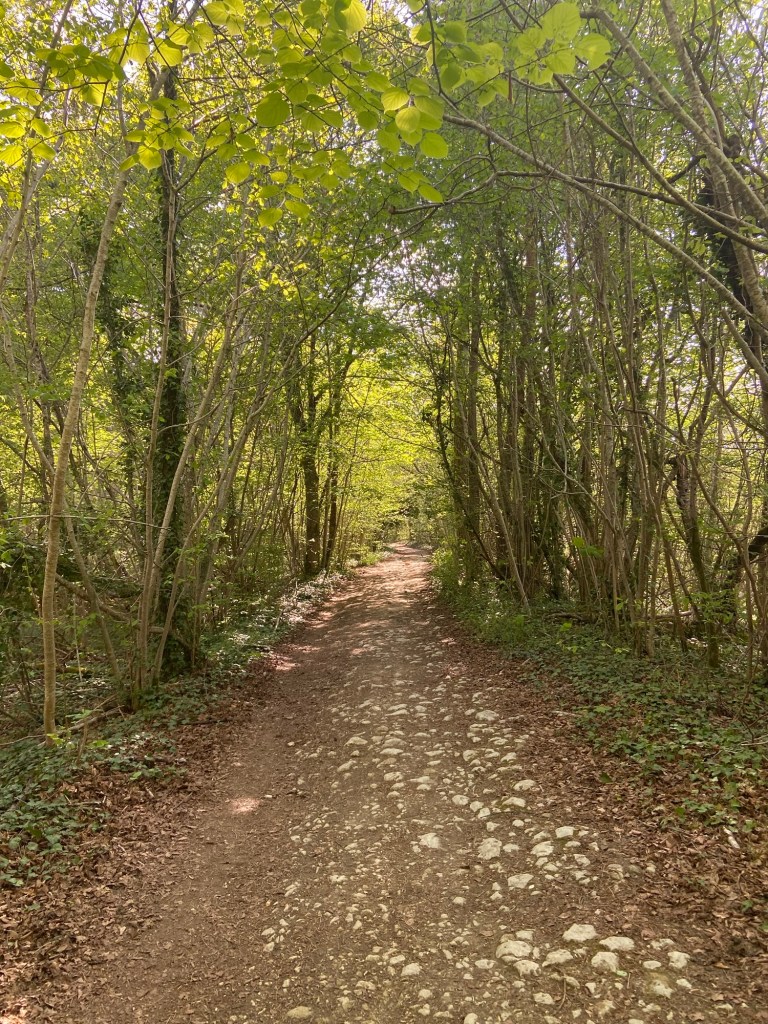
Trouble was, the path exit I could see on the map didn’t seem to exist on the ground. I found out later, looking at a map legend, that I had read a canton boundary as a bridleway (boundaries mostly coinciding with significant paths I have followed, hence my confusion). There were a number of definite paths however, and I just needed to get onto one — but many of them turned out to be mountain biking trails with quite vertiginous drops to them that I absolutely would not risk tackling.
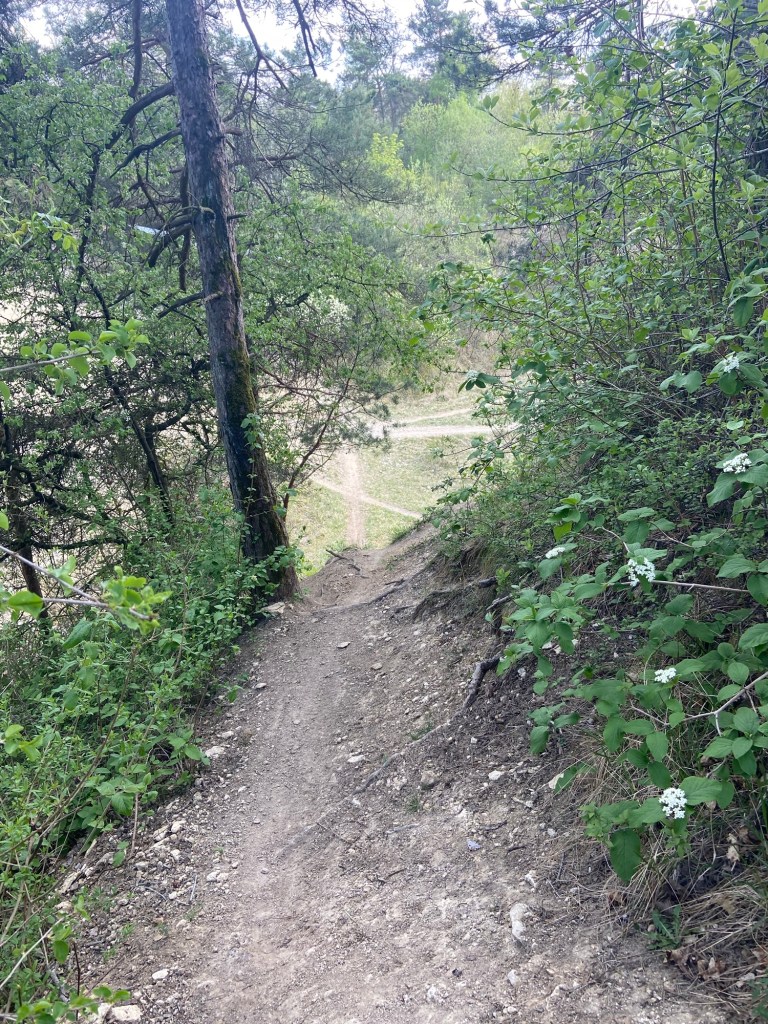
This was the first time on this journey where route-finding had become a problem, and it was simply because I had of necessity gone radically off the marked route.
I can see how this might be fun if you were so inclined as to like mountain biking, but it was quite tiring at the thick end of a long day, and on the clock too! And I don’t ever want to mountain bike.
Of course there was an unusual amount of mud.
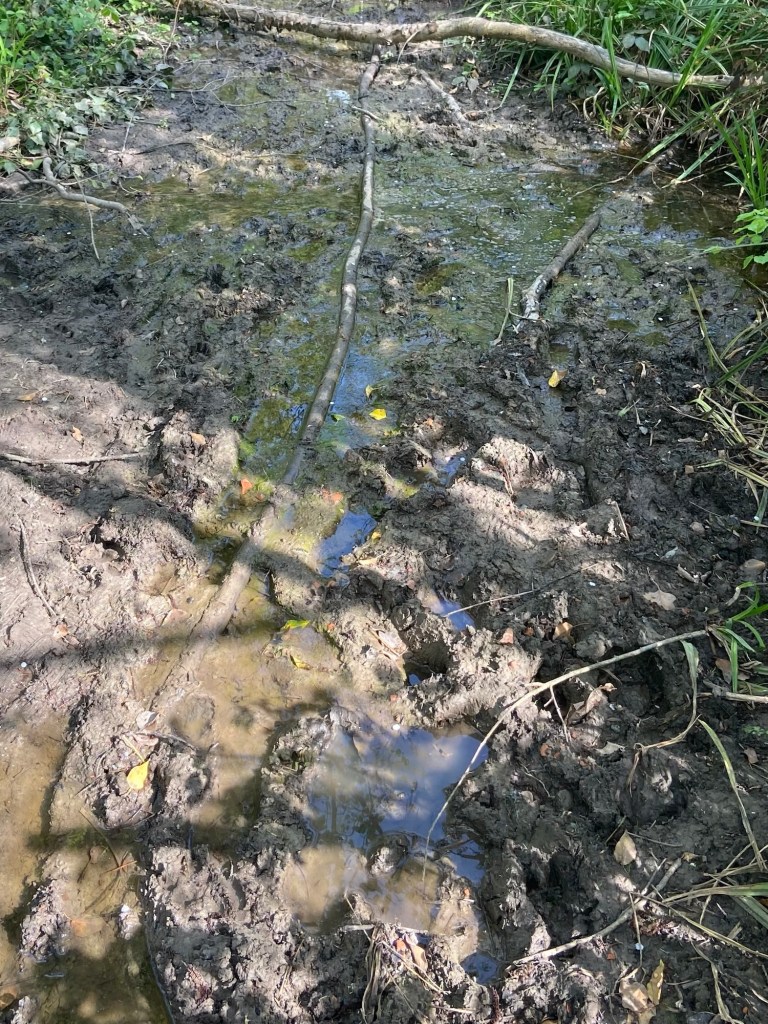
I was beginning to feel like I was in an Indiana Jones film.
However, I also became aware that I had a big grin on my face, and bits of foliage caught in the clips of my walking poles from the various Struggles. I was tackling map reading in France, and intrepidly getting across a difficult landscape.
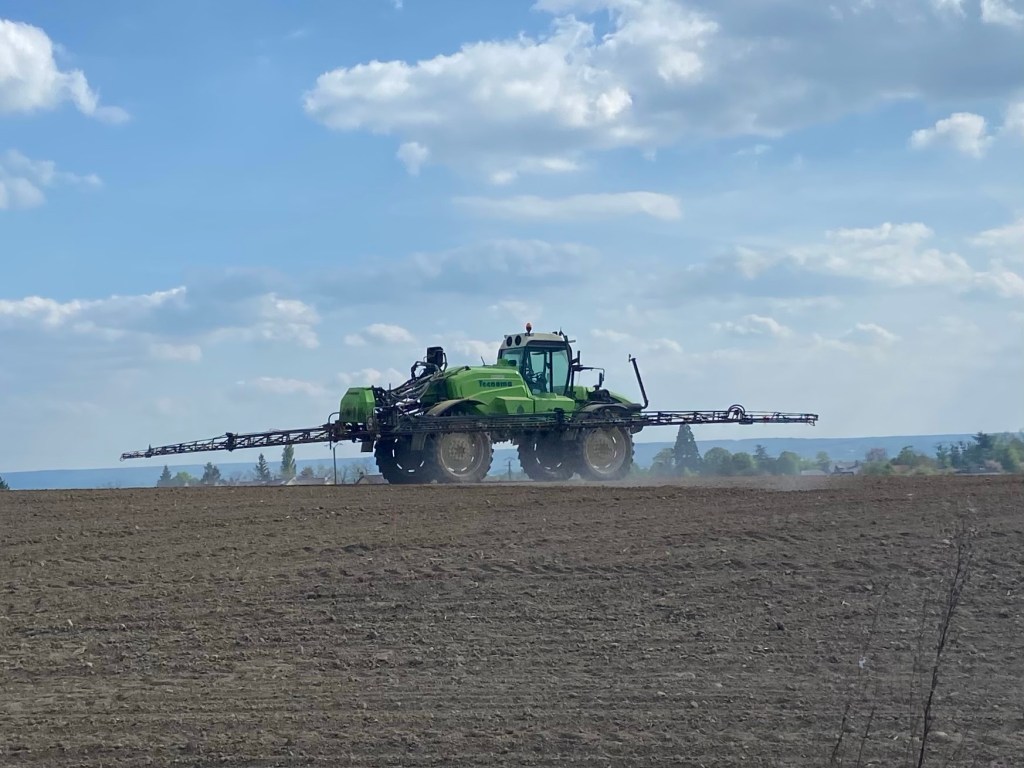
Eventually, I made it out to the road, with the village clearly visible on the other side of some fields, where an enormous tractor had its booms out it was spraying. I felt it catching my throat and in my eyes. Indiana Jones indeed.
Martin was waiting for me in front of the Mairie. I had made it with 20 minutes to spare, not bad precision given that what I thought would be a 23 km day turned out to be more than 30!

Stats for the Day
Distance: An unanticipated 30.52km
Time: 6hrs 24 mins, although I was out for almost 9.5 hours
Average pace 4.8 km/hr (which I’m impressed with, over that distance)
Award-winning bakeries opposite convent: 1
 Walking The Landscape
How lovely to be walking through countryside that still supports so many birds rarely seen, if at all, in the UK. Well done for tucking such a good number of kilometres under your belt. I’m so enjoying reading your blog each day!
LikeLiked by 1 person
Thank you! Yes — there is so much land in France and they haven’t had to raze so much of it. We were astonished by the number of butterflies we saw down in the south last summer. Just so, so many. Same is true here of all the birds. Huge diversity
LikeLike
So many birds! I picture you in the next weeks walking, arms stretched, with them flying to your hands in appreciation of your appreciation of them….. Enjoy your shorter day, and then a blessed Rest Day!! Xx
LikeLiked by 1 person
Ha I would love that!!!!
LikeLike
your blog is so well written, so entertaining. Keep up the spirit ! Thanks for the nice encounter along the canal !
LikeLiked by 1 person
Thank you so so much Solartrain! It was so great to meet you. Your bike is incredible. Bonne route!
LikeLike
Ha ha! I knew Indiana Jones would get a mention at some point! How fabulous to be hearing and seeing so many birds, particularly the gold crests and a turtle dove 🥰. Pity about the Cliquot residence (my fave fizz) but very happy you’re within sniffing distance of a glass or 2 of bubbles! Xx
LikeLiked by 1 person
Firecrests! Goldcrests are two a penny. (Or at least, I hear them a lot, and I have never heard a firecrest)
LikeLike
I DO like champagne!🥂 🍾
LikeLike
Just joined you. What a remarkable adventure – and commentary. Thank you so much for the delightful vicarious experience and reflections shared through such glorious prose. A real gift!
LikeLiked by 1 person
Easter hugs to you, Vicki! And thanks for popping up to remind me I haven’t emailed you! Rest day today, so plenty of time so to do.
LikeLike