
Two Princesses, sedentary by condition, age, and taste, are suddenly possessed by a mania for travelling and running about the world. That is singular, but possible.
Chronique de Paris, on the news that the Princesses Adélaïde and Victoire were leaving France on the eve of the Revolution
I got to sleep at about 10.30, when I realised I was beginning to be writing words from my dreams in with the details of yesterday‘s walk. I then woke up at 1:30, wide-awake and worked on it until it was done at 4:30 and then slept until 7:10. My brain was going round in circles by that point, so I staggered downstairs to dose myself up with caffeine for the day.
Hotel breakfasts are a special kind of ritual. Strangers sit in silence, exquisitely and excruciatingly aware of each other but maintaining an absolute fictitious separation. Then there is the mystery of the breakfast bar. There was only stale-looking packet bread on offer so I loaded a piece up with butter and jam, not having understood that the Maître d’ was saying that he would bring me a basket of croissants and baguette (this is not difficult a French so either I was exceptionally addled or he a mumbler — you may decide which). There were eggs, but what was I supposed to do with them? I might have assayed a water bath as back in Bapaume, but there didn’t seem to be one here. After I had masticated my way through the dry bread (and then the baguette with jam, when turned up like manna from heaven), I distinctly heard him offering to make an omelette for a couple at a table on the other side of the room. Gah! I need to get these breakfasts sussed.
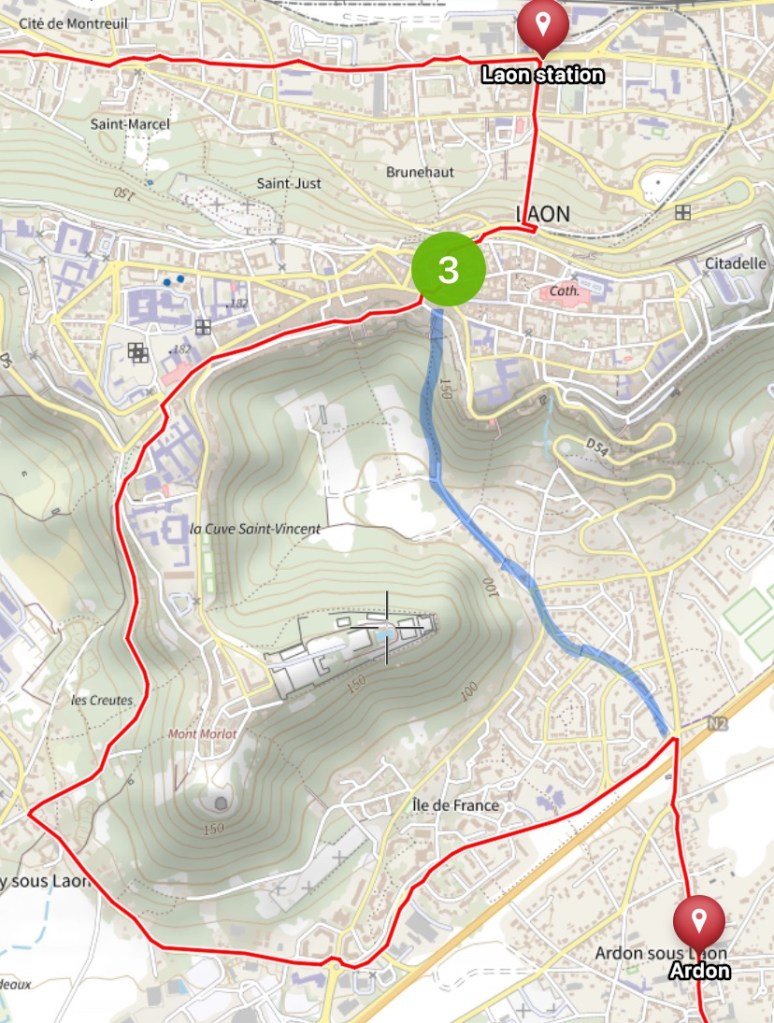
One thing I did have sussed was my exit from the city. The official route takes a baffling way out as circuitous as its way in, but I had seen a direct route out to match the one I had climbed up yesterday.
It proved fantastic. The Porte des Chenizelles, braced by a little bridge which was part of the restaurant I had eaten in the night before, dates from around 1200 and then connected the aristocratic city above with the craftspeople in the Burg below. Today it was inhabited by a kitchen worker hauling the bins up the cobbled steps. It looked like really hard work and I tried to ask whether he wanted any help, but I couldn’t remember the French words, and it was an entire communication fail.

The gate led down to the ‘panorama steps’ and I was just sending a photograph of the view at the top to my route finding expert back at the ranch, when a chap behind me to whom I’d bid a jaunty good morning turned around and asked me whether I needed any help. ‘I’m just sending a text to my husband,’ I replied. ‘You can help if you want!’ I felt superhuman, cracking early morning jokes in French. We both snorted.
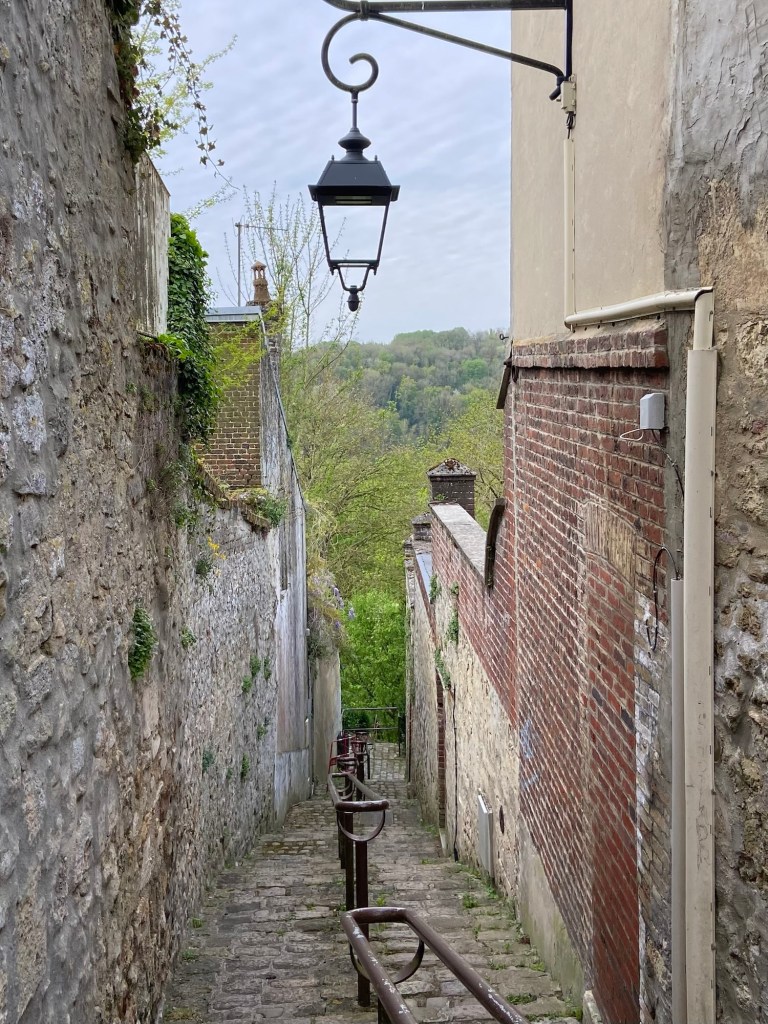
I fairly danced down the steps, enjoying the panorama as I went. A zippy straight path took me in 1.6km down to the town at the bottom of the hill that the guidebook says you should reach in 4.6. I was delighted to have sliced 3 km already out of a 29.6km day.
Rather than a death-defying crossing of the Route Nationale, the exiting Pilgrim can take an underpass, with a better class of graffiti than most.

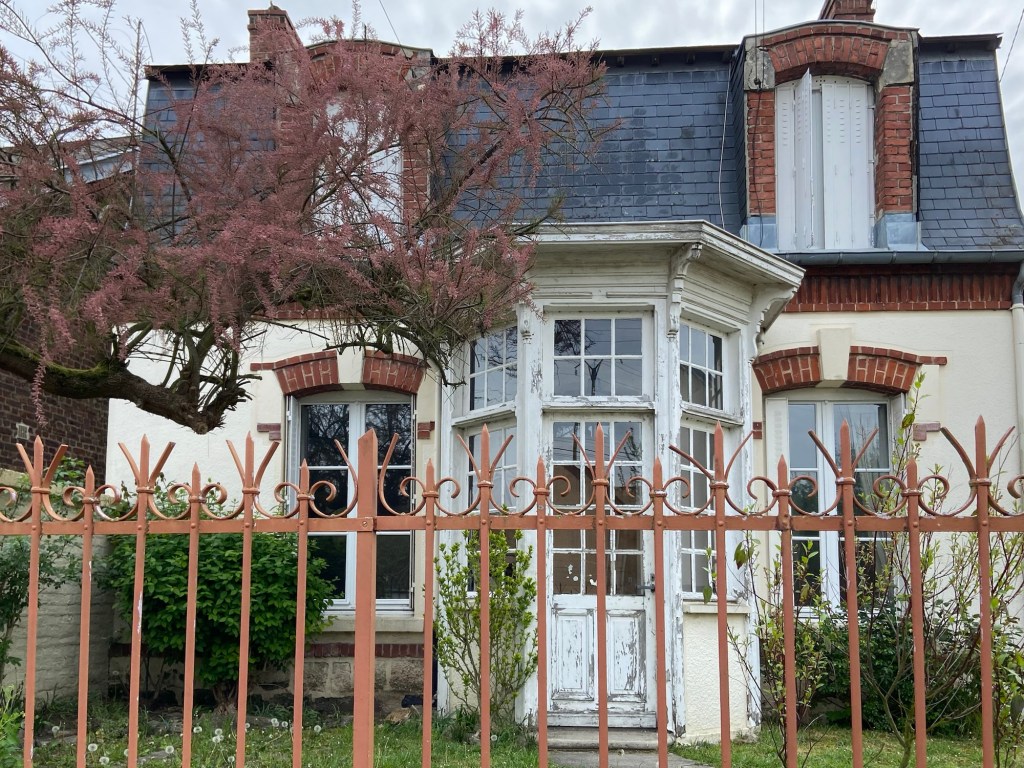
Arden-sous-Laon was a workaday place but nonetheless had some interesting features, including this house in which I am sure I would write great literary novels, if it were mine.
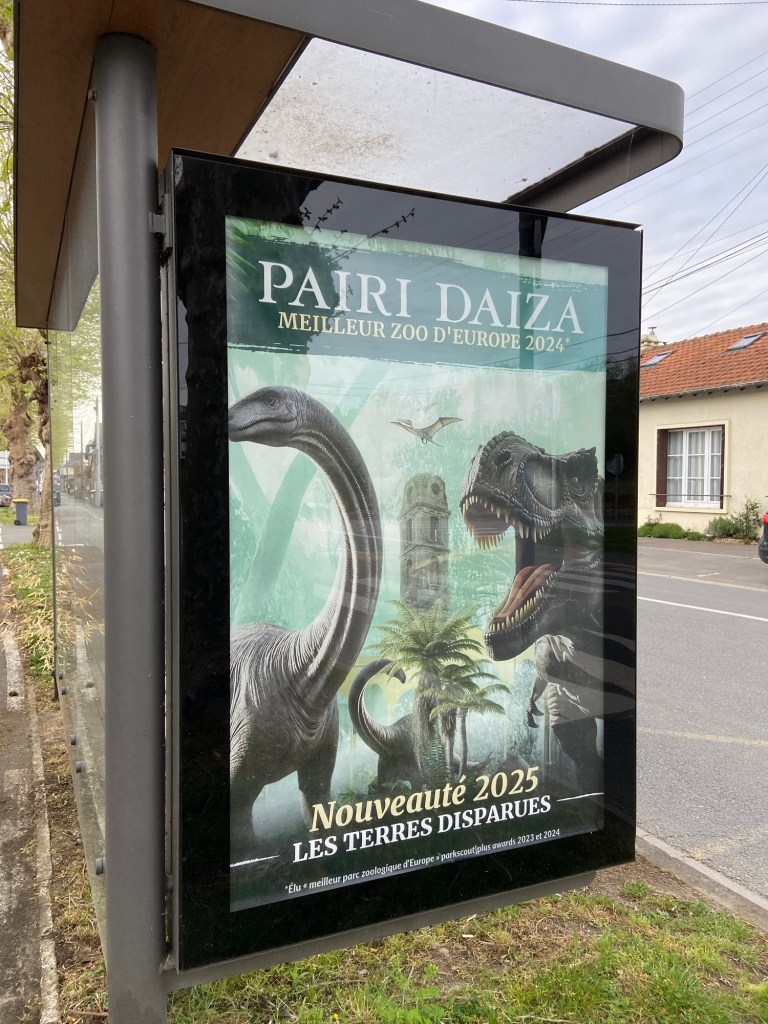
Or perhaps (inspired by the dinosaur barn yesterday) I would write a bestselling screenplay about prehistoric beasts rampaging through the medieval city.
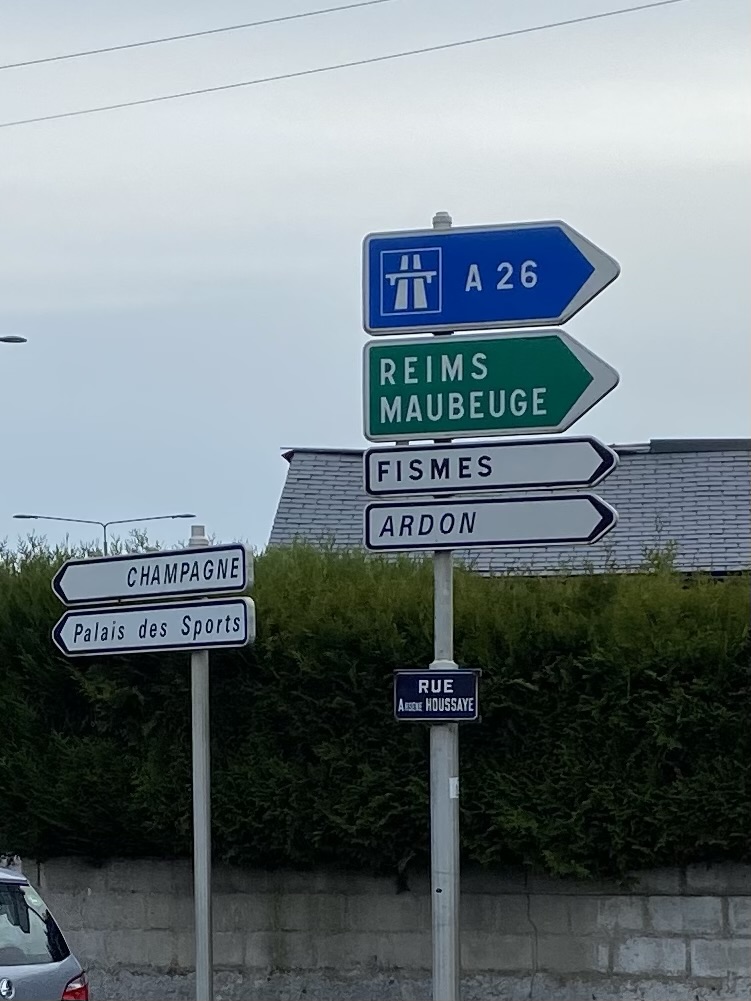
The town also had a motivating set of road signs pointing both towards Reims and to Champagne. Decisions, decisions! But this was not ‘The Road Not Taken’. My road takes in both Reims and the Champagne region, and I have an appointment with Regine AND a glass of champagne on Saturday in the great Cathedral city.
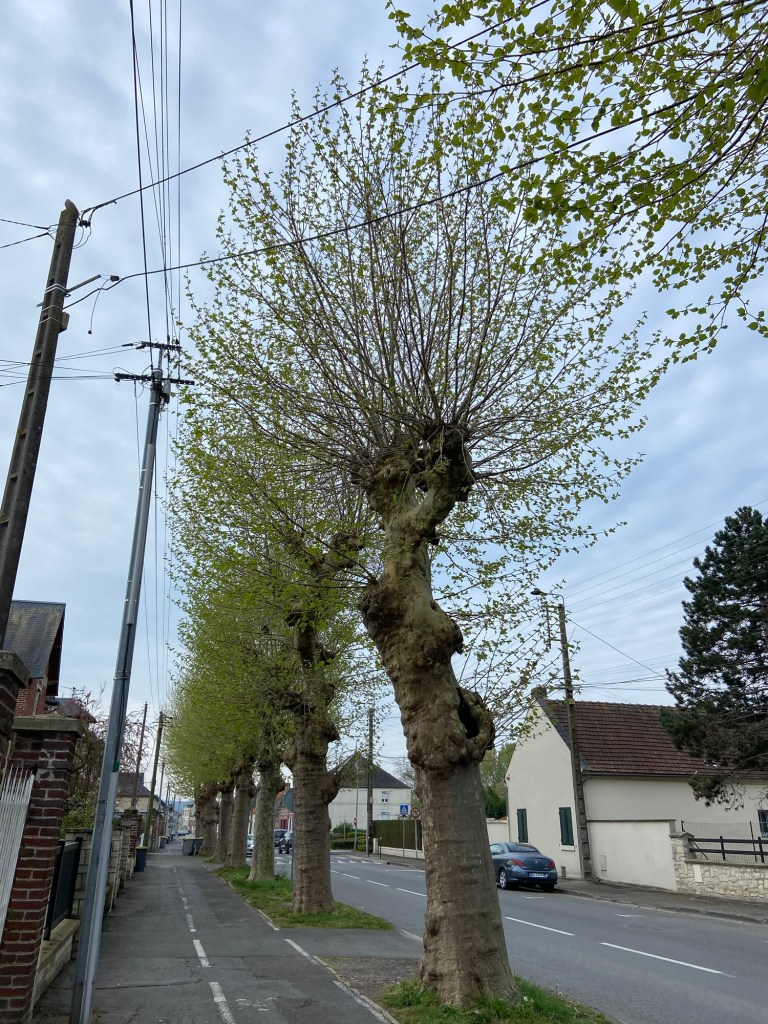
Here, the pruning of the plane trees had been done last year, and so the road looked like it was getting ready for French summer business, instead of being all bare and naked.
I was feeling fantastic. All the aches and pains of yesterday evening had completely disappeared, whether through the magical properties of caffeine, or because I was hardening up, I couldn’t tell. I am very grateful to all the people who have commented or sent private messages of support after my hard day. You know who you are! And you make such a difference. I’m sure this contributes to my getting out with a spring in my stride today.
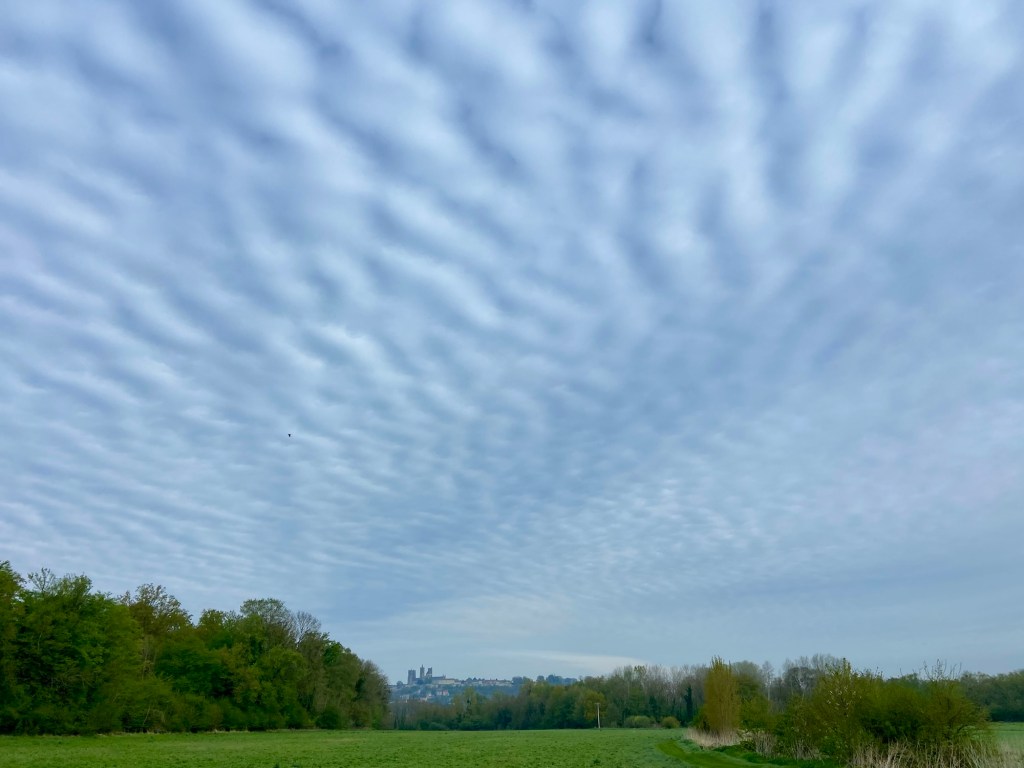
The road as it left urbanisation gave me one last inspiring distant view of Notre Dame Cathedral under a pale, mackerel sky.
I had gone almost 6km by the time I saw my first VF sign painted on a tree. The lack of signage had contributed to my missing my way at one point, so it’s a good thing I have the little red line of the GPX on the mapping app to correct me. The path had come into a long woodland stretch by the time the signs started up again, and the sun was properly filtering through the leaves of a hazel coppiced section with a lovely open structure.
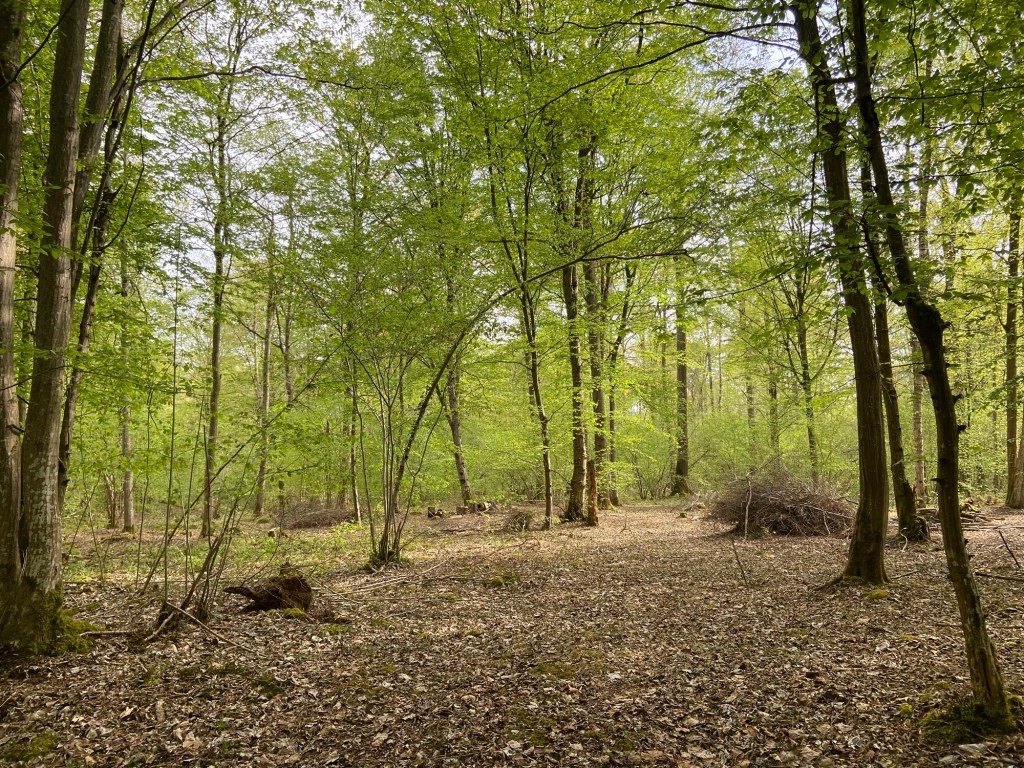
Apart from the birds, I’m surprised I don’t encounter more animals in the woods. There had been a dead slowworm on yesterday’s path, and there must be tens of thousands of deer in the forest, but of these I have seen not a twitch of an ear. But often when I have been on the forest and woodland paths I have walked through a wave of the unmistakable warm scent of beeswax, so there must be plenty of wild bee colonies industriously creating storehouses for their next few months of intense labour.
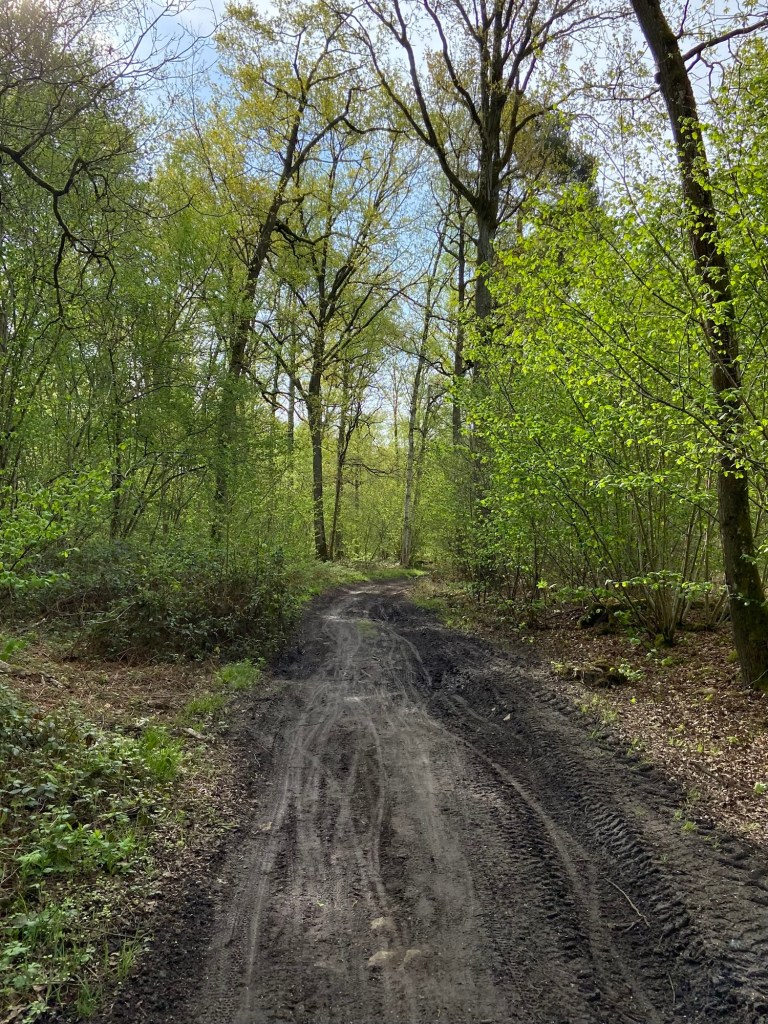
The path was dark, damp earth, obviously a favourite of gravel bikers, but for the most part they had not created the ruts that are so annoying to pick your way between if one is a piéton.
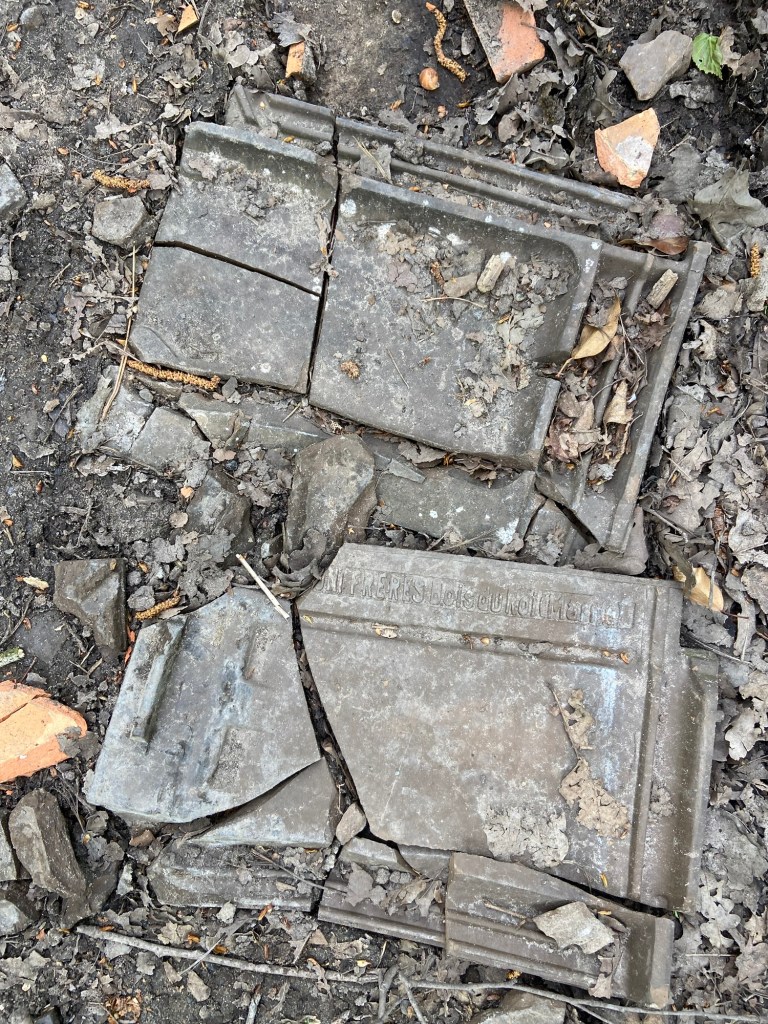
A particularly muddy 50-foot stretch had once been filled in with what looked like broken tiles: they all had fragments of the same words written on them.
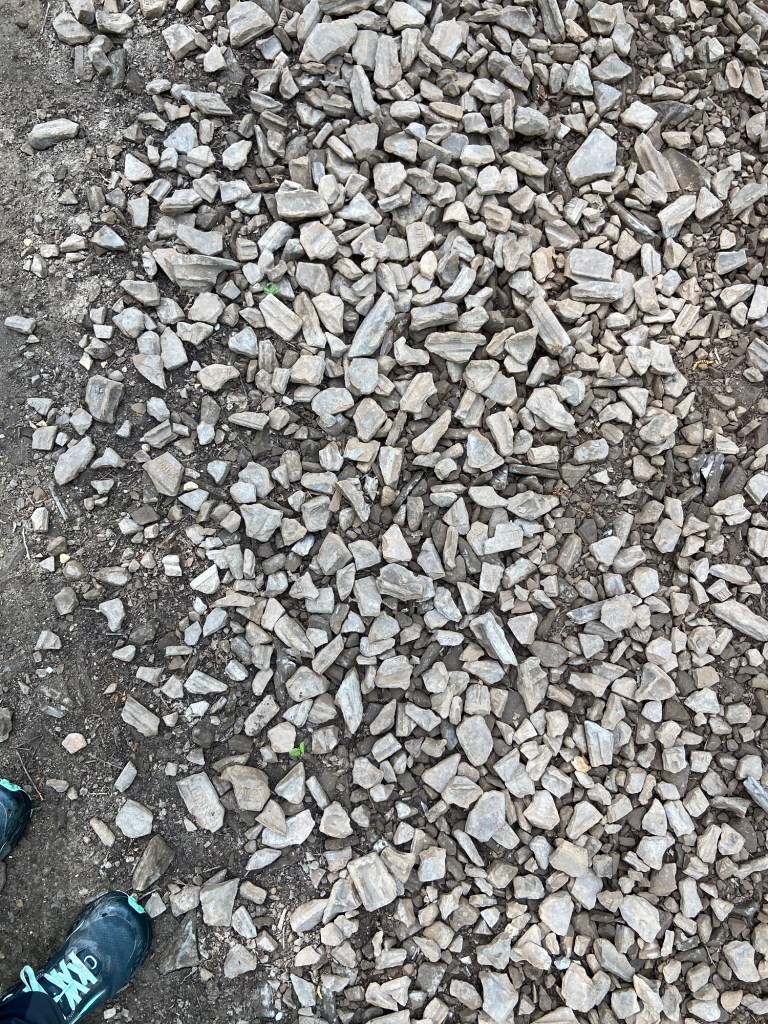
One more complete tile was an almost finished version of the jigsaw. It’s annoying that I shall never know what they were! I trod over them and on I went.
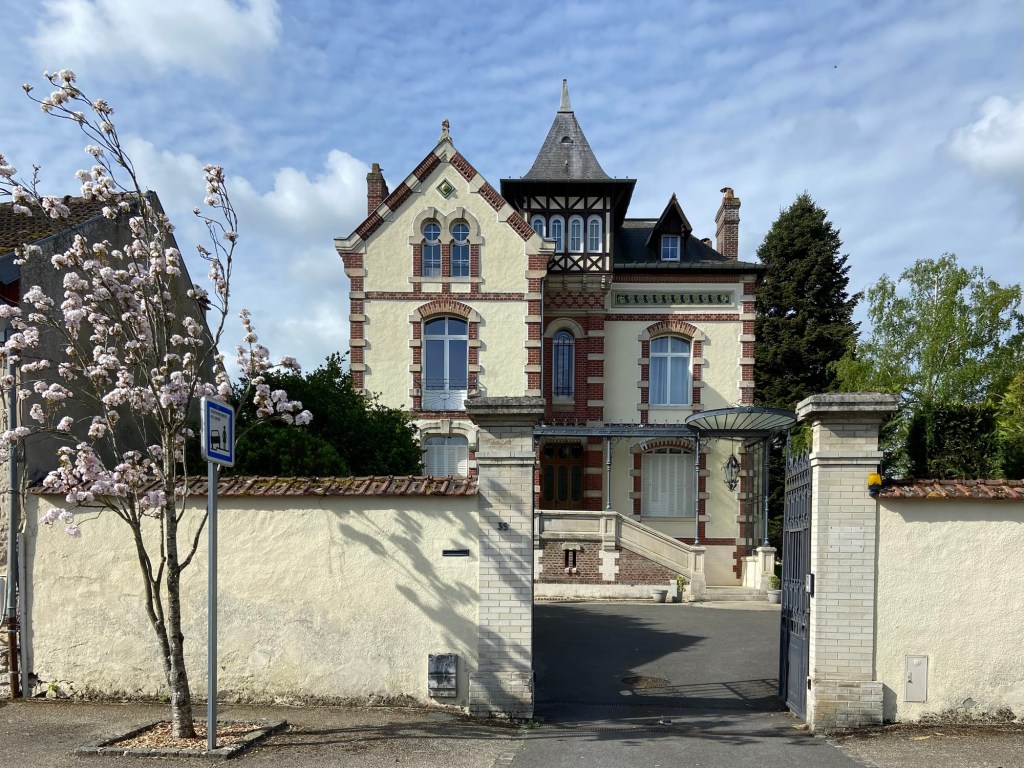
The town of Bruyères-et-Montbèrault could not have been more different from the ghost towns of the Pas-de-Calais. A proper town of people working, houses being renovated, dog walkers on the pavement, little shops open. And there was quite a bit of money here.
Thinking of the wax I had smelt in the wood, it was my first thought when I saw a little camion parked up with some neat boxes stacked in the back that these were supers for hives. I went over to have a sniff, but there was no scent of wax. Ok — maybe they were for carrots.

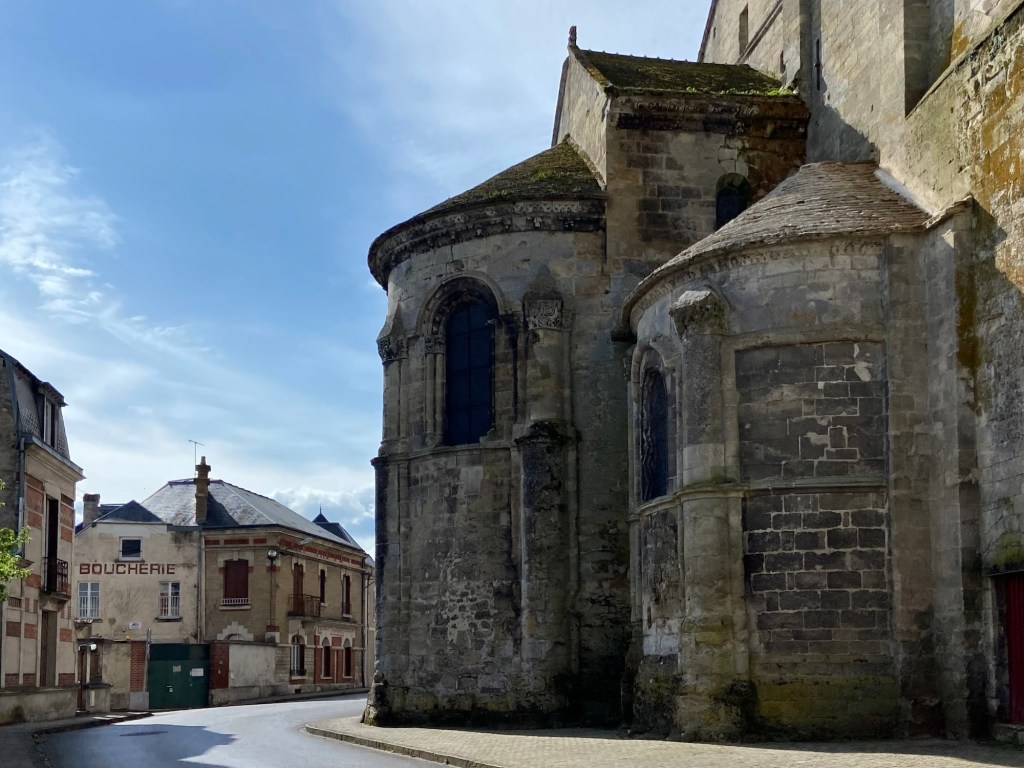
As I finished taking a photograph of the church plus an old Boulangerie sign, which struck me as an aesthetic combination, a chap behind me who had been waiting for me to take the photograph before walking past me engaged me in conversation about what I was doing and where I was going.
He said it was his little truck I had taken a photograph of. He must have thought I was completely mad, photographing and smelling the crates. I explained that I had been thinking of the smell of wax in the forest and because my husband is a beekeeper I had thought that these might have been supers. Yes, he said they were! They’re empty. He’s going to Corbeny later on to fit them to his hives. I gave him a high-five, because I was so pleased with myself for having recognised them for what they were. And for conducting another quite complex conversation in French.
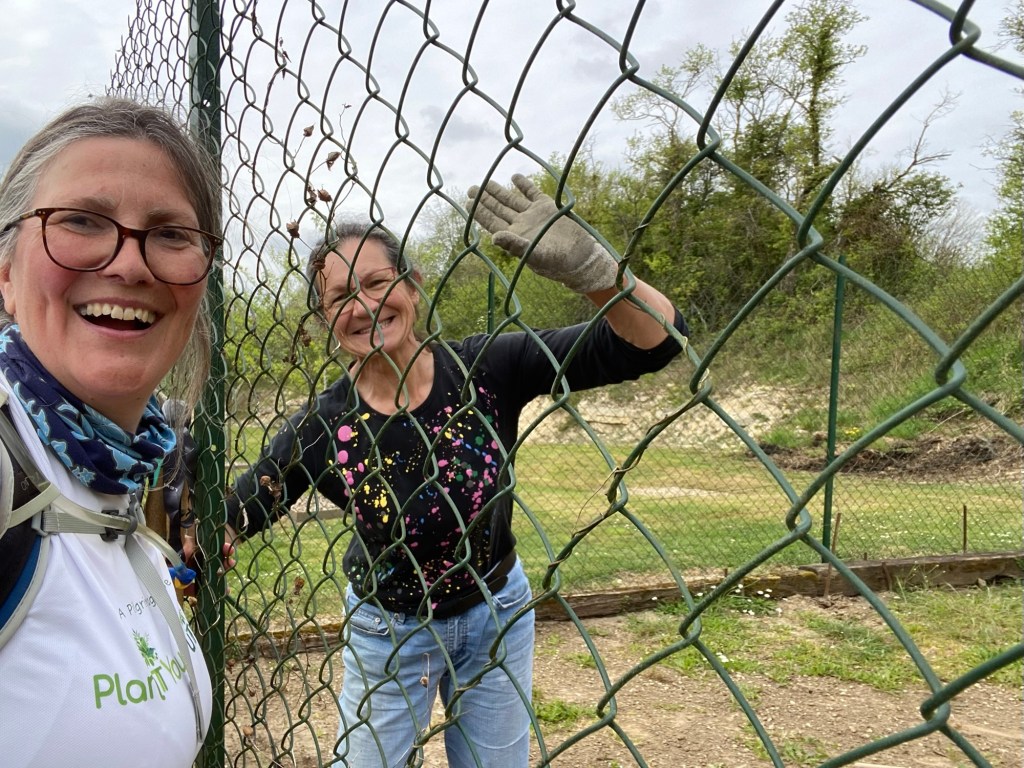
By 12 o’clock I had come to Martigny-Courpierre, and my arrival in the village was marked by a warm and friendly greeting from Sabine who was working in her little veg patch. I asked her what she was planting. Radishes, and perhaps some potatoes. We chatted for ages: she wanted to know my age and whether I was a gardener too. I told her that my husband back home had been putting in the tomato plants and cucumbers in the greenhouse. She was such an open-hearted woman, and so behind the idea of getting out and walking. She says she sometimes is asked for water by pilgrims passing through. I’m so glad to have met her; sometimes this route feels quite lonely and empty, and I really appreciate these moments of human connection.
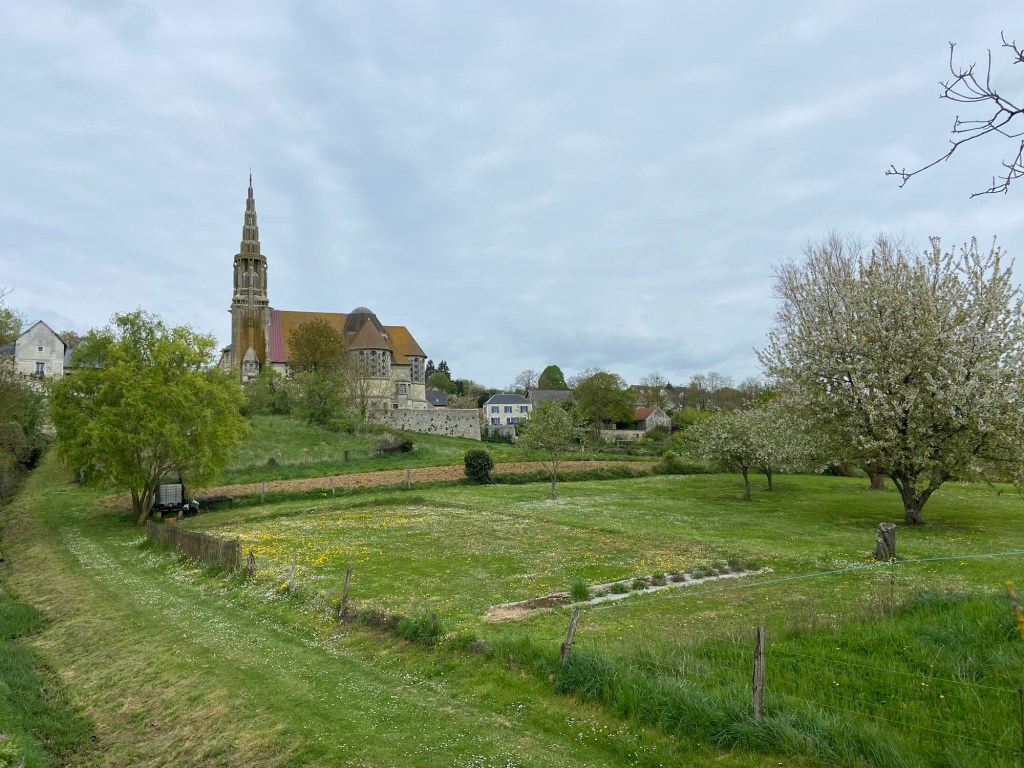
During the first world war this little village was another of those unfortunate settlements which had been brutally bombed to total destruction and their Romanesque church was one of the architectural casualties. The architect Paul Müller was commissioned to build another in the 1930s, and he brought the geometric forms of Art Deco and the new techniques of reinforced concrete to the post-war reconstruction project.
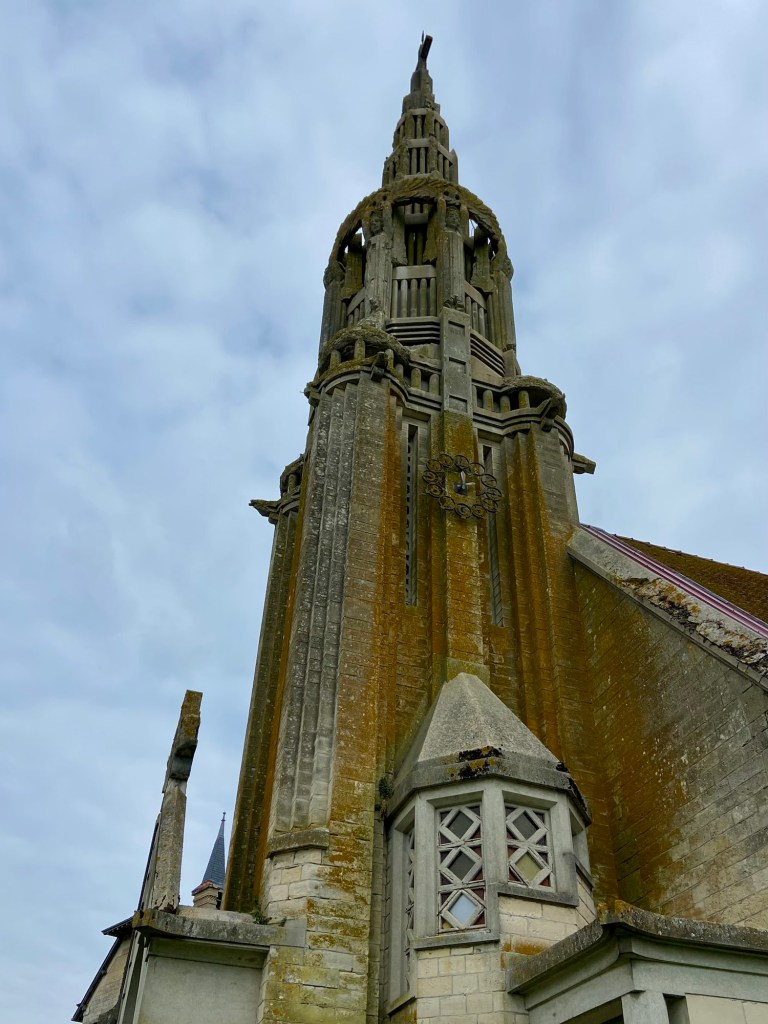
“Through its plasticity, this new material breathed new life into the art of building. It allowed monoblock architecture and large spaces freed from the need for intermediate supporting structures”. (Jacqueline Danysz).
The Laon architect Paul Müller used reinforced cement like a sculptor, getting decorative effects from the building’s very structure:
The large angels that mark the start of the upper part just barely stand out thanks to a light cement skin that accentuates the folds of their robes and lines of their erect wings and arms raised high to hold a crown of leaves (the work of Gabriel Dufrasne).
The steeple bursts from a robust square porch with reinforced angles in the front building. The impression of solidity asserts a will for stability, a will to be rooted in a land that was hotly disputed during the recent conflict.
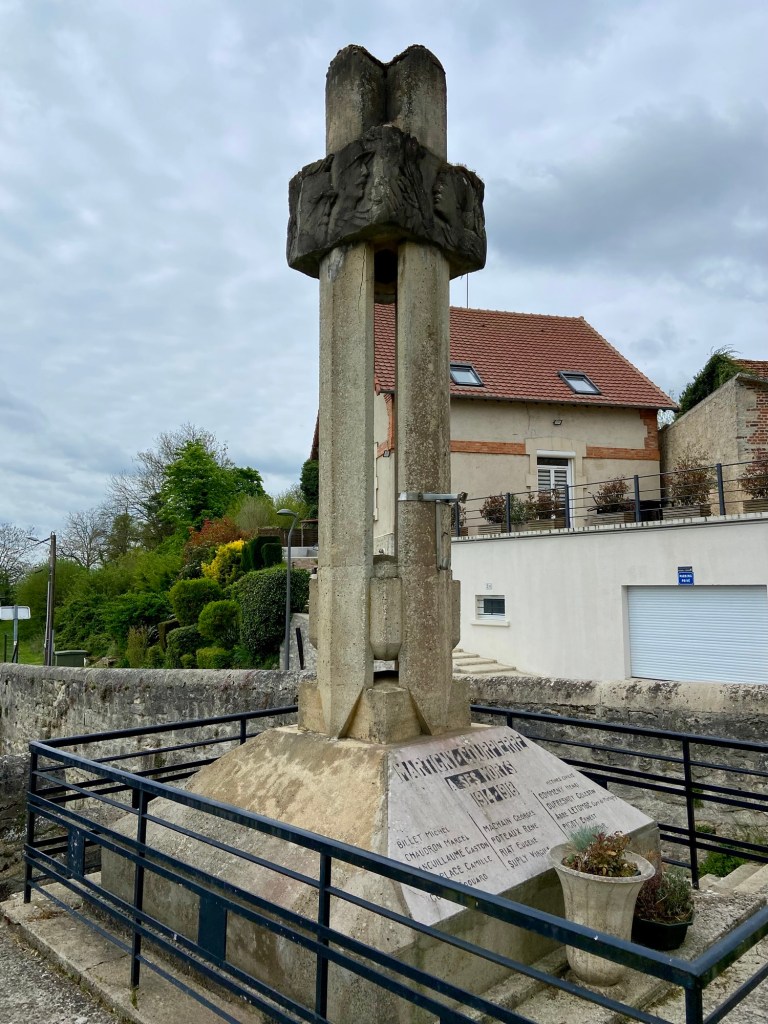
The human casualties, including the civil dead were marked on 1930s Art Deco war memorial which matched the cathedral. This felt poignant: both church and memorial were in some fashion each other’s twin, born as they were at the same time.
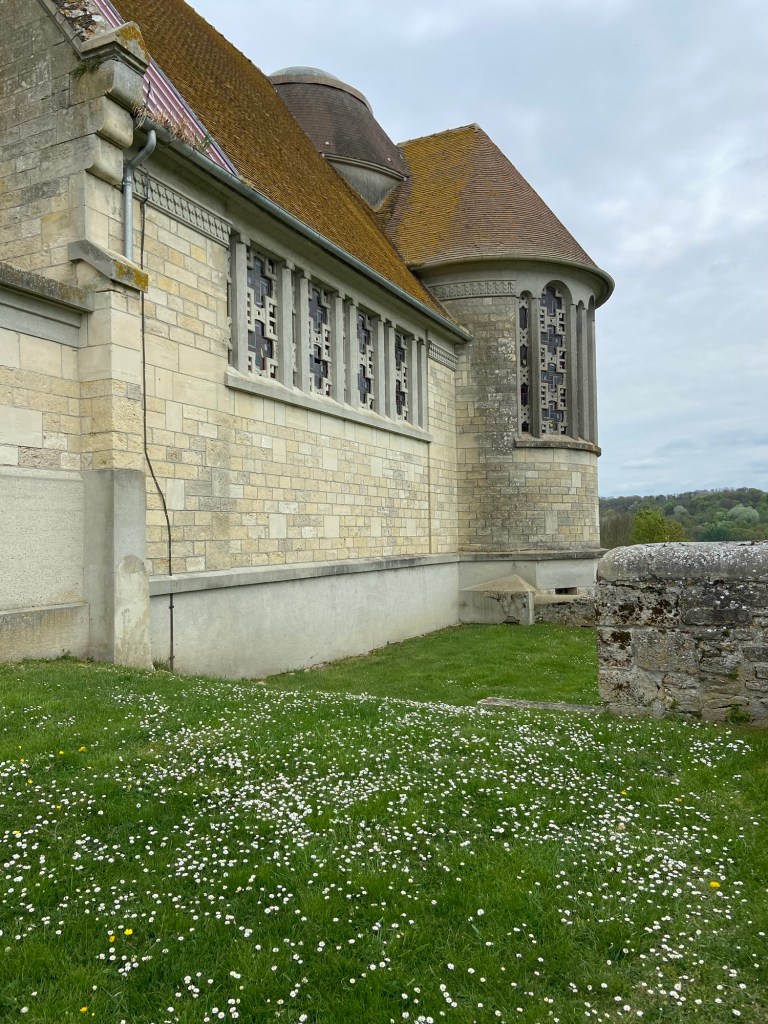
I loved everything about this church — its clock, one of a piece with the rest of the design, and its Art Deco stained glass windows. I would have loved to have gone inside to see how that was treated. This church is simply now to be added to the list of places to be visited on a longer and more leisurely holiday.
As I walked out of the village, there was an unpleasant moment of human connection, which has never happened to me on a walk before: some young idiot guys in a small white car hung out of the windows shouting something at me. I’ve no idea what, but the tenor was clear. Luckily, they had somewhere to be and didn’t stick around to harass me.
Lunch was a delightful interlude by the shores of a lake on which between 40 or 50 swans were preening. None of them had paired off yet so their titivation was clearly the prelude to the big match-making event. I sat on a providential warm piece of concrete and let myself be lulled by the lapping water, my shoes off again, and my bare toes stretching in the air.
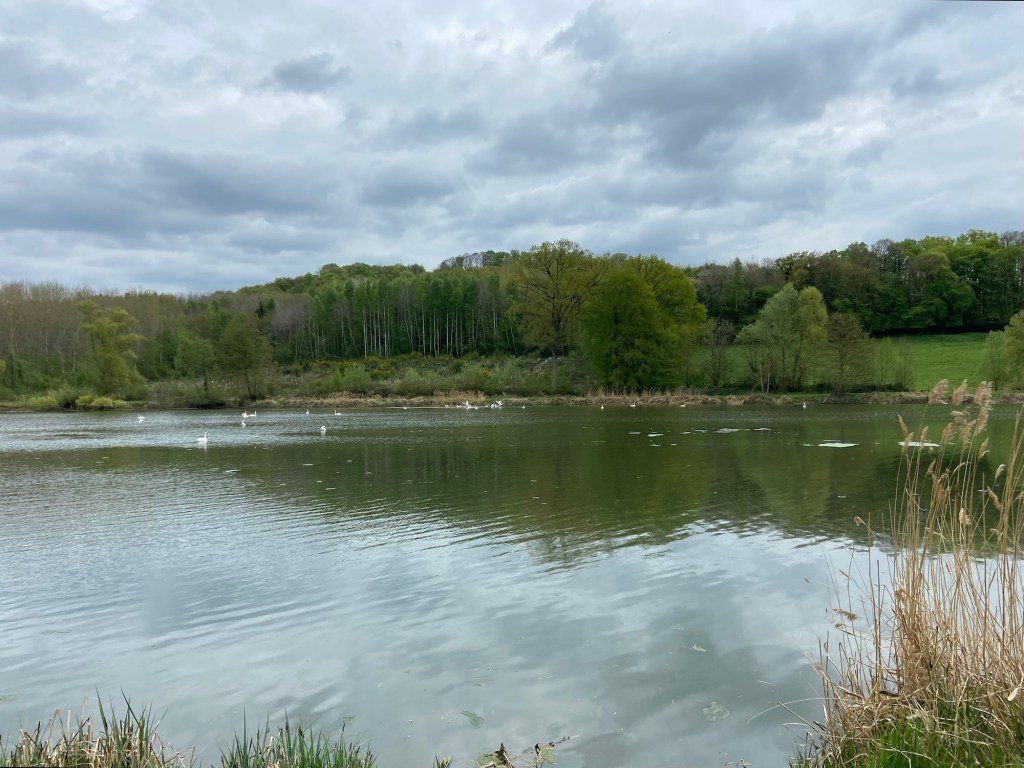
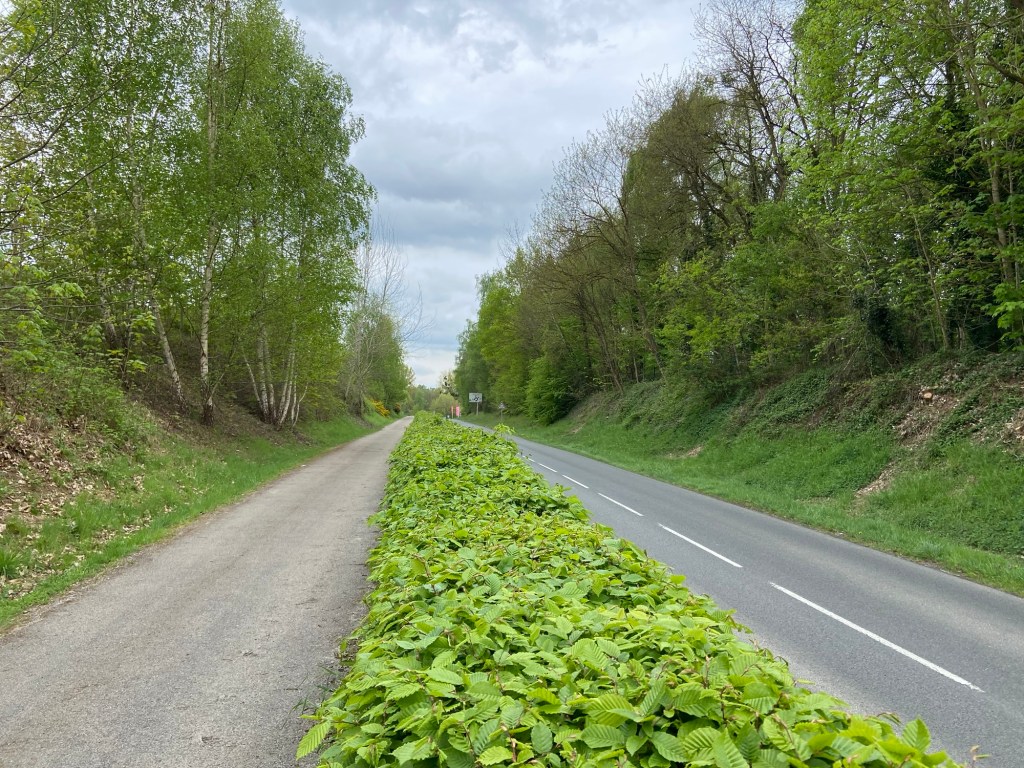
The method worked its usual magic, very much like the balm for Hilaire Belloc’s knee. Which was good, because there was to be an awful lot of road walking this afternoon. I set off with a good will and then realised that there was a pedestrian/cycling route on the other side of a closely-planted hornbeam hedge. As I’d already had to leap onto the verge to avoid the cars speeding past, I found a place where the hedge looked less thick, and I’m afraid I forced my way through.
There were also idiots on the road, like the blue-clad motorcyclist going uphill on a blind bend at top speed doing a wheelie. What a dude. Later on I heard him in the woods up to my left, and sure enough when I passed the turning for the green lane that would take me up there, there was a sign which said ‘no motorcyclists’. Oh dear, what a bitter old biddy I am become.
The small cycle path (here called the Voie Verte or Greenway) became a big thing with big information boards at a roundabout off which was turning to a Centre Parc stretching all the way along the shores of the lake at the tiny little end of which I had had my lunch.
Lake Ailette is man-made, an absolute haven for birdlife. I detoured off the Greenway to the lakeshore at the first opportunity when it stopped being the Centre Parc, and watched a pair of grebes, the female on the nest and the male bringing her food. There were cormorants too, drying themselves on posts.
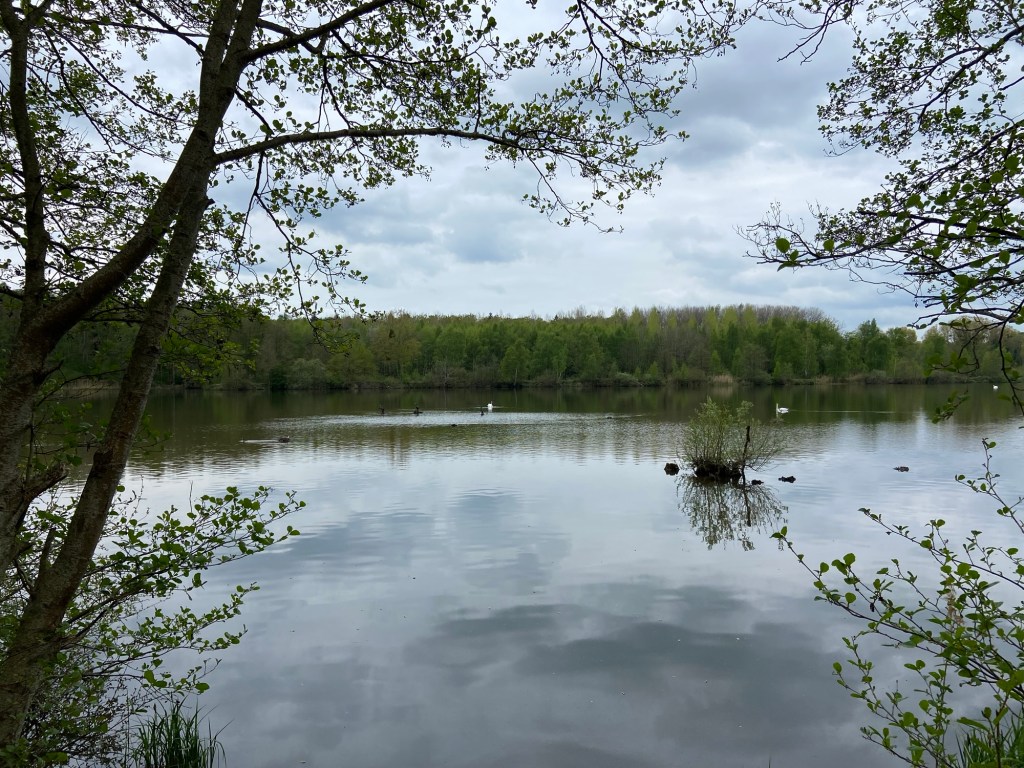
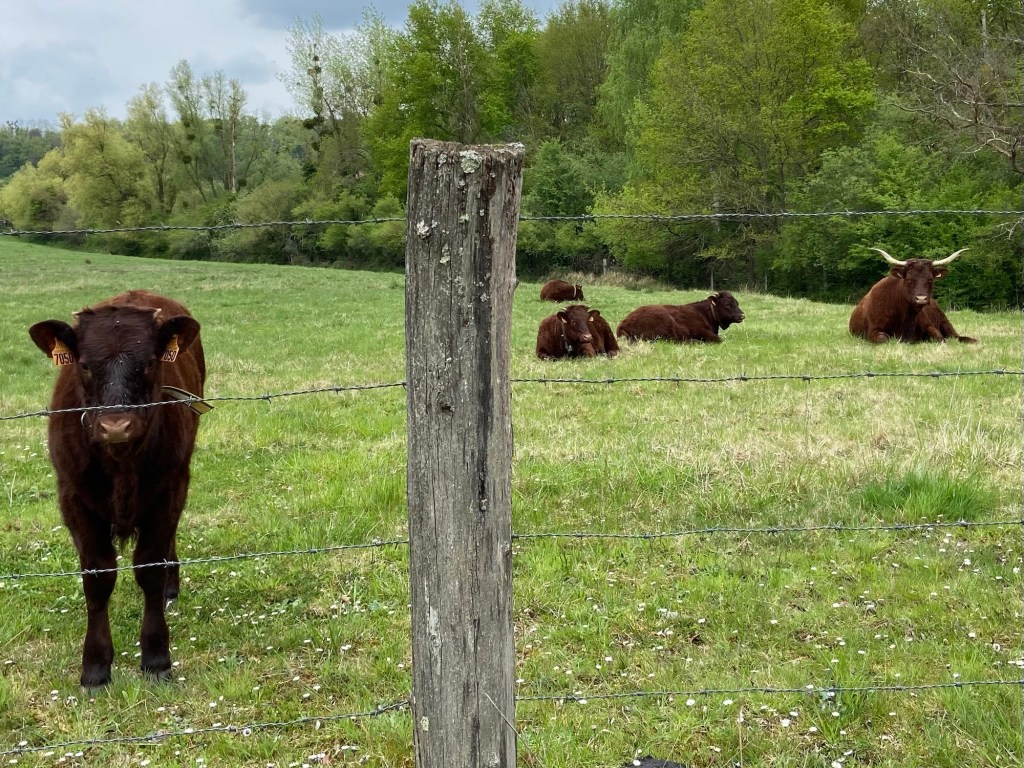
Earlier on the cycle path had been paved, but now it was beaten earth, which was much easier under my feet as I covered the 4.5km to Vauclare Abbey. I passed several families spending their Easter vacation out in the countryside, all on bikes, and a field of spectacular cows, chestnut coloured, with twisted horns and bells around their necks.
And then a providential bench produced somewhere for me to sit a while and rest my feet. I think I remember this from the end to end walk. The first couple of weeks were absolutely excruciating, and with longer days, I was often in tears and exhausted by the end of it. I remember having to stop every 10 minutes to rest my feet. Stephen was incredibly patient with me. I also remember that by the end (admittedly, 70 days later) I would think nothing of doing 32 km on paved roads in my boots. I guess feet won’t toughen up if you don’t walk on them!

The Greenway finished at the ruins of the ancient Abbey of Vauclair. Founded in 1134 by Bernard of Clairvaux, it fell victim to the Hundred Years War and to the Revolution. The ruins were now too dangerous to walk around, so I just looked at them from the outside, and appreciated the work they are doing to restore parts of the ancient structure. It is set in a lovely orchard which now is in full flower, and later in the season will provide shade to the visiting families, and still later apples and pears. I thought thought of the sisters at Wisques, and those I will meet tomorrow at the Benedictine Abbey of St Thierry; how hard it is for these communities materially to keep going in the buildings they have inherited.

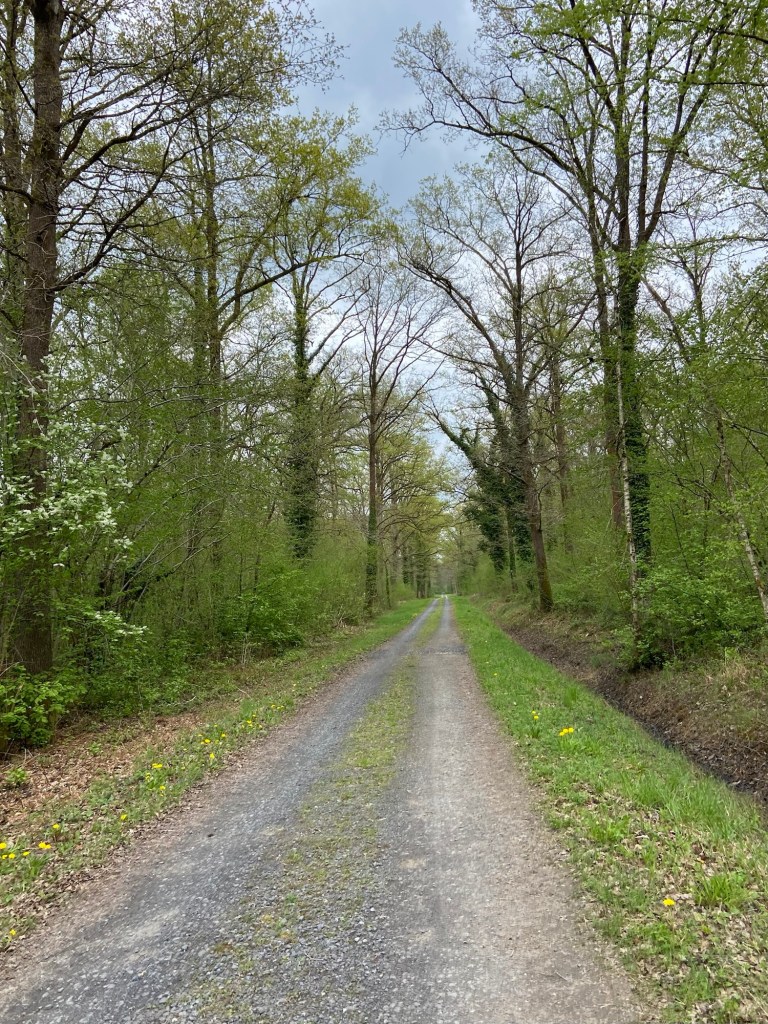
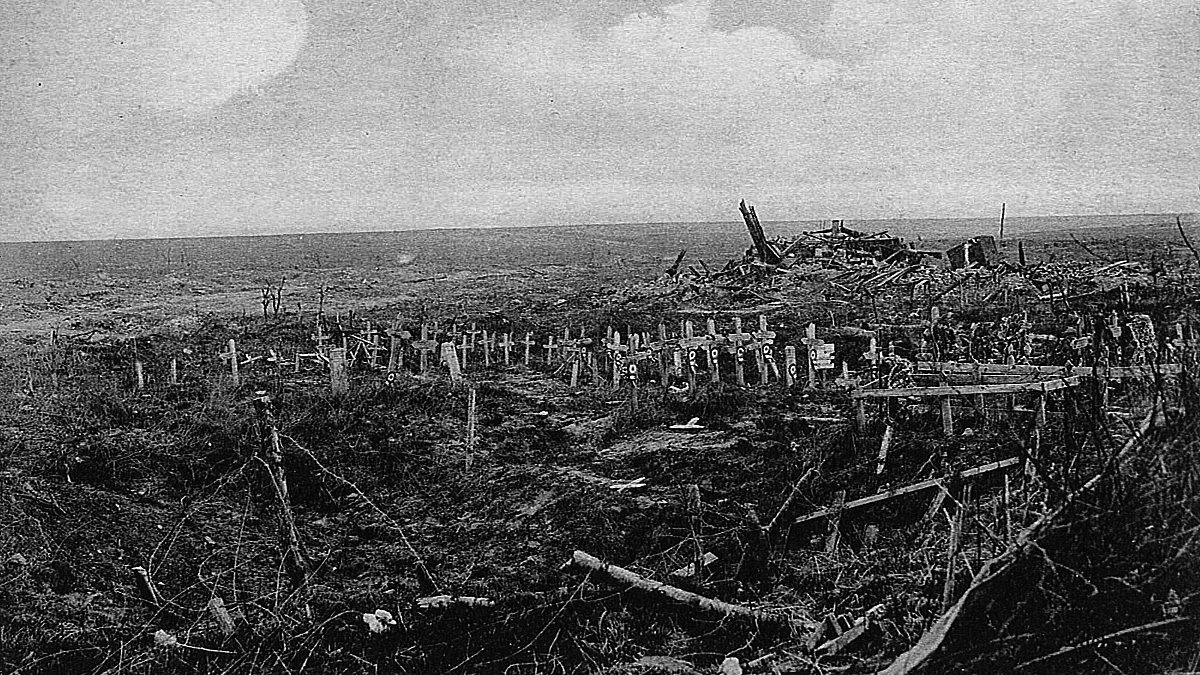
Since lunchtime at the start of the lake, I had been walking on the Chemin des Dames, named after the route taken by the ‘Ladies of France’, Adélaïde and Victoire, daughters of Louis XV. They frequently travelled this way to get to the Château de la Bove. However the Chemin is infamous for the appalling battles in the third year of the Great War. It follows a ridgeline which was bitterly and brutally contested, particularly noted for the suicidal folly of the Nivelle Offensive. More than a quarter of a million men lost their lives here; very many bodies were simply unidentifiable and are buried in ossuaries, or in collective graves. The conditions of the battle were unimaginable to me as I walked the long, peaceful green roads. So much more similar to how it must have been when the Ladies of France passed through in their carriages.
So I looked up the battles later and found a series of harrowing photographs, one of which I reproduce here, as a reminder of the history of this place. The forest was blasted out of existence, replaced by wooden crosses for the nameless dead.
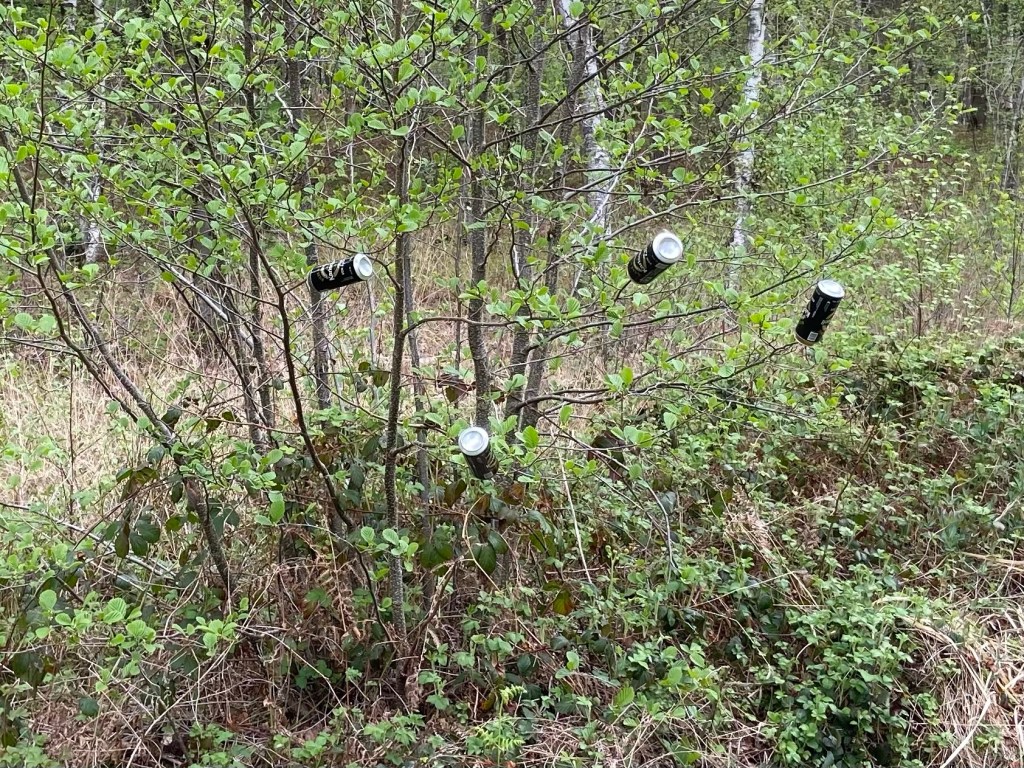
The modern road from the Abbey to Corbeny, the stage’s end, was long and almost dead straight. Its last section was characterised by a large number of beer cans which had been bizarrely stuck onto twigs and branches. If there hadn’t been so many, I would’ve picked them up, but as it was, I couldn’t carry any. I did keep a weather eye on the traffic though, because somebody is clearly drunk driving.
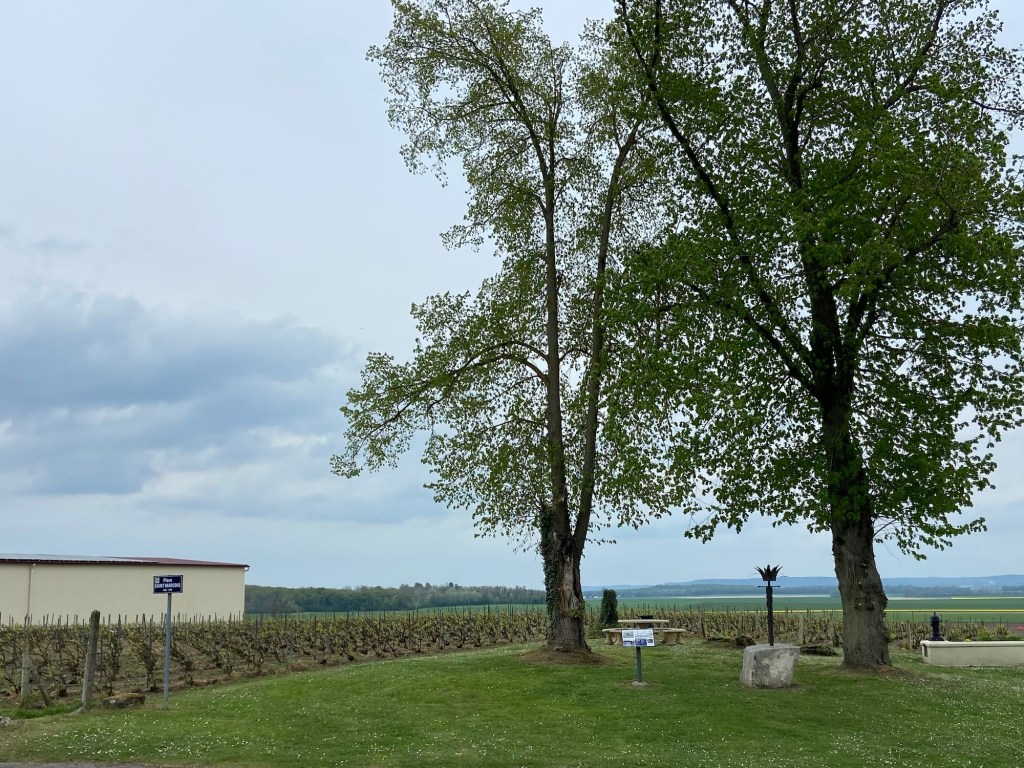
After the beautiful monotony of the forest, Corbeny was a literal breath of fresh air, with a real-life vineyard at the top of a hill.
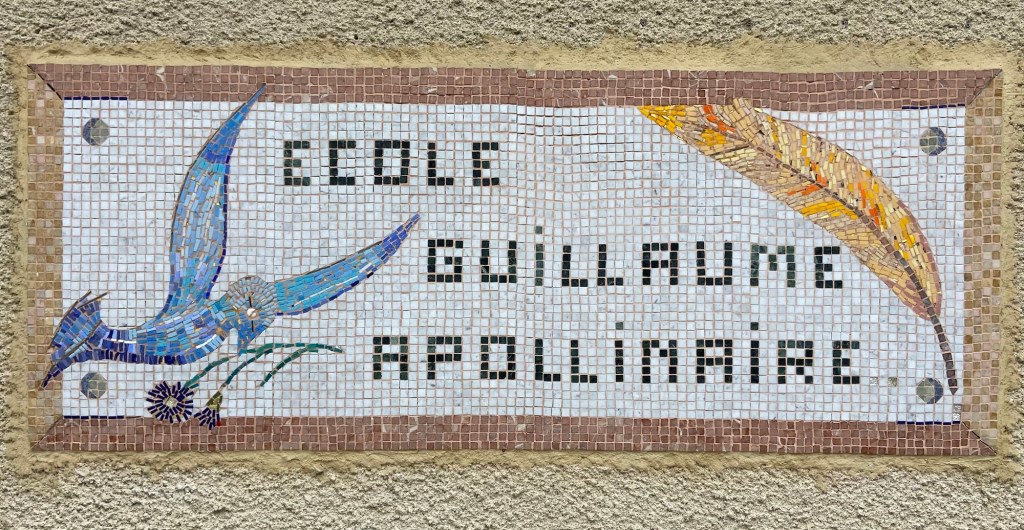
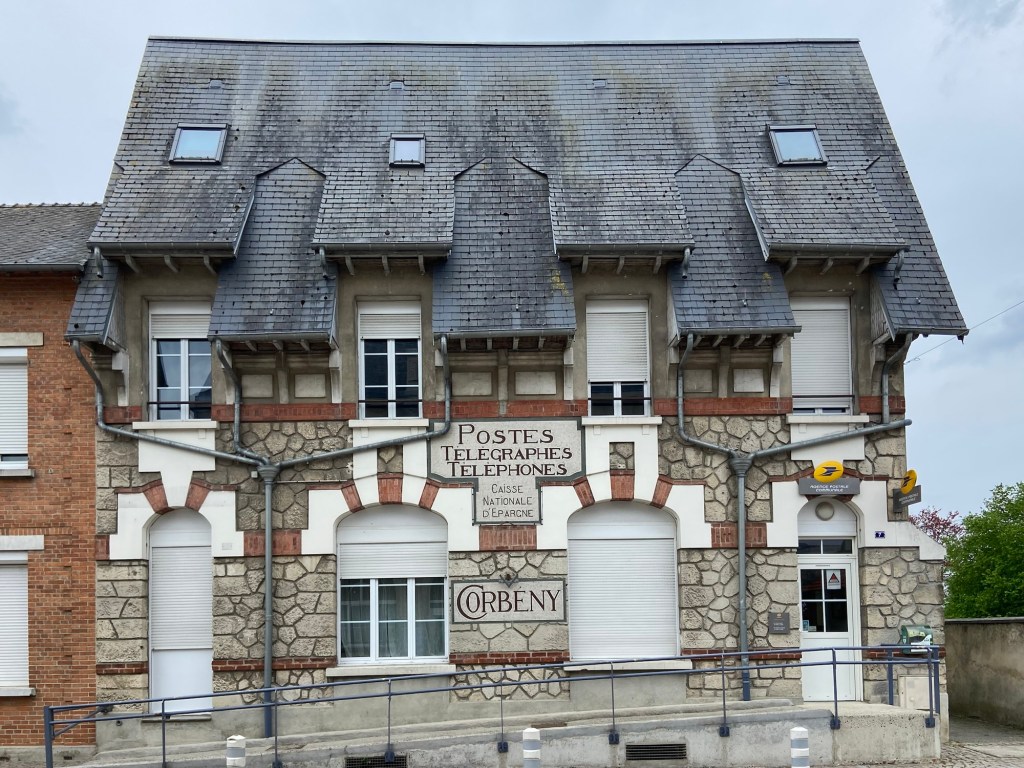
I gratefully knocked at the door of the Hôtel Chemin des Dames, but not before I had appreciated the tilework on the school sign, echoing the historical tiles on the old Post Office and Caisse d’Epargne opposite.
It was another long day, but one in which I felt I had made some strides in managing distance and foot fatigue. Tomorrow is the last of the long days — my rest day is inching closer!
Stats for the Day
Distance: 25.40
Time: 5 hrs 23 mins
 Walking The Landscape
Just felt the need to cheer you on, hopefully you have already reached the end of your long walk today! Xxx
LikeLiked by 1 person
I have!! And thank you! It was a day of wonderful things.
LikeLike
I’m also in the cheering you on camp.
I went for a walk in the rain today and at the point I was about to complain bitterly and suggest turning back I decided I needed to “be more Sophie” and just keep going (for my 3km!).
Bravo for gathering strength as you progress through the long days. Reims will be amazing
LikeLiked by 1 person
Hahahahha!!!!!! Xxxxxx
LikeLike
Today’s 23km turned out to be 30!
LikeLike
There is so much joy in this, Sophie, and it inspires such joy in the reader too. And cracking jokes in French? Formidable!
LikeLiked by 1 person
💪
LikeLike
Oh, the roofline of the Post Office 🥰. Such beautiful narration of your increasingly impressive distances! Xx
LikeLiked by 1 person