Walking fast is neither sexy not engaging. Nobody notices the people who race around. If you’re walking in heels, you’ve got time.
Christian Louboutin
After a poor night in Arras I was pretty tired when I got in to Bapaume, and after a shower I crawled into bed and immediately fell asleep for an hour before supper. I started writing the blog and made some headway, but by 10.30pm I realised that sleep was more important than the blog, and that I would probably be more effective once I had some sleep. I set the alarm for six.
But I woke up just before three, and was so wide awake that I thought I might as well carry on, so wrote until five. Having finished the text part of the blog, I went back to sleep until the alarm woke me, when I uploaded it all to the WordPress site and added the photographs.
I had definitely not had enough sleep: I felt a headache coming on, and was feeling a little shaky when I turned up for hotel breakfast. The wonders of the breakfast bar pretty soon swept away any feeble thoughts, fortify me as it did with bottomless cups of coffee and my choice of Scotch pancakes, fresh off the griddle, lovely French butter and apricot jam. I could make neither head nor tail of the idea of boiling my own eggs in the water bath, but did make up a little baguette with cheese and ham for lunch, and took a bit of fruit.
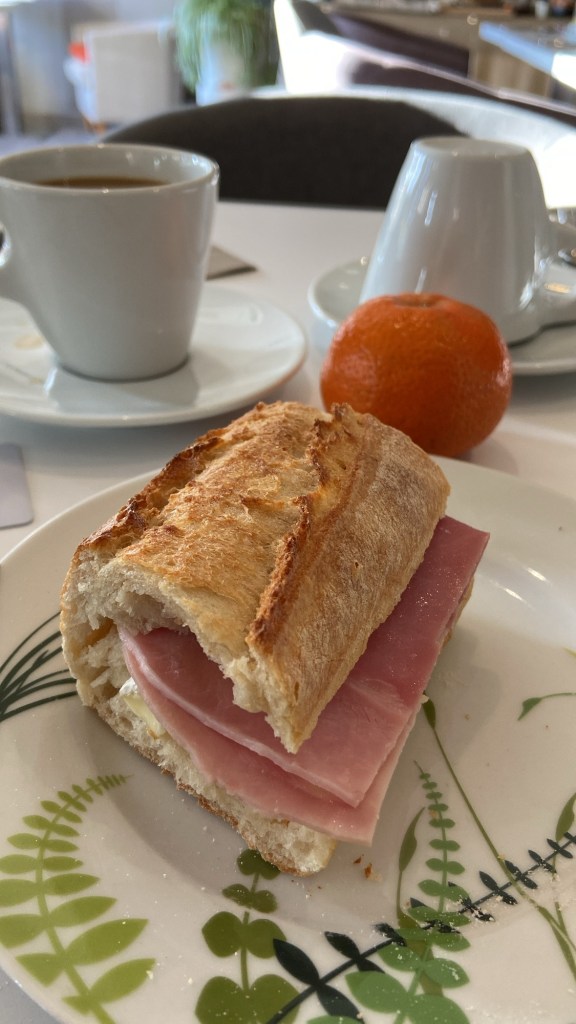
I was going to start the day with a shortcut (apologies to the purists out there — I am aiming to get as close to 20 km a day as I can, and these first two days on my own are two days of 28 km back to back and I felt that I needed to feel my way into it).
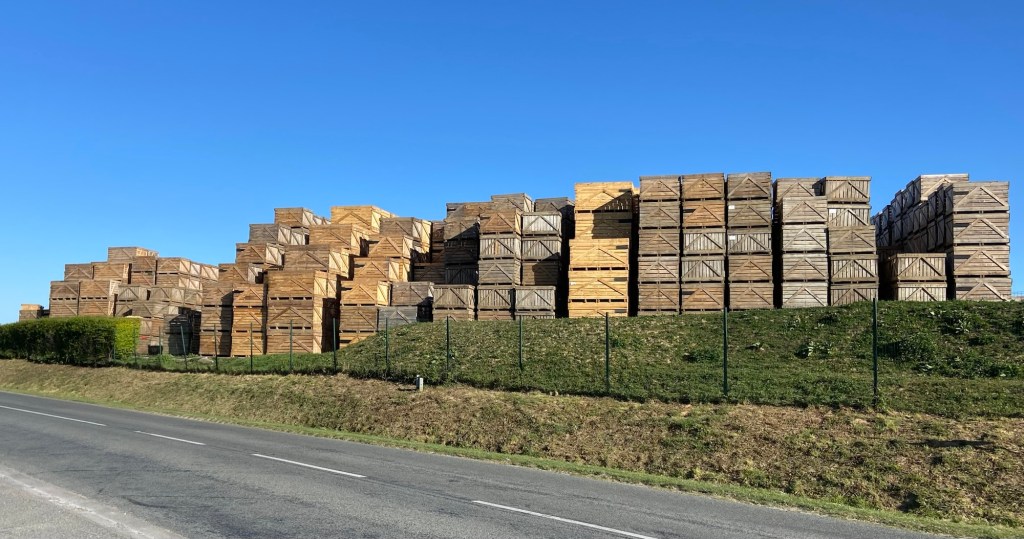
This shortcut whisked me quite quickly out of town and over the railway and motorway, past towers of potato boxes that I thought probably predicted the kind of day I would have.
In the early morning sunlight a tractor scattered nitrogen pellets over improbably green wheatfields. A beautiful breeze was blowing which promised an easier day than yesterday, and the path was lined with little willows just coming into leaf. There was no water however and I reflected that one of the really tiring things about yesterday had actually been that I had not seen any: no ponds, no water-filled ditches, no lakes, no rivers. Without reading ahead in the guidebook, I didn’t know whether that was going to change today, but I hoped so.

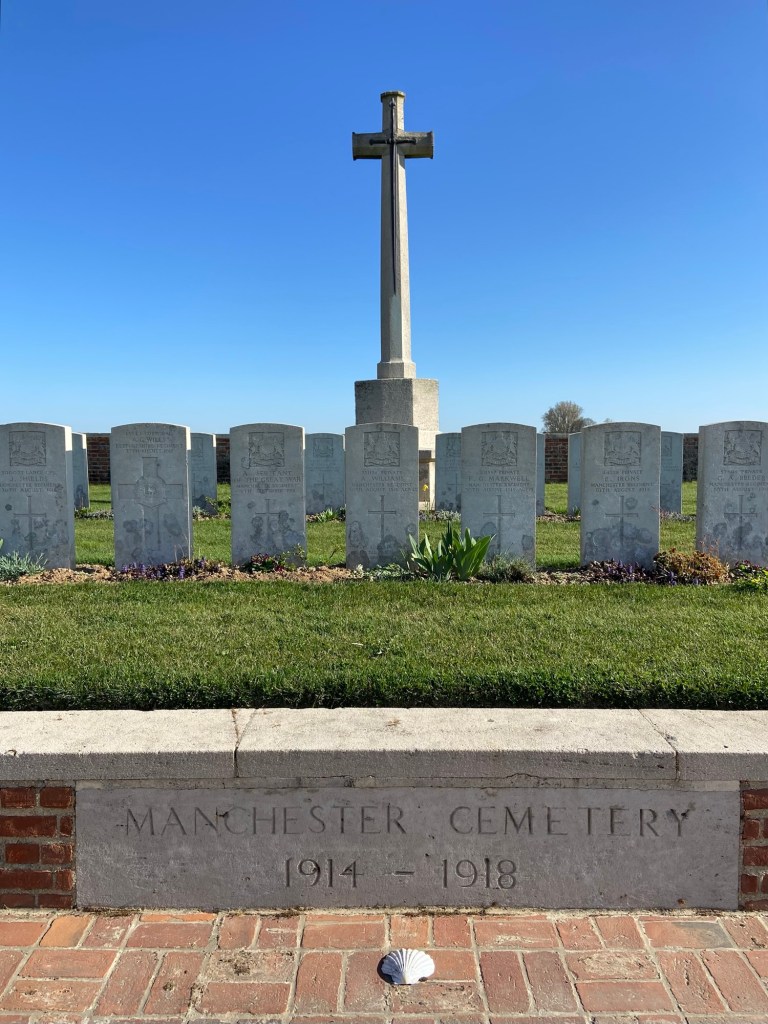
I rejoined the Via Francigena again, just at the point where fallen soldiers of the Manchester regiments are buried, in another little cemetery on a lonely road. All the names had dates of death of 2nd of September or 30th of August — there must’ve been two big battles at this time which caused heavy casualties. Particularly poignant were the headstones marked simply as ‘an unknown soldier’ or ‘an unknown Sergeant’ of a particular regiment, And I thought of all those ‘missing in action’ telegrams arriving back home, and the lack of closure for the sorrowing families. As I was leaving I found a large white scallop shell in the dust at the side of the road, right by the bank of periwinkles leading up to the cemetery. Being a symbol of pilgrimage, it must have fallen out of a pilgrim’s rucksack. I picked it up and put it in the cemetery with a special thought for all the nameless dead therein.
In Villiers-au-Flos I was struck by how quiet it all was — there was just one man upon a roof fitting tiles — and how empty the brightly-coloured primary school playground. Then I realised it was a Saturday. This pretty, cheerfully-coloured little village seemed still asleep except for the twittering sparrows and collared doves, and four yellow wagtails pecking at the grass in a field in the middle of town. Someone had been out being efficient, though,
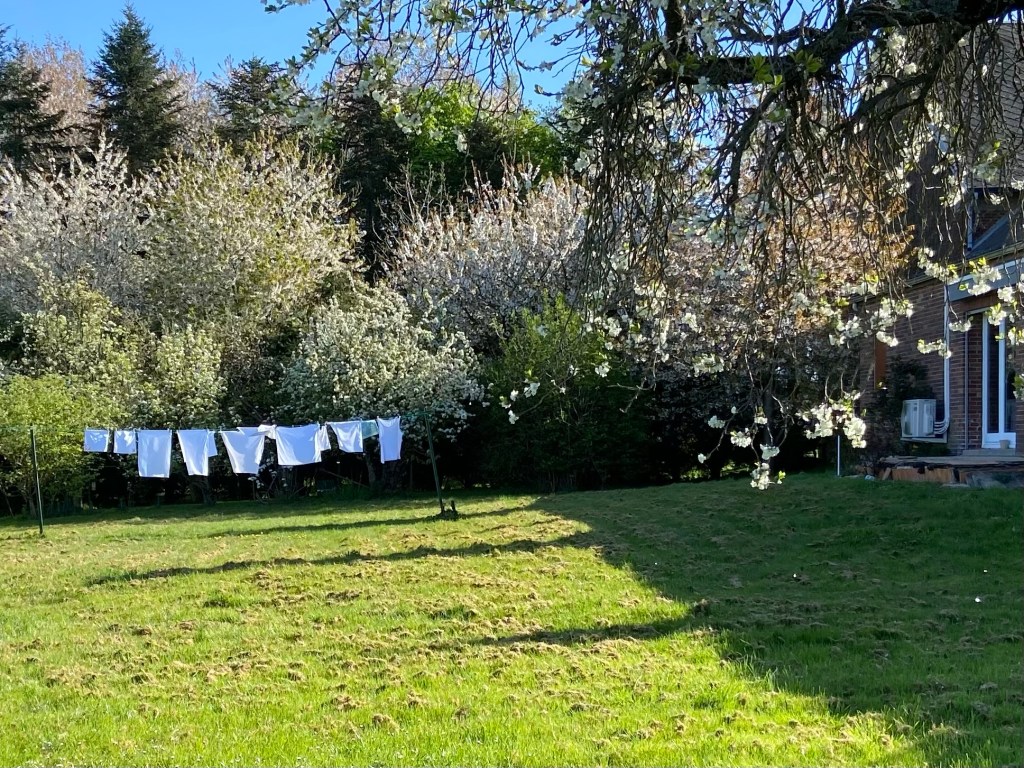
whilst others maybe had a little more tidying to do on their weekend.

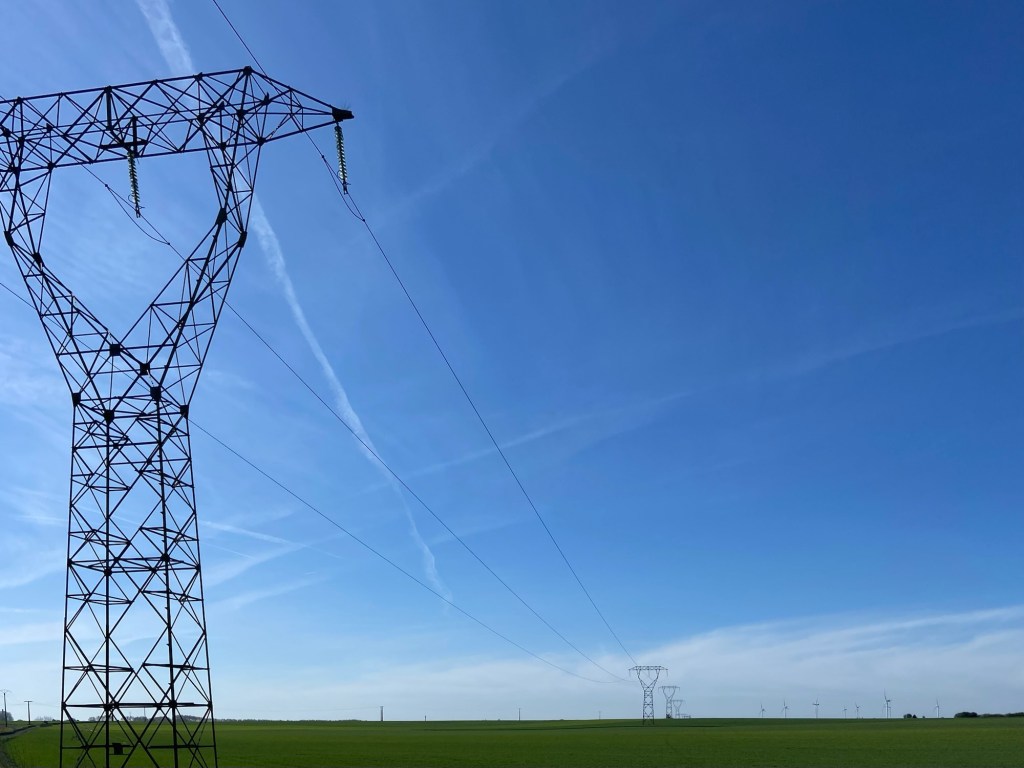
Today the walking would be mostly flat and overwhelmingly paved. It was, at least at first, another giant landscape, bestridden by pylons,
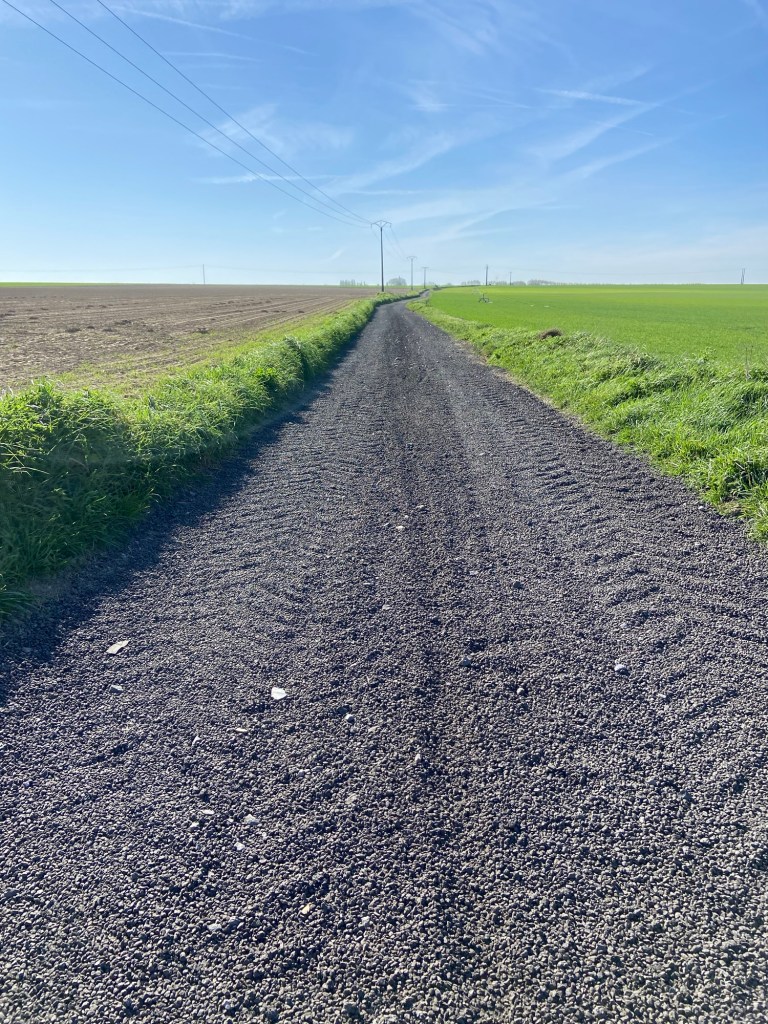
and someone had unhelpfully filled the white gravel road with black stones which I thought with a sigh was going to cause my shoes some attrition.
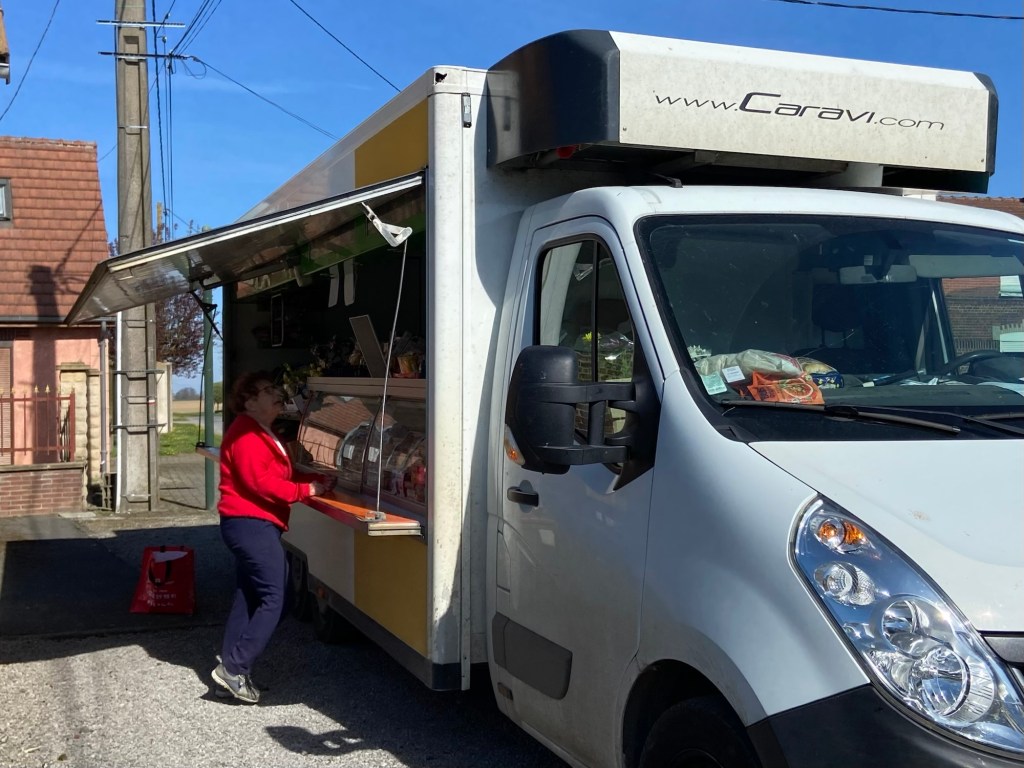
But it was worth it to get to the next village, Rocquigny, which had plenty of interest for the walker, slightly bored of paved surfaces and huge fields. A mobile shop like the one Stephen and I had fortuitously encountered here sold fruit, vegetables, cheeses, and meats. I thought about getting a banana to supplement the lunch I had packed from the hotel, but they didn’t have any.
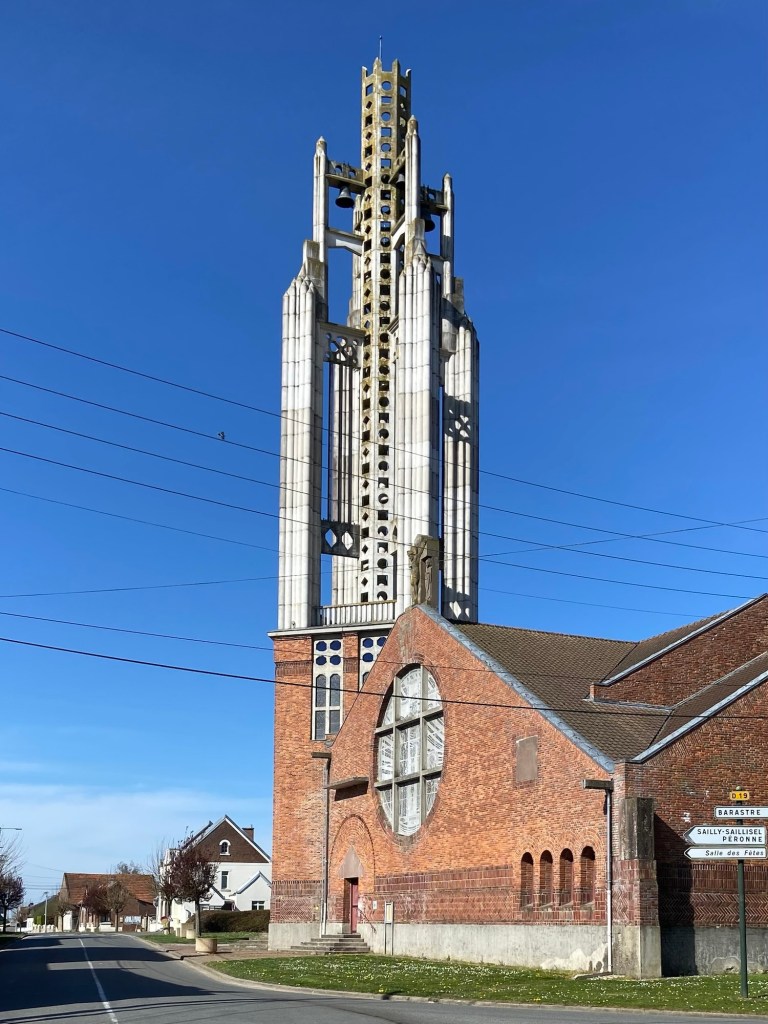
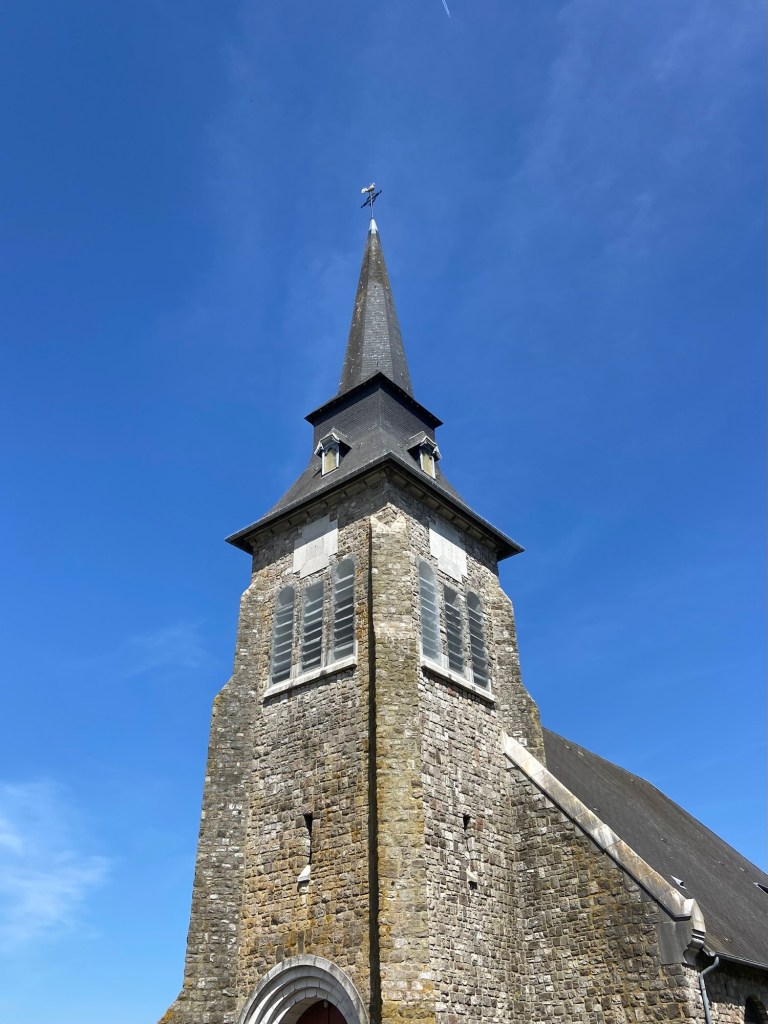
Next up was the extraordinary church tower. I can see the attempt at modernising Gothic references, but in all honesty I agreed with the guidebook that it looked like nothing so much as a launchpad.
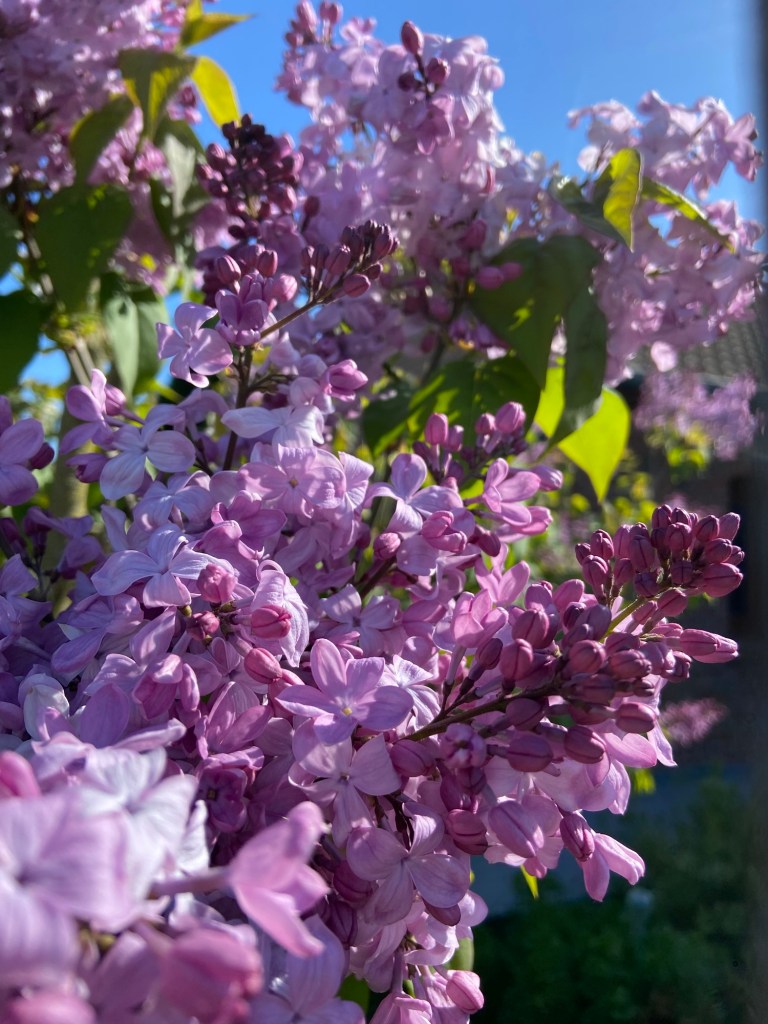
The first of the lilac was out. So early here!
And also, against the warm brick walls, pale mauve honesty, and the first irises.

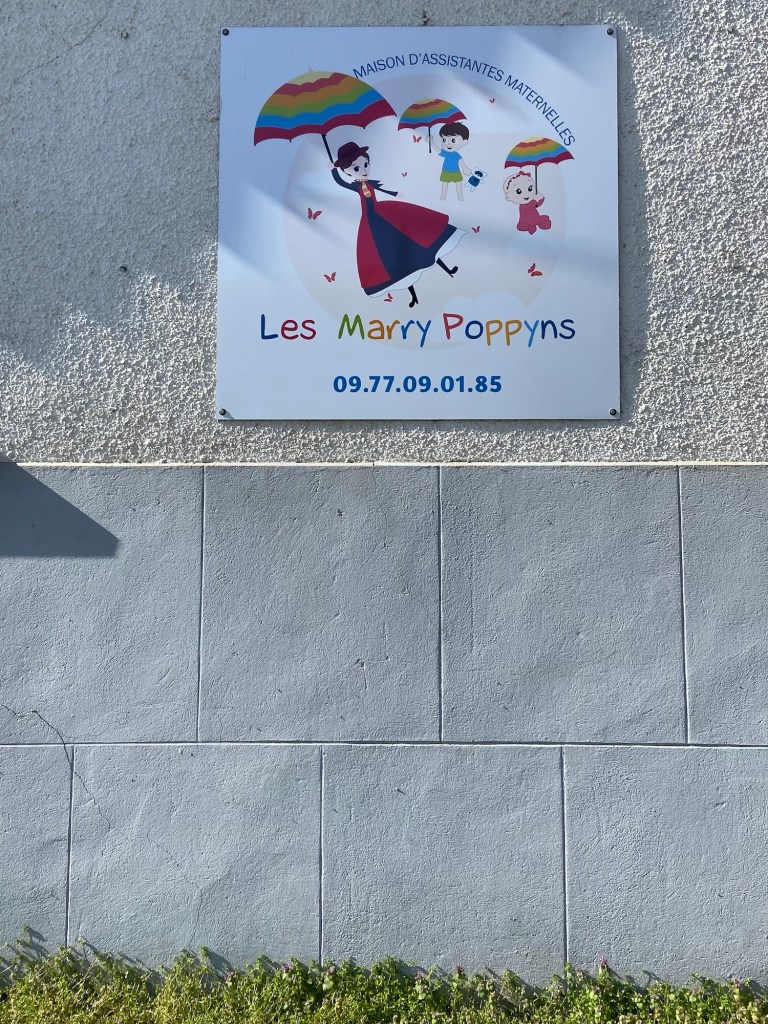
I admired (but was also a bit baffled by) the creative spelling on the sign for this nursery school,
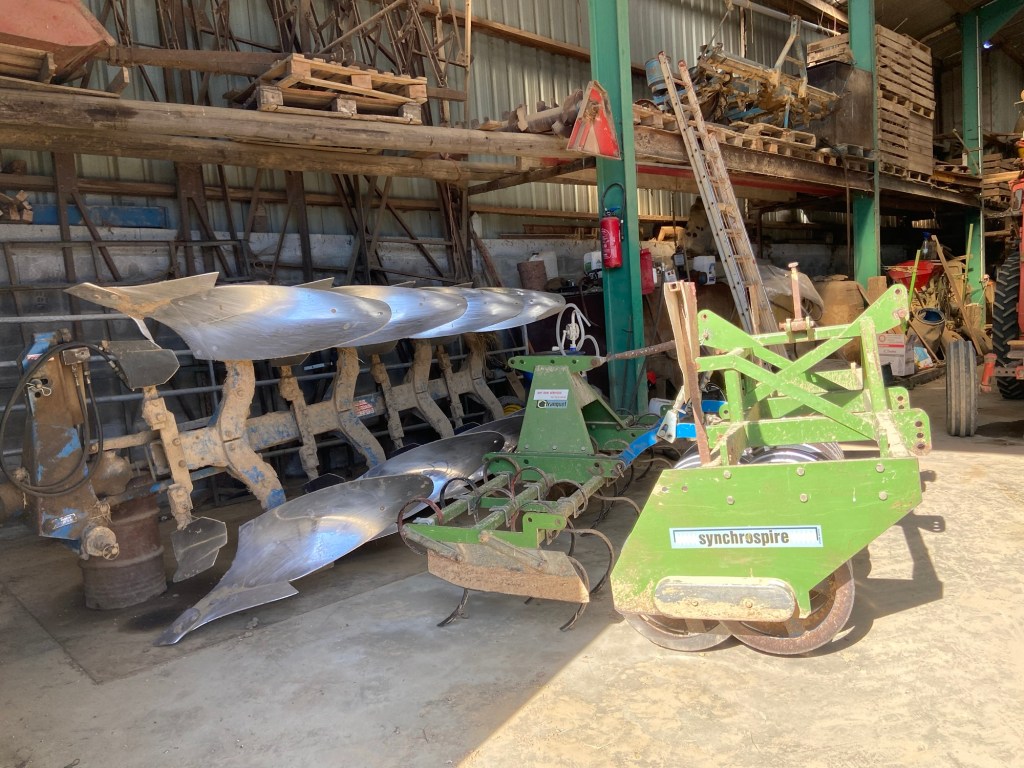
and was interested to get a closer look at some of the agricultural implements that I have seen in action over the past couple of weeks. I looked at the gleaming blades of the plough, and felt a bit guilty at the thought of the trowels and forks back home, put away dirty.
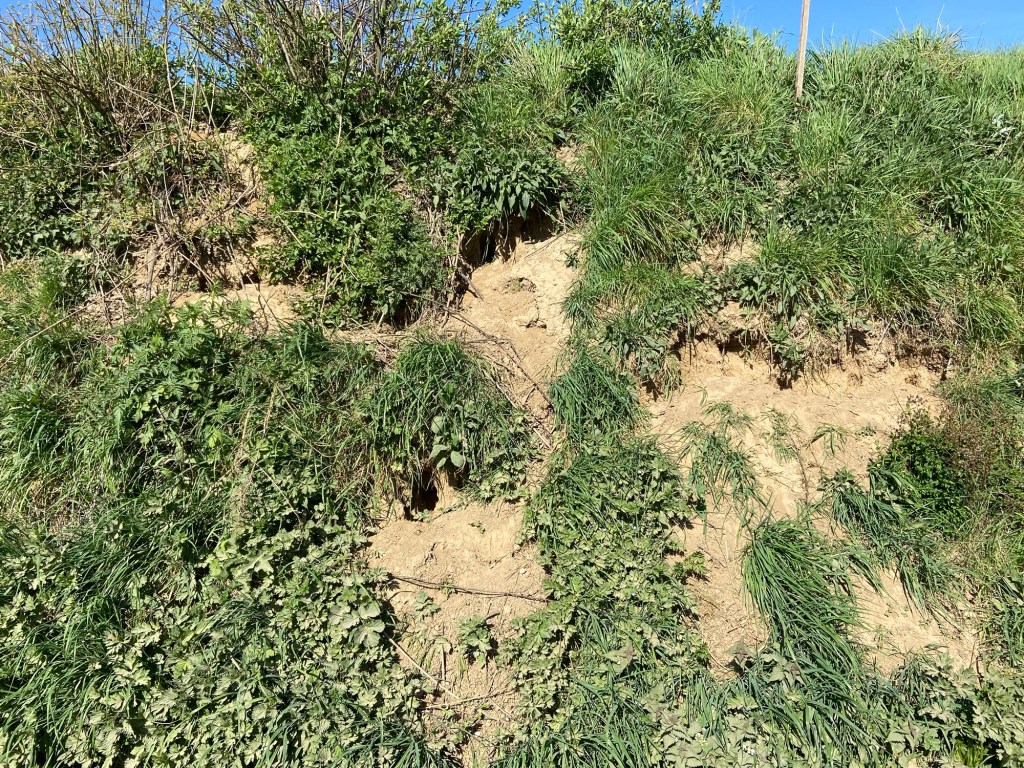
From there it was back out into the fields again, but even here there were points of interest, a rabbit warren dug into the bank,
and the first quintessentially French tree-lined road I have walked down. It was delightful walking in the sunshine, especially with the breeze that was turning the blades on the wind turbines at a decent lick.

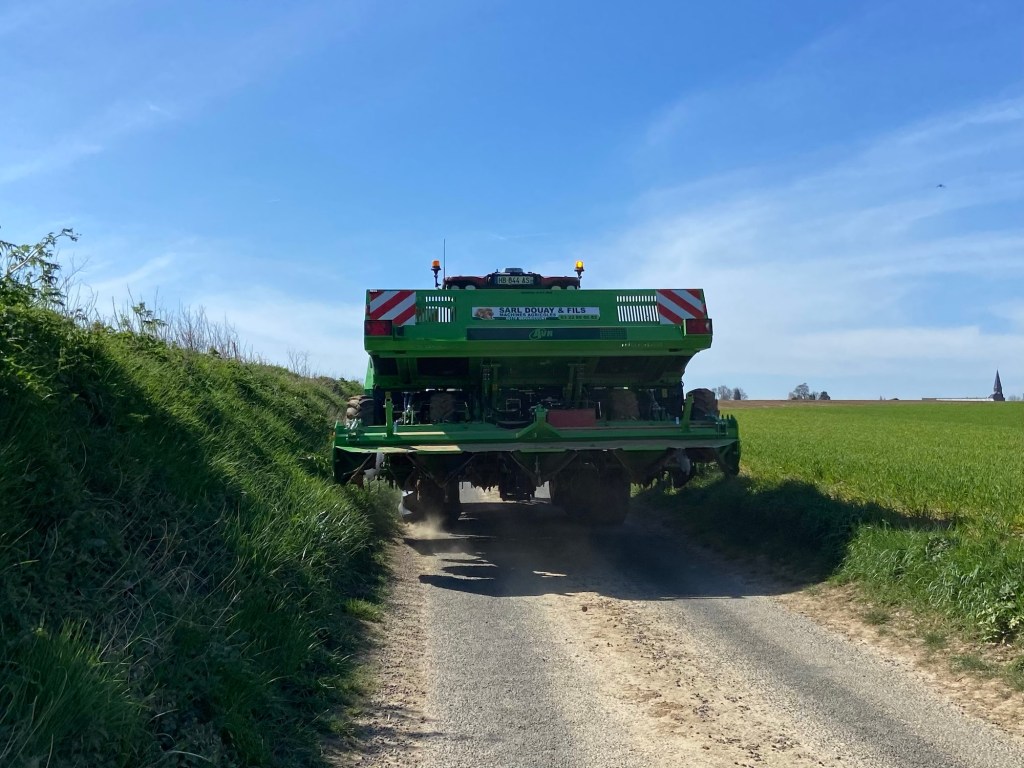
Although I spoke to nobody from when I left reception at the Hôtel de la Paix until I got to my accommodation at Péronne, I nonetheless appreciated the fleeting contact that I make with drivers of cars, thanking them for giving me a wide birth. I invariably got a wave and a grin back, and my impression is that this happens more than it does in the UK. Even if drivers were cheerful and went slowly, there was nothing they could do about raising a cloud of dust behind them as they passed me. There was much rubbing of the eyes and wiping of the phone screens after this one,

and I had to climb the bank through the long grass and nettles to avoid this one! It was followed by a smaller vehicle with a forklift and then one with a trailer a few minutes later. It was like being a character on the farm page of Richard Scarry’s Busy Busy World.
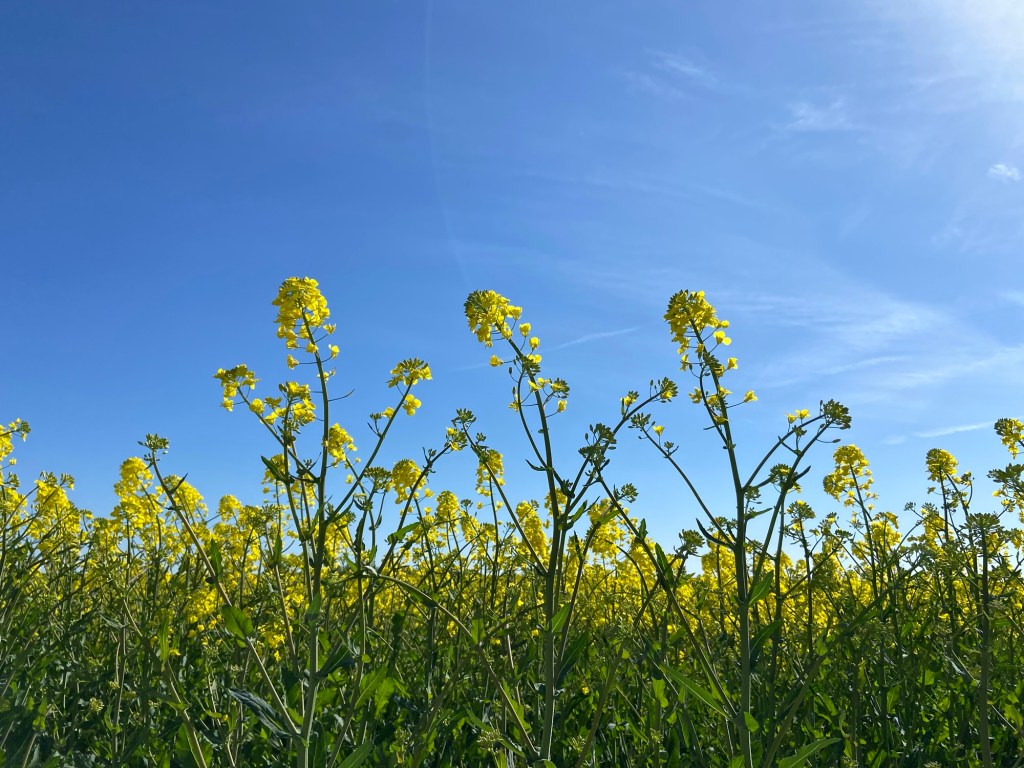
Beyond Rocquigny the potato fields thank God had given way to more cheerful rape fields,
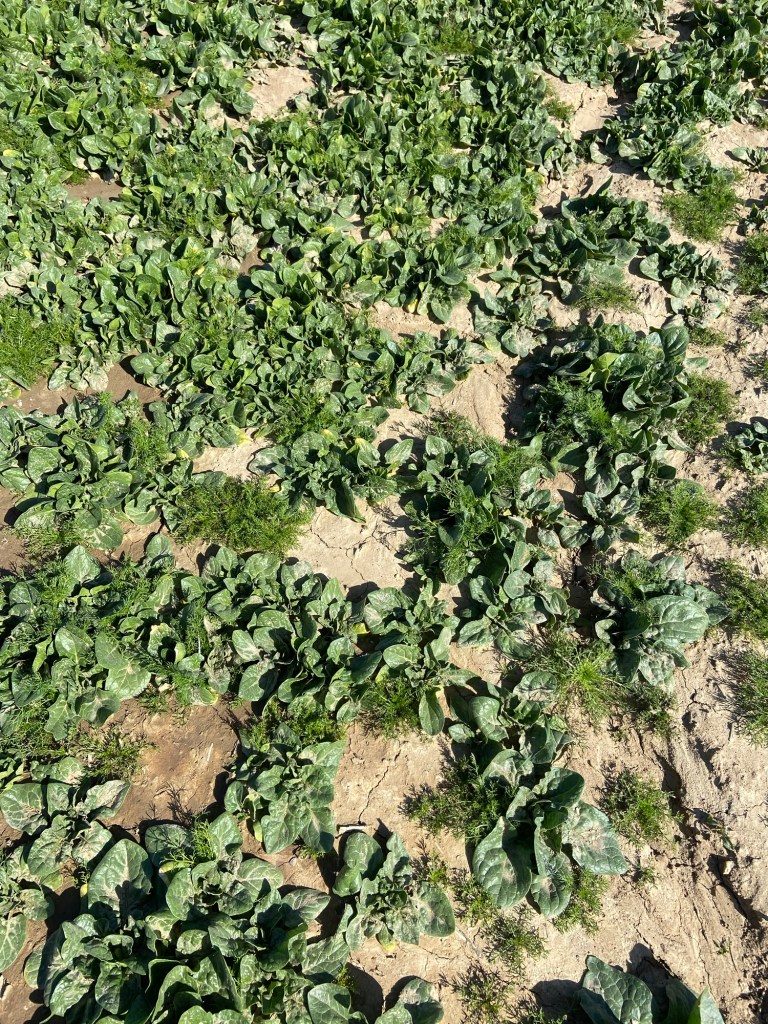
wheat that had been planted earlier that had really got going, and another one of those rosette-leaved crops that Stephen and I had seen a few days ago. This one had been planted right up to the side of the road so I could nibble the very end of one of the leaves (like a rabbit! I thought back to the warren I had seen earlier, and the hare scampering away in the fields as I crossed the motorway bridge first thing in the morning). It certainly tasted sort of spinach-like.
I was learning that on a long hot day on featureless French roads one should never look a gift bench in the butt, so I took the guidebook’s note about Sailly-Saillisel (which sounded like the French equivalent of Boaty McBoatFace to me) which said ‘benches, left’ as an instruction, even though I was not yet halfway through the walk. I took off my pack and just sat in the breeze drying the back of my T-shirt and enjoyed the sun coming round enough while I sat, to give me a bit of shade. It was very restorative.
On the way out of the village, I was honked at very aggressively by an attack goose. Like the many barky dogs in people’s gardens it was behind an effective fence, but a rat that had been nibbling at the two baguettes propped up by the front door of the house didn’t find the fence any kind of barrier, and whisked through the mesh as I approached. I wanted to take a photograph of the angry goose (its furious tongue was quite spectacularly sticking out), but in all the commotion a hand was coming round the kitchen door and the goose was getting really quite agitated. I hurried on.
Out in the fields, the midday sun was now hot enough to make heat mirages shimmer over the brown Earth, and the breeze strong enough to create dust devils.
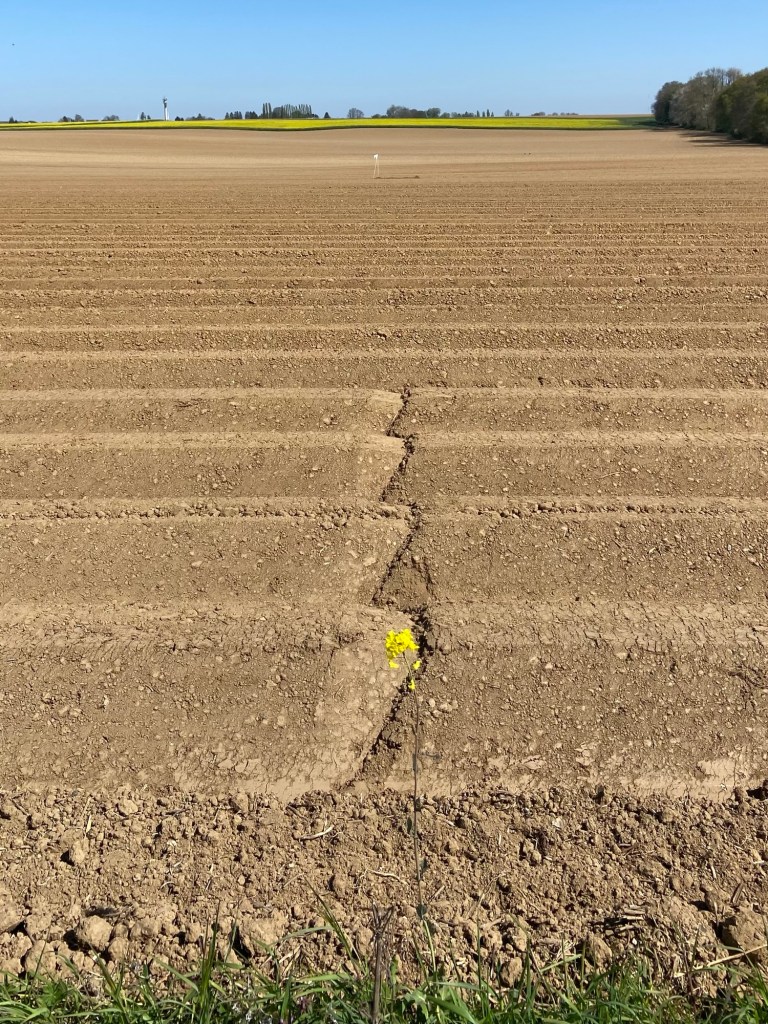
Across the potato hilling I could hear a cuckoo calling, and I was grateful when the path headed off the road and towards the woods.
The Bois de Saint Pierre Vaast was private property but there was a beautiful grassy path around the outside. I could hear the cuckoo quite clearly, as well as the sweet, varied sound of blackcaps, robins, the ubiquitous chiffchaffs, wrens, and great tits.
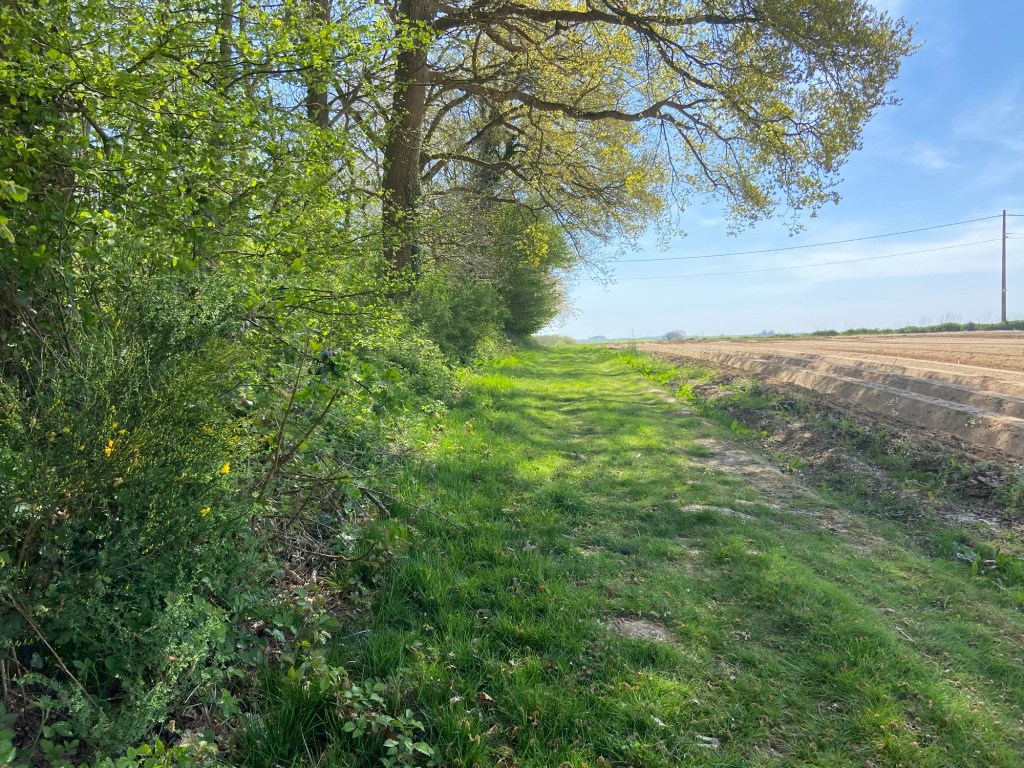
It was a brief but absolutely delightful interlude, especially when the wood opened out to engulf the path.
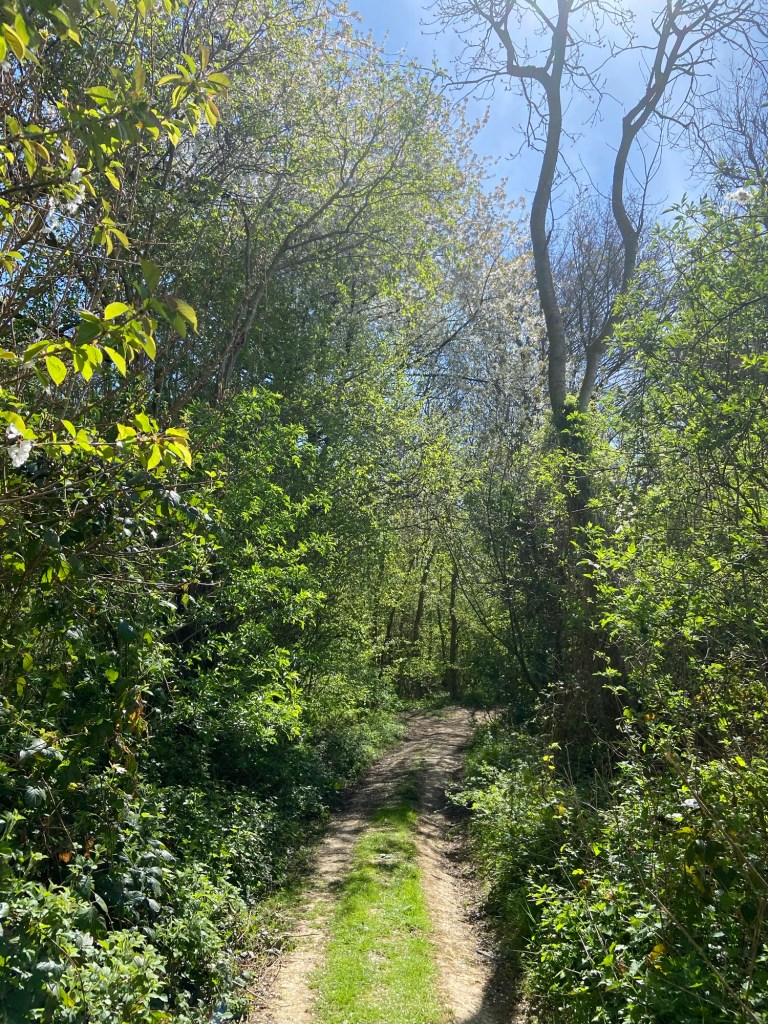
I was enjoying being back amongst the trees, and appreciating the yellow broom, bluebells, stitchwort and all, till I suddenly realised that what I initially had thought was a little pile of stacked logs — wasn’t.
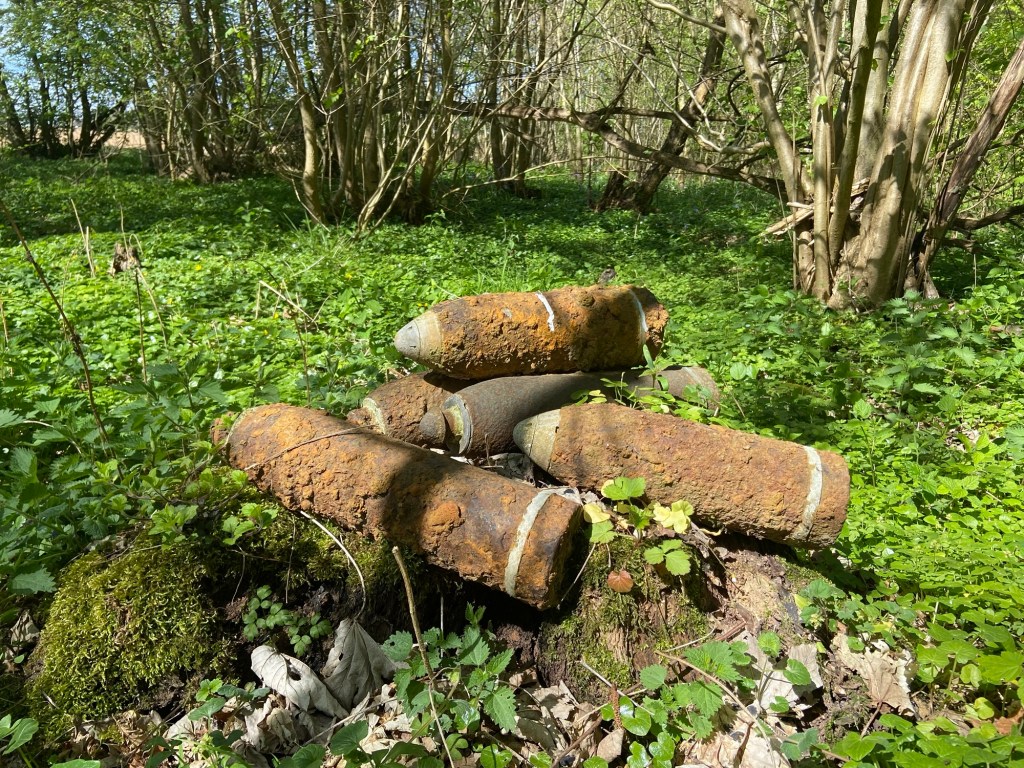
A timely reminder that I was now walking through the Somme. The battle for this wood in November 1916, in a cesspool of mud and with ammunition supply cut off, had been knife work.
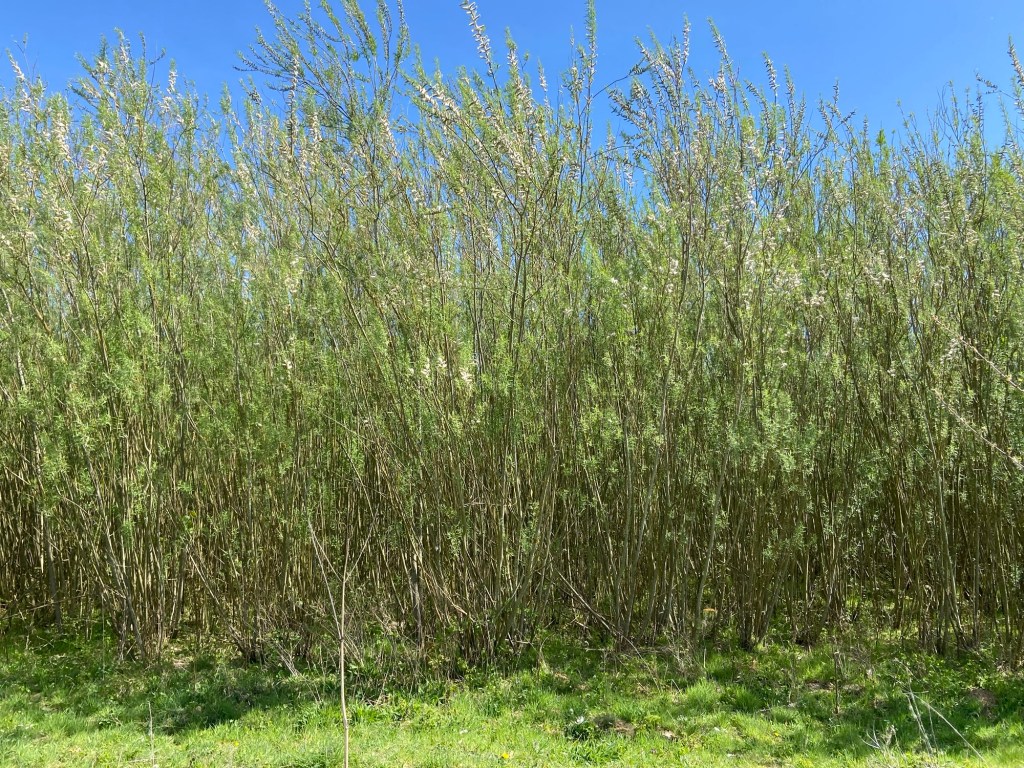
All too soon, the path came out of the woods, but for me, today in 2025, it stayed green and grassy. I passed thick osier beds, with their new leaves rustling in the breeze, and thought that this was more of a ’Sentier des Osiers’ than the one I’d walked on yesterday, where there were none.
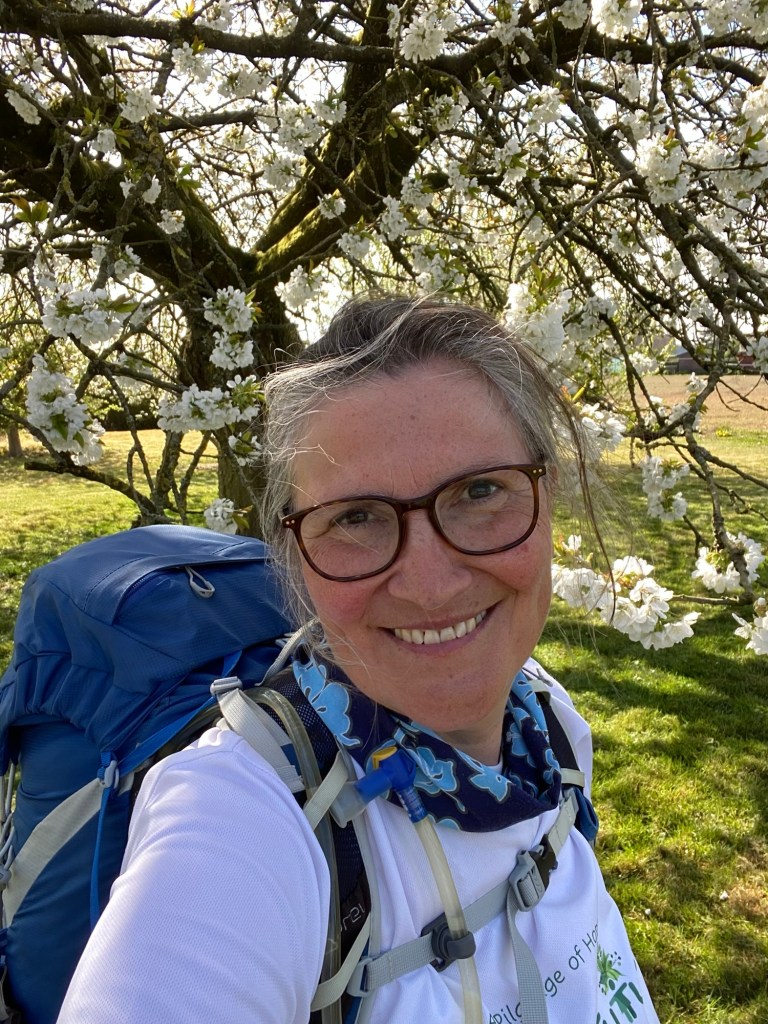
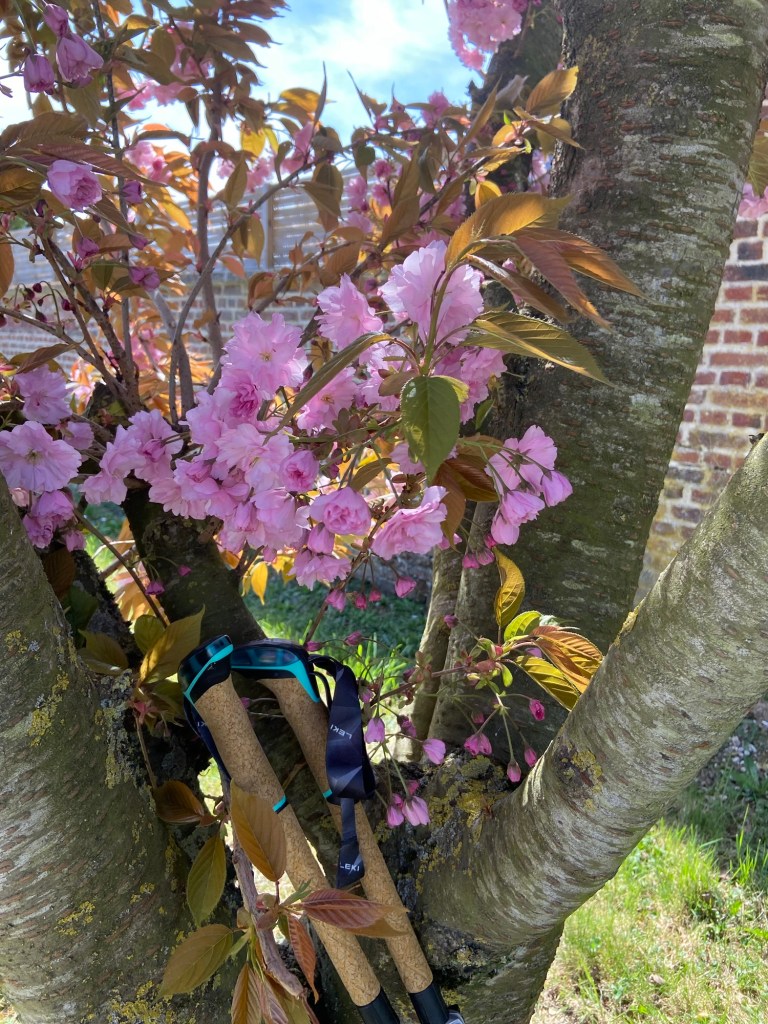
At 1.10 with about 8km to go it was time to sit again and the village of Bouchavesnes-Bergen gave me just such an opportunity in the form of a cherry tree covered in blossom and a nice, dry, mossy, grassy bank to sit on. I took my socks and shoes off, and ate the second half of my roll from the hotel. Fantastic. I could’ve stayed there all afternoon.
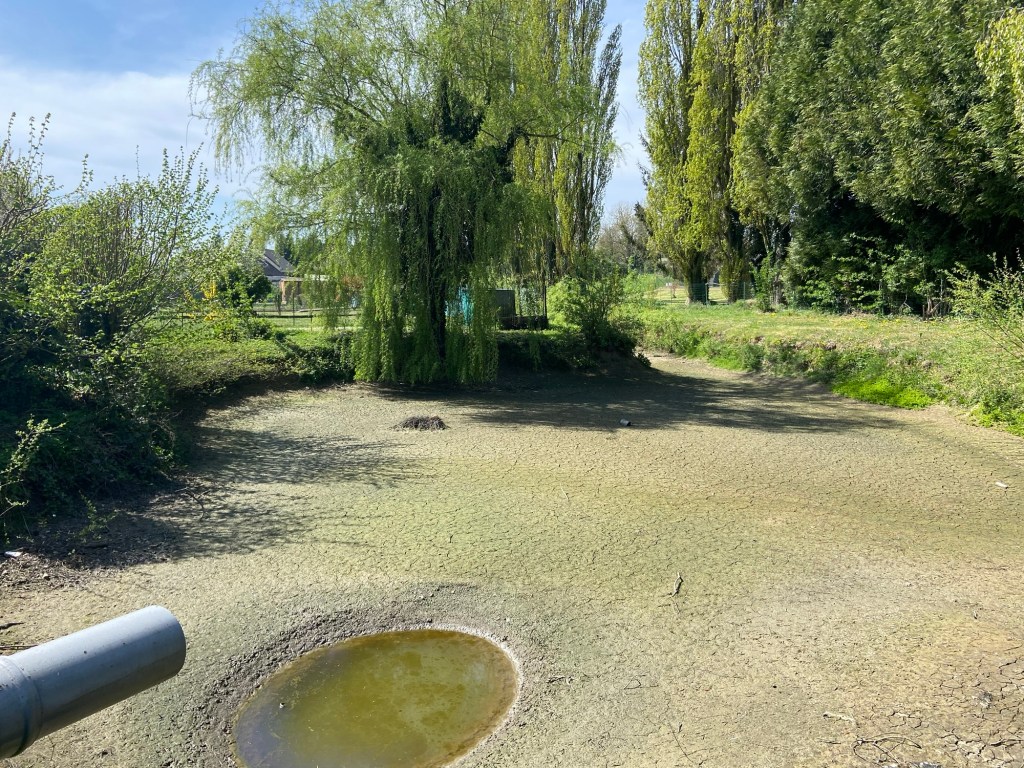
With the miraculous power of cooled down feet, and swapped over, equally miraculously dried socks, I set off again, disturbed to see evidence of how little rain there has been in an almost completely dried out pond.
The village was notable for two other things, the Harry Potter moment of the day,
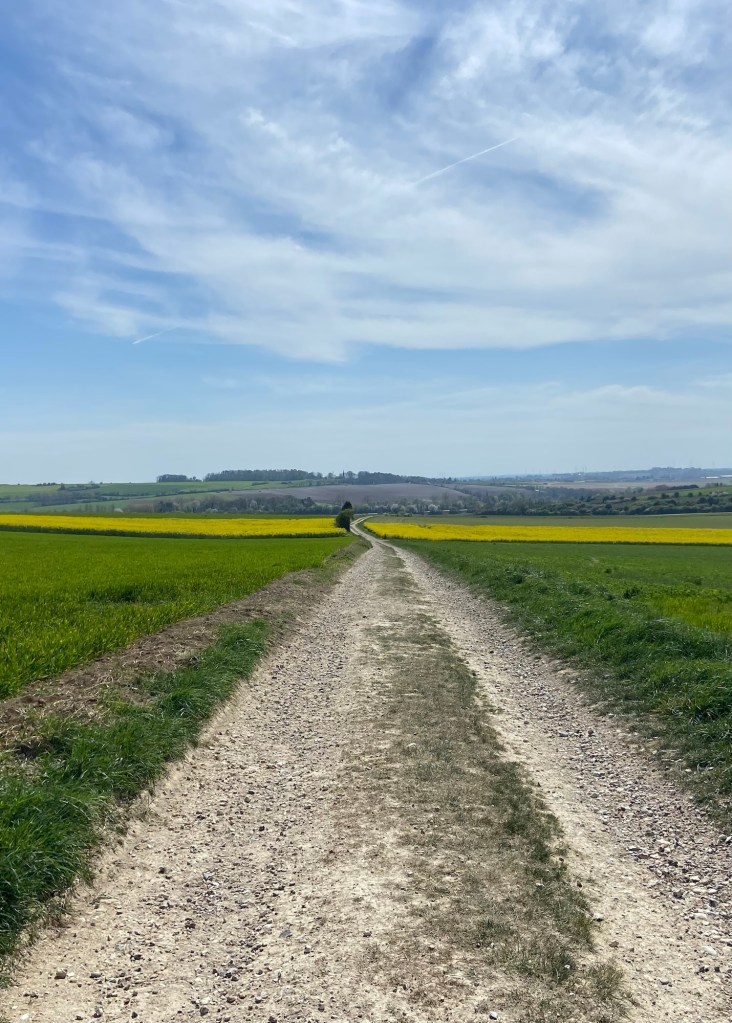
And the first of two climbs, for which I had stretched my calves in preparation when I had stopped for my break. It wasn’t really a climb so’s you’d notice, but from the top I suddenly had the most amazing view into the next valley and Péronne in the distance.
The path came off the road at this point, and descended slowly on a long gravel road with a beautiful strip of grass in the middle. On the right, rolling hills, on the left amongst the fading blackthorn flowers a corridor of blackcap song and a chorus of low humming from the bees. The fields were still vast here, but they were nestling between wooded hill in a patchwork. I felt myself filling up with sun and breeze.
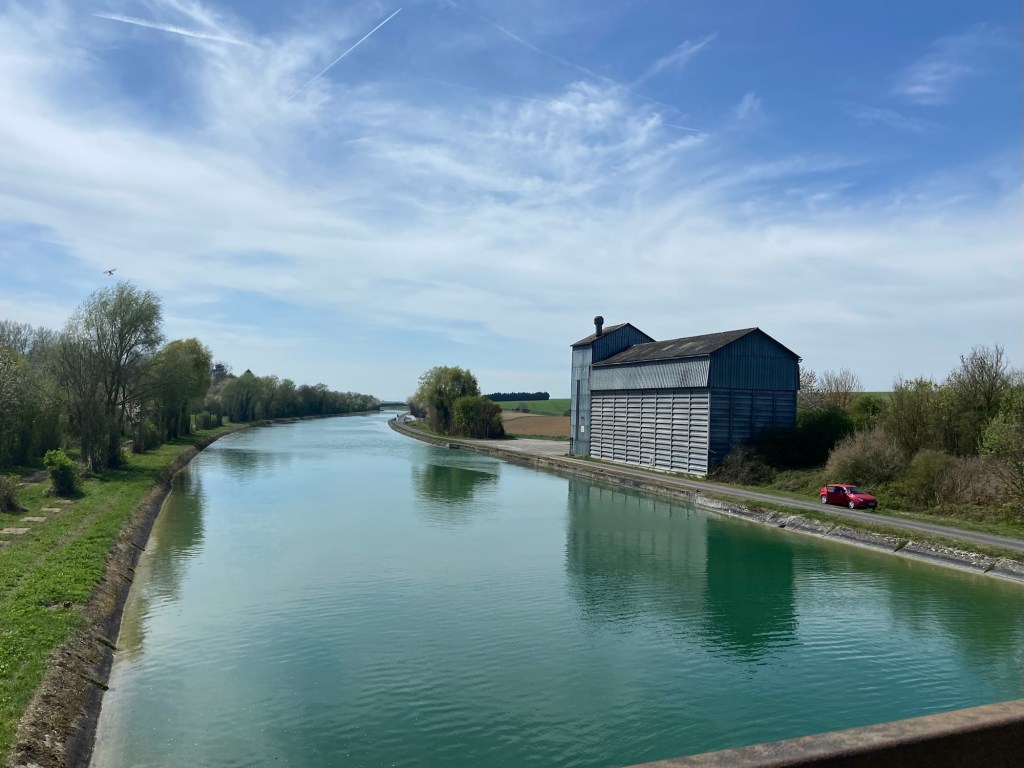
And to cap it all, at the bottom of the hill was the Canal du Nord. To my huge disappointment my exposure to it was limited to its crossing, but its wide blue-green ribbon felt refreshing, even just looking at it from the top of the bridge.
Thereafter, I walked in the shade when I could. There was still a nice breeze, but the weather app was saying 22° now, and I would be surprised if out in the sun it wasn’t a bit more. Certainly my spring-weight trousers were feeling too heavy and I wished I had my shorts on.
The country road climbed steadily up the slopes of Mont Saint-Quentin. A trailer full of potatoes pitched at an improbable angle was hitched up to a tractor by the side of the road with its engine on and an empty cab. Next to it was a smaller tractor with its bucket full of potatoes, and a chilled young driver with a well-groomed beard, scrolling on his phone.
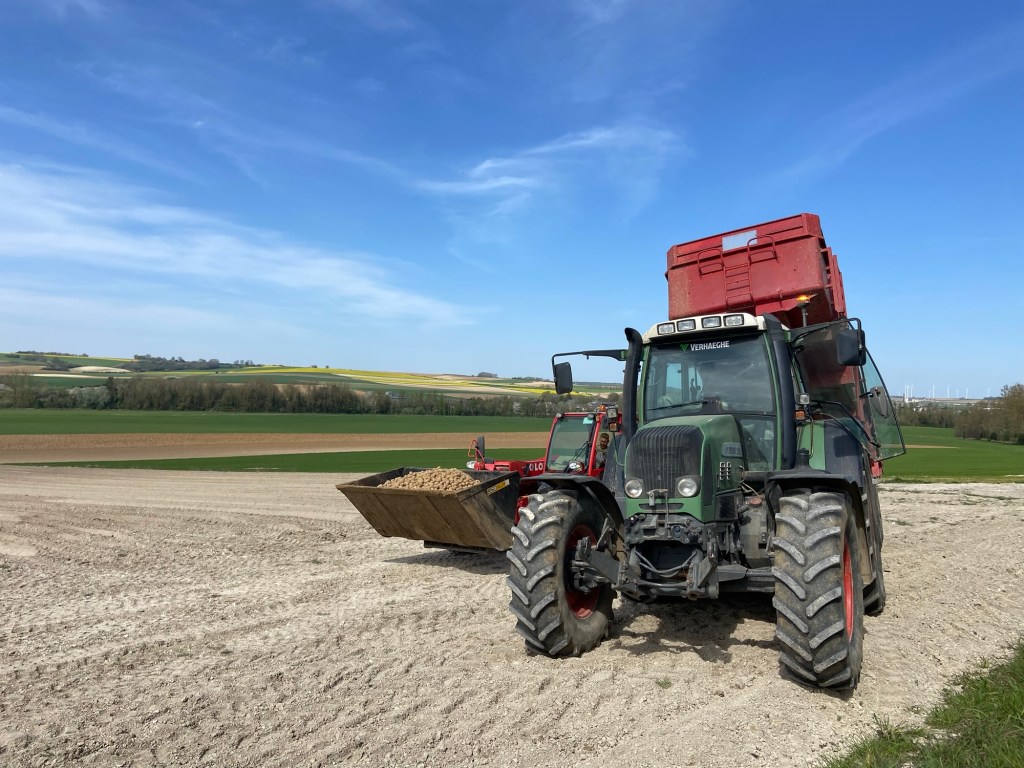
In the sweep of the field below him five tractors crawled up and down, dropping potatoes into the ground and hilling the soil up over them. When one of the tractors neared the top of a row, scrolling man sprang his tractor into action, bucket at the ready.
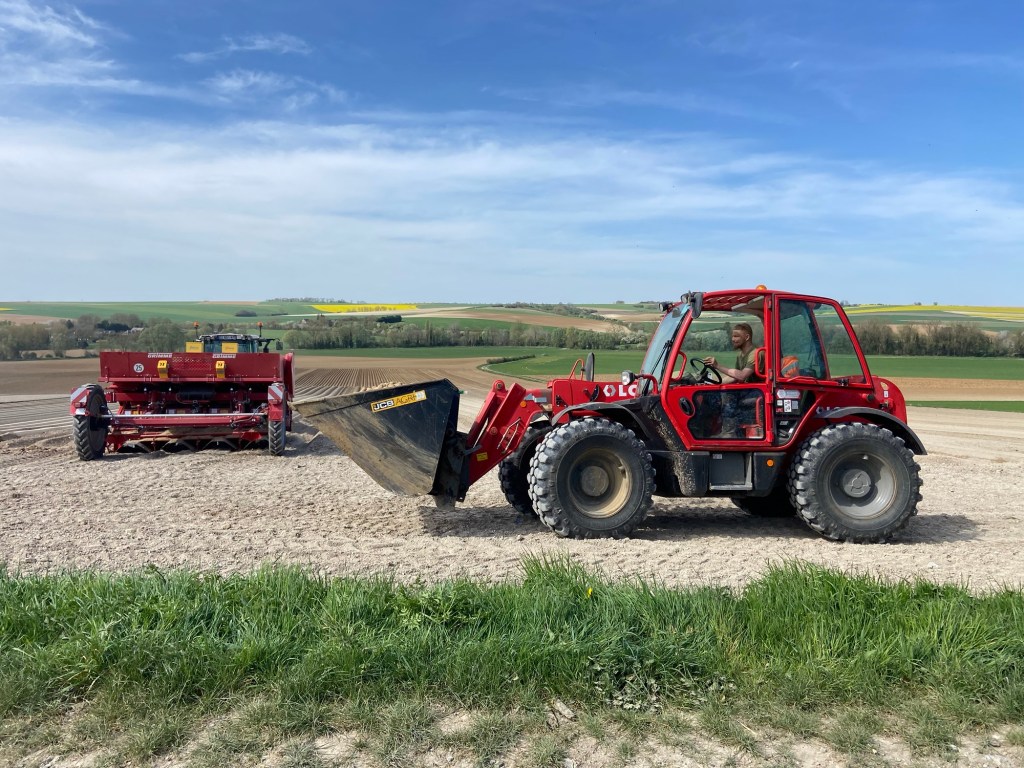
The planting tractor turned and momentarily stopped as its hopper was refilled.

Potato choreography in slow motion.
I wondered how long it would take them to get through the whole field.
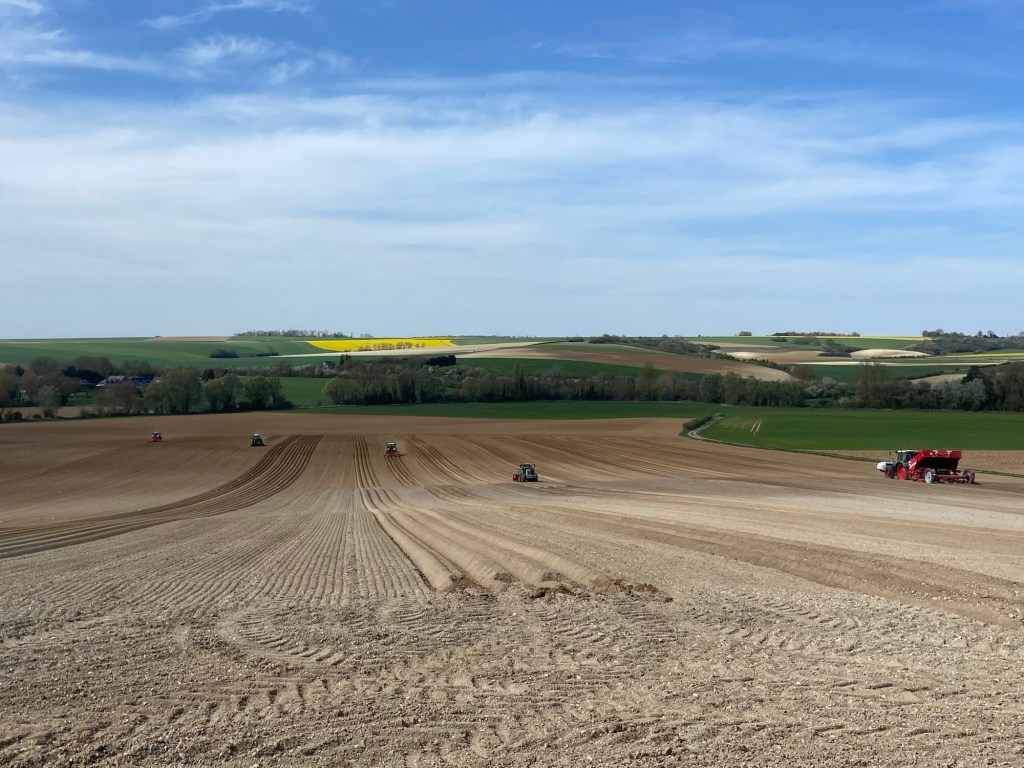
At the top of the hill, I turned to appreciate the wide view of the land I had just crossed, pinpointing my route.
But there was also another history mapped onto this view, and another narrative — a memorial in the form of printed blocks, to the ‘Determination’ of the Allied forces in the late summer of 1918 to capture the ridge on the slopes of which the potatoes were now being planted. I started to see the landscape with new eyes as I read its story:
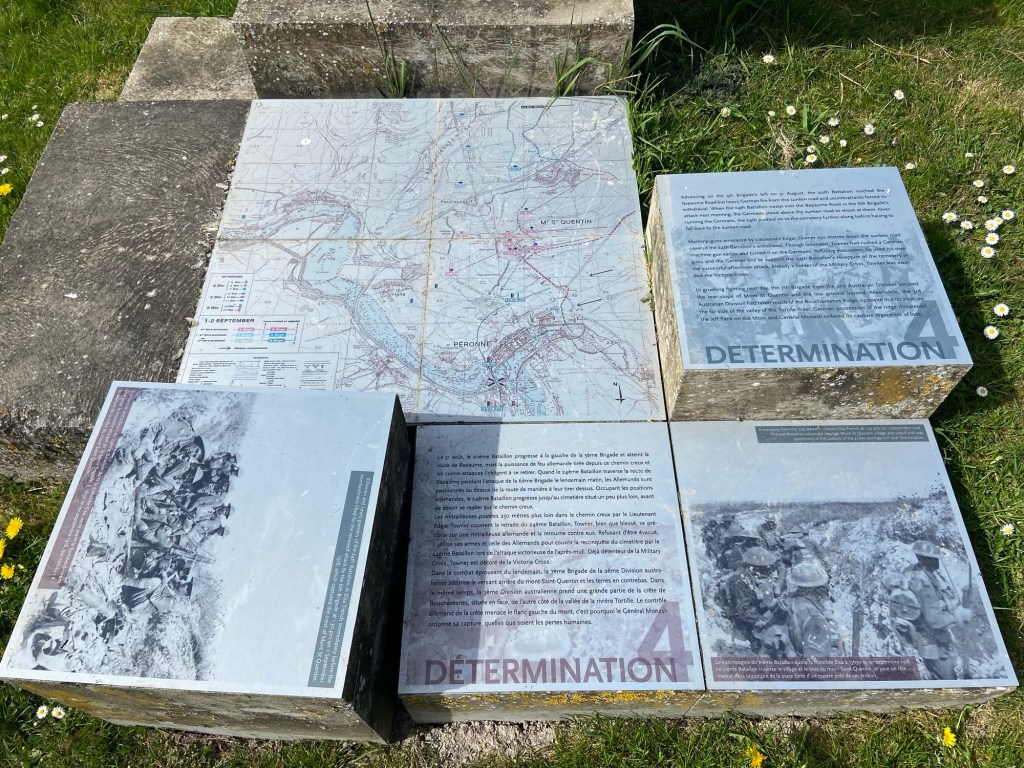
Advancing on the 5th Brigades left on 21 August, the 2oth Battalion reached the Bapaume road but heavy German fire from this sunken road and counterattacks forced its fall back to the sunken road.
Machine-guns emplaced by Lieutenant Edgar Towner 250 metres down the sunken road covered the 24th Battalion’s withdrawal, Though wounded, Towner had rushed a German machine-gun earlier and turned it on the Germans. Refusing evacuation, he used his own guns and the German one to support the 24th Battalion’s recapture of the cemetery in the successful afternoon attack. Already a holder of the Military Cross, Towner was awarded the Victoria Cross
In gruelling fighting next day, the 7th Brigade from the 2nd Australian Division secured the rear slope of Mont St Quentin and the low ground beyond. Meanwhile, the 3rd Australian Division had taken much of the Bouchavesnes Ridge, opposite this location on the far side of the valley of the Tortille River. German possession of the ridge threatened the left flank on the Mont and General Monash ordered its capture regardless of loss.
Photographs and maps brought the narrative to life, and through a black steel girder I looked back over the way I had come over the beautiful landscape away north, through the words of Lance Corporal David Wilson, 24th Battalion AlE.

I lay the gun on one whom I thought was an officer and gave him a burst and he burst into flames and fell back. I must have hit the bombs he was carrying or his ammunition.
I turned away, climbing to the top of what once had been a vantage so important that its capture was necessary ‘regardless of loss’, and my way dropped easily down into the town, and the day’s end.
Stats for the Day
Distance 26.69 km
Time: 5:21
Speed: an astonishing average of 5km/h, almost all on tarmac.
Read about my fundraiser here!
 Walking The Landscape
I am amazed at you being so resilient on such little sleep, and the blog is great today, the last section particularly. Thank you for putting the hours in so that we can read it. I’m surprised how few walkers you’re meeting, are you? X
LikeLiked by 1 person
I’m walking with Matt today!
LikeLike