I was never less alone than when by myself
Edward Gibbon
Stephen and I had spent a quiet day yesterday working through the admin, washing clothes and resting instead of seeing the sights of Arras (I will spare you a photograph of the dirty water after I had hand-washed my socks, but suffice to say it was quite disturbingly pond-like). There are a few days coming up where I will need to carry all my food, perhaps for a day or two, and others where there will be no opportunity to buy lunch, and I need to look ahead so that I know what’s coming.
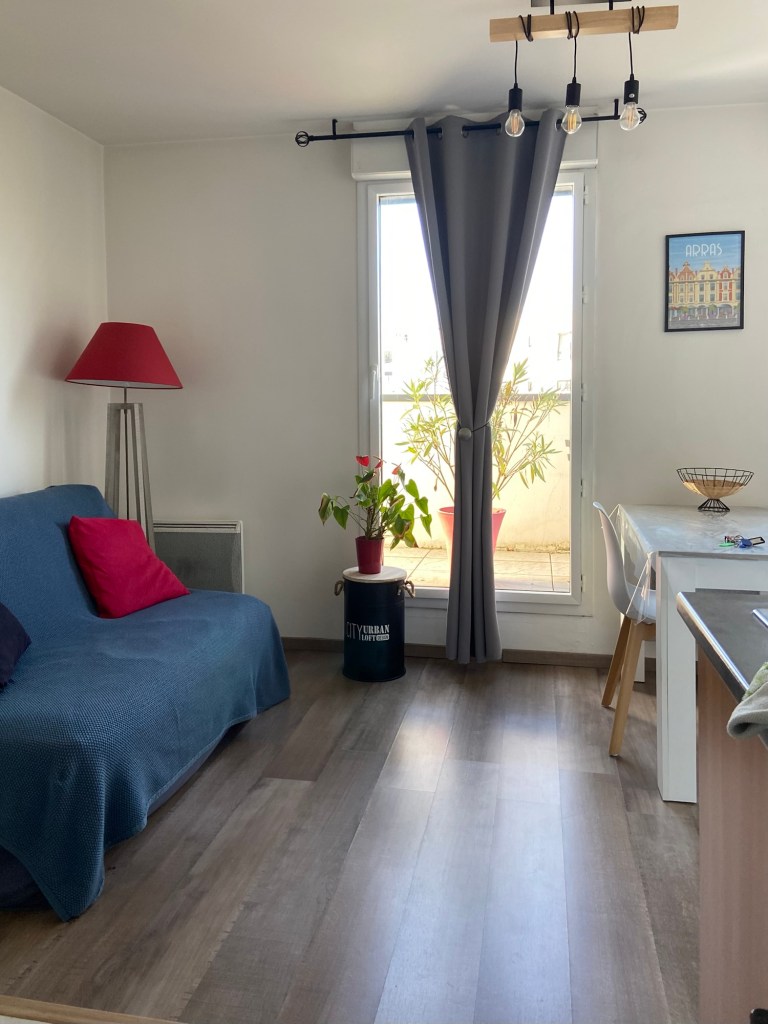
It was also just lovely spending the last quiet hours together in the sunny AirBnB,

but at last, the time came to accompany Stephen to the train station, and see him on the TVG to Lille where he was to pick up the Eurostar to London. It has been wonderful being able to start this journey off together and I really wish he didn’t have to leave, but I know I have the walking resources to undertake the rest of the journey myself.

It took me a couple of hours to get out of the Airbnb this morning, making sure my slightly less voluminously-filled but heavier rucksack was well packed, including a well-sealed plastic pot that Micheline Peacock had given us, full of my lunch for today: the remains of the potatoes and lentils that Stephen and I had had on Wednesday night. My last beautifully home-cooked meal for a while!
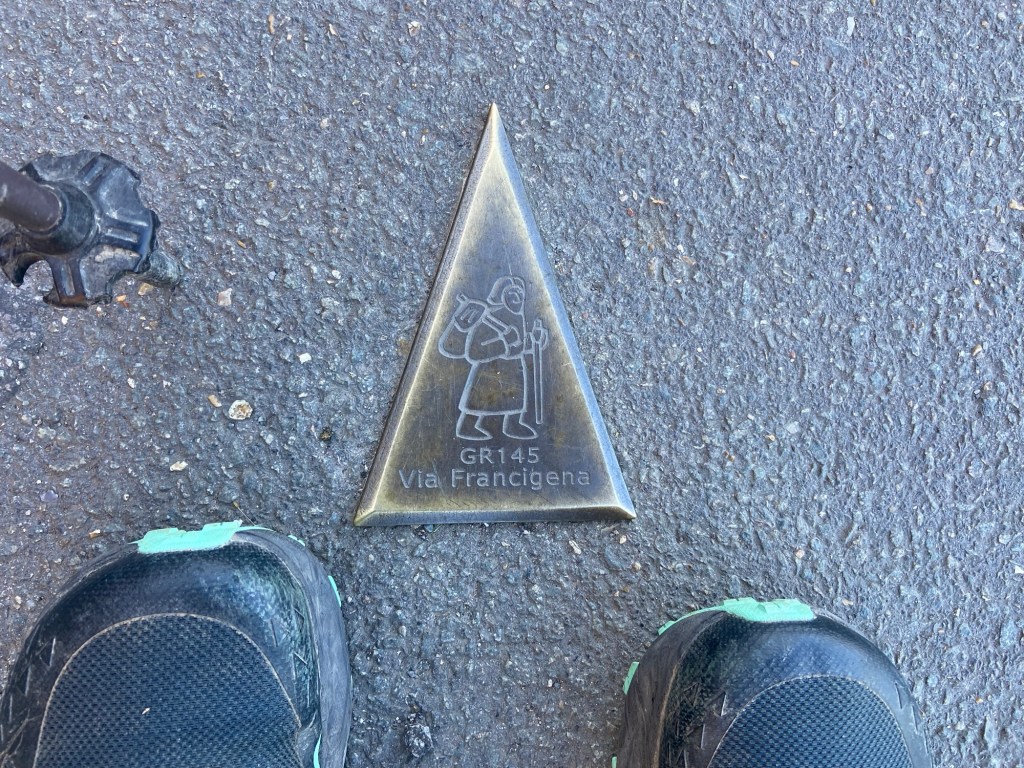
I walked out past the station where I had said goodbye to Stephen yesterday, picking up the VF signage on posts, and the little metal decals hammered into the pavement. The little pilgrim felt especially friendly today.
Now it was out on a long, long straight road initially lined with pharmacies and plumbers and the general business of an urban area. The people coming towards me were all purposefully heading into the city centre for a day’s work, either on foot (wrapped up well against the apparent cold) or whizzing along on the scooters that they fold up to take on the trains with them. I was heading in the opposite direction, towards the countryside.
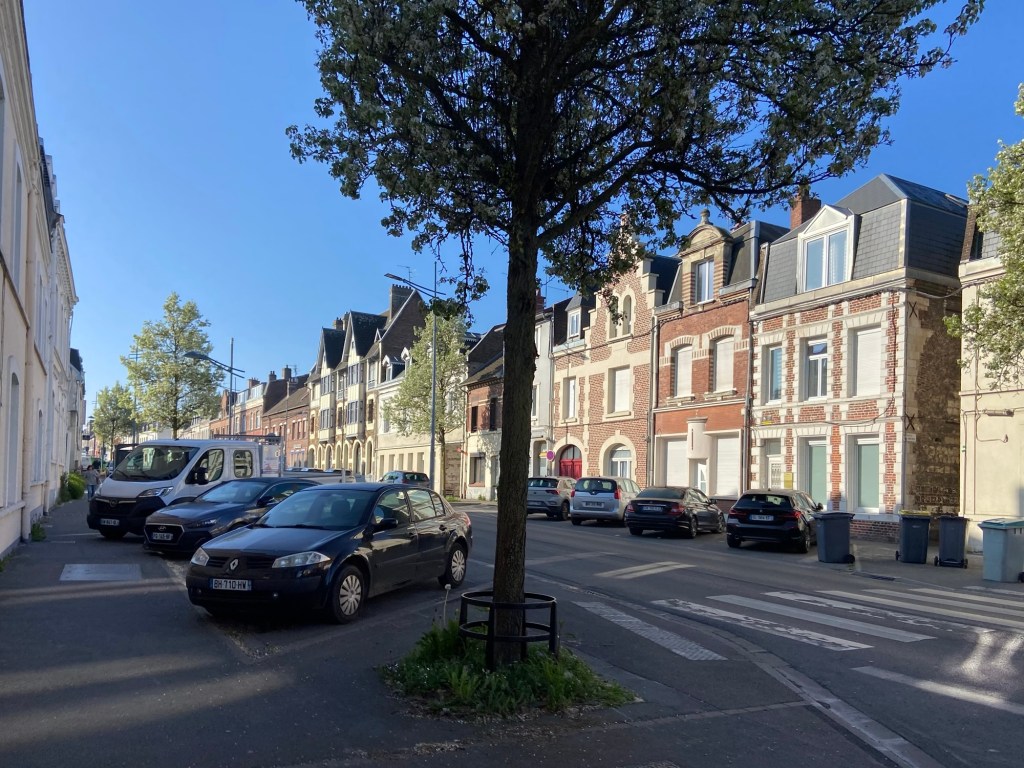
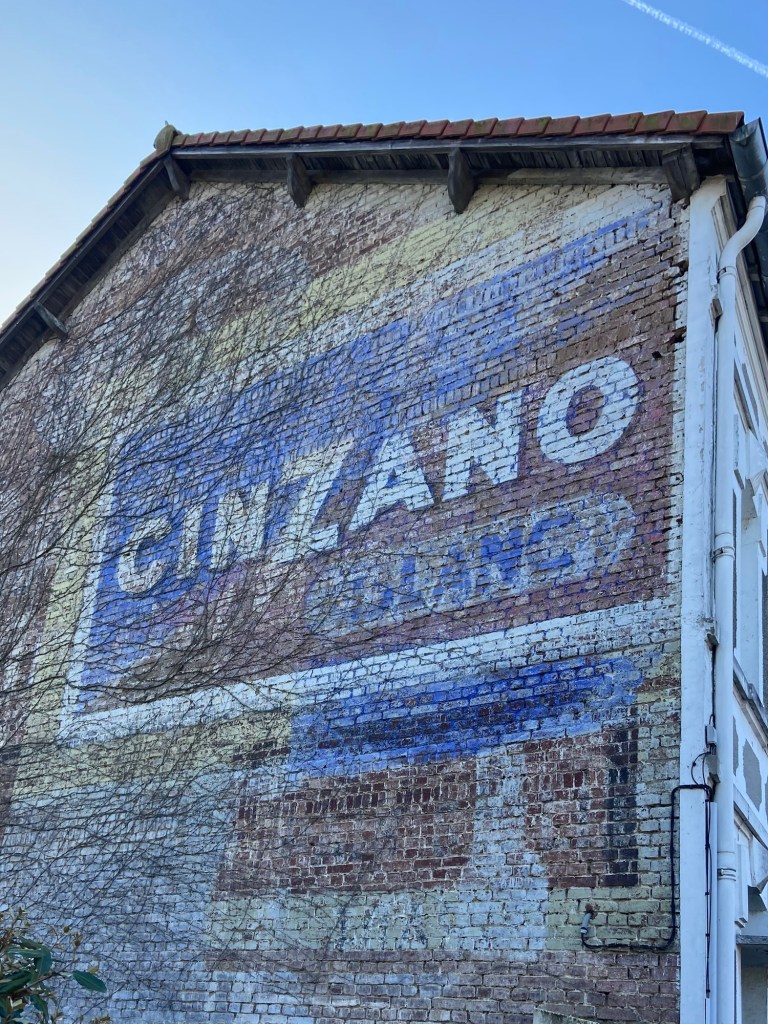
I could feel myself inching towards it with every step. I left the city Centre behind, the character of the road changed and became more neighbourhood-like, with some lovely brick and ceramic tile detailing on the houses, and two faded adverts for Cinzano and Palmolive, classics I remember well from the 70s and early 80s.
I knew I was really out of the city centre when I heard, very loud and close, a cuckoo. I tried to get a recording to send to my mum whose birthday it is today (happy birthday Mum!) But despite it seeming to me a really loud sound, I couldn’t pick it up.
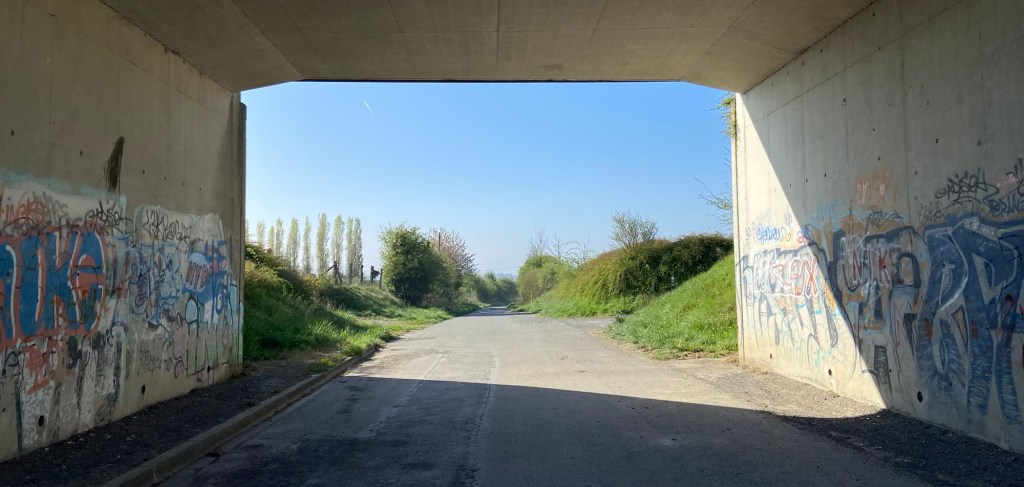
The route turned off the main road on the chillingly-named Rue Robespierre, and finally under a road bridge which marked the end of the built-up area, and functioned as a frame to draw me on into the countryside.
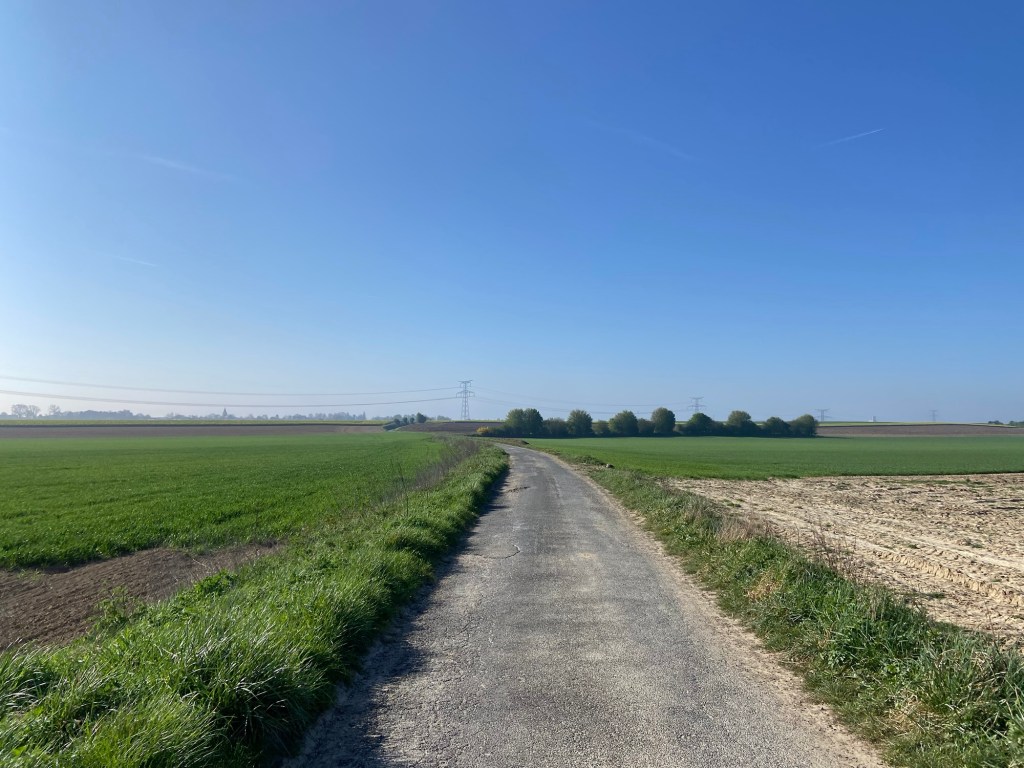
I welcomed the enormous arable fields today after the confined spaces of the city, the breadth and the depth of it all and the tiny larks fluttering out of the wheat and into the air. Although this was road walking, it meant I could get a decent walking rhythm going and kilometres under my belt.
There were no conversations! It is a very different proposition walking on my own, and I have already noticed that that I’m talking to myself! I had some little micro conversations with people along the way, for example a grandpa our with his little granddaughter in a pram in the first village. ‘I’m not her father,’ he said proudly, ‘I am Papi!’ I think when she’s walking herself she’s going to enjoy the diggers in this yard, and the tiles on this wall.
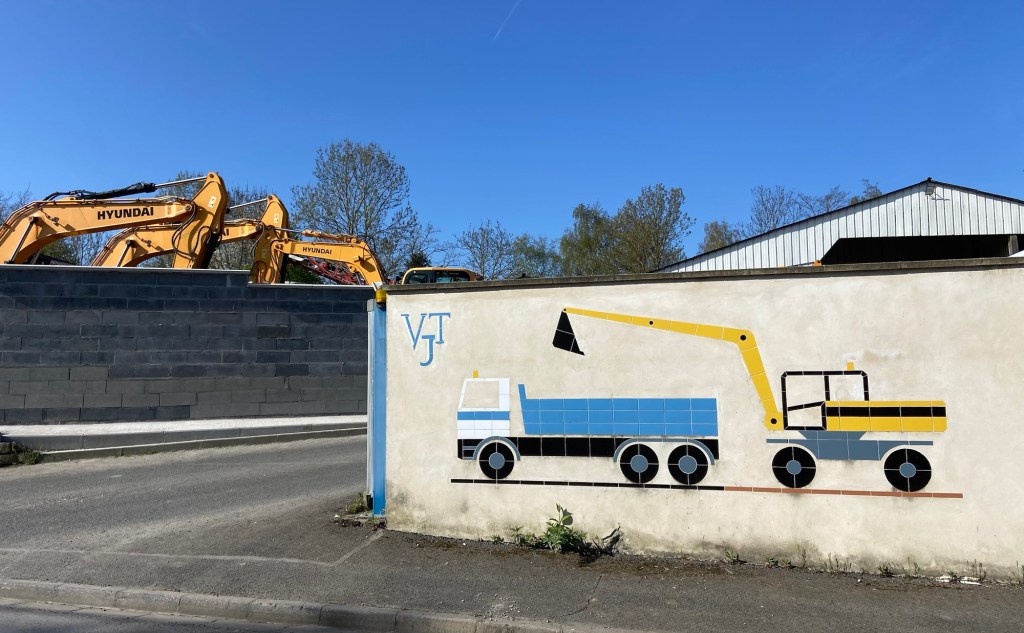
There had been a frost overnight but there was not a single breath of wind today, and I thought it’s going to end up being quite hot.
Walking on one’s own is a different proposition. I was lucky that today, to get me into being entirely responsible for making sure I was going the right way, the roads were very straight with only a few turns to negotiate. Stephen had been carrying the guidebook before because it was so heavy (quality paper and full colour illustrations) we had decided it would be a good idea for me to rip out all of the pages we used so far (quite a satisfying amount in weight!) and pack the book, just keeping the two or three pages I would need for that day’s walk in the belt pocket of my rucksack for easy access. This solution worked really well, although I am also reliant upon geolocating my position in the IGNRando map app.
Other things I sent home with Stephen were my sleeping bag (which it turns out I don’t need, because pilgrim accommodation can offer blankets, as long as you have a sleeping bag liner), and a few little bits and bobs that together added up to quite a bit of weight. But I’ve also taken on some things that Stephen had been carrying for me, the guidebook and also the power bank to charge my phone from on the go. The weight is all manageable, and I have got some really useful extra space now in the pack to carry food in that had been taken up by the sleeping bag.
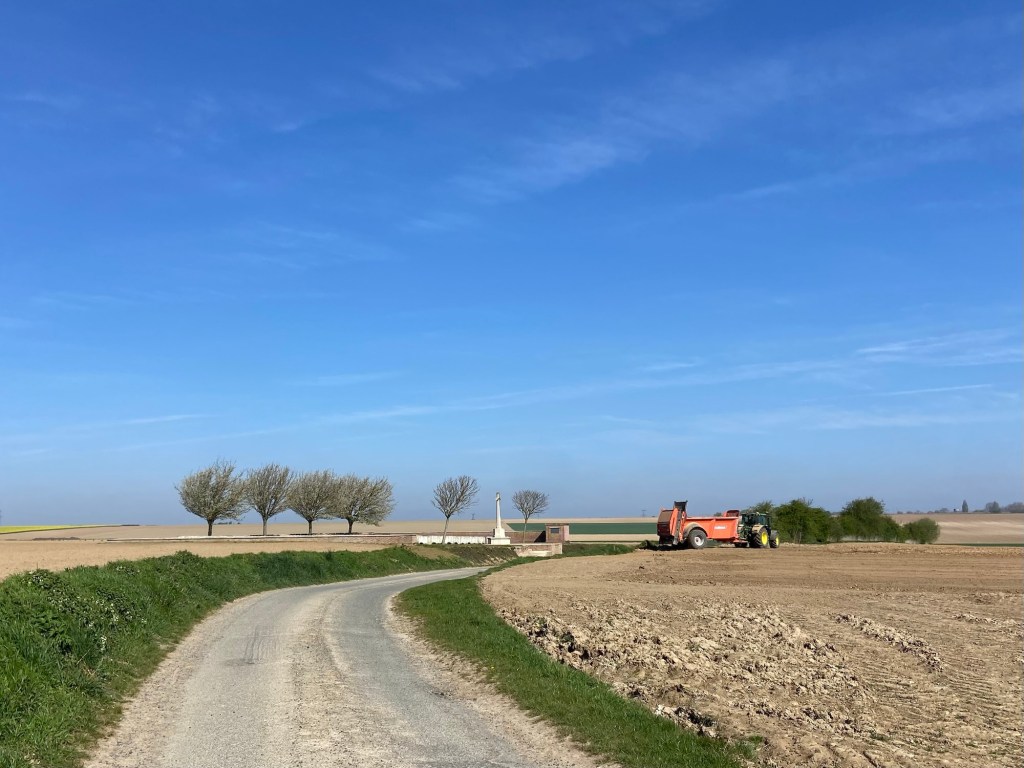
Although the countryside is so springlike and beautiful now, I was now finally leaving the Pas-de-Calais and approaching the Somme, the World War I theatre of appalling loss of life. The first acknowledgement of this was the Sunken Road cemetery where 200 Allied soldiers who fell here are buried. Whereas before cemeteries have been associated with settlements, here the cemetery is at the roadside, way out in the middle of the open fields, a walled garden with flowering trees for a backdrop, beautifully tended, beautifully planted, incredibly peaceful.
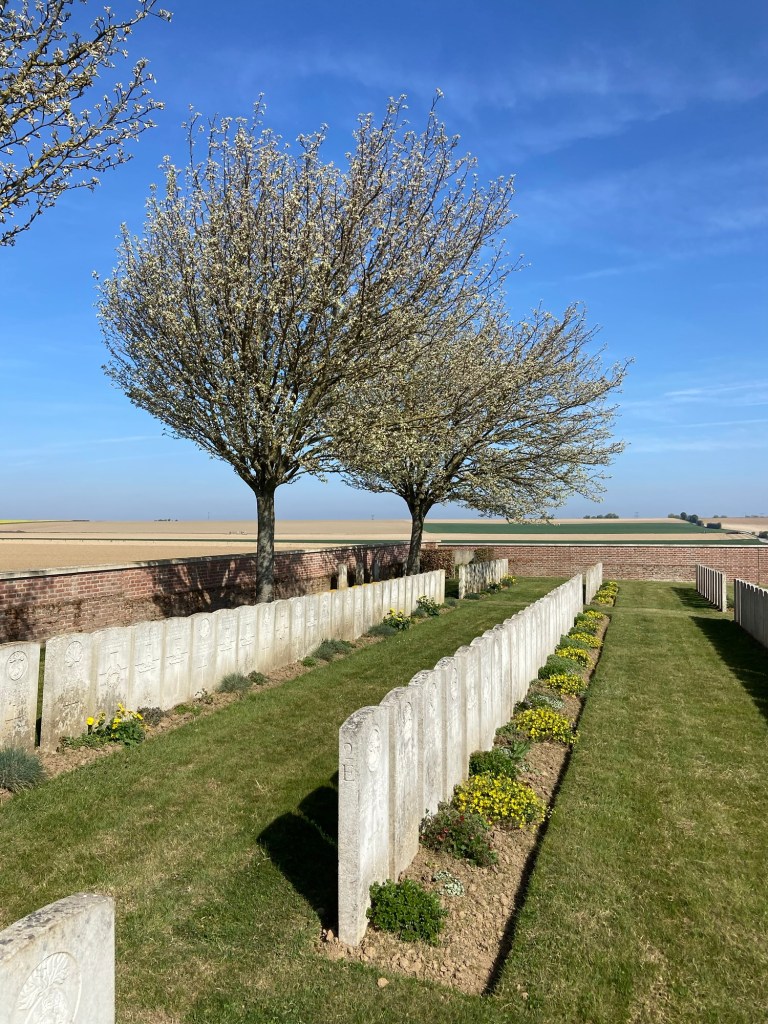
Inset into the front wall was a brass cupboard with a cemetery register in it, and also a visitors’ book, which I signed.
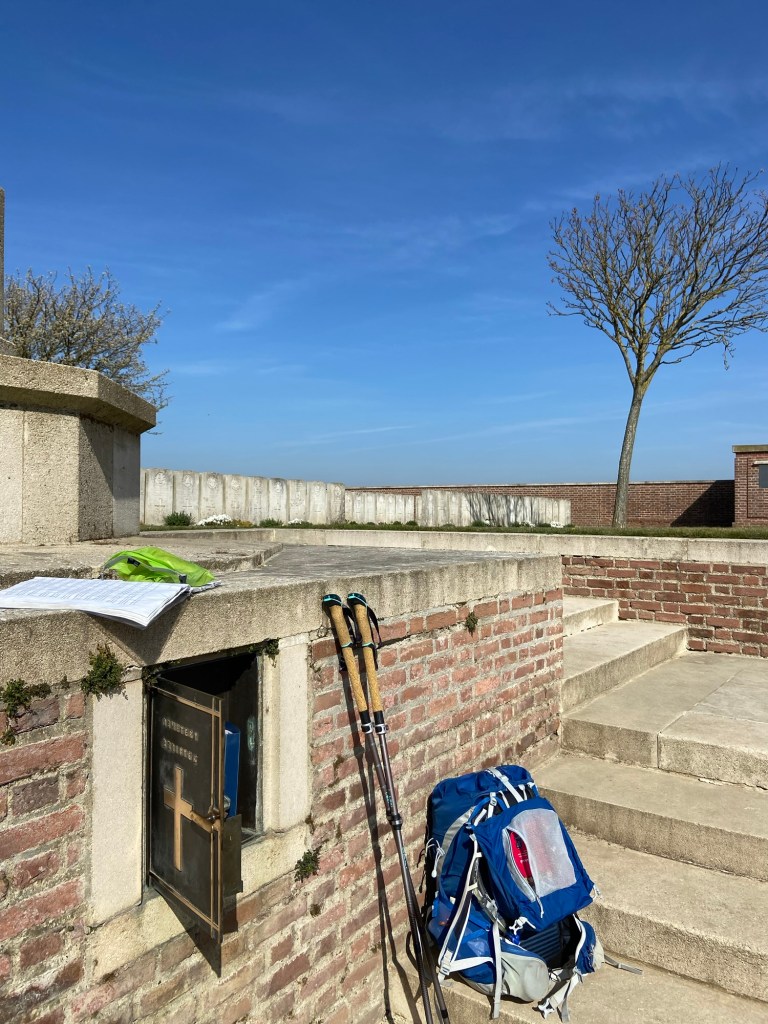
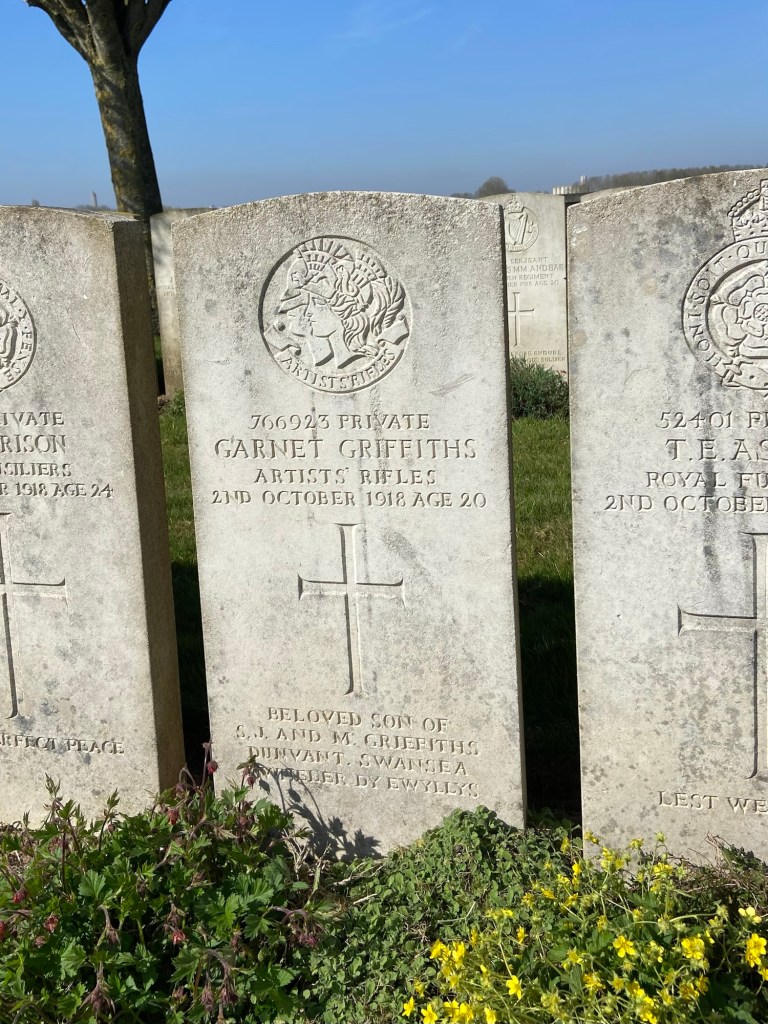
There was space in the visitors’ book to write notes about the men who are buried here. The great niece of 20-year-old Garnet Griffiths had written that he was a budding artist studying art at university who had enlisted with the Artists’ Rifles and had died of wounds on 2 October, 1918. Above his grave in one of the four trees trembling on the verge of bursting into full flower, a linnet was singing.
It was a quiet interlude and I left the cemetery with much of the peace that I had found within it, looking back to see it standing there on that lonely road, the cross and trees unchanging except for the seasons, as the world moves on.
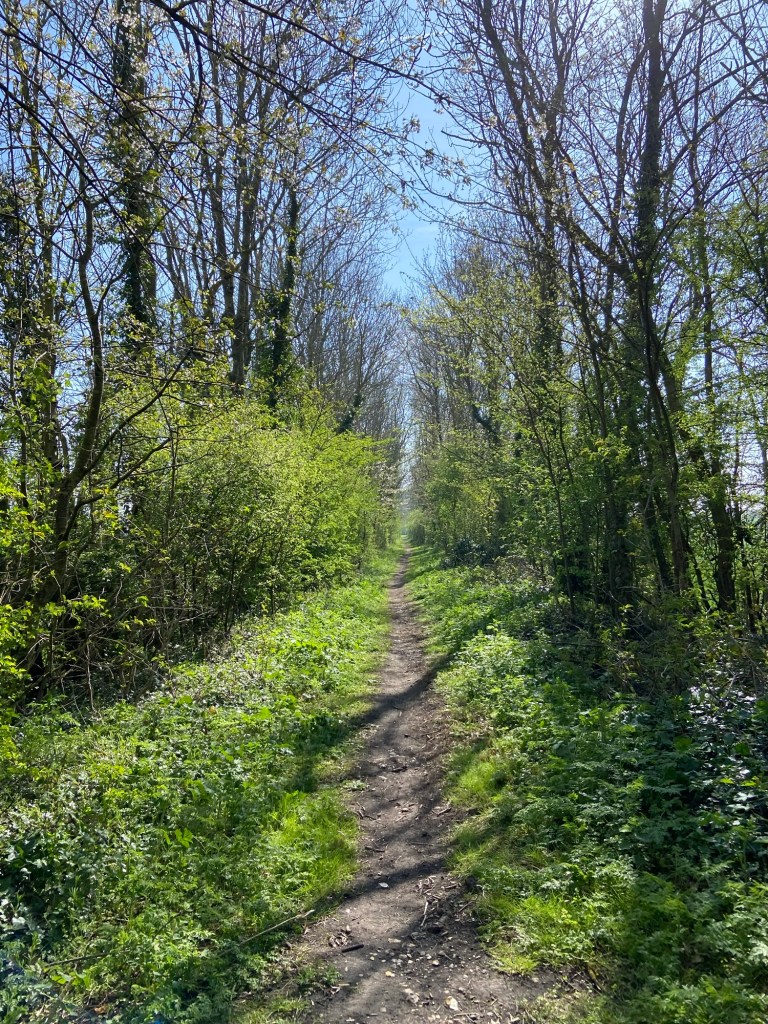
After two and a half hours on the road I climbed a set of wooden steps onto a causeway, the Sentier des Osiers, the Willow Path (although I didn’t see any willows along it). At first marshy woodland stretched away on either side, but then the fields rose to meet the path, which became two thin lines of trees, mostly sickly looking ashes, sadly, which nonetheless provided me with good shade from the sun on what was shaping up to being a still, hot day.
Later when I got out into the huge fields again, I found myself threading across the landscape punctuated by spread-out wind turbines turning so glacially slowly I cannot imagine they would’ve been generating much energy today. Solar panels will have been a better bet.
The weather app claimed it was 14°. Fat lie! It felt more like 23. I kept well hydrated, but I was looking for a place to sit down in the shade by 12:40, but there were not a lot of suitable places in the vast, open arable landscape. Everything was dead flat.

While I trudge on looking for a place to take my rucksack off and sit a while, a word about signage. Sometimes there are little Via Francigena signposts a little like the UK footpath signs, but because the Via has been designated a national long distance path (think Pennine Way, for example), I am mainly following the signage for a Grande Randonnée route. The signs to look out for the GR routes are white and red. Sometimes they are stickers on metal surfaces like road signs, sometimes someone has been effortfully out with two pots of paint and two brushes, painting marks on walls, trees, wooden posts and poles, even the roadway, in the case of the Via Francigena, GR145, all along the thousand kilometres of the route. There are three possible signs:
Go straight on (with frequent reminder signs that you are still on the right route)
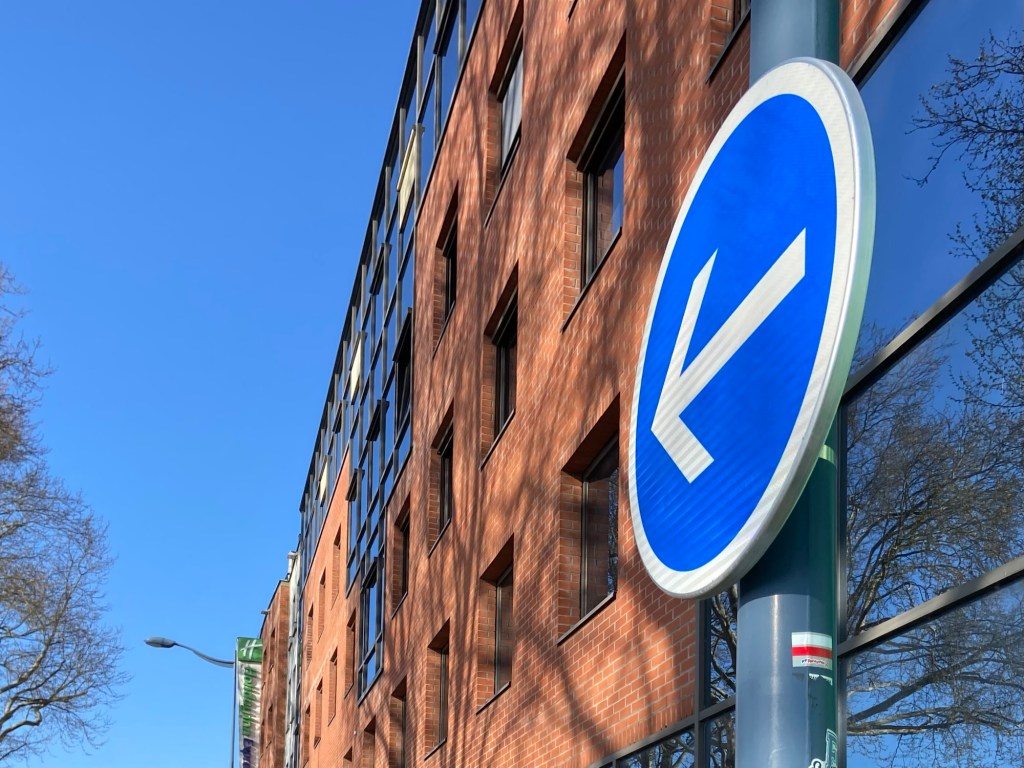
Turn left or right (the sign becomes a little flag shape to indicate which)
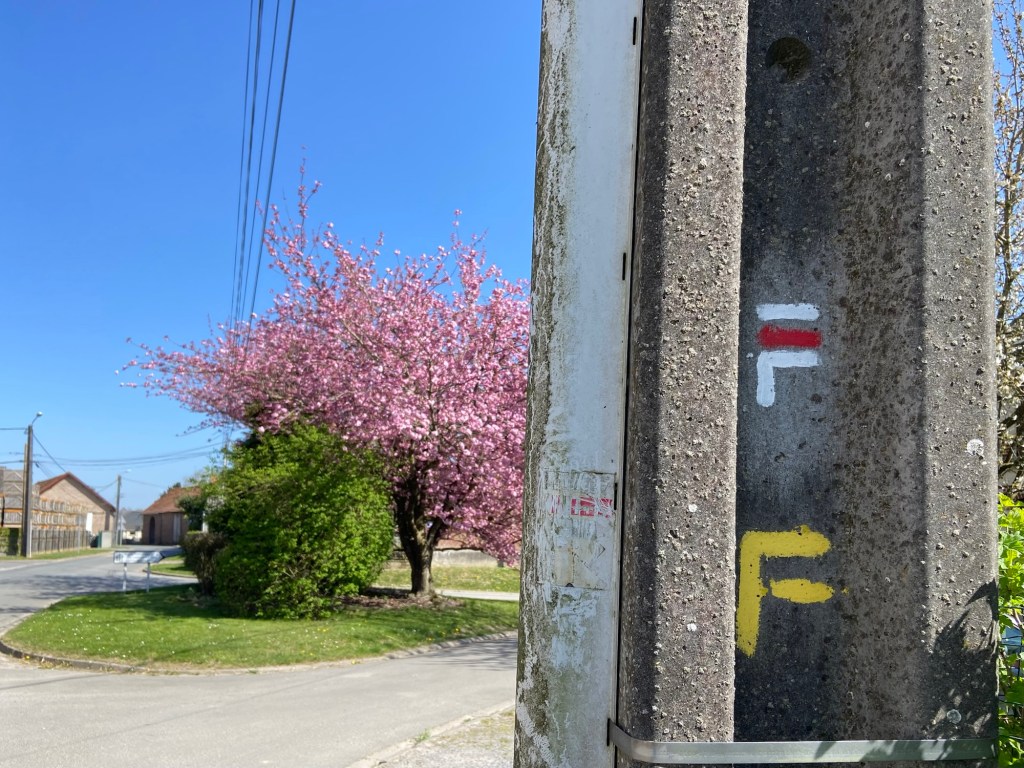
and a ‘don’t go this way’ sign.
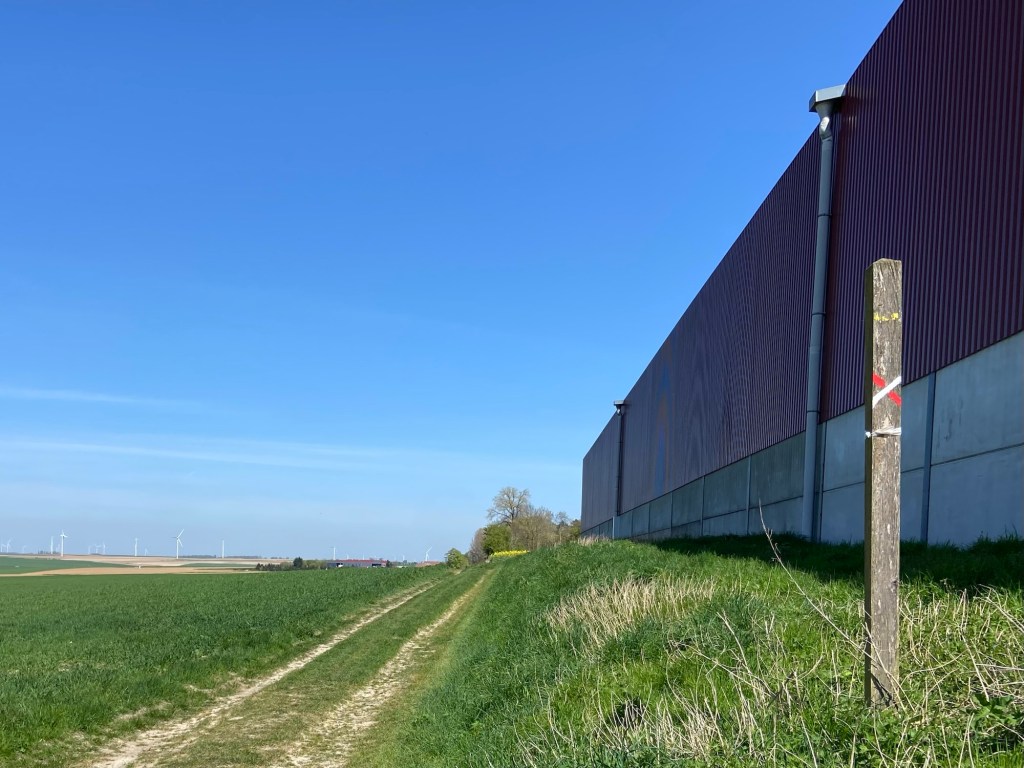
At a crossroads there will be four signs somewhere: two ‘don’t go this way’ signs, one straight on or turn sign, and a confirmatory ‘go straight’ sign. I remember reading about it on a website about walking in France and thinking it sounded incredibly complicated. It isn’t: it is incredibly simple and utterly comprehensively rolled out system. It’s the best walking signage I’ve ever had to use.
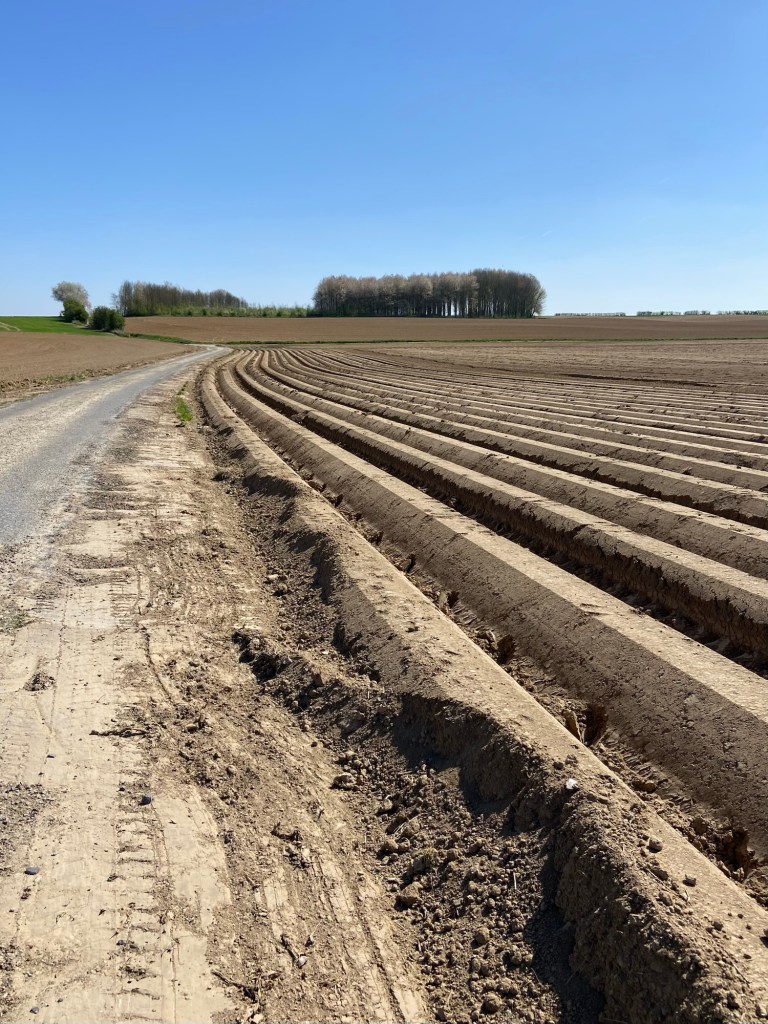
That little educational interlude has brought us up to where the potato farmers were working. Near to me, two tractors were creating the ridges and furrows and planting at the same time, and I didn’t need any expert to tell me about it because I could see how it was done. The tractors worked in parallel, each creating a set of four rows, which left the other tractor enough space to turn perfectly at the rows’ end to go down the other way on the rows’ far side. A tractor turned right in front of me and I kid you not, the driver looked about 16. When he had completed the term properly he put the ridge maker into the ground: blades pulled the soil up, and a sloping-sided N-shaped former packed it into the ridge. A wheel scooted along between each ridge, forming the firm bottom of the trench.

If you ever come walking with me, fear or not that you will remain ignorant of what you are seeing, for I am becoming my own expert by the simple means of good observation. Needs must. I will feel very free to share all of my knowledge with you.
I felt terrifically pleased at my self sufficiency in figuring out how commercial potato planting worked. A little further on the huge hose reel of a hydro jet was plugged into a hydrant next to the path, and steadily pumping steadily half a kilometre away on the other side of the vast field. This felt like a hopeful sign to me, since rain is forecasted overnight tomorrow night and for two or three days next week, so I am presuming that it’s not going to be enough to get the potatoes to sprout.

The first place I found to sit down was after 18km and four and a half hours — the steps of a little ruined chapel just outside the village of Hamelincourt. The ancient door did start to move when I pushed at it, but I think it might’ve come off its hinges and crashed inwards, and I didn’t want to risk it.
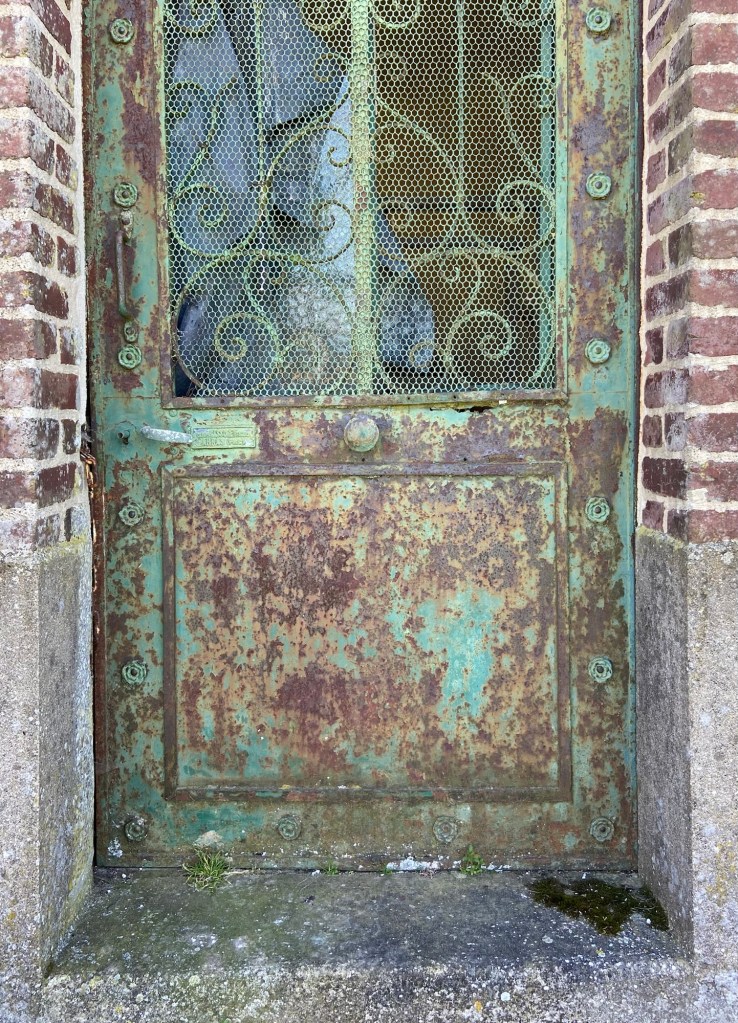
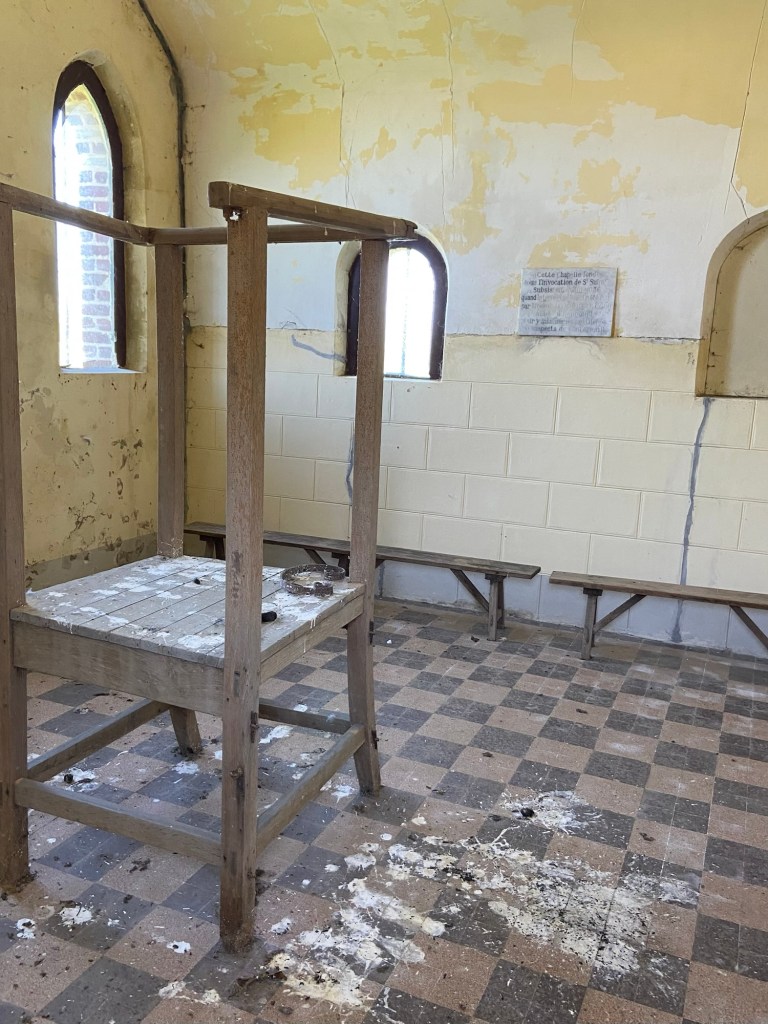
I peered in through one of the windows where the glass was completely missing, and saw that the disused chapel had been used by a large bird of some kind as a perch. I wondered whether it was an owl — although I couldn’t see any pellets on the ground.
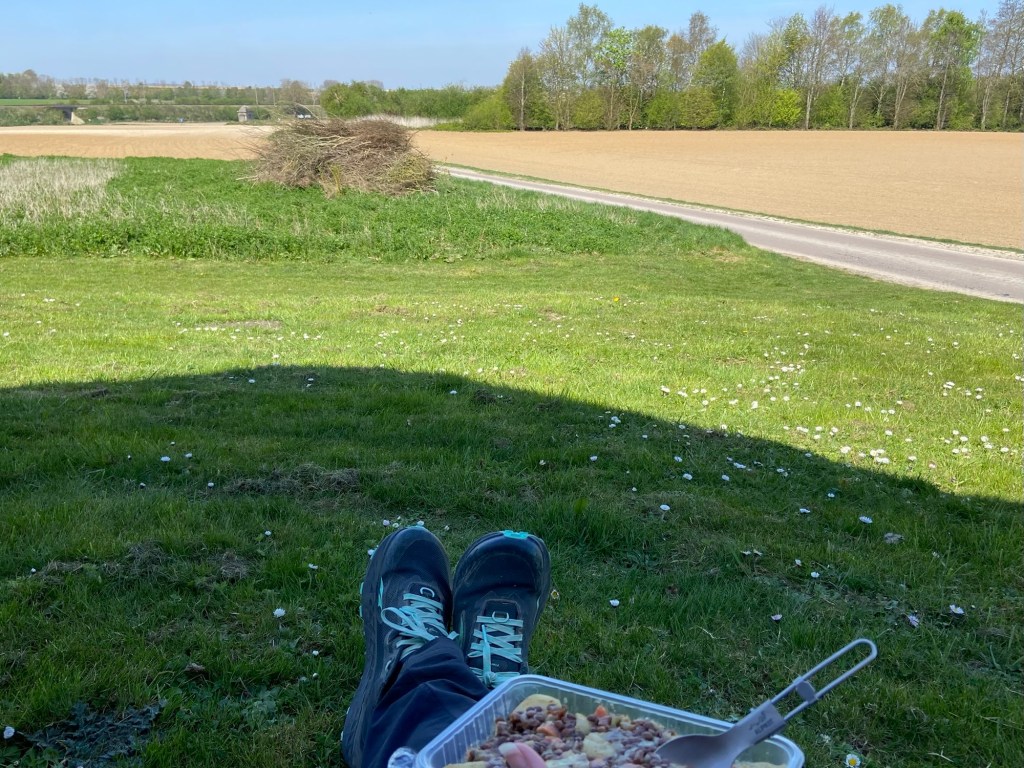
I took my shoes and socks off and sat in the shade until I had cooled down. It was fantastic to be able to wiggle my toes in the air, and lunch was delicious.
A chap walked past with a small rucksack and a sunhat looking very GR145-ish (apart from the cloth shopping bag he had slung over his shoulder). ‘Are you doing the Francigena?’ I called out to him. He came over. He was: he was a Belgian who was just doing five or six days. ‘Although looking at the weather forecast, I might just do three,’ he said, ominously. ‘I did the first two days with my girlfriend, but being on one’s own also has its advantages.’ I had absolutely no idea what he meant by that, and didn’t ask. He commented on the lack of coffee on the route and the expense of coffee in Switzerland. ‘It costs 5 euros. Of course I could pay even 10,’ he added, carelessly. When I explained I was doing the whole route in two chunks because of the 90-day restriction he laughed scornfully as though this was my just desserts. Safe to say when he went on, I left a good bit of time between setting off myself so as not to risk catching him up. I used the time profitably to do some stretching. My back was aching a little bit. Perhaps the extra weight in my rucksack, or perhaps I need to pack the weight differently. There is no expert to ask so I will have to work it out for myself.
But it certainly felt lighter having eaten part of the weight in the form of my lunch. And my feet felt fantastic when I put the socks and shoes back on. I thought (although I was wrong) that only had another 8 km to go now, and three of those took me to the other side of Gomiecourt (‘no services’), a sleepy little village on the outskirts of which was a large dairy farm. I went and had a look at the cows. They didn’t look quite so happy as they lot we had seen back on our lovely day — this seemed a very mechanised operation, perhaps one of those systems where the cows wander over and get milked when they feel like it. I don’t know. There seemed to be very little for the cows to eat, and a lot of them were lying down in the individual metal-railed stalls on the concrete.
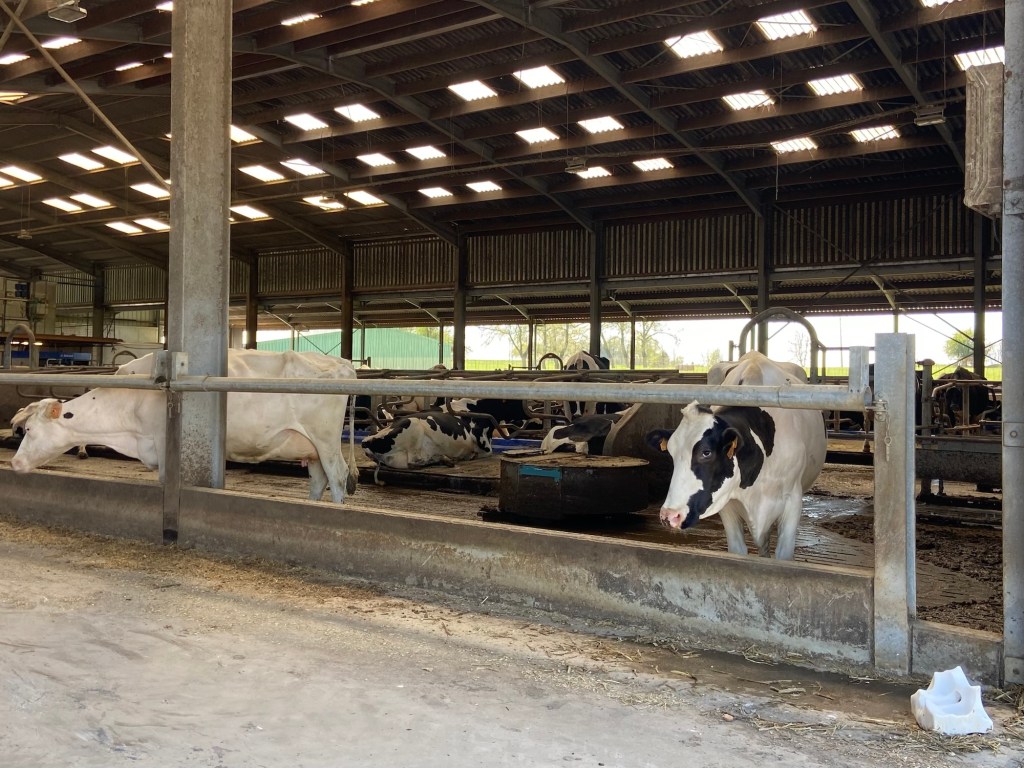
What the farm did have going for it, though, was an ingenious automatic slurry scraper like an industrial version of a Roomba going up and down of its own accord sweeping the various effluents into a gully which funnelled it all out into a giant tank outside. But I dunno. Overall I didn’t like the atmosphere there.
In Gomiécourt someone had gone overboard planting plane trees in front of the Mairie, but the upkeep was meticulous — they’d been pollarded to within an inch of their lives.

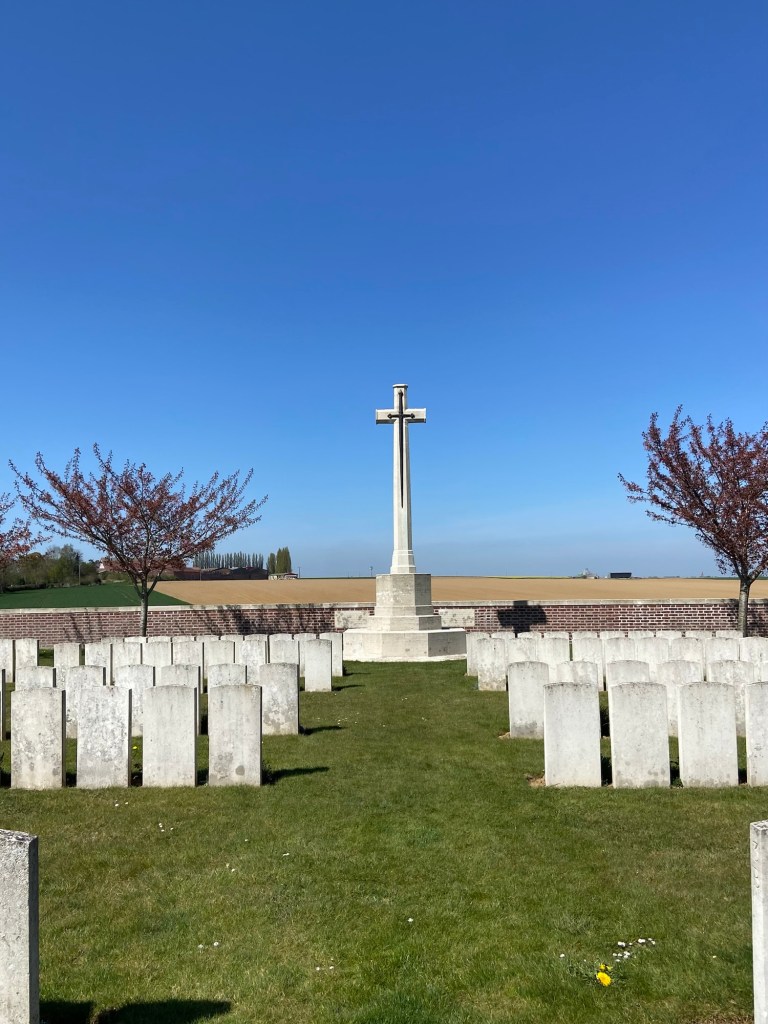
Like a kind of faraway visual echo — perhaps in the back of the minds of the people who had planted the trees in the village square — was the out of-town cemetery, the headstones this time facing away from the visitor towards the by-now-familiar white stone cross with its shape traced by a bronze sword. The gate here was quite fiddly to open, so I paid my respects outside.
More visual echoes were created by the potato fields sweeping me on, here with not even a hint of a verge to separate me from the mounded earth
and the white gravel road, going on and on into the distance.
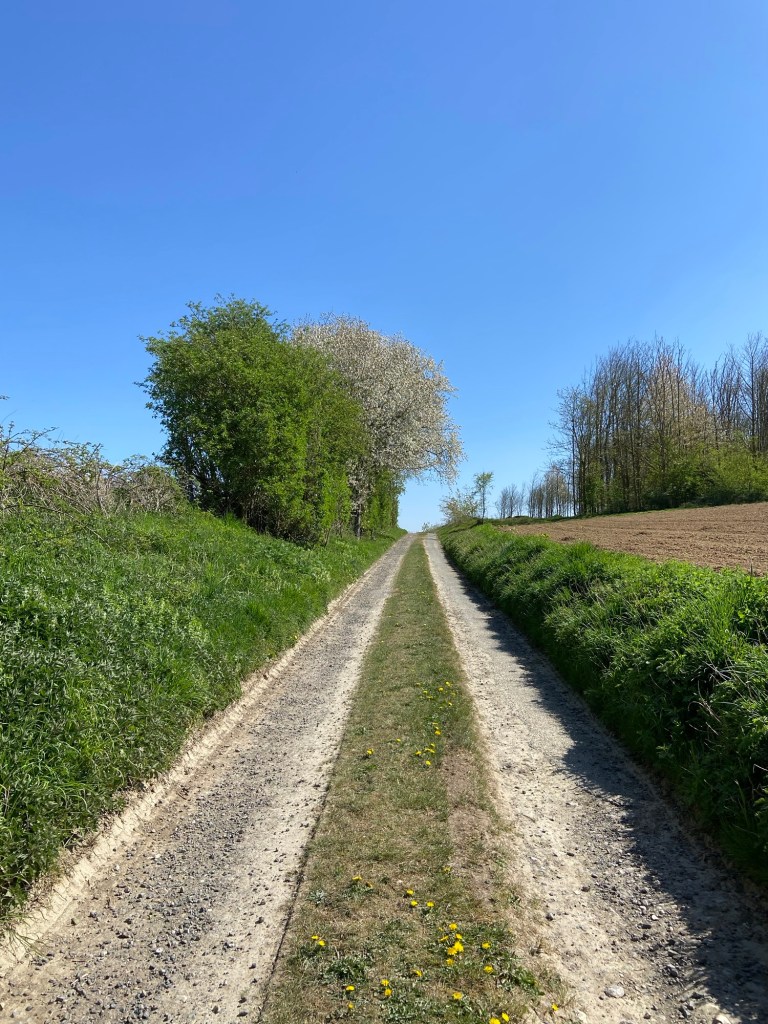
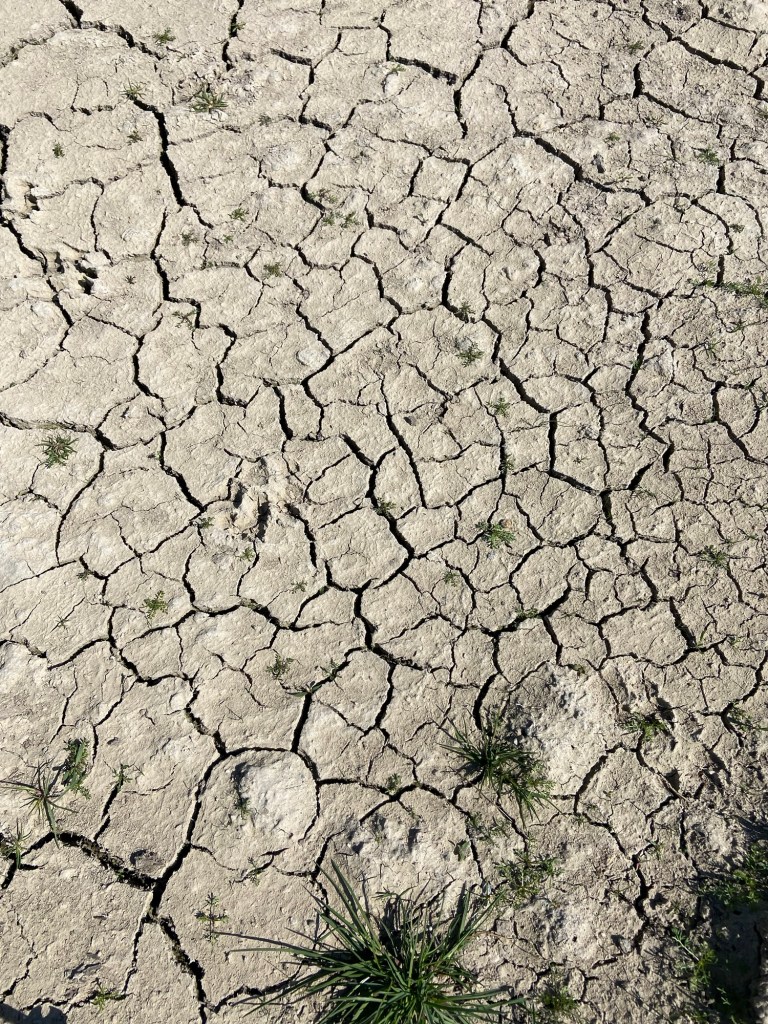
Pretty much all day these field roads have been grassy in the middle, so I was able to walk on the slightly soft surface. It is very clear though that there has not been any rain for a good long time, and I could feel the dry grass crisp and crunchy under my shoes.
If I hadn’t been able to see it, I would’ve been able to smell the next farm coming up: the really quite lovely smell of fermenting grass in a vast silage clamp covered with black plastic and old tyres to hold it all in place. Silage — like kefir, only for cows. The path took me through the pristine farmyard, and I peered into the vast barns with their precision-engineered stacks of straw bales.
As I was passing the industrial-scale barns where the cows were placidly eating, so much cleaner and seemingly happier than the dairy farm down the road, I took the opportunity to ask the farmer questions that I could not ask my faraway cattle expert. The herd is an absolutely beautiful breed called ‘Parthenaise’, unknown to me although apparently it’s quite popular in the UK and Ireland. The cows had the same lovely white hair around their muzzle and dark, dark eyes that the Jersey cows have.
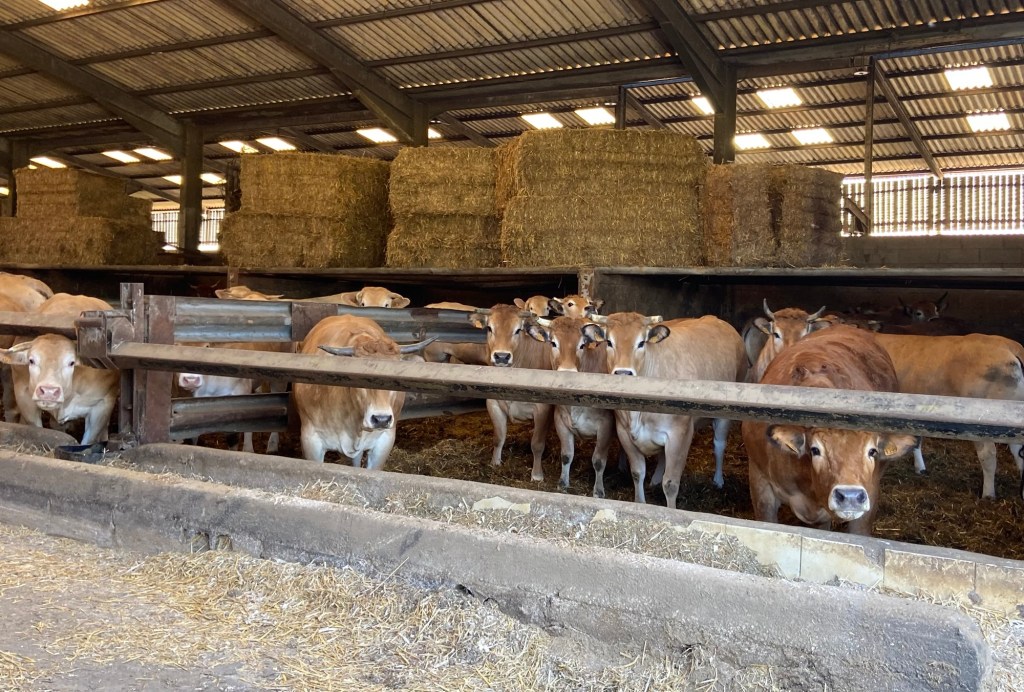
But these were not graceful Jerseys. Oh no. These were body builders: beef cows. Jean-Pierre keeps 2500 of the creatures! They are a ‘double muscled’ breed, which produces lean meat. Parthenaise are known for being placid (my kind of cows) — and these ones certainly looked extremely contented. I told him about my experiences of having to walk through fields in England with cattle in, that sometimes the cows are a bit aggressive. His Parthenaise in contrast were totally Zen. Sometimes hunters come into the farmyard shooting pigeons, he said, but the cows don’t pay any attention. Most of this conversation happened with me speaking English, because my French seems to have deserted me. Oh dear.

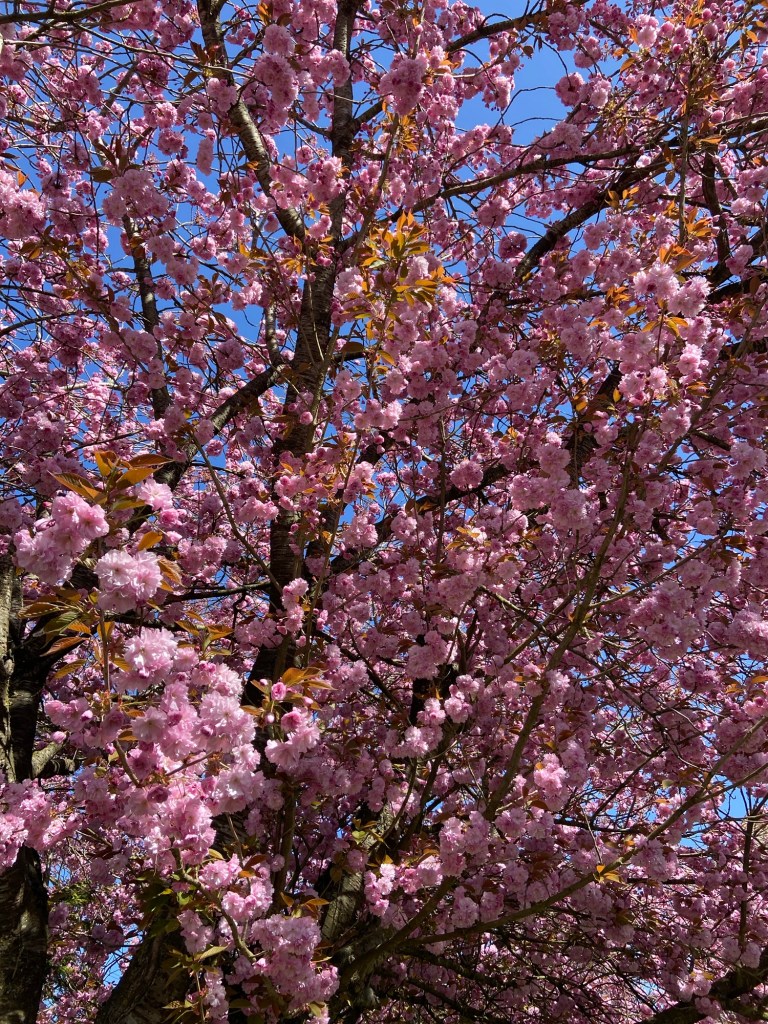
There was a German cemetery in the next town, but although the signpost indicated it was in the direction I was going, I never actually saw it. Perhaps my attention was entirely taken up by the most glorious cherry tree in full blossom.
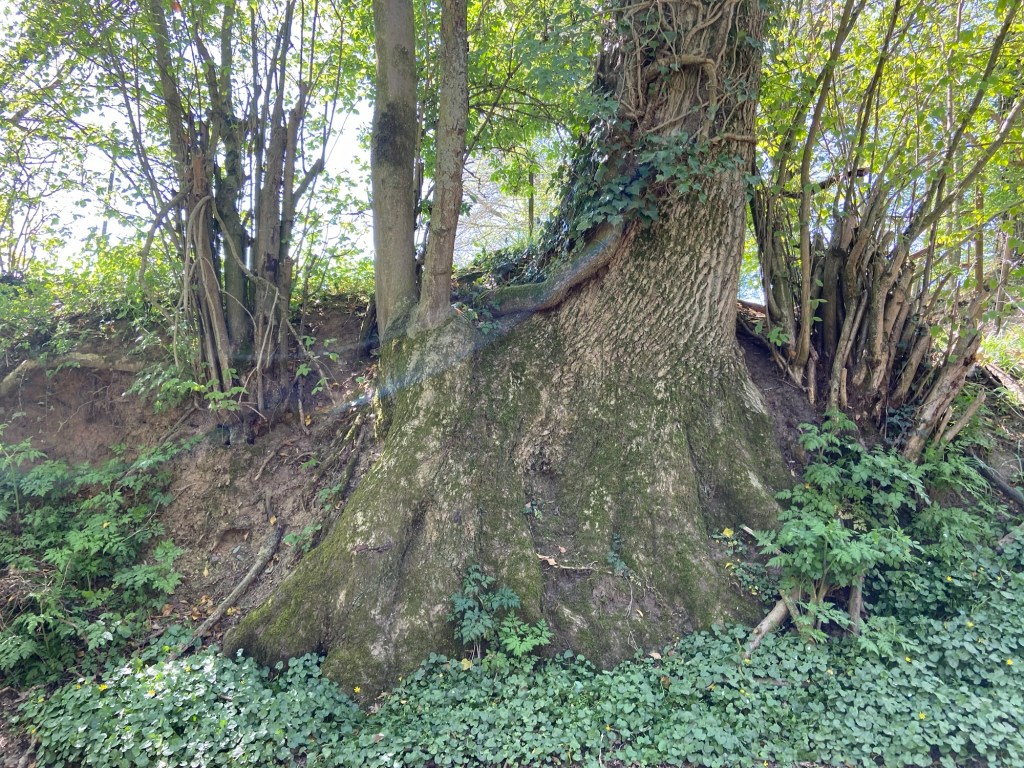
Respite from the sun beating down on the hard dusty ground was briefly provided by a sunken lane,
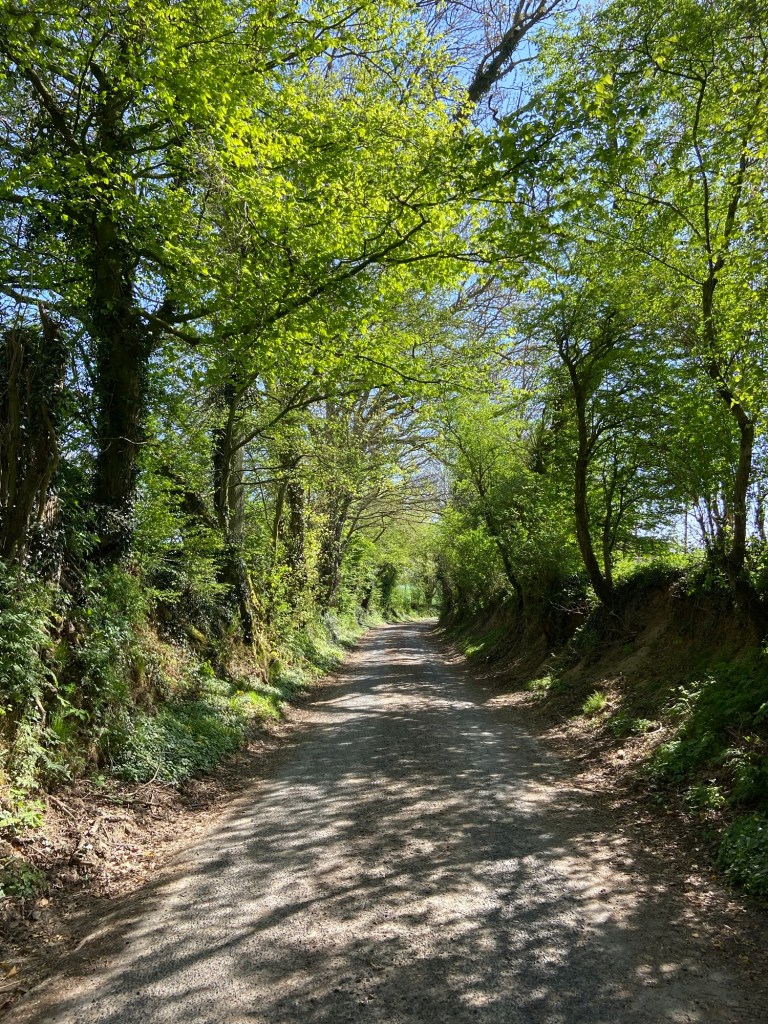
and it was respite also from the monotony of the sweeping, empty arable vistas. Here there were trees whose roots had spread out to create a wide plate to support the tree as it clung to the side of the bank,
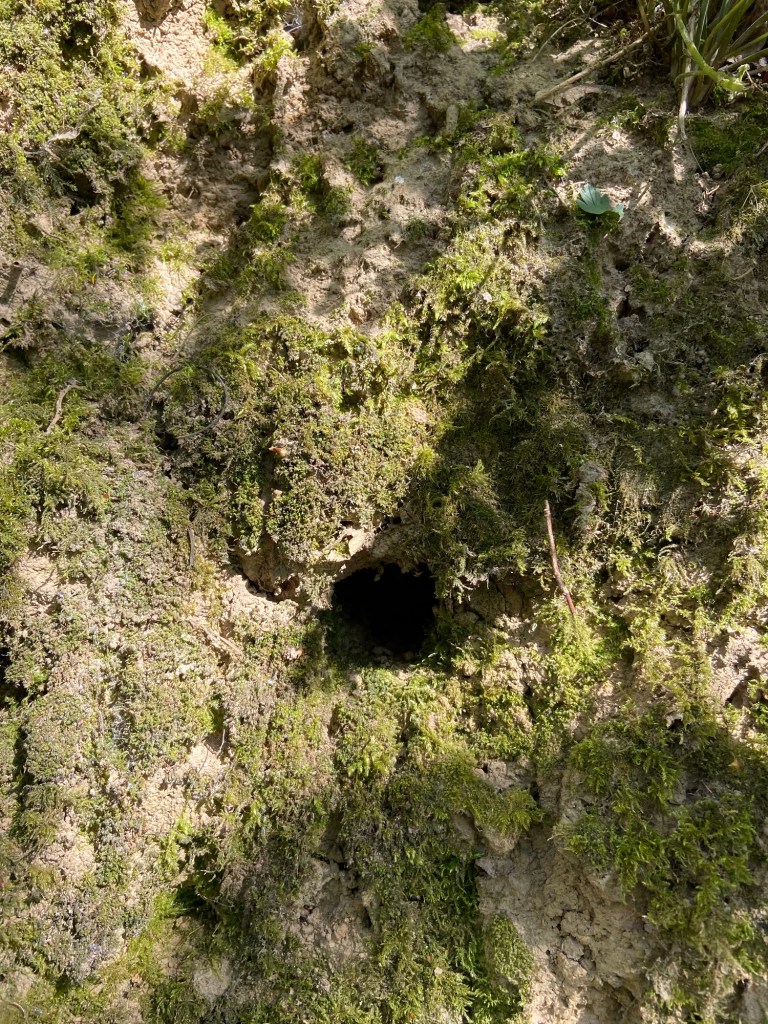
and on the opposite bank there were interesting holes where something lived.
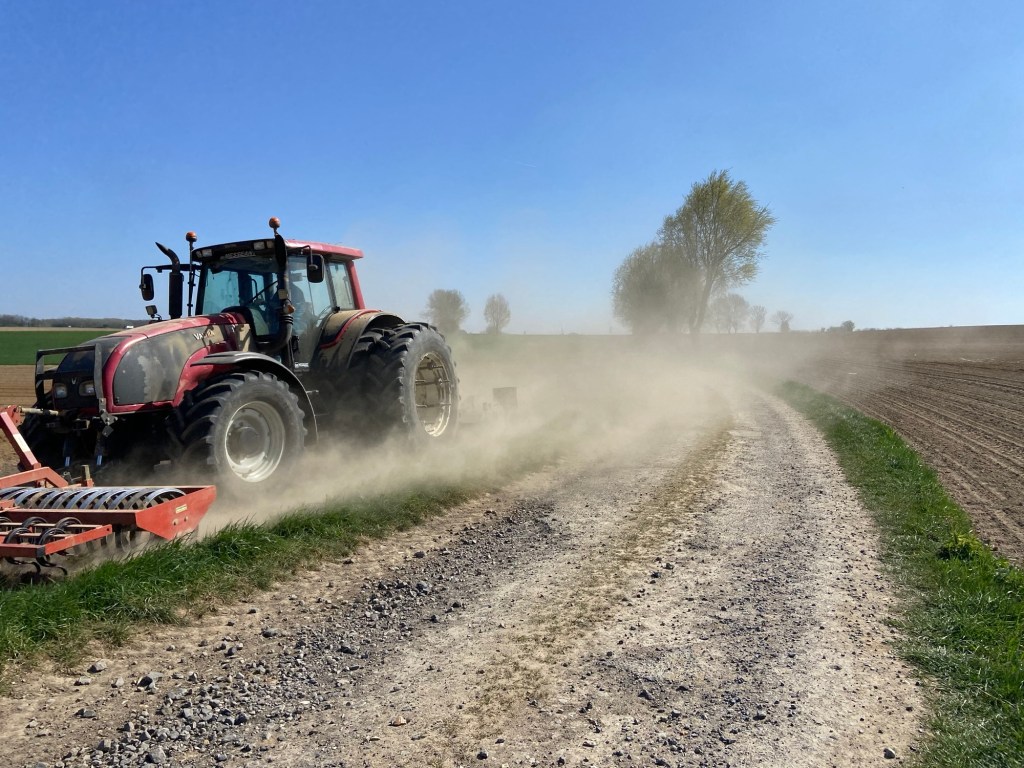
But mostly, I was walking through the heat and the dust in the endless fields. I nearly got engulfed in the dust cloud raised by a tractor working the edge of the field as I walked by. Fortunately and very chivalrously, the driver stopped to let me pass, but I was covered to head to toe in fine gritty dust nonetheless.
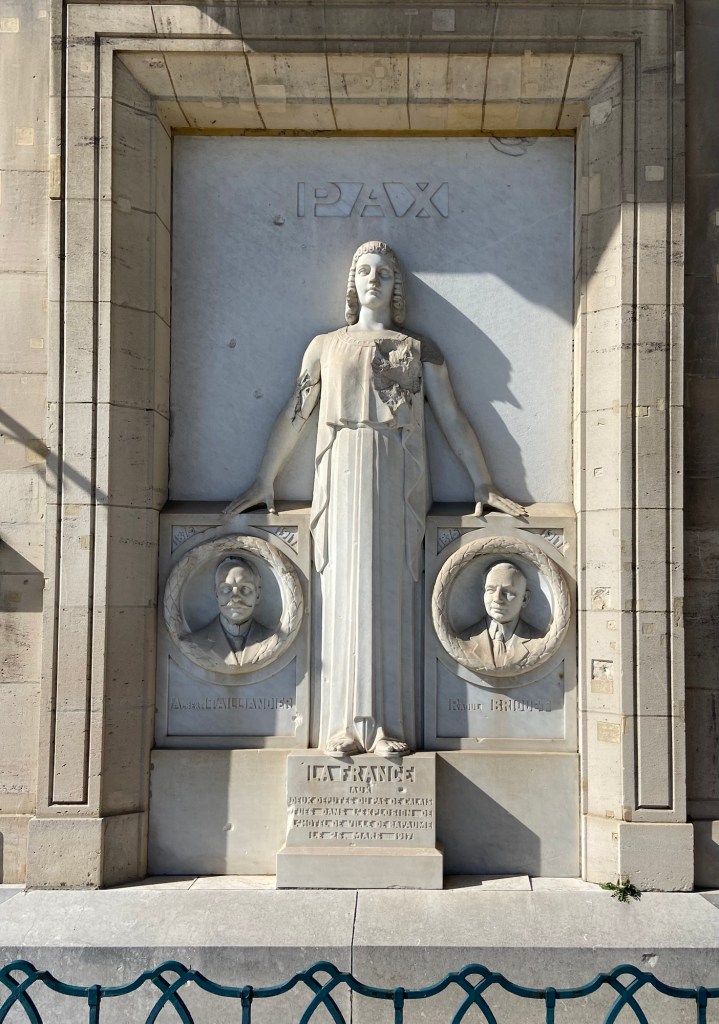
I was pretty much now on the outskirts of what I thought was Bapaume, but which turned out to be a neighbouring village, attached to it, and I still had a demotivating 2 km still to go. But just putting one foot in front of the other is enough to get you there eventually, and so it proved. I stopped off at the Mairie to collect my pilgrim stamp. Bapaume like many towns in this region played a key part in various battles from the Franco-Prussian wars onwards, to which struggles there were many monuments in the main square. It seemed that each monument had been successively damaged by the bombardments of the next — or perhaps they had all been damaged by the booby-trap device that had been left when the Germans abandoned the town, and which killed many, including a large number of Australian troops.
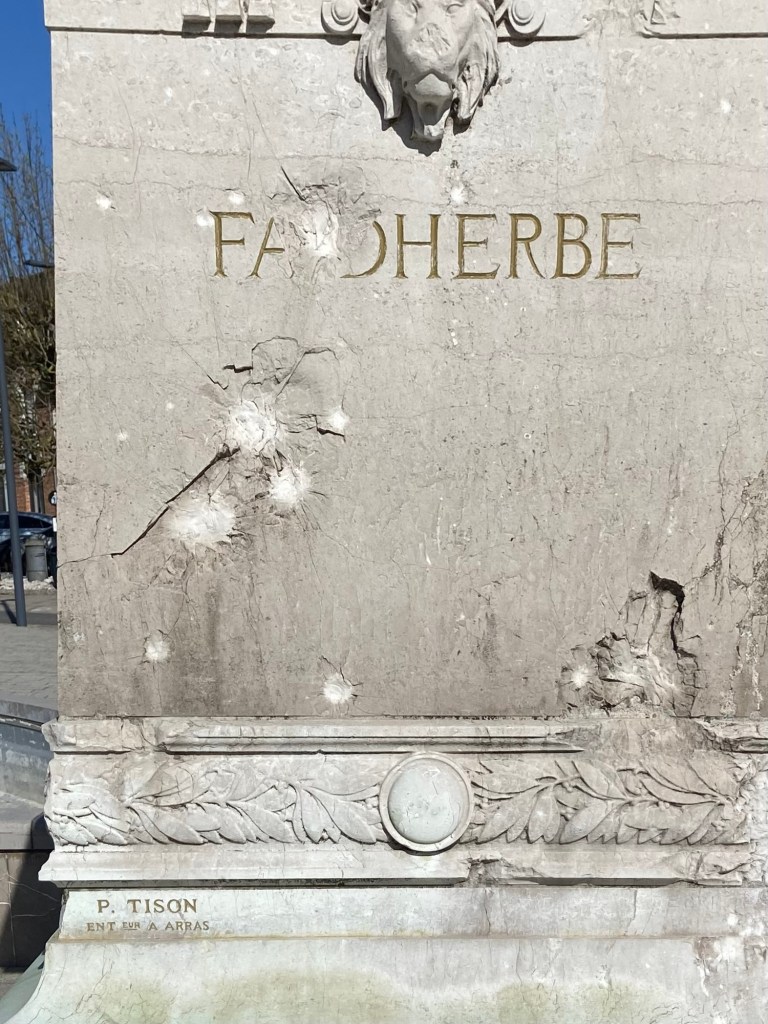
The irony that the monument to Peace had taken such a grievous wound to her chest did not pass me by. But I passed her by, and eventually found my hotel at the bottom of the town: the Hôtel de La Paix.
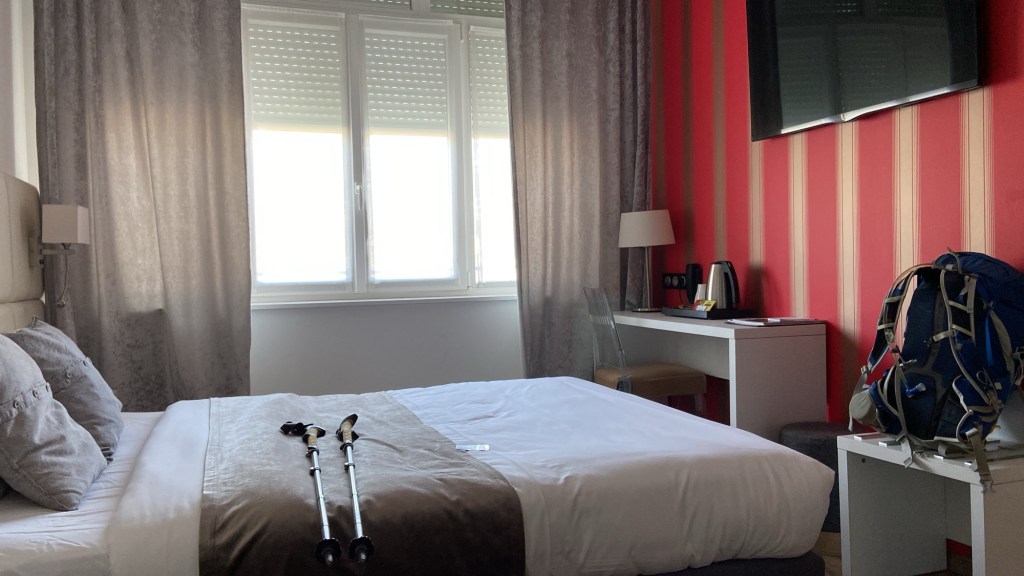
I pretty much staggered in, hot, covered in dust, but very proud that I had managed 28 km on my own. A shower looked good right now.
Stats for the Day
Distance 28.14km
Time: 5:51, 7:31 with rest breaks
Speed: a pretty amazing average 4.8km/h. No wonder I was tired when I got in.
Read about my fundraiser here!
🌱 🪴 🌴 🦥 🌎 💚
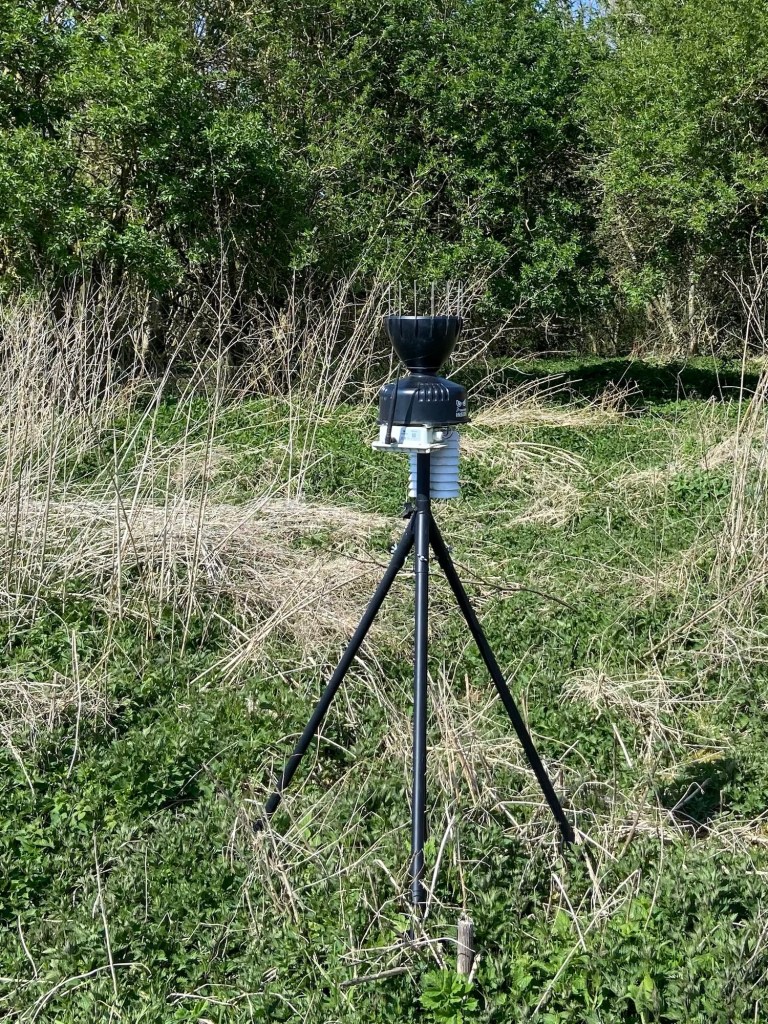
Bonus incomprehensible agricultural equipment
 Walking The Landscape
Oh Sophie, well done! That was a good distance for your first solo Via walk! Thank you for the photos and interesting information which make my day. (I think the probe droid is a portable weather station?)
LikeLiked by 1 person
My meteorological expert!
LikeLike
It sounds like you had a big day! I’m not surprised you needed a rest! Matt G ☺️
LikeLiked by 1 person