
John Muir
Come to the woods, for here is rest. There is no repose like that of the green deep woods. Sleep in forgetfulness of all ill.
Annie was so kind and sweet and made us a lovely 4-course dinner (it would have been 5 but we persuaded her not to heat up the soup!) with lots of wine and cheese , and a great breakfast this morning. So generous and thoughtful.
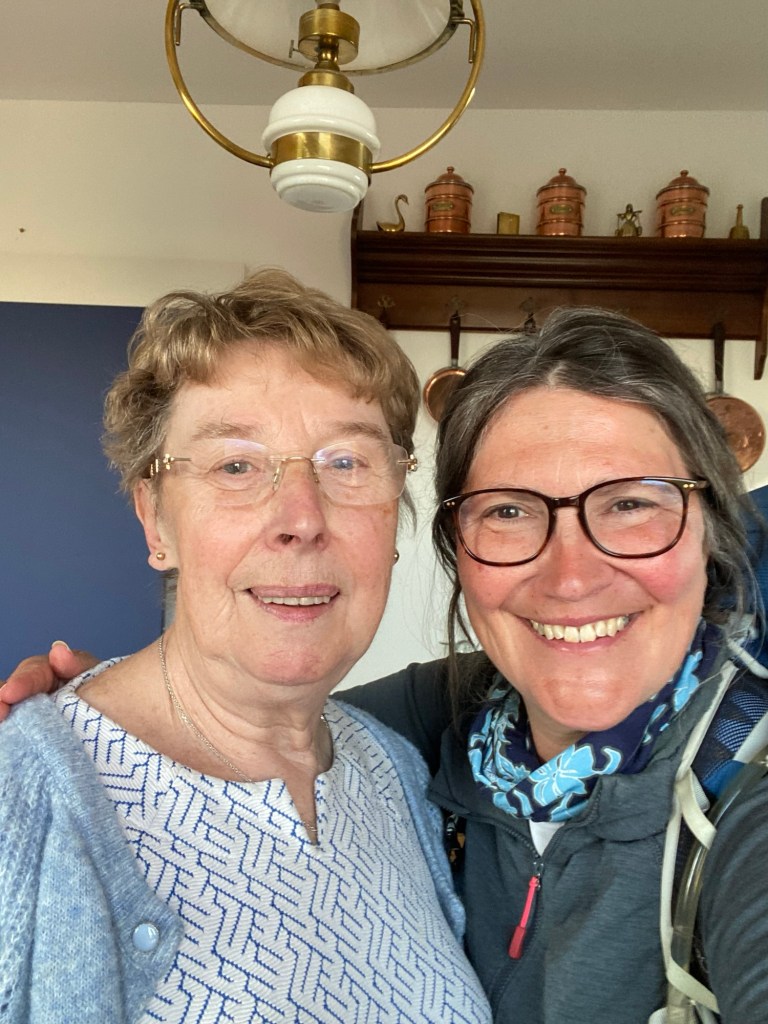
We set off a little earlier than usual, around 8.30, because today was to be the longest day yet, with a fair amount of climb to slopes us down. We had added to today’s kilometres because Annie lived on the near side of a town the guidebook describes as ‘octopus-shaped’ and we had to walk down into the valleys made by its arms to pass through.
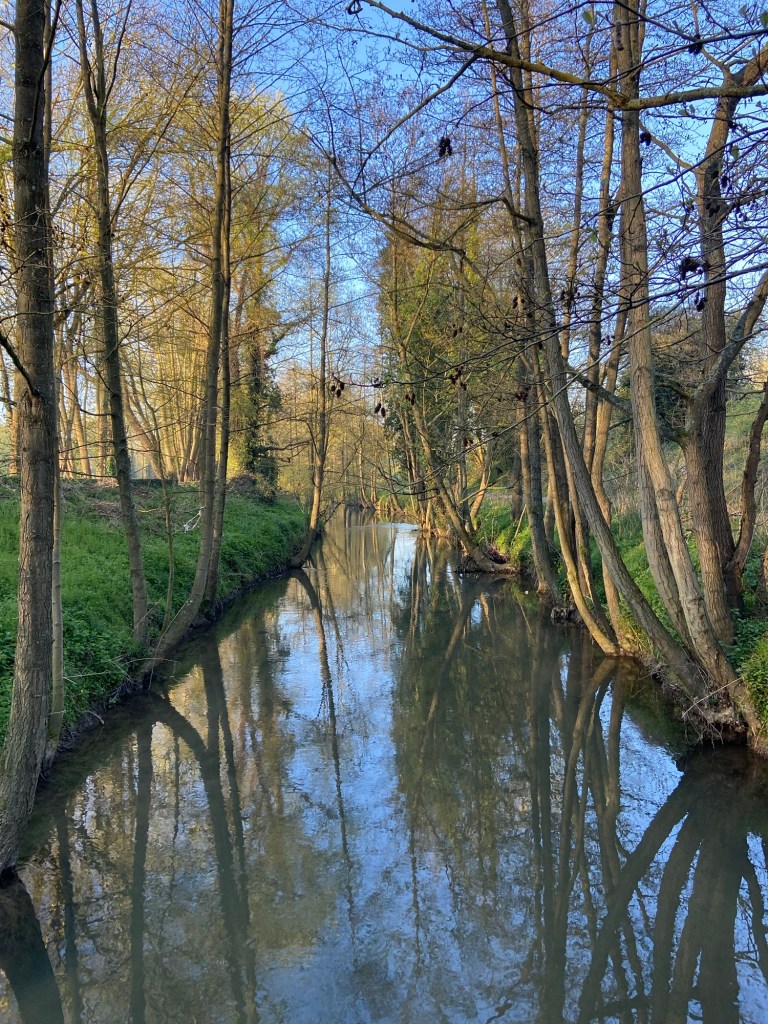
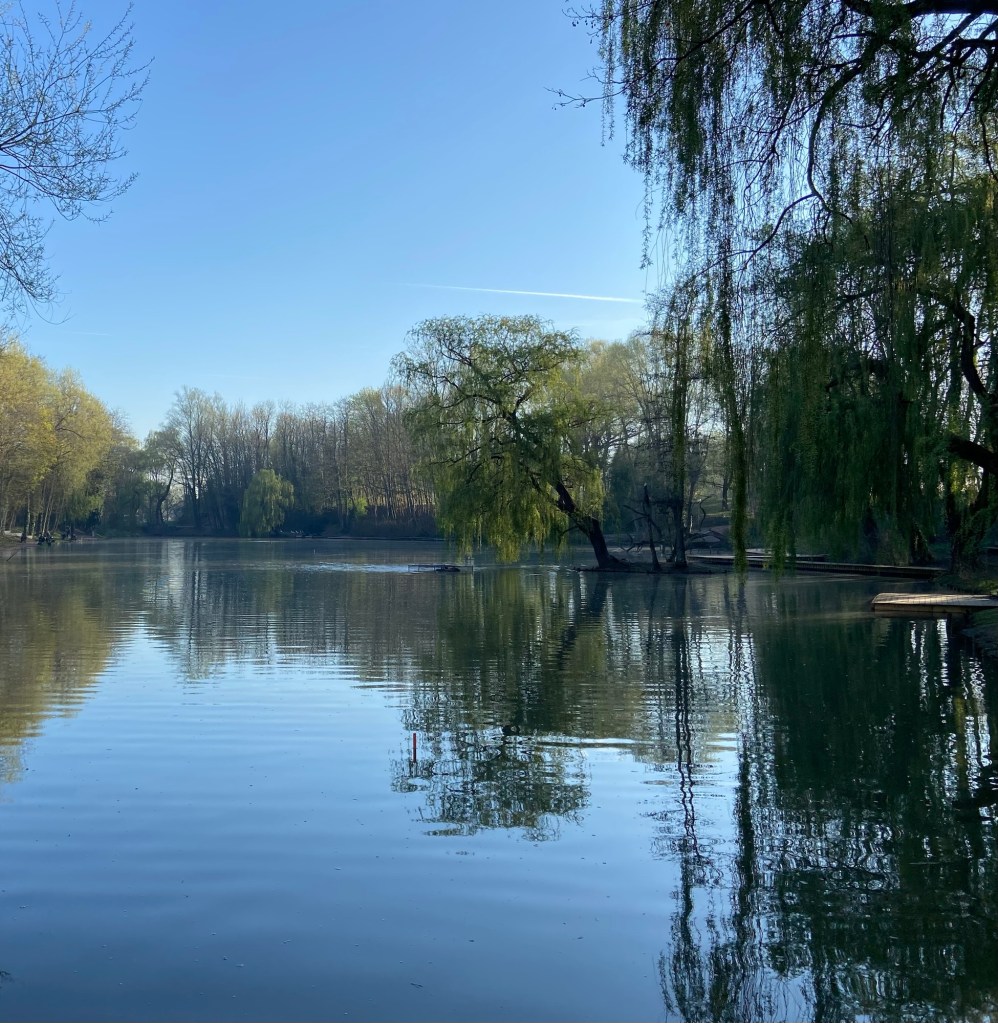
The early-morning reflections on the Lawe river which ran through the valley in the middle of town boded well for the day, as did the willows coming into leaf around the fishing lake that had been created beside it. Fishermen were already setting up for the day on its banks.
Last night Stephen had made a real connection with Annie over the world of international competitive cycling. Despite Annie not speaking much English and Stephen speaking in words rather than sentences, they had an amazing conversation about their favourite cyclists, the ones they fancy most for the various Tours, and found a corresponding enthusiasm for the Paris-Roubaix cycling race which is to be held this Sunday. The 129-yr old race from Paris to the border with Belgium, one of the oldest cycling races in the world, is known as the ‘Hell of the North’. Not beause it is hard, but because, as it was reported at the time, when the race organisers went to cycle the route in 1919 to see whether there was even a route left after the Great War, ‘as they neared the north, the air began to reek of broken drains, raw sewage and the stench of rotting cattle. Trees which had begun to look forward to spring became instead blackened, ragged stumps, their twisted branches pushed to the sky like the crippled arms of a dying man. Everywhere was mud.’
Henri Pélissier, winner of the race that year, said that it wasn’t so much a race as a ‘pilgrimage’, and today our own pilgrimage route was to leave mining country and enter a landscape now of forests and fertile fields, but that had been, just over a century ago, the battlefields of World War I’s Western Front, a post apocalyptic treeless landscape of bomb craters, destruction and death. We were to finish the day at Ablaine-Saint-Nazaire, not far at all from Vimy Ridge.
I have always avoided the subject of history, or had it avoided for me. Whereas science was brilliantly taught in my all girls secondary school, the social sciences were given one term each in what is now years 7, 8 and 9, and so my secondary education in geography, social sciences and history consisted of three disjointed terms each. And the history syllabus was extraordinary: a term each on prehistory, Romans, and the Regency period! I know this was a severe disappointment to my father whose first degree was in history, and although it is one of those things I could have read up on for myself, I have always found it difficult to read non-fiction, as I am a plot addict.
Additionally, I have always found the subject of war incredibly painful, but there was to be no avoiding it today as our hosts for the night had explicitly told us that at the end of our 27 km walk today we must visit the nearby First World War cemetery before arriving at their home.
It seems all the more important in this time of war on our European doorstep, and general global destabilisation to forge connections, and focus on the things that bind us rather than the differences. Or at least, as the International Baccalaureate mission statement says, recognise that ‘other people, with their differences, can also be right’.
This is something that struck me at the Louvre Abu Dhabi, which has been explicitly curated to explore the common experiential ground of humans across time and space. Not to make everybody the same, but to celebrate both connection and difference.
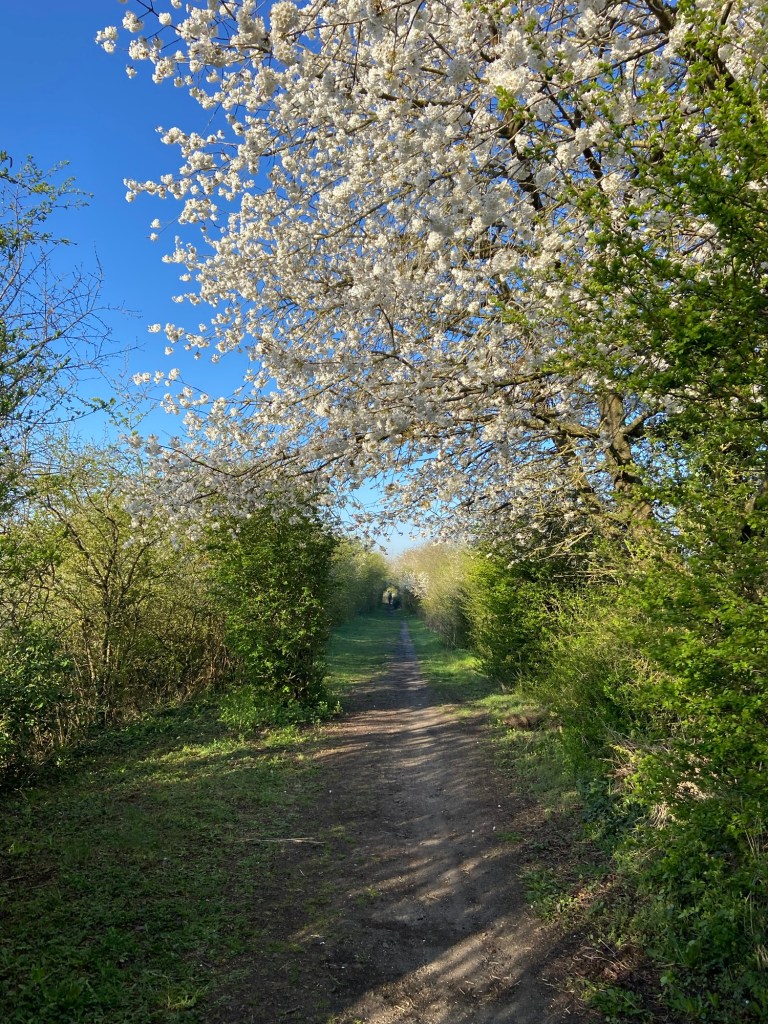
In this spirit we sought to make connections with the people we passed today, thanking the crew maintaining the impeccable green footpath snaking its way on an old railway line around the town of Houdain,
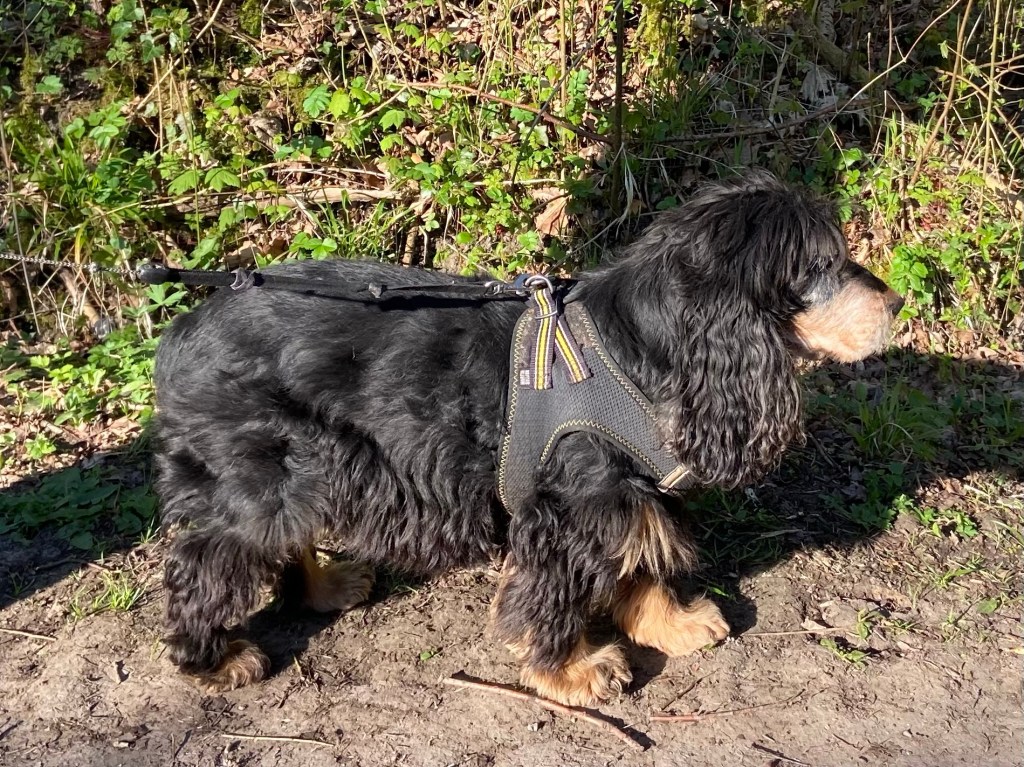
and stopping to chat with a gentleman out walking his very slow, blind spaniel Genevieve, and explain what we are doing.
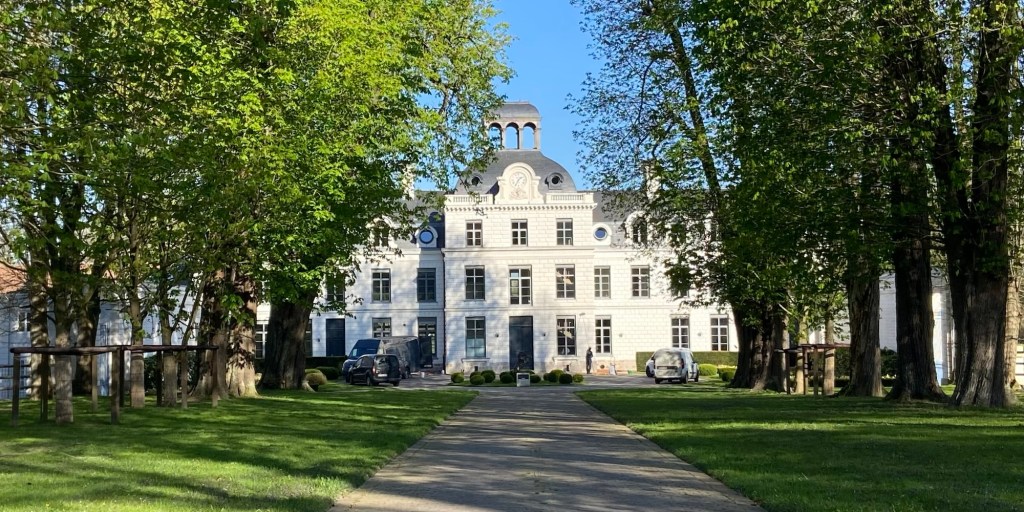
We were excited to get our first view of a really grand château. And as we sneaked around the Rue du Chateau we remarked on the metal doors into the walls, and the broken shards of glass set into the top. We felt that we had liked the first chateau we had seen much better: this one was a lot less friendly.
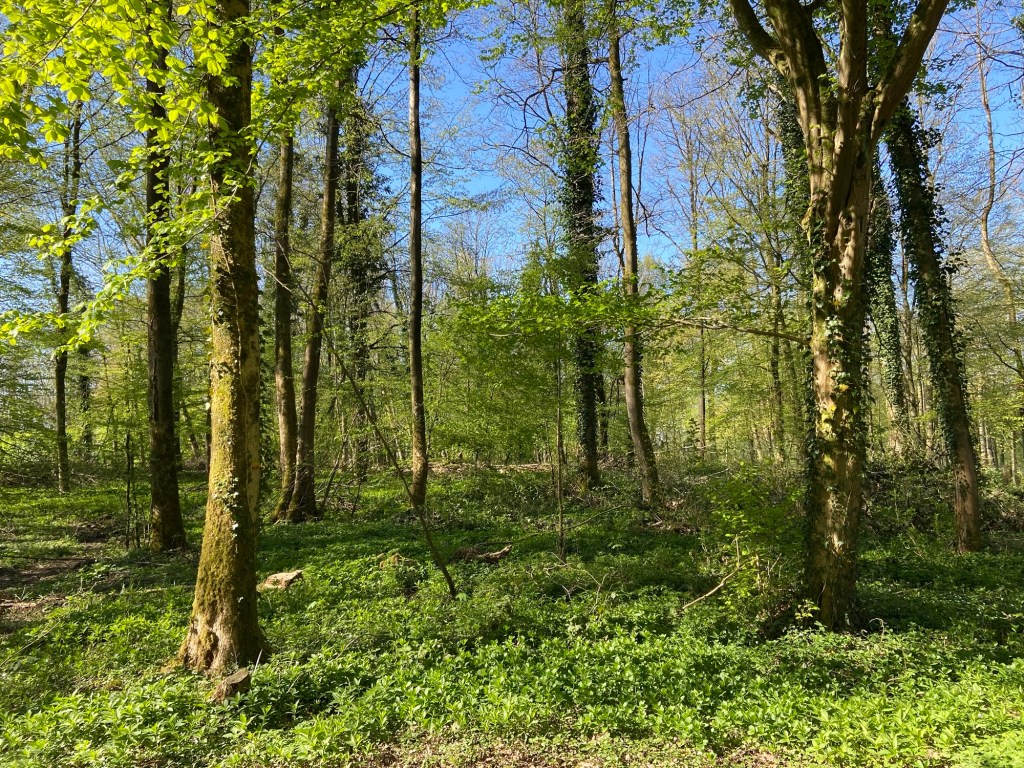
We were glad to see on the map that the next major section of this long day was going to be through a very long wood. We were looking forward to the shade and the dampness, the shelter from the sun and the peace and quiet. Initially, we climbed up through a deeply water-scored chalk path, noticing the large quantity of moss tossed about on the ground by birds looking for nesting material.
In this part we had to duck to get through the close foliage.
Up and up we went and over the top, only to come to a car park with a fair number of coaches in it. A sign which we understood to be introducing the mining basin area sent us uphill again on a wide tarmac road to regain the height we had just lost (the up and down was to be a feature of a day which had 500m of climb in it)
.
With his finally honed teacher ears, Stephen was the first to hear the buzz of voices of innocence up ahead, and soon we saw them: large school parties of little monkeys playing in giant aerial bridges, shrieking and bouncing and having a whale of a time.
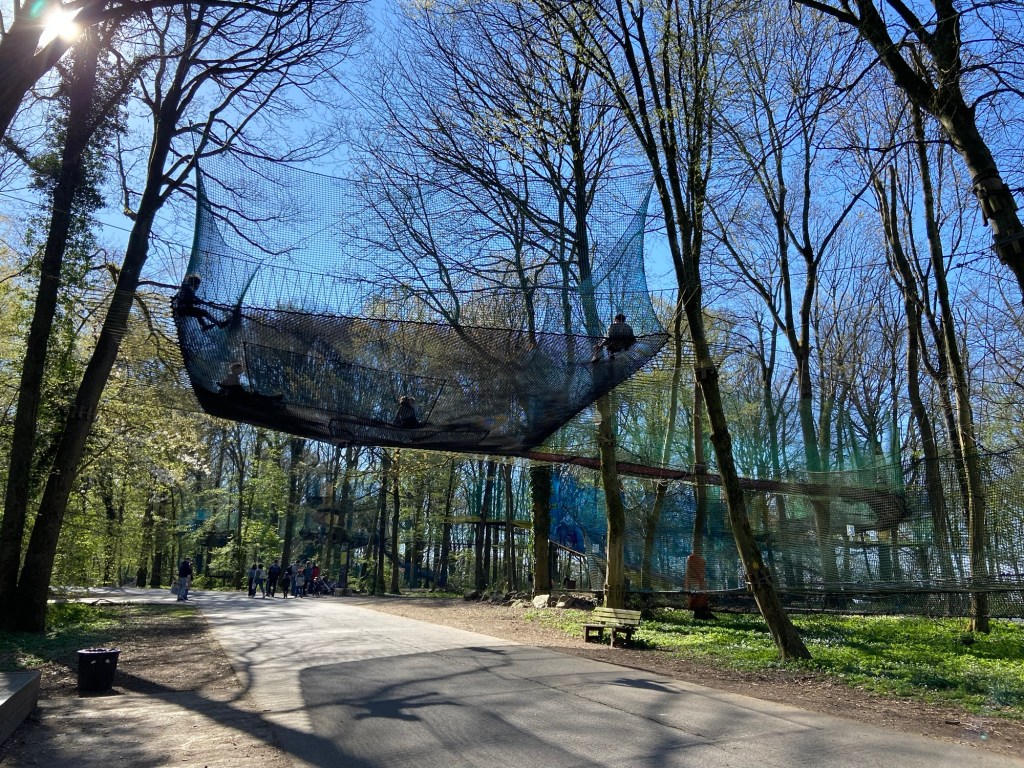
That is a great idea for the end of term, mused the deputy head. Put them all in a string bag and hoist them up in the trees to tire themselves out.
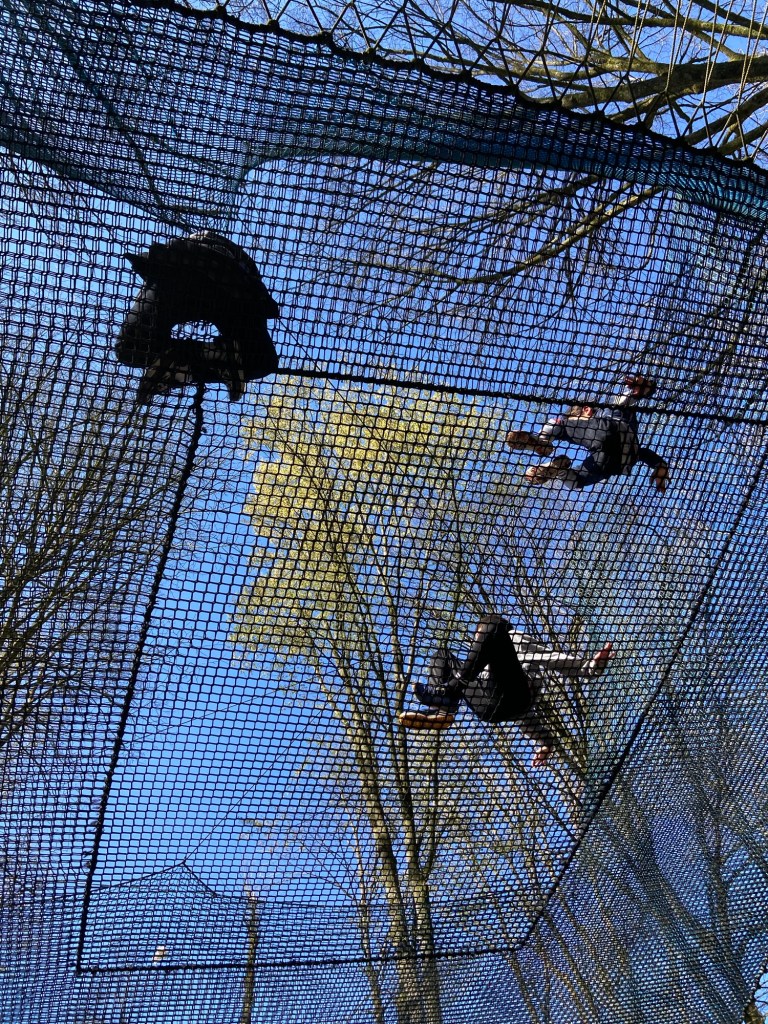
As we went on it soon became clear that actually we were in the middle of a woodland adventure park. Enormous numbers of kids were there with their teachers, up in the trees, building dens, heading off to the swimming pool, or to the high tower with the slide chutes, or playing in the wide open grassy spaces. It was lovely also to see a party of children in wheelchairs too. Not exactly the quiet woodland walk we had been expecting!
But eventually we left them behind and were swallowed up by the woodland paths, now a corridor of birdsong and noticeably greener than they had been even a week ago.
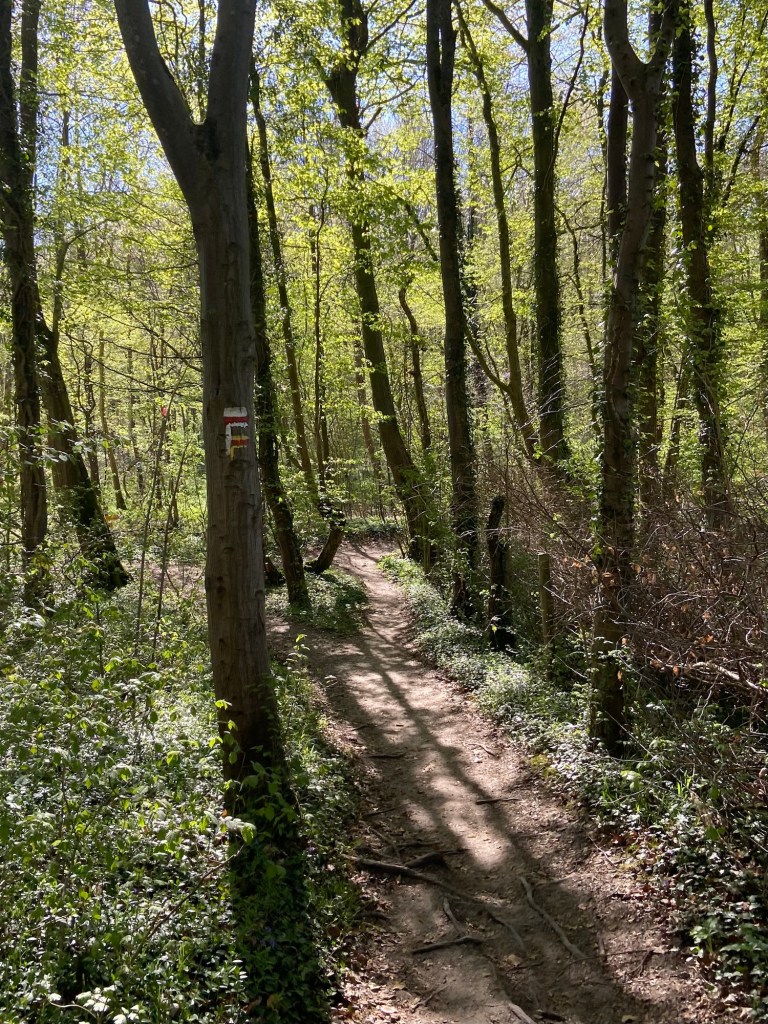
To our right with a manicured lawns of a golf club, and ahead, kilometres of beautiful soft woodland paths. There were cowslips and violets lining the paths, bluebells fully out
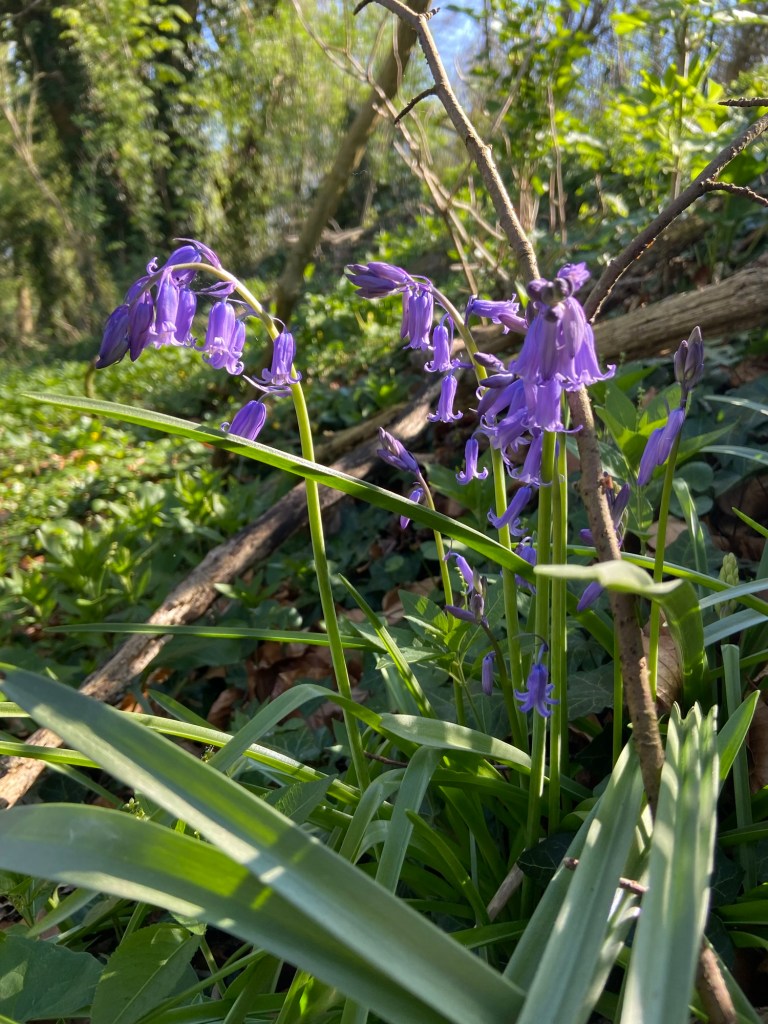
and a good number of really healthy orchids, fat buds still tightly closed. But it won’t be long now.
The wood went on and on, and we mostly walked in silence. The woodland floor was for a long stretch covered entirely with low growing periwinkle, and later on with a starry carpet of millions of wood anemones. Occasionally the path spat us temporarily out into a field, but that just made us appreciate the woodland path even more when we went back in. Each section of wood was different: thin saplings, ancient beaches grown out of hedges, and sometimes a staircase of roots we could use to climb up a steep slope.

It was an absolutely magical interlude, proper forest bathing.
The Via finally exited the wood and it was then that we saw in front of our eyes, an actual miracle. We had been planning to buy lunch at the little town of Houblain, but the green railway line path had taken us right to the far edge of the village, and we would have had to have walked back into it to have find a Boulanger. Since it was such a long day, we thought that we would just carry on with the fag end of salami that Stephen had in his bag, and the two granola bars that I had in mine. There had been a restaurant in the forest adventure place, but it didn’t open for another hour and at that point we felt it was going to be mobbed with hungry children. There was absolutely nothing else on the map between here and Servins, only 7km away from the days end. We had now come just over 16 km in three hours 45 minutes, and although we were going very well, we felt we were going to need to find a place to sit down and devour our meagre rations. But there was a van parked on the roadway. An ice cream van? No! Even better than that. It was a fruit and veg van!
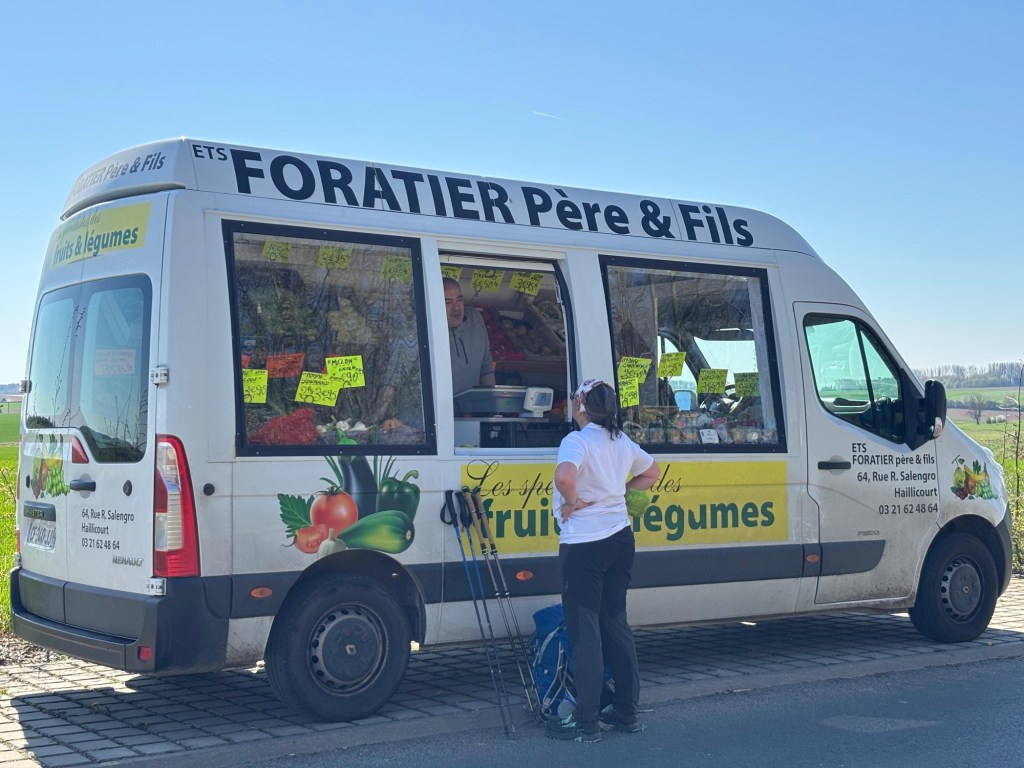
We fell upon it., Absolutely thrilled. It is easy to find food of the bread, cheese and meat variety (except on a Tuesday in Servins) but much harder, actually, to get vegetables and fruit.
Mr. Foratier told us that he was the fifth generation of greengrocers here, and that he remembers his great grandfather putting his fruit and veg into a cart and travelling along the roads with his horse to pull it.

We bought tomatoes, a pepper, an apple and a banana, and we set off across fields which actually weren’t as hot as we had thought they would be, to try and do 20km before lunch.
We found a fantastic spot for lunch: a little cemetery with a beautiful wooden shed with a water tap to wash our vegetables, and a little bench to sit on in the shade. We made it a proper stop of an hour, and I carried on the search for forward accommodation. I now feel confident enough to handle conversations on the phone in French as I have got the vocabulary down. I filled in two gaps in my spreadsheet, including one rather frightenjng one for this coming Friday (frightening because I like to have everything booked for a week in advance to avoid stress). I had to go for a swanky hotel at a cost of €110 for bed and breakfast. I shall make sure to enjoy the palatial bed!
After lunch we had about seven or 8 km to go, and it was just absolutely glorious walking. We’ve had a really proper break of about an hour and there was such a lovely breeze out in the open sections, and beautiful flat walking in the woodland sections. We saw saw a gigantic buck hare bound away from us, and two partridge, similarly nervous of us.
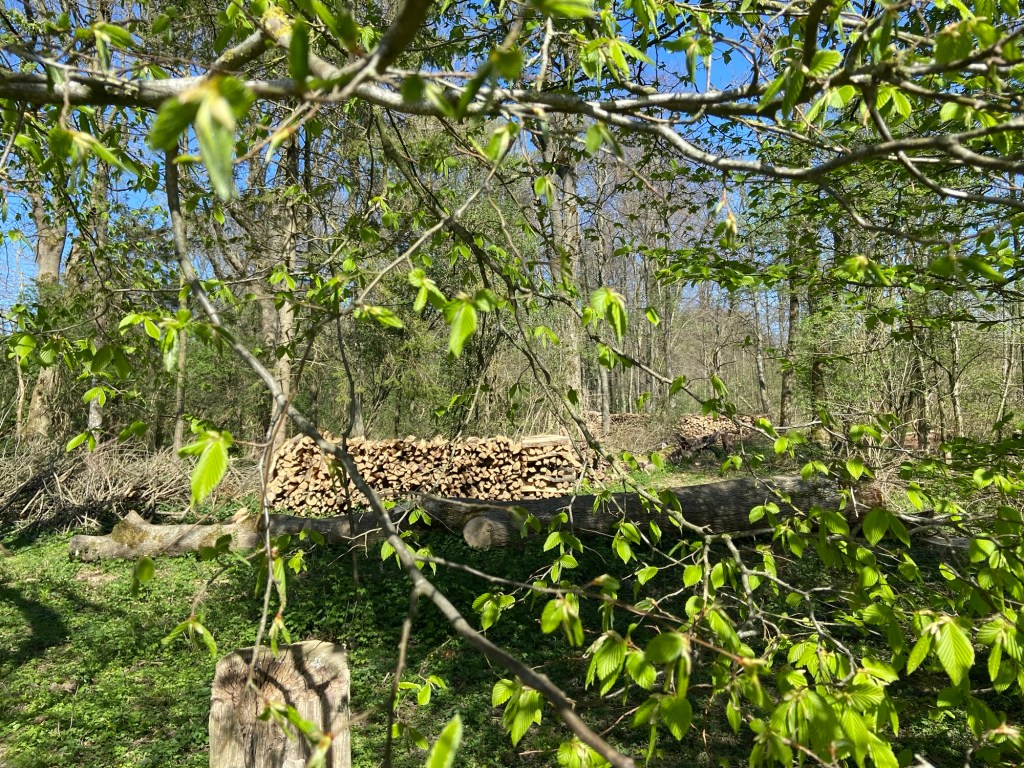
In the woods gigantic stacks of firewood were neatly arranged.
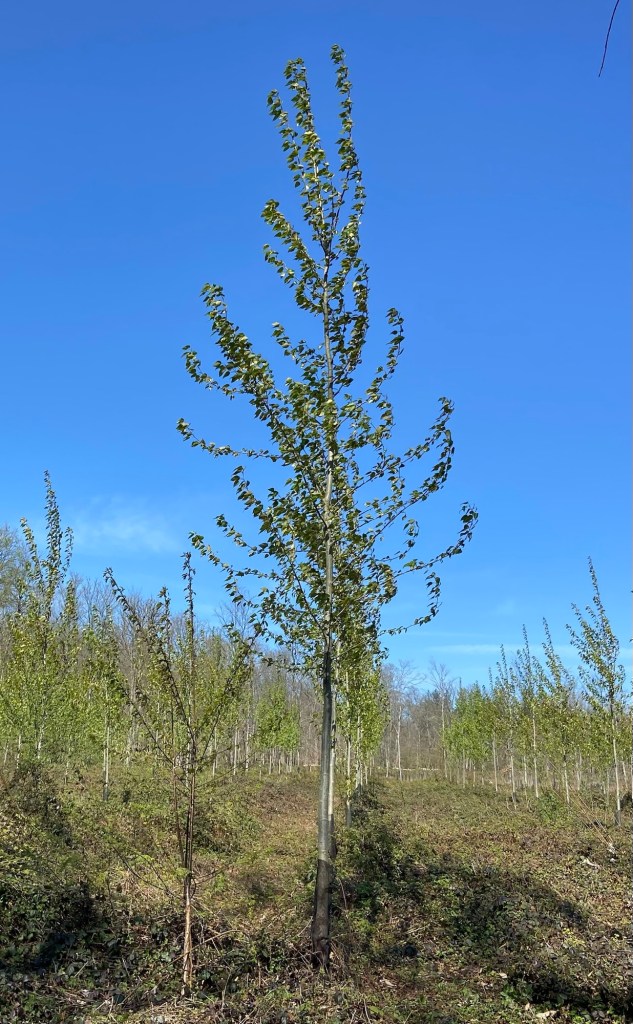
next door there was a fairly recent plantation of popular trees with leaves trembling horizontally in the breeze. The brambles underneath will provide a fantastic autumn crop for the walkers passing this way.
It was amazing how good we felt walking. I think it was because we had eaten so well last night courtesy of Annie, and we weren’t having to deal with the reflected heat of pavements like we had been yesterday. Urban walking (and route finding) is tiring… this was just completely wonderful countryside walking. Again, another glorious stage. By 2.50 we had come 23.5 km, and weren’t really feeling it yet.

The last wood was annoying in that we made a lot of height, lost it and then had to haul ourselves up a very exposed steep slope on the hottest part of the day. But once we were up we were up — and then it was horizontal walking
All at once we had arrived at the most impressive and simultaneously appalling part of the day: the Lorette military cemetery, where more than 40,000 French soldiers who died in the Great War are buried.
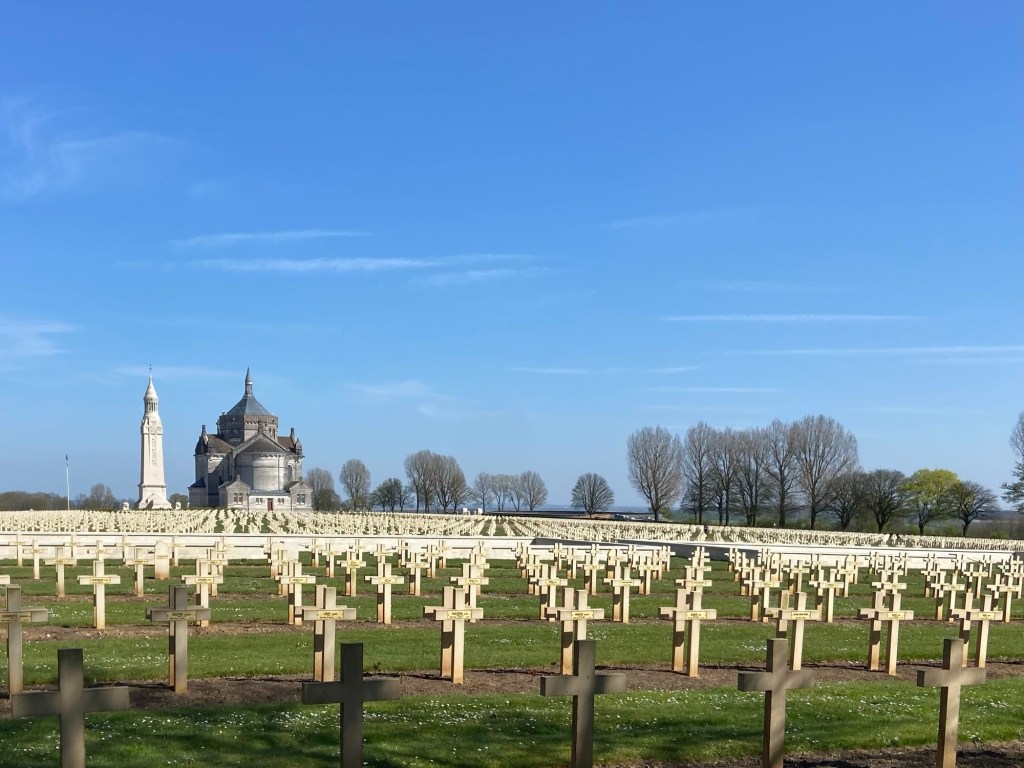
It was a different kind of forest, this.
With that last steep hill we had effectively climbed up to the top of the Lorette ridge, site of the front line — and I think the route will follow the Western Front now until Reims.
We visited the museum first — a jumble of extraordinary memorabilia — and then walked into the vast necropolis, a huge city of the dead.
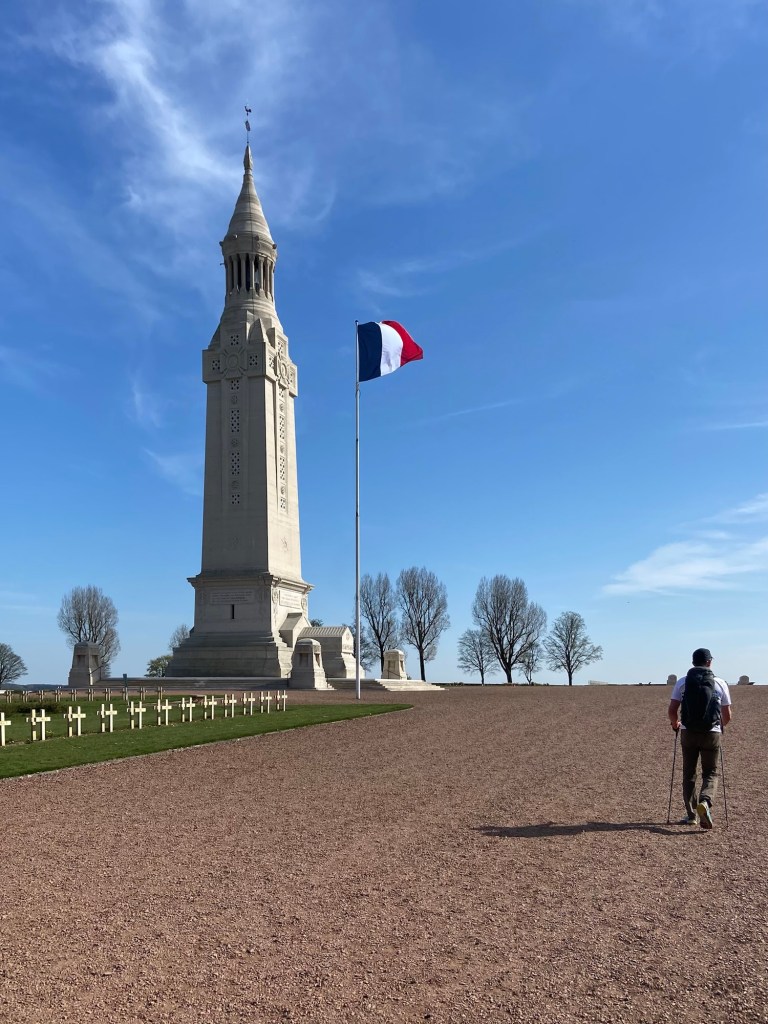
The most moving part for us, apart from the terrible scale of the losses made visible in the rows and rows of simple headstone crosses, was the Ring of Memory, a huge circular sculptural form 345 meters across, inscribed with the names of the 580,000 soldiers who died in the region during the Great War. All the names are there: soldiers equal in death, in simple alphabetical order, without distinction of rank or nationality.
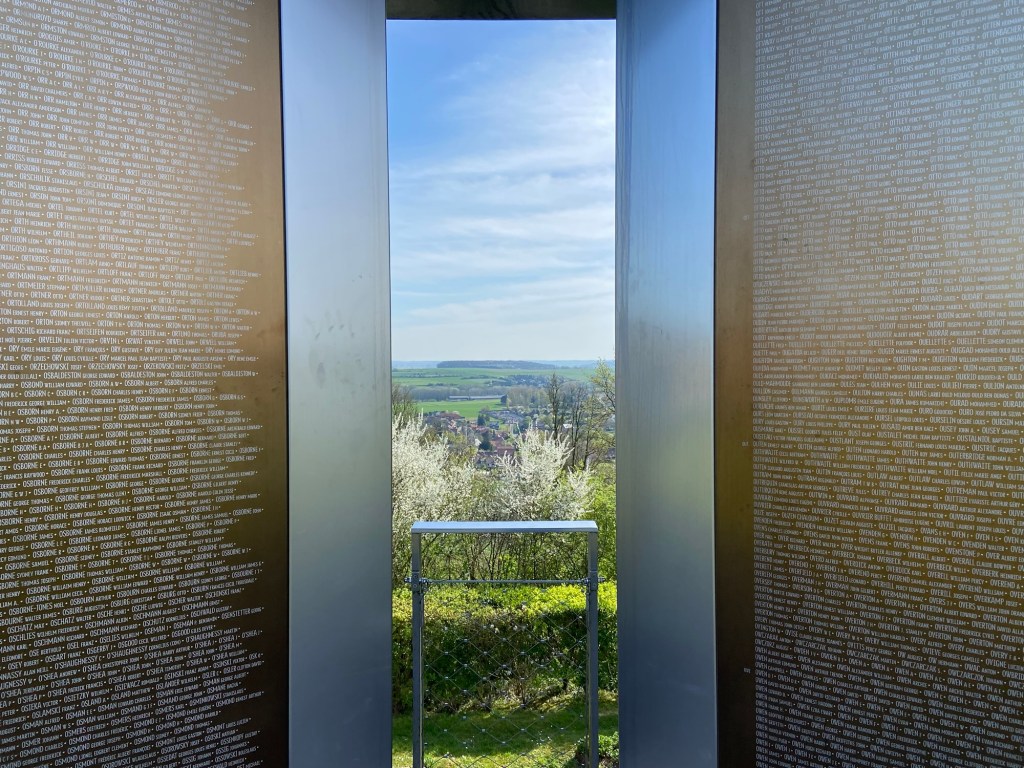
We walked slowly round the ring taking in the names — the more than half a million names.

There were Müllers and Millers and Schmidts and Smiths, columns and columns of Scottish soldiers with names beginning Mc and Mac. Polish names, French names. The whole slaughter laid out in front of us.

Each name a person with a family and a future life cruelly snuffed out.
We found the list of Holroyds who had died near here.
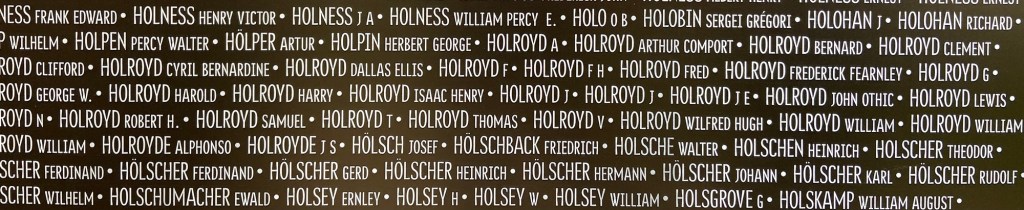
Deeply moved and very thoughtful we left the cemetery and descended into town, for our last night before Arras, a rest day, and Stephen’s departure on Thursday.
Stats for the Day
Distance: a whopping 31km that felt like about half that
Time: 6 hrs 51
Climb: 497m
 Walking The Landscape
I loved this today. I felt I was walking alongside you with the greenness of the trees mirrored in Kent. Just wish I could continue walking too! The Ring of Memory, what a place. It reminds me of singing at the evening ceremony at the Menin Gate, with all those names of all those wasted lives. Enjoy your rest day. Xx
LikeLiked by 1 person
It is so poignant. And then having the space to walk and think afterwards too.
LikeLike