I must choose between despair and Energy──I choose the latter.
John Keats
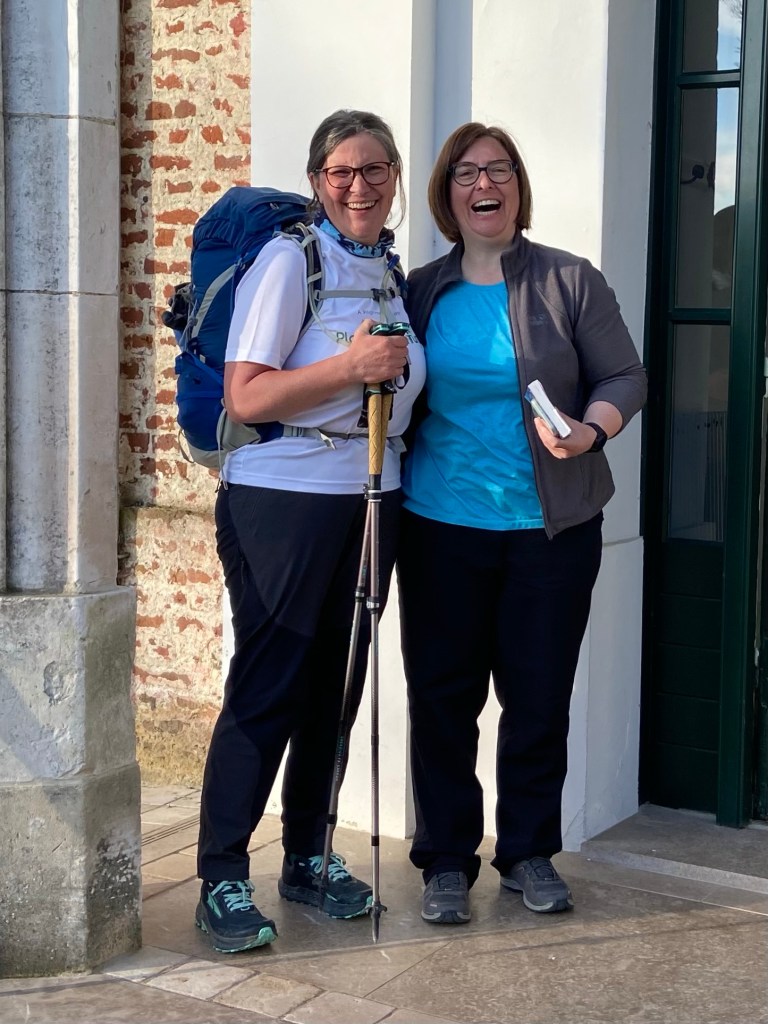
The bonne chance coffee machine posed no problems for my expert barista this morning, and we set off well caffeinated and after a breakfast of bread given to us in a basket by sister Lucie yesterday, lovely French butter and the nuns’ home-made peach jam. Regine and I swapped phone numbers, because although we are not staying at the same place tonight and Stephen and I have a rest day planned for tomorrow, she and I will coincide in Reims where she is due to stay for a few days to enjoy a champagne tour of a vineyard, a gift from her ex-coworkers. It was lovely to meet you, Regine, and I really look forward to catching up with you in a few days’ time.
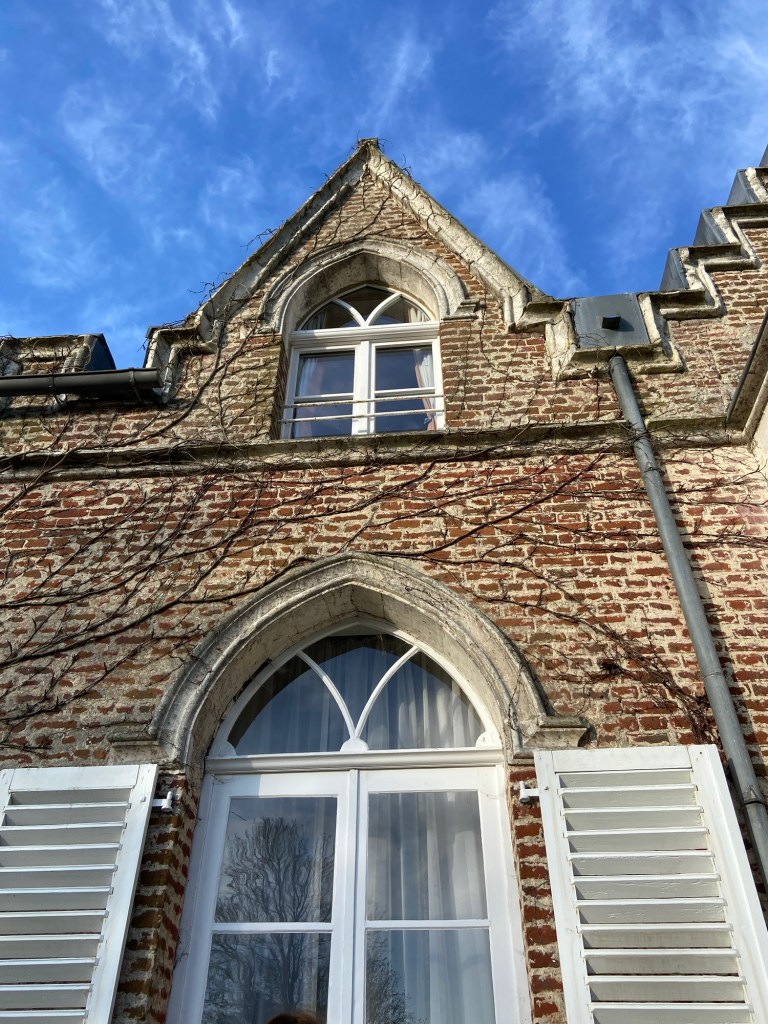
It was very special to have had time at the convent. It felt like a real privilege. We loved the old guesthouse kitchen with its copper pots hanging up and its old wooden cupboards, the spiral staircase and the graceful windows.
We seem to have made the adjustment to walking life in a fairly seamless way. Our rucksacks are feeling comfortable and not overpacked, and so far the feet have been more or less comfortable too. I don’t think these shoes will last the distance (lots of abrasive surfaces underfoot) so I will have to think about how to purchase another pair and have them sent out. I think I will send my sleeping bag back with Stephen because a silk liner and a blanket or two has proved fine for sleeping.
One of the adjustments I have absolutely NOT made is the linguistic one. Italian and French are all totally mashed up and confused for me and sometimes I seem even to have lost the ability to distinguish between them. I can’t think of some English words either — my mind is reduced to sounds and syllables, signifying nothing!
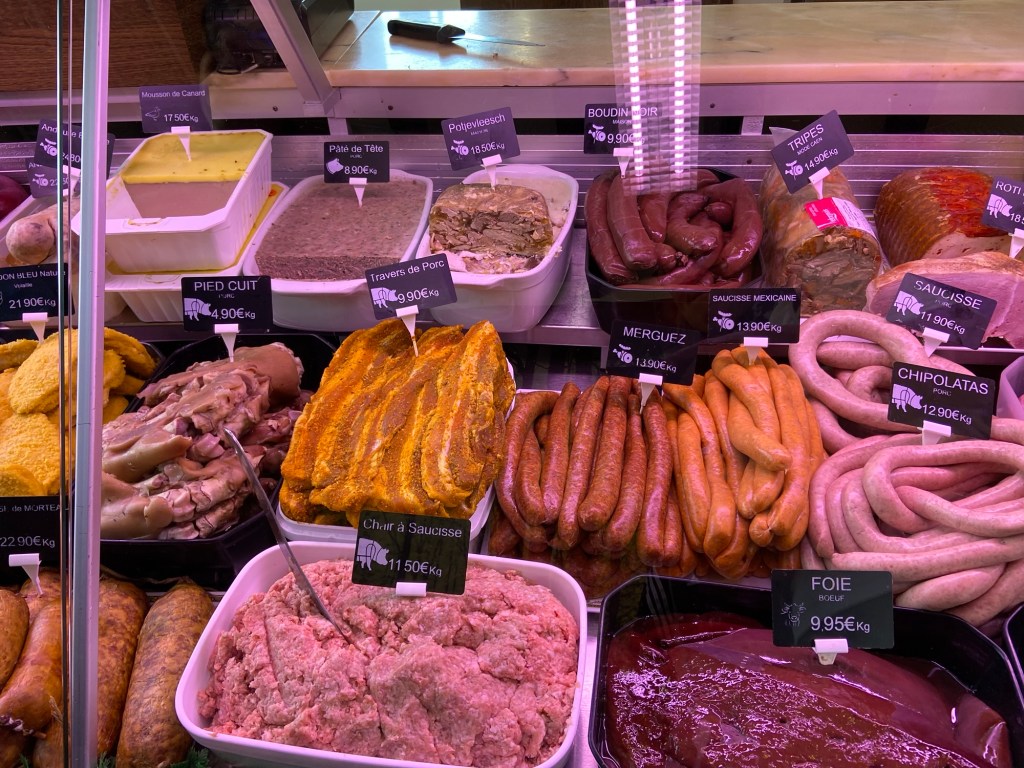
In the first village we reached we decided to visit the butchers to stock up on some lunch. The long queue of people in front of us gave me the time to think of a few sentences of French and Stephen the opportunity to really appreciate the full range of traditional meats and cuts — cooked trotters, anduiettes, brawn, whole rabbits, tongues and tripe. Mercifully we left with just two quiches in our plastic pot.
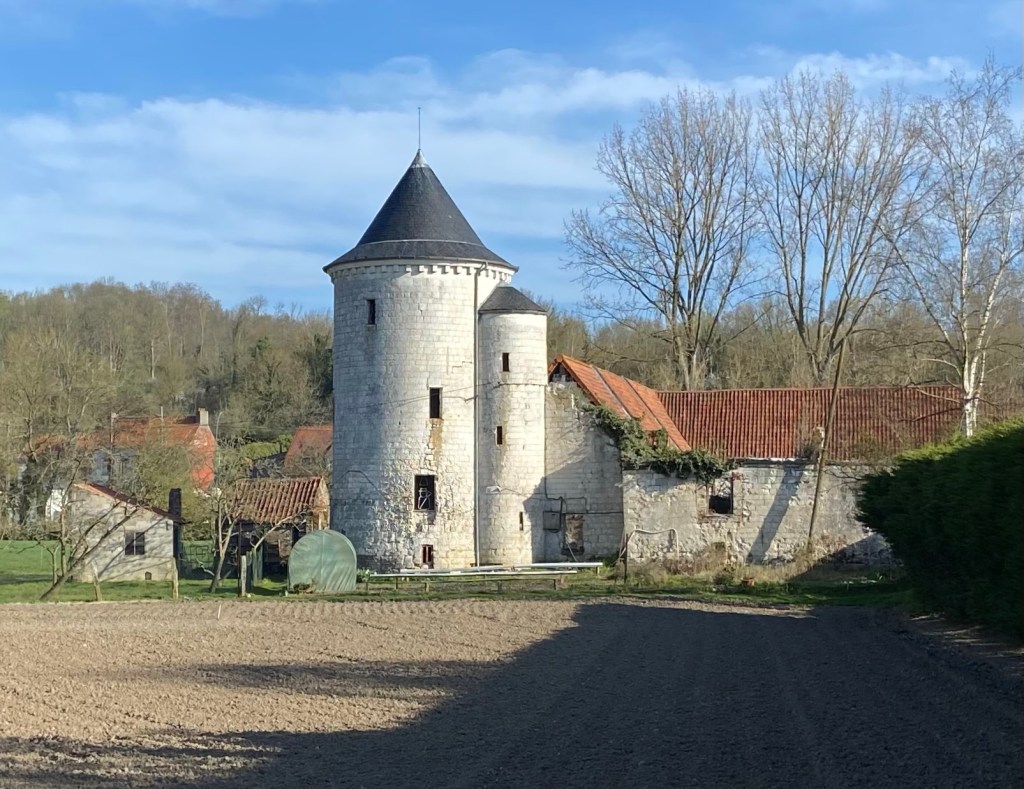
Esquerdes felt like much more of a rural settlement, with an ancient farmhouse within the village itself.
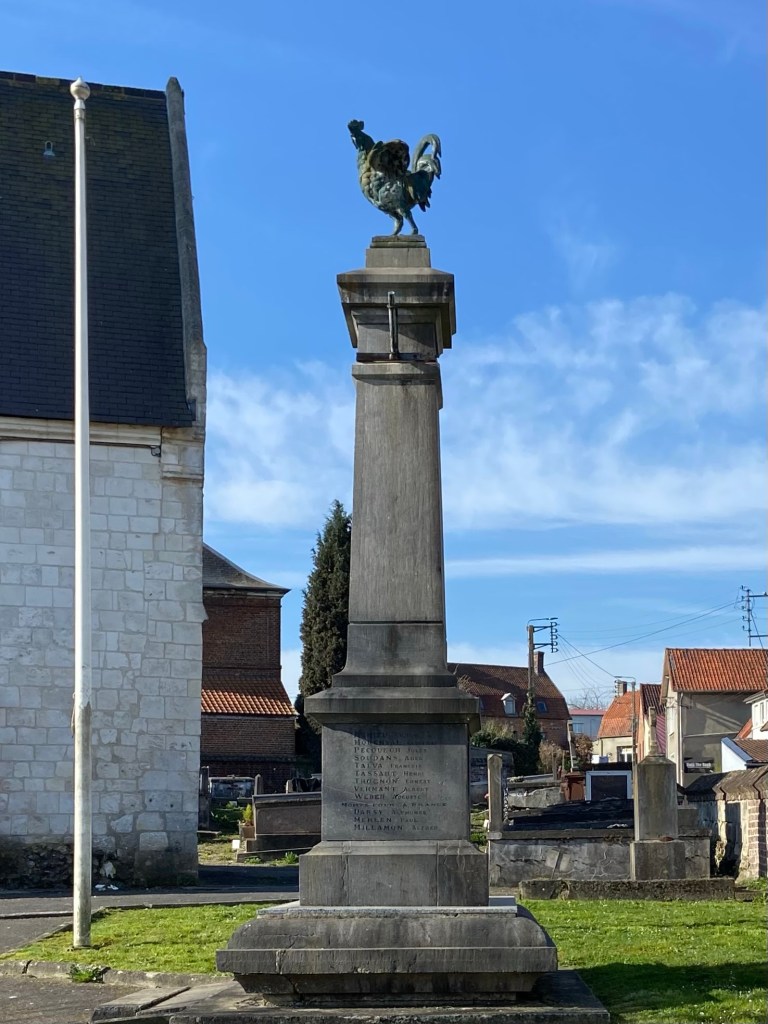
In front of the church was the war memorial, with the by-now familiar statue of a cockerel on top, symbol of France. This reminded us of the wonderful 13-year-old student we had once had who went on the school French trip, enterprisingly purchased a chicken in a livestock market, then released it in a shop. He used to carry pocket editions of Shakespeare plays or the New Testament in his pocket, and went on to join the army and take a bullet in the shoulder in Afghanistan. So we felt the cockerel on this war memorial was partly for him.
There was a steep climb up onto a wooded limestone ridge where ropes of old man’s beard lay across the path to trip the unwary. Stands of (wild?) gooseberry and bramble will provide wayside snacks for pilgrims later in the year. Neatly stacked piles of wood drew Stephen’s attention. ‘Beautiful oak,’ he said. ‘Lovely French oak. You can tell because it’s yellowish.’
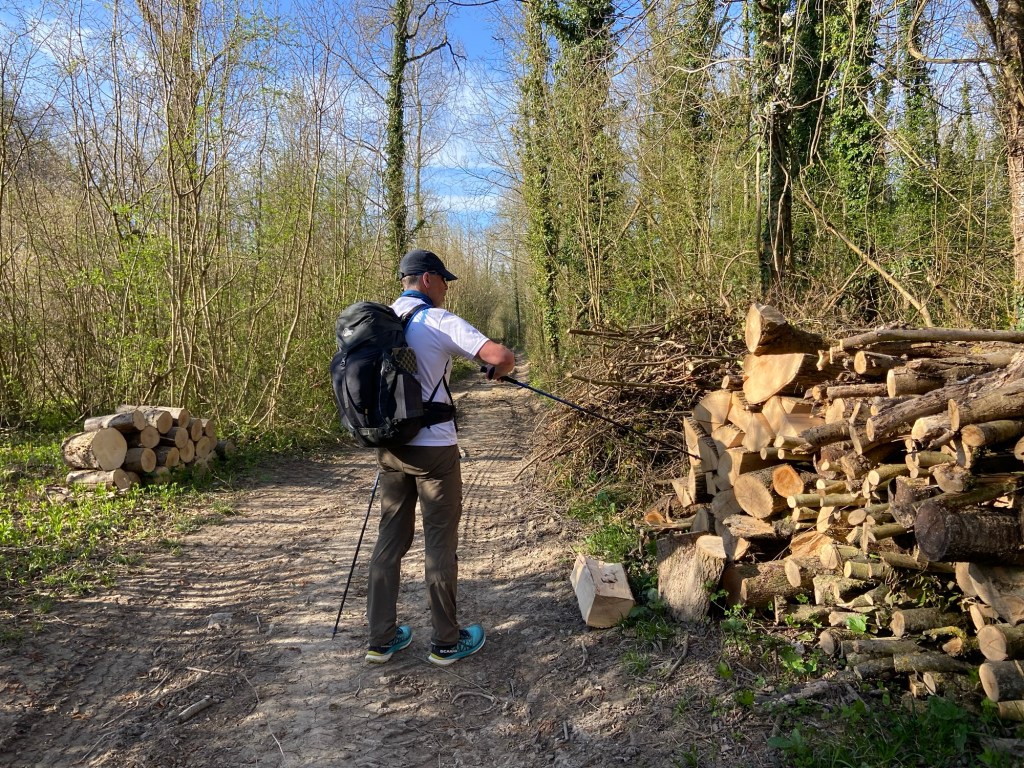
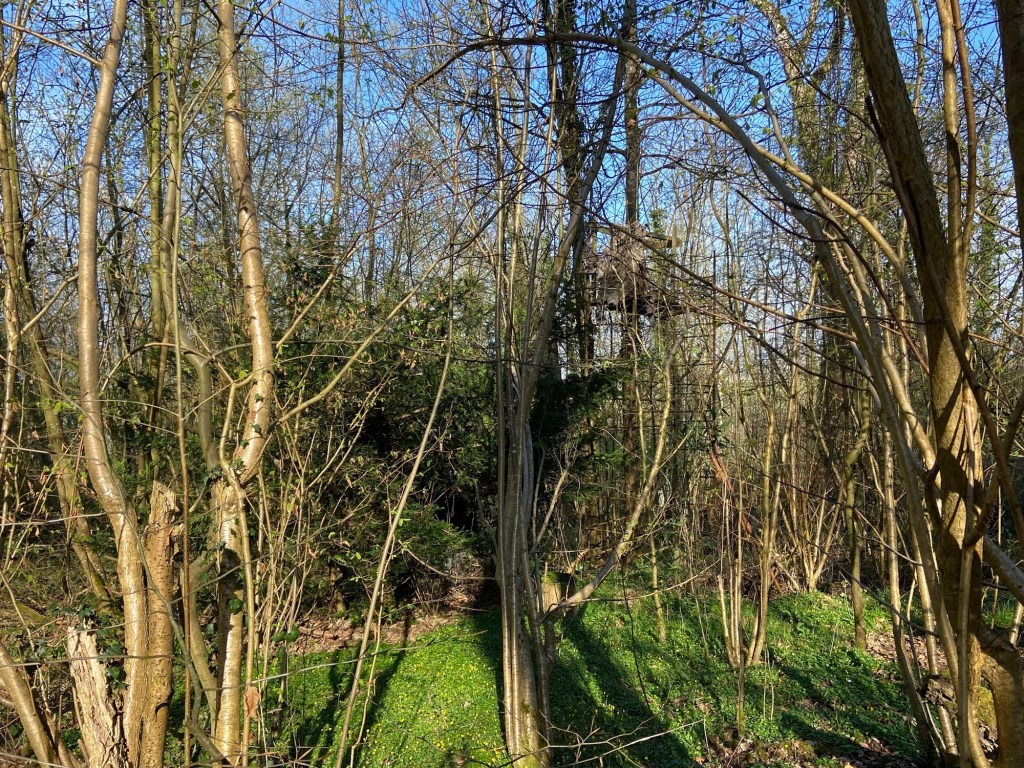
We had just heard our first woodpecker, when, commenting on all the little neatly stacked piles of wood along the path, we suddenly noticed a well-camouflaged hunting tower practically in from of our noses and so came to understand the previously mysterious white triangles painted on trees with directions to the nearest hide.
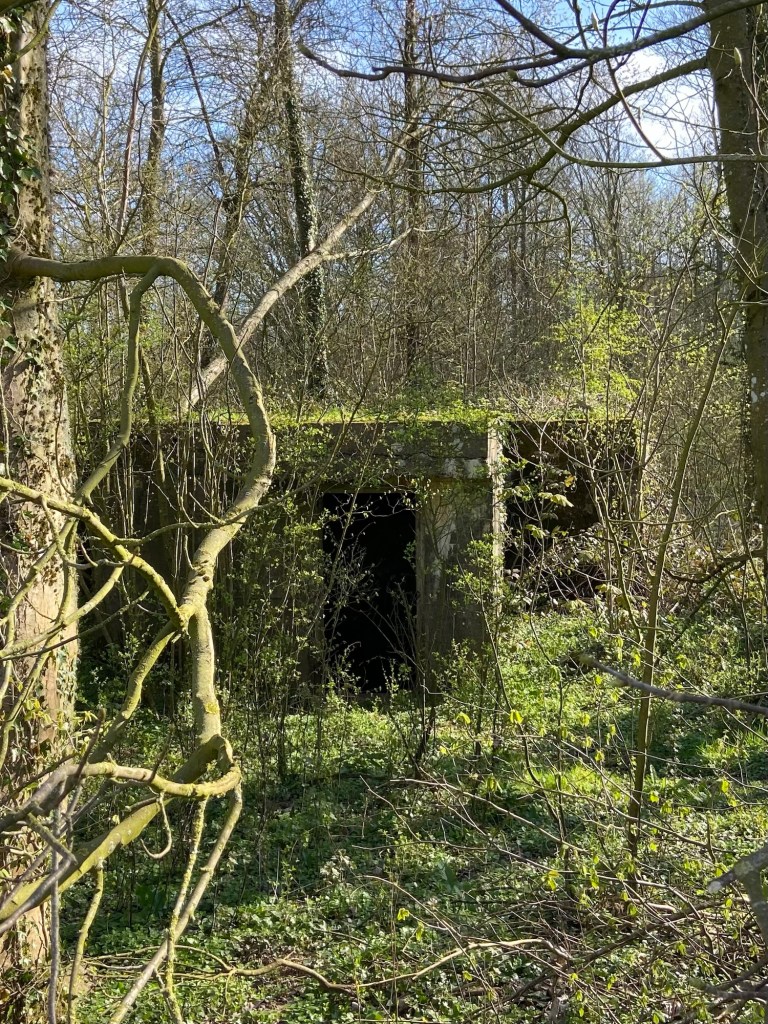
Just before we exited the Bois d’Esquerdes we came across a concrete structure amongst the trees just off the path. Later in our gîte Stephen found a history of the secret German constructions in the Thérouanne area and the blockhouse was marked on one of the maps as being part of the complex that was a ‘Site lourd V1’. Since it was right on the edge we thought it might have been storage for the charges.
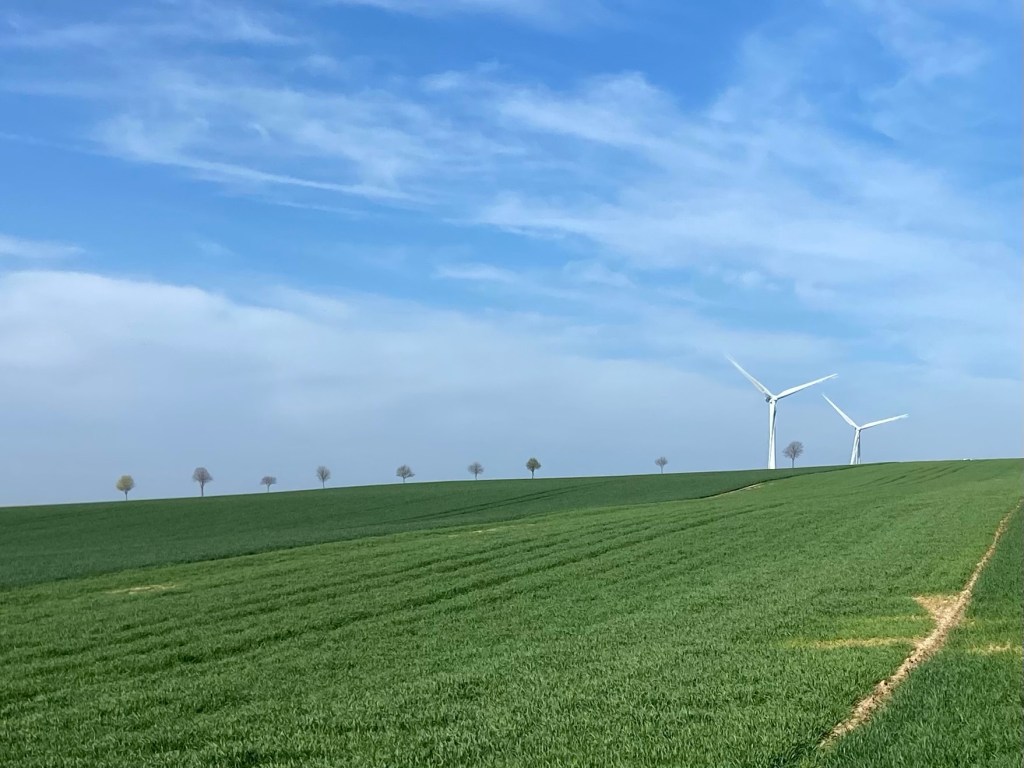
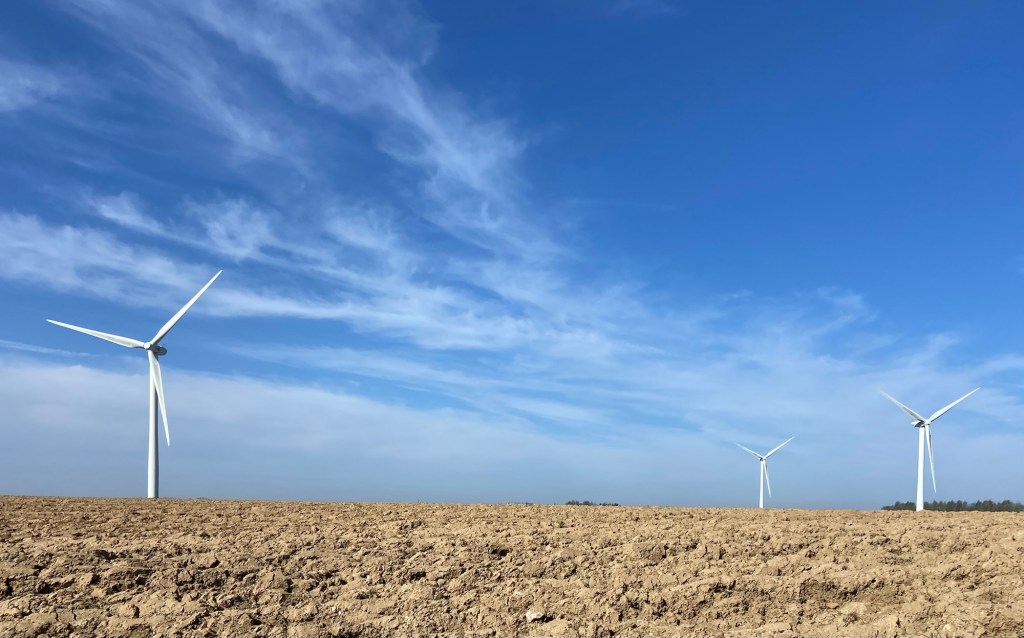
Out of the woods, the visual and atmospheric focus for the next quarter of the day were the gigantic wind turbines dotted about the landscape, tall, white and majestic, turning slowly and gracefully in the light breeze to generate clean and renewable energy with seeming effortlessness.
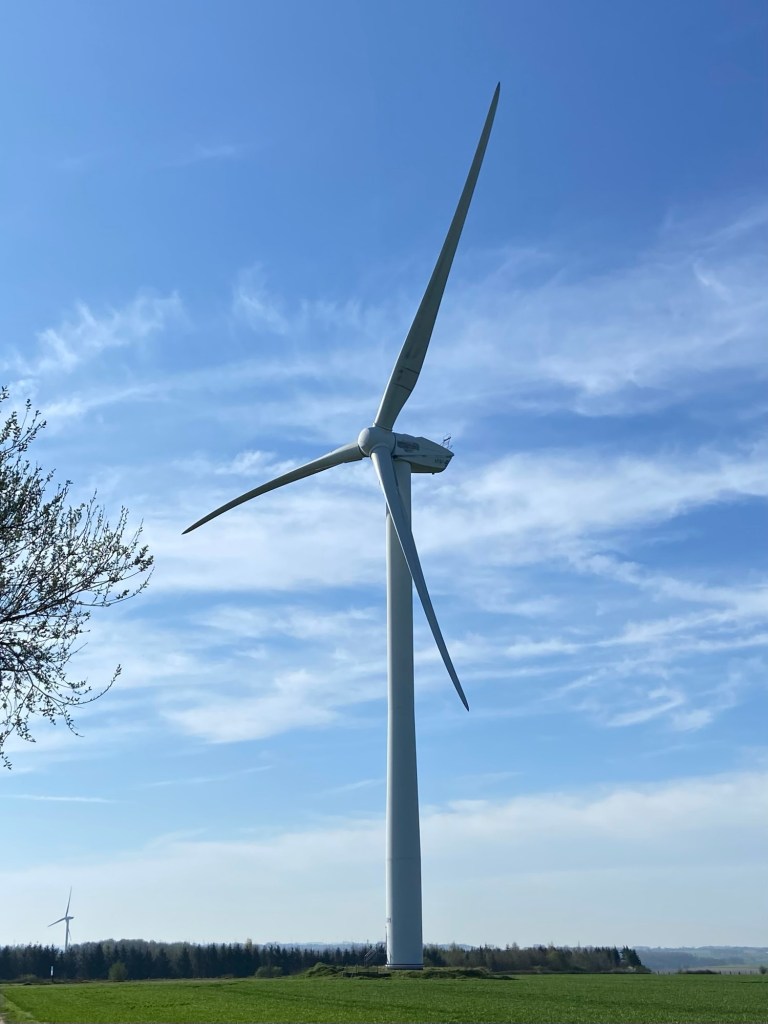
They were a subject with almost endless photographic possibilities.
But we did have to keep quite a bit of attention on our feet, and the careful placing thereof on surfaces which were uneven. Not to guard against tripping, but just to avoid feet rubbing against the side of shoes on an off-camber. We were grateful to arrive at the beautiful village pond in Cléty l’Aval where we had seen on the map that a picnic site was waiting for us. We sat in the sun and gentle breeze listening to the mallards honking, and a guitar being strummed by a chilled-out cyclist with a pile of blond dreadlocks having a break for a beer and a doobie.
It was really quite hard to motivate ourselves to get moving again.
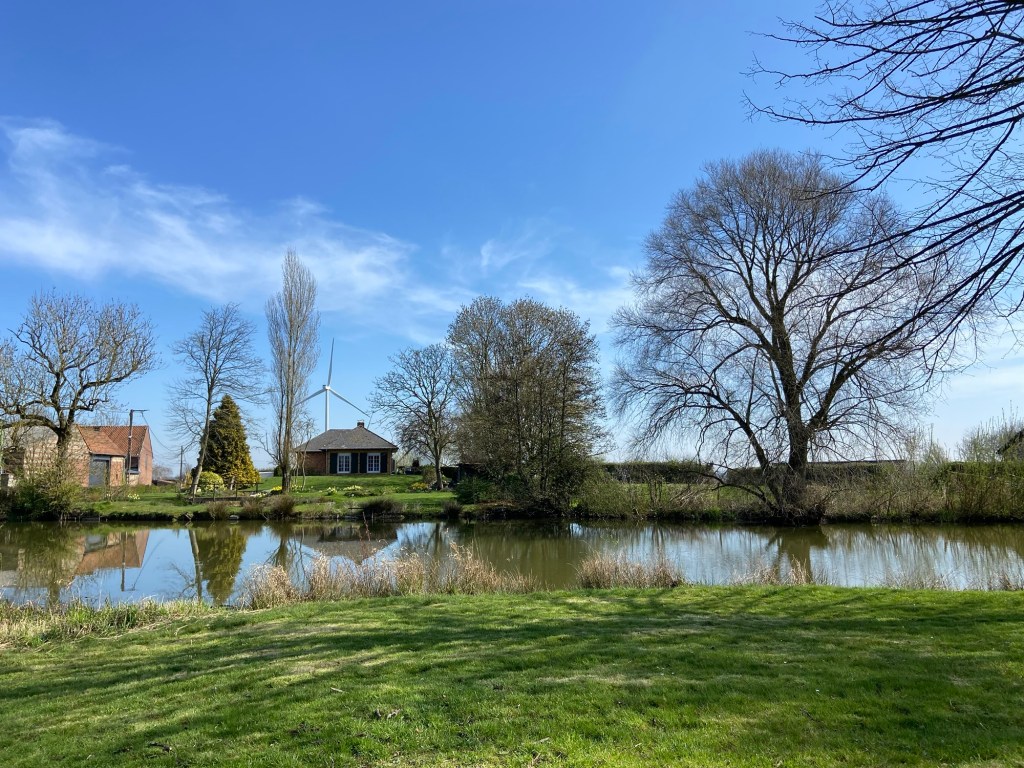
But move on we must, because we still had more than half the day’s kilometrage to accomplish. My morality expert frowned upon my idea of taking a road shortcut, which would’ve shaved an hour or so off today’s walk, so I was determined to enjoy the beauties of the afternoon. A macerated rat on the road out of the village and a dozen also squashed and desiccated frogs on the road around the pond were definitely not good energy, but rather very bad juju.
However I was, as I said, determined to think positively (despite the hill, because you know, what goes up must come down)
So I took care to notice the bird cherry in flower, and in fact when we stopped to look at it, we became aware of the sing sound of thousands of bees up in its canopy, collecting pollen and drinking nectar.
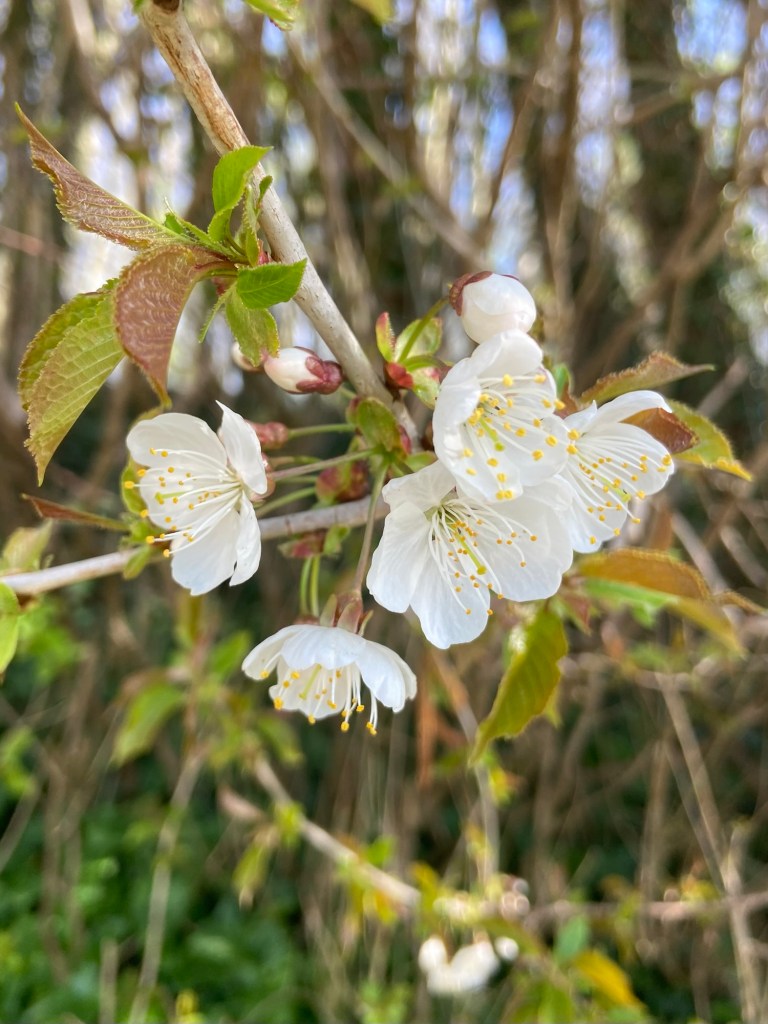
Then the juju kicked in. On the map there was a feature marked called ‘sunken path’ and at first it was a lovely sunken lane rather like those in Cornwall and elsewhere.
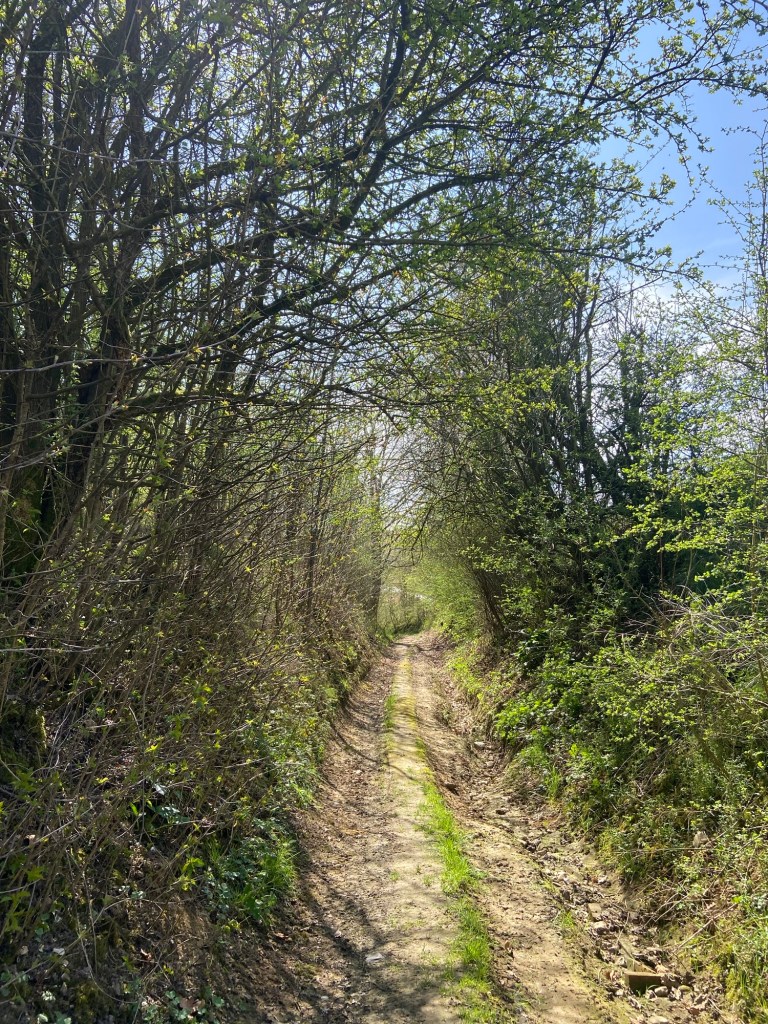
But then it turned a right-angle corner and deteriorated to a real horror of a path: three quarters of a mile of huge loose lumps of flint, laid deep. This photo was right at the start where there were a few slabs, but it quickly descended into a horror.
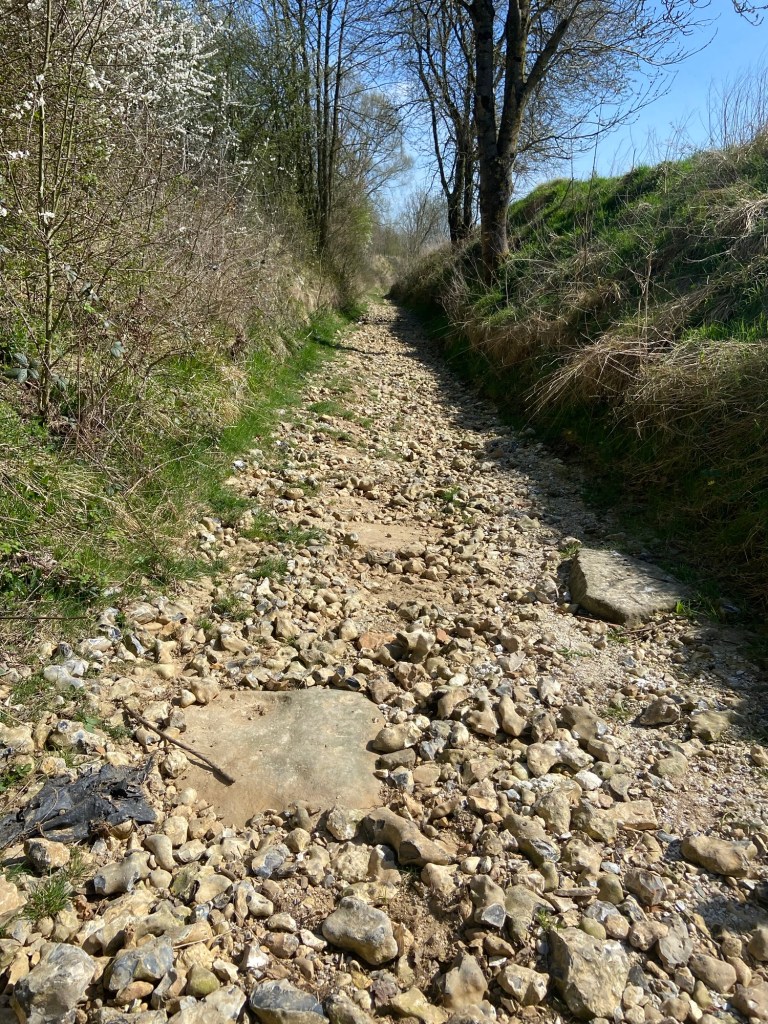
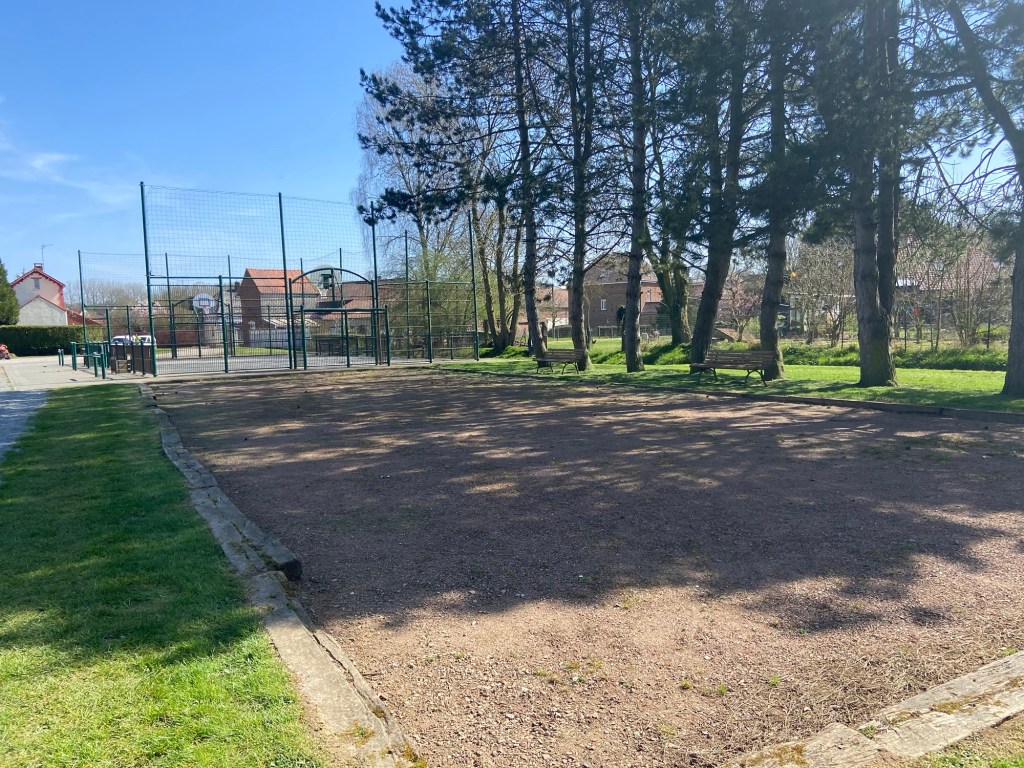
I think it took us about 25 minutes to walk the 1.2km. When we emerged out of the valley of the shadow of death there was Delette, a small town which gets top marks for its picnic table-and-bench density, and distinguishes itself also by having the first boules stadium of the walk. Also, having even a tiny little bit of mown grass to walk on after the evil sunken lane raises it in my esteem.
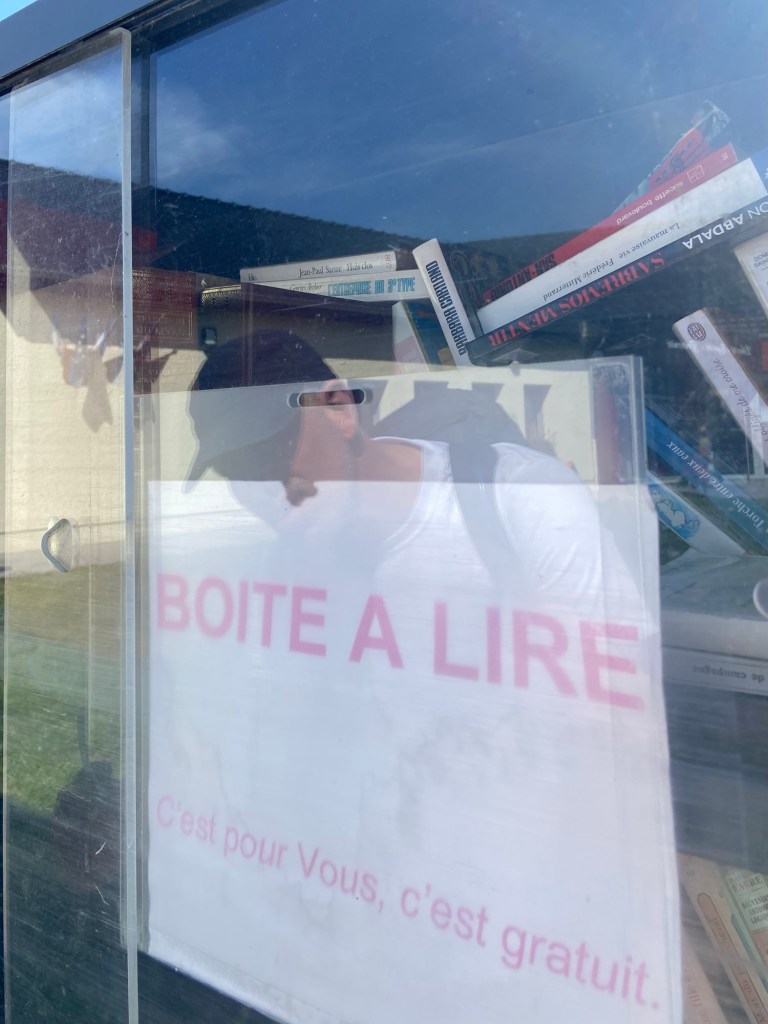
Just outside the Mairie was one of those book bank things like they have in old telephone boxes in the UK. Only here they don’t have old copies of Danielle Steele and Jeffrey Archer. Oh no. Here in France they have Sartre. I’m glad we’d got out of the sunken lane before I saw Huis Clos… it would have been horrendous juju otherwise.
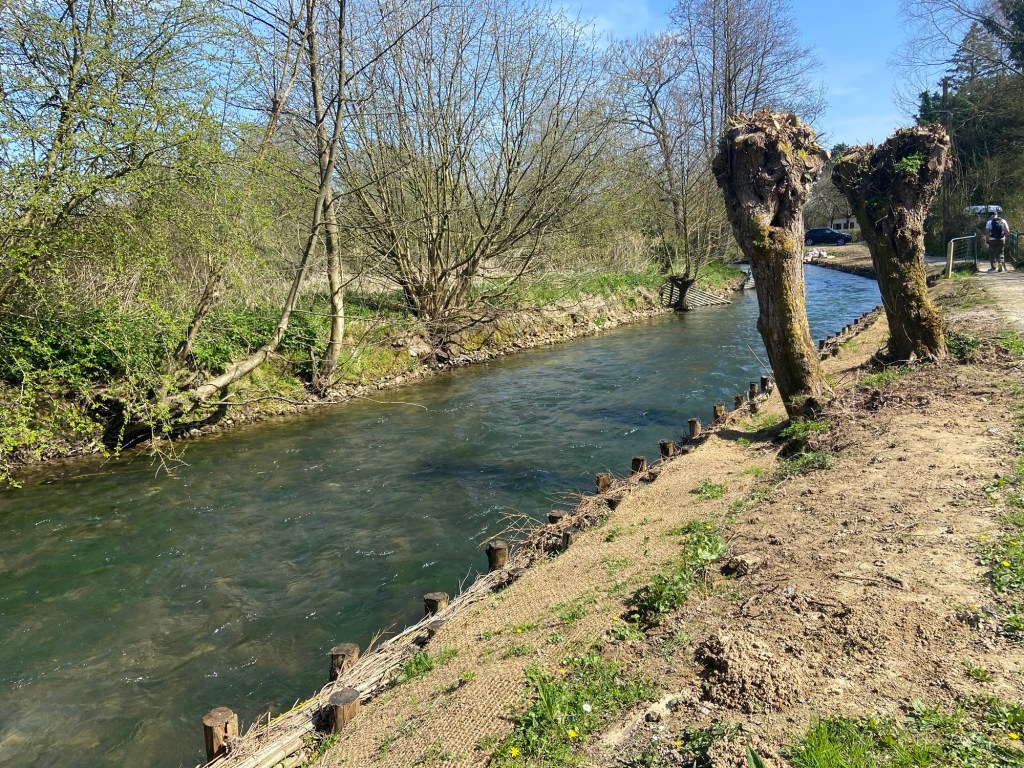
Another nice thing about Delettes was the river. They had stabilised the banks with woven willow withies (creating a haven for small fry) and jute, and pollarded the willows. I would love to come back here later and see it all in full summer.
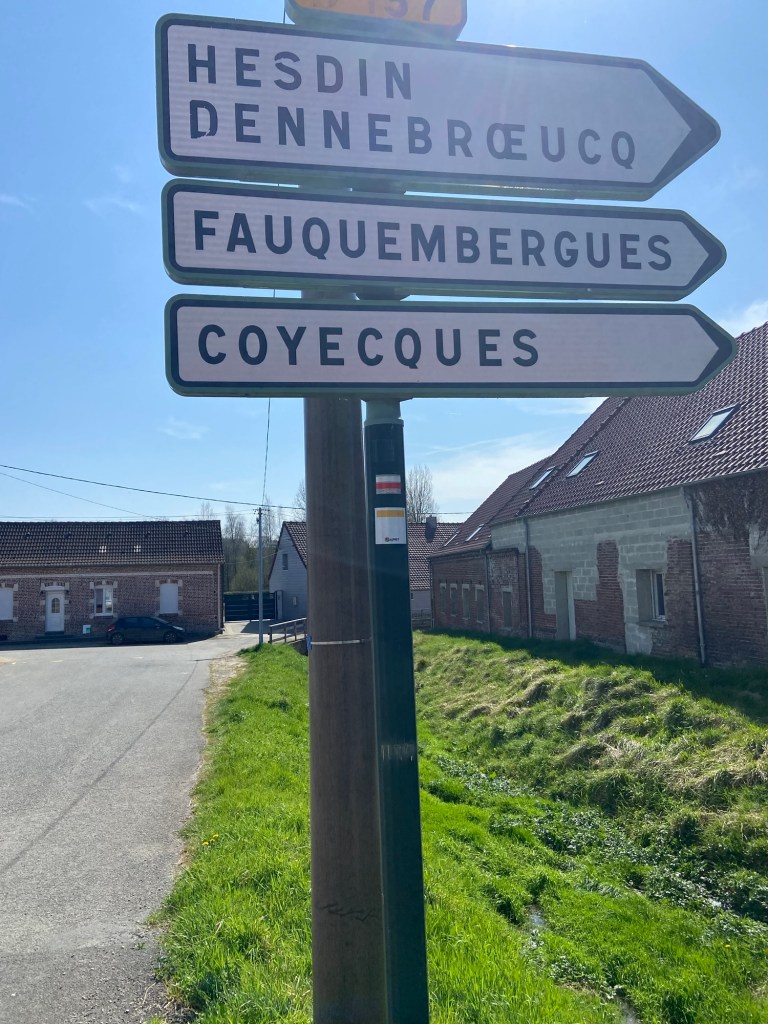
For now there was still much to see. The vernacular of the architecture really has changed. Although there are still towns with Flemish names (one handful on a signed post looked as though it was the random letters picked out for Countdown),
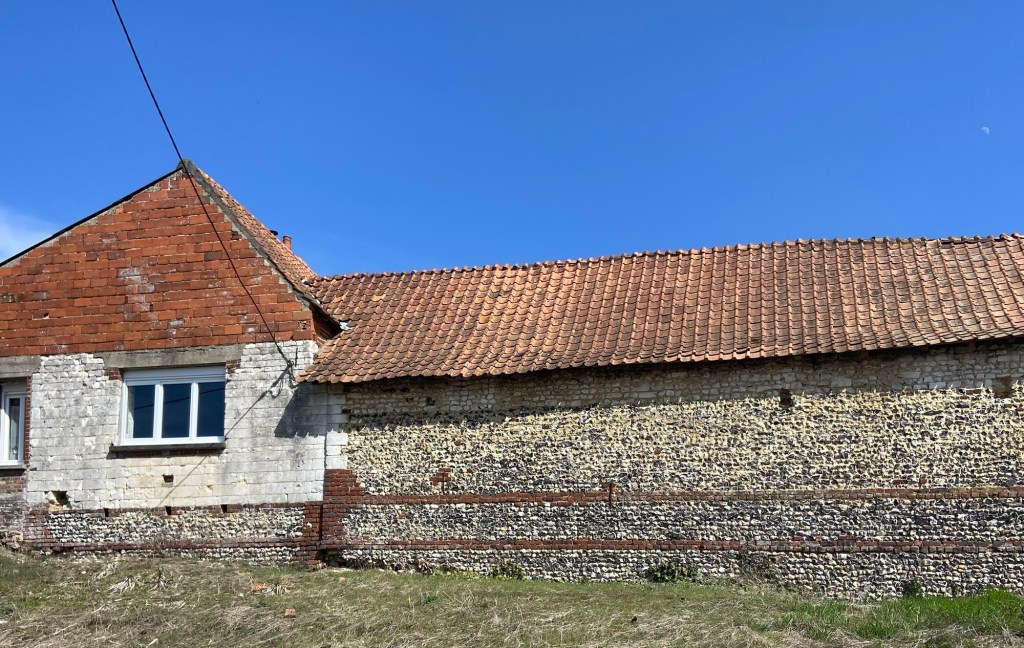
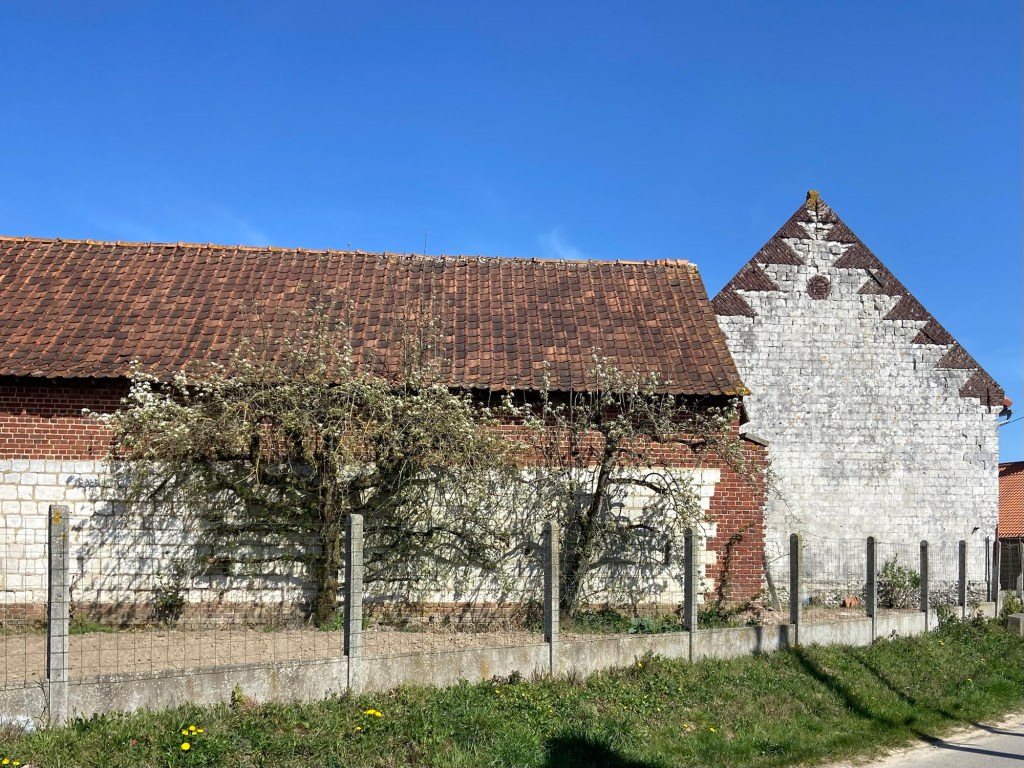
many of the houses now started to be constructed out of blinding white limestone blocks and brick. There were farm buildings in the centre of town and where old buildings had been repurposed, the original building materials had been retained as much as possible.
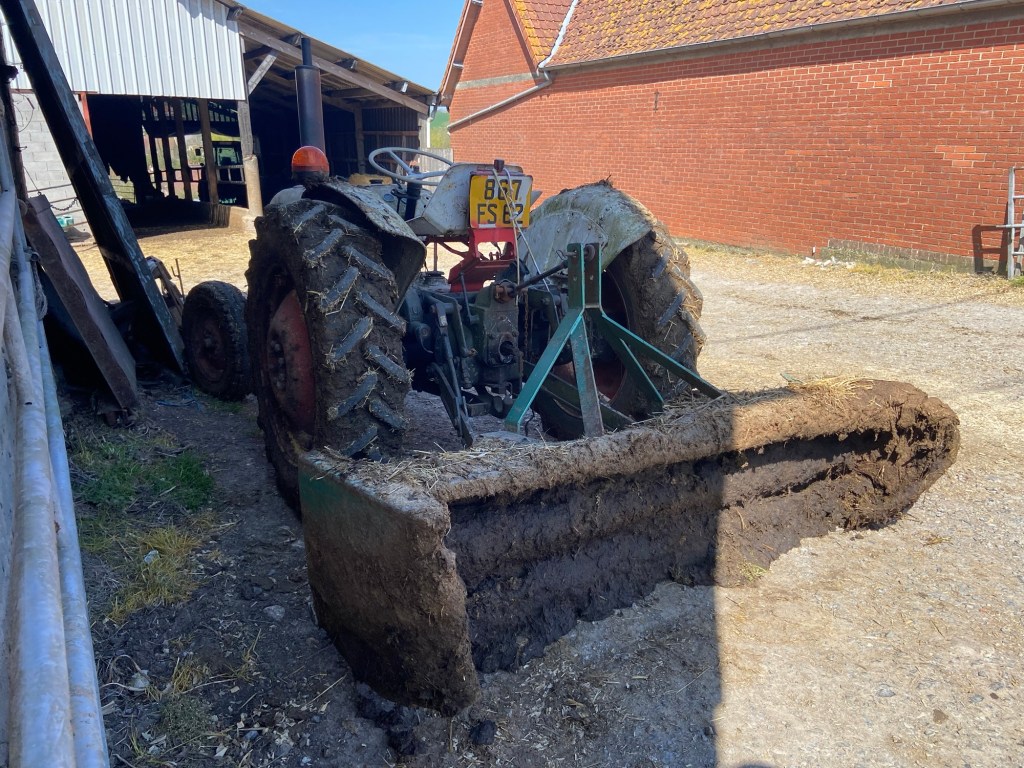
Best of all, a slurry scraper: an old tractor which just goes up and down the farmyard, doing what it says on the tin.
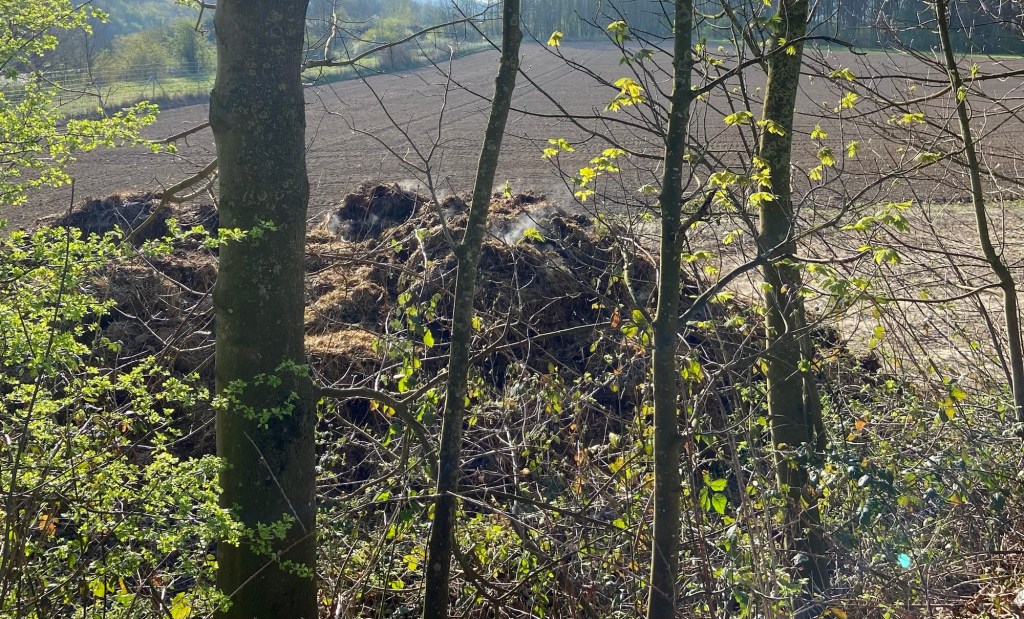
The slurry scraper reminded us of one of the most exciting spots of the day: the pile of dung in a field, actually steaming, with the early morning light behind it.
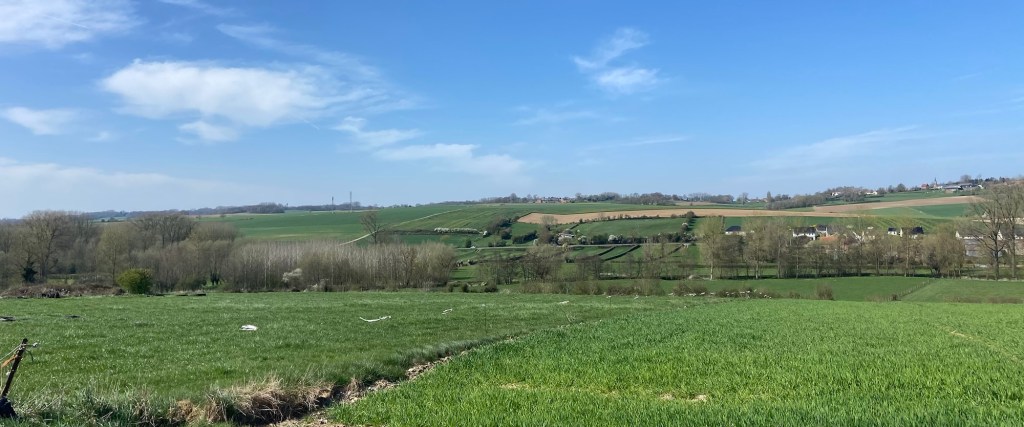
Yes it felt like a long day and yes we were walking now on the road for a few kilometres. And yes it was a dystopian false flat which has just enough sustained climb to be a real effort at the end of the day, but the breeze was really reviving, and the flat tarmac was heavenly after the loose flint. There were views down into the river valley with white poplar trees and willows showing green.
It wasn’t long before we came into the outskirts of Thérouanne, a little village called Nielles, which presented us with a stunning old farmhouse in the characteristic brick and limestone block style with beautiful espaliered pear trees in flower all along its length.
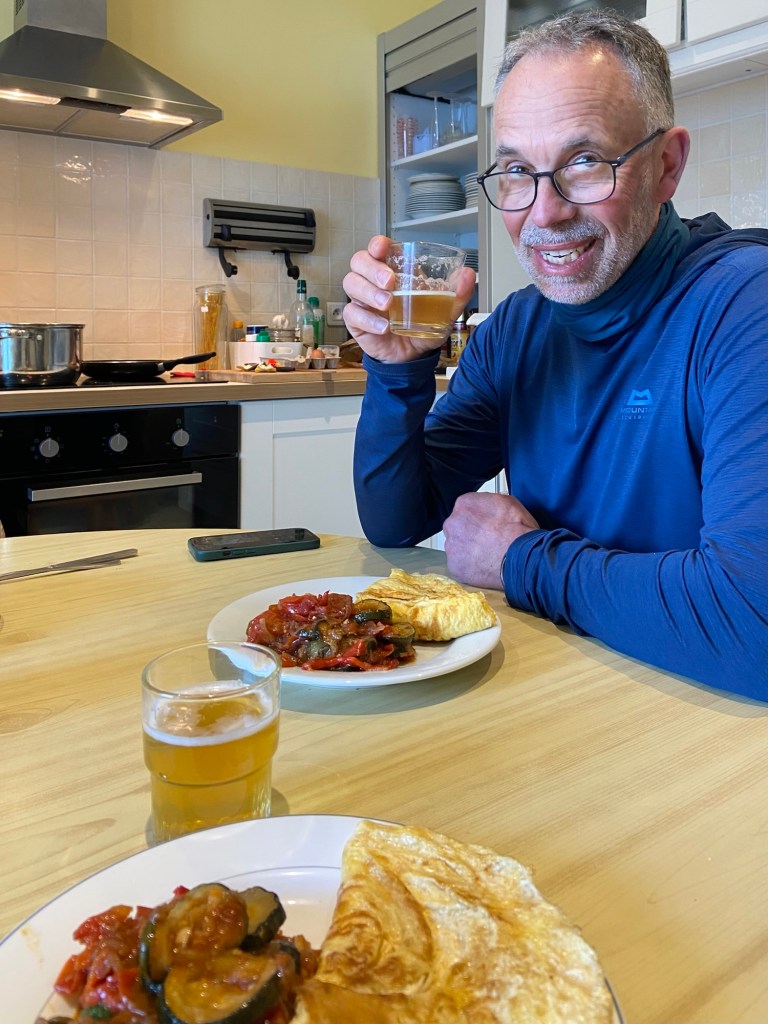
And from there it was only a short step to our pilgrim gîte, where we are the only ones staying tonight. Sparkling clean, with a fully equipped kitchen, sofas, fantastic showers, a WASHING MACHINE and that really interesting book about the secret German constructions. We recovered a bit then went out on an expedition to buy provisions.
As Stephen was cooking supper Alain the host (and birthday boy) arrived. He told us the fascinating history of old Thérouanne, a town of 20,000, established as an Episcopal See in the 7th century by St Audomar (Saint Omer). The cathedral built after the town’s first destruction by the Flemish in 1303 was at the time the largest in France, and the important town was besieged by the Emperor Charles V, and, once captured, razed to the ground. Today almost no trace of it remains … but where we are now was a little hamlet outside the walls, which gradually grew up into a thriving small town and took the name of Thérouanne.
There endeth the lesson — which I may say was delivered in French and which I understood all of, as verified by my checking it on Wikipedia after supper.
REST DAY TOMORROW!
Stats for the day
Distance: 23.19km (seemed more!)
Climb: 285 (seemed more! With the Escheresque uphill that was all uphill until we somehow came to the bottom of the valley)
 Walking The Landscape
You are doing so well! All those kilometres and hills, and all that French! Have a wonderful rest day. X
LikeLiked by 1 person
Thank you!! Lots of stretching I think. My Mr Universe calf muscles are getting a bit tight. Oh, and the archaeological museum as well.
LikeLike