
Vincent Van Gogh
The French air cleans up the brain and does good – a world of good.
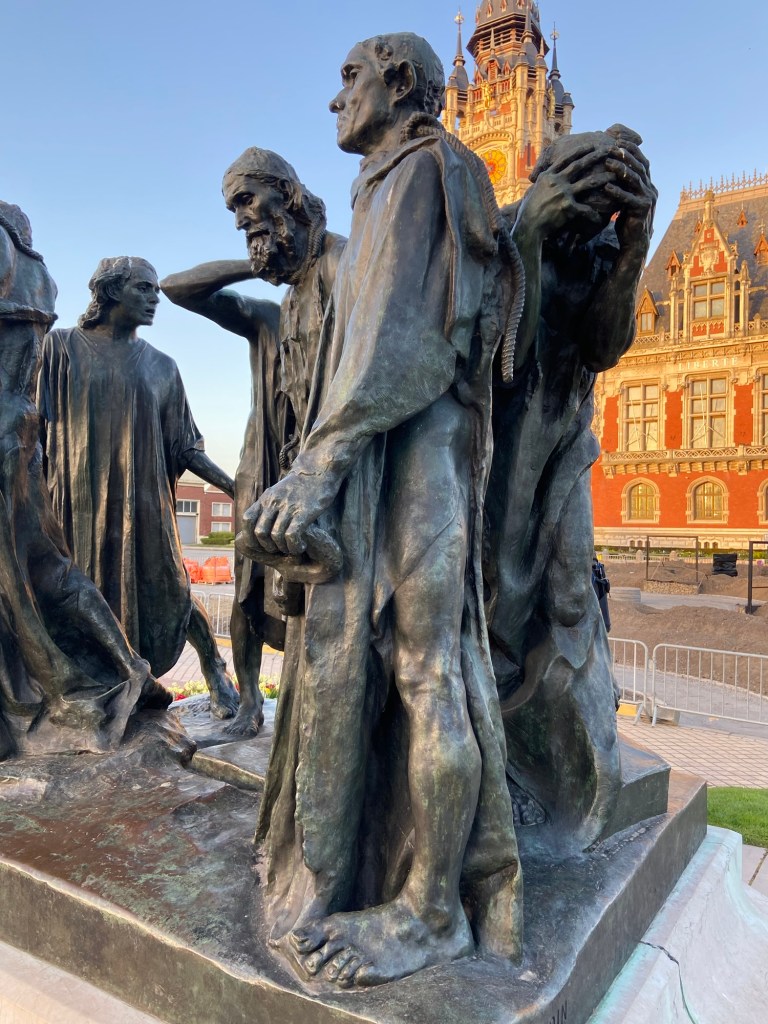
Coming into Calais from the ferry yesterday we made for our hotel via August Rodin’s extraordinary statue, the Burghers of Calais (or, as Sara on the ferry adorably called them, the Burglars of Calais…). The Hôtel de Ville behind the sculptures was the landmark to locate the statue, and its stand before the intertwining group of medieval figures, their resigned, inward-looking faces contrasting powerfully with the picture-perfect municipal flowerbeds.
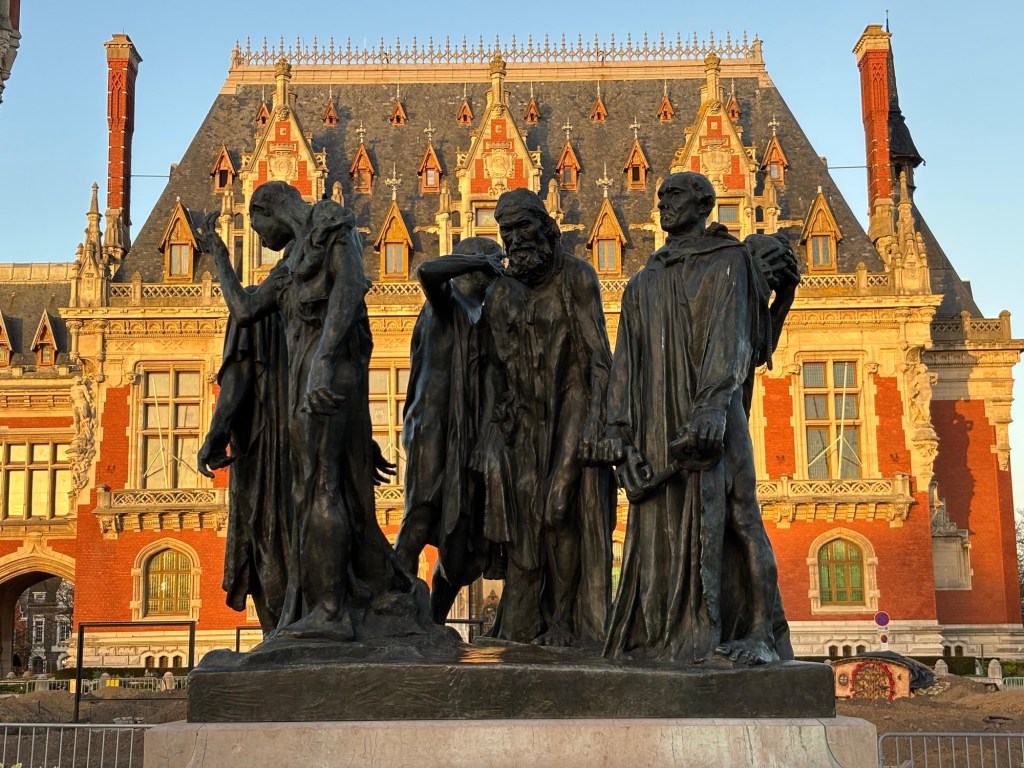
I had seen a copy of this statue somewhere, and had studied it at school, but it was very moving to see it in the place it had been intended, and to experience the impact of Rodin’s quiet exploration in the fourteenth-century events of a new kind of heroism. We walked around and around it, appreciating the details of hands and faces, and the way the figures interacted in their circular form. I felt embarrassed as an Englishwoman that the statue commemorated a disgraceful episode in our nation’s past, in which the lives of these courageous men were willingly sacrificed in return for the lifting of the English siege of the city, so long ago.
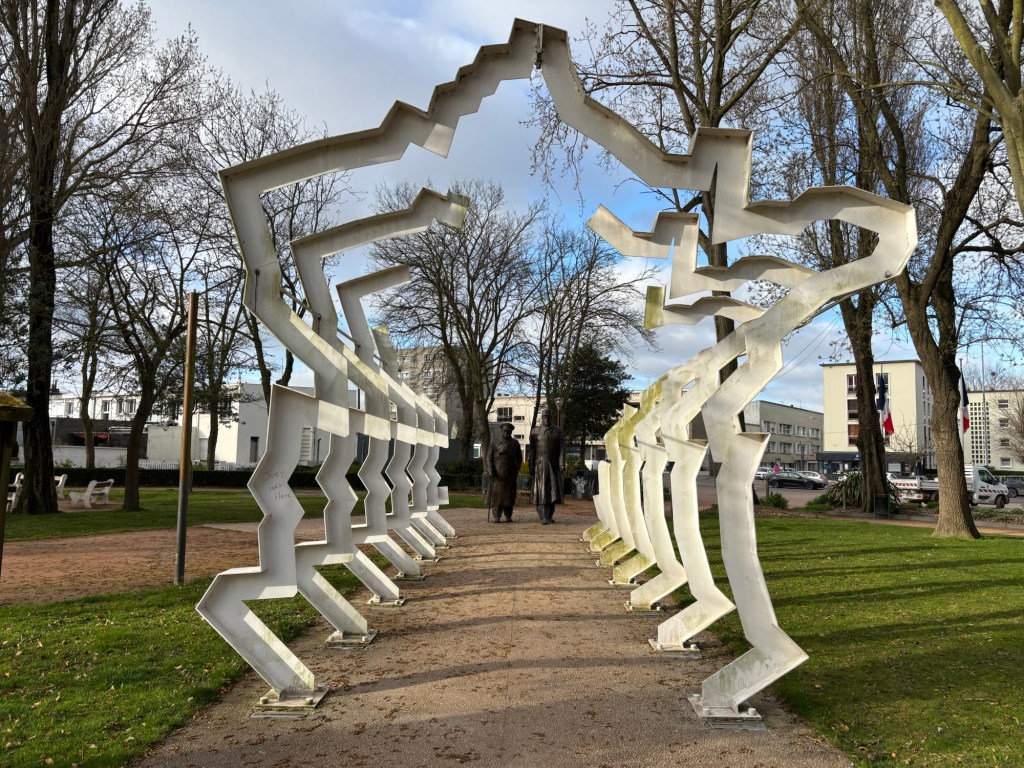
Our little hotel was on the far side of Parc Richlieu. Walking through the park to reach it we encountered another sculpture, unexpected this time, the unmistakeable figures of Winston Churchill and General Charles de Gaulle.
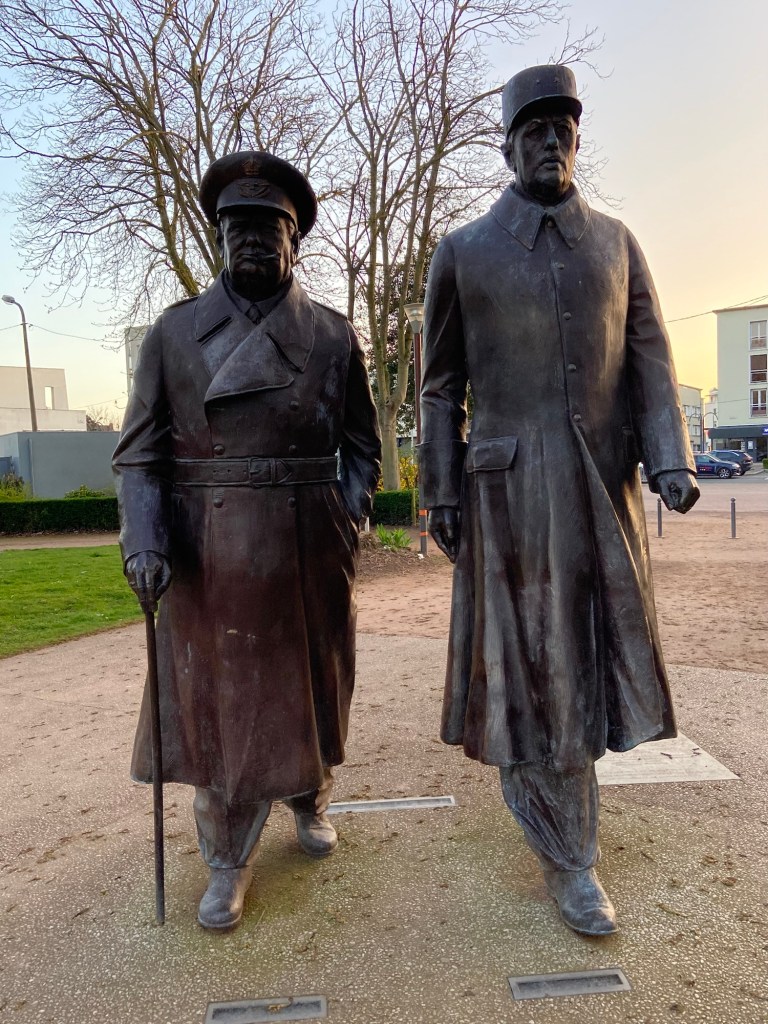
They were standing at the end of a corridor constructed out of a receding series of outlines of France, the closest one to the statues being broken, and becoming gradually whole and entire as the series nears the viewer. It was a lovely reminder that over the long history of the relationship between our two countries, there have been real moments of cooperation and closeness.
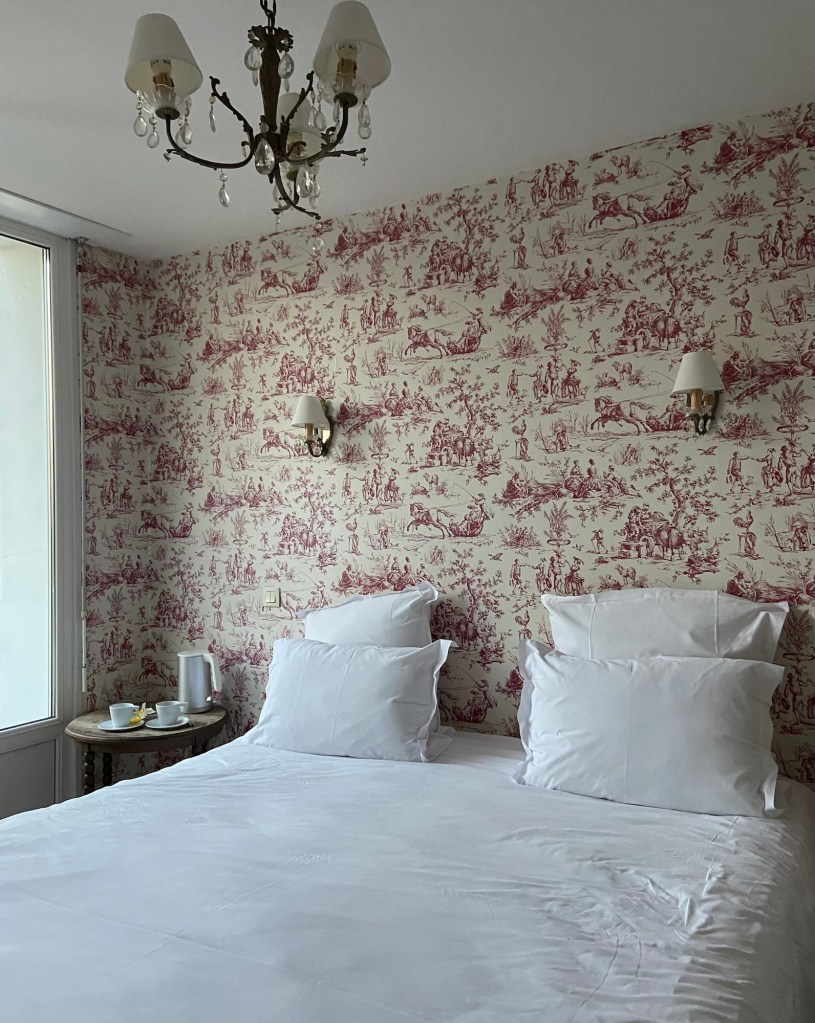
We arrived at Hotel Richlieu just as our host was leaving, and Benoît welcomed us on the steps and seen by us up to find our room. It was perfect: newly renovated, with a very few but beautiful pieces of furniture, lovely toile de jouy wallpaper, and an exceptionally comfortable and enormous bed. We opened the doors to the balcony and to the sound of blackbirds and robins singing their hearts out as they came to roost in the plane trees of Parc Richlieu, seeming to welcome us to France.
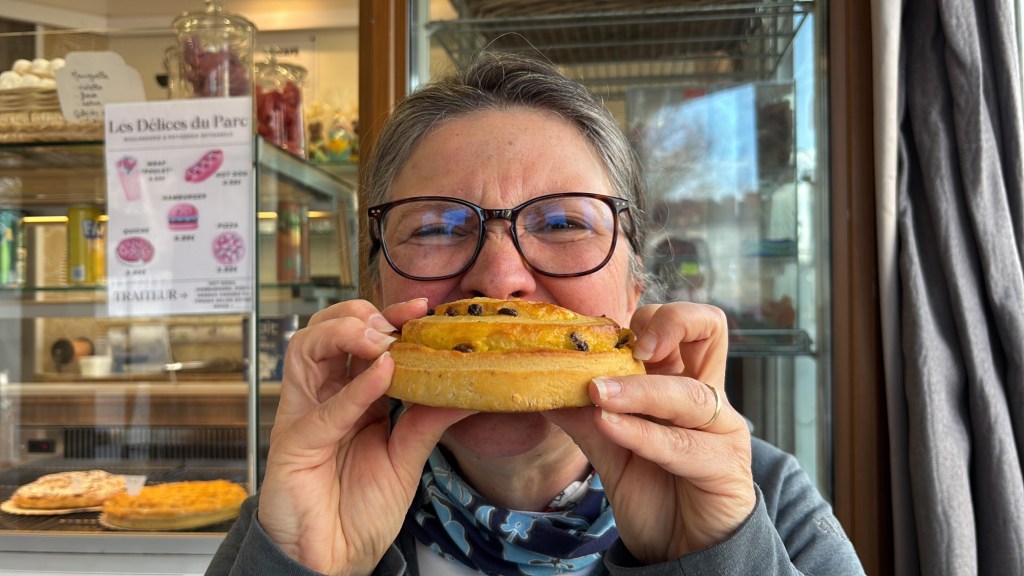
We didn’t need supper after our enormous Turkish lunch, but we were very hungry this morning. We found a bakery not far from the hotel where we could caffeinate ourselves in preparation for the day’s walk, and do some jolly experimental chatting with the young woman who was serving. Calais pastries seem to be quite doughy and heavy, but the croissants were excellent. I couldn’t manage all my pain aux raisins so saved some for later.
The other task we needed to accomplish was to ascertain whether we could get cash out of the ATM with the currency card. Successfully newly afloat, so to speak, we headed down to the beach to begin the French stage proper of the Via Francigena.
It wasn’t very far, but was not uneventful since not only were we delighted to spot the little pilgrim decals stuck to the municipal pavements, but also, for the first time, the all-important red and white symbols of the GR145 signage. We were particularly pleased to have understood the symbol for ‘take a left turn here’.

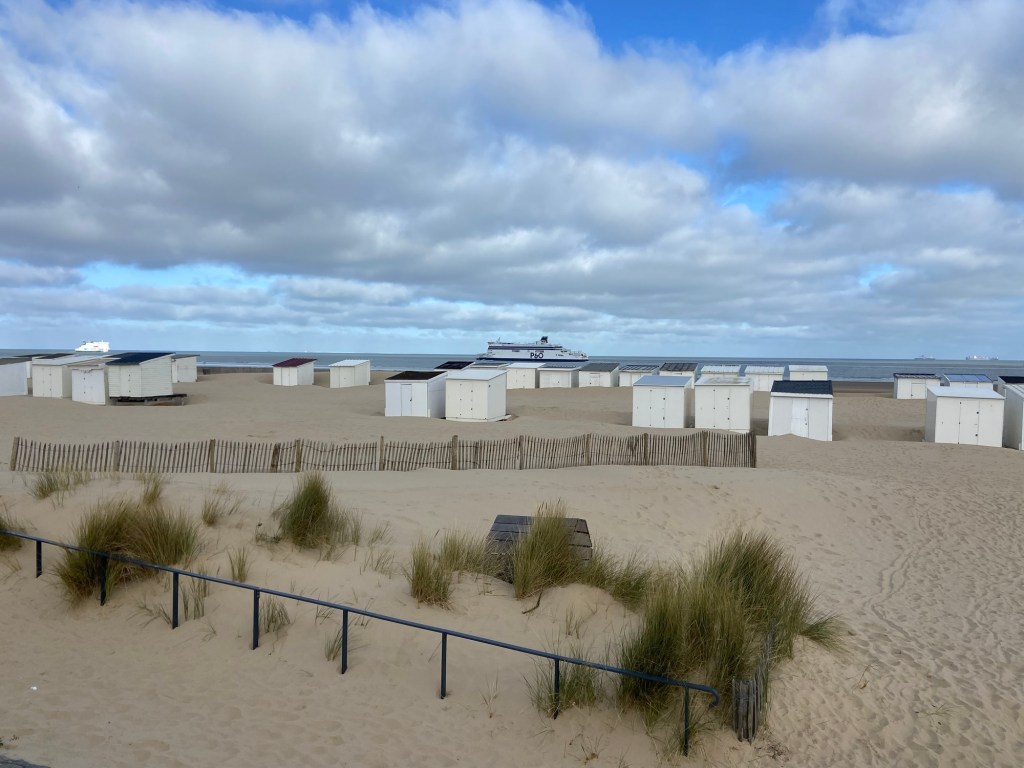
The beach was surprisingly attractive for one by a gigantic ferry terminal: it was still out of season but the little beach huts and booths to sit in, the golden sand and the public exercise equipment like spinning bikes with a great view out to sea, gave the promenade a jaunty, welcoming air.
But were we to be in danger of overromanticising this part of the coast, we had only to look at the stencilled graffiti to see sobering reminder of other people’s realities.
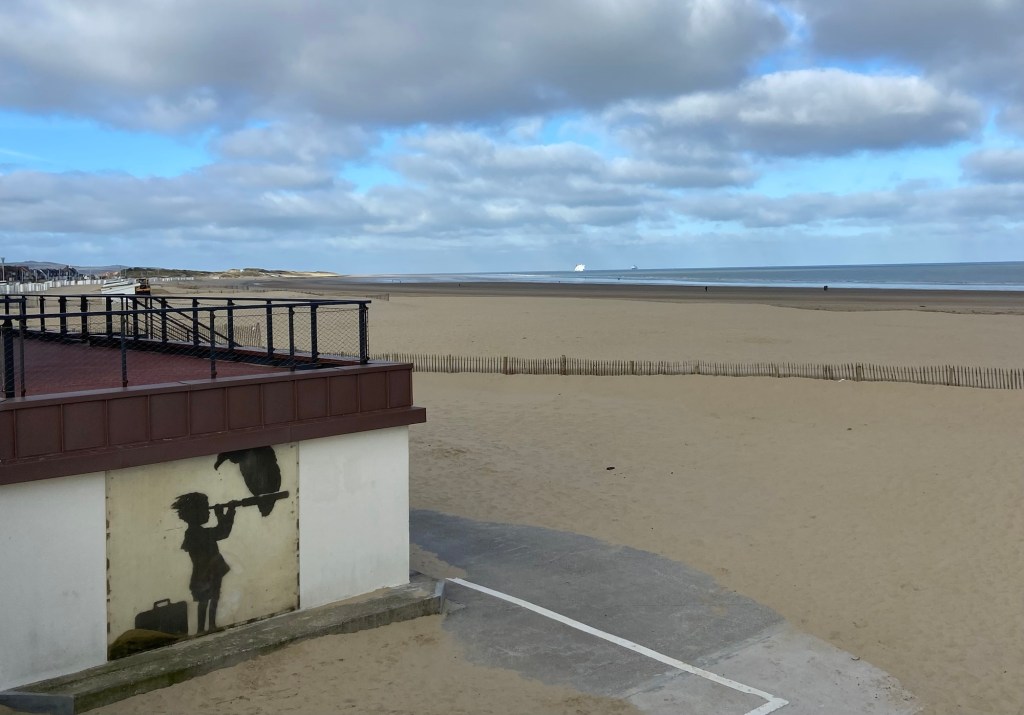
We were heading westwards, a counterintuitive start to this walk which otherwise traces an almost direct line south east from Calais to Lausanne. I think there is no reason for the routing other than Sigeric came this way on his path to Rome (had he made a mistake and got his cardinal compass points completely confused, perhaps?), but a coastal path is always a joy, and there isn’t another one until Italy! We set off towards the white chalk cliffs we had been so excited to see from the ferry yesterday, ready to savour the day.
Rather than making us wading through dunes the Via took us straight down onto the beach, where the retreating tide had left wonderful flat firm sand for us to walk on with no danger of any sand ingress into our shoes.

It also gave us a reminder, this time of historical tensions rather than contemporary ones, in the still-extant concrete German gun emplacements embedded in the dunes. Many of them showed signs of having been targeted by colossal explosions, listing sideways or broken into pieces.

While my WW2 expert was examining the historical remains, I was chatting with a dog-walking gentleman about the little socks his dog was wearing on his back feet, to protect them from getting cut by the shells. I was very proud of my French conversation skills, since I do not remember learning the vocabulary at school for the scenario for a sock-wearing dog (although I do know a Welsh nursery rhyme about two dogs wearing shoes).
At a certain point we should have come off the beach to do a small section in the dunes I think, but we missed it and by the time we realised, we were enjoying the beach so much that we didn’t see the reason to leave it. We could see that we could walk right down the coast as far at least as Sangatte.
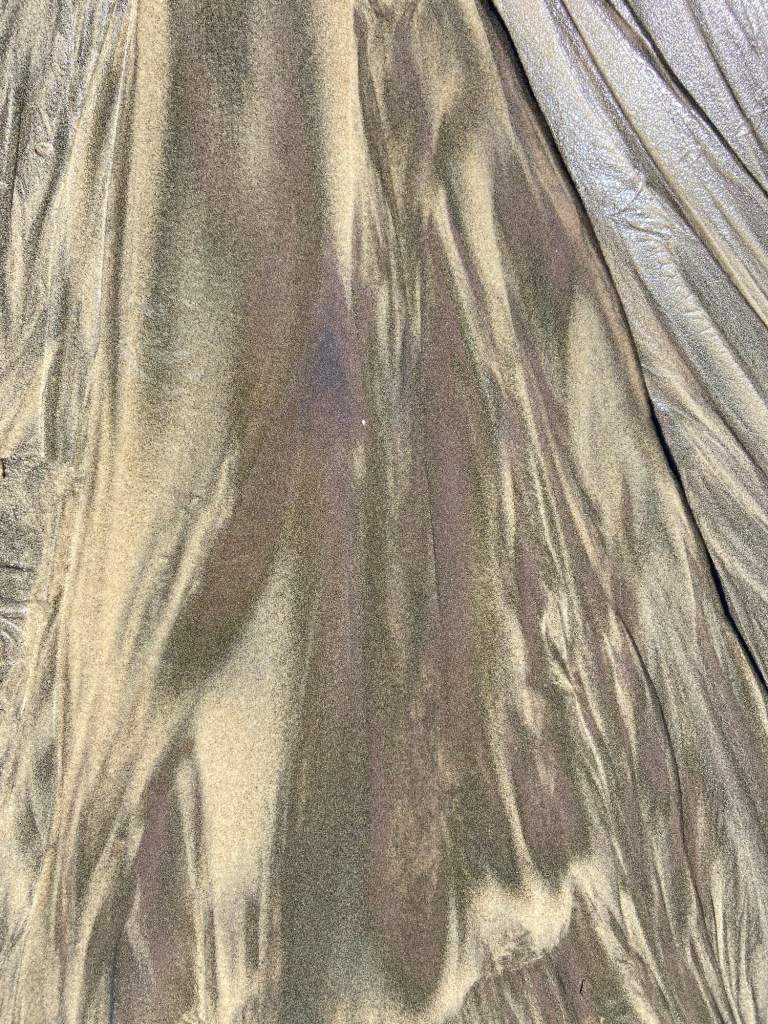
There were the usual extraordinary beach patterns in the sand, this one created by a rivulet of water separating out the grains of different colours,
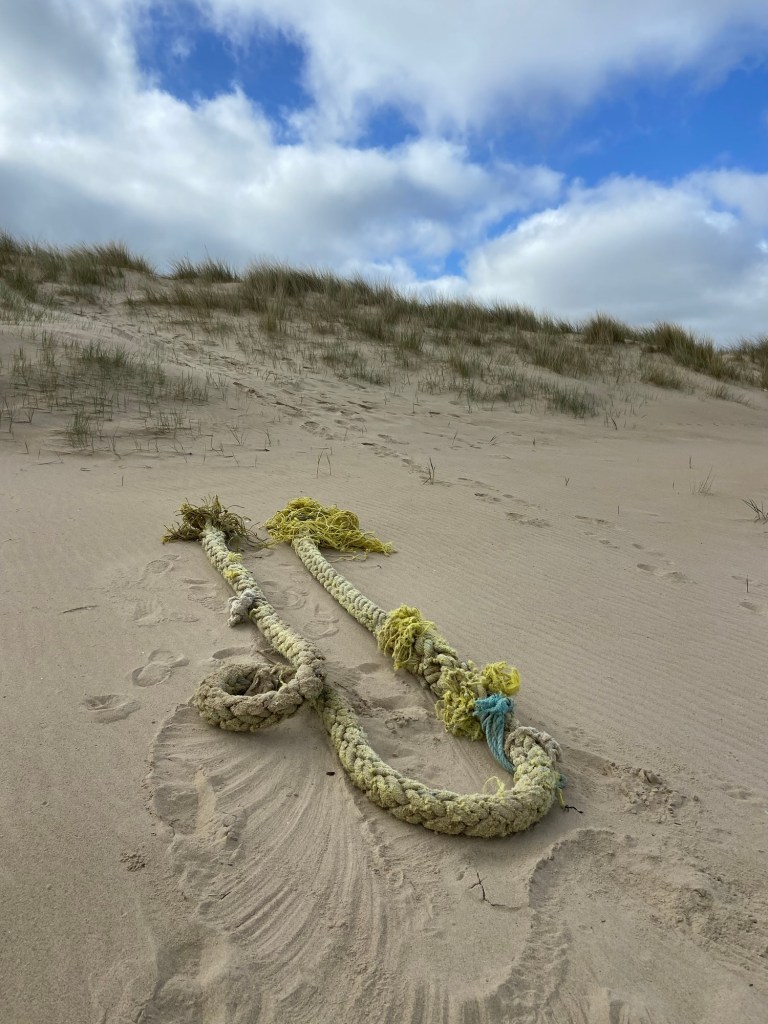
And statement pieces in the beach art gallery like this giant hawser blown ashore and landed high and dry:
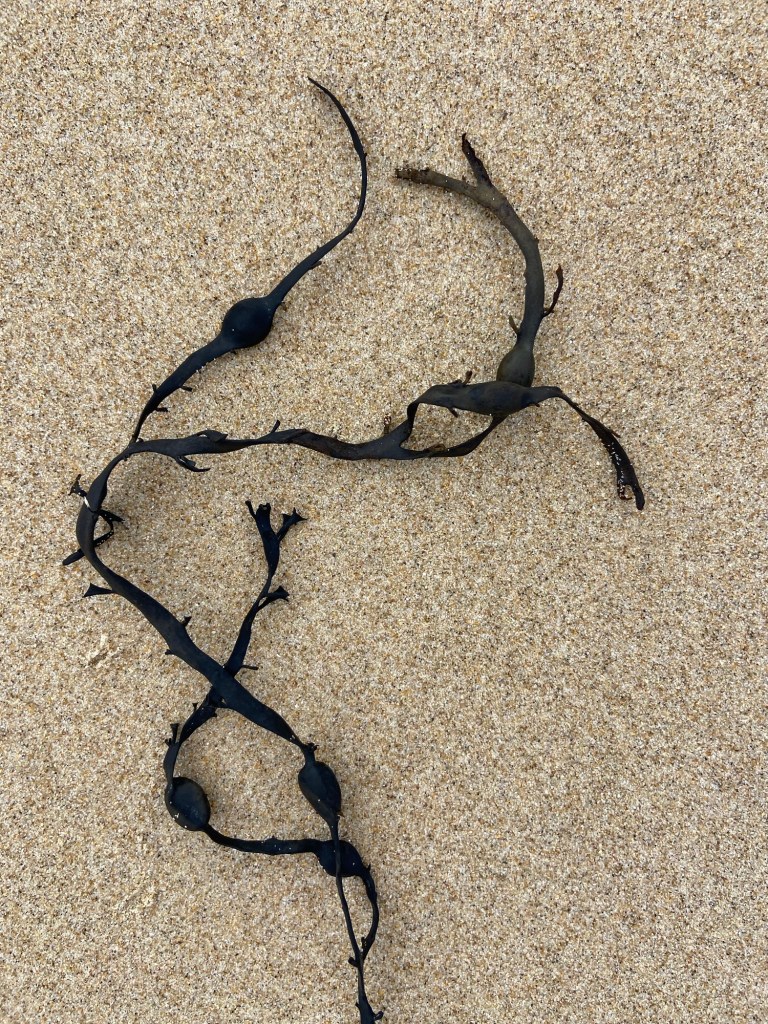
But even the humblest item is made special by arranging it on flat sand, even pieces of desiccated bladderwrack.
And then there were the really special treasures, pieces of sea glass, involuted intact oyster shells of a kind I haven’t seen before,
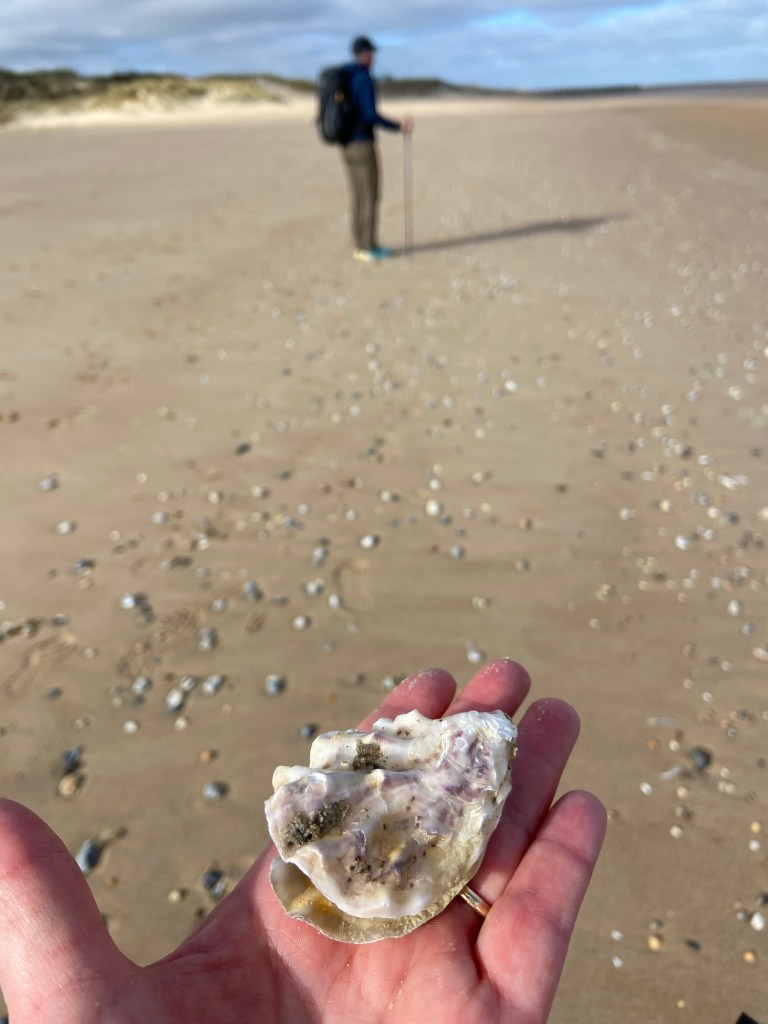
and best of all, a little plastic tapir with an articulated head. I am taking him on the walk with me.

Sangatte was a pretty little village, with a hefty police presence as the only sign of the migrant crisis. We saw our first quintessential mini-chateau-style houses,
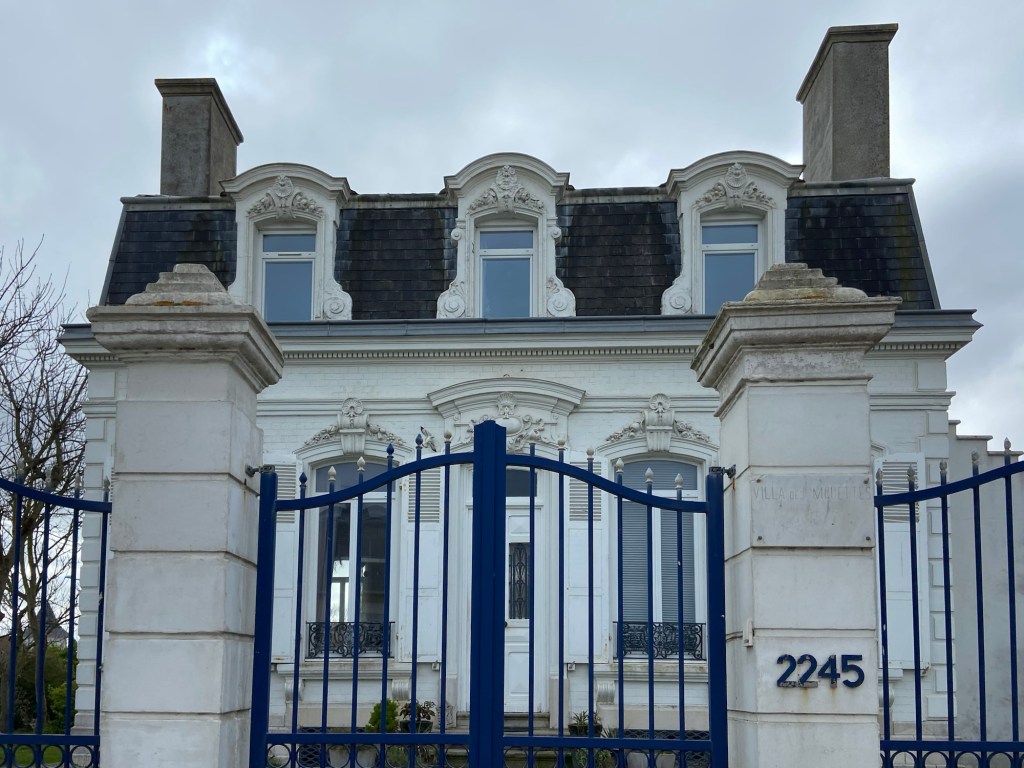
and a 1930s hotel, all elegant detailing.

From Sangatte the Francigena now headed temporarily inland, climbing steadily to the lookout at Cap Blanc Nez. We were both pleased at how our new shoes were handling the rocky surfaces underfoot — our feet weren’t getting tired at all and I remember in contrast the first painful days of the End-to-End. We stopped every now and then to ake in the views, across the Channel and all the way back to the analogous (although taller and whiter) chalk cliffs of the English coast.
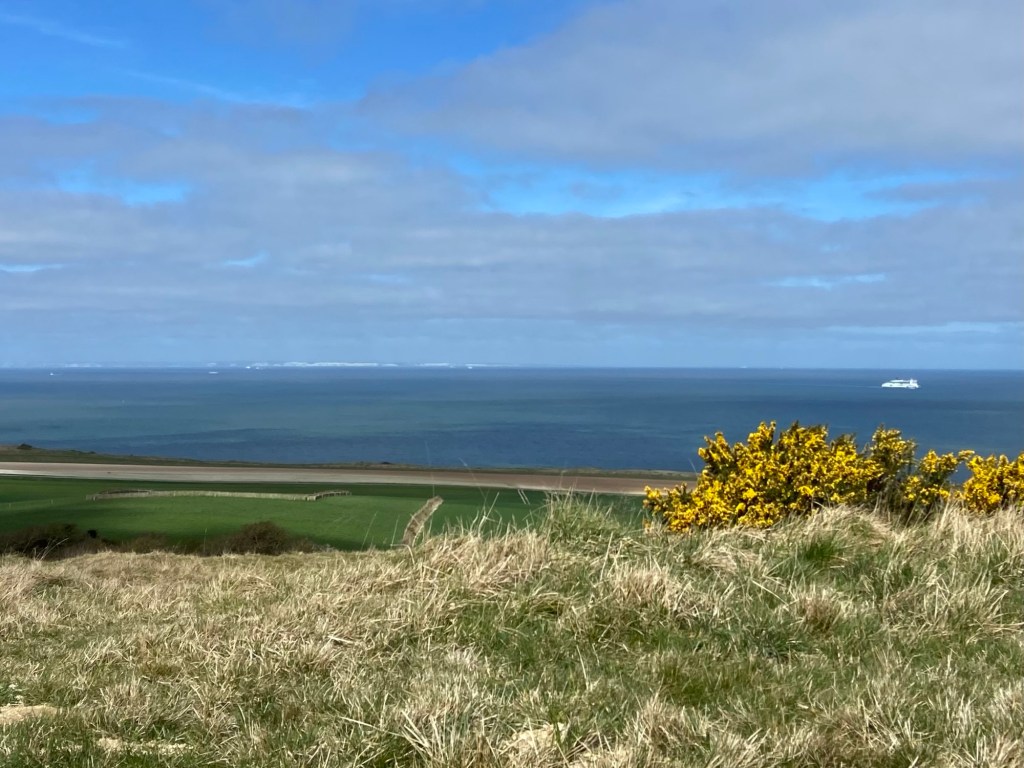
Atop Cap Blanc Nez sits a gigantic monument commemorating the work of the Dover Patrol, but that was as nothing compared to the colossal view of the Côtes d’Opale which stretched away before us all the way to Wissant and beyond. We like the other tourists stood at the viewpoints, appreciating the extraordinary variety of peacock colours of the sea far below.
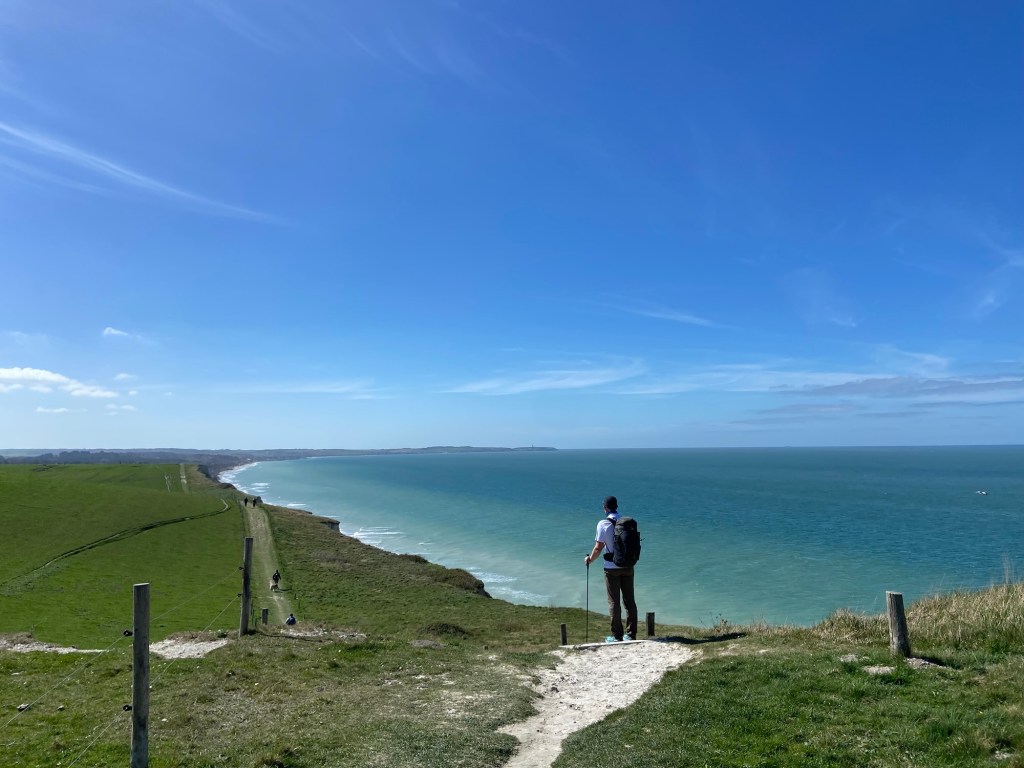
Our path also stretched away (a happy distance away from the crumbling cliffs, about which there were many warning signs), so we powered along it in the direction of Wissant, enjoying the warm sun (although I realised by the end of the day that I should have put some sun screen on my arms) and the tremendous views out to sea.
Soon, a GR red and white sign pointed us down some bleached wooden steps back onto the sand, where really it could not have been more exquisite. Soft waves of the blues and whitest varieties hissed over the sand and dissipated at our feet,
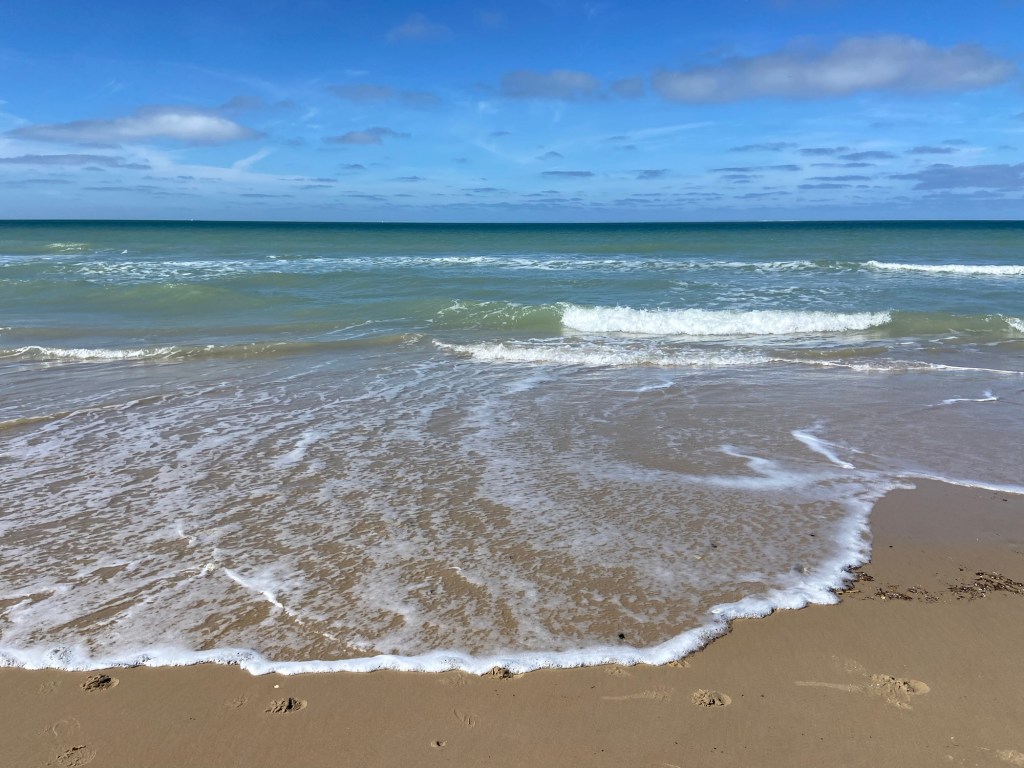
and it was a crying shame that since we had walked along Blériot Plage in Calais the super-high spring tide had roared up the beach, and ahead of us has reached the top of the single where it met the low cliffs. We were just in time to leave the beach with dry feet before the waters reached us — I am not sure the woman behind us and her dog were so lucky.
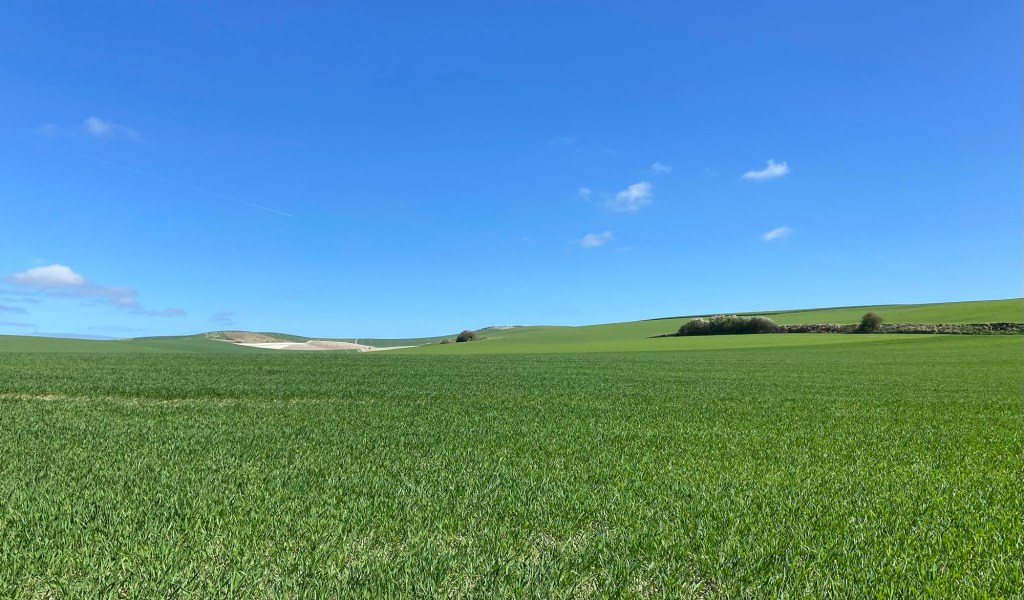
With the beach effectively closed, a detour was necessary, slightly inland and into Wissant. I would rather have been gazing at the sea but the fields made a spectacularly sweeping alternative panorama, an analogue to the rolling sea, reaching the chalk cliff over which we had just walked, far now in the distance.
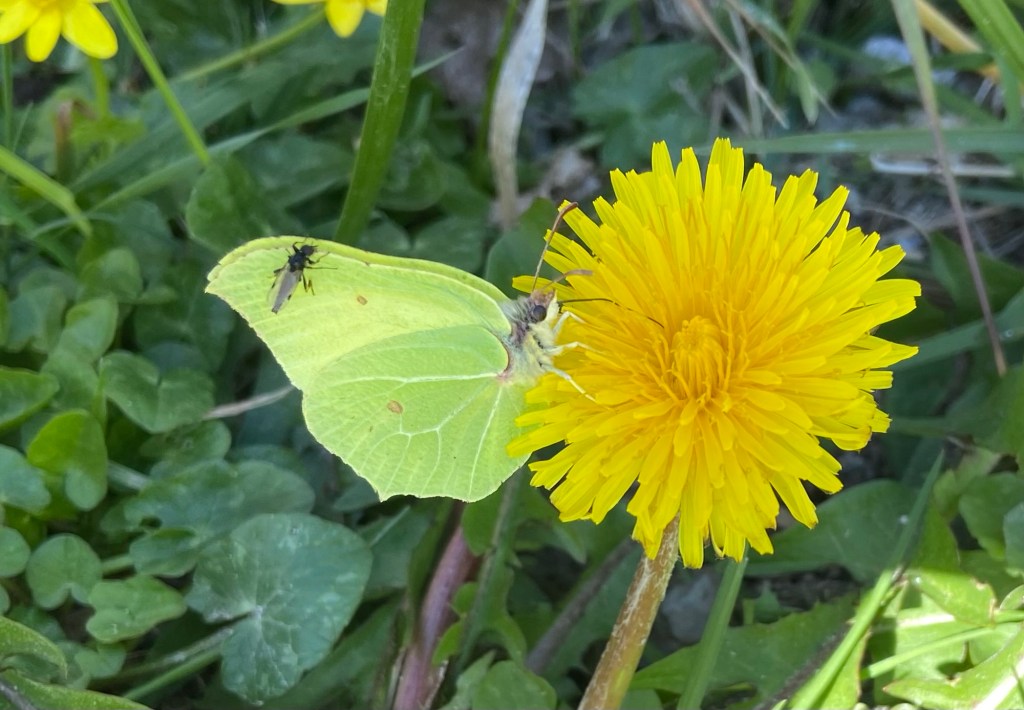
Dodging the terrifyingly speeding motorcyclists on the road was not just our job, but also that of a brimstone butterfly, clinging for dear life to a dandelion on the roadside while the motorbikes roared by. And a tiny fly was clinging in its turn to the butterfly’s wings.
We decided not to go into Wissant village since the detour had joined us up with the road out of the village to Audembert where Micheline and her partner Paul lived. We were effectively taking a chunk out of tomorrow’s walk, which was a a good thing as it is slated to be a long one. It was good to be walking on a country road rather than a main one,

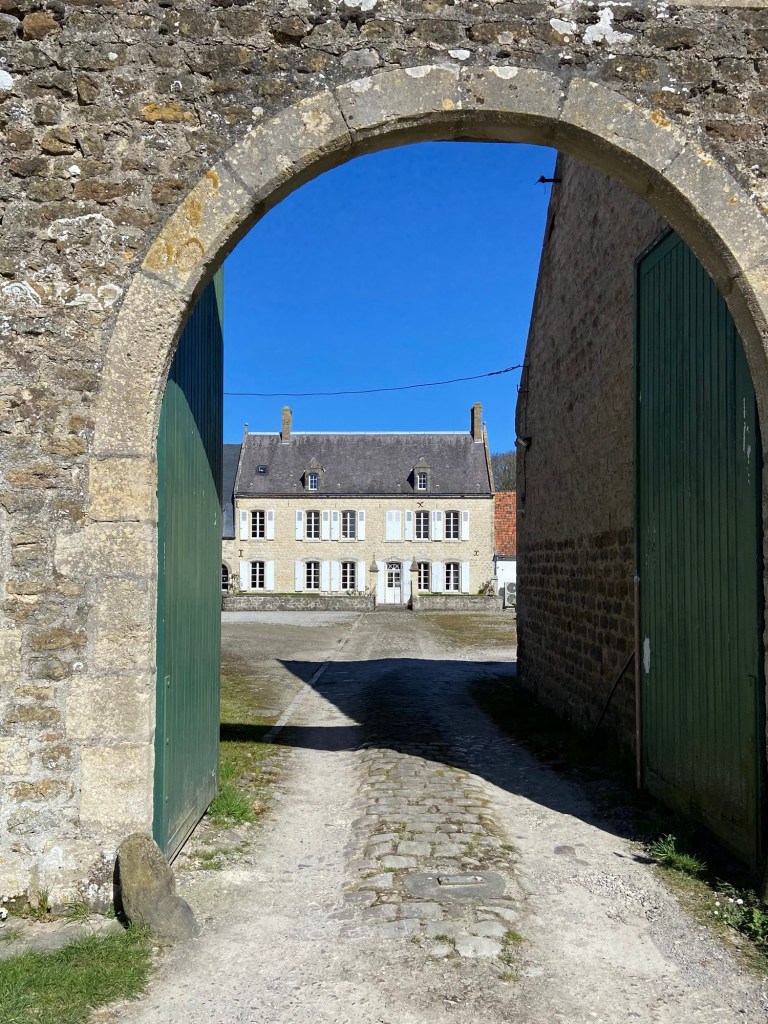
past massive, quintessentially French farm houses.
I realised about three kilometres in, when we sat on an unexpected bench in the middle of nowhere, that Audembert was off the route, so I triangulated the very patchy cartographic detail of All Trails (RIP OS Mapping! You are sorely missed) with that of Google maps and located a couple of footpaths we could take to get there.
We both felt that off-routing with All Trails didn’t feel very comfortable and it was more than nice to have Stephen there with whom to talk rerouting. Tomorrow I might try using the IGNRando app instead. But as it turned out the rural paths were really excellent, and signed for mountain bikes, two of which powered past us on their way down to Wissant.
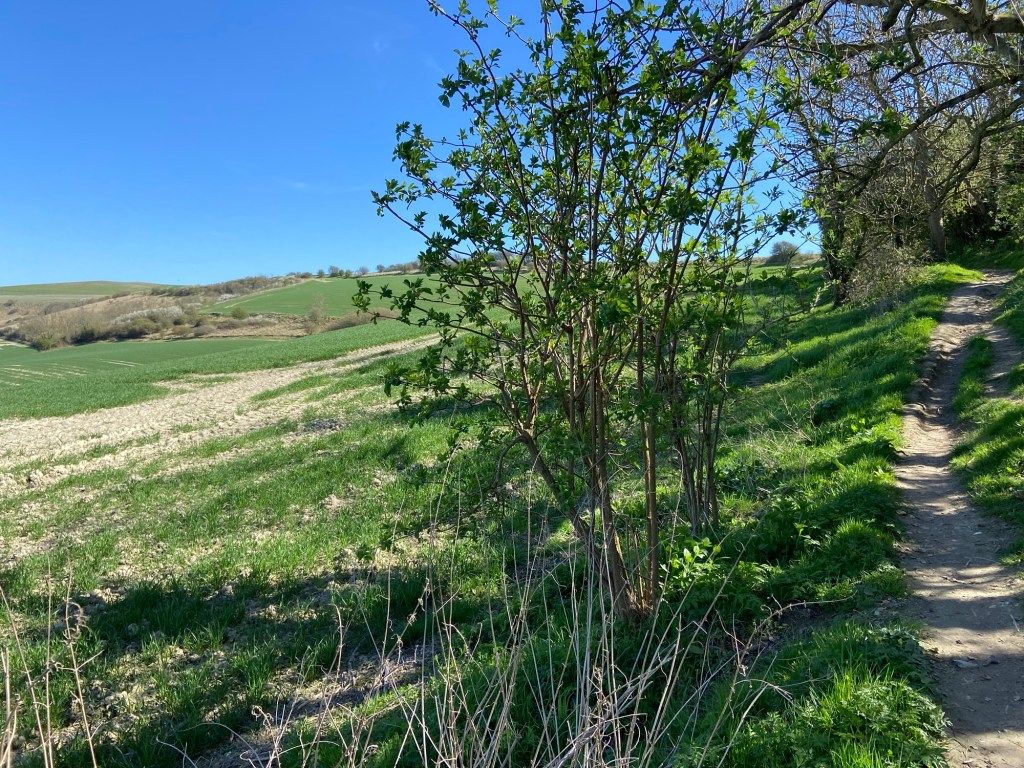
From the top of the hill we could at last see Wissant, and in the other direction the spire of Audembert church near which Micheline and Paul live.
It was short work to locate their house after that, and we were welcomed by Micheline with offers of showers and two pots of gorgeously refreshing home-made lemon balm and liquorice tea.
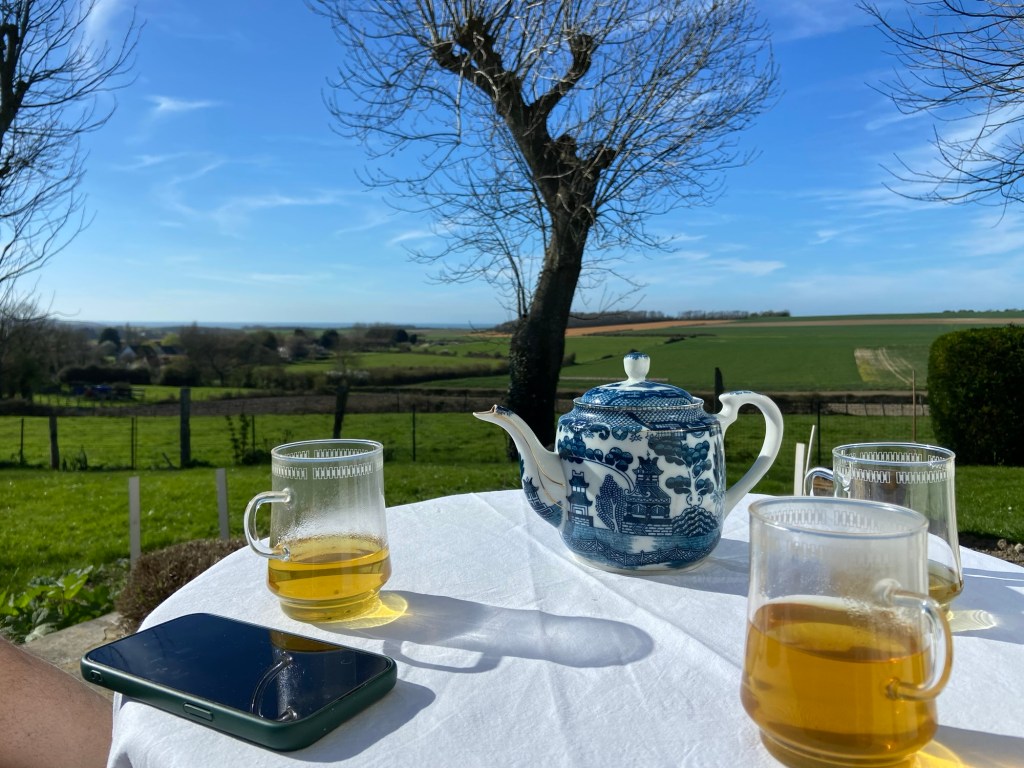
There were wonderful conversations too, and then the most delicious home-cooked three course meal. We are the first pilgrims of the year for Micheline! I am sure a few more are hot on our heels.
Micheline and Paul kindly offered to drive us down to the village to see the section of beach we hadn’t been able to walk along earlier. The tide was far out again now, and the sun was setting spectacularly in the west, casting long shadows towards us behind the wooden breakwaters.
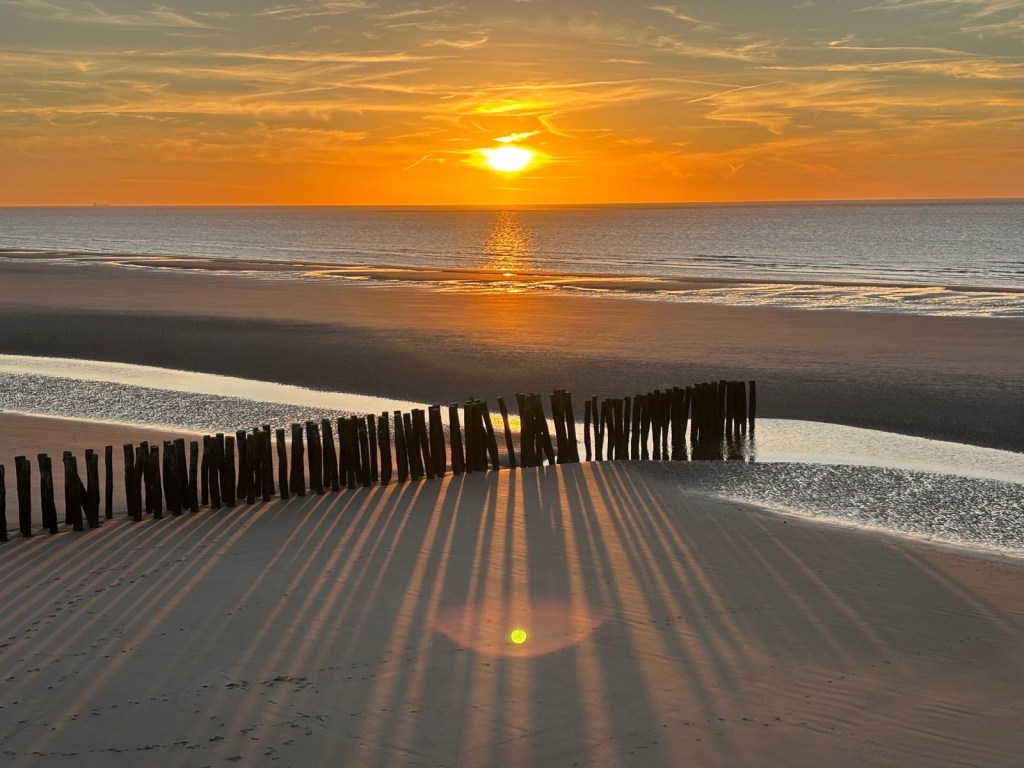
It was the perfect end to our first day in France. We had been made to feel incredibly welcome, with treat after treat. I cannot imagine that we will have a warmer welcome or a more delicious meal for the rest of the walk… it’s all downhill from here!

Stats for the Day:
Distance: 25.2km
Climb: 373m
 Walking The Landscape
We went to the Dover Patrol and those beaches with the kids. I have a wonderful photo somewhere that I will dig out. What a wonderful first day in France.
LikeLiked by 1 person
Wow!! Lots of maritime interest yesterday. One day only!!
LikeLike
What a fabulous first full day walking in France. I’m really enjoying the photos, some beautiful captures. X
LikeLiked by 1 person
Oh Gilbo! How lovely to hear from you. My walking pal! Glad you enjoyed the read xx
LikeLike
I wouldn’t miss it for the world. You are my after lunch rest and reading. 😊Xx Gill
LikeLiked by 1 person
Hey,
can you tell me how long it took you to get off the ferry and into the centre of Calais?
The thing is, I shall be taking the morning ferry from Dover to Calais, and after my arrival I will have to carry on walking to Audembert, so I wonder how much time I shall have for that. I have already booked a bed with Micheline and I am so glad I did after reading your blog post!
Thanx!
Christian
LikeLiked by 1 person
There’s a shuttle bus that takes you into the centre and I’d recommend that as it’s otherwise a 50-min walk on roads that are not designed to be walked along. It took us 5.5 hrs to walk from the centre of Calais to Audembert (moving time).
LikeLike
Thank you very much for your reply. That’s good to know! And also thank you for your PM, I saved the track in my app, so I shall have no problems finding my way then!
Keep on walking!
LikeLiked by 1 person
You are most welcome! We did two stages today — Guînes to Tournehem. 🤪
LikeLiked by 1 person