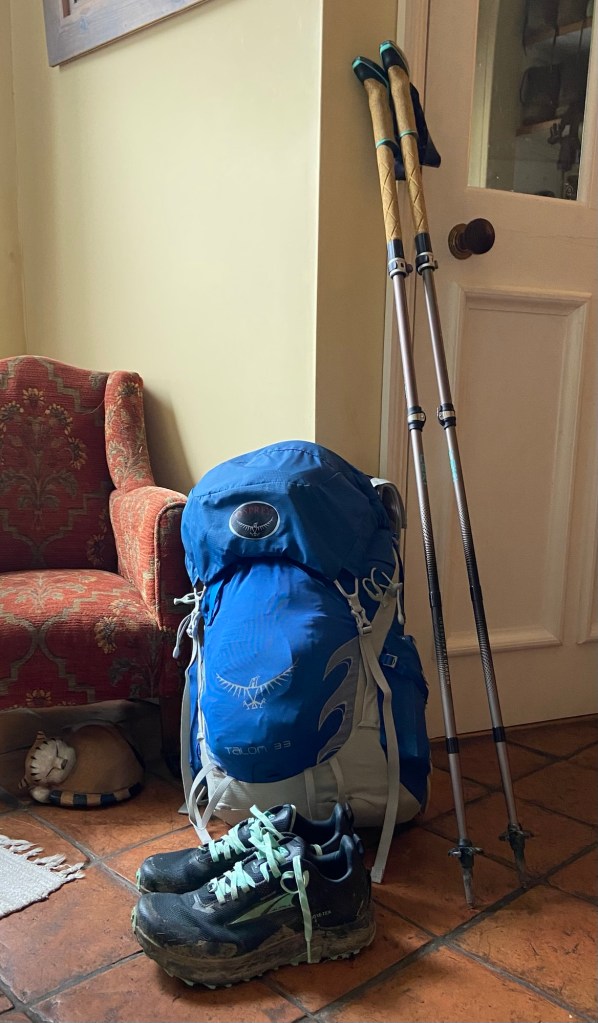
I had the rucksack ready packed for the morning and had reduced its weight from 17 to 15.5 kilos by leaving out binoculars, a transistor and part of the cooking equipment.
Gerard Hughes, SJ, In Search of a Way
I seem to have been planning this walk for months, although it’s only been the last four weeks or so that I have been preparing in earnest. The route is established for me, so my tasks are to arrange accommodation, attend to the nitty gritty of administration, and decide what to take with me.

To supplement to the published guide to pilgrim accommodation on the Via Francigena, an exceptionally kind member of the Via Francigena Facebook group offered me the spreadsheet of her itinerary, complete with the details and costs of all the accommodation she had arranged for herself. I have used this as a lifeline, and arranged to stay in the same places for the first couple of weeks while I am walking with Stephen. We have two rest days planned, one after the first week of walking, and then a day together in Arras before Stephen gets the train home. After the socks are washed there might even be a little time for sight-seeing, per Sandy Brown’s Cicerone guide, and some fancy food…
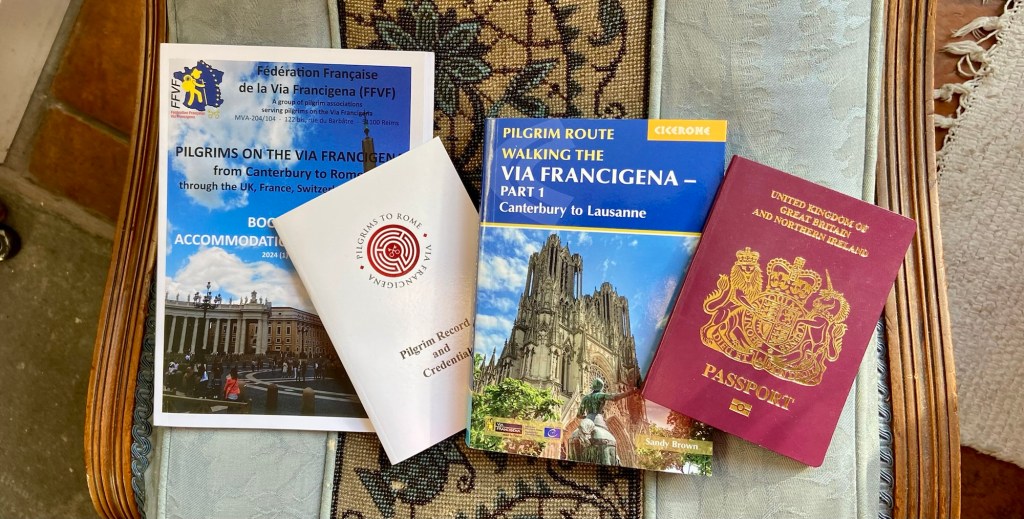
Train tickets are purchased, the ferry is booked. Insurance was something of a pig because although we have annual multitrip insurance this one is a big one, more than twice the 30-day trip limit, so isn’t covered. I have taken pity on Stephen and will worm and de-flea the cat before I go, and have made alternative arrangements for some of the more exigent houseplants which I doubt would have survived two months of benign neglect.
I consulted an online how-to-pack guide for would-be medieval pilgrims, and was pleased to see that I have pretty much ticked all the boxes, with a few extra modern conveniences.

- The iconic pilgrim’s staff – well, I carry two in the form of my walking poles. I note that the medieval pilgrim’s staff could, ‘in an emergency, function as a makeshift spear’. Because you never know when you might be set upon by robbers in the forest. The poles I am taking are all-singing all-dancing fantastic new ones courtesy of Stephen’s mother Judith. I love my trusty old poles (‘what larks!’) but they don’t collapse down far enough to fit into a bag or case. More importantly they’re not 100% reliable: the locking part of the mechanism which resizes them failed at the start of the South Downs Way a couple of years ago, and I had to walk with one pole for a week. When I got back home my walking pole expert mended the broken one by cannibalising a section from another pair; I have used them since and they have been faithful companions, but I am not sure they have another 1000km in them. The new ones come with detachable rubber ends for walking on roads and pavements, and a Special Bag.
- I don’t take with me a pilgrim’s hat – especially one ‘resembling a salad bowl’ like the unfortunate medieval traveller depicted above. I have a hairband which kind of fans out to cover my head from (what I hope will be) the powerful rays of the sun. The how-to guide notes that bona fide pilgrims attach pilgrim badges to the hat, but instead I have got a ‘credential’, a little booklet which I will get stamped every day like a sort of a passport. How one locates these stamps is one of the mysteries of the journey that I am looking forward to solving. Excitingly, the credential gets presented at the Vatican when I finally get there, and, having proved I have walked all the way, I will be given a Testimonium, a very grand certificate written in Latin.
- I don’t know why medieval pilgrims didn’t carry a kind of rucksack or backpack. I think quite a few of them went on horseback… which seems to me to be a huge cop-out. They had a scrip (a mini satchel), plus sometimes an extra bag which was hung from their staff, Dick Whittington style. In the picture above it’s the woman who is doing most of the heavy lifting but I can assure you the Holroyds live in more enlightened times. My gear bag is my mouse-eaten old faithful blue Osprey rucksack. In it is my modern equivalent of the surcoat or gardecorps – my excellent set of Gortex waterproofs, which unlike the medieval equivalent don’t have circular sleeves (perhaps the resulting awkward volume is the reason why they didn’t carry backpacks). It also houses my water bladder, much lighter than the ancient versions, ‘costrels’ made from pottery, leather or wood. I don’t plan to carry more than a litre and a half of water at a time; one of my kind hosts has already messaged to say pilgrims can fill up from water-taps in cemeteries, and I have found that many householders are willing to give me a glass of water. Also in my bag is the mod con to end all mod cons which no medieval traveller could even have dreamed of: a mobile phone. Unlike the thoughtful Jesuit pilgrim Gerard Hughes, who undertook the Via Francigena in 1975, I do not have to leave out a ‘transistor’ radio because my marvellous phone has radio, video and all the maps, geolocation software and reading books I could ever want, as well as guides to identify birdsong, flora and fauna. It is my camera and my diary and notebook, as well as my contact with family and friends back home. It necessitates its own paraphernalia: a heavy powerbank, EU plug and charging cables, but all of that is worth its weight in gold. In the rucksack has gone also the sleeping bag and luxurious new silk liner (fantastic Christmas present from mum), and any doubts I had about including what is a fairly bulky item have already been removed by three of the hosts we are booked in with having checked with us that we are carrying our own bedding. So far on my walks I have either camped or used B&B/AirBnBs, and I’m quite looking forward to using pilgrim staging posts, a new form of accommodation.
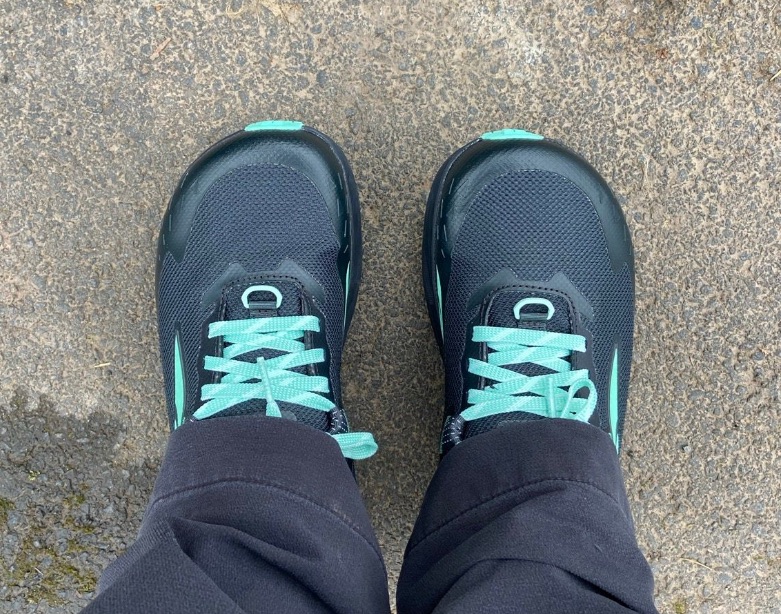
- Some medieval pilgrims are depicted walking barefoot. I do not intend to do this, although I may cool my aching feet in refreshing mountain streams. I’ve had quite a few problems over the last few years with footwear causing blisters. I have come to the conclusion that it’s partly down to incorrectly-sized (and subsequently poorly constructed, although ruinously expensive) custom footbeds, and partly down to my feet changing shape as I age. For this walk I had to decide between walking boots and hiking shoes… I can’t take both. For a walk such as that to Cambridge shoes were a safe bet: there was no mountainous terrain and a fair amount of walking over paved surfaces; for the End-to-End walk there was a good deal of the former, and ankle support and a robust construction was crucial. Shoes let in a lot of water, boots make feet hotter. Boots are waterproof, shoes have better shock absorbency. After some research and trials in Trekkit, Hereford’s Mecca for outdoor gear, I went for a pair of Altra Timps, waterproof hiking shoes which seem to have excellent grip (I am thinking Jura Mountains), a wider toebox (which gives space for the toes to flex) and a weird shape which is supposed to anatomically replicate the foot at rest. I tried them out on a couple of long walks, judged them to be a success, and put them aside… they will have between 4-800km of wear in them and I need them to do 1000, so the last thing I want to do is waste their precious shock absorbency and grip on piddling little walks around Bromyard. I have rebooted (see what I did there?) my stocks of Compeed, the phenomenal hydrocolloidal plasters which I have found to be a match for even the most vicious of blisters.
I have done a test pack. There were a few things I have yet to assemble (like emergency gels), but I also considered I could jettison a few things too. There is a section in the middle of France where you go two or three days without seeing a shop, so I initially packed three dehydrated meals, but I don’t really want to have to carry them for two or three weeks before needing them, so I took them out. I sadly put to one side my tiny binoculars as well; I know I will regret not taking them, but they are a luxury. I might reconsider before I go. Stephen has a little foam sit mat (‘observe my foresight!’), and I might regret not having one of those. Without water and the clothes I’ll be wearing, this lot weighs just over 7kg. Which is quite remarkable, really.

There has also been a certain amount of physical preparation. I had lost a lot of fitness by lounging about over most of the autumn (if my memory serves it rained for months) and overeating at Christmas. It was sobering to see on Strava that I only got out to do even tiny short walks on six days in the whole of December. Since the new year I have made a concerted effort to get out and really push myself to get my muscles into shape, especially those supporting the knee which I damaged walking to Anglesey last May and which never recovered properly. Physio and osteopathy haven’t made any difference, but better muscle strength has. Walking poles certainly help, and I have found that if I consciously engage my glutes rather than my quads to walk with, the knee isn’t making so much effort. If there’s anything that’s going to put the kybosh on this walk it will be the knees, but we will see what we will see.

As for mental preparation, I was recommended two accounts of the Francigena by our friend John V-F (an auspicious name!). The aforementioned Gerard Hughes SJ wrote a terrifically accessible and interesting record of his walk to Rome, In Search of a Way, from which the title quotation of this post is taken, and to my great surprise, Hilaire Belloc of the Cautionary Tales also made the journey, and wrote an account of The Path to Rome complete with his pencil sketches. He tells the following Encouraging Tale:
Seeing an apothecary’s shop as I was leaving the town, I went in and said to the apothecary: ‘my knee has swelled and is very painful and I have to walk far; Perhaps you can tell me how to cure it, or give me something that will.’
‘There is nothing easier,’ he said; ‘I have here a specific for the very thing that you complain of.’
With this he pulled out a round bottle, on the label of which was printed in great letters, ‘BALM’.
‘You have but to rub your knees strongly and long with this ointment of mine,’ he said, ‘and you will be cured.’ Nor did he mention any special form of words to be repeated as one did it.
Everything happened just as he had said. When I was some little way above the town I sat down on a low wall and rubbed my knee strongly and long with this balm, and the pain instantly disappeared. Then, with a heart renewed by this prodigy, I took the road again.
I find my heart to be renewed as well, even at the thought of such miraculous cures for painful knees. My version of a scrip contains various specifics that I hope will help mine: Traumadol, an arnica massage cream (bet you a medieval pilgrim used arnica), and Voltarol, an Ibuprofen-based gel to reduce swelling (I have one up on my medieval counterpart there). I have pills too: glucosamine and calcium to help with joint and bone health, and magnesium to help me get a good night’s sleep.
Hilaire Belloc was Anglo-French, and his language skills were impeccable. Mine – not so much. Indeed, one of the things that has gnawing at the back of my mind is the necessity of having to survive the entire length of France on my limited schoolgirl French. I got a B at O-level in the long-ago of the last century, but whatever proficiency I ever had has been lost in the mists of time. Recently, I have found useful phrases washing around in my mind (‘Au secours!’) and I have been reasoning that even spending two whole months in a country must surely improve one’s abilities. However, I finally forced myself to bite the bullet, put Japanese Duolingo to one side as being entirely useless for present purposes, and take up French instead. After a week of lessons I have reassured myself that most of the vocabulary I will need is either slowly floating to the surface, or can be reverse-engineered from Italian, and the verb forms and tenses that were the rustiest part of my linguistic toolkit can be sanded down and oiled.

One last piece of preparation: I have polished the silver St Christopher medallion that John V-F gave us before we set off to walk from Land’s End to John O’Groats. And there were indeed times when we needed its protection from raging rivers. I have threaded the tiny talisman onto a necklace, and it’ll be with me every step of the way.
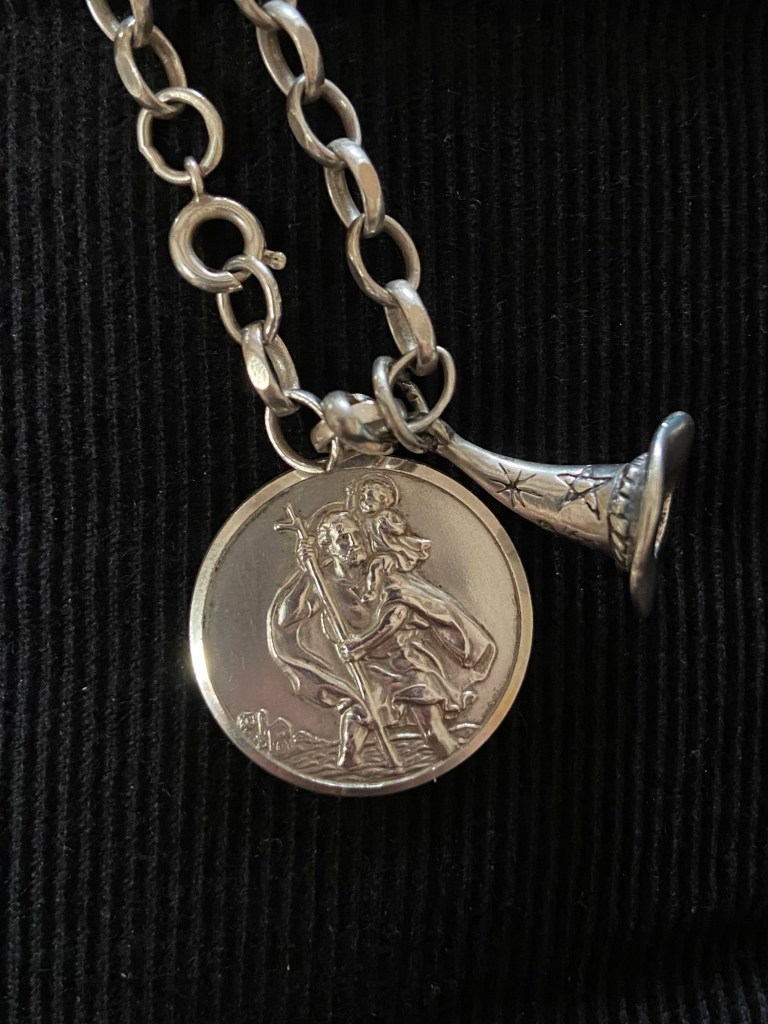
So. The preparations are almost complete. There is less than a week to go now and excitement is starting to outweigh the fear. It’s currently showing rain for Canterbury on Saturday 29th… but a week is a long time in meteorological forecasting, and we have our full wets and our St Christopher. Plus, as my friend Andrea says, ‘skin is waterproof’. Courage, mon brave!
 Walking The Landscape
I am so excited for you. And for me to be following your journey. Bring it on!!!
LikeLiked by 1 person
Bring it on! 😚 🥾
LikeLike
Bon courage! I look forward to following your next journey x
LikeLiked by 1 person
I can hardly imagine it could be any better than YOUR most recent incredible journey! Very much enjoyed following that too! xxxx
LikeLike
As Bob M and Paul W would say “and awaaay”! Looks like you’re all set to go and I’m all set to follow your amazing adventures from my sofa ☺️😘
LikeLiked by 1 person
Excellent!
LikeLike