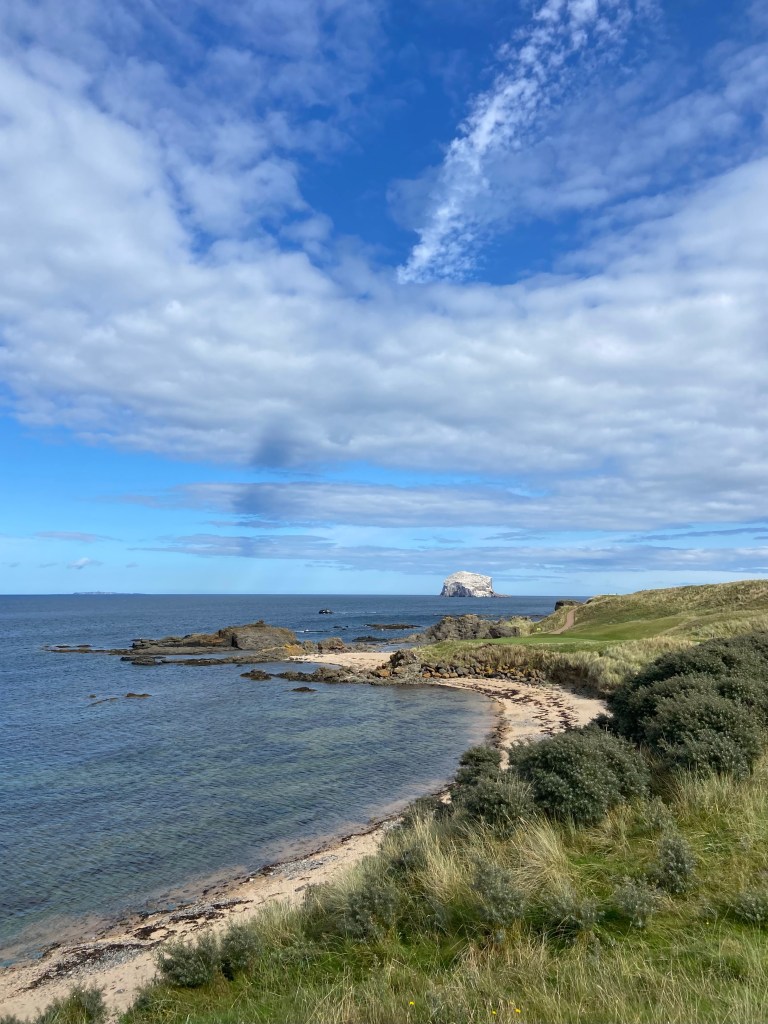
ane wounderful crag, risand within the sea, with so narrow and strait hals that na schip nor boit bot allanerlie at ane part of it. This crag is callet the Bas; unwinnabil by ingine of man.
Hector Boece, Scottish gphilosopher and historian
Last night had been a wonderful reunion and welcome back into the heart of this riotously chaotic, creative and loving family. I had woken at a 3:15 this morning, and lay awake for awhile listening to the barn owls out hunting over the fields, in the knowledge that I needed to write yesterday’s blog, which I hadn’t really been able to get started yesterday evening.
I worked on it for some hours until I joined Adam and Ruth for a peaceful breakfast of bacon and bright yellow scrambled eggs from their own hens. The breakfast table was framed by a spectacular view out over fields studded with what appeared at first glance to be boulders, but which are closer examination dozens of enormous hares, crouching motionless and resting among the stalks of the harvested crops.

One by one the boys appeared, and I listened to their plans for the day while I put the finishing touches to what I fear might have been an overly-wordy blog post, being the account of a very long, but very rich day’s walking. Adam called me away from the blog reminding me of my intention to have been away by 8 o’clock, but it was half past before we climbed into his car and set off for Gullane beach, enjoying one of those half-hour conversations, facilitated by a car journey, about the things which matter most in life.
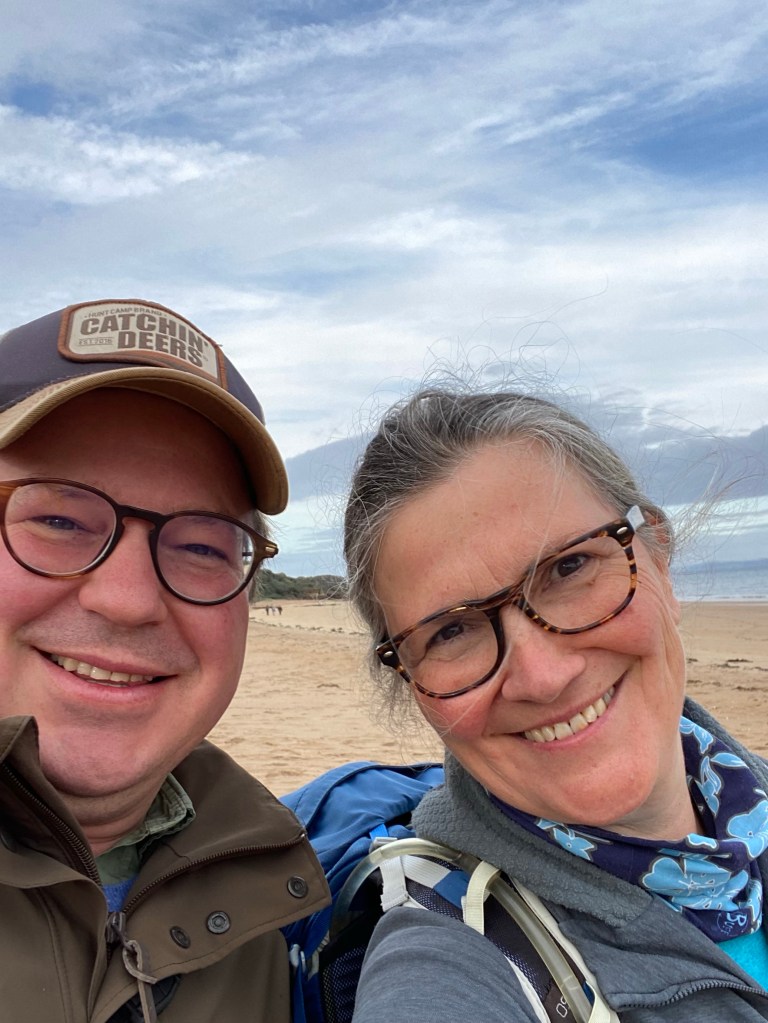
From the car park Adam noticed a long skein of geese flying towards us up the Firth in classic V-formation, those in front slipstreaming those behind, making their forward motion easier. It struck me that Victoria on Friday and Adam and Ruth yesterday and this morning have done the same for me on this journey, providing me effortless food and rest, and enabling my journey to procede smoothly. But the geese doing the hard work at front peeled off to the back, resting themselves while the fresher birds took over, and my domestiques didn’t get that same favour from me! Sorry, guys. I should be more goose.

Down on the beach, we looked back the way I had come over the last two days. Edinburgh was just a shadow on the horizon, but the new Forth Bridge lifted its triple fan of white hawsers resembling the shining pinions of a seagull in flight.
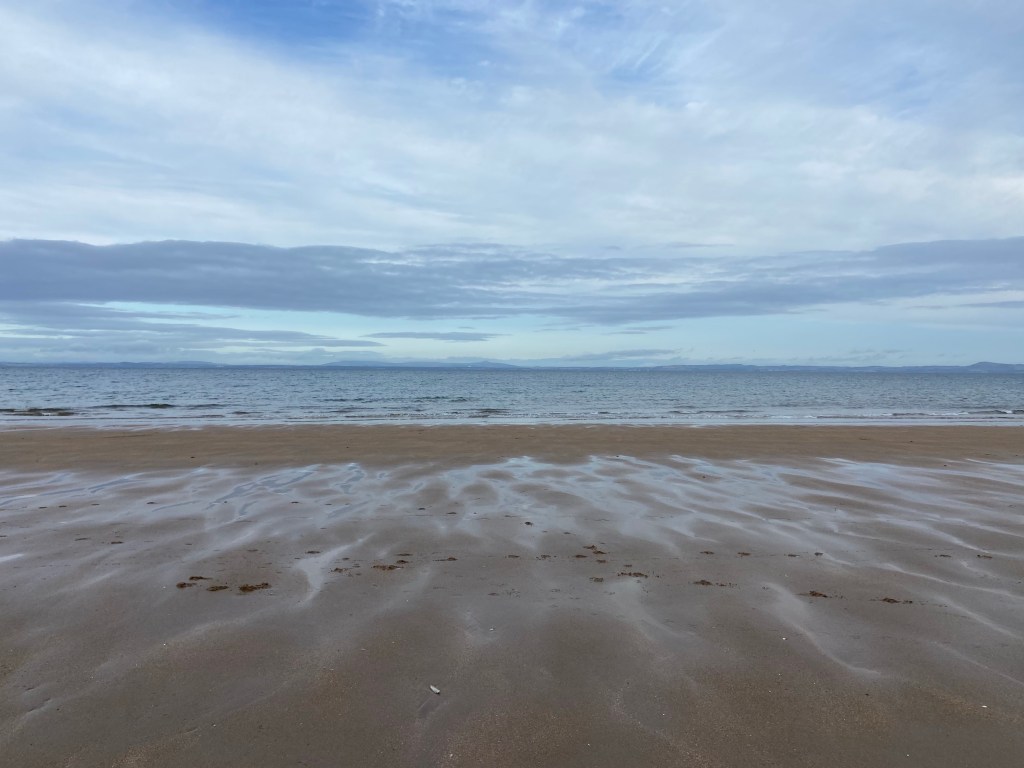
Adam turned back to his Sunday jobs of turning his carload of apples into cider and clearing stones from fields, but I turned east on my vastly simpler task of putting one foot in front of the other whilst enjoying the peace of the almost-empty bay, sand smoothed out by the receding tide and as yet undisturbed by many dog walkers.
The beach was dotted with the huge driftwood tree trunks that have been such a feature of the seashore all along the Firth. They must be the detritus of huge storms which felled trees inland and carried them out to sea. This one’s roots and trunk curving away behind it looked like the skeleton of an ancient marine monster:

I was a good distance off the John Muir Way here, but the path I had planned climbed off the far end of the beach to join it, into dunes stabilised (as I learned from a fun fact on the interpretation panel in the car park which Adam had read out to me) by the sea buckthorn, introduced in the 1970s for the purpose. It is such a striking plant, and one that I knew only as a name until earlier on this summer when we encountered it on our walk along the Norfolk coastal path.

The dunes loomed over the beach far below me, the path winding its way through long dry grasses punctuated with hawthorn bushes that the wind had contorted into fantastical black shapes. They reminded me of the animals turned to stone by Polomoche on the island in Babar and Zephyr.

I had a good long catch-up phone chat with Stephen, who was back at the ranch with his nose to the school grindstone. The conversation took me to the end of the dunes and a climb down onto a beach nestling between Eyebroughy and Weaklaw rocks, rounding the shoulder of the great southern arm of the Firth of Forth and finally hiding Edinburgh and Arthur’s Seat from view.

Instead, the island of Fidra came into view: the first of the handful of islands off the North Berwick coast. Fidra’s lighthouse, the first in Scotland to be automated, was echoed in shape by a conical stone memorial surrounded by fenced-off marram grass, newly planted to stabilise and conserve the dunes above the beach.

I had to take my jacket off now as the sun was coming up, transmuting the yellow beach sand into a rose-gold sheet.

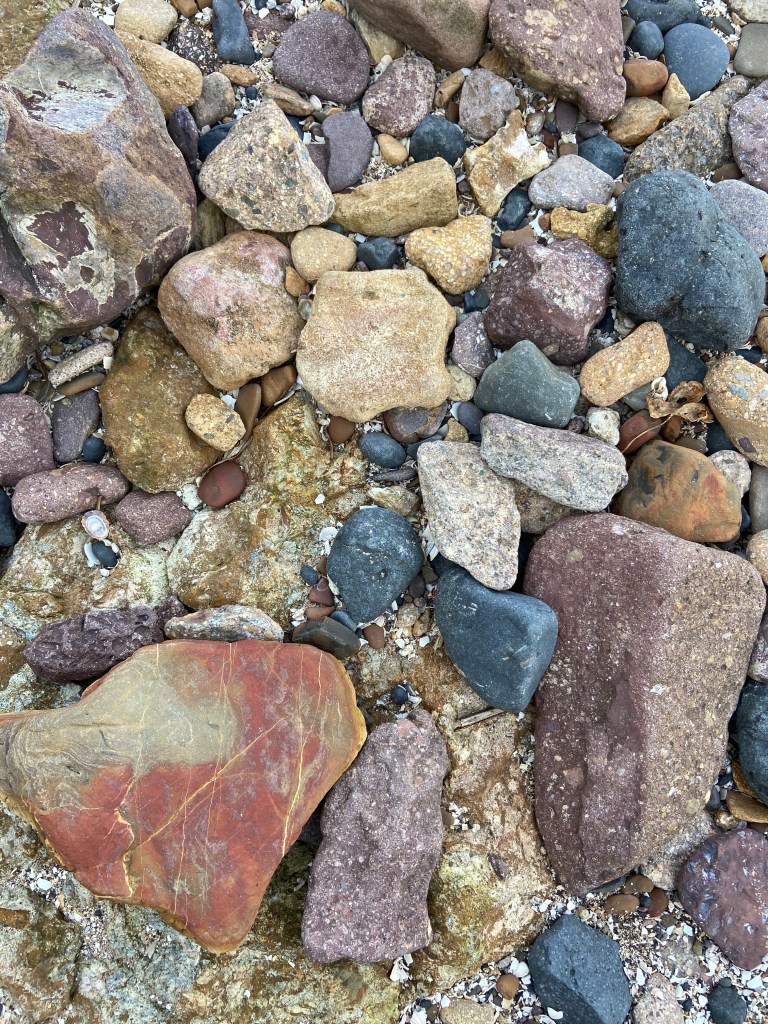
Here at the turn of the coastline the geology was changing. At the foot of the wooden steps climbing off the beach was a fascinating jumble of multicoloured stones lying on top of knobbly, weathering, iron-yellow sandstone pavement.
At the top of the rocks the sandy path skirted around the headland, sometimes enclosed with buckthorn, sometimes giving clear views out to Fidra and forward along the shingle coast. The piping call of redshanks accompanied me, and the sun on the narrow silver-grey leaves of the buckthorn illuminated the path like a shining thread.

This was the land of the immensely wealthy, whose ultra modern beach homes are blessed with exquisite coastal views.

The skerries here at the eastern end of Yellow Craig beach have wonderful names: the Lamb is guarded by North Dog and South Dog, and Mac the extraordinary long-haired malamute posed on the Brigs of Fidra in front of Fidra’s own South Dog rock, which at high tide becomes a separate island in miniature.
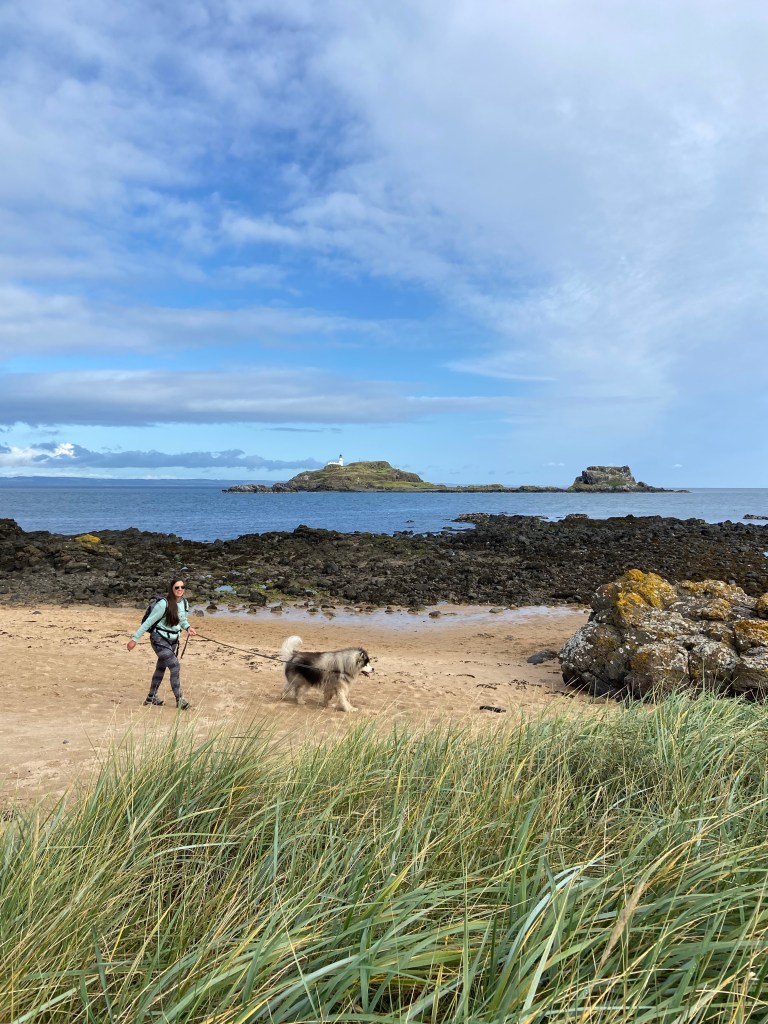
Yellow Craig is justifiably a favourite beach with locals and tourists. Today a pair of riders on horseback were about to canter along it, and I encountered a tent pitched amongst the low dunes on the beach edge. This shocked me before I remembered that wild camping is generally allowed in Scotland, and I hoped that these campers would pack away their little chairs, tables and cooking kit, and leave no trace behind them. For now, however, they were enjoying clear views over the beach out to the islands.

It appears that sea buckthorn, whilst a useful stabiliser of shifting dune sand, can also become problematically invasive: another example of an introduced species which has created environmental imbalances. A large roped-off area warned ‘ground under repair’, with explanatory signs explaining that conservationists were removing the rapidly-spreading bushes, and returning the area to species-rich grassland, including late harebells, and viper’s bugloss which has not yet entirely gone to seed

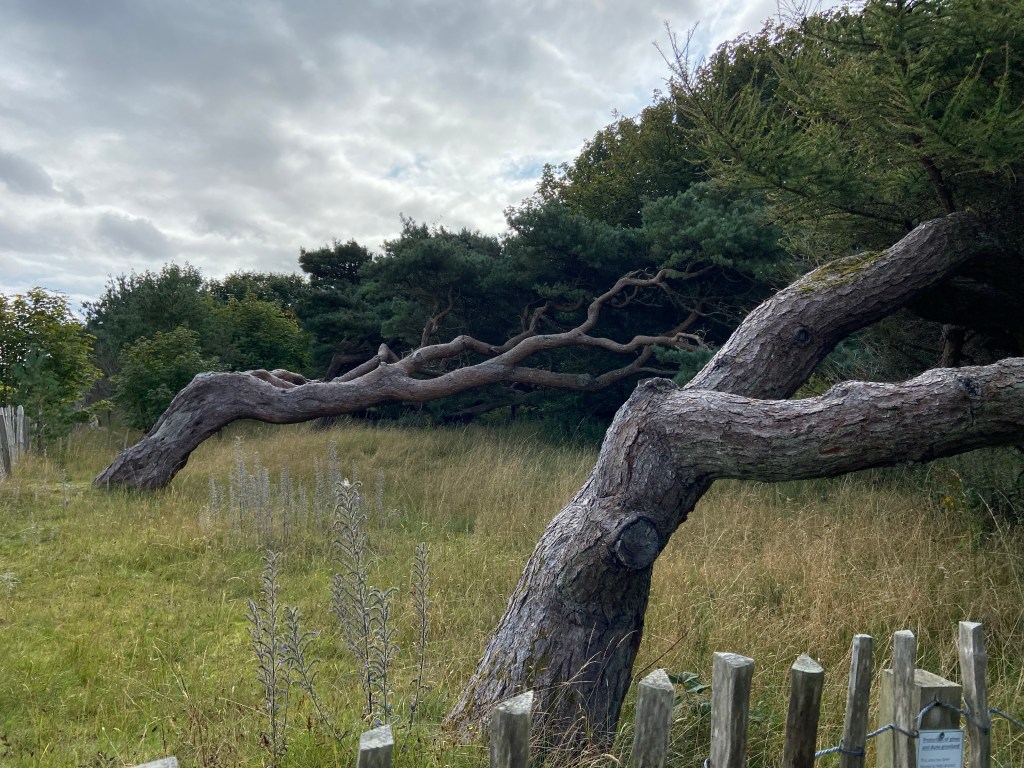
Wild campers are not always well behaved. Two twisted pines in Yellow Craig plantation had been fenced off to stop inconsiderate campers damaging them and lighting fires.
The approach into North Berwick on the John Muir Way takes you across a turnip field at the entrance to which a sign warns of the dangers of being hit on the head by stray golf balls. There was a bit of moisture in the air, and I was by now looking forward to sitting down, charging my phone and contemplating perhaps a modest second breakfast.
I have lost count of the number of golf courses I have walked past so far on this journey. I am sceptical of Donald Trump’s claim that his golf course is the most beautiful in Scotland — because North Berwick West Links must be in with a chance of that winning that accolade. They wrap around the whole of the corner of the coast from Yellow Craigs Bay right into the town, with stunning views to the north over to Anstruther and Crail on the Fife coast, particularly clear on a day like today, over Craigleith island right out to the Isle of May. It is hard to photograph, though, as it’s so vast that the pictures are just a massive sea of emerald green grass.
I slogged along the road into North Berwick, trying to decide whether it would be better to stop for a snack here in town, or to press on an hour and a half out of town, to reach the famous Drift clifftop coffee house which had been recommended to me by my friend Helen. The decision about where and whether to stop in Berwick was decided by two factors: the fact that I need to catch a particular bus at the end of the day to take me to my accommodation in Dunbar, and the more immediately pressing fact that I really needed a wee. Public loos there were none as I snaked along the JMW through the residential outskirts of North Berwick, admiring the perfection of the shaped hedges, and the combination of golfing whimsy and respect for nature that was on display.

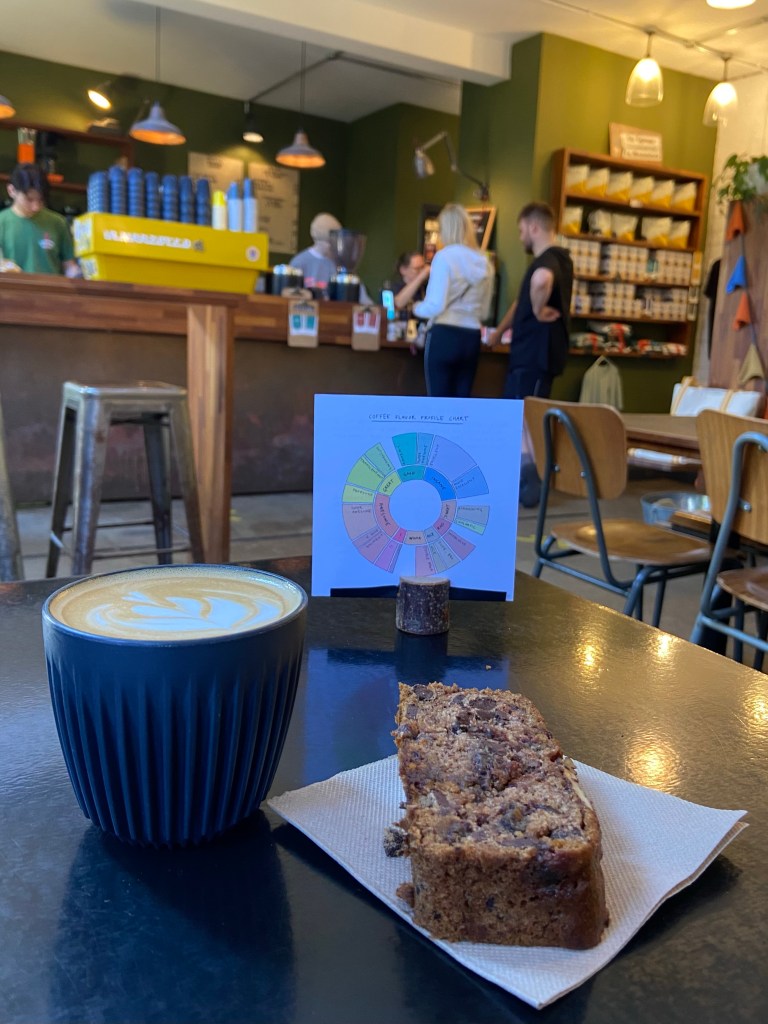
I eyed up several cafés on the high street, but they didn’t quite grab me. Google maps suggested the Steampunk café, which turned out to be a perfect pit stop: a coffee roasters with a record shop upstairs, it had impeccable ethical credentials, a laidback steampunky vibe, cheerful staff, and a really delicious coffee and slab of freshly-baked banana bread stuffed with chocolate chips. And a great loo.

To climb up out of Berwick, I decided to get the pain over sooner rather than later and took a steep set of steps up onto the cliff top instead of doing the longer, slower road climb.
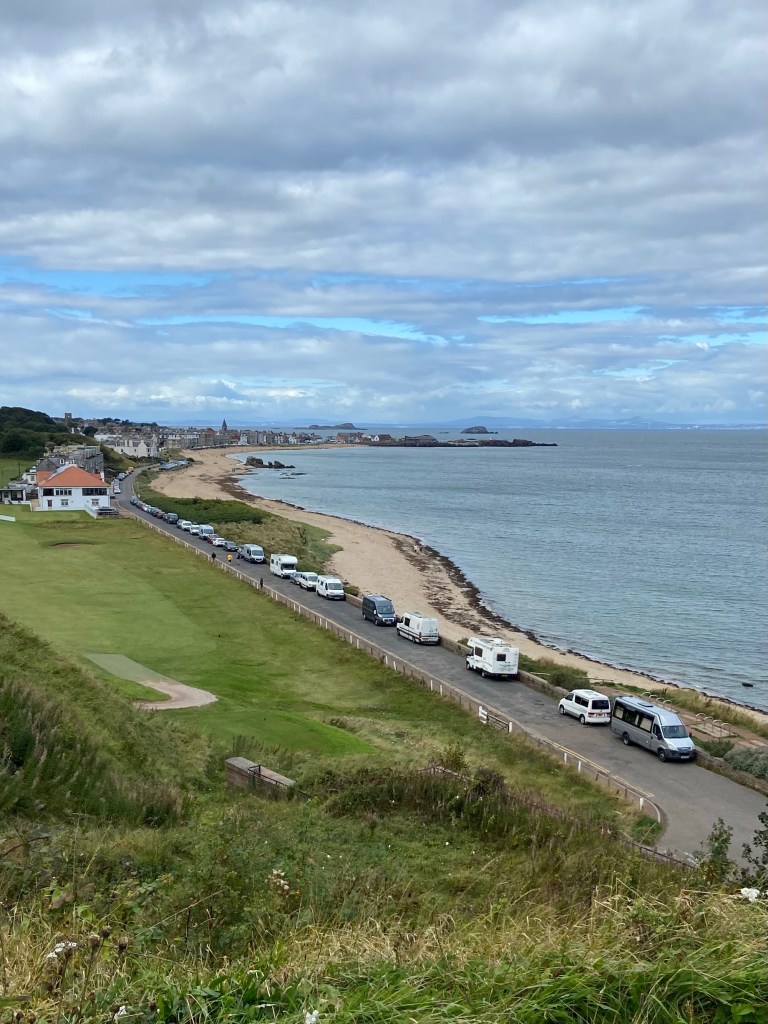
It was a mistake — I found myself in the middle of a golf course, and I could’ve gone the 50 feet along its edge, but there was no path and I have been shouted at by enough golfists in my time to be wary even if taking a signed public footpath across their greens.
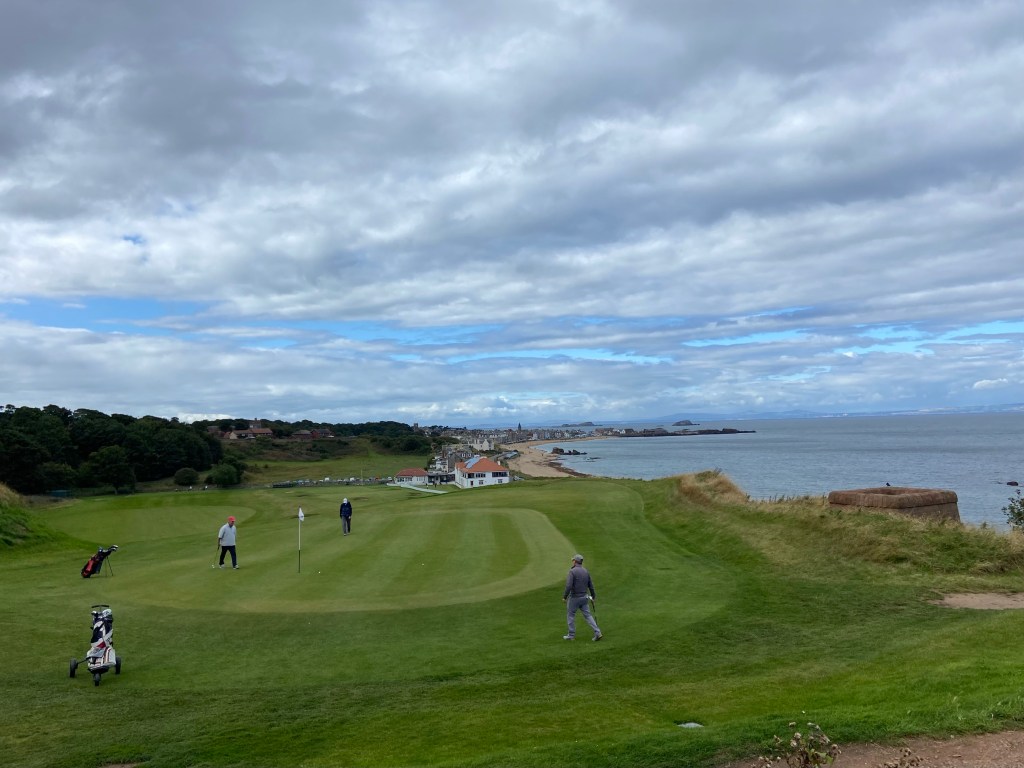
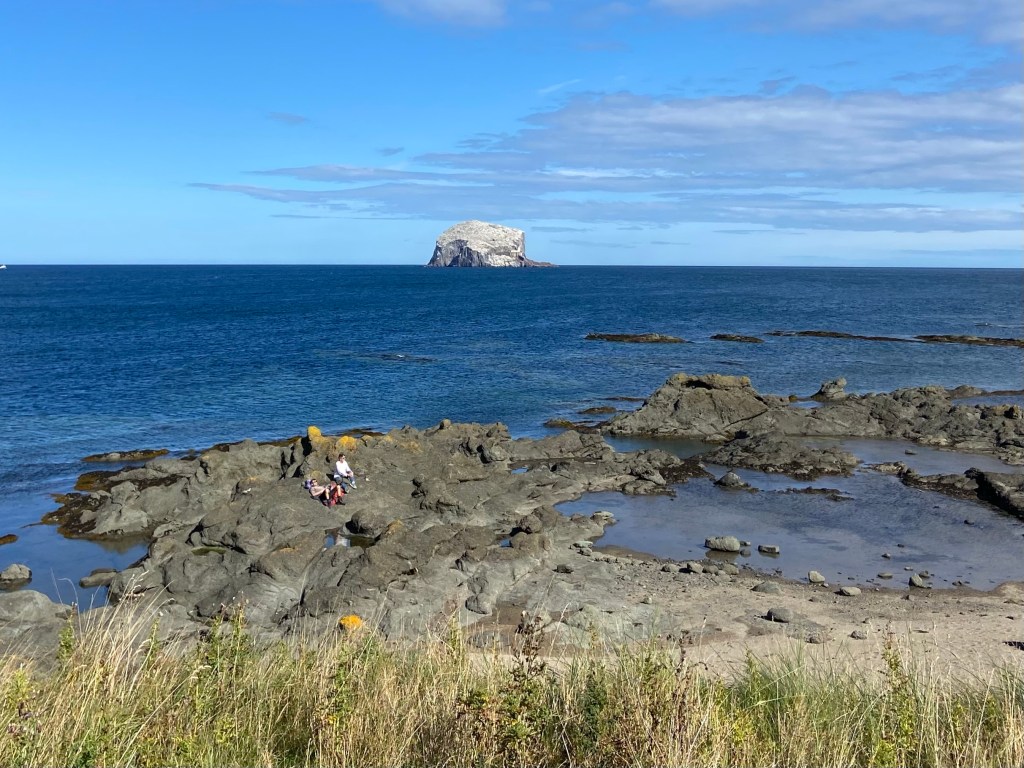
So despite the fact that I was under pressure of time, I was forced to make a pointless detour around the far side of the golf course and the estate behind it, although the ten minutes I lost gave the sun enough time to come out, meaning that as it came into closer view, Bass Rock, covered in a prodigious quantity of guano, shone in the sunlight in all its bespattered glory. The Rock is another one of those volcanic plugs, like Arthur’s Seat and a Carlton Hill, and indeed North Berwick Law (the striking, conical law-shaped hill rising up behind North Berwick, a ruined chapel at the top, and a fibreglass replica of the whale’s jawbone which until recently stood on the summit, visible for miles around).
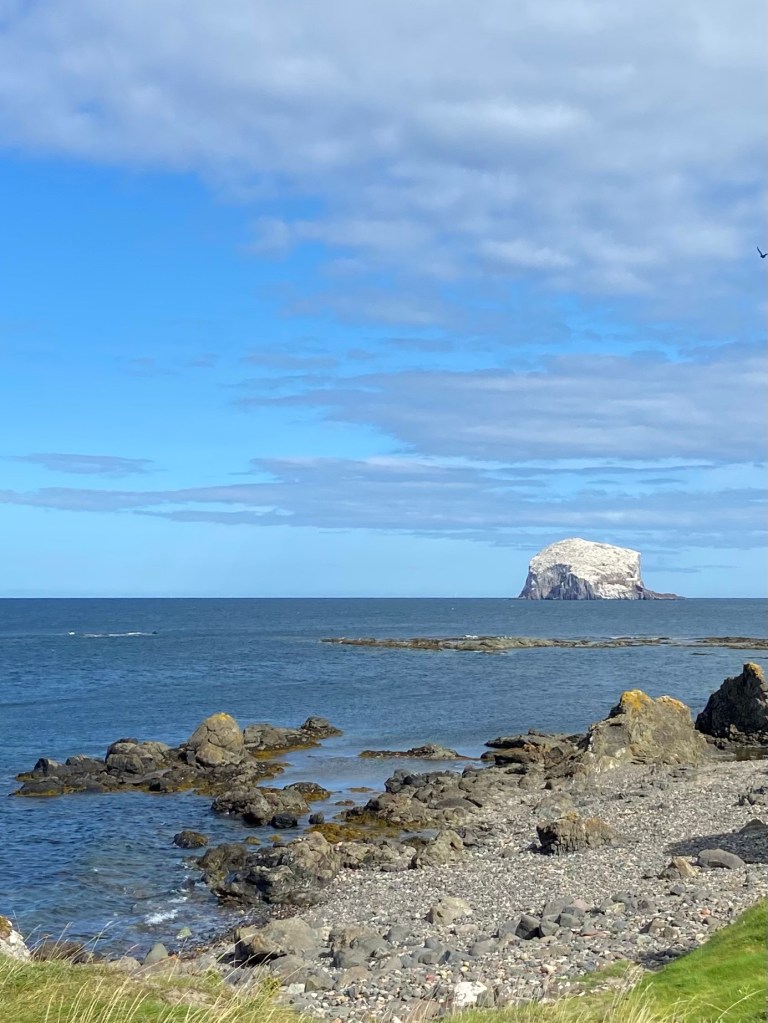
No longer the abode of a Christian hermit, Bass Rock is home now to a nationally important colony of seabirds — the gannets that I could see through the binoculars creating a kinetically fluttering white cap over the black crag that they have turned white with a thick, renewing layer of guano.
Guano was revealed to be the secret of the fairways’ emerald green grass too: piles of pellets had been dumped at the cliff edges of the golf course, ready for scattering out of season. I liked the contrast between the brown chicken pellety piles and the shining white of the gannet guano-covered rock out to sea.
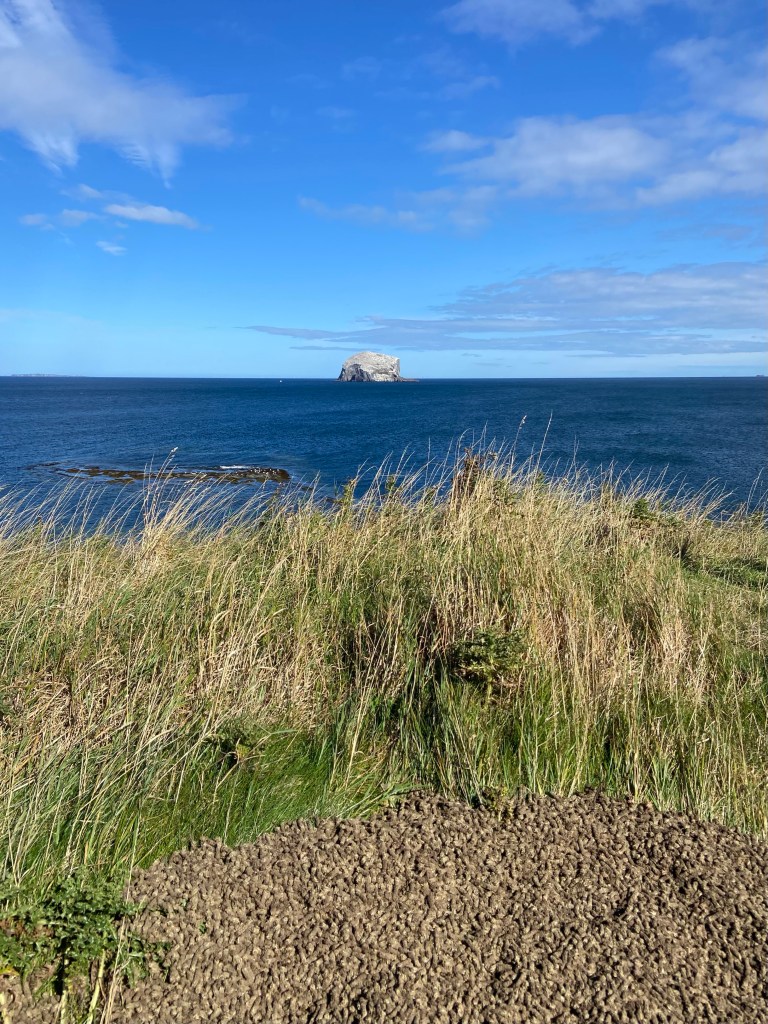
The narrow thread of the coastal footpath wound its way round the headland, right on the edge of the Glen golf course. At times it was sandwiched vertiginously between friable sandy cliffs one side and the lethal golfists swinging their clubs and dispatching projectiles into the air on the other. I gripped the handles of my walking poles with sweaty palms, and dug the spikes of my poles into the sandy soil to anchor myself. There were distractions: the furious golfist who had fluffed a shot, swearing foully and thwacking the ground with his club, and the deserted beaches below me,

which unfolded mouth-wateringly one after another, water getting clearer and more radiantly peacock in colour with each jewel-like tiny bay.
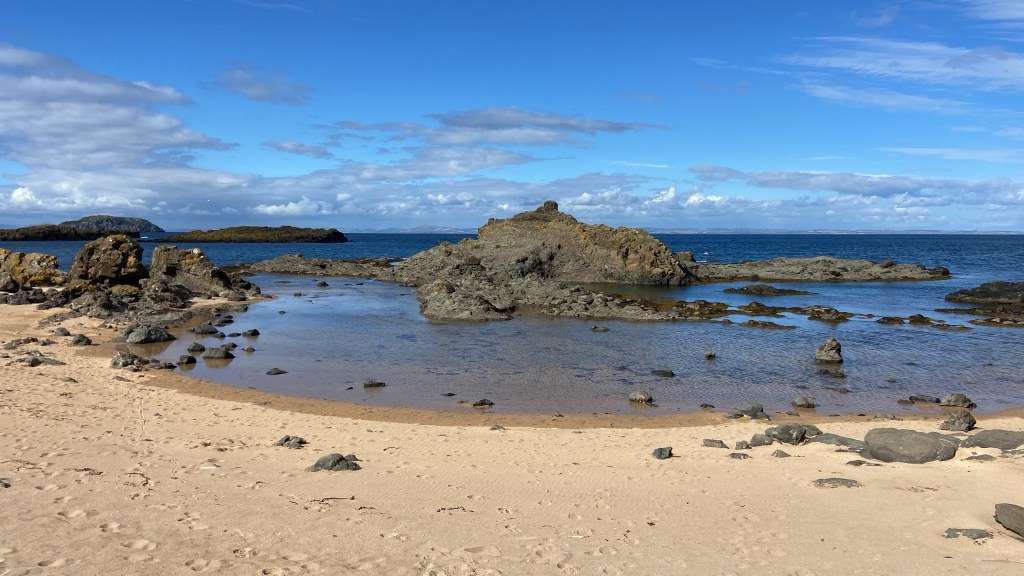
As Adam had promised, standing a mile offshore Bass Rock was the unimpeded visual focus for the whole of the rest of the day’s walk, providing the backdrop to each new set of crags, each new strand, and each new shallow with a brighter palatte of blue and green hues.
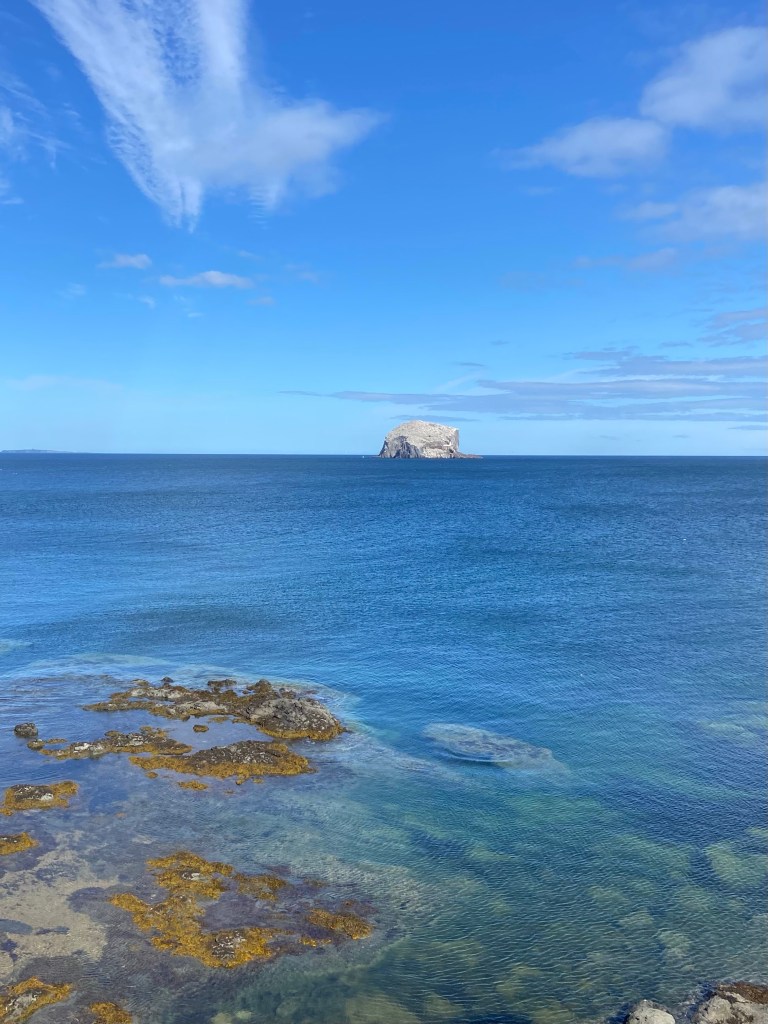
The iconic effect was only enhanced by the shifting cloud formations.
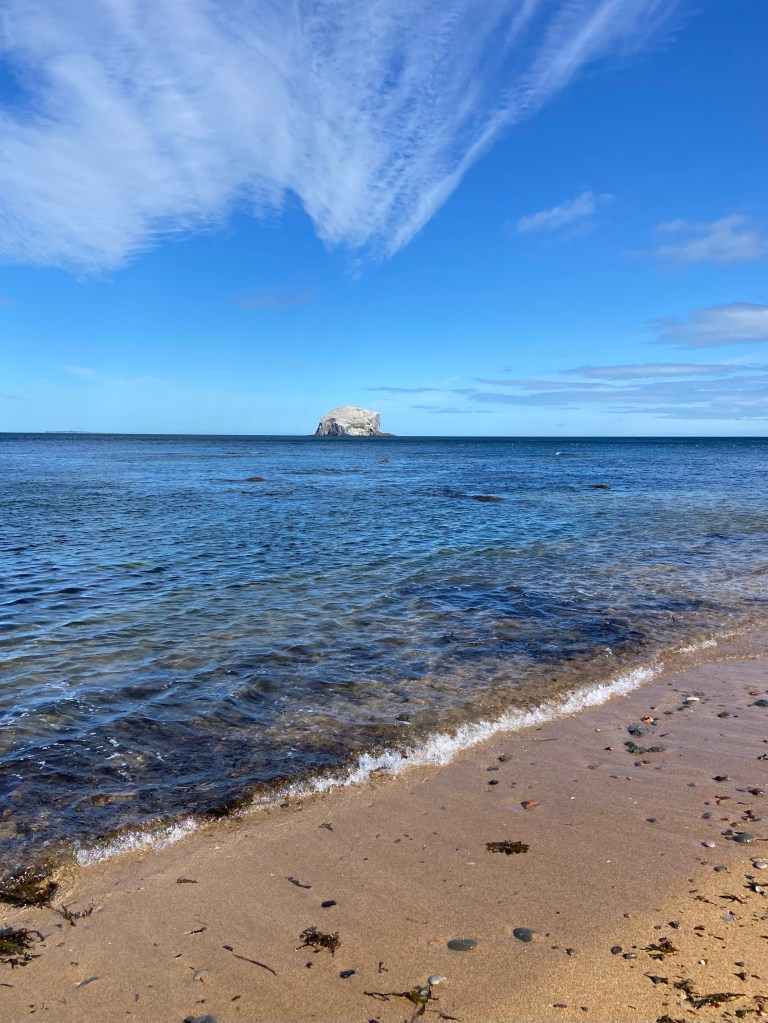
The final beach of the day was the long, gently curving sandy edge of Canty Bay, with a steep grassy cliff at the far end, up which I could see my path climbed, seemingly vertically.
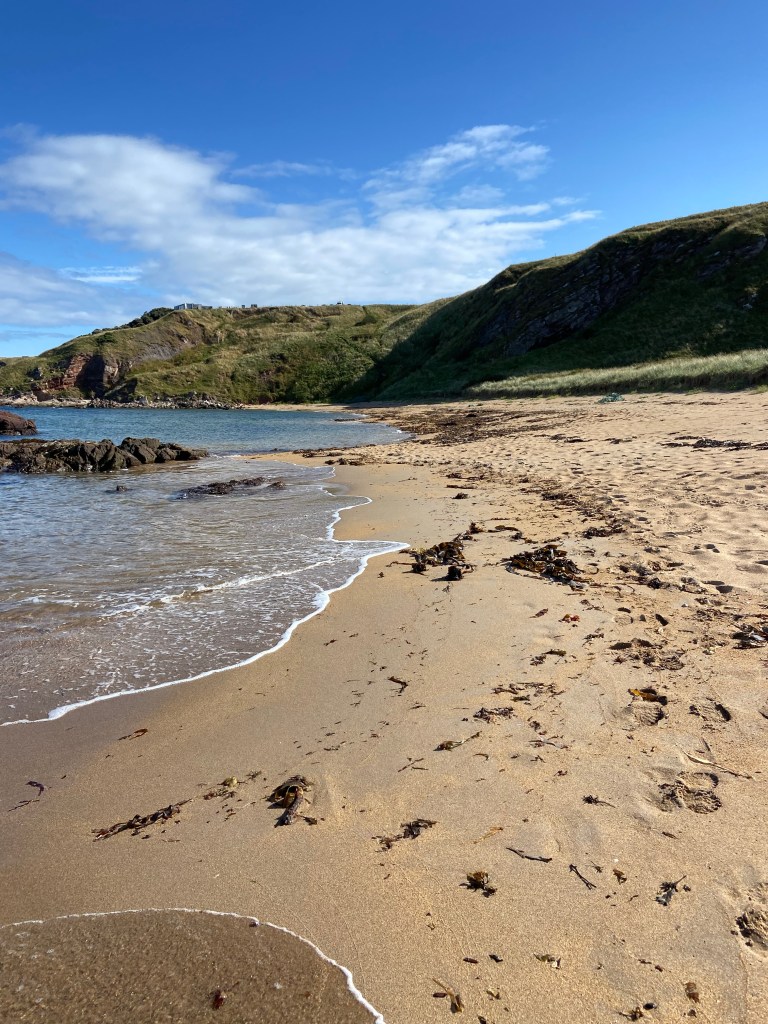
Water softly curled around the ancient lava rocks, then sucked back over the fine sandy shingle, hissing as it went.
At the bottom of the climb I paused to rest my feet, confident now that I would catch the three o’clock bus, and noticed redshank marshalling a small flock of ringed plovers, all picking at the kelp mounded up by the tide beneath the rocky cliff.
The climb itself was not too bad, with the poles. Two women coming down them expressed their envy at the way my poles stabilised me — but then they were dressed in fine knitwear and left the air perfumed behind them. The same cannot be said of myself. It’s a matter of stylistic choice, I told myself, as I hauled myself to the top.
There on the cliff was perched the famous Drift café, built from containers with panoramic windows inserted.
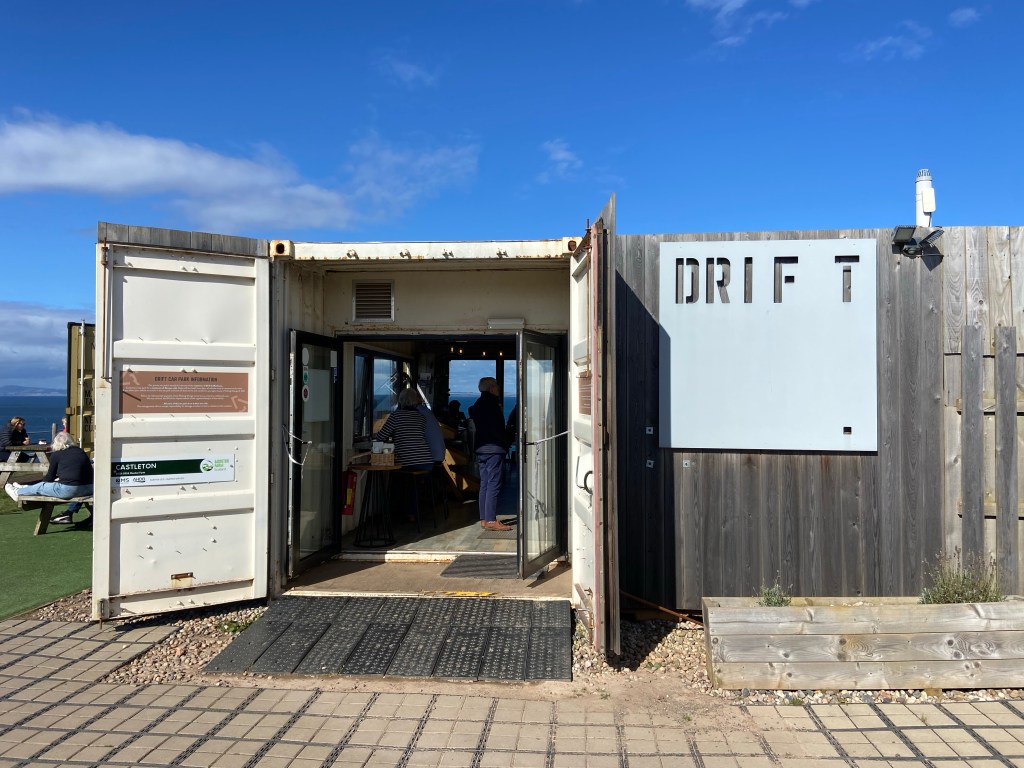
I debated whether to try for a table and have some lunch, or a piece of Cake with a capital C, but I decided that time wasn’t on my side and I would have to leave the café for another day.
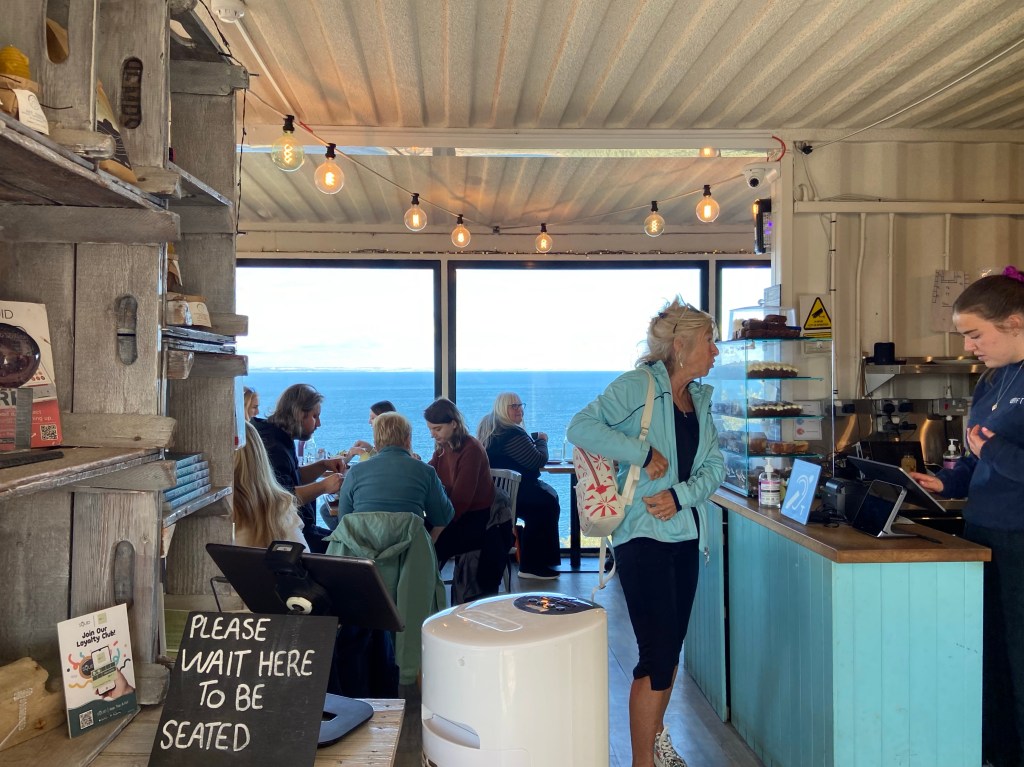
For now I just drank in the views, feeding my soul on them instead.

A tedious walking section now faced me, two kilometres down the A198. My blisters weren’t looking forward to the slog, but in fact there was a narrow stretch of the verge which had been trodden into an acceptable thin path of sorts. In any case today’s walk had one final treat to focus on: Tantallon Castle, a ruined mid-14th century fortress of pinkish-red rock, occupying a commanding position on the cliff edge away across the cornfield. It’s open to the public but like so many other things today, I will have to leave it for a future return visit.

I had about 20 minutes to wait for the bus at Auldhame cottages. I was tired, and feeling slightly guilty that I had ended the walk early here, instead of walking on to Scoughall. But that would have meant an extra four kilometres, and an hour to cool my heels waiting for the 5.15 bus, and a problem the other end finding a shop open on a Sunday to buy my supper. The bus arrived exactly on time, and I sat in some kind of grateful stupor right to the end of the line at Dunbar Asda, tottering therein to source a microwaveable mac and cheese. From there it was just under a kilometre to the AirBnB, through an immaculate estate with a walker’s fairway of soft mown grass running alongside the pavement all the way. I was welcomed by June, and her snuffling pug Peggy, of whom there will be a photo tomorrow. I didn’t have the energy to think of taking one today!
Things to do when I come back here on holiday
North Berwick’s Seabird centre
Climb North Berwick Law
Tantallon Castle
Eat cake at Drift
Sit on All The Beaches instead of marching agonisingly past them to catch a bus

 Walking The Landscape
What a read, and what photos! It gives me such joy. Sorry about the blisters though, and the lost cake, and the sitting on the beaches! Next time…..
LikeLiked by 1 person