
When we try to pick out anything by itself, we find it hitched to everything else in the Universe.
John Muir, My First Summer in the Sierra
It’s wonderful how one can travel so far and be so close to so many good friends. I had been met by Victoria last night who took me out for a Nepalese meal at the Gurkha restaurant in Musselburgh. We chatted happily for a couple of hours over a delicious meal, the remains of which I took home in boxes for my breakfast.
Fortified this morning therefore by daal makhani, I met up with Ruthie first thing, who had coincidentally dropped off her boys early for Saturday rugby matches a stone’s throw from me, and was using her precious free time to walk a stretch of the way with me, and catch up on a few years of each other’s lives.
We got chatting to a chap with a birdwatching telescope he had trained on the sandbars at the mouth of the river Esk as they began to be uncovered by the slowly retreating tide.
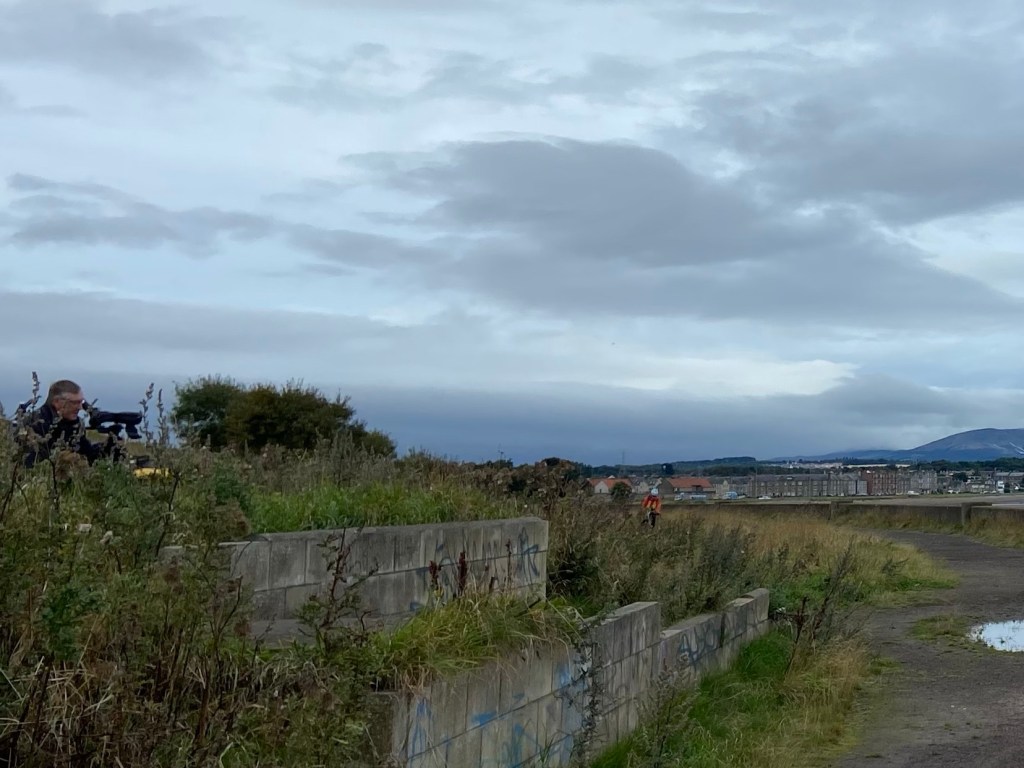
There were dozens and dozens of mute swans out there, not old enough yet to pair up for mating, and non-migrating until they grow all their flight feathers. He records their numbers for a national database. We asked him about the impact on local bird populations of the bird flu epidemic and he said he’d seen numbers falling dramatically in many species, but that had come with a corresponding rise in food stocks so the remaining birds benefited from plentiful food to be a key role in start rebuilding their colonies.
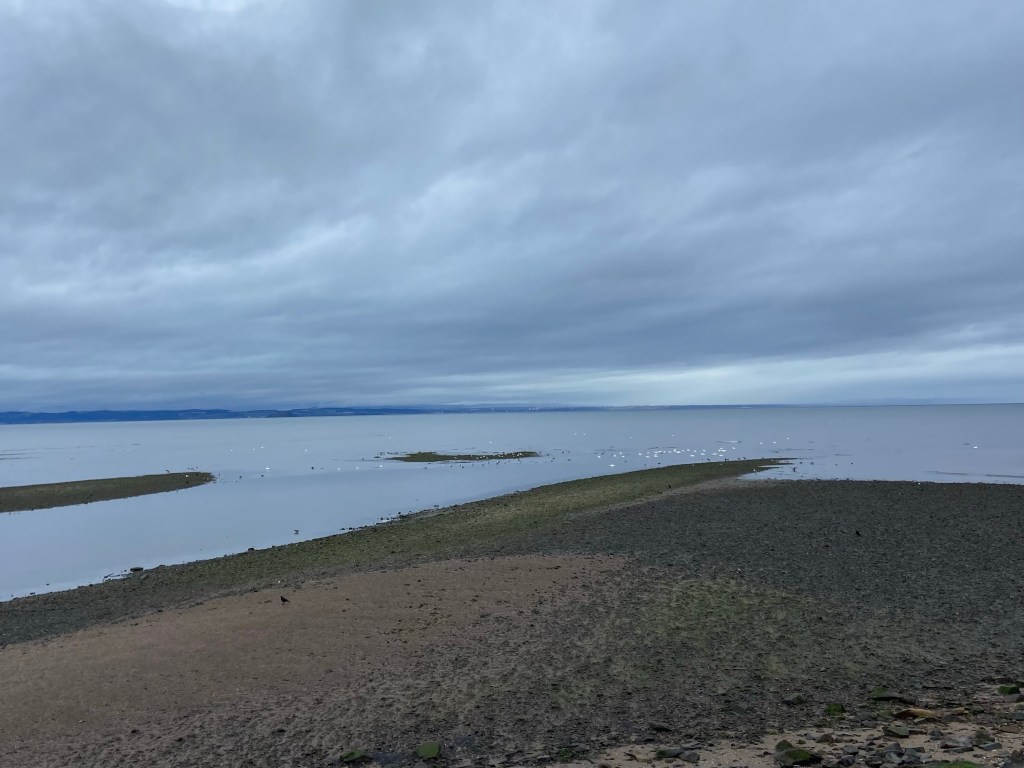
It’s a shame (or perhaps a good thing, for the undertaking of a long walk, as I was doing, rathe me than a long sit, like the bird recorder) that I was not carrying (and in any case do not own!) a long-lens camera, but I did have my tiny but powerful binoculars, and I kept them handy all day in my pockets or round my neck, to look close up at the sometimes astonishingly large flocks of birds to be seen all along this stretch of coast. It’s one of the benefits of bed and breakfast and travelling light that I had not even had to think about sacrificing the extra weight it means to carry them.
The first part of today’s 24km walk, however, was characterised not by birdlife but by the way the area’s industrial heritage had shaped its landscape. Here, a series of lagoons were the result of past processing at the now demolished Cockenzie coal-fired power station further up the coast of ‘fly ash’, the airborne toxic ash waste product of burning coal. Captured by electrostatic precipitators, it was pumped into lagoons to settle, and the lagoons then capped off to prevent the toxic chemical cocktail from leaching out into the soil and local water systems, and landscaped as a nature reserve with open lagoons and scrapes of water to provide roosting habitats for wading birds. Ruthie and I bid a temporary farewell at the Musselburgh Lagoons artificial boating lake, both looking forward to seeing each other at the end of the day.
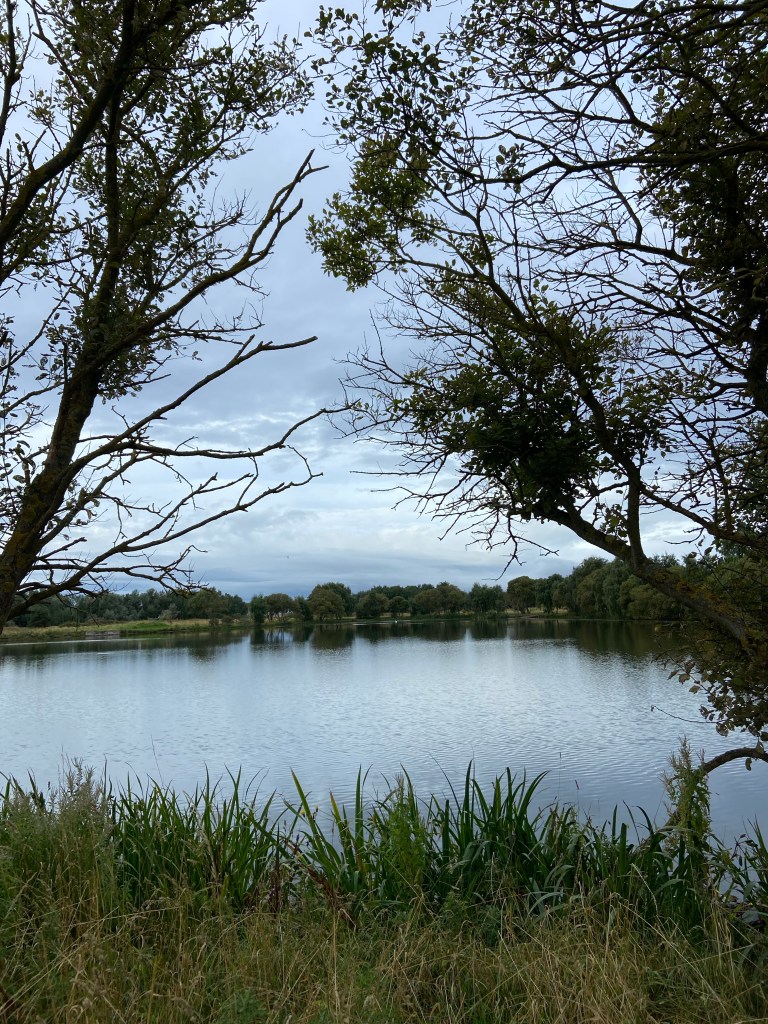
I peeled off into the woodland which concealed the wader scrapes, where roofless, concrete and brick hides have been created to observe the birds. I was delighted to see hundreds of lapwing roosting quietly, mostly facing into the wind so as not to disturb their plumage, their flock punctuated by the odd small snipe and black-tailed godwit, the latter a beautifully-patterned mid-sized wading bird with a characteristically long beak for probing sand and gravels for tiny worms and crustaceans.
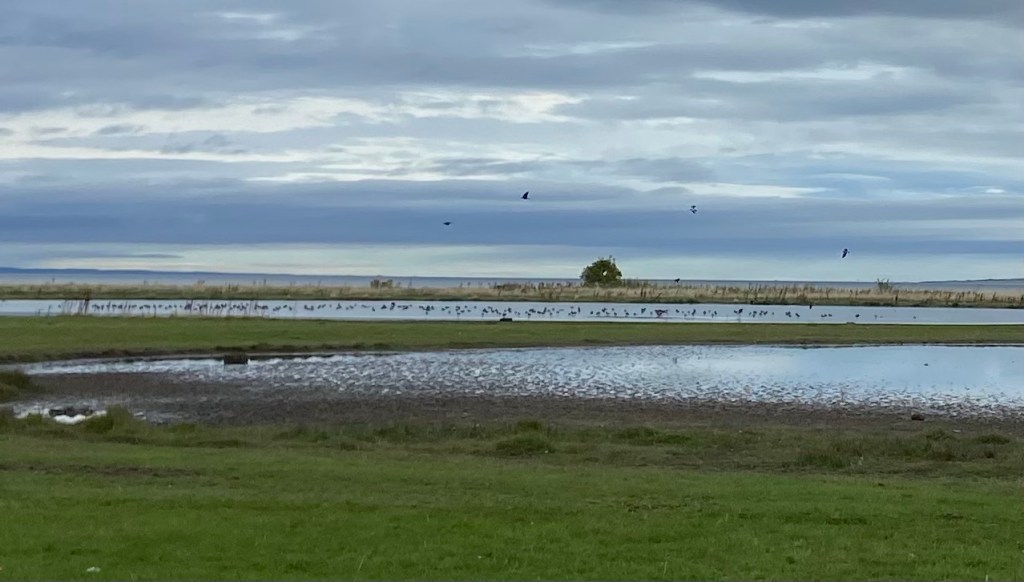
I could not afford to stay long. I pressed on to Prestonpans (see what I did there?), past the industrial heritage museum which unfortunately didn’t open until much later in the morning, and instead enjoying the little flashes of colour against the background of the Firth provided by sea asters,

the last roses of summer,

And the curves of the little shingle bays as they unfolded one after another.

The JMW skirts round the little post-industrial town on a dilapidated concrete pavement, covered by each rising tide which leaves patches of treacherous slippery green seaweed and bladderwrack growing behind it. I picked my way circumspectly over it and onto the beach where I had to force myself to limit the number of pieces of sea glass which I put into my rucksack pockets. It’s usually so rare nowadays, but here was scattered all over the gravelly shingle, in quantities like those I remember as a child.
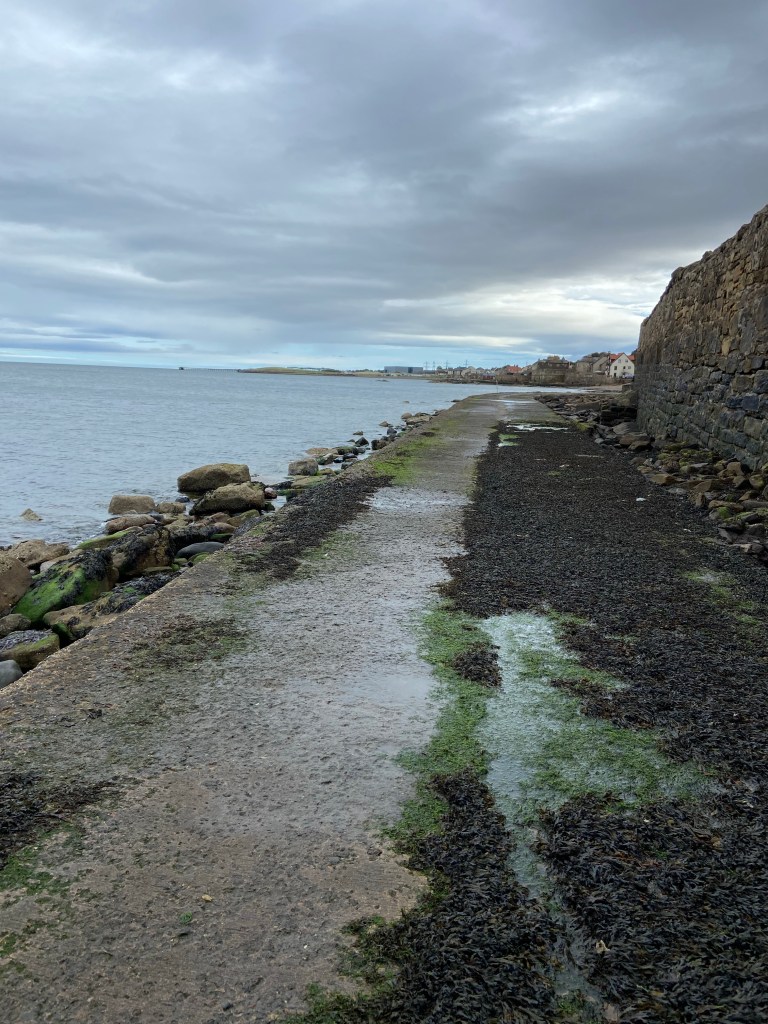
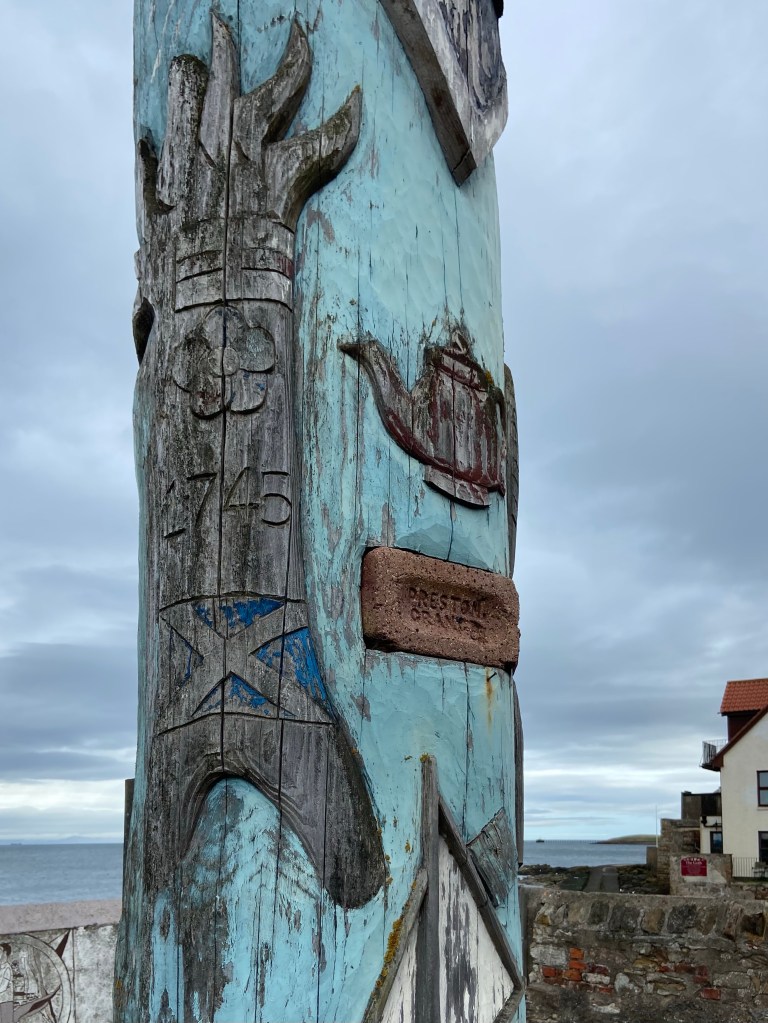
Prestonpans provided an unexpected amount of interest and distraction for the walker who really should be getting a move on. There has been a recent focus on keeping alive the social and cultural history and traditions as well as the industrial and commercial heritage of its salt production (the ‘pans’ in its name) and glassworking. The car park sea wall introduced a panel commemorating the Scottish diaspora, and a surprising 32-foot red cedar totem pole carved by Canadian First Nations craftspeople with totemic symbols to a design created by ‘local youngsters and indwellers’, representing the traditions that the scattered peoples had taken away with them overseas.
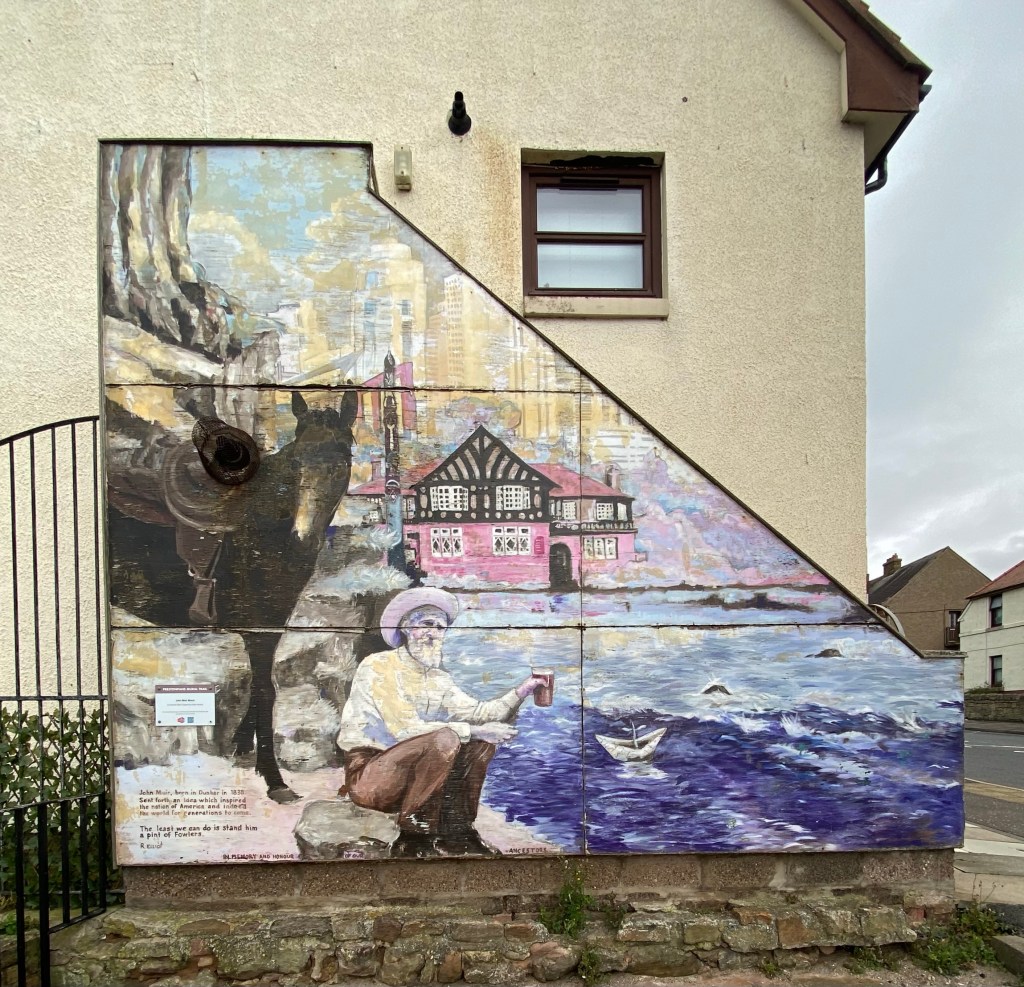
Next to it was the first of many town murals (unveiled at the Biennial Conference of the Global Mural Arts — who knew?) celebrating the historic Goth Tavern, one of the several embracing the Gothenburg Principles which evolved in the 19th century in Sweden as a means to control alcohol consumption, a single trust being created to manage a town’s taverns and committed to ploughing 5% of the profits from the sale of alcohol back into community projects. The mural also imagines as a patron of the Goth Lothian’s famous son John Muir, “who sent forth an idea which inspired the nation of America and indeed the world for generations to come. The least we can do is stand him a pint of Fowlers”.
My favourite part of the walk through Prestonpans, however, was the quiet and contemplative design of its war memorial, a small, well-kept plaza housing a single Scots pine planted zen-like into the sandstone flagstones, a traditional statue of a highland soldier behind wrought iron railings bearing a thistle design, and a simple rectangular opening in a smooth sandstone wall framing and focusing a view of the waters of the Firth behind it, the names next to the names of the fallen carved in stone in bas relief: ‘no one is truly forgotten whose name is still spoken’.

Beyond Prestonpans, the ex-Cockenzie power station site was a vast, bleak, windswept concrete space being slowly redeveloped. The path, hard underfoot, zigzagged round its perimeter past a lone fisherman, rod and line resting on the crumbling sea wall, who studiously avoided eye contact, and a cheeky urchin also fishing amongst the wind-blown rubbish and waste-ground weeds.

It was a sad and unwelcoming place with an air of decay despite the construction work going on in the background even on a Saturday, to raise the vast steel frame of a warehouse or factory. I moved on as swiftly as I could.
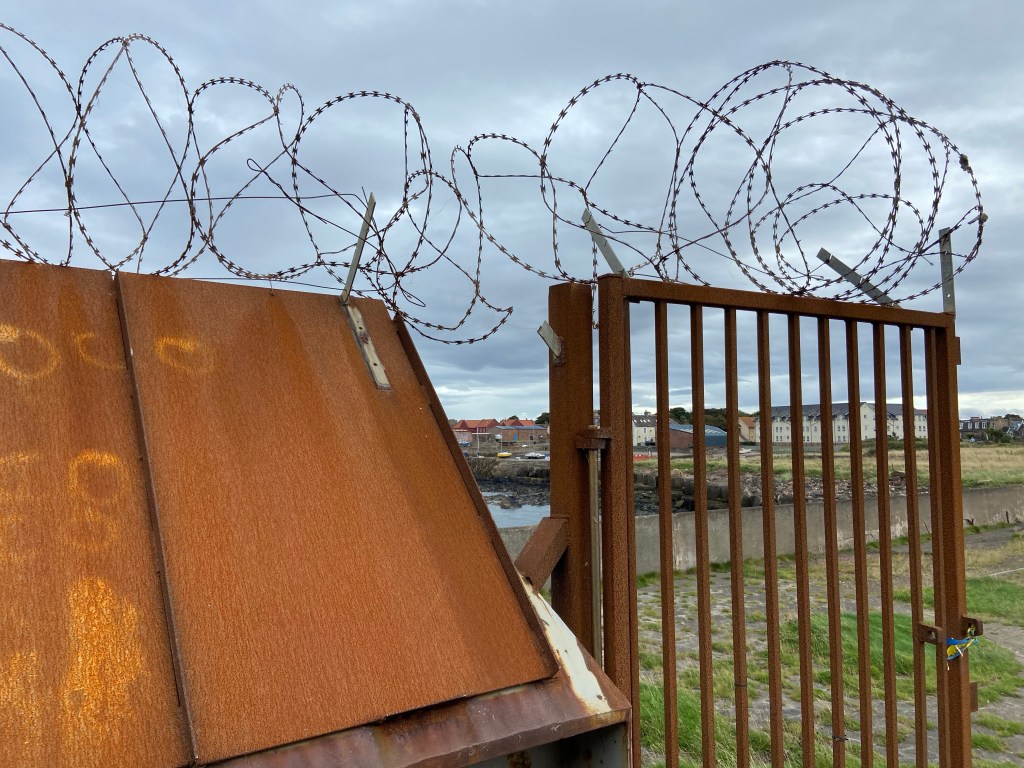
Cockenzie harbour was almost deserted
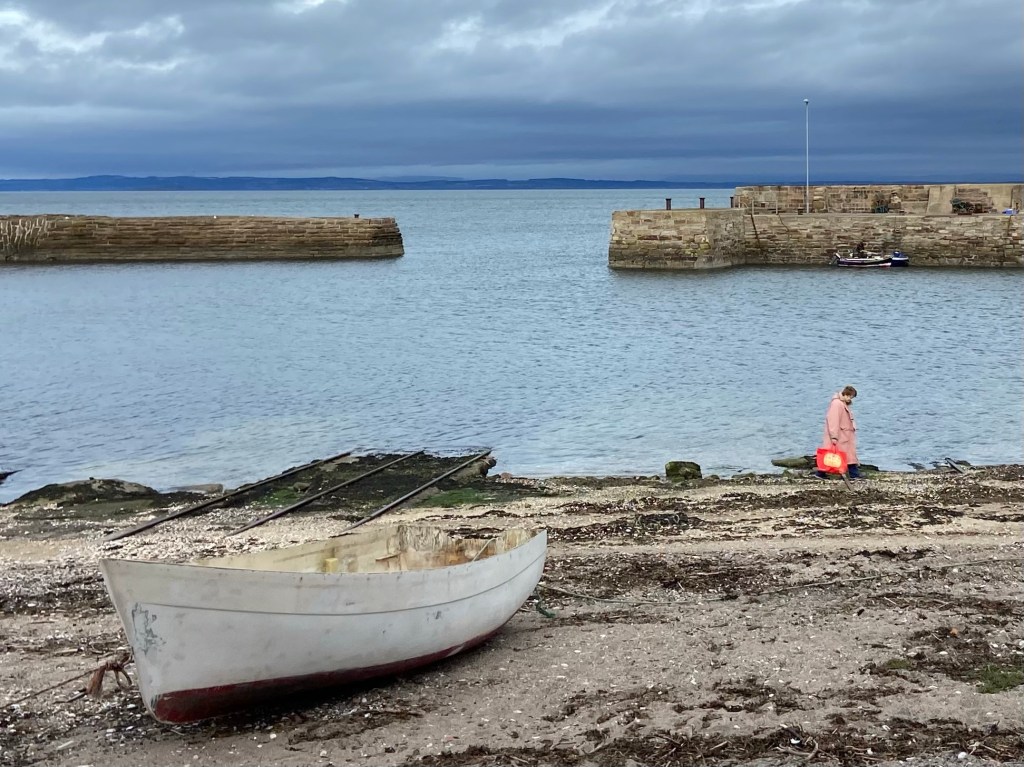
But beyond it Port Seton, the last of the ex-industrial settlements of the Edinburgh outskirts was a more friendly fishing settlement, with lobster pots stacked up on the mole of its working harbour,

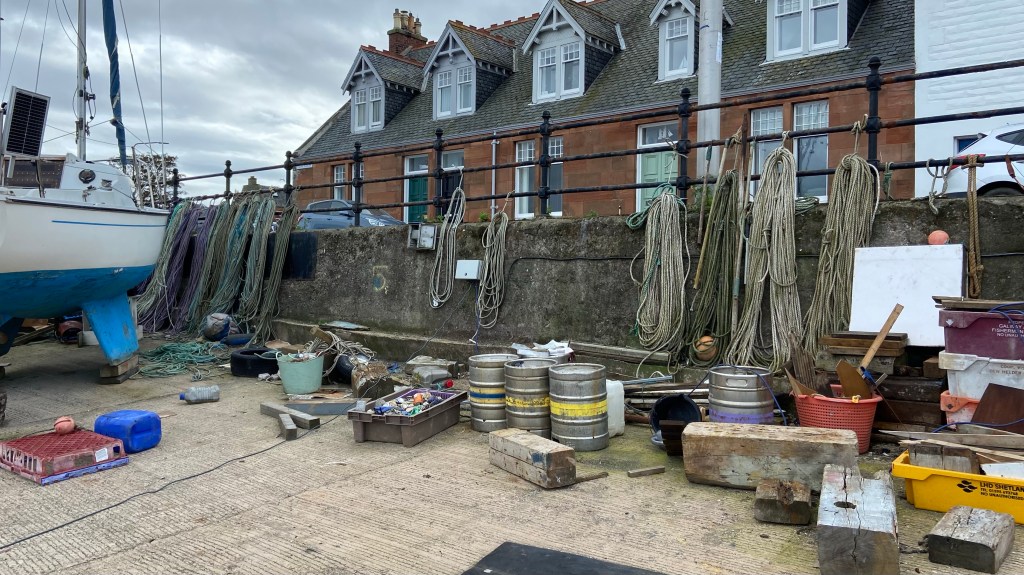
quiet on a Saturday but evidencing efficient professionalism in the ship-shape, tidy way the boat maintenance tools and paraphernalia were stored along the walls of the open boatyard.
I ducked into a greasy spoon for the most delicious cup of sweet potato and red pepper soup, and sat on a bench outside, gratefully resting my feet awhile from the unremitting concrete path, charging my phone, and watching the steady stream of customers collecting their burgers and chips. In a moment of brief respite from the kitchen, Ann said she was frankly baffled why anyone would walk to spend a week walking round the coast, while Mikael just smiled and made me a much-needed and perfectly sweetened cup of decent coffee to give me the energy for the second half of my walk. ‘But you’re not even half way! And it’s all uphill!’ scoffed the co-owner as he headed out of the door on his way to hustle his second job as a delivery driver (‘if you can call it work’, said Mikael). ‘Mind you, it’s all beautiful from here on.’

And it was. Port Seton marked a distinct change in the socio-economic profile of this part of the coast. Historically a resort, it boasted a long, well-kept and litter-free, grass-lined promenade on which I stopped to look over the railings at some of the large flocks of birds out on the rocky shore. Although I could recognise oyster catchers, I didn’t really know what else I was looking at. So I asked Billy, out watching the birdlife every day with his binoculars and cameras, and he pointed the sandwich terns gathering to fly to Scandinavia, and an enormous flock of hundreds of golden plover, so beautifully camouflaged that I had not even spotted them amongst the golden sand between the rocks. There were bar-tailed godwit too, common here, unlike the black-tailed resident species which I had seen back down the coast at Musselburgh, trotting businesslike to and fro along the waterline, stabbing their long beaks deep into the sand.
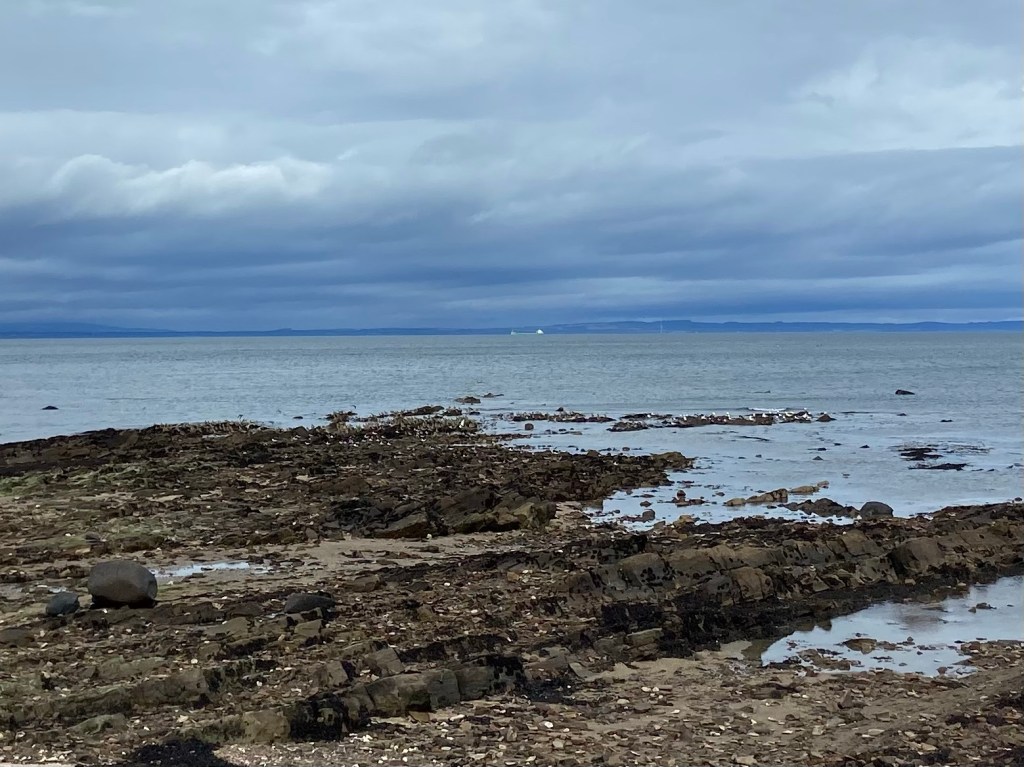
Billy showed me a stunning photograph on his camera viewfinder from last March of a king eider — a very rare spot. It had blown in from Siberia. Striking (and definitely regal) facial markings. Out on the water now, common eiderducks flew over in dramatic black-and-white flocks. Billy was dismissive: all these birds are moulting at the moment, and not displaying their beautiful winter plumage. But I thought they were simply glorious. I wish I could’ve taken photographs through the binoculars, but had to content myself with far-away photos of the general scene.

The sand along the seashore out beyond Port Seton was now thick with colossal scallop shells, oyster shells, gigantic whelks, fat razor clams and giant, bleached mussel shells. What a thing it would be to dive offshore and swim above the oyster and scallop beds where they have come from. I crunched over them, sorry to be doing inevitable damage.
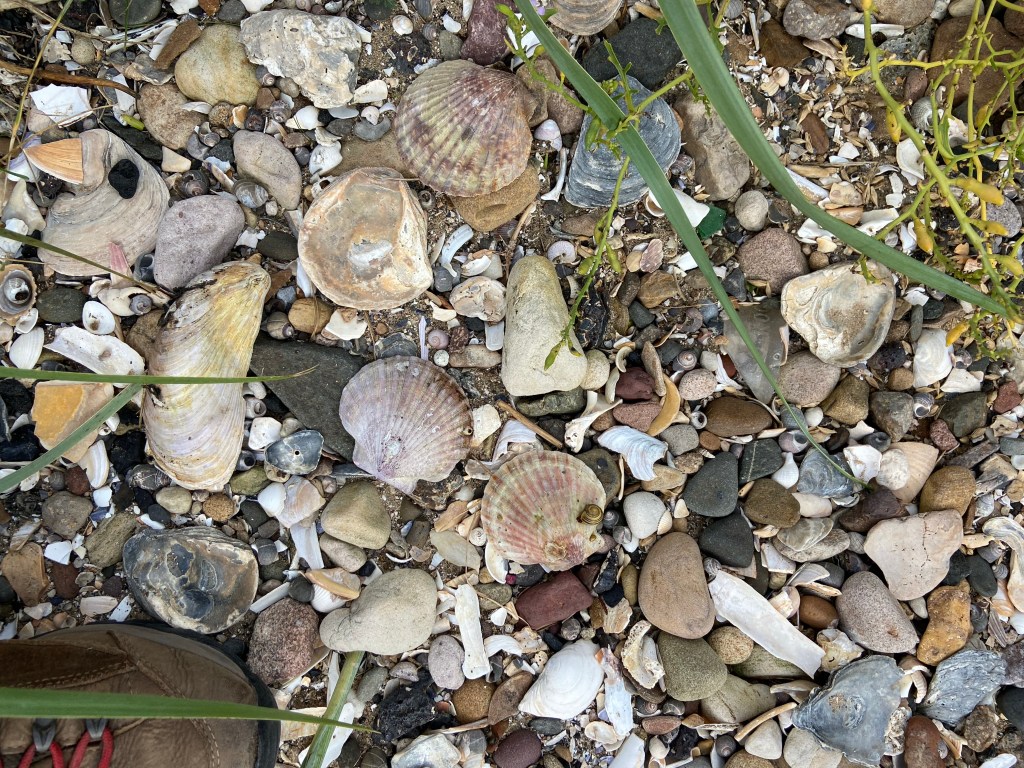
Here I picked my way along the shoreline, dodging the incoming waves and forcing myself not to pick up shell after beautiful shell. Tangles of kelp and bladderwrack lined the strand at the edge of the water, the freshly storm-uprooted plants fat and glistening, the older kelp bleached and rotting like strips of decaying cloth.
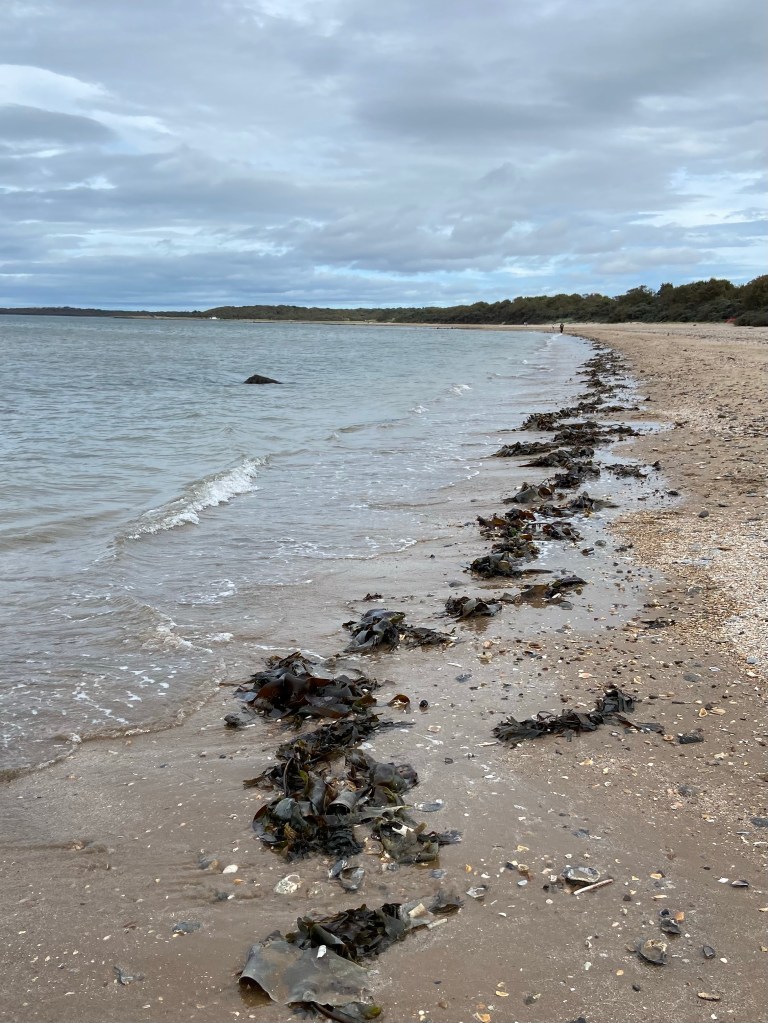
Blow lugworm casts covered the newly-exposed sand. The sand looked bare but underneath it, hundreds of the marine worms lie safely in their u-shaped burrows, heads down and tails pointing upwards, digesting the microorganisms and organic matter in the sediment they eat and excreting the indigestible portions onto the surface as worm casts. I have never seen so many.

Longniddry beach stretched away before me, punctuated with smooth volcanic boulders. As they weather and are eroded, their ground-down remains create shadows of black sand amongst the gold.

At the end of the beach, however, rockier features, slower to weather, create the curving arm of the bay. As the flat oyster and scallop beds gave way to the rocks, the kelp on the shoreline was replaced by thick heaps of bladderwrack, oysters and scallops by limpets, and the beach became a thick mulch of black sand mixed with millions of tiny winkles, through which I waded to reach the car park. A gentleman I had met back on the beach had extolled the virtues of the kiosk beach café explaining that his French bulldog comes out here every day for his ice cream, and pulling a paper bag out of his own pocket to show me a piece of cake nestling like a secret treasure in a cardboard tray. But I had had my very early lunch back in Port Seton and although I had been walking purposefully along the beach now for over an hour, I still felt that I was going too slowly. The walker’s dilemma: finding a balance between covering ground and paying attention to what is in the landscape.

And so I followed the JMW away from the shore, and through a quieter grassland flat, studded with late wildflowers, the odd knapweed attracting a wasp or two, and some startlingly bright bloody cranesbills.

It was not long though before the path rejoined the shore at Gosford Sands, a curving bay with yet another geological character, here slabs of sandstone pavement, slightly weathered and tilted up in a great sheets. Along the path bees took advantage of the last of the sea pinks
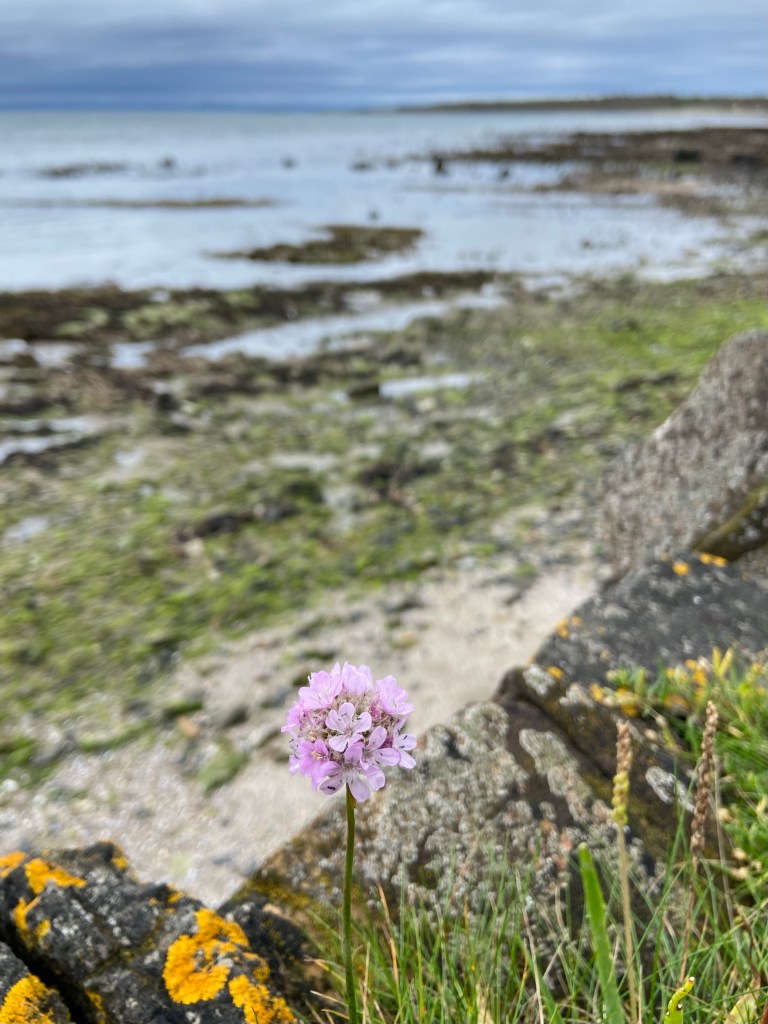
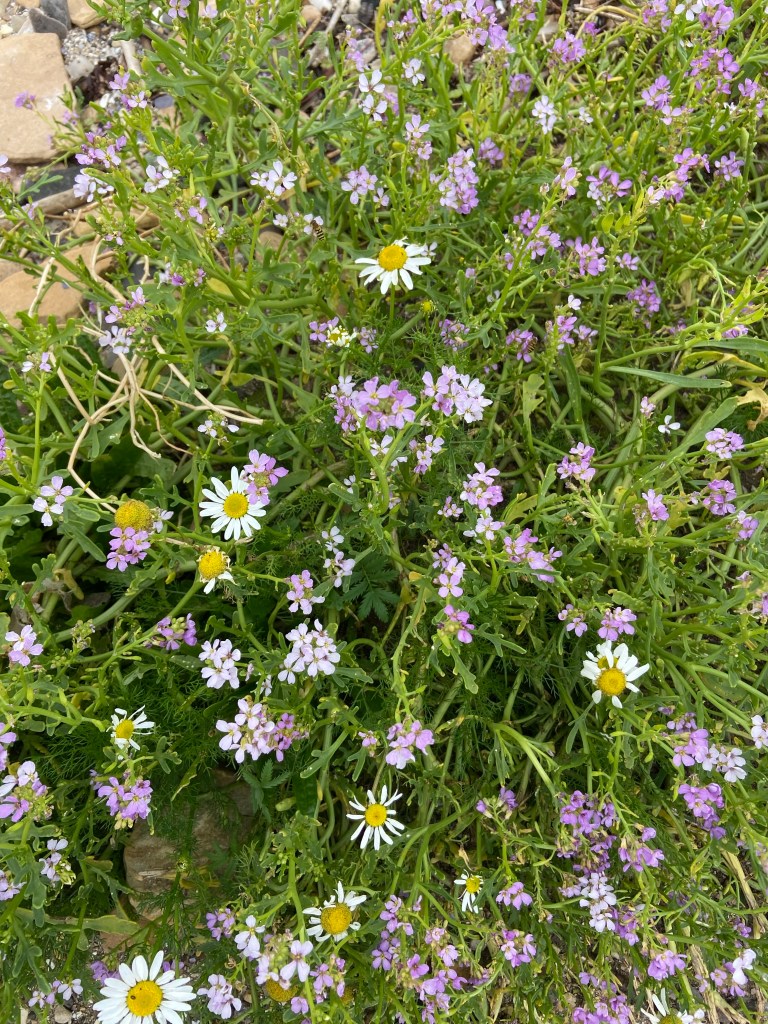
and hoverflies clustered around low mats of sea chamomile and sea rocket.
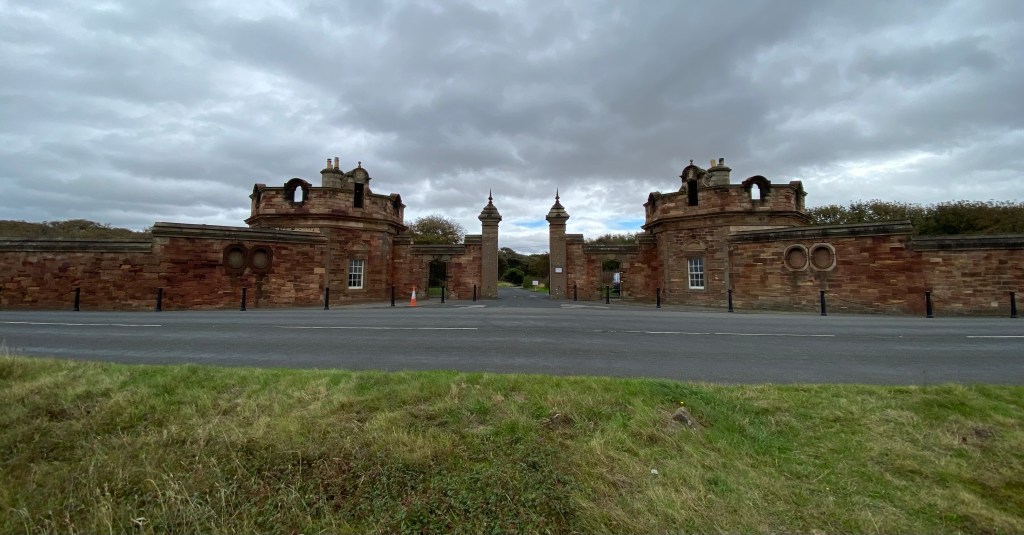
In commanding position at the centre of the Gosford Bay, a pair of dark red sandstone gatehouses guarded the entrance to a huge country estate. These were the North Lodge gates of Gosford House, but I bet anything you like that this was the inspiration for the Gosford Park of the silver screen. As I stood looking a car turned in through the gateway, and I wondered whether I was watching the arrival of a victim, or a murderer?
Next to Gosford Bay, the wildlife in the village of Aberlady consisted of a large flock of local men playing tournament bowls.

It was a picture-postcard little town, each building more beautiful than the last.

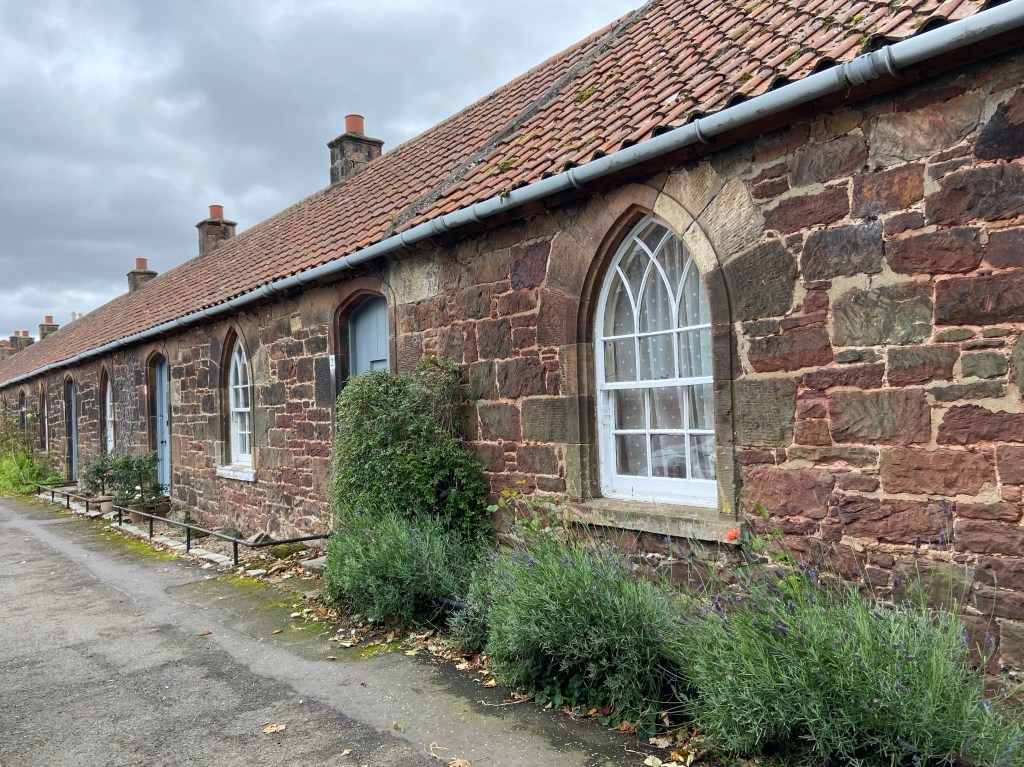
But its expensive architectural attractions gave away to an estuary edged with saltmarsh and crossed by a wooden footbridge.

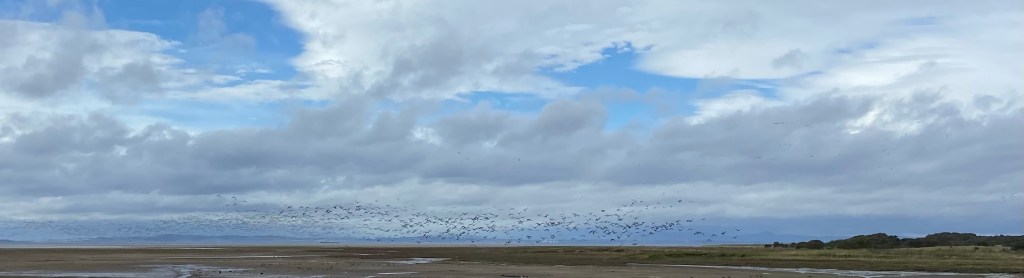
The exposed mudflats were simply covered in the largest flock of greylag and pink-footed geese I have ever seen: thousands upon thousands of them. They had all been clustered by the bridge, and I had been looking forward to seeing them up close, but as I stood in the car park chatting to Christian the ranger, a throaty motorbike engine spooked them, and they took off in a great grey cloud, honking deafeningly, to settle again further out into the estuary. It was a sight I shan’t soon forget.
I crossed the bridge, counting the white egrets that fed upstream in the Peffer Burn, stabbing down suddenly into the water to spear small fish with their stiletto beaks. Nine of them. Their populations have thrived in recent years, where other species have declined. They used to be such a rare spot, but I still find them an exotic-looking thrill.
I was now into the Gullane Sands nature reserve, and Ruthie’s husband Adam and I were sharing our locations over our phones so as to be able to meet up so he could join me for the end of today’s walk. The shoreline and the inland reserve were however unconnected by footpaths, and he told me later that he’d tucked his neat, soft-eared spaniel under his jacket to shelter her from the wind-blown sand, and they’d both dozed off in the sun, sitting up against one of the driftwood tree-trunks in the partial shelter of the dunes.

I was moving through those same dunes, following unmapped paths in what I could see on my phoned was roughly the right direction to intersect with Adam’s position. A reed-fringed lake glinting in the afternoon sun and patrolled by dragonflies was a brief delight,

although climbing the sand dunes was an assault course I could have done without at the back end of a long day’s walk. I was feeling rather tired and foot-sore.
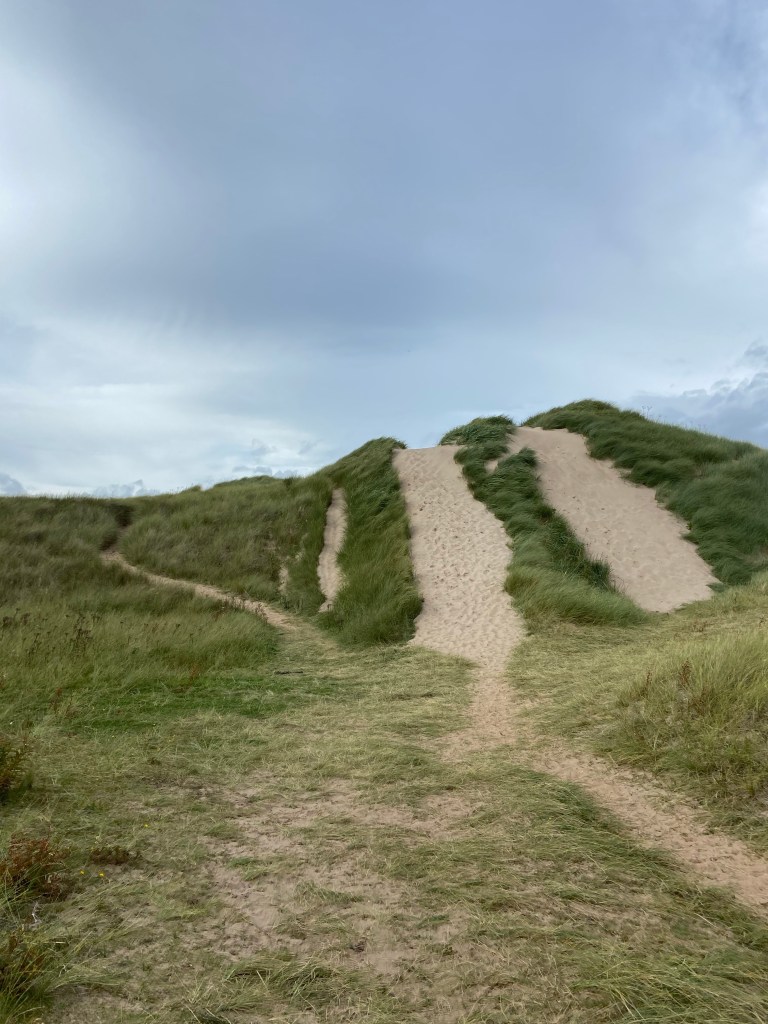
The beach, though, was an exhilarating and instantly rejuvenating experience.
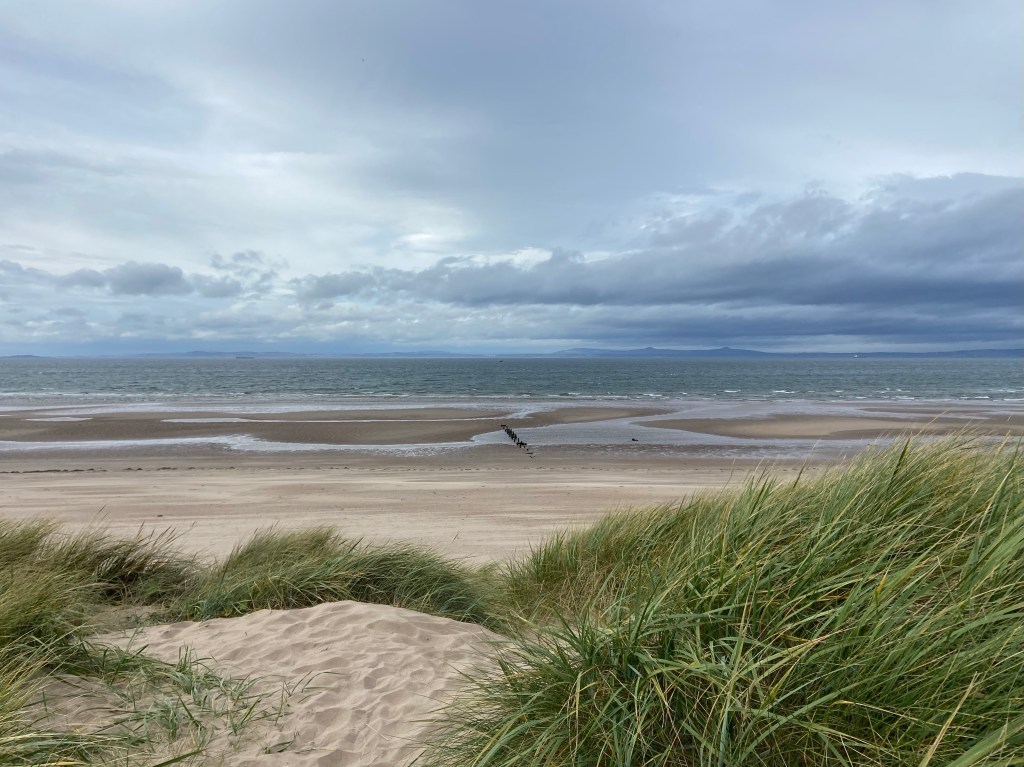
Adam came down the beach to meet me,

and Sika, rested now, ran around our ankles.
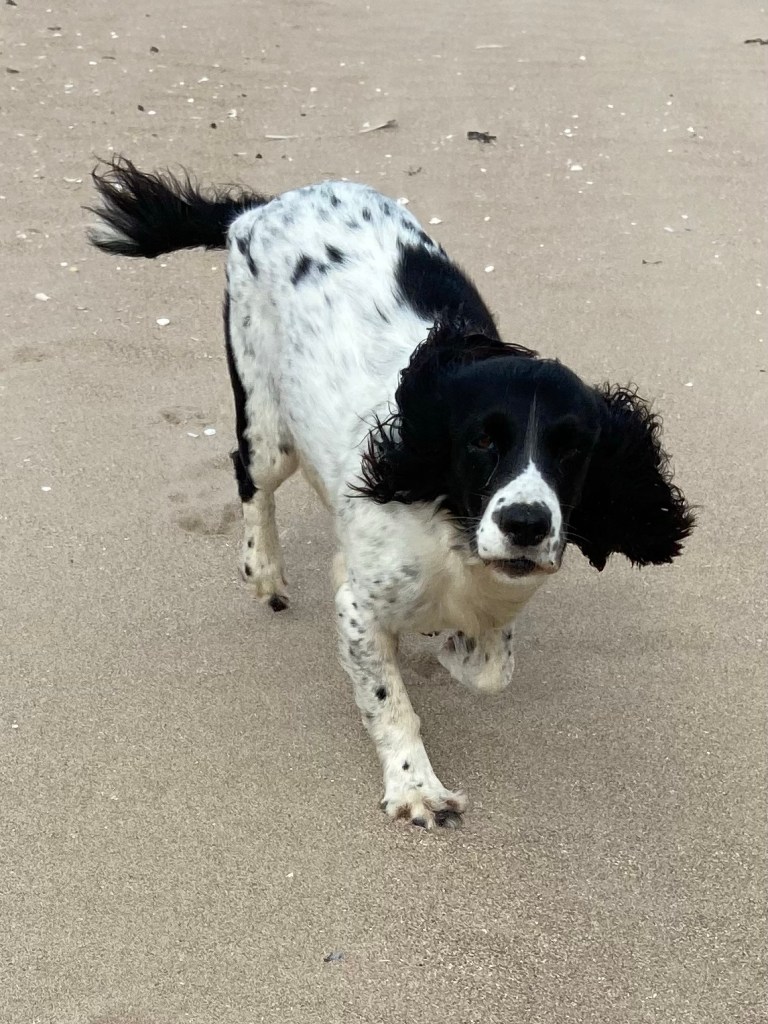
Wild and empty, the beach was scoured by a constant strong westerly wind, which carried sandgrains in rivers across the top of the close-packed sand beneath it. It was like watching streams of some kind of visible magic force, or dynamic ribbons of space-time.

Over the Hummell rocks we climbed with the dog, past tiny natural rocky bays where eider ducks sheltered, onto Gullane beach. Even here at the end of the day there were natural sights to fascinate the tired walker:

fantastically eroded sandstone rocks,
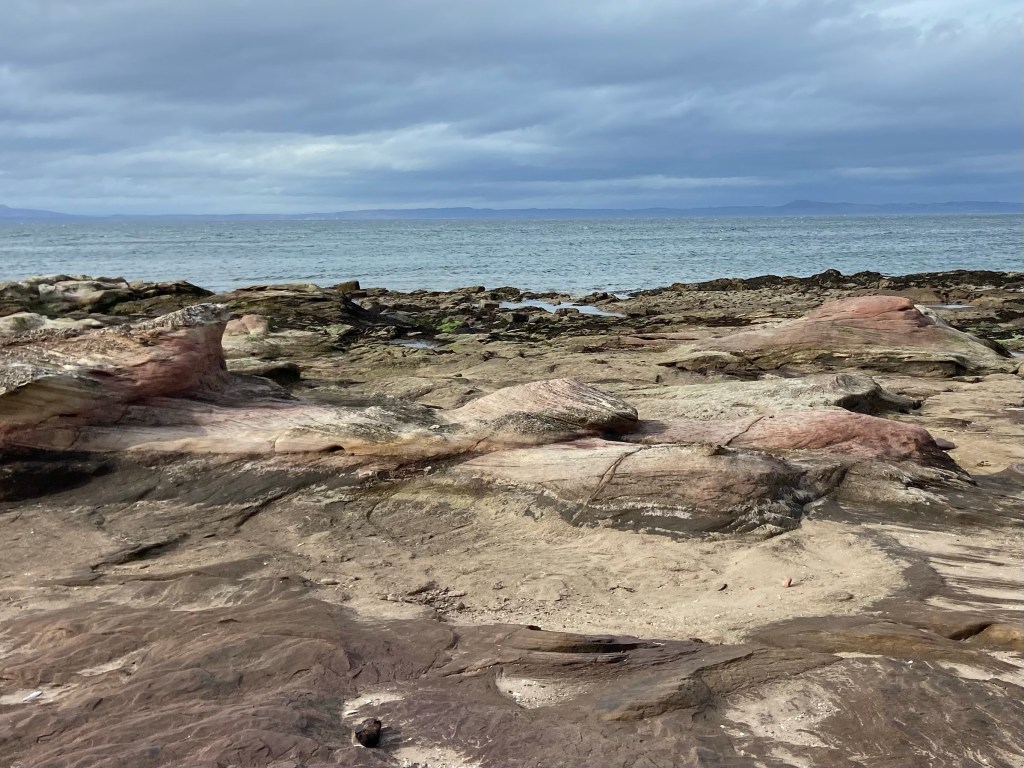
sculpted by wind and water.

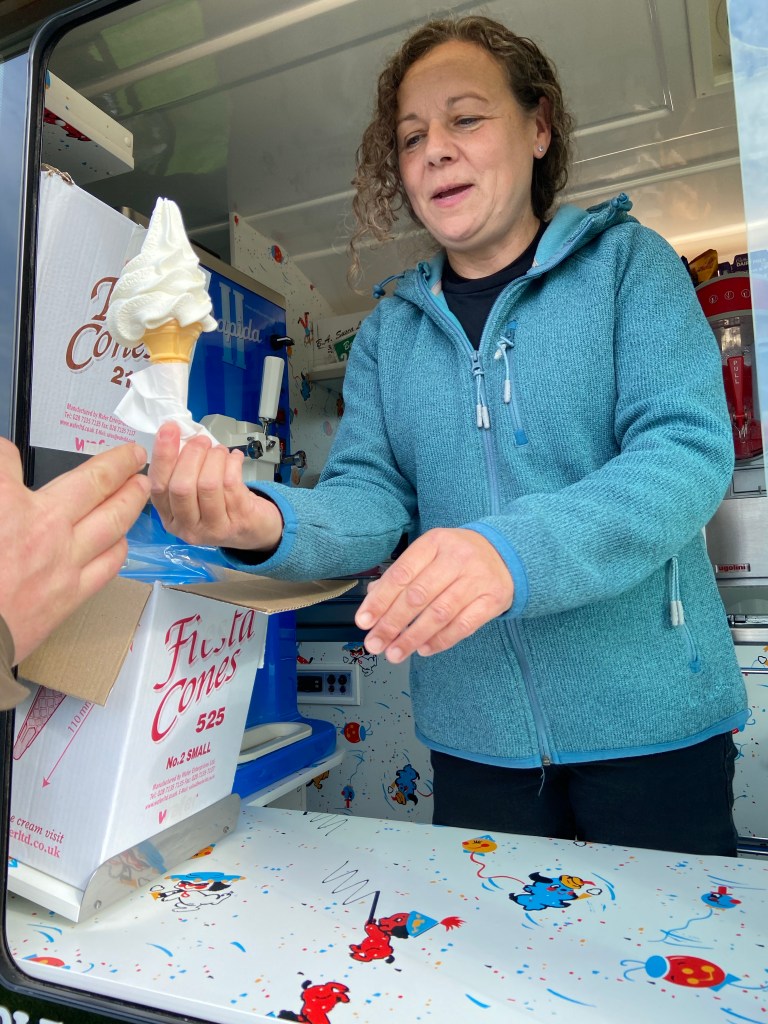
One final treat awaited me, in the beach car park: an ice cream van. A day full of wonders, book-ended with good friends, and rounded off with an utterly restorative Mr Whippy complete with chocolate flake. Thank you, Adam!
 Walking The Landscape
Cracking photos from this chapter, Sophie x
LikeLiked by 2 people
Thank you so much, Manda! Xx
LikeLike
Cracking photos from this chapter, Sophie x
LikeLiked by 1 person