
This is a city of shifting light, of changing skies, of sudden vistas
Alexander McCall Smith
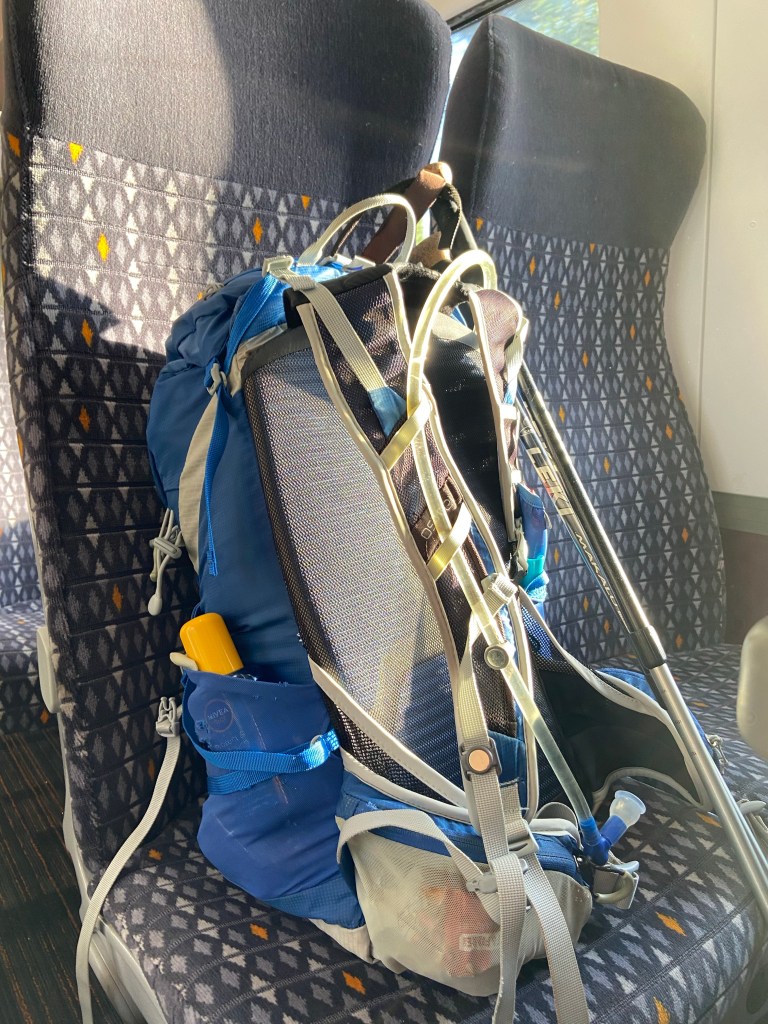
It was something of a guilty relief not to be packing my large rucksack with my camping gear, much as I love it. My smaller pack sat neatly on the seat next to me, filled with the usual 6.6kg of things I need for the coming week, as three interconnecting trains sped me from Malvern to Edinburgh.
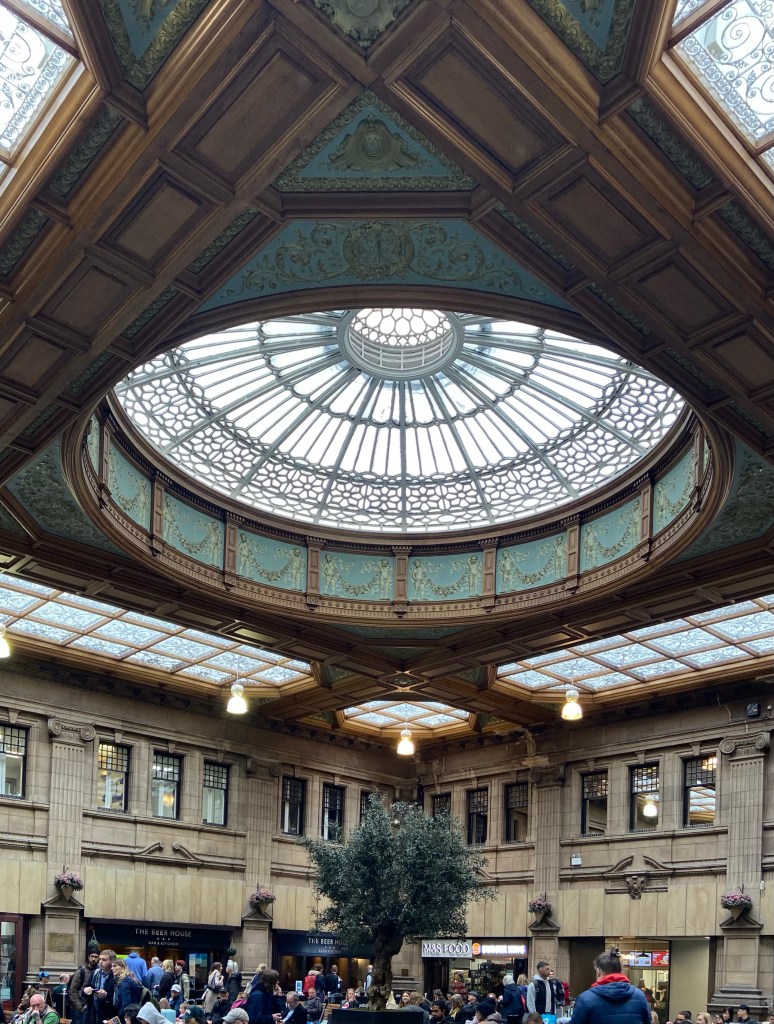
Edinburgh’s Waverley station is the only station in the world to be named after a novel. One of the many achievements of author Sir Walter Scott had been to organise the pageant to welcome King George IV to Scotland almost exactly 200 years ago. Despite various re-fits the station has undergone, the central Victorian glass dome has remained intact, and floods the waiting room with enough light to grow an incongruous olive tree, the space a tranquil pageantry of sorts to greet one on arrival in Edinburgh from the South
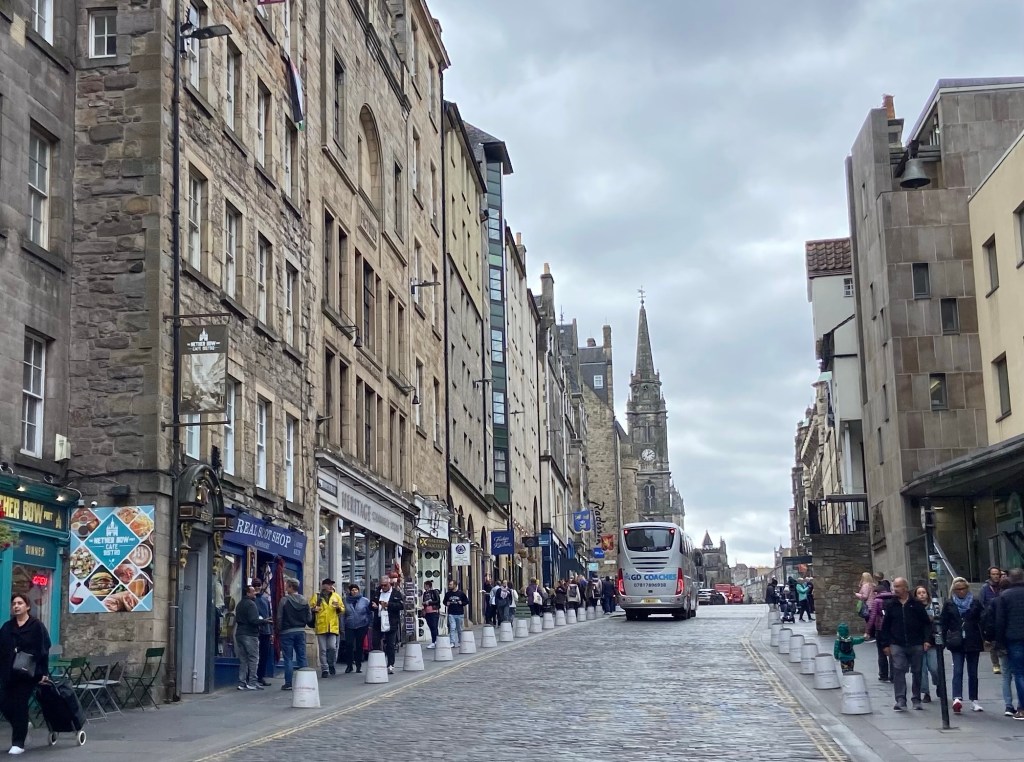
I started climbing almost immediately, firstly up to the spectacular processional route of the Royal Mile (its kilt shops celebrating the tartan heritage of the Scots, recuperated from proscription following the Jacobite uprising by the same Sir Walter Scott when it featured prominently in his welcoming pageant of 1822 as the dress both of the welcoming committee and of the new monarch), and then through the backstreets of the old town, past tattoo parlours and bike hire companies, climbing steeply up and out of the narrow valley in the bottom of which Waverley sits.
I was immediately confronted with the ‘sudden vista’ of Arthur’s Seat, an iconic sight and simultaneously incongruous, in this capital city.

I’ve only climbed Arthur’s Seat once before, a quarter of a century ago, when I was five months pregnant. I remember it as having been an unsurprisingly exhausting undertaking, and gazing up it its rearing bulk topped with a hedgehog bristle of tiny figures, I was once again diffident about my plan to detour off the John Muir Way and add the climb to the day’s walk, for the sake of taking a view.

It was certainly the stand-out feature of the day, in all senses. Arthur’s Seat towers above a city which already has its fair share of hills. In terms of the walk it was the most strenuous section, and the views it afforded from the top were nothing short of majestic. Avoiding the paved path which had been blocked in 2018 by a huge rockfall, I took the shortest and nearest path, very steep but mostly laid with solid chunks of stone to be used as steps. I was glad of the rugged treads of my boots on the more scree-like parts of the path and quizzed a woman on her way down as to the effect on the knees. ‘Fine!’ she said. She was a lot younger than me. She doesn’t know about knees.
I had used some of the train journey up to Edinburgh to read up on Arthur’s Seat, ‘a hill for magnitude, a mountain in virtue of its bold design’, according to Robert Louis Stevenson. This walk takes me across the geological landscape of our island’s volcanic past, and the ‘bold design’ of Arthur’s Seat, if perhaps planned by the god of the Mormons who are so peculiarly attached to the hill, was nonetheless executed 330 million years ago by volcanos in the Carboniferous era. There were no Carboniferous gigantic dragonflies with 3m wingspans buzzing around my head today, fortunately, and instead I enjoyed imagining the glaciers, which partially eroded the lava plugs of the ancient volcano two million years ago, crawling eastwards across the land like colossal snails, depositing the sediments which form the eastern portions of the Seat in their wake.
I made a point of finding some wet grass and patting the water therefrom on my unbecomingly red cheeks, eager to experience the same aesthetic transformation that the local maidens sought (and perhaps still seek) on May Day when they come and bathe their eyes in dew:
Frae grass the caller dew draps wring
To weet their een,
And water clear as crystal spring
To synd them clean

            Robert Fergusson, 1773
(Reader, although fully embracing the belief in beautifying myself through tried and tested folkloric methods, I avoided getting the beauty-enhancing dewdraps in my eyes through an abundance of caution about dog-poo-transmitted toxocariasis)

From the top views out in all directions were spectacular, and more than repaid the effort of hauling myself up there. I had the company of dozens of tourists, groups of freshers out on an orientation walk to introduce themselves and get to know each other, taking photos of the views, and themselves on top of the world.

I joined in, recording the moment with a selfie or two of my beauteously dew-enhanced face against a background of the route out along the coast that I was just about to begin.

Somewhere on this hill in 1836 boys out hunting rabbits had found seventeen mysterious miniature coffins containing tiny figures. There has never been any satisfactory explanation for these coffins, which are now on display in the National Museum of Scotland, but one theory links them commemoratively to the victims of the notorious grave-robbing serial Edinburgh murderers Burke and Hare. The bench I had photographed at the bottom of the hill today had been installed only two weeks ago to commemorate Fawziyah Javad, a young lawyer, newly pregnant, who was pushed to her death from Arthur’s Seat by her controlling husband in September 2021.
I turned back the way I had come, and picked my way down the rocks, thoughts of the more chilling chambers of Edinburgh’s dark heart giving way to a total focus on the ground under my feet. Initially I had to go quite gingerly, and my legs were still shaking a little from the exertions of the climb. One of the freshers asked whether I needed any help and offered me her hand. “Well done for giving it a go,” she said. And I felt rather that through her eyes what I was undertaking was some kind of feat of gerontological mountaineering.
Despite the friable surface and the steep risers of the rocky steps, the way down was easier than I had expected. I enjoyed listening to the getting-to-know-you conversations of the freshers climbing past me: “don’t worry, the volcano is totally extinct…”“and then we saw a whole family of elephants…”, “my mum is really nice; she’s also a little overbearing…” (Note to self: be less overbearing). I mentally wished them all well with their time in the city and their new lives, just beginning as I was leaving.
I joined the John Muir Way at the bottom of the hill. It was as paved as I remember it and I couldn’t help thinking that John Muir would have been saddened that the route named after him feels so un-amongst-it. One really has to work hard to find any kind of connection with nature, what with the graffiti and the high stone walls on either side, despite the fact that I could see on the map I was walking past a bird reserve and country house. However, nature I did find, in the form of the structural beauties of seedheads: rosebay willow herb, and teazel.
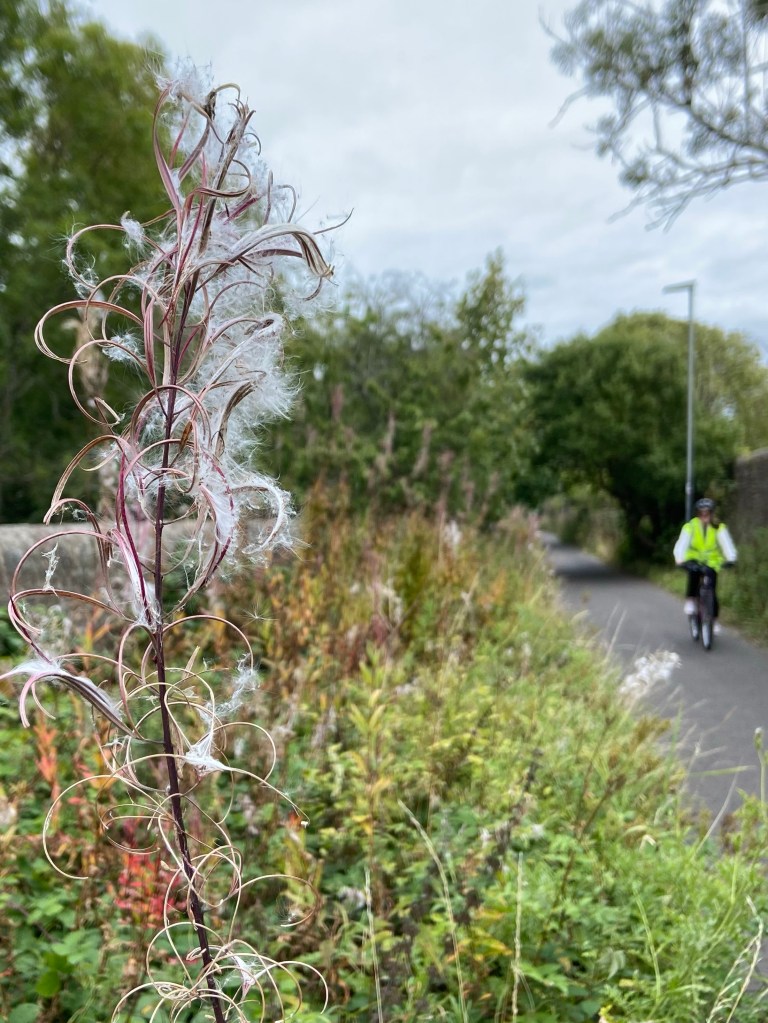
I picked a few blackberries, and noted hawthorn berries and rose hips. The raspberries had all been taken by the birds, which I did not begrudge.
The good thing about the path, of course, is that one motors along it. Not literally, you understand — that would be cheating. I was texting my dear old friend Victoria about the likely time I would finish when I saw a sign saying that I was only a third of a mile away from her home in Portobello, the sandy beachfront dormitory village on the edge of the Firth. We both gnashed our teeth at the idiocy of my having booked an Airbnb in Musselburgh. I didn’t somehow feel, though, that I had walked far enough yet to call it a day, despite being slightly fed up with the pavement, and the cyclists speeding past me on the beautifully smooth, hard surface.
The path wound its way to the edge of Magdalen Glen, a thread of community woodland in the heart of the sprawl of urban estates, following a sluggish burn choked with end-of-season fading greenery, tyres, crisp packets and hubcaps.
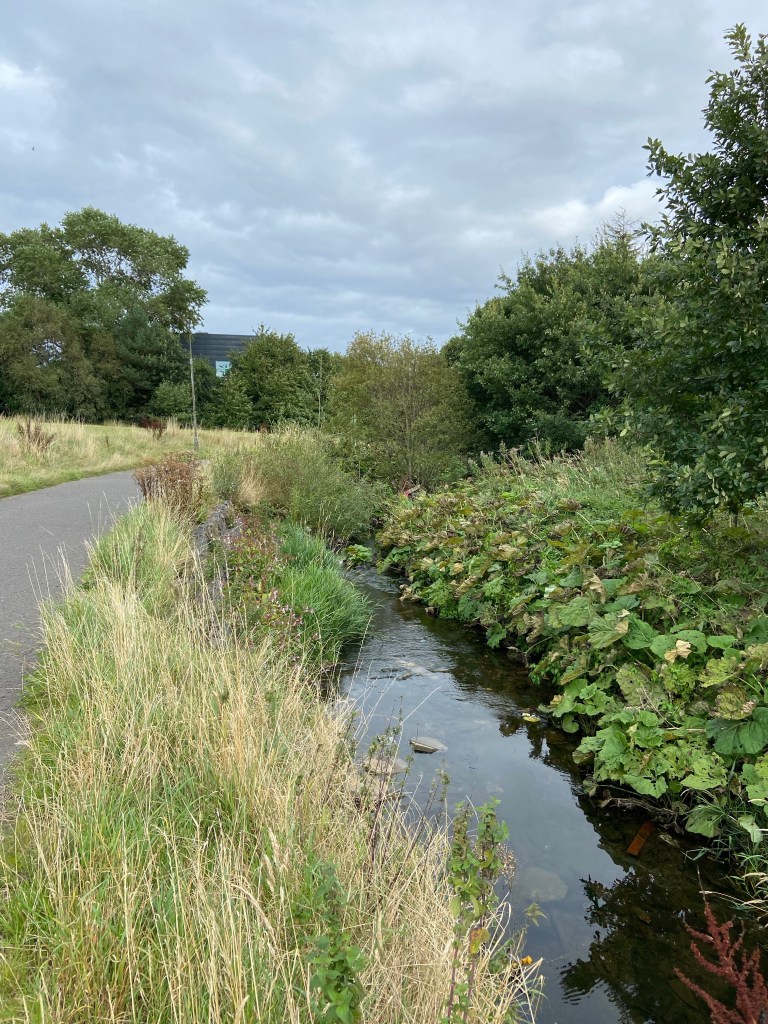
Suddenly, a flash of russet movement in the vegetation on the other side of the burn caught my eye. A miniature deer bounded through the long, wet grass, and stopped by the garden fence to browse on a scrubby tree. It was a moment of startling enlightenment, and one which John Muir would certainly have gloried in, as did I.
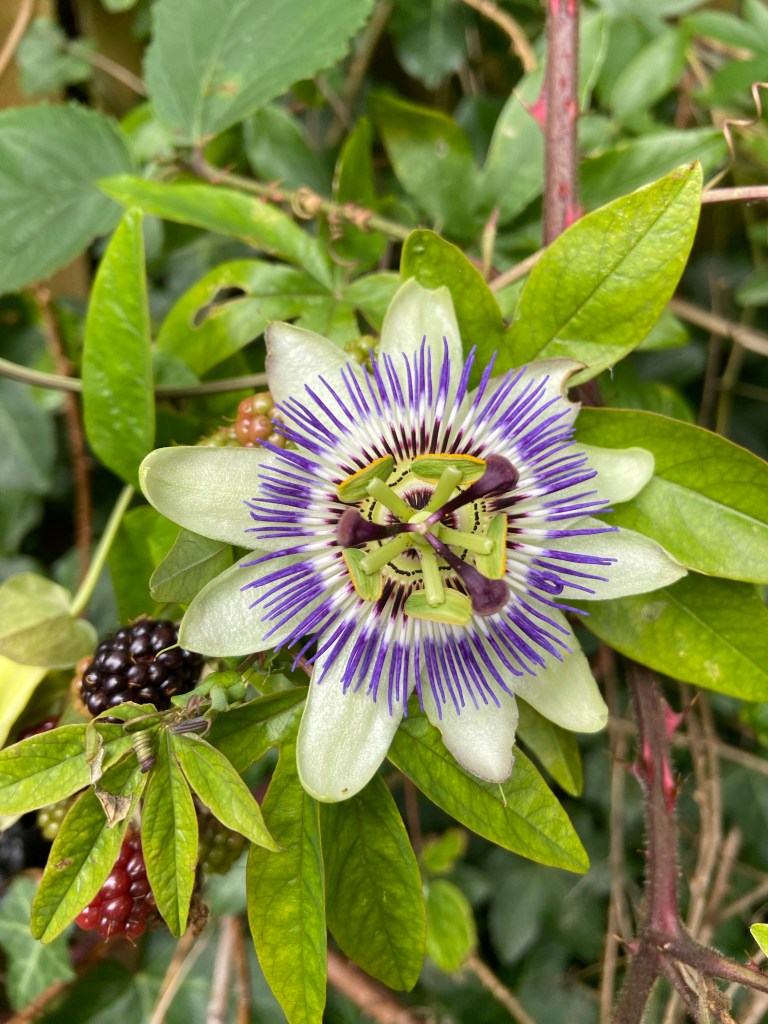
The pavement wound its way onwards, the Niddrie Burn losing itself under the railway connecting Edinburgh with Newcastle and the South, and re-emerging on the other side in a new community park as the Brunstane Burn. Here there were other momentary encounters: a passionflower strikingly purple and white against the dark purple black of the berries I was searching out,
and a fairy garden meticulously assembled amongst the ivy and leaf litter, complete with festoons of minuscule bunting strung twig to twig above it.

Every now and then there was a view of the burn, the sound of which bubbled away incessantly to my right.

Brunstane Burn Park opened out into farmland on one side and leafy gardens of well-to-do houses on the other. My attention was now caught by cloudscapes, and I felt for the first time today a wonderful sense of expansion that I did not feel even at the top of Arthur‘s seat with its panoramic views, crawling as it had been with other people. I was sharing the path here with cheerful, sociable small groups of runners, individual joggers with earphones in passing me swiftly in the other direction, the odd pair of dog walkers nodding to me in acknowledgment, and overhead, the first cries of seagulls called to me to press onwards. It had rather stupidly not occurred to me that of course the burn would open out into the sea, very close now. My final approached to the Firth was accompanied by late jasmine and honeysuckle tumbling fragrantly over a garden fence, and grey green willow branches encroaching onto the path.
I emerged from the park onto the main road right at the edge of Musselburgh, a sign announcing it to be the ancient birthplace of the Saltire, Scotland’s flag of Saint Andrew.

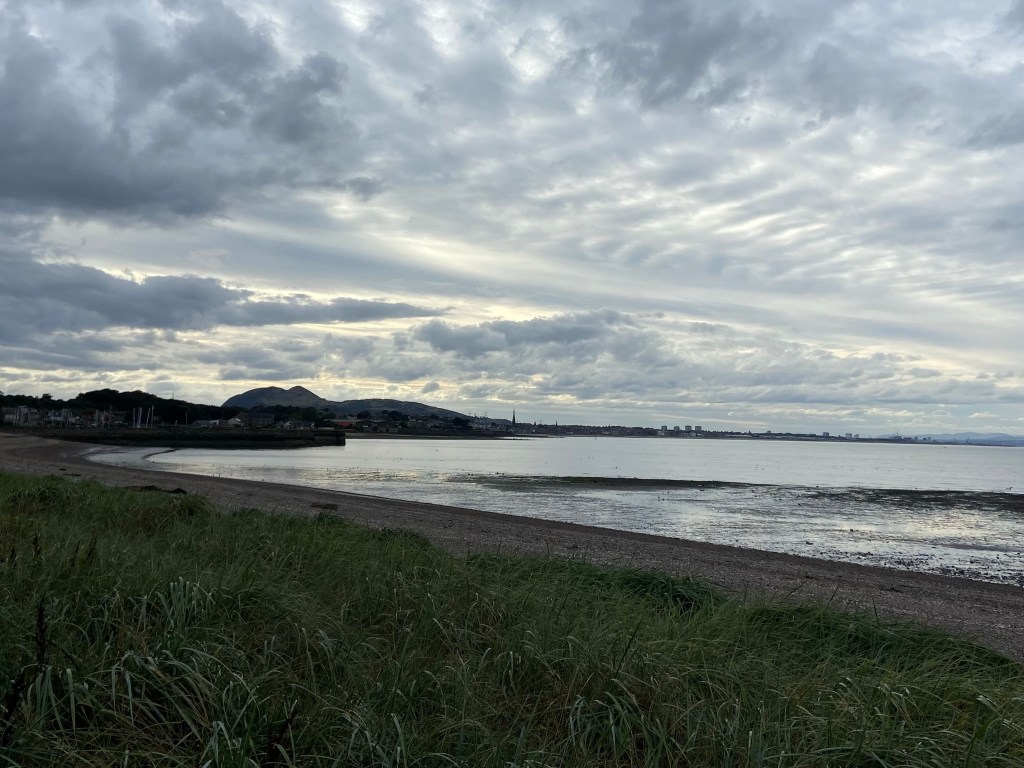
On the other side of the road there at last was the great expanse of the Firth, widening here into a huge mouth with the East and West Lomond hills on the northern side.

I walked over the dark red sand, tidelines of shells, including the dark blue and white mussels after which the settlement is named, stretching away across the curve of the beach.
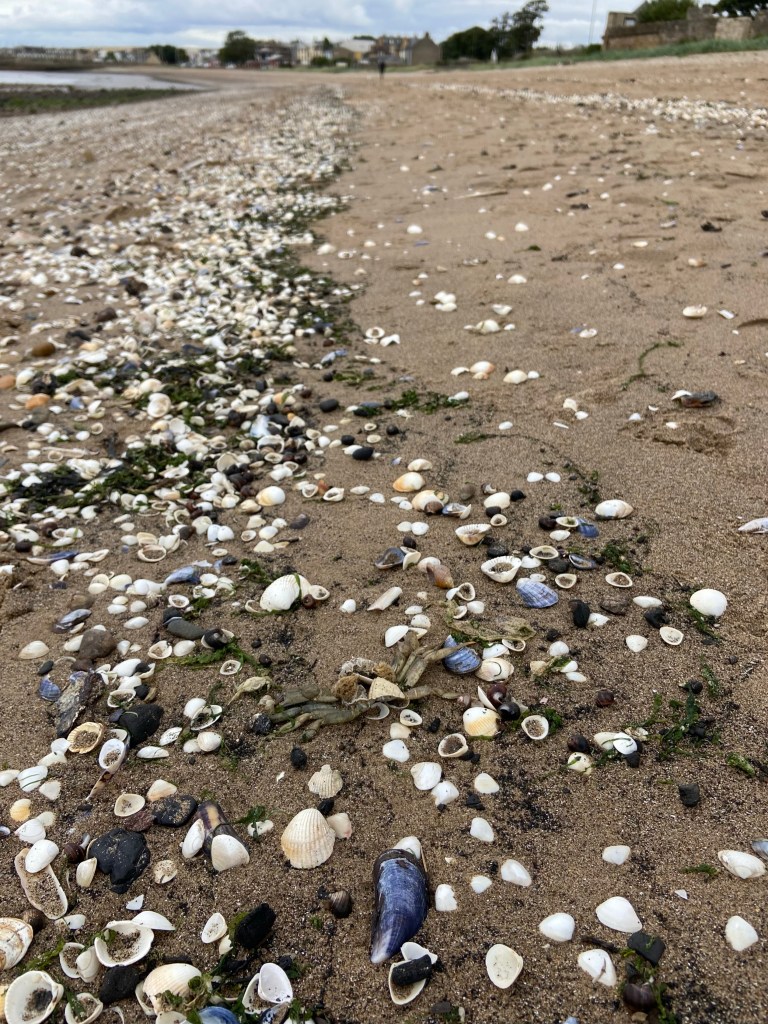
Fat curlews with long, curved bills and oystercatchers in their smart liveries picked at shells and tiny crustaceans along the shoreline, their calls mixing with those of the gulls and the jackdaws.

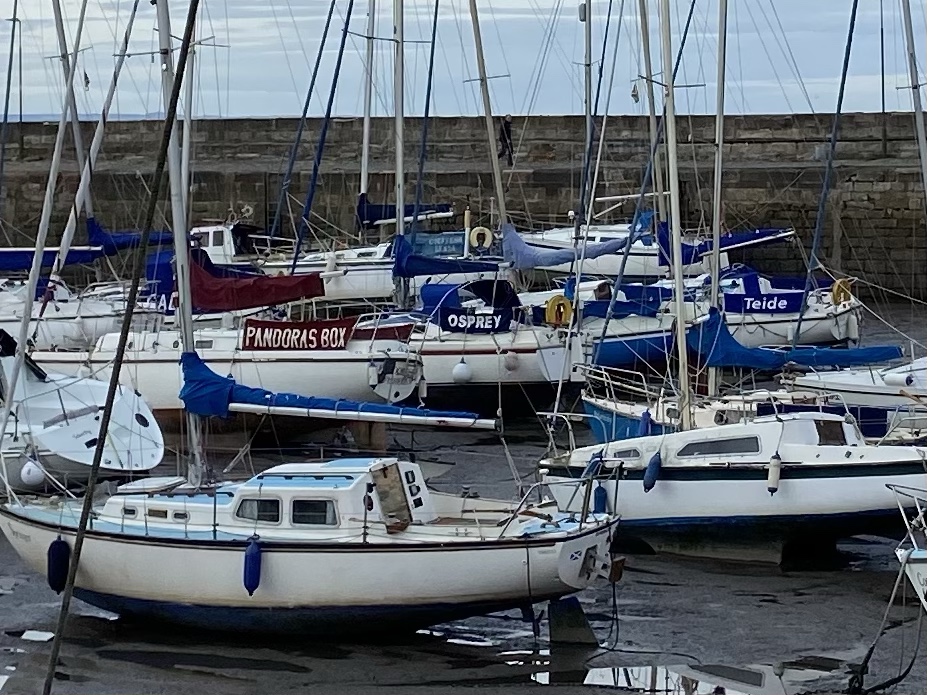
I paused a moment to look at the boats high and dry now at low tide in the safety of the tiny harbour. I thought how much rather I would go to sea in a boat called Osprey, than one called Pandora’s Box. A more inauspicious name for a boat one would struggle to select. Perhaps they had meant ‘cornucopia’? The two seem to be muddled in people’s minds.
I had arrived at the end of my walk earlier than I had expected so I could take my time sauntering along Fisherrow promenade. I tried not to stare at a pair of tall identical twin teenage girls, with striking waves of thick Titian, Pre-Raphaelite hair tied back, out for a walk with their father and chatting animatedly. Instead, I stared out over the low clumps of autumnal Rosa rugosa out to sea,

And back the way I had come, to Arthur’s Seat silhouetted against a mackerel sky.
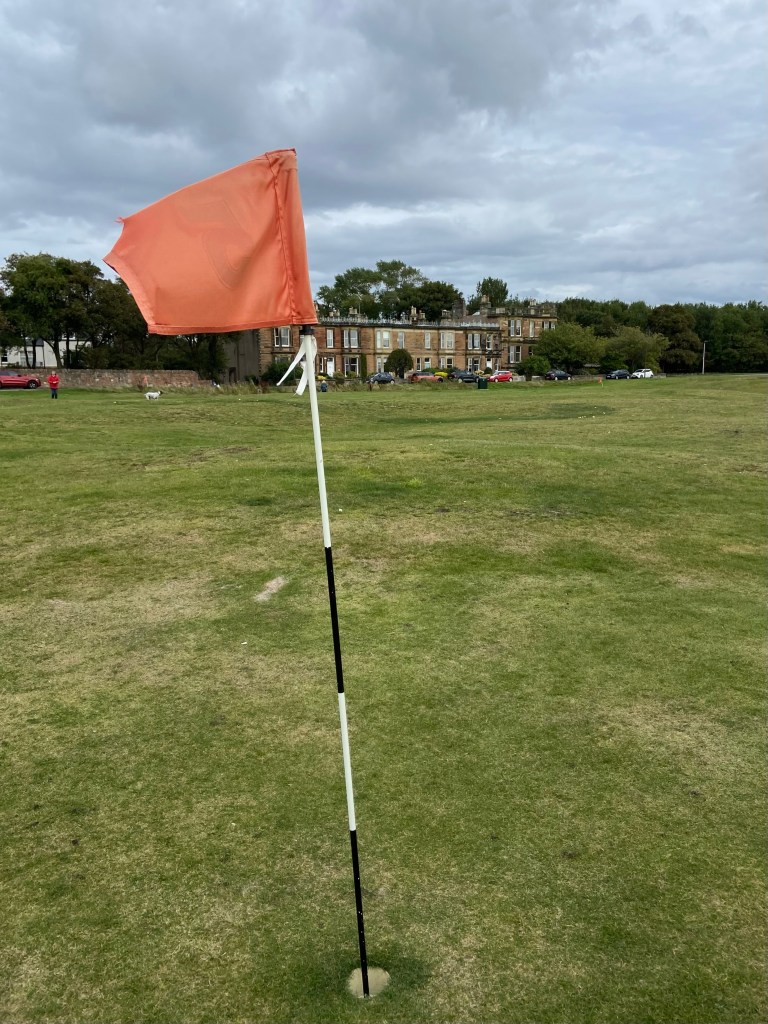
The three-storey house I was aiming for was easily identifiable across the turf of what was marked in the map as ‘the links’. There were goalposts and floodlights here, and I wondered briefly whether I had got it wrong, and that ‘links’ was a generic name for a recreation ground. But no, golf course there was, with flags posted into holes lined with white cups, and a white-haired lady playing a solo round, seemingly unperturbed by a spaniel chasing tennis balls thrown for him in the fading light.
Fun fact
Sir Walter Scott, of Waverley fame, had begun writing to help clear the eye-watering debt — some 13.5 million pounds in today’s money — that he had got into as a result of the collapse of the printing house Ballantyne in 1825. I wonder whether it was this money-generating strategy which just over a century later inspired my grandfather, also a judge, to turn to writing detective fiction in order to clear the £5,000 debt he had to pay to a Swedish opera singer who sued him for breach of promise when he married my grandmother instead of her.
 Walking The Landscape
So many details to love here, the twins, the overbearing mother, your grandfather…. But mainly just so glad to hear your walking happiness. Well done for giving it a go! 🤣
LikeLiked by 2 people
🤣
LikeLike
Thank you! I was transported to Scotland there.
“She doesn’t know about knees”.
LikeLiked by 2 people
Hahaha!
LikeLike