maru mori — “the heartbreaking simplicity of ordinary things”; dès vu — “the awareness that this moment will become a memory”
Neologisms from The Dictionary of Obscure Sorrows by John Koenig
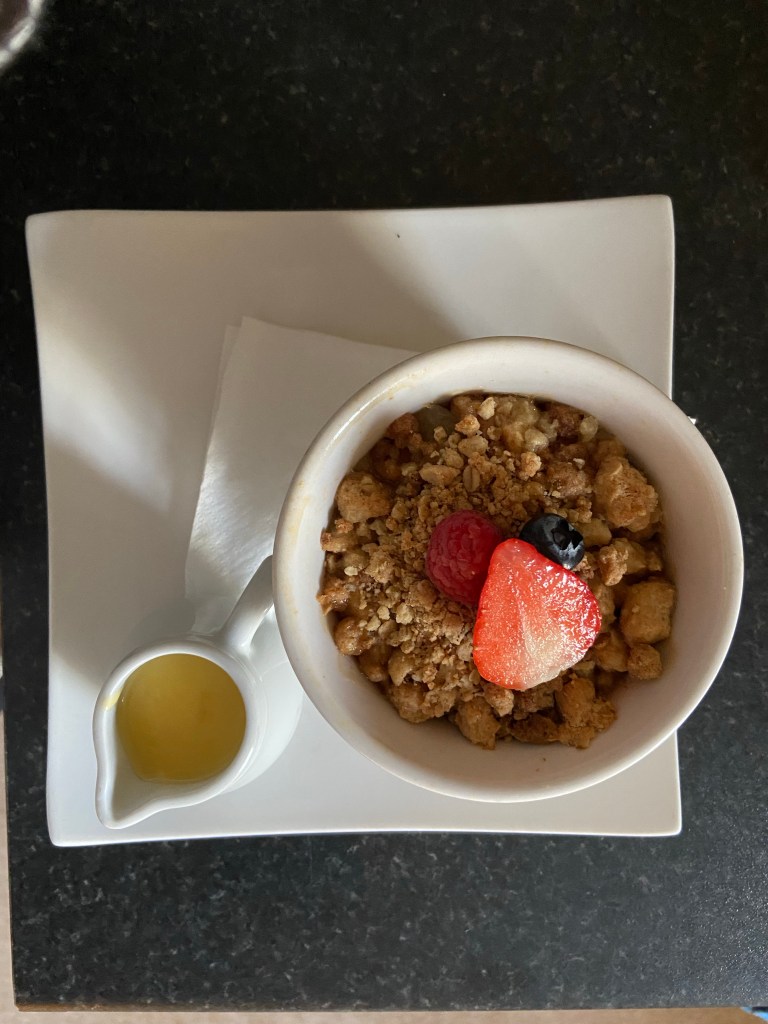
This morning’s breakfast was a decadent apple crumble and custard which I had providently had made up the night before when I realised the pub didn’t serve breakfast. Breakfast in bed proofreading the blog and adding photos was so relaxing that I found out very difficult to get shifting.
But shift I did, putting on my waterproof and stepping out into the smirr.
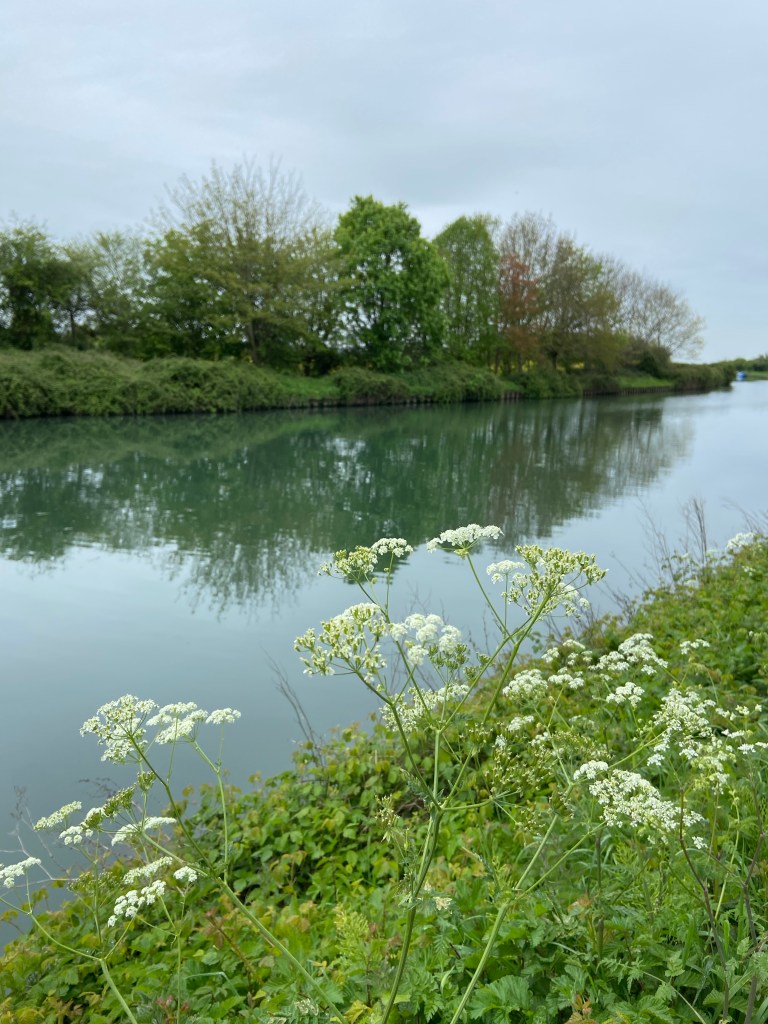
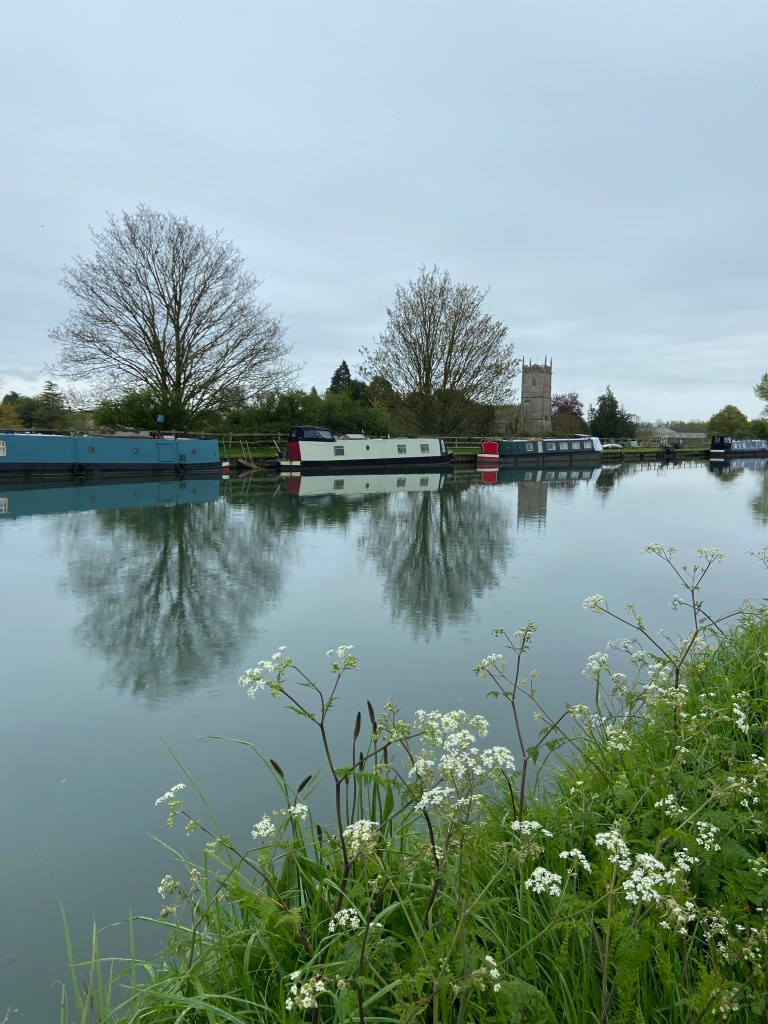
The canal was a different animal this morning. Quiet, green, and flattened by the moisture that hung softly in the air.
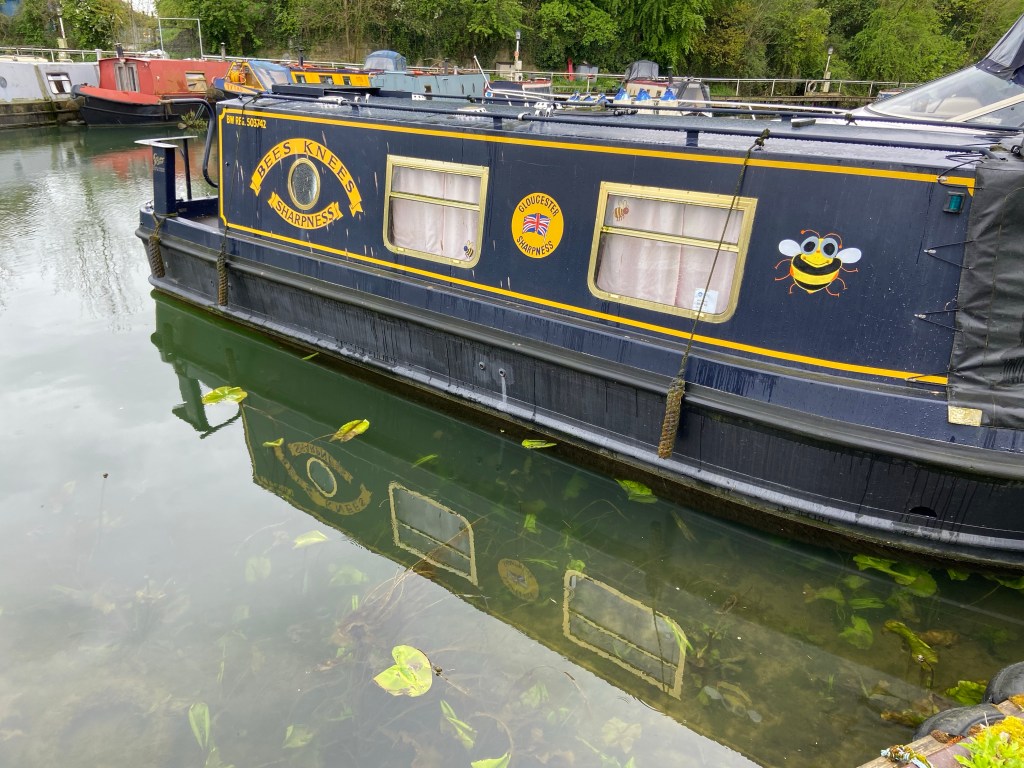
The church at Splatt bridge rose pleasingly up behind the still boats tied up at their moorings, and despite the smirr the water was still enough to reflect the willows.
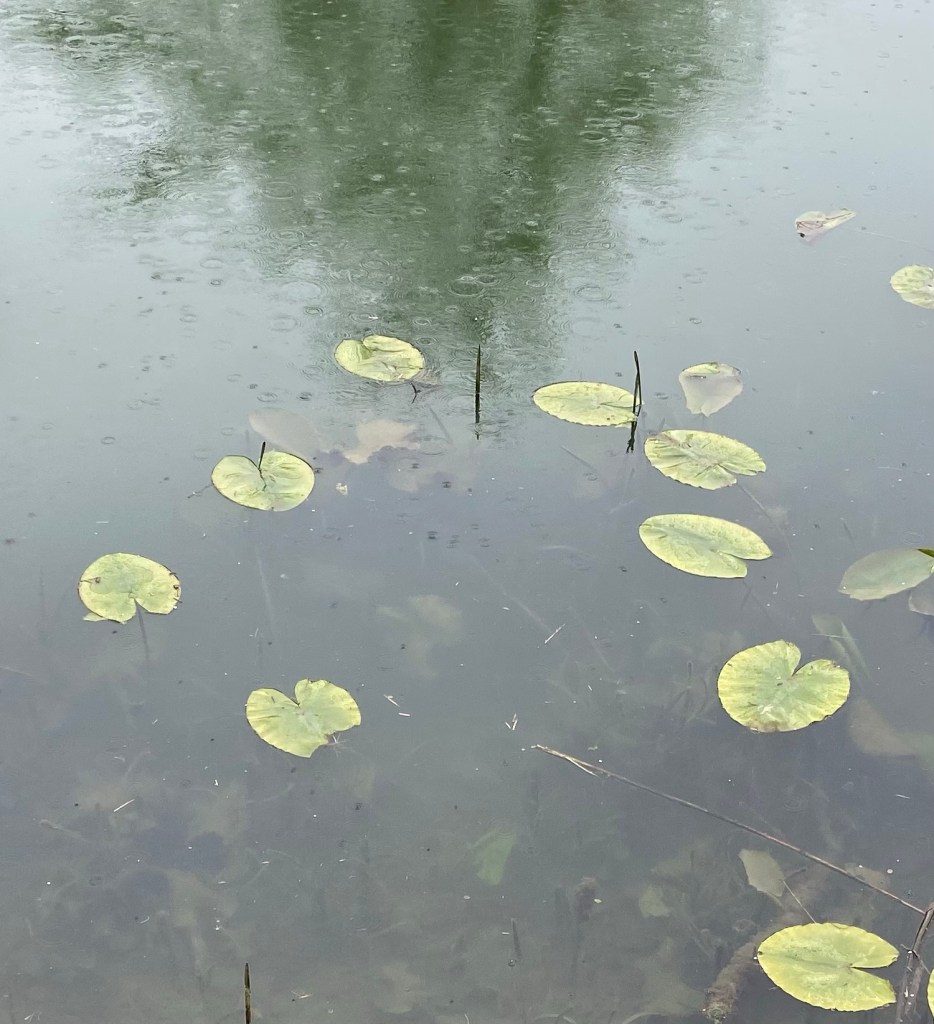
Still enough too for the fine silt to settle, making the water clear enough to see to the bottom in many places.
Before setting off, I had put my binoculars in my jacket pocket, because I would be passing the marshes and wetlands at Slimbridge WWT between the canal and the river. As I tried to develop a metronomic pace (I would be walking along the tow path for the entirety of my walk today), I also stopped to listen out for birds with the Merlin app, and look out over the marshes to see whether I could spot any interesting birds. I was especially hoping to hear a bittern boom in the reedbeds. I didn’t hear one but Merlin did identify for me a sedge warbler (which I can now identify for myself) and a Cetti’s warbler (which I still can’t).
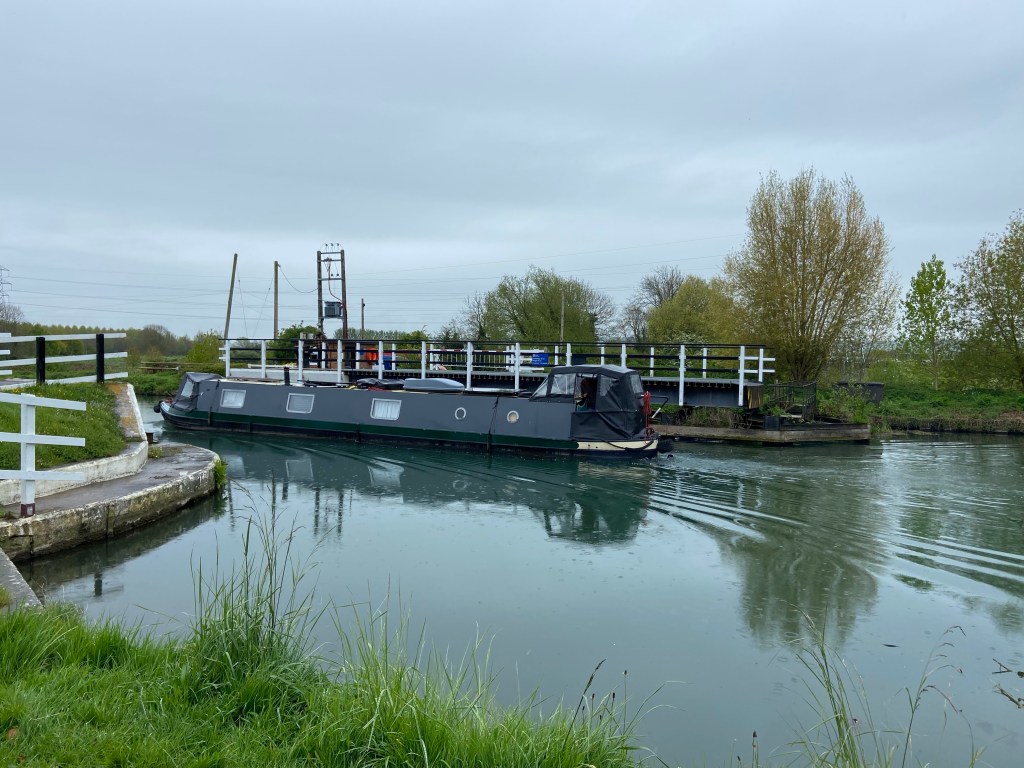
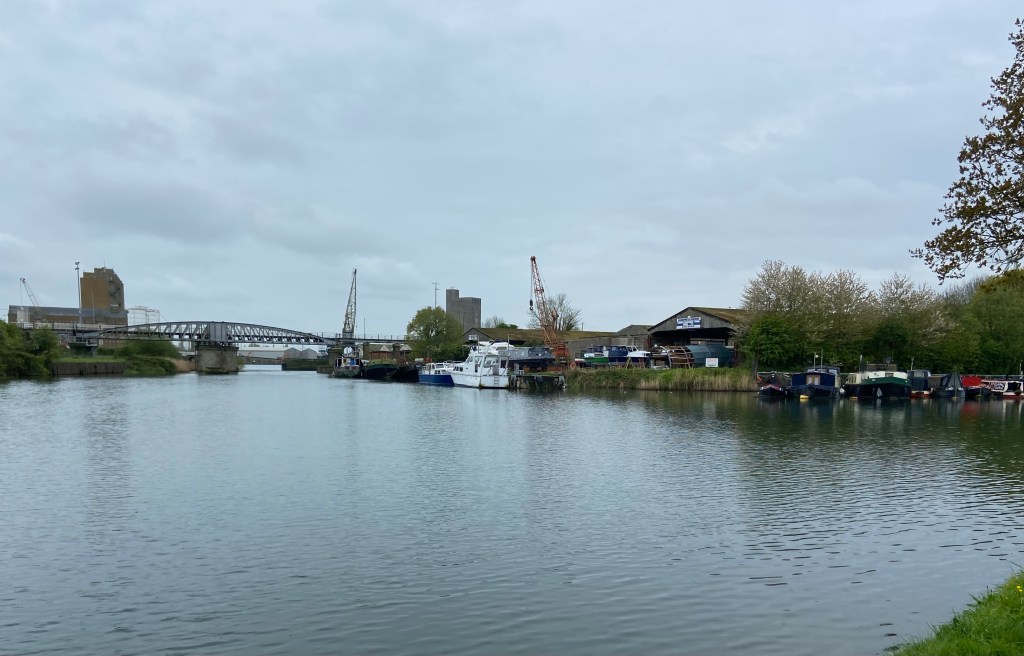
There are two swing bridges between Frampton and Slimbridge. These are cranked open by hand to swing the entire roadway round to fit snugly against the bank to let a boat through. The first, at Frampton itself, was just opening up as I crossed it, but the second, the marvellously-named Splatt Bridge, was being swung as I arrived, so I stopped to watch the boat glide past.
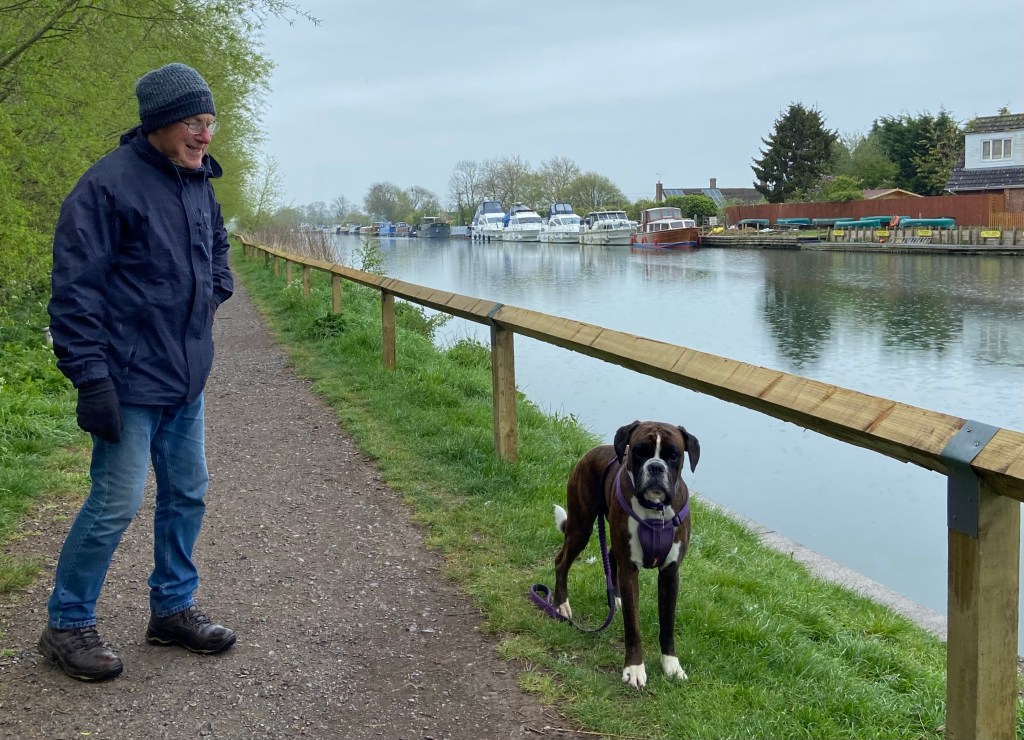
As I was awkwardly balancing on one leg to put by waterproof trousers on, I got talking to narrowboatman Stuart, out walking his boxer Wilson, and asked about cafés in Sharpness, a couple of hours down the canal, where I might get lunch.
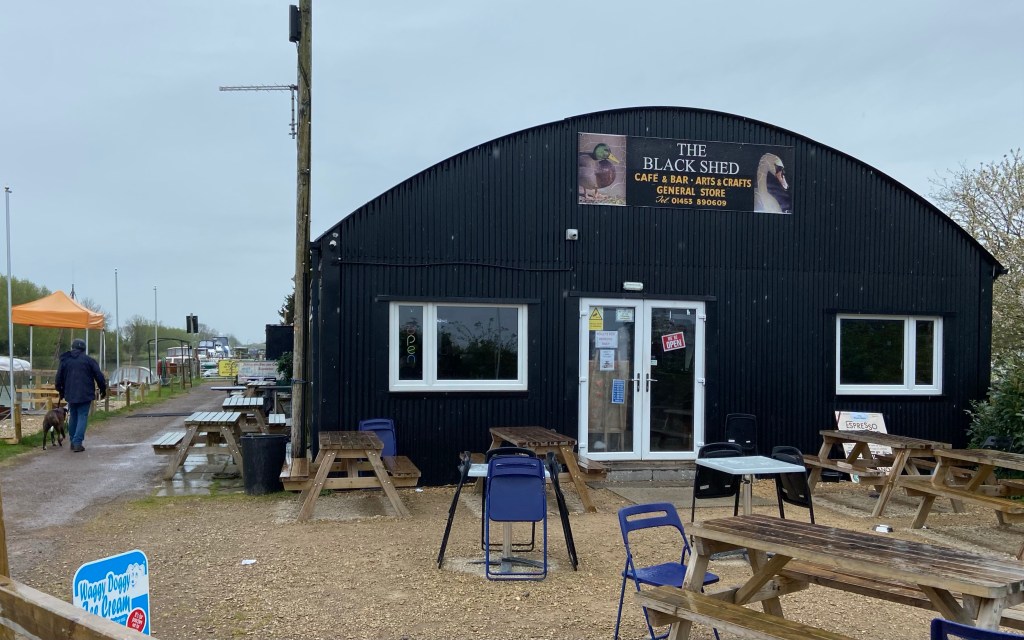
The word was that apparently the little town was a bit of a dead loss, with no shops or cafés and only one pub, probably not open for lunch. However Stuart pointed out that we happened to be right by the Boat Shed, so I took the opportunity to sit for a bit and enjoy a late morning coffee (which my decadent breakfast had not included) and get a fat sausage and egg sandwich made up for me for lunch.
I got talking to Mandy, who it turns out is local to me in Herefordshire. Her impeccably-behaved arthritic bull terrier sat patiently at her feet in the doorway as we swapped stories of renovating old Herefordshire houses.
I could have stayed all day but it was time to cram my sandwich into my pack and crack on. I didn’t really want to see how far I hadn’t managed to get yet, but checked anyway and was baffled to see that I was apparently in the middle of the river on a sandbank.
It took a while for the app and the location services to sync, so it was lucky for me that my route consisted of the towpath, on which there was very little chance of getting lost. The caffeine seemed to go straight into my bloodstream and I cranked up the pace, determined to get on, and stop flathering around with photos unless something really interesting presented itself, and stop stopping to find out what tweets and chirps were coming from the bushes.
But it’s hard to resist. There was this milepost, one of a thousand made to mark the creation of the national cycle network (can it really be 34.5 miles still to go to Bristol?? Surely not);
and I think I was fully justified in stopping to watch a couple of courting swans mirroring each other’s movements, as they dipped their heads from side to side and preened in synchrony.
There was the man piloting his boat under an umbrella (he waved),
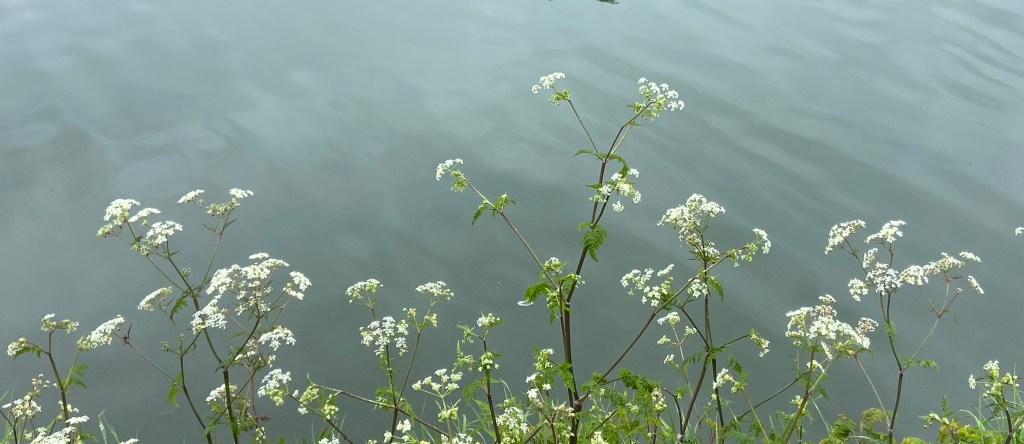
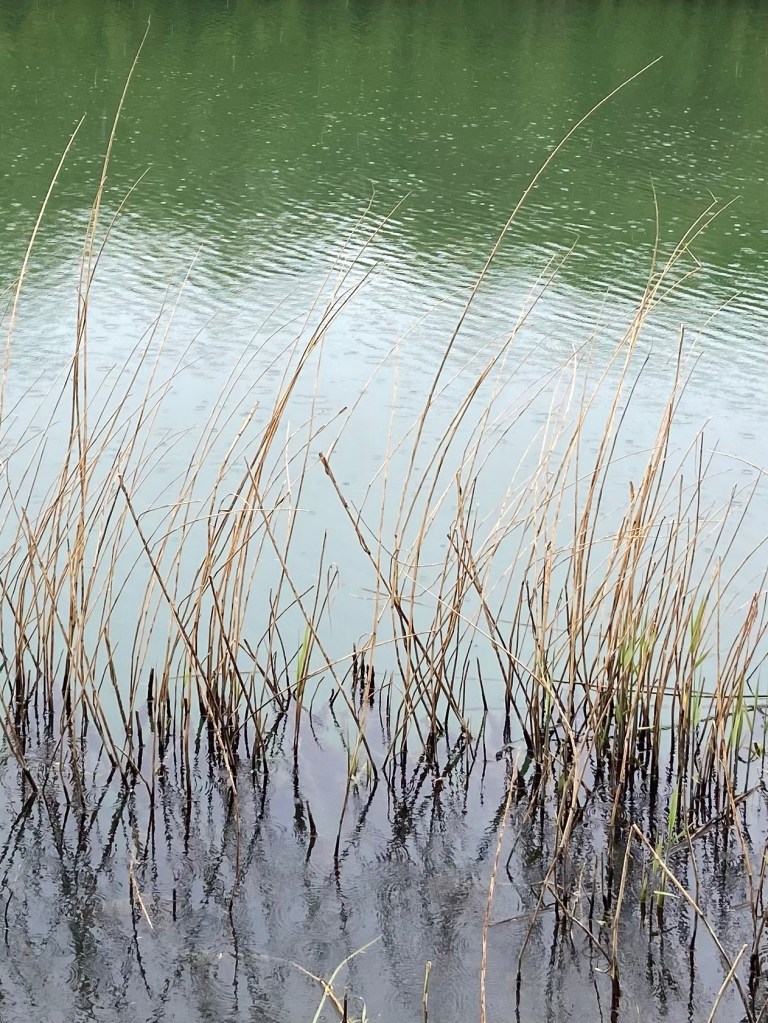
and the blackened stalks of last year’s reeds adding another layer of colour in the green and silvery-grey water.
Altogether I was glad of the ‘heartbreaking simplicity of ordinary things’, given a name by Koenig in his Dictionaryof Obscure Sorrows, of words he had coined for feelings that have no names: maru mori.
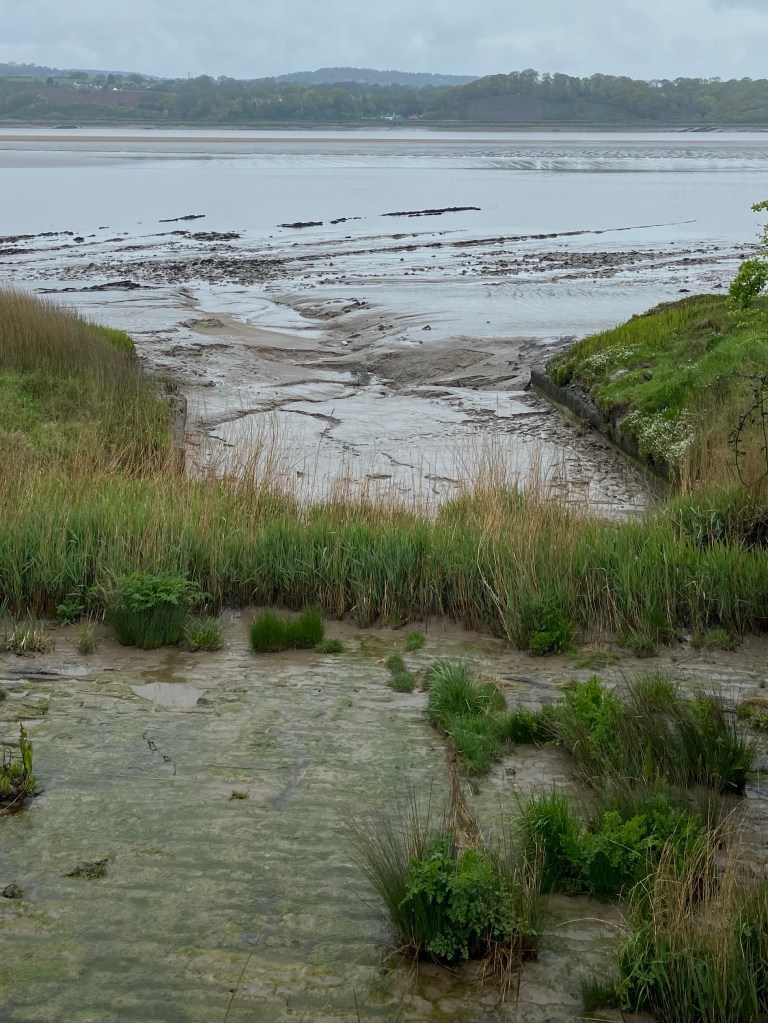
The Severn and the canal eventually draw very close, and I found myself walking a narrow strip of land between them. They were connected at one point by a spillway, or automatic weir, which would spill excess water from the canal down into the river.
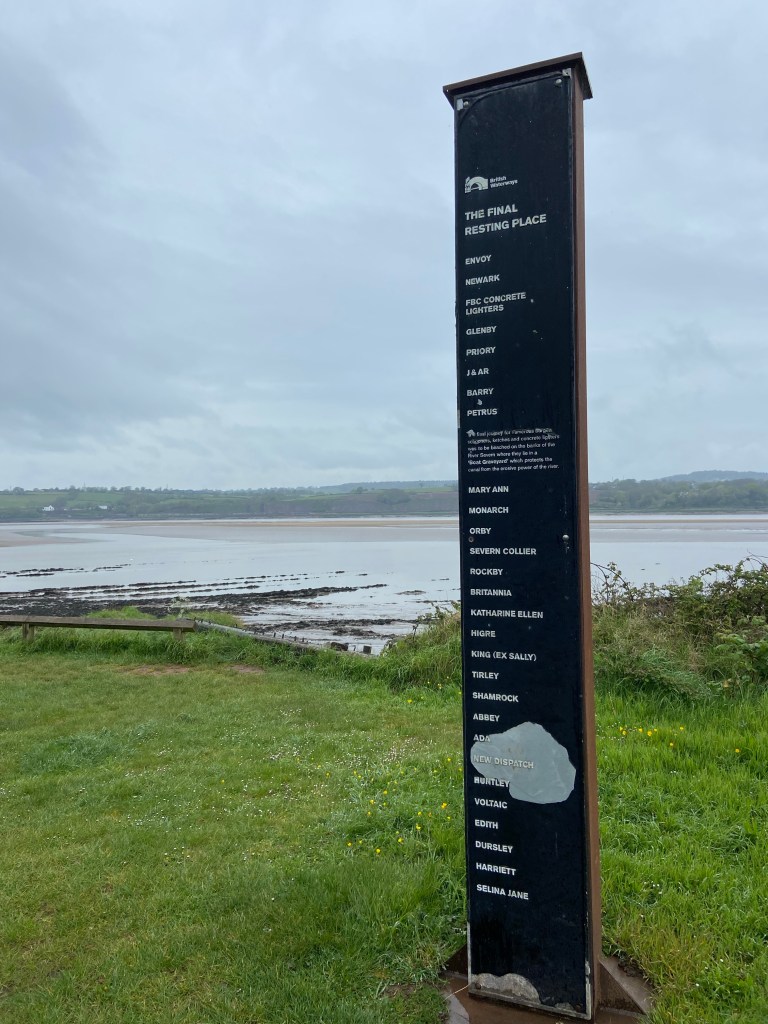
At Purton there is a ship graveyard, a ‘sight of historic importance’ and part of the estuarine SSSI. For 56 years up to 1965, scrapped vessels were beached on the foreshore, and allowed to fill with silt and become an artificial barrier to prevent erosion of the canal embankment by the river.
The hulks have become a constituent physical part of the embankment itself, a bleak but heart-tugging sight against the mournful, empty flats.
I walked out onto the deck of one of the ships to sweep the tidal mud with my binoculars; but apart from some shelduck and lesser black-backed gulls, there was no sign of birds.
The most moving monument, though, was to the ships and crew who lost their lives in the terrible disaster in 1960, as an interpretation board explained: ‘Thick fog and a strong tide meant that boats entering Sharpness dock were having extra difficulty. Two tanker barges, the Arkendale H, and the Wastdale H laden with petrol, missed the entrance, and were carried upstream towards the bridge. The Wastdale H collided with column 17, her petrol tanks, ruptured, and the force of the tide pushed Arkendale H on top of her. The collision caused two bridge spans to collapse, rupturing a gas main and an electric cable. There was a mighty explosion and the barges burst into flames. Fire spread across the river as oil and petrol spilled into the water. Of the eight crew, only three survived, having swum to the safety of the shore.’
The two shoreward spans on this side of the river still survive, reminiscent in their overgrown state of the Argonath in The Fellowship of the Ring.
They announced the arrival at Sharpness, a bleak, industrial end to the rural idyll of the canal, calling back to its man-made origins.
The path leads round the docks, the boats all silent and seemingly abandoned.
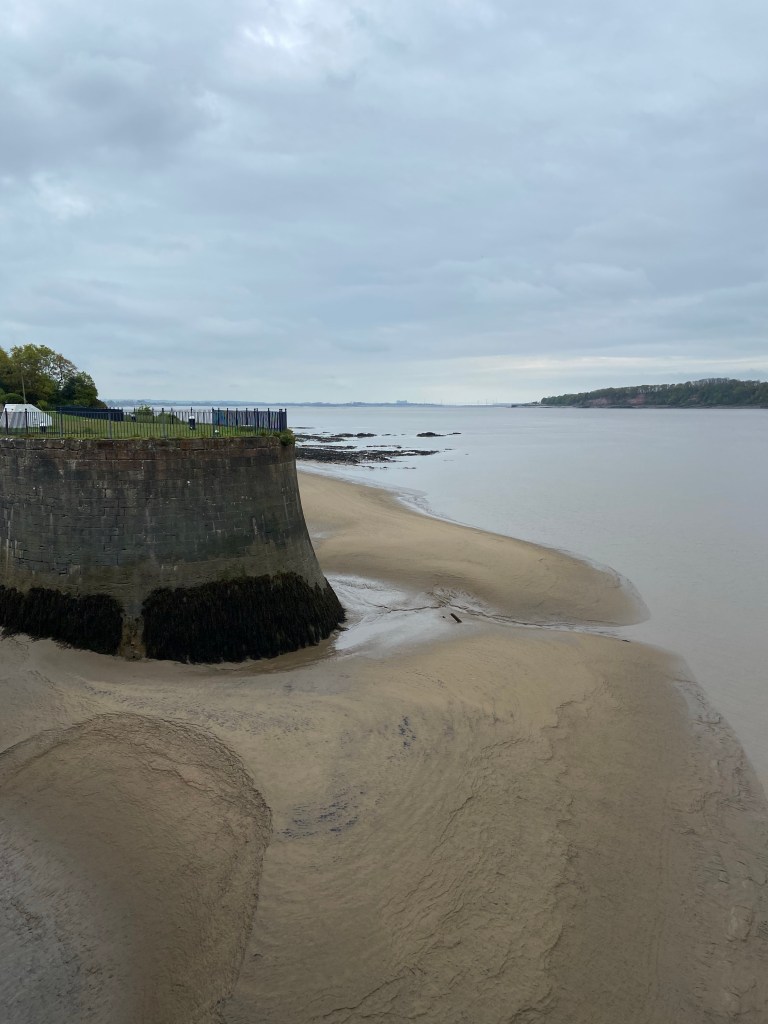
At the very end of the dock the ‘ness’ or nose of Sharpness extends out into the estuary, surrounded by vast sandbanks and mud flats. I sat on the bench and gazed downriver to the Severn Crossing on the horizon, the destination for tomorrow’s walk.
The basin at the end of the canal was dark and green and reflective,
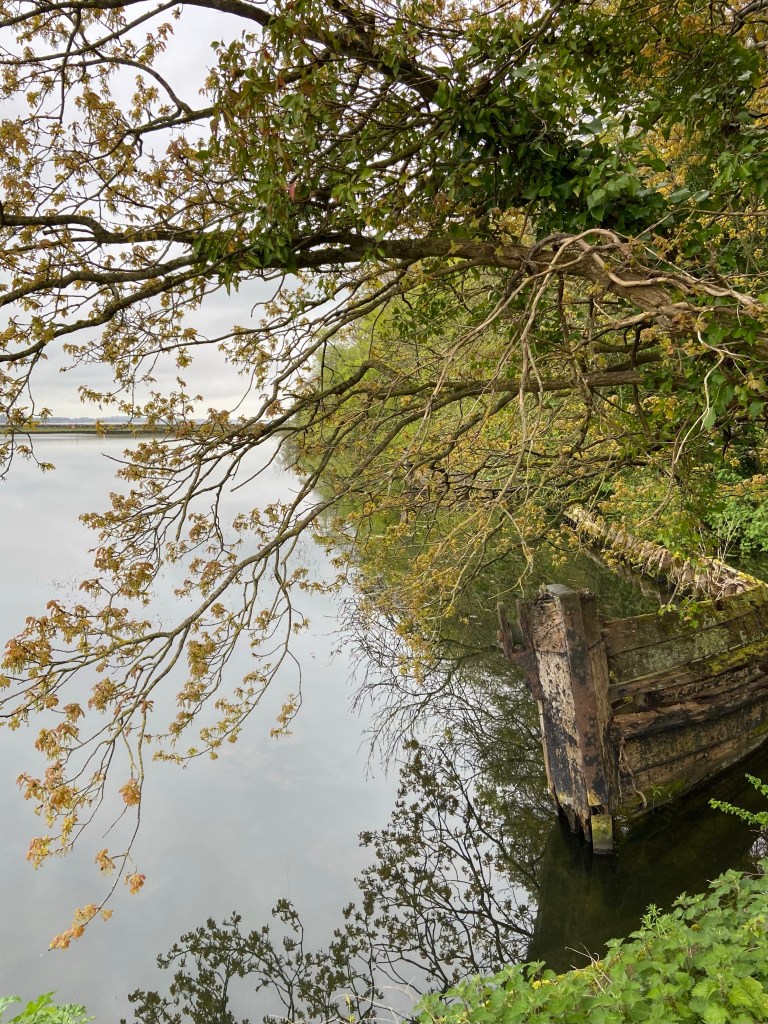
and one final boat, the Mary, had been scrapped there, her skeletal timbers slowly collapsing into the still water.
I came off the Severn Way shortly afterwards, preferring to take a slightly more direct route into Berkeley to find my AirBnB. A cycle path became a muddy track, probably preferable to the industrial foreshore of Sharpness, but a dull end to a quiet, damp day.
Apparently a cyborg had trodden the path in front of me, with a boot on one leg and a tyre on the other
Stats for the Day
Distance: 18.89km. Blessedly short!
Nothing else, really!
So here are two beautifully-contrasting maps from the Wikipedia entry for the Gloucester and Sharpness canal, the first the 1933 Ordnance Survey map
(Showing the entirety of today’s walk)
And a map in a more contemporary, graphic style, closely resembling the strip maps of old, and matching my experience of walking the narrow strip of the canal path as it unfurls before you.








 Walking The Landscape
I love a day like that. Not much in it, yet everything in it. Those ship hulks! And I’m so glad it was a short one too.
LikeLiked by 1 person
‘Not much in it, yet everything in it’. That’s it 🤍
LikeLike