
Dyfal donc y dyr y garreg.
Welsh Proverb: Slow and steady wins the race.
I have lost count of the number of times I have mapped today’s walk. There was a 20km low-level walk and a 20km high level walk which looked to take on some terrific views. But then Storm Agnes hove into view on the horizon. I had been watching the weather forecast over the last couple of days, and it seemed that Wednesday was going to be volatile to say the least.
In the end, caution won out again and rather than risk a day’s slog through farmland in torrential rain and terrifying high winds, I thought I’d just do another (yet another) schlep along the roads. This choice had the added advantage of shortening the walk by 7km, and thus, I thought, l looking at the satellite forecasts, I might be able to take advantage of a weather window that looked to be opening up in the early afternoon.
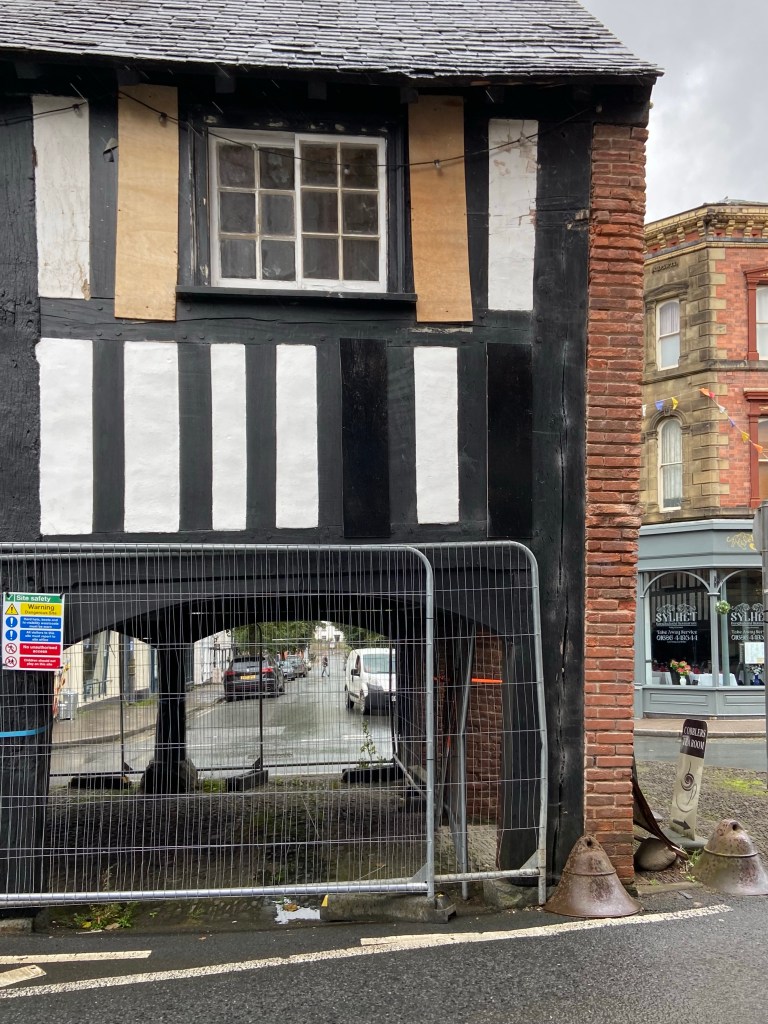
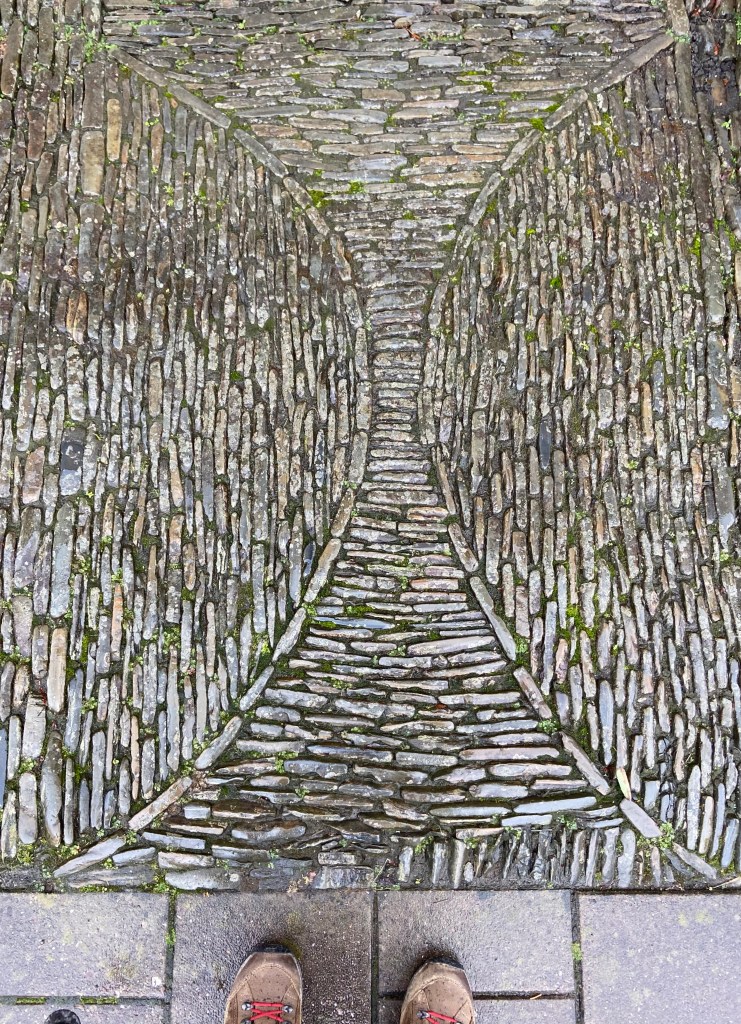
Best of all, I could make a leisurely start of it. I’d had about 4 1/2 hours sleep and was really feeling like 20km would have been quite an effort. Instead I could potter about at home and not need to start out until about 11. I reached Llanidloes in the dry, although rain was just starting to patter on the windscreen, as I shouldered my (delightfully lightweight) pack and set off through the unexpectedly pretty little town, past Sunday’s chippy, in search of a loo. Llanidloes’ Tudor market hall is being restored, but still looked picturesque behind its construction barriers, and there were quaint architectural features everywhere I turned. I rather liked the tiny cobbles set into patterns at the sides of the town’s pavements.
Crossing the river was more momentous than one might think.
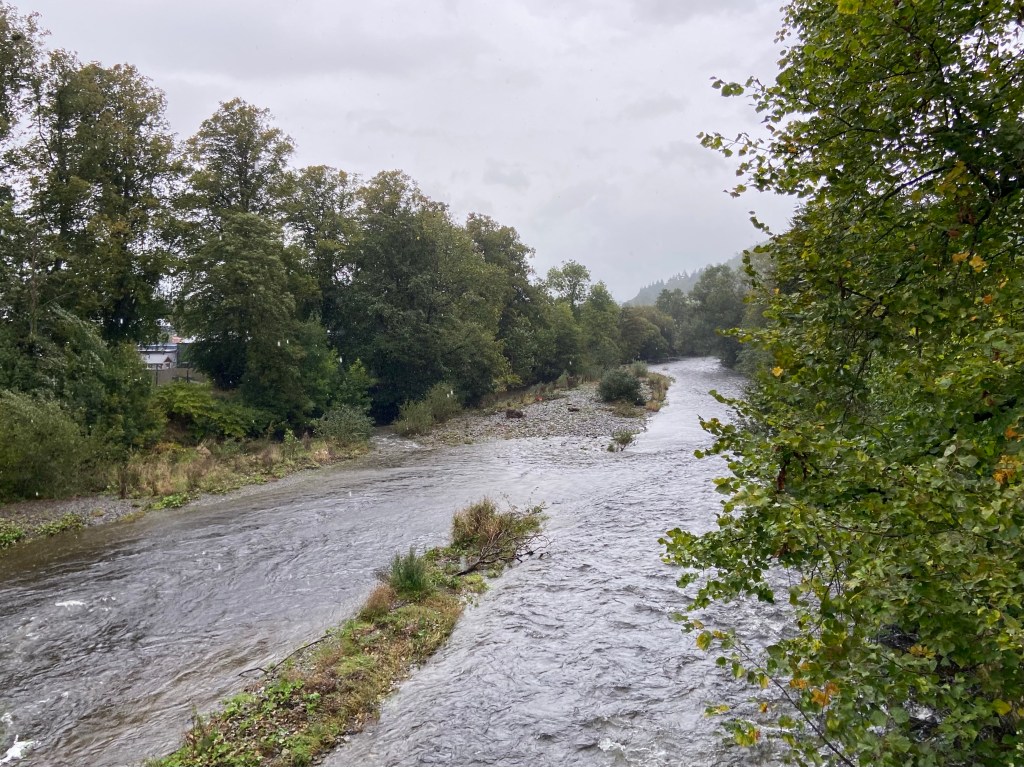
This was the River Severn, it’s source high in the Cambrian mountains only 14km away as the crow flies, where I should have been wild camping this evening (fat chance, in the middle of a named storm!). It was extraordinary to think that less than a month ago, Stephen and I had done a pickup walk from the Land’s End to John O’Groats route which took us over the Severn Bridge, and the river was so wide there, close to its mouth, that it took us a whole 40 minutes to walk across. Here it was a matter of seconds.
I soon found myself sheltering in someone’s driveway as a squall of rain blew in. I rather wondered whether I had not made an error in starting out in the rain, and whether it would not be better to wait for half an hour or so.

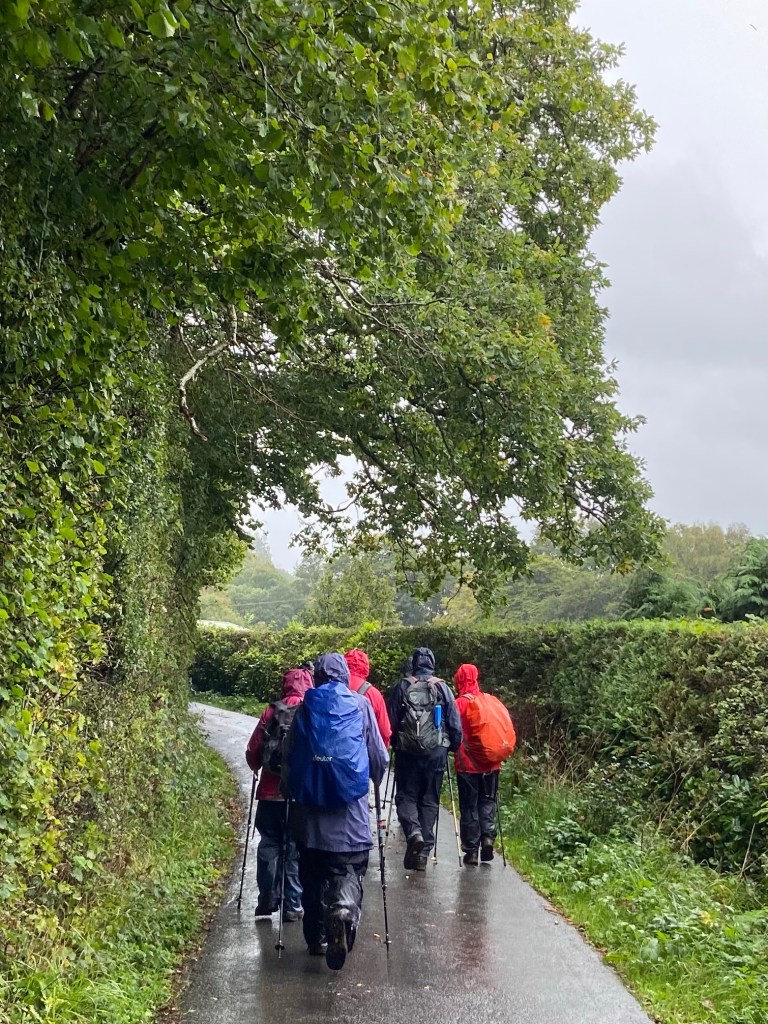
After the heavy initial downpour had eased off a little, though, I thought I would just get going. I had identified places where I could walk parallel to the B-road on tracks or unclassified country lanes, and the first of these came almost immediately, a lovely long lane contouring along the steep sides of the valley carved by the Clywedog river, a tributary of the Severn. Almost immediately I met a group of seniors out on a walk, coming in the other direction. They were swathed in a colourful selection of waterproofs, and coming back into town after what look like a very, very wet walk. We grinned at each other, all parties clearly enjoying being out in the fresh air whatever the weather, but didn’t stop to chat.
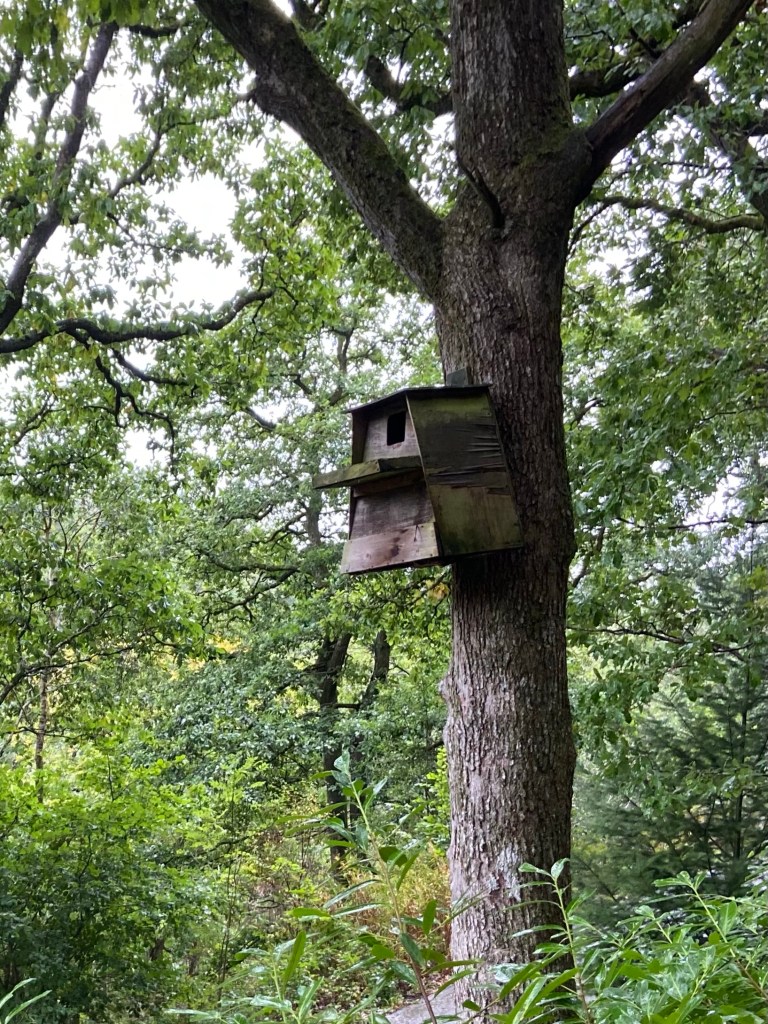
The lane was wooded almost for its whole extent, and nearest the town the trees were encompassed within gardens backing onto the lane. There were several very fine examples of nest boxes mounted on the trunks of oak trees. I think this one was for a barn or little owl.
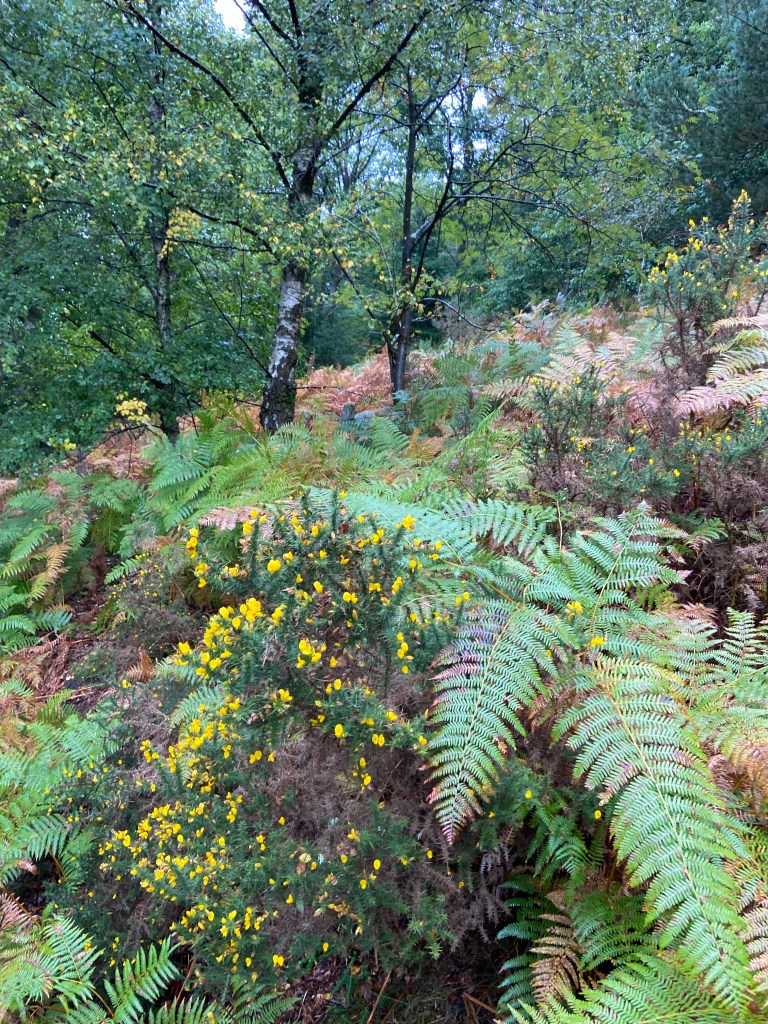
It was really refreshing being in deciduous woodland. There were patches where the leaves of birch trees were just starting to turn, and the understory was a mix of green and golden-brown bracken.
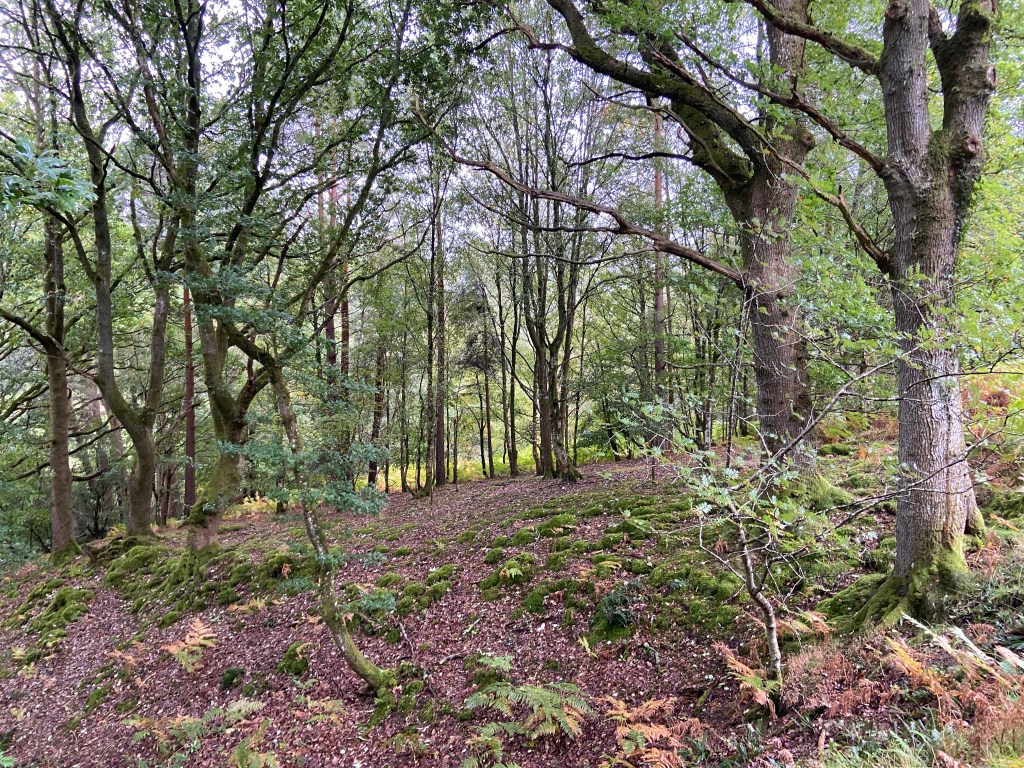
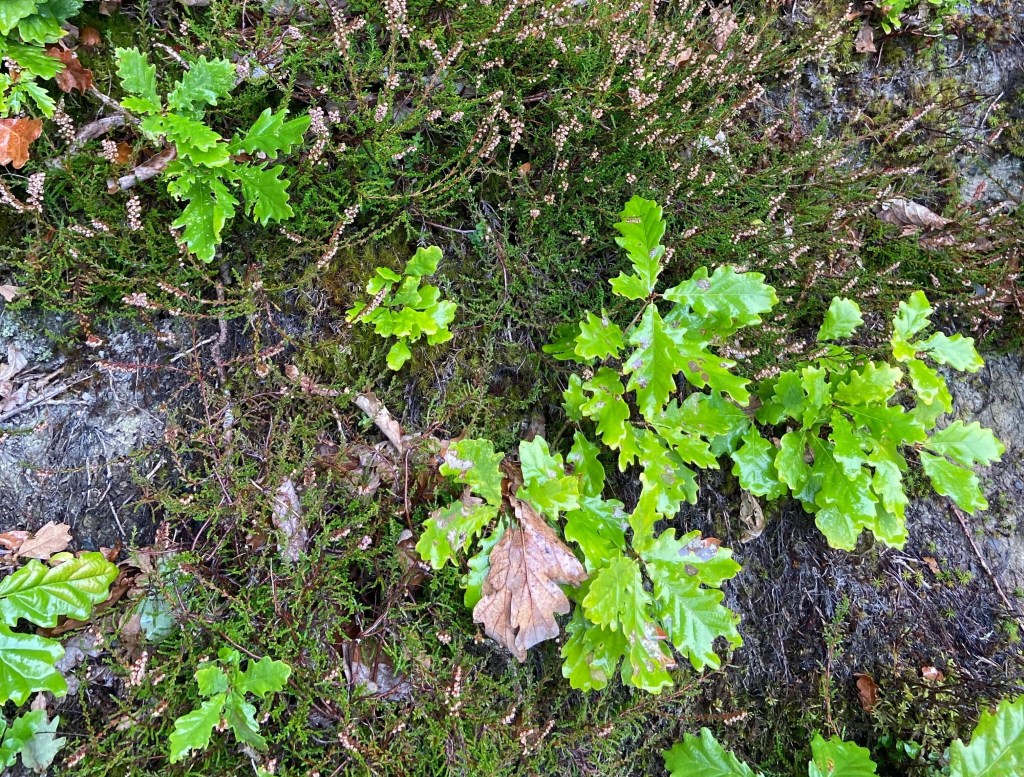
But for the most part it was oak woodland, in some places a natural distribution, an ancient-looking collection of trees with moss gradually building up around the bases of the trunks. In the open spaces, where the road was cut into the hillside, hundreds of acorns had germinated.
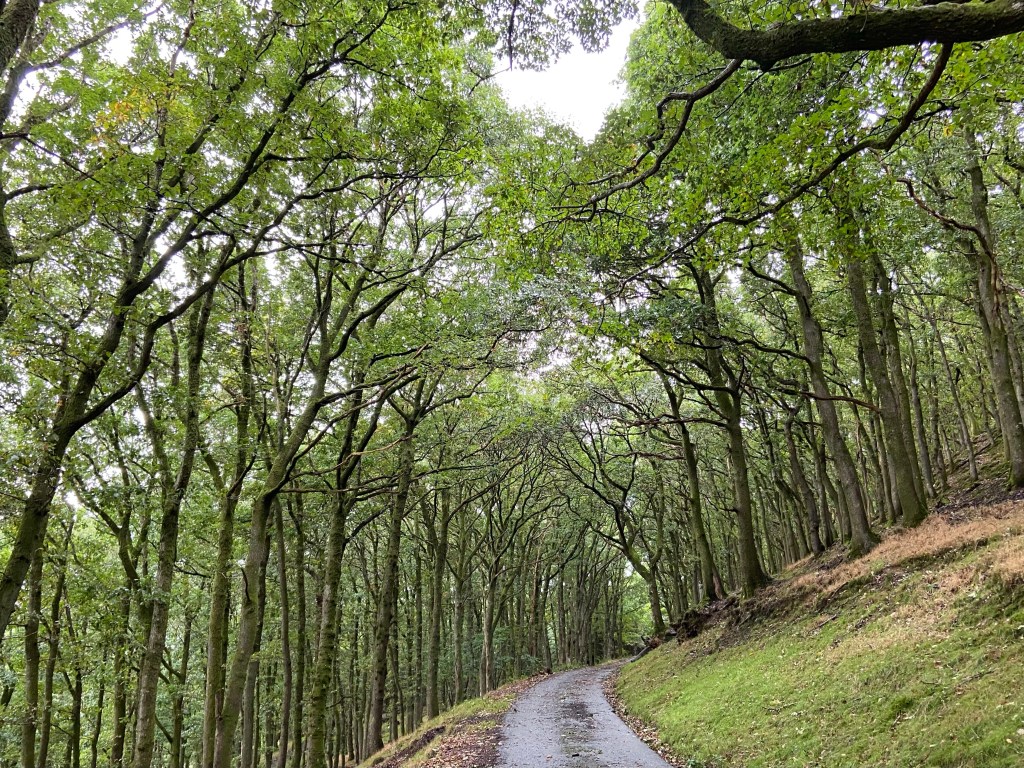
My favourite part, however, was the oak plantation. Usually the graceful effect is created by beech trees, but I loved the novelty of walking down intentionally-planted rows of oaks, trunks all growing timber-straight up to the point at which their angular branches took over.
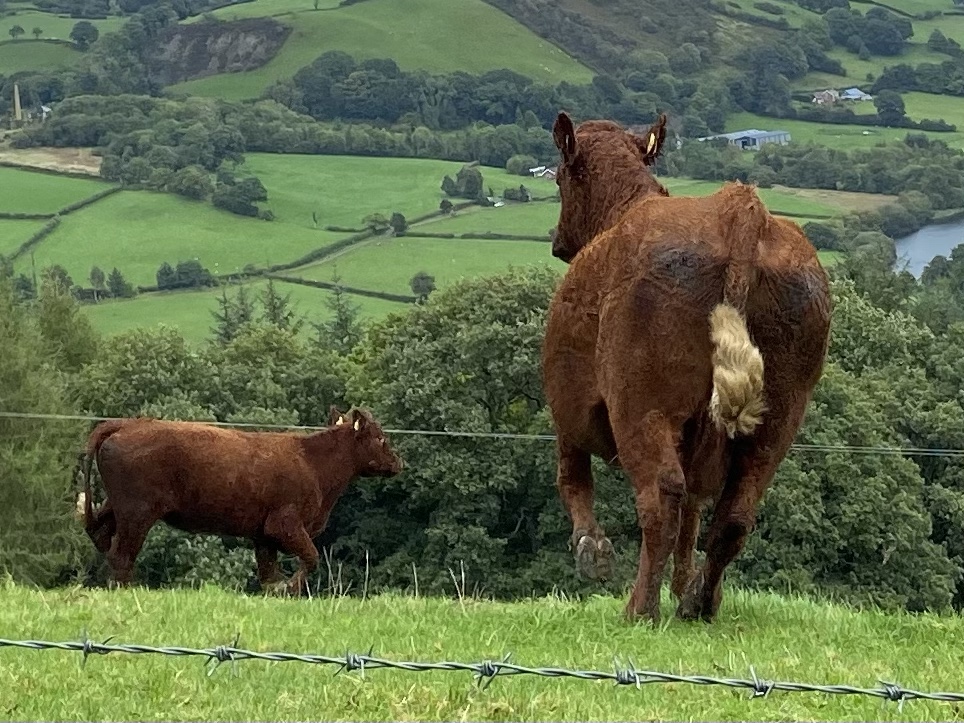
The lane stopped at a farm, although the path continued on through a farmyard as neat as a pin. By this time the rain had completely stopped, so I took my jacket off and just walked in a T-shirt — something I had not been expecting at all. I was now back on the B-road, with options to detour off if it turned out to be busy. It wasn’t, though, and although I was keeping an eye out for cars, I could also enjoy looking into the open fields. The first one was full of red poll cattle – a deep red breed with white only on the ends of their tails. They were a bit skittish and nervy, and I was glad I was on the road and not in the field with them. I was really disturbed by Stephen’s experience on Sunday.
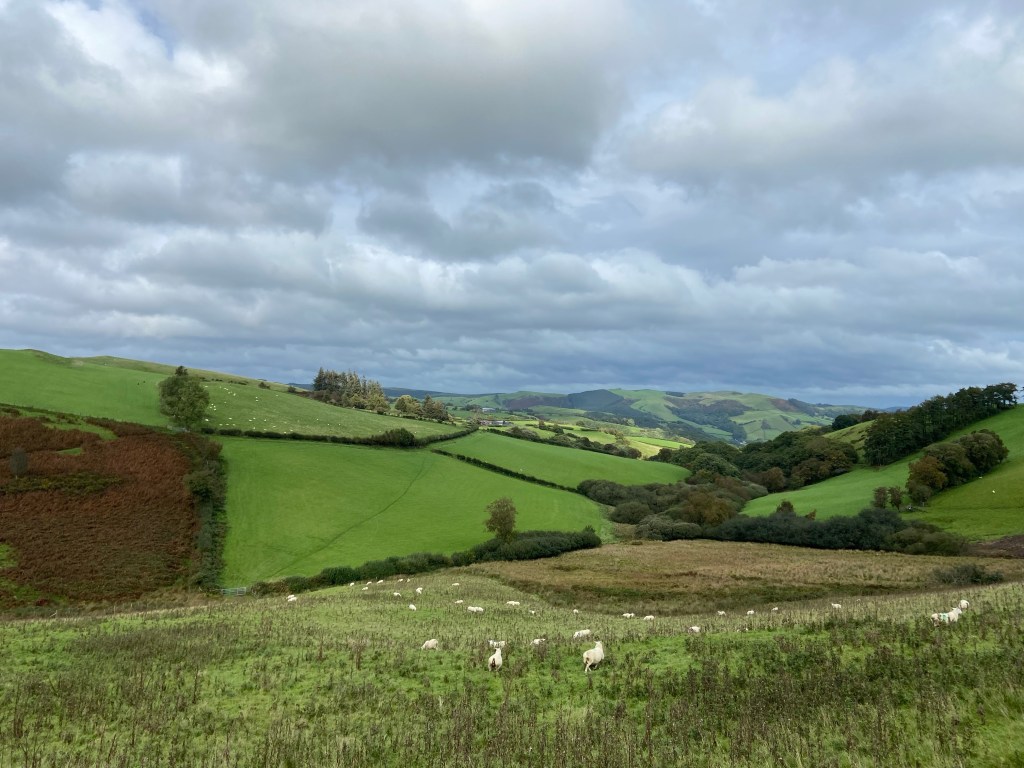
I think the road must’ve been routed for its picturesque qualities: as it climbed, views opened up on all sides, over hillsides folding round each other.
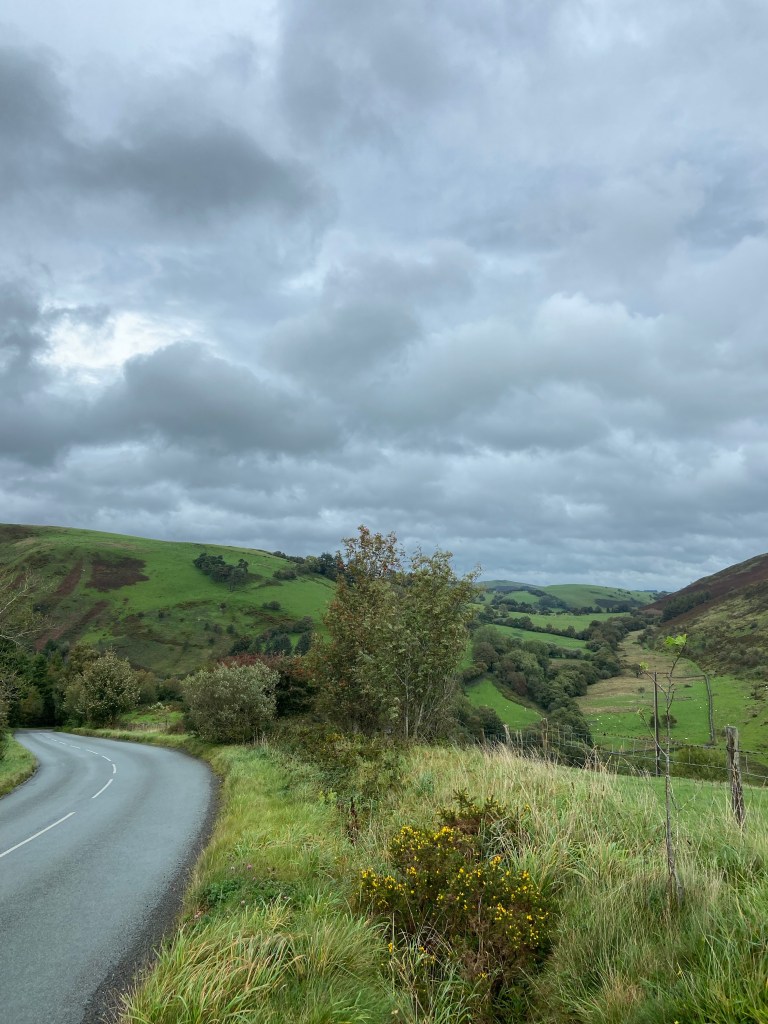
The nicest ones had frames of pine branches or the ubiquitous oaks.
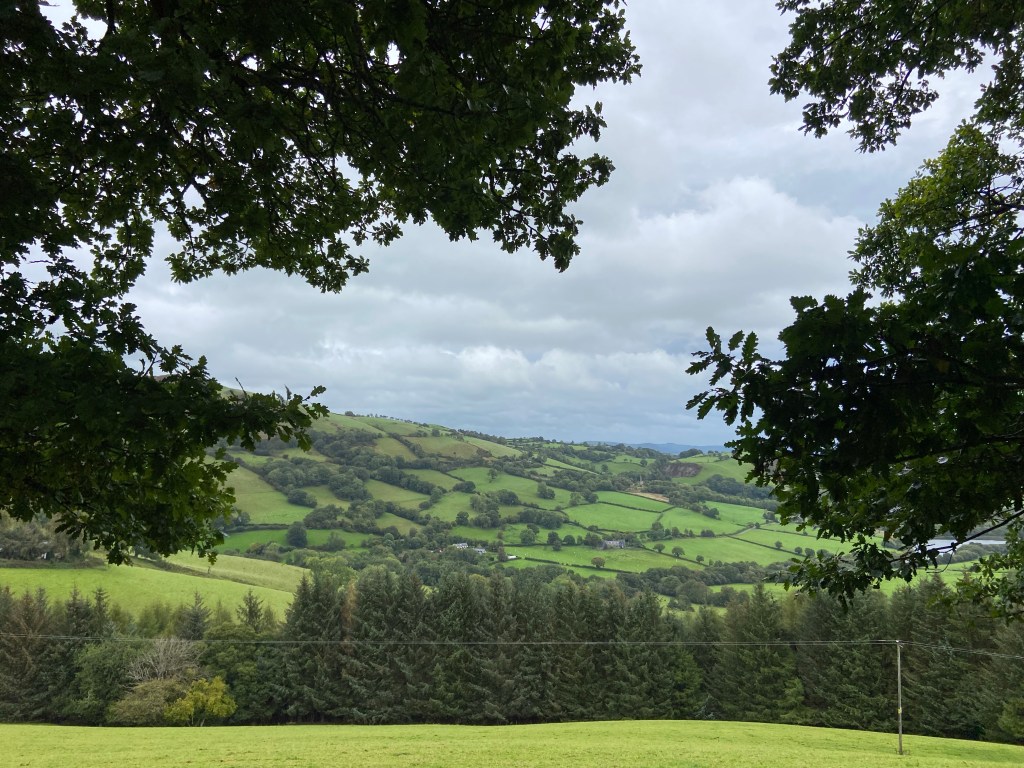
The geology here is so complex. Hill after hill of mudstone and shale, heaved up and folded so that the friable bedding planes lie nearly vertical and liable to break off and cascade down the sides of exposed rock faces.

On the higher stretches of road the fields have way to moorland, but with views extending into the far, far distance from this height. I could see the forward stretch of my road, first losing significant height, and then climbing steadily ahead.
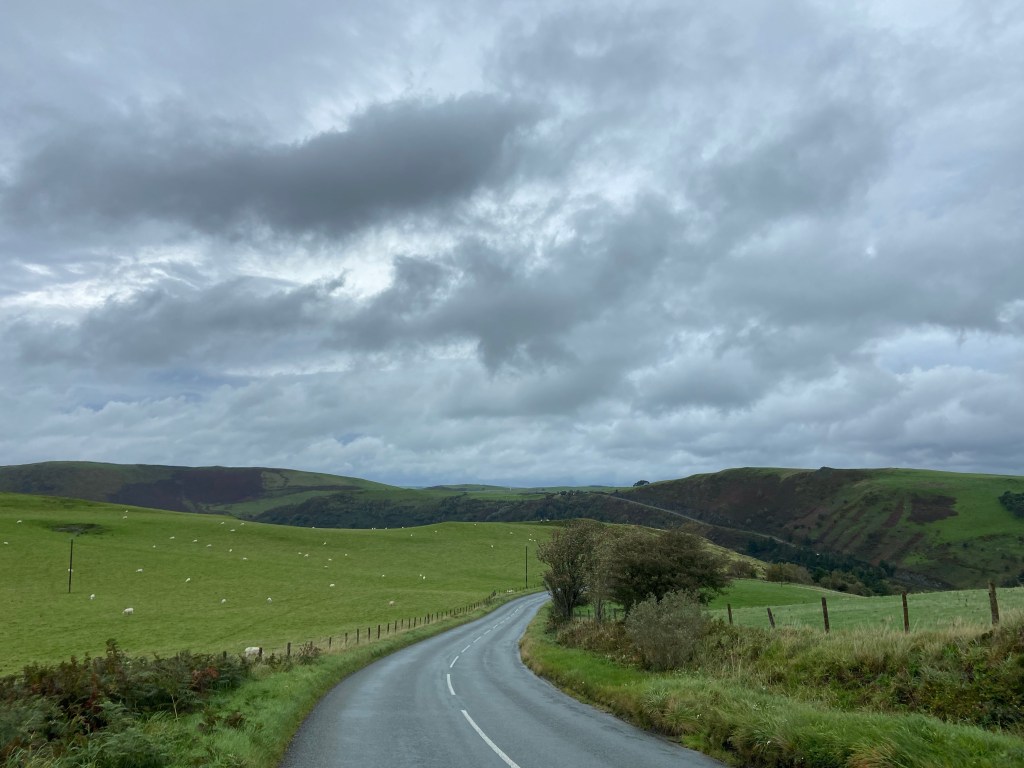
I wasn’t irritated by the gains and subsequent losses in height, though, because there was plenty to see. The steep hill was leading down to a dam behind which was held the Llyn Clywedog reservoir, and not only were the low-level perspectives of the water absolutely beautiful,
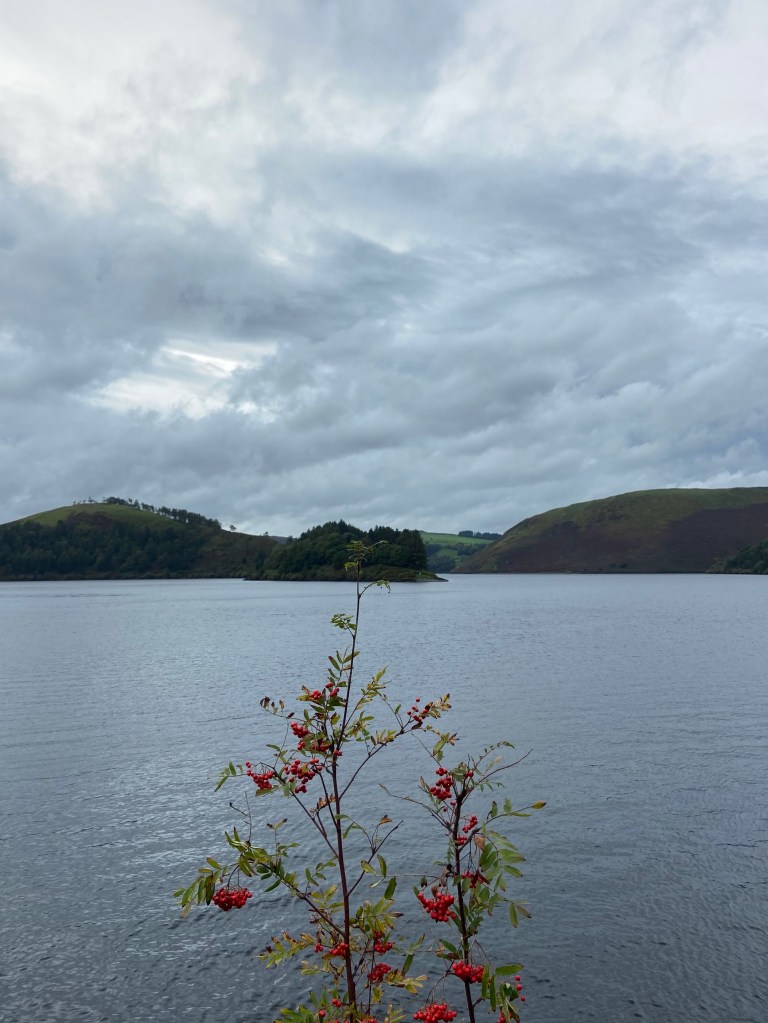
but as I climbed, different vistas opened up. My original route had taken me all along the far side of the reservoir, and while I regretted the fact that I had not been able to do that longer walk, only having about three hours between downpours at my disposal, as I reckoned, I cannot imagine that it would’ve been any more attractive.
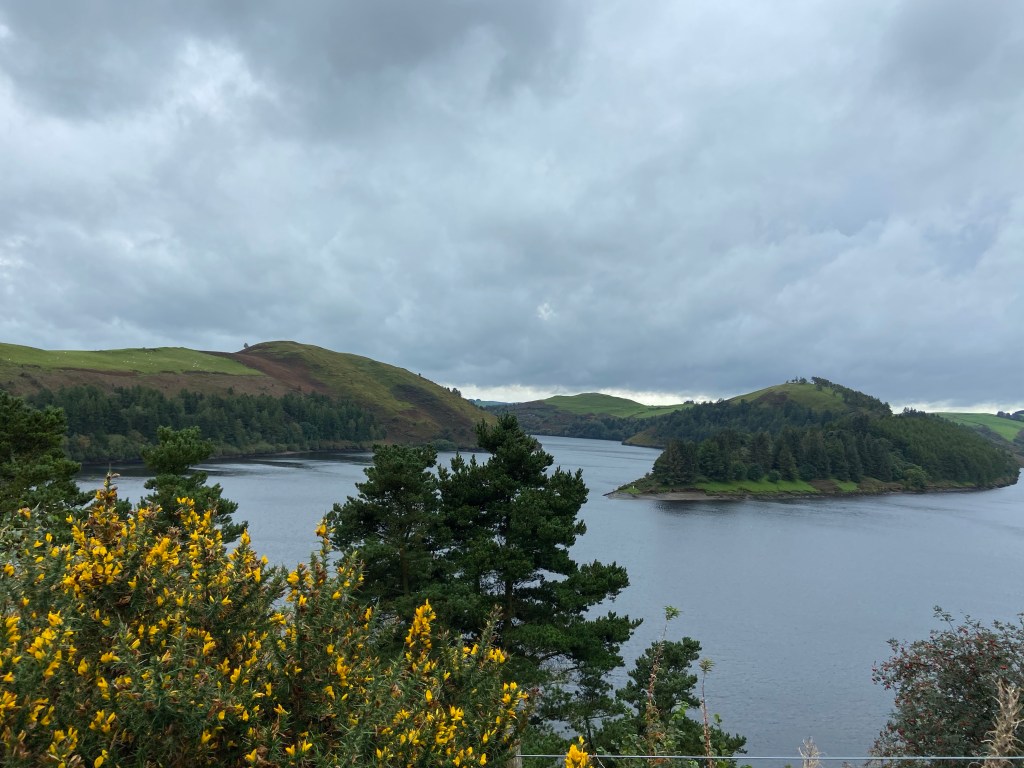
Near the sheer drop down to the lake the fence had been flattened, and tattered lengths of police tape still marked where a car had almost gone over the edge. I wondered whether they had been distracted by the view.

If they had it would have been unnecessary, because at the summit there was a viewpoint with ample, safe parking. An information board told me that the lake held the equivalent of 264 billion glasses of water. It is a relatively new reservoir, only having been constructed in the nineteen sixties to regulate the flow of water in the river Severn by controlling the water of its tributary the Clywedog.
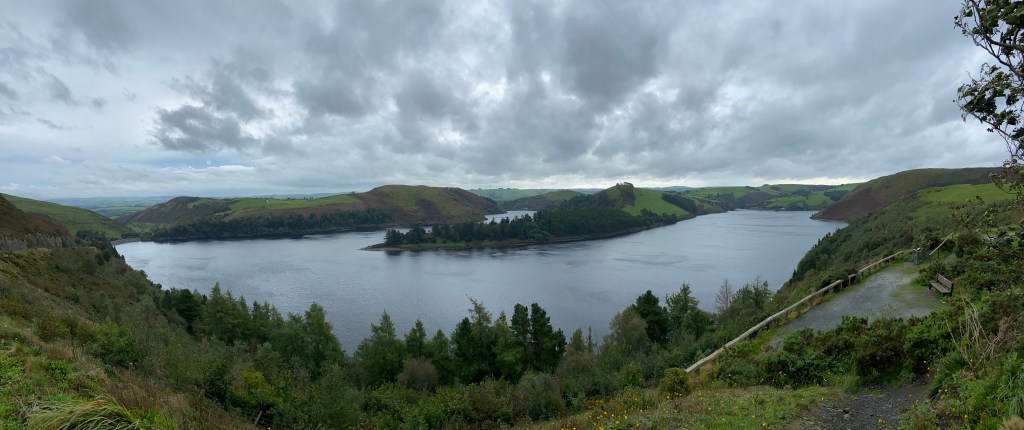
I was glad that at this exposed height the weather window was still open. For a brief moment the sun even came unexpectedly out, and the landscape was elevated into something glorious,

but for the most part the road simply wound on under a thick cover of clouds, serving up twists and turns, coppices, a patchwork of fields, and glimpses of the reservoir.
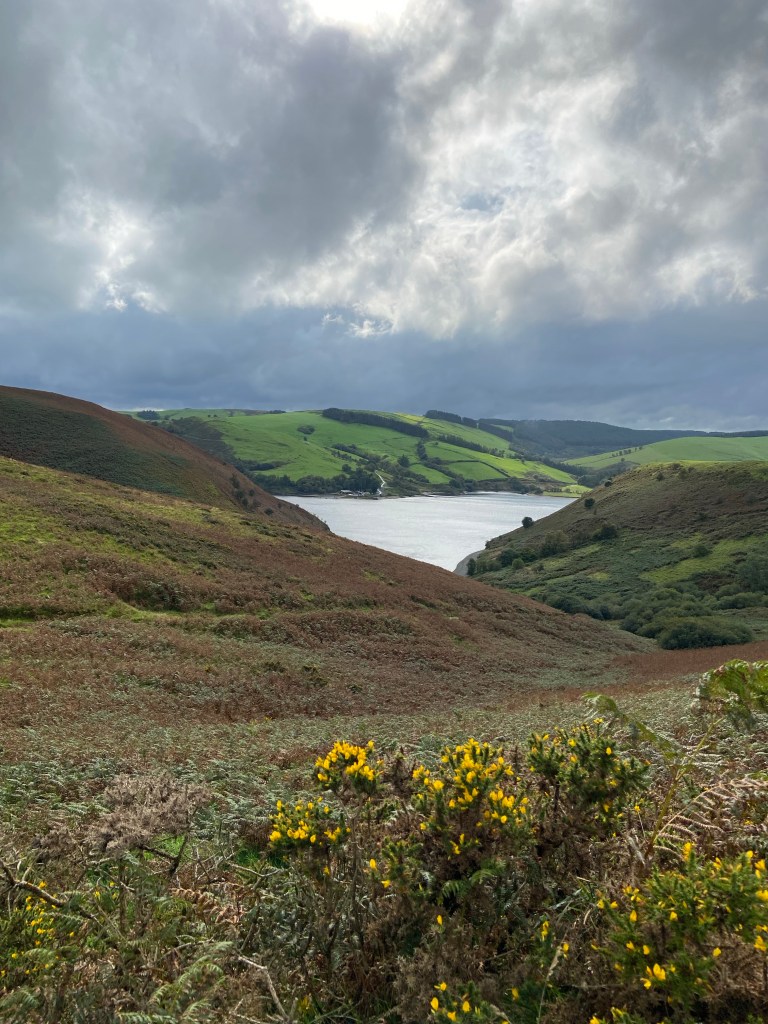
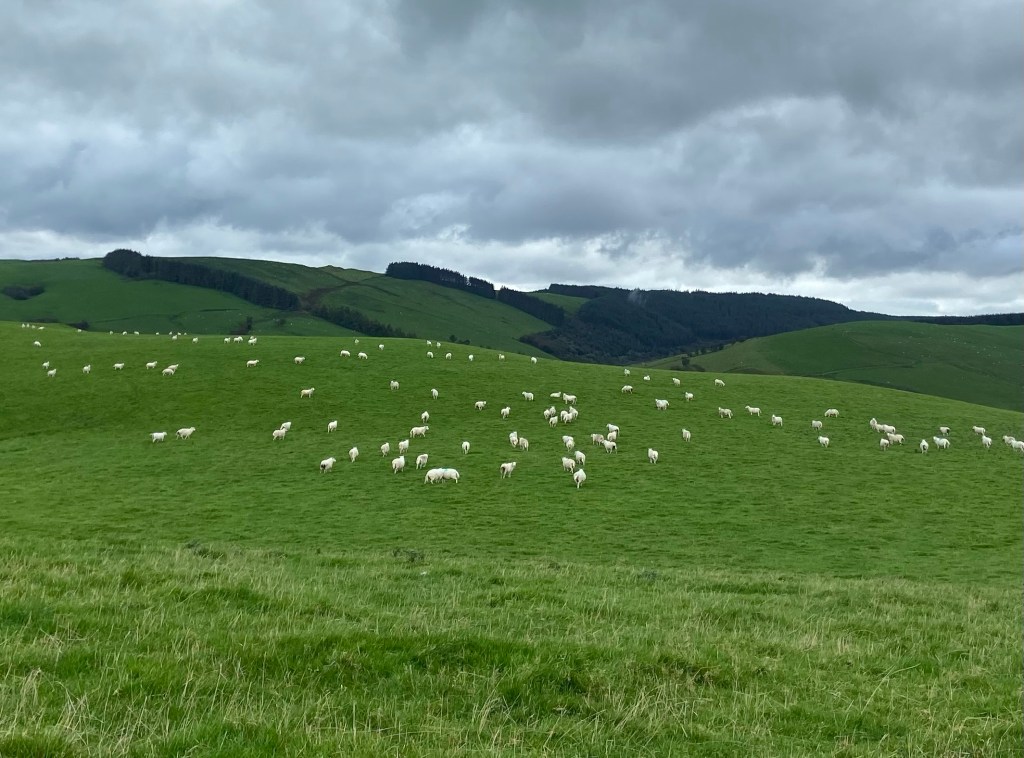
Interest was provided today as on Sunday, by the insects and other tiny details. Larger animals were all deeply mistrustful, with every field of sheep fleeing en masse — perhaps unnerved by the brightly-coloured rain cover on my rucksack.
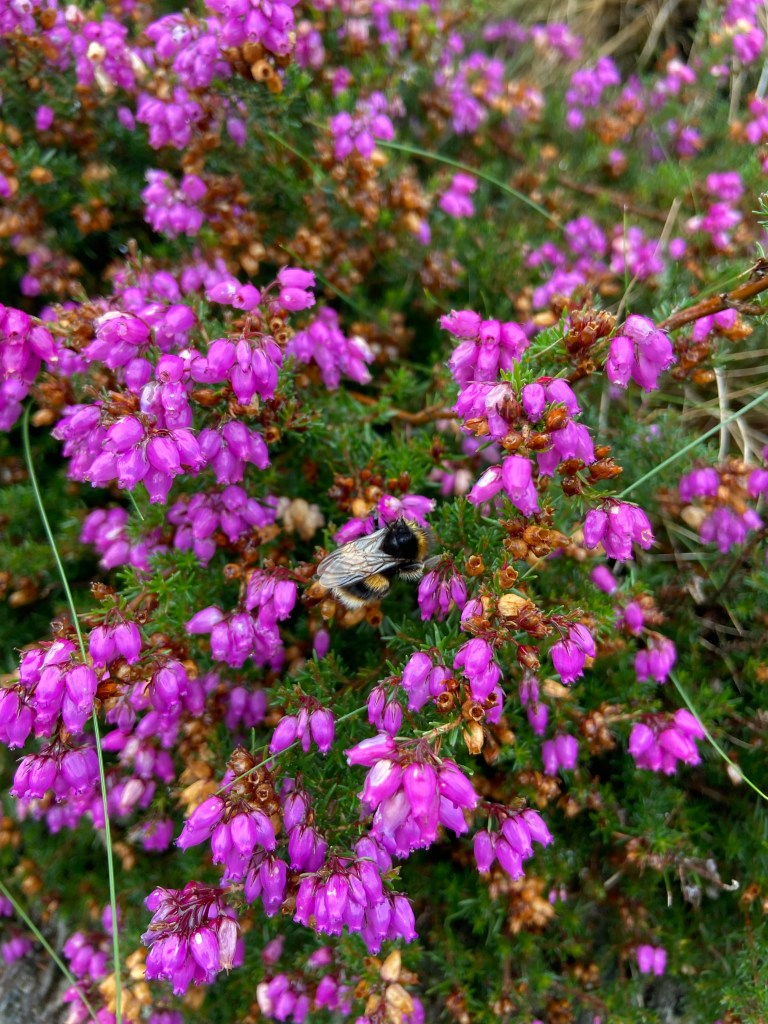
But a single white-tailed bumblebee industriously explored tiny bells of heather under my nose,
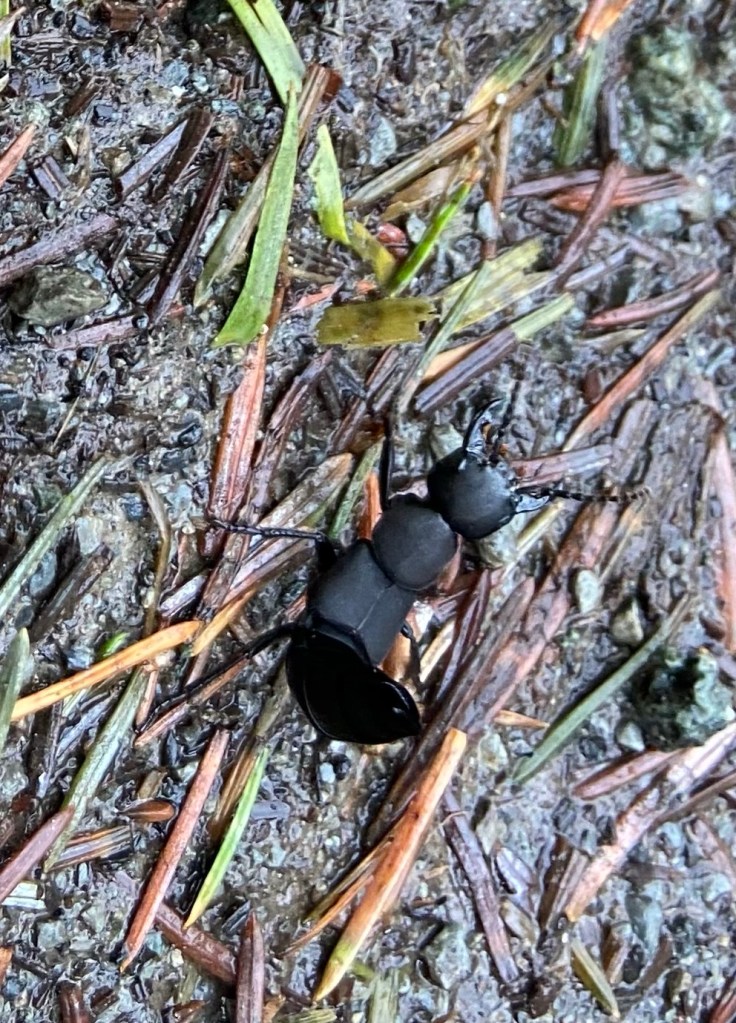
but my best spot was a black rove beetle, an Ocypus olens. Its Latin species name is ‘stinking’ because of the two white glands on its abdomen, which were strikingly visible when I stooped to inspect the creature: it lifted its abdomen threateningly like a miniature scorpion, thus illustrating why it rejoices in its common name: the cock-tail beetle. It also has other common names: the Devil’s coach horse beetle, the Devil’s footman and the Devil’s steed, to name but three.
The road now fell steeply down into the river valley of the Clywedog upstream of the reservoir. It feels odd that although I am only two days walk away from the sea, this river doesn’t flow westwards into the sea, but rather south into the Severn, and thus these waters, meandering over this wide valley, would one day end up joining the sea 125km away to the south in the Bristol Channel.

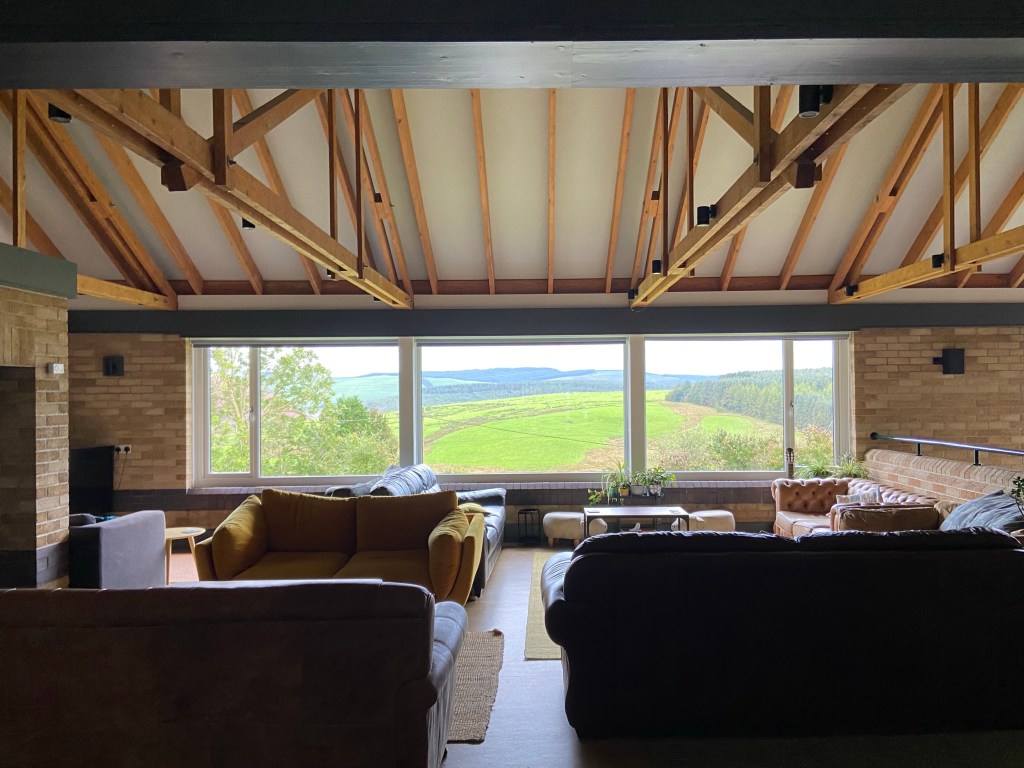
The Lodge in the tiny hamlet of Staylittle is a fabulous wooden-clad eco-outdoor centre, which also does B&B. I was blown away by the view. I had arrived at just the right time: as I watched, the wind started to howl, and hiss, and whistle, and tug at the trees, and the pelting rain came in. If I had waited at the start of the day for the dry, I would have finished in the wet — and as the wind strengthened to storm proportions I was overwhelmingly relieved I wasn’t camping up in the mountains.
 Walking The Landscape
What a fab set of photos! Reading this is a great start to my day! Thanks Sophie xx
LikeLiked by 1 person
Oh thank you!! Well- today’s pictures I HOPE will be better because I’m finally going to cross the mountains…
LikeLike
A real coincidence this morning… a couple walking along our lane, stopped for a chat in our driveway. Jess brought our notice to this feisty little beetle which raised its tail at us. How chuffed I was to be able to name it so quickly and easily! I even showed them the photo you had taken! Thank you Sophie!! xx
LikeLiked by 1 person
Hahahhahaha!!!!
LikeLike