Carreg a dreigla, ni fwsoga
Welsh proverb: ‘a rolling stone gathers no moss’
In order to make the rest of the walk to Aberdovey work in the time I have available, I was going to have to make use of Sunday to walk from Abbeycwmhir to Llanidloes, come what may. It appeared that what would come was a morning of grey rain, clearing in the afternoon, so Stephen loaded his mountain bike into the back of the Landrover, and I bundled a modest amount of stuff in a day pack (bliss – and not much water needed either), and off we set for mid Wales. I had junked the expensivo orthotics for the old faithfuls that had seen me through the End-to-End, and would you believe, I had no foot issues all day. There you go then: the orthotics are damaging my feet — empirically verified.
We reached the Abbey in the Long Valley at about 12.30. This was later than I had planned, but as it was still raining dismally, I frankly felt minimal enthusiasm about making a start, despite gurning gamely for a selfie.
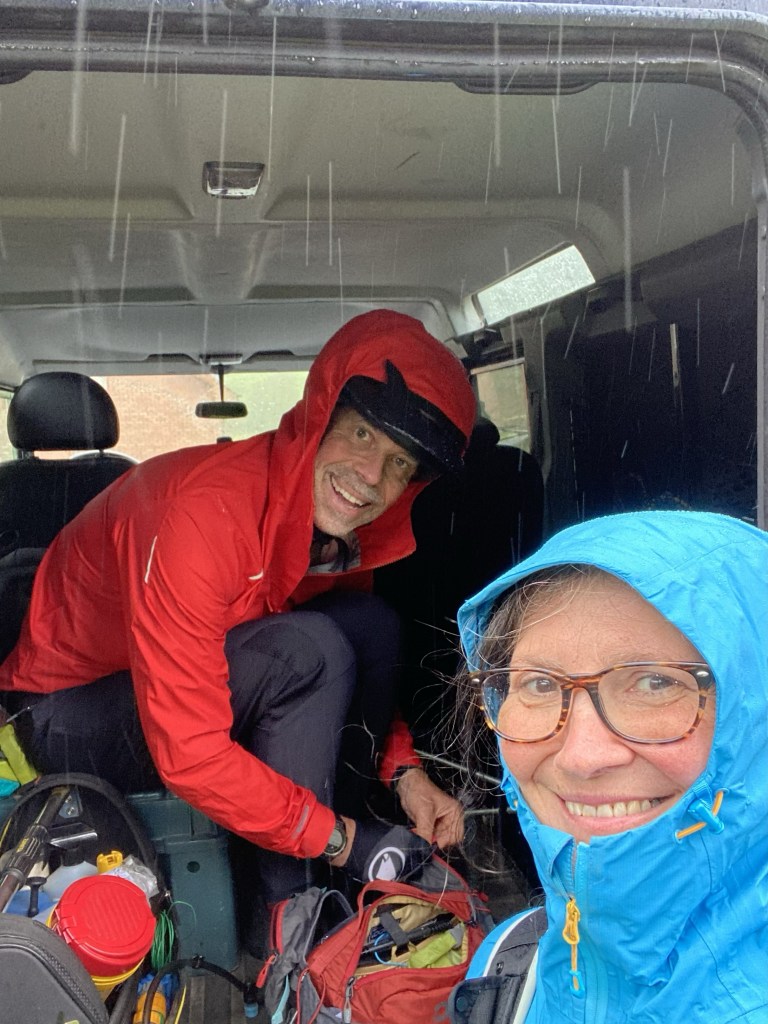
It was going to be one of those trudges. And I estimated a five and a half-hour gig as well, so by the time I set off at ten to one, I was doubtful I’d be able to make it to Llanidloes, 20km further west, by the time we would really need to be heading home. Ho-hum. Stephen was going to be mountain-biking a series of loops locally and then meeting me in Llanidloes, the plan being that somehow I was then going to make it back to the little town on Wednesday morning, ready to start the last three days to the coast.
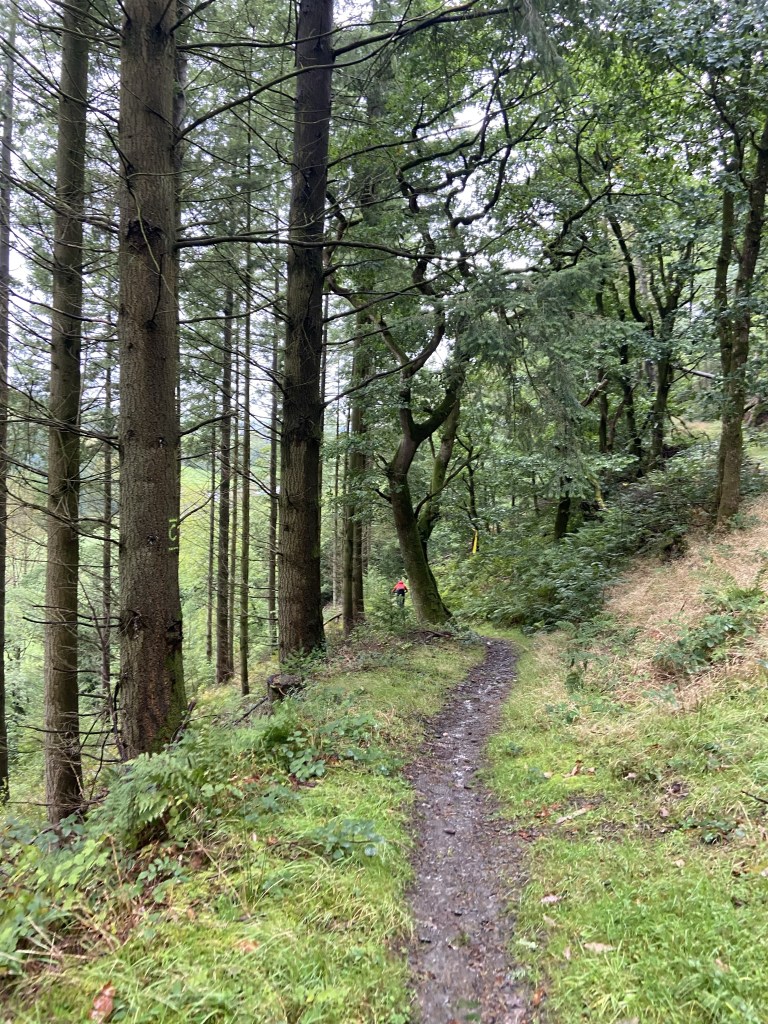
To get to Llanidloes swiftly I’d created a route that would just hack along minor roads, potentially dreary but ensuring speed and maximum ground coverage to make the most of the compressed time I had at my disposal. There were, however, a couple of places where I would set my shoes on a footpath, and the first part of the walk was one of these, a rising track through a plantation. I’d worn shoes rather than boots because of the large amount of tarmac, and started out wondering whether this had not been a mistake as I hopped from minuscule path edge to miniscule path edge in an effort to avoid the puddles and stodgy mud (not visible in this photo because I didn’t want to take a mid-hop photo and drop the phone into the mire).

I was quite pleased that I’d gone a ways before I was caught up by my mountain biking expert, who flashed past me, exhilarated by the mud and fresh air. However unappealing I found this first haul up the slippery path which threatened to soak my socks before I’d barely started (reader, you will rejoice with me that the hopping tactic mostly kept the socks dry), I thanked my lucky stars that I was not the sort of person who felt compelled to put myself through a four-hour mountain bike ride.
I caught up with Stephen at the first ford, and it had stopped raining and so we were both exhilarated and happy by this point.

Next meeting: 20km away, I hoped.
Off he sped, having called over his shoulder that he’d seen a toad crossing his path back down the hill, and I followed on more slowly, exiting out of the path onto the open road.

The skies were dark and fairly lowering, but I appreciated the contours of the landscape anyway, a bit sorry that I wasn’t walking on the ridges, but also somewhat relieved, as I imagined that after the rain we’d had, I’d have been regretting not having worn my boots if I had much more off-road path.

I’d worried that being a road-walk there would not be much to keep the time from dragging, but I was enjoying stepping out smartly and being able to look about me without worrying about placing my feet, and being able to appreciate the way thin ribbons of arable land filled the space between me and the open bracken-covered moorland rising beyond,
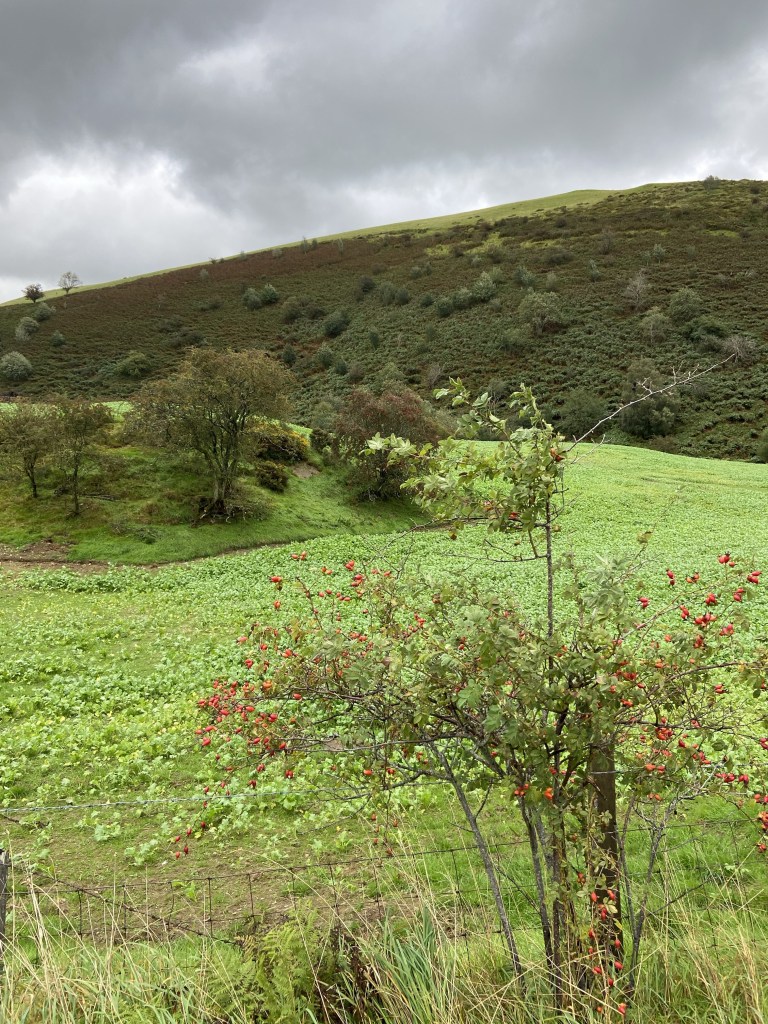
or the soft contours of bright green sheep pastures.

There had been a visible change in the hedgerows even in the couple of weeks since I was last walking here. The blackberries were long gone, rotted in the rain, and the autumn colours are noticeably further advanced. Wayside apple trees were bowed down with the weight of their fruit.
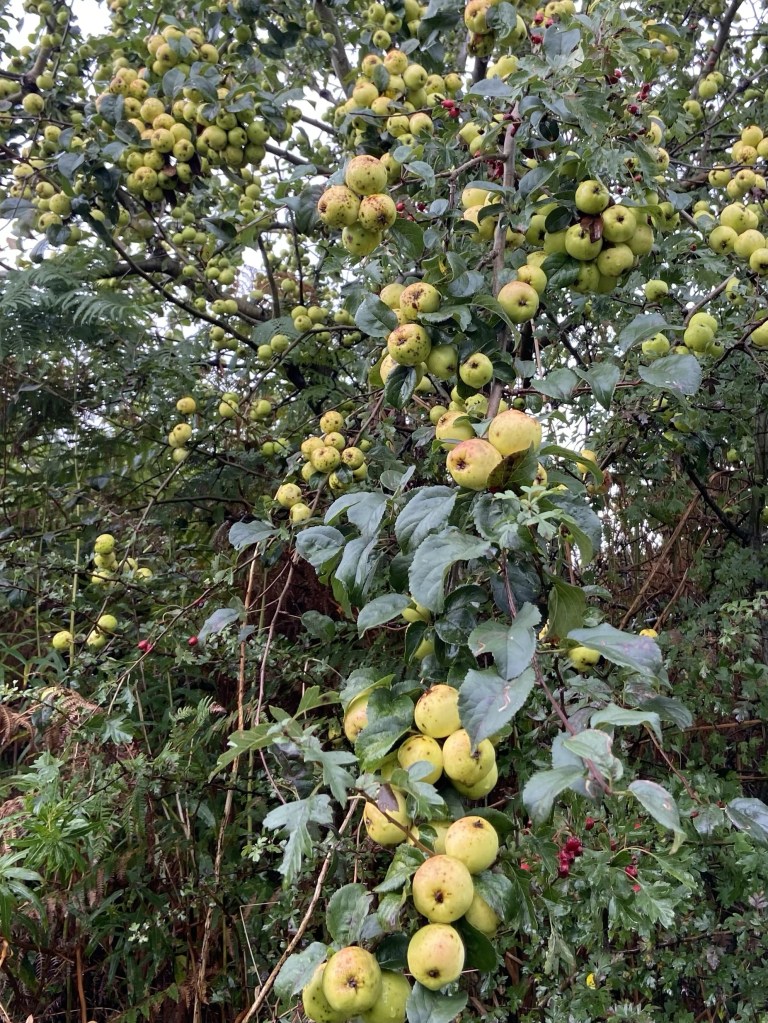
Some hawthorns wore their full cargo of berries on already almost bare branches
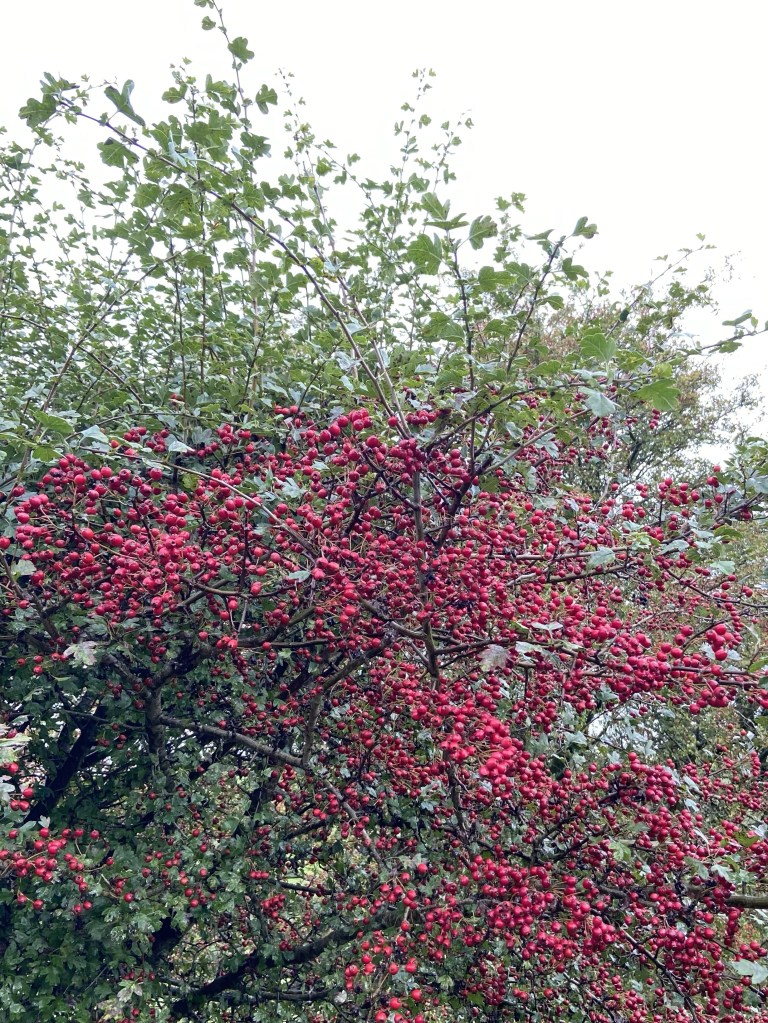
and the clusters of mountain ash berries were well-nigh luminous.

I was listening, in a fairly obsessive way, to Richard Osman’s latest offering in his Thursday Murder Club series. I hadn’t been sure about the shift to Fiona Shaw as narrator in The Bullet that Missed, but I was fully into her characterisation now and could hardly bear to turn my mental attention away from the compelling story and focus on the landscape. However, the cloud had begun now to break up, and the little gleams of light spurred me on to keep up a good pace on the tarmac.
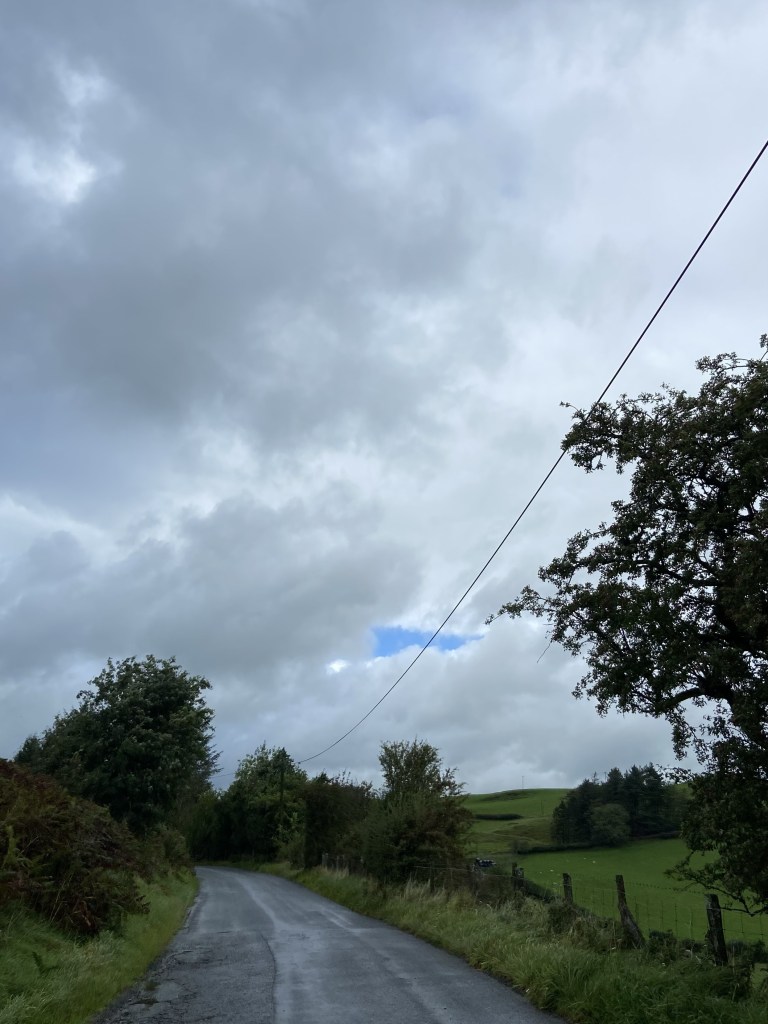
The rain had only lasted for the first half kilometre or so of the walk, but in its place a gusty wind had arisen, pulling so hard at the pine branches that the ends of the twigs were blown horizontal.

By the time I left the road for another plantation (thankfully a made-up forestry track), the sky was more blue than grey. Although I was walking in cloud-shadow, the triangular v-shape formed by the trees receding into the distance created the effect of the sky seeming to pull me forward into it.
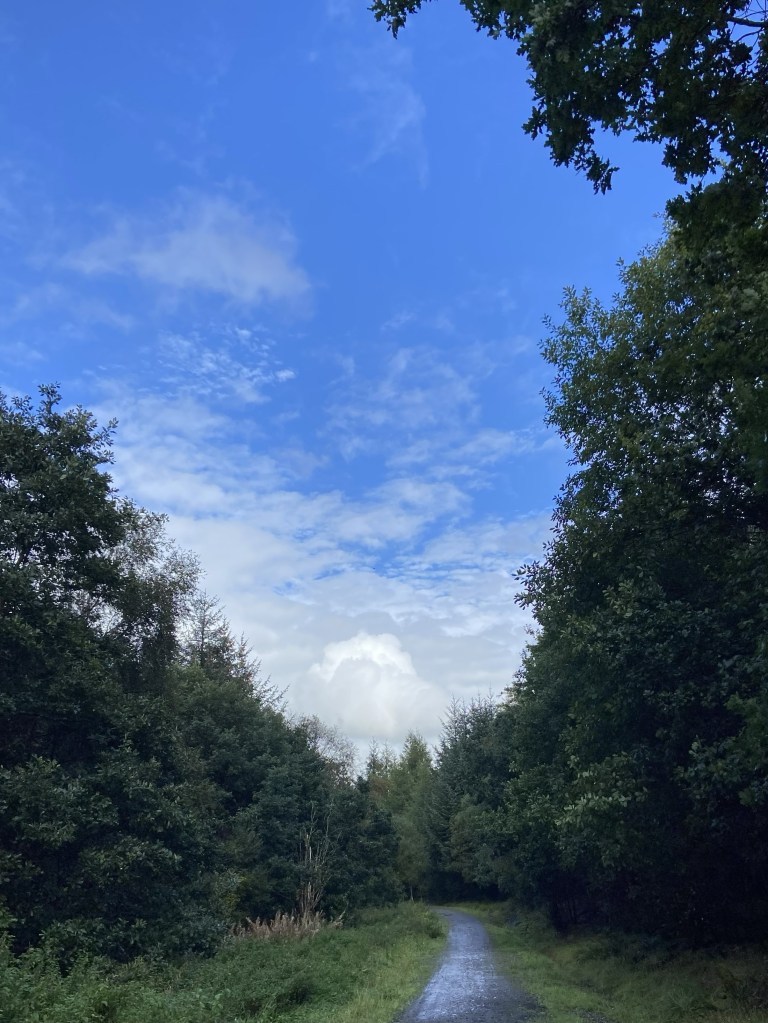
The Glyndwr Way (which I was not particularly following) briefly intersected with the forestry track and I was glad, peering back up it, that I wasn’t taking that path, for I could see the conditions underfoot were so much wetter.

I marched on, up an open road with exhilaratingly wind-blown young sweet chestnut trees to one side.

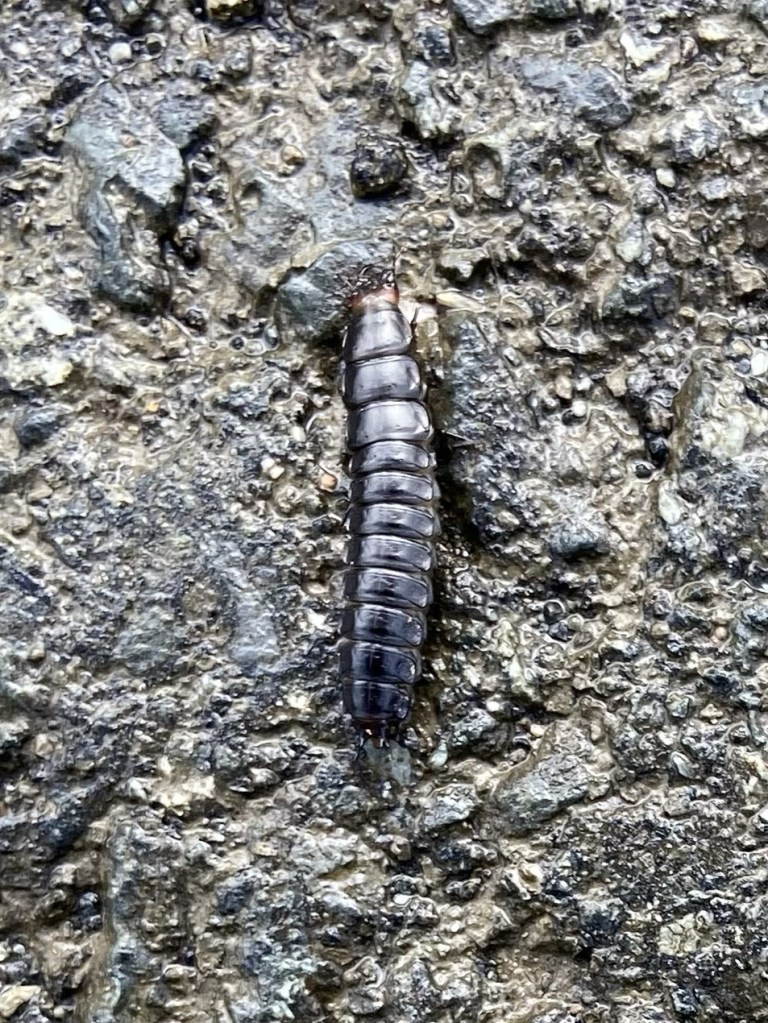
I saw no toads, but almost underfoot some kind of centipede scuttled at top speed over the tarmac, a pair of legs for each segment of its body. I googled it later on but haven’t managed to find an ID; it didn’t have the long antennae that seem to characterise centipedes.
Further on the same stretch of track there was a real mystery. A patch of the strange jelly-like substance that sometimes appears on the ground. I’d always thought it was a kind of slime mould — fascinating outliers on the tree of life, being neither animal, vegetable or mineral — but on looking it up it appears that no one yet knows what it is, although there are theories.
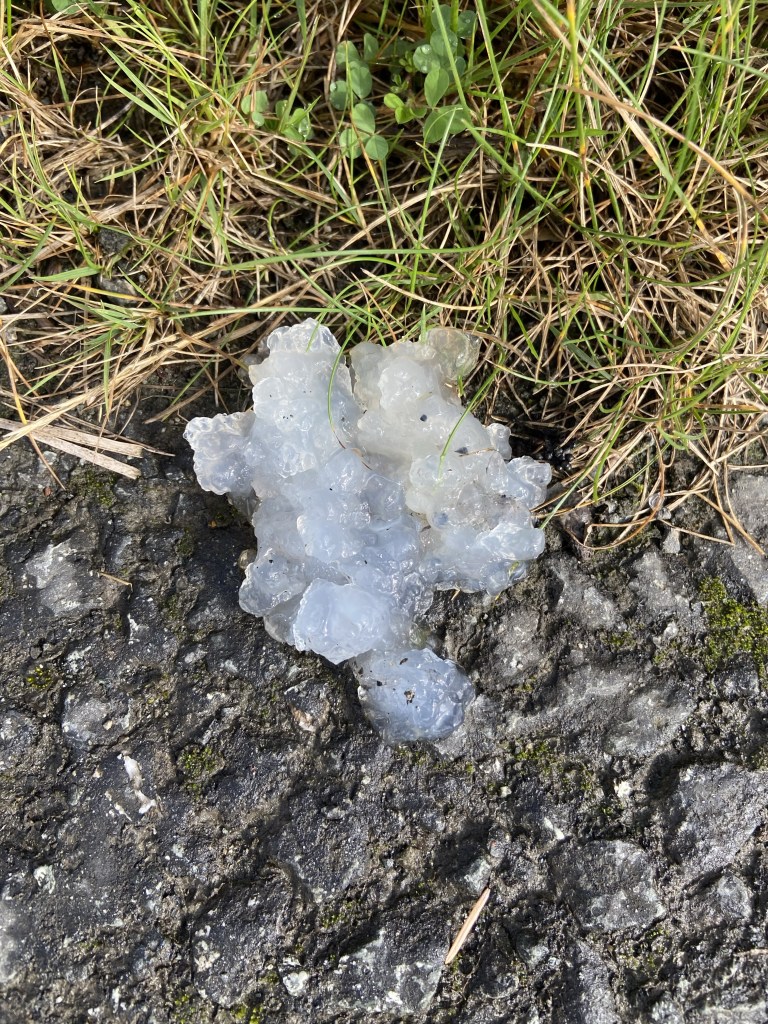
For now it’s called star jelly. A strange name which originates in the early modern belief that the jelly was the remains of a shooting star. Other theories that have been proposed include the hypothesis that it’s the indigestible spawn-producing parts of frogs and toads, vomited up by their predators. Well, I hadn’t seen any toads…. So perhaps this was indeed their only remains. But researchers have analysed samples of star jelly and failed to find any trace of DNA in it, so no certain biological origin has been identified. It is amazing and exciting to me that here is a relatively commonly-occurring substance which is still a scientific mystery. Until someone manages to explain its origin and formation it remains the mysterious stuff of early modern poetry and motifs in fiction.
Very much stimulated by this scientific curiosity, I switched off the audiobook and kept up my pace along a road now vaulted by striations of altocumulus stratiformis clouds, which the Met Office describes as being ‘separated by rivers of sky’. I felt joyous and filled with the energy of being out in it all again, walking well and not burdened by a heavy pack or the heat.

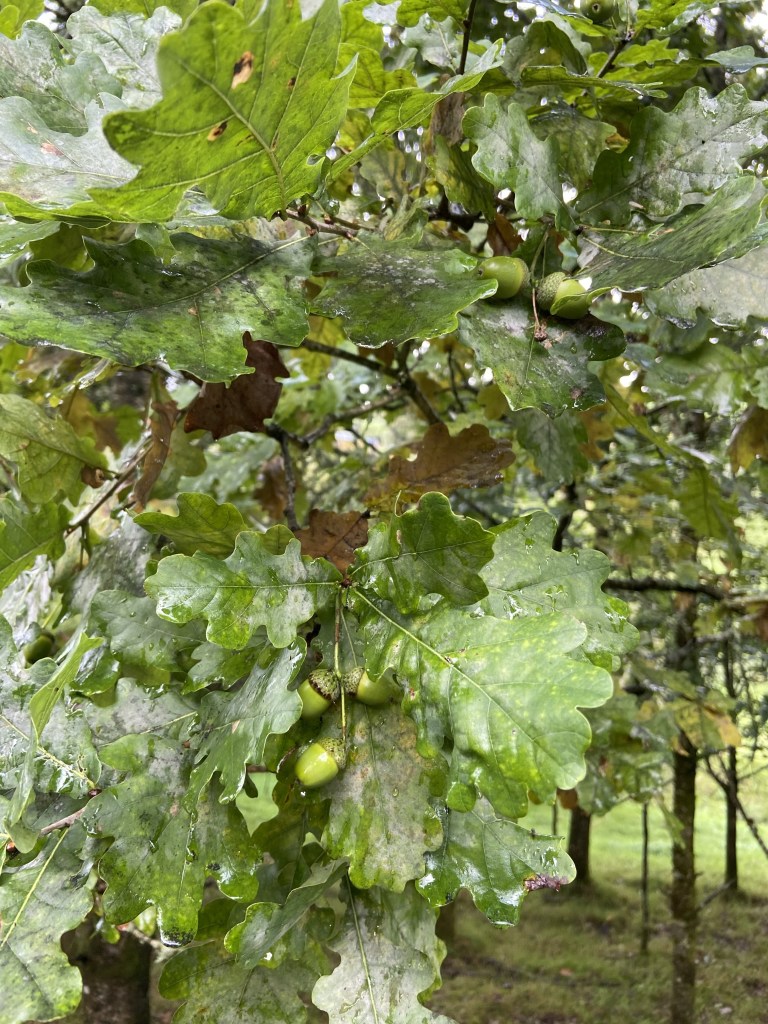
The clearing skies and the light they lent made this by far the nicest part of the walk. Every wet surface gleamed: the leaves and acorns of the oak
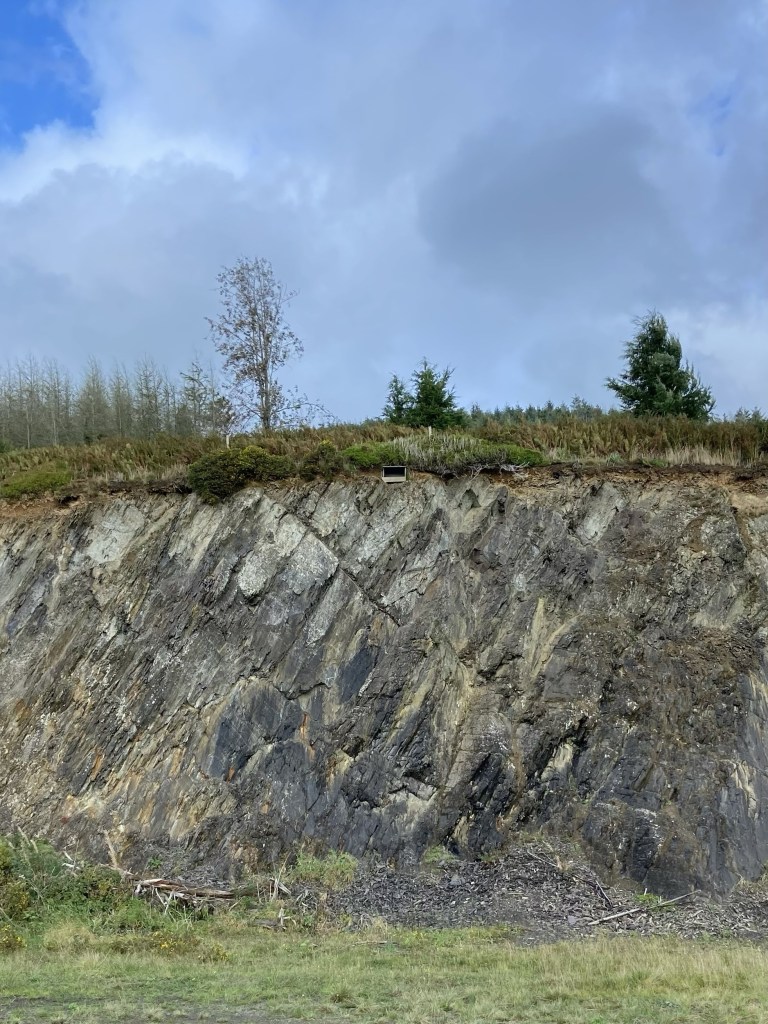
and the puddles in front of a quarry face, atop which there appeared to have been mounted some kind of nesting box. I’d just watched wildlife cameraman and Strictly star Hamza’s documentary on Britain’s birds of prey, and this box looked as though it would be perfect for peregrines. But perhaps the quarry wasn’t high or inaccessible enough. Another mystery.
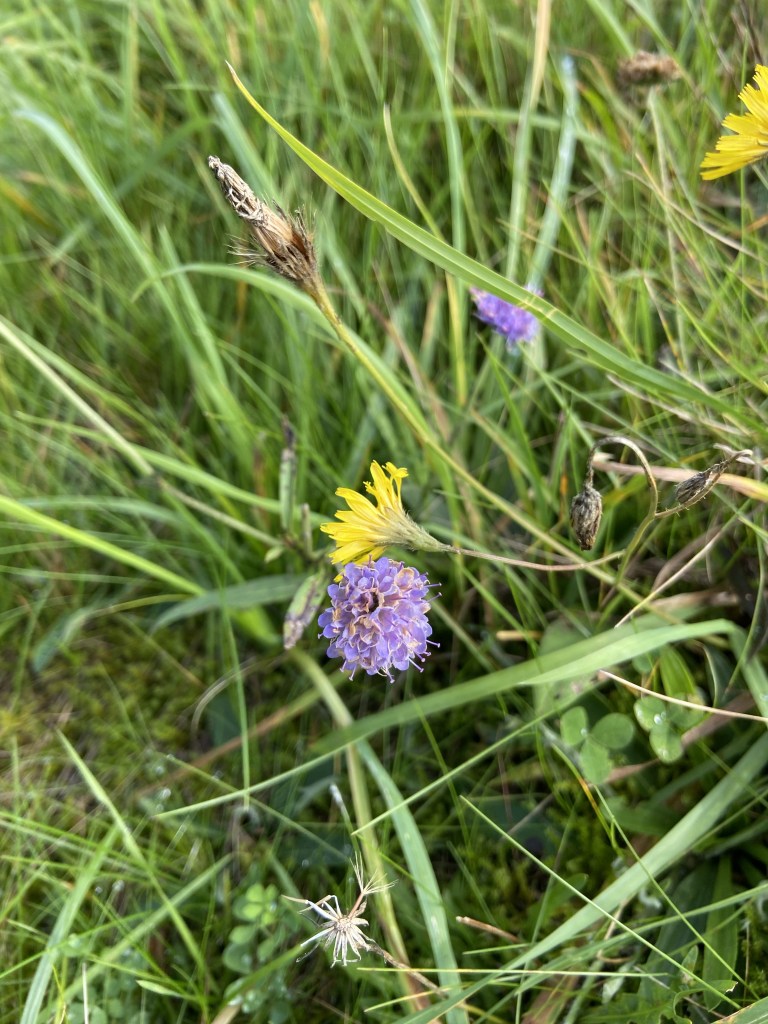
The light turned the devil’s-bit scabious into tiny jewels in the verges,
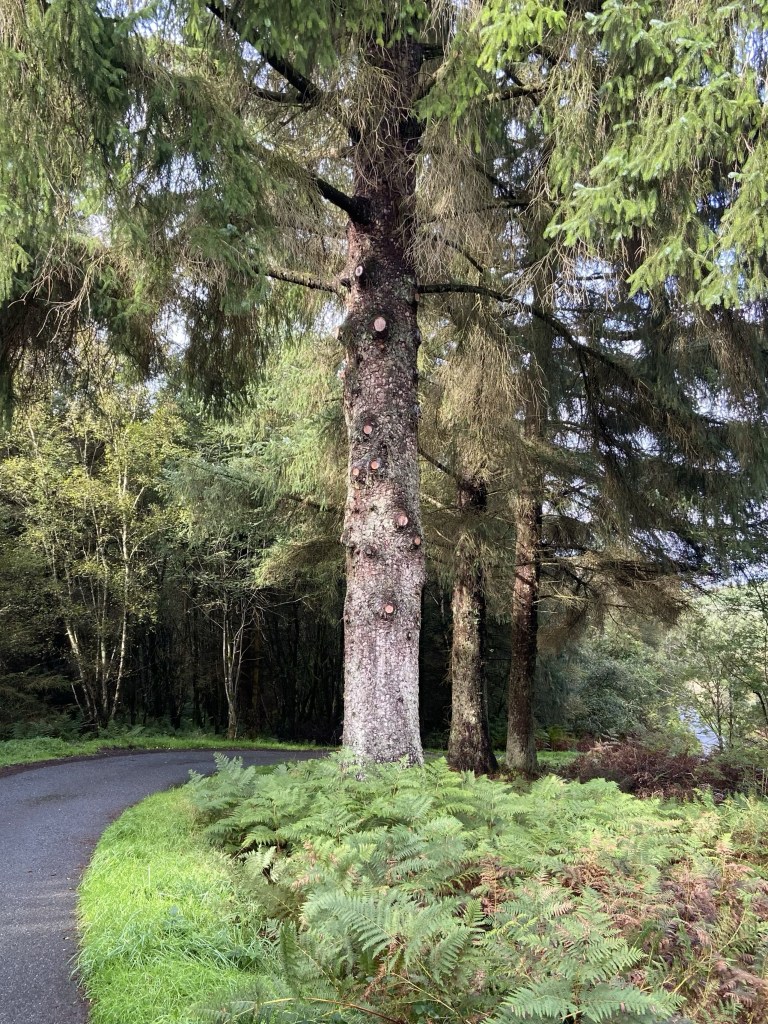
and shafts of sun illuminated the trunks of pine trees so that they gleamed in the shadowy wooded curves of the road.
In open sections gorse bushes in flower provided interest in the foreground to a hill silhouetted with trees on the skyline

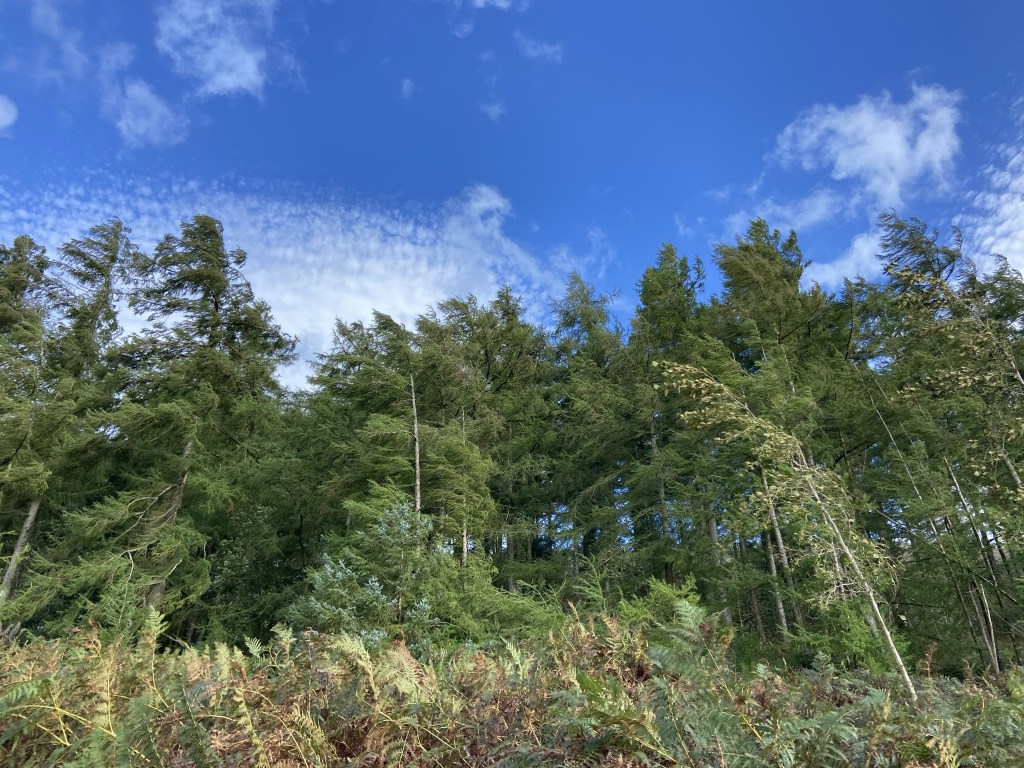
The wind was still high, and above me on a hill pine trees were tossed frenziedly about,
while insects of all kind clung immobile to the late flowers of the umbelliferae amongst the grasses: honey bees, bumblebees, wasps and hover flies, all fastened their three pairs of legs onto the flowers for safety in the strong gusts.

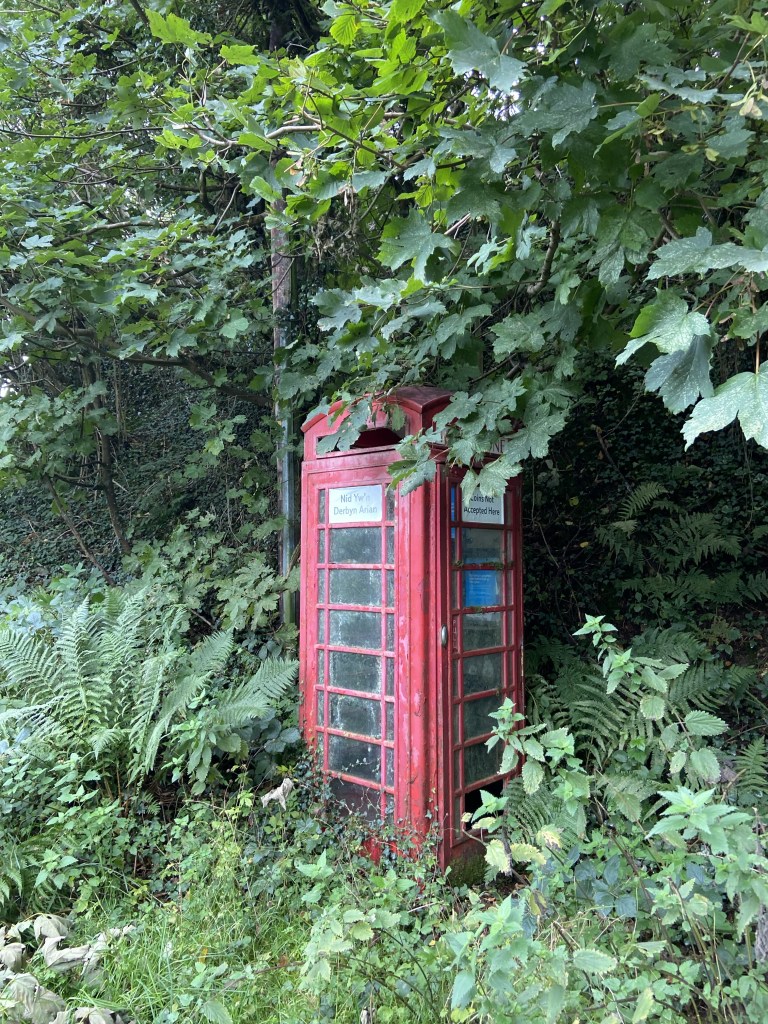
My eyes found correspondences: the faded red of a dilapidated telephone box drew my eyes, as did the ripening holly berries; it is three days after the equinox, and we are half way from the summer solstice to midwinter.

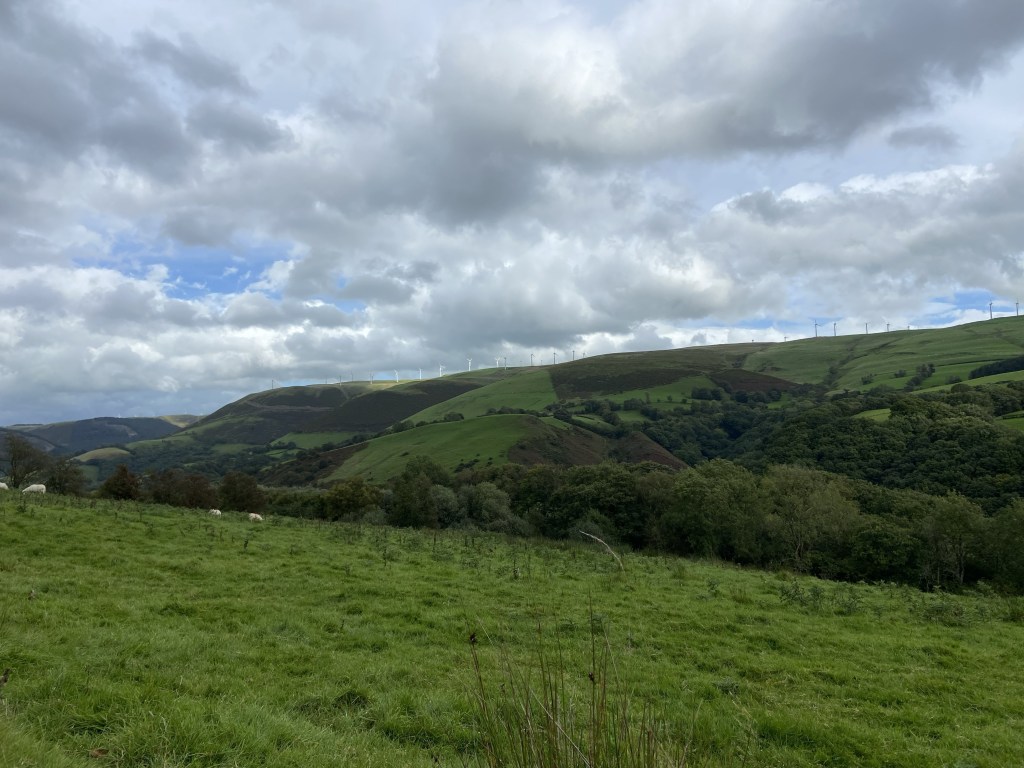
The spikes leaves of the holly suggested an echo in miniature of the wind farm on the horizon, on the slopes of the hills above Llanidloes.
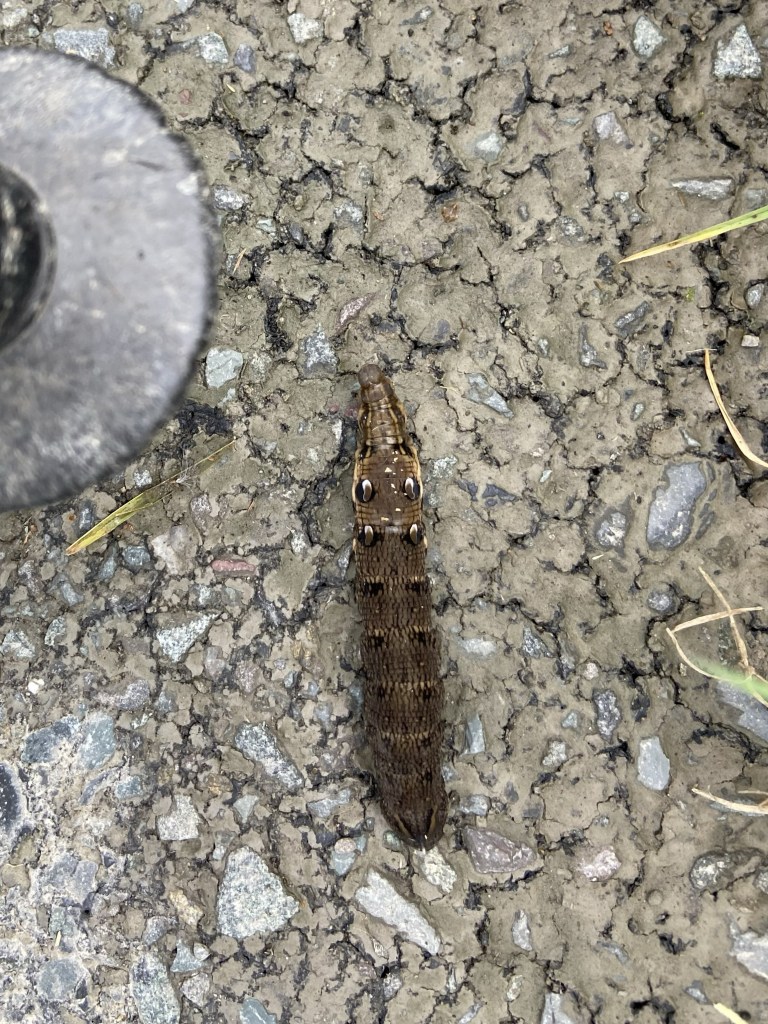
I might not have seen a warty toad crawling along the road (always a privilege to encounter and quite distinct from smooth-skinned frogs), but I did enjoy one final special sight before I descended to the little town of Llanidloes: one of the spectacular super-sized caterpillars of the elephant hawk moth.
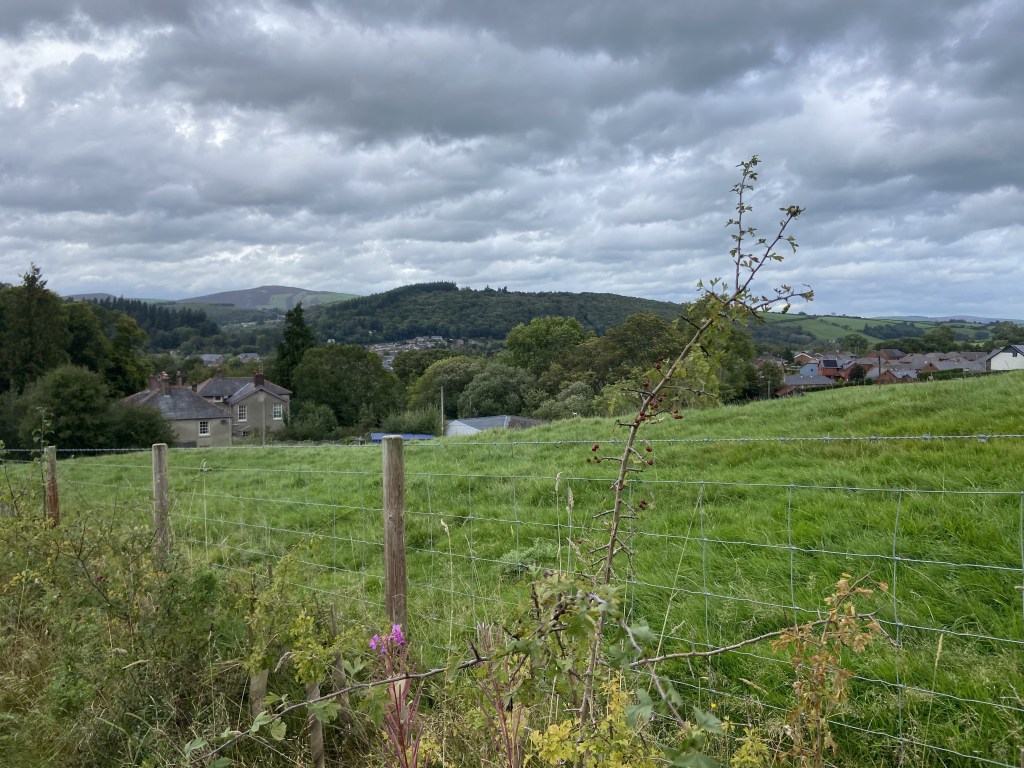
I waited for Stephen in an empty, wind-blown but sunny carpark, feeling extremely pleased with myself: I had walked 20km in 3 hours 52 minutes. I’d stopped for a grand total of only 10 minutes across the whole walk, arriving in Llanidloes 4 hours 1 minute after I’d set off. Considering the state I had finished the previous walk in, I was happy with that.
When Stephen eventually arrived he had a dramatic story to tell: he’d circumspectly avoided going on a bridleway through the middle of a field of bullocks because he didn’t like the look of the herd. Instead he’d accessed the field from a point much further away, and skirted the field edge on a track on the far side of a stream. But then a young bull leaped over the stream on the attack and led a charge of four bullocks towards Stephen down the track, baring his teeth and snarling in a weird non-cow way. It was a matter of who would reach the gate first: Stephen pedalled for dear life and managed to get himself and his bike through a gate at the end of the track — by which time the bull was only two feet behind him. Terrifying. Unsurprisingly Stephen was famished, having used up all his reserves of energy to race away from the charging animals, so we demolished a large tray of Llanidloes’ finest chips. Excellent recovery food.
 Walking The Landscape
Joyous reading! Except for the chase at the end! X
LikeLiked by 1 person
Yes. I am terribly glad it wasn’t just me who managed to cover the ground quickly. I honestly think that if the bullock had caught up with him he would’ve been extremely badly injured, if not killed.
LikeLike
Is the ‘centipede’ perhaps a beetle larvae?
LikeLiked by 1 person
I don’t know! It seemed chitinous and I thought larvae were all soft … but on this Australian site there’s a larva that looks exactly like what I saw. So probably some kind of ground beetle or rove beetle larva. Thanks, Gill!
LikeLike