The road to a friend’s house is never long
Just as it would have been a shame not to have spent three days on the Grand Union Canal without having set foot on a narrowboat, it would have been a shame to have walked this beautiful river for three days without having had a dip. Stephen and I went down to the Old Ferry Boat Inn at 7.30, and slipped into water which was deliciously cool on what was shaping up to be a 32-degree day. There was nobody about. Damselflies skimmed the water surface and around our heads, and reflections rippled in the leaves of the willow trees. There were glints of sun on the water to the east, downriver, and the river was pretty much clear of water weeds here, and without sediment, if we didn’t stir up the sandy riverbed. It was the perfect shared start to the day: a tiny microcosm of clean peace carved out of daily life for Stephen, and a sense for me that the physical stresses and strains of the previous two weeks’ walk were being washed away, leaving me with a sense of a tiny microcosm of clean peace. As we climbed out of the water and walked back to Sam and Cathy‘s, a pair of swallows arrived, darting low over the water to hoover up some of the little insects that had been hatching from its surface.
Clearing up after the party and chatting over coffee and breakfast took its time, and it wasn’t until 11.40 that I set off. But it was not the usual step out of the front door: Sam got his canoe out and rolled it down to the river. I was going to get a ferry.
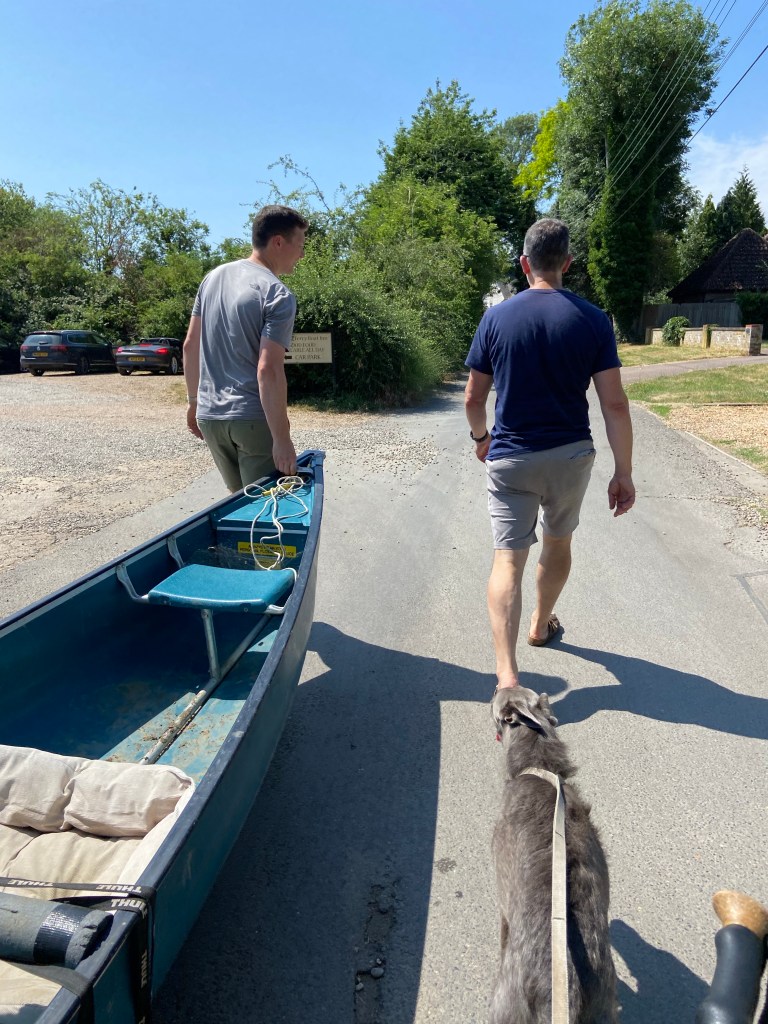
As I had discovered on Friday, there are limited options for crossing the river Great Ouse around Holywell. The route I had planned took me downriver up to the nearest bridge at Needingworth and back down again the other side for a distance of 5km and more than an hour’s walking.
I got aboard with my now very much reduced pack, which now contained no tent, no spare walking clothes, not even my flip-flops. Just nice clothes for me to wear for the next few days when I got to Cambridge. We launched and set off, through a duckweed-covered backwater,

and out across the ferry pool.
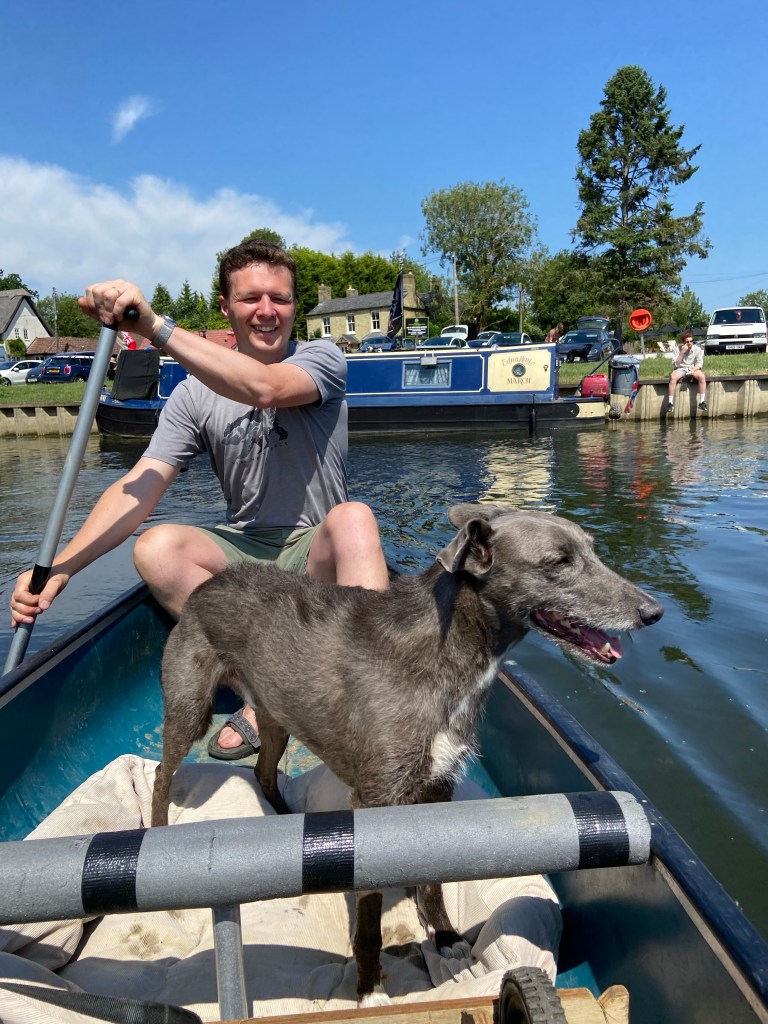
It took Sam a mere two and a half minutes to bring me to the same point in the canoe that I would have reached in more than an hour tracking downriver to the bridge.
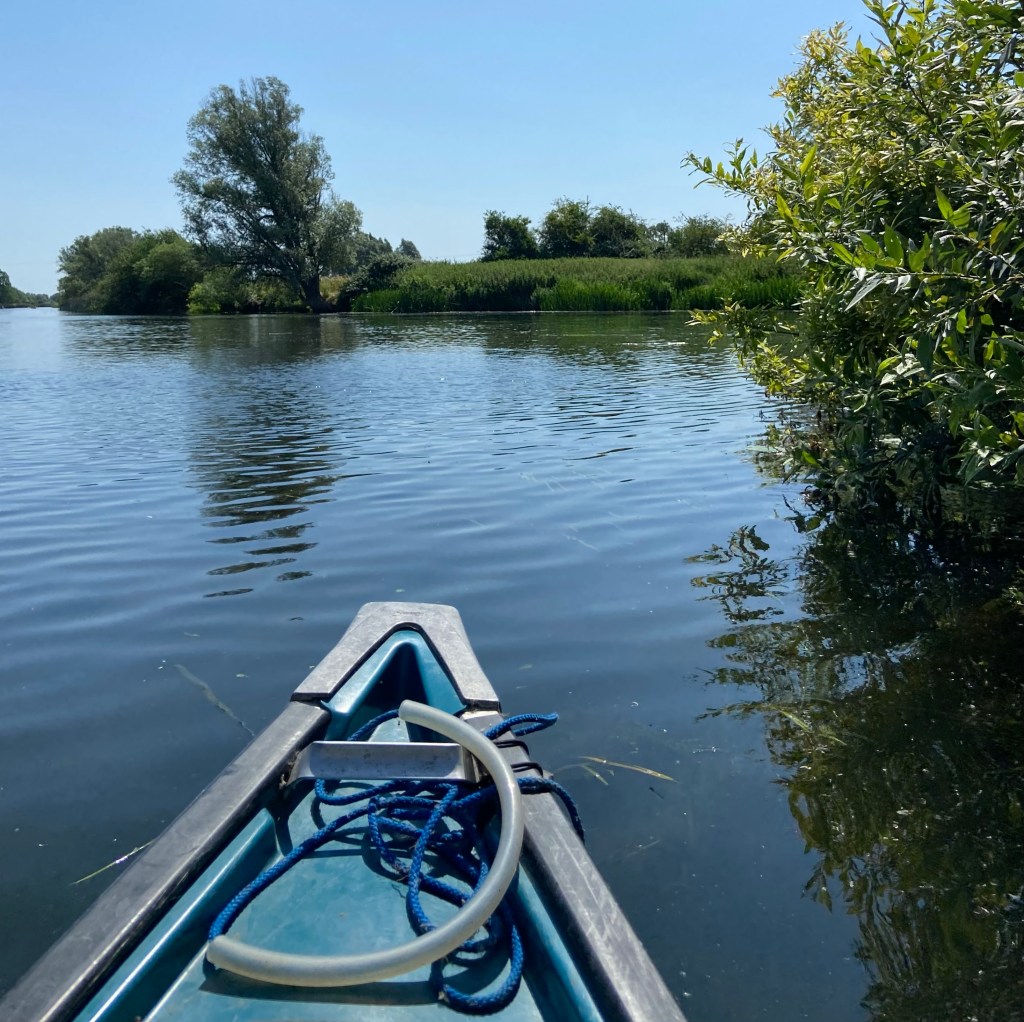
I scrambled up the bank and waved my thanks to Sam and a farewell to Stephen, waiting behind on the far bank. I missed him already.
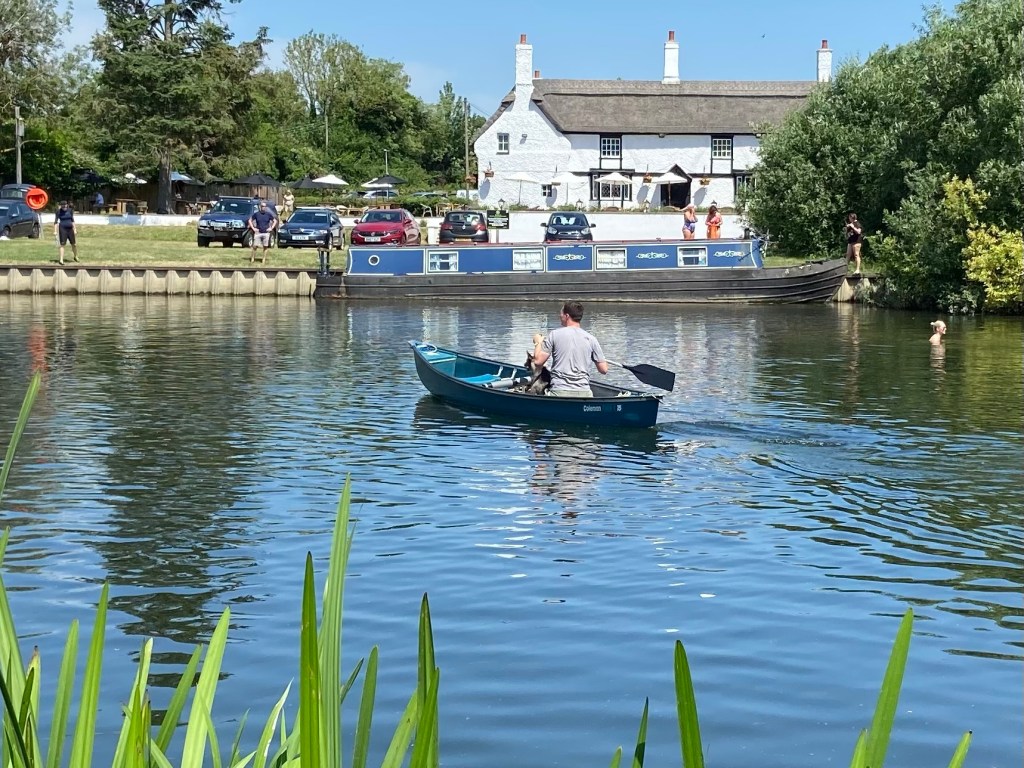
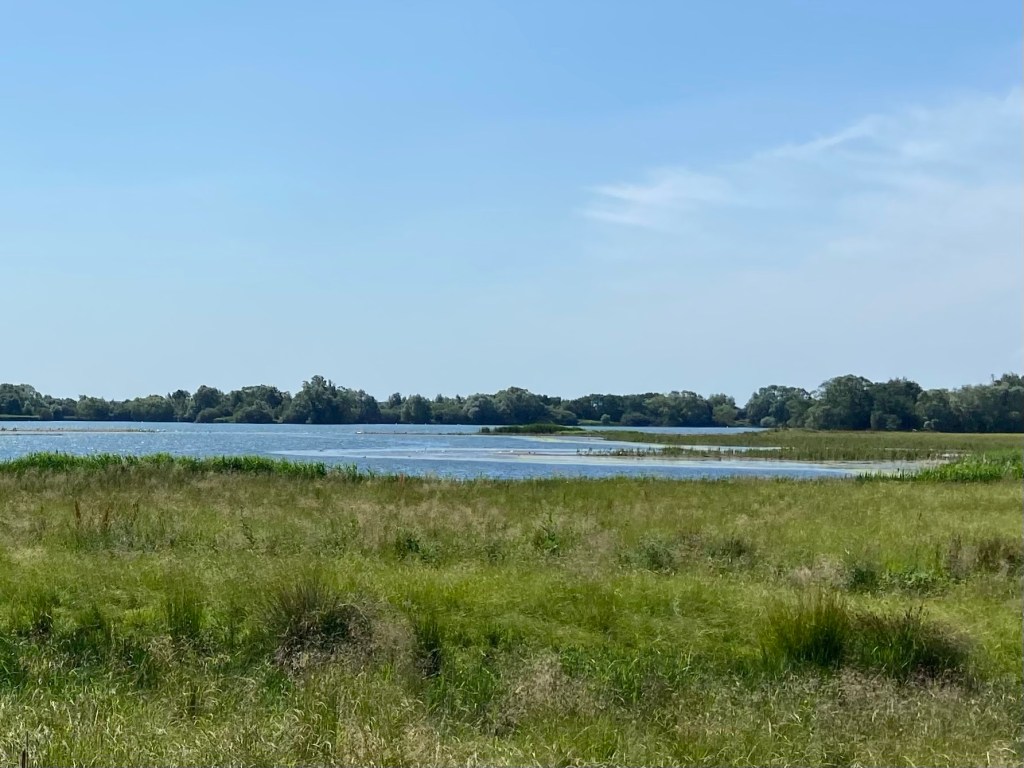
On the other side of the river where I so miraculously effortlessly now was, is the Fen Drayton RSPB nature reserve. It encompassed the river path that I was on, but also to my right a number of yet more large ponds and pools created from old quarries, a tiny part of a joined up strategic plan for man-made wetlands covering 25 miles (40km) of the Ouse Valley floodplain. There was a hide set up, but without binoculars it would have been fairly pointless to have diverted to have a look. From this far away, I could see that there was a substantial congregation of swans, but I have no idea what else.
I had started the day wearing long trousers, because I was by now a pro at walking the late June riverbank. Sure enough at the point at which I turned away from the river for the last time, glad that I had experienced the feel of its water enveloping my whole skin,
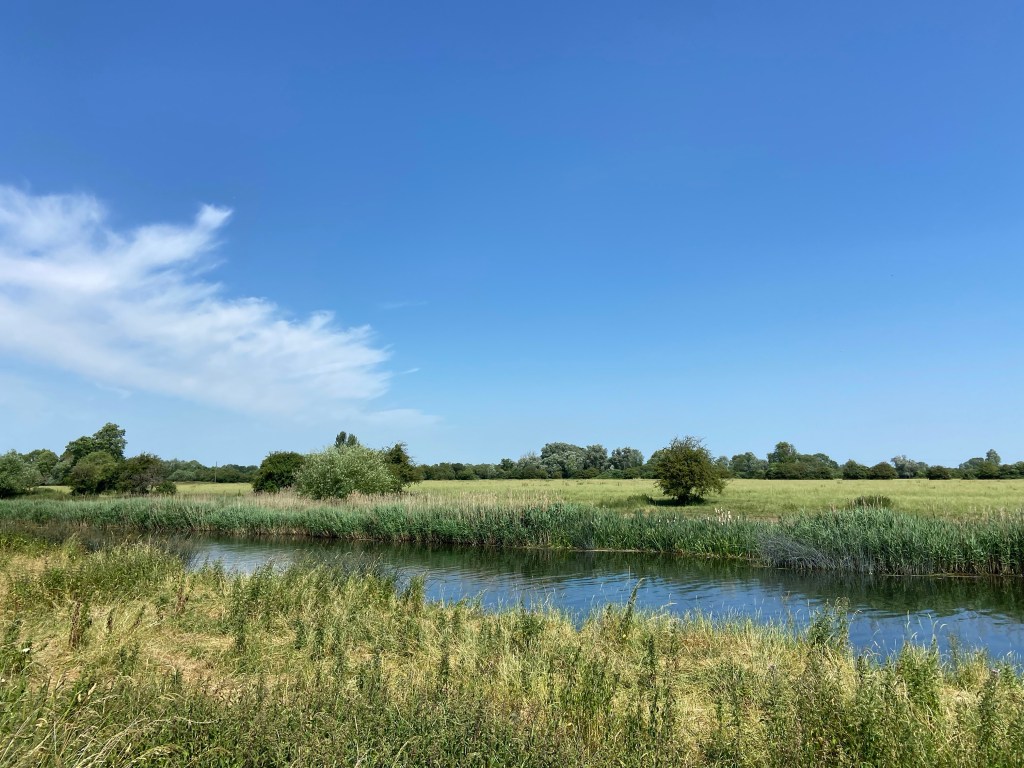
the vegetation closed in once more, running alongside a what is now a lesser ditch but which used to be a navigable drain. But this was my last chance to kick my way through grasses, full of dragonflies and the tiny electric blue cylinders of the azure damselflies, and I didn’t mind at all — welcomed it, even.
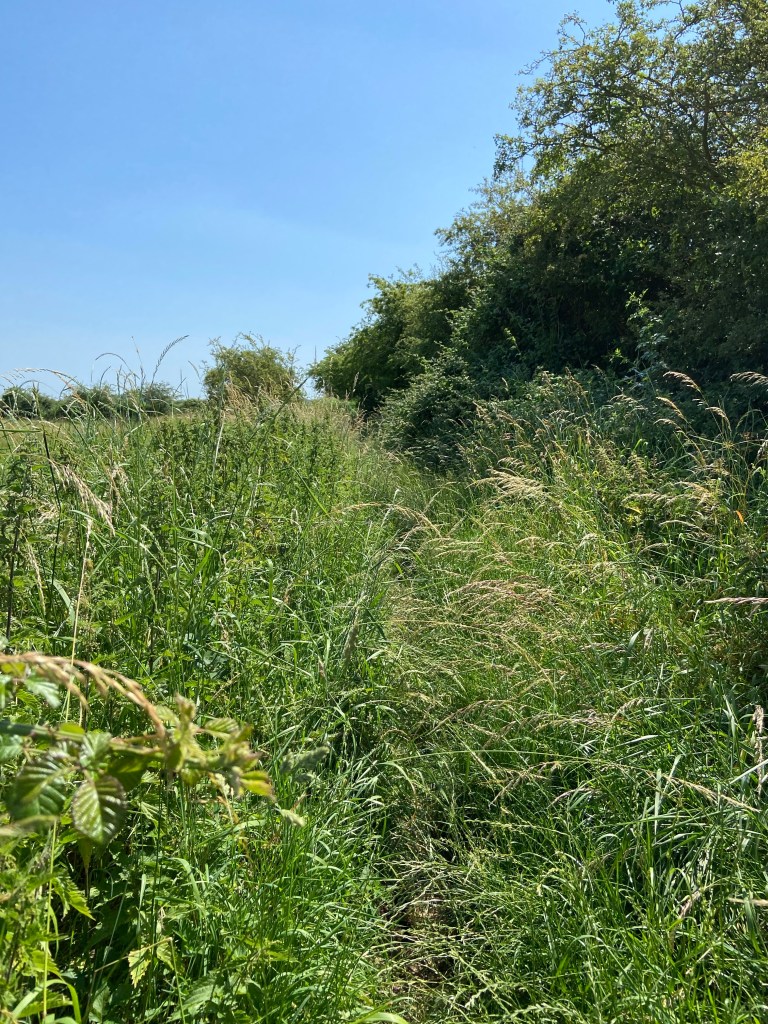
By the time, I crossed the busway, I was ready to change back into my shorts as I was fairly sure that the onward paths would be clear. I could have taken the busway all the way to Cambridge, an easy route following the old railway line, but hard underfoot, and oh! The boredom!

I was now walking through the Fens proper. Flat farmland stretched away in all directions, created by draining the soil with ditches.
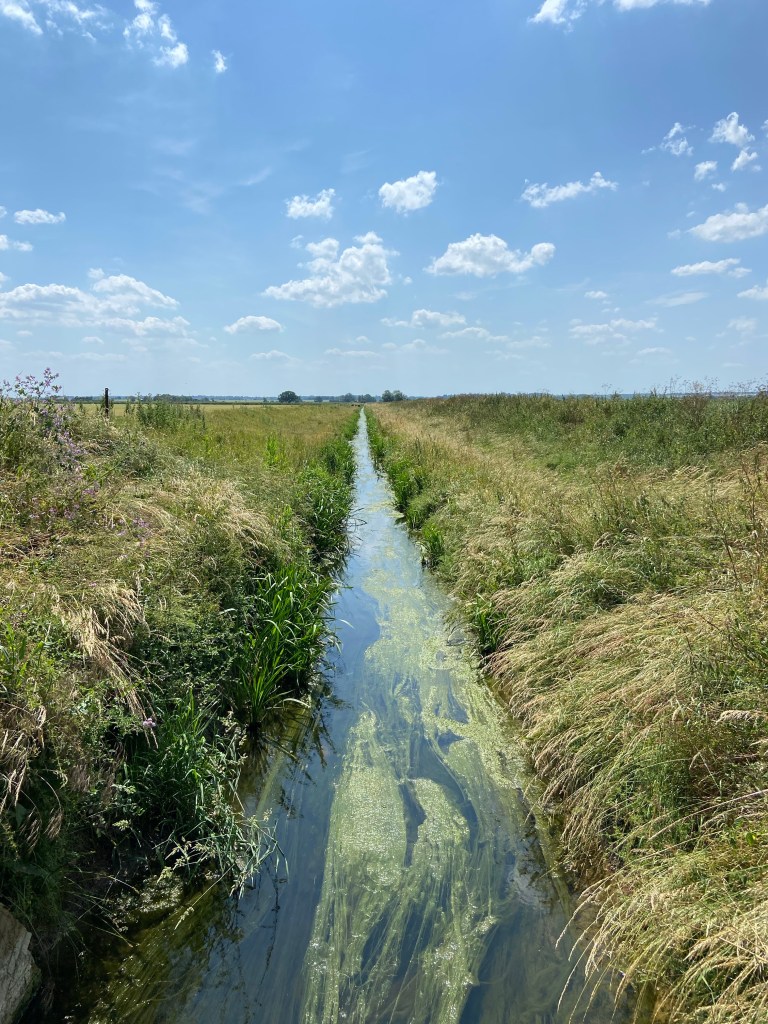
Far away to my left a bus sped by on the busway to Cambridge, far away to my right, cars and trucks raced to Cambridge on the A14. They were too far away to be heard, and in a different world. Where I walked cows stood in the ditches, and herons flapped away as I passed. The sky was gigantic.

That water was a precious resource even here was evident from stock ponds that had completely dried out in the heat after months without proper rain.

The lanes and paths I was walking (Holywell Ferry Road, Cow Fen Lane, Middle Fen Drove Road…) mapped their history — trade and droving routes in continuous use from Roman times (the A14 was originally the Via Devana from Cambridge to Godmanchester) through the Anglo-Saxon period during which the roads were not kept up and gradually disintegrated into tracks. In the Middle Ages and beyond they deteriorated even further so that by 1675 one of the clerks of Trinity College, Thomas Mace, complained about “wayes, which are so grossly foul and bad … now spoiled and trampled down in all wide roads, where coaches and carts take liberty to pick and chose for their best advantiges; besides, such sprawling and straggling of coaches and carts utterly confound the road.”
Luckily once away from the river my way was metalled — long and straight but not quite as brutally featureless as the busway,
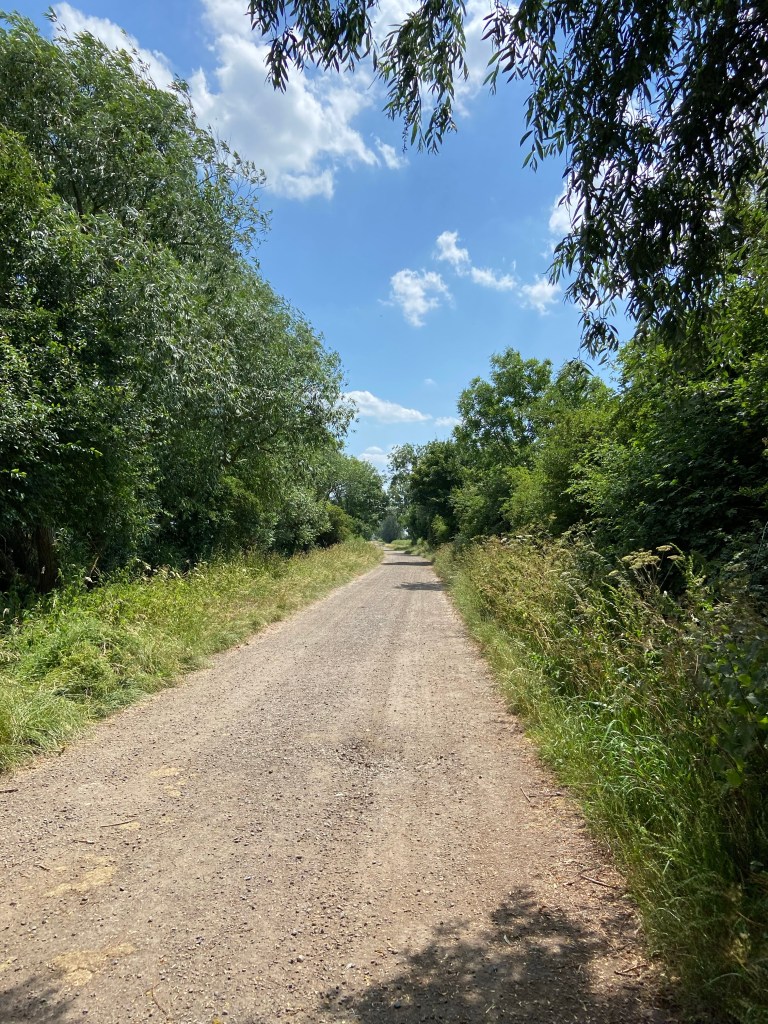
and with occasional company.

The view stretched for miles, but any feature of interest lay in the far distant horizon. Occasionally I had a bit of company, but by and large, it was just me and the open road, and a windmill on the horizon, getting slowly closer.
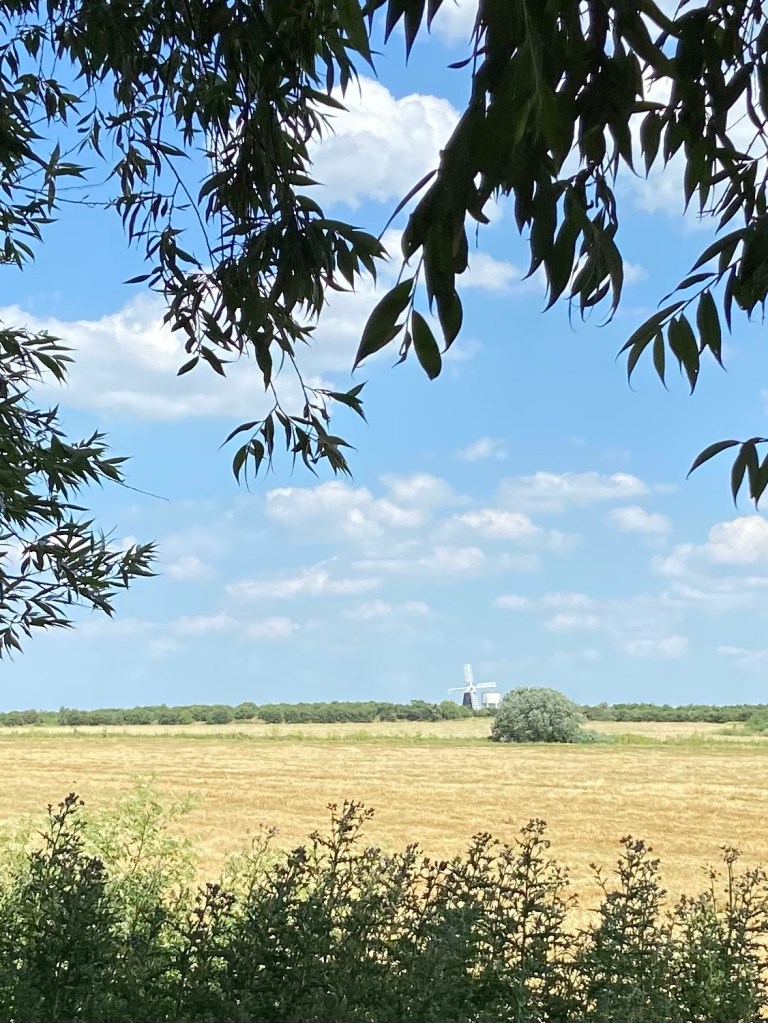
Cow Fen Lane eventually ended and I passed once again into farmland,
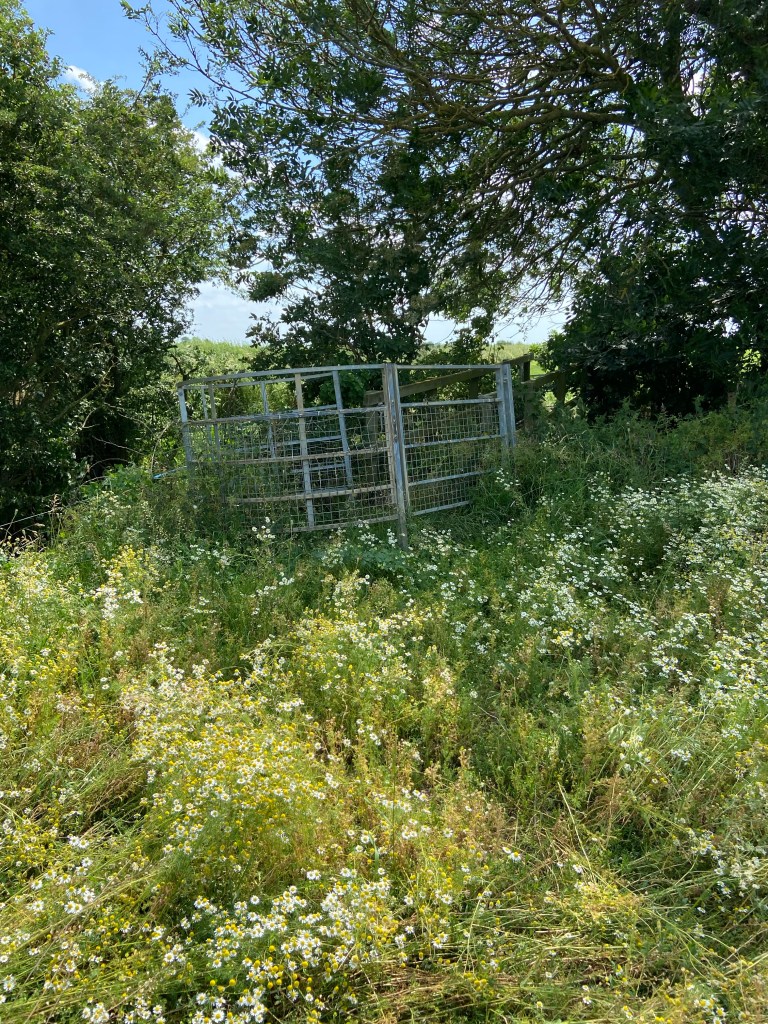
appreciating the clear path and the fact that the last herd of cows were kept distant and uninterested by an electric fence.

The field path this morning should have been appreciated for another reason too: it was the last bit of earth path of the two weeks’ walk, although I didn’t realise it at the time. From here on, it was just pavement.
On the map there was a little cut through to shave the corner off the Longstanton bypass and avoid walking along the roundabout verge, but it was heavily padlocked, with big signs firmly warning off entry. I was forced to hack along the road — although the orchid success of the last roundabout was once again repeated for one last time, here with a backdrop of jet black vetch seedpods, split explosively open in a hard, scratchy spiral.

Nature was slowly encroaching onto a disused lane off the main road, dessicated moss and brambles creeping forward to obliterate the tarmac.

By this time it was the full heat of the day, around 1.30. I had only been going for two hours but it felt like more. The tarmac felt fairly spongy because it was melting, whereas the pavements were rockhard, so I walked through Longstanton in the roadway where I could.
I passed St Michaels, a disused church with a green and ferny medieval well in its churchyard, once used for baptisms and now looking cool and inviting.
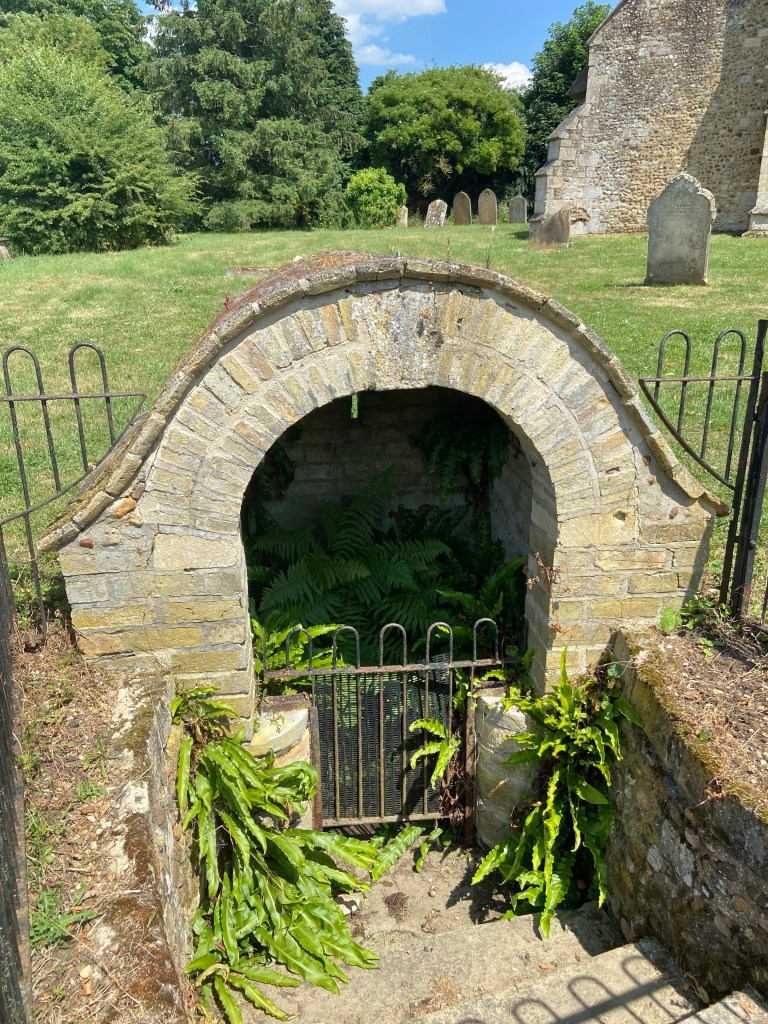
But it was on the far side of the churchyard wall and instead my path was a hard, hot, airless cycleway which crossed several blocked off unfinished roads leading nowhere, and on which construction appears to have stalled.

I reached the White Horse at Oakington an hour later, more than ready for a rest in the shade and a quick plate of bangers and mash to fuel the last two hours of walking.

It was then a head game walking along the roads. There was a pavement on the left hand side, but unfortunately it was sunbaked and pitiless, and any scraps of shade there were from trees were on the right side of the road. I chose to walk in the shade and make the most of the strong breeze that was blowing — not exactly cooling, but at least drying. When the breeze died down, I was walking through a wall of heat.

But there were street name signs and they all said ‘Cambridge Road’. I was so near the end!Through the village of Girton I walked, galvanised by the sight of the first Cambridge College — the beginning of the end.

The last three kilometres passed in a flash. I was eager to finish but at the same time feeling a kind of nostalgia and sense of loss.
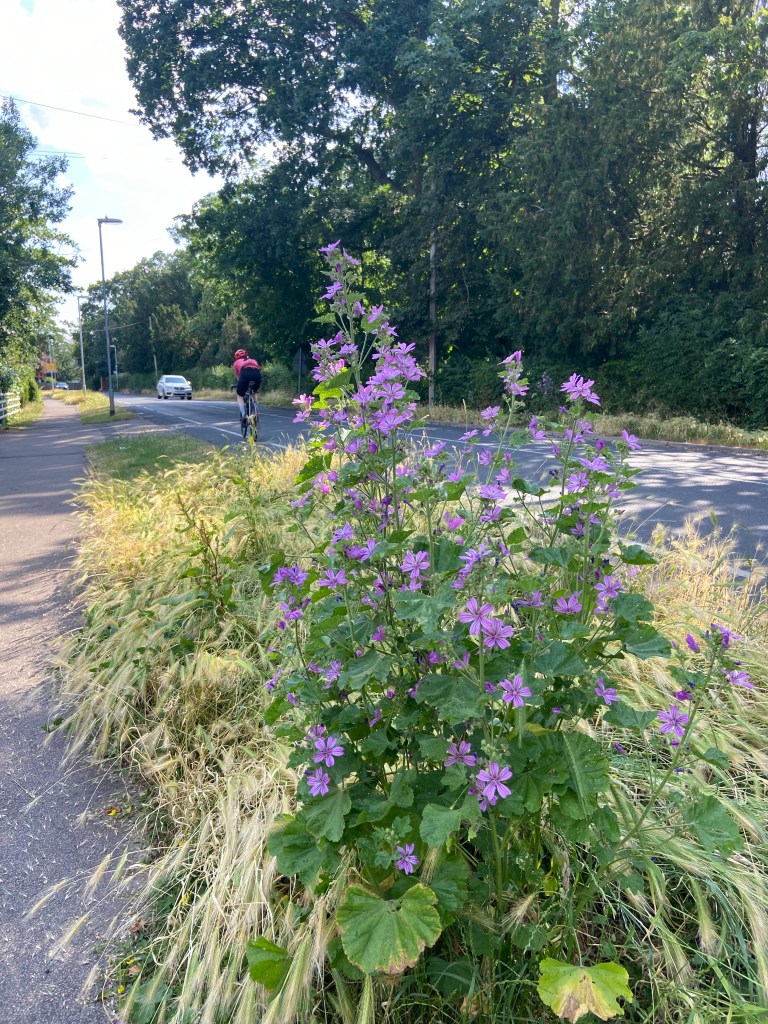
Natural verges of mallow and barley gave way to flowerbeds — even a phone boxes had been filled with petunia planters.
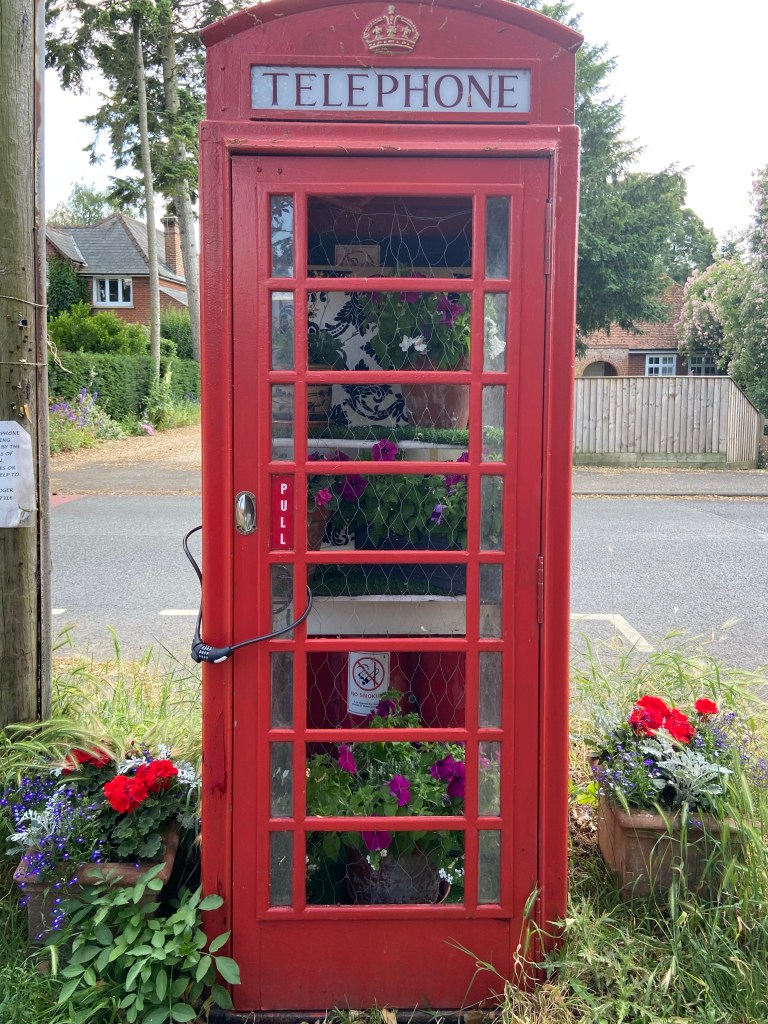
After fourteen days’ walking, 310 kilometres (194 miles) of countryside was behind me, and I was swallowed up, finally, by the built environment.
The old City of Cambridge was for tomorrow, though: Ros lives on the near side of town. Soon, I turned into her street and there she was, dear and familiar, outside her gate to welcome me.
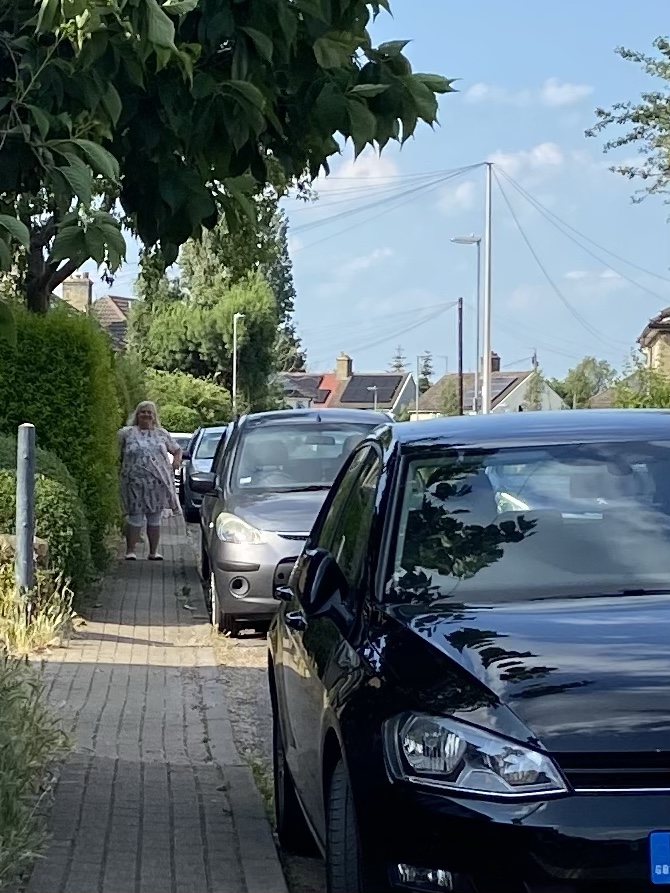
Finis

 Walking The Landscape
Journey’s end! So great to greet you and such a fantastic achievement!
LikeLiked by 1 person
Thank you! Xxxxxx
LikeLike
Enjoyed reading this and love your descriptions of nature. Impressed by the number of miles you’ve covered in a relatively short space of time. Wow and well done!
LikeLiked by 1 person
It’s lovely to hear from you! Thanks for following the journey! Xxxx
LikeLike
Well done, Sophie! Looking forward to the next one!
LikeLiked by 1 person
Thank you! I’m thinking what that might be….
LikeLike