Who Dares Wins
Sir David Stirling
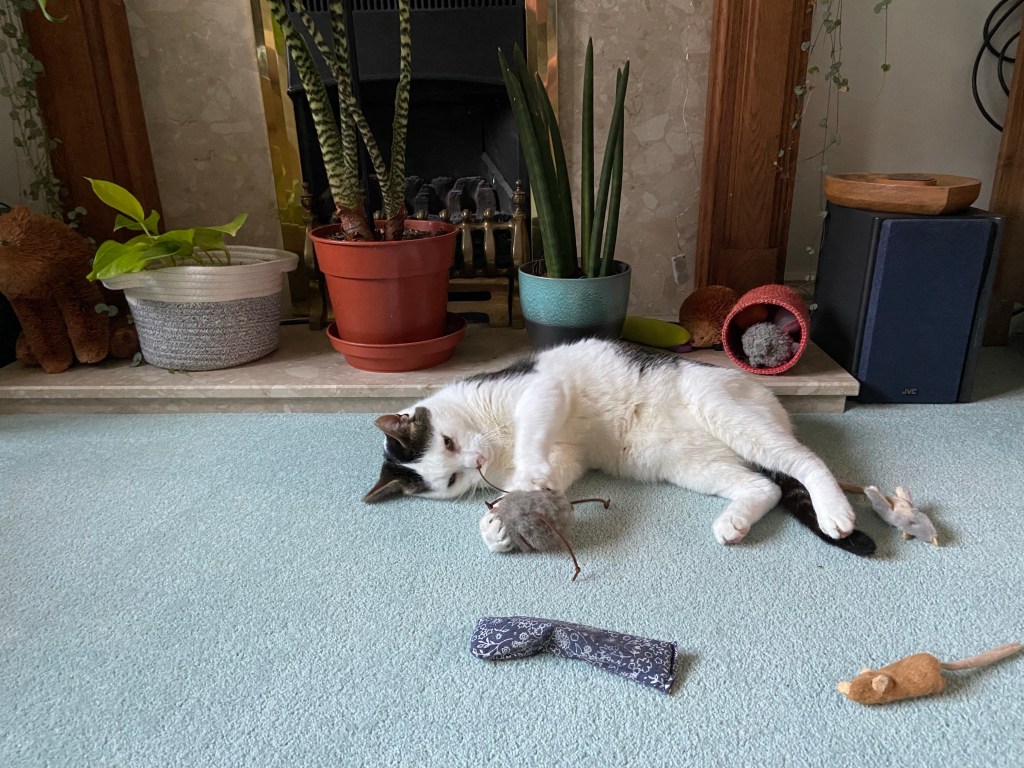
With only twelve kilometres to go today, I enjoyed a marvellous lazy morning getting up to date with the blog in this peaceful home, enjoying the sense of well-being that comes from the sound of primary school children playing outdoors at break time and having a lovely person and a lovely cat for company.
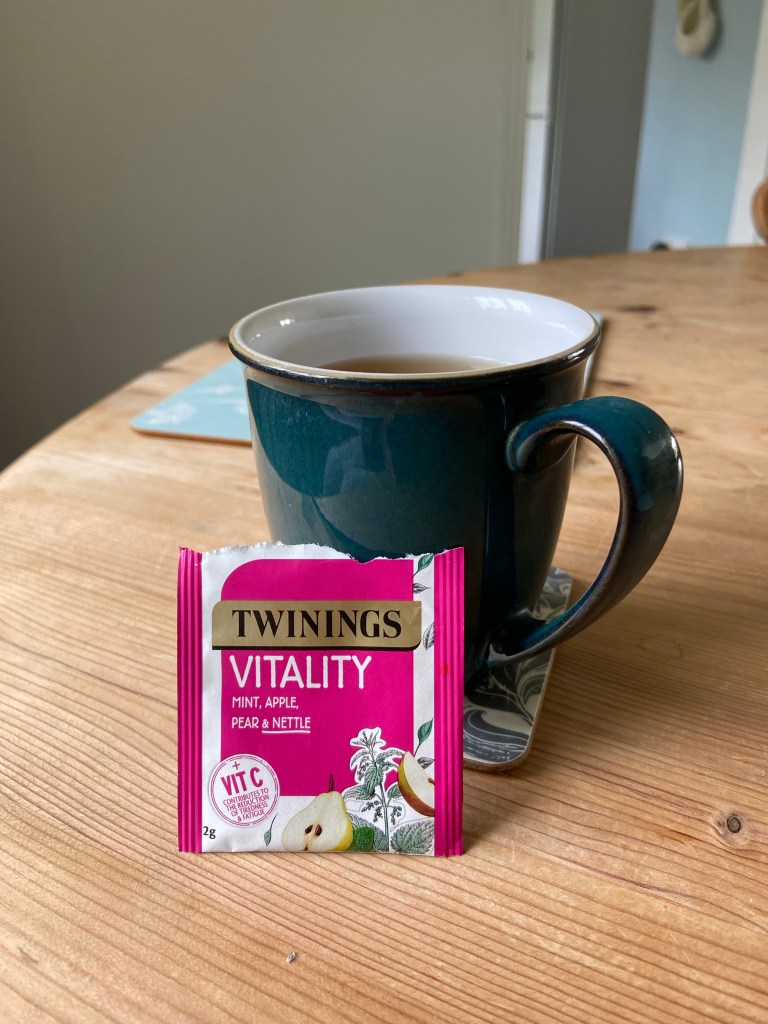
I even got my own back on the nettles from the last week or so, by drinking them in a herbal tea with a promisingly energetic name. I was to need that vitality, although I didn’t know it.
Yesterday I had walked through the Buckden Marina and the sight of this boat made me think just how far across the map of England I had come on foot. It’s extraordinary how a step at a time, a day at a time, the distance accumulates.
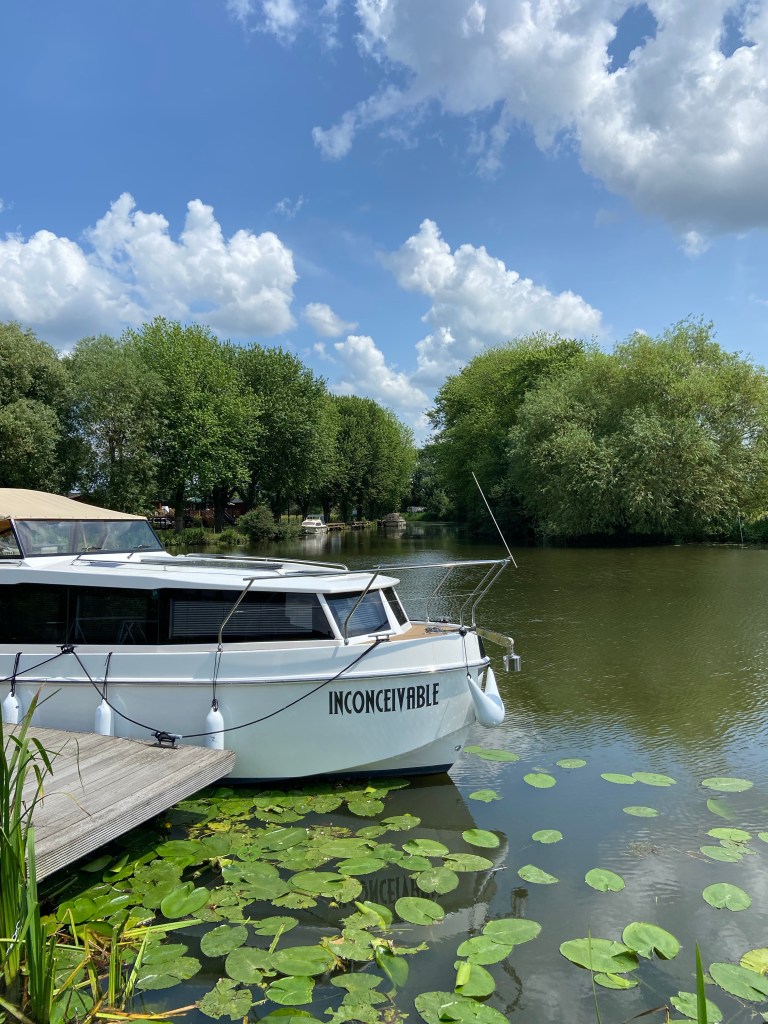
Today I was to reach Holywell, the last-but-one destination on this walk, where our friends Sam and Cathy live.
I had stretched my leisurely time out slightly too far and when everything was packed and I checked the time, I realised I only had one minute to say my heartfelt thank-yous to Jacqueline and a rushed goodbye, and then three minutes to run — yes run, with the full 10kg pack on my back, for the bus. Reader, I know I said there would be no running in this blog, despite the shoes, but I was like something out of an SAS challenge. I could feel my knees creaking under the combined weight of the pack and me, but nothing buckled.
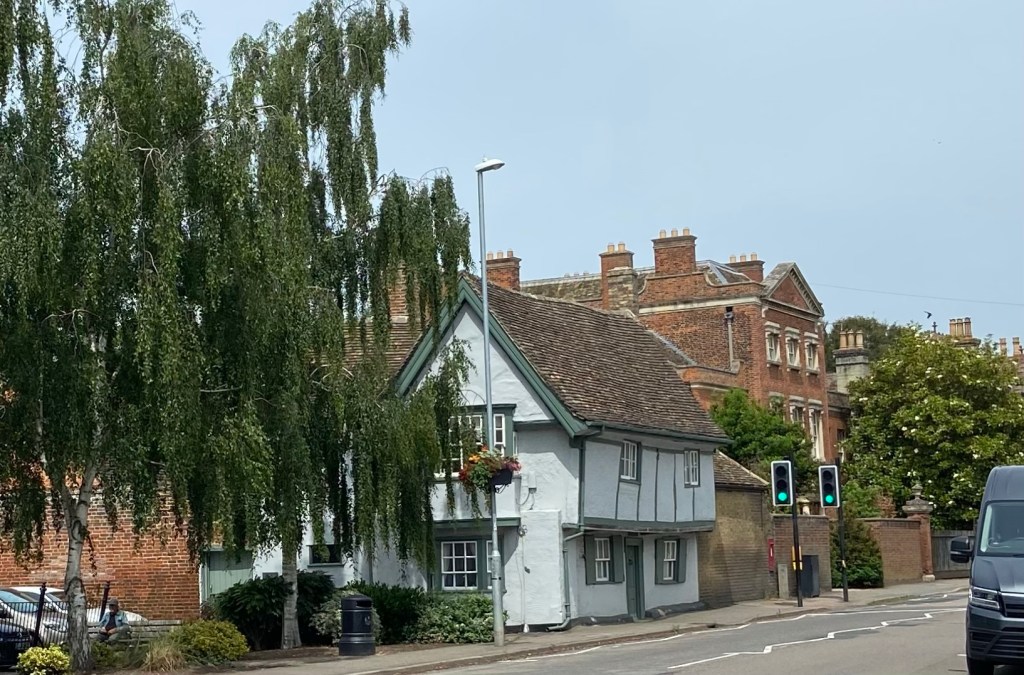
The bus dropped me in Godmanchester on the opposite side of the road from where I had caught it last night.
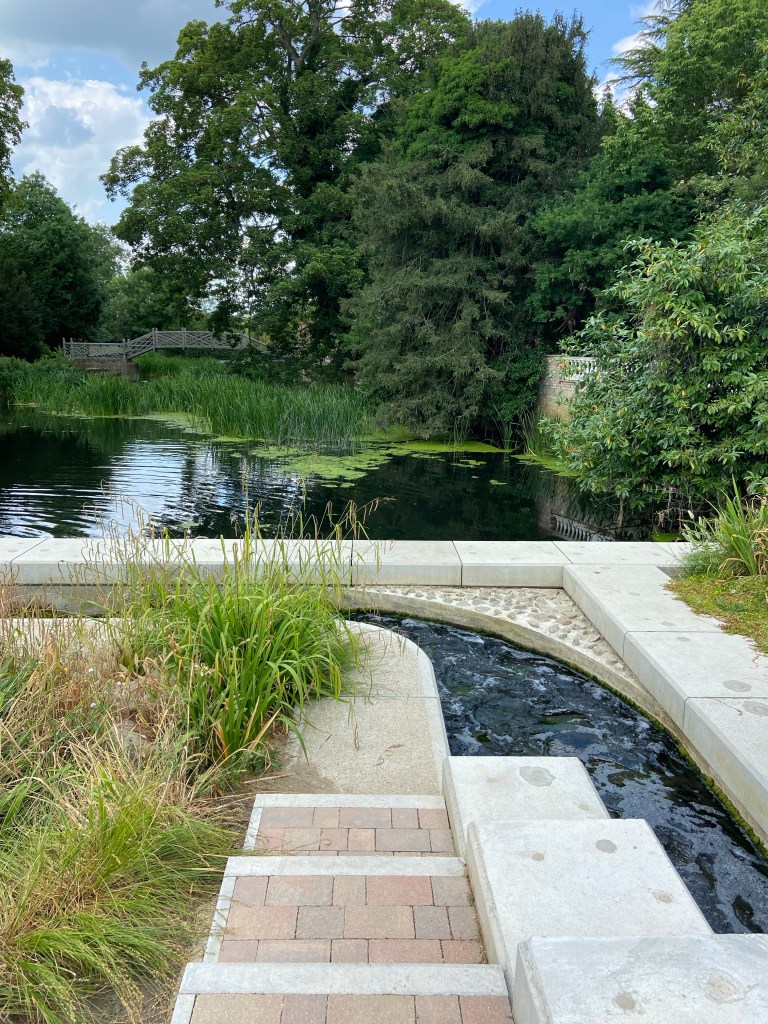
There was time enough to appreciate the architectural new fish ladder at the Mill Steps to allow salmon and eels to navigate the changes in water levels,
before the path swallowed me up: through the churchyard, across the town cricket pitch on which non-existent grass growth was being mown, beyond the underpass to the dual carriageway. The route today took a winding course through several reserves which together form a strategic ‘Living Landscape’ partnership between the Wildlife Trusts of Bedfordshire, Northamptonshire and Cambridgeshire. It was to be characterised by commons and water meadows all the way to St Ives.
The first reserve consisted of four reclaimed gravel pits, the first lake now colonised by huge flocks of serene geese, and gulls nesting on islands.
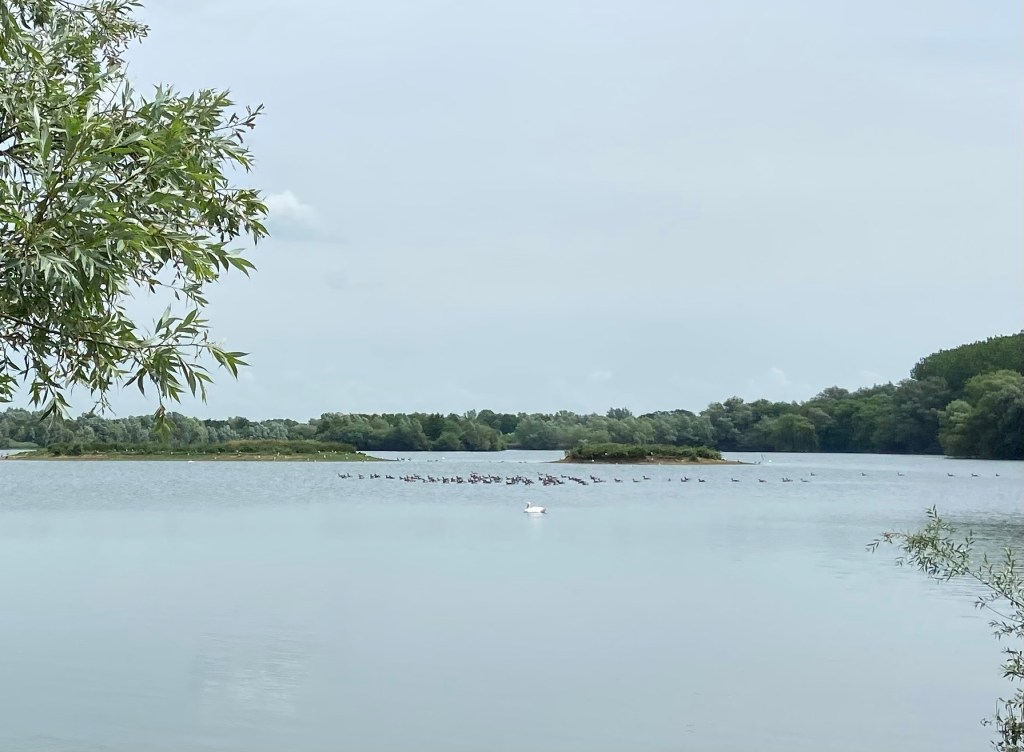
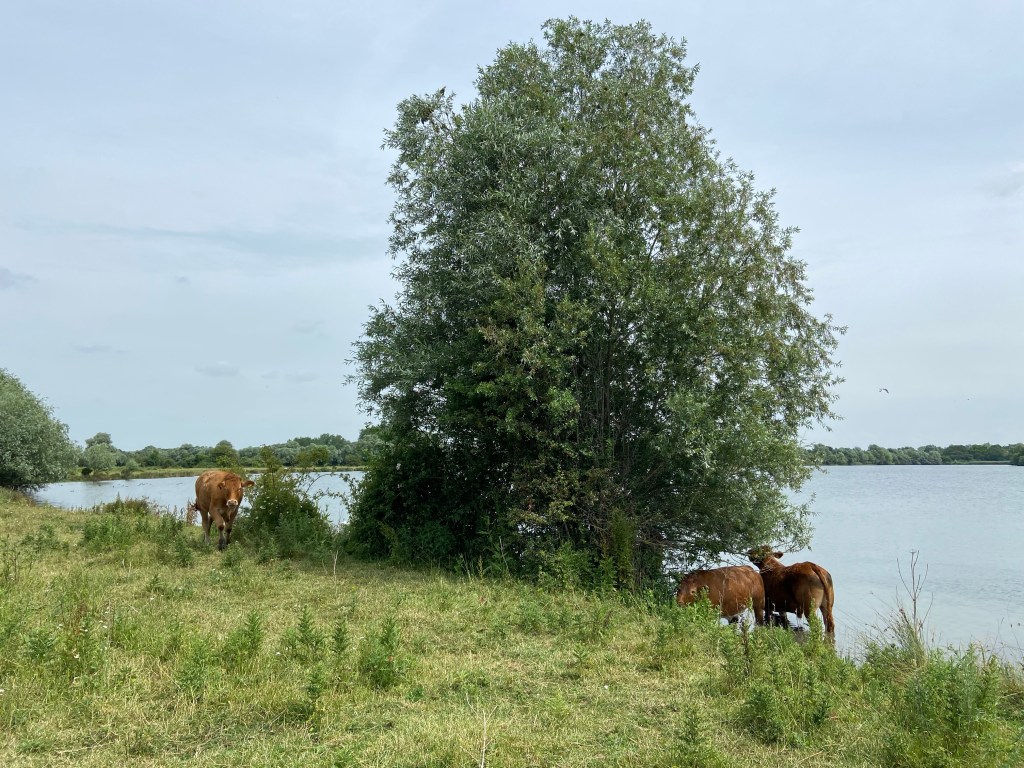
They graze cows here to support wildlife; although I walked right by them, they took absolutely no notice of me, much more interested in browsing in the willow trees and drinking the lake water.
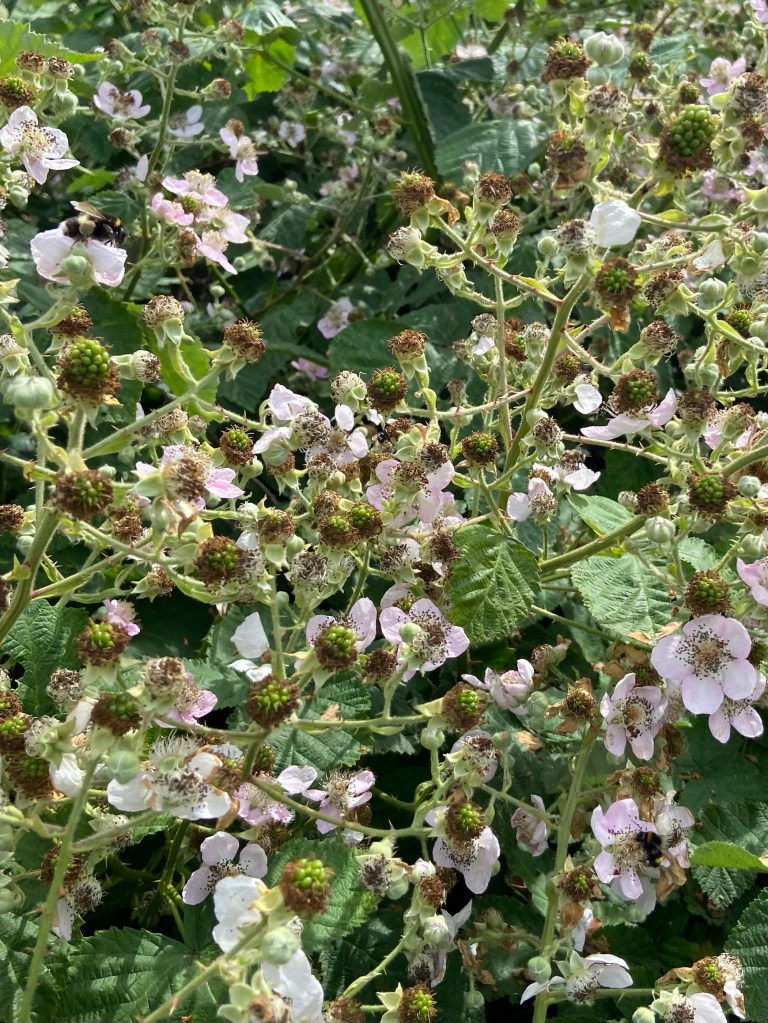
The path skirted the edge of the reserve, alongside bramble hedges humming with bees, some of which had filled their pollen sacs so full it was a miracle they could fly,
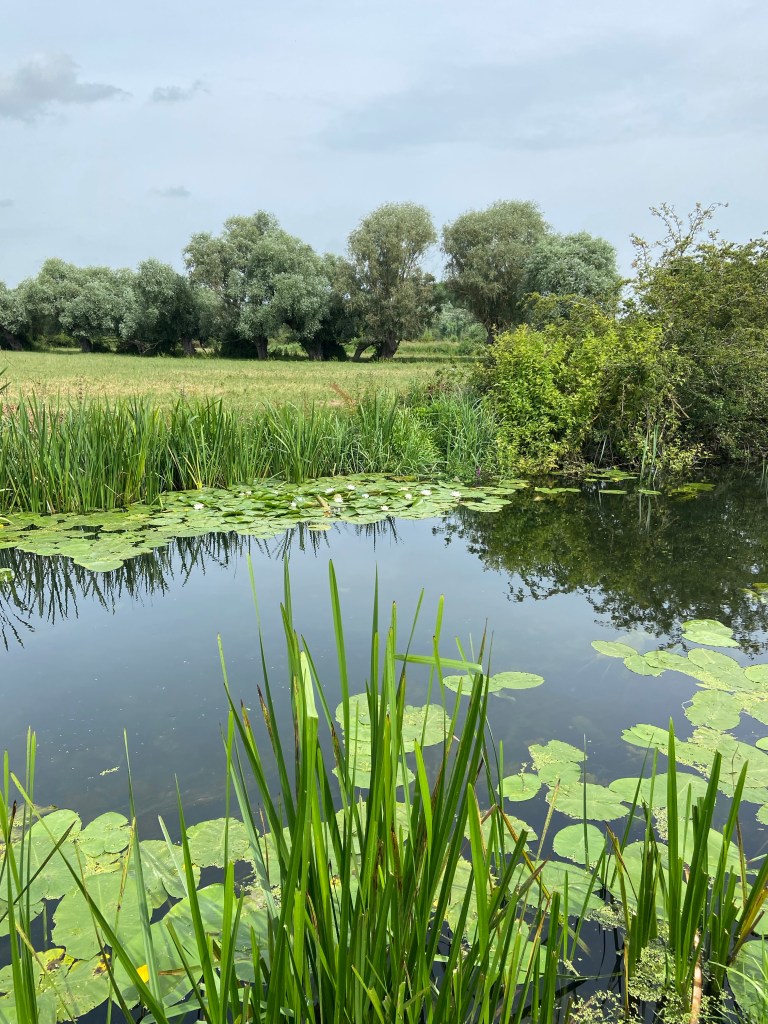
and drainage ditches too beautiful to deserve that name. White waterlilies grew here together with the common yellow variety, and emperor dragonflies chased off lesser species.
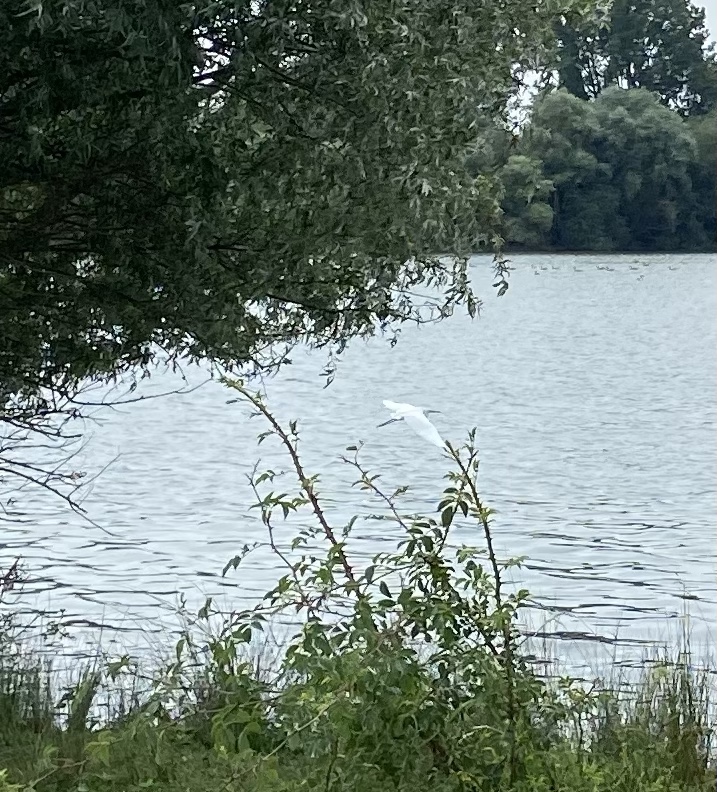
I disturbed a little egret as I passed from Island Lake to Roman Lake,
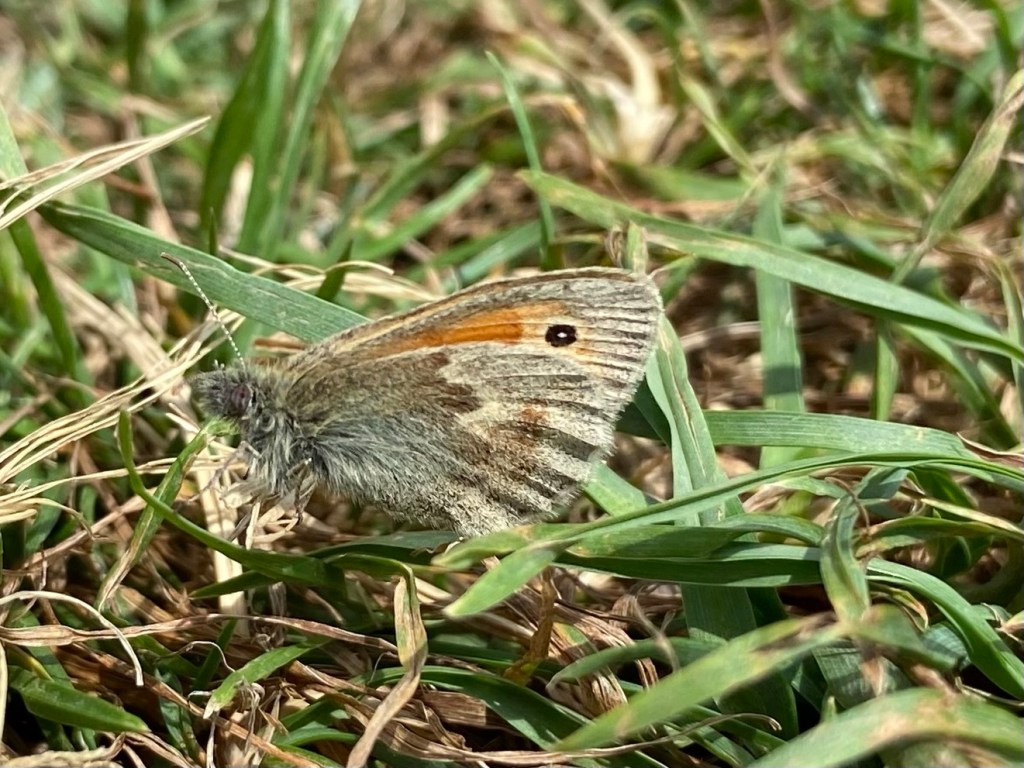
and disturbed also a pair of swans, a pair of coots and a pair of Egyptian ducks with their brood. A small heath butterfly stayed still enough for me to be able to photograph it; there was no chance to get a photograph of its spread wings, as they are always folded when it is at rest.
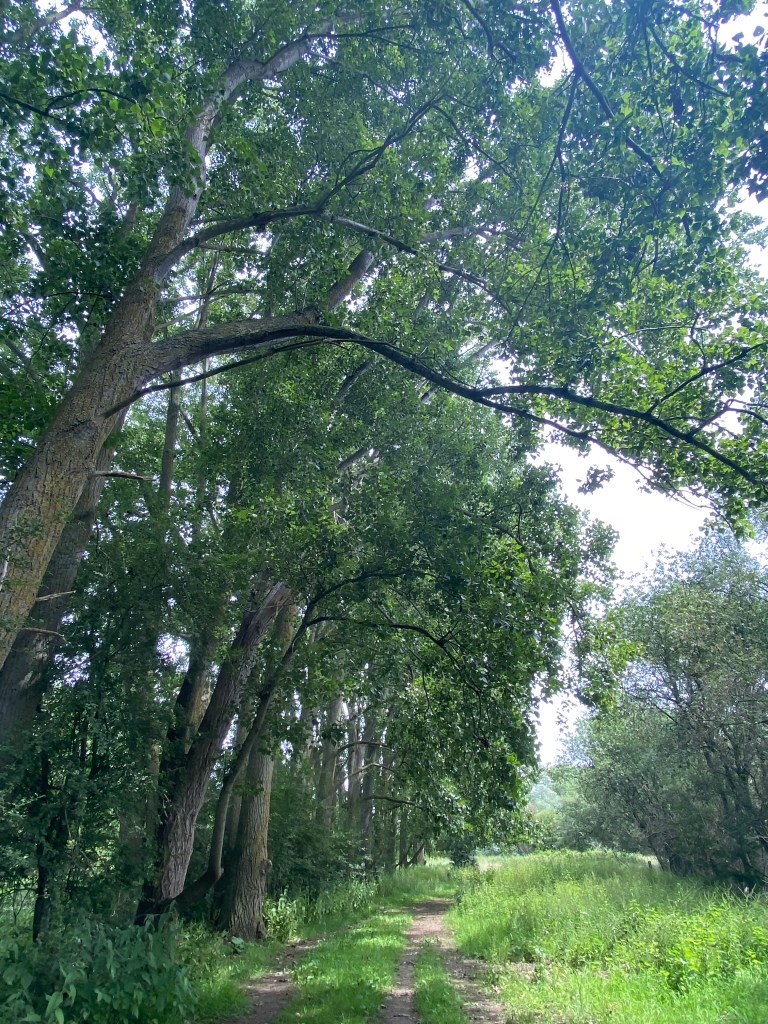
A line of poplars reared up above my head — it felt rather as though I were in a cathedral, and I found myself walking on trying to be extra quiet and not make any more wildlife feel anxious at my presence.
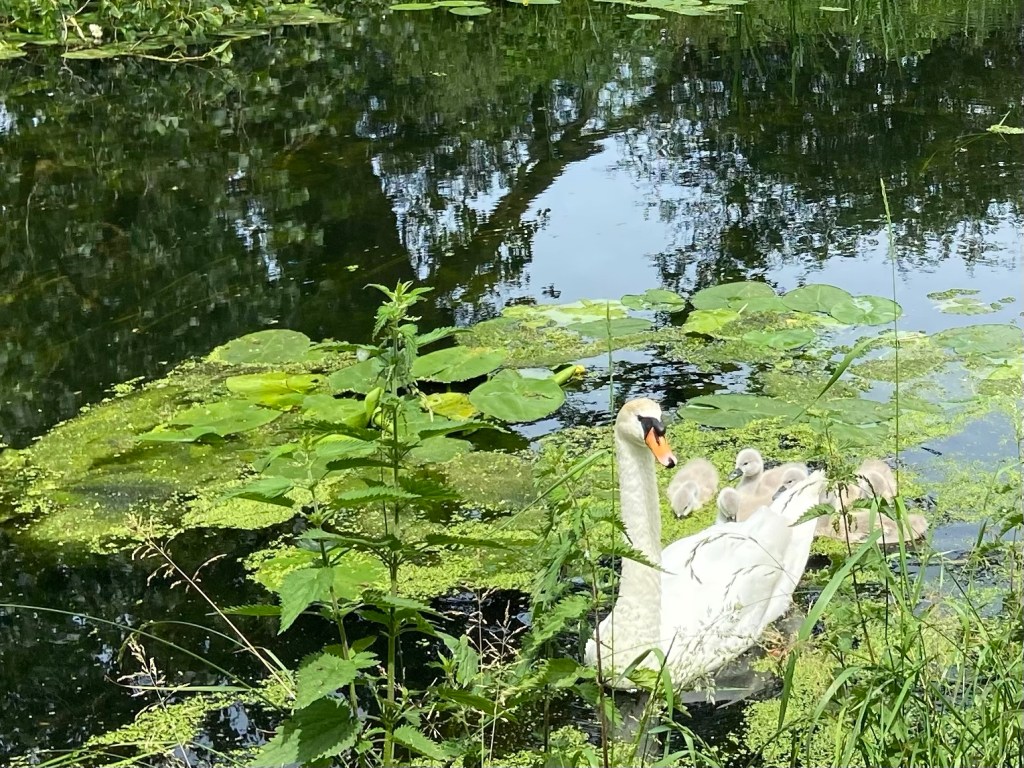
Certainly a swan with her cygnets did not wish me to get close, hissing a warning as I passed by.
The cathedral analogy worked in another way too: this was my last day on the Ouse Valley Way and it did feel meditative. I was entirely on my own again, and once out of the reserves I lost myself in the wide, flat spacious meadows of Godmanchester Eastside Common.
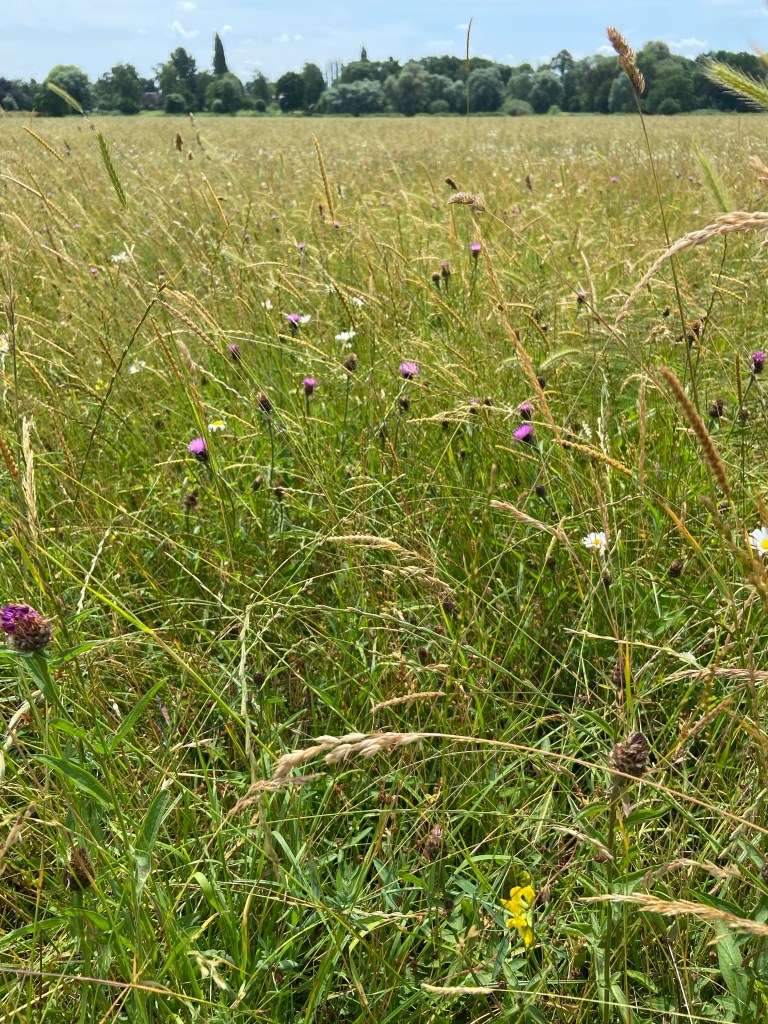
The path had been well-trodden through the grasses, with footbridges over the channels.
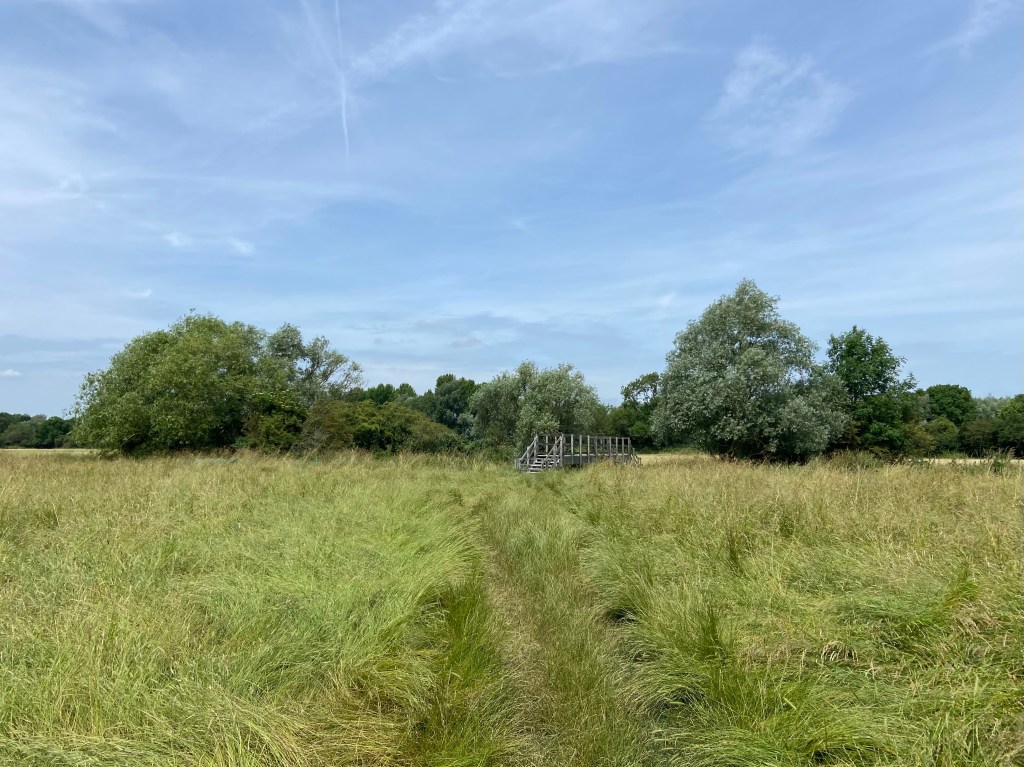
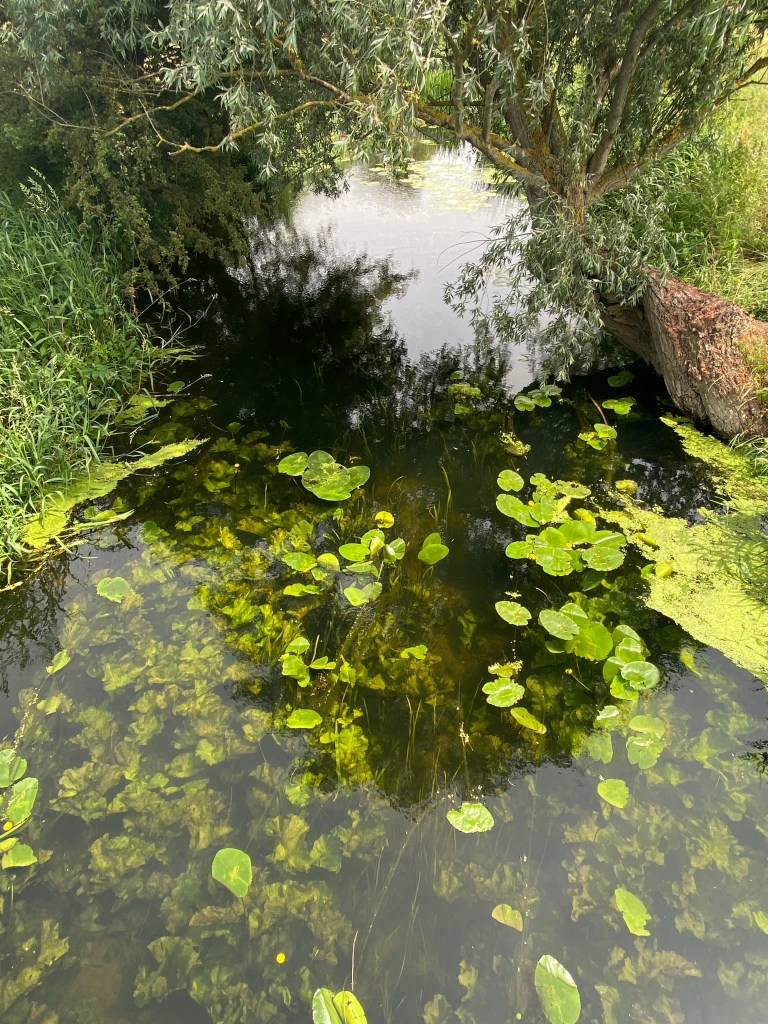
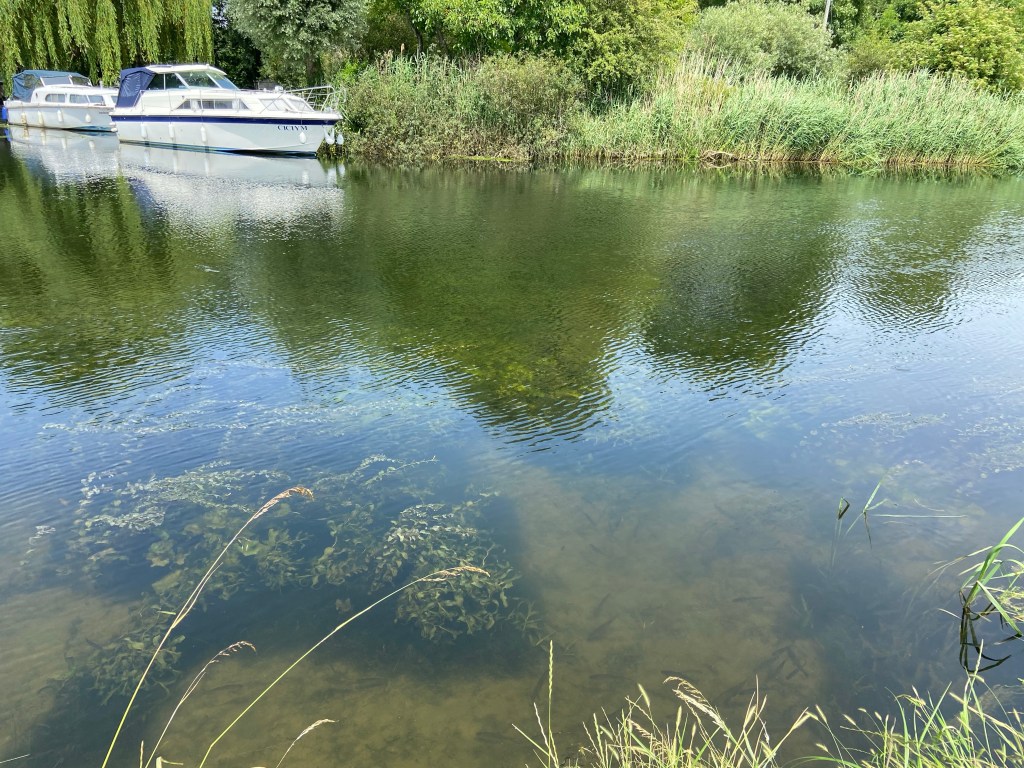
The water was in some places stunningly clear, thick with the oxygenating underwater foliage of yellow waterlily,
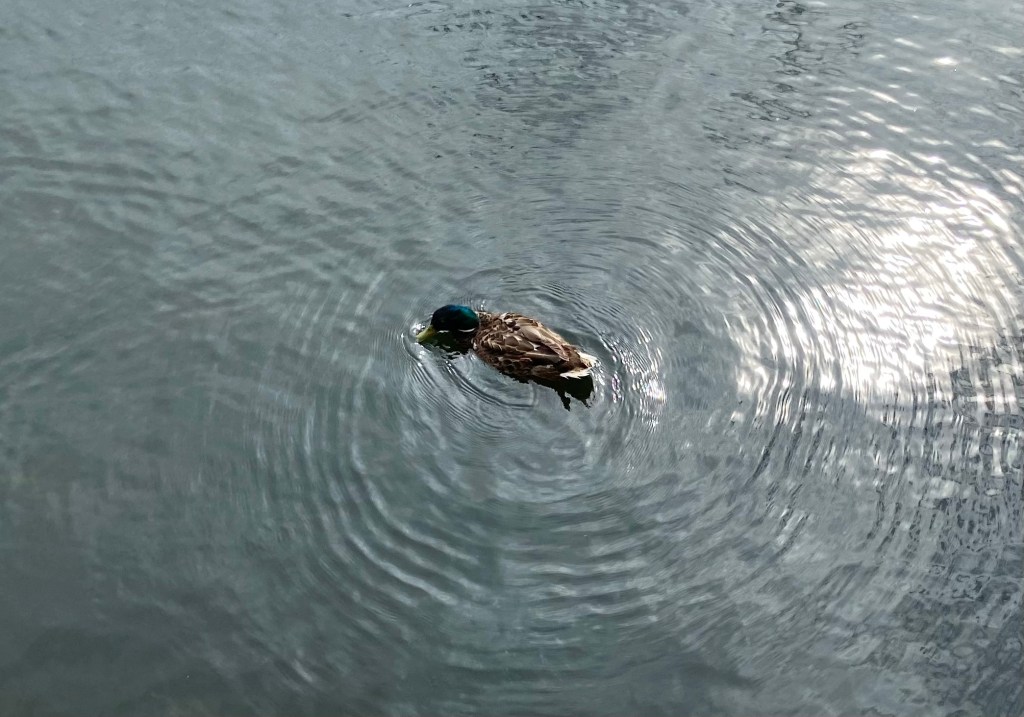
in other places opaque, and ruffled by the wind, so that one’s attention was drawn rather to the surface.
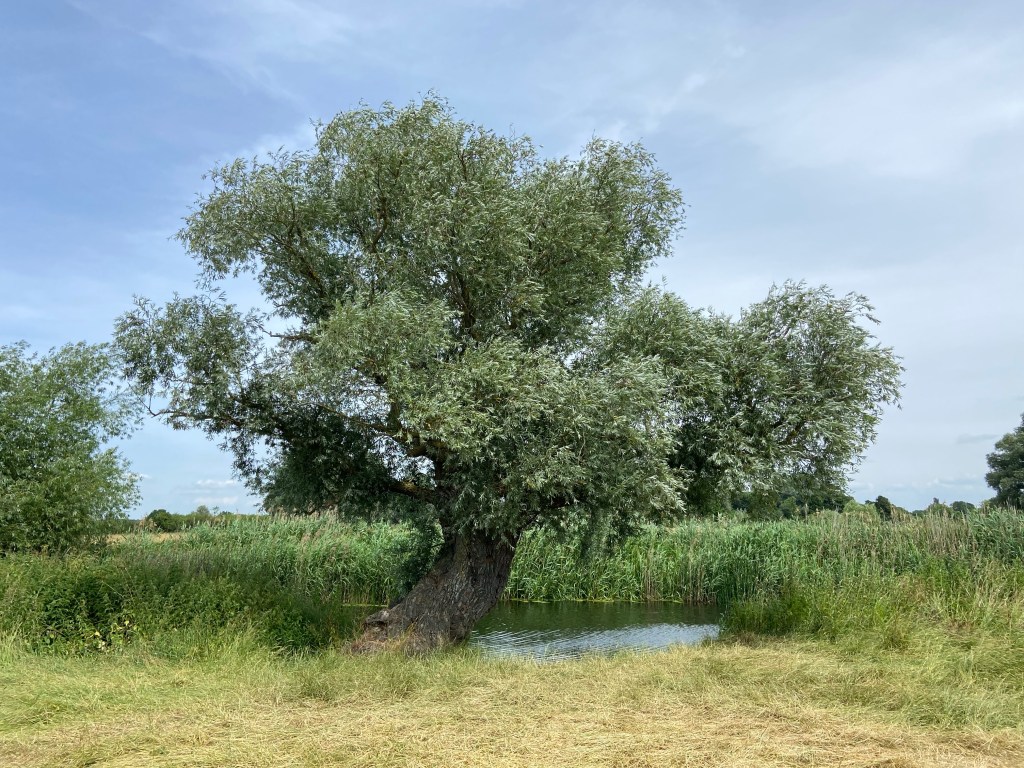
Field led onto field following the contours of the river. A red kite wheeled lazily above. Ancient willows looked as though they had lined these banks for hundreds of years.
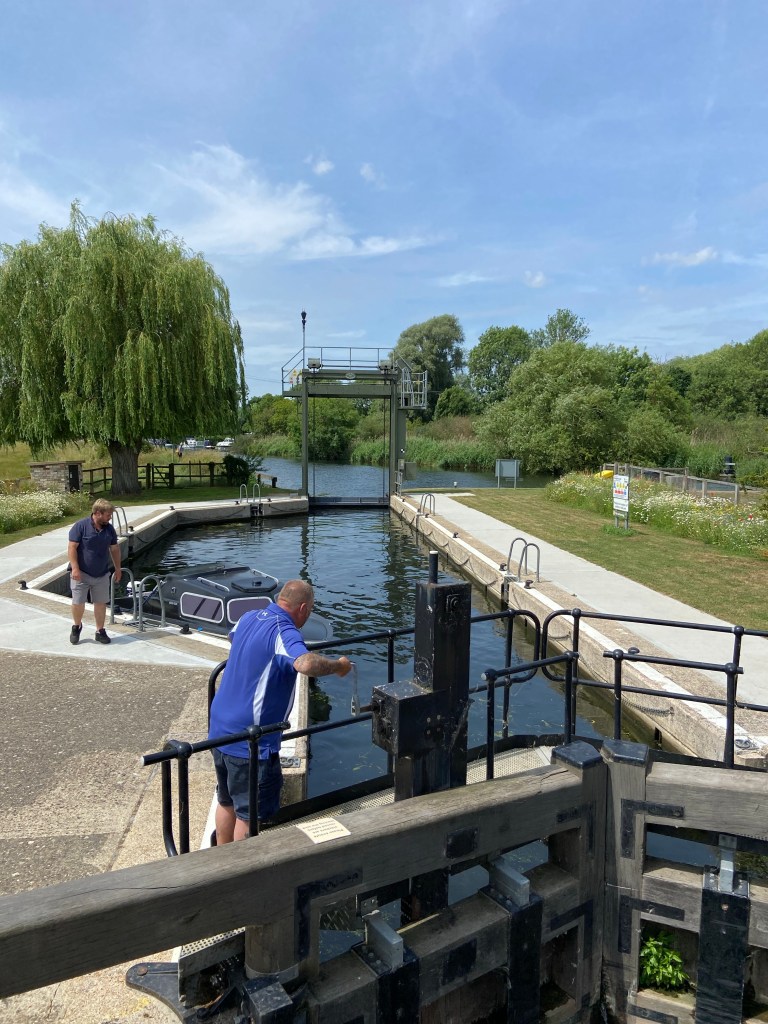
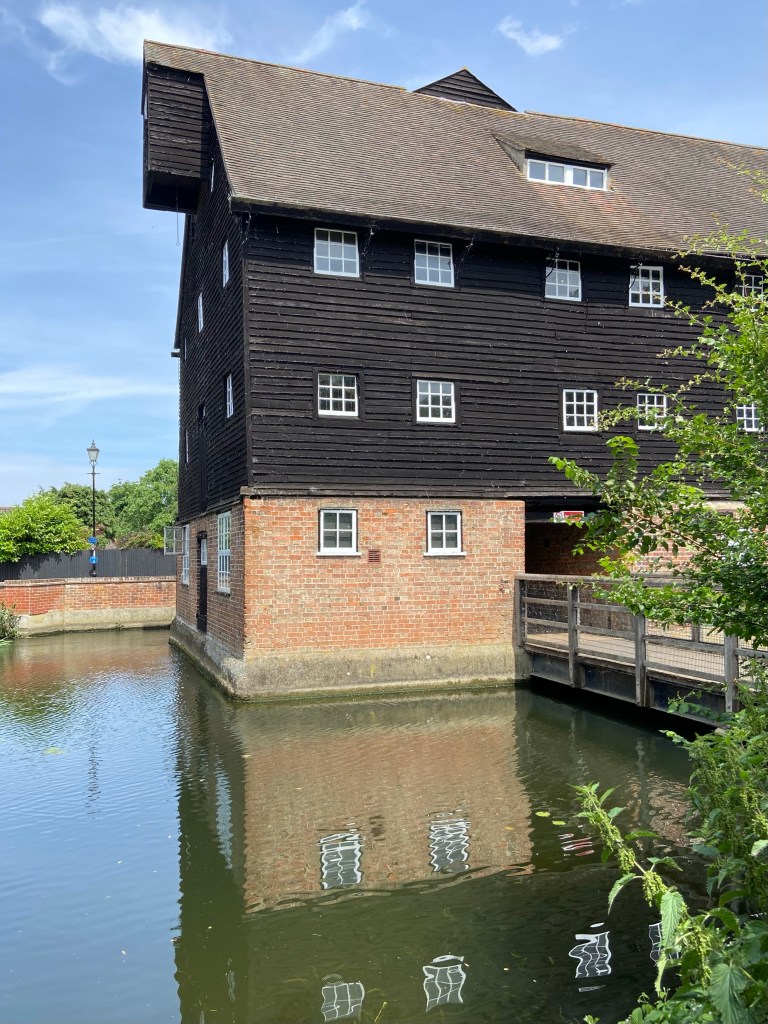
After the unpeopled landscape, it was jarring to arrive at Houghton Mill where the usual bustle of navigating the lock was the backdrop to sunbathers.
Pat and Clive were watching a female emperor dragonfly laying eggs on the leaves, by bending her abdomen to get her ovipositor under water. They pointed out to me the different species of fish: the perch with vertical stripes, the surface-feeding rudd with their blood-red fins, and the shoals of roach, fins paler red than the rudd.
I crossed at the lock, glad that I did not have to put my back into opening the lock gate. I did wish that I could join the swimmers in the water though: many people at the Houghton Mill tearooms had just been swimming, and as I ate my cheese and onion pasty, I watched a steady stream of people walking by with swimming things. If I was Jane Smith, I would’ve come prepared and have had my swimsuit in my rucksack.
There has been a mill on this site since at least 974, and it is mentioned in Domesday. The current mill dates from the 18th century and used to be a youth hostel until the National Trust took it over.
The approach to St Ives was a paved wooded path. The Thicket was a wild mixed deciduous woodland growing on a heavy clay soil, carpeted with goosegrass.
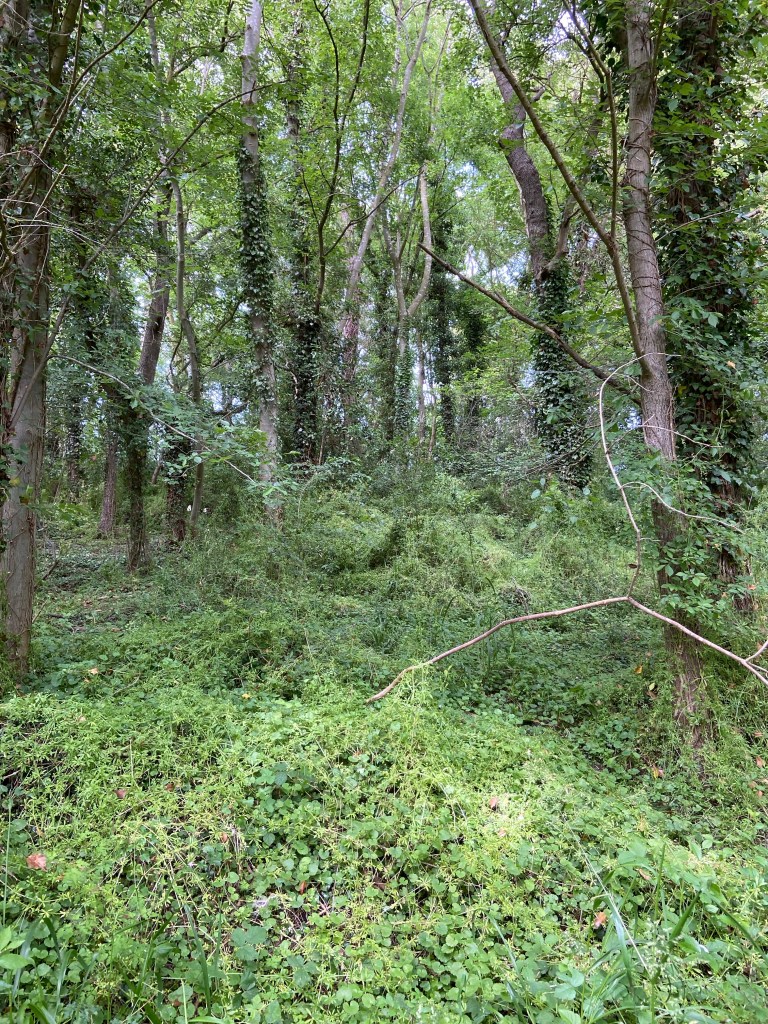
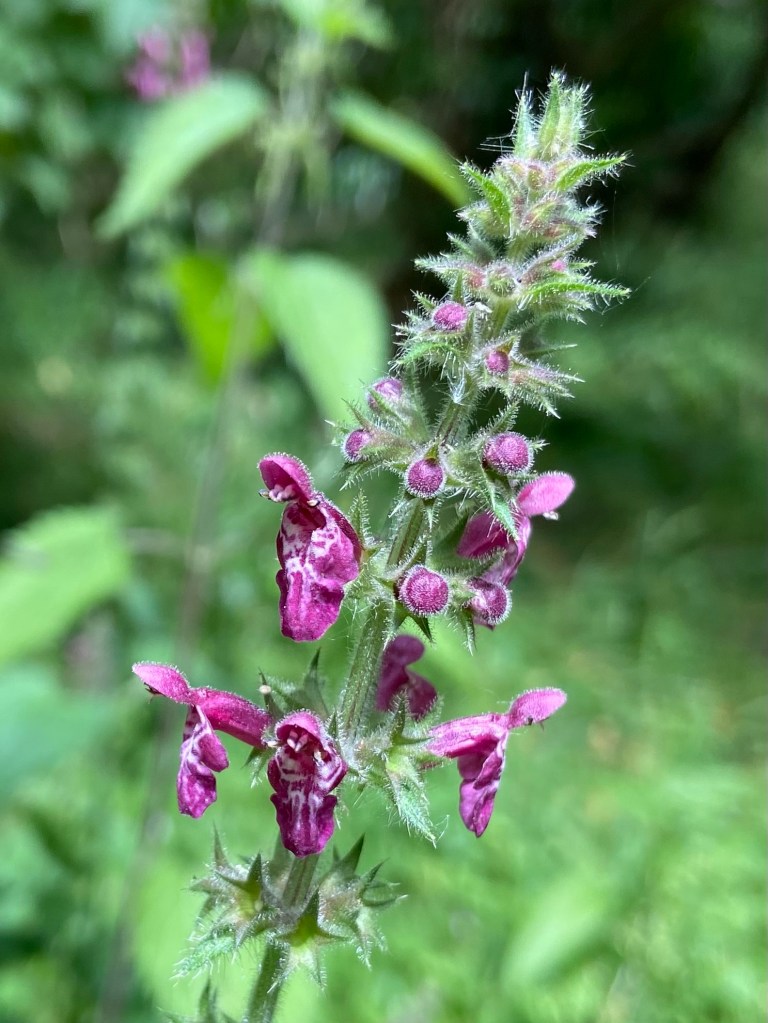
A few woundwort had struggled through the blanket of cleavers into the light. In my garden they are a stinking weed but their flowers are lovely close to, and the insects love them.
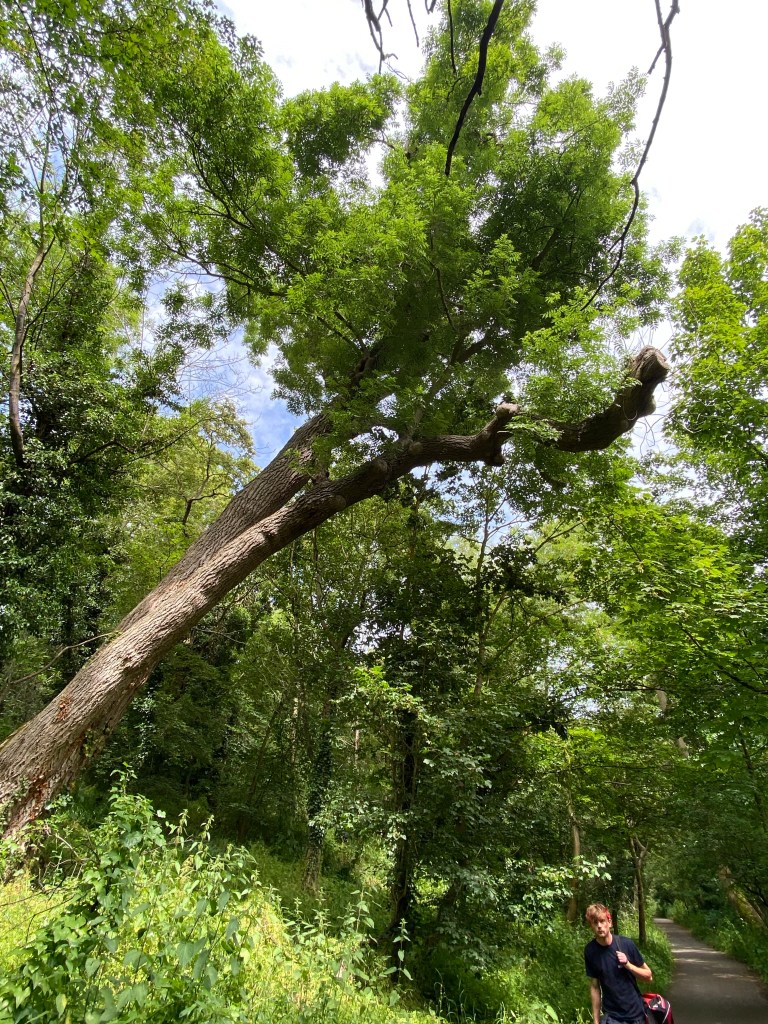
A large proportion of the wood was ash. Many of these looked quite healthy, but the sickly ones were marked with the terrible aerosol sign on their trunks that marks them for felling.
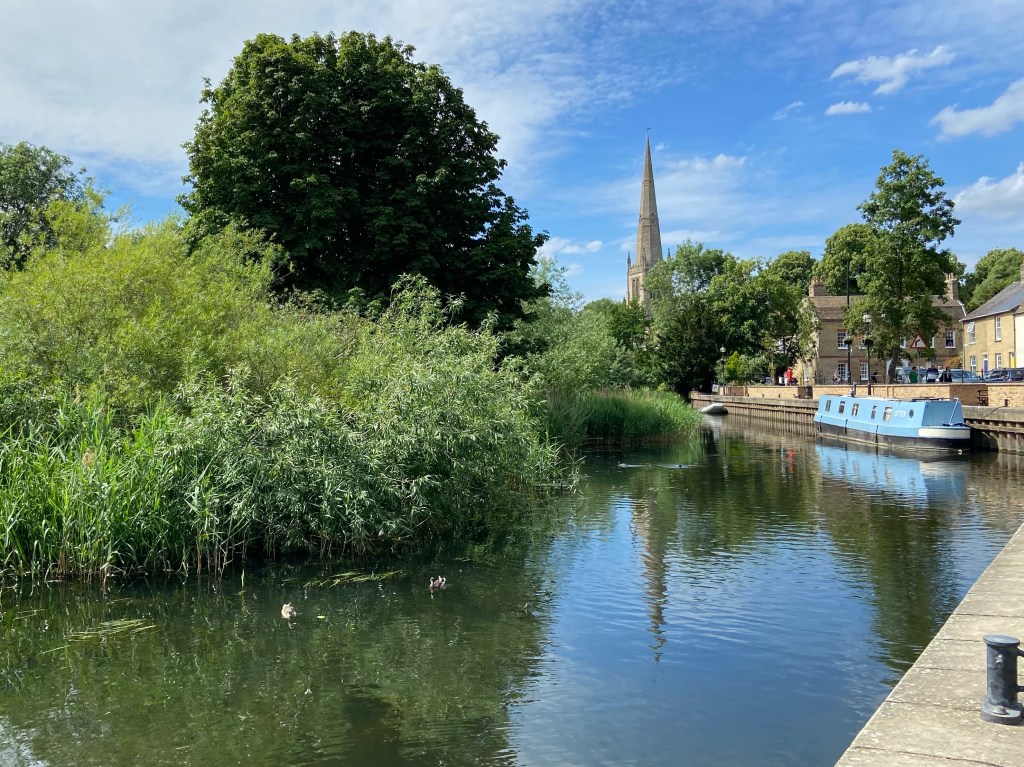
St Ives was an absolute picture. A small channel diverted to go through the town, the Waits, was home to a mother coot and her downy baby. She was diving for food for it, and the water was so clear that I could see her swimming underwater, lines of bubbles coming from her beak.
I stopped to buy a delicious blackcurrant sorbet ice cream from lovely Rachel at The Commute Café. After such a long commute of my own, it was lovely to have something so cold at this point with just a few kilometres to go.

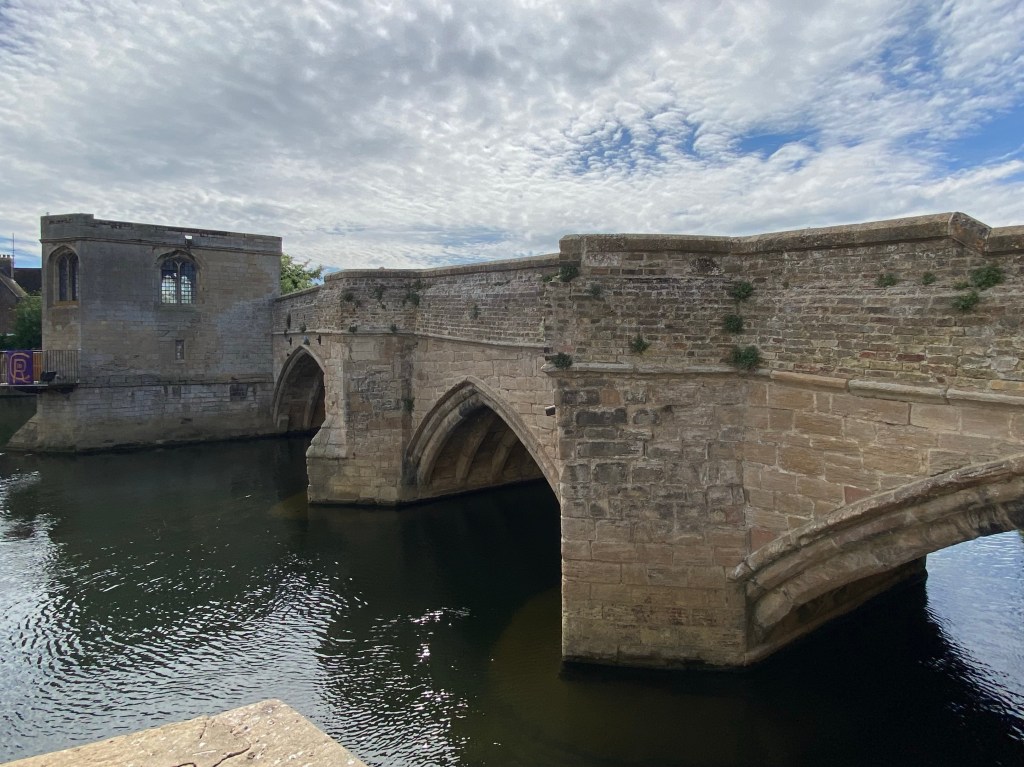
I now faced a choice of route. The Ouse Valley Way runs in a straight line from St Ives to Holywell, but Sam had suggested taking the river route; really, there was no contest: this was my last day on the river, and I wasn’t ready to leave it yet. It first takes you over the historical bridge with a chapel on it — one of only five bridge chapels in the country.
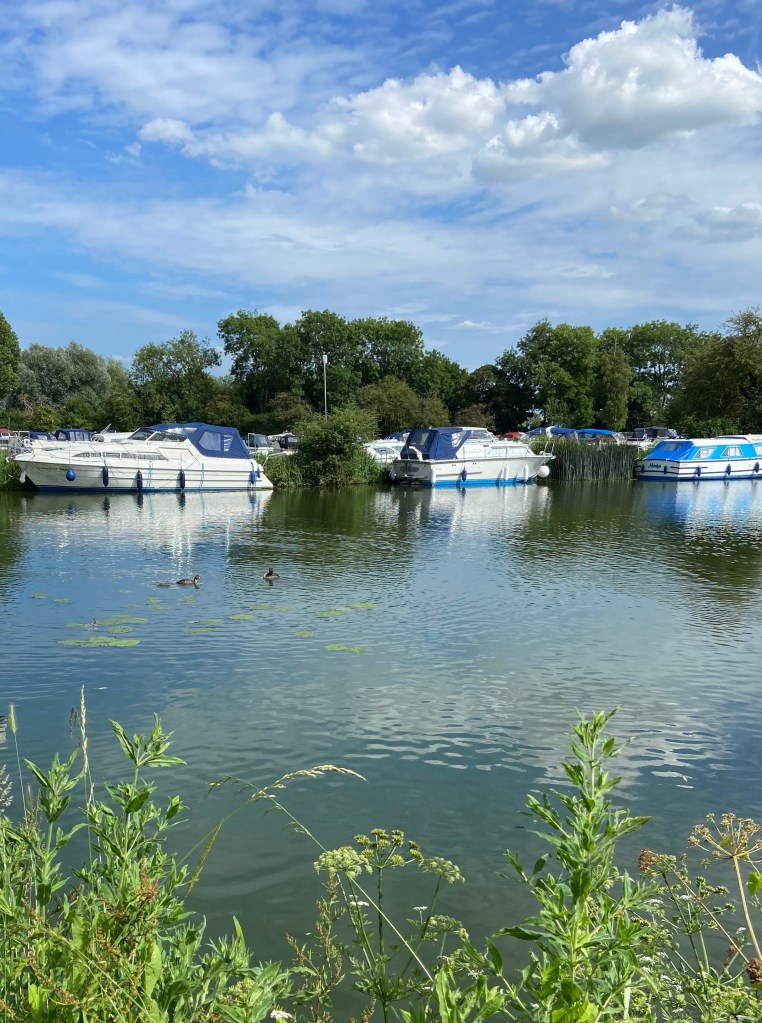
Once out the other side of town, the St Ives marina has to be one of the most beautiful places I have seen on this whole walk. It would be worth it to buy a boat and keep it berthed here, simply to be able to enjoy this place. It gifted me a clutch of little ducklings in the shade under the prow of a boat, and a pair of crested grebe with a small chick to manage.
The footpath takes you over an extraordinarily high footbridge wreathed in deliciously scented honeysuckle.
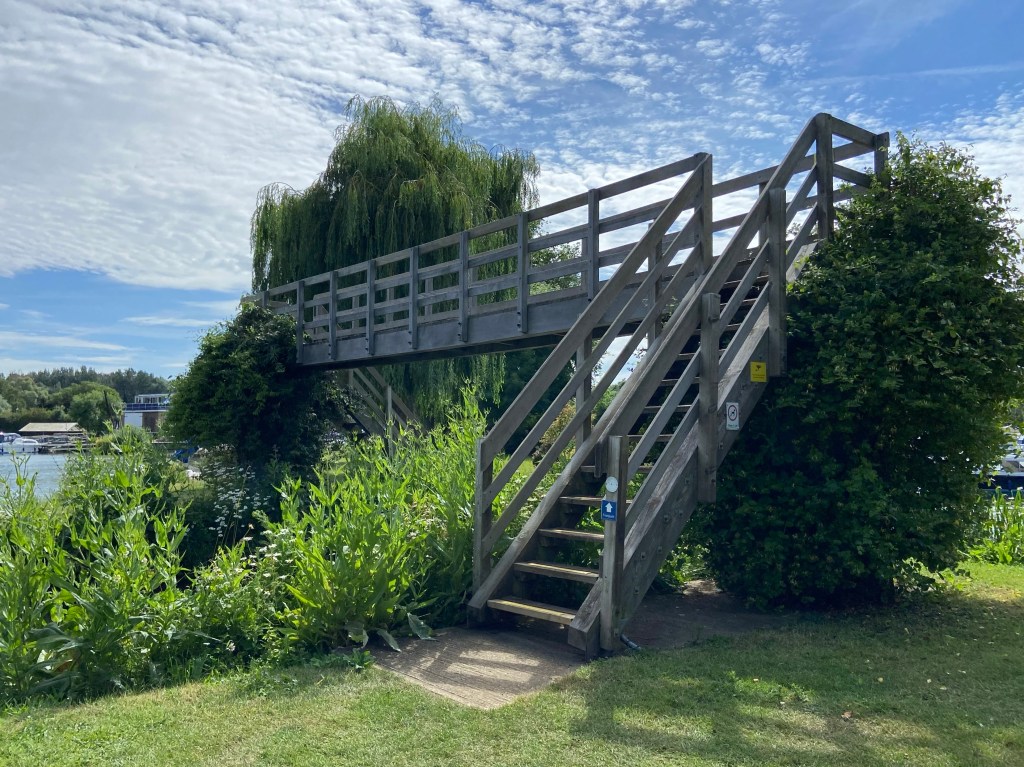
The views from the top were spectacular.
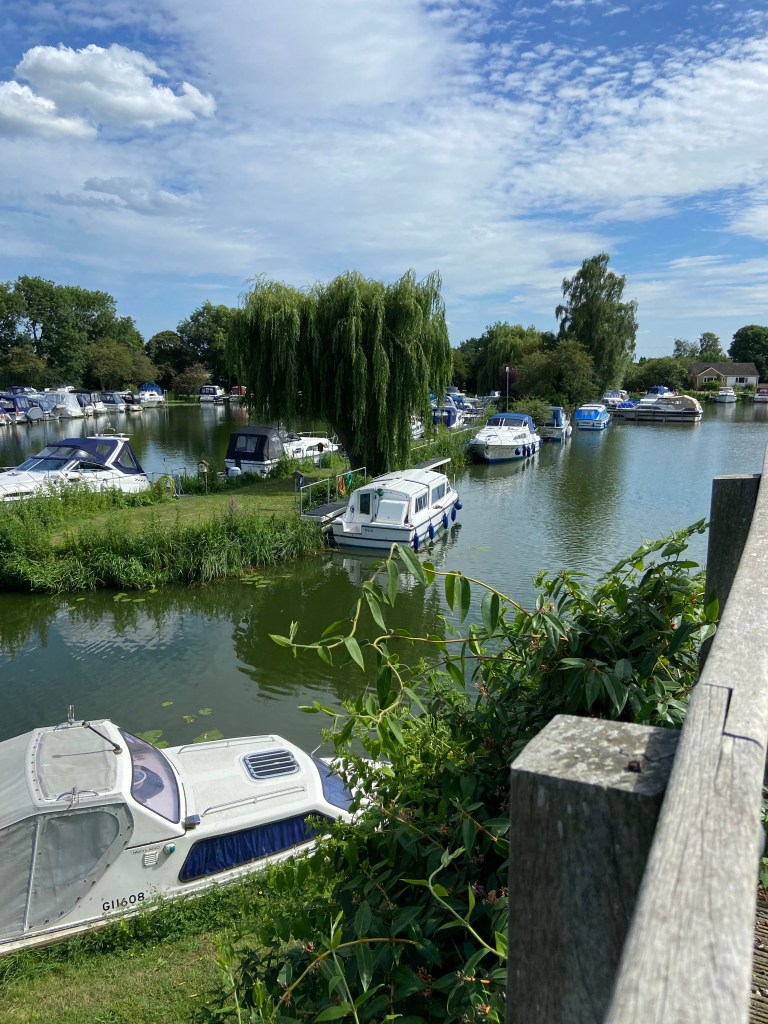
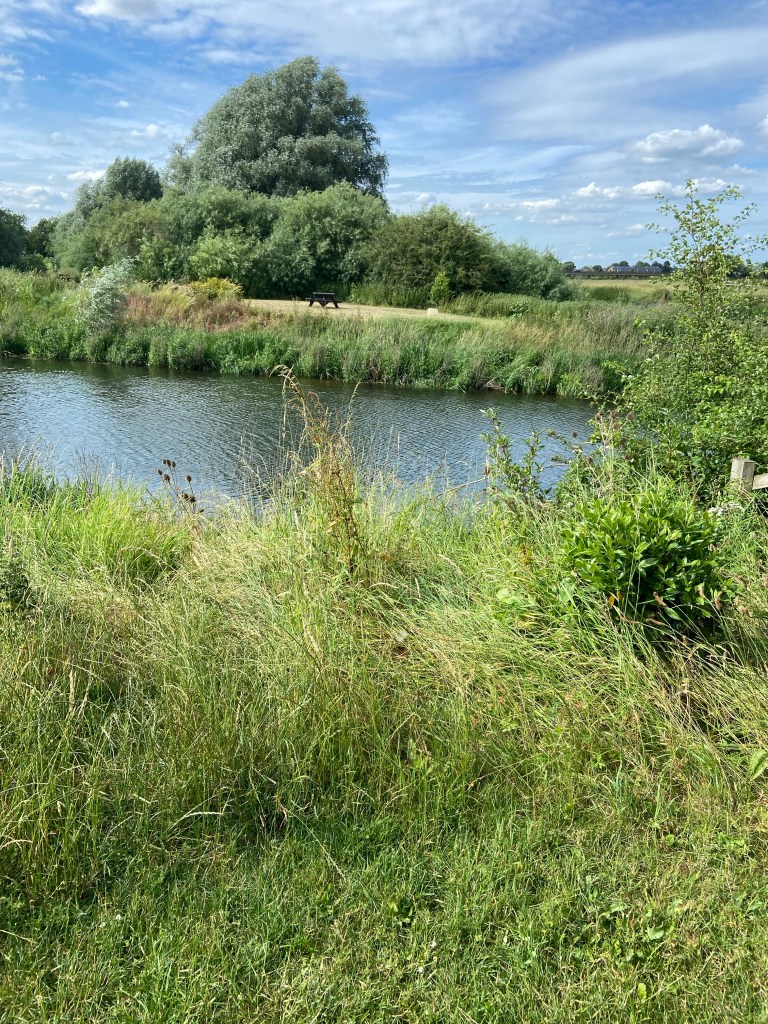
I then started to run into some routing problems. The OS map on the app (for those of you who are interested) is static, whereas the online one is dynamic and updated with changes to the rights of way. It was clear that the footpath had changed sometime ago, but it was not reflected on the paper map which I was using. I therefore trespassed around for quite a while before I found my way onto the footpath which didn’t try to route me over a non-existent bridge from a picnic table on one side of the marina entrance to a meadow on the other.
The second spanner in the works was that I suddenly felt a sharp, stinging pain in my heel: one of my blisters had broken, and I couldn’t walk with my shoe anymore. Never mind: it wasn’t very far now; I took the shoe off and put it in my pack, and started walking with a flip-flop on that foot instead.
But there were lovely things. The last few kilometres took me down by the early evening river through more meadows. I even heard a corn bunting — I have to thank Carrie for teaching me to recognise its sparkly trademark song, the phrase ending in an electric fizz.
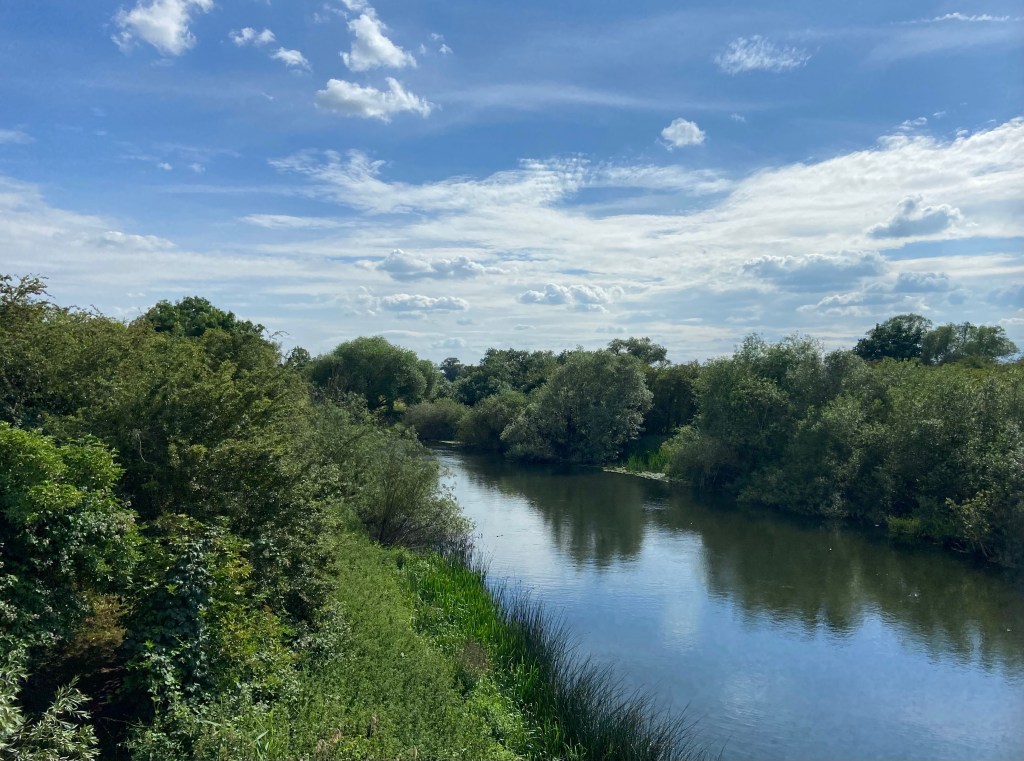
Then I got to the bridge which on the map was to take me over to the north side of the river. It was some way above my head with no way up to it — and as I stood puzzling this conundrum, a horsefly bit me on the arm. I tracked back along the bridge, which is the raised track for the infamous guided busway to Cambridge, until I saw a steep bank I could haul myself up.
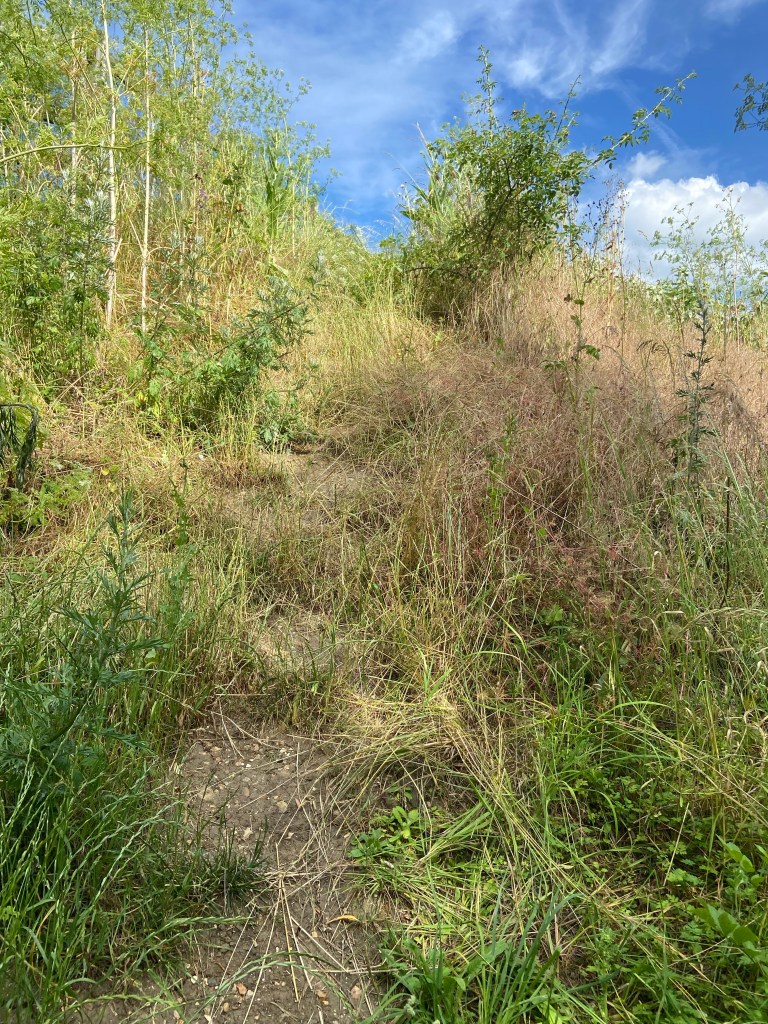
Reaching the top, I limped back the way I had come towards St Ives along the busway, still with one flop and one shoe.
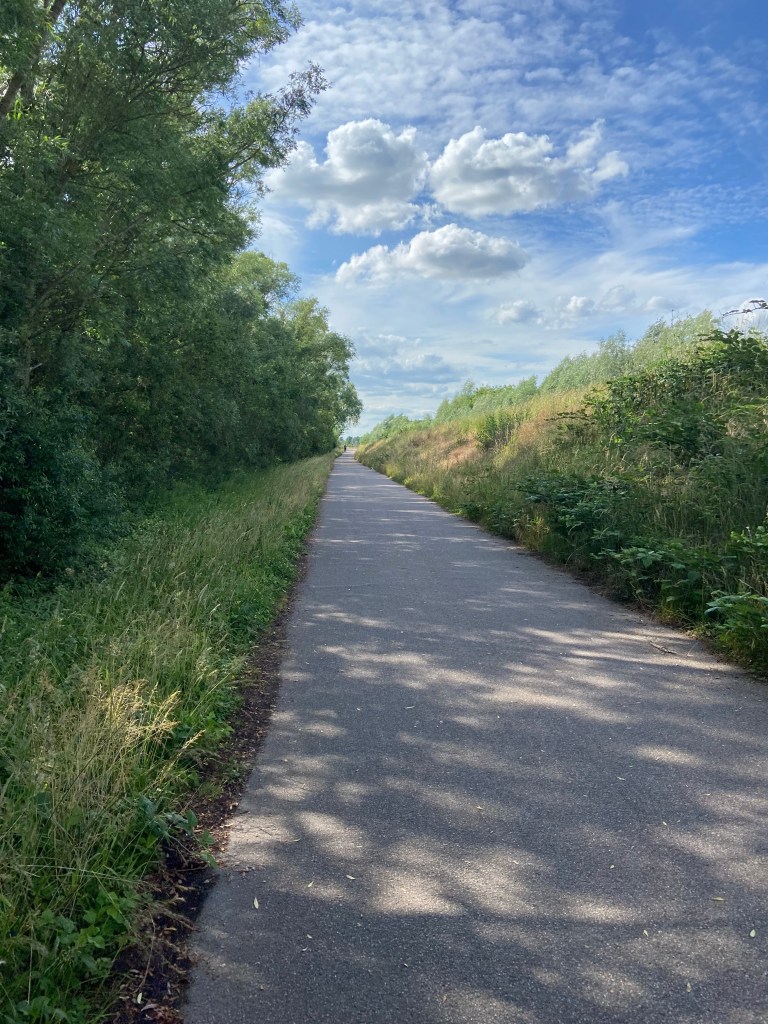
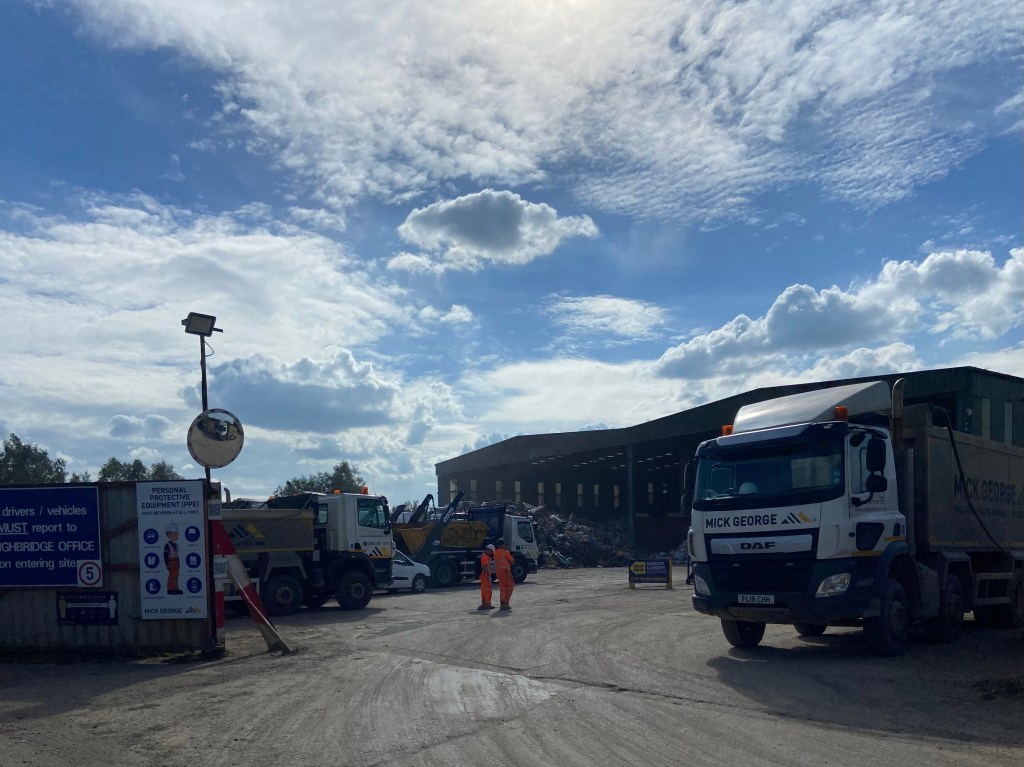
There wasn’t an exit off the busway for quite a while. I took the first one possible, passing through a recycling works on the industrial outskirts of St Ives where workers were leaving for the weekend, and then I could turn back on myself once again to head towards Holywell.
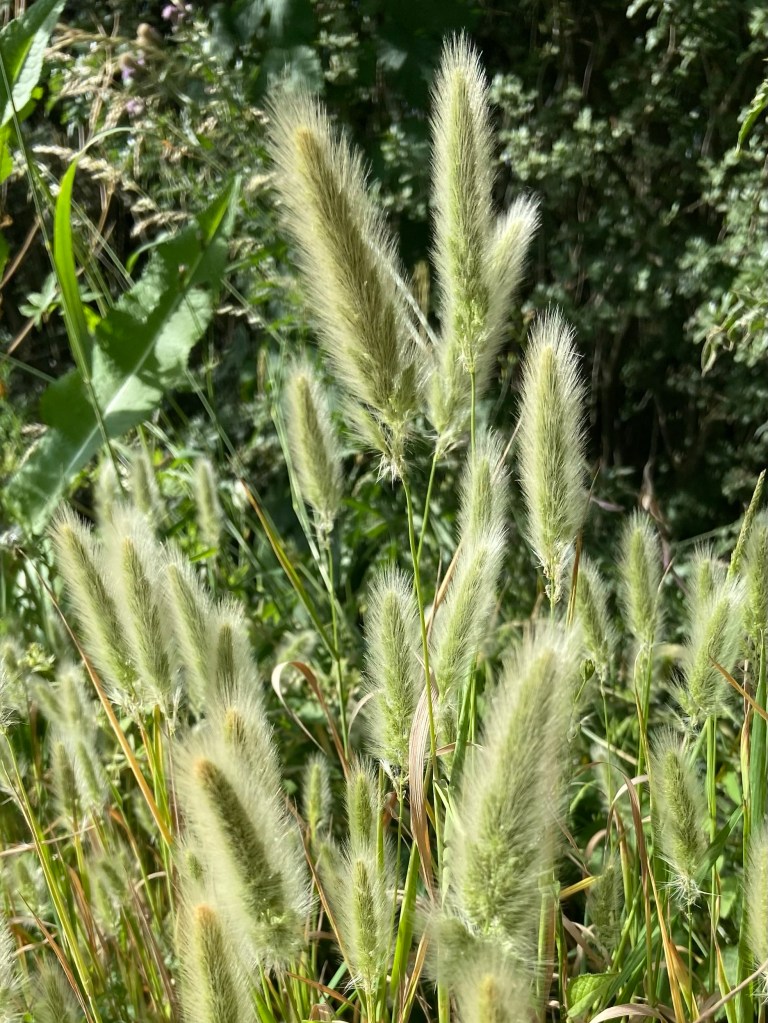
But still there were lovely things to see: comma butterflies, and fat ponytail grasses,
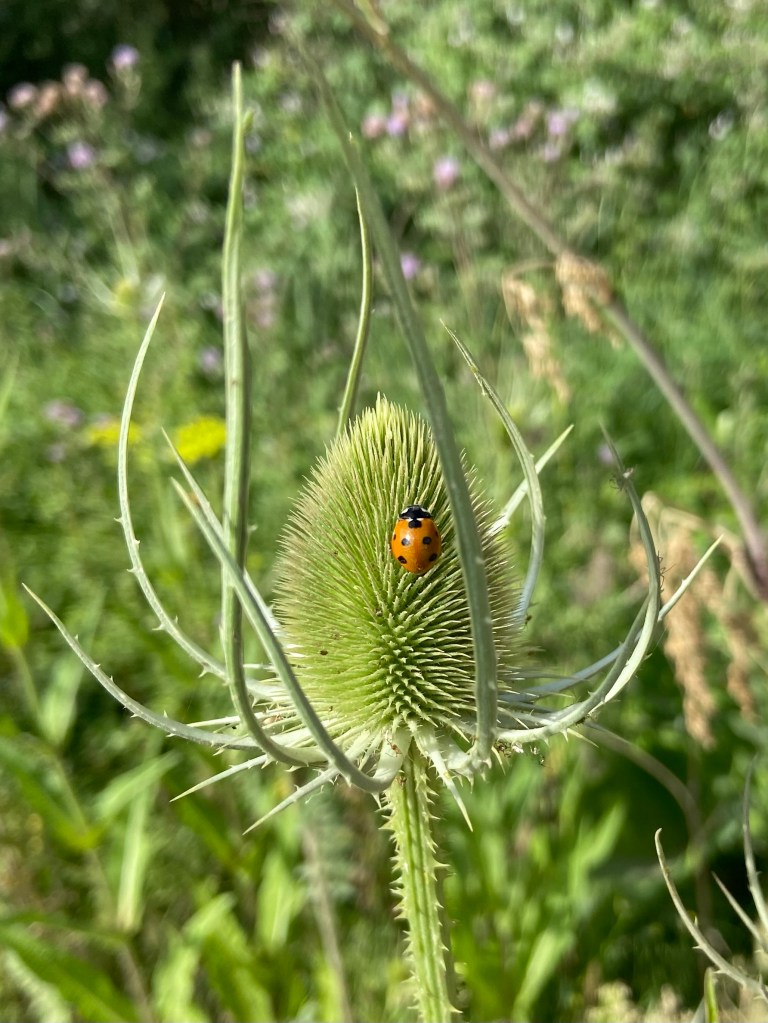
masses and masses of ladybird larvae climbing in the wild fennel looking for aphids, and ladybirds themselves, on teasel
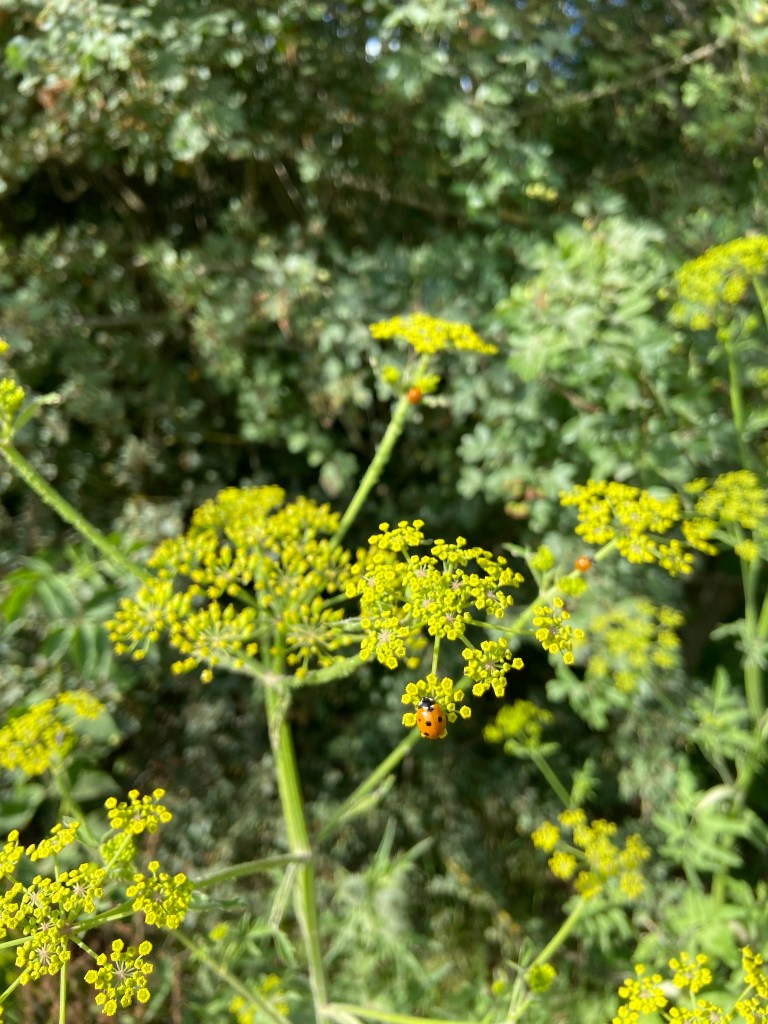
and bright green-yellow umbellifer,
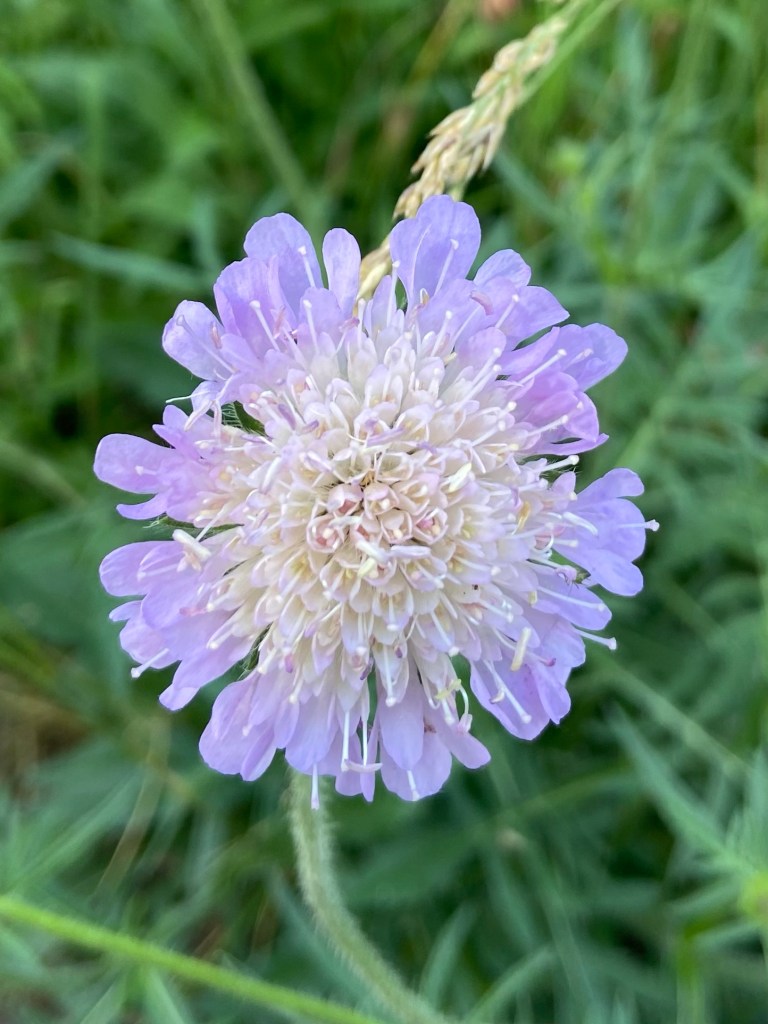
and the first of the scabious that I have seen this season.
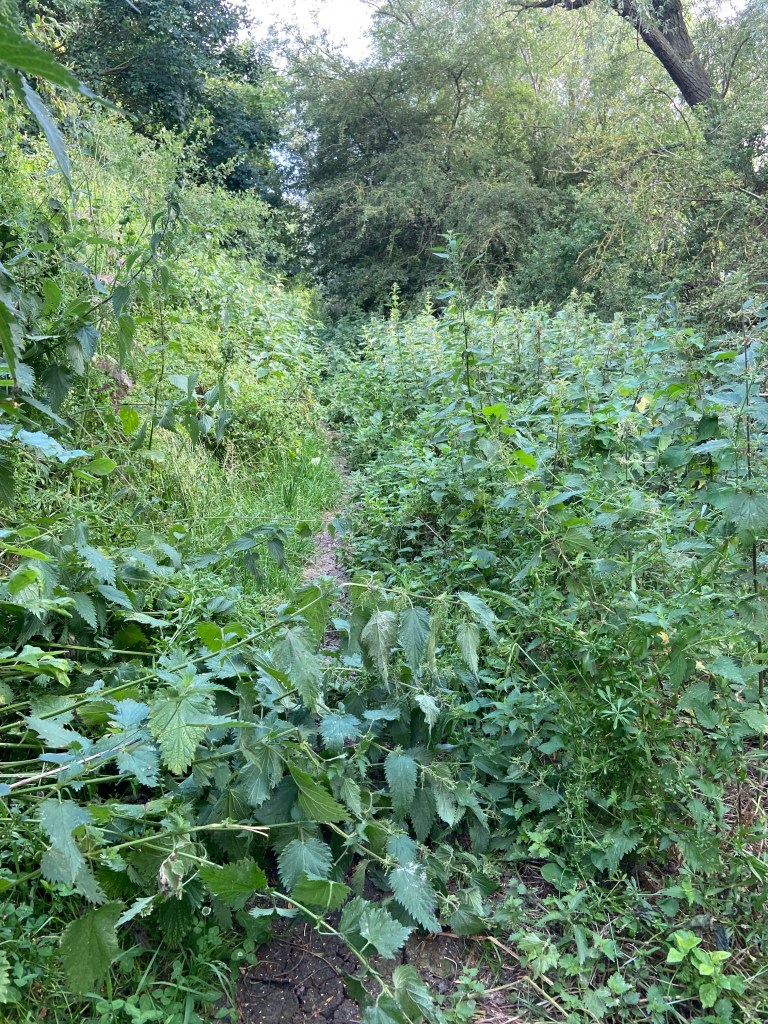
I think the final insult was the nettle-strewn path, in my depleted state quite a challenge with one flip-flop. But I got through without getting stung.
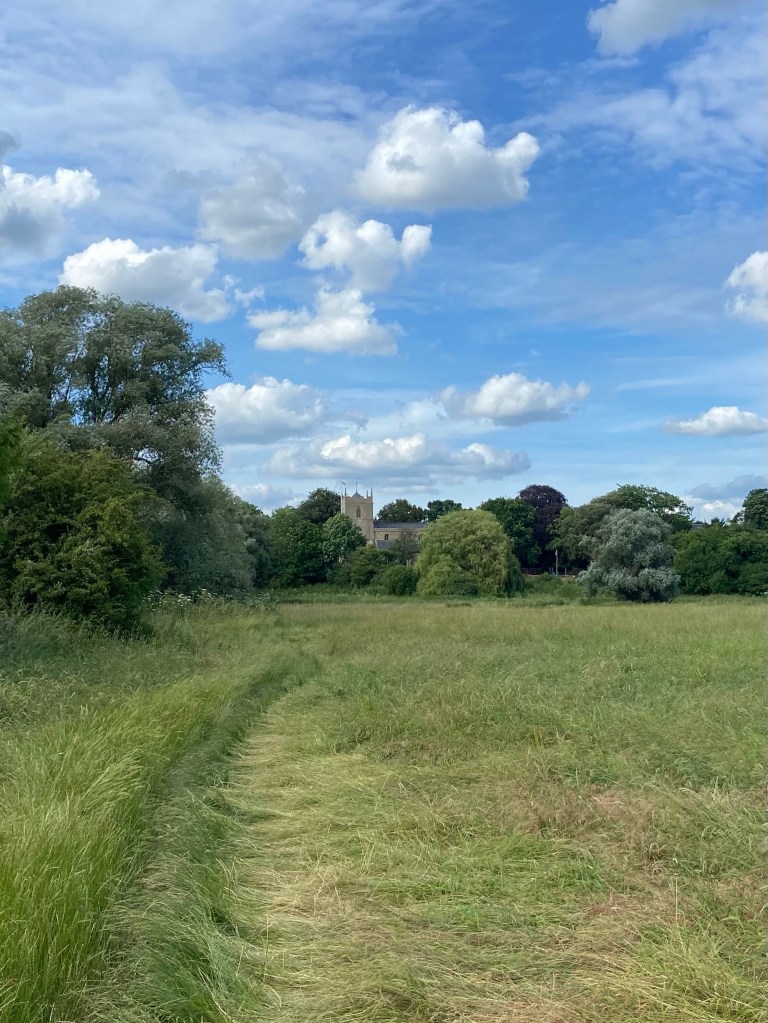
Finally I was in sight of Holywell church, where the bells were ringing.
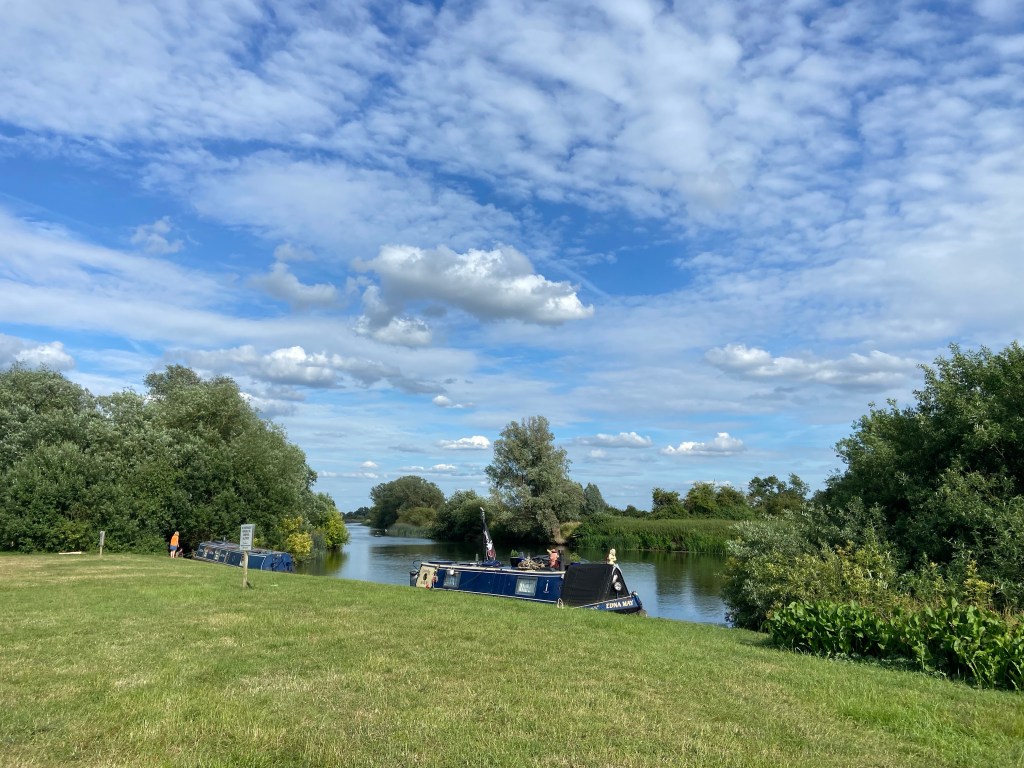
The Anglo-Saxon ring village of Holywell consists of two parallel roads joined at either end. I walked widdershins along The Front, taking the long way round, to be able to visit the old ferry crossing where Norman Conquest rebel Hereward the Wake crossed the Ouse, fleeing from the Battle of Hastings to his stronghold on the Isle of Ely, thence to drum up support for the rebels throughout Anglia. The river swimming spot by the pub looked beautiful in late afternoon light, and, fittingly, a narrowboat moored up outside the Old Ferry pub was flying a pirate flag.
It had turned out to be a much harder day than I had expected, especially the last section in which a 12km day had turned into an 18km one — but I had made it. Now for a day’s rest and a party… and then the processional into Cambridge on Sunday!
 Walking The Landscape
I’ve dipped into your journeyin a rather haphazard way this time, but oh, what delight and what an adventure you’ve had! I’m so pleased you’ve seen a kingfisher and so many more birds, insects, plants, fish. I love that journey tales are packed full of nature, at a time when it’s easy to feel there’s so little left. You’d make a very fine Wildlife Trust advocate! Xx
LikeLiked by 1 person
I feel I’m giving you a dis-service by reading it so late after your wrote it – sorry!
LikeLiked by 1 person
Hahahaha!!
LikeLike