
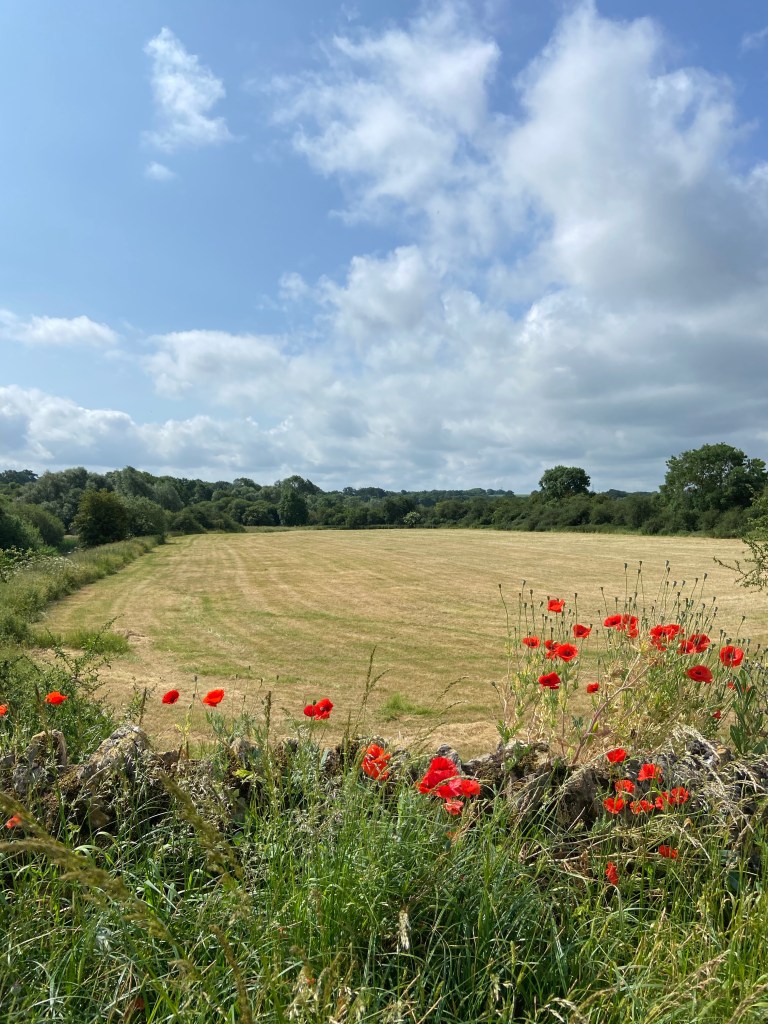
I caught this morning morning’s minion, king-
Gerald Manley Hopkins, ‘The Windhover’
dom of daylight’s dauphin, dapple-dawn-drawn Falcon, in his riding
Of the rolling level underneath him steady air, and striding
High there, how he rung upon the rein of a wimpling wing
In his ecstasy!
After a fantastic night’s sleep in the tent — my last — I awoke at 6.07 precisely, feeling good and raring to go. The effort I had gone to of carrying breakfast I all yesterday was completely worth it: yoghurt and granola, to which I added blueberries and pinenuts. I packed up the tent in the dry, letting the sun take off the last of the condensation, and shouldered my pack, now at least 2.5kg lighter than yesterday. Everything felt as it should, and everything felt eminently manageable.
The sky was overcast; a blessed relief after the oppressive heat of yesterday. I think it was about 16°: perfect walking temperature. Milton Keynes Council has outdone itself with this campsite within the 88-hectare country park constructed from old gravel pits — the first such country park in Britain. There is a delineated section for static caravans, two rally fields and three touring fields, with and without electricity. A park ranger had come to visit last night, checking that I felt safe and happy all on my own in the huge field, and the bin men were out in action this morning clearing the refuse, of which there is remarkably little in the whole park. It seems that the whole site is properly staffed to maintain and protect this stunning habitat.
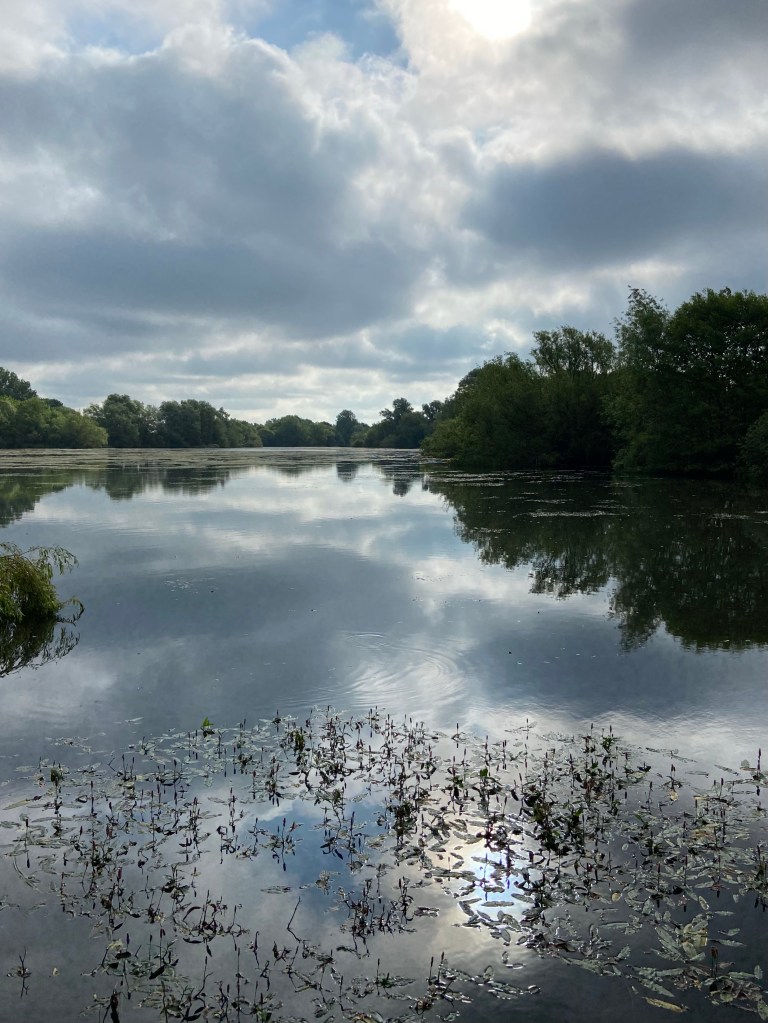
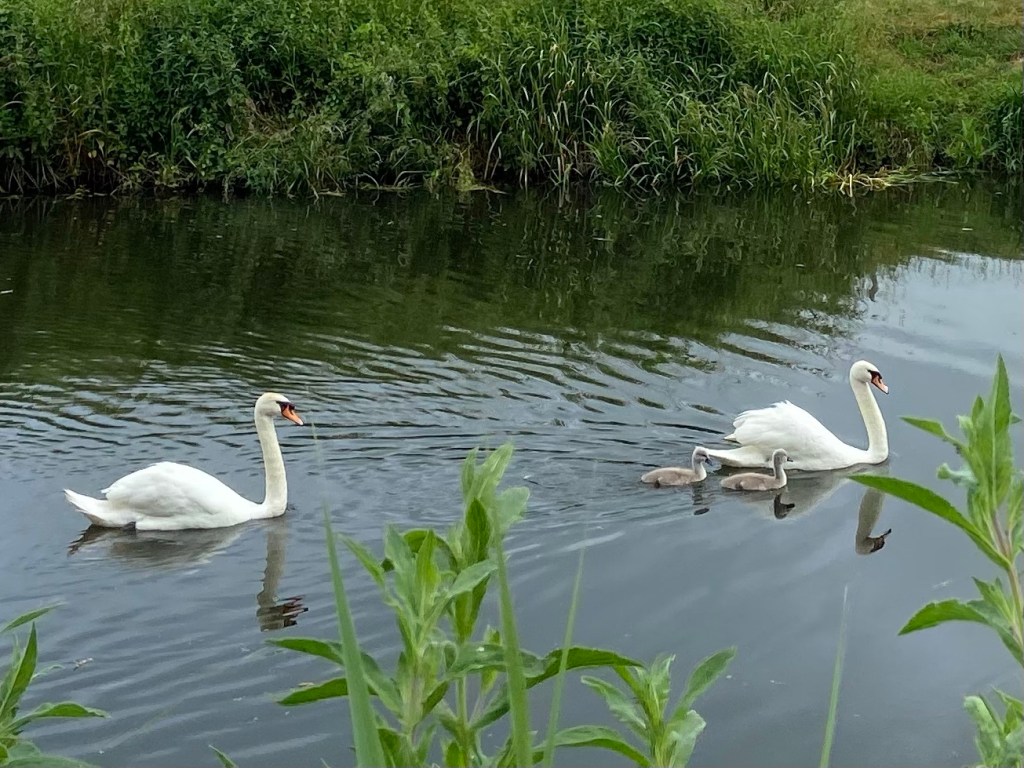
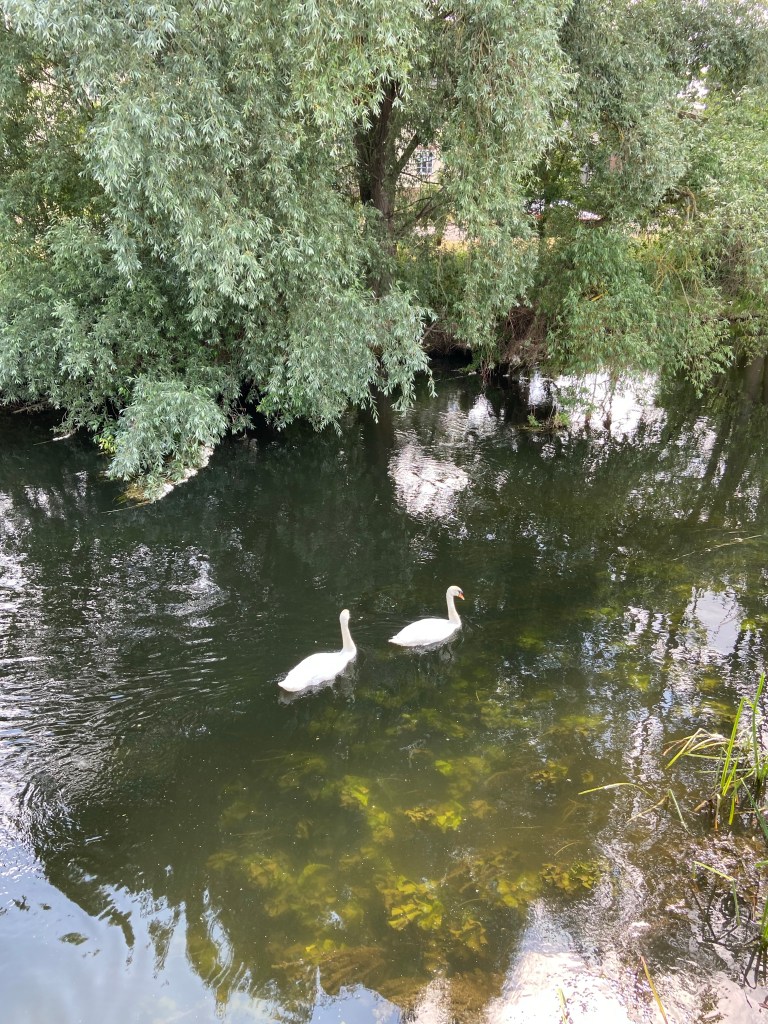
The river Ouse snakes through the park, and I joined it, walking past two swans — the sign of the Ouse Valley Way.
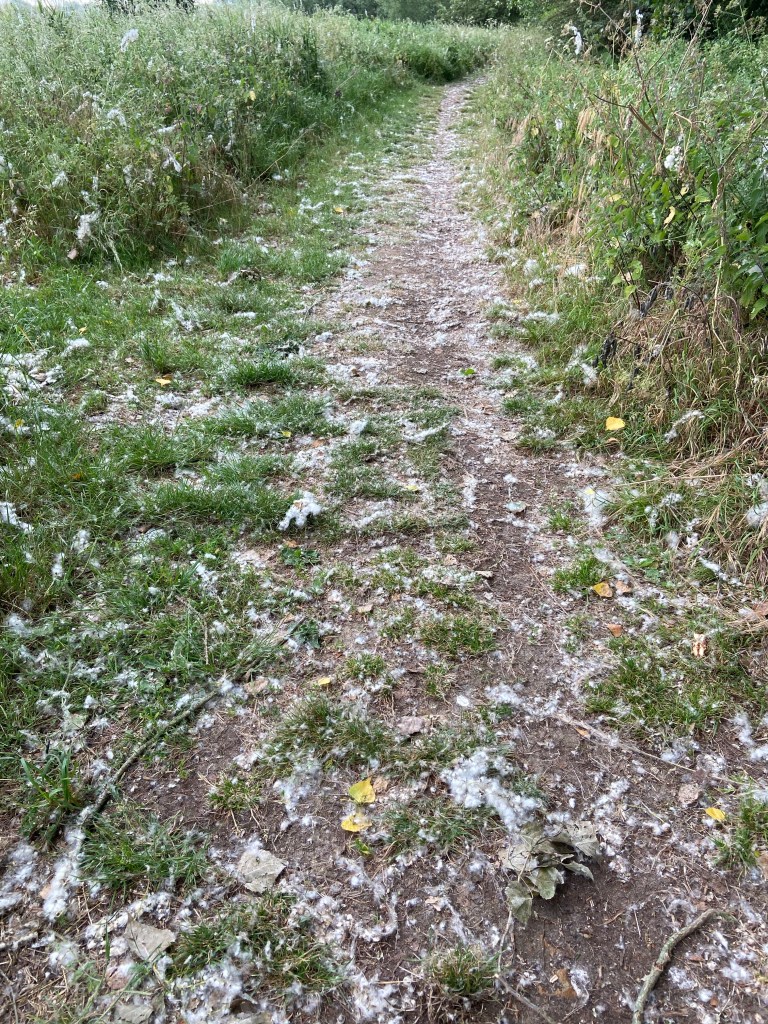
I took this as a good omen, and followed the swans’ way for a while, along the river path carpeted with silken seedfluff from the white willow trees.
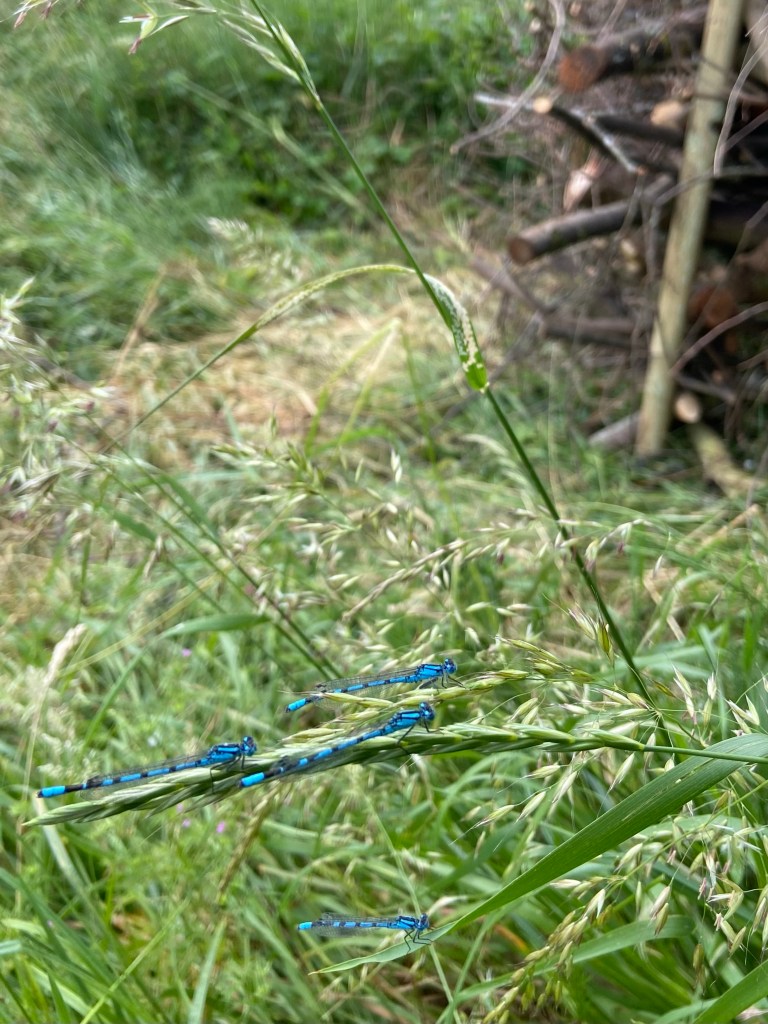
To get out of the park I took a track winding between two lakes on a path filled with blue damselflies,
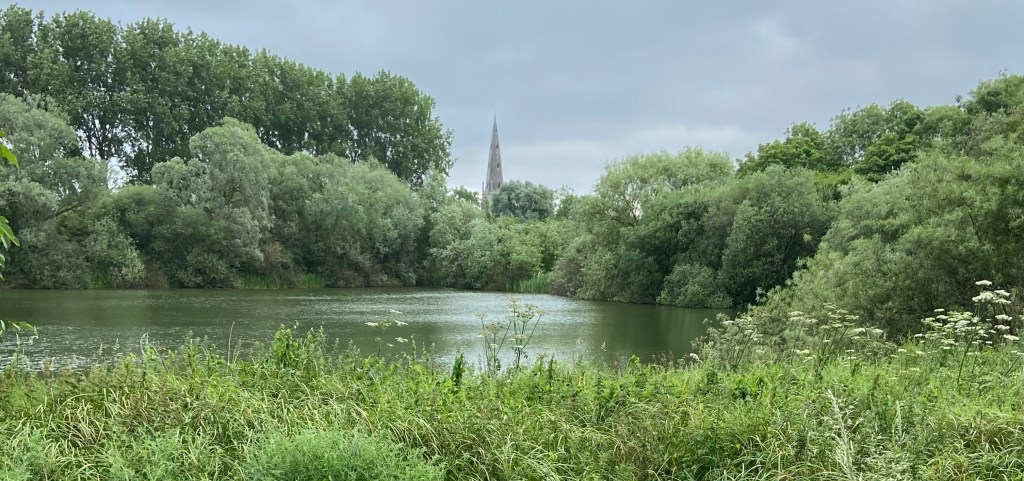
giving views straight out of a Constable painting across the water to the church at Olney.
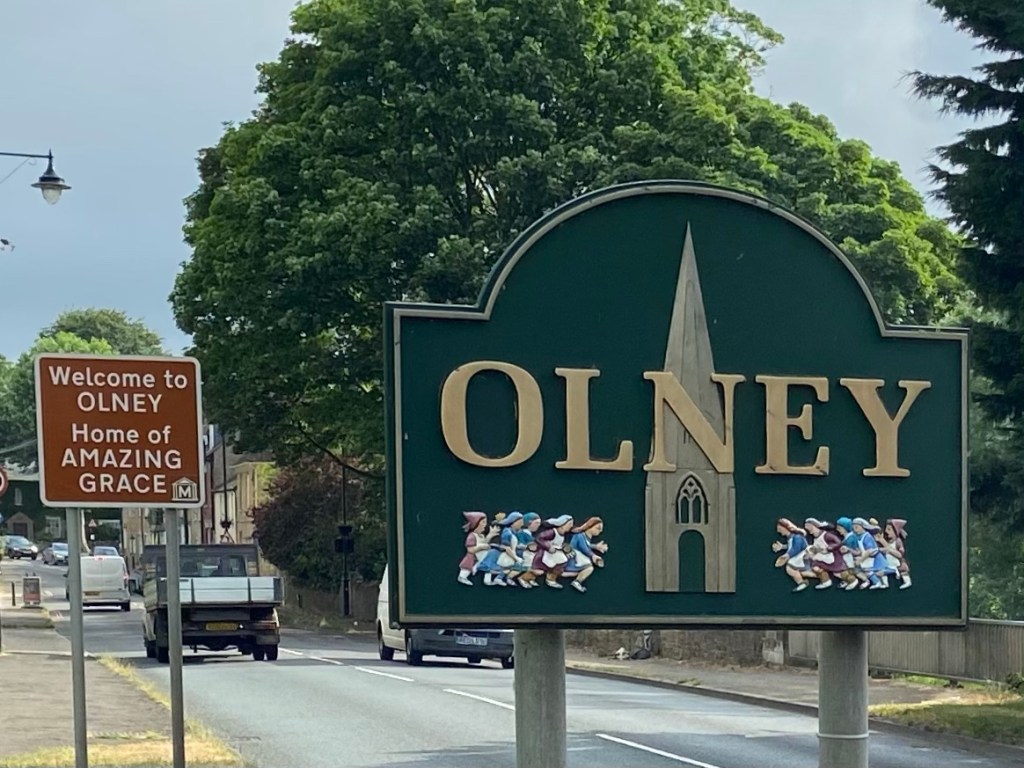
The path spat me out onto the A-road at Olney, by the ancient bridge held by the Parliamentarians against the Royalists in a skirmish of 1643. It could not have been more peaceful today, nearly 400 years later. The place-name sign at the town boundary announced that Olney was ‘Home to Amazing Grace’.
I certainly felt that the river here was something of a divine gift, both the weir, lined with willows,
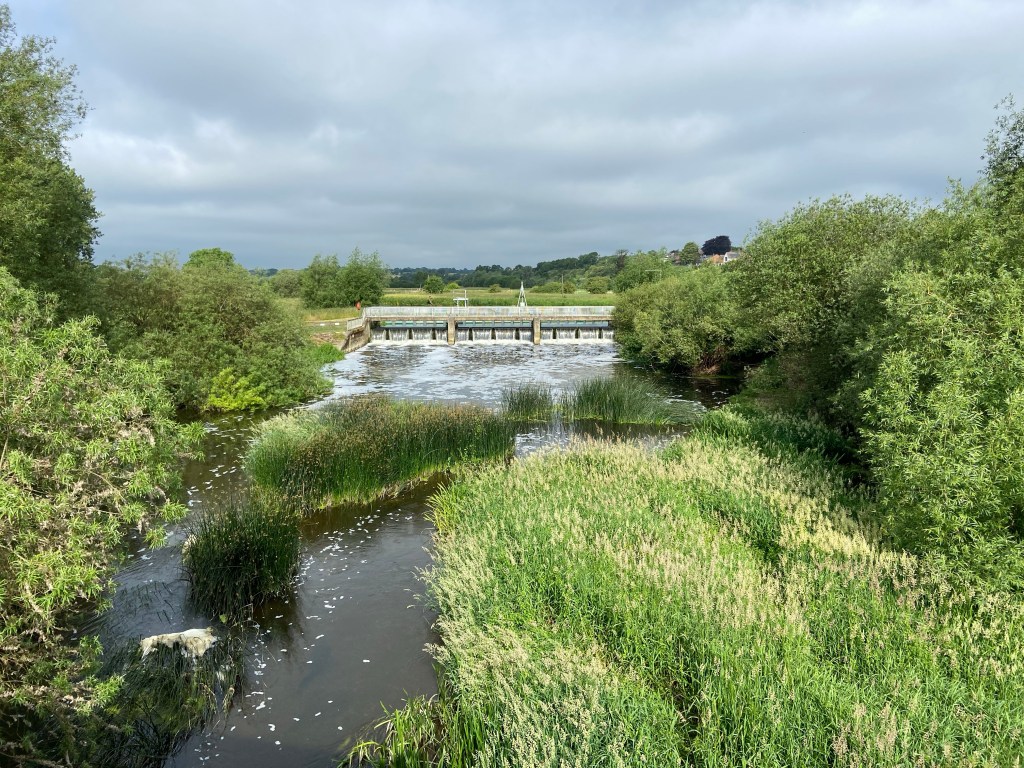
and opening out afterwards into slower waters, thick with reeds and other vegetation, but more especially the side channel.
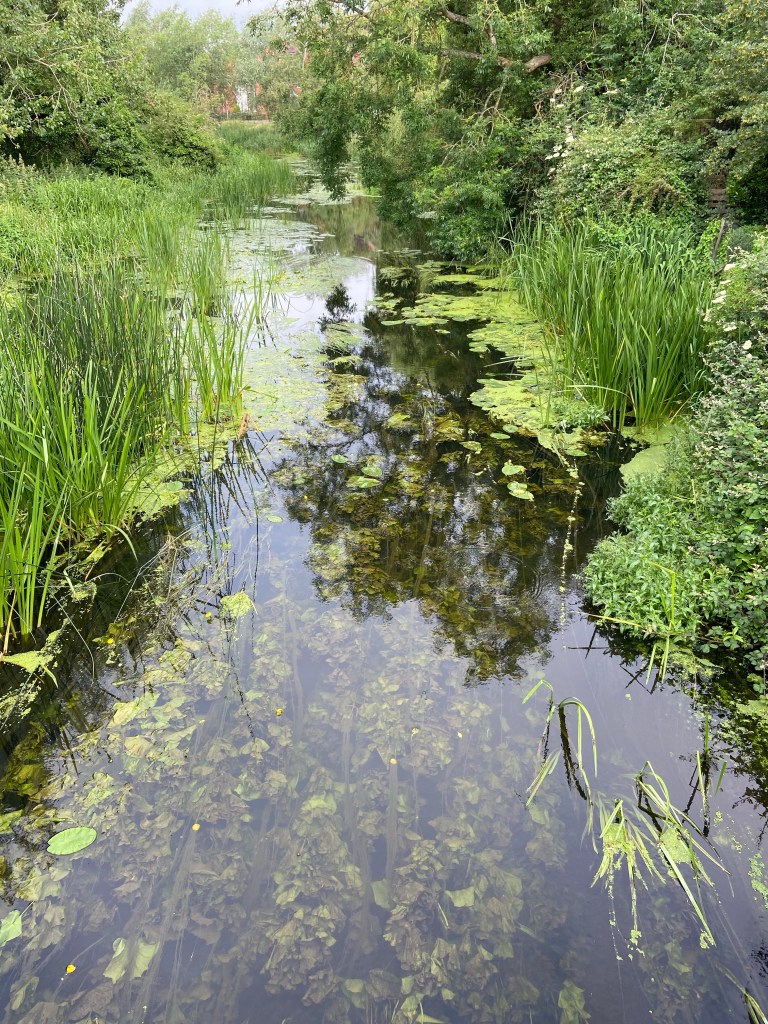
The waters are slow enough for yellow waterlily to grow. If this was a day to see kingfishers, I thought it might have been it. That would have been an Amazing Grace indeed — but sadly I saw none.
The Olney church of St Peter and St Paul was the benefice of the John Newton, one-time slaver and abolitionist convert, who wrote ‘Amazing Grace’ with William Cowper in 1772.
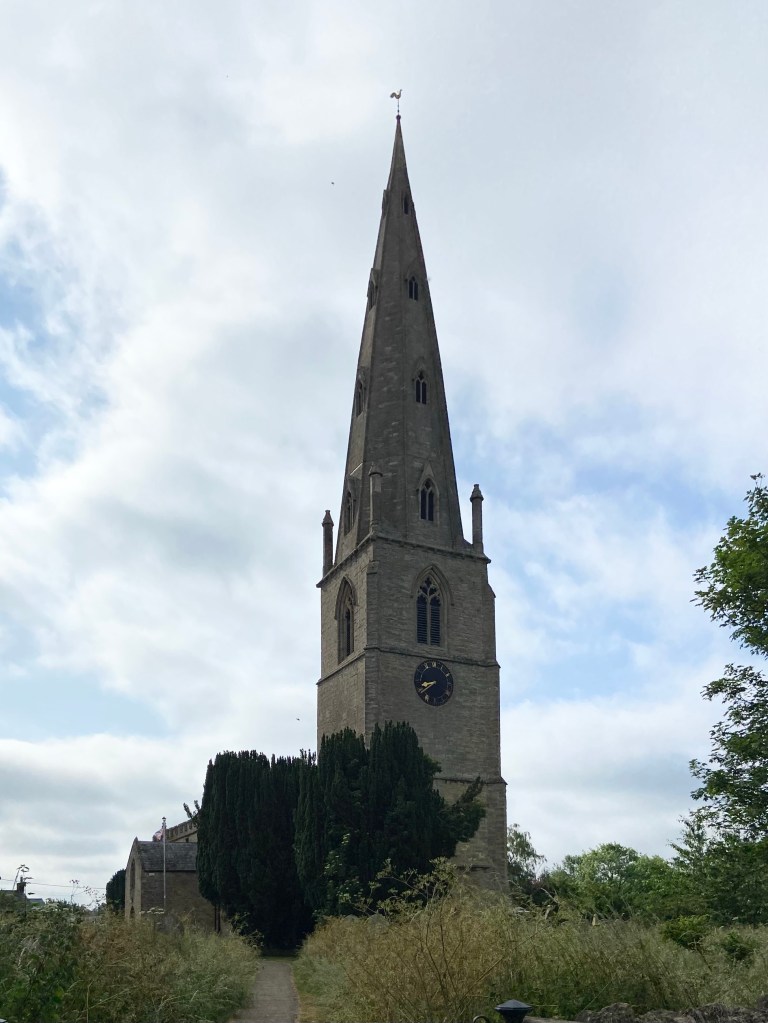
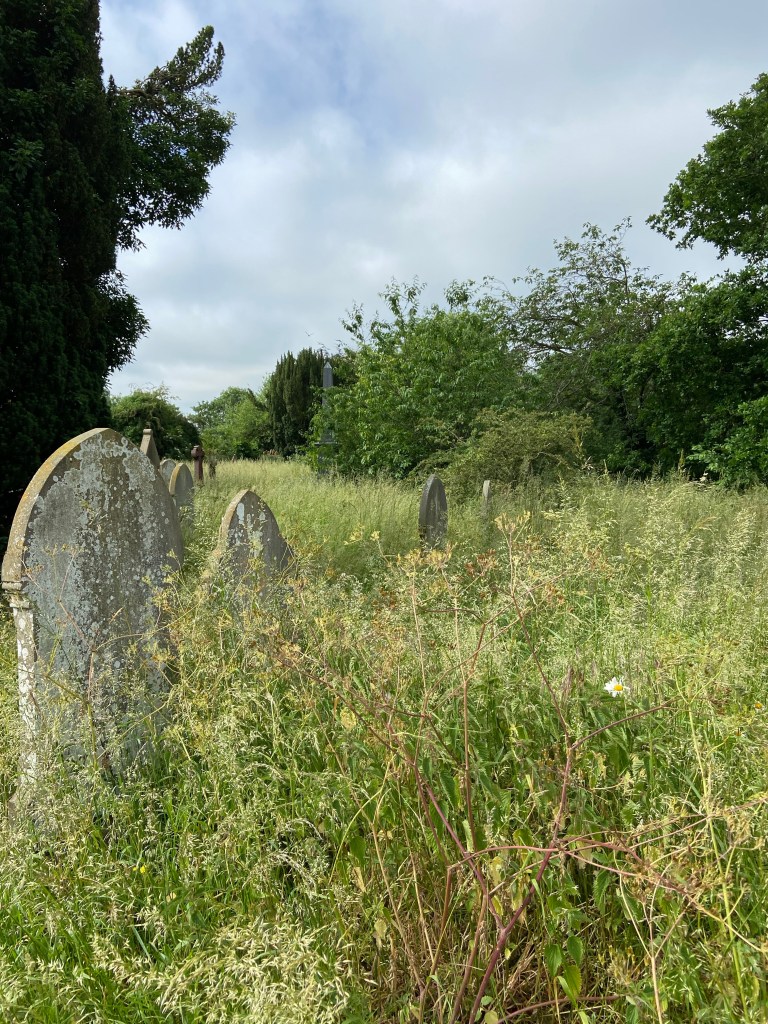
Its churchyard was overgrown and I couldn’t decide whether they ought to get graveyard clearing party organised, or whether they should leave it as a wonderful habitat. I had in mind the little hamsters living in the Viennese cemeteries, getting fat on the wax from votive candles, as shown in the wonderful David Attenborough clip. I did not see hamsters, but there were very many jackdaws sitting atop the ancient gravestones. Perhaps another omen?
The Church of St Peter and St Paul is famous for another reason: it is the location of the ancient Shrove Tuesday tradition of pancake racing — also shown on the town sign with two lines of ‘Ladies of Olney’ running to the doors of the church at the signal of the shriving bell with their headscarves, aprons and pans (provided — you have to bring your own pancake). The race dates from 1445 during the Wars of the Roses, and has been run continuously since 1948, even during Covid when a runner was chosen to do the course all on her own.
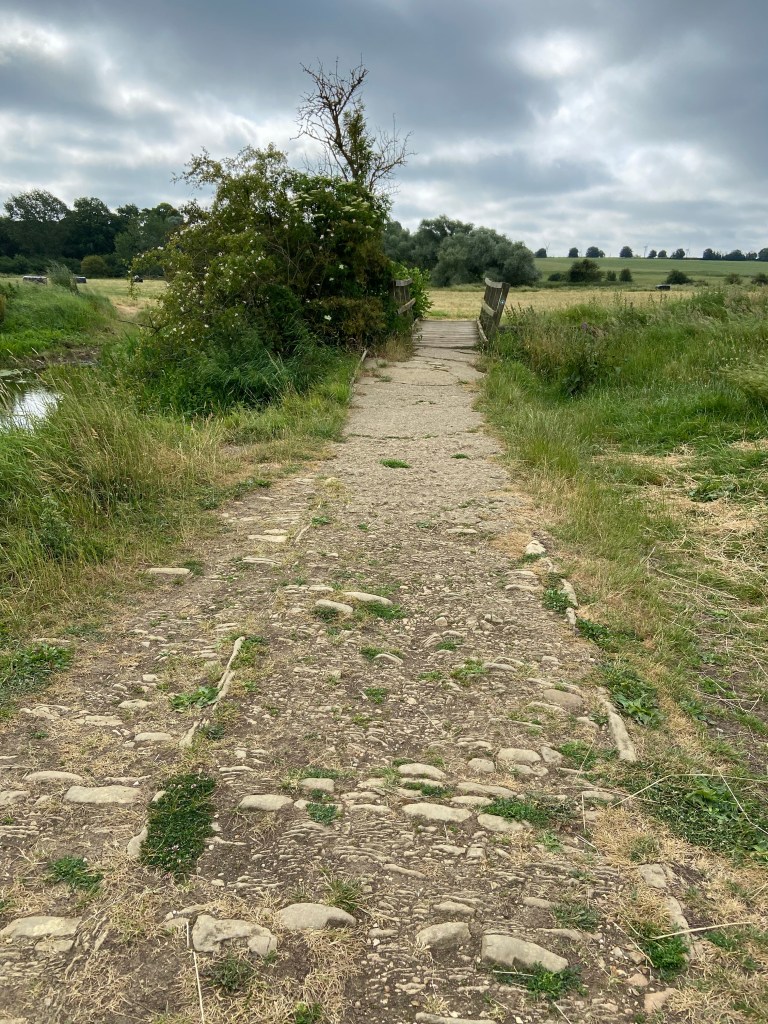
The path winding through the fields by the river is clearly a very old one. There are several channels to the river here, and the footbridges which cross them must have been in use for centuries, if the cobbles are any guide. They added to the general feel of being in an 18th century working watery landscape.
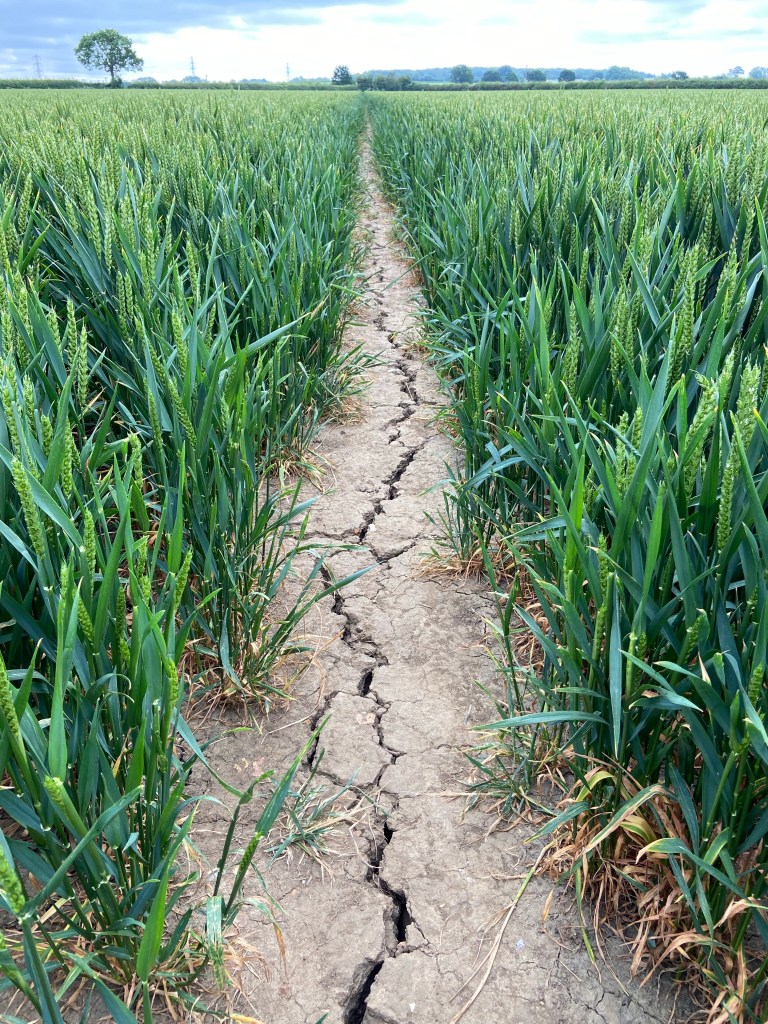
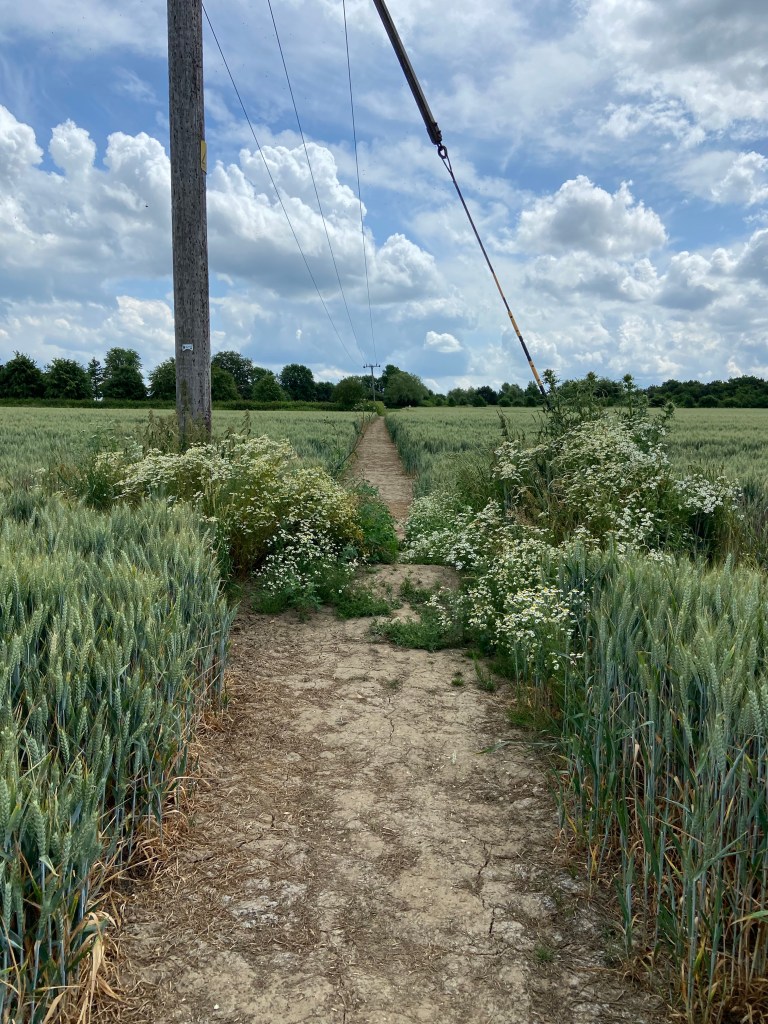
Up at the top of the hill which followed, I found myself straight back in the agricultural 21st century: the path went through one of those cornfields where a dead straight footpath has been weedkilled through the crop, cracked and fissured with a single line like something from the imagination of Andy Goldsworthy. The corn reached thigh-height, and everything above was larksong.
I met Rob and Jo in the middle of the field walking the dogs. In recounting the tale of how I came to be here, I surprised myself by saying “and this is the first day that I actually feel that I can do this walk”. It was an odd realisation —but true. I had spent a lot of yesterday in the oppressive heat and the overweighted pack, feeling that I could not make it to the end of the day. Good luck with your back recovery, Rob. I hope everything settles soon. I saw you again later on your walk from far away, when I had wandered into a wrong field and was thrashing about trying to get out! You were passing through the gate into the village and effectively helpfully showed me where the path was!
Newton Blossomville lives up to its name.
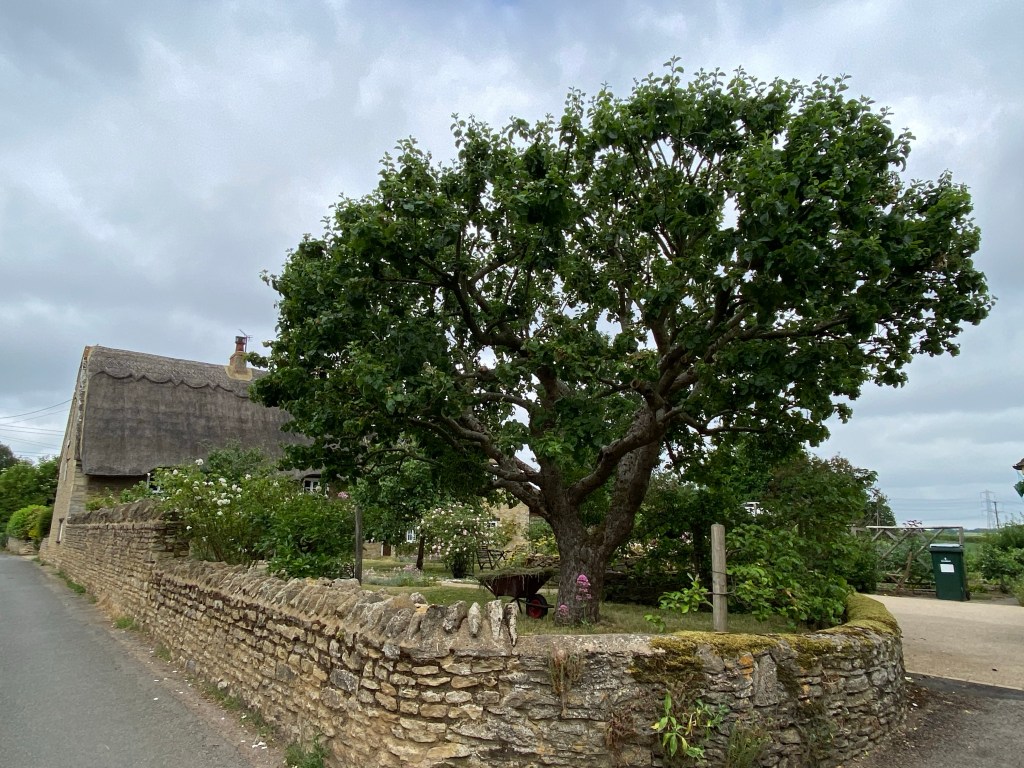
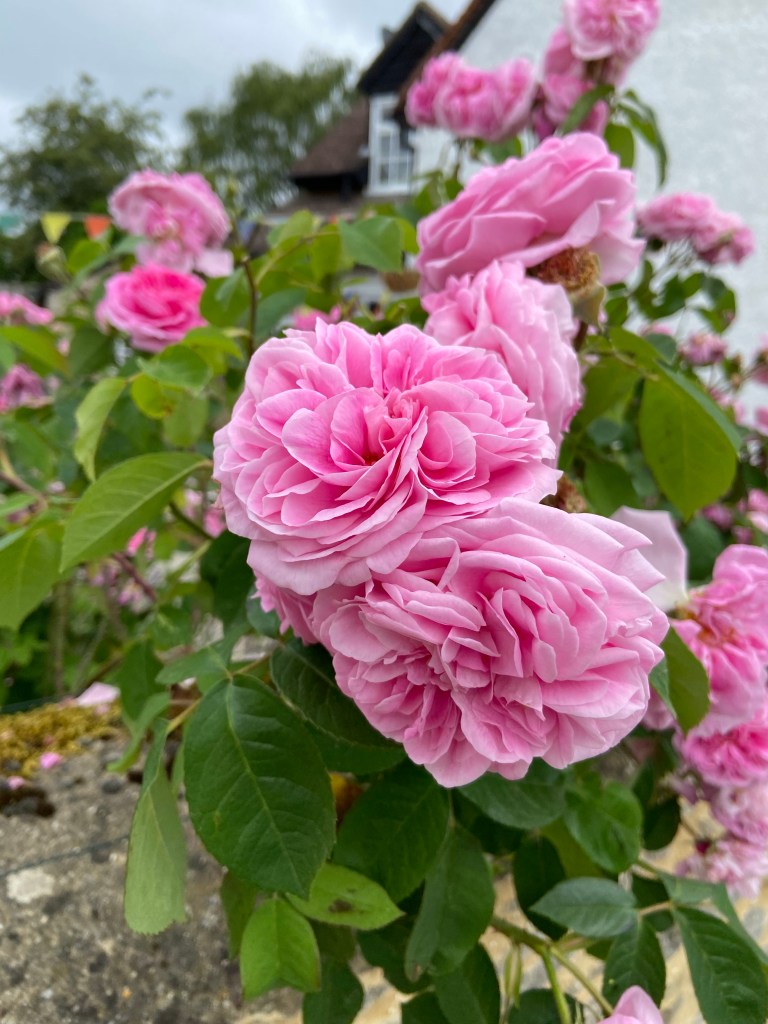
It is a village glowing with warm sandstone buildings, cottage gardens, beautiful thatched roofs, and scented honeysuckle and roses everywhere.
On the path went, connecting the villages all along the river valley. The Ouse has a meandering course which loops northwards until it winds its way south again to Bedford. The Ouse Valley Way takes welcome shortcuts through farmland and crisscrosses the river several times, but I could always follow the visual line of the river through the landscape before me in the silvery canopy of the white willows, which seem to be this river’s trademark.
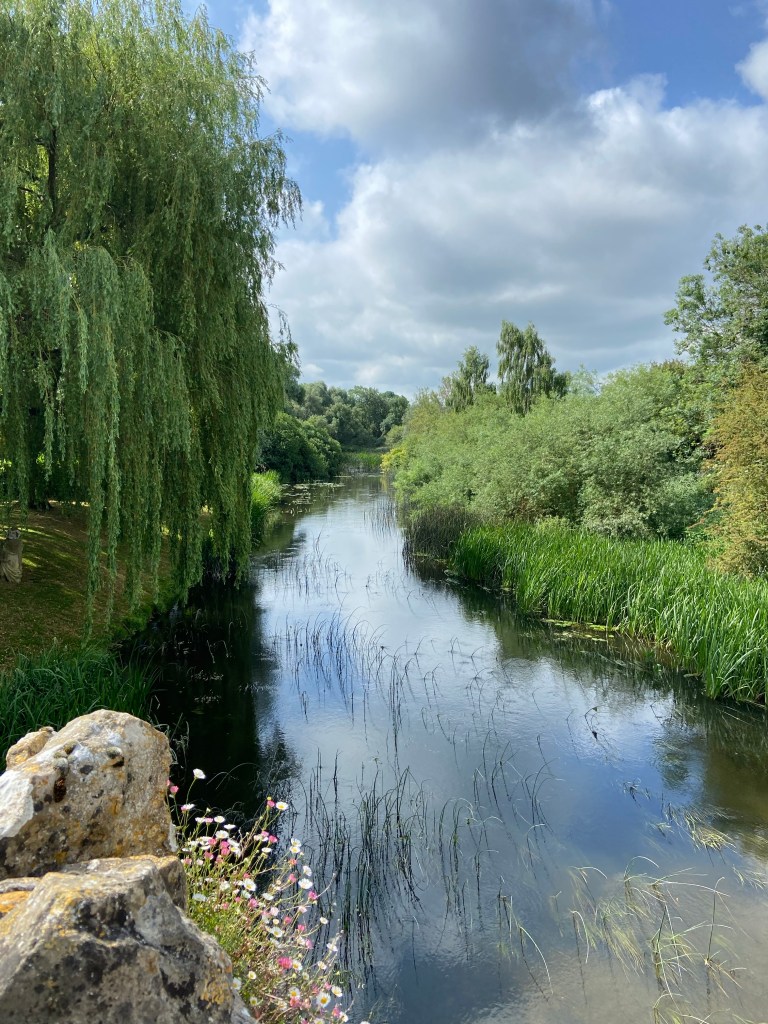
At Turvey, I crossed the river again by yet another ancient bridge, here spanning three channels, each one with a different character,
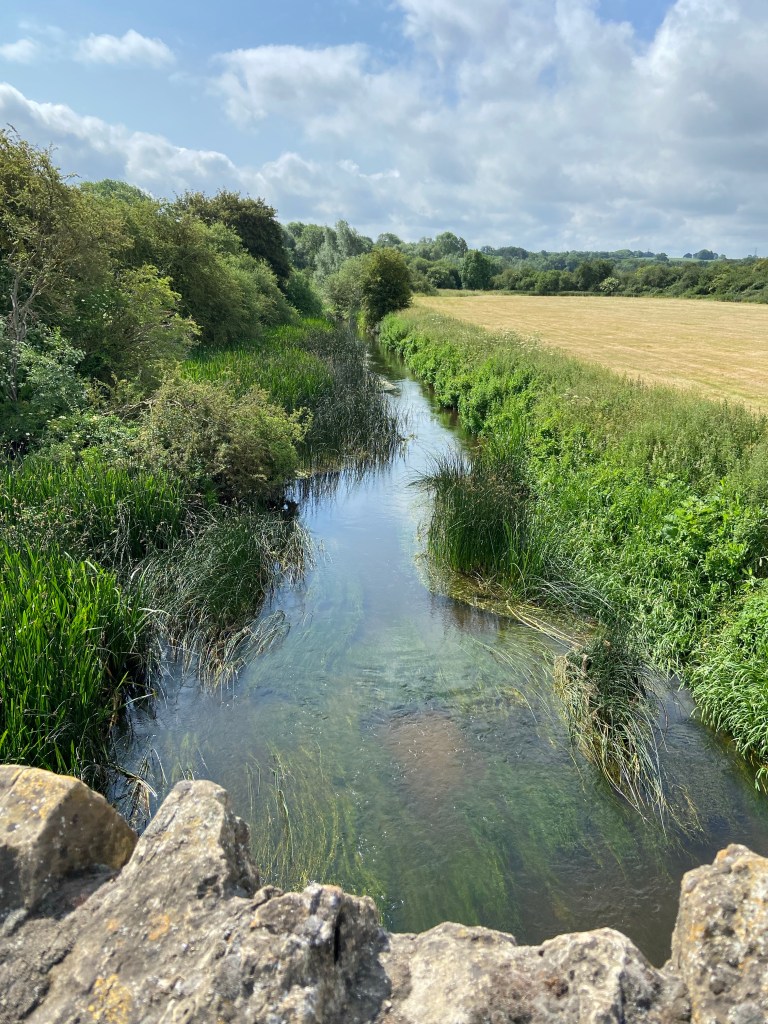
moving from Milton Keynes in Buckinghamshire to Bedfordshire as I did so — my sixth county on this walk.
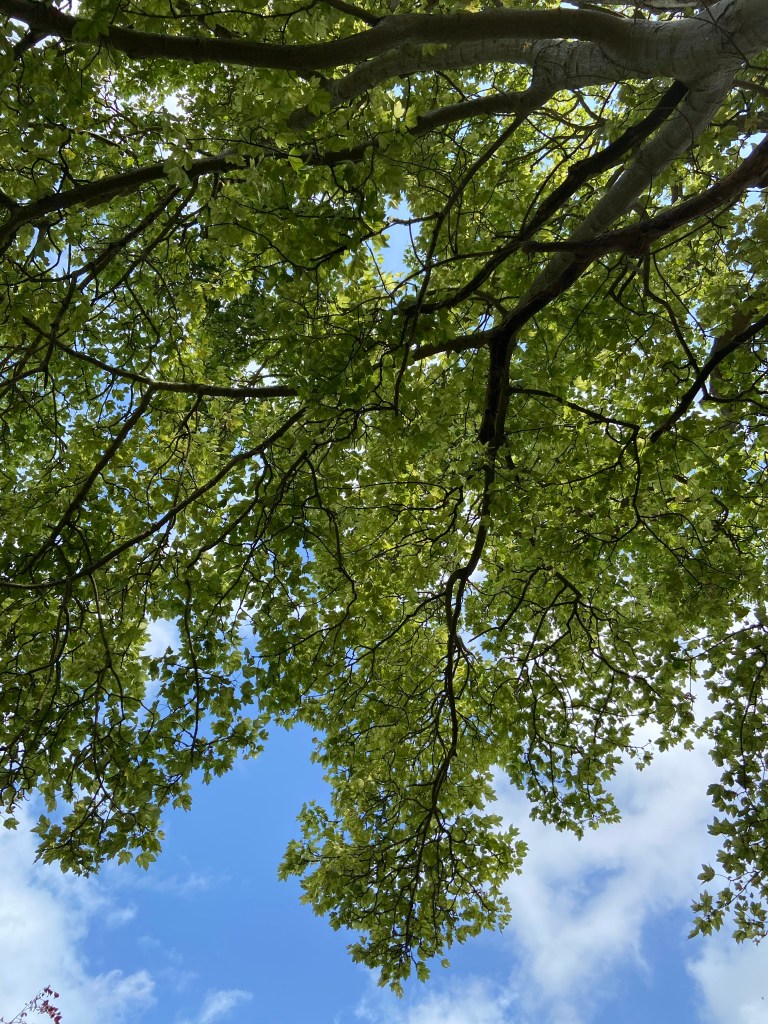
Turvey was a sizable village, and I had high hopes of a decent café, where I could sit down and rest. None of the pubs were open, and café there was none — surely a business opportunity there. I bought a roll and (by accident because the milk reservoir must have been empty), a tragically black coffee from a cornershop, and ate the roll on a bench under an enormous plane tree. I watered it with the coffee.
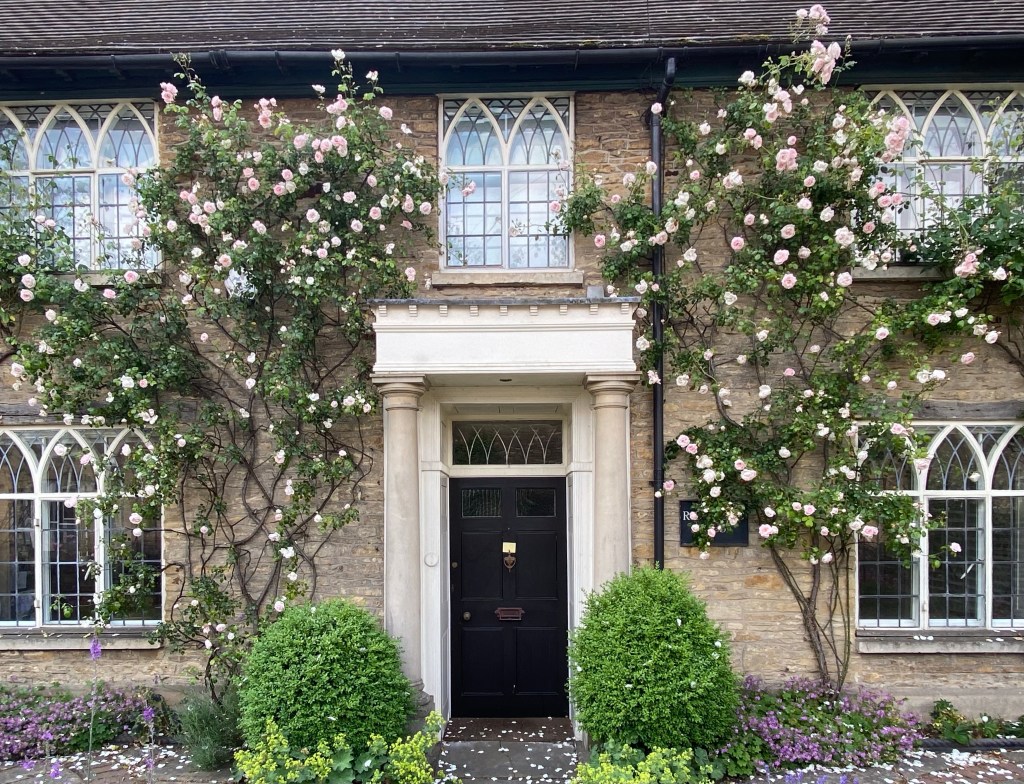
I wandered on through the village. It really was remarkably pretty, with the many pubs, much topiary, and several houses looking as though they had come straight out of an Austen novel.
In the village I turned away from the Ouse Valley Way because it was heading northwards on that gigantic meander, and I wanted to get to Bedford by the most expedient route.
Gentle readers, I commend to you the North Buckinghamshire Heritage Trail. Exquisitely maintained, your broad and close mown grass path takes you through parkland hay meadows,
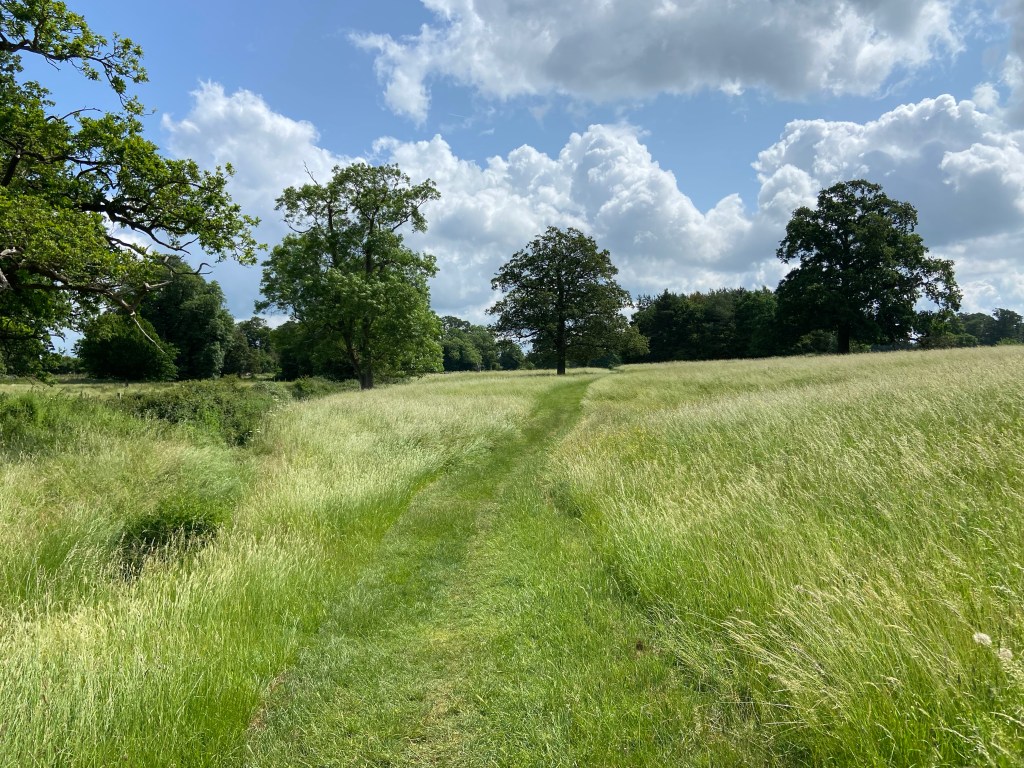
sweet-smelling bean fields thick with corn chamomile, past thorny brakes overgrown with climbing dog rose and honeysuckle, and patches where the bedstraws are interspersed with orchids. Walk this way in September and October, and you will find the field edges full of juicy blackberries and sloes for your Christmas gin, and the field maple leaves turned all to autumn fire, scarlet hawthorn berries, and the crimson leaves of bird cherry.
In one bean field I met Brother John, the last remaining monk at Turvey Abbey, out with his field glasses on a contemplative walk. This was a green lane, he explained. There used to be a coaching inn in the middle of this field, and when the road was too wet and boggy to use, this lane became the main thoroughfare.
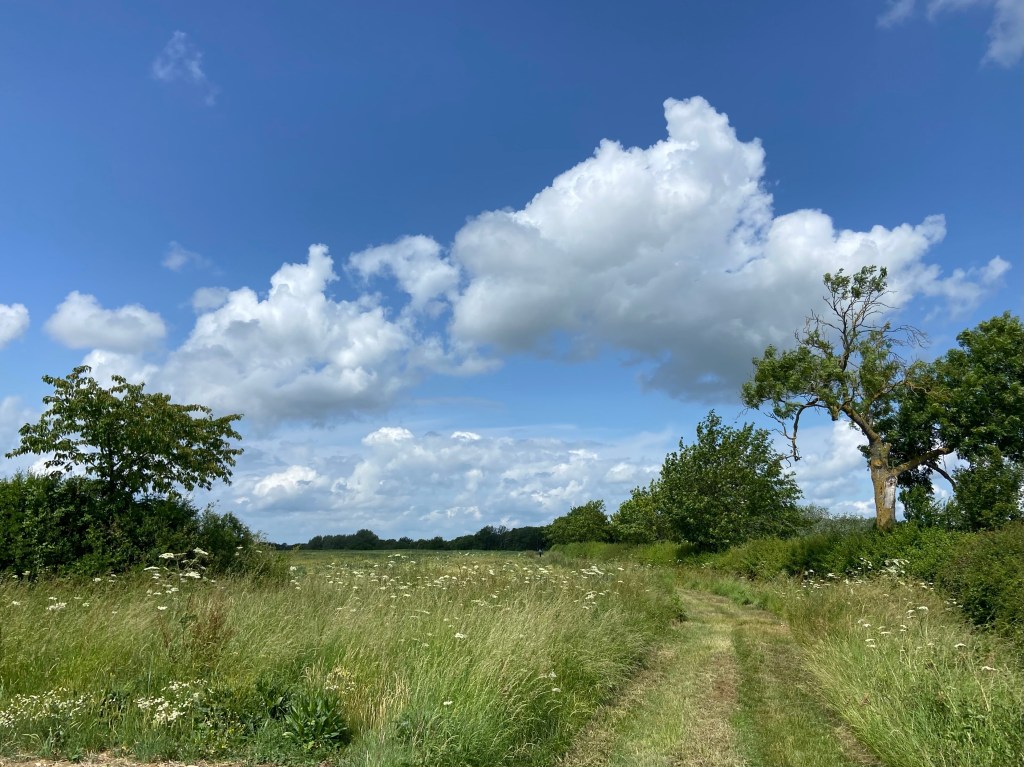
We parted, he back to the Abbey and I making for Bedford along the green lanes, but the encounter stayed with me. As I walked I thought of Gerard Manley Hopkins, and his ardent joy in nature, which he saw as a reflection of the divine. Brother John’s pleasure in the Bedfordshire countryside seemed to share something of the poet’s view. He was a delight to meet; a gentle and perceptive man.
The fields gradually fell away behind me. Tiny pea seedlings, fields of oats, and one field of blue flax, which, within a week or two will be a blaze of blue to match the sky. There were red kites – and a hovering kestrel, immobile over a field and then peeling away out of sight.
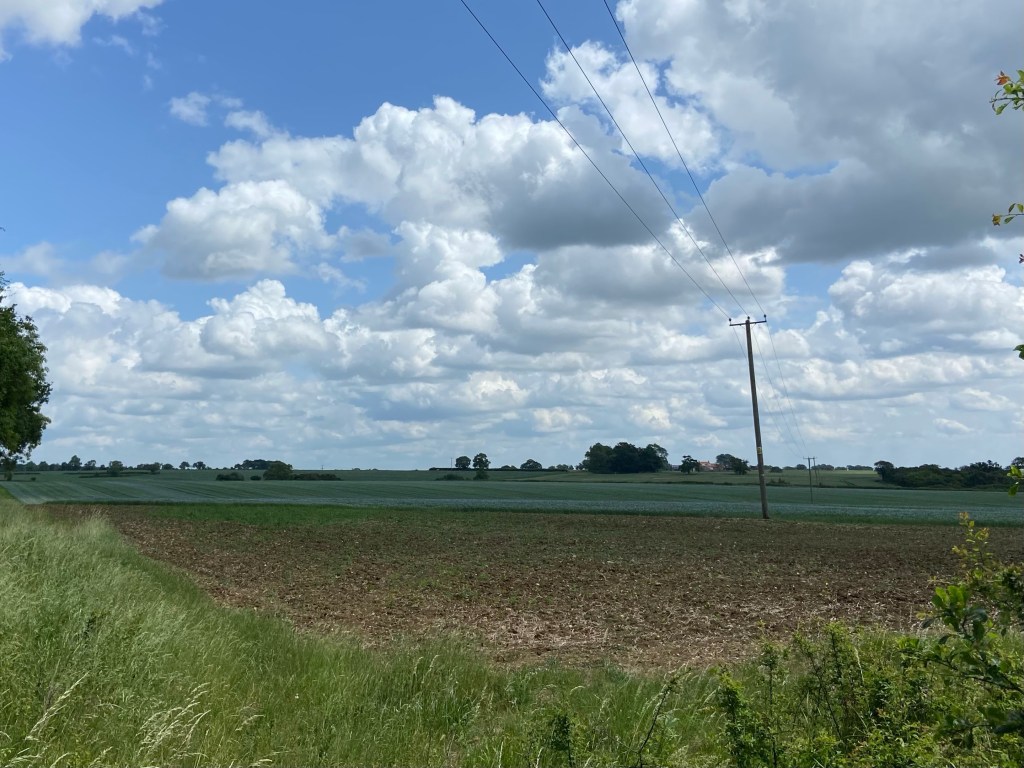
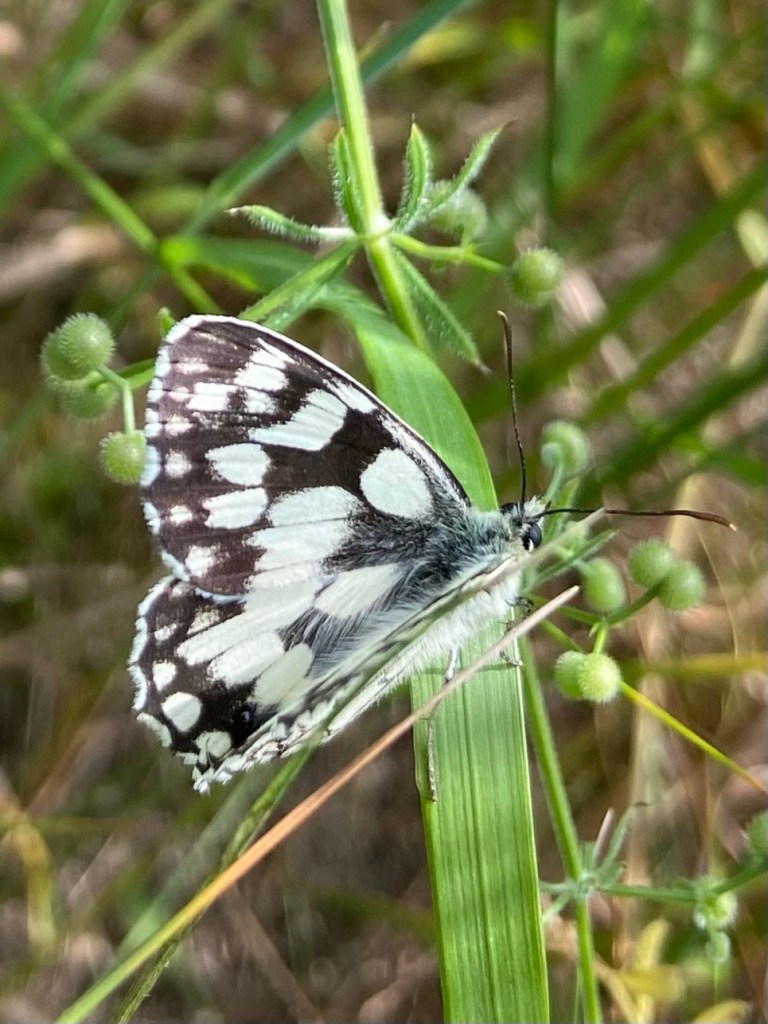
Marbled white butterflies fluttered around the wide field margins, and tiny, orangey-brown small heath butterflies. Their caterpillars feed on a range of grasses — fescues, meadow-grasses and bent grasses — so this sunny habitat was perfect for them. Other plants fed other insects: the pink and white striped miniature trumpets of field convolvulus provided nectar for beetles.
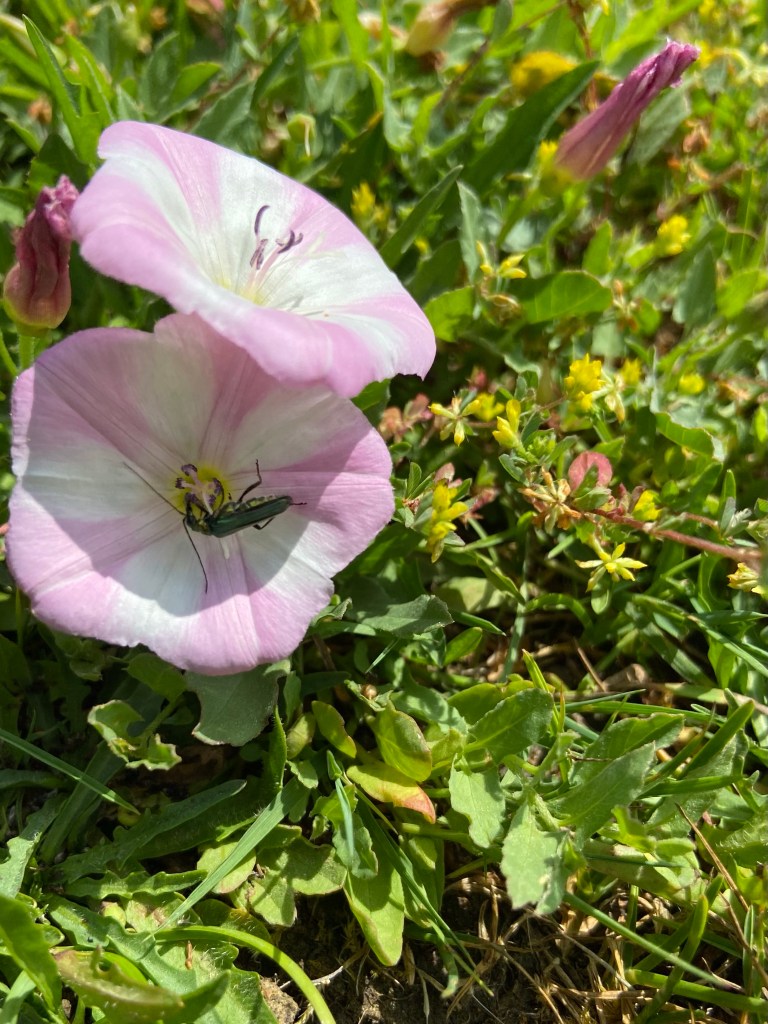
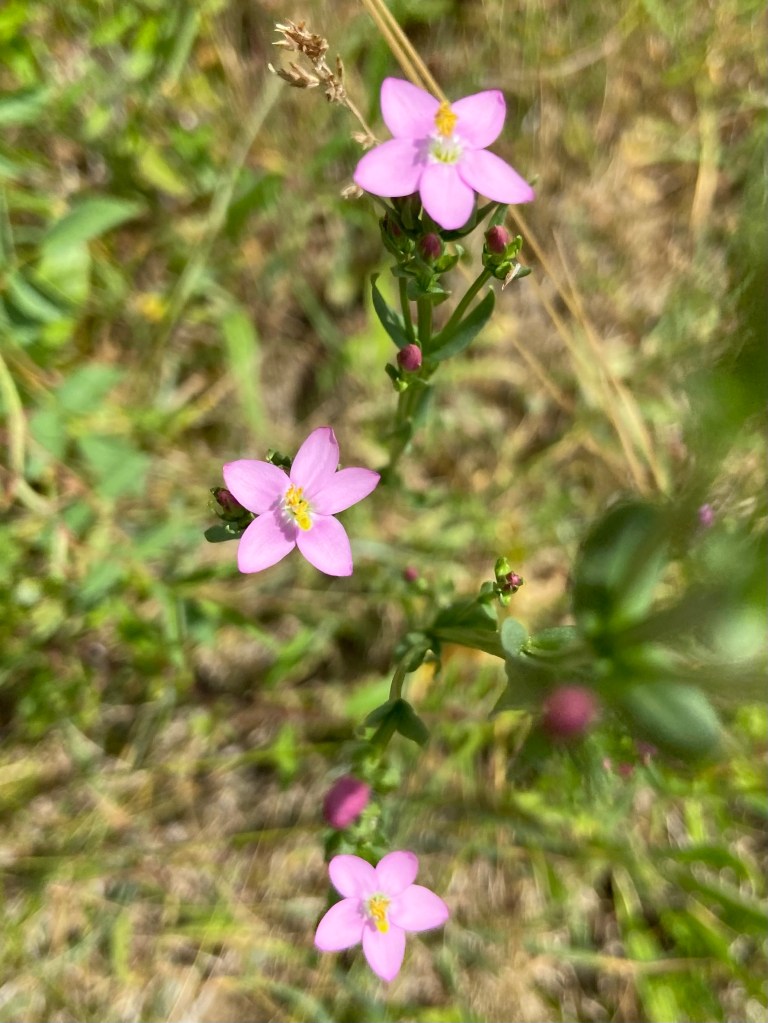
The biodiversity here was a textbook example of the benefits of a well-managed 12-foot field margin. Indeed, I came across species I had not before encountered: common century,
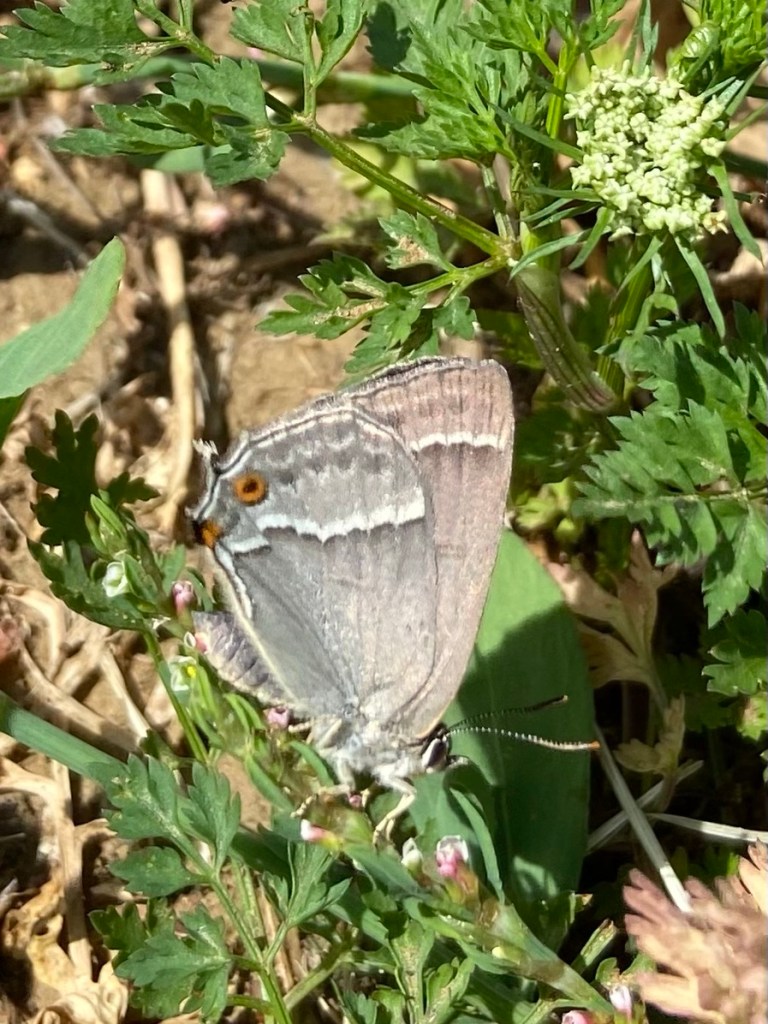
and an unfamiliar butterfly, dark on the wing, which came to rest near the ground, enabling me to photograph its striking grey underwing. I had to message my butterfly expert photographer friend, Andrew Fusek Peters for an ID. “It’s a purple hairstreak,” he said. “Well caught!“ These butterflies usually confine themselves to the canopies of oak trees, and it is only during prolonged drought, like the one we are having now, where they come down to the ground to find honeydew and nectar.
On this journey larks have mostly been heard but not seen. As I came over the rise by the trig point at Astey wood, there was a grand view over the fields to Kempston and Bedford in the distance, and a little lark rose in front of me, fluttering its wings indefatigably and pouring out its liquid song. I thought of my father, whose five-year anniversary it is today, at whose funeral and memorial we played Elgar’s ‘Lark Ascending’.
I took a quick detour on the John Bunyan Way (although I had been warned of the dangers inherent in an excess of this son of the city in Bedford) to cut off a corner and was glad I did, watching dragonflies patrol round a telegraph pole,
And finally managing to creep up on a marbled white to take its picture by a roundabout on the A6.
Although the walk had been cheerful all day, it was also a long one, and my feet were beginning to feel bruised underneath. Having crossed over into what was effectively the Bedford conurbation with 21km under my belt, I now felt I was practically there — but there was another hour and a half and six more kilometres yet to walk. I had run out of water.
One of the pleasures was that I joined the river Ouse again, after what seemed like an age, at the bottom of the huge meander which was now to bend north and then east again into Bedford proper. There were two swans here to mark the event, and families with pre-schoolers out fishing for tiddlers — to almost uncontainable excitement.
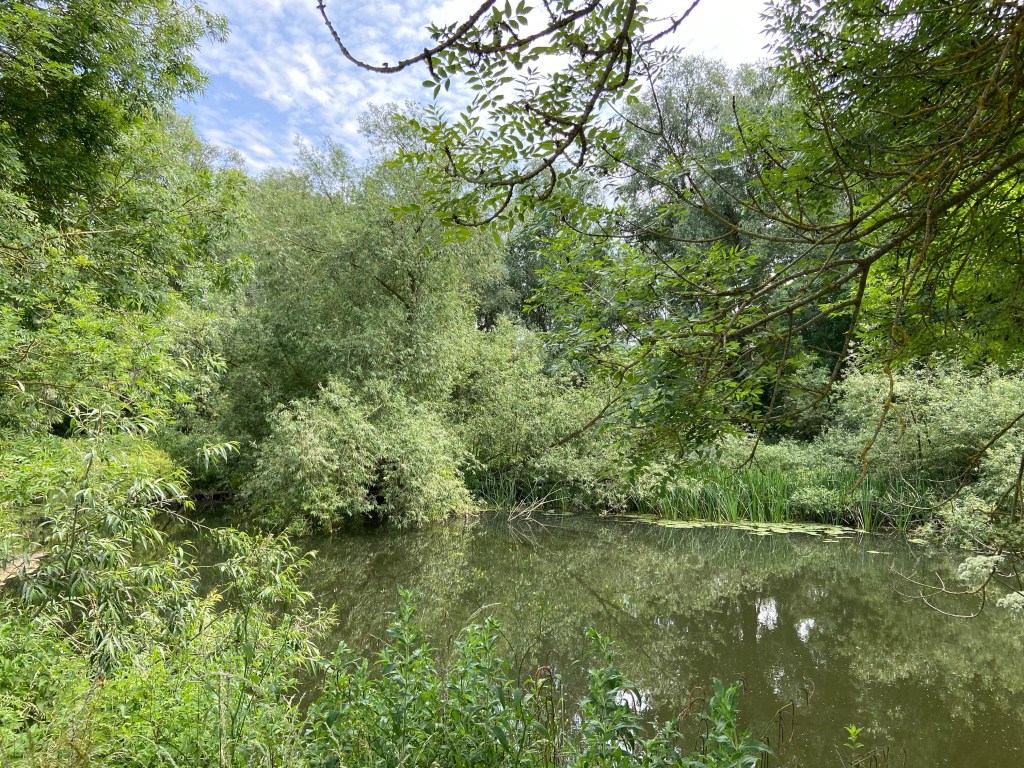
A gruellingly compacted and blindingly white path led a kilometer and a half through the implacable heat of the afternoon up the Great Denham Country Park. To my right were tantalising views of a river which looked deliciously cool (if devoid of kingfishers).
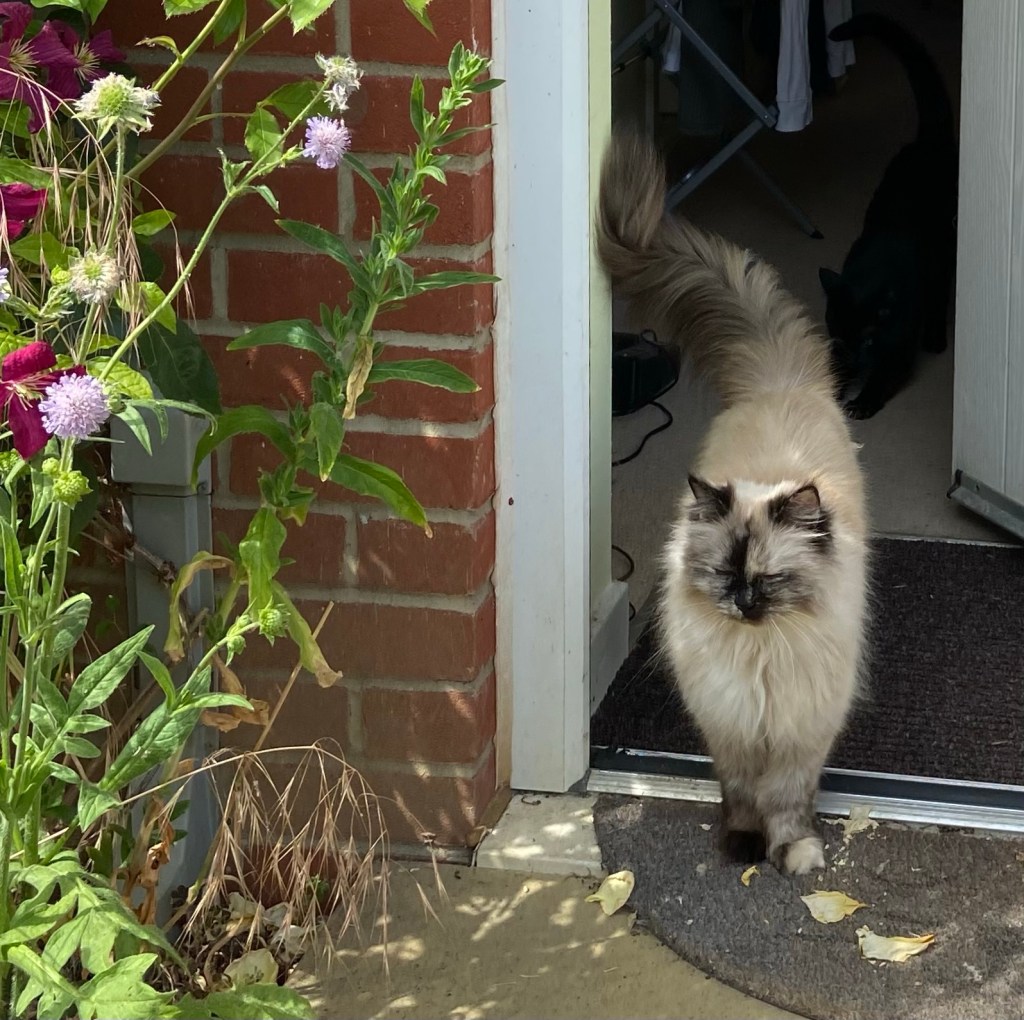
I was getting thirstier and thirstier. Several passers-by gave me directions to Sainsbury’s as being the single possible source of water, but it lay in the wrong direction and I didn’t think I could bear to take any diversions at this point in the day. Eventually, I knocked on the door of a house with a tiny front garden full of wildflowers. It belonged to Trisha, owner of a beautiful ragdoll rescue cat who had come to her with feline Covid, which meant she could not get the cat spayed. In the time it took for the cat to recover, she had already been making a liaison dangereuse with the local ginger tom, and ended up with a litter of six kittens, all of which Tricia had to keep.
Kind Trisha generously furnished me with a chilled bottle of water from her fridge which saw me right through to the end of the day’s walk — thank you, Tricia! Some are born mad cat ladies, and some have mad cat lady thrust upon them!
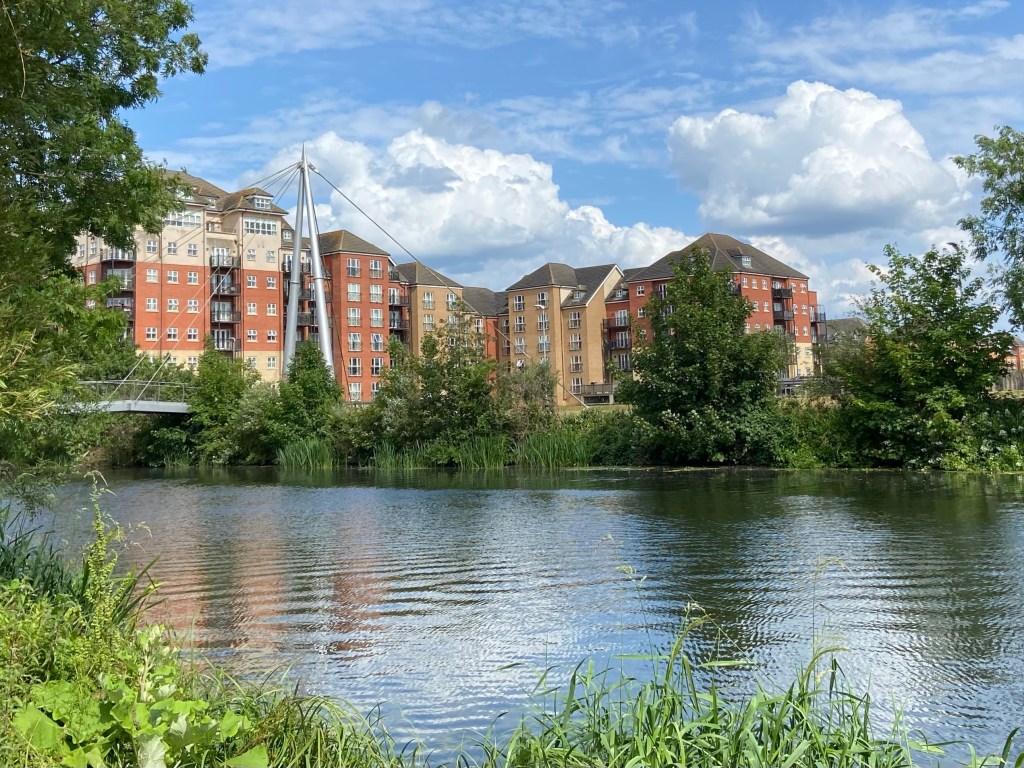
The Ouse Valley Way runs right along the river’s edge through Bedford and it began to assume a more urban character, with riverside apartment blocks
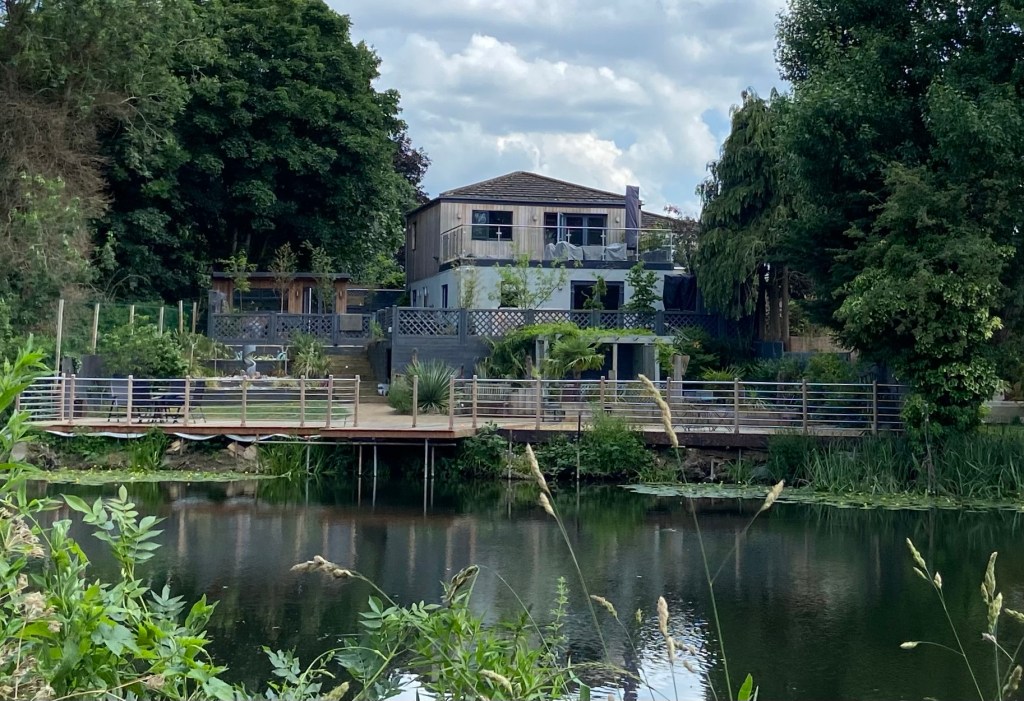
and luxury waterside homes
and a selection of bridges criss-crossing the Ouse, old and new, reflecting Bedford’s history.
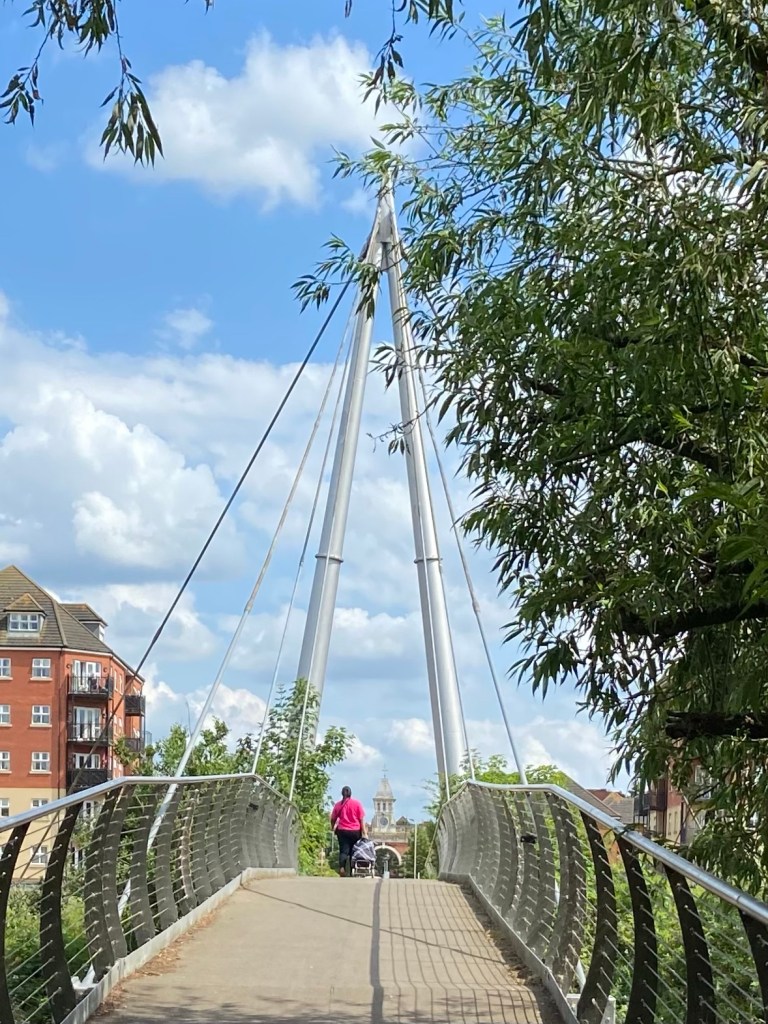
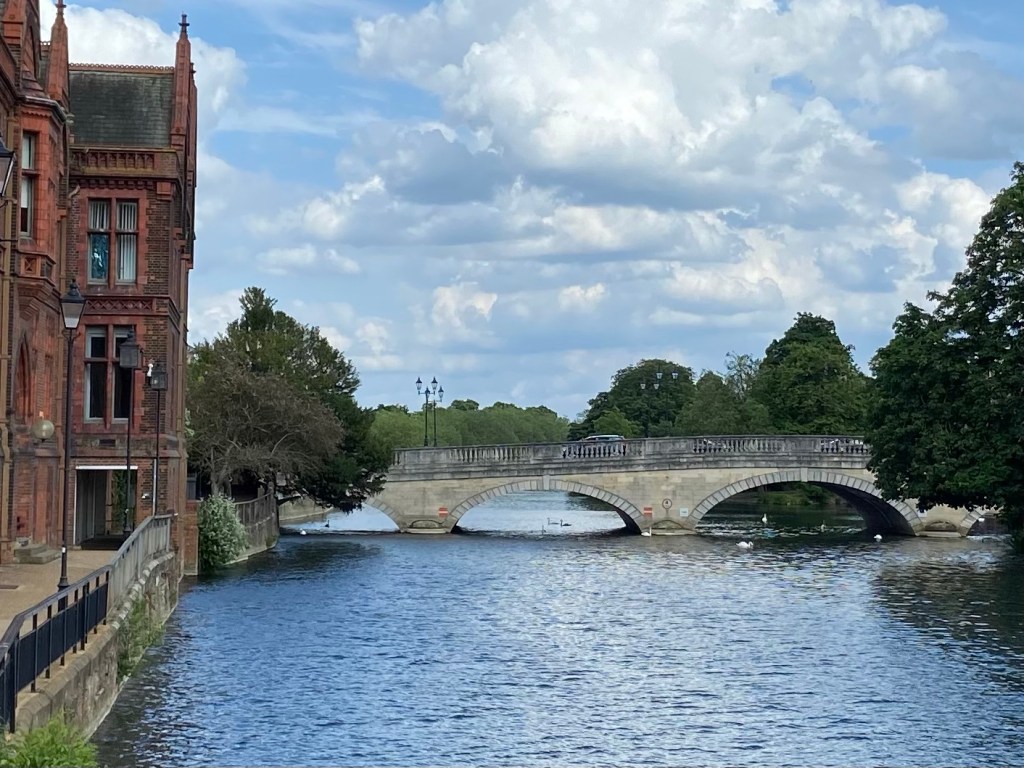
I was more than thrilled to have reached the sanctuary of The Embankment Hotel, to enjoy two nights of rest and relaxation, a wash of person and of clothes, some good food and some good sleep — and a critical restock of Compeed.
 Walking The Landscape
I woke late this morning but saw I had two blogs unread. To read them both is a retiree’s prerogative, yes? I’m not sure whether reading the times you have struggled has worn me out before the day has started or whether I am invigorated by the amazing things you have seen on your journey! However being that it’s the longest day today, the sun’s zenith halted at the Tropic of Capricorn I feel that I will still have plenty of daylight hours to do all I need despite my binge reading of your antics!!
LikeLiked by 2 people
Love you, Gill xxxxxxx
LikeLiked by 1 person