
And this our life, exempt from public haunt,
As You Like It, William Shakespeare
Finds tongues in trees, books in the running brooks,
Sermons in stones, and good in everything.
I would not change it.”
It had been an excellent idea to take my rest day yesterday: it gave my feet time to recover from the long road sections. In addition, today was noticeably cooler – at least at 7.30 when I started walking.
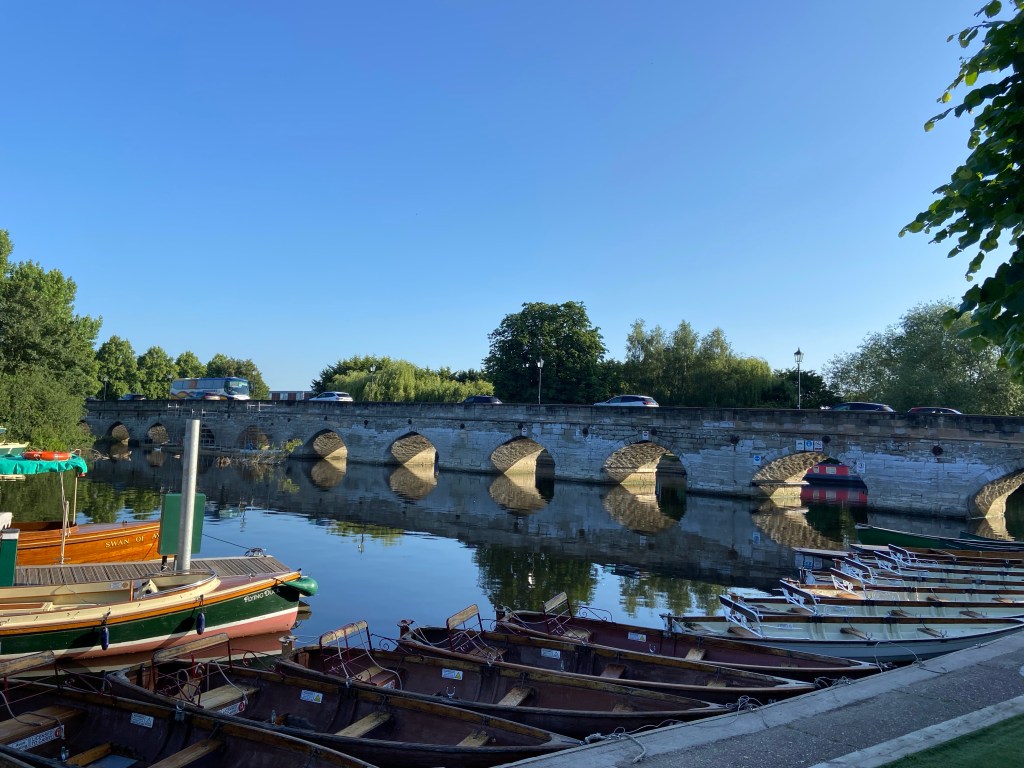
Oscar dropped me off at the carpark where he’d picked me up but it was almost impossible to believe that it was the same place. Yesterday I had been sheltering from the deluge and everyone was hurrying through the rain; today people were wandering round in a kind of stupefaction, looking at the early morning light playing on the underside of the bridge, the quiet boats moored in neat rows waiting for the day to begin, the swans and ducks preening their feathers on the water.
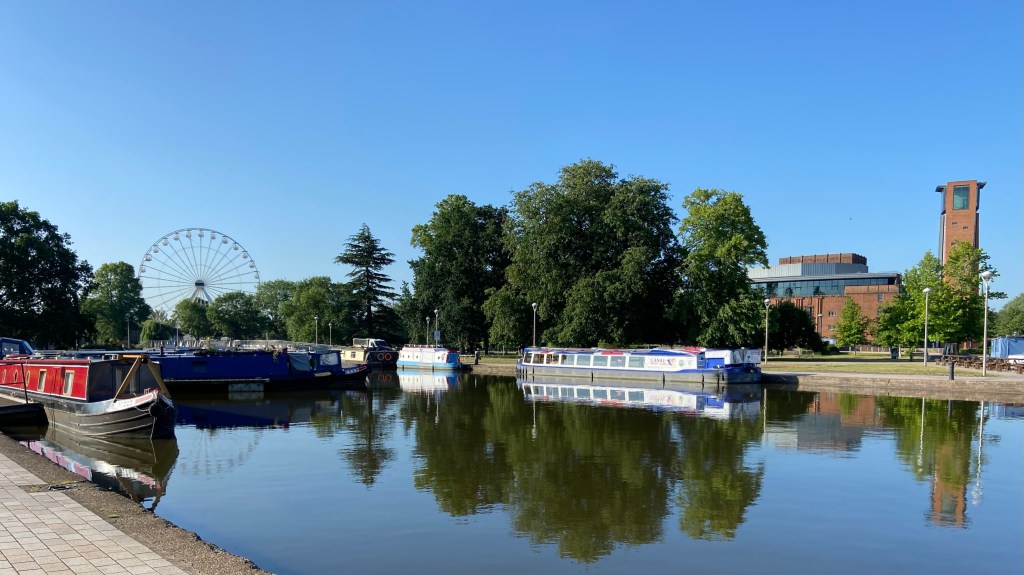
The Royal Shakespeare Theatre was a monumental feature, its tower balanced this morning by the gigantic ferris wheel on the other side of the river. I took a photo for four French tourists with the marina in the foreground — the mirror basin was the perfect foil to the landmarks in the background.
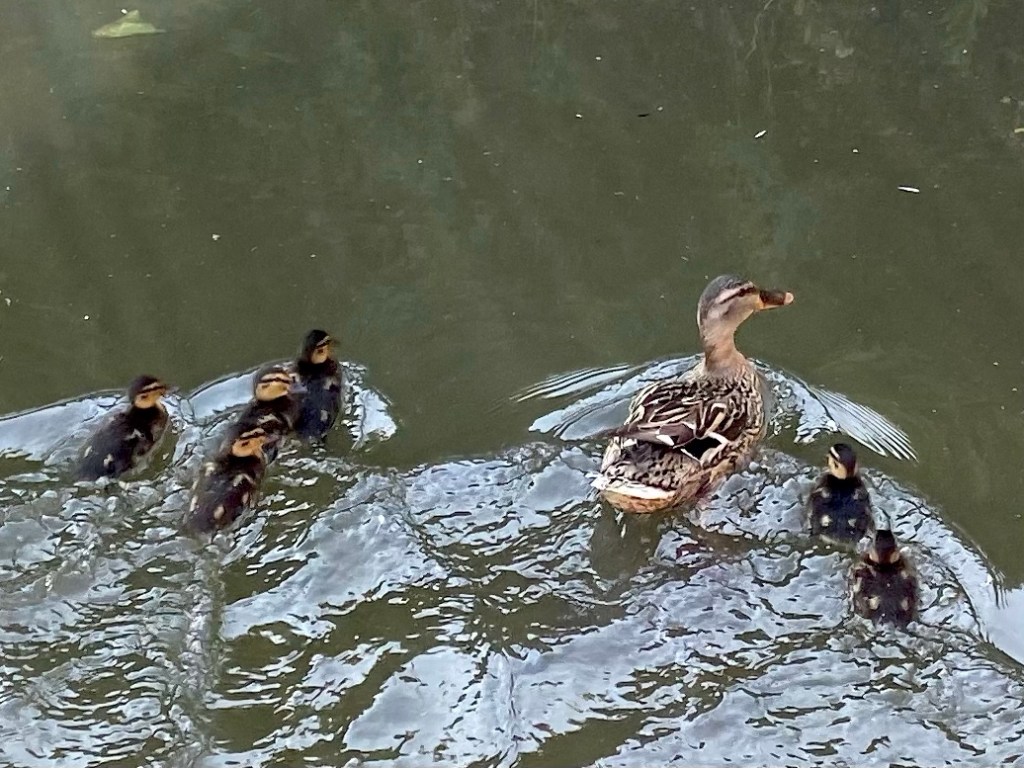
River access is limited on the section upstream from Stratford, since much of the bank is privately owned. The path detours away from the river proper, down a new basin leading to an old canal. A mallard shepherded her six tiny ducklings on the water,
past a narrowboat winning all the prizes for Best Garden.
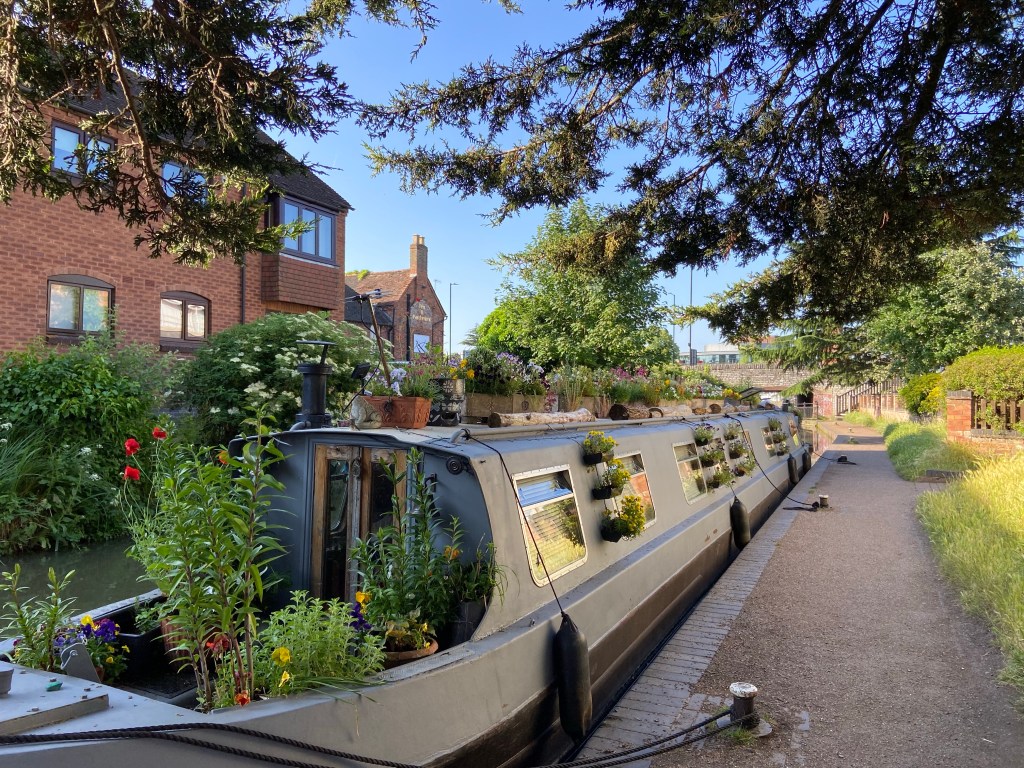
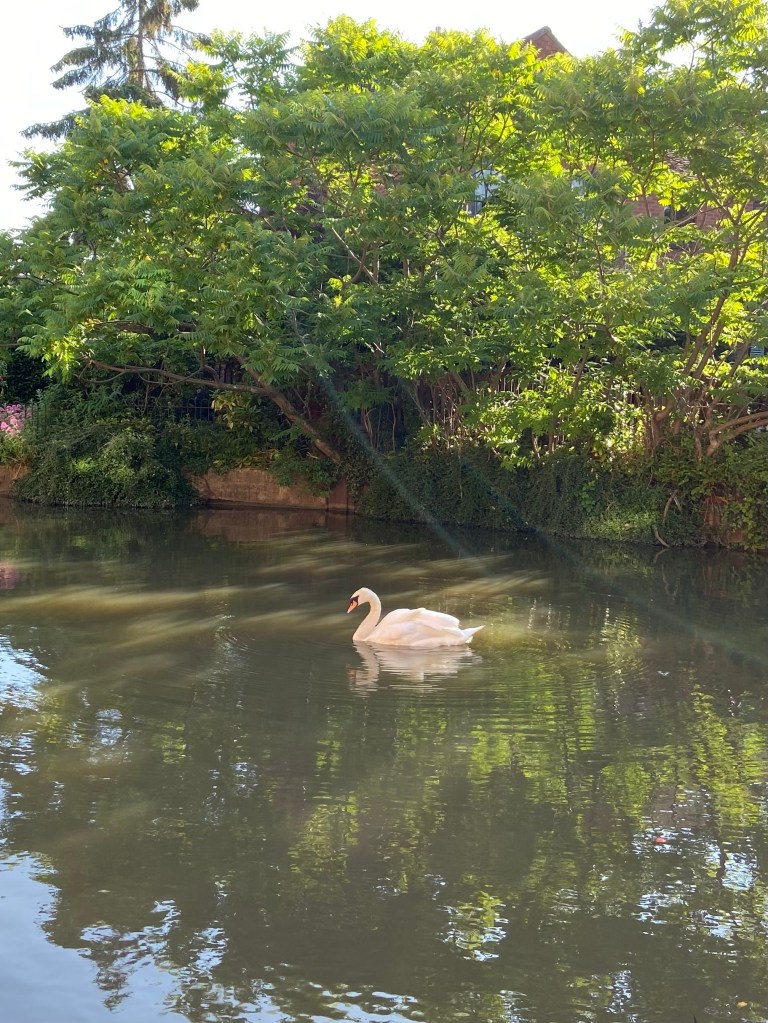
Further on, one of the many swans I saw today was gliding in a stately manner up the canal basin, in shafts of sunlight.
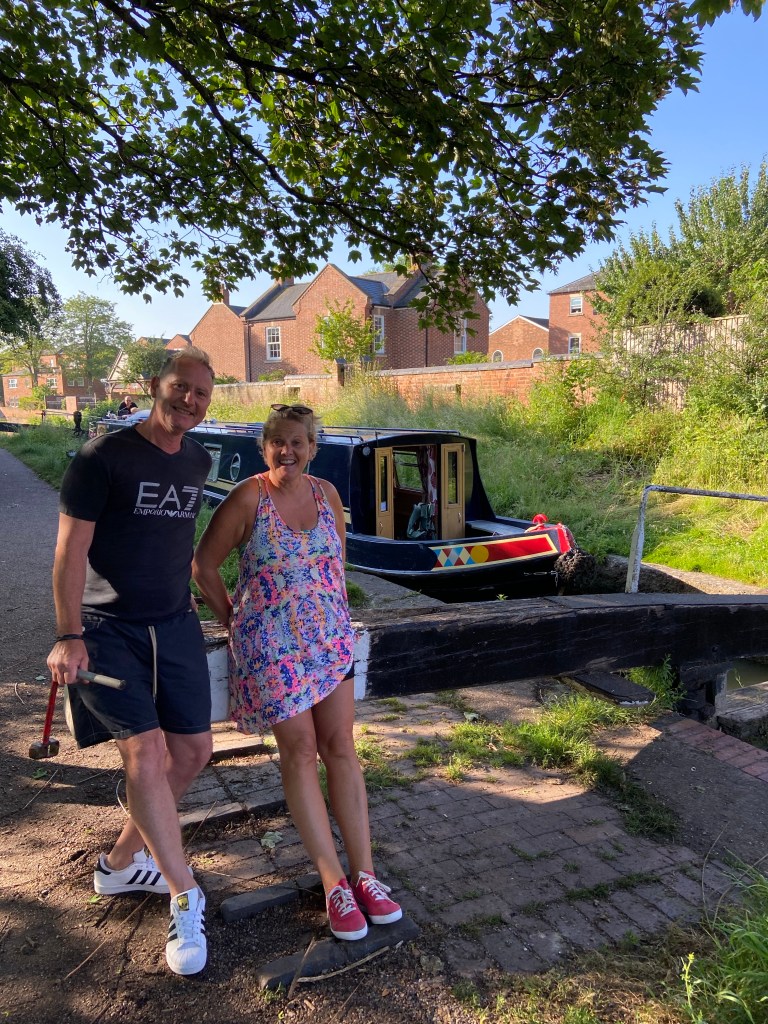
The path turns off before the canal proper, but I went up it a little way to the first lock, where Lana and Simon were taking their narrowboat Constance through. It gave me a foretaste of the Grand Union Canal, where I would end today.
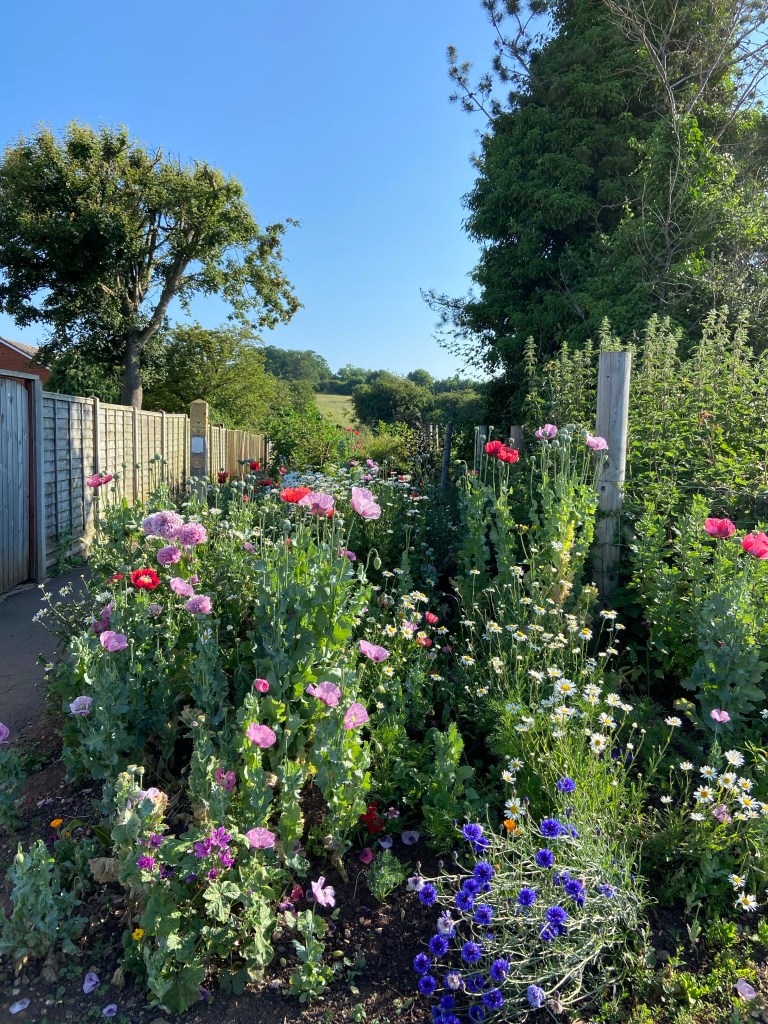
One of the features of this walk has been the wildflower mixes that people are starting to plant on little patchwork pieces of ground. They also unexpected, and so beautiful, and so valuable. This one was at the entrance to a country park.
It’s been a while since I have done a hill of any kind and the minor pull up Welcombe Hill was noticeably different to walking completely on the flat. The view from the obelisk at the top of the hill back towards Stratford to the south was the first of many wonderful panoramas today. In the foreground was the extraordinary Neo-Jacobean grade II listed edifice of Welcombe Hotel with its forest of tall Tudor-style chimneys.
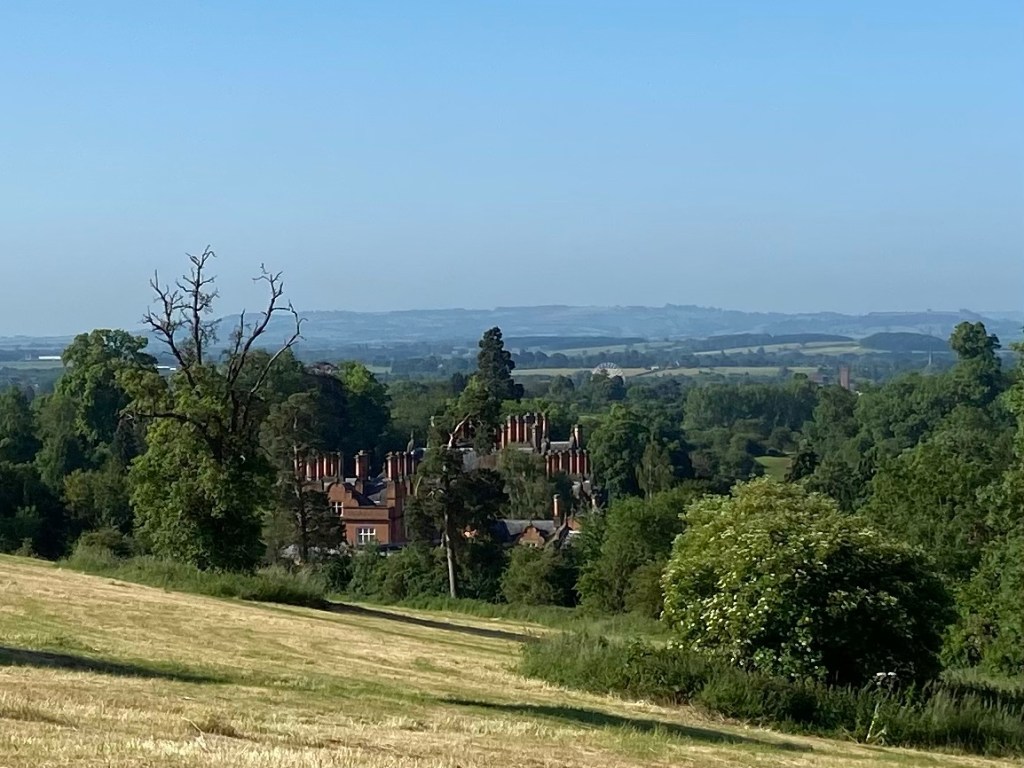
There is a wonderful comment by Cambridge historian George Macaulay Trevelyan who has been born in the house in 1876:
It was one of those enormous country mansions with which the wealthy Victorian bourgeoisie loved to burden their newly purchased estates. Welcombe house was, indeed, only a few years older than I was, though it was long ere I grasped that disillusioning fact.
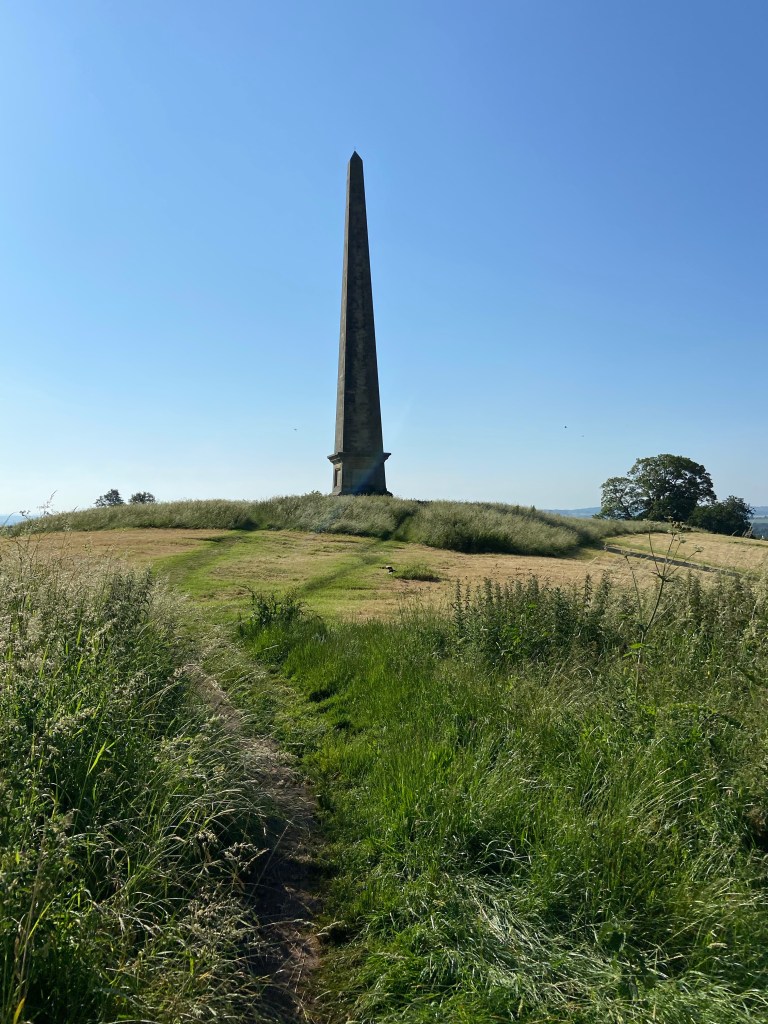
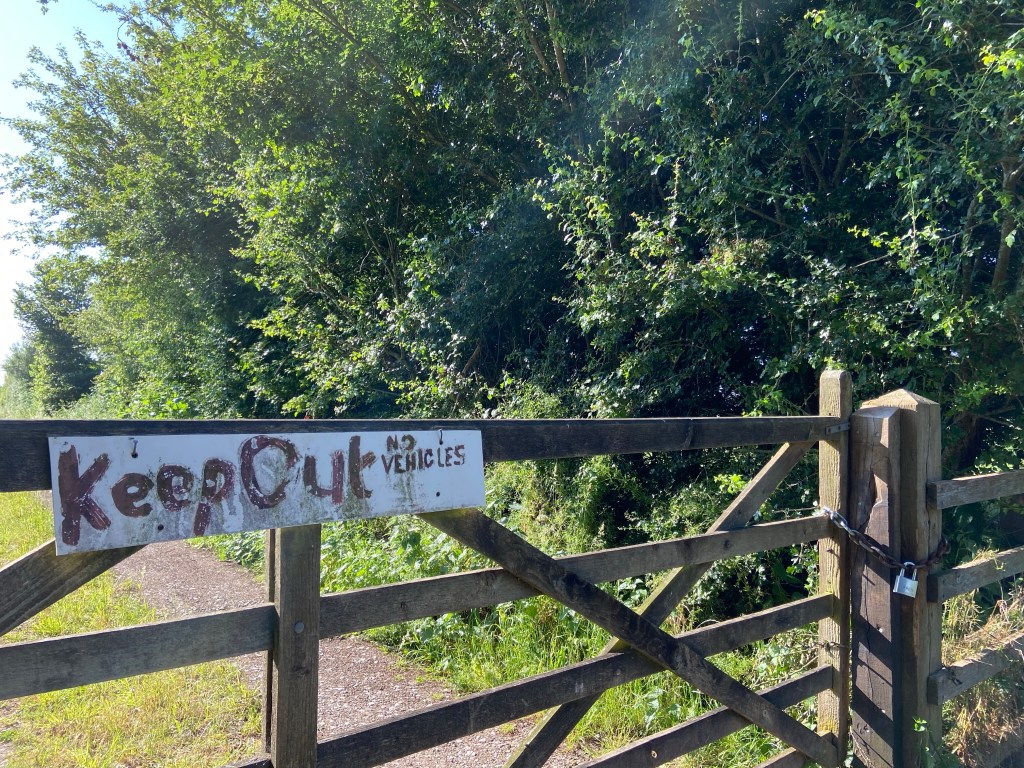
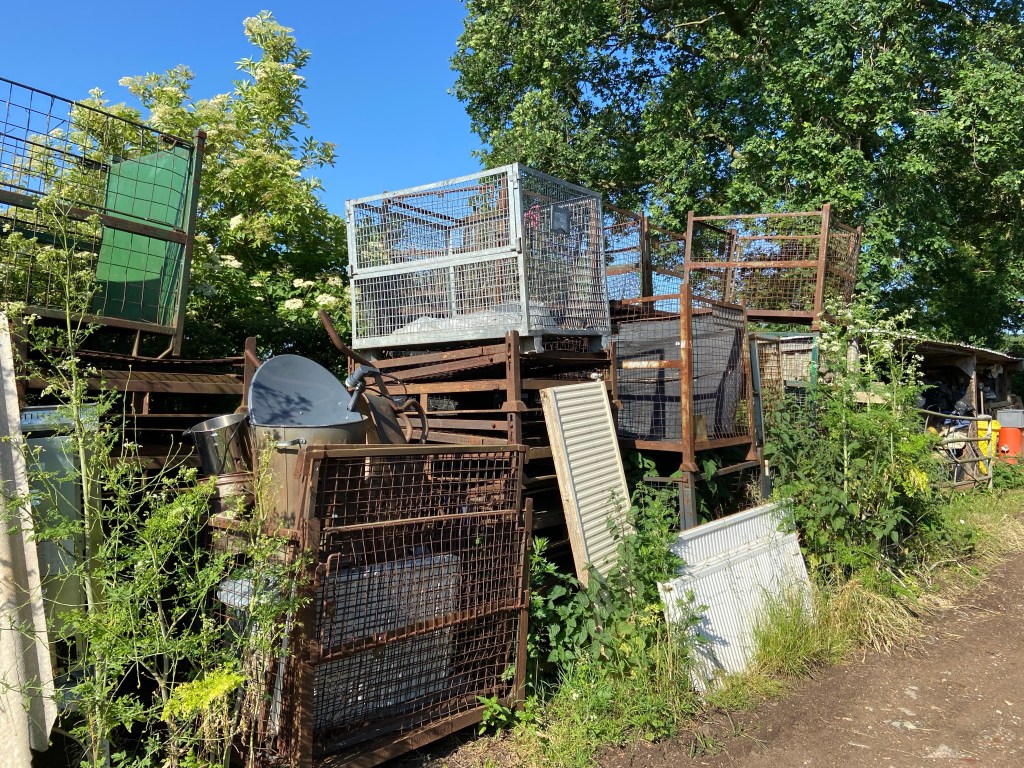
Welcombe Hill was a blip on an otherwise completely flat day. The path initially stuck close to the river. But it was hidden behind banks of nettles, and completely invisible. Access was by a farm track with a forbidding-looking gate, and the disquieting farmyard itself stacked with piles of empty cages, was downright frightening.
I was so relieved that, for this early part of the walk, there were fields of which a cut of silage had already taken been taken off, so there was not the same problem of long wet grass as I have encountered before. Now, nearly a week after I started, the flowering grasses are beginning to set their seed, and that might become more annoying in my shoes as time goes on.
But for now it wasn’t a problem and there was much to see: moving between the fields sometimes disturbed gigantic fluttering clouds of beautiful demoiselles. At every step a new cloud rose up to flutter about my head.
When there was a view of the river I lingered – at one point to play a kingfisher song recording from xeno-canto, the superlative online database of bird calls, to see whether I could call a kingfisher to a tree nearby. It certainly works for goldcrests but didn’t work today, although I was definitely hearing their two-tone peeping call. Frustratingly I didn’t have decent enough views of the river or, sadly, time enough to spend sitting quietly, waiting for them to be outraged by the presence of the recorded intruder bird to come and investigate… but I did see a tree-creeper working a branch of a beautiful riverside oak.
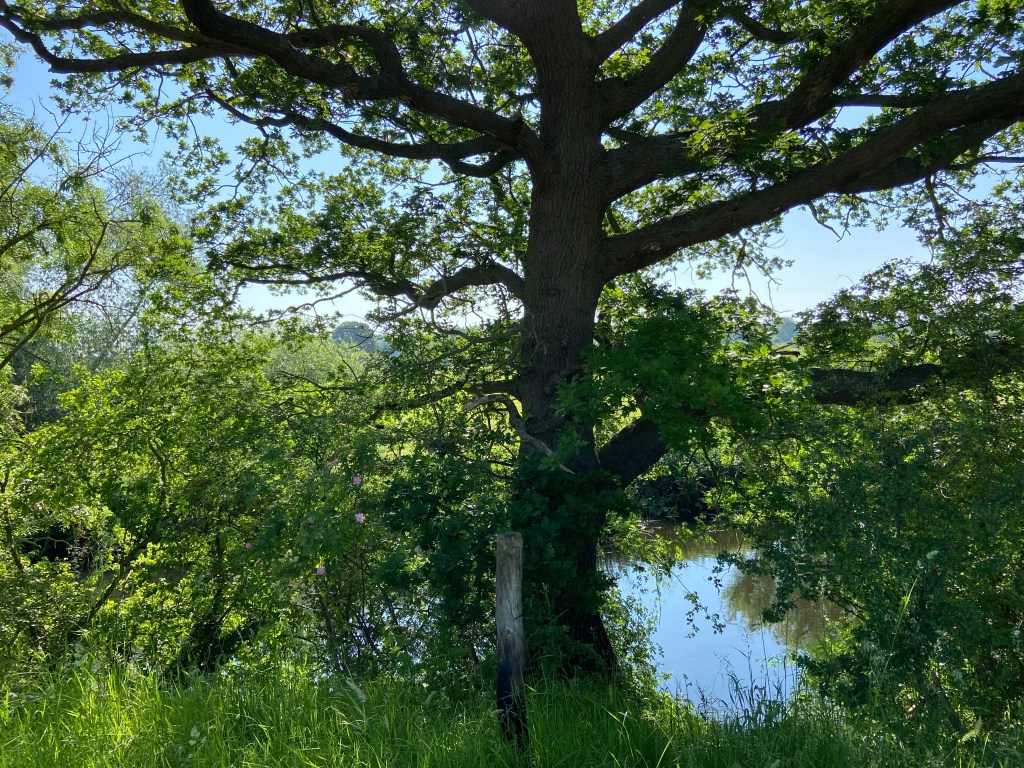
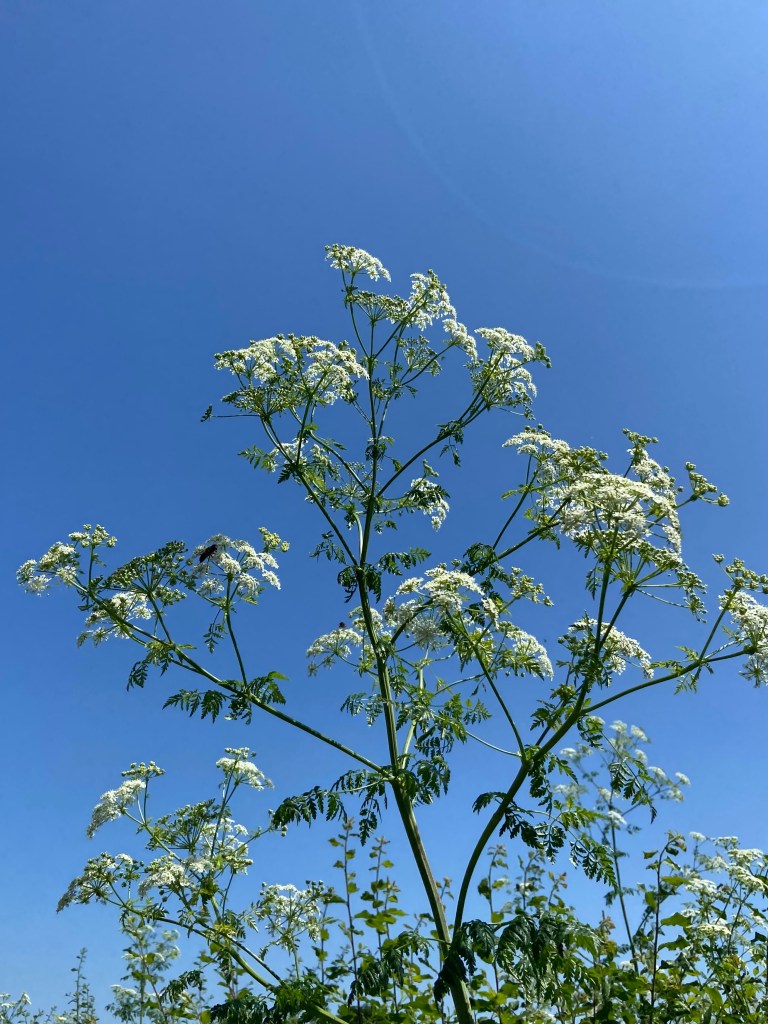
I moved as swiftly as I could between the now drearily familiar weedy sections, by turns bashing my way through with my poles, and weaving between nettles and bramble whips (as I imagined it) looking like Catherine Zeta Jones in Entrapment. Though I don’t recall her hair being snagged by dangling branches of wild rose, or her swearing sweatily as she batted away tall frondy stems of head height umbelliferae.
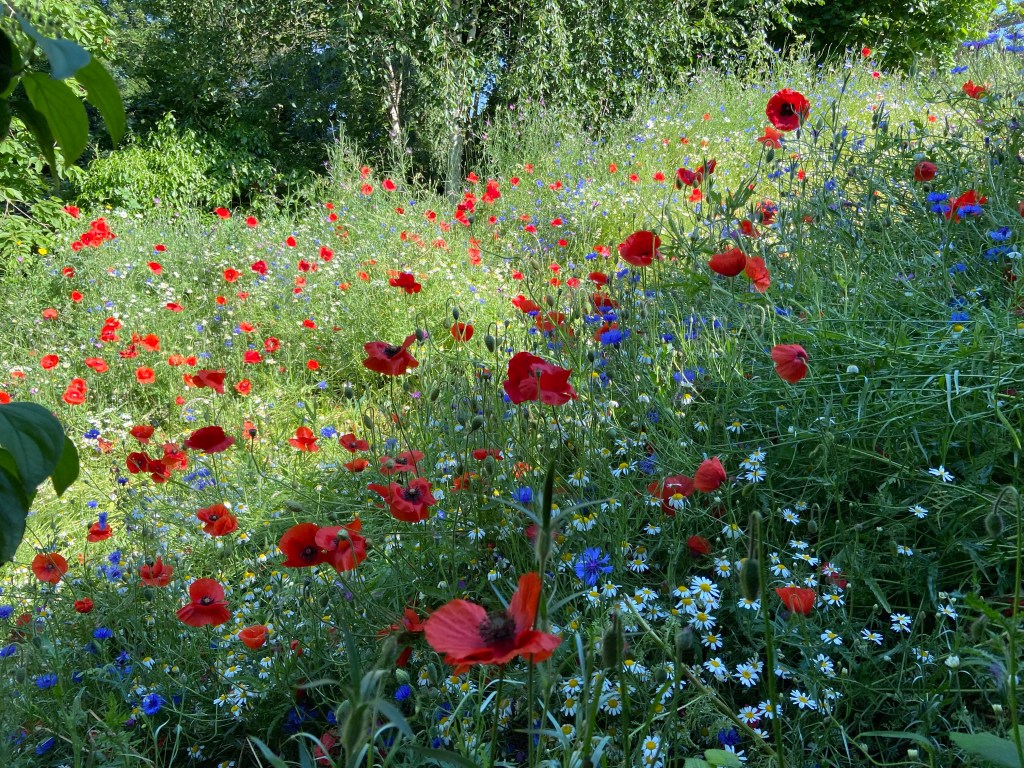
I turned around after one backwards-facing battle to see, with an audible jolt of pleasure, a wildflower bank that someone had sown where their property met the damp woodland banks of the river.
Another time, feeling I was in the middle of nowhere going nowhere, I got another jolt, this time a sensation of unease, provoked by what looked like an enormous office block recently constructed and immediately abandoned, its eerily empty ground floor parking beginning the inexorable process of being overrun with brambles. It was as though I had been transported into a post-apocalyptic film.
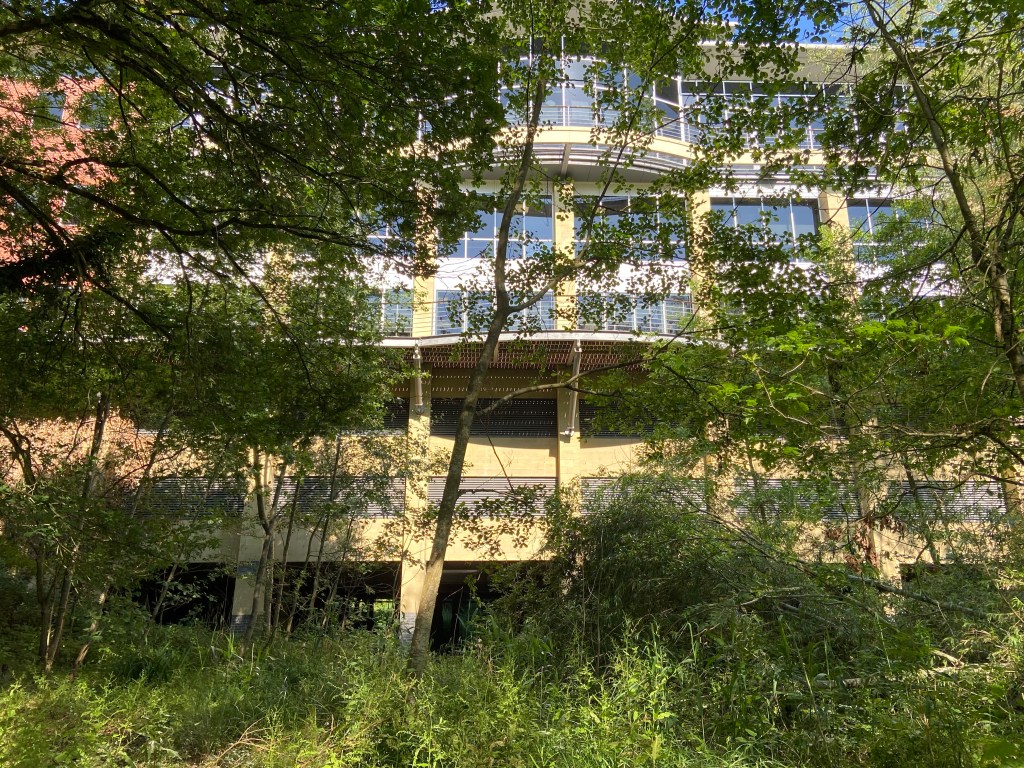
As I climbed out of that little dell, though, turning back I could see it was part of a huge complex which (as I saw on the map) included a number of buildings arranged attractively around a lake.
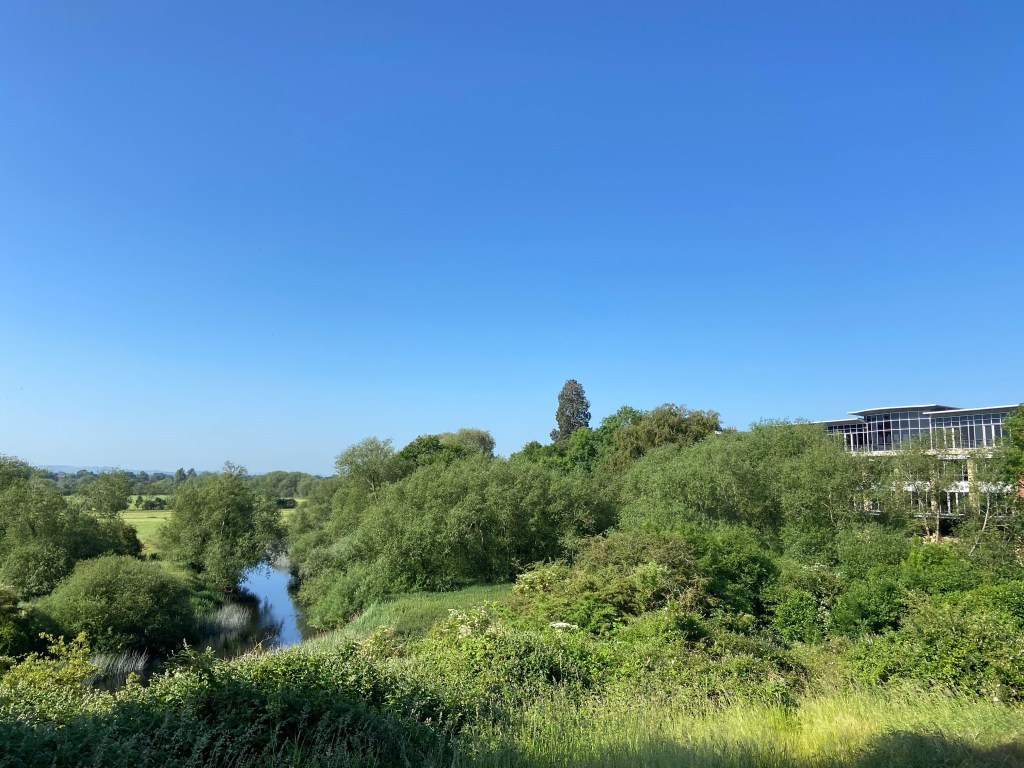
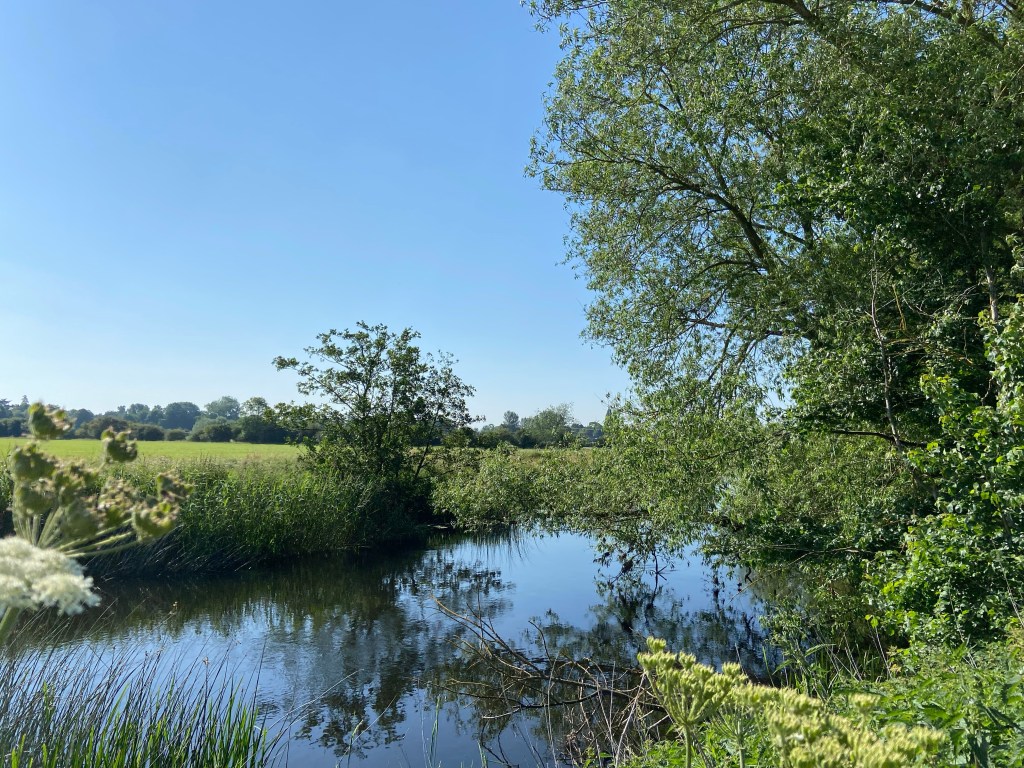
The river scoops round in a huge, ancient meander here, lying at the bottom of an escarpment which opened out to give me views out over the vale east of Stratford, fields and villages lying lushly in the thousand-year-old agricultural landscape after the recent rains.
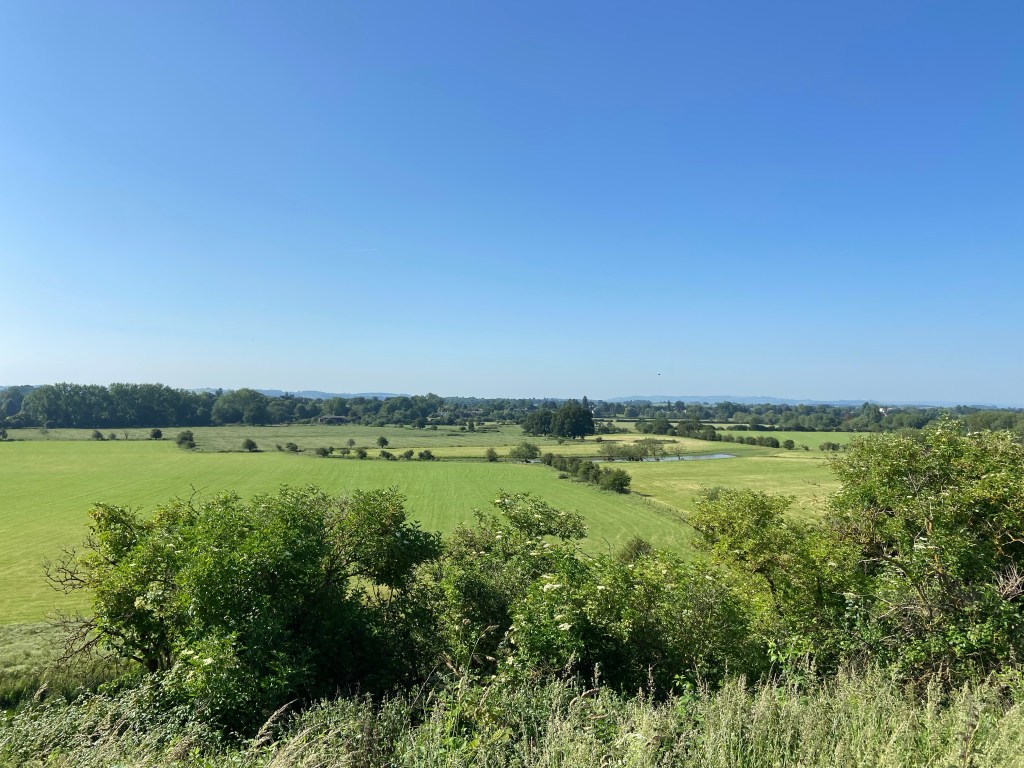
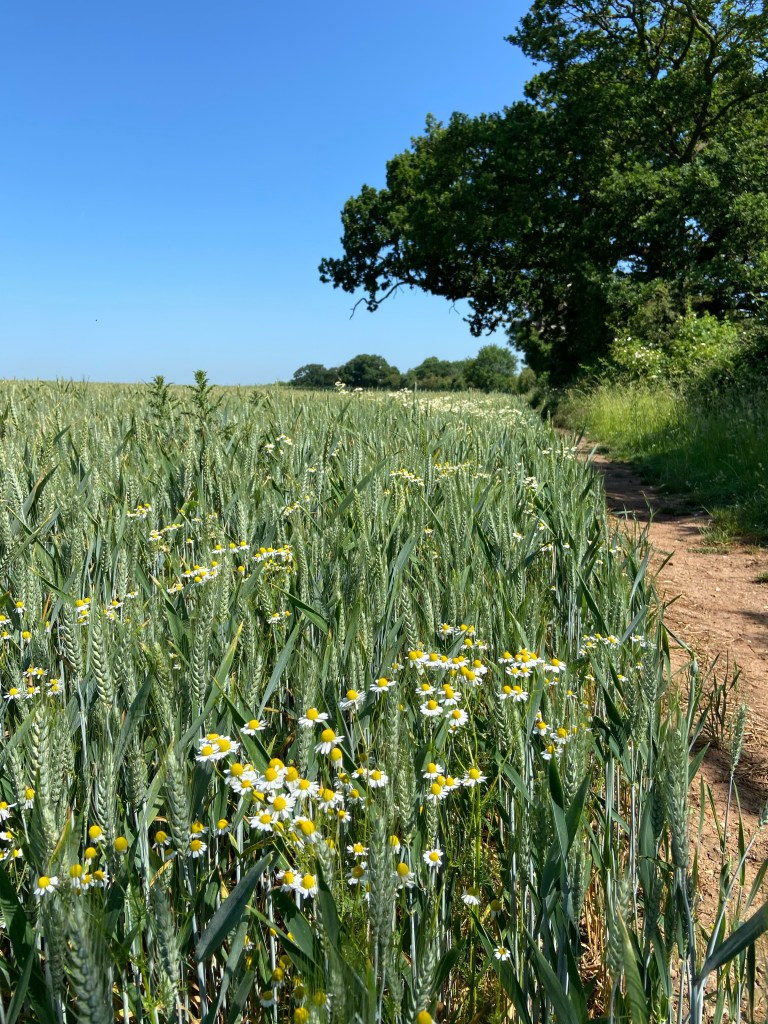
The path left the river and headed along a straight stretch of old Roman road with huge wheatfields extending out on either side, the position of long-ago grubbed-up hedgerows still discernible in the lines of oaks punctuating the fields. I have mixed feelings about this landscape: it is beautiful and well-kept and productive; but it is also effectively an ecological desert. Large-scale fields make industrial sowing and harvesting possible and profitable, but the hedges are the green corridors and habitats for so many species, and their loss means the loss of biodiversity. Even, efficient weedless fields of wheat are familiar to us now and seem ‘natural’ … but they are profoundly unnatural, and barren of the corncockles, cornflowers, corn marigolds that once filled the fields and fed the birds and insects, their vestigial presence now only an echo in their names.
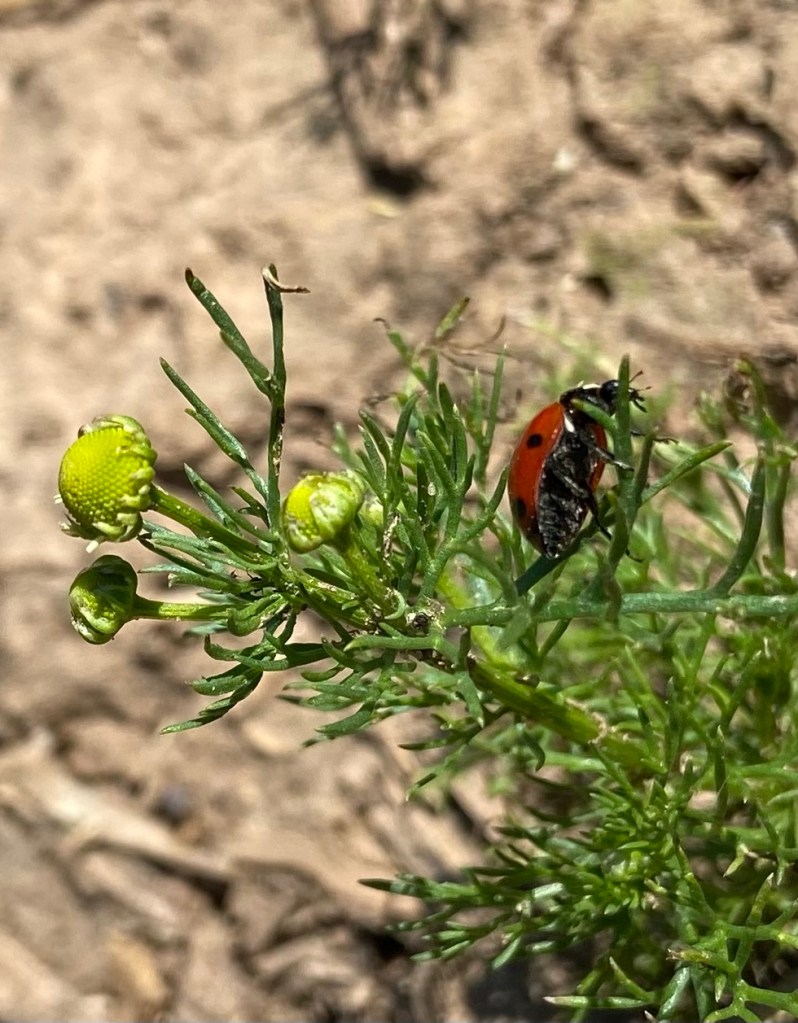
There have been so few insects to see that I was even happy to see a single tiny ladybird.
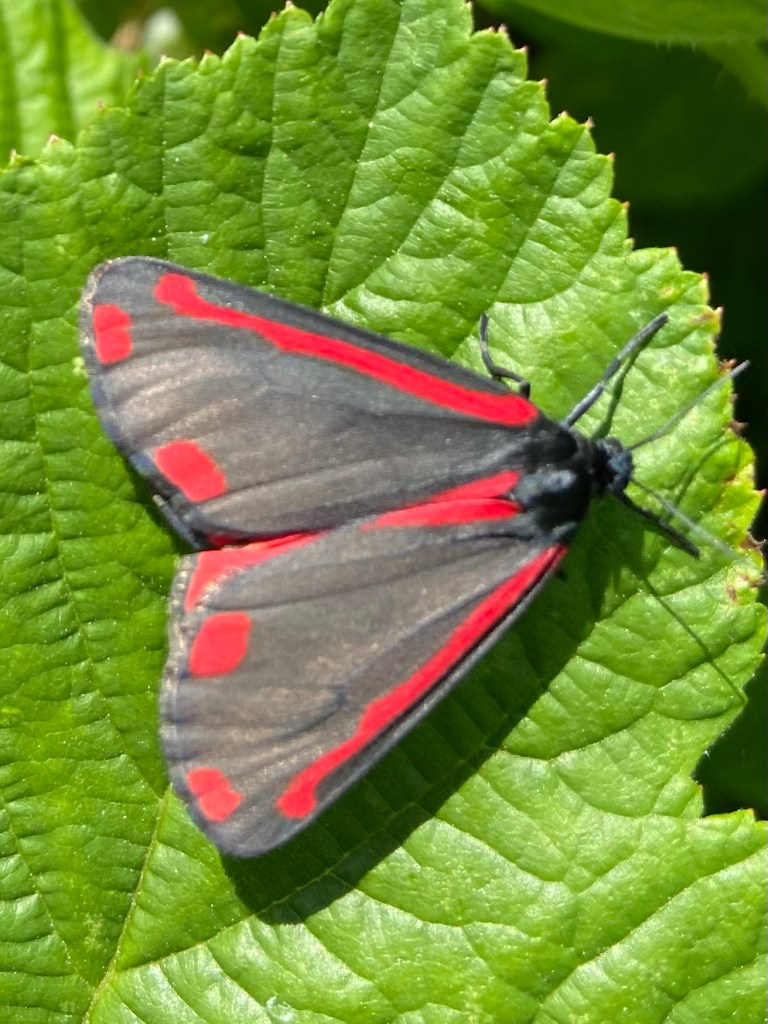
A cinnabar moth had clearly been able to find enough ragwort or groundsel for its caterpillar to pupate,
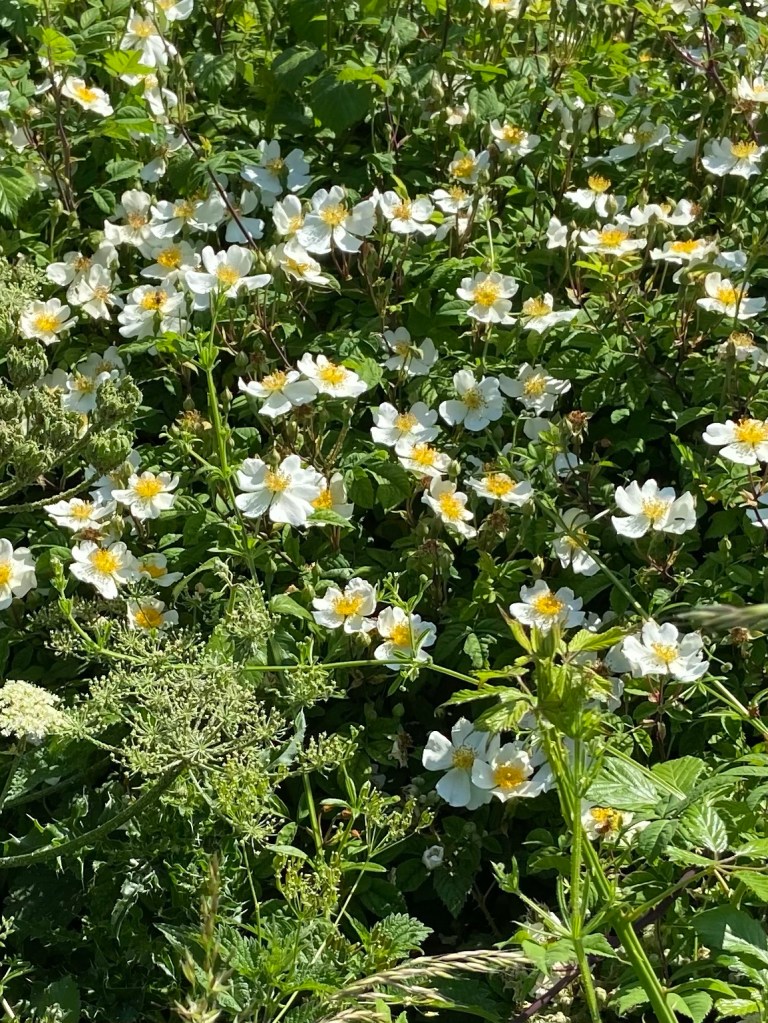
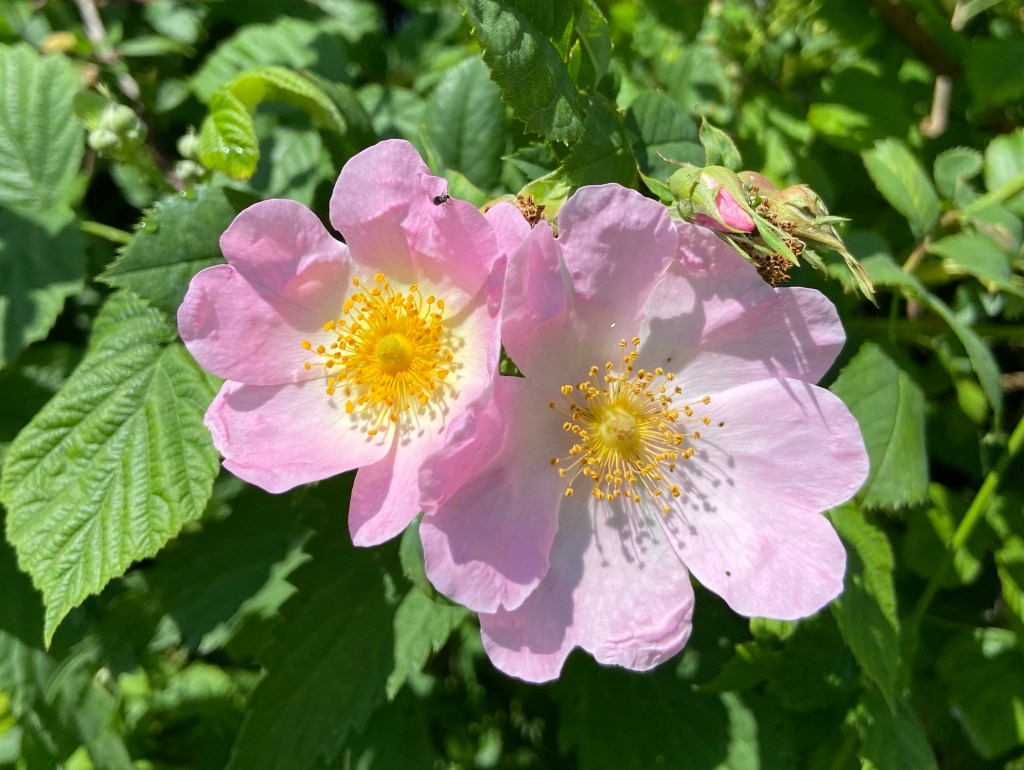
And like the bees, I continued to enjoy the dog roses, both pink and white (when they weren’t tearing my hairband off).
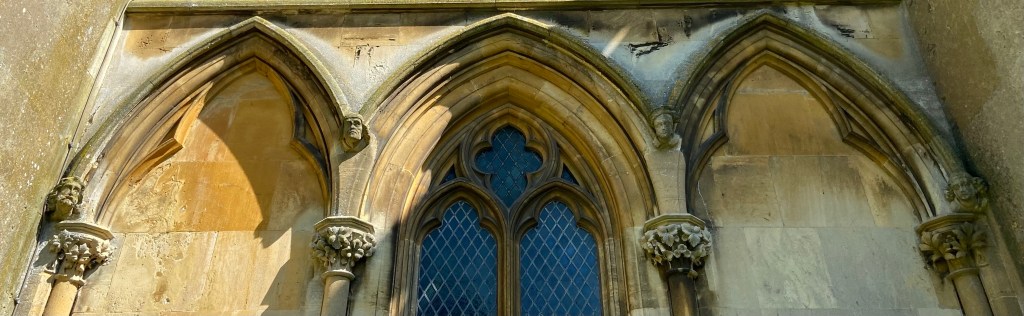
The village of Hampton Lucy failed to deliver me a café for mid-morning coffee, but I decided to visit the Gothic Revival church of St Peter ad Vincula — learning from my walker friend Jane Smith who, on her Land’s End to John O’Groats journey, made time to visit the places she passed through.
On the outside I rather liked the four Gothic-style carved heads placed like corbels on the window hoods – they each had real character.
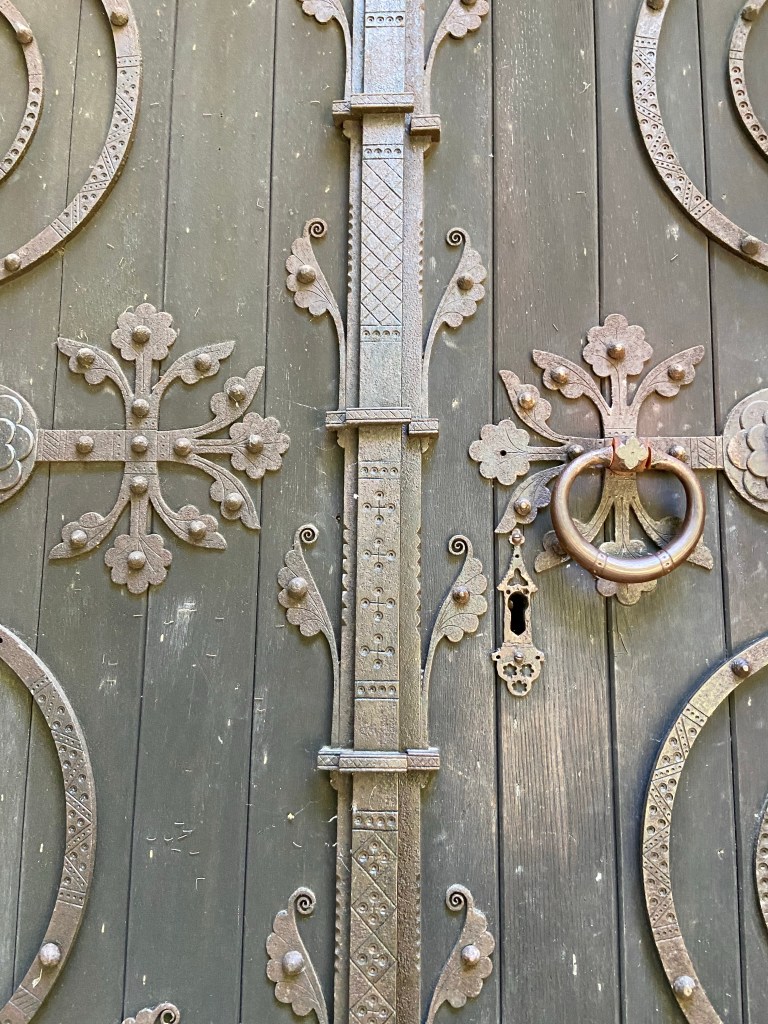
The door was a beautiful example of Gothic Revival ironwork,
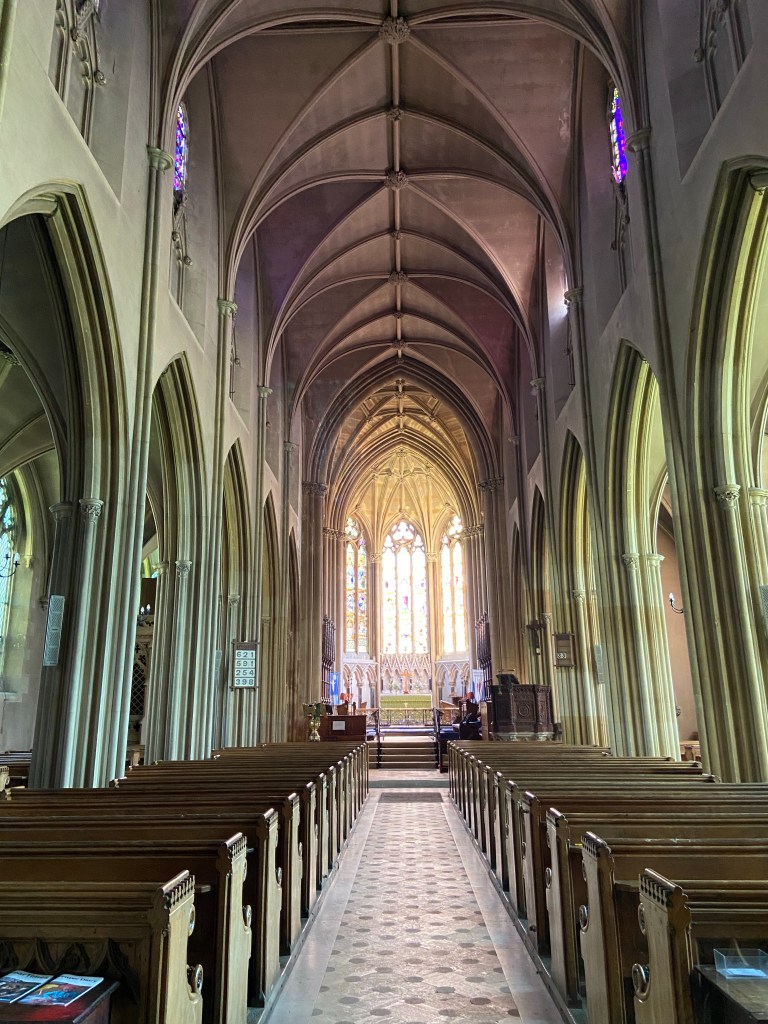
And the interior was cool and soaringly peaceful.
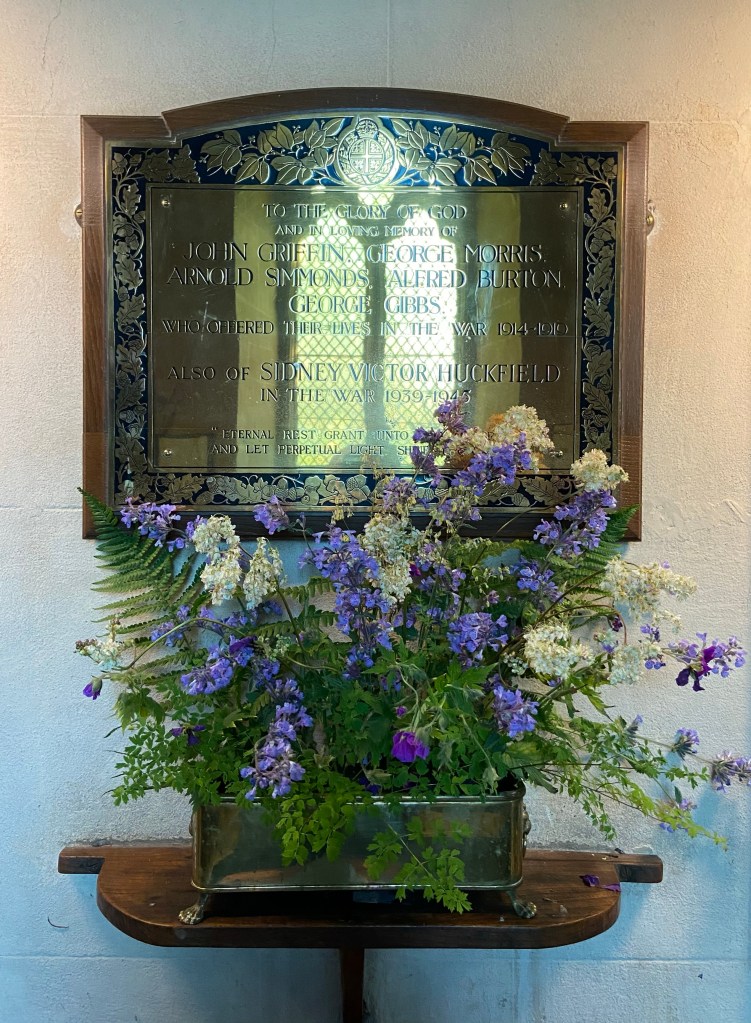
The organist was practising, so I sat in the Gilbert Scott porch and applied sunscreen, chatting to John Gilchrist who travels round the country in his spare time photographing war memorials for inclusion in the Imperial War Museum War Memorials Register.
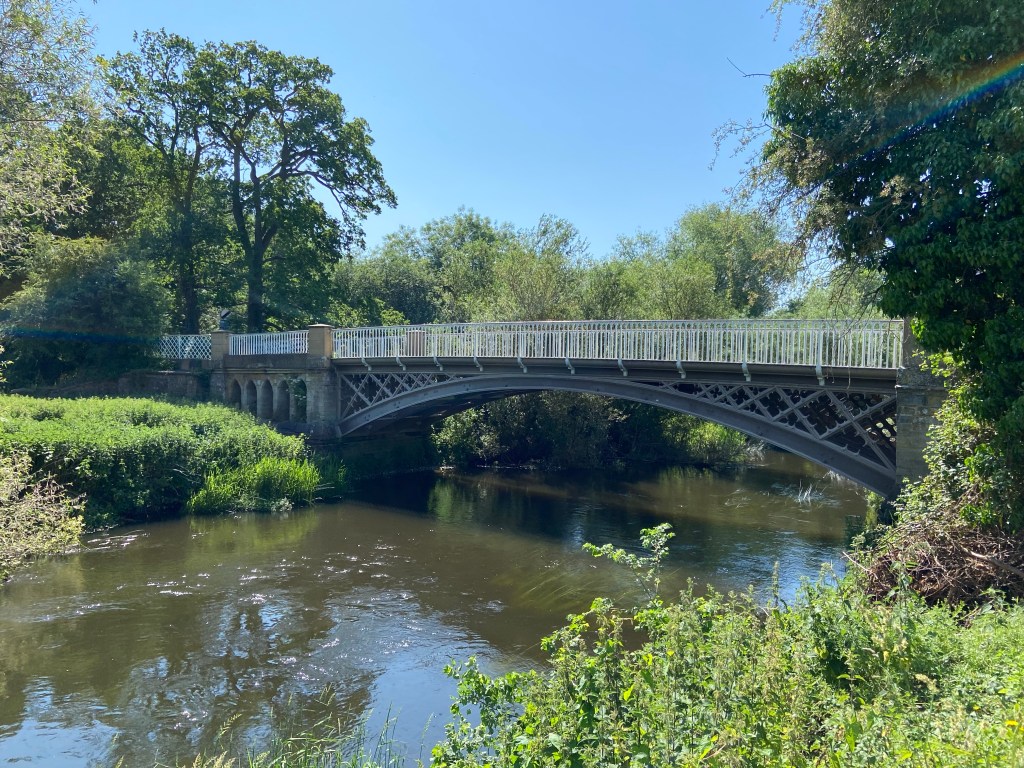
The Hampton Lucy bridge is a lovely cast iron affair, paid for in 1829 by the then rector of the parish, Rev. John Lucy. It spanned the quiet river gracefully and I watched the waterweeds moving gently beneath me until a group of passing cyclists (of which there are many) called out a warning to me and gave me the shock of my life.
Once again the path left the river. In my mind this 70-km Avon section was to have been a river journey and I was frustrated by how little of the river I had seen, both because the route diverts so much away from the river where there are no rights of way, and also because of the miles of weed overgrowth, which makes it impossible to get more than occasional views of the water. But I spent time thinking about this and felt my perspective shift back to the overarching purpose of the journey, a walk from Bromyard to Cambridge, reimagining this walk as a ribbon of land threading its way, not just along waterways, but also following woodland and field paths.
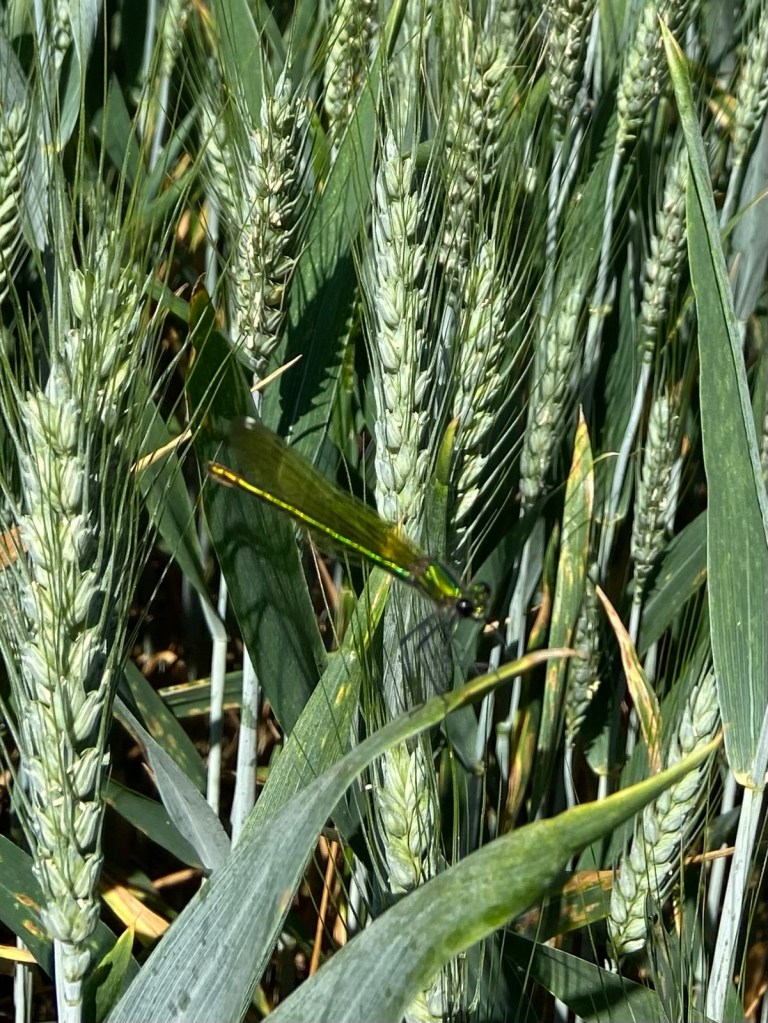
Several of these fields were prime damselfly territory. Alongside the male beautiful demoiselles were now their green female mates. Nearly impossible to photograph with my phone, but I did waste some time having a good go.
This was the last of path-walking for the day until I reached the very final section of the river. From here on it was roadways. I passed the Wildlife Trust Reserve of Hampton Wood and Meadow, struck by the birdsong and sorry I could not stop and explore,
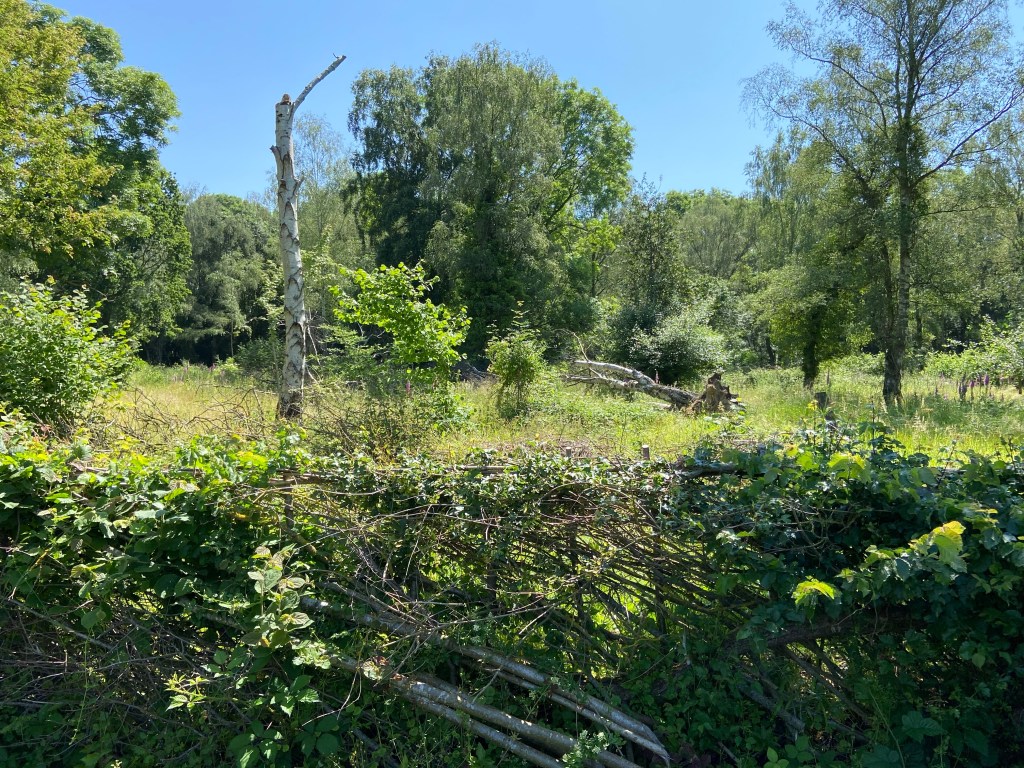
and bid farewell to the Shakespeare’s Avon Way at a bend in the road, for I was turning towards Warwick and Leamington Spa for the end of my day’s walk.
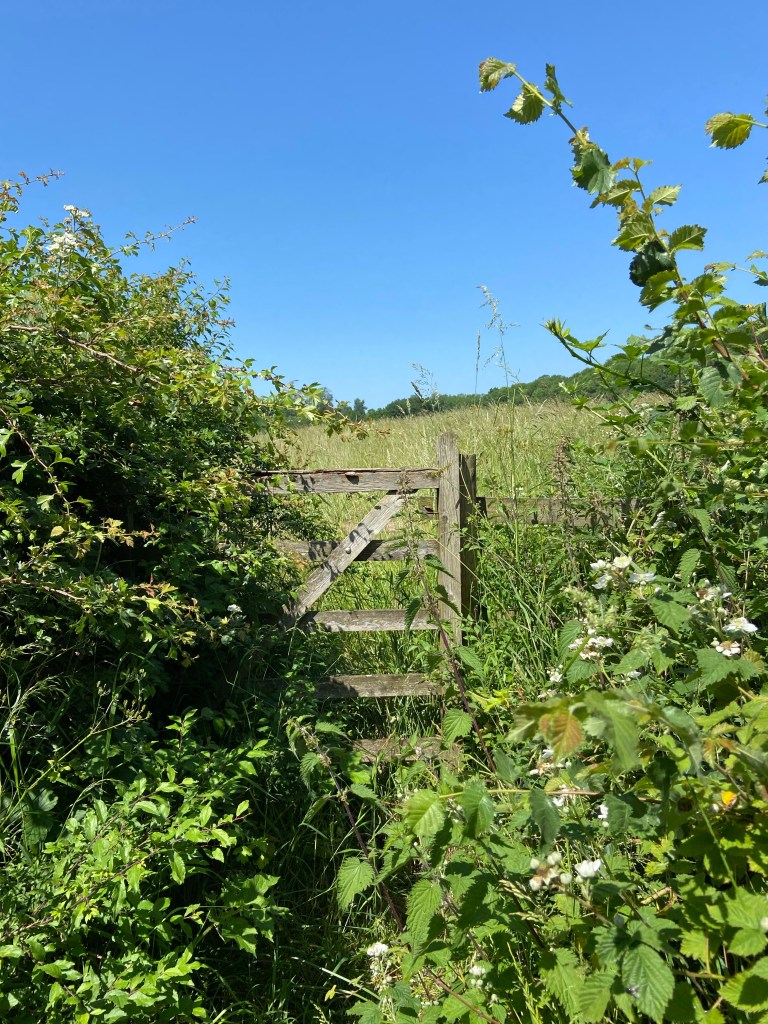
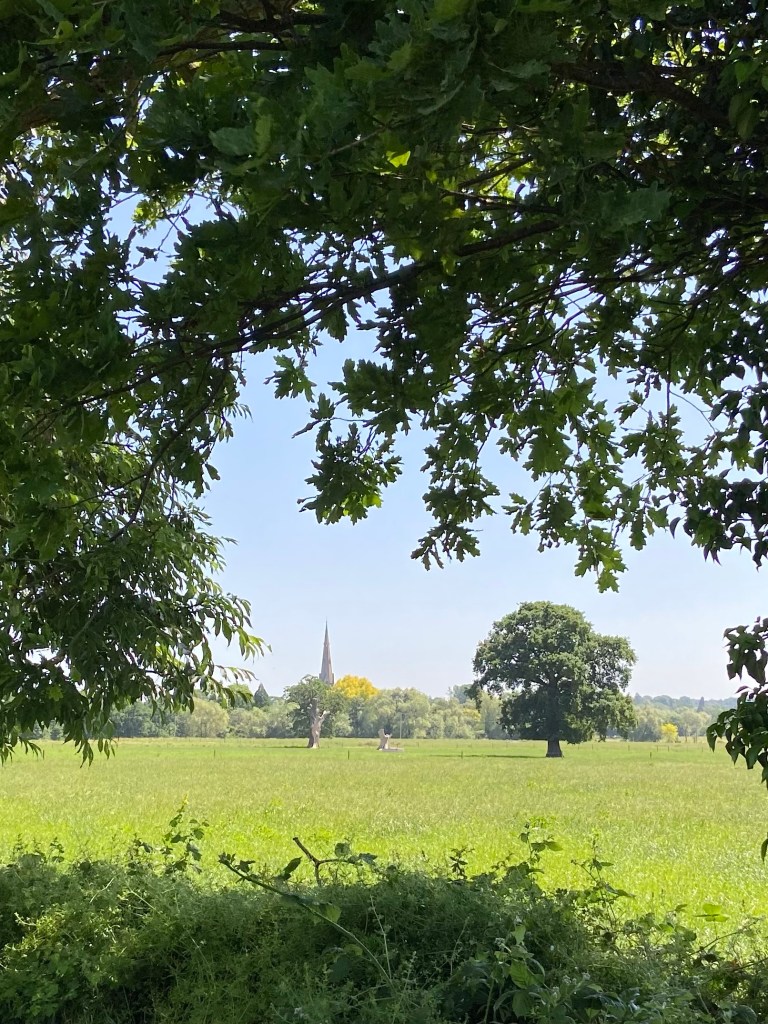
The bucolic views of village steeples framed like a Constable painting by ash and oak
gave way to road signage
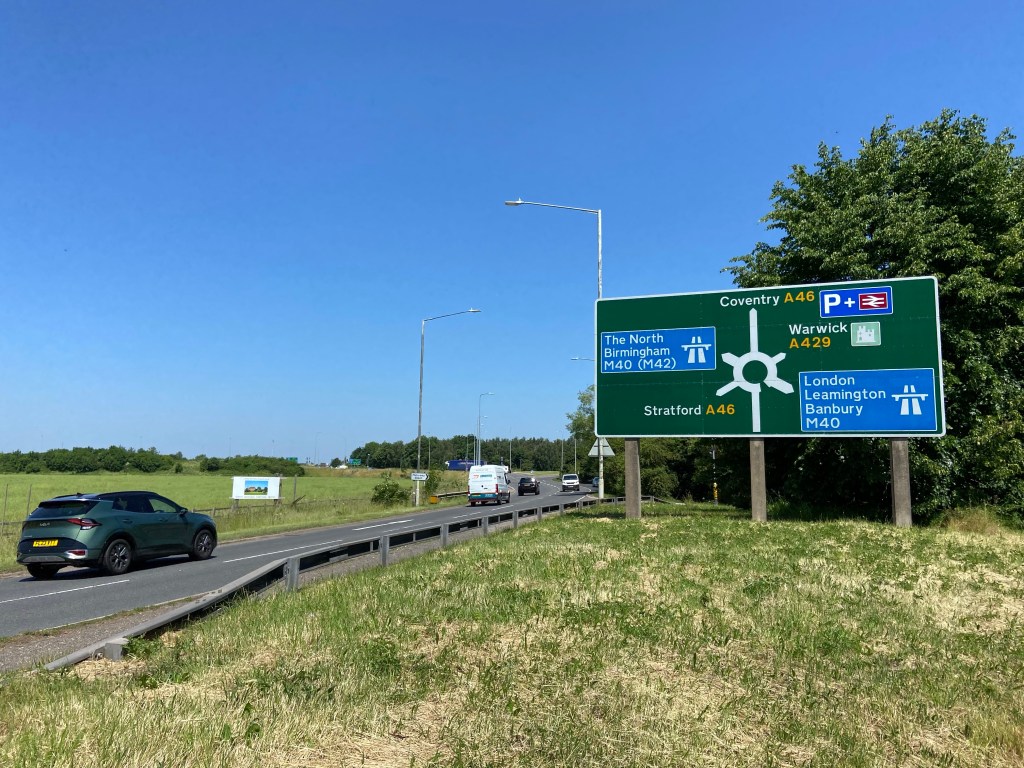
and I climbed an embankment on a cycleway to cross the eleven-lane M40 motorway. Vehicles seemed to me to be travelling terrifyingly and incomprehensively fast.
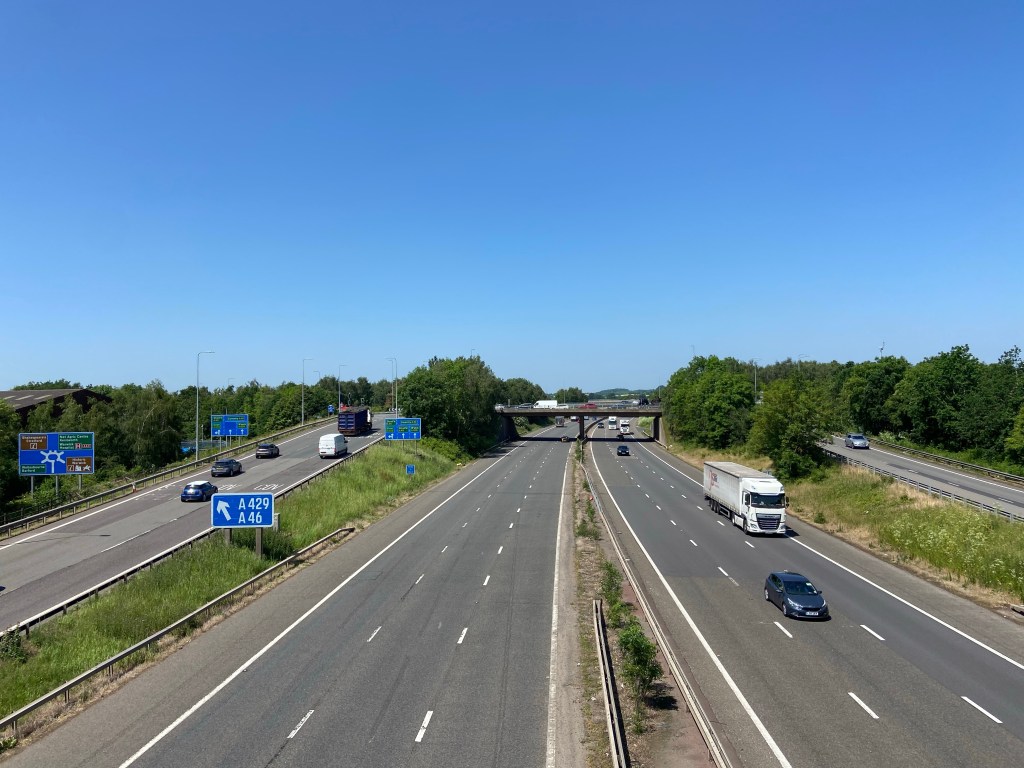
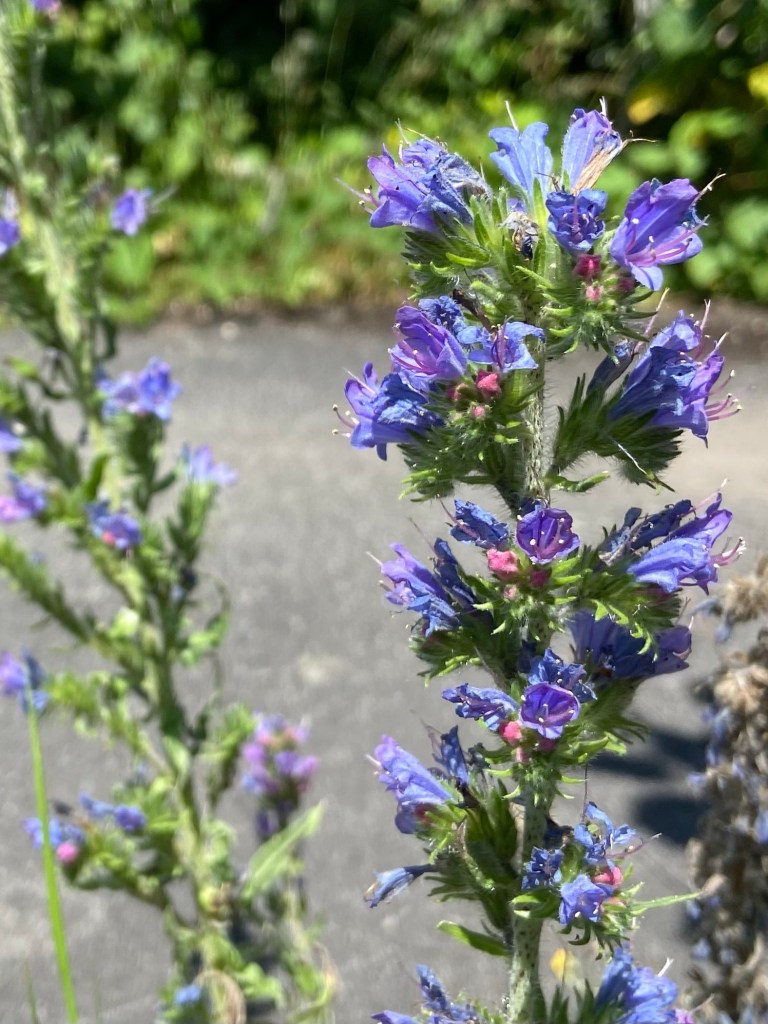
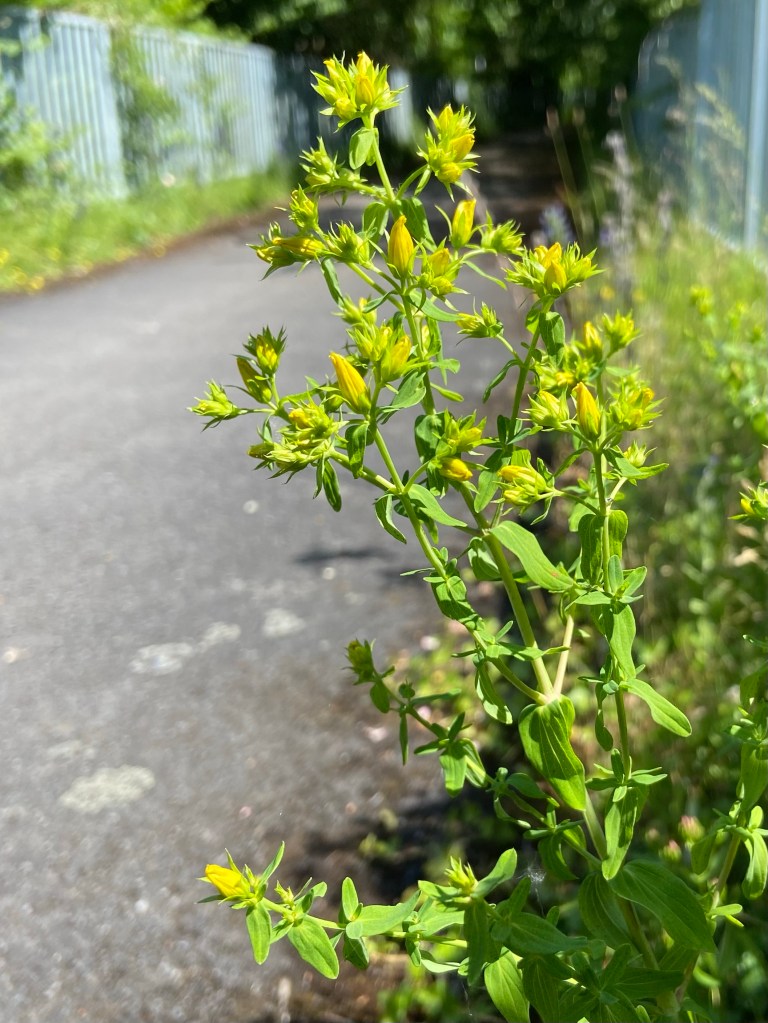
I have travelled this stretch of motorway many times, and it was extraordinary to experience it from a completely different mental standpoint, one more interested in the maturing broadleaf planting on the embankment, and the viper’s bugloss and common St John’s wort.
I was now right on the outskirts of Warwick, and having come 18 km, was really in need of a sit down and some food. I found both in the hub café of a business park. The freshest and fattest doorstep of a coronation chicken sandwich was prepared by the wonderful ladies who cater to the office workers. I rested for the best part of an hour, chatting to Tony about walking, cycling, nutrition, and the links between particle physics and investment.

Before moving on I went to avail myself of the loo and had a horrid surprise: I had left my bottle of sunscreen back in Hampton Lucy church.
This could be pretty serious, as it was now two o’clock and pretty blastingly hot.
I attempted to reroute a bit to try and walk through the woods of Warwick Castle, and asked a lady getting into her car whether there was access. There wasn’t, she said, but kind Emma got out of her car, unlocked her house again, and went inside to fetch me some suncream so that I wouldn’t burn on the rest of my walk. I am just bowled over by the kindness of strangers. Many people ask whether I’m scared of walking on my own, but really it is actions like Emma’s today and Sue’s back in Pershore which have been my experience.
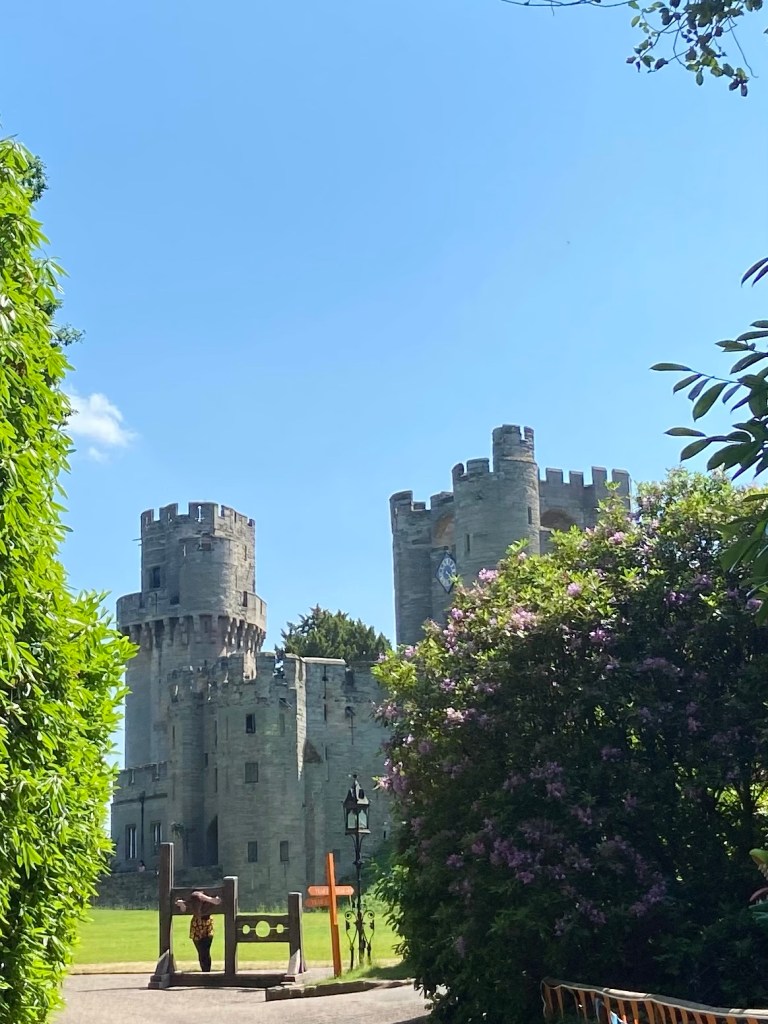
I could walk through other parts of Warwick Castle grounds though, accessing it from the Stratford road. Being on the edge of the tourist experience was slightly surreal: watching coach parties put themselves in the stocks to a soundtrack of screeching peacocks.
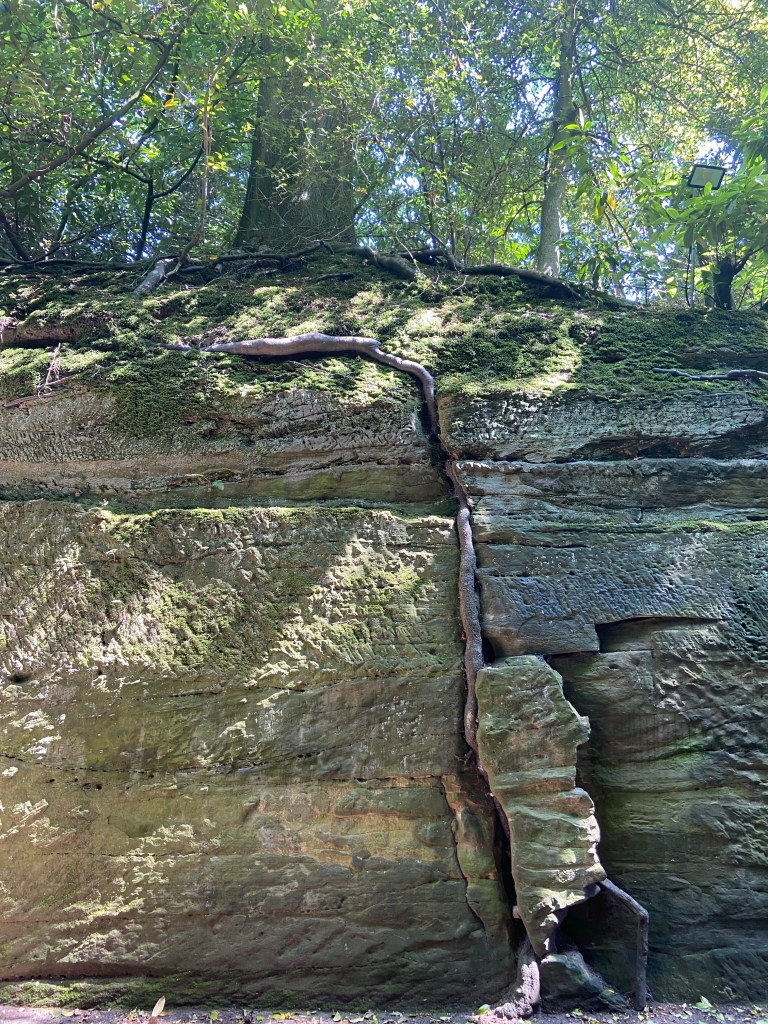
I exited out into the town of Warwick through a deep curving path cut into sandstone rock where ancient roots of a beech tree had snaked down, widening a tiny crack into a fissure. It looked like a miniature version of Angkor Wat.
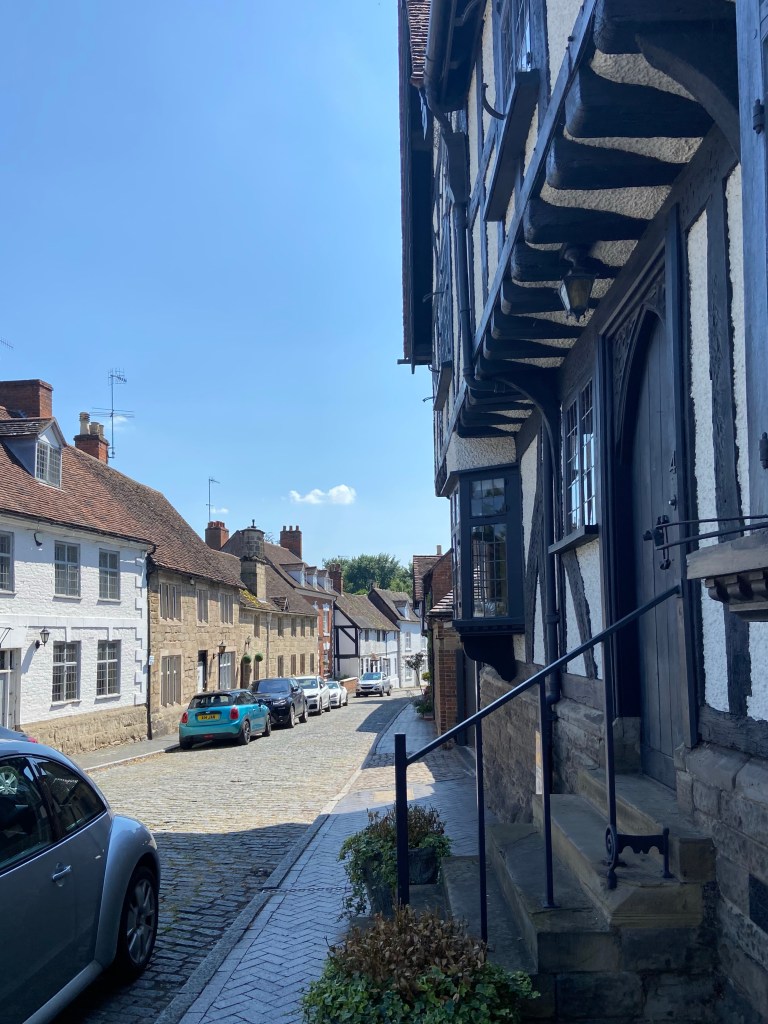
The sunken path spat me out into the ancient streets of Warwick, all half-timbered houses and cobbled streets,
and then across the road through St Nick’s park for the final section of the Avon: the riverside walk to Leamington. I was on the Centenary Way here and not Shakespeare’s Avon Way, which inexplicably routes higher up through the town and not down on the riverbank.
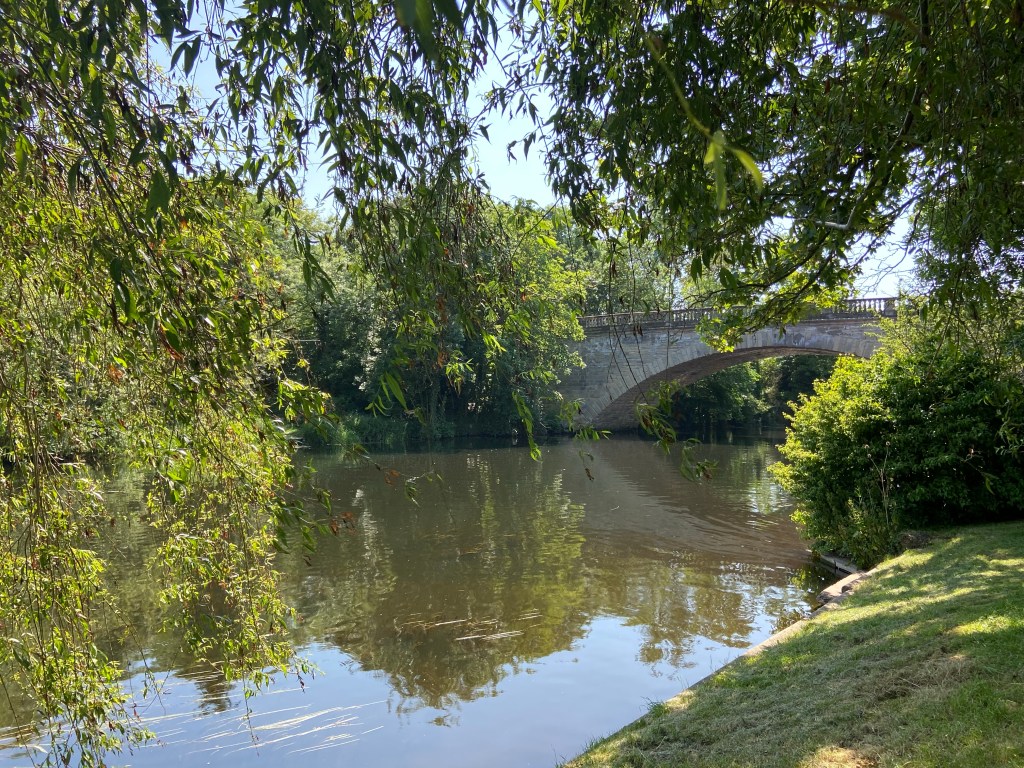
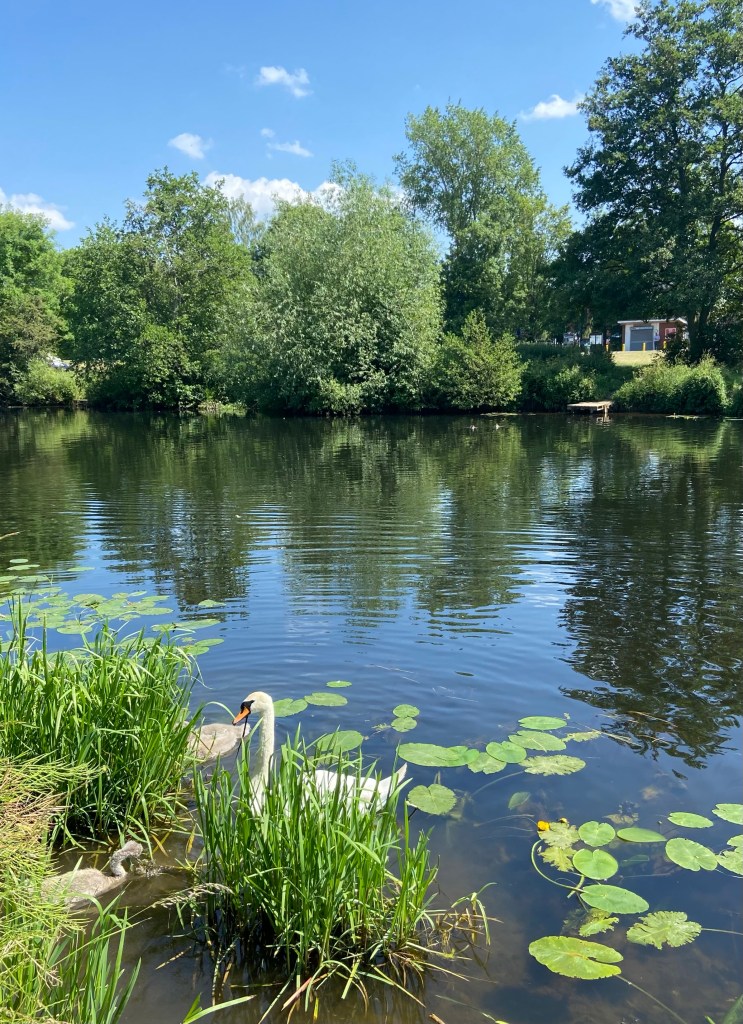
It was a wonderful finale: a sense of the countryside in the middle of town, the bluest of reflected skies in the water, swans teaching their ugly ducklings to snap up black slimy strings of waterweed amongst the waterlilies.
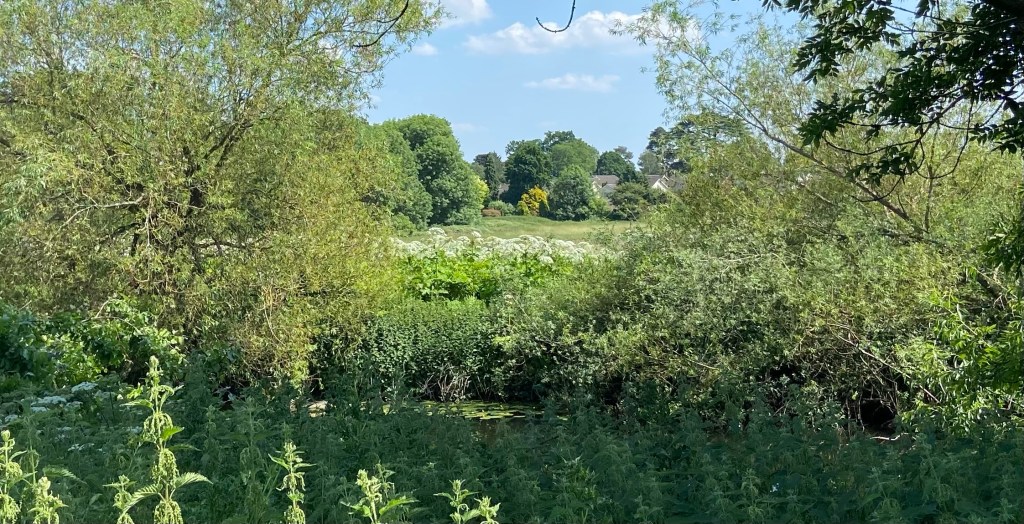
In the distance on the other bank I could see a gigantic stand of the super-poisonous giant hogweed. Of the hard-to-identify umbellifera it’s the most striking – and now quite rare because it is rooted out.
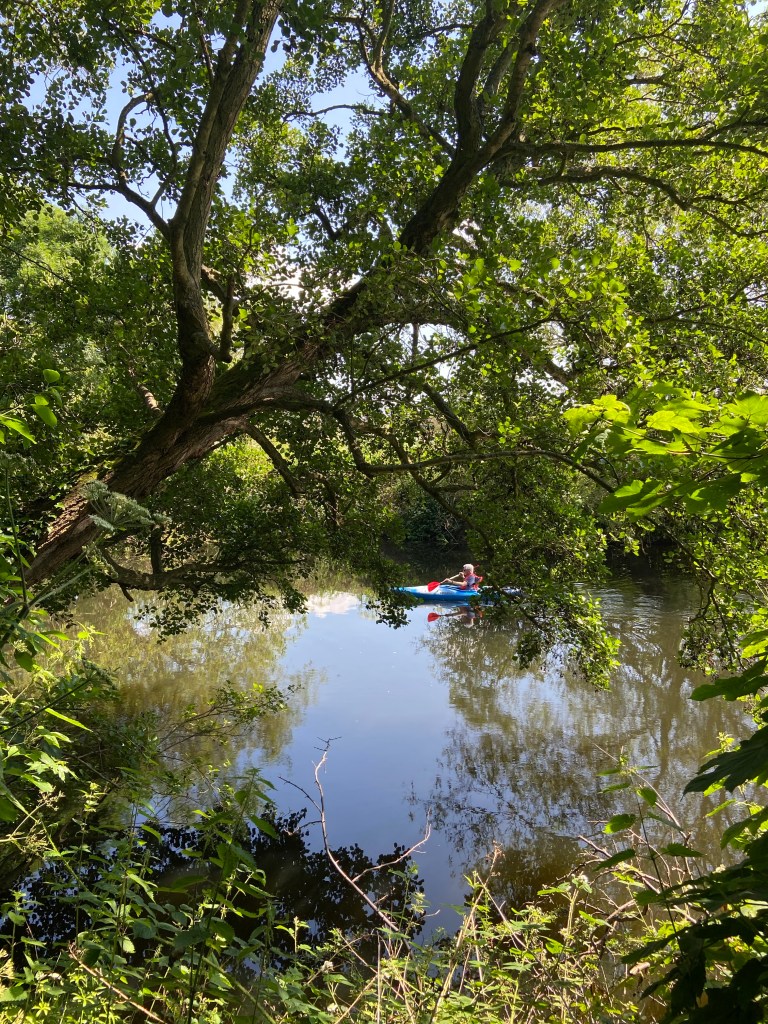
A few kayakers paddled upstream, ruining any chance I might have had for kingfishers in what felt like an otherwise quiet backwater.
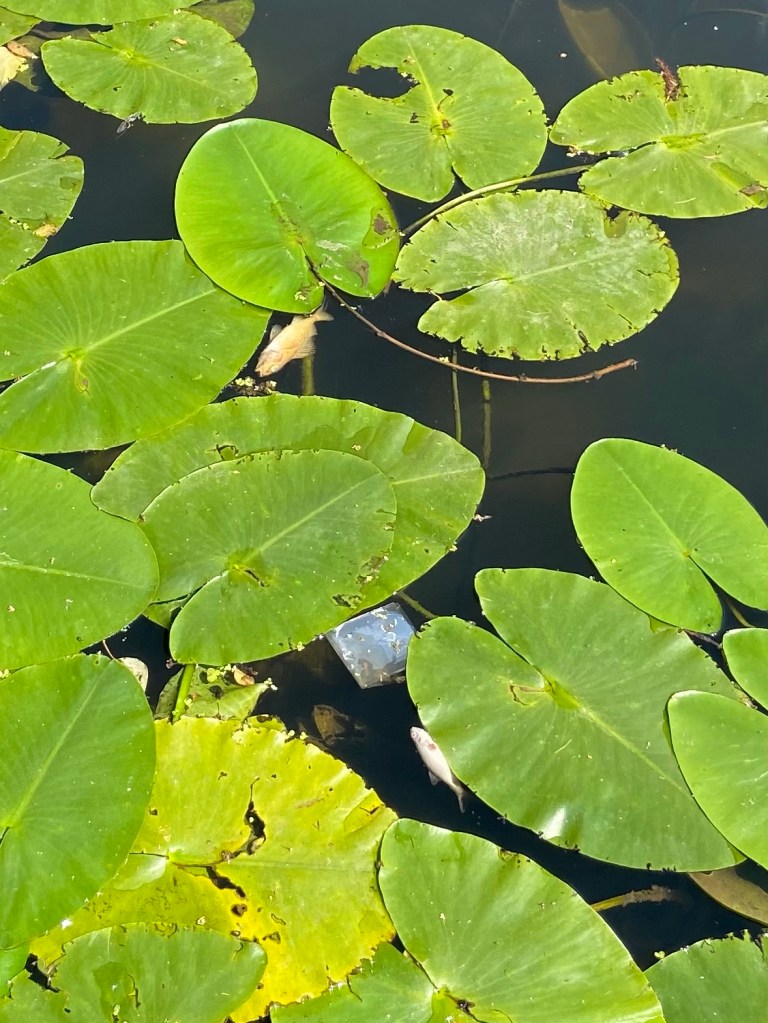
I went down to stand on one of the fishing platforms near where someone had left a link bikini out to dry and was shocked to see a dozen or so little fish, belly up and dead in the water amongst the reeds and lily pads. When I got back to Oscar and Charlotte’s I googled this and found the Facebook page of the Leamington Anglers. A post from the day before had noted that there had been a spill of some kind upstream from the Saxon Mill north of the town, and it had obviously worked its way downstream since then, and polluted this stretch of the river also. The Environment Agency is investigating.
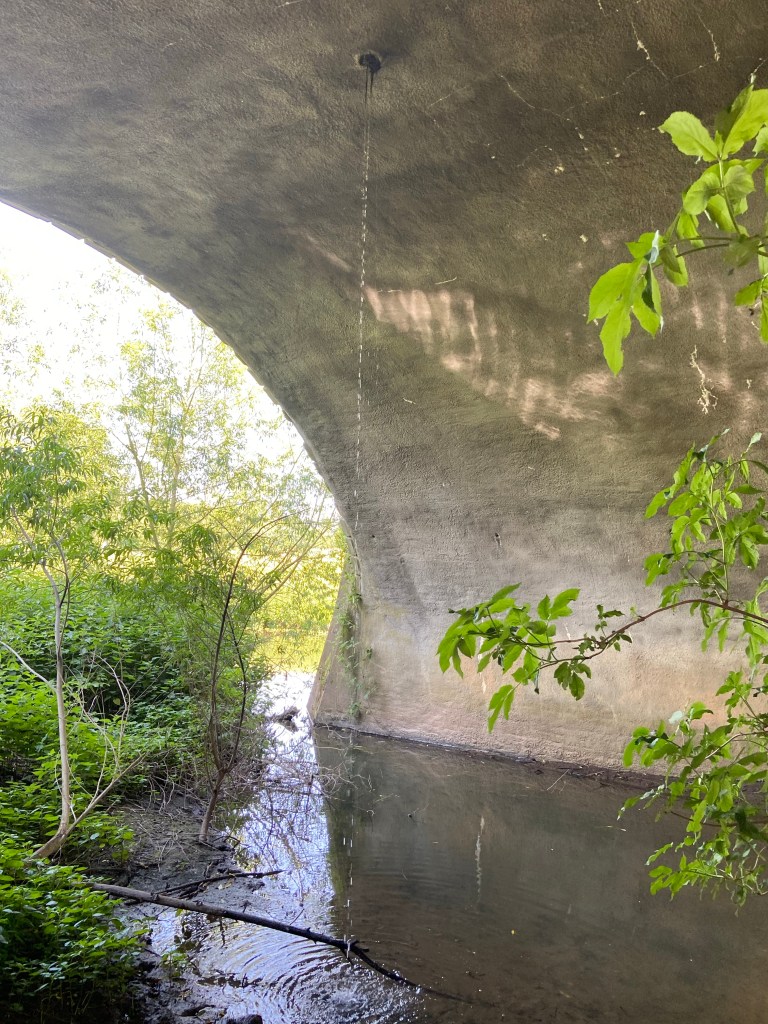
I reached the end of my journey along the Shakespeare’s Avon Way at the point where it flows under the aqueduct carrying the Grand Union Canal from London to Birmingham. It was leaking. I wondered whether I should be concerned.
I didn’t see a kingfisher or an otter, and there certainly was a degree of adversity in my three-day journey along the river. But there was also much that was deeply peaceful and beautiful, in the trees and the smoothly flowing river, and in the wildflowers and creatures that lived along its margins. I would not change it. Except perhaps go in early May rather than mid June, to be impeded by fewer nettles, and certainly not to encounter the tragic results of human river pollution. I would wish that away with all my heart.
 Walking The Landscape
I got a shout out! Very excited about that, thanks!
I was transported back to a year ago, doing the same canal section leaving Stratford in the same sort of weather. I really hope you’ll see a kingfisher soon. Xx
LikeLiked by 1 person
I think of you often, Jane. Happy packing, and happy walking to you!
LikeLike
Loving the Blog again Sophie. The pictures are beautiful. I’m just sad my Form have all left school now, so I’ve no one to share it with!
LikeLiked by 1 person
What a tragedy to see the poisoned fish. Hope you have good luck with the kingfishers soon. I saw one in the drive at Pixham a few weeks ago!
LikeLiked by 1 person
AMAZING!!
LikeLike