

Sam: This is it
Screenplay, Fellowship of the Ring
Frodo: What?
Sam: If I take one more step, I’ll be the farthest away from home I’ve ever been.
As always, the departure is an uncomfortable experience. Thursday’s walk was so familiar, undertaken with a tiny backpack and little more than sunscreen and water; today felt like the real departure. My stomach was a churning mass of adrenaline and queasiness, a sensation to which I have now become accustomed at the beginning of a long walk, and I recognise it as perhaps an inevitable part of the whole: anticipation, rather than panic. However, there had been a lot to do. I packed my rucksack last night and was horrified when I weighed it to see that even without adding drinking water at a kilo a litre, the pack weighed a hefty 10.5 kg. Certainly more than I felt comfortable carrying. Stephen sat on the bed while I emptied it all out, and we discussed how to strip out anything not absolutely necessary. Out went the binoculars (although I do feel this is an error as otherwise how can I observe all the KINGFISHERS that are waiting for me on the waterways?), out went my one warm hooded top (“the thunderstorms are just going to be wet,” my meteorological expert observed, “it’s not actually going to be cold”). The blog from day 1 took ages to write, and it felt like wading though treacle. I got it done, but it was 12.45am before I finished. Exhausting, and dispiriting.
But I felt sprightly enough when I got to school. Malvern College provided an iconic point from which to set off this morning, and it really felt as though I was starting the walk proper. Stephen waved me off from his office window.
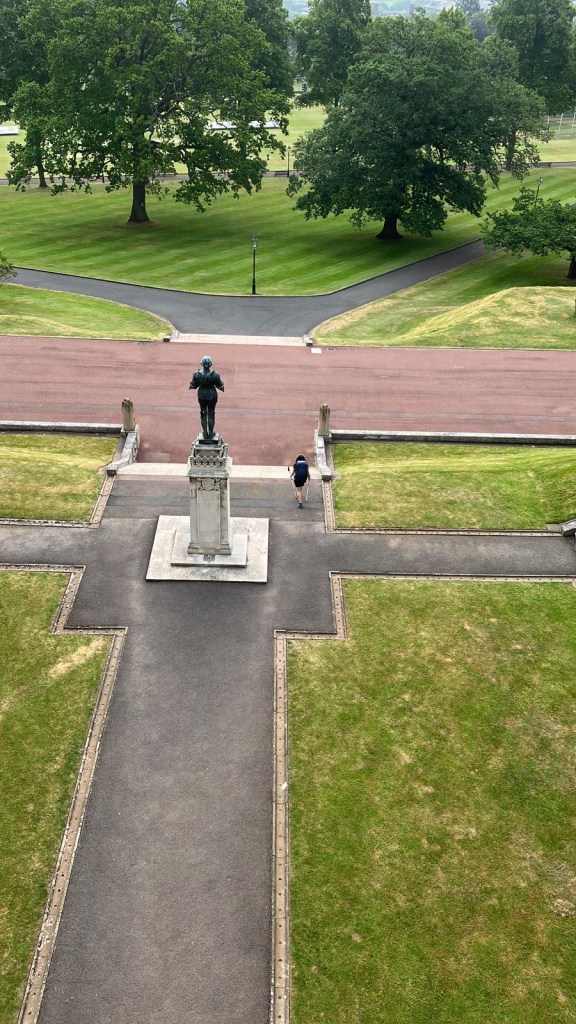
and I took a moment to interrupt Miss Fleur’s breakfast and wave farewell to her too.

Then I headed east, letting the footpath direct me, and the quiet meadows and woodlands swallow me up.
The path looked more as I would expect at the end of the summer, not at the beginning of it. Everything is parched and thirsty — although there are thunderstorms forecast for later on today. Indeed, there is a weather warning out.

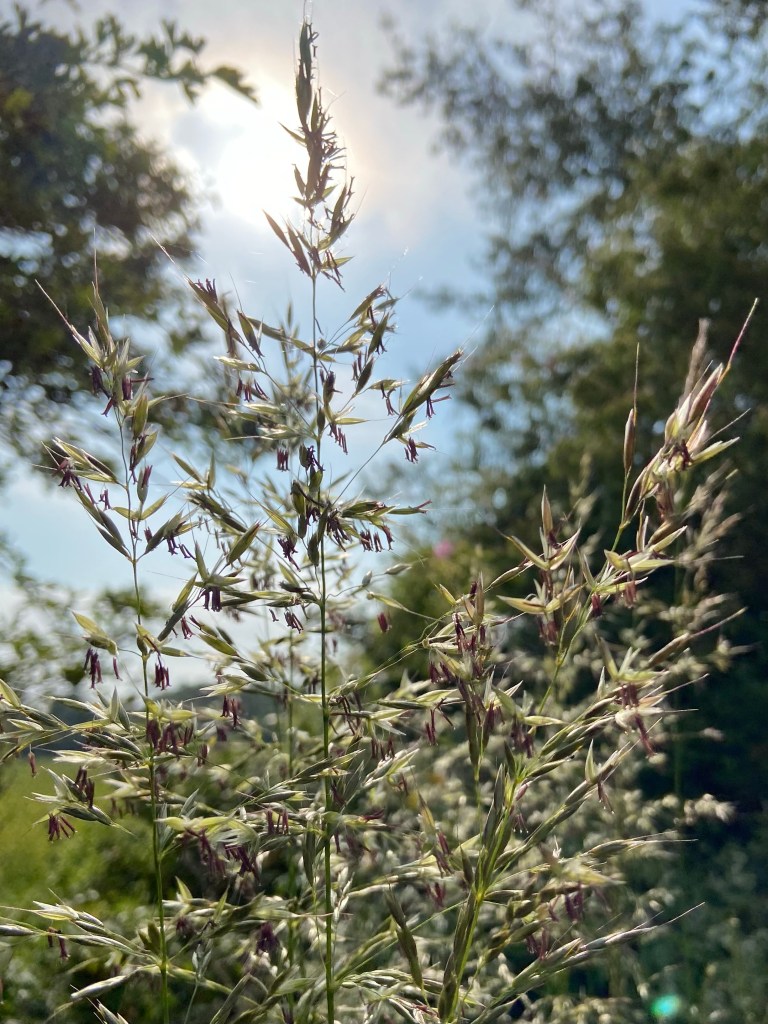
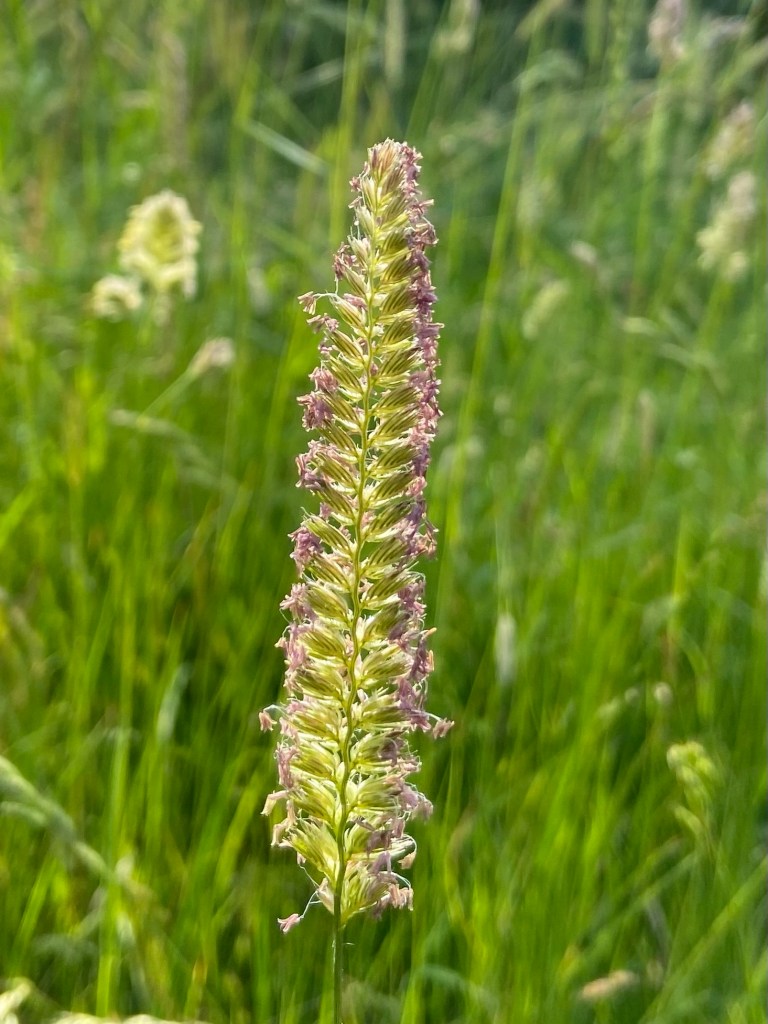
Now the spring wildflowers are decisively over, I was grateful for Carrie’s lessons in the identification of grasses. They have wonderful names.: Cocksfoot, Yorkshire fog, dogcrest, cattail, quaking grass. They are the evolutionary first of earth’s flowering plants, and undervalued, I feel. Up close they are exquisitely, minutely beautiful.
I would have been glad of a beast of burden to haul my pack up onto the top of Ox Hill, but I turned at the top and forgot my literal breathlessness at the sight of the physically breathtaking panorama of the Malvern Hills behind me. I was not sure I should have this sweeping view again, so I paused for a moment to savour it. Or perhaps it was just to catch my breath.
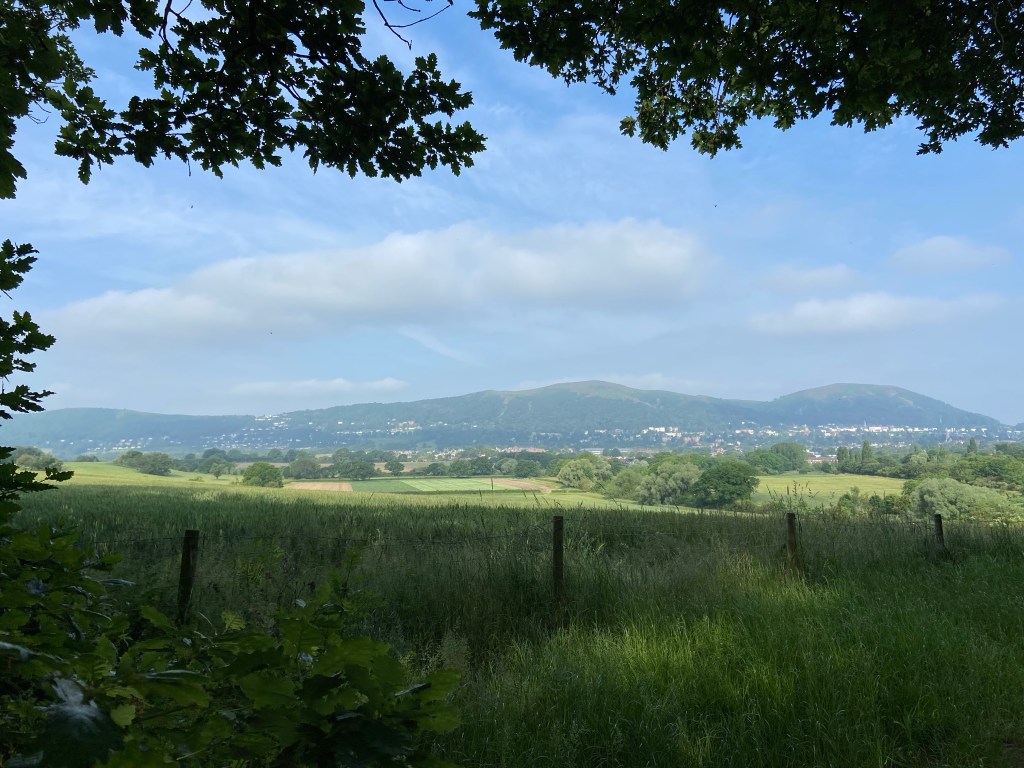
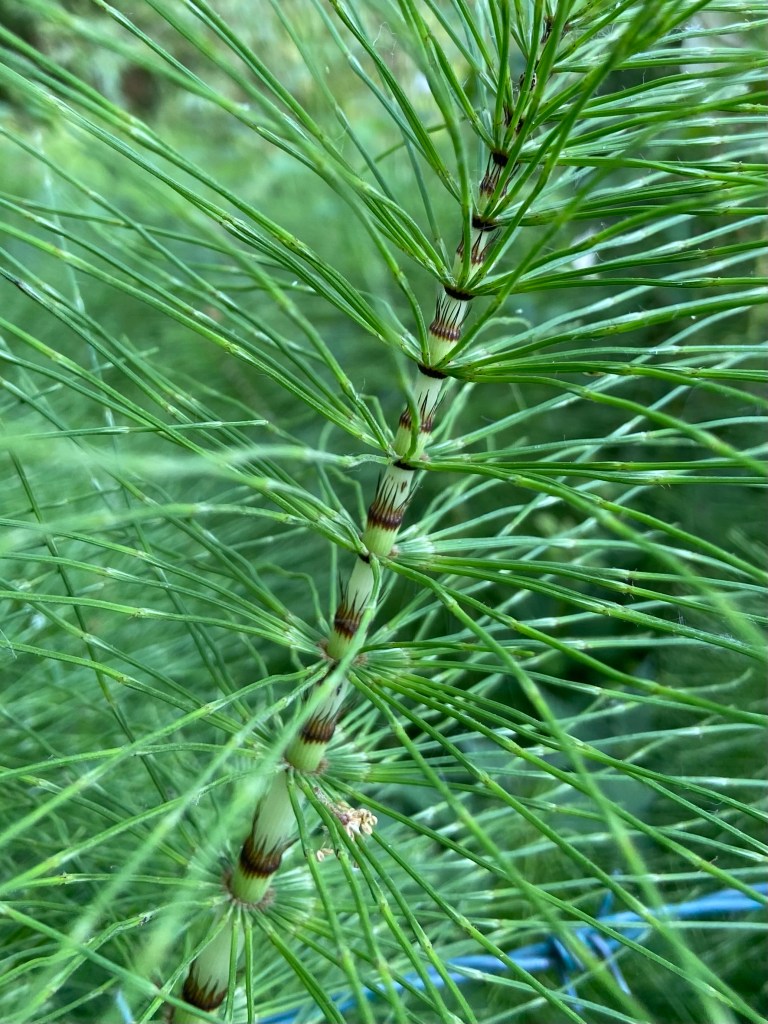
The fields beyond were flat and quiet. I interrupted rabbits at their peaceful morning flayrah. They scattered before me, racing for the shelter of their dry borrows. Other fields were full of long meadow grasses upon which bright blue damselflies rested, and the white clover which denotes nutrient poor grassland, so that it was not a surprise to see the parasitic yellow rattle, setting seed in its telltale seed pods. Between each field was a ribbon of damp ground moistened by a thin trickle of water where grew mares-tail, older even than the flowering grasses.
I came into the first major village, Hanley Swan, down a long lane leading to the village pond, feeling as though I could almost drown in the draughts of wild honeysuckle perfume emanating in waves from the hedges. I reached the Swan Pool just as the sun came properly out to perfect the view.
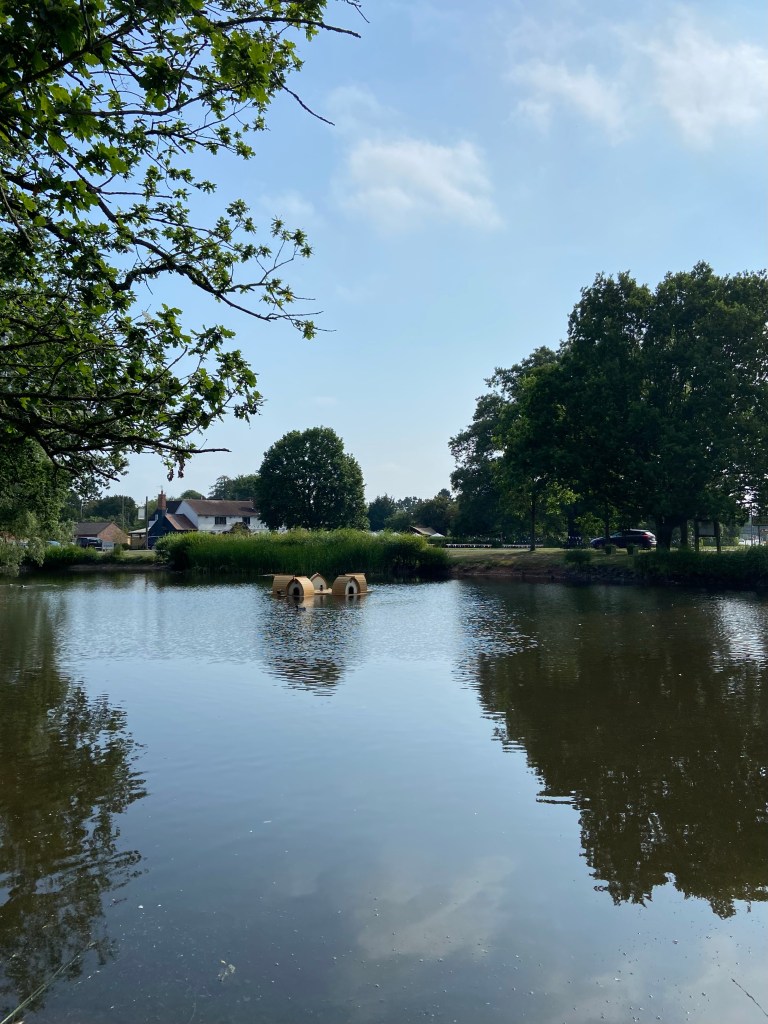
There doesn’t seem anything much more quintessentially English than a village green with a duck pond and a huge oak with a circular bench around the trunk, and bunting.

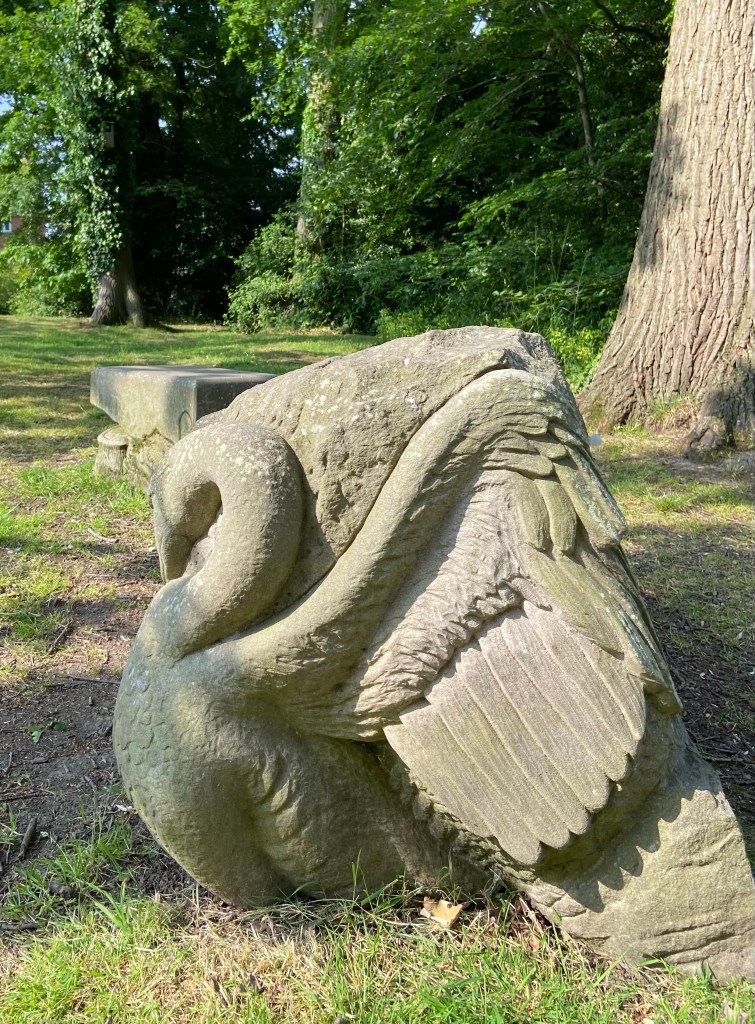
Two lovely sisters were sitting on the bench beyond the carved stone swan, with their three-legged collie, Tom.
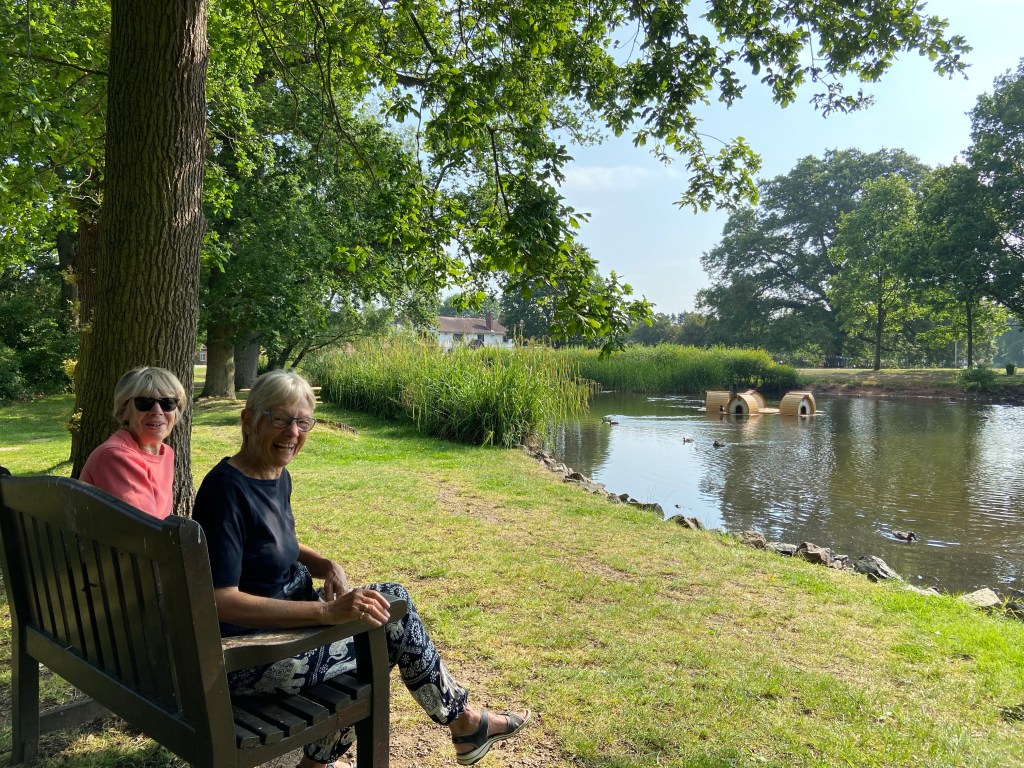
Helen and Sue were the first people I had talked to properly to since starting out, apart from exchanging pleasantries with the dog walkers out early to try to beat the heat. So far I had walked without putting sunscreen on, but the heat, even so early in the day, was beginning really to pack a punch, and I stopped off at the Swan Inn to tie my hair up, admire the wallpaper in the toilets, and liberally apply sunscreen.

The fields and roads are utterly flat now; I have moved decisively onto the alluvial plain of the River Seven. I passed Gilberts End Farm with its Tudor chimney stacks. The farm threw up a sharp memory for me of knocking on the door there more than a quarter of a century ago, to ask permission to take 1200 walkers along the public footpath running across their land, on a school charity sponsored walk. That walk was almost the first thing that I did at the school after moving back from Italy. I remember pitching it as an idea to the headmaster before I had thought too much about what it would entail, and Stephen‘s frustration at my impulsiveness. In the end, the marathon distance route took us a whole year to lock down, since we felt we needed to secure permission from each landowner (for which there is no national register, it is simply a matter of identifying your route and walking each inch of it, knocking on doors asking who owns the land) to take such a large number of people across the fields, even if we were walking along public footpaths. It was a colossal undertaking, but in the end I felt the £25,000 raised for National Meningitis Trust was worth the effort.

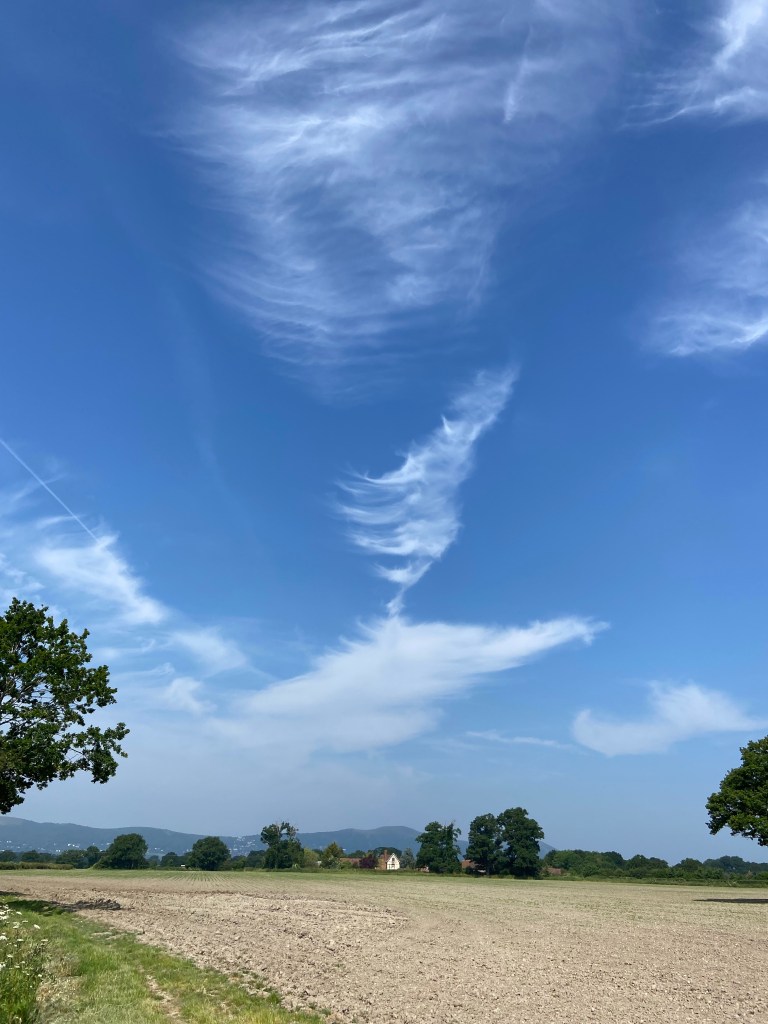
The fields beyond the farmhouse were my first experience on this route of the frustrations of walking across farmland. Field edges have changed over time and mapping sometimes has not caught up, or ploughing and sowing have erased the visible footpath. I stopped to put a little more sunscreen on my nose and take my pack off for a while, and as I appreciated the backwards view to the ancient farmhouse, the hills and the high-level cirrus clouds, I heard a cuckoo calling ahead.
The halfway point on today’s journey was the riverside village of Upton upon Severn, which grew up around one of the few crossings over the river around here. My mother and I came here a couple of months ago for lunch, and the water was so high it was threatening to overtop the banks (a not infrequent occurrence here). Today, the river level had dropped sharply, and people were out in shorts and T-shirts, as grateful as I was for the airconditioned cool of the supermarket where I stocked up on some lunch for later, and some water to supplement what I had with me.
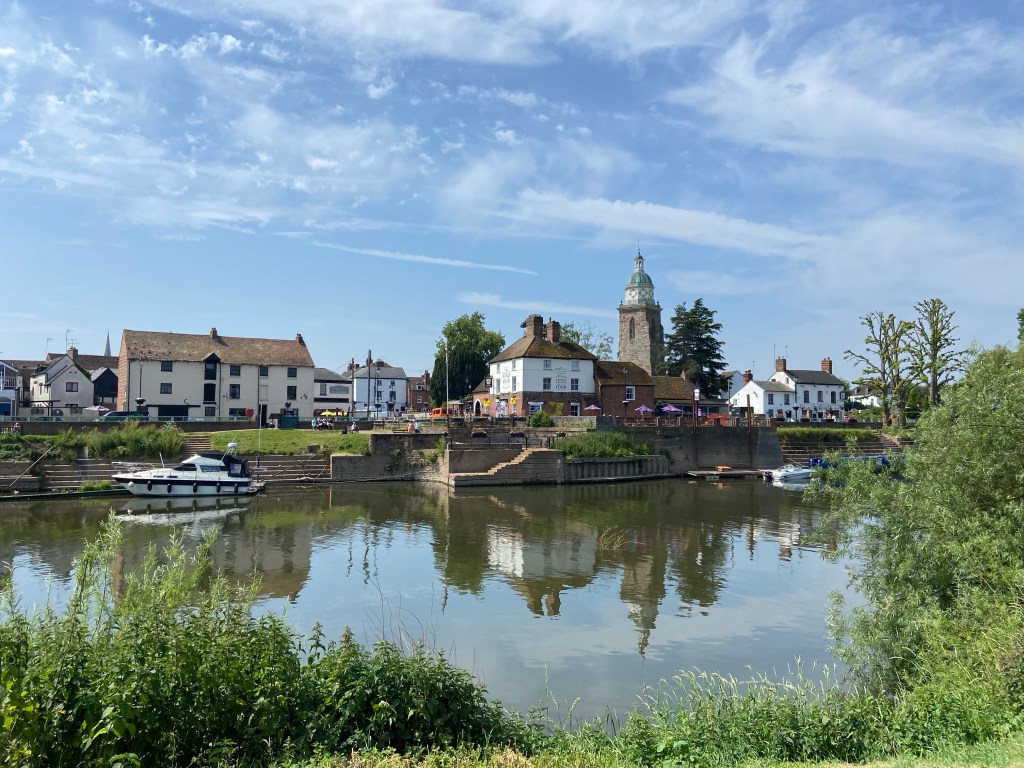
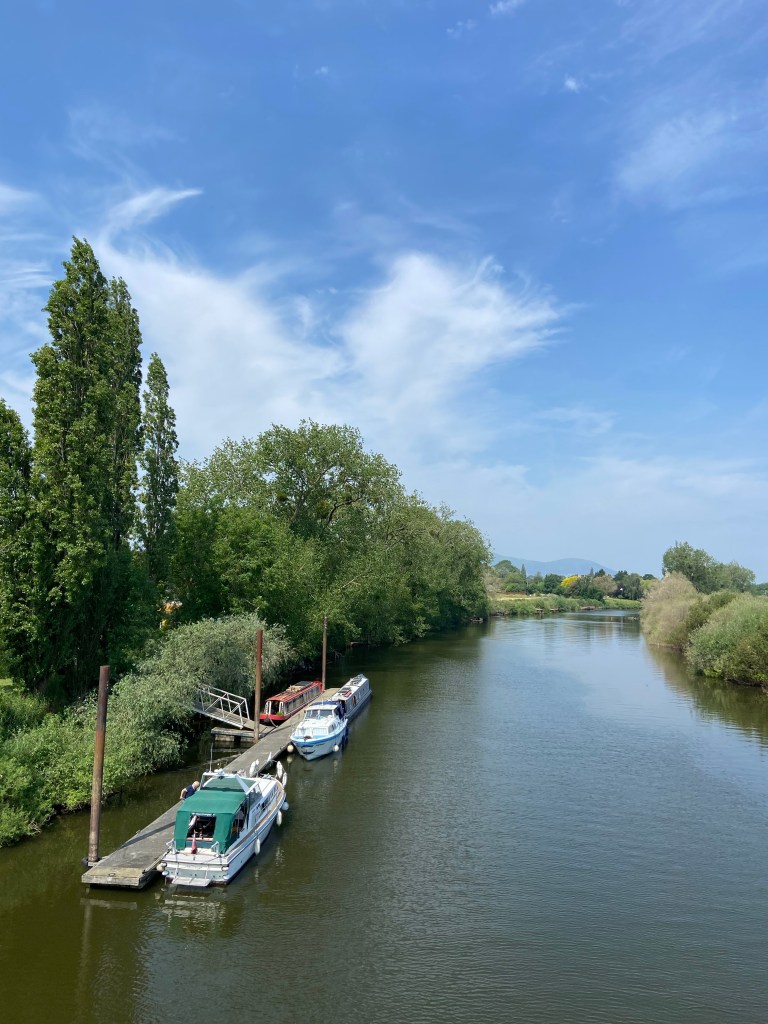
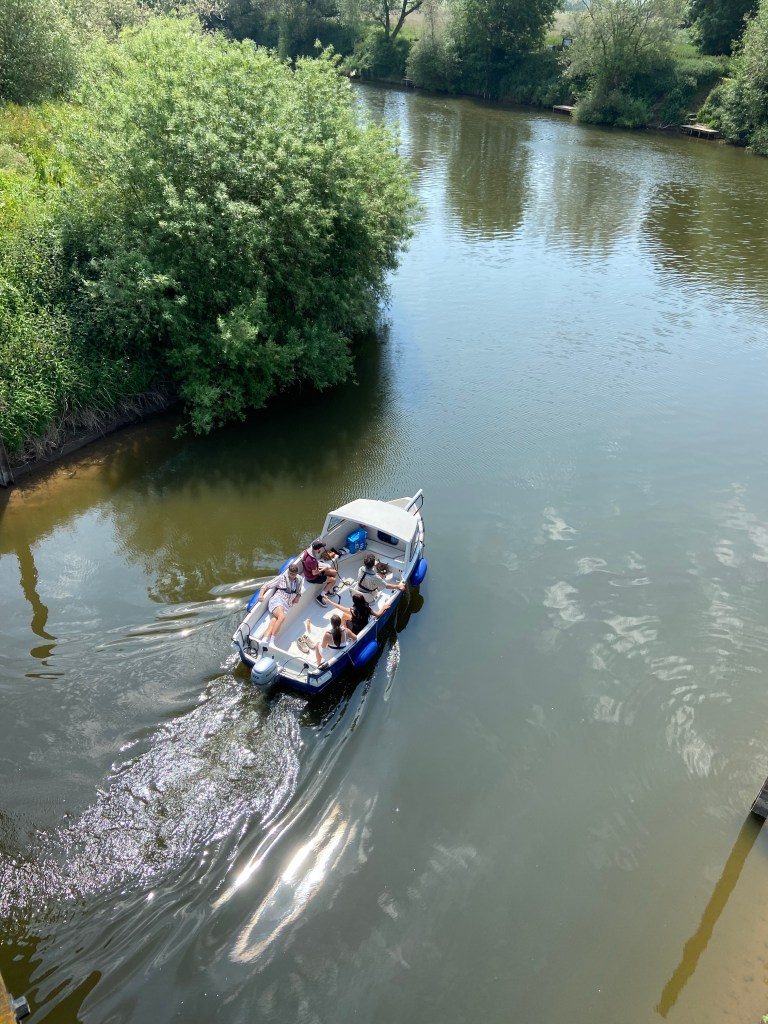
I crossed the river at the bridge, which gave wonderful views back to the hills, reassuringly far away now. The river looked as pretty as a picture, the waterfolk spring cleaning their craft and their moorings.
On the other bank was a feature of this route that I have been looking forward to all morning: Upton Marina. There is something vicariously luxurious about a marina, about strolling along the wooden boards of the dock, and dreaming mistily of owning a little boat. It being Saturday, and a hot one, various boat owners were getting away from it all. Some young lads were paddling canoes,
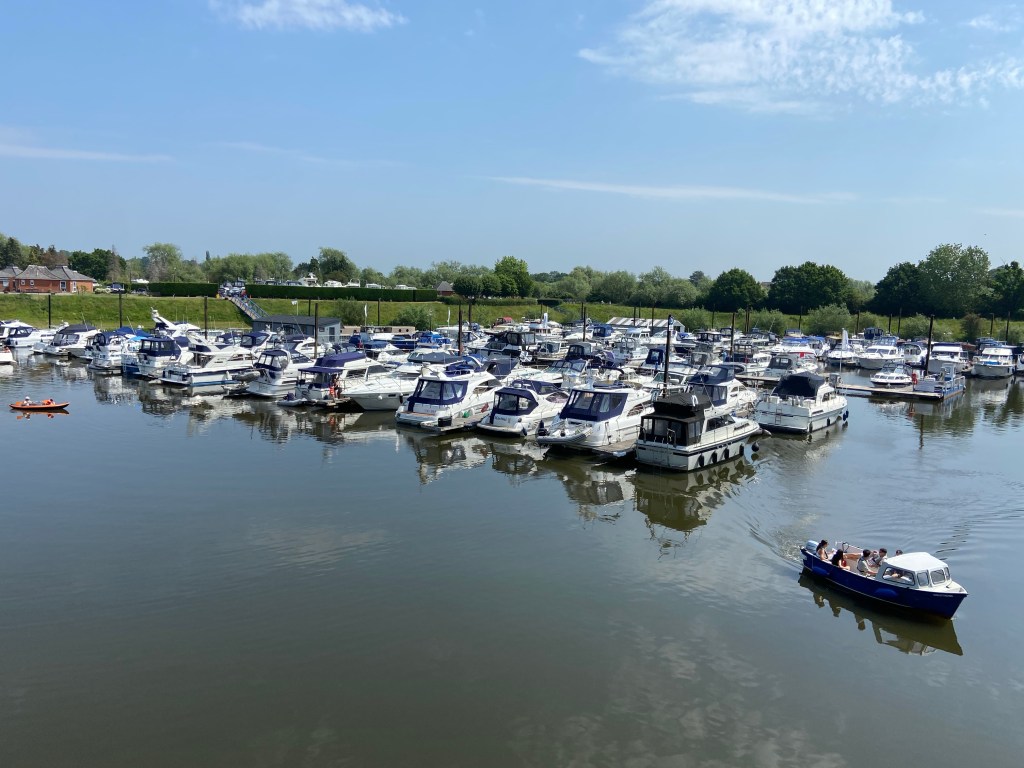
and others were heading off for what looked like a heavenly afternoon, drifting downstream, and maybe finding a spot in the shade of a willow on the banks to tie up and nod off.
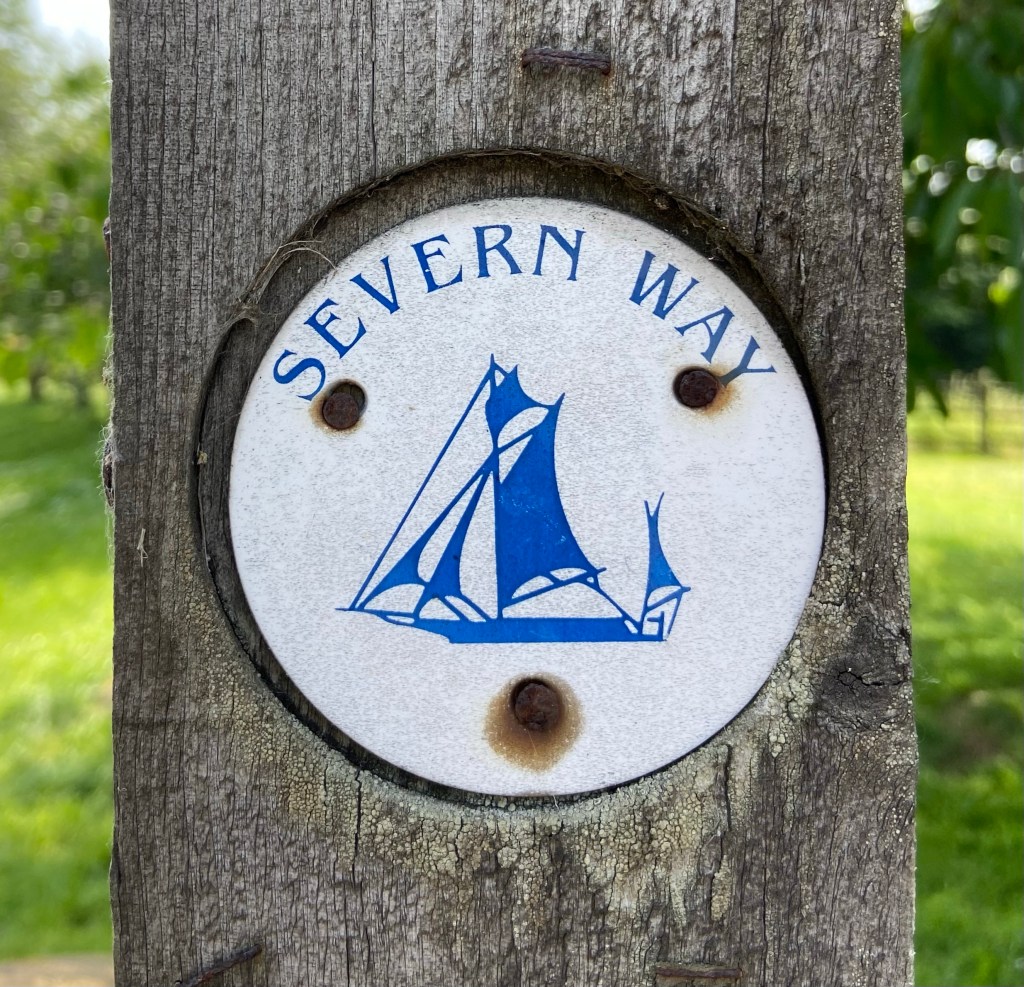
I had joined the Severn Way for a bit, another route that is familiar to me from walks past and from the marathon walk in 1996, although I don’t remember having noticed its footpath sign, a sailing boat.
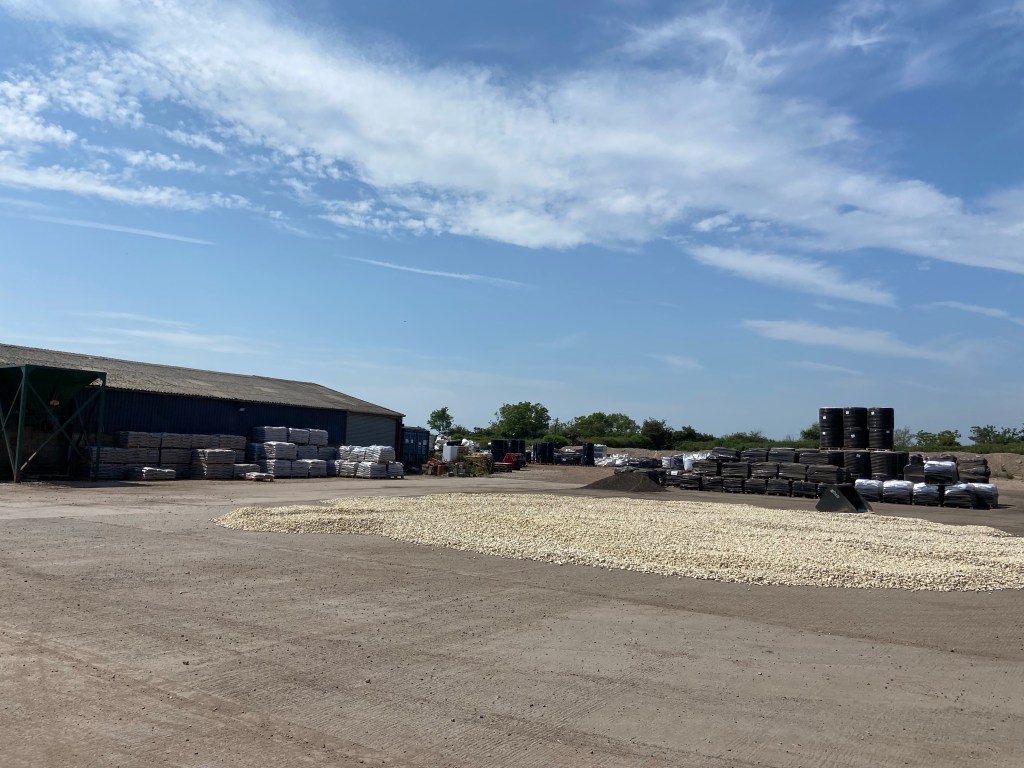
Leaving luxury behind, there was a brief, uncomfortable, very short section, where I walked through the yard of an aggregate storage depot. It was hot and dry as the Atacama desert, heat bouncing off the concrete, and I looked longingly over to my right where somewhere unseen was the cool, green river.
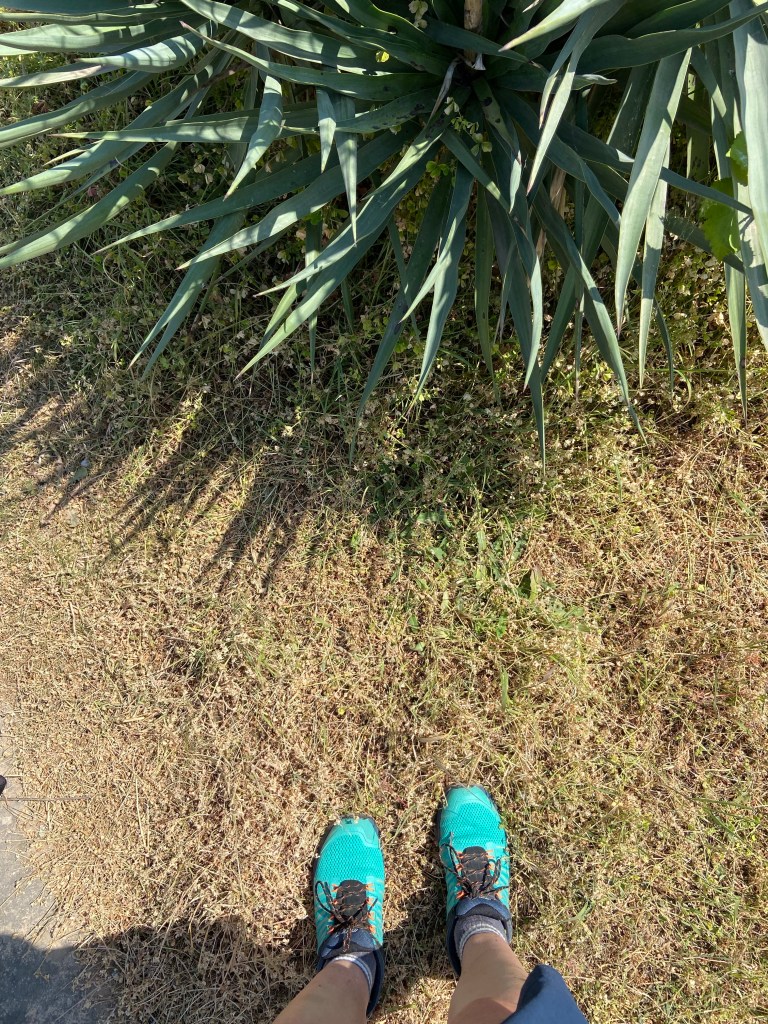
But the River Severn is not the focus of this journey. It was time I turned my face towards my actual destination: the Avon. The gates of the depot were the point where I would tread new ground for the first time, stepping away from familiar paths, and taking nothing but new ones from here to Holywell in Cambridgeshire. Like Samwise Gamgee, I stopped at this realisation. It turned out I had not been far off with the desert comparison: the point at which I was to turn east once more, off the Severn Way and away from rivers until I reach the banks of the Avon at the end of the day, was marked by some extraordinary desert plants. It makes the next stage of the journey seem as though I am embarking on a trip through a foreign land.
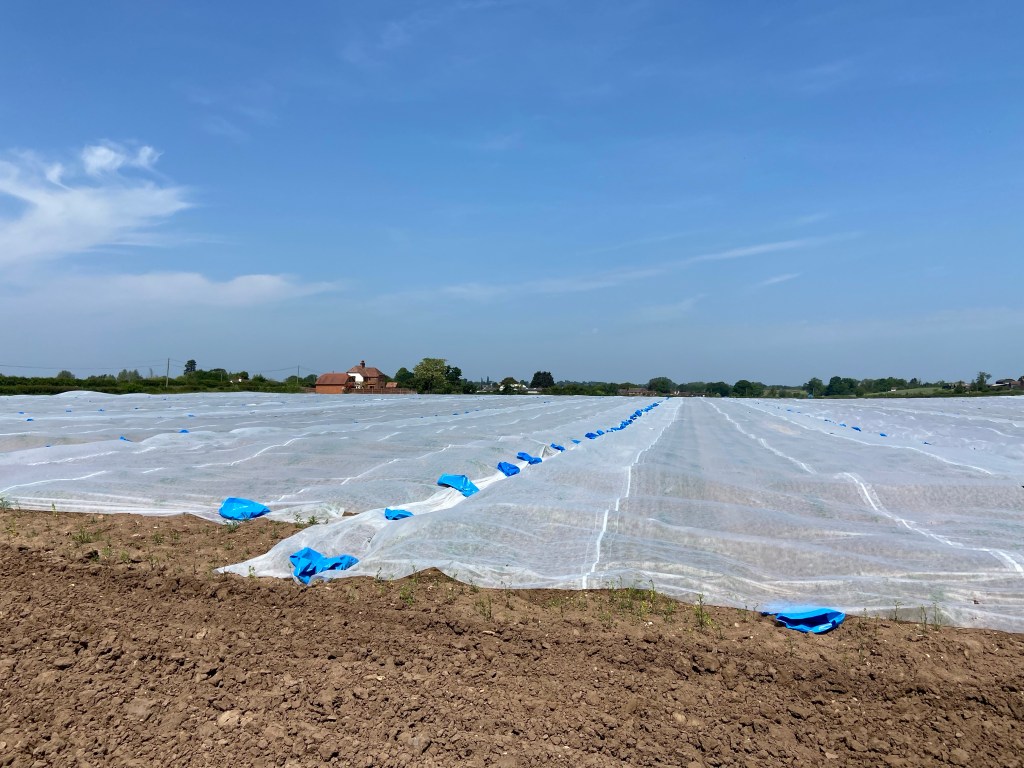
The first stretch of such a trip appeared to be a sea crossing, hugging the edge of a field planted up with potatoes, the ridges covered with acres of white horticultural fleece to cut down on the need for irrigation. The wave patterns of the wind passing under the fleece were simply mesmerising.
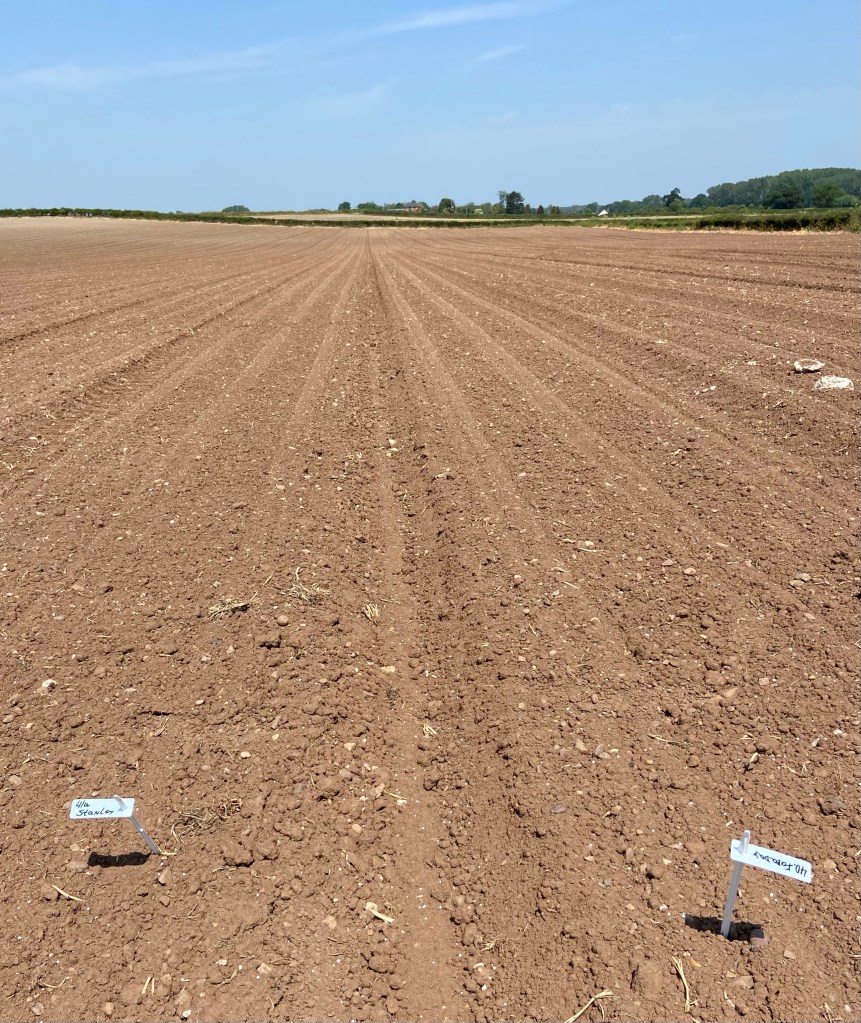
There were more desert landscapes to come, ploughed fields with markers to indicate the varieties of potato planted.
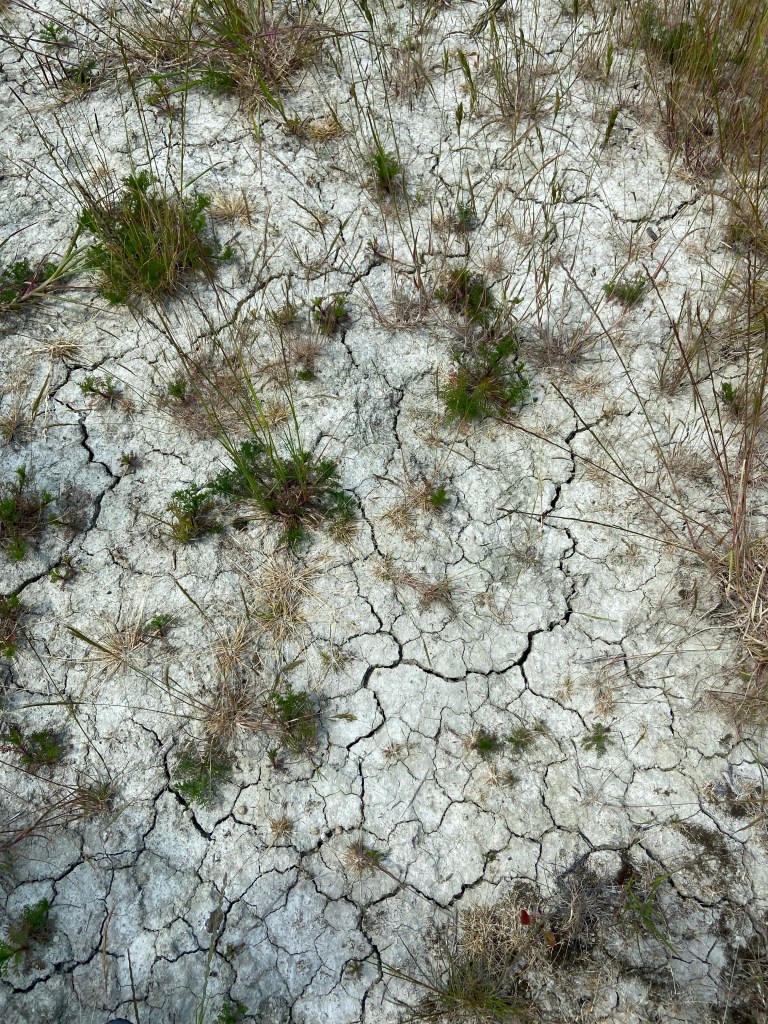
and cracked and fissured mud, almost too dry to sustain life.
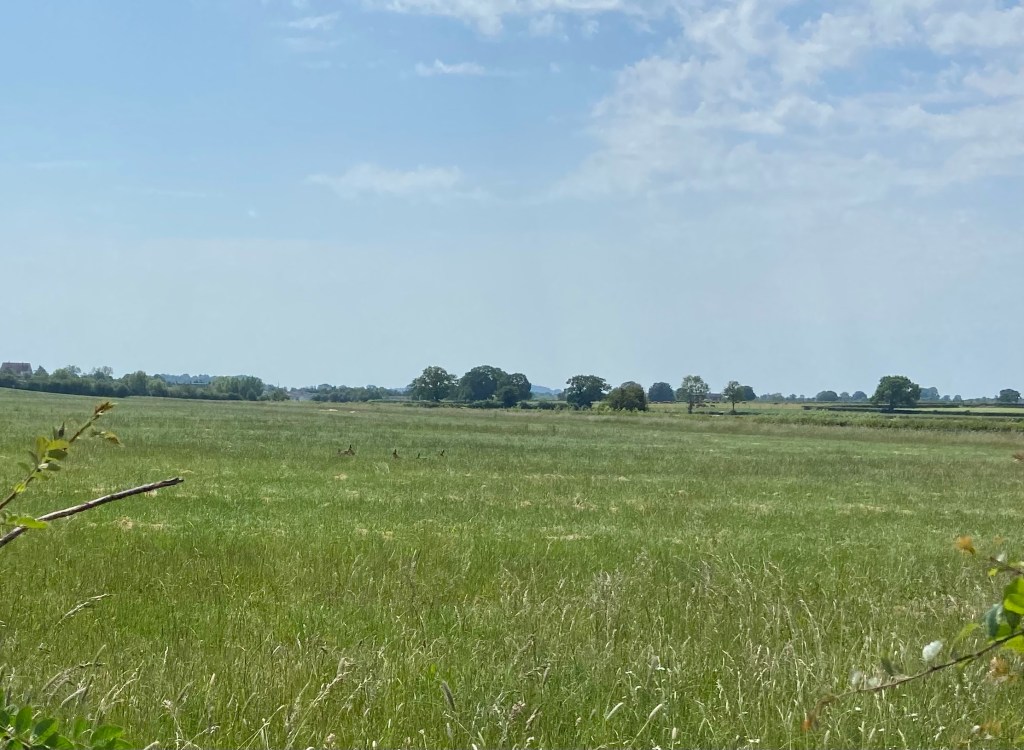
On the other side of a plank bridge over a water-filled ditch full of small fry was an opening in a hedge framing a view of a parched field, where a large hare was grazing. He loped away at the sight of me, but paused further along the field edge, joining two others. When I came towards them, they scattered (I won’t say ‘hared off’), making for the safety of the next field, and three others raced out of the grass to join them. Six hares! When I got up to the place they had all shot through the long grass of the field boundary I looked over to the next field, and saw a row of ears all sticking up above the grass stalks. What a sight.
I slogged on in the one o’clock heat up the steep slope, intersecting at the top with a couple like me out on a long walk through the fields. Georgina and Kev live not far away in Twyning, and our roads coincided for a while. That wasn’t the only coincidence though: it turns out that Georgina’s niece lives a couple of doors away from Sam and Cathy in the tiny village of Holywell. Maybe I will meet her at their party!
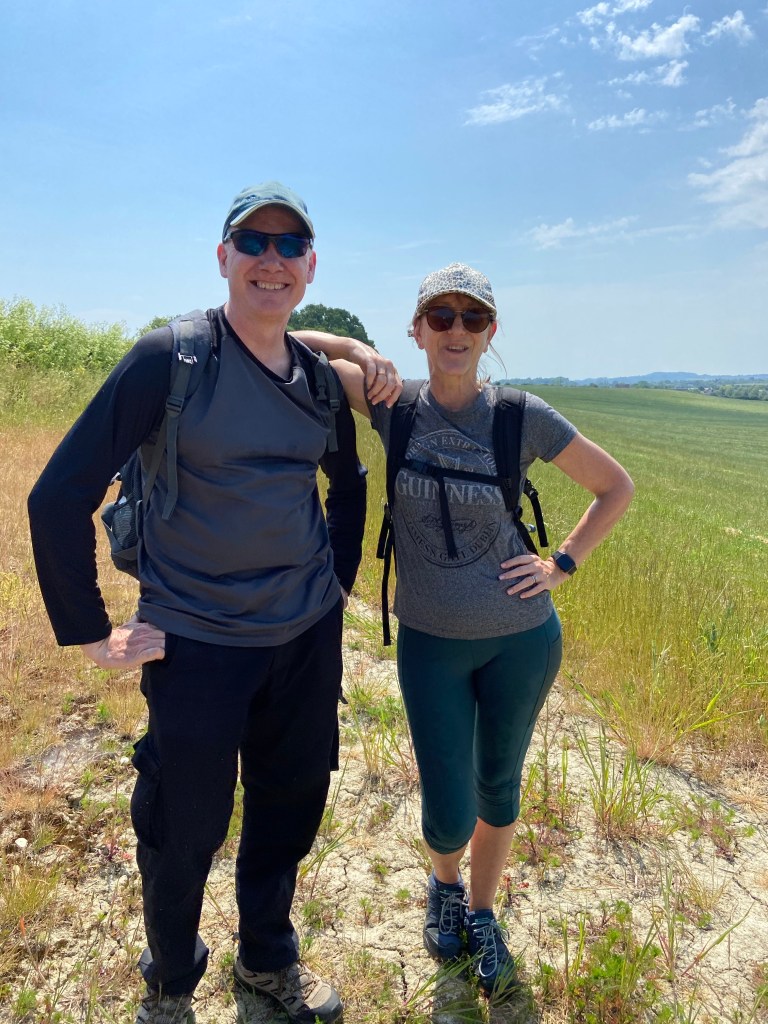
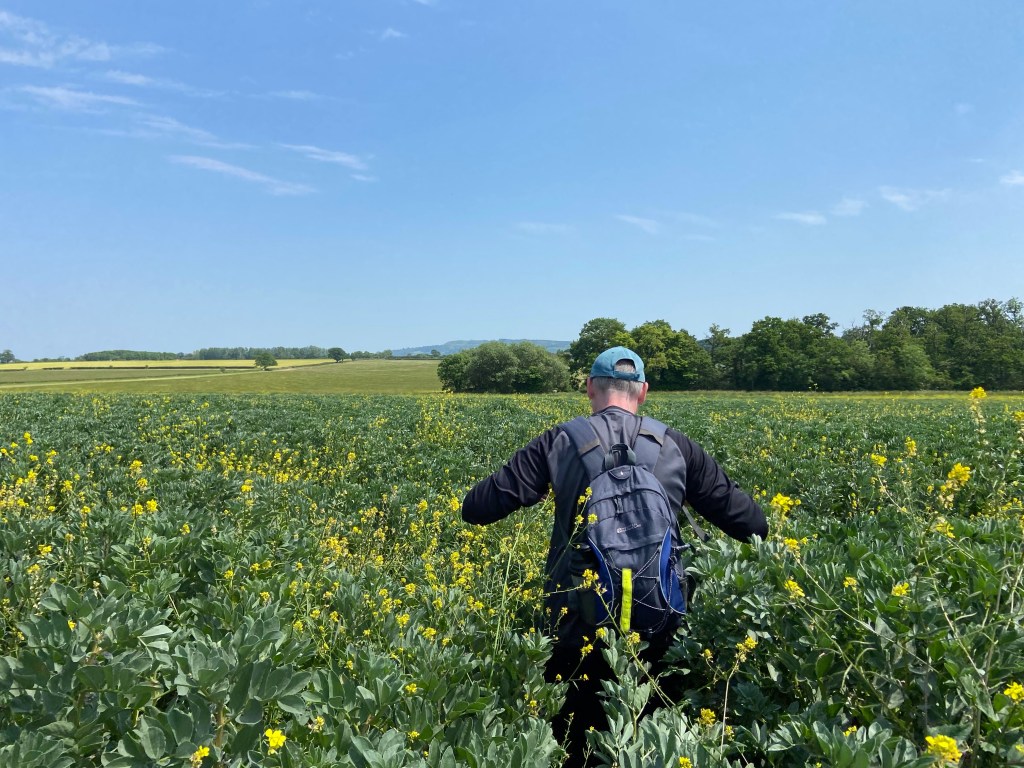
As we walked, Georgina and Kev told me about a two–week hiking tour of Japan they’d undertaken not long ago. Kev blazed a trail along an almost imperceptible footpath through a beanfield, and being locals, Georgina and Kev knew some alternative fields to take which avoided some horribly overgrown stretches.
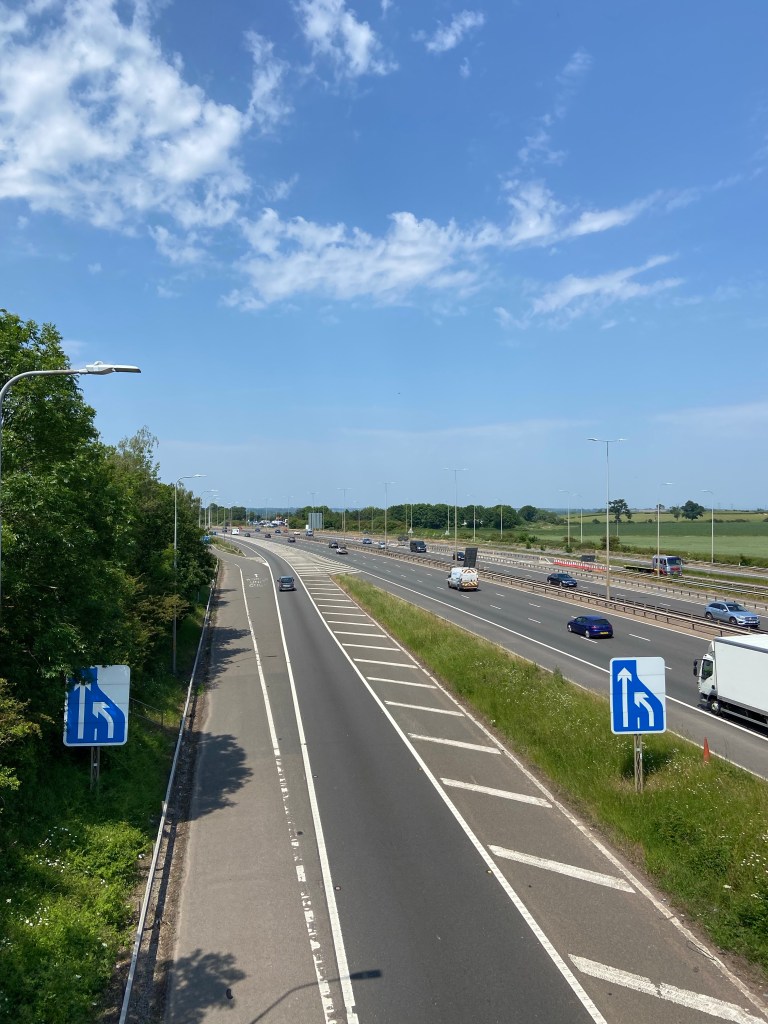
We paused on the bridge above the M5 motorway — above two motorways in fact, since this was the sliproad where the M50 joined it, a road I must’ve taken dozens of times. Another milestone, and not far to go now.
Eventually, our paths diverged, and I walked on, thankful for the cheerful company and the interesting conversations which had made the kilometres in the hottest part of the day pass so swiftly.
Breeden Hill was nearing ever closer, a visual marker signalling the beginning of the Cotswolds. The Avon, I knew, ran beneath it. But first I needed to get past the water treatment centre — to be precise, a sludge treatment centre, I wondered how often they discharge into the Avon. There were another set of buildings on the map on the other side of the road, and I had assumed that they were part of same Severn Trent facility. But there was a double set of steel gates, and high fences, and CCTV, absolutely everywhere. Notices forbidding photographs or tailgating. A bit of an exaggeration, just to keep sludge safe, surely? But perhaps it is a dangerous business: an escort vehicle with flashing lights, followed by an ambulance, disappeared down the road before me, and they didn’t seem to be anywhere else they could’ve gone.
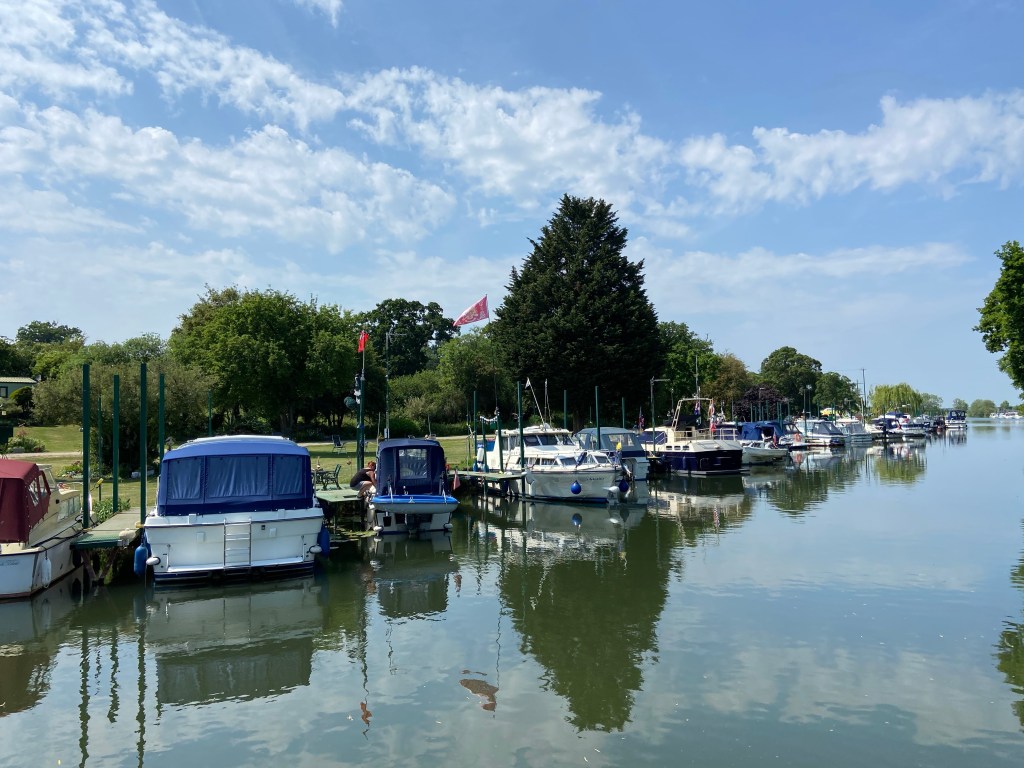
Suddenly, abruptly, I found I had reached the Avon. The footpath goes through a small marina, a delightful sight, with boats moored amongst the lily pads.
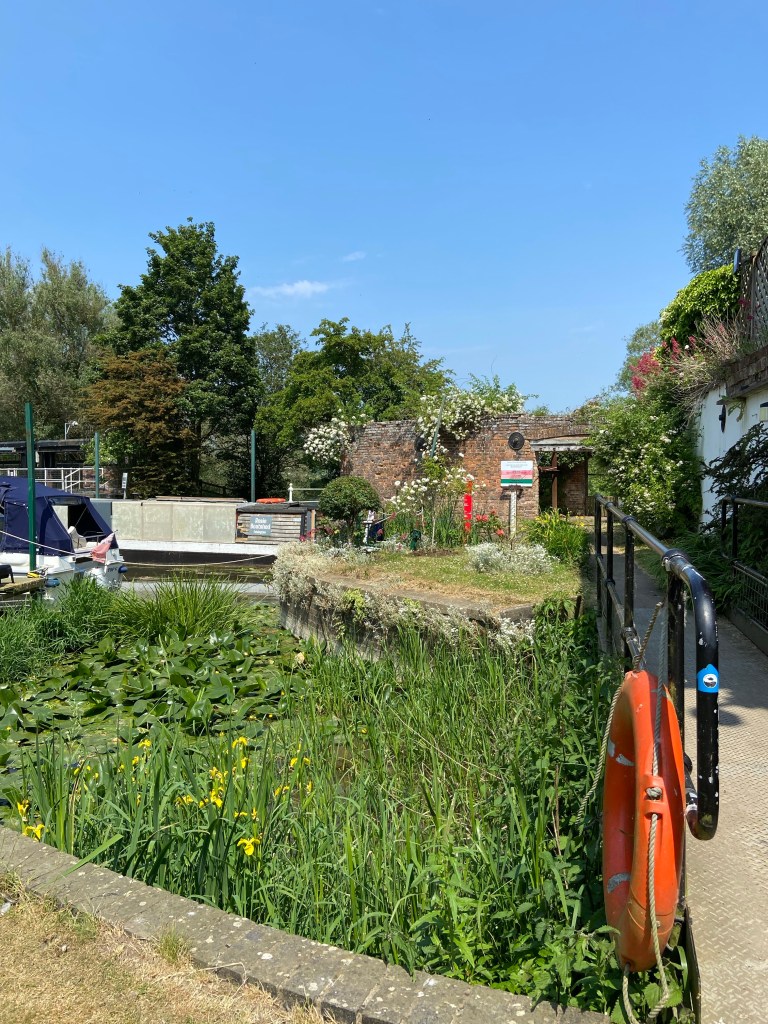
and then over the top of a weir, crossing over two islands.
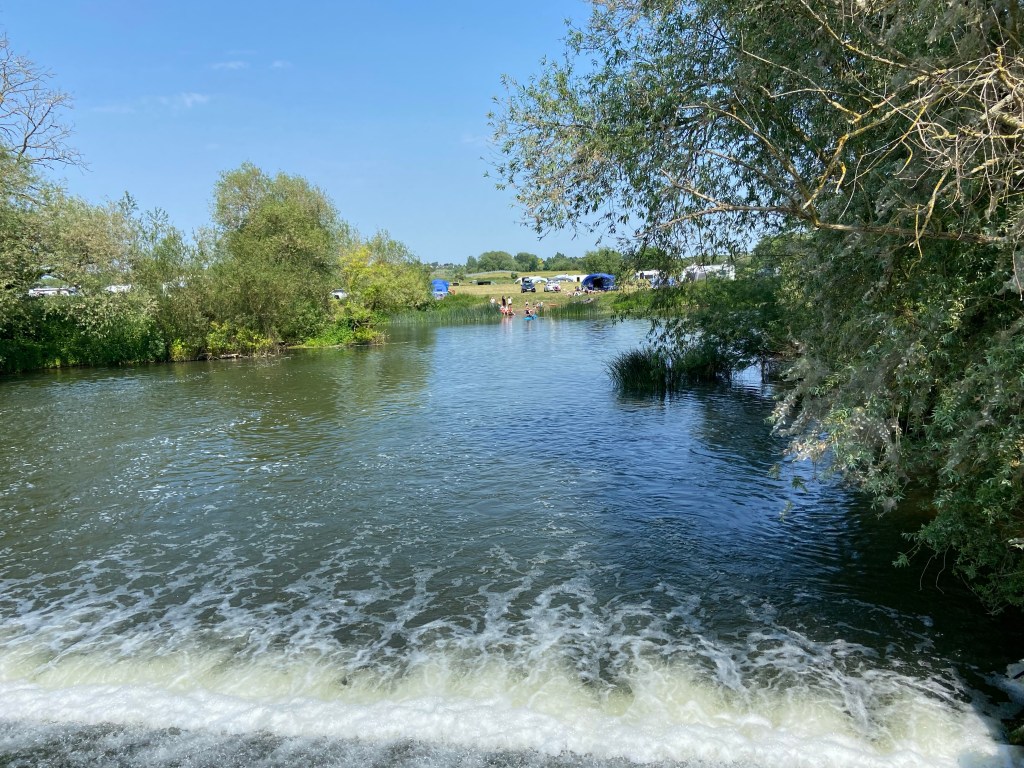
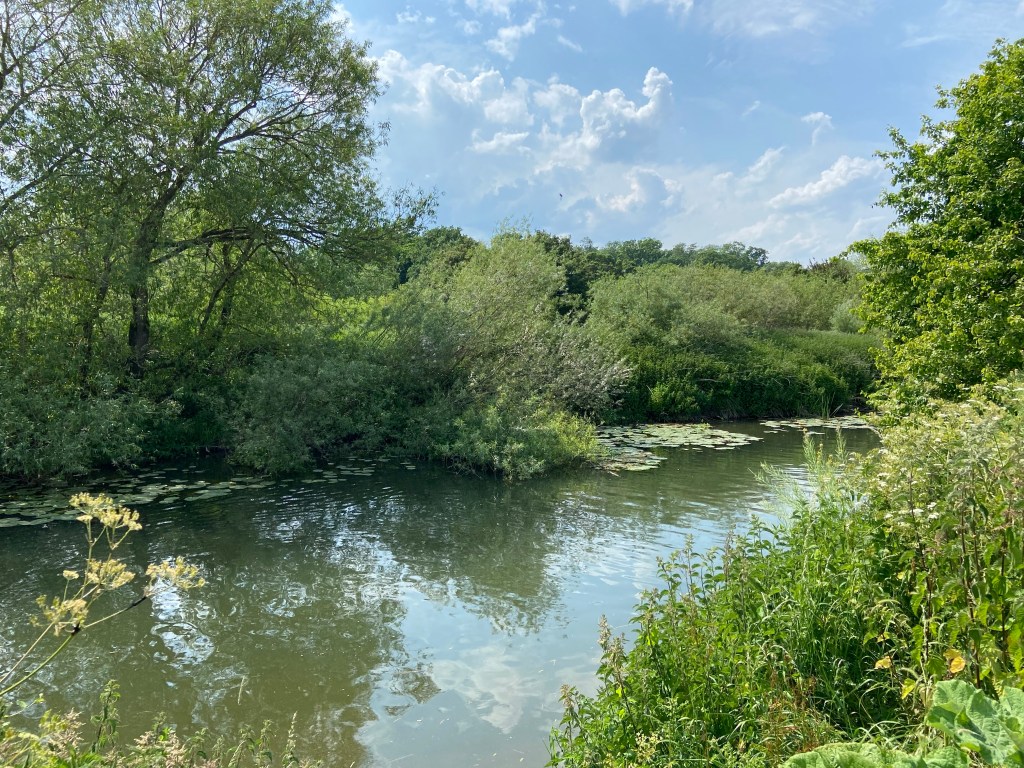
The view up river from the two little islands in the middle of the stream was spectacular, and I can’t wait to spend more time with this beautiful waterway over the next three days. It made me feel cooler just looking at it.
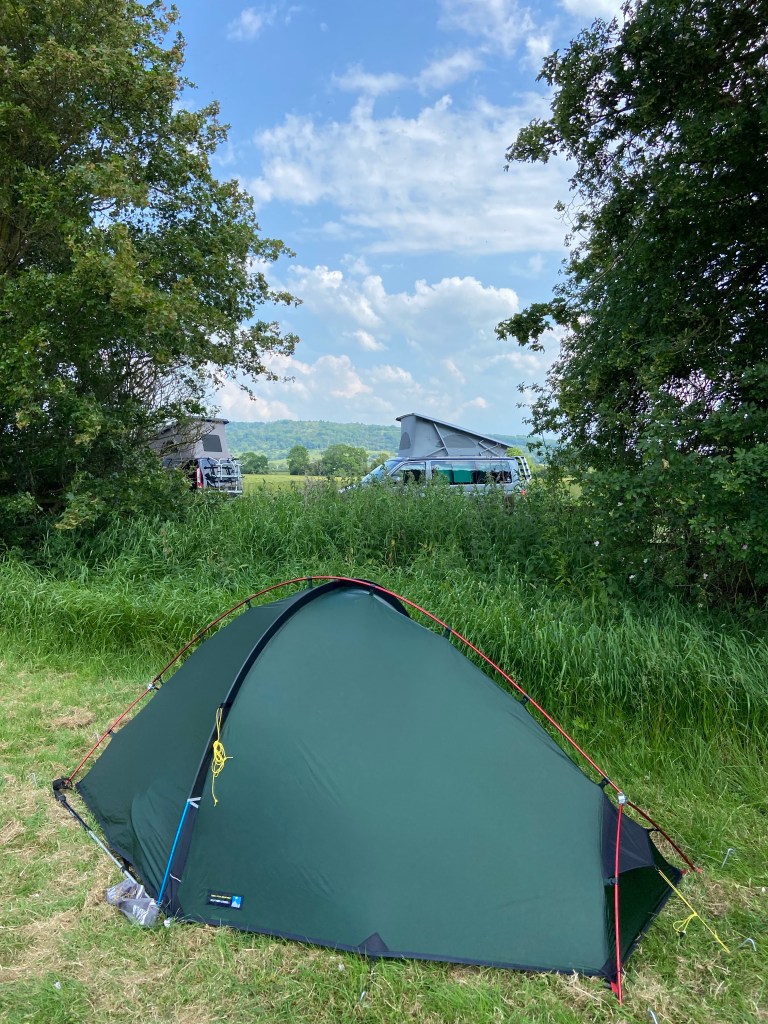
I had made it to the campsite before the rain came. I pitched my tent near a hedge under a field maple and lay down to recover from the heat, before exploring the campsite’s riverside setting.
I checked the weather again, and low, and behold, an amber weather warning for thunderstorms had developed. Soon fat drops began to fall — and then the mother of all storms unleashed itself. I lay in my tent and listened to the thunder rolling from horizon to horizon and back again, some thunder so cracks so long and powerful that I could feel them through my mattress. And not because I’m a princess. Lightning flashed through the skin of the tent, the rain hammered down, soaking into the thirsty earth. It was a blissful sound.
Although it had taken me 5 1/2 hours to get here, it was not a long journey by car. Stephen came out to take me to the nearest pub for supper, and it was wonderful to see him. Wonderful, also not to have to walk in the pouring rain. Over dinner, my military adjacent expert told me that the DeRA had highly specialised, closed facilities out here, doing highly restricted work. So, not sludge then.
The air must be approaching 100% humidity this evening. Tomorrow, it’s going to be like a sweltering jungle!
 Walking The Landscape
So lovely to be reading your walking again, as I anticipate starting mine very soon. Similar bag stripping is occurring! Xx
LikeLiked by 1 person
“so I paused for a moment to savour it. Or perhaps it was just to catch my breath.”….I often pause to savour the view!!!
LikeLiked by 1 person
Xxxx I love your walk posts, A.
LikeLike