Will.i.am
I have a pro tools rig that I carry in my backpack.
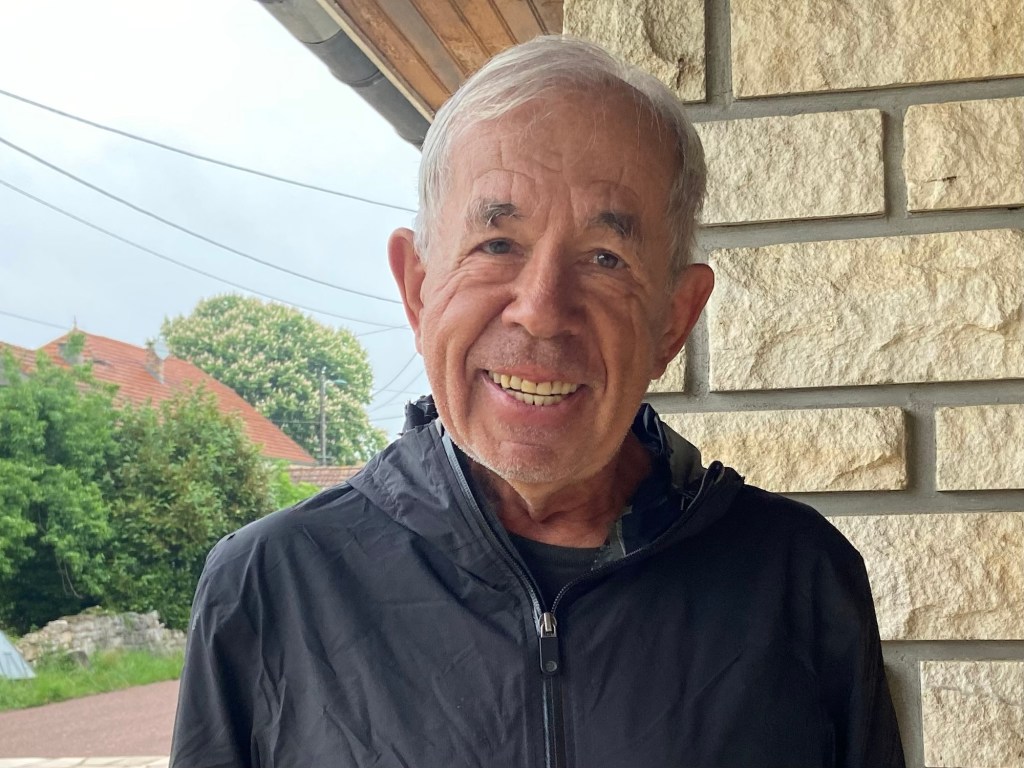
I think walking through the heat of the last week has, after days of it, been very sapping. I felt enervated when I got to Mormont last night, and after a hot bath, conked out for a solid 40 minutes. I was woken by the arrival of another walker of whom I had heard from Ian: 83-year-old Doug, a retired law professor currently living in Arizona. While he and I are both walking to Langres today, he is finishing there, training to Paris early tomorrow and then flying back for the same reasons as I am stopping at Lausanne.
He was a late arrival at the hostel party, so Madame Annick brought over a couple of eggs and some pasta, and while I ate the lentil stew she had left in the fridge for me, Doug snuffled up the pasta and the eggs, and supplemented them with a carrot and a tin of fish he had brought with him.
I worked on the blog until about 10.30 and again when I woke at 2.30am until almost 5.00, and when I got up again this morning, unsurprisingly I did not feel remotely rested and very much in need of the rest today which was now only 24 km away. This was the first morning when I felt very much that I didn’t want to get out there and start walking. In contrast, Doug was up and away early — in the pouring rain that was forecast to last until lunchtime.
I sat at the breakfast table feeling very feeble. I was a little bit concerned about my heels, the pressure and soreness that I had felt yesterday, and when I checked my emails, I saw the following message from the distance tracker app I have been using. Because I logged my shoes when I started, the app has now informed me that it’s likely they are wearing out.

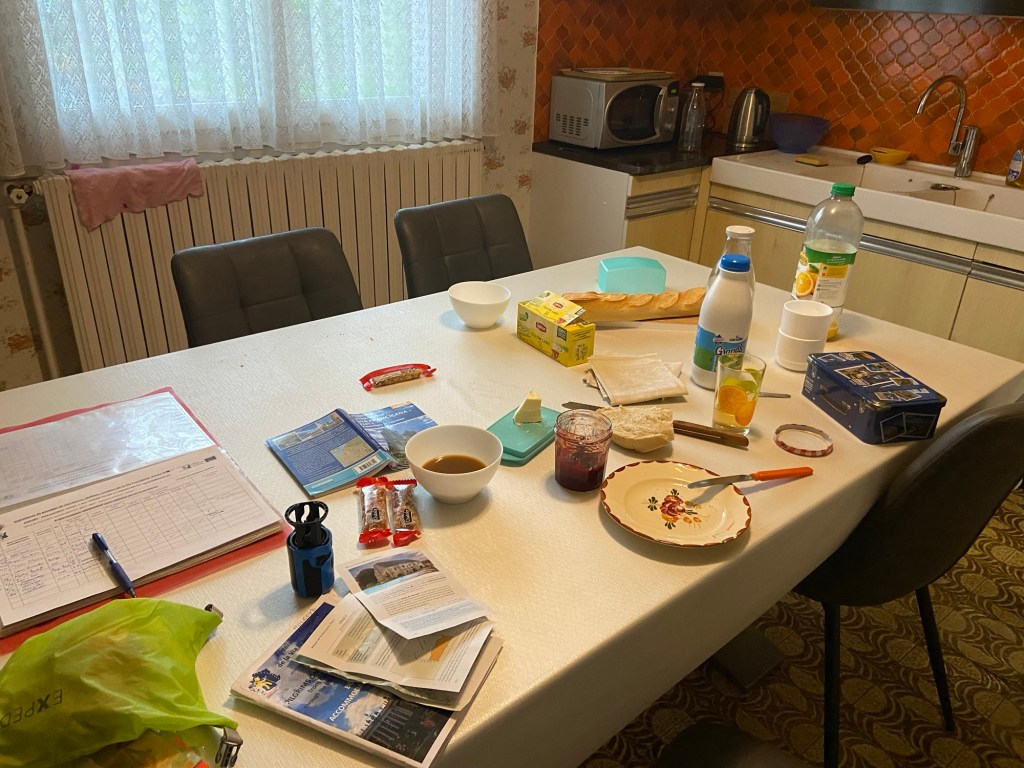
But I not only have a rest day in Langres, I actually have two. Annick suggested to me on the phone back in Brienne-le-Château that since I couldn’t find accommodation between Mormont and Langres I could just stick on the Roman Road all the way to the medieval town today instead of doing the winding Francigena path and getting only half way. So I have booked another Airbnb for tonight, and I will move to my ‘rest day’ Airbnb tomorrow. Annick’s cunning plan means I have only 24 km to do today, instead of the 39 that Doug has: being a self-confessed purist he is taking the official route. Over bread, butter and plum jam, it suddenly occurred to me that because I have an extra rest day, I could use it to hop on a train and go to Dijon to see whether I could replace my shoes.
Despite my lack of enthusiasm for the day ahead, two bowls of coffee did the trick and made me feel buzzing and ready to go again.
I applied fresh Compeed very carefully to my heels, noting the inch-long pressure blister. I packed a wad of Ian’s lambswool on top of it, and secured it with a clean sock that I had washed last night and soaked in diluted fabric softener, from the tiny bottle I had brought with me. This is an innovation which I have introduced for this walk, since I have found that wool socks without softener get a bit scratchy and abrasive. The clean socks certainly did feel luxurious when I put them on. I also stuffed some wool down inside the socks to cover the backs of my heels around the ankle, where the fabric and sponge padding has worn away inside the shoes, but this didn’t stay in place for very long.
Next came the packing of my bag. I packed it very very carefully, trying to keep the weight as low and as close to my back as possible. Compactness and even weight distribution: good packing skills.
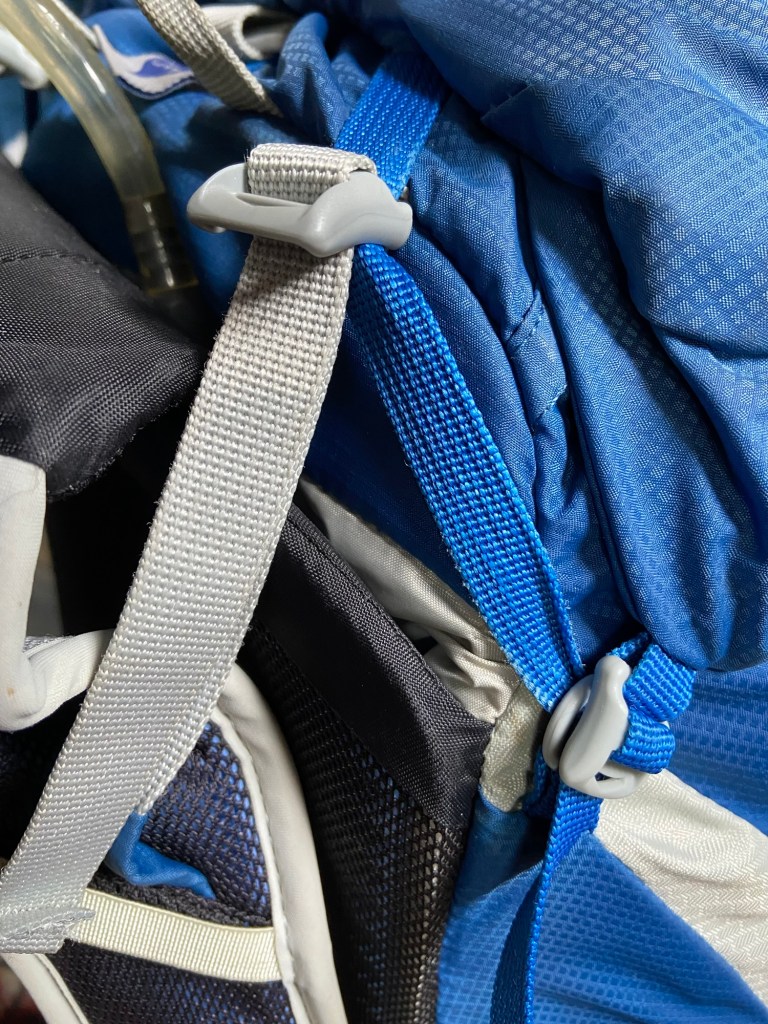
The next tip I have for you, O reader (for I firmly expect you to follow in my footsteps), is to pay great attention to the adjustment mechanisms on your rucksack. For 31 years, I have been letting my rucksack-fitting expert do this for me while I pretty much stood there wailing ‘I’m only a girl!’ But today I remembered what he had said ages ago while he was adjusting various combinations of straps and buckles on my pack, that there was an order of play to the process. It was this: firstly, loosen all straps. Then, fasten hip belt and adjust. Then, tighten the shoulder straps with the pull-down mechanism at the waist. Now, this next bit is where people go wrong. There is a third adjustment mechanism which loosens or tightens the pack up by the lid, to bring the top of the rucksack closer in or further away from your back. I think the basic point of this is to be able to increase the space between the main body of the backpack and the pouch where the water bladder goes in, making it easier to insert. Anyway, after putting the water in you must tighten those little straps back up, to bring the rucksack’s weight as close to your spine as possible from top to bottom, so the weight is carried downwards onto your hips, instead of it pulling back and putting pressure on your shoulders.
So I did all that, but then I noticed there was a fourth strap mechanism, a blue one, that went through the third. As you will know, I have been having muscle pain in the base of my right shoulder blades for a while (you will recall the much-anticipated but ultimately pointless massage on my last rest day that I had hoped would sort it out). On one side (the ‘good’ side) this fourth strap was tight, but on the painful side it was twisted and loose. I fiddled about with it for a while to straighten it and pulled it tight. I have no idea what it really adjusts, but it made an absolutely enormous difference. Shoulder pain eliminated!
So dear reader, while we have been contemplating elite-level hiking skills, you will be very pleased to hear that it has stopped raining. Doug had left impressively chipper in the downpour. But instead of hauling on my full wets, I put on my now-more-fragrant charity T-shirt, having washed it through last night and dried it in the sun before the thunderstorm started, and my shorts. Annick said with alarm when she saw me that it was only 6° outside. Personally, I thought that sounded deliciously cool.
So, out into the day I stepped. Doug had gone out last night after supper to have a look at the Abbey ruins, and I might have missed a trick there. But I had just been too tired, and felt I had had a pretty good look on my way in last night. This morning as I left the village, I was able to appreciate the reutilisation of significant stone blocks from the Abbey buildings as door lintels.
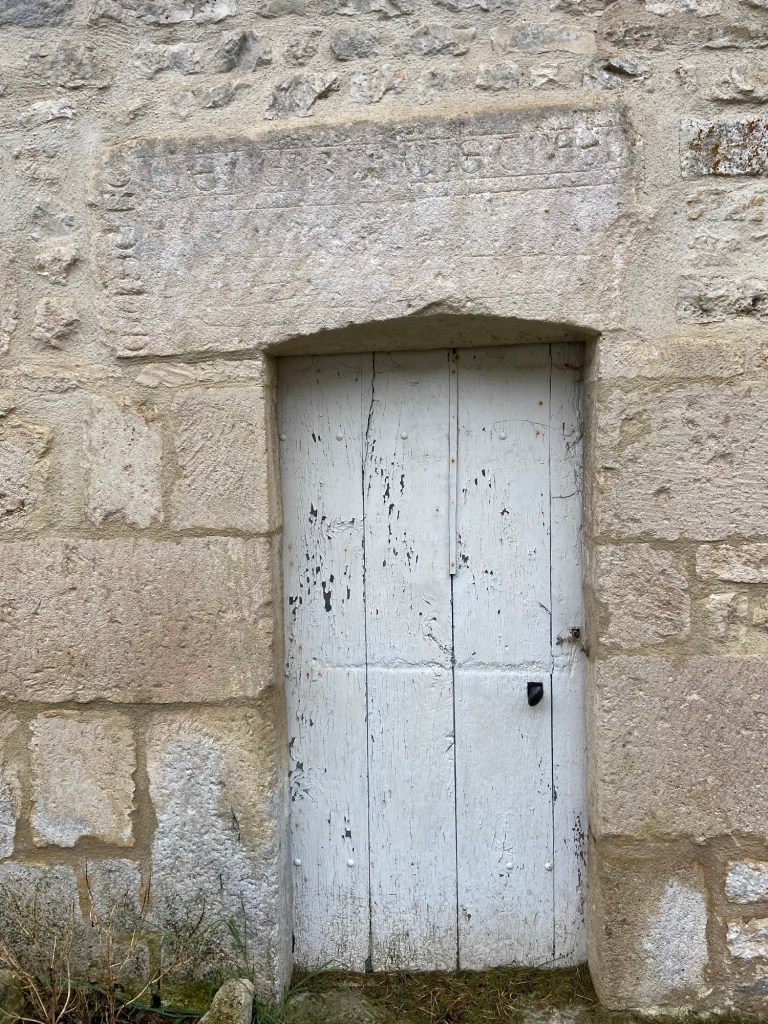
I continued to ponder this as I started out on the road. 12th century abbey ruins seem ancient to me, but this asphalt road I was walking on was almost double the age at 2,000 years. It’s extraordinary that the basic infrastructure of human movement across the landscape has lasted so long. This ‘Roman’ road is today part asphalt, part gravel farm road, part grassy path, but it still exists intact as a line on a map and on the ground.
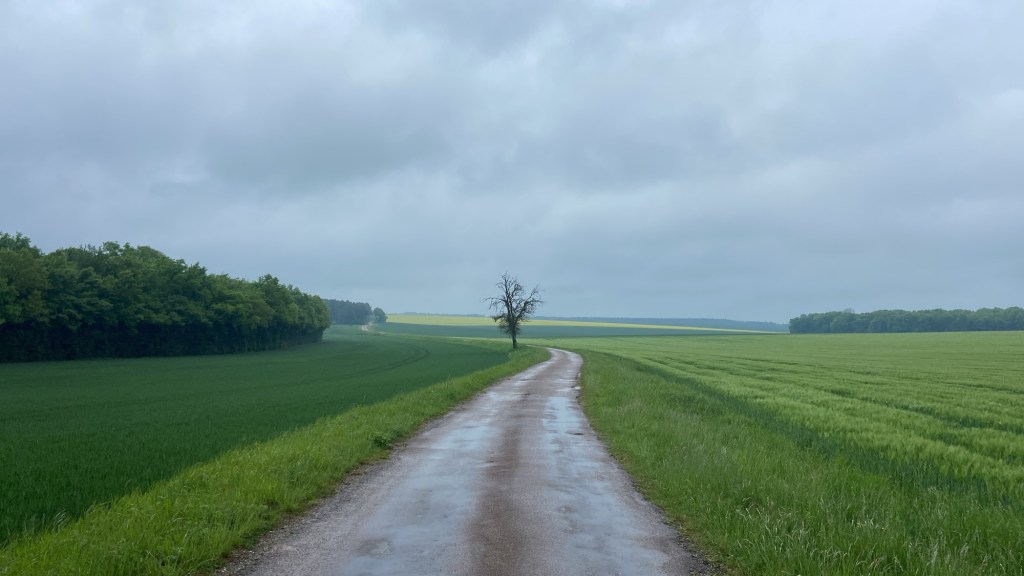
Feeling absolutely no pain in my heels and buzzing from the coffee (‘Wonderful coffee! It’s a meal in itself!’), I marched along the road. Having read up on Roman and other military marching cadence, I counted my own paces. 123 regular steps to the minute, although I don’t know how many centimetres each pace is. I know that I do 4.8 km an hour, so I should be able to work that out, but not in my head.
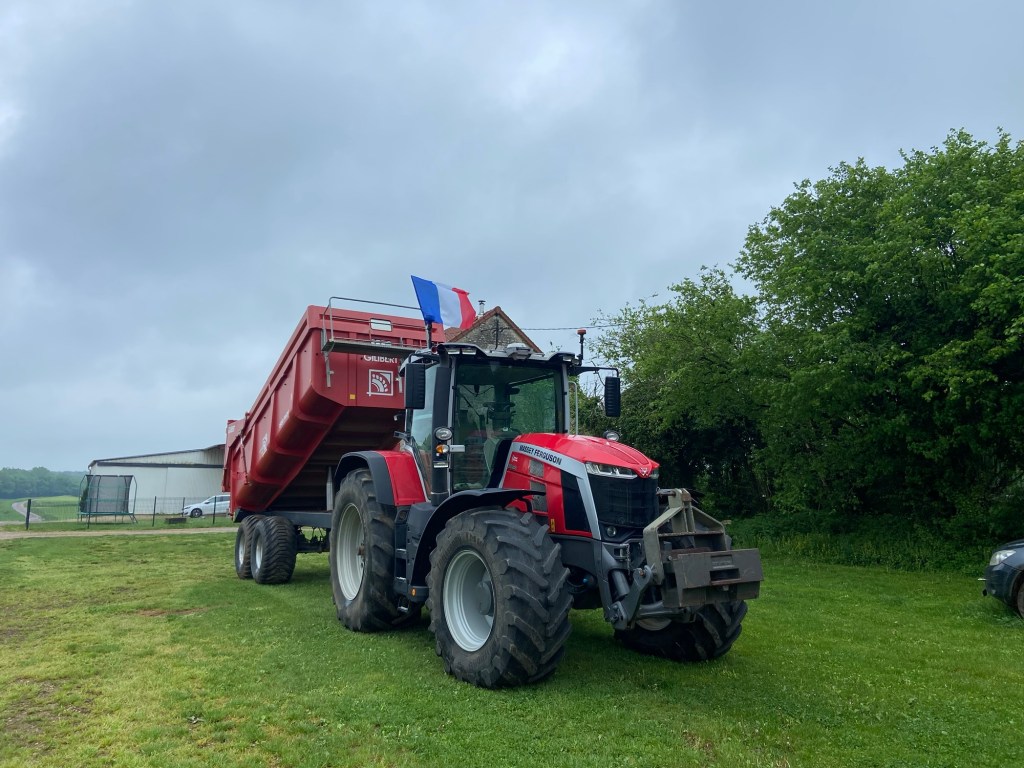
6°C felt perfect. By the time I had gone half a kilometre or so my muscles had warmed up and I felt perfectly well dressed in my shorts and T-shirt. Everything seemed cheerful, even the local tractors, flying the Tricolore.
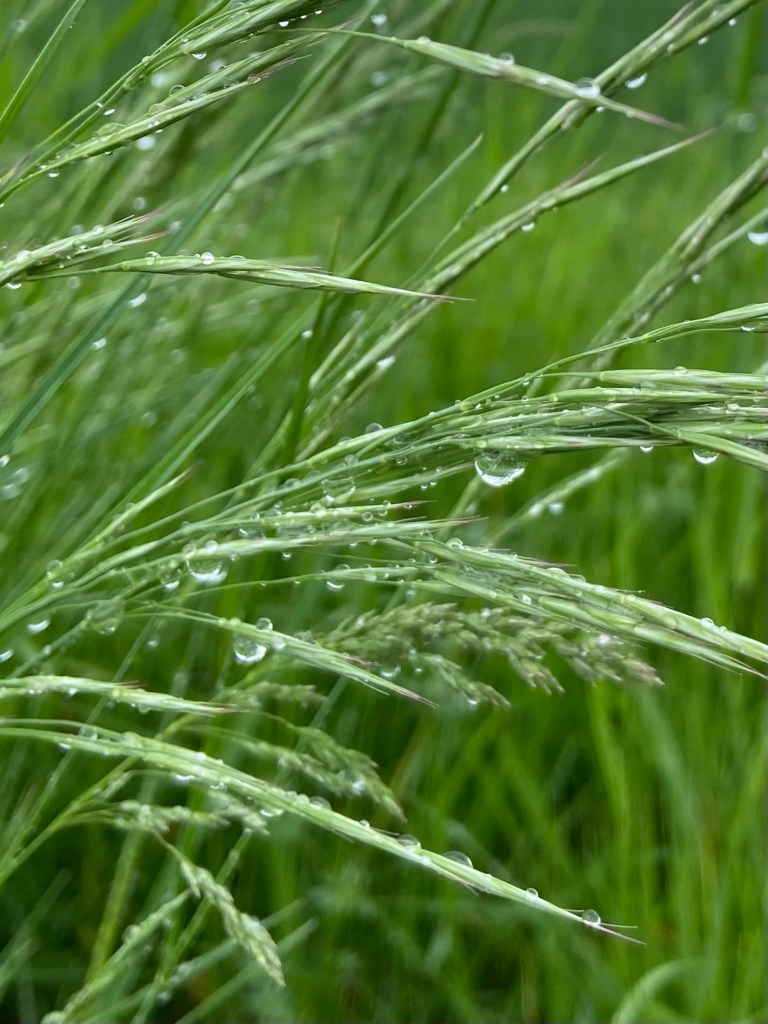
After the rain, the grasses by the side of the road were covered in drops of water that reflected the grays of the sky in tones of white and silver.
The asphalt section of the road finished at an ominous turning circle where fields had been fenced and the mouths of three paths into the wood had been roped off with a double line of electric tape. Having read up about the forest yesterday, I felt pretty sure this was to keep the denizens of the forest (in the form of the cervids and the wild boar) out. And I was going in.
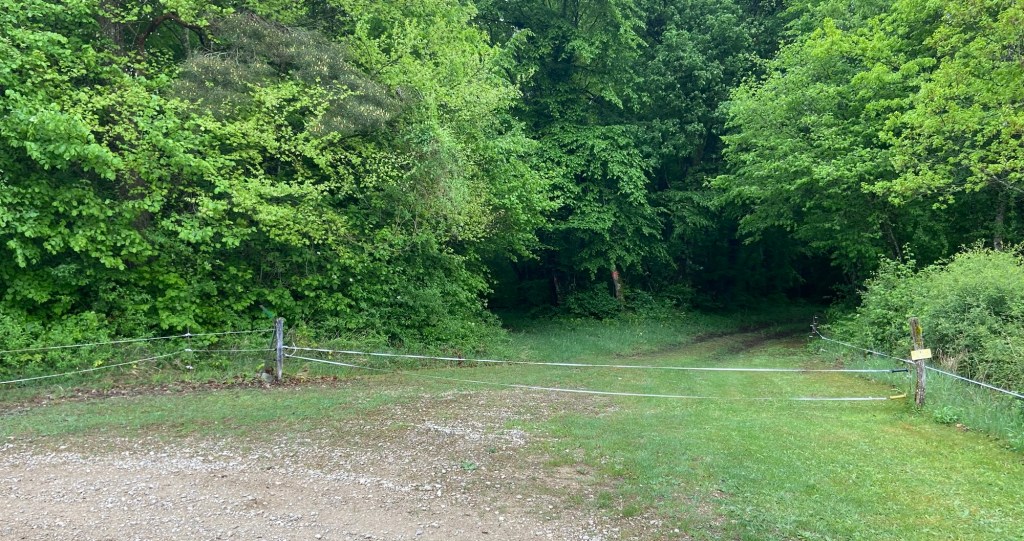
Okay, so I had managed to avoid the forest path yesterday, but this was more of a We’re Going on a Bear Hunt situation. I had to go through it.
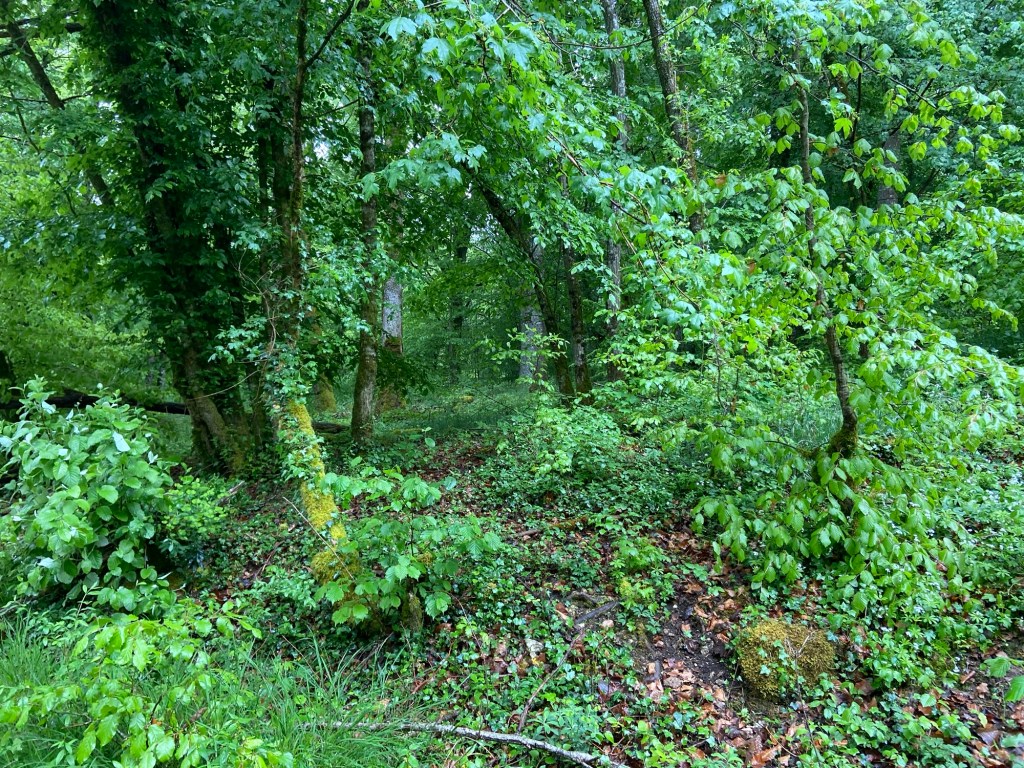
On the map it wasn’t a very long stretch, just under 3km, 35 minutes walking, so I set off down the forest path singing as loudly as I could. Today’s tune was the stately dance from the BBC Pride and Prejudice Netherfield ball. My lyrics were stream of consciousness stuff about forest paths and hunters and wild boar. After twenty minutes of fitting my thoughts to the meter, I decided I needed a change of tune. This is where the Malvern College school song came in very handy. Altogether now: ‘Exultemus O Sodales…’
The exceptionally cheery tune did the trick, and I was in a positive mood with nerves fully under control by the time I reached comforting evidence of other human presence in the forest: a sort of makeshift hunting lodge with long, rough wooden tables to feast on at the end of a successful day out with the guns.
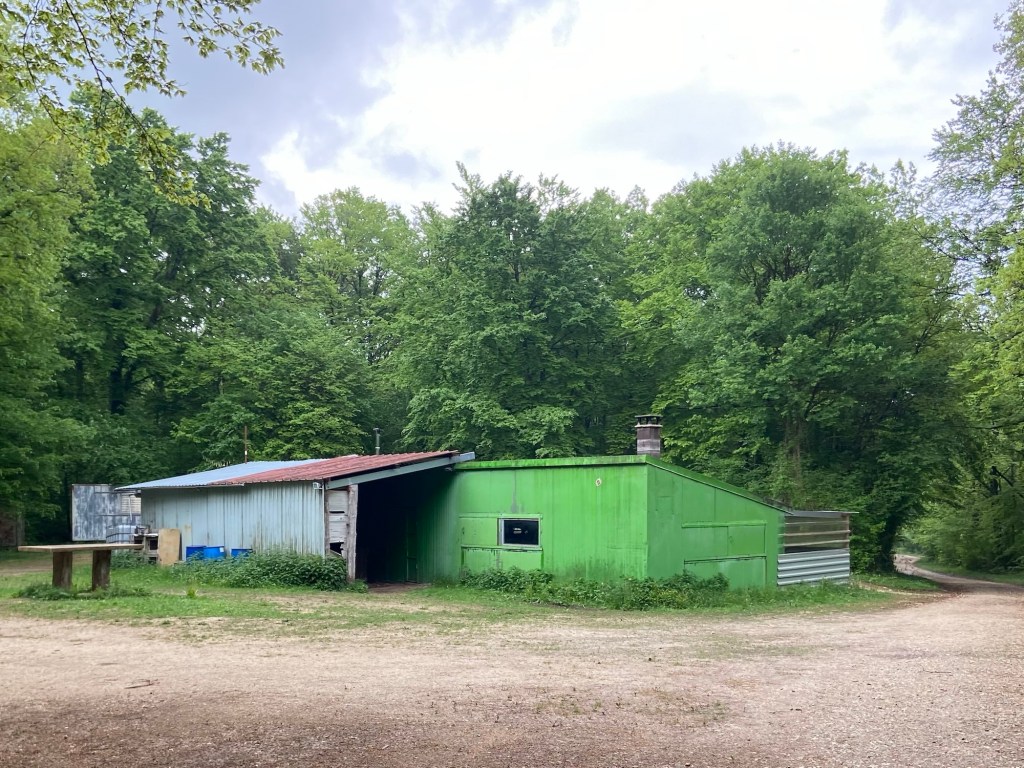
I wondered whether in France there is as much pushback against hunting as there is in the UK. I know they no longer net songbirds, but from what I had read on the Wikipedia page about this forest, it seems that it’s much more widespread and organised on a national level. There had been a big interpretation board way back on the first section of this road which had explained the environmental management the Departmental Federation of Hunters of Haute-Marne undertake on agricultural land, creating hedgerows and wide strips of grass sward, and so I wondered whether this was in response to national criticism of the pastime.
Finally, I reached the end of the forest section for the day. I felt I had survived some kind of episode of I’m A Celebrity Get Me Out Of Here (with fewer challenges and no celebrities).
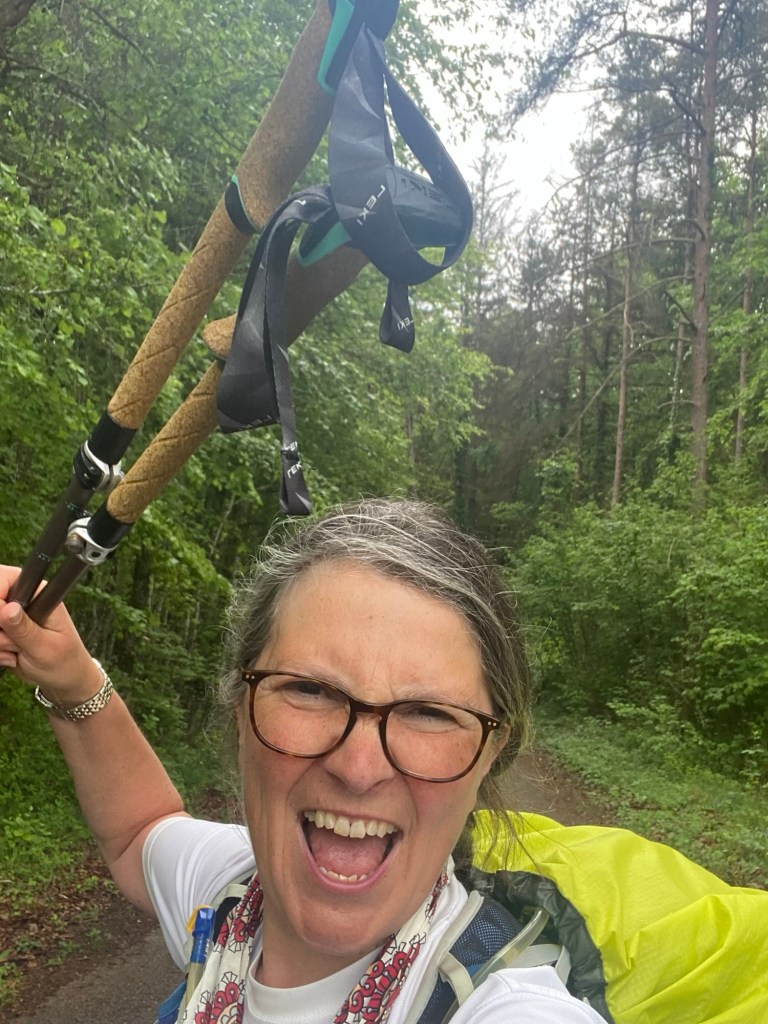
The only forest denizen I had encountered hadn’t been very scary —
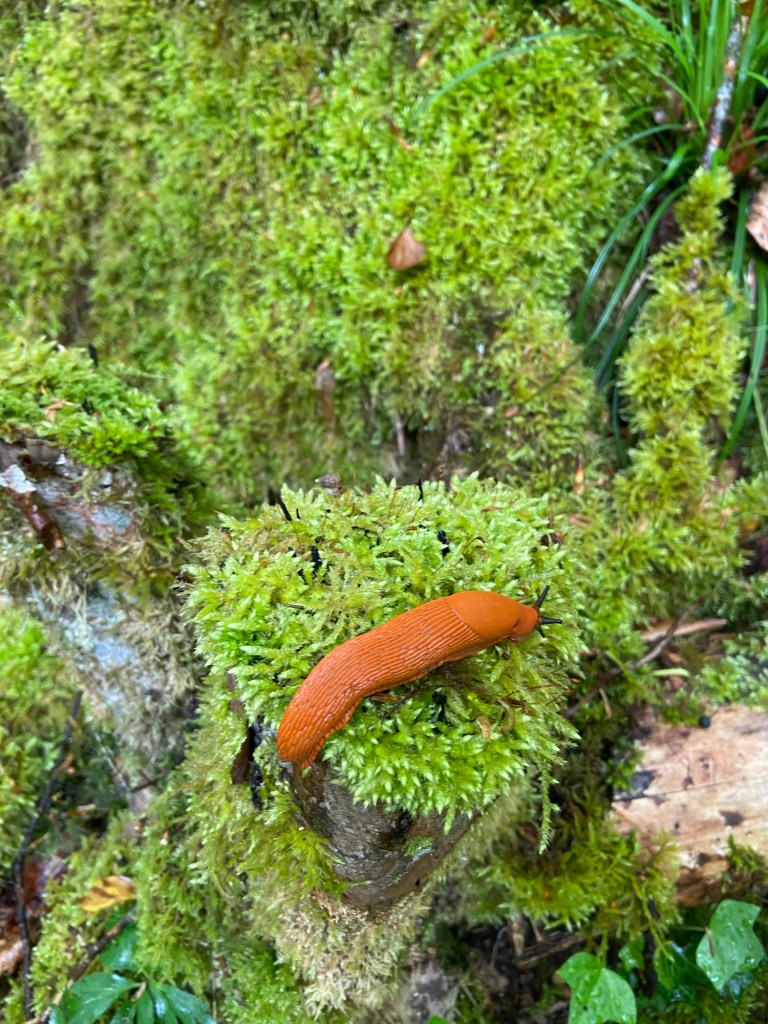
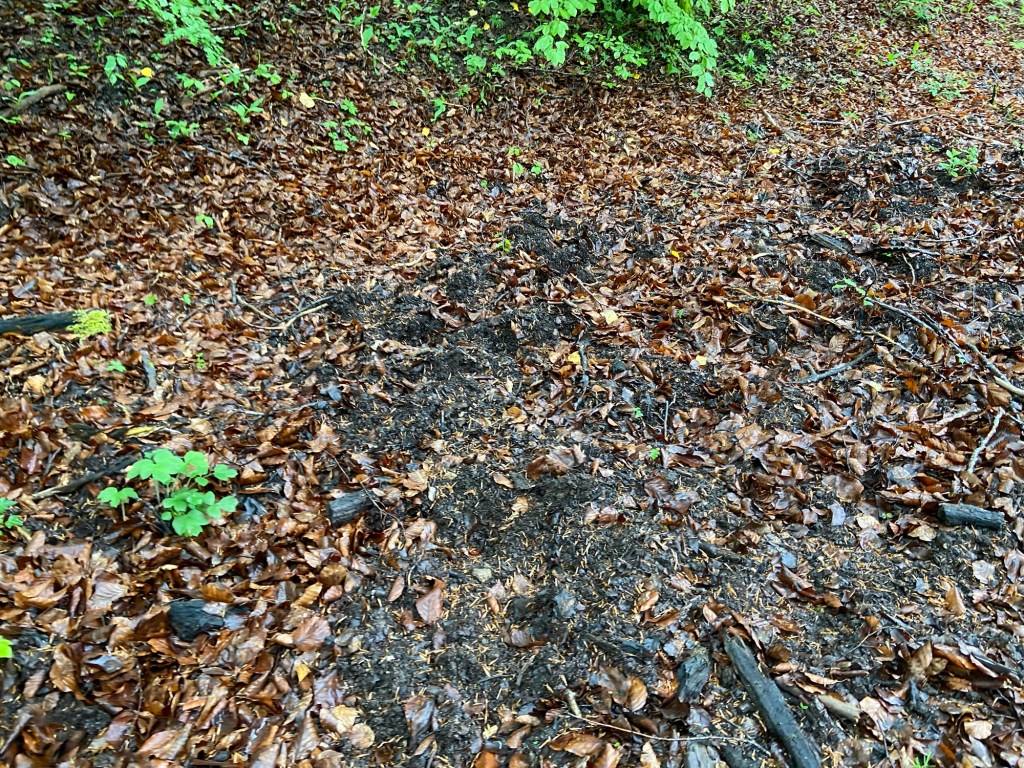
— although there had been more signs of boar.
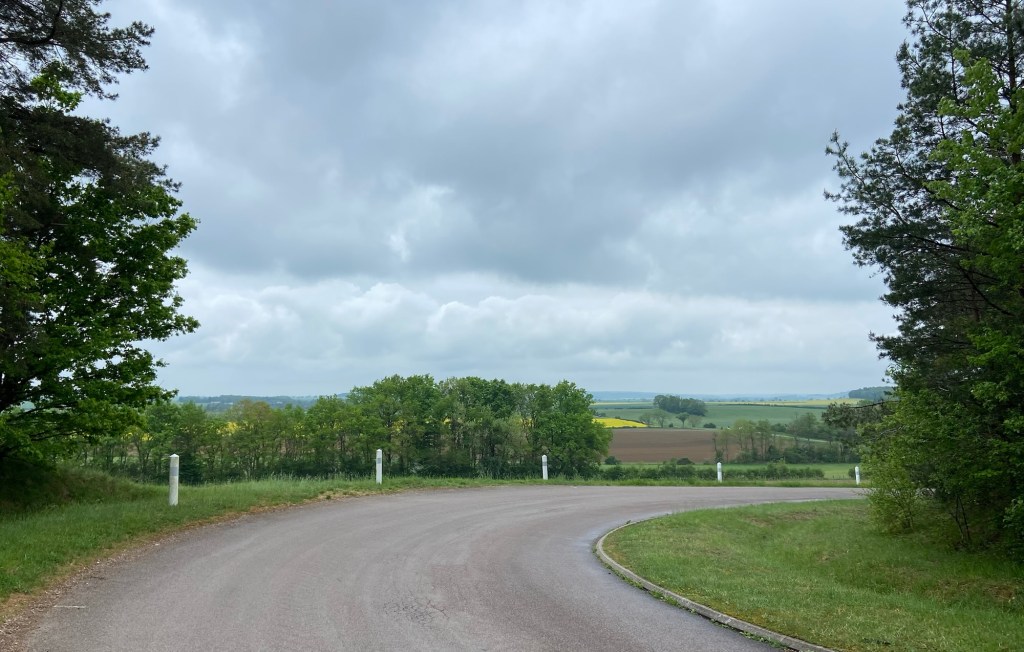
The end of the forest coincided with the road dropping down off the plateau ridge and into a valley, across which, far away, I could see some other wooded hills which I would need to reach today.
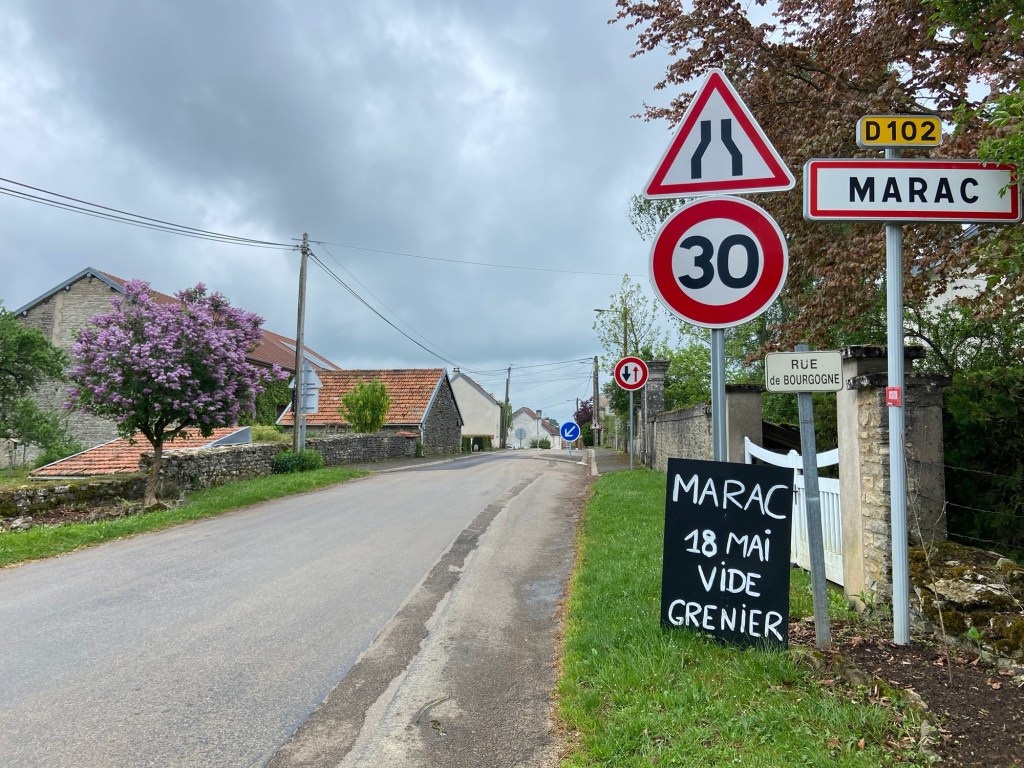
It didn’t take me long then to reach the day’s first village, where lilac and laburnum were in full flower, and where the road sign reminded me that I was now coming out out of the Champagne region and into Burgundy and I had already come a third of today’s distance.
It started spitting with rain.
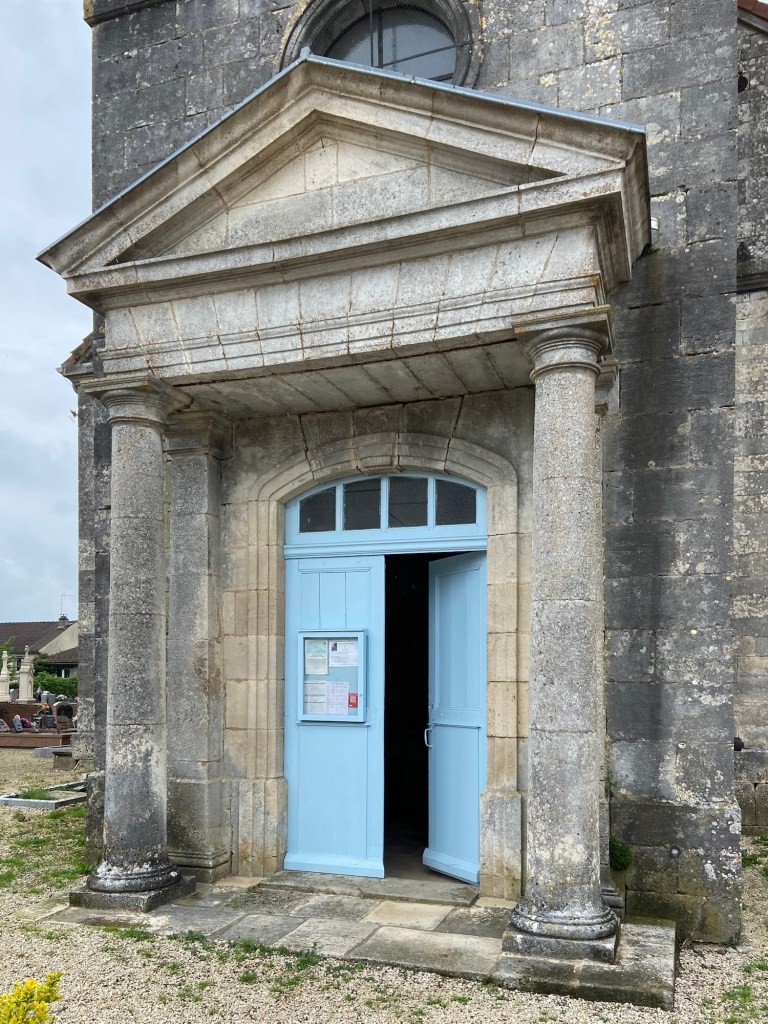
I turned off the road and made for the church: not only was it open but it actually felt relatively warm inside. The heat of this week has been retained by the blocks of stone and whereas I had on previous days appreciated the coolness of church interiors, here it was the opposite.
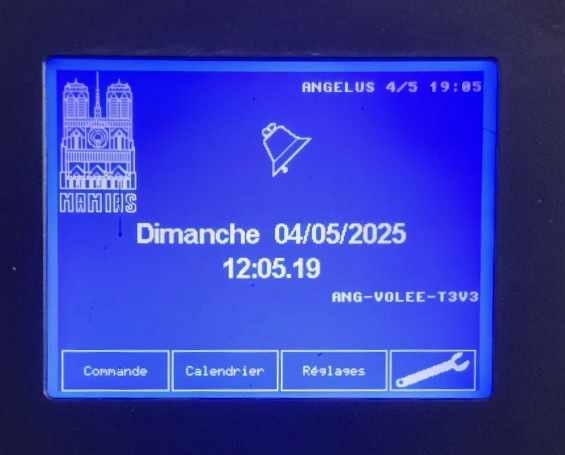
It was just before midday and the church bell was tolling. On the wall in the antechapel was an electronic system controlling the ringing of the bell with an animated bell icon tolling back-and-forth. I thought of my over-the-road neighbour David who is tower captain of our magnificent peel of Bromyard bells. A real art form and a team effort, unlike here!
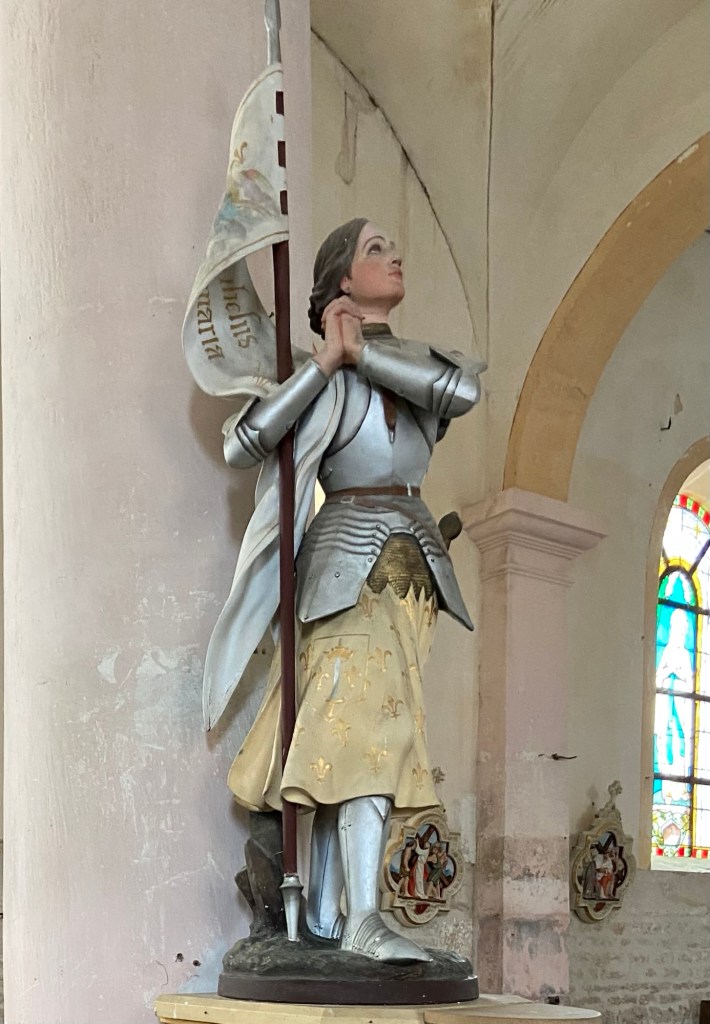
I wandered a little bit around the church, noting local devotion to that auxiliary to the liberation from the English, Saint Joan of Arc.
In terms of the aesthetic, I preferred the simplicity of the font.

When the rain had stopped, I set off on my way, now feeling a little chilly and scoffing the two snack bars that Doug had bequeathed to me this morning when he set off. The first bit of the path was a climb uphill, for which I was grateful as it made my muscles work a little harder and helped me began to warm up.
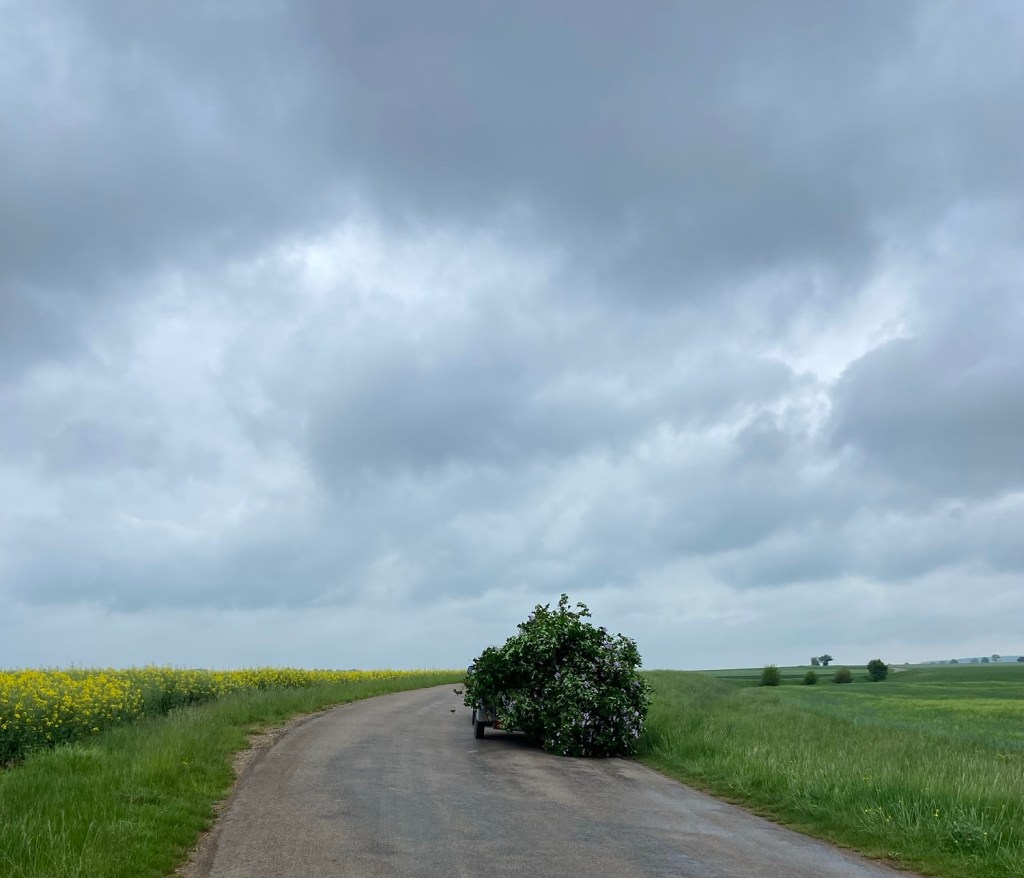
At the top of the hill, I met Florian, stuffing an entire lilac tree in flower on the back of a trailer. He said he was going to take it out somewhere into the countryside and dump it.
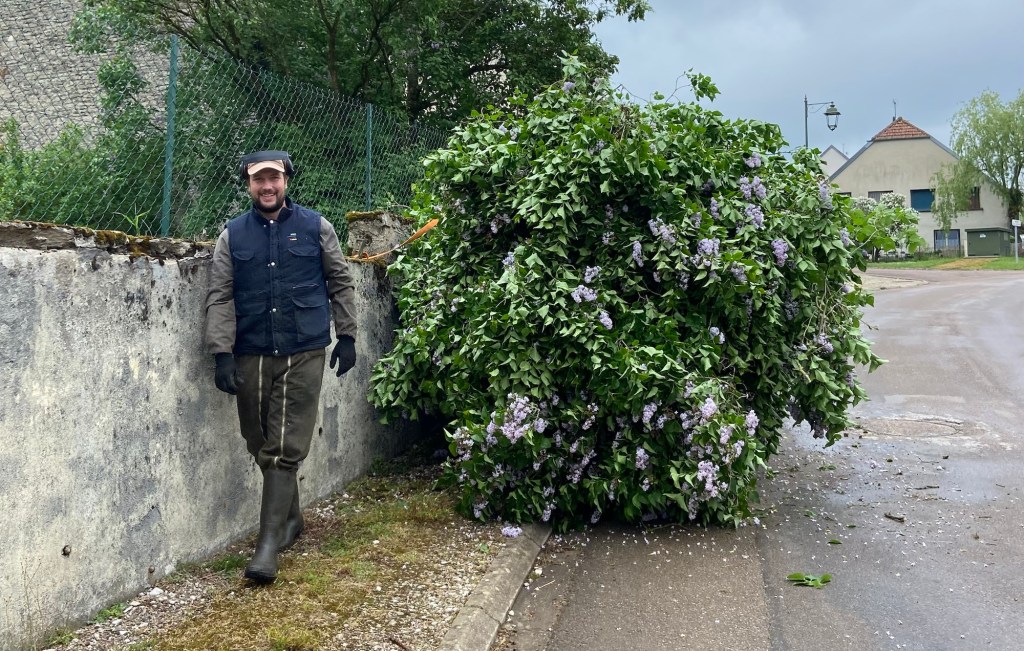
I marched on underneath a canopy of lark song, thinking this was a fairly good sign that the rain wouldn’t start up again, and in short order Florian passed me in his van, the lilac dragging on the road behind him as the tree sagged off the end of the trailer. It left a trail of little flowers for me to follow.
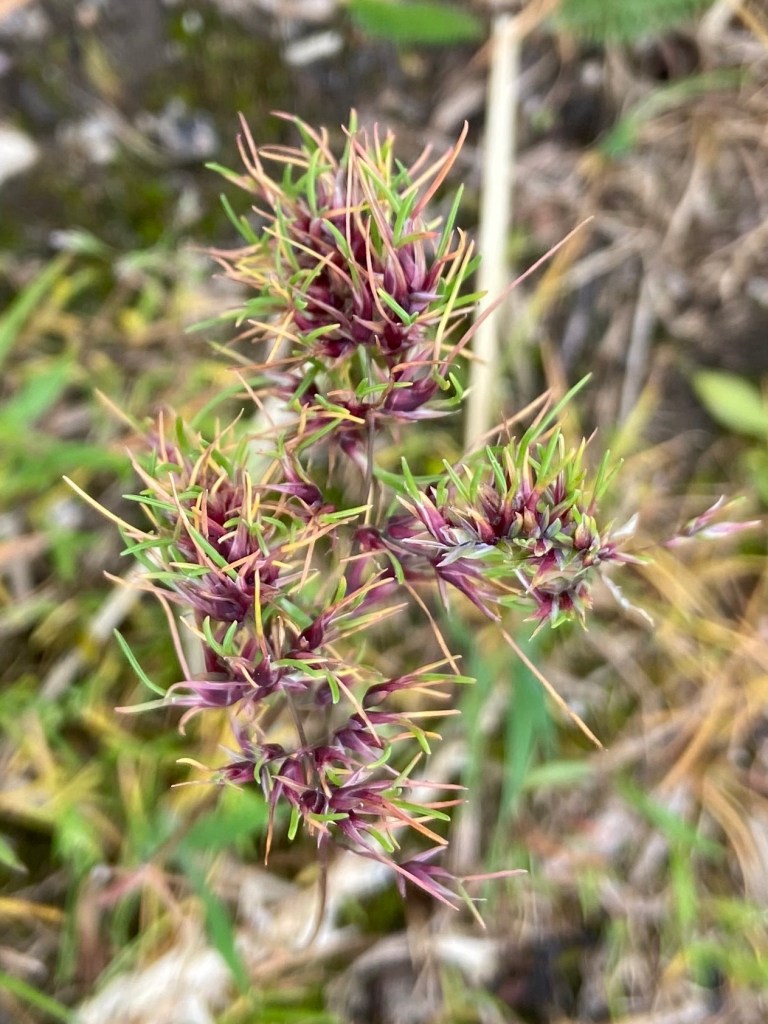
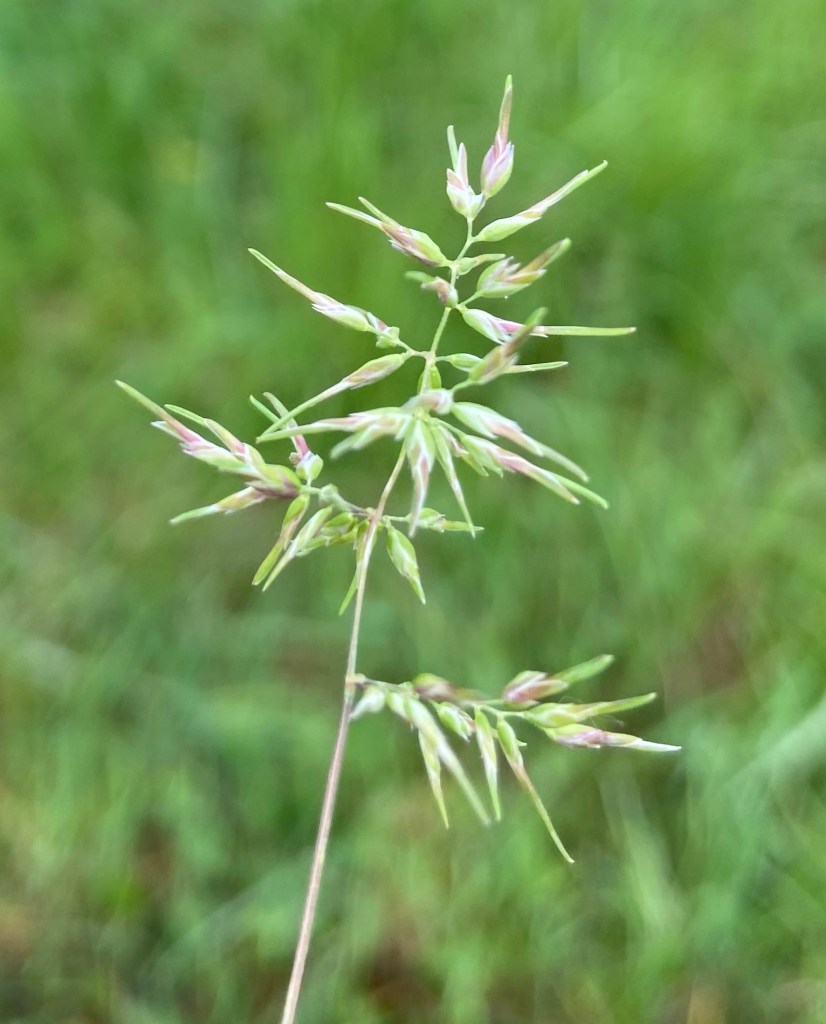
I was going much slower than the van, though, slow enough to notice how beautiful the grass flowers were.
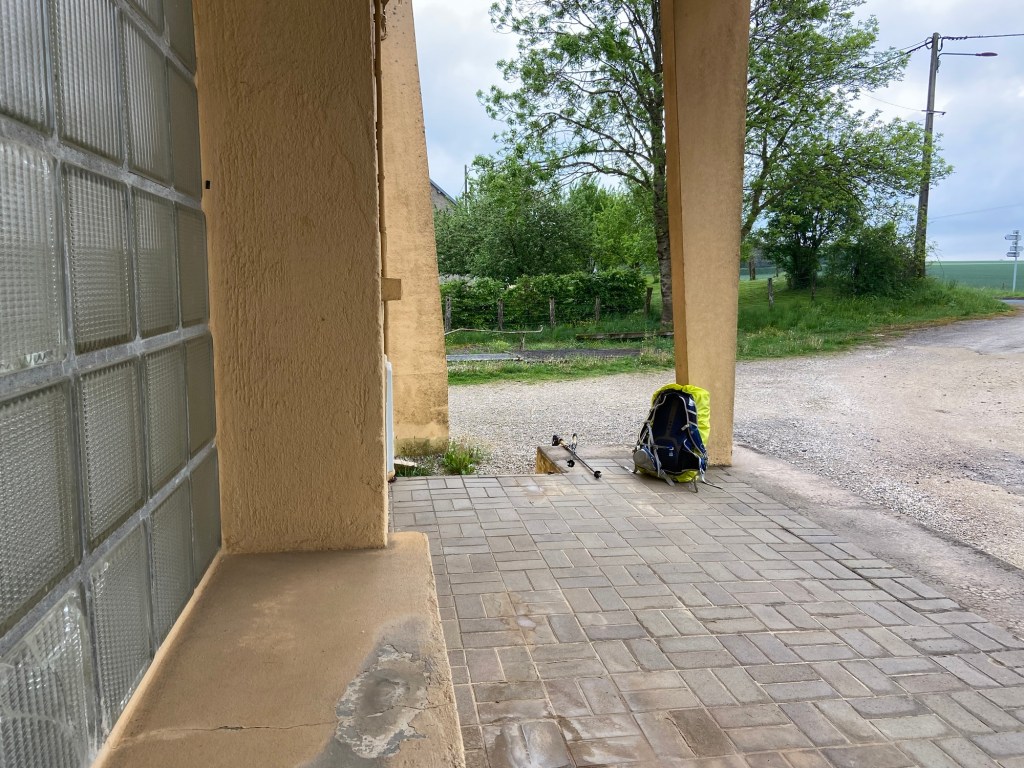
It didn’t feel long until I got to the village of Beauchemin on the other side of the A5 motorway. As had been the case at Marac, as soon as there was available shelter, it started to rain. So once again, rather than being caught out and exposed in the middle of nowhere I was able to take shelter, here under a sort of covered porch of a storehouse, with glass bricks and a deep sort of windowsill at just the right height for me to sit on. I was really glad I had stopped because the rain intensified, and I was starting to get cold in my shorts and T-shirt. So I put my full wets on for only the second time in more than a month.
While I waited for the rain to stop, I looked at the stalactites and stalagmites that years of slow calcareous water drips were creating on the tiles.
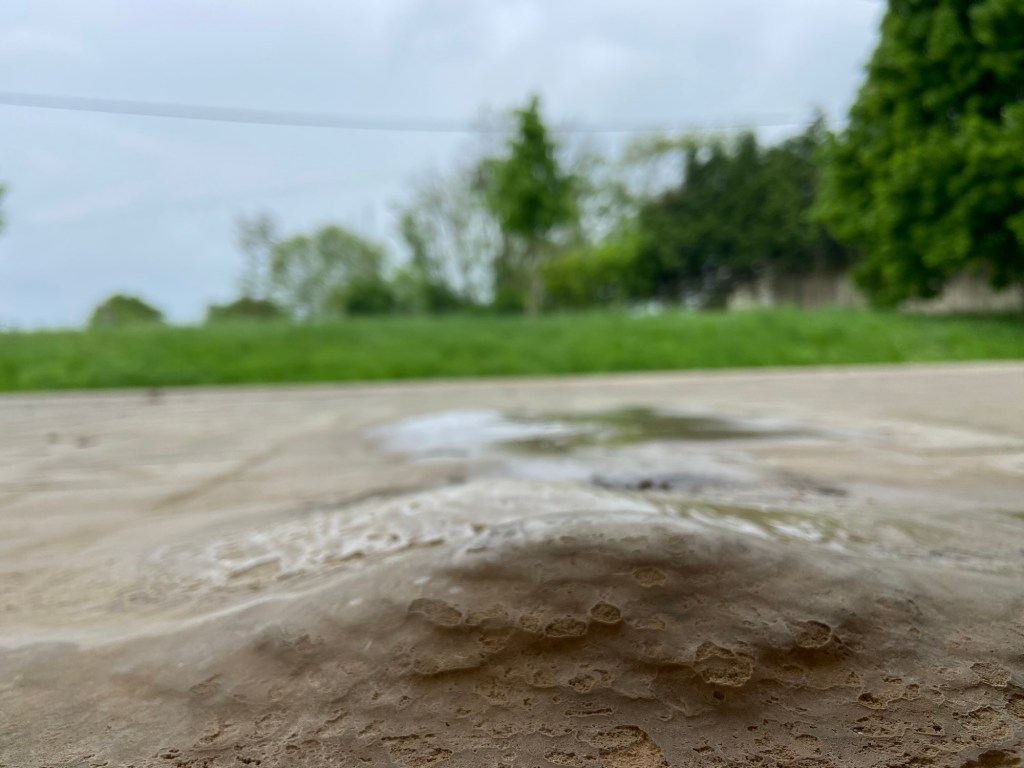
It looked to be stopping after about half an hour and I didn’t want to wait around all day, so I set off again in the tail end of the shower down the continuation of the Roman Road, wondering whether there had been a crossroads and a settlement here two thousand years ago when the road was first constructed in Agrippa’s plan to control and reorganise Gaul.

It felt warm and snug walking with a waterproof layer on, and I listened to my audiobook until I heard another nightingale (yet another nightingale!) singing from the bushes. I thought it was wrong to give my attention elsewhere, so I switched off the book. I have been enjoying listening to Louis de Bernier’s The Dust That Falls from Dreams. It is set during the Great War, and concerns experiences on both the Western and Home Fronts. I found the fragmentary diary entries of one of the characters in the appalling conditions of the trenches particularly poignant, and the accounts of the wounded, shockingly ravaged by war, arriving at hospitals back in Blighty. I have spent the last month walking past cemetery after cemetery, battlefield site after battlefield, and it’s helpful to listen to an emotionally charged account, even imaginary, of the human experience of a century ago. Like the recent Post Office scandal in the UK, which was so slow to get legal address and compensation until the screening of the docudrama. Often the Arts are the most effective way in which people can connect emotionally with terrible events, and feel them enough to do something about them.
Sooner than I thought possible I was at Saint Martin of Langres, last proper village before the town, and here I very briefly intersected with the official VF route for the day.
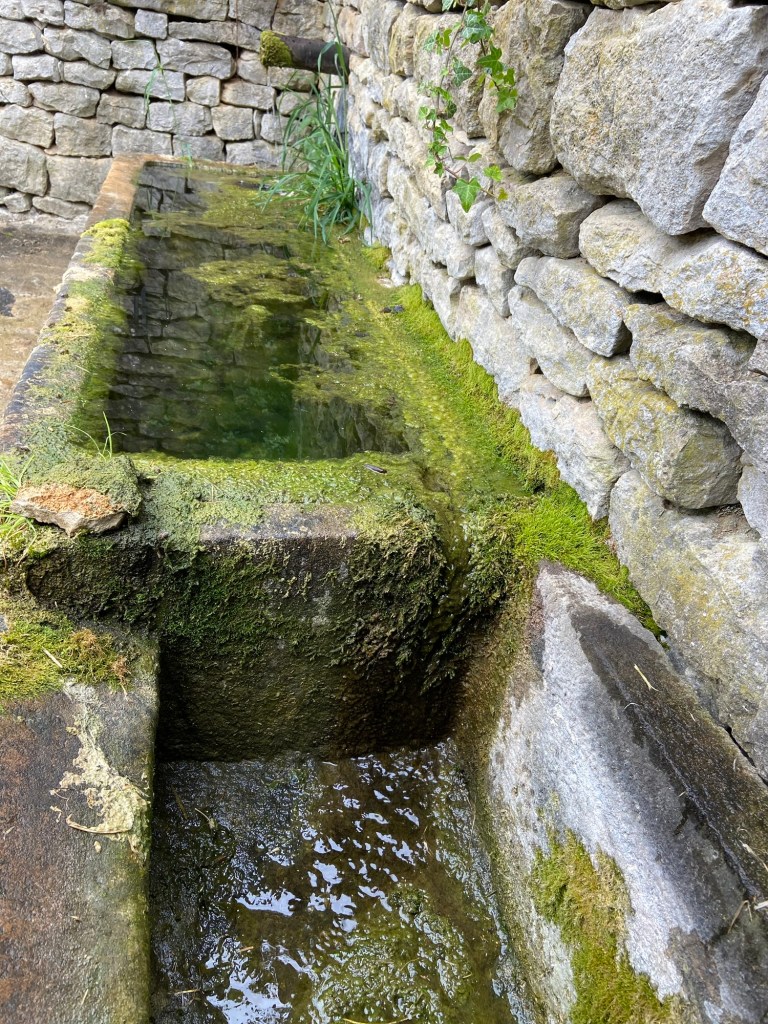
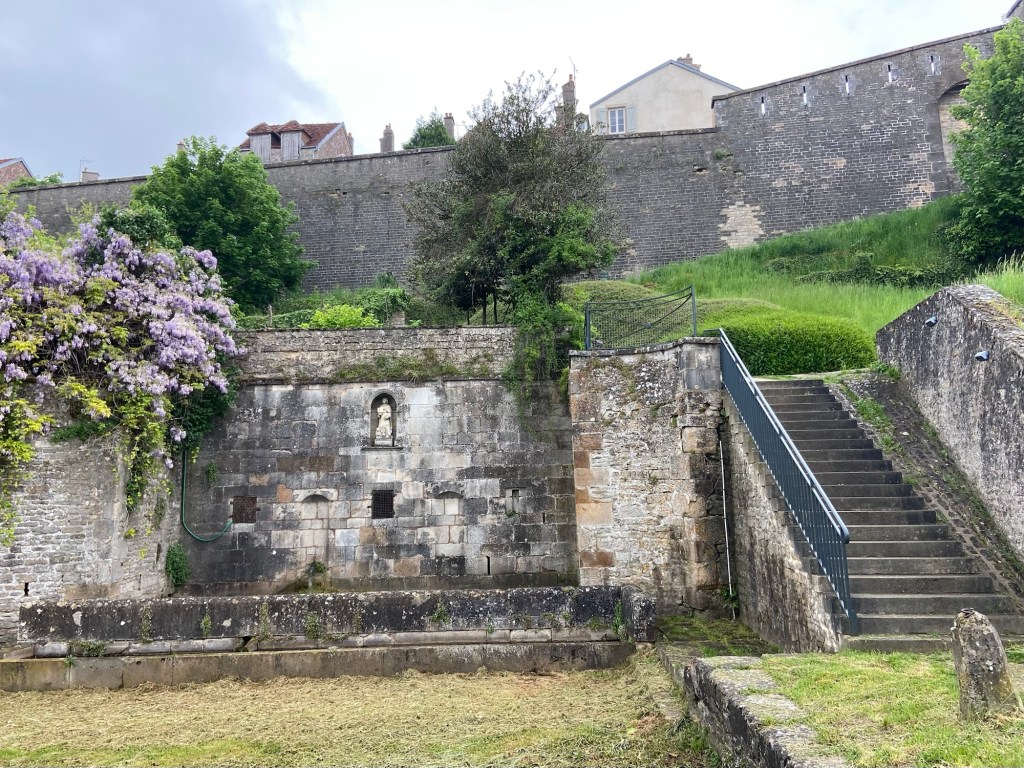
Saint-Martin-de-Langres was a village precipitously on the side of a ridge, a place concerned with cleanliness, with an old washhouse and a historic communal fountain.
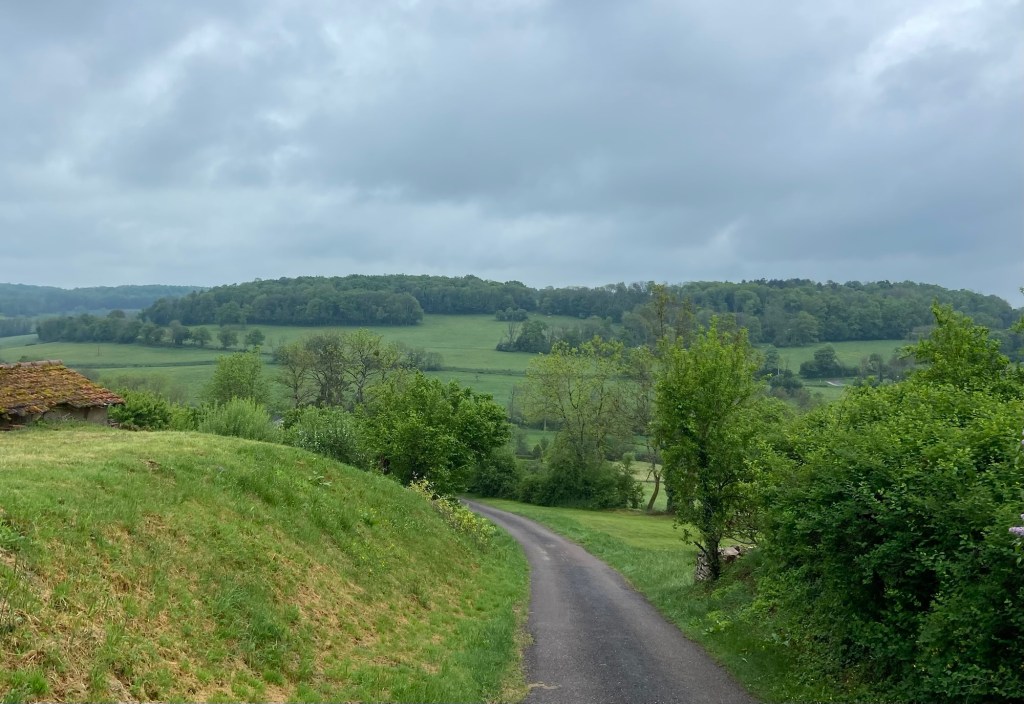
The view ahead was now completely different to the France that I’ve mostly walked through over the past month. This was much more of a green and pleasant land, small pastures dropping down to the river and up again the other side.
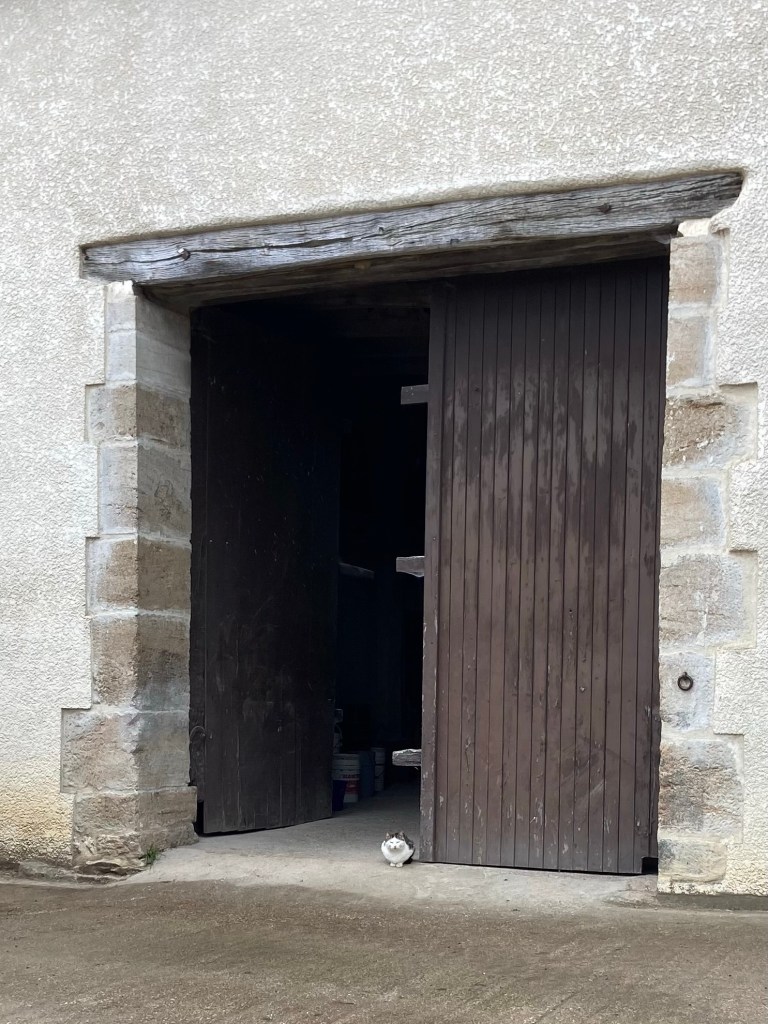
This was a land of ancient farms, and farmyard cats,
of cattle chewing the cud (though lumbering to their feet as I came near).
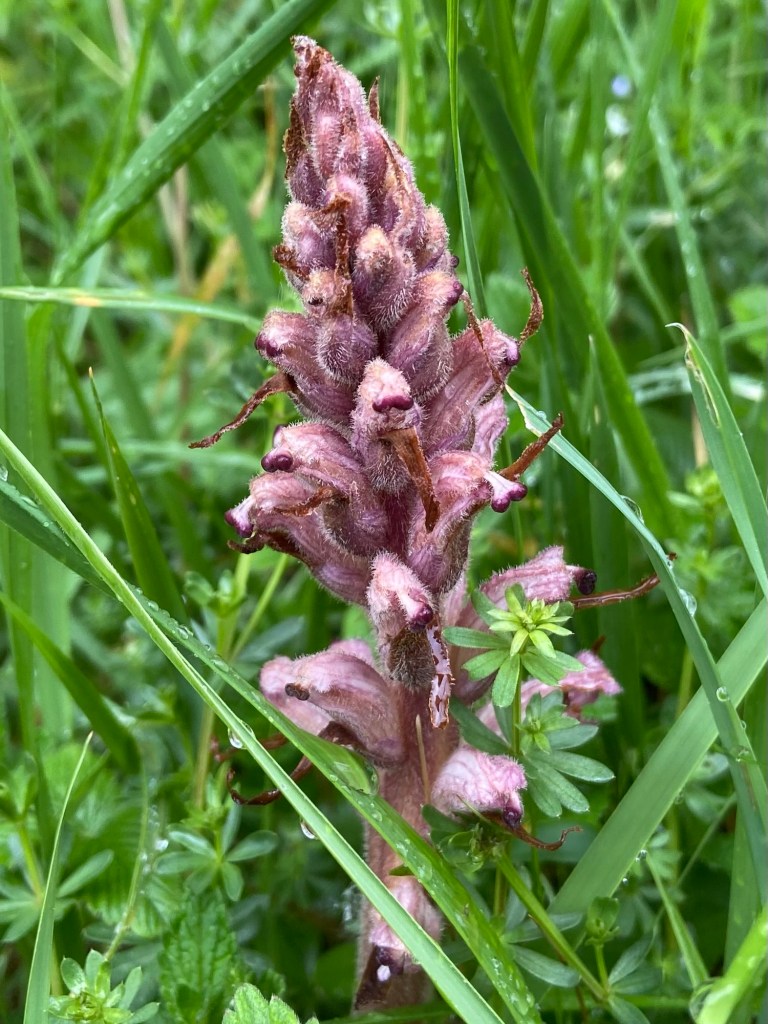
In the damp verges was a little patch of a plant I’ve been looking out for: broomrape. These plants entirely lack chlorophyll, and instead get their energy by parasitising other plants. This one, common broomrape, parasitises plants in the pea and daisy families.
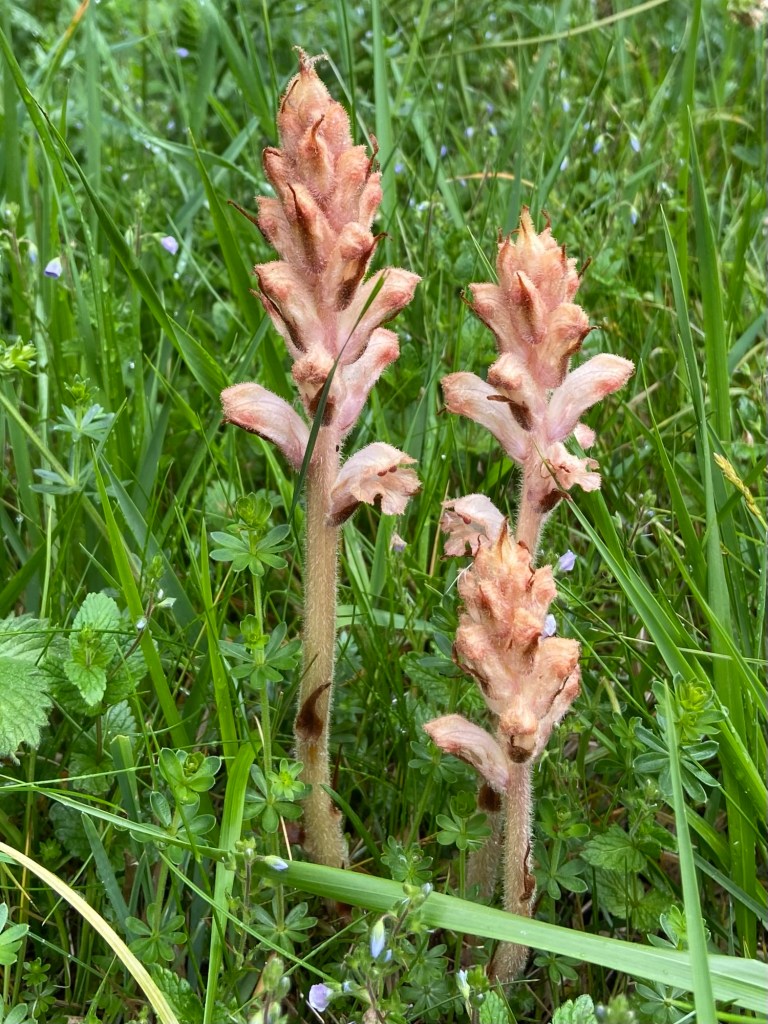
And I think this is another — their morphology is quite varied.
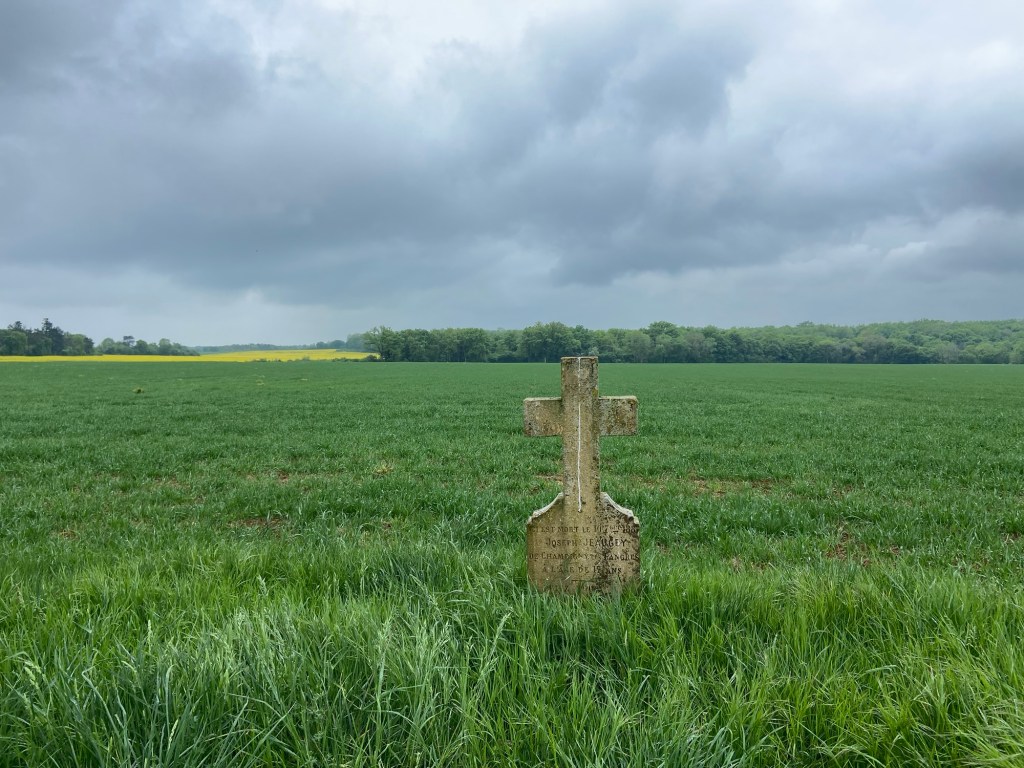
There was one last plateau to cross. More straight roads and open fields, punctuated by lonely crosses, this one marking the death in 1887 of 17-yr-old Joseph Jeaugey. I wondered how he had died — roadside monuments to teenagers are sadly still a familiar sight today.
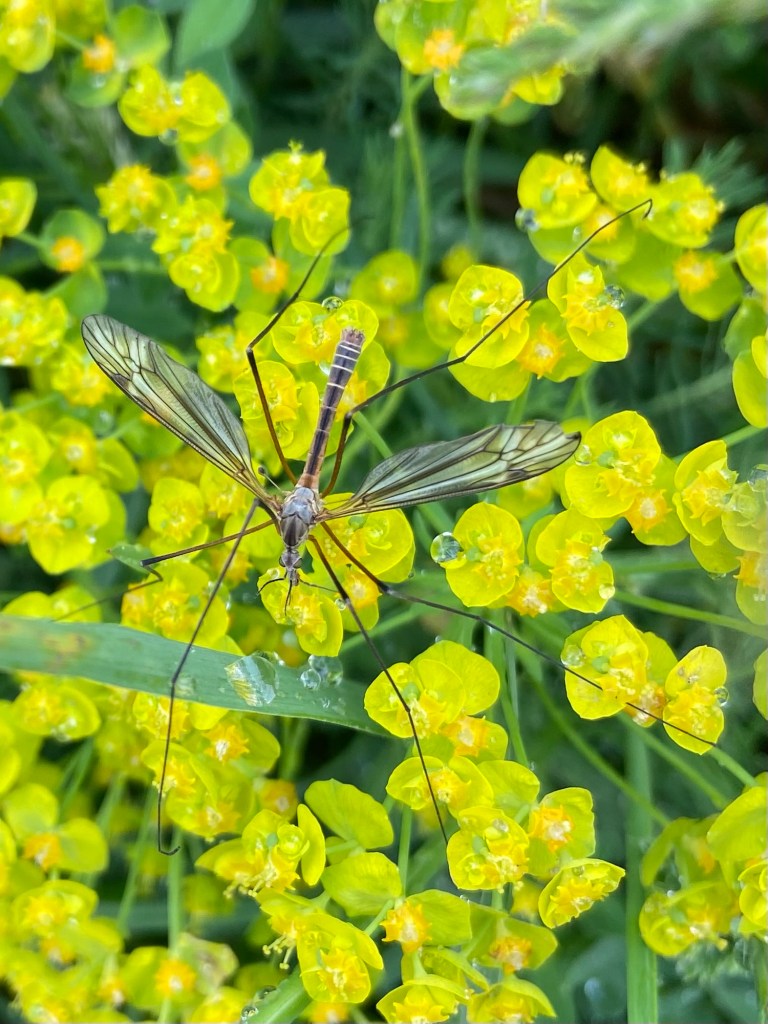
I shared the road today only with larks, and crane flies.
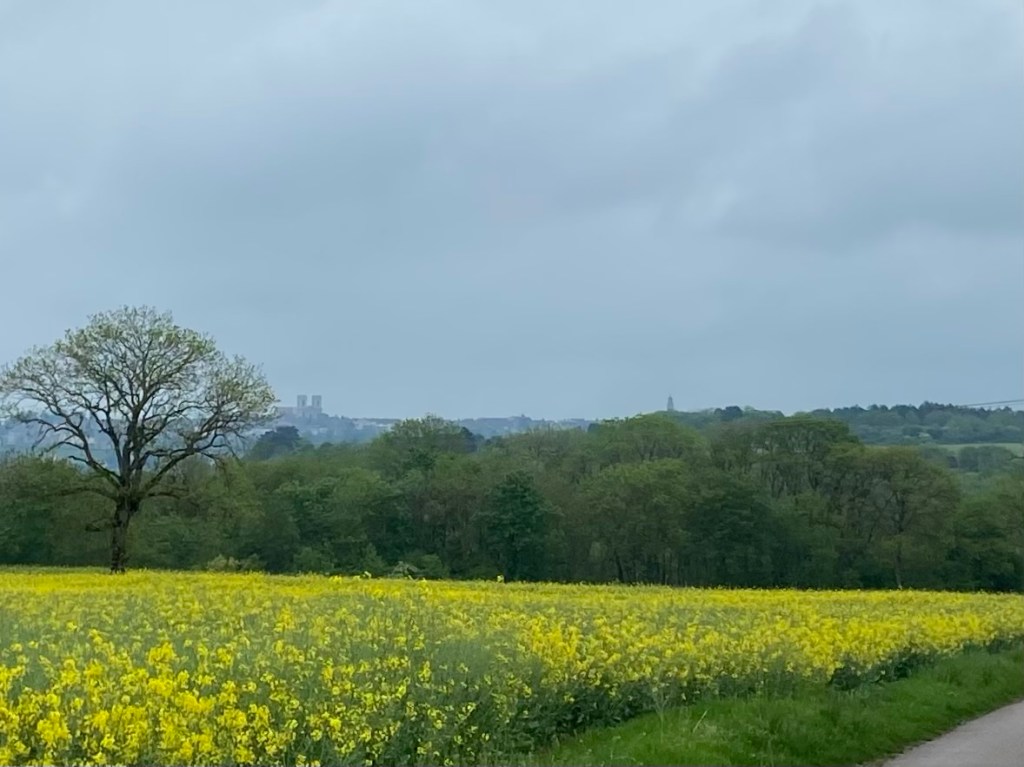
I looked back from the top of the plateau across the 21 km I had come in a straight line. And when I turned forward again, there was Langres on a limestone promontory high above the valley of the river Bonnelle which I would cross before I climbed the slopes up to the fortified town. Across the oil-seed rape field through the moisture-laden air, I could see the twin towers of its Renaissance cathedral.
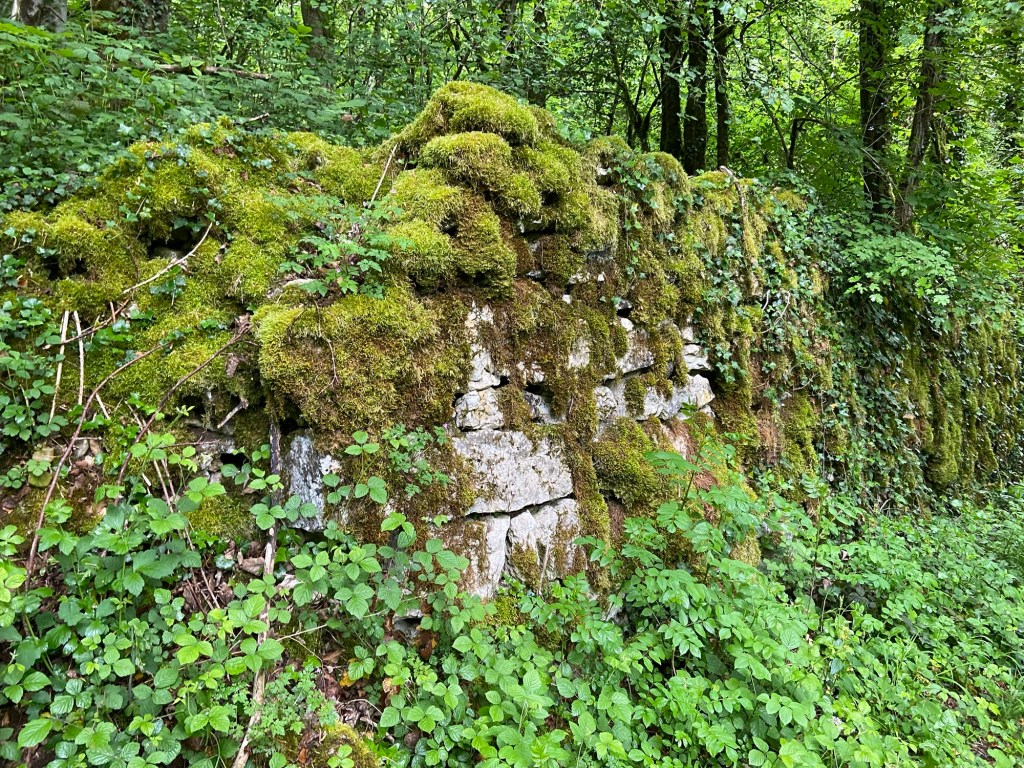
I rejoined the Francigena for the approach into town. We turned down a grassy path which became precipitous and dark as it made its way to the bottom of the valley, a damp and green secret way with rubble underfoot from various stone walls, perhaps once parts of buildings, now almost completely covered in moss.
At the bottom I turned to photograph the church. Looming dark clouds were coming up fast behind me.
I hadn’t far to go now, but it was all uphill and very steep, and I was racing the rain (a losing battle).
The way was guarded by figures forbidding,
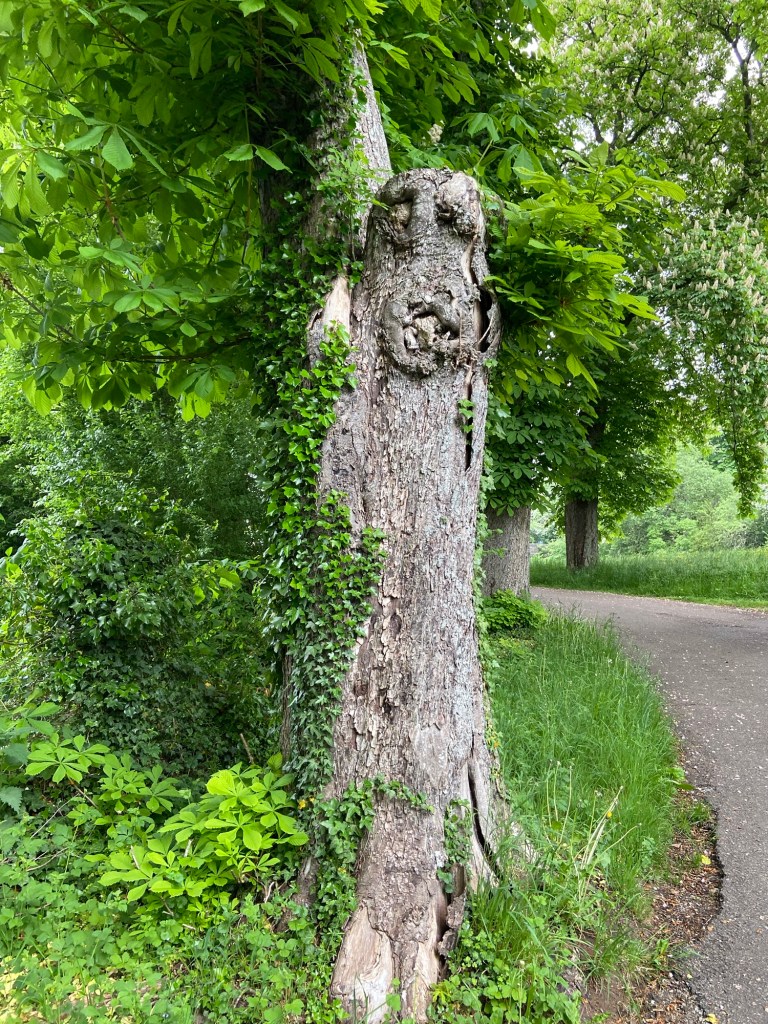
friendly,
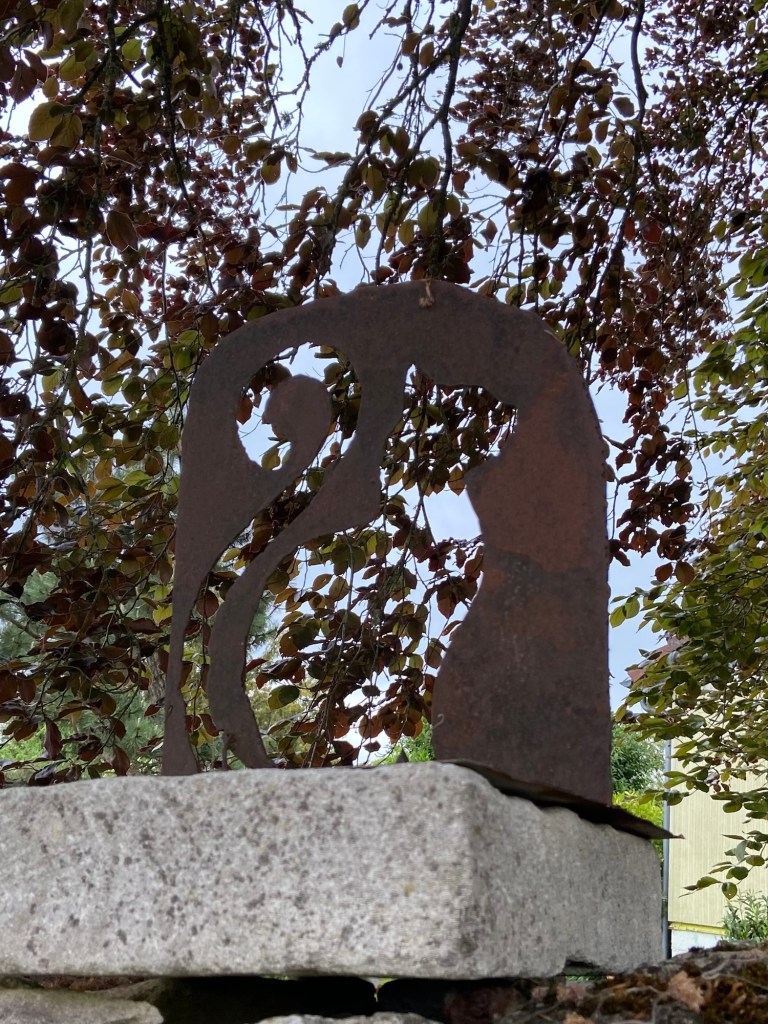
and anciently inscrutable,
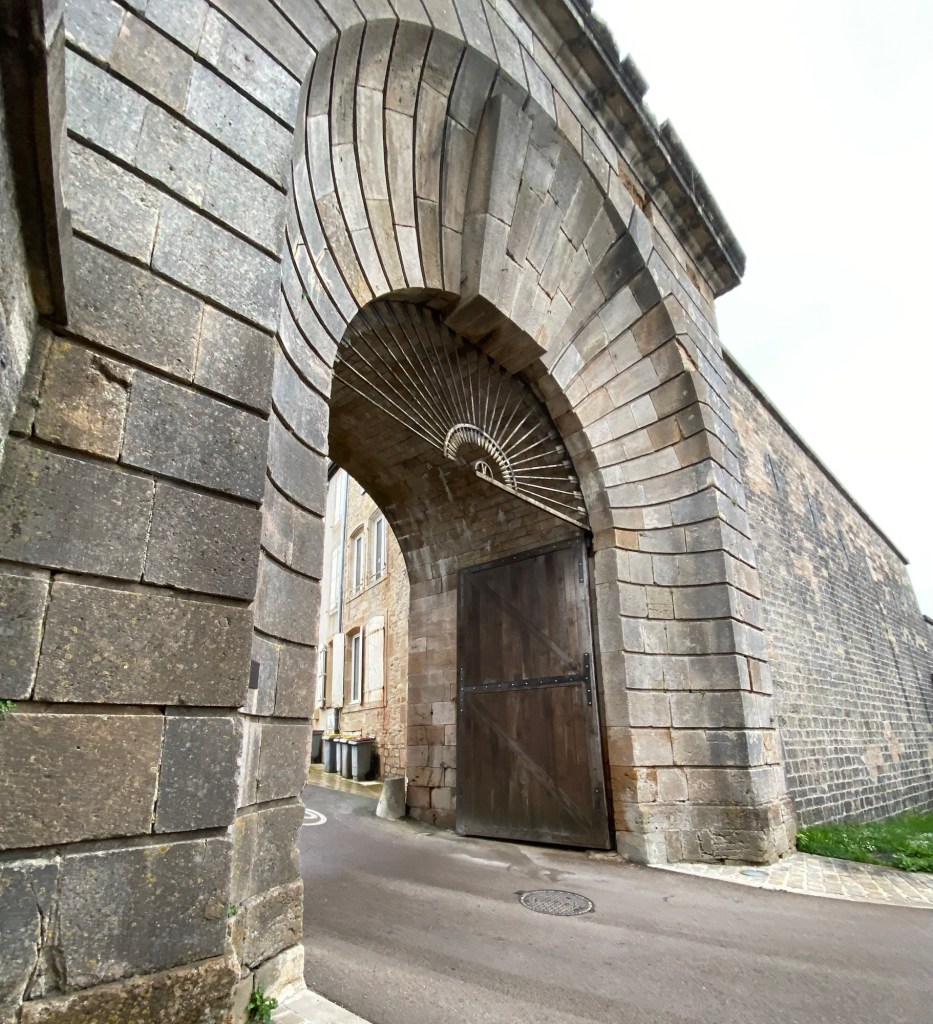
but at last I was at a gate that would take me through the fortified walls, and into the town where I could enjoy not one but two rest days.
Once in my AirBnB with my clothes being laundered in the washing machine, I caught up with my messages. Ian, a day behind me and walking through the forest, had texted to say he’d SEEN THREE WOLVES. I felt I had got out of the forests by the skin of my teeth!
Stats for the Day
Distance: 24.82 km
Time: 5 hrs 12 mins over 6 hrs 35 mins
Pace: my Roman marching speed of 4.8km/hr
Bizarre insect inside Annick’s hostel: the European House Centipede (Scutigera coleoptrata). It’s an insectivore, with a diet of bedbugs, cockroaches, silverfish, wasps, ants and other pests, which it paralysis with venom injected through ‘forcipules’ near its mouthparts. They leap on their prey, or can can trap more than one insect at a time by using their mandibles and their many legs to ‘lasso’ them or beat them. So. Ferocious, but in a good way.

Post scriptum note on Pace:
🥾 Covering 4.8km/hr at 123 paces per minute, I calculate that each regular pace of mine is 65cm. This compares with standard military quick march of 116 x 76cm paces per minute. 🥾
 Walking The Landscape
I appreciate the slug. I’m also intrigued by the methods around stuffing wool into your shoes. Age old perhaps.
LikeLiked by 1 person
Yes! I thought of bog bodies found with their shoes stuffed with moss and wool
LikeLike