When you put your hand in a flowing stream, you touch the last that has gone before, and the first of what is still to come.
Leonardo da Vinci
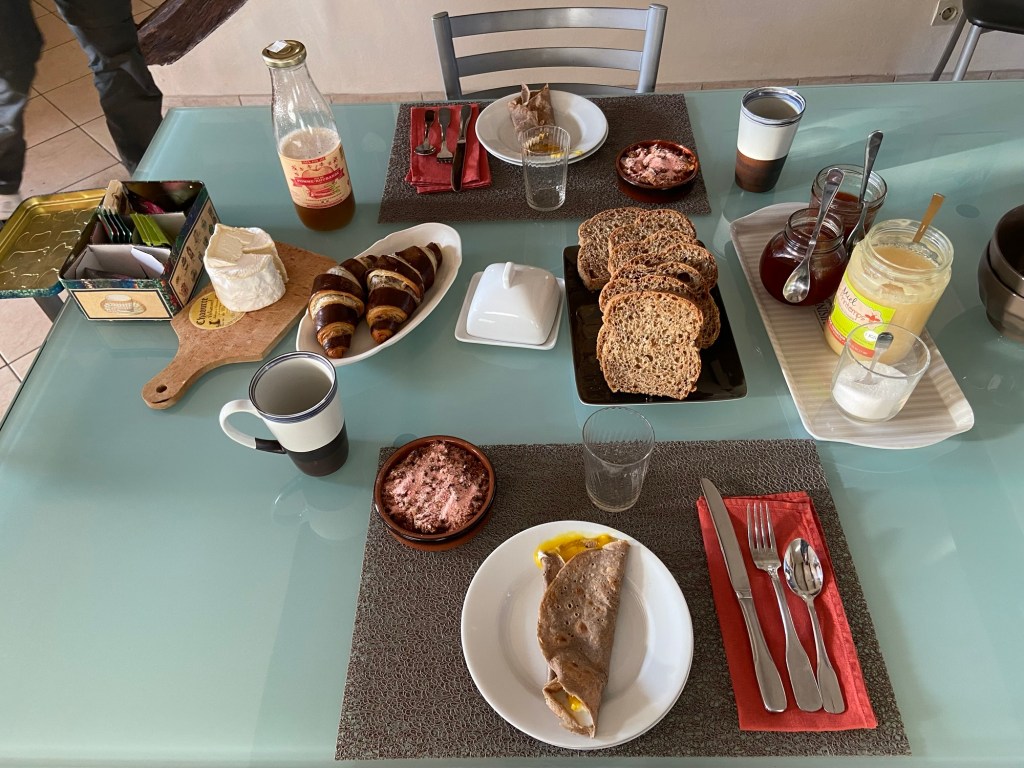
We could almost not believe our eyes when we saw the breakfast laid out for us this morning. There were freshly made buckwheat crêpes with an egg inside (at least, I think they were buckwheat: Mme Monique said it was ‘Saracen’ grain. There was also a little pot of strawberry crumble with the rose biscuits crushed and dusted on the top, bread, butter, and jam. There was fresh coffee, and local, farm-made apple and rhubarb juice. Not to mention the chocolate and cinnamon croissant, the likes of which I have never seen. I nibbled the end of this last, decided I couldn’t eat another thing, and put it in the pocket of my rucksack to have for lunch.
We all said our goodbyes. Ian and I because he is going one further stop than me today and needed to get on the road, but I needed to kill some time in Chalons because despite only having 21 km to go today, a matter of four or five hours, I am not expected at my accommodation until six, and there is no café or bar in the little villageI am stopping at today.
I also bid a very fond farewell to Monique who had so warmly and generously welcomed us last night. She really is peerless among pilgrim hosts.
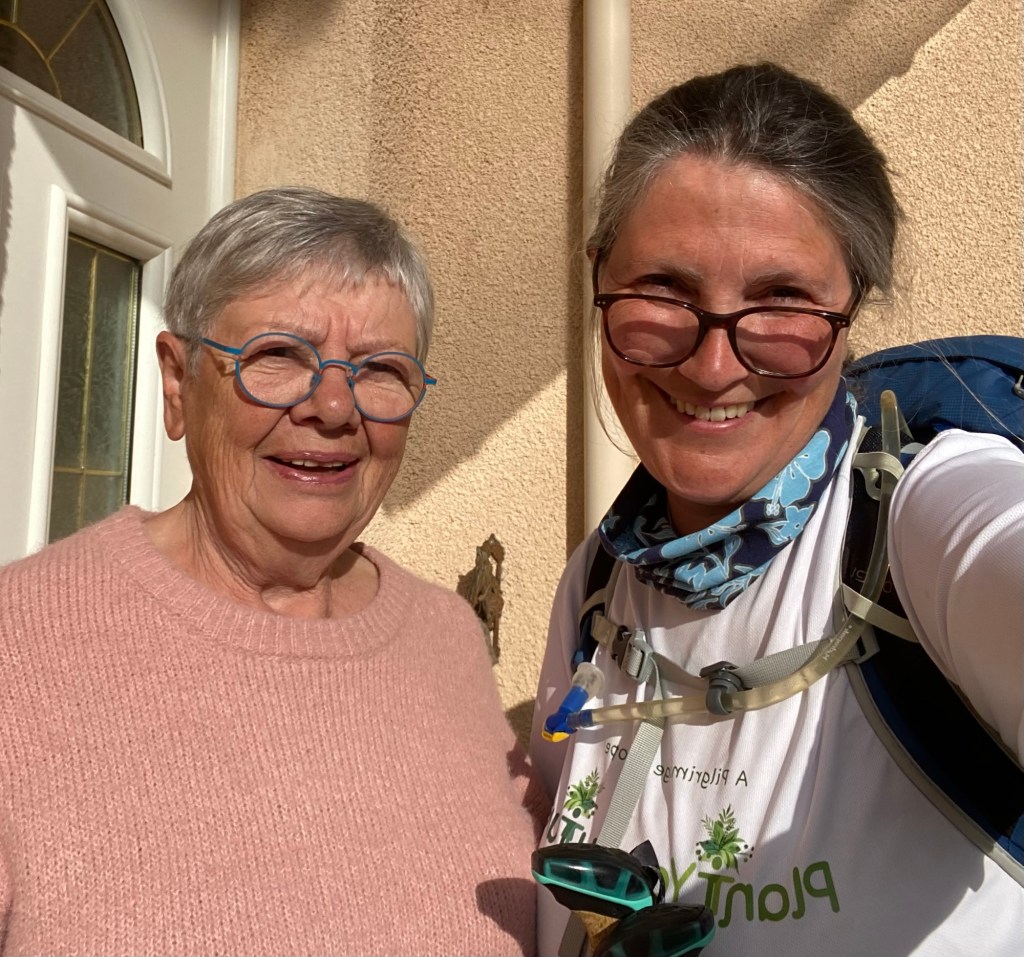
And Ian had been a really companionable fellow pilgrim. I had thoroughly enjoyed my time with him on the path. We had fallen into a very companionable rhythm of walking, stopping, deciding what to eat, sourcing the food, cooking it, washing up, and then sitting writing our respective accounts of our experiences. Ian has a very different blog style to me: it is in the form of a thematic colloquy, held between the persona of himself, Ian, who is the emotional, experiencing persona, and Jacob, Ian’s historian, informative persona. A third person narrator crafts the shape of the conversation and brings it all together. Each day has a theme: yesterday it was canals, the day before I think it was me! The day before that was champagne, and I was amused to hear that he took much of the text of my own blog post on the subject, and condensed it to use for his own. One extraordinary thing: when he opened my WordPress blog, it had been automatically translated into Dutch! Absolutely no idea how that could have happened.
Madame Monique had mentioned that the cathedral was usually closed, a bit of a shame, I thought. So I decided I would make my way to the church of Notre Dame instead. The city had a very different feel today, cheerful and attractive instead of damp and dismal as it had been yesterday.
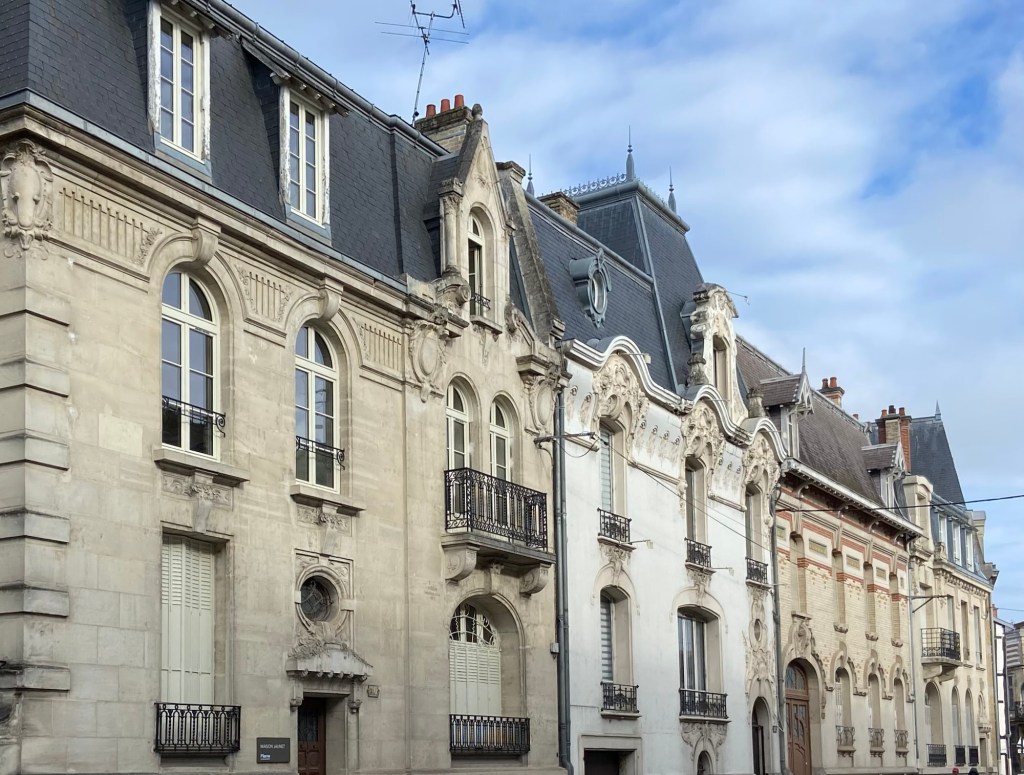
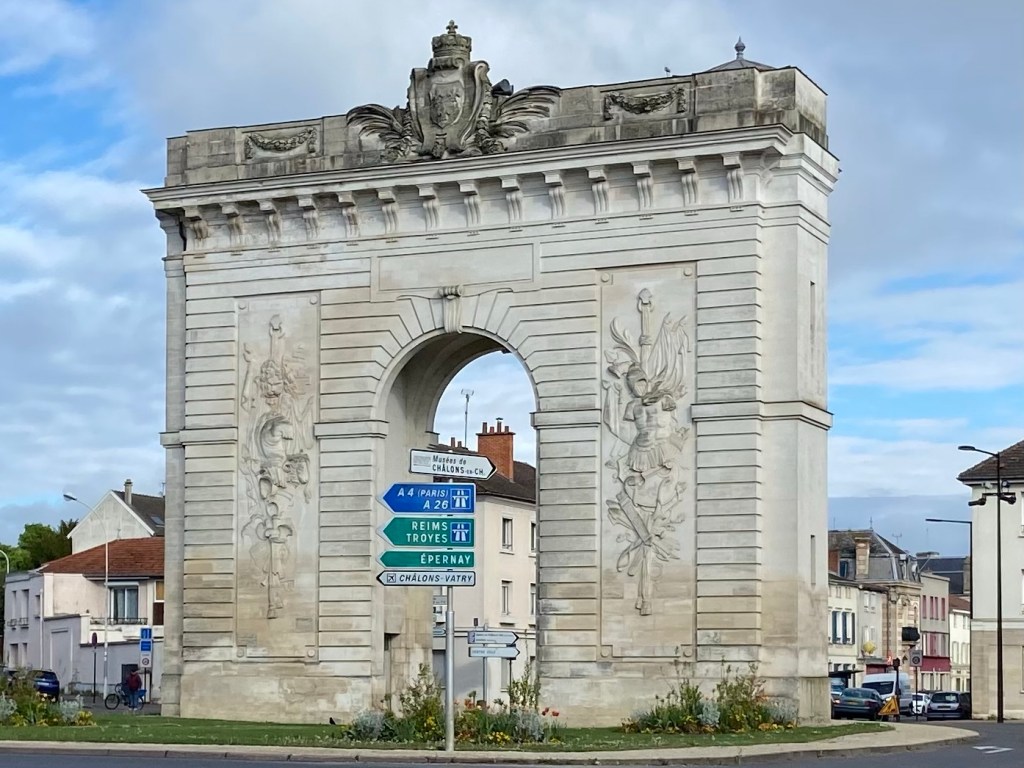
I made my way back past the great triumphal arch through which Marie Antoinette had entered the city on her journey to marry Louis XVI. I admired the six pack on the martial torso on the right hand leg of the arch, and wondered whether she had too.
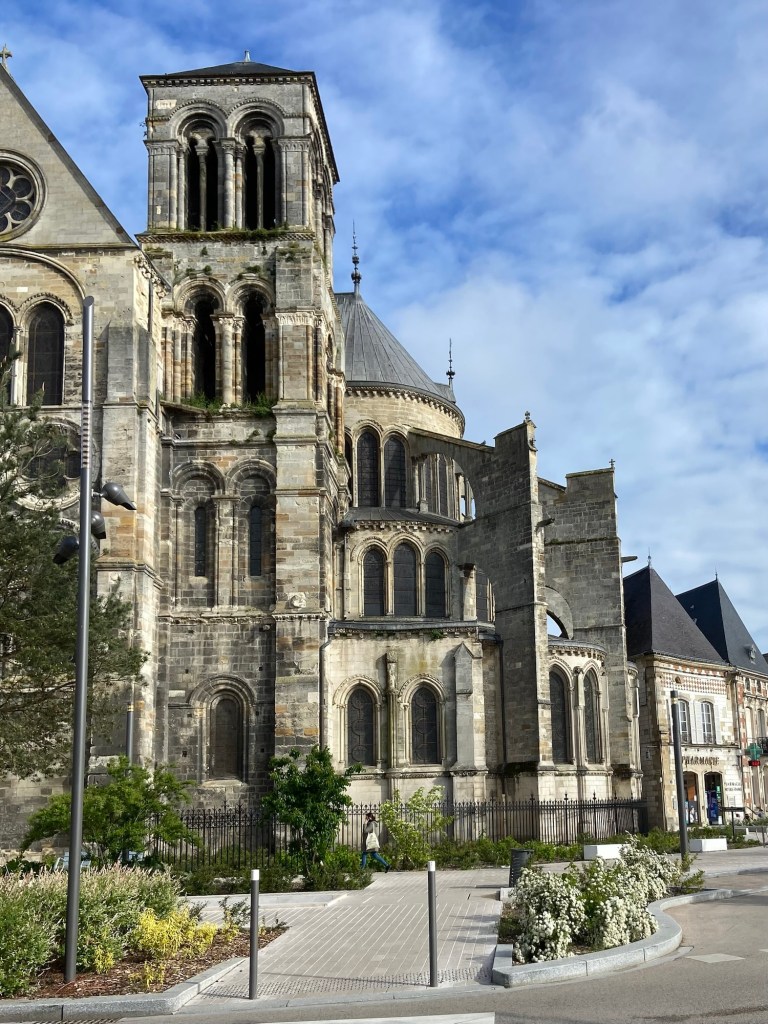
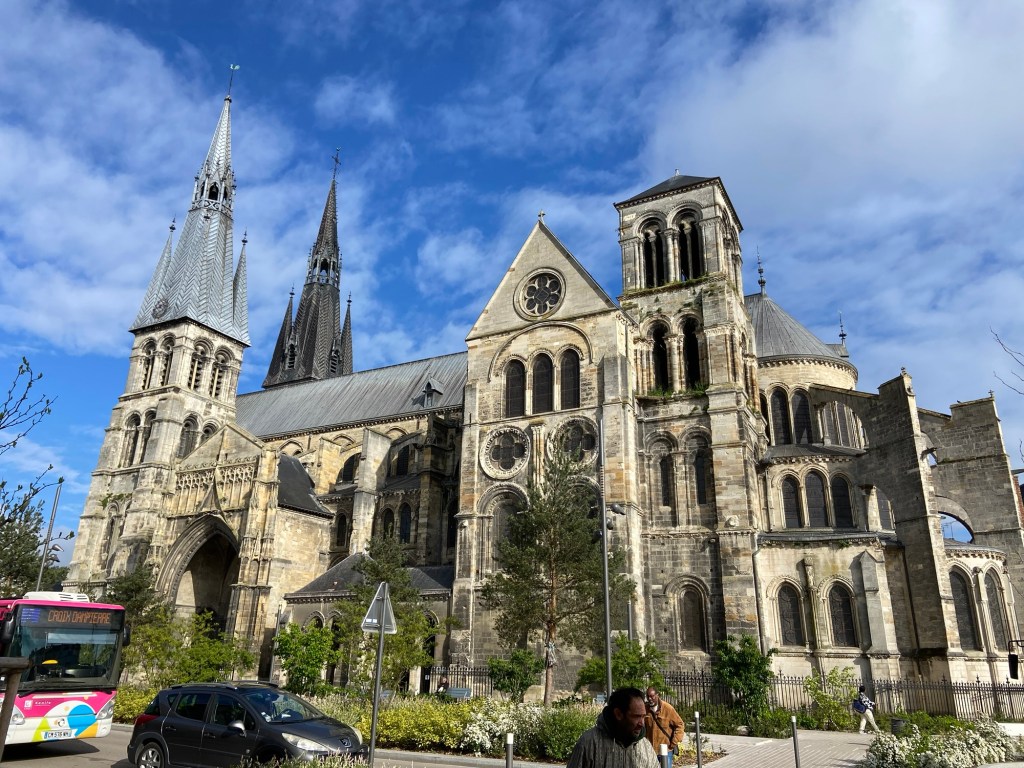
The exterior of Notre Dame was absolutely beautiful, a Gothic cathedral in miniature, with flying buttresses to compete with the best of them, albeit on a smaller scale.
I also admired two elongated pyramidal lead tops to the bell towers which I had seen from miles away as we had approached the city yesterday on the canal.
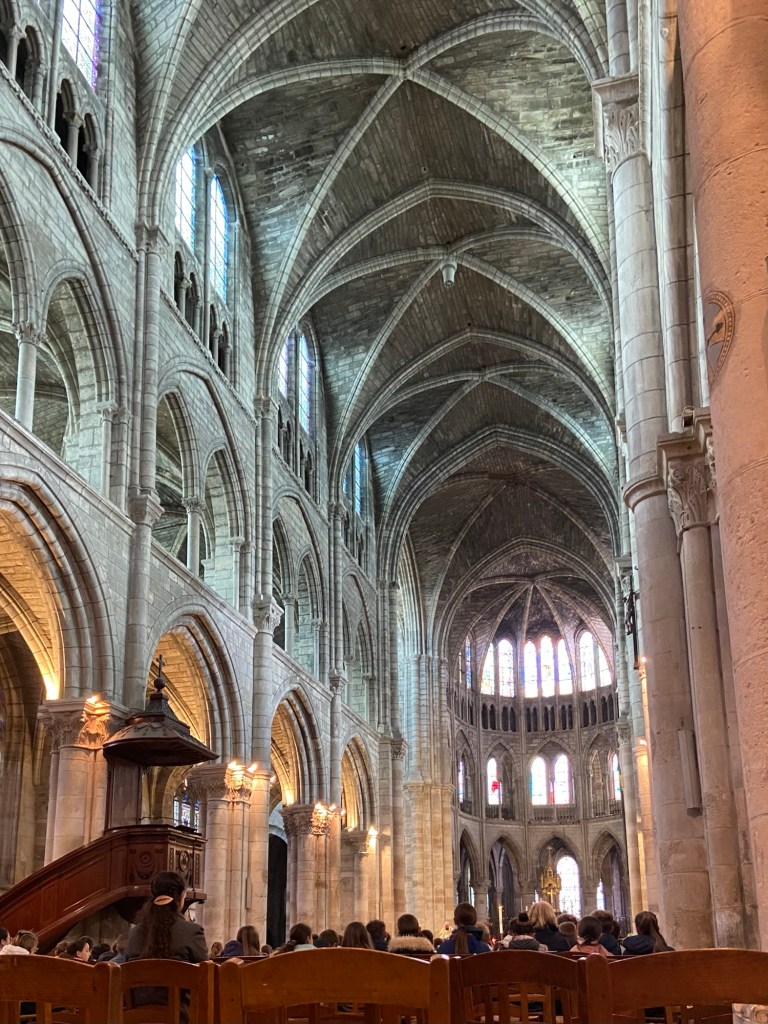
There was a service in progress. The church was full of school children chaperoned by their teachers and sitting through what seemed to be a kind of educational service about Easter. The particular focus was baptism, and some of the children who had been baptised on Easter Day were called up to the front. I crept to the back and sat quietly, taking in the interior. And also wondering in what context a school in France’s determinedly secular Republic might take pupils into a Catholic Church service for the purposes of religious education.
I had pretty much decided that I wasn’t going to be able to mooch around the city very effectively. It was just that I was finding it very difficult to be in a city at all. I walked through the mall in the centre, and found myself feeling completely detached from the world of the clothes shops, the shoe shops, the beauty salons. I had just had breakfast and didn’t feel like sitting down in the coffee shop, so I thought I would just set off our into the countryside, go very slowly so as not to arrive too early, stop frequently and perhaps seek a really nice place to sit down and be in the countryside rather than the city. It was interesting to realise that this walk doesn’t feel remotely ‘touristic ‘; it feels much more about moving through a landscape in slow but perpetual motion. Having got up and got out this morning, I just didn’t want to stop, and being in Chalons felt like stopping.
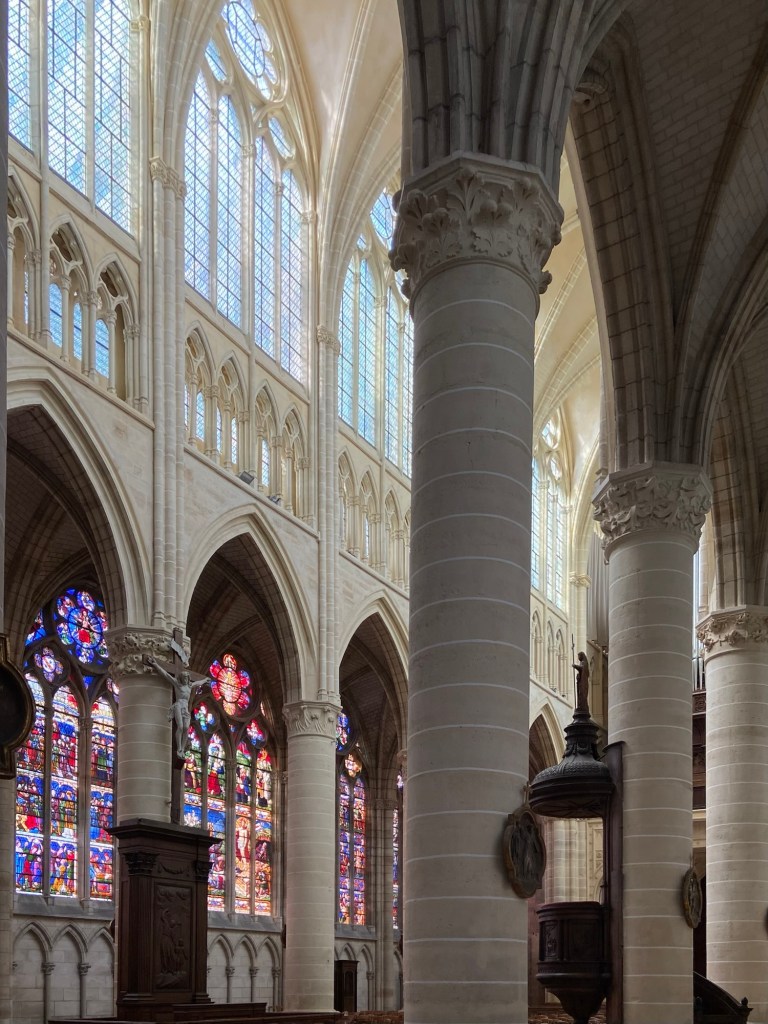
On the way through the city to the point where the Via Francigena joined the Marne river path I saw that the cathedral door was in fact open, so I went in to look round, stopping to photograph the extraordinary reflections in puddles of water in the doorway.

The cathedral was eerily empty of people and I took my time doing a circuit around the transepts,
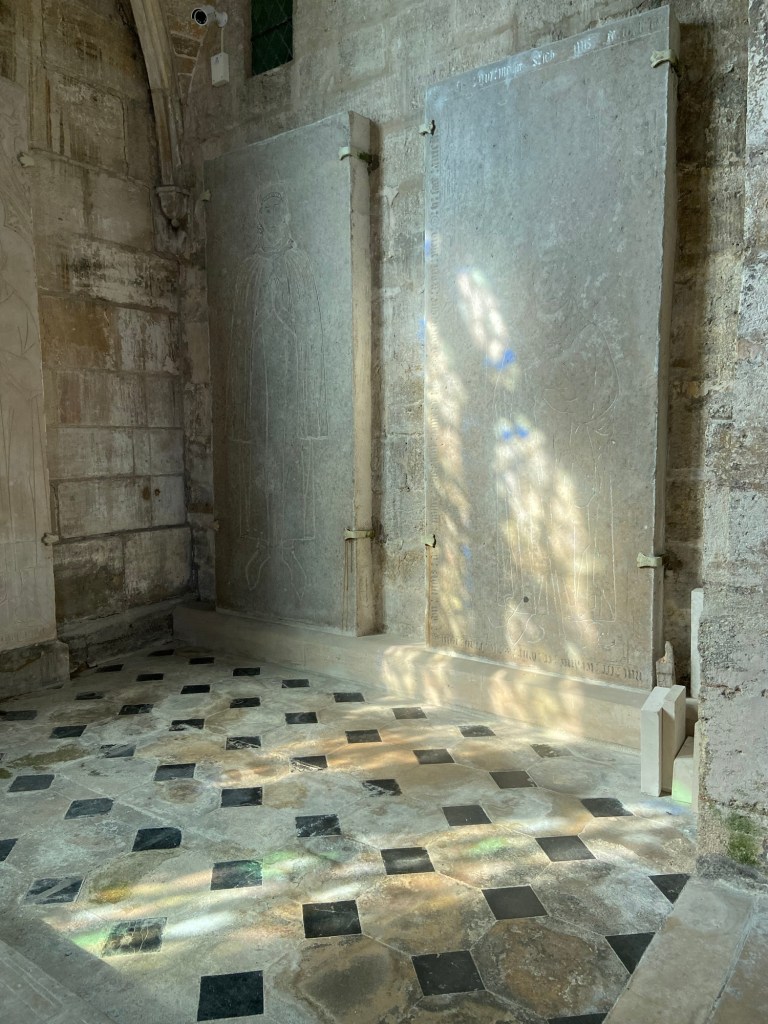
And trying to make out inscriptions on memorial slabs.
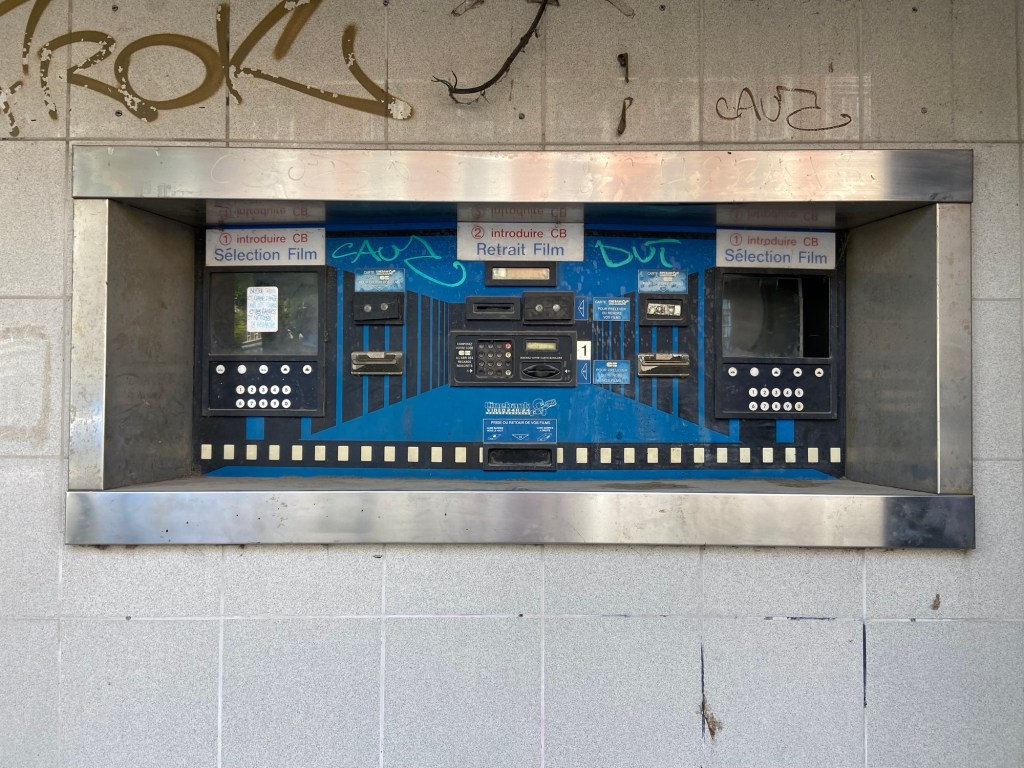
Emerging into the sun, I found a more recent relic of city life: a vintage hole-in-the-wall video and dvd dispenser along the lines of a jukebox.
Having decided not to be a tourist, I felt I was now rather shaping up to be one. Instead of taking the river path immediately, I wandered out onto the bridge.
Fish were visible from above weaving lazily to and fro to keep themselves stationary in the water below. The bridge itself was constructed in 1945 to a utilitarian design, the latest iteration in a number of crossings of the Marne destroyed over the centuries one after the other. The 1776 stone bridge was damaged by revolutionaries in 1814, and the repaired version was blown up by the French in 1940 to stop the German advance. And the night before the liberation of the city in 1944 the Germans themselves destroyed their replacement bridge in an effort to prevent the Allies from entering the city. I thought of the Pope’s title, ‘Pontiff’, from the Latin Pontifex, builder of bridges.
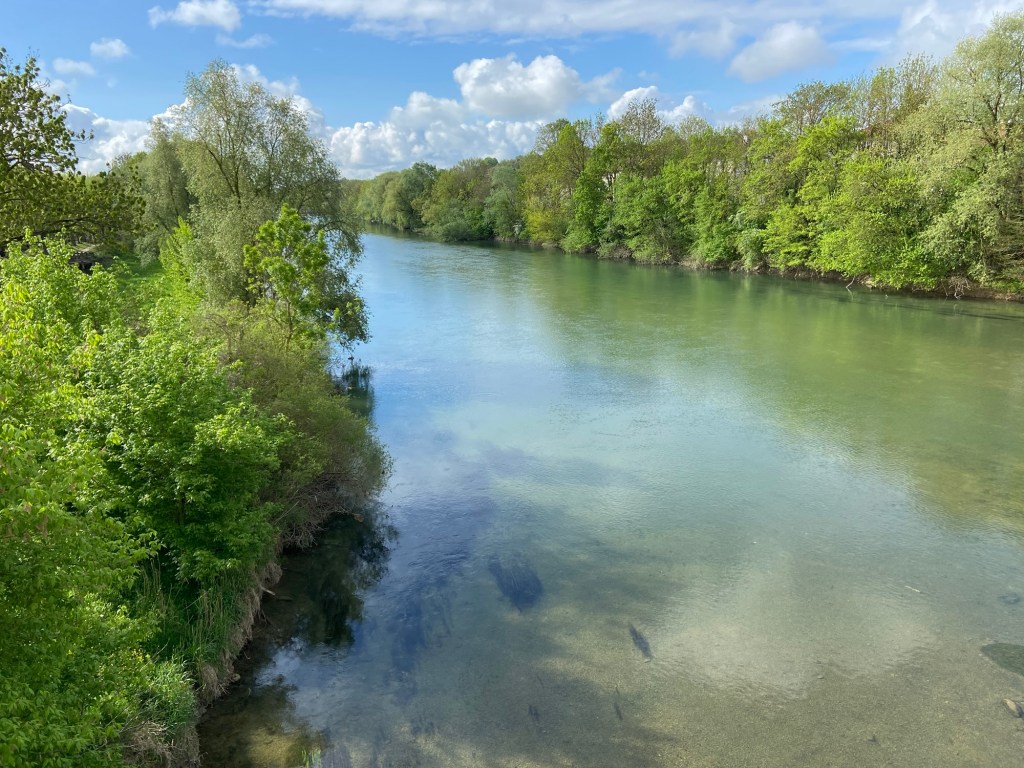
It was time to take the river path, and almost immediately it threw up an interesting encounter.
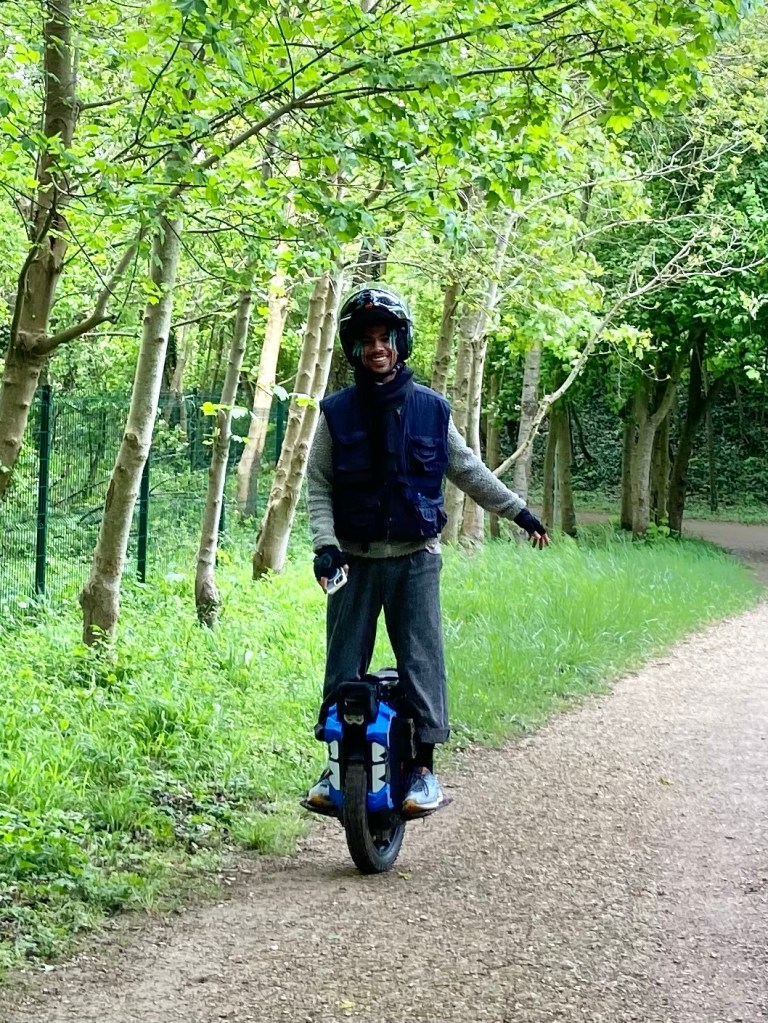
I asked the young man if I could take a photograph of him on his electric unicycle and asked whether it was an easy kind of thing to ride. He gave me a very long and technically involved response probably involving gyroscopes and accelerometers, of which I understood not one single word, but I nodded and smiled as if it had made perfect sense and said that it was extremely cool — chouette— which means literally ‘owl’. I said it was much cooler than walking on foot. ‘Ah, but walking on foot is much more sporty,’ he replied. We said our goodbyes and I carried on, rather tickled with anybody should think of me as ‘sporty’!
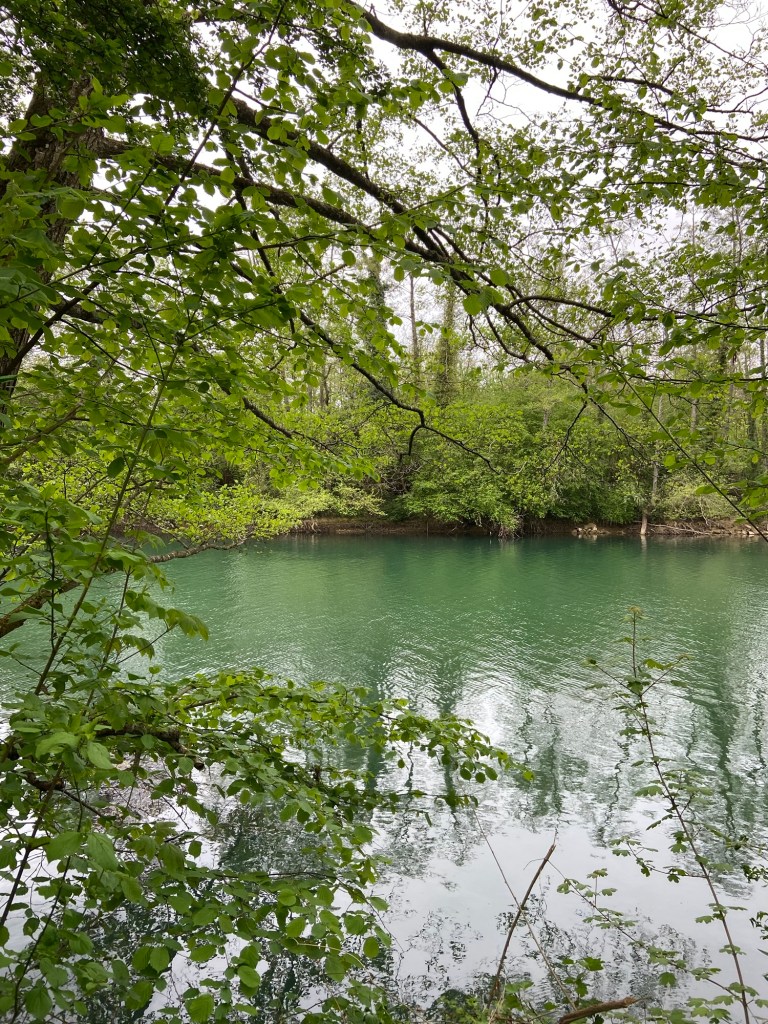
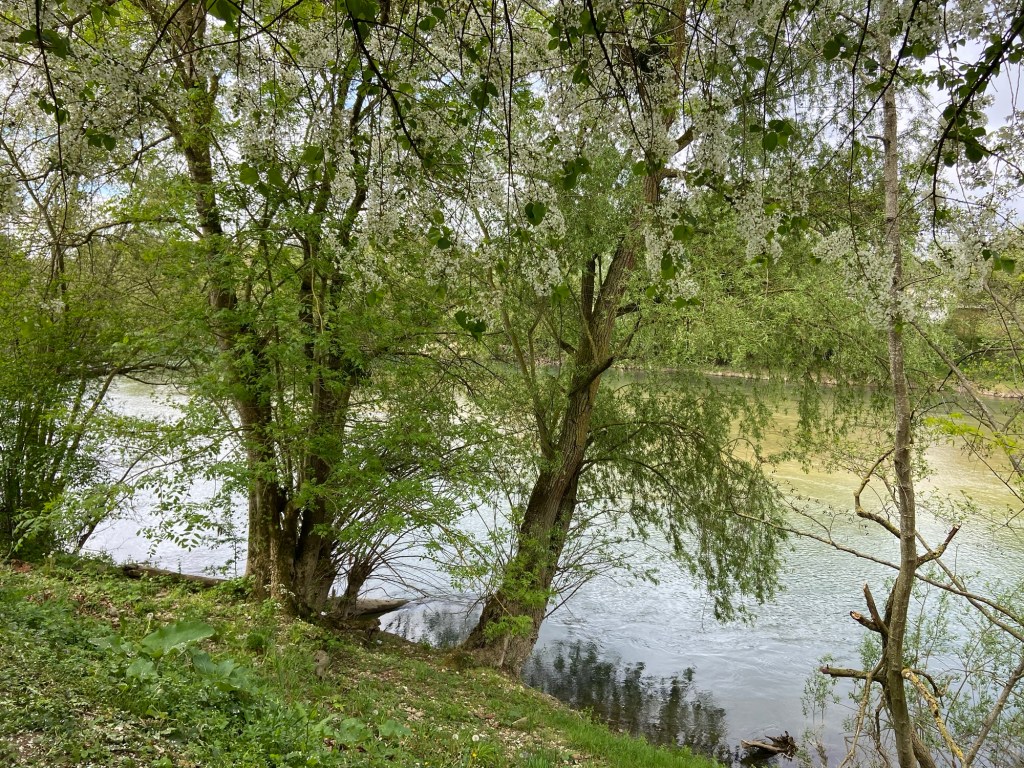
The river path wound through a very pleasant woodland lining the banks of the Marne for a couple of kilometres with lovely river views,
giving way to open farmland with wheat, oil-seed rape and alfalfa.
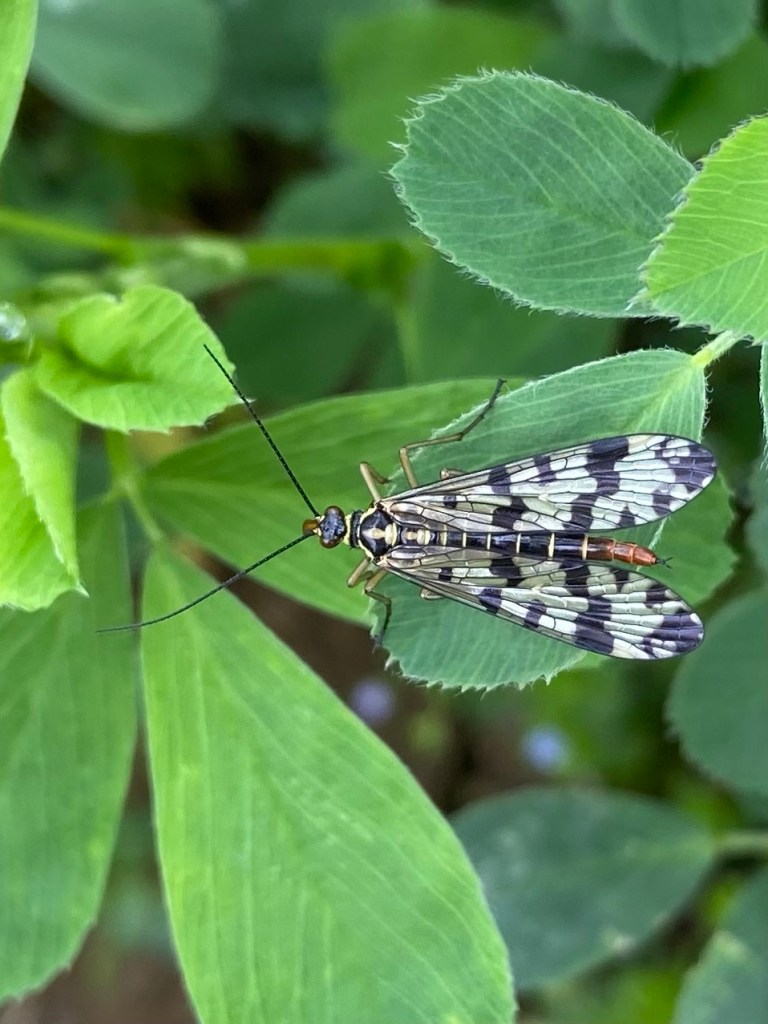
Larks and corn buntings were making merry in the air and on the ground hidden amongst the crops, joined by tree pipits and some extremely noisy jays as the Francigena picked a path around patchworks of woodland. Listening to the gratingly harsh calls I could understand why the jay’s Latin name is Garrulous. The river here was wide and shallow with willow-lined gravel shoals, although past floods had cut deep cross-sections into the banks where the water flowed fast on the inside of bends.

Sogny Mills was a slight detour off the route to find somewhere to sit. I perched on a low wall in the graveyard of the church and gave my feet a little break, swapping over my socks and trying to adjust things to make it a bit easier for the little toe on my left foot. I wasn’t very sure about where I was in the arc of the day’s walk because I had racked up quite a few kilometres meandering through Chalons and couldn’t work out how much of the actual route I had done, but I thought I would press on anyway, feeling that there was now quite a way to go. I took a shortcut through the old sand works on the other side of the river, now a graveyard itself, of slightly spooky conveyor belts, looking like an old set for Star Wars.
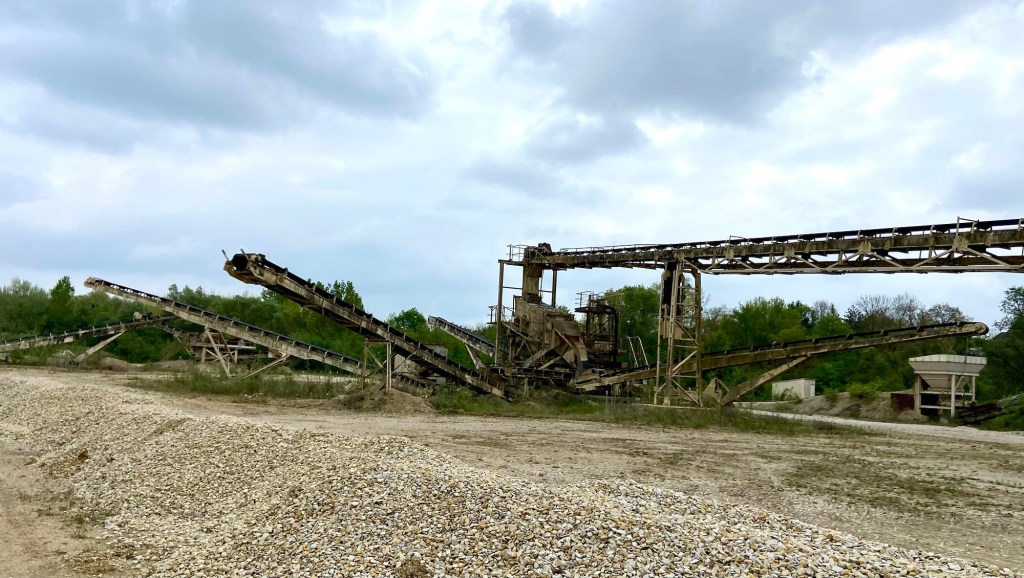
There had been a choice of two paths today, another canal towpath stage, or a more winding river route which at times moved away from the water to zigzag through fields and around patches of woodland.
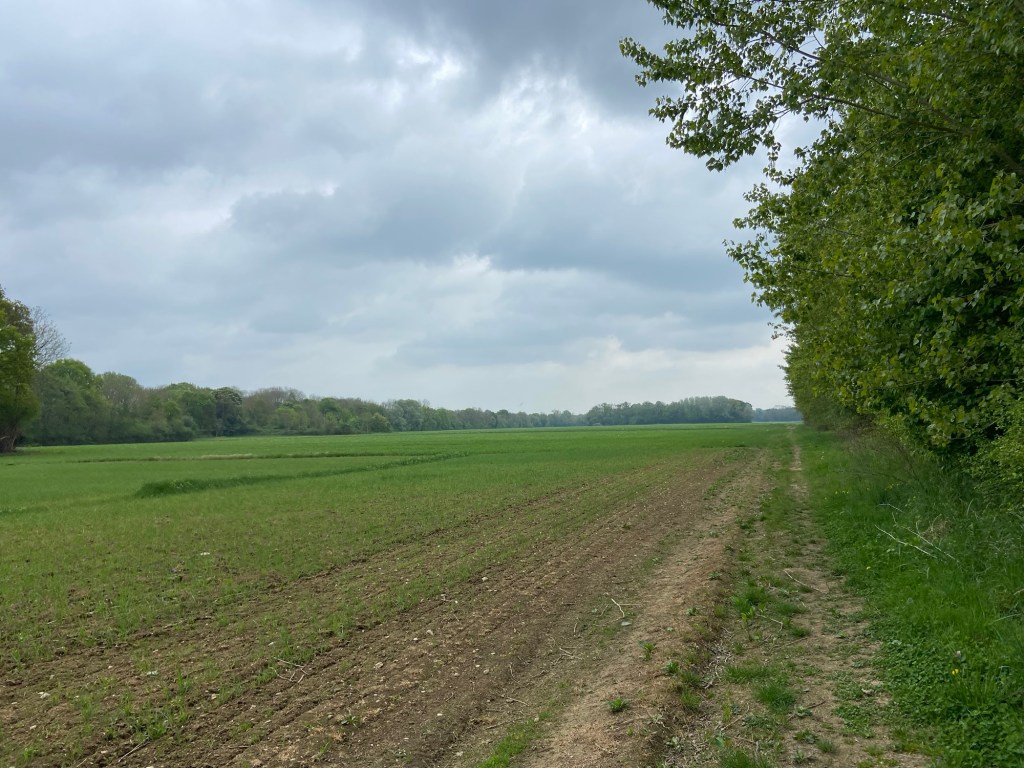
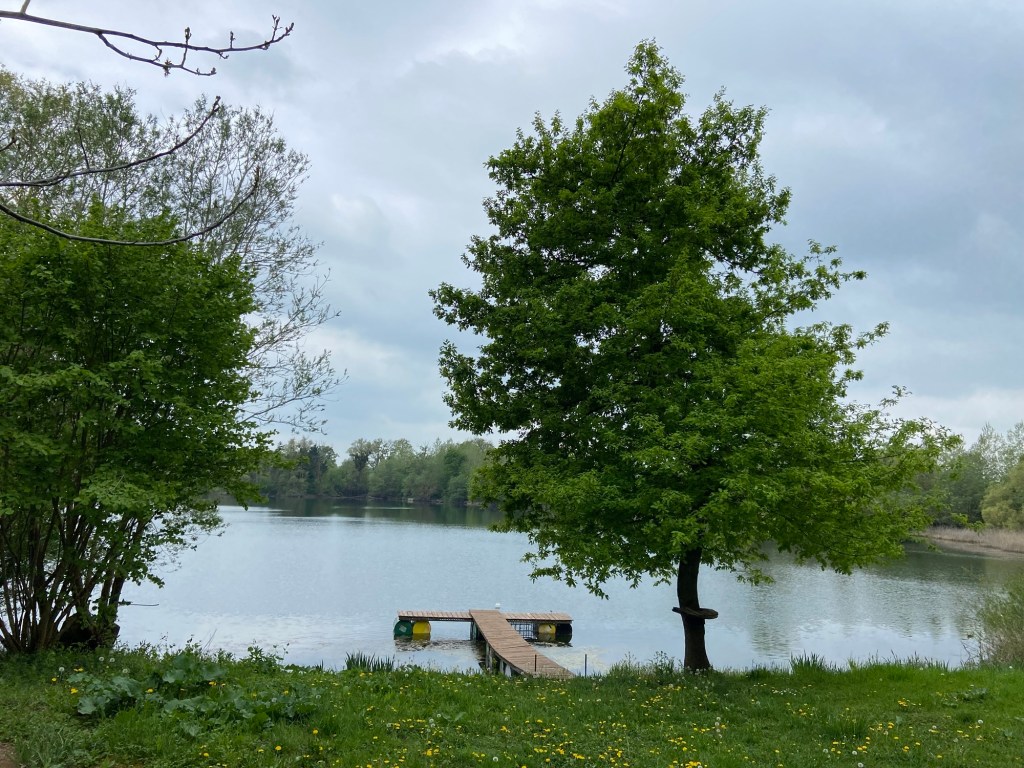
Some of those zigzags I could now see were to circumnavigate flooded gravel pits, sadly mostly hidden from view by thickets of trees, with only the most occasional of glimpses.
My shortcut had brought me quite close to the canal path alternative. I felt I had had enough of zigzagging for now, and hopped back up onto the raised embankment at a little bridge, patrolled by a storm trooper.

A barge was approaching.
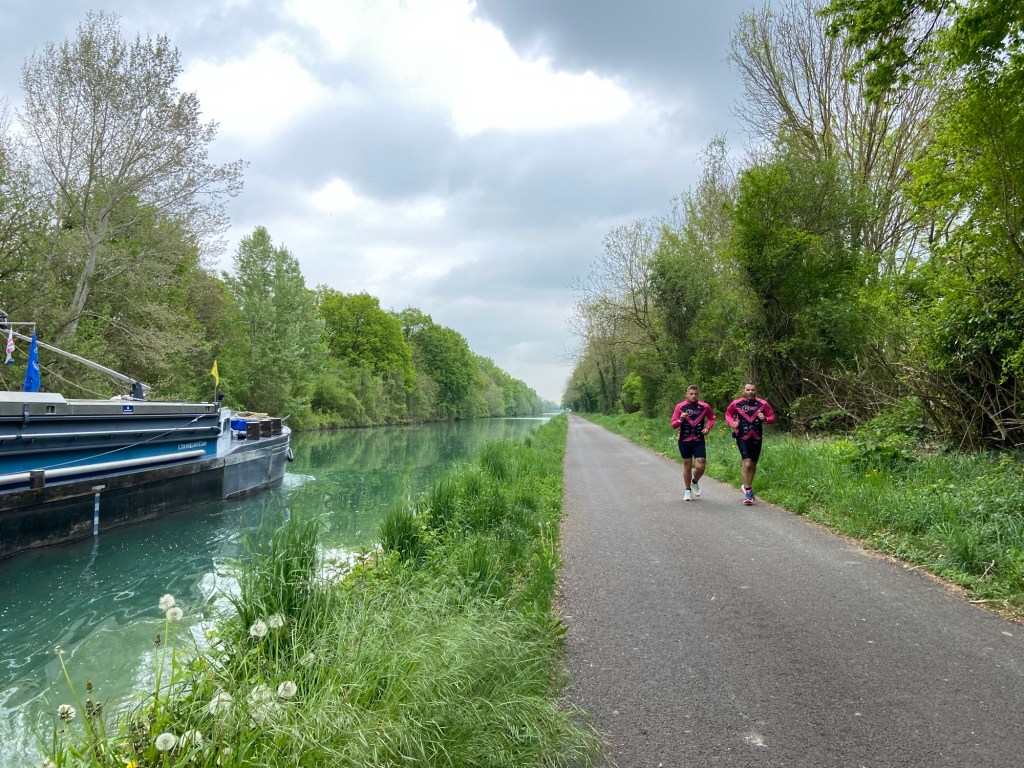
I photographed it as it went by, waving at the couple in the cabin, then suddenly decided to try and beat it to the lock two kilometres ahead. I increased my pace to get out ahead of El Paso, and was overtaken by a surprise third contestant in the race, one of the little vans driven by the itinerant lock keepers. She disappeared ahead, I presumed to open the next lock for the barge.
However, we came up to the van at the next bridge (like the hare and the tortoise) where it had stopped to join a little convocation of identical lock keeper vans. A gaggle of the drivers were standing at the other end of the bridge, smoking and chatting. It must be a strategic node whence they can leap into their vehicles when a call comes. A canal and lock keeper version of Tracy Island and the Thunderbirds, perhaps.
The mystery of the boom hanging over the water was now solved as from the deck the bargeman twizzled the dangling plastic cable to call a lock operator.
I sat on a bench by the lock and waited for the performance to begin. Eventually a van turned up and a posse of lock keepers emptied out of it. The big gates of the lock opened, and the bargewoman slid the boat in with literally millimetres to spare on either side and not a scrape on her. As my narrowboat friend Stevie from the Grand Union Canal caper commented when I texted him the picture, ‘one careful lady owner, then!’
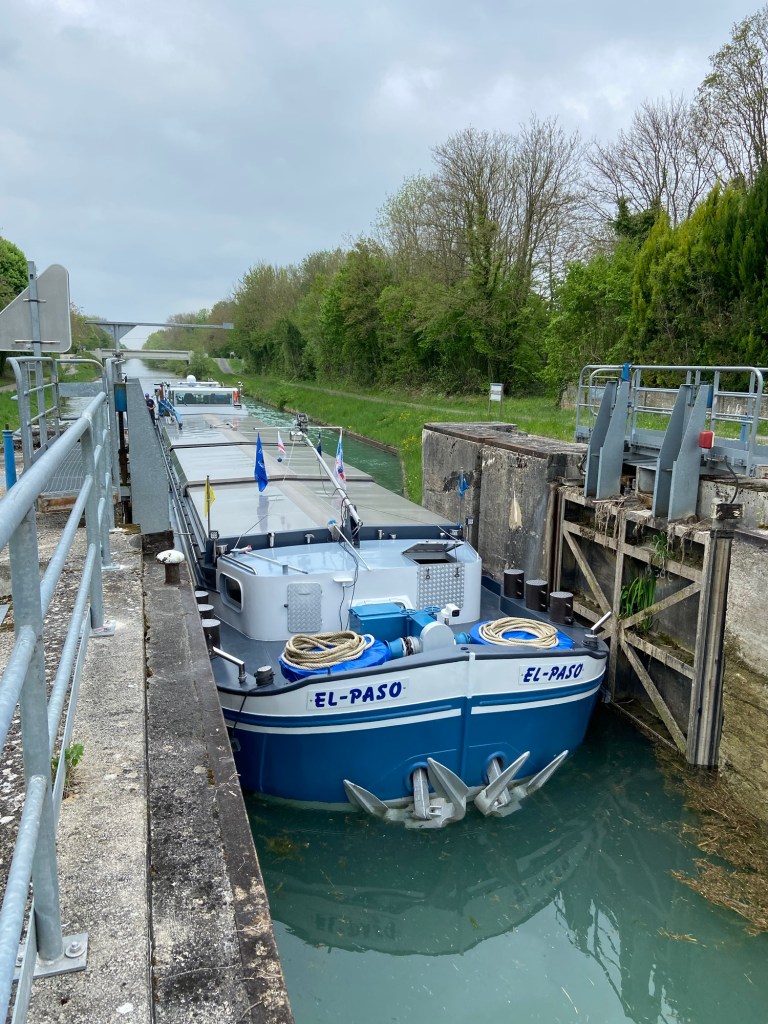
It took five minutes to fill up the lock, quicker than I ever would have thought, and once the forward gates opened El Paso slid out again, smooth as you like.
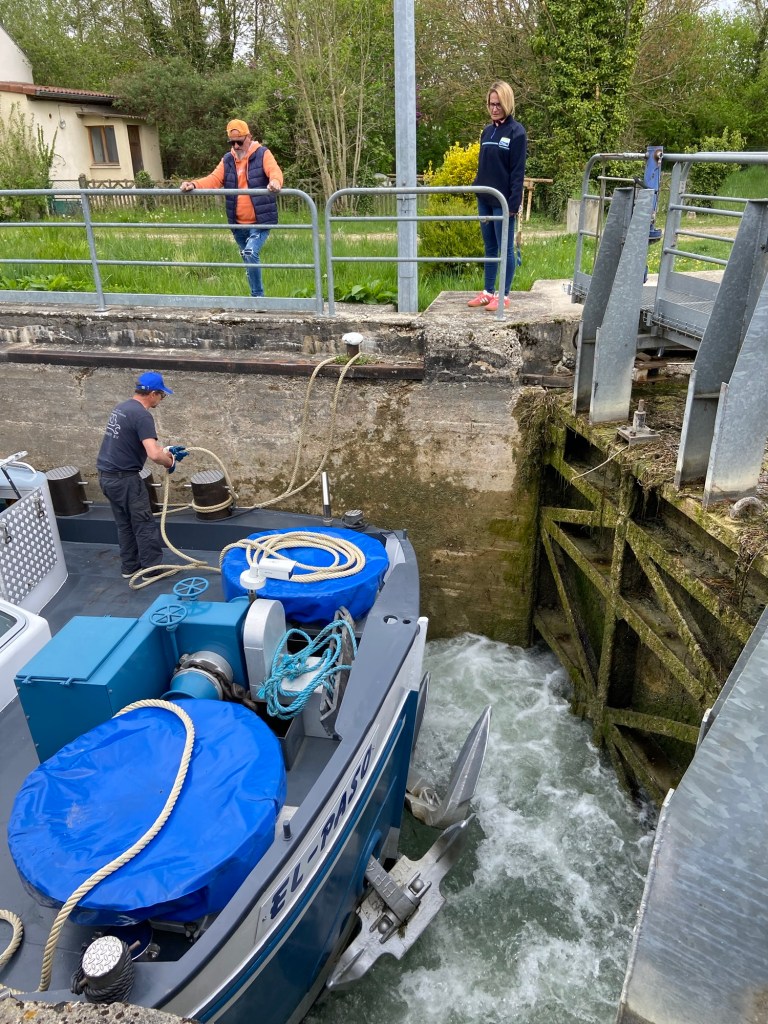
It was as exciting as watching the potato man fill up the potato-planting tractor’s hopper, way back on the way to Péronne.
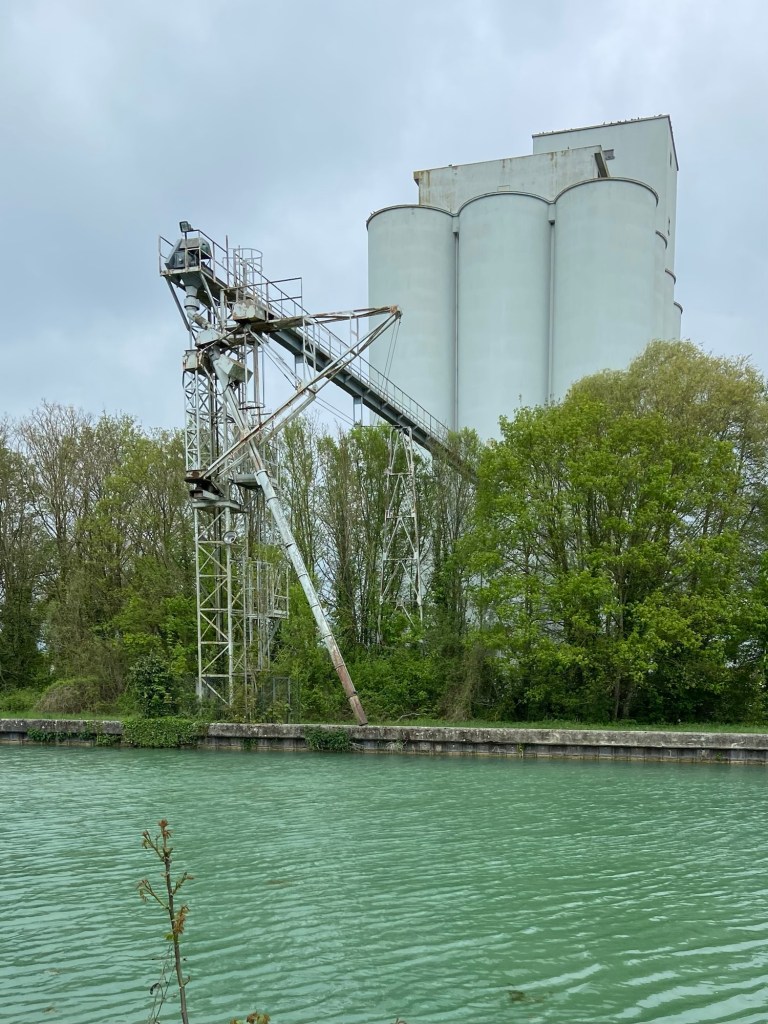
I had noticed as the boat was below me in the lock that the hold was empty, so after it had gone I asked the lock keepers what cargo the barge l was going to pick up. They shrugged in Gallic fashion but one suggested it might be going to get grain, and another that it was going to get bobbins — those huge great big cotton reel things that they wrap cables around.
I had enjoyed the little interlude, and sat there awhile afterwards gathering my energies after my efforts (successful, I may add) to beat the boat to the lock. Perhaps I was indeed sporty, as the chap on the electric unicycle had suggested.
I took up the path again, rather disdained that the boat hadn’t been filling up at the grain elevator, which would have put the cherry on the canal cake.
I had 9 km to go and several hours in which to do it.
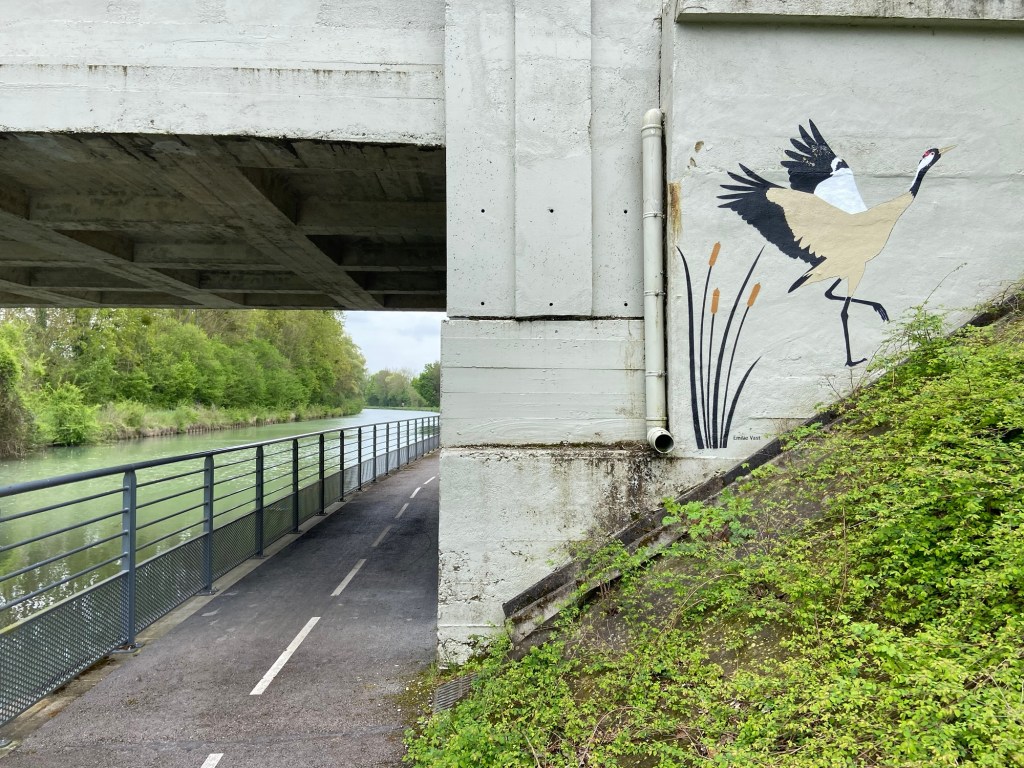
I took my time walking, enjoying the peace and quiet of the canal,
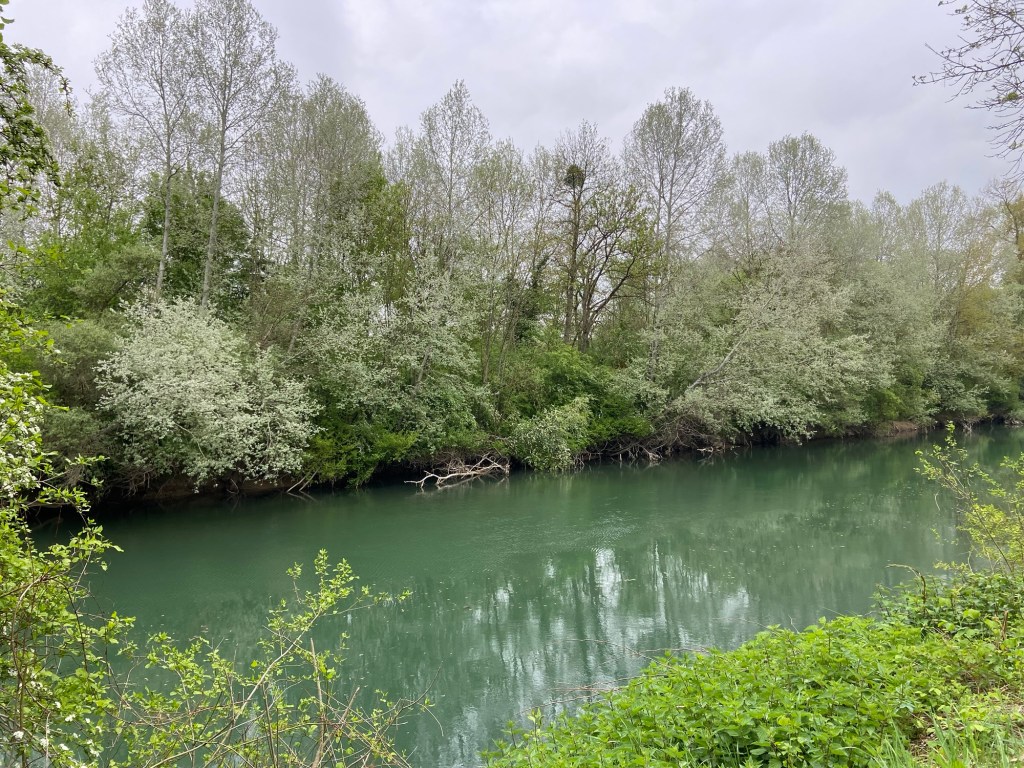
and the occasional tributary flowing under it to join the Marne, gathering its waters to carry them northwest to the Seine.
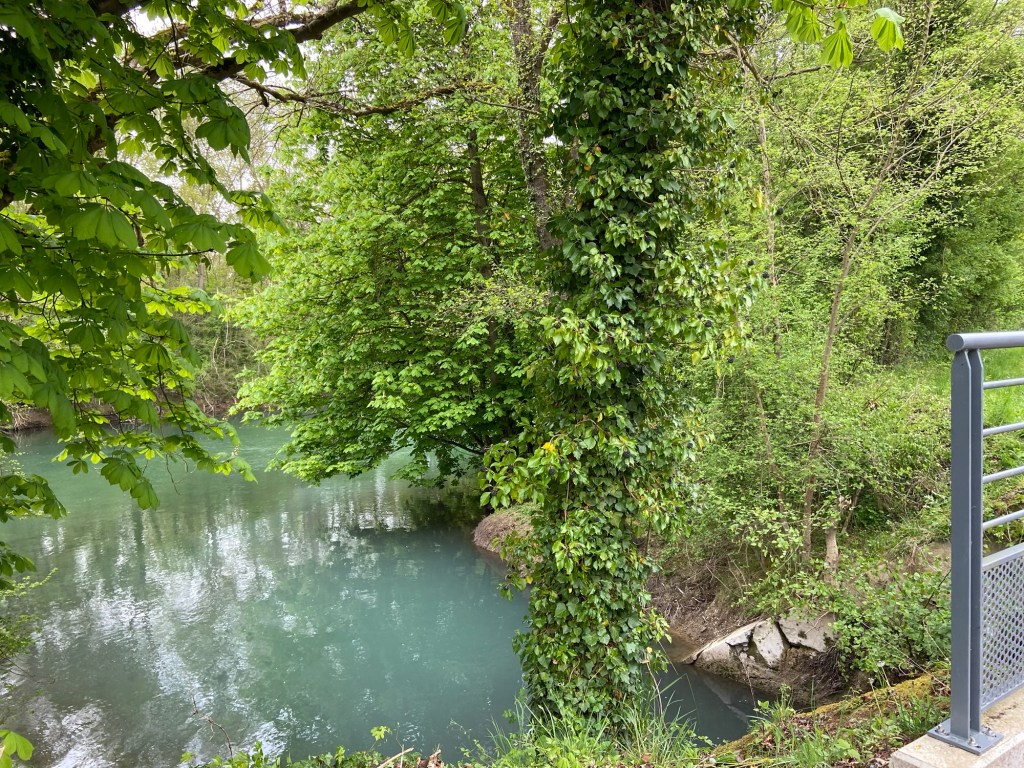
By the time I came off the canal and the road took a little detour by streams and farmland, I was feeling quite tired. It wasn’t so much the distance, it was the fact that it had taken me all day to do! Going slow is sometimes more tiring than going fast. It had taken me six hours to walk 28 km but I was out for almost ten hours in the end. The canal had also felt like quite a social place, and the detour off it felt quite remote and lonely.
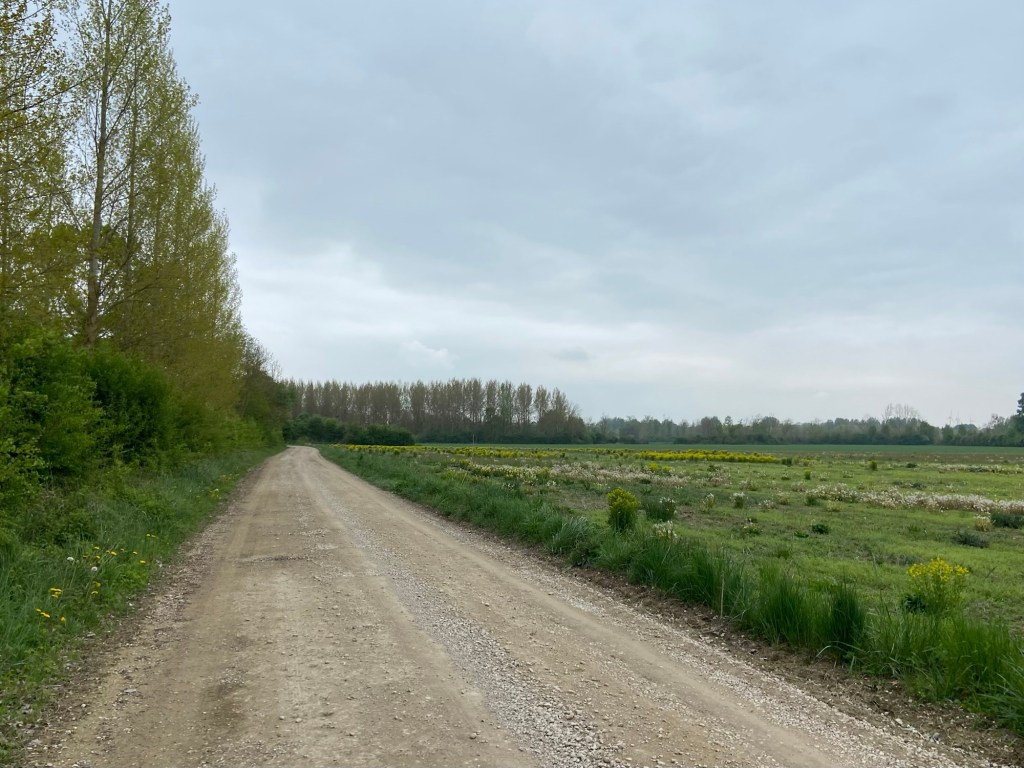
So I was yawning quite a bit when I crossed the river for the last time by the bridge into Chaussée,
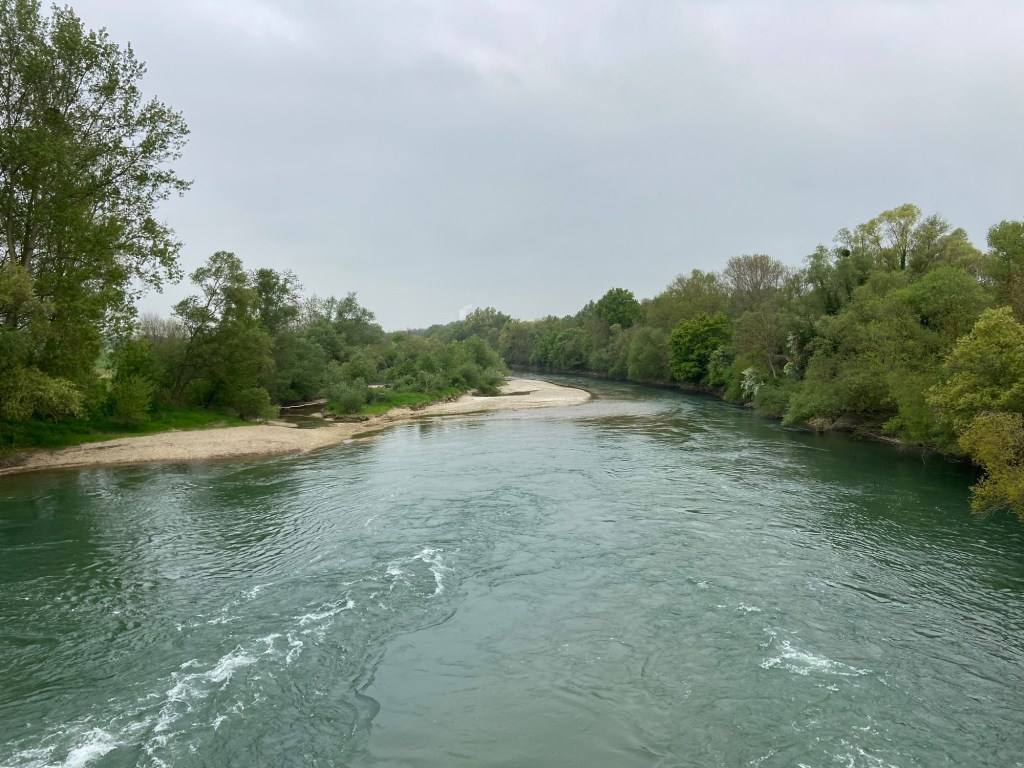
and I sat on the steps of a little church on the outskirts of town to try and work out where my host lived. Discouragingly, it was a kilometre on the other side of town. I felt the first drops of rain fall.
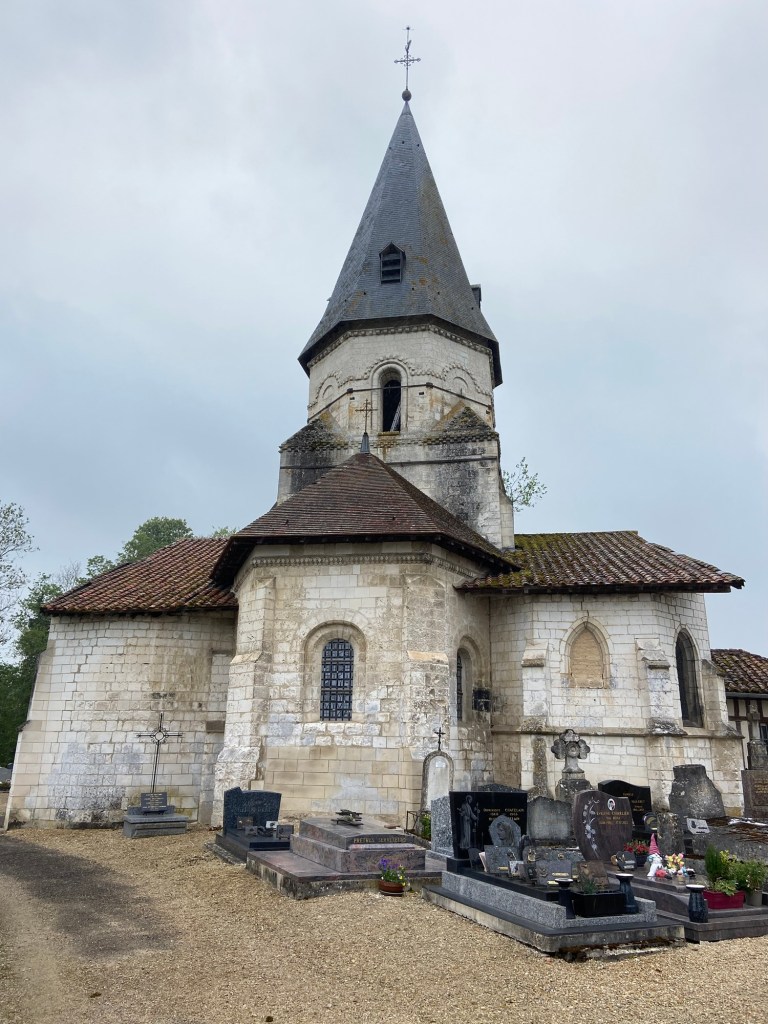
I had three quarters of an hour to wait until my rendezvous with my host at 6 o’clock. The second little church in the village didn’t look like it would provide any shelter,
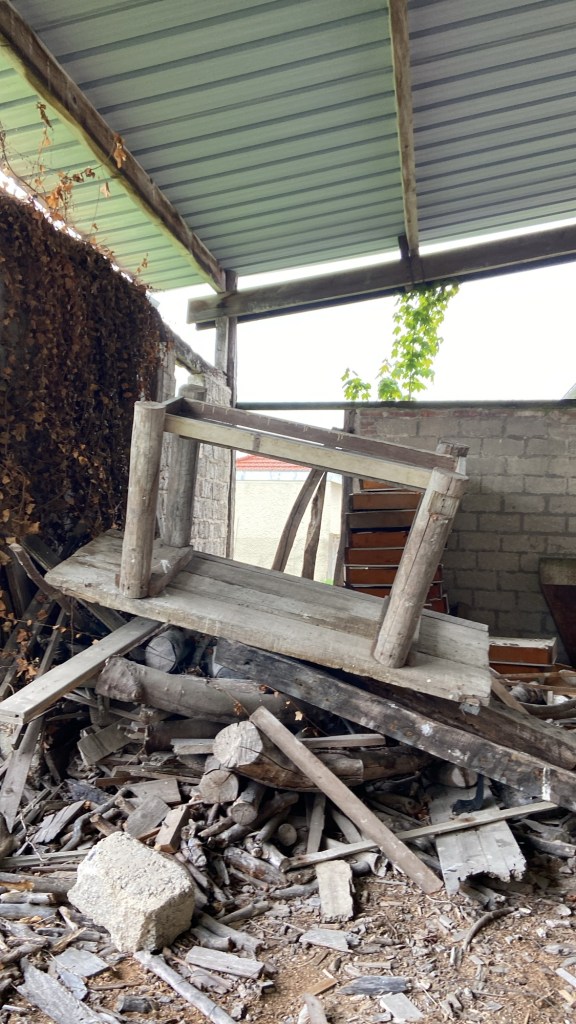
But a little further on a tumbledown farm building gave me just what I need: a roof over my head and a big block of limestone to sit on.
Once the rain stopped, I went the last few hundred metres to the gîte. Mme Chavary wasn’t back from her trip to Troyes yet so I sat on the front step until she arrived — 45 minutes late!
Stats for the Day
Distance: 28.28 — with meanders, rather more than the advertised 23
Time: 6hrs 1min walking in a 9hr 44min day
Pace: 4.7km/hr even tho I was trying to go slowly
 Walking The Landscape