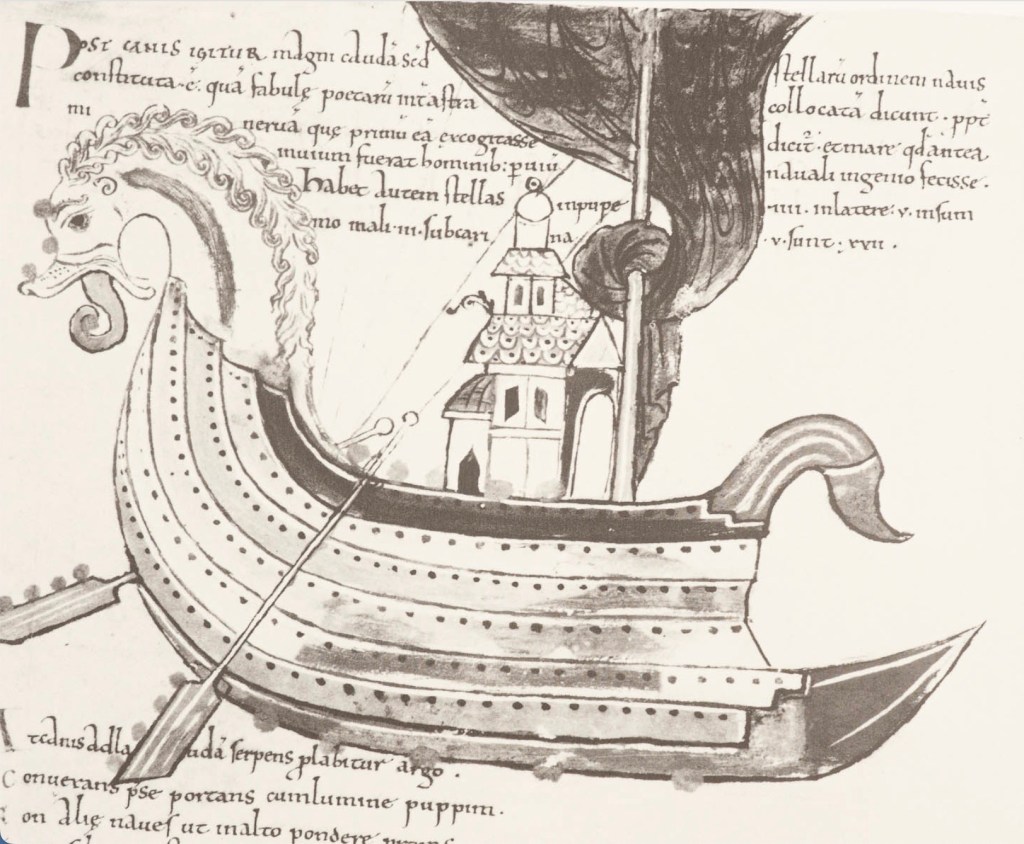
Fair stood the wind for France
Michael Drayton, ‘Agincourt’
Stephen read yesterday’s blog this morning and commented that it was quite factual. And I thought about that. I had actually been feeling all sorts of complicated emotions, lying awake in the night worrying about food (by now a familiar nocturnal routine), and then being almost overwhelmed at the thought of seeing Canterbury Cathedral. But the actual walking itself didn’t involve much emotion — because there were the three of us, and there was much chatting going on about things which had nothing to do with the walk.

Frances also came with us for the first hour of today’s walk to Dover. We crossed a chain of vast undulating fields similar to yesterday’s, filled with millions of uniform wheat seedlings with their roots in the chalk, until we came to the parkland of the Waldenshare Park Estate. Here stood majestically twisted tree trunks (chestnut?), and a field gate that led nowhere
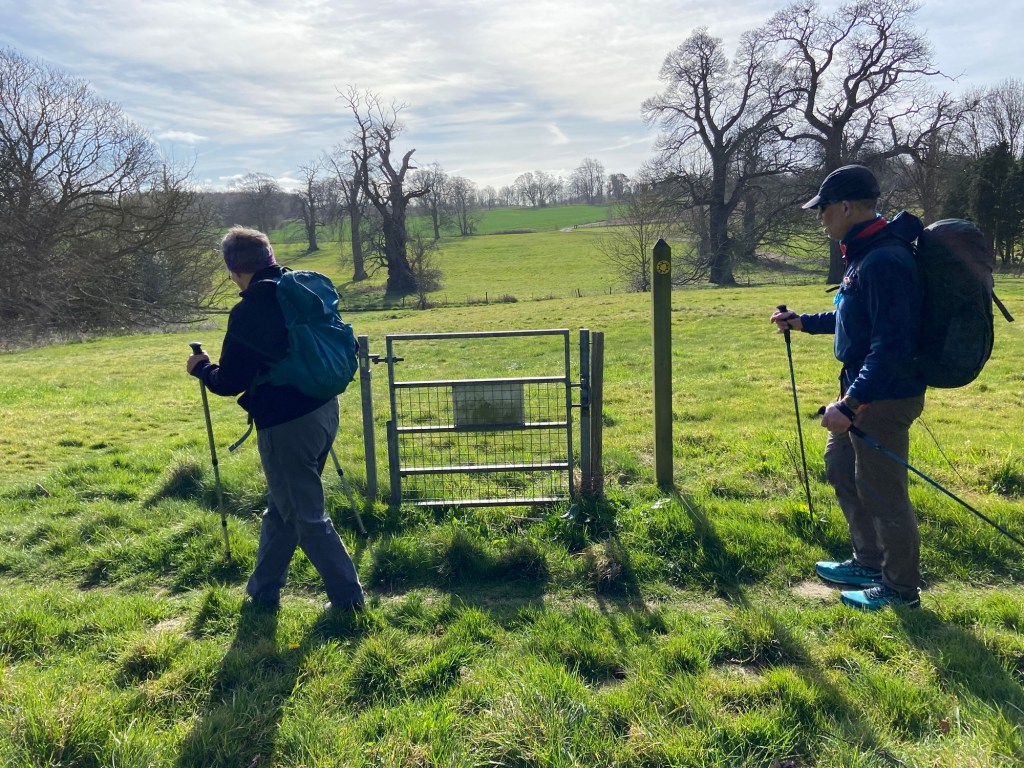
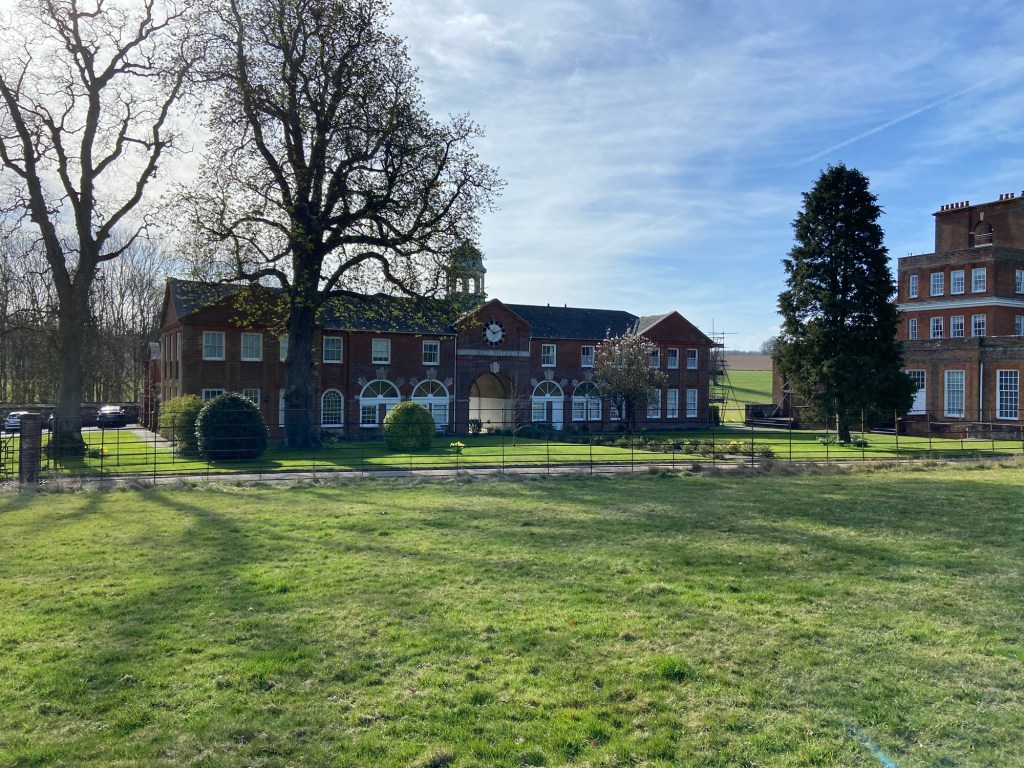
while the path offered us views of the Queen Anne-style mansion and the stable block beside it, bearing a motto, writ large: DISCE VIVERE. We agreed we could get behind this as a life lesson (although this perhaps is the opposite of the motto’s exhortation), and also agreed that we would rather live in the stables than in the great country house.
There followed a short walk through the Hornsby Groves, named after lover of trees and Maid of Kent Miss Mary Hornsby, in whose honour the Kent branch of the Men of the Trees replanted a section of the estate much damaged in the great storm of 1987 with 1237 saplings, including a small circular wood with the mildly amusing name of Piddling Coppice. On its other side was the disused Church of All Saints, an unassuming, pleasingly simple little structure, with the shocking exception of a chapel stuffed full of an overdone and disproportionate monument to members of the Monin and Furnese families.
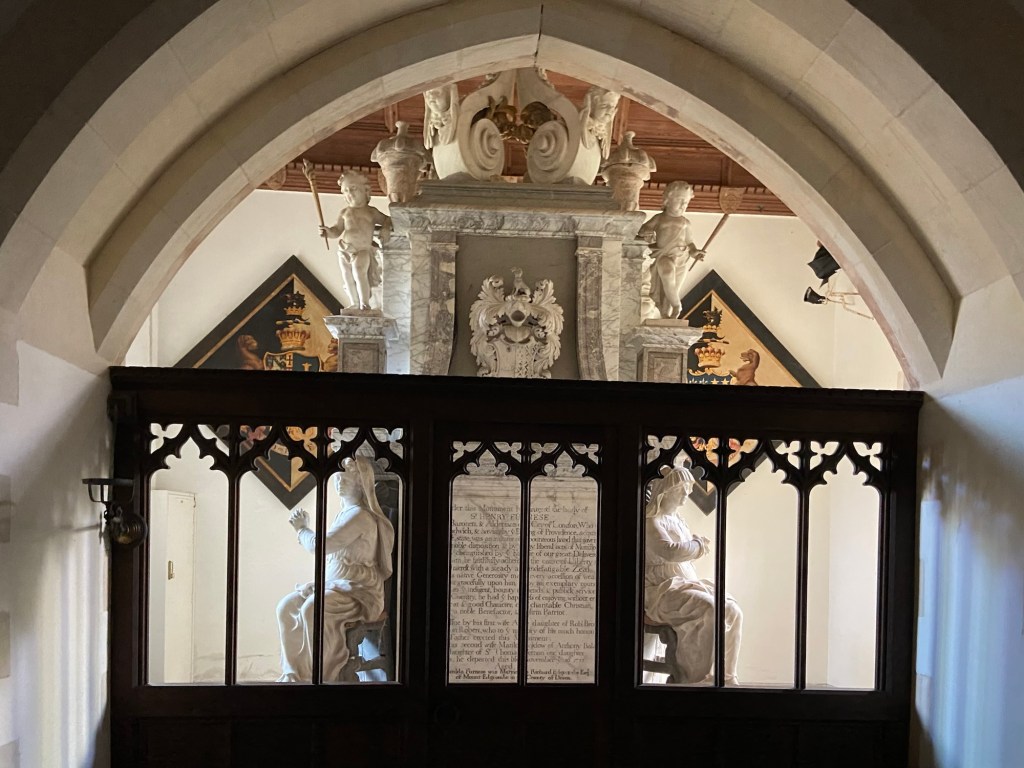
The Via Francigena took us through the churchyard, full of morning light and daffodils, and two ancient yew trees, one of which had collapsed onto the other,
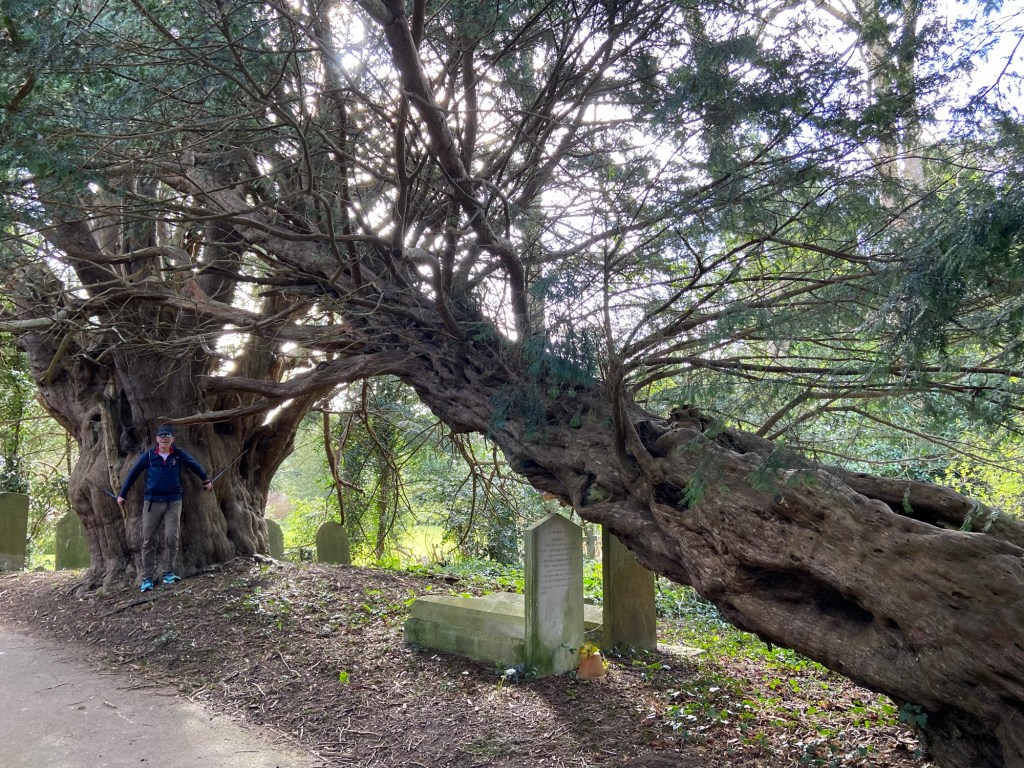
just missing a gravestone underneath commemorating 15-yr-old Greaves Walker, who had died ‘of a gun shot wound inflicted by the culpable imprudence of a youth’.

We chose the largest of these yews as the Parting Tree, our version of the Wordsworths’ Parting Stone (only I can confidently tell you, dear reader, that unlike brother John we have not been lost at sea because as I write this we are docking securely in Calais). It has been wonderful to start our walk with the company of Frances and her family — although it was not the last of them, as you shall hear.
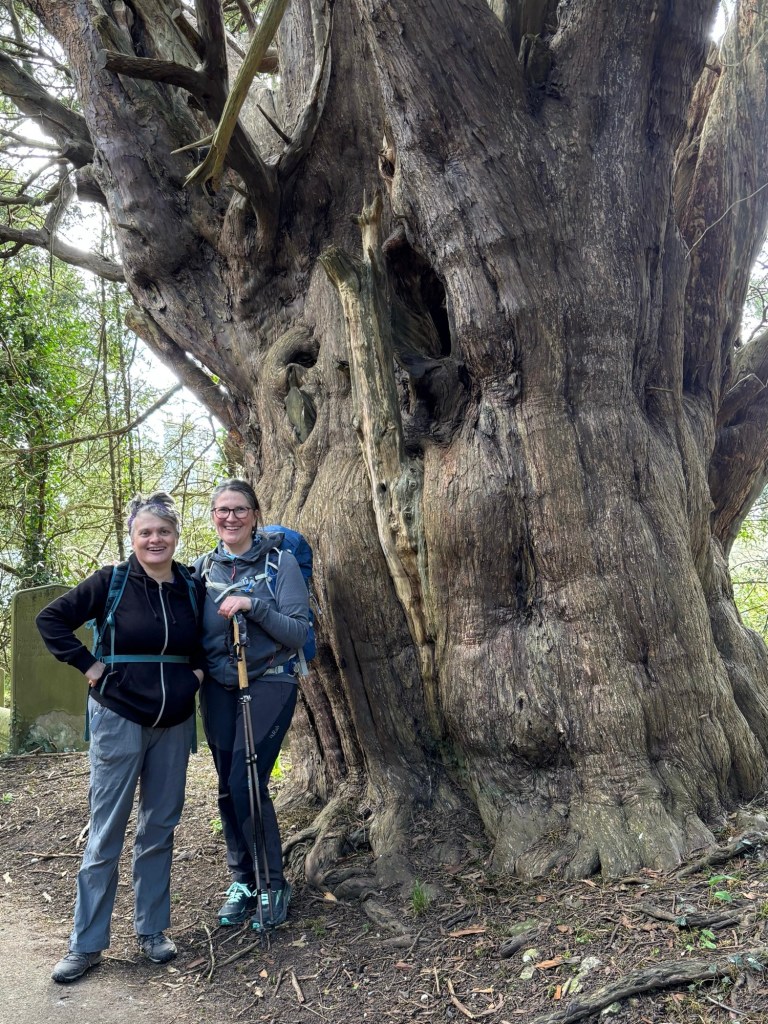
And now it was just the two of us: walking quietly, as Stephen describes it, ‘on standby’, attention available for surroundings.
Such as the brimstone butterfly, a tiny, unphotographable fluttering handkerchief of acid yellow, or the sudden appearance of a flock of seagulls on the undulating chalk, perhaps scavenging worms, but in any case drowning out the liquid songs of the larks with their harsher cries, urging us forward to the south coast.
After an odd eastwards detour, the Via Francigena veered southwards, steering a determined course to the Cinq Port of Dover. At first we were on a
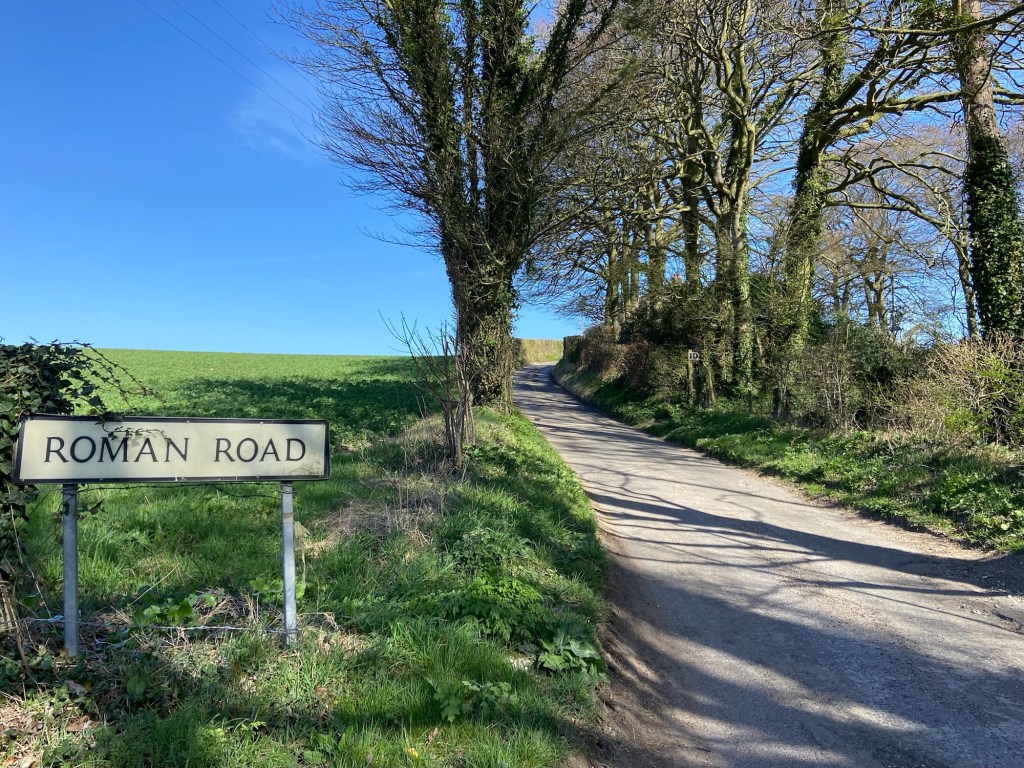
But where this curved away, perhaps following ancient field boundaries, our route marched straight on, up byways that must lie on the original Roman route, such a straight continuation were they. It was hard to imagine a wheeled vehicle passing,
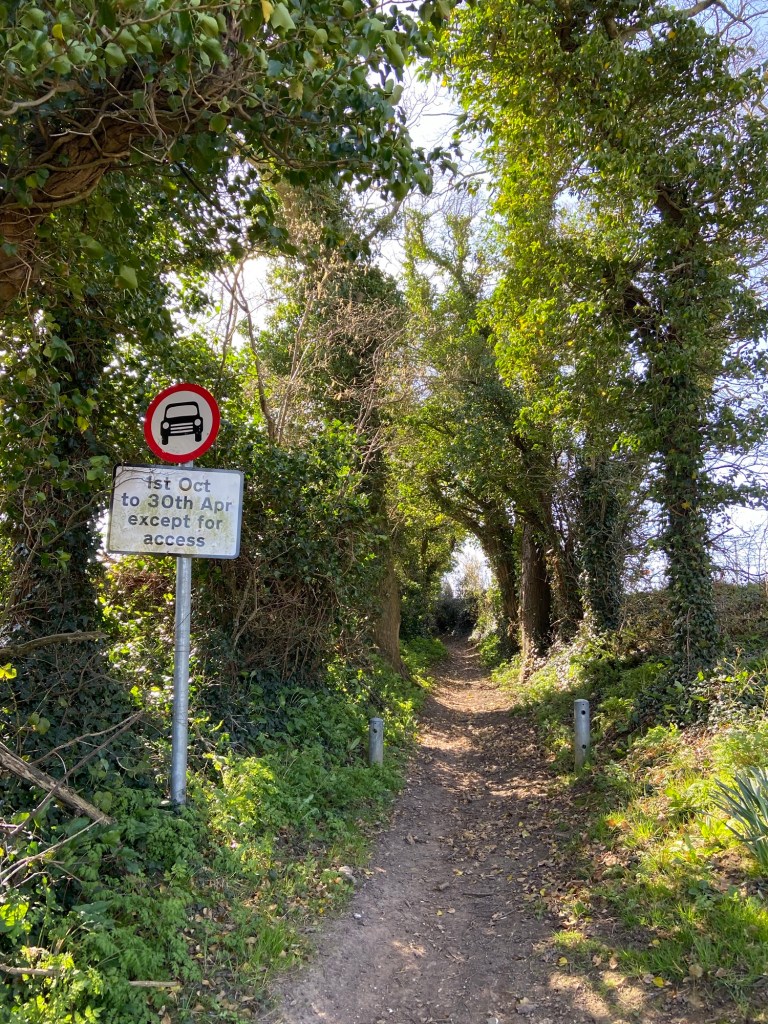
although bikes clearly had tried.
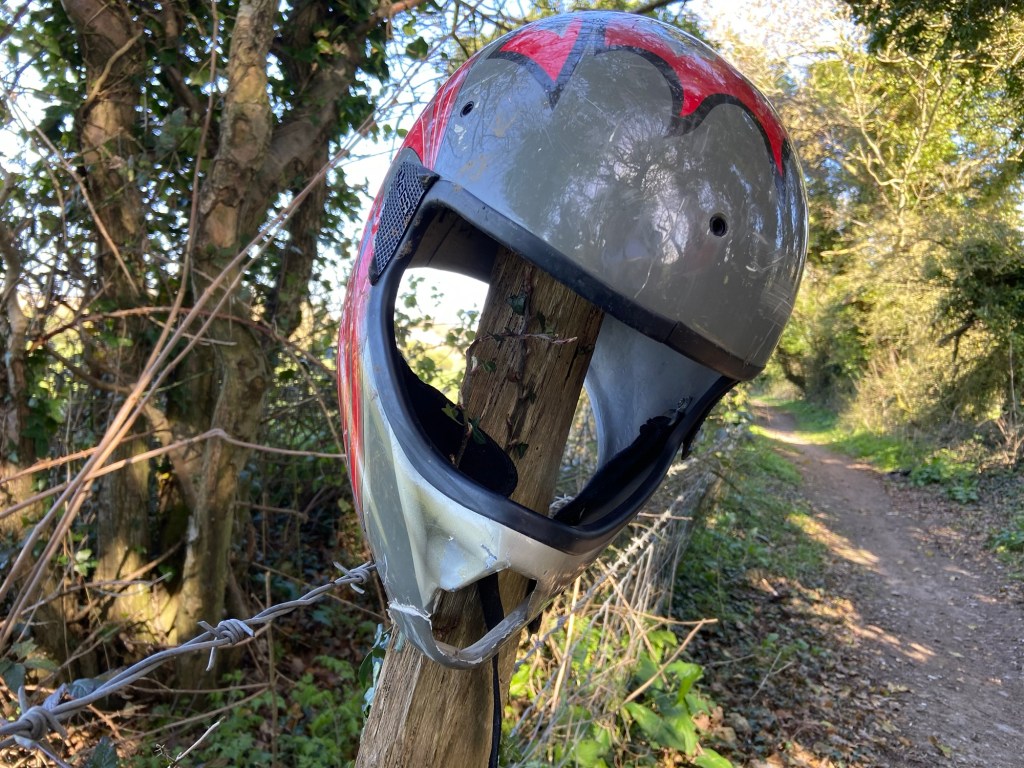
We had seen a sign earlier in the day informing us that as well as the North Downs Way and the Via Francigena we were also walking on the Jerusalem Way (good grief! Isn’t Rome far enough?), and I wondered whether this was the abandoned helm of a modern-day crusader. It looked exceptionally creepy.
Less creepy was, paradoxically, the valley of the shadow of death which we passed through, in the form of the Charlton Cemetary. On either side of a steep coombe the monuments stood, nineteenth century figures to the west, amongst what would’ve been a riot of primroses, were this not a sober and respectful place. On the eastern slope the modern graves were spaced out and dotted about, just like houses in a landscape.

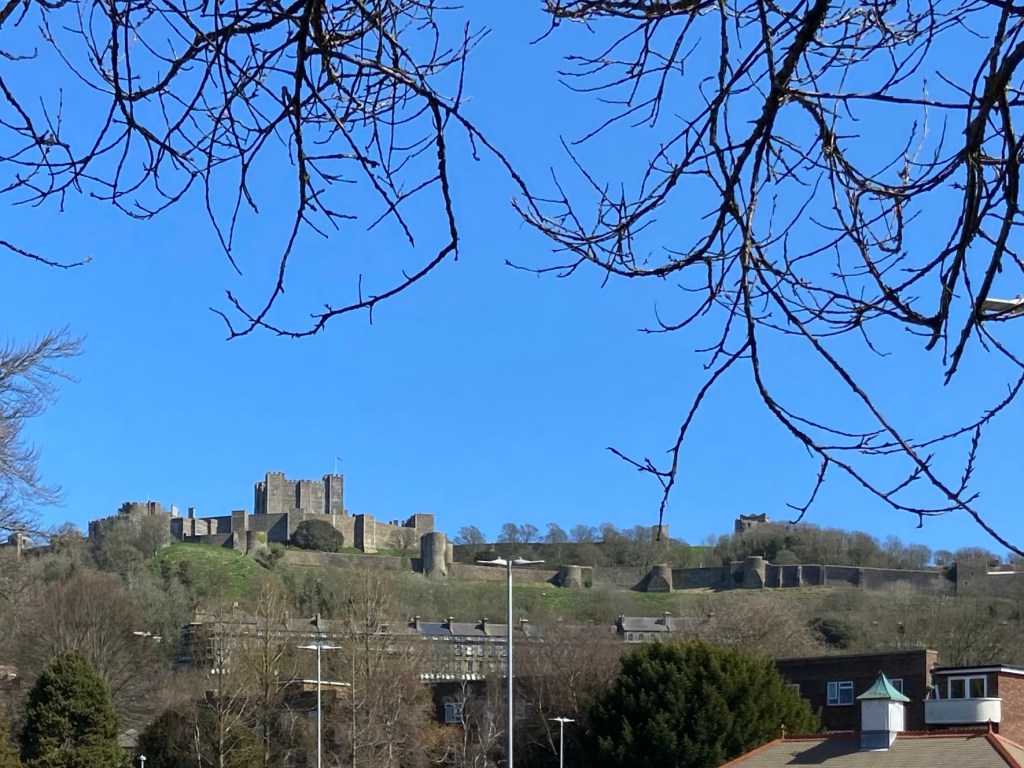
We descended into Dover, with the magnificent castle on our left. ‘Norman’, said my curtain walls and keep expert, grimly. Also, filming location for Wolf Hall, Mel Gibson’s Hamlet, and Avengers: Age of Ultron.
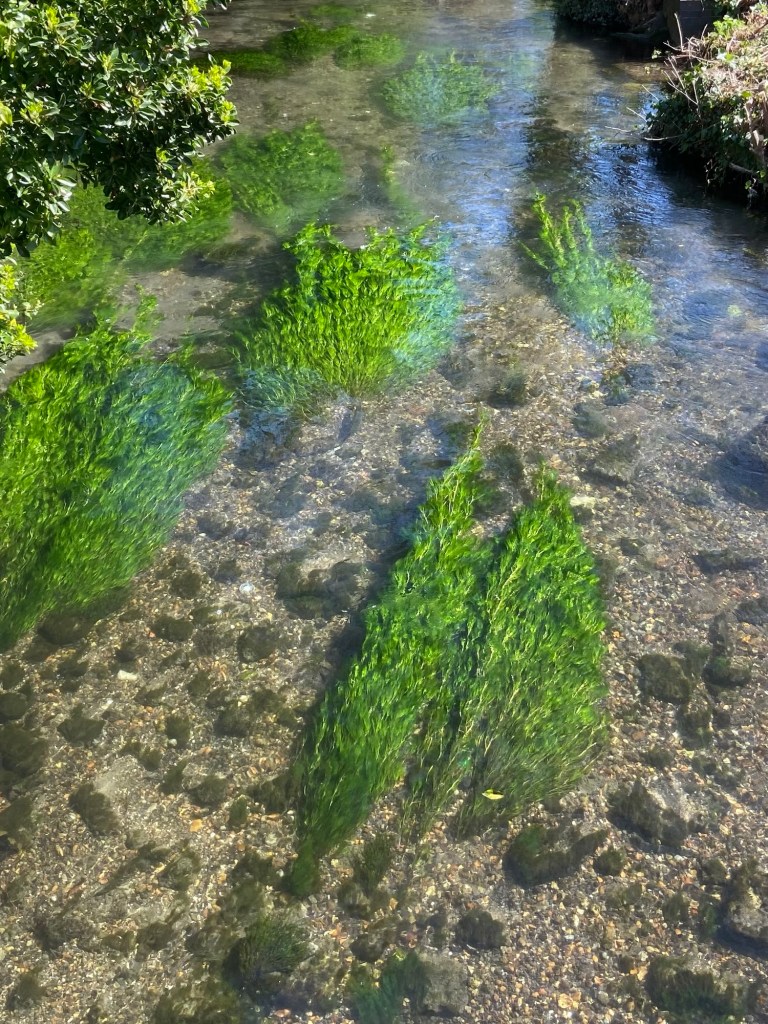
We were both surprised at what a green path the Via traces through the city, with magnolias bursting into flower and the not-at-all River Dour, water crowfoot tresses waving, flowing crystal clear through the middle of it.
Once in the city centre we cast about for a stamp. The church at the official end of the stage was locked, so I went into the next door parish rooms, where a lively Sunday post-service get together was taking place. A chap putting away some chairs located church warden Lindsay for me, who kindly opened up the church, although sadly to no avail since it was essentially a building site. While the new kitchen and flooring is being put in, all the everyday church gubbins, including pilgrim accreditation, has been boxed up and put in storage. However, Lindsay cheerfully signed and dated my credential, and I felt that was perfectly satisfactory.
It was now 1 o’clock (such early finishes!), and Mr. Google had helped us identify a promising restaurant in which to eat. A Turkish place: Aspendos (‘We call it Asbestos!’ said Lindsay). It turned out to be a fabulous place. We apologised about our dishevelled appearance and were told not to worry, but were nonetheless ushered upstairs to an out-of-the-way table, but one which accorded us a grandstand view of the plaster mural coating the whole of the south wall. Crusaders with the castle and white cliffs as their backdrop — or perhaps (given that this was a Turkish restaurant) Saracens in cunning disguise.
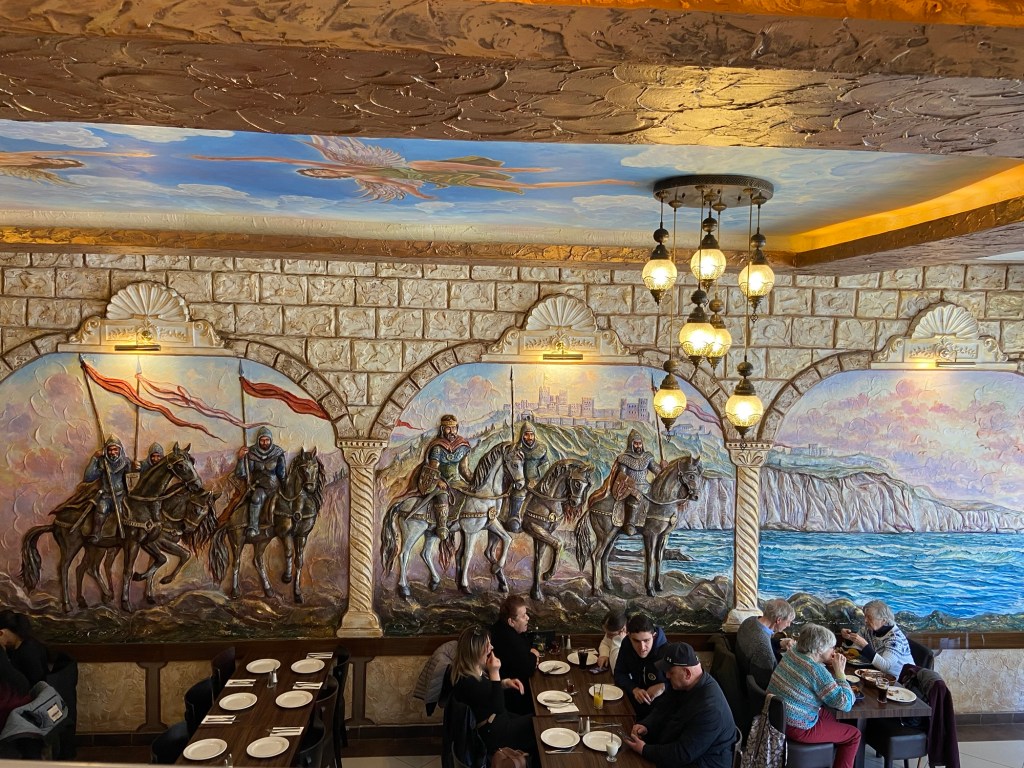
In any case, we had two stonking plates of mixed mezzes, hot and cold, which we hoped would last us until tomorrow morning
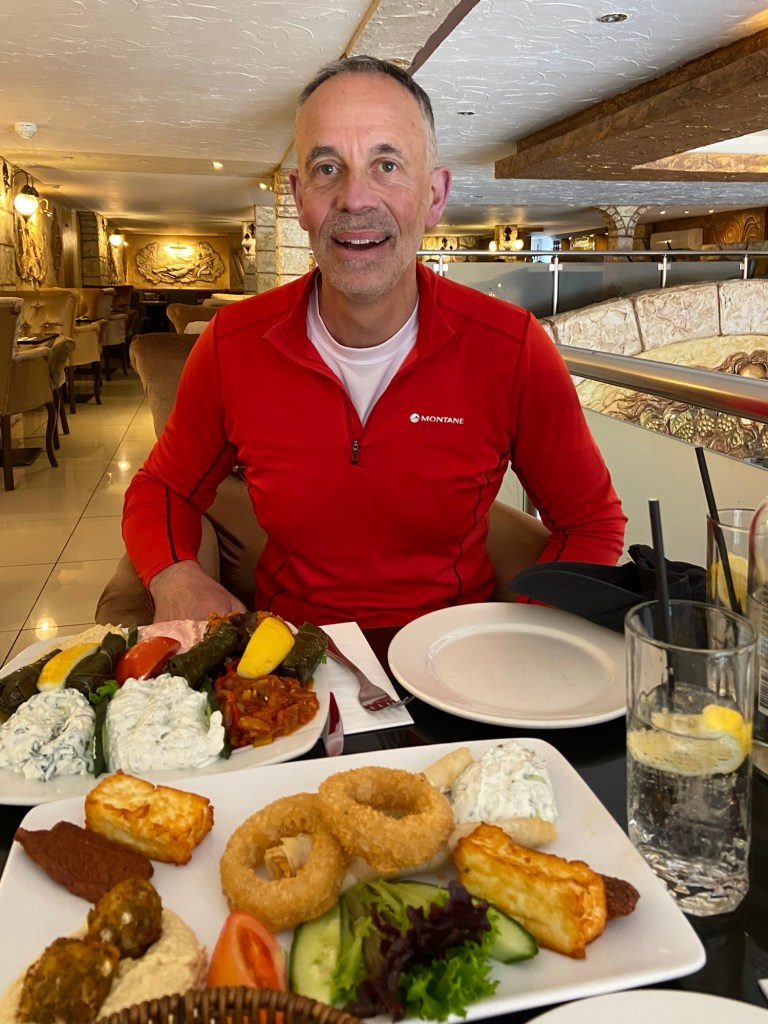
although Stephen, peering over the balcony at the gigantic piles of mouthwatering kebabs being delivered to the tables below, felt he might be missing out.
An odd thing about today’s walk is that it takes you 16 km towards the coast with only one single, very distant glimpse of the sea. Coming out of the restaurant it dawned on Is that we were now we were only metres away. Stephen suddenly squiggled with excitement, squeaking ‘Oh, we’re going to get on a ferry!’ And we simultaneously forcefully and fondly recalled being loose in the back of family cars in the 1970s with stressed fathers trying to navigate the rats’ nest of roads and car lanes at Cross Channel ferry terminals.
The modern roads were still a rats’ nest, but we used an underpass painted with a mural of ‘shipping through the ages’, and suddenly we were out on the promenade, the glittering warm blue sea in front of us, beyond steeply shelving shingle banks. Seagulls risked wipeouts as they bobbed about on the surface, rising screaming into the air from the water just before the waves broke under them.
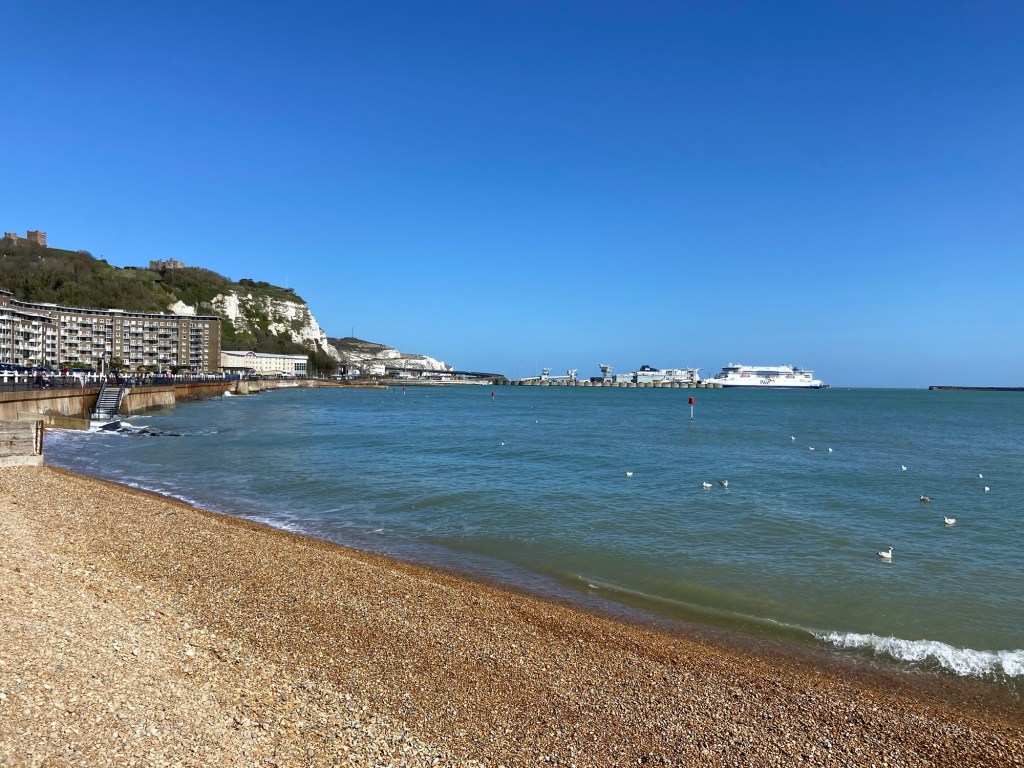
To the left in the distance were two huge cross channel ferries docked at the port, and, rising above them, the iconic white cliffs, shining positively blindingly in the sun.
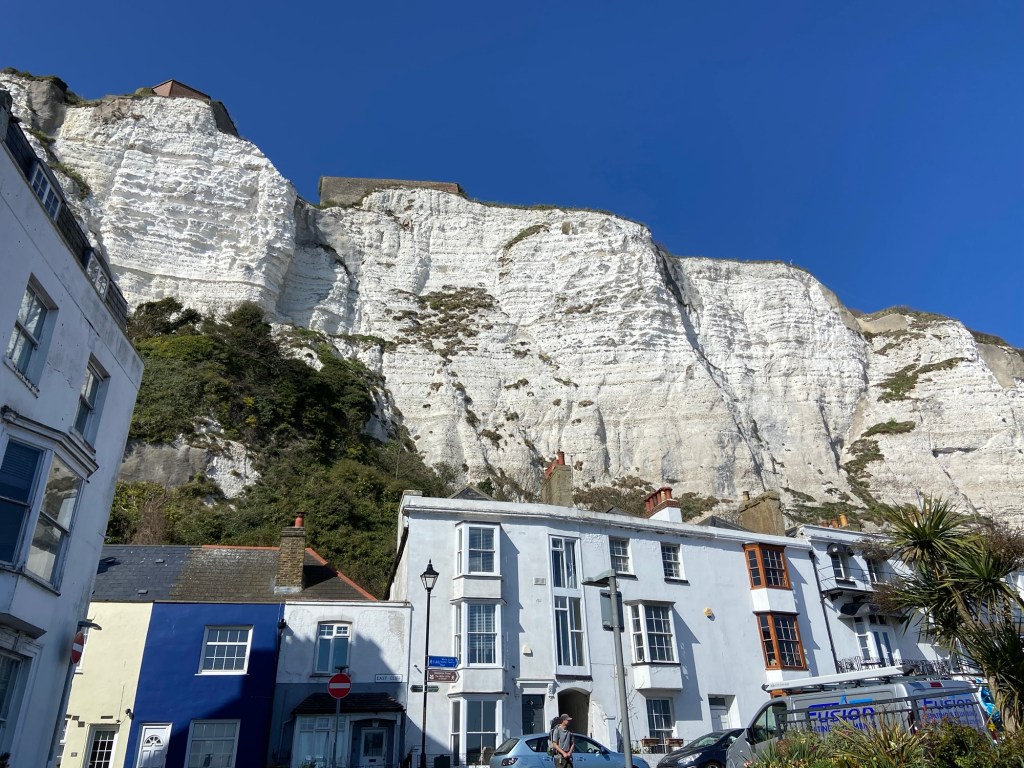
A sight to lift any heart. This was fabulous! We walked towards it all along the promenade, enjoying the faded glory of the stuccoed houses along the front with the colossal chalk cliff faces towering over them.
We arrived ridiculously early into the vast cleanliness of the Foot Passenger Terminal. All the documentation said that car passengers could arrive no less than an hour before departure, but foot passengers (obviously very much more administratively burdensome) had to be there no less than 90 minutes before the sailing. Emma at the check-in was a right laugh and I wish we’d been able to chat all afternoon. Absolutely nobody but you mad pilgrims travelling on a Sunday afternoon she said, as we looked in bafflement at the empty concourses. She brandished her P&O stamp with alacrity in lieu of the missing St Mary’s one, so I didn’t get a stamp in Dover after all. Emma and Stephen had plenty to say about education, and spoke as one mind on the subject, agreeing that they should go on Question Time to pontificate. Emma also had the distinction of being the first person in the history of the world to scan the QR code on my natty blog sign, which had been tied securely to my backpack, until my backpack expert managed to rip it off by heaving it into and hauling it out of the luggage racks in the trains on the way down to Canterbury. Let it not be said, though, that I wasn’t grateful for his baggage handling, and also for the fact that he has since mended it with an amazing roll of gorilla tape which he unfeasibly pulled out of his rucksack.
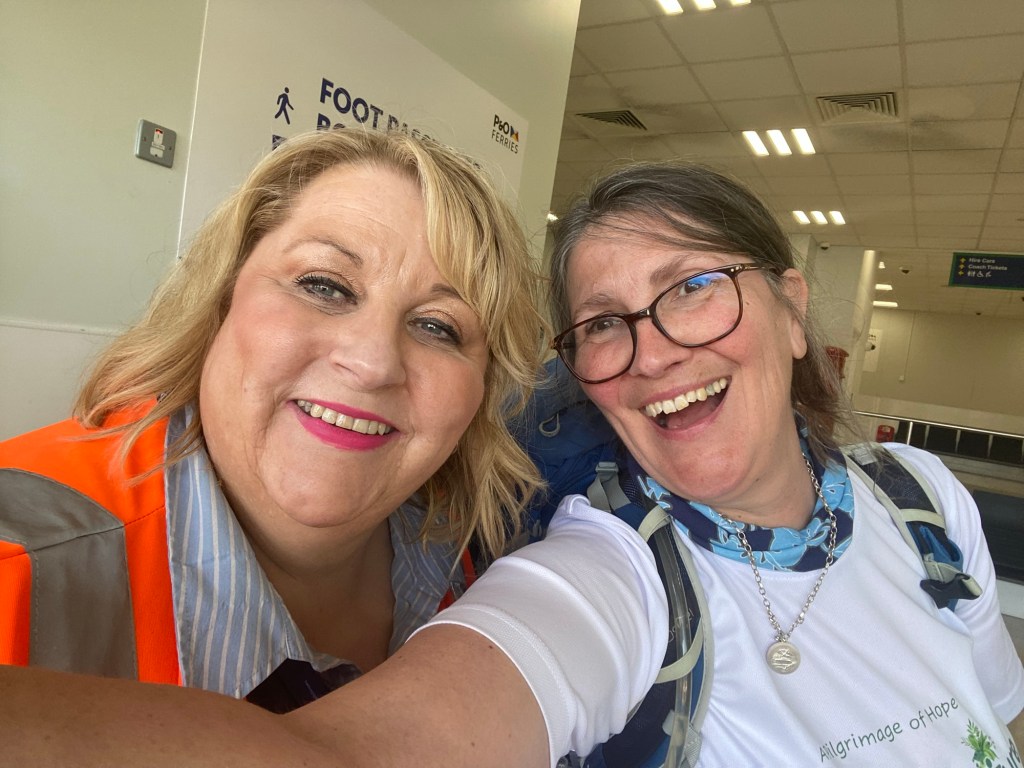
Emma invited us to wait in the Foot Passenger Boarding Area, until (she said with a snort) we were collected by the P&O foot passenger bus. Stephen went off to wish his mum a Happy Mother’s Day over the phone, and I soaked up the atmos. It consisted of three employees of the port of Dover, dressed in eye-wateringly orange hi-vis jackets and trousers, too thick to be at all comfortable on a hot day like today. And a hearing-impaired older lady who was having a silent but clearly fraught conversation in sign language over video chat. The two groups intersected when one of the port officials came over to help her, and began explaining to somebody on the phone that this lady’s daughter’s car had been impounded, but that she hadn’t been able to get her luggage out before it was taken away. She needed access to the pound so that she could retrieve it — or at least someone needed to fetch it for her. What an incredibly difficult thing it is to have nuanced conversations (especially with what were clearly obstructive officials on the other end of the phone) when there are immense communication barriers to to surmount. I’m acutely aware of this as I contemplate two months in France… But for both of us, for me and this stranded lady, technology can come to our aid: me with Google Translate, and her with video calling and the ability easily to write text on her phone.
By the time we were called to the bus her luggage had been extracted. And off we all went on a convoluted bus tour which would have stressed our fathers beyond endurance. But the driver, smoking her roll-up as we waited for the Sprit of France to dock its monumental derrière, flung the bus around the roundabouts and the diversions, temporarily disgorged us sans baggages to traverse French Passport Control in the shadow of the white cliffs, and sped us, thumbing our metaphorical noses, past the massed queueing lines of the cars, lorries and motorhomes.
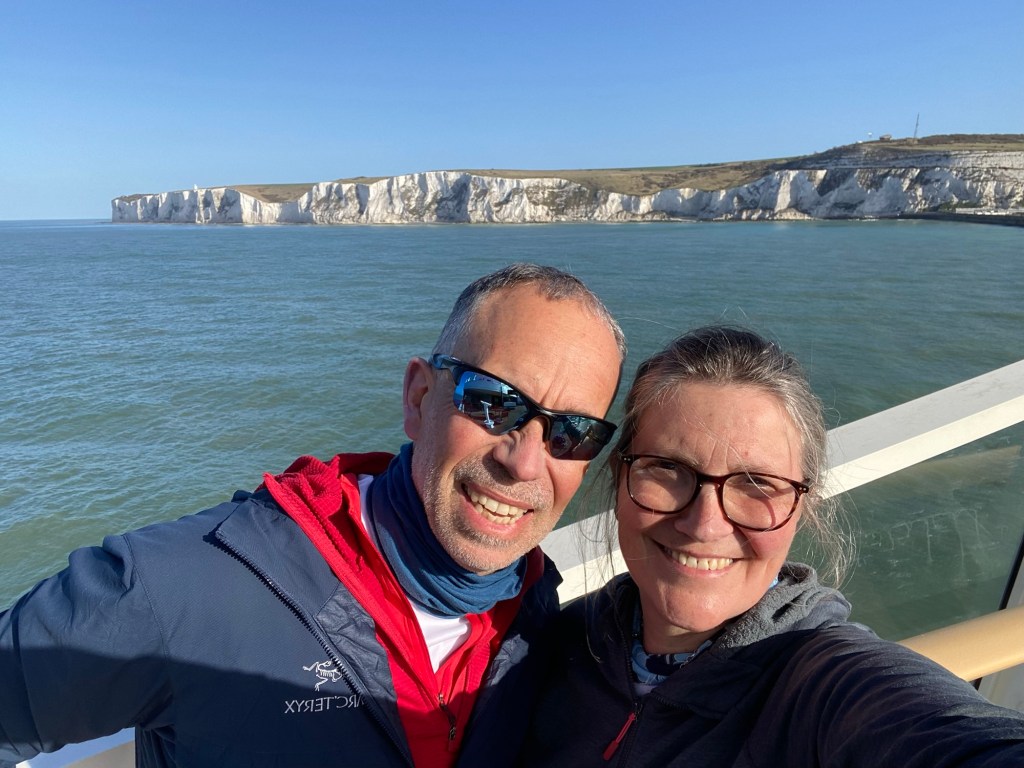
We boarded the ship onto one of the upper decks via a skyway external tower plus removable bridge, and quickly bagged some seats in the outdoor deck in the lovely warm evening sun. The views were spectacular, inspiring, the great cliffs extending out behind us.

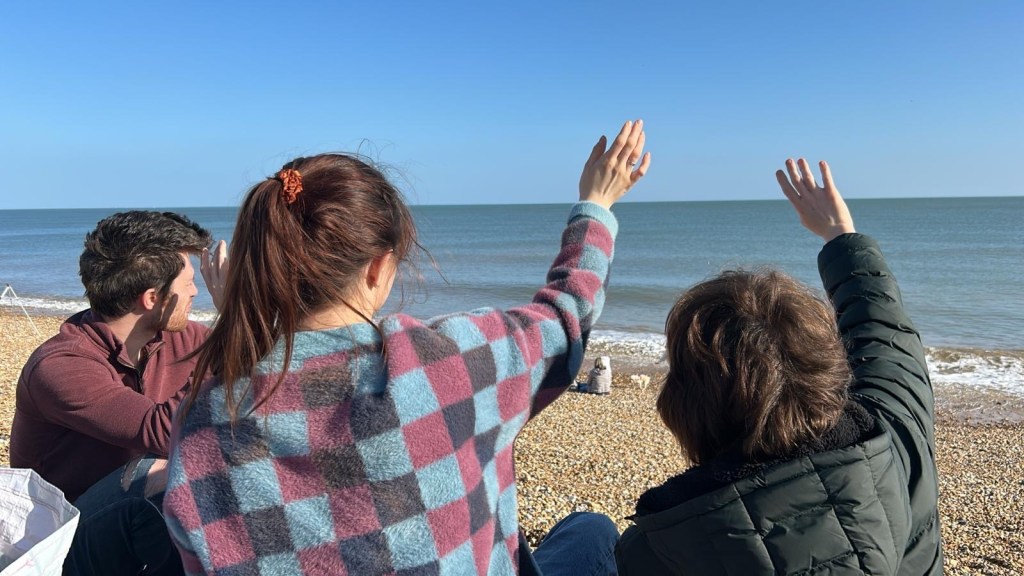
Just as we were leaving, a text arrived from Frances saying that they were down the coast in Hythe and fancied they could just see us in the very far distance. And so they were waving us off.
We had an honour guard of seagulls as we slipped smoothly out of port, leaving the Coast of Blighty behind us in the setting sun, and turning our faces towards the coast of France, and the next part of this great adventure.

With winged heels, as English Mercuries.
William Shakespeare, Henry V, Prologue to Act II
For now sits Expectation in the air,
[…]
And thence to France shall we convey you safe, […] charming the narrow seas
To give you gentle pass;
Stats for the Day:
Distance: 17.29km
Climb: 226m
 Walking The Landscape