The ragged cliff face has a thousand faces in a thousand hours
Ralph Waldo Emerson
Victoria came from Portobello to pick me up at 8 o’clock, a kind offer of a lift so that I didn’t have to catch the first bus down to Cockburnspath which wouldn’t come until 10.20. I bid an extremely fond farewell to June, sorry that I hadn’t seen Davey (who leaves for work at 5 am), and also to little Peggy, who snuffled her own goodbyes.
Our road down to the beach at Pease Bay was blocked off with a road closed sign, so we parked in the turning circle and walked down to the beach, past a colossal yellow piece of heavy machinery. It was a crane, they explained, for moving mobile homes. Grant, in charge of maintenance at the holiday park, said that the enormous crane we had passed was a tiddler at 150 tonnes, instead of the 500-tonne one they sometimes use!

For half an hour, Victoria and I sat at the back of the beach, propped up on the little tussocks of marram grass, discussing bicycles and seabirds (last year there had been so few birds that Bass Rock hadn’t been white!), taking turns to look through the binoculars at the shoreline, and at the fog bank almost engulfing the offshore wind farm, 25km away out into the North Sea.
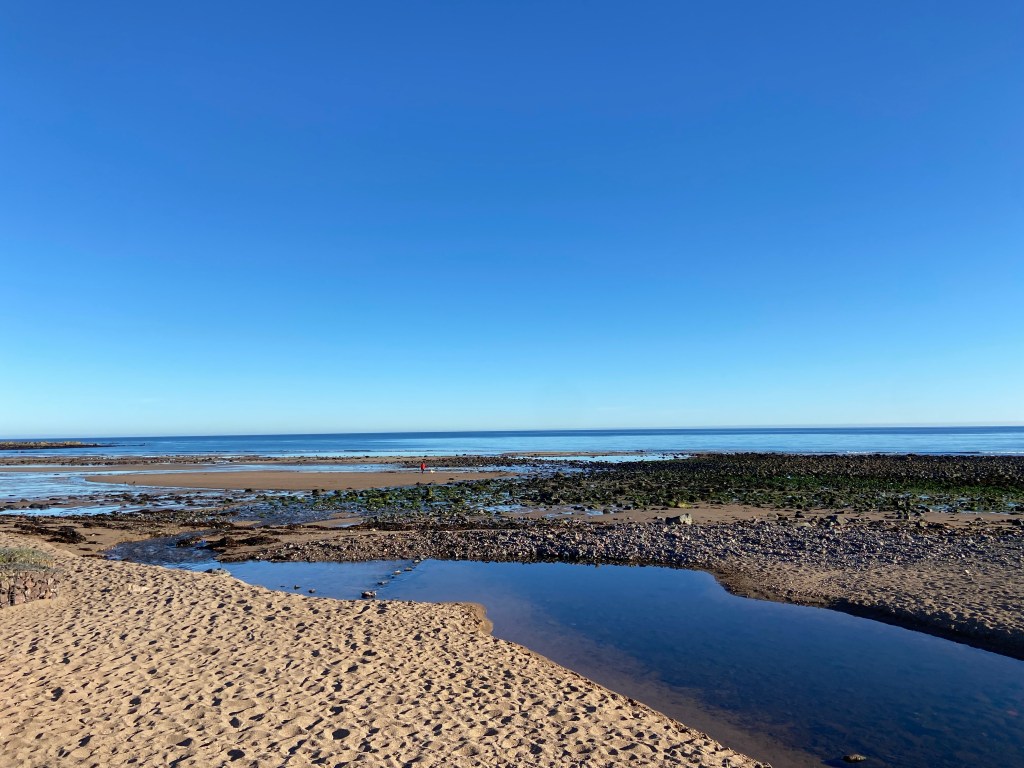
At the north end of the bay the slouching red sandstone bulk of the cliffs caught the early morning sun,
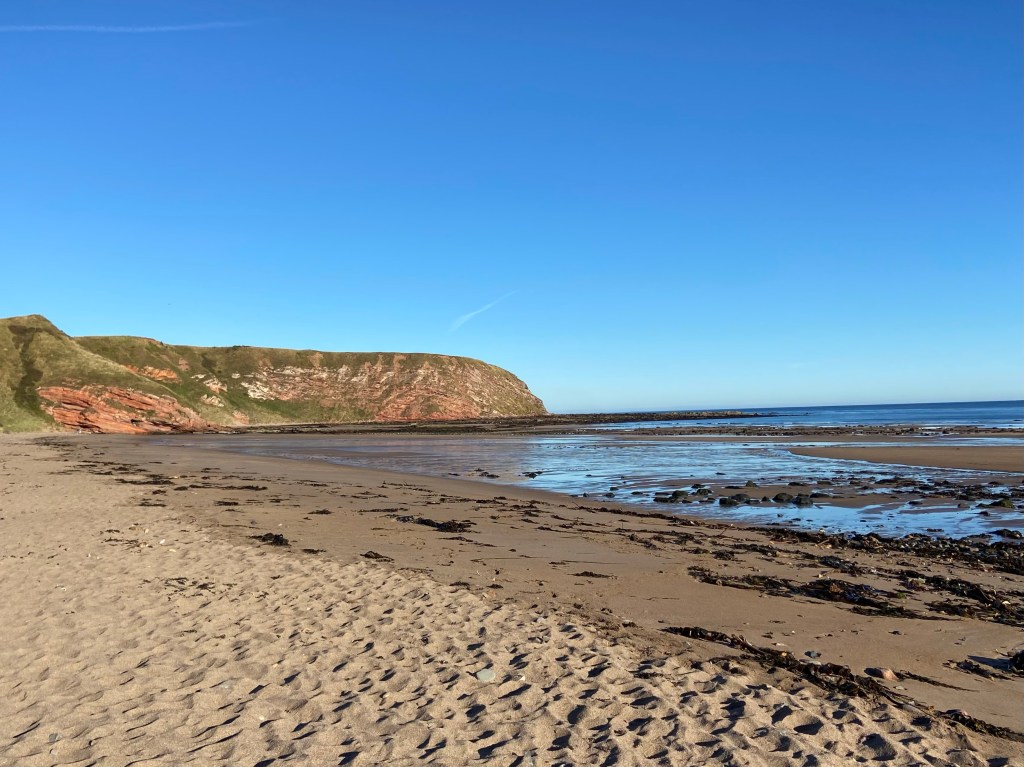
and to the south the cliffs were in shadow, hiding whatever horrors of steep path awaited me. I had a long day ahead and much as it was blissful sitting on a beach eating strawberries with Victoria, I needed to tear myself away. We parted ways at the burn, Victoria heading uphill to her little white car, whilst I turned south towards the clifftop drama of Saint Abb’s head.
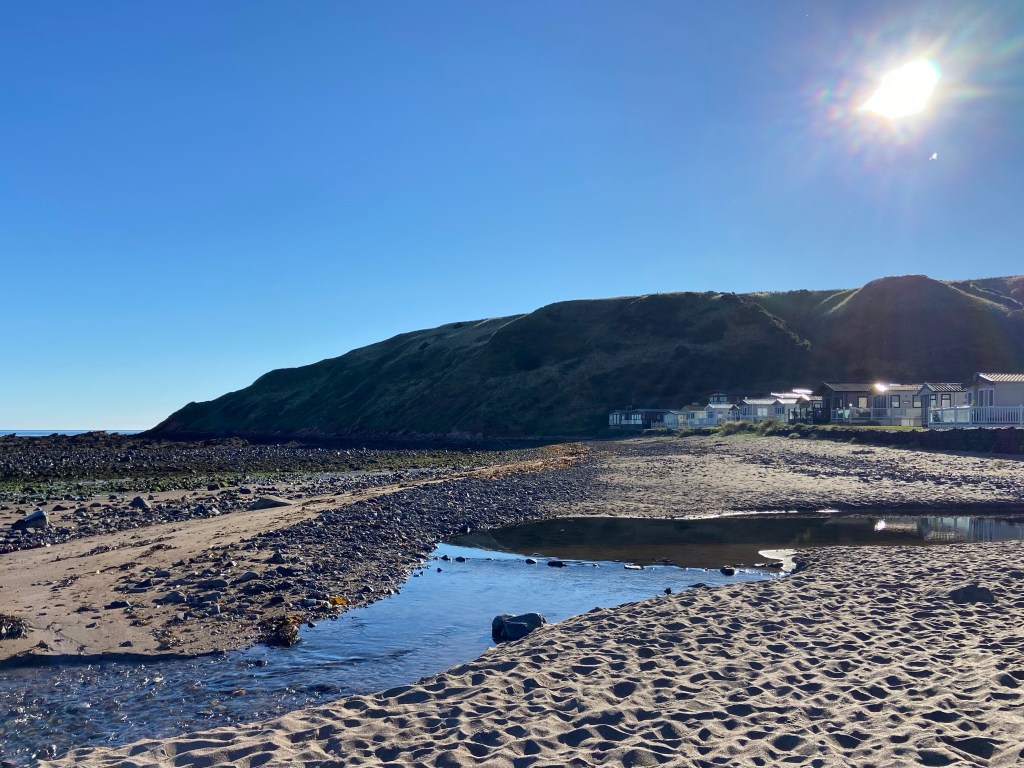
Today my whole system felt functional, and in balance. When I climbed the 30 metres of steps up to the top of the cliff, my breath and heartbeat now recovered within two minutes. I stood and gazed down at the beach. On the hill above, Vicky‘s car was turning at the roadblock. I waved my poles in farewell, and fancied the sunlight flashing on her car windows as it turned was her answering farewell.
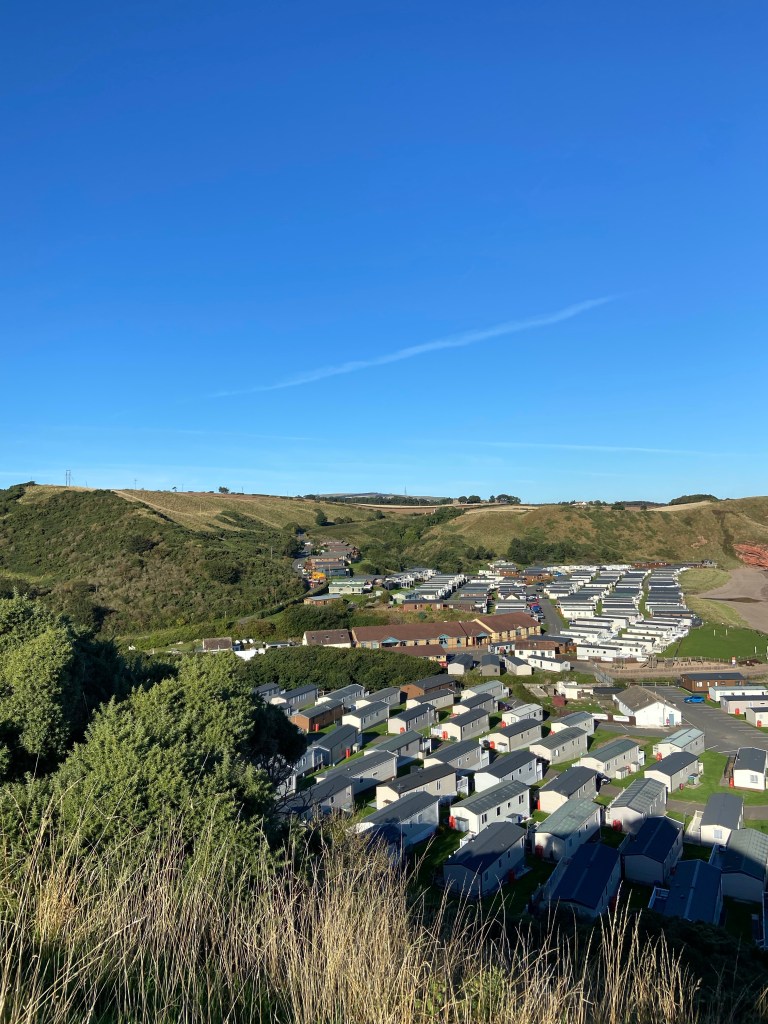
I took a leaf out of my friend Jane’s book of walking (the chapter which states you must visit points of interest even if they are not strictly speaking en route), and made the 2km detour out of the disused Old Cambus sandstone quarries to visit Siccar point, which has a claim to being the birthplace of the geological sciences, since it was here in 1788 that James Hutton set out in a little boat to observe the cliff and gather the evidence to confirm his revolutionary theory that the Earth, rather than being 6,000 years old as biblical scholarship of the time claimed, was the result of geological processes over aeons. Hutton’s Unconformity seems to be (I found it all quite hard to understand — at least hard to understand why this should constitute ‘proof’) beds of striated graywacke, sandstone created when great tectonic plates closed over the Iapetus Sea dividing Scotland from England, folding and forcing the graywacke up by the tectonic action which created colossal Himalayan-scale mountains to the north west in what now are the Scottish Highlands. The beds were first laid vertically, and then covered over time by the red sandy sediments washing down from those mountains as they were eroded. This last was the bit that I think I understood, having read the interpretation panels on the geological creation of the mountain of Slioch, on the west coast, where sandstone once lay five kilometres deep on top of the ancient rocks which now remain. In the cliffs at Siccar the graywacke is overlaid by the red sandstone, and this was Hutton’s revolutionary proof. June had a geologist guest once who was terrifically excited about visiting this point, and we had both been baffled as to why. This is the reason, June!
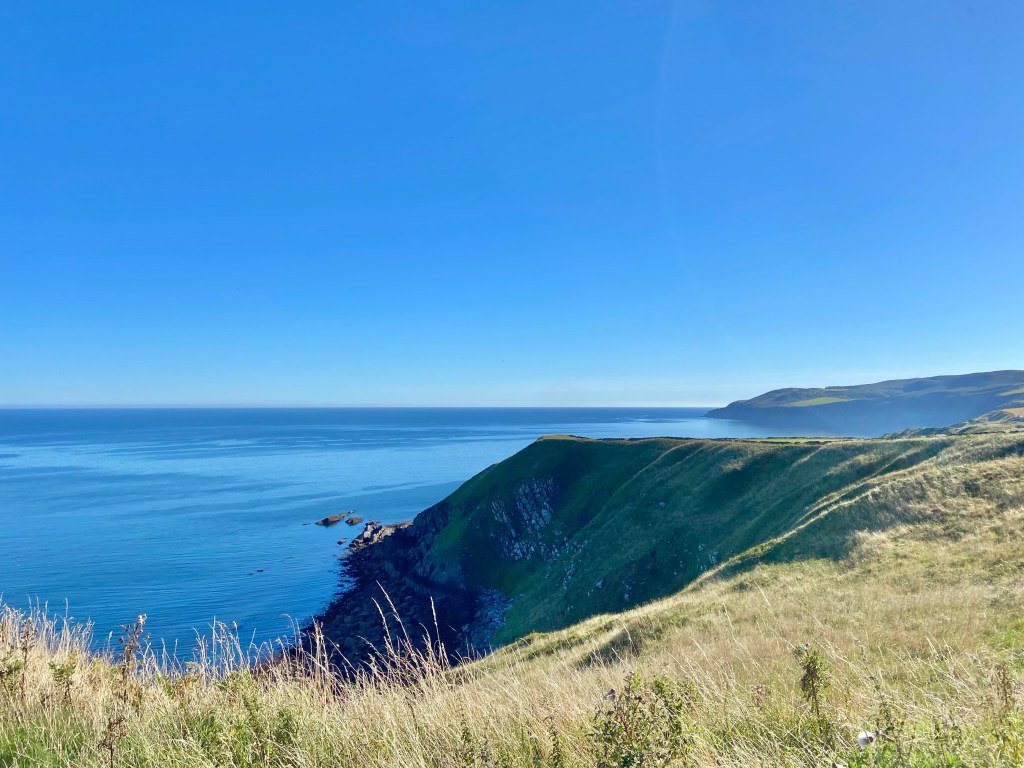
The coastal path tracked miles over undulating coastal hills above the sea-braes, always trending upwards. There were constant views back along the coast, cliffs sometimes hidden except for their top edges scalloped smoothly back like bites taken out of the coastline by the sea,
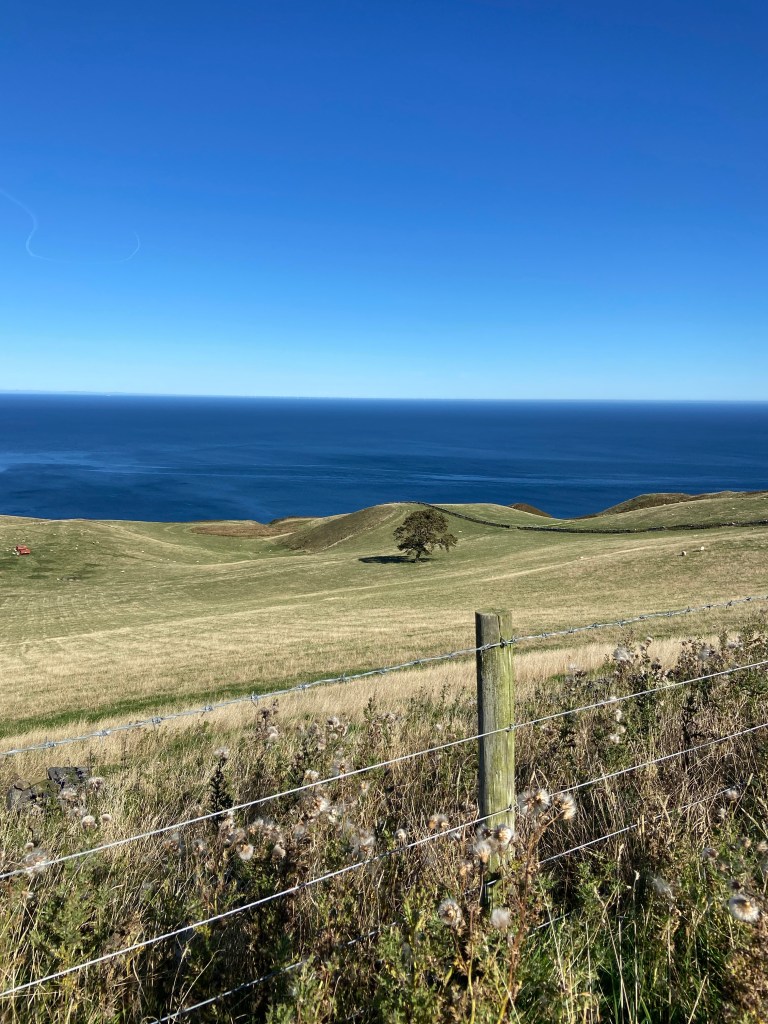
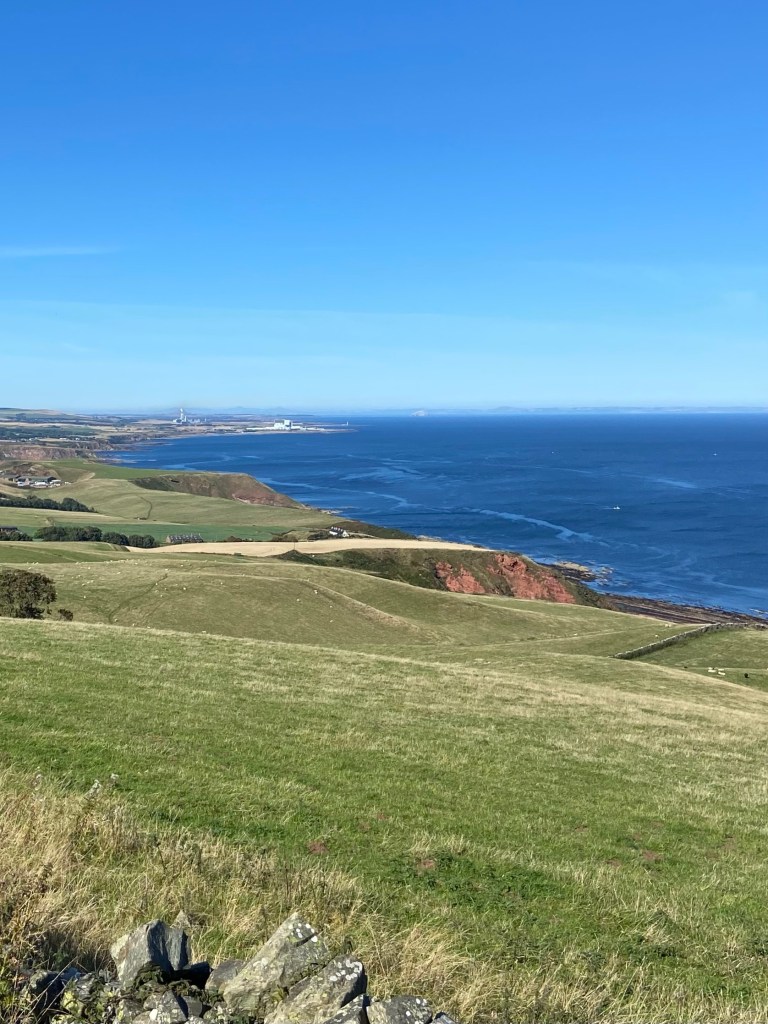
and sometimes revealing the scarps and rocky cliff edges, exhilarating views stretching all the way back to Torness power station.
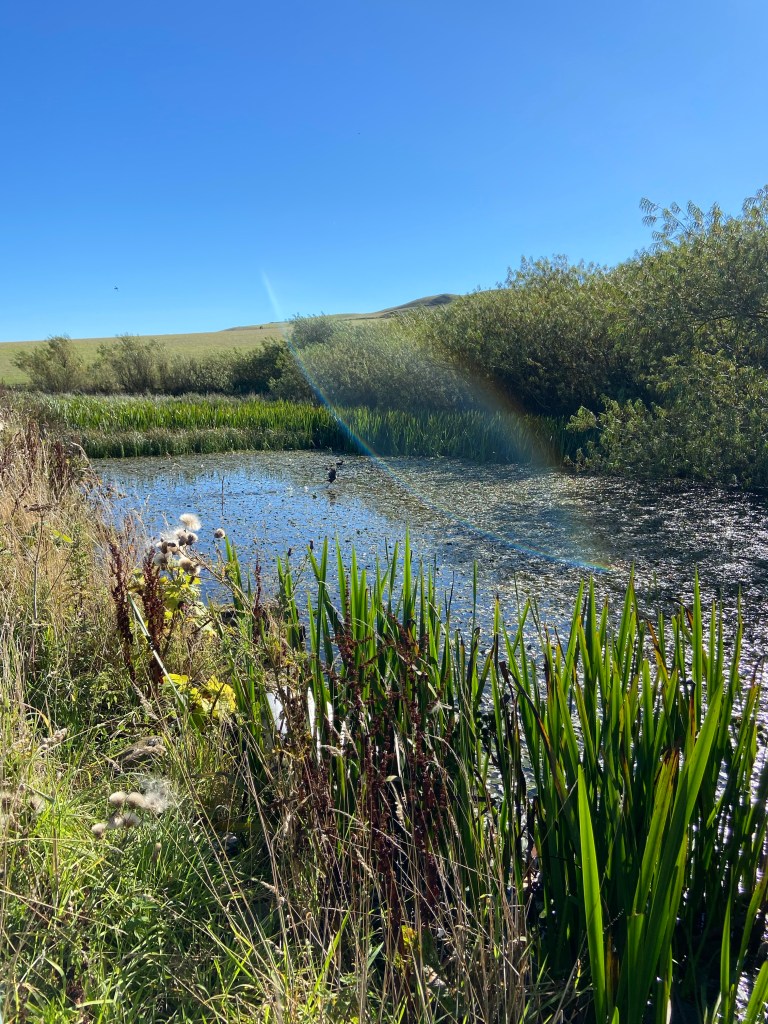
The way was mostly clear and well signed, except for a fiddly bit through a farmyard in which a sign announced in arresting capital letters: ATTENTION! TURN BACK, YOUR SAT NAV IS WRONG. Mine wasn’t though, and I would have been sorry to have missed the cootlings running in panic across the surface of a glittering pond as I passed.
An onshore wind farm of about 45 masts was turning steadily behind me; here on the clifftop the breeze was picking up to cool the walker’s exertions. After about 10 km, just over a third of today’s walk behind me, I stopped for a lunch of peanuts and baby plum tomatoes leftover from my (rather desperate) microwave suppers in Dunbar, and some apricots. I perched on a rock with a spectacular view all the way up the coast to North Berwick on past Edinburgh to the Kingdom of Fife, and set off again as soon as my socks had dried on the rock in the stiff breeze. It was 12:30, with 17 km still ahead of me and the bulk of of the climb yet to come. I hoped I was going to do it faster than the WalkHighlands time estimate, which seemed to think that today’s route could take up to 10 hours. To take my mind off that fact, I looked far out to sea with the binoculars and watched a long skein of bright white geese heading south over the water.
Just before Dowlaw Farm, I met Alan, out on a day’s bike ride from his home in Saint Abbs. We revelled mutually in the glories of the weather, and when I said I was a little worried about how long the walk was going to be today, he told me to stop by for a cup of tea when I reached Saint Abbs. I might well take him up on the offer. For now, we agreed that I should crack on.
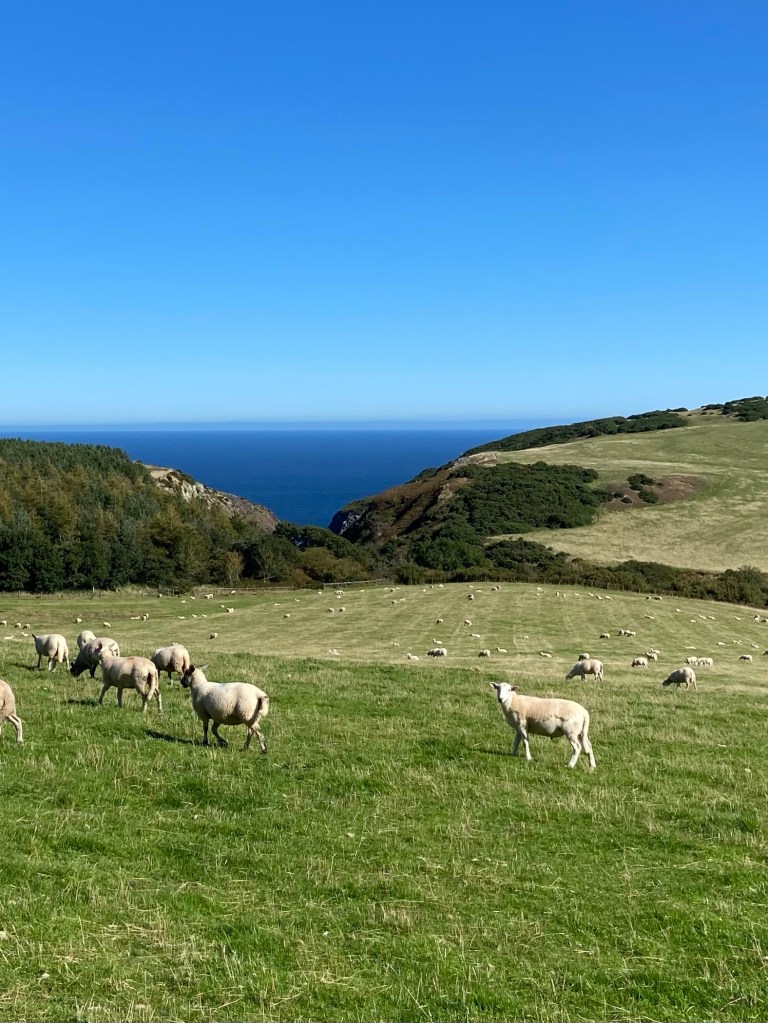
I was coming through agricultural land now through fields of sheep that afforded the occasional glimpse of the sea down steep dingles.
Coming up one hill I could hear furiously bellowing cows in fields ahead both to the right and left, and devoutly hoped that the path would not take me through any herds. I had enjoyed being alone in the empty fields with only the meadow pipits and the occasional rabbit for company.
The cows turned out simply to be calling to each other across the valley in joy at being fed, and the tractor with the feed lumbered up the hillside away from me as I stuck carefully to the path, now tracking close to the cliff edge, and heeded warning signs to give it a wide berth, especially at the unfenced points.
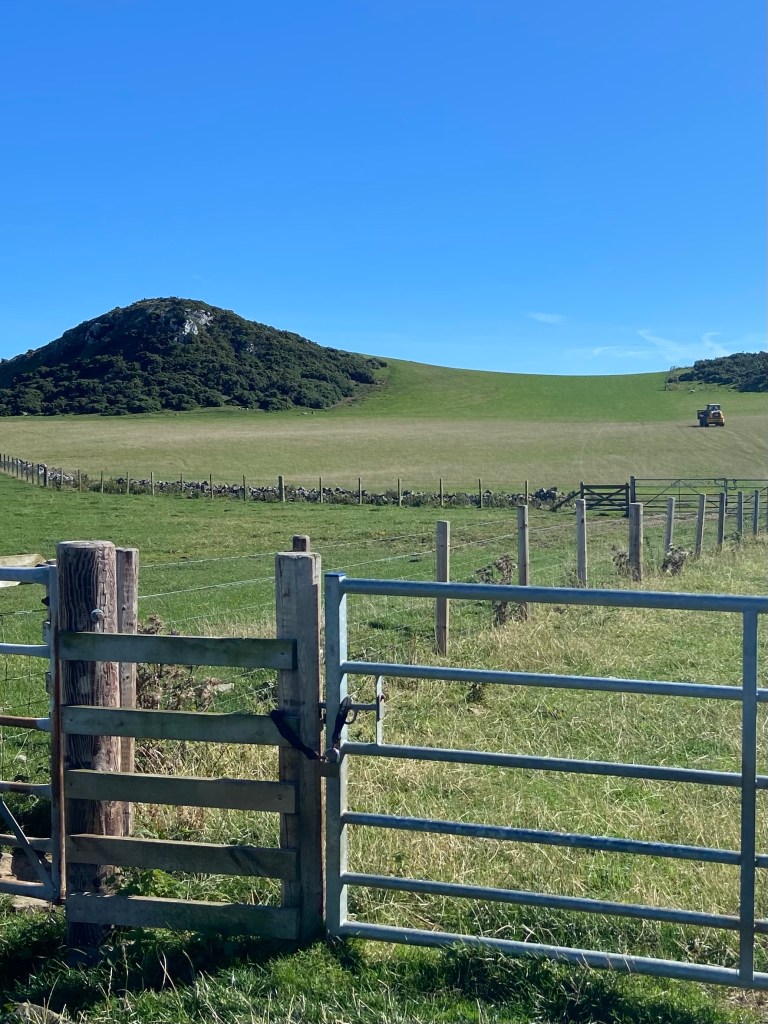
The white swans were still moving south in their line out to sea, either the ones I had seen earlier or another migratory group. It couldn’t be possible that we were keeping pace with each other; they must be going faster than me. I thought about the terrific power and stamina in the muscles powering those beating wings, and how far they carry them all the way from their summer breeding grounds in the Russian tundra or Iceland, perhaps as far down as Slimbridge wetlands in Gloucestershire, not far from me at home.
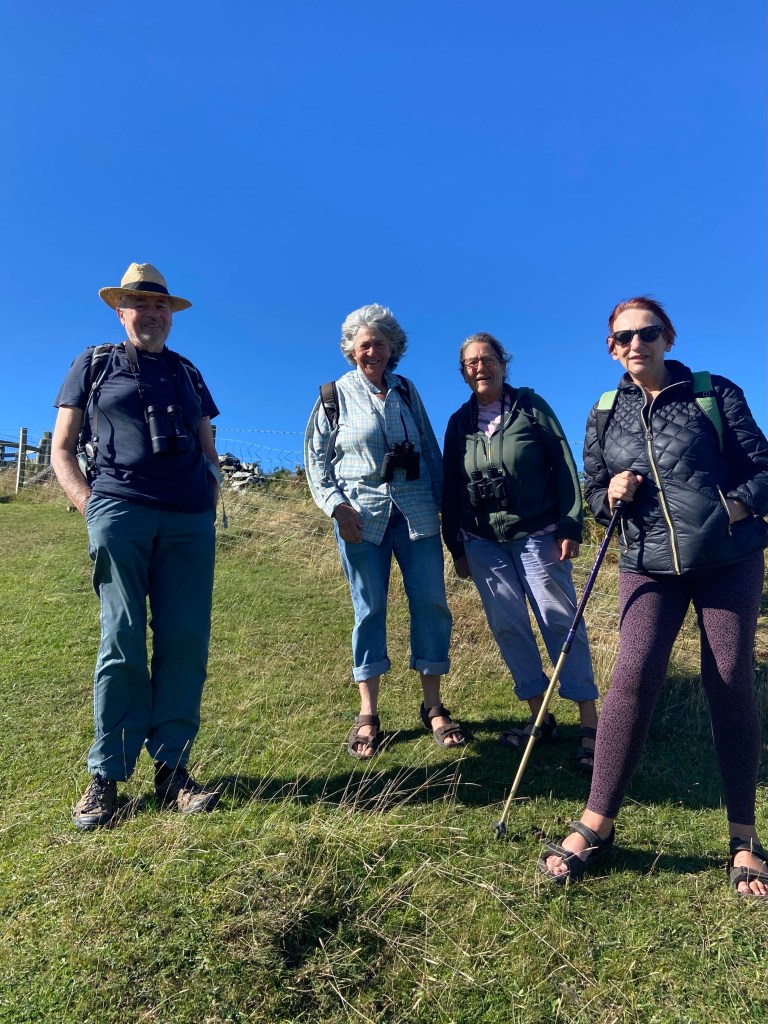
Coming towards me was a couple from Haddington up in East Lothian, his sister from London and her partner, up from Ramsgate, a strikingly convivial and jolly group out for a reunion walk and sharing some of that joy with me. After chatting for a while I walked on with a smile on my face and the phrase ‘You’ve got one big down and up to go’ ringing in my ears.
And a big down and up it was too: a zawn worthy of the South West Coastal Path: a vertical gash in cliffs traversed near the bottom over a footbridge on which I sat for a while to rest, eating some nuts and thanking Victoria in my mind for her tiny gift of the Gurkha chocolate.
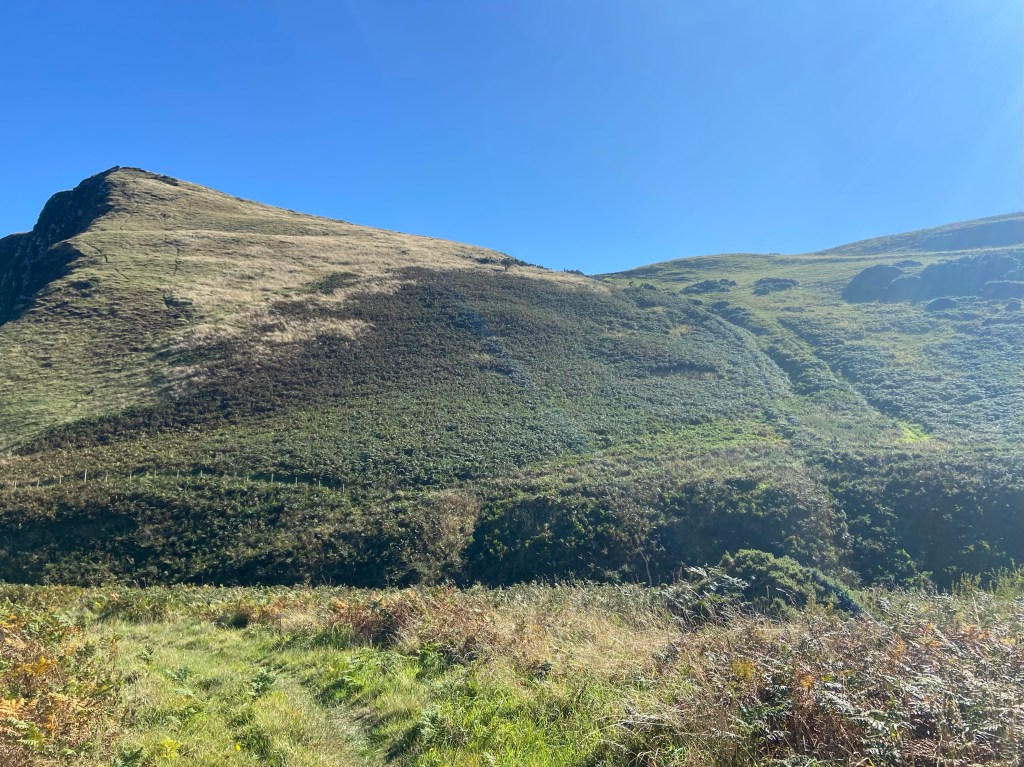
Loins thus girded, I started the climb, placing my feet carefully, using my poles to anchor me, and taking as deep, slow breaths as I could. I looked up from the footholds to see Fiona coming towards me, equally carefully, and placing her feet very sensibly sideways. It’s much worse coming down than it is going up.
‘How are you doing?’ I called up to her. ‘GUID!’ came the reply, ‘How are you?’ And I said ‘GOOD!’ to match her cheery enthusiasm, even though in truth I wasn’t particularly feeling it at that particular moment. We stopped on the shuddering path for a fabulous chat about long distance walking (she is on a sabbatical from her primary school teaching job), sizes of rucksack, and what to pack in them. I can’t tell you how much meeting you made a difference to my day, Fiona. It was cognitive behavioural therapy for me which turned into genuine positivity. Have a wonderful time in New Zealand!
Fiona‘s buoyancy floated me effortlessly all the way up the rest of the hill. I looked back to catch a sight of her toiling up the other side — her tiny figure in the path in the bottom right of the photograph provides a human scale to illustrate the vastness of this landscape through which I was travelling today.
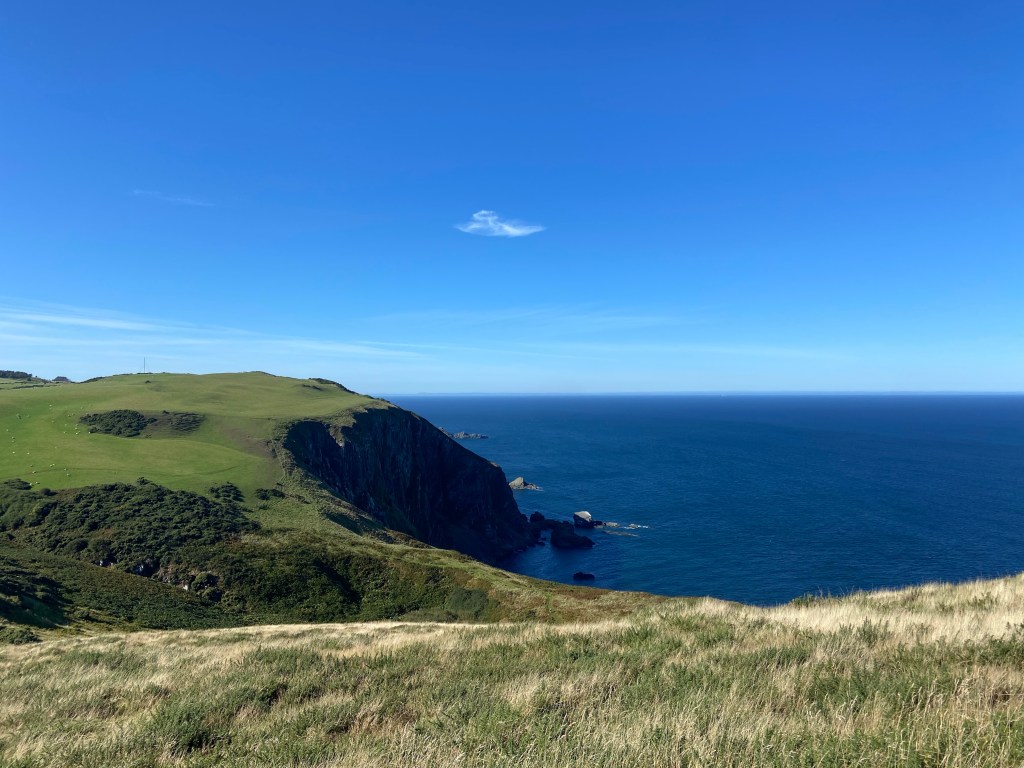
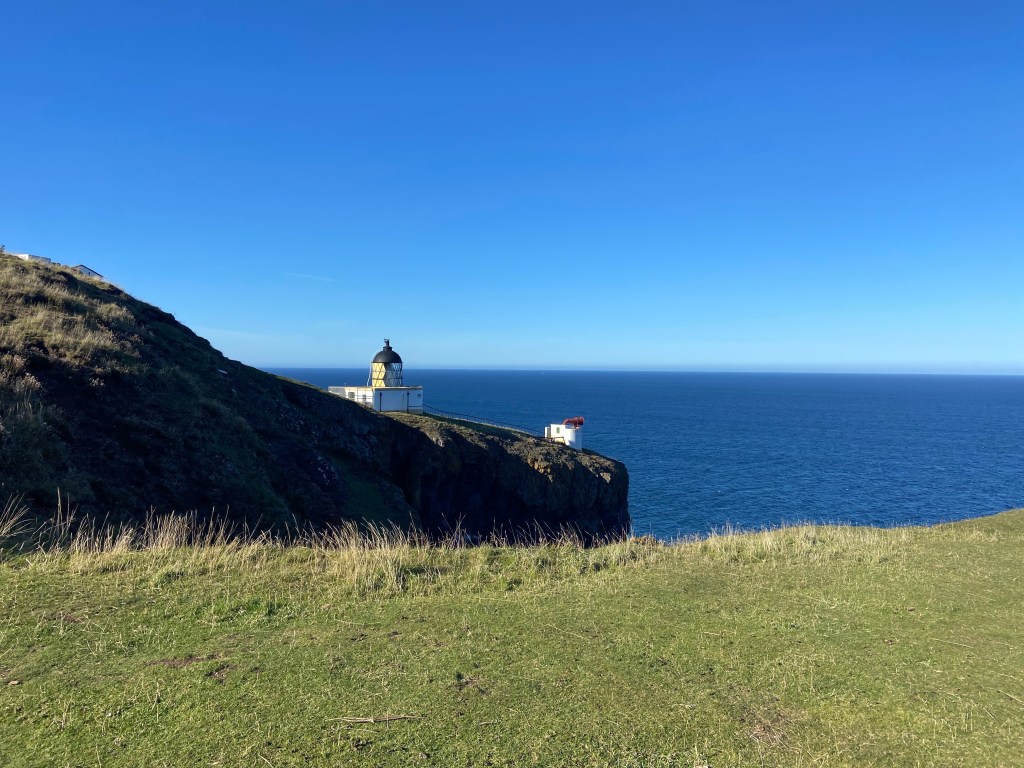
On the hilltop I got my first proper views of the dramatic highlight of this walk: the iconic spur of St Abb’s head, jutting out to sea.
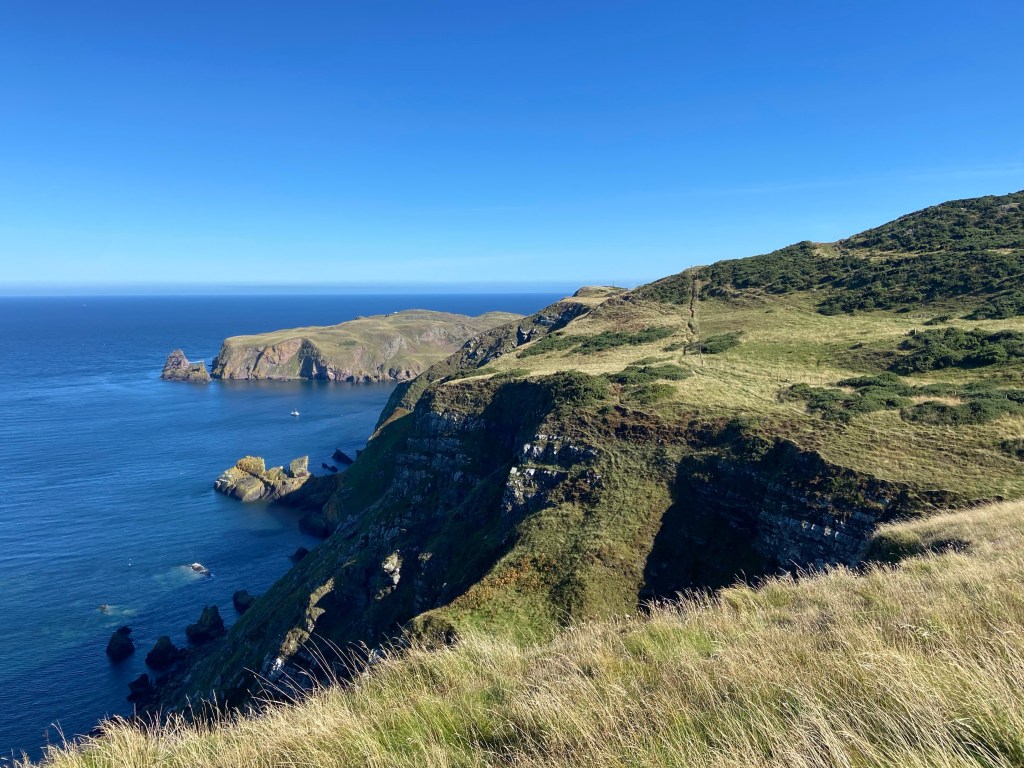
It was a fairly easy walk round (although at times vertiginous) to the foot of the climb up to Saint Abbs lighthouse and viewpoint. I came here once before 22 years ago, on a chilly grey day. Today, however, the sea was a sparkling Mediterranean blue, the limpid waters a Mecca for scuba divers. A boat was out there now, divers in the water.
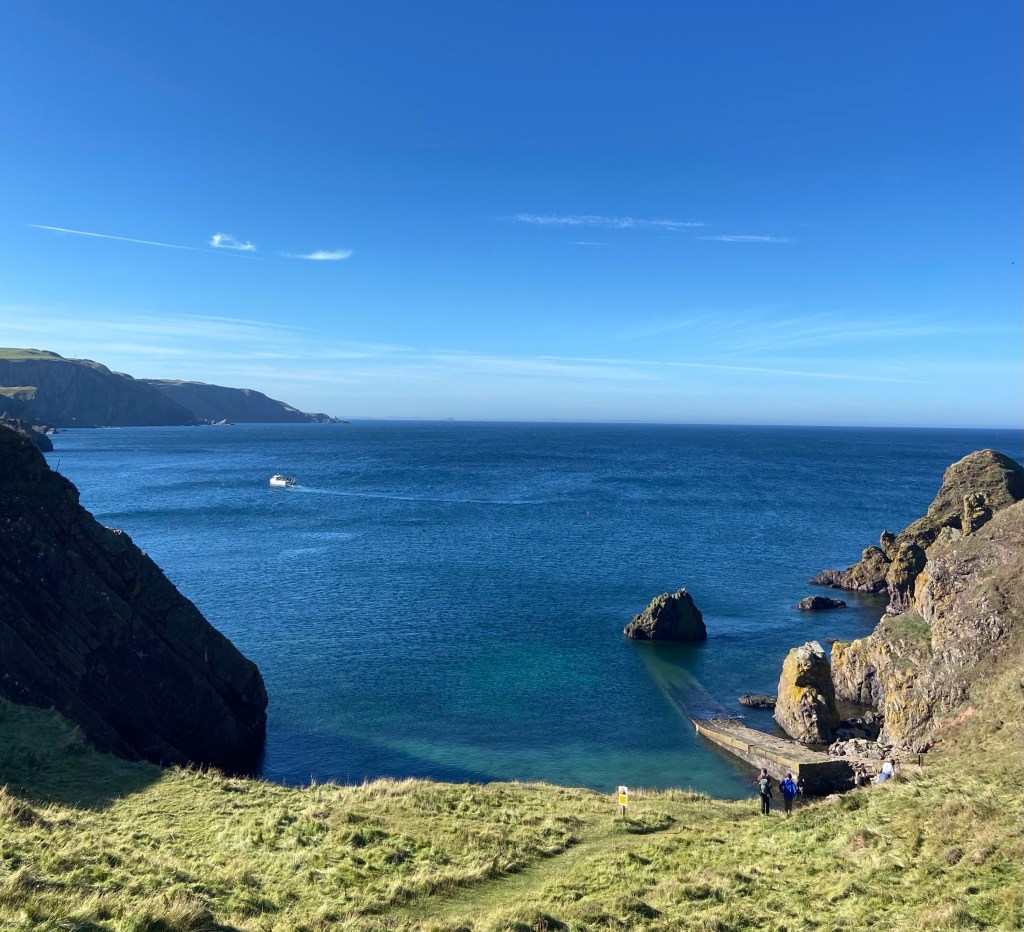
I chose the shortest steep but grassy path over the gentler, longer but paved path. Two wardens were on their way down — one asked me whether I had seen Fastcastle up the coast today — an actual castle which it would be hard to miss. I checked on the map later and saw that it was a detour from Dowlaw farm that I had completely missed on the map. Jane — my apologies.
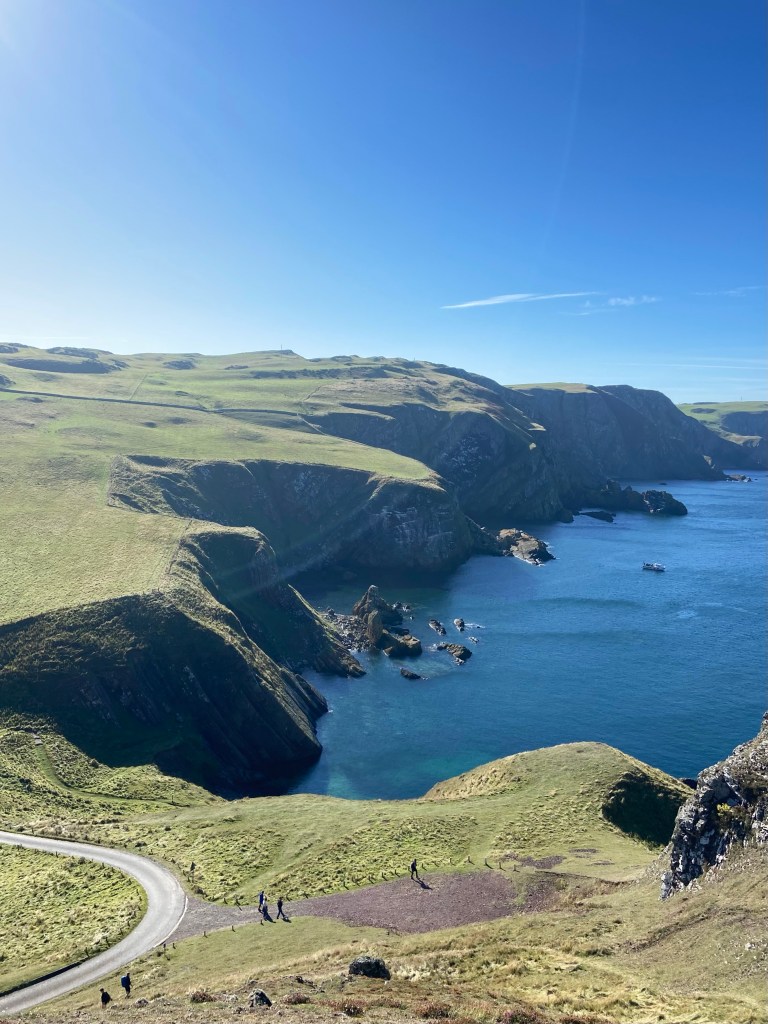
I eventually reached the old pumping station which is now a tiny visitor centre providing shelter from the wind. There were two chairs inside to sit on, and I took my boots off and let my feet breathe a bit and toes stretch out, whilst taking on some more food and water. Dawn and her sister and mother came in briefly, glowing with enthusiasm at the high point of the Saint Abb’s circular walk. It was lovely to meet you, Dawn!
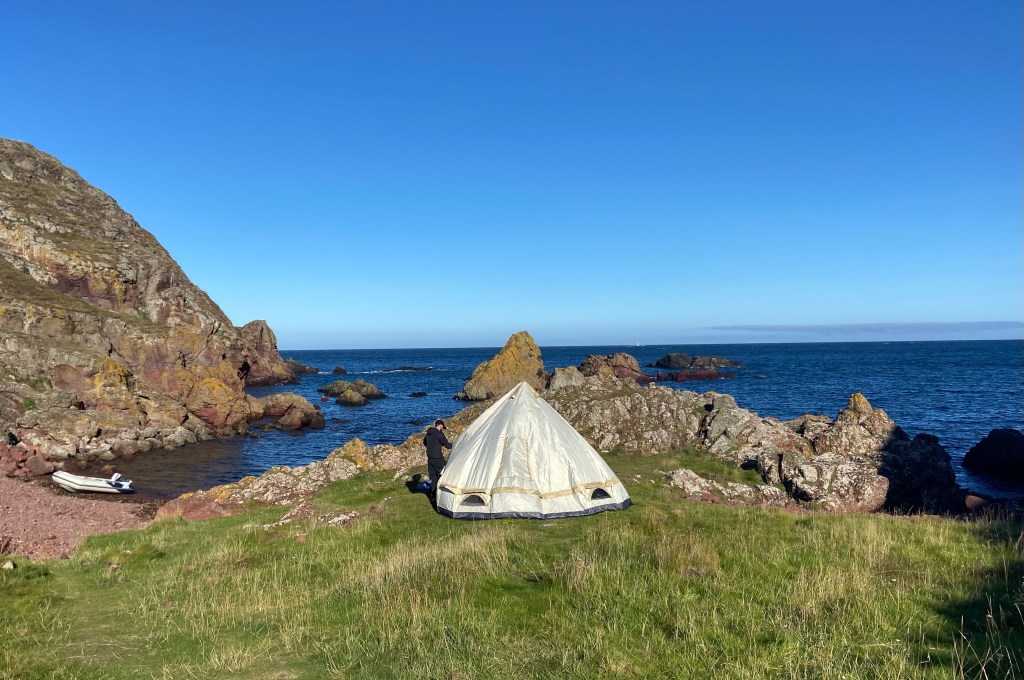
I was less pleased to meet a group of four young men who had beached a small inflatable at the bottom of the hill, unloaded a stack of camping gear and were putting up a tent for the night. Surely wild camping isn’t permitted in this National Trust reserve?
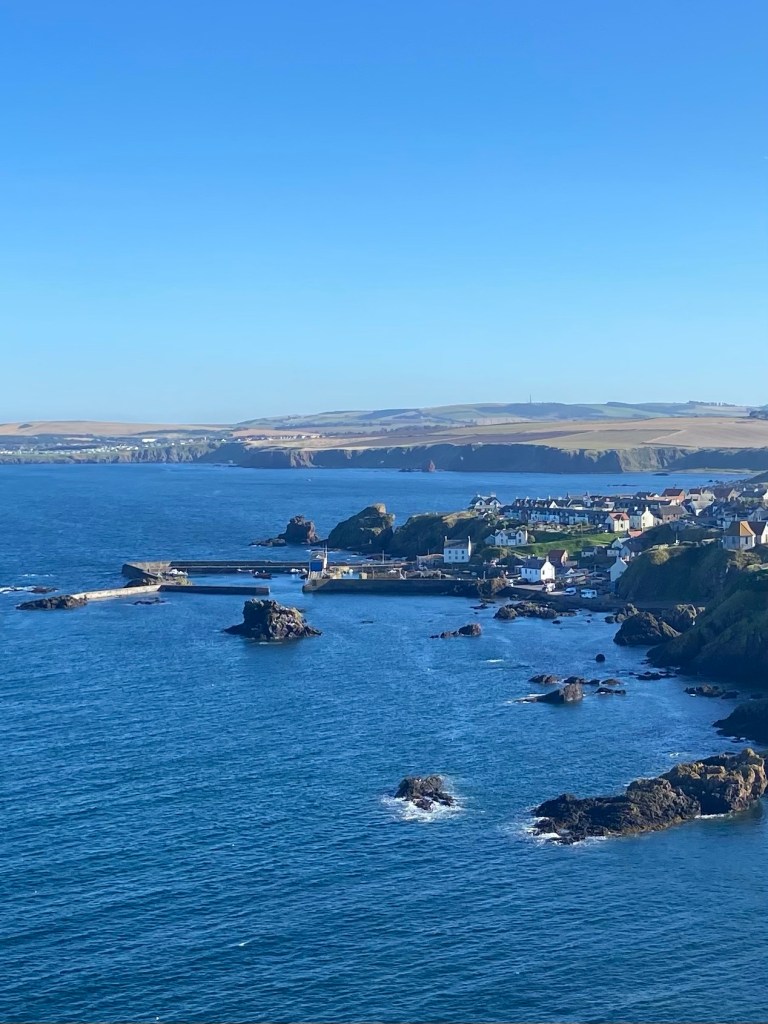
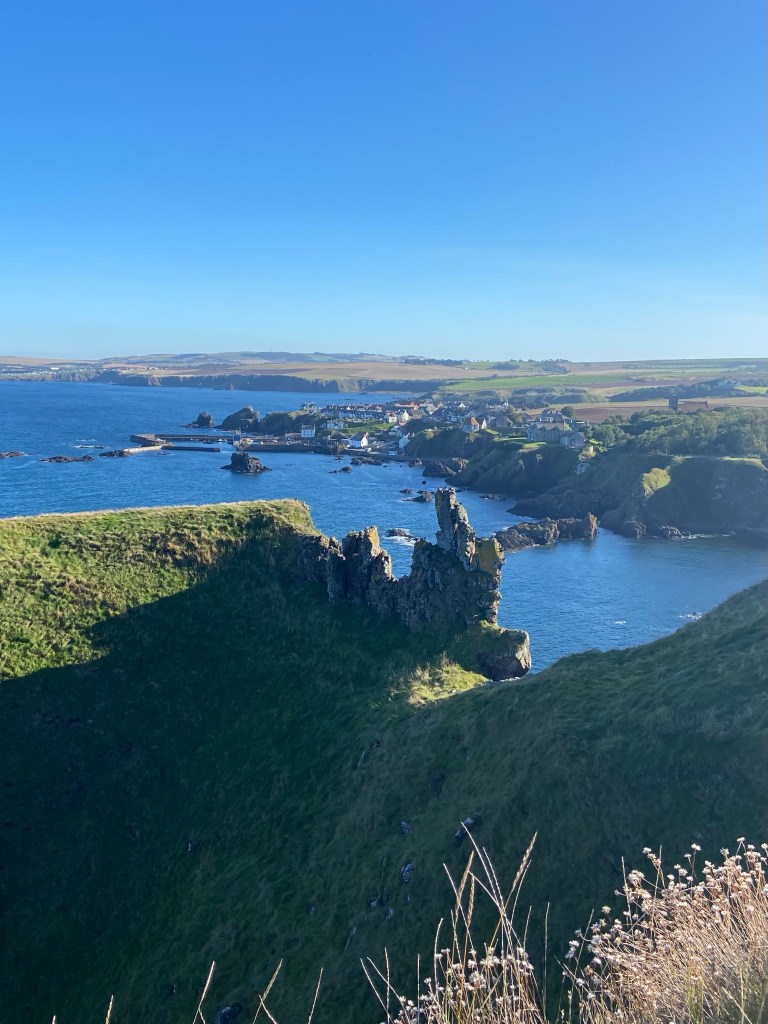
St Abb’s village was an easy three quarters of an hour further on down the hill, a perfect little harbour framed by the spectacular rock formations of White Heugh on which crows had made their roost.
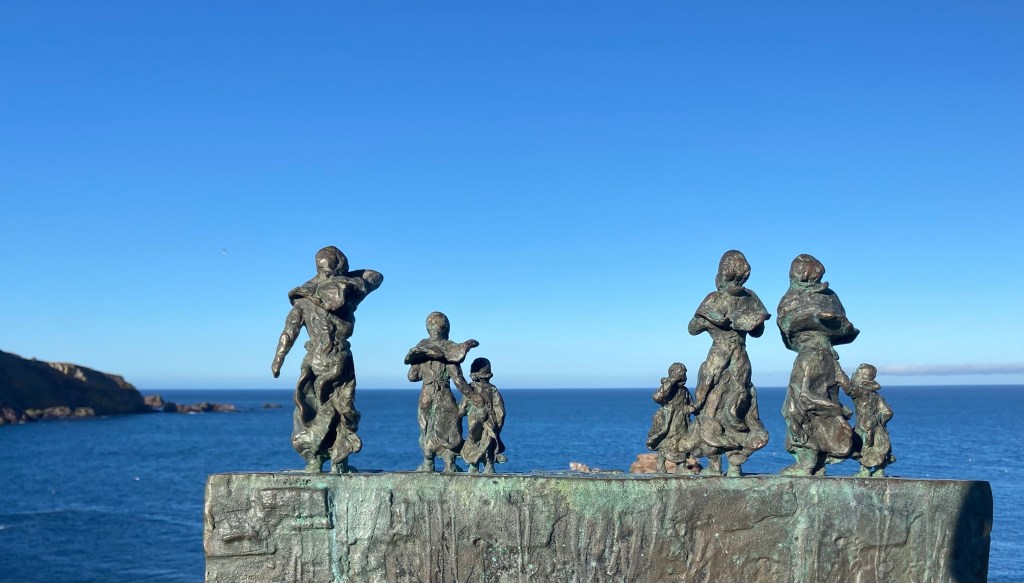
Like all fishing villages locally, St Abb’s has lost men to the sea, and a memorial statue of the wives and children of Charles Purves and brothers James and William Thorburn, watching desperately for the return of their boat, records the catastrophic loss of the three men among the 189 fishermen from the villages along this coast in a devastating storm on 14th October 1881.
I still had about 6 km to go from Saint Abbs to Eyemouth, and it was almost 5 o’clock. I didn’t look up Alan and his wife for that cup of tea, although I would have loved a sit-down and a chat. The village stores had just closed, and I had just ran out of water as I left St Abb’s city limits, taking the 1000-yr-old Creel Path used by fishermen of inland village Coldingham and monks of the abbey there, to carry their creeks down to the boats on the shore, at what would one day become the village named after St Ebba, sister of the Saint Oswald who would become King of Northumberland (a daring mission to recover the bones of whom you can read about jn Victoria’s first novel, The Bone Thief).
The communities here are still close and don’t give the sense of being emptied out like so many little fishing villages in Cornwall. One such example is the community of Coldingham Bay, lined with a rainbow of beach huts,
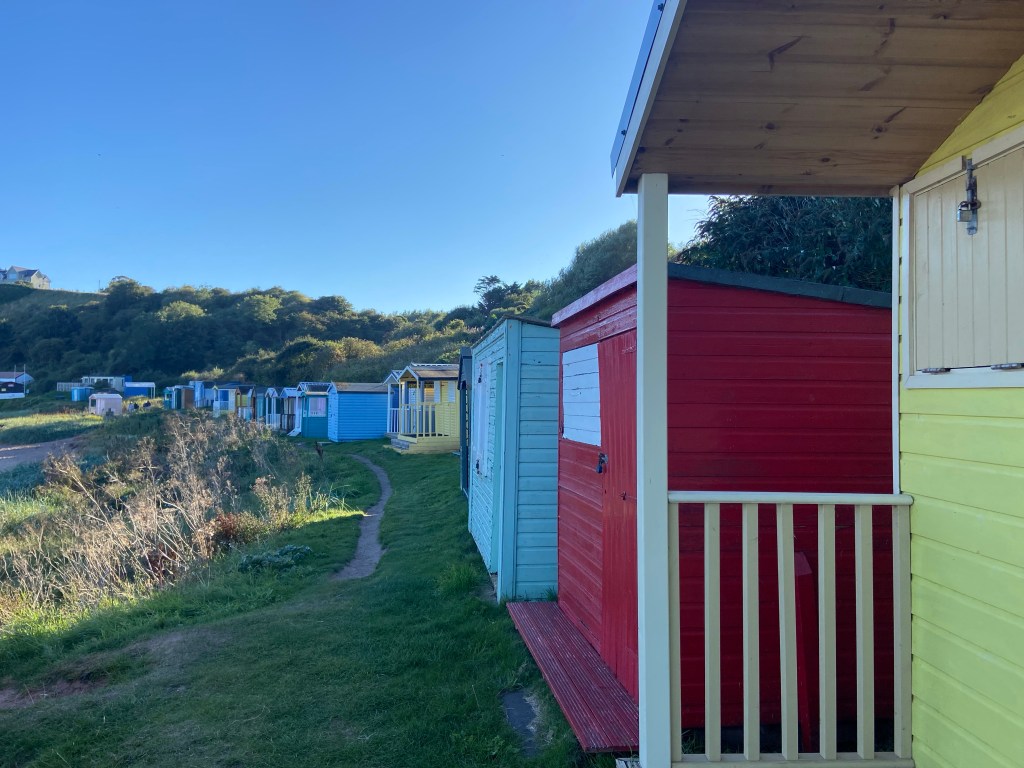
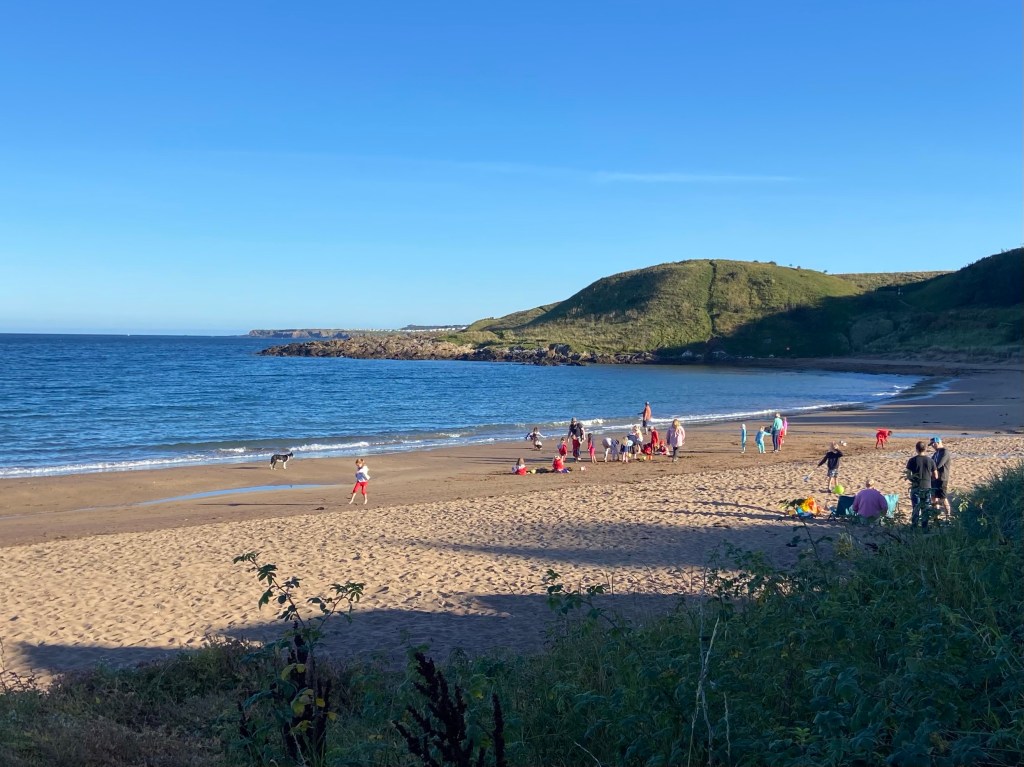
where a large group of small children had been taken down to play in the evening sun. The community has worked hard to enable disability access to the sandy beach, and a rangers service takes groups of children rockpooling. Even at this late time of day a lifeguard was on duty.
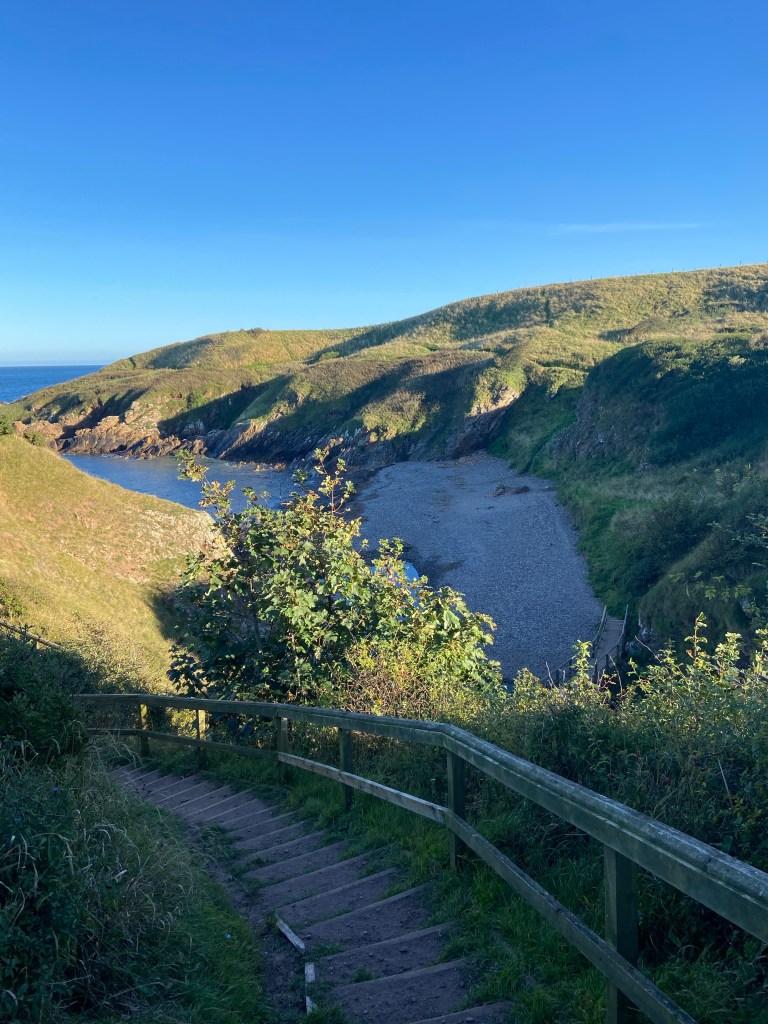
The coastal path snakes vertically up onto cliffs and down onto the beaches, three of them in the 6km between St Abb’s and Eyemouth. A winding wooden staircase was provided to give access onto the next beach,
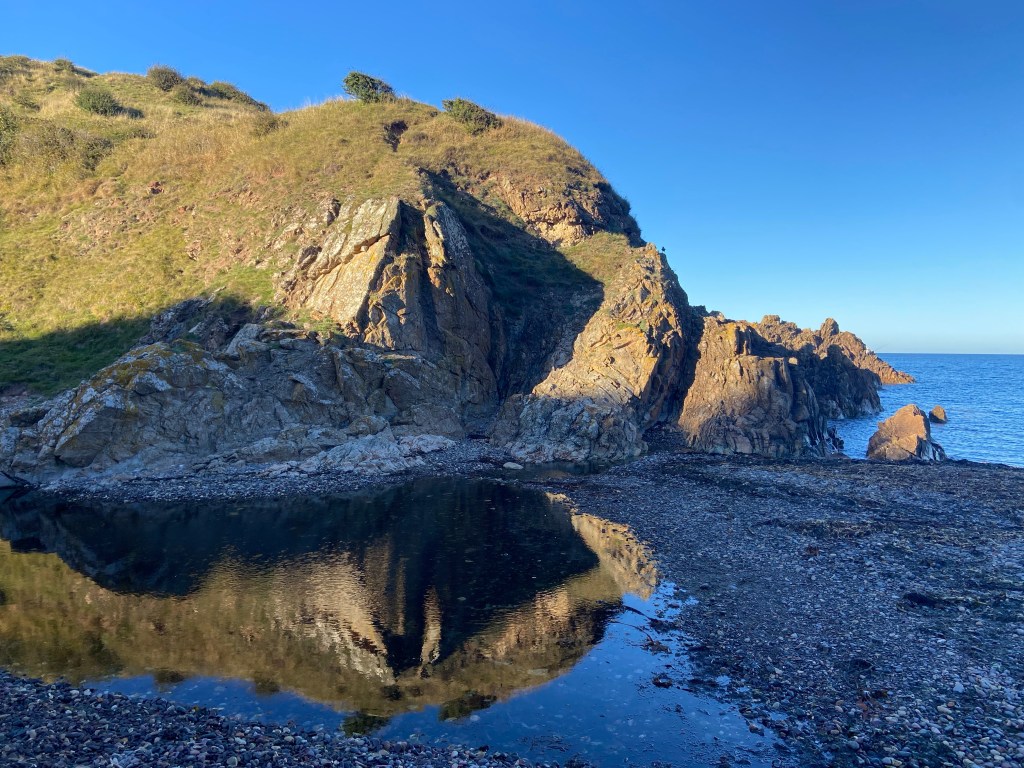
where a lone fisherman perched quietly on the edge of the rocks, and the stillness of the early evening created a perfect reflection of the rocks in a pool.
And now it was down to the last beach of the day, Yellow Craig, a long, curving strand of shingle and rocks reddish gold in the declining evening sun. I disturbed the settling seabirds who flew up in alarm as I passed.
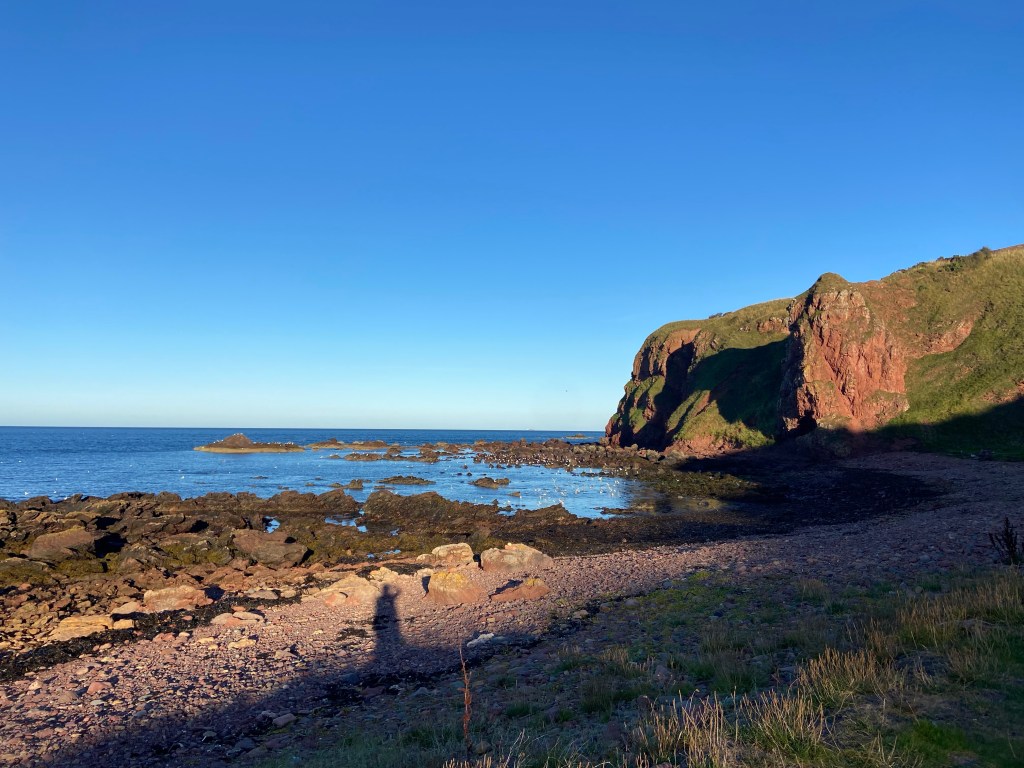
Here was Eyemouth at last. I will pick up the harbour path tomorrow, but for now I headed inland, straight to my accommodation. I was more than grateful to Victoria for dropping me Pease Bay instead of starting at Cockburnspath this morning: it saved me a 3.5km walk down to the sea; as it was, today’s walk had not only involved the most up and down, for a total of about 1500m, it had also been the longest, at 27km. I had been out walking from 9.15am and finally stumbled, tired but ecstatic, into reception at the Eye Sleep Over motel at 6.40pm — pretty much on the WalkHighlands estimated nail. I took off my boots for the last time today, and sank into the hottest bath I could stand. The day had been challenging, for sure, but I had also enjoyed the most spectacular and dramatic scenery from the cliff-top vantage point, and met the nicest and cheeriest of people.
 Walking The Landscape
What a stupendous hike this has been! The weather, the birds, the people, all glorious. And the baffling geology too. I love the fact I have a book of walking…. Brava, lovely Sophie. X
LikeLiked by 1 person
Awwww, Jane 🥾 🗺️
LikeLike
After a busy few days cutting 120m of country hedge, I have sat down this evening and binged on your latest blogs and enjoyed every step from the comfort of my ancient recliner. Thank you dear Sophie!! Xxxx
LikeLiked by 1 person
Amazing! I should think you deserve the recliner, after all that strenuous work. It’s the same here in Berwick!
LikeLike
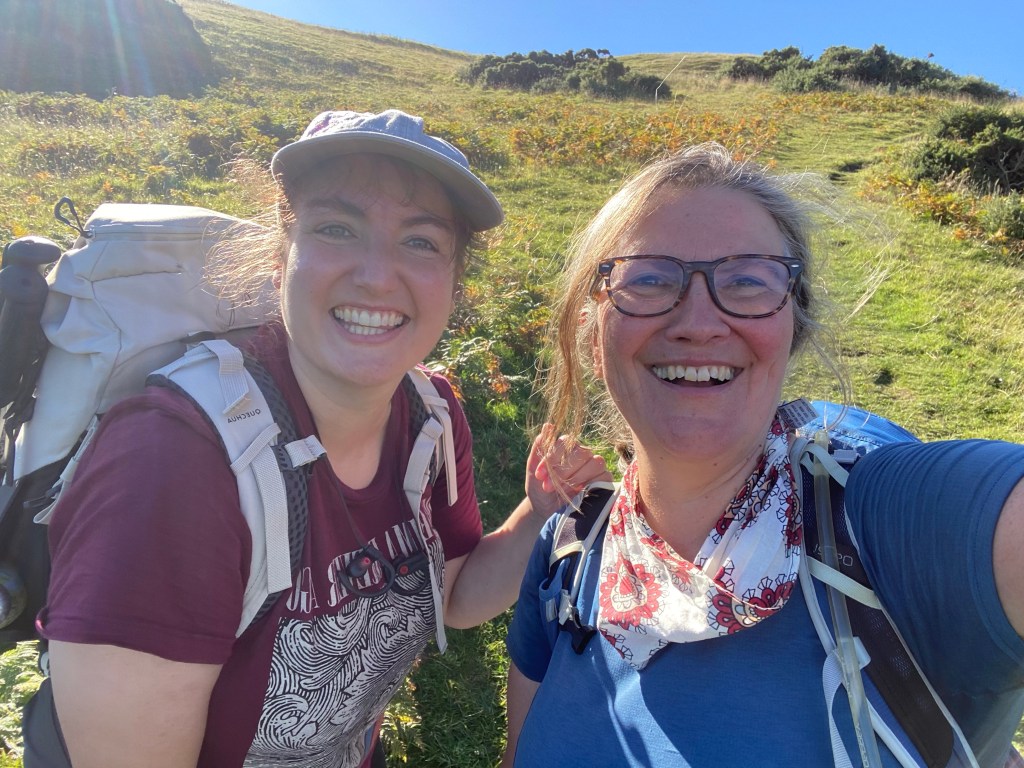
Love those beautiful smiles! That makes MY day. 🙂
LikeLiked by 1 person