

Green was the silence, wet was the light
Pablo Neruda
I woke with the Sun on the longest day, on the one hand rather regretful that I was not out there in the countryside, watching the sunrise, and on the other, thoroughly enjoying my second morning waking up, deliciously, in a comfortable hotel bed. Thank you, Jenni, for this treat, for the rest and relaxation that your gift has enabled, and for the personal guide to Bedford which I followed scrupulously yesterday with much enjoyment.
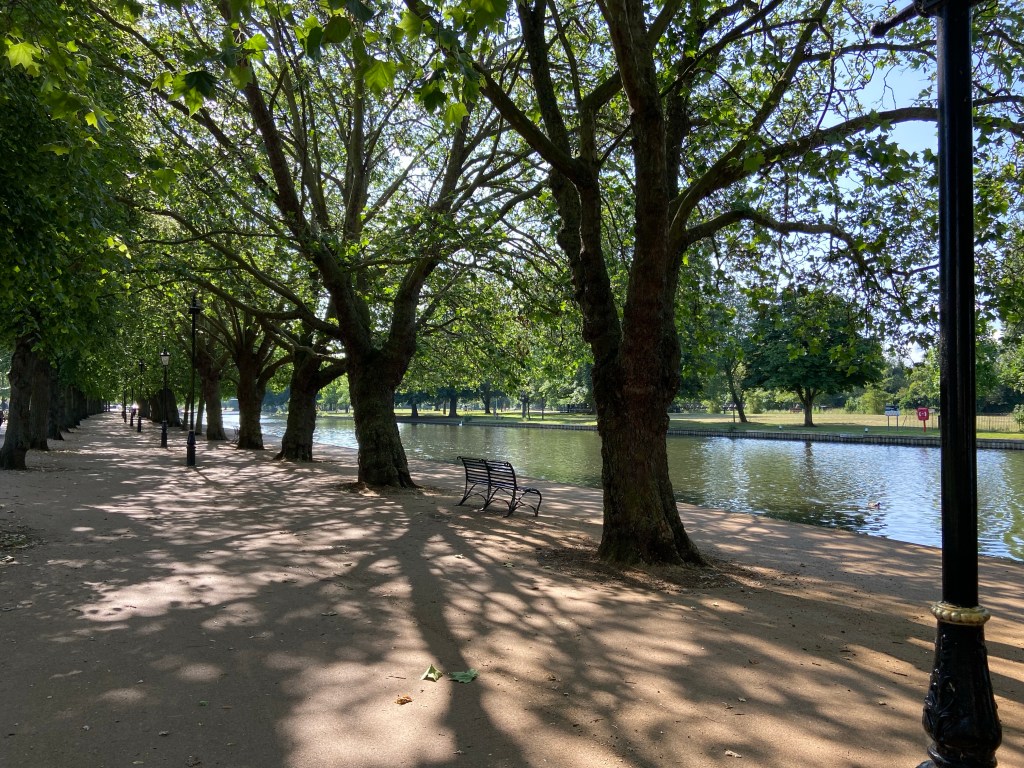
Today I was to walk what looked on the map to be a fairly straightforward path up to St Neots, where I would get a bus out to Camborne, to be kindly hosted by my friend Jacqueline. No more camping for me until I get to Holywell on Friday night, and a much lighter pack tomorrow — although this morning I felt well able to shoulder what felt like not a very great burden. I had new gel pads under the balls of my feet and I strode out into the solstice morning with renewed energy and enthusiasm. I had been phenomenally lucky with the weather, my rest day coinciding with the one day where there has been any rain at all, and I took up the trail again in sparkling sunshine.
The river glittered in the morning light. Adults were out rowing in the place of the children of yesterday; the air felt remarkably clear and sharp instead of oppressive and heavy.

All today the river Ouse was to follow its pattern of dividing into channels, ponds and lakes. These are being actively managed under an environmental stewardship programme to create an enormous swathe of waterland habitat, from Bedford’s essentially urban Priory Park, filled with dog walkers and runners, to the wilder rural stretches where the river runs through arable land and the path is just a ribbon sandwiched between riverbank and fields.
There was a superficially tempting shortcut , two, in fact, suggested by a cycleway, which followed the straight, efficient line of an old railway track. The Ouse Valley Way takes a looping path, though, first on one side of the cycle way through Priory Park, and then on the other through the Grange Estate, like tracing a treble clef. I rather felt that I should make the best use of every second the longest day had to offer, and chose the longer looping route.
It was the right decision: I still had a brief view of the marina, crammed with narrowboats and much wider barges,

but instead of the hard tarmac path, I was walking in the shade by the river, enjoying the tiny woodland watercourses lit by the sun filtering through the leaves,

and the many uplifting views of the river, framed by the grey foliage of white willow, or the greener leaves of crack willow, brittle branches often snapped and lying in the water.

The easy path and good views of the quieter stretch of river gave me once again the chance to spot a kingfisher. But here too boats from the marina puttered up and down, and although my feet were silent on the the soft path, kingfishers would all have been chased away by the little craft.
I walked straight element of the treble clef between the to parks, enjoying the tall, thick stands of hemlock on one side, in some places as tall as the reedy scrub it grew between, twittering with a profusion of birds,
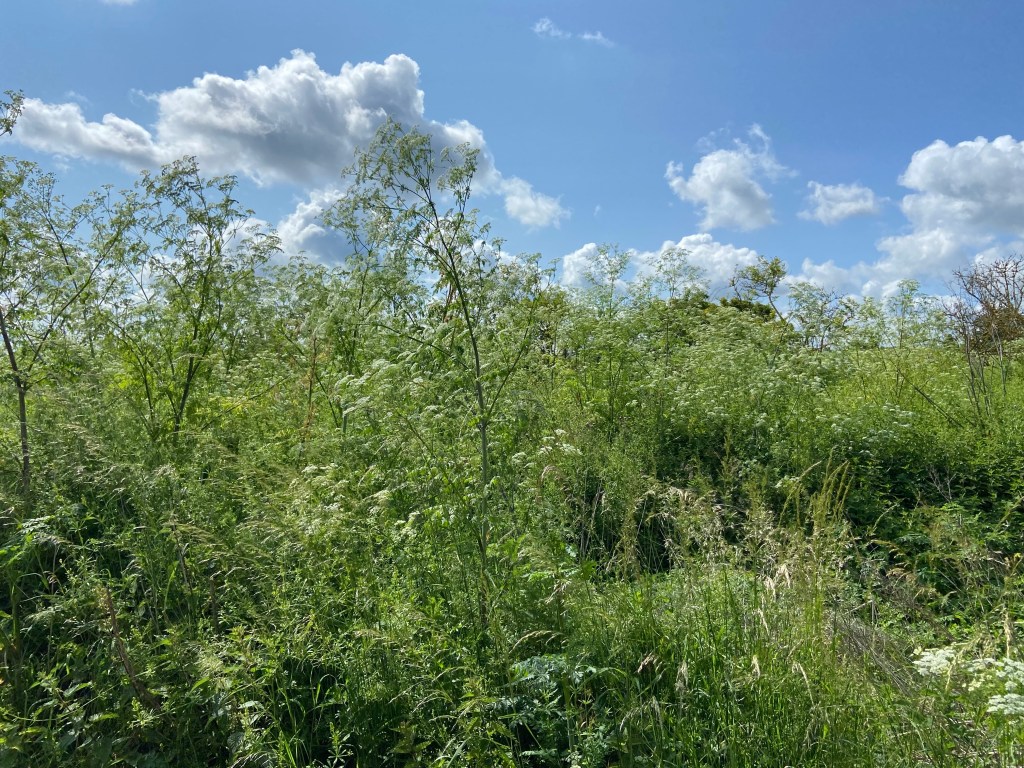
and a deep purple vetch, which fringed an oat field and looked as though it had started out life as a green manure but escaped the plough here on the field edge.

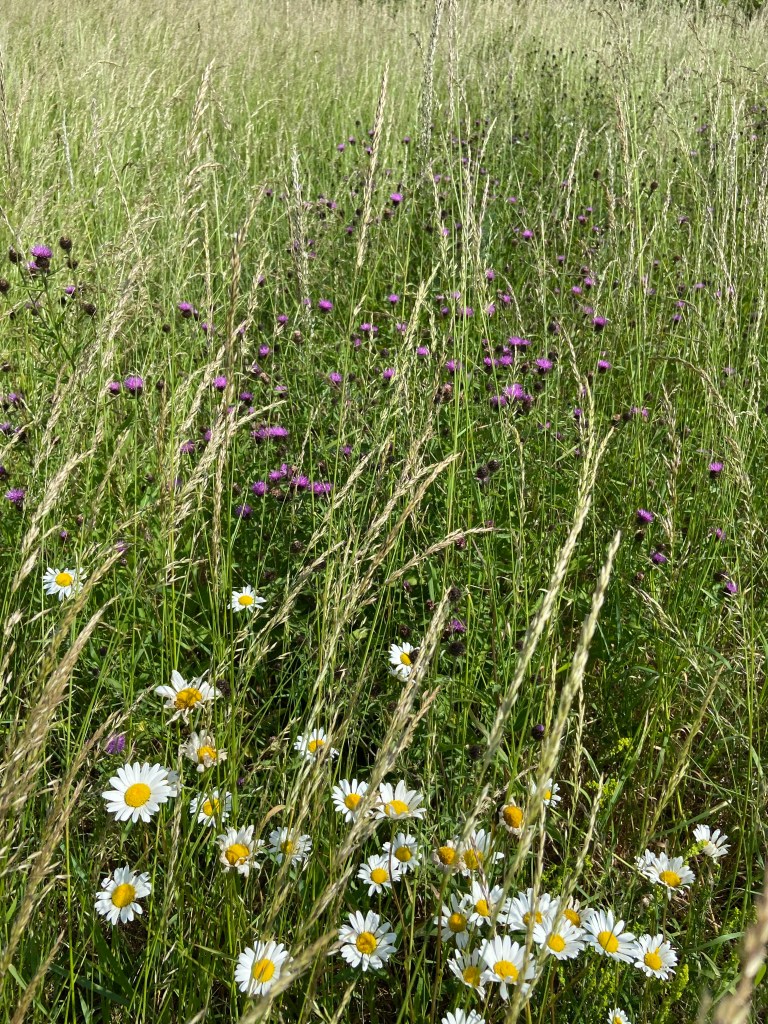
Further on the farmland fell away as the path entered the Grange estate. Bent grasses, oxeye, daisies, and knapweed, filled the huge grassland spaces to the side of the path,
and there were a series of carved wooden sculptures placed in the grassland to reflect the Neolithic mortuary grounds that had been excavated here, traces of platforms for ancient sky burials still faintly visible in the winter months in the shallow square ditches and post holes that remain.

The land contained by the path’s left-hand loop l was a 3.5 square mile estate once owned by Bryant and May, planted in the 1960s with groves of poplars for matchstick production. The poplars were all felled in the 1980s when land was exploited for its sand and gravel, the pits subsequently filled in to create a huge ecological wetland mosaic of open water and wet woodlands, and reed beds and shallow ponds to provide habitats for red- and greenshank, lapwings, bar-tailed godwit and snipe.
I didn’t see whether any of these birds were resident because the path went around the edge of the wetland, but I was stunned to hear the booming of a bittern. It is only the second time in my life that I have heard one, low and unmistakable, sometimes on a single note, and sometimes with two tones.

I met Ally walking through the Grant estate with her beautiful greyhound Sal. Ally pointed out to me the cuckoo that I hadn’t heard, and I exchanged that nugget of information for my bittern. We walked along for a while along the woodland riverbank, and Ally shouted me a coffee at the Danish Camp café. She has to be one of the coolest people I have met on this trip so far, with a sturdy view on life and a great career behind her as a space engineer.

It was swift walking from the estate downriver. Dragonflies of all colours, bronze, red, blue and green patrolled and fought above the vegetation and the water alongside the now usual clouds of metallic damselflies. The river flowed wide and slow here and a small party of paddle-boarders seemed by turns as though they were paddling down the Amazon,

or suspended in a river flowing through the sky.

More people were enjoying the river by the historic 17-arch Barford Bridge; a couple swimming in the water by one of the arches, downriver from an Egyptian goose.
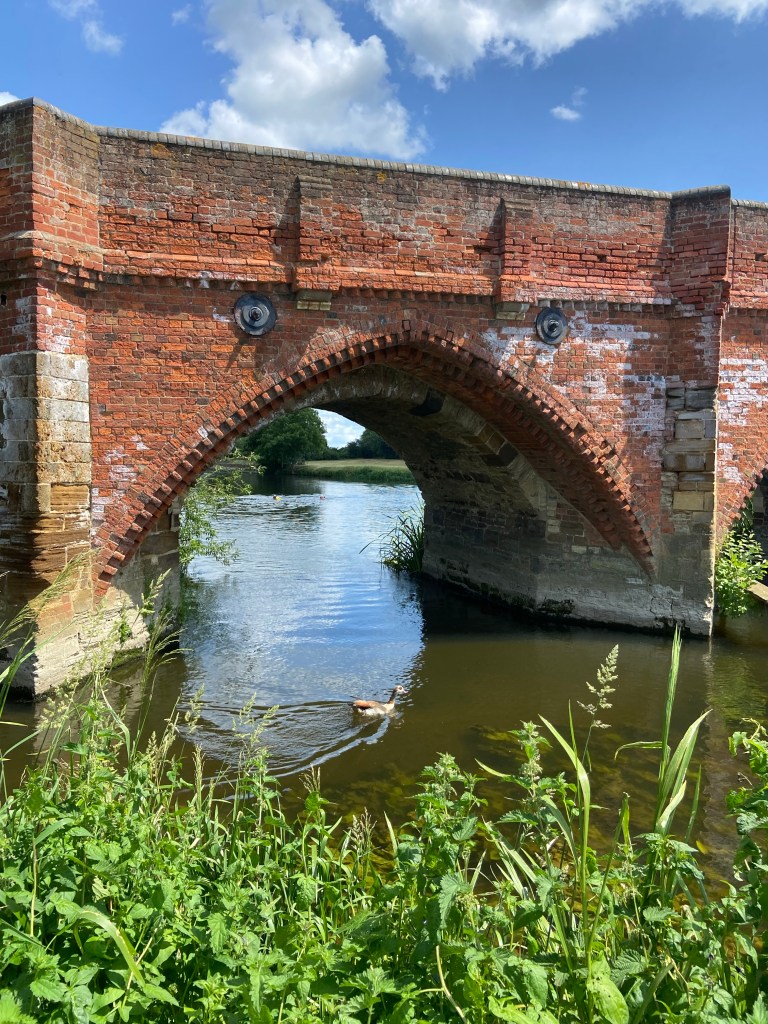
The character of the landscape and of the houses began to change beyond the bridge. The land got flatter and began to begin to look more fen-like,

And the architectural vernacular started to include weatherboarded and black painted houses reminiscent of Dutch barns. I was definitely moving further east.

Unfortunately the next section, north of Barford to the downriver village of Roxham, was overgrown. It was so irritating to have to struggle along a narrow path lined with nettles, ducking under branches and sometimes even taking my pack off to crawl under fallen trees. It felt such a waste of time having to keep my eyes on the ground instead of looking into the trees for kingfishers.
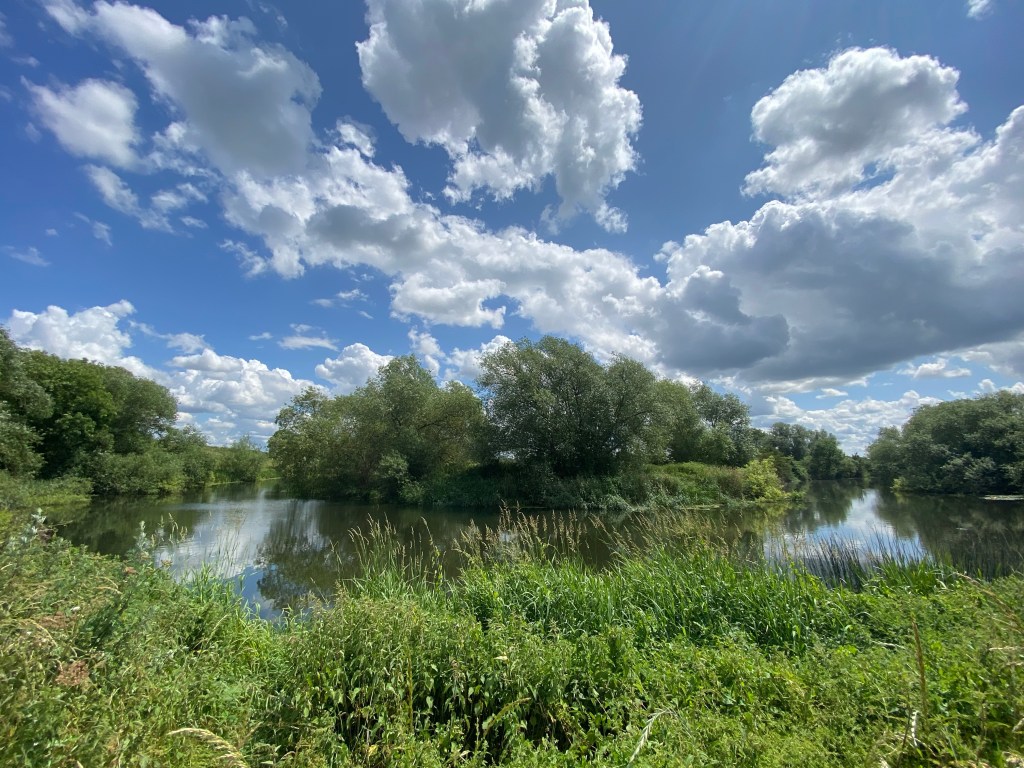
At one point there was a sign saying that otters use this part of the river…

But that was as close as I got to one.
Finally in Roxton I fell gratefully into Ann and Kev’s immaculate Little Acorn café for a late lunch. As I waited for my food to arrive I inspected my nettle stings and the photos of Roxton’s interesting buildings: an old farmhouse with decorative plasterwork under the eves of the windows,

and an extraordinary thatched Congregational church, once an early 19th/century barn, with tree-trunk pillars supporting the overhang.

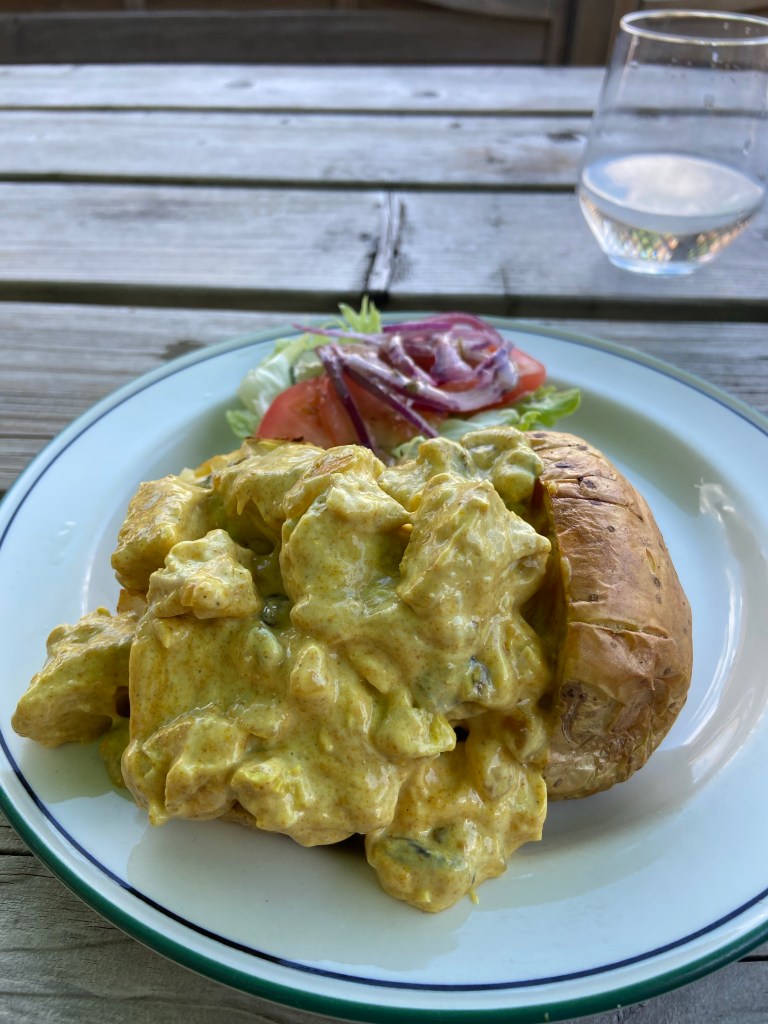
But Kev had produced me the most stonking coronation chicken jacket potato, and my attention was then entirely taken up with devouring every scrap. I only wish I had had room for the blueberry sponge.
I still had seven kilometres to go and I had dawdled by the river too long. I cut a section out of the onward route to simply hack along the road for a bit to save time: I could see from the aerial satellite map that the Great North Road had a path running along the side of it and although it was going to be grim, I could pick up the Ouse Valley Way where it crossed the road by a footbridge.

Some detours work out and some don’t. This one paid off spectacularly: in the scrubby verge of the vast roundabout where the four lanes of the A421 met the dual carriageway of the A1 at a mighty roundabout, I discovered a patch of bee orchids, thriving in the poor soil.
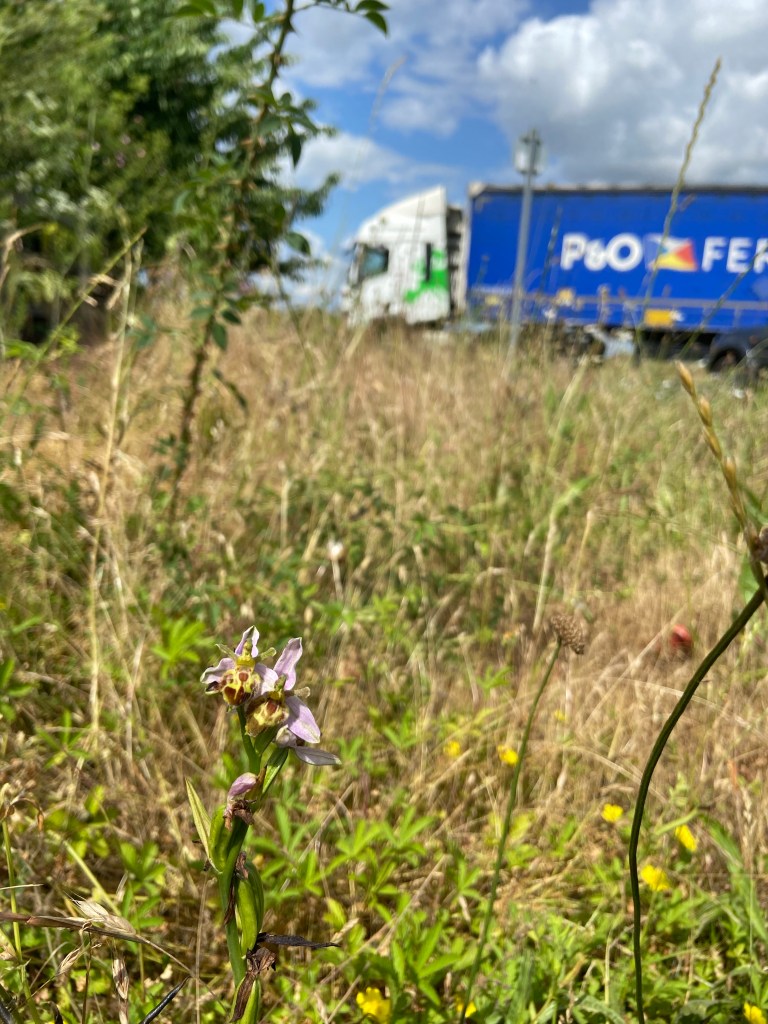
Bitterns and bee orchids in one day! Who needs otters and kingfishers?
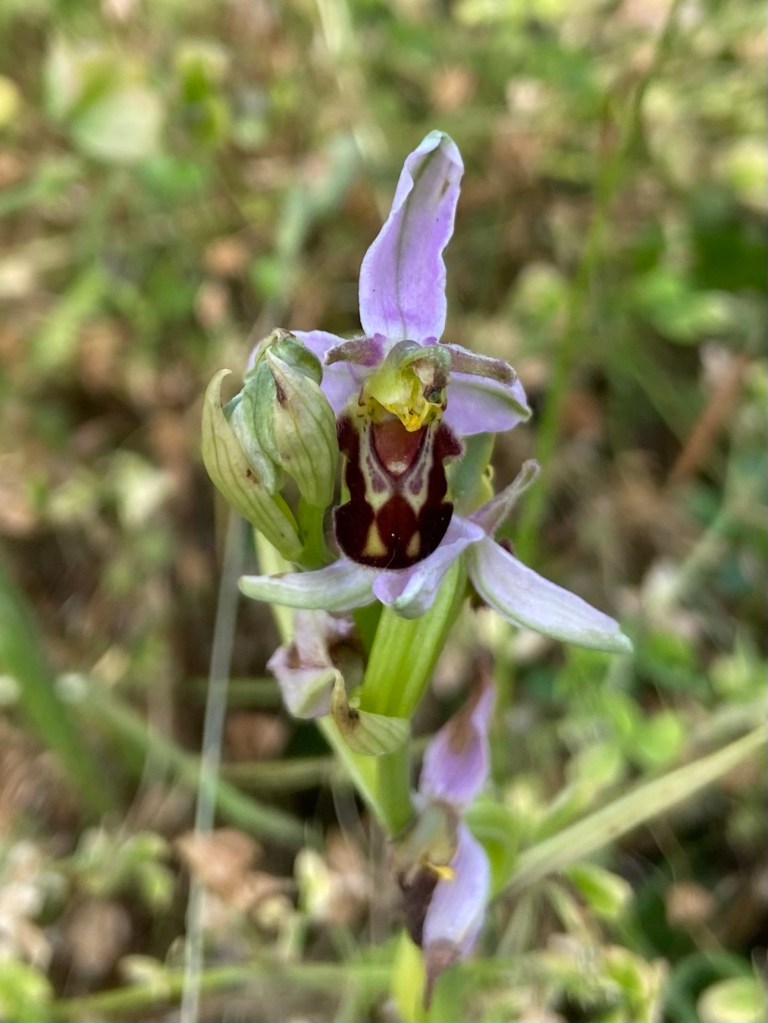
There were other orchids there too, and more of the common century,
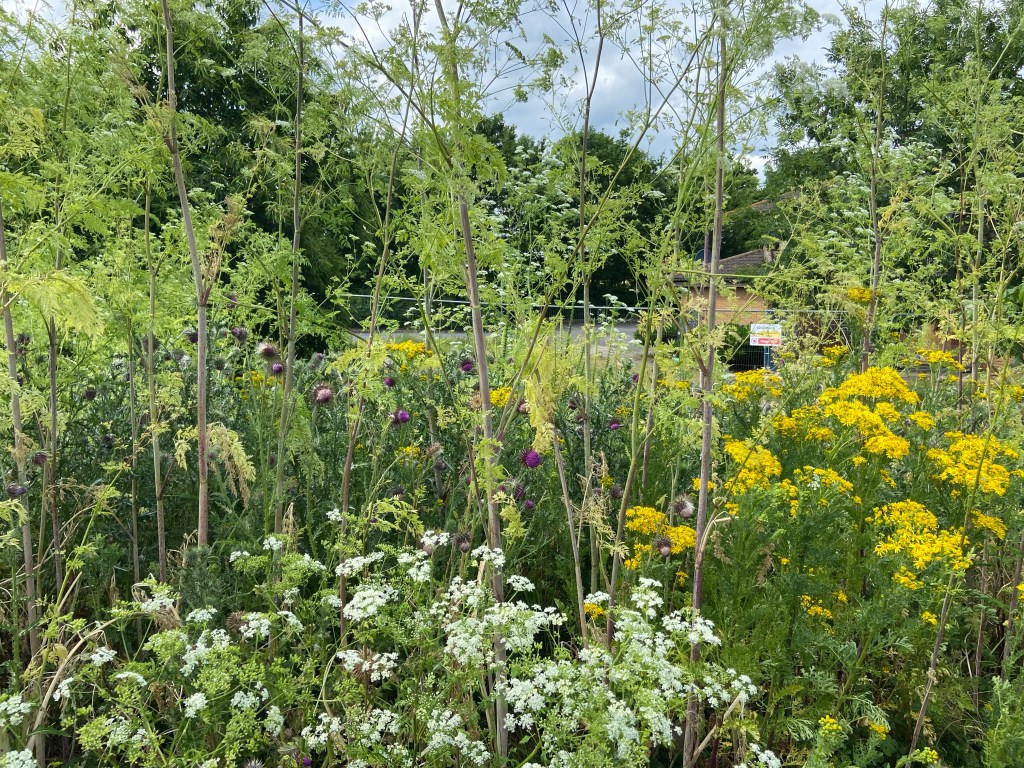
And further on an extraordinary patch of weld (the root of which used to be used by dyers to create a bright yellow colour) grew strongly in the lime-rich, disturbed wasteland soil next to a thick stand of nodding-headed musk thistle, the two plants immensely attractive to insects and squabbling birds feeding on the thistle seeds.
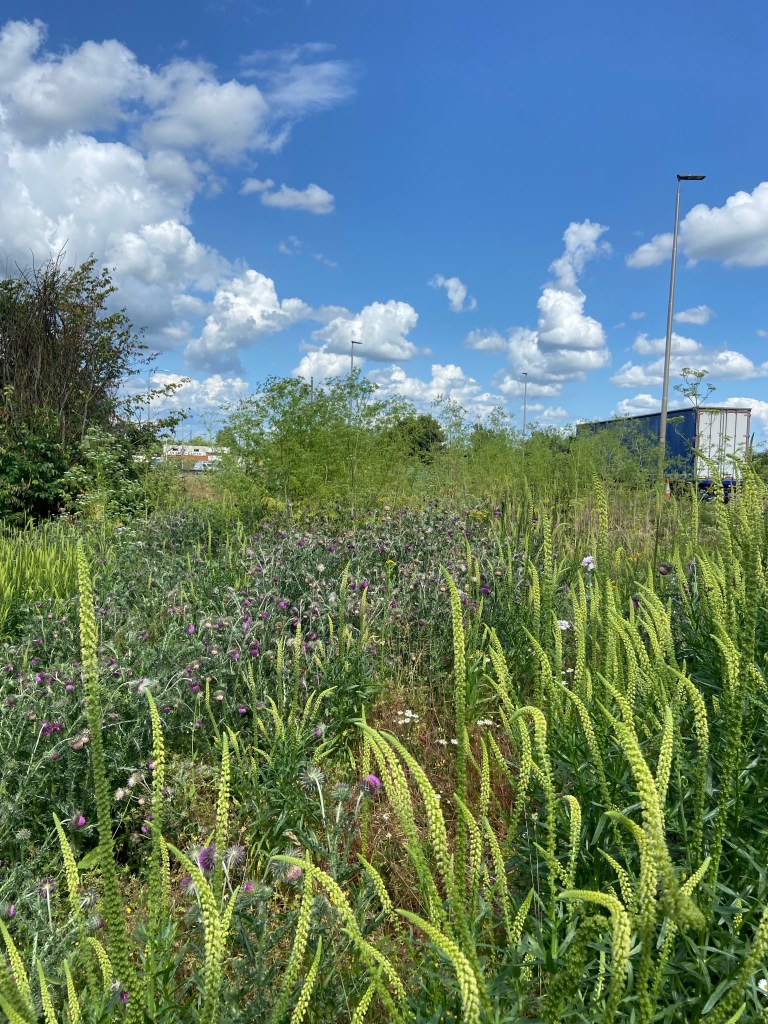
I walked along the thundering road almost unaware of the sound of the traffic I was so taken by the orchids and the other wildflowers in this habitat that — unsurprisingly — I had never explored before. Ragwort and hemlock also grew thickly in these verges next to the heavy traffic, and all supported a wide variety of pollinating insects such as bees. I don’t know how they all survive the air turbulence. Some don’t: there was a dead demoiselle on the path.
Although the footbridge over the A1 was closed I managed to find a break in the traffic to safely cross both carriageways — not an experience I would like to repeat. Gratefully I turned into the river valley on the outskirts of St Neots, only metres away from the trunk roads but sharply contrasting in its tranquility.
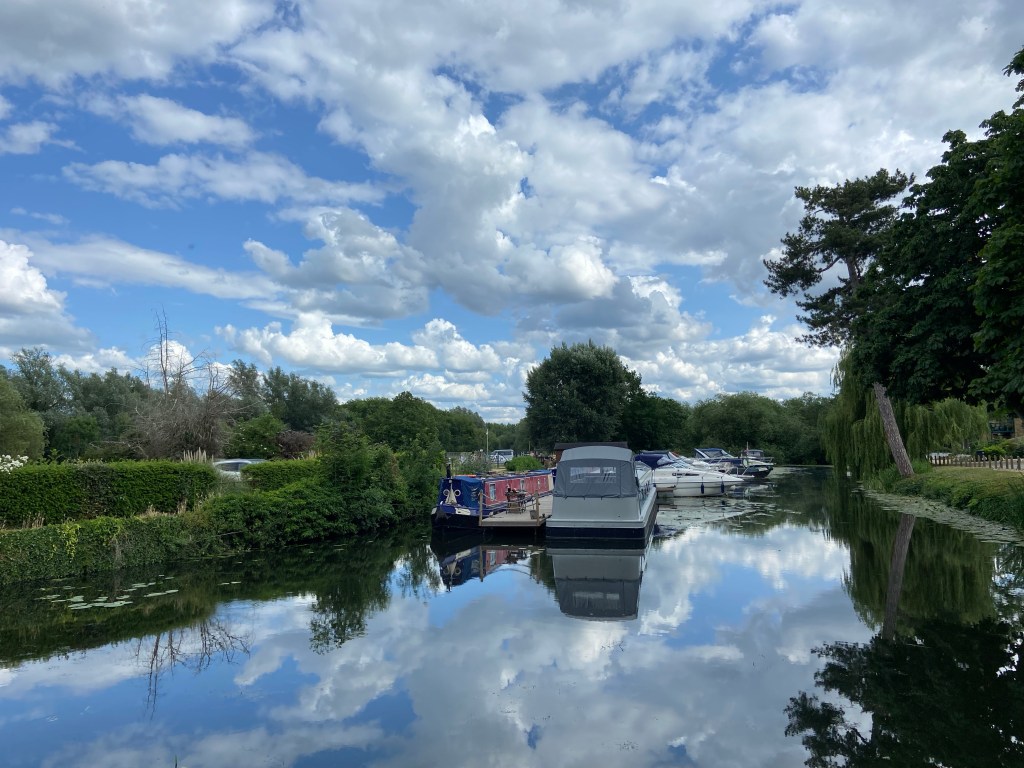
I took some breaths after the mad speed of the roads and letting myself slow down to the the pace of the water.

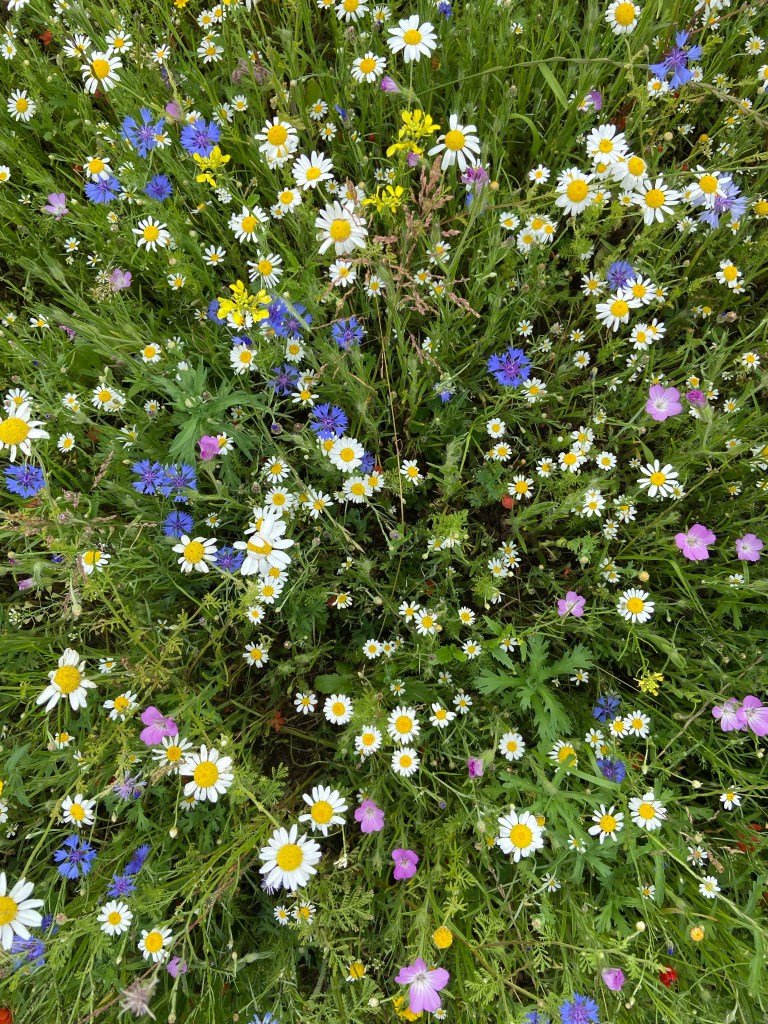
Wildflower seed mixes had been planted and they were beautiful – but I had also loved the way the truly wild flower species — the evening primroses for example — had colonised the scrap ground and cling on in their niches.
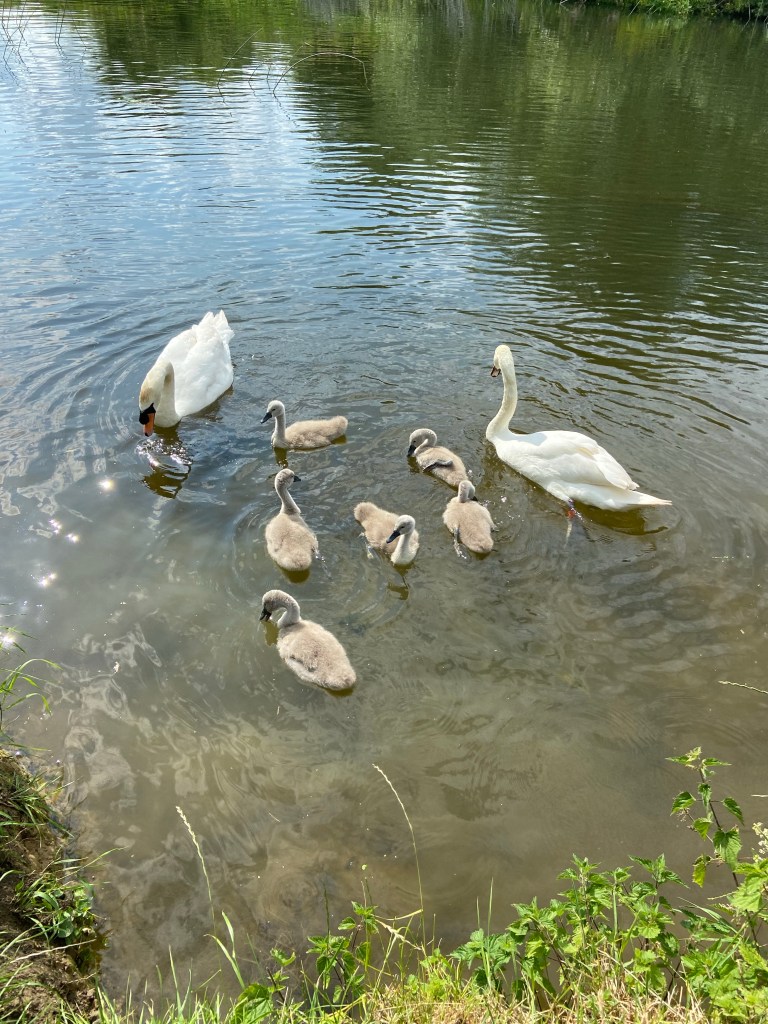
One of the interesting things today has been to follow the line of the river through the human settlements. Because the Ouse floods so easily and has been channelised over time, its character of complex pools and islands is retained as it flows through the towns and villages. Here in the centre of town I walked past people at the riverside campsite fishing next door to swans and their cygnets,
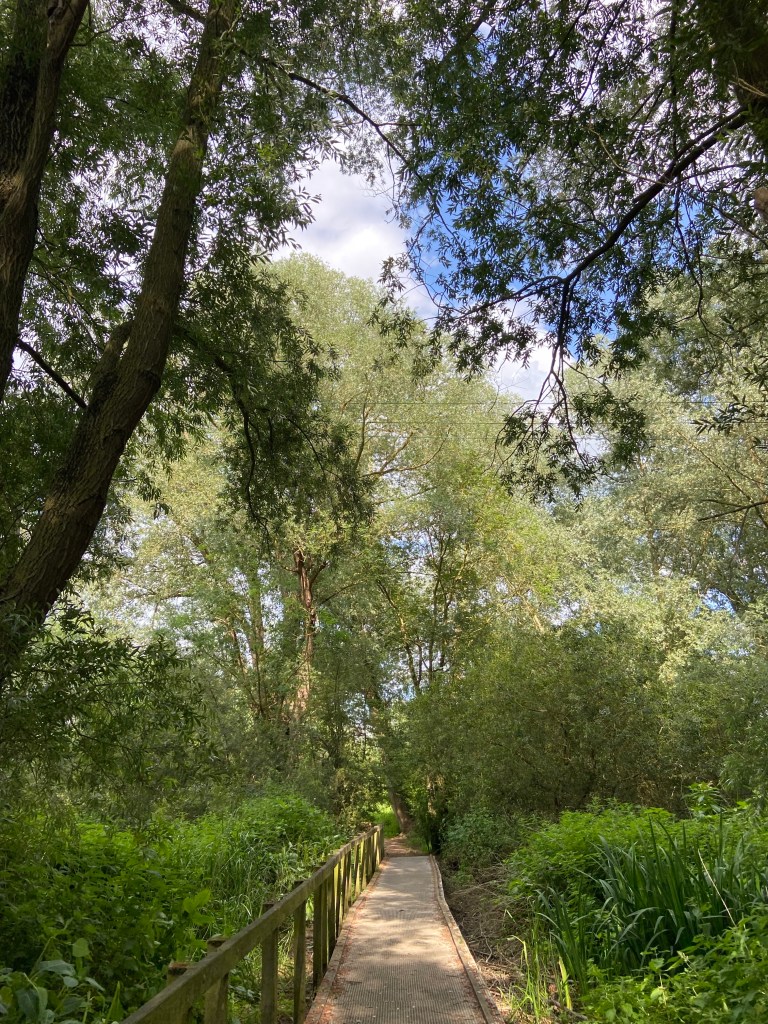
and up through a wet wood of willows, the remnants of an ancient landscape of osier beds for basket-making and now long grown out into trees.
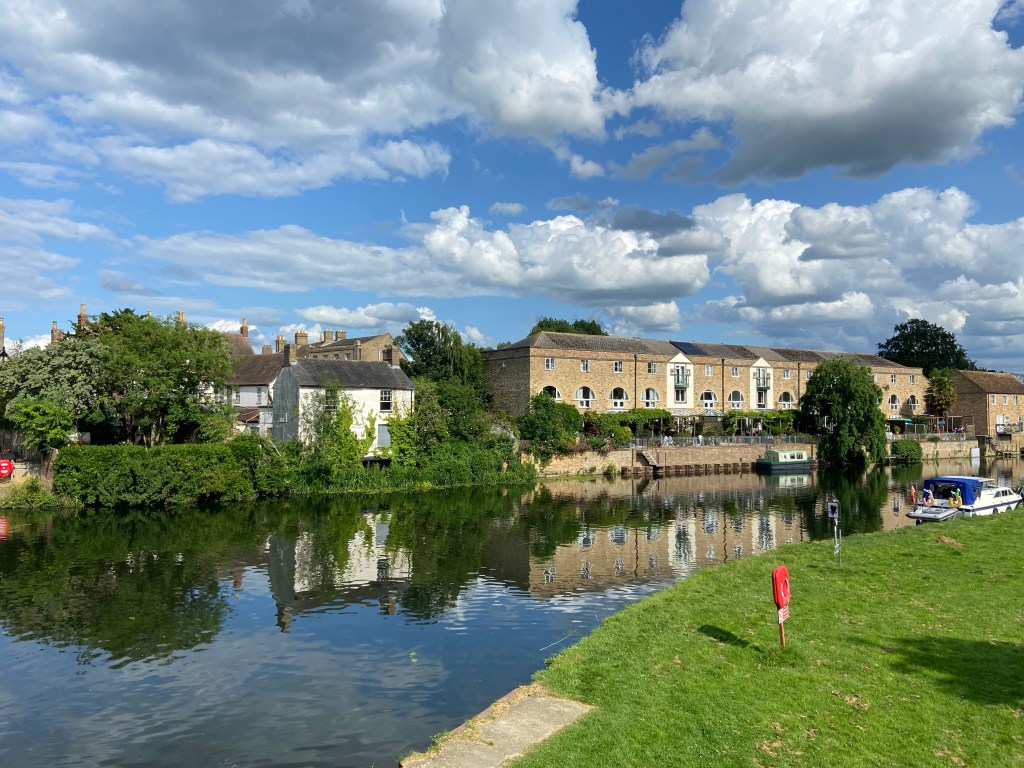
I had been making for the market square in St Neots to catch a bus to Cambourne, but it was clear that I wasn’t going to make it. Jacqueline offered to come and collect me rather than me waiting hour for the next one. So I didn’t have to hurry the last couple of kilometres on this 26km day, and could take time to appreciate the green and blue heart of this little town.
 Walking The Landscape